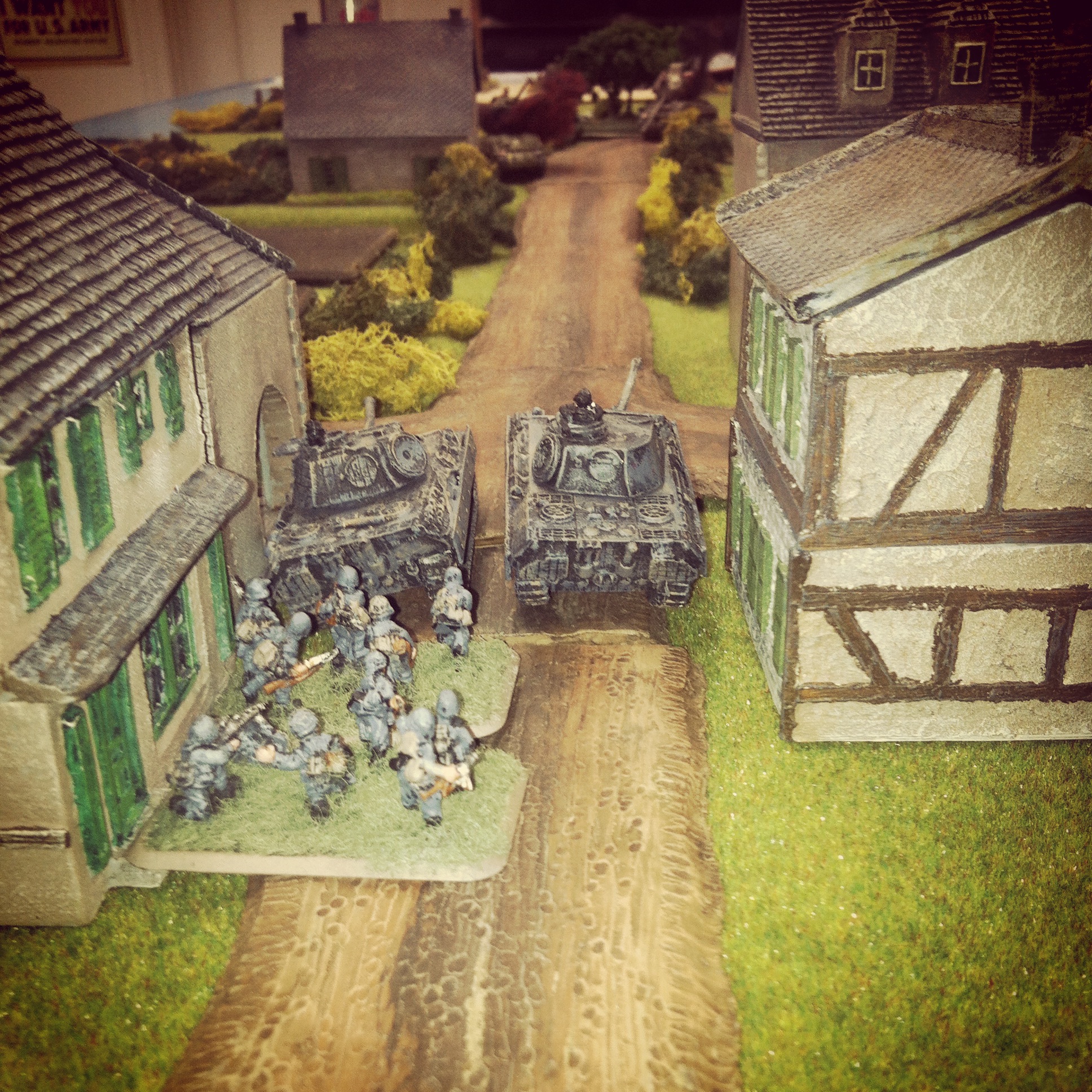
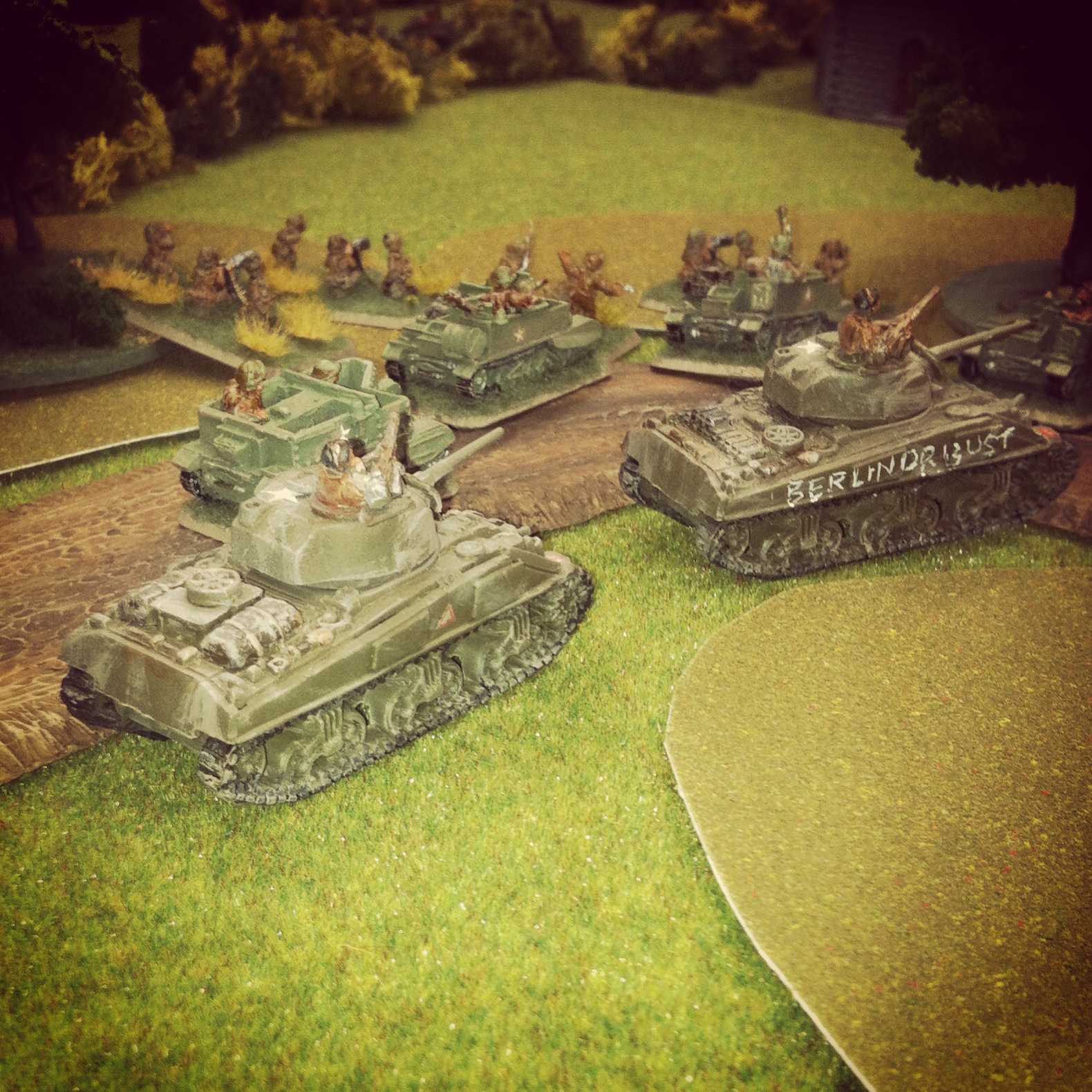
World War I: The Battle of Vimy Ridge 1917 with Price of Glory

VimyRidgepic

The Battle of Vimy Ridge, France over four days in early April 1917 was not just a victory for the Allies during World War I. The battle also served as a shining example of Canadian national pride as the overwhelming Canadian-led force was able to stand on its own for the first time without British leadership on the field against Germany. The decisive capture of the German lines at the ridge would hold this section of the Western Front for the Allies until the end of the war.

pogcover“Price of Glory” by Iron Ivan Games

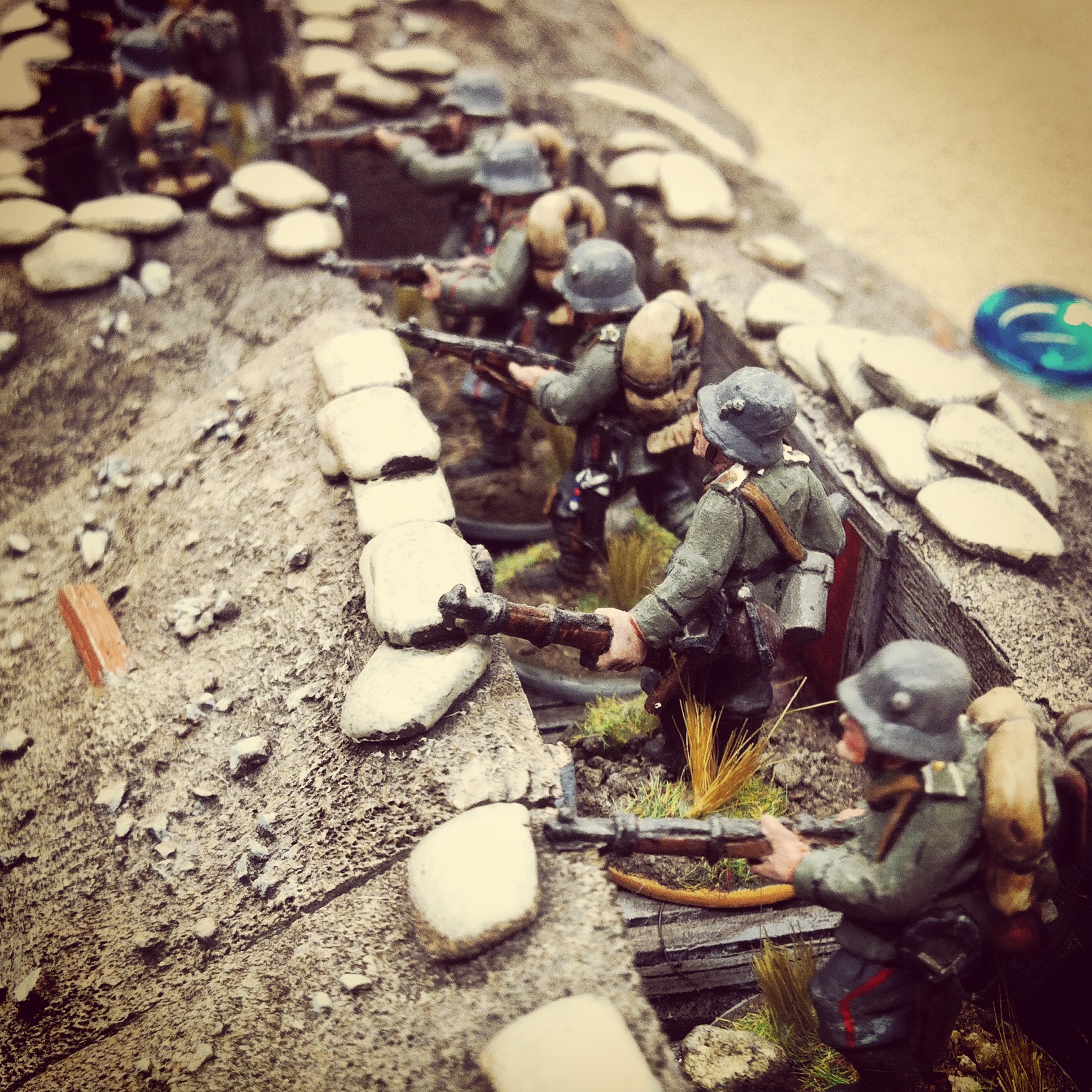
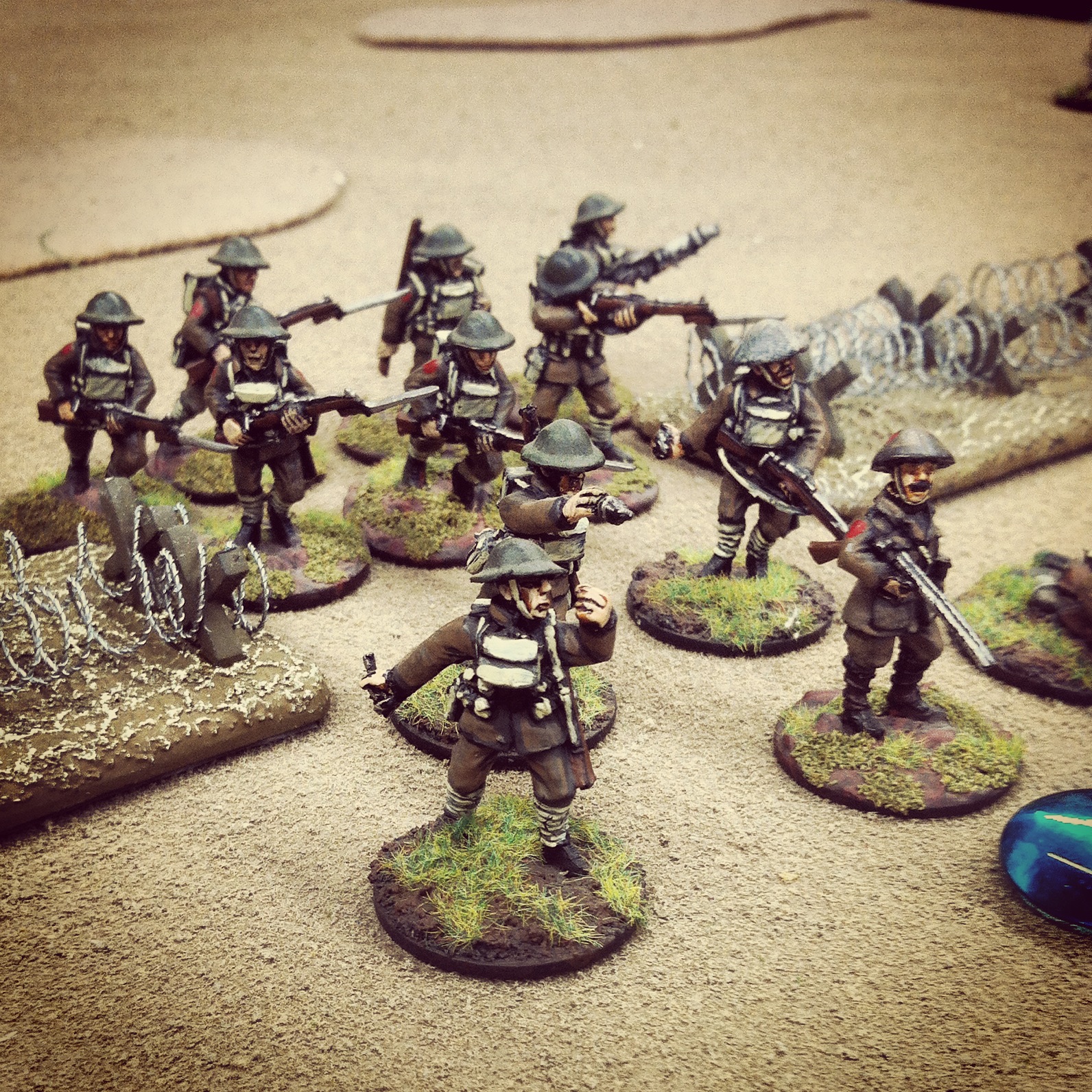
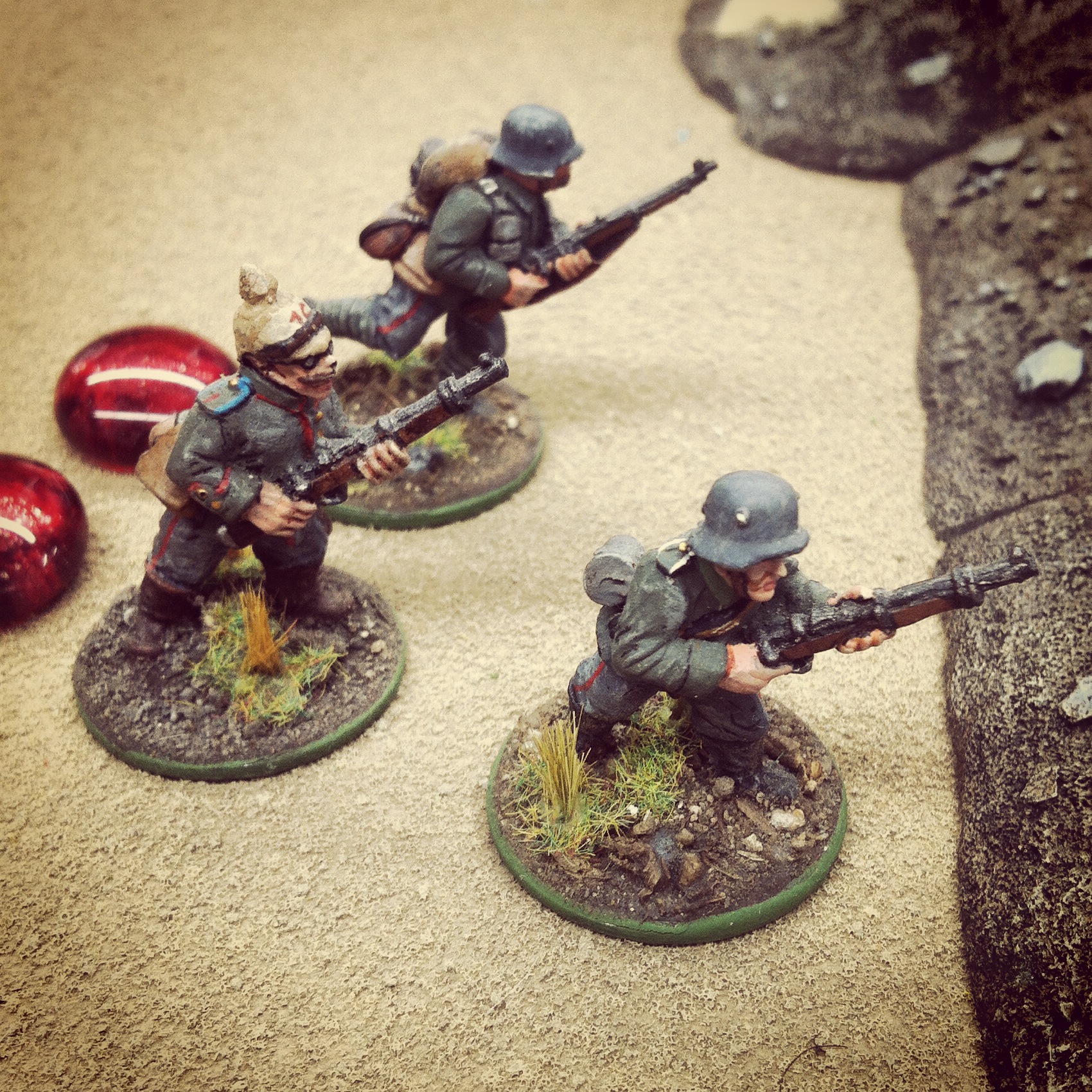
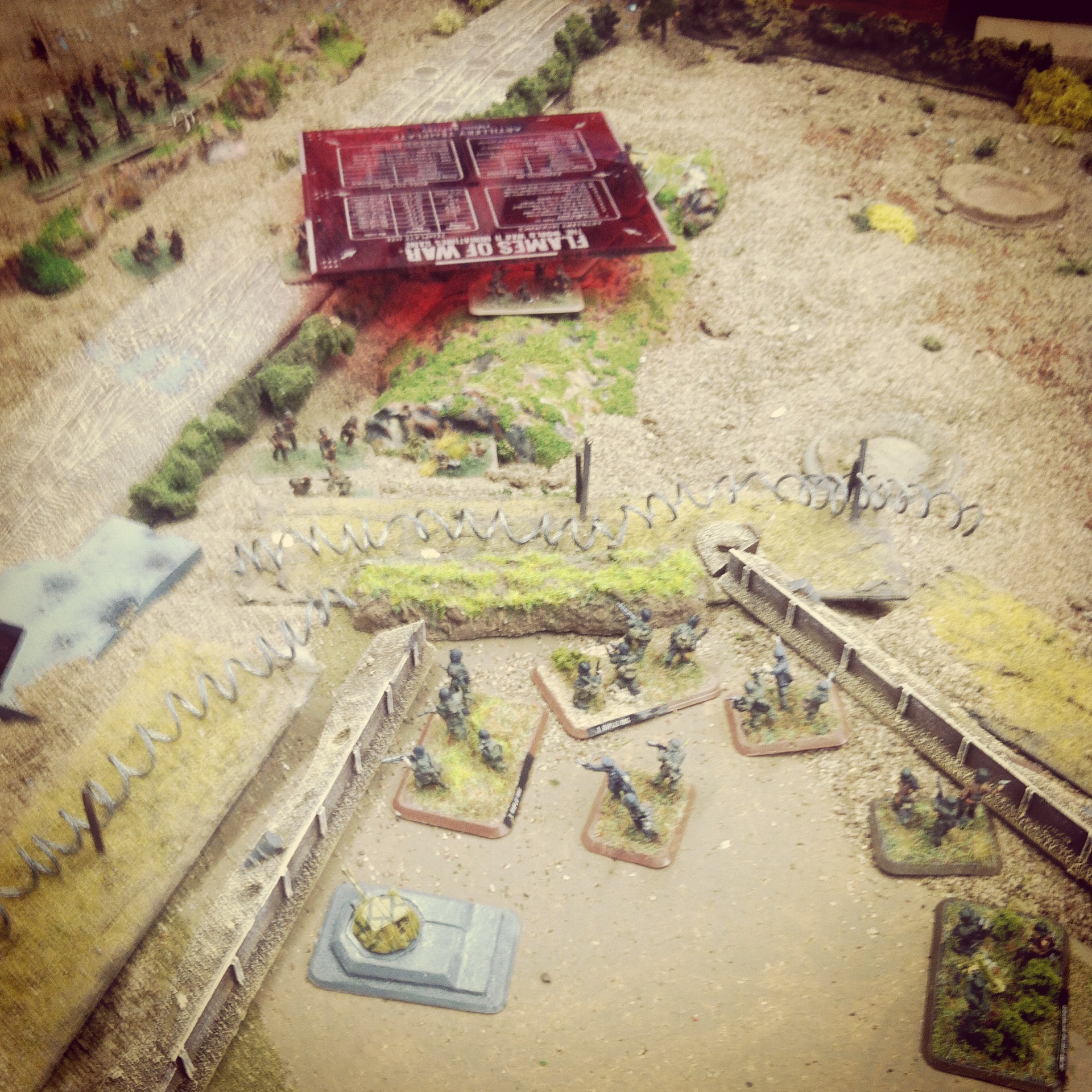
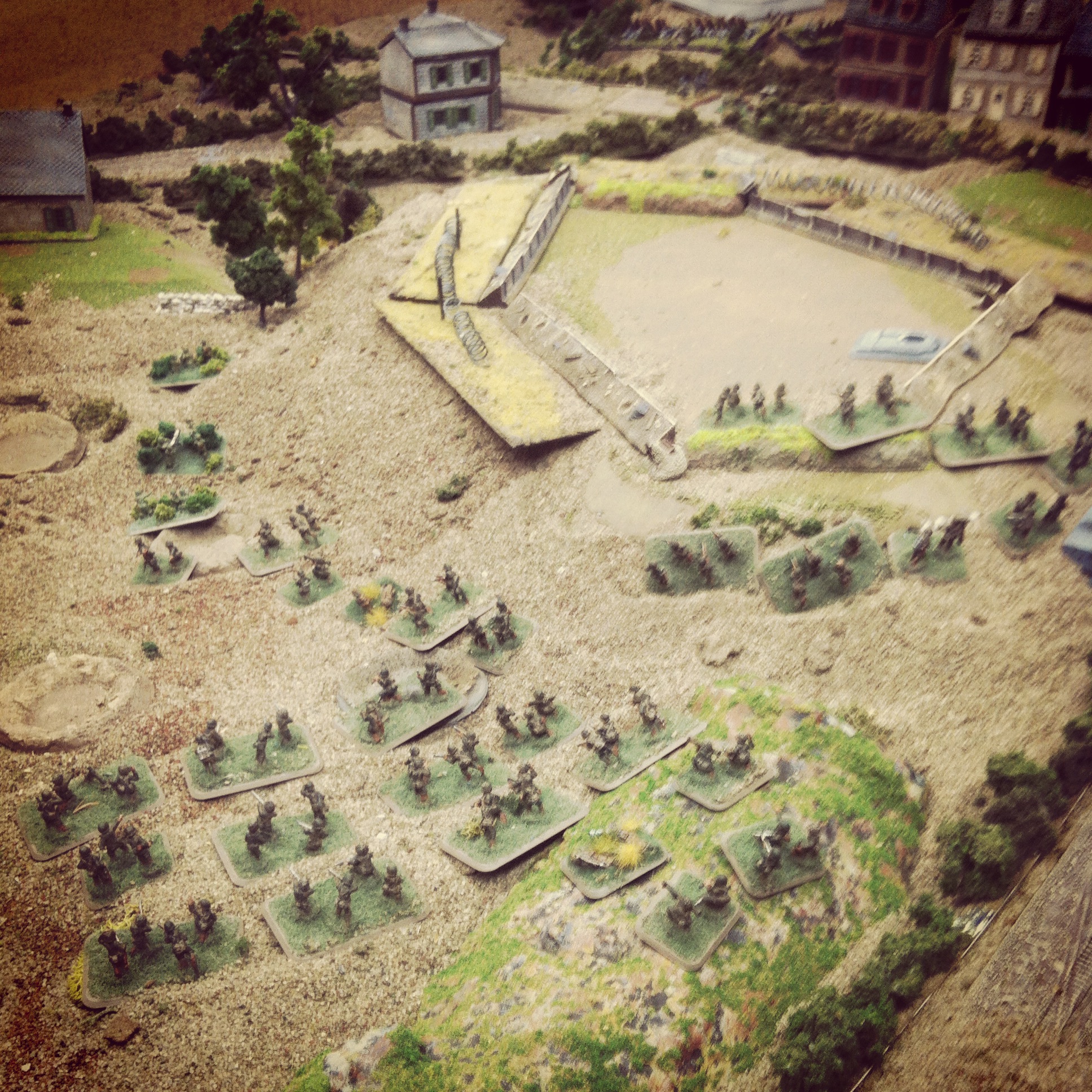
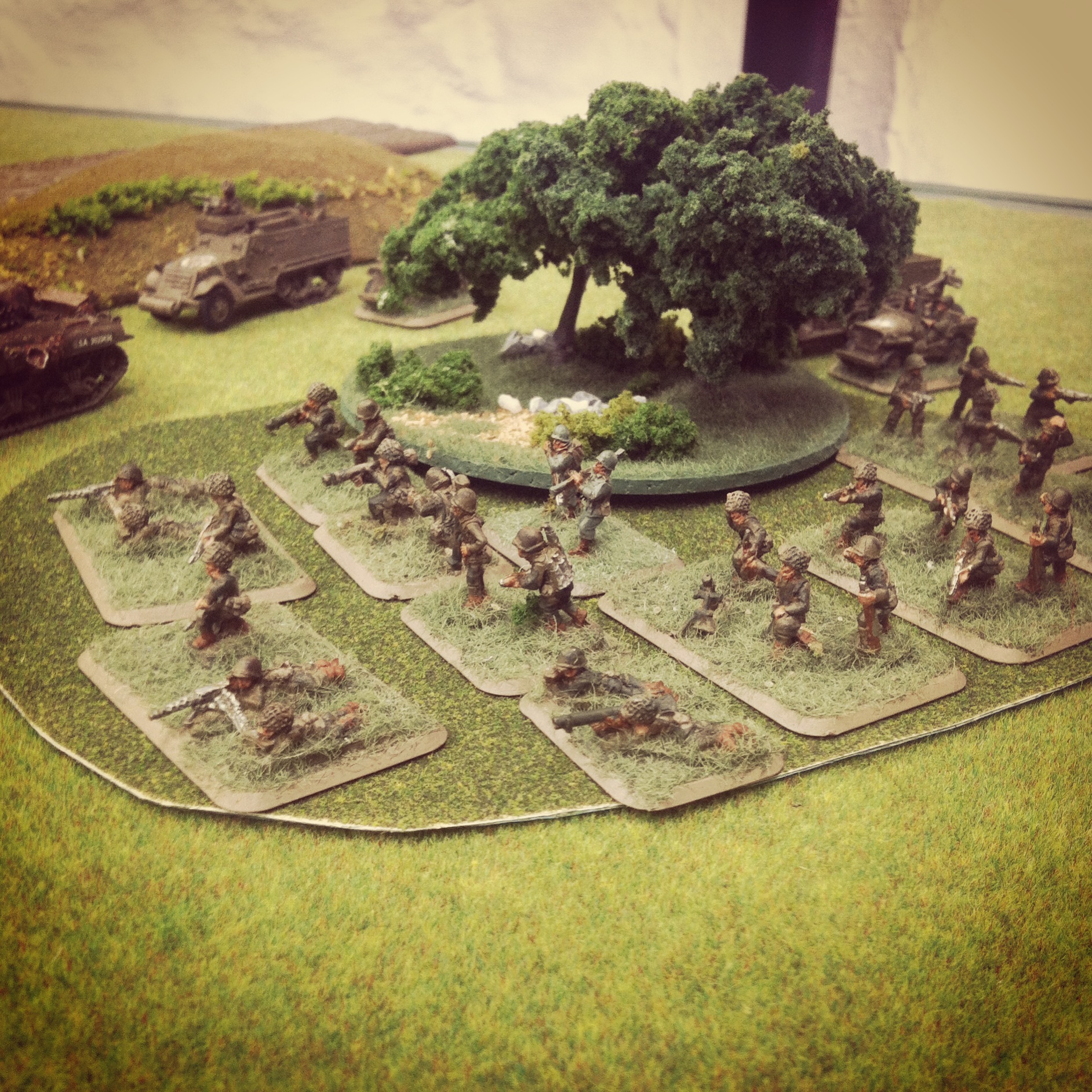
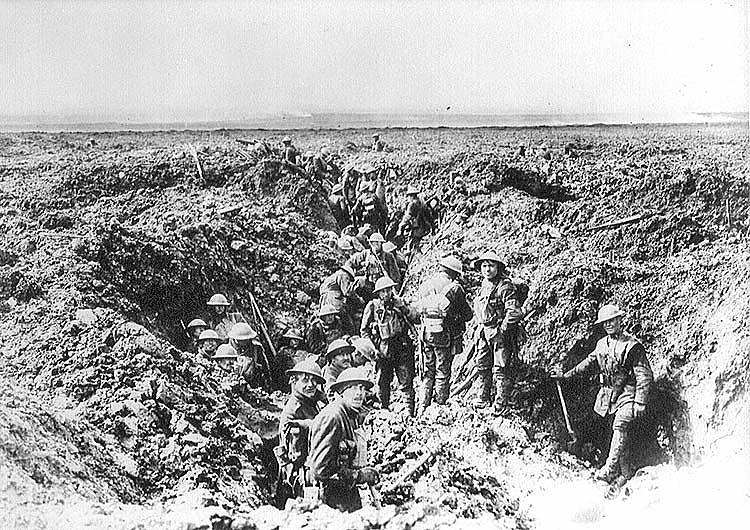
This past weekend at Metropolitan Wargamers we finally got some WWI gaming in with a quick scenario modelled on the Canadian exploits at Vimy Ridge with the Price of Glory rules from Iron Ivan Games. We unpacked over six feet of beautifully modelled trench works that had laid too long in storage and set up a gorgeous collection of 28mm WWI German and Canadian troops from Great War Miniatures. The three of us new to the rules divided the Canadians among ourselves with four rifle and machine gun squads, a grenade-armed bombing party and a Vickers machine gun to our right. Facing us across the cratered and barb-wired field was two lines of German trenches initially defended by two teams of Germans and a MG 08 on their right flank. The level of Canadian victory would be measured by the capture of the German front line, rear set of trenches or the treeline beyond in a ten-turn game.

IMG_4620

Canadian troops advance on the German lines at Vimy Ridge

The Canadians initially plotted four artillery targets along the front and rear trench lines. After the starting German deployment, we rolled off for the artillery bombardment which we had luckily ranged-in directly on the German rifles and machine gun on the front line. Unfortunately the dice were not with the Canadians, and all four artillery shots missed. From there, the Price of Glory rules progressed simple enough with a D10 roll-off for initiative which the Canadians won and began their advance. Teams alternate on each side of the table taking move, fire or melee actions with short movement of 3″ allowing for a full rate of fire, 6″ at fire at half-rate and a 9″ sprint allowing for now firing.

IMG_4621

Germans hold the front line in the trenches

As the first few turns elapsed, the Canadians at the right slowly advanced from crater to crater as they took heavy fire from the German rifles and machine gun. Defending from the trenches, the Germans were a hard target with only a “1” result counting as a hit on the fistfuls of D10s being thrown. In the rules, a team taking fire must also roll a D10 morale check or become suppressed. Morale rating is based on the command strength of the squad, with squads on both sides initially beginning with two officers each at a “7” and “8” rating. A morale check equal to or less than the command rating for the squad passes and may take an action on their turn. A squad losing their morale check must use their next activation to rally.

IMG_4622

Canadians advance through a gap in the wire

By mid-game, one Canadian squad had met their doom in the open wasteland in front of the German line and a second was torn in half as they limped to the trench line at the German left. At the center, a full Canadian squad made their way through a center gap followed by the bomb team. On the German right, the machine gun was eliminated and a final squad of fresh Canadians made way for the trenches. The Canadians continued to win initiative roll-offs which were modified at -1 on each side for lost squads or squads failing morale checks.

IMG_4623

Germans flee the front line to defend from the next line of trenches

As the remnants of one surviving squad of Germans fled the first line of defense after losing two morale checks against the encroaching Canadians, two reserve units of Germans emerged from the woods to the rear and ran to defend the secondary line of trenches. From there, the final turns of the game became a shoot-out between the two trenches with the Canadian bomb crew and a German rifle squad being nearly eliminated in the firefight. At the final turn, the Canadians had scored a minor yet costly victory by securing the first line of the German trenches for the Allies.

IMG_4625

The Canadian bombing party occupies the first line of trenches

IMG_4626

Germans hold the second line at Vimy Ridge

IMG_4624

Canadians hold the first line for victory

I hadn’t played a WWI game in a couple of years, and the figures and terrain at the club hadn’t hit the table in quite some time either. The Price of Glory rules ran fast, and we were all generally of the opinion it captured the combined fire and morale effects found during the conflict. We also agreed another larger game with a bit more complexity and perhaps some artillery, armor and cavalry would be in order. With many worldwide commemorations this year of the Great War’s 100th anniversary (including an excellent site from the Imperial War Museum), is was good to make time for our own journey back to the Western Front.

Downloading: Valiant Hearts: The Great War

Valiant-Hearts-Logo

World War I has quickly moved from news to memory to history in the past 100 years, especially in the United States. While there are certainly plenty of grand remembrances being made of the lingering historical and political ripples of the Great War, the best parts of historical memory often continue to ring truest to us through personal stories. This is the reason why a classic book like All Quiet On The Western Front or the more recent graphic novel The Harlem Hellfighters resonate still in telling the story of WWI.

So, in this centenary year it’s a pleasure to have the distant memory of WWI retold in a vivid modern way with Valiant Hearts: The Great War from Ubisoft. Like any good war story, Valiant Hearts isn’t really about guns and glory, but more about love, friendship, connection and dedication humans strive to maintain when faced with the most hugely catastrophic events.

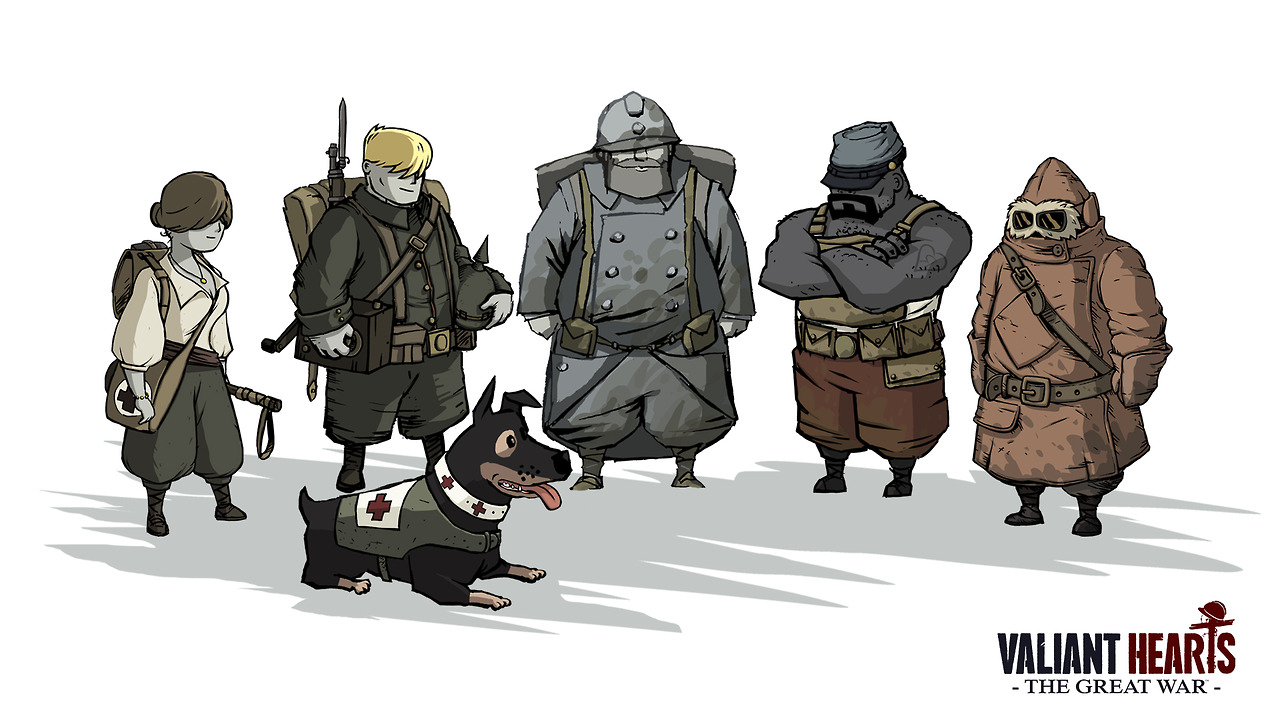
ValiantHeartsCharactersMain cast of characters from Valiant Hearts: Ana, Walt (dog), Karl, Emile, Freddie and George

The cast of characters presented in Valiant Hearts represents a cross-section of nationalities swept up in the European conflict. The main character is Emile, a French farmer who is pressed into service at the outbreak of the war. His daughter is in a relationship with Karl, a German who is exiled from France at the beginning of the war and subsequently compelled into service with the German army. Just after completing basic training, Emile meets Freddie, an American ex-patriot living in Paris and volunteer in the fight against Germany. Once in the trenches, Emile befriends a military service dog named Walt. A fast-driving Belgian nurse named Ana completes the main cast of characters, although a British pilot named George does make a cameo later on in the game.

vhtraining

Emile completing basic training in Valiant Hearts

With a minimal amount of introductory back story of the outbreak of WWI, the game begins with Emile marching off to some quick basic training which introduces a player to the basic climbing, attacking, picking-up and throwing actions. Once at the front, the game quickly moves into the more familiar trench warfare settings which were the hallmark of the war.

For gamers looking for WWI first-person combat wielding a bayonetted rifle or driving a clattering tank through No Man’s Land, there will be disappointment. Although death and destruction surrounds the game, there is surprisingly little direct combat experienced by the player. The entire WWI setting and all its trappings of planes, tanks, artillery and machine guns become tools to propel the characters to action, more like a violent ghostly hand lurking in the background than the main focus of the action.

vhgp6

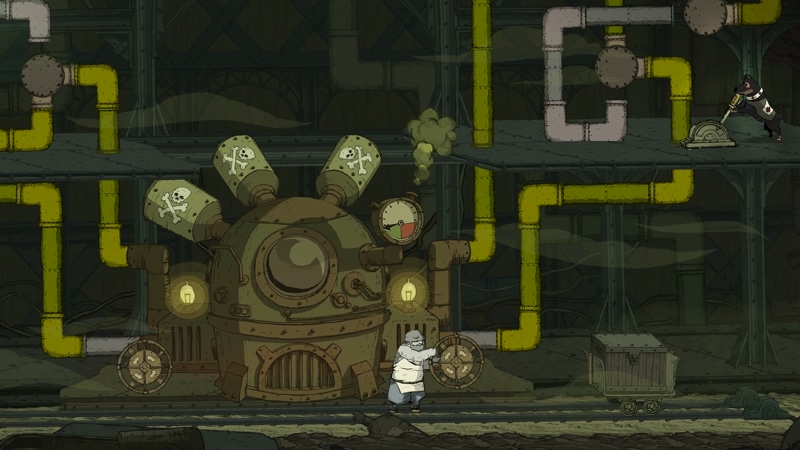
A typical puzzle challenge in Valiant Hearts

As a game, the main focus of Valiant Hearts is at its core a platform, puzzle and adventure game. It is a game set within the war, but the playable characters are not working on racking-up body counts. More typically, a character will work their way through completing a series of tasks to progress to the next level– break down a wall, crouch in a trench, dig a tunnel, climb a ladder, crank a wheel, set a charge and blow up a bridge.

Different characters in the game also work in combination to get puzzles solved and sometimes work with non-player characters. For instance, the burly Freddie is good at smashing down walls, doors and barriers with his bare fists while Emile is handy at digging and Ana provides care to wounded soldiers on and off the field. Characters can also order commands to Walt to move and fetch objects from areas unreachable by the other human characters, such as crawling under clouds of poisonous gas.

vhgp1

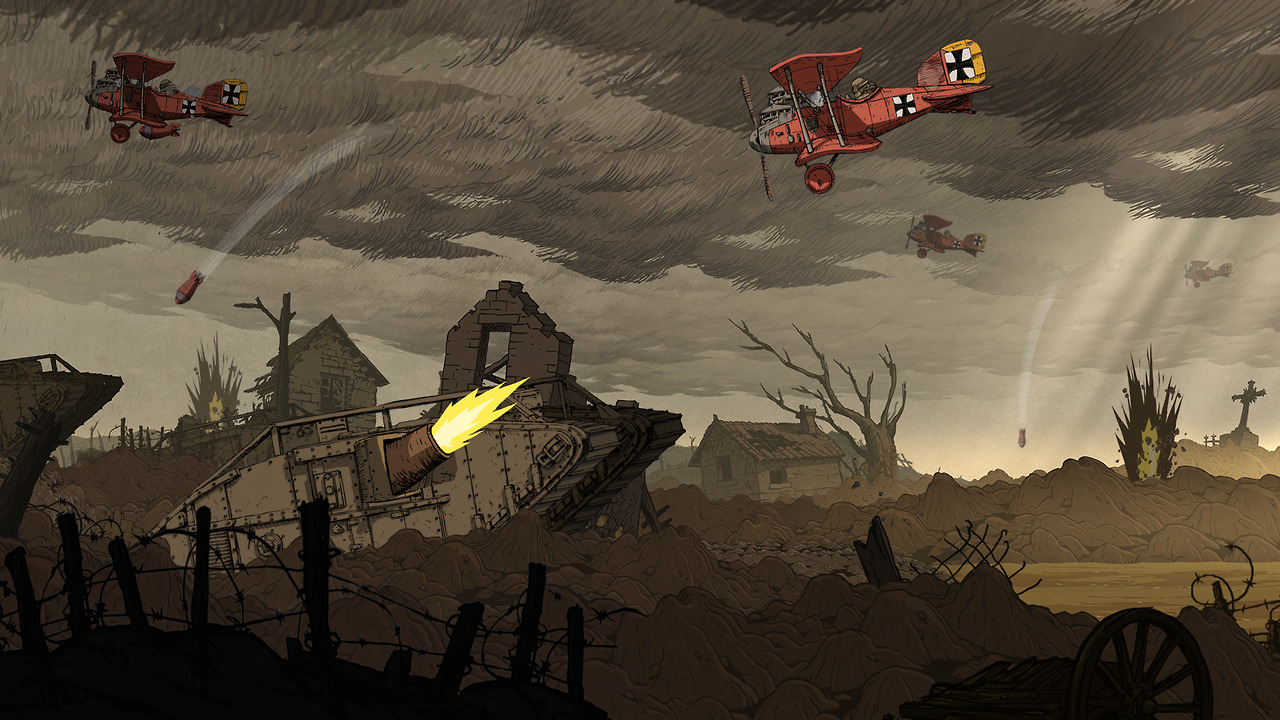
Richly accurate artwork of the Western Front and equipment such as tanks and biplanes set the scene in Valiant Hearts

Beyond the entertainment of the puzzle adventure gameplay, Valiant Hearts is rich in historic detail. A number of short behind-the-scenes developer videos on the game’s website show the depths to which the team at Ubisoft went to paint a vivid picture of WWI using primary documents. Even within the cartoonish game animation, there’s a ton of detail in the flags, uniforms, weapons, vehicles and settings throughout the game. The diversity of nations participating in the war is well-represented, so we not only see the typical British, German, United States and French soldiers but also those from countries like India. To keep the nationalities with their mix of languages consistent, dialogue among characters is limited to emotive symbols and vaguely accented but recognizable foreign mumbles.

Valiant Hearts: The Great War_20140625183402

Historical photos and background fill out the detail in Valiant Hearts

As Valiant Hearts progresses, gamers and would-be historians will find a wealth history laced within the action. Brief cut-scenes do well to set chapters within regional maps and shifting events throughout the war. Pop-up screens provide historical facts and beautifully color-tinted period photographs of life, equipment and stories from WWI. Players who complete puzzles within the game also collect historic artifacts such as identification tags, a whistle, a helmet or actual letters from soldiers of multiple nations. Again, additional pop-up windows takes a player back to the primary sources from which each object is drawn.

Both my 14-year-old son and I have spent time playing through Valiant Hearts this week. As a hardcore gamer, my son found the play pretty rudimentary by modern standards but my greener fingers did find at least some initial challenge to the puzzles. What we both equally delighted in was the art and historical documentation which was wrapped up around the simple human story unfolding throughout the game.

Far away from the politics, grand plans and horrors of combat, every war throughout history has come down to humans and relationships torn asunder or brought together in wartime. This is the journey of the characters in Valiant Hearts: The Great War and one well worth the trip back a century in time.

Valiant Hearts: The Great War is available for PS3, PS4, Xbox 360, Xbox One and Windows PC.

Metropolitan Wargamers D-Day Plus 70 Event Report

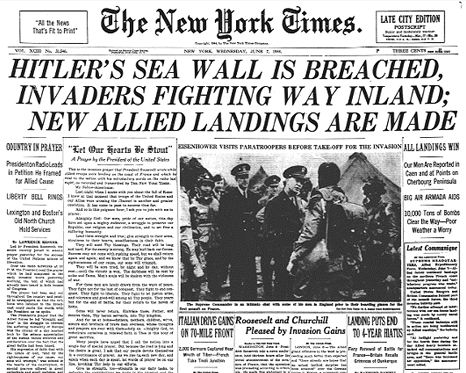
NYTimesDDay

This past weekend at Metropolitan Wargamers in Brooklyn, NY, dozens of gamers came together for three days commemorating the 70th anniversary of the Allied invasion of Normandy on June 6, 1944. Throughout the weekend, we ran multiple WWII-themed games, including Normandy ’44, I Ain’t Been Shot Mum, Flames of War, World In Flames and Memoir ’44. Dice were rolled, strategies were debated, prizes were won and Allied and Axis forces vied for control of France. In all, it was another great weekend full of gaming at our club’s space in the heart of Brooklyn.

Friday Games

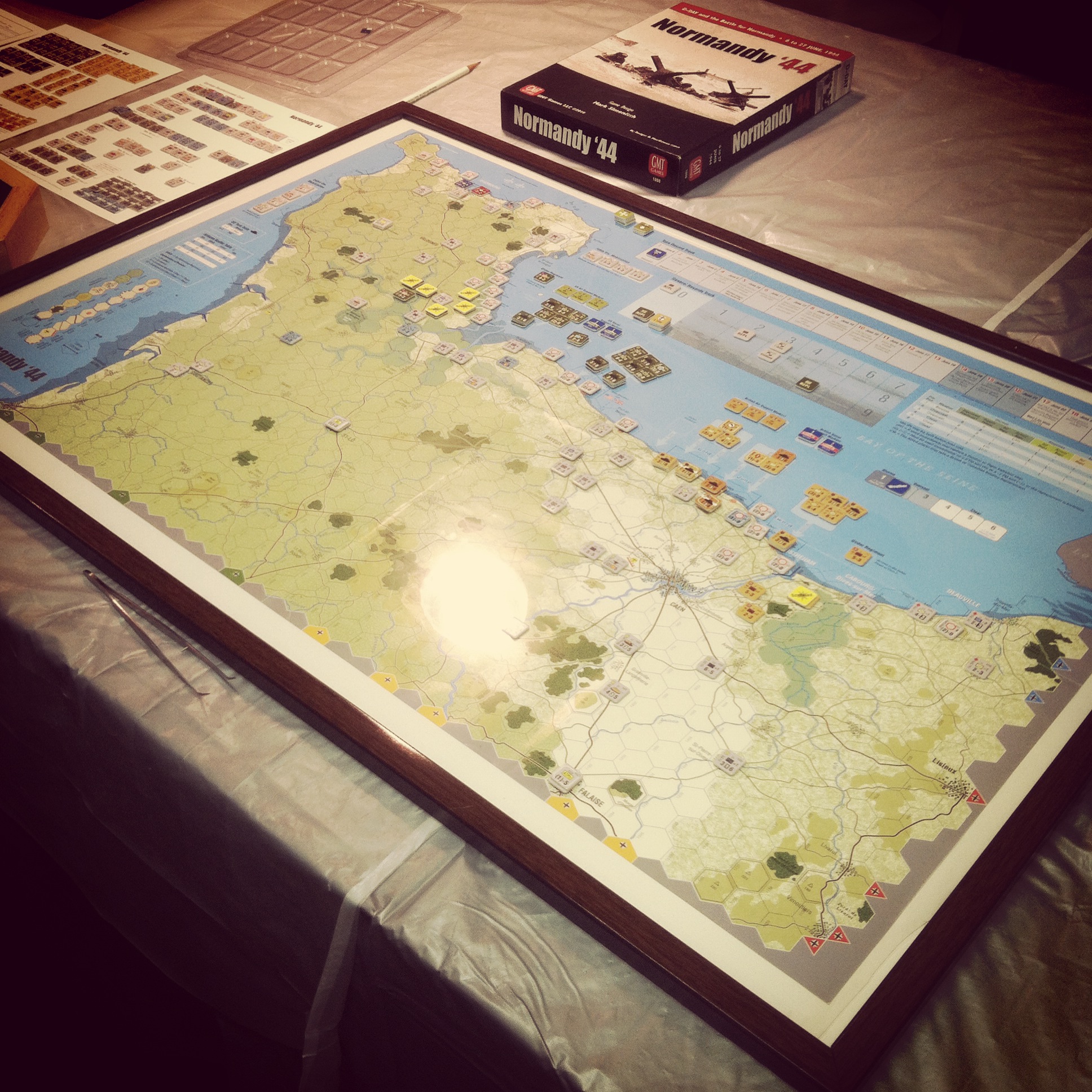
IMG_3586The invasion of France begins with Normandy ’44 at Metropolitan Wargamers

Friday kicked off after work with a few players unpacking a fresh copy of the classic Normandy ’44 from GMT Games. This one-map game covers the pre-dawn D-Day Airborne landing areas, five Allied invasion beaches and the charge to the initial inland objectives. The game scale plays with regiments and battalions with each turn representing one day of action. The small, self-contained game provides a great introduction to game mechanics at this scale with a tight, clear rules set. With a quick look at the game, I decided I’m going to have to personally give this one a shot sometime soon.

IMG_3587 US infantry blinds move toward unsuspecting German defenders at a farm outside Vierville

At the back of the club, we ran a game of our new favorite WWII tactical miniatures game, IABSM  from Too Fat Lardies. In our ongoing campaign of the Normandy scenarios in the IABSM Where The Hell Have You Been Boys? book, our game focused on the battle at Vierville-sur-Mer. With the 116th Infantry Division supported by the 5th Ranger Batallion, the Allied mission was to drive inland to capture and defend the church at Vierville.

IMG_3589

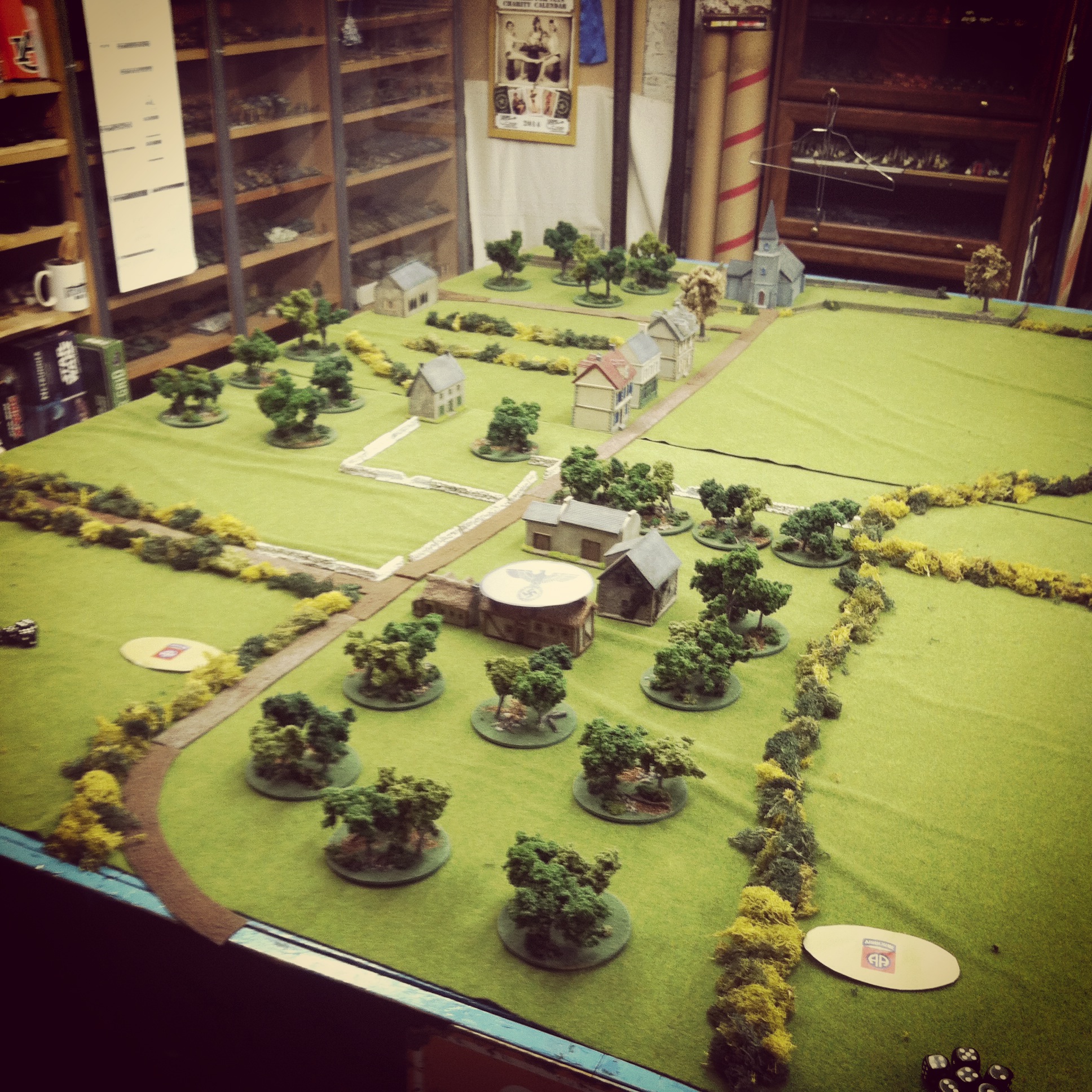
German and US units exchange fire in and around the farm at Vierville

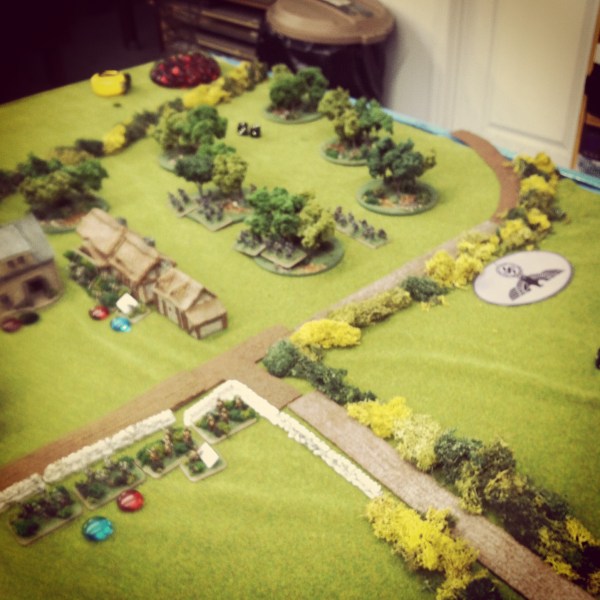
As per the scenario, initial Allied blinds approach a farm outside Vierville where a German blind sits unknowingly in the complex of buildings. With Allied infantry closing in over dense bocage hedgerows and orchards, a firefight erupted and drove the German defenders through the buildings and into the orchard beyond.
IMG_3590

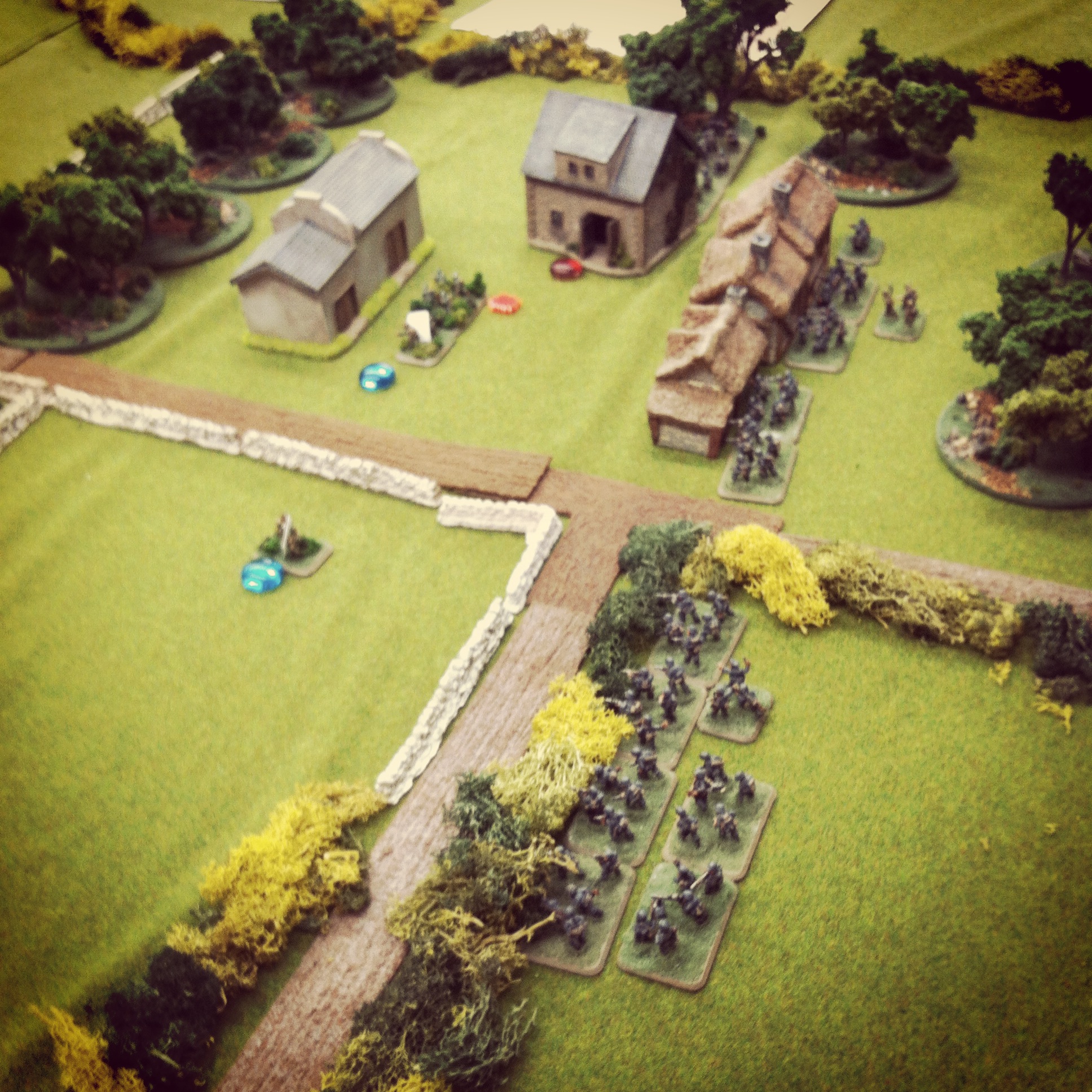
German reserves arrive at the flanks of the advancing US infantry outside Vierville
IMG_3633

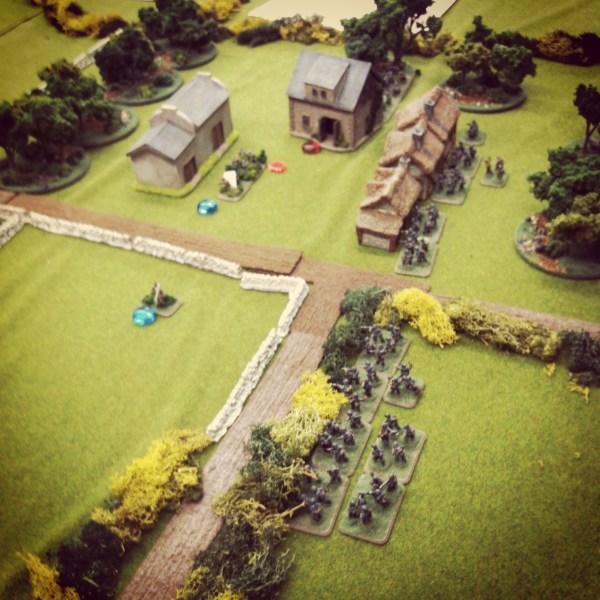
Germans reinforcements push the Americans from the farm

As the first force of Germans fled the farm, their reinforcing comrades came on to the rear and flank of the US infantry. The Americans made consecutive moves of firing and moving back to defend at a series of stone walls across the road from the farm. The retreating defensive US actions held off the German onslaught until enough Americans could take up position amid Vierville’s houses. At the same time, the US Rangers moved in at the far end of town to hold the objective at the church.
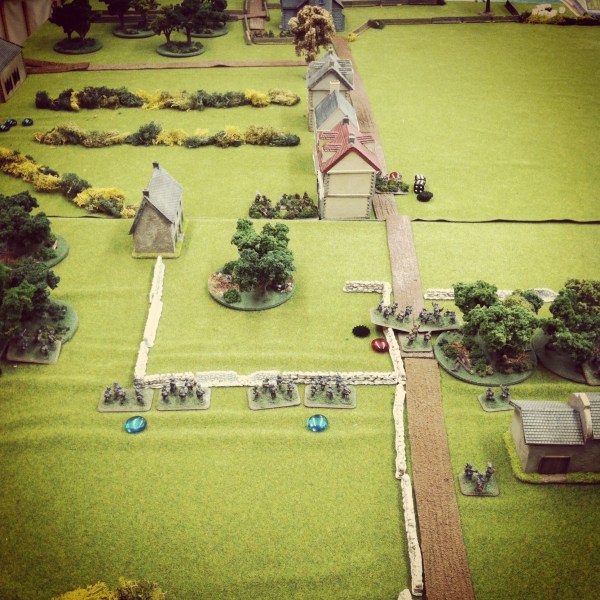
IMG_3632

Americans pull back from the farm to take position in Vierville

The game eventually settled into a bloody house-to-house and hedge-to-hedge fight along the road leading toward the church. Occasional lucky shots from US Ranger light machine guns at the church also harassed the Germans lying low behind their stone wall position at the farm’s orchard. By midnight, much of the initial American force had been destroyed or was retreating to a final stand at the church held by the Rangers. While the Germans had also lost a sizable amount of their force, their heavy machine guns were still in play as they closed in through the town. This time around, we called the action at Vierville a draw.

Saturday Games

IMG_3603The Americans hit the Easy Green sector of Omaha Beach

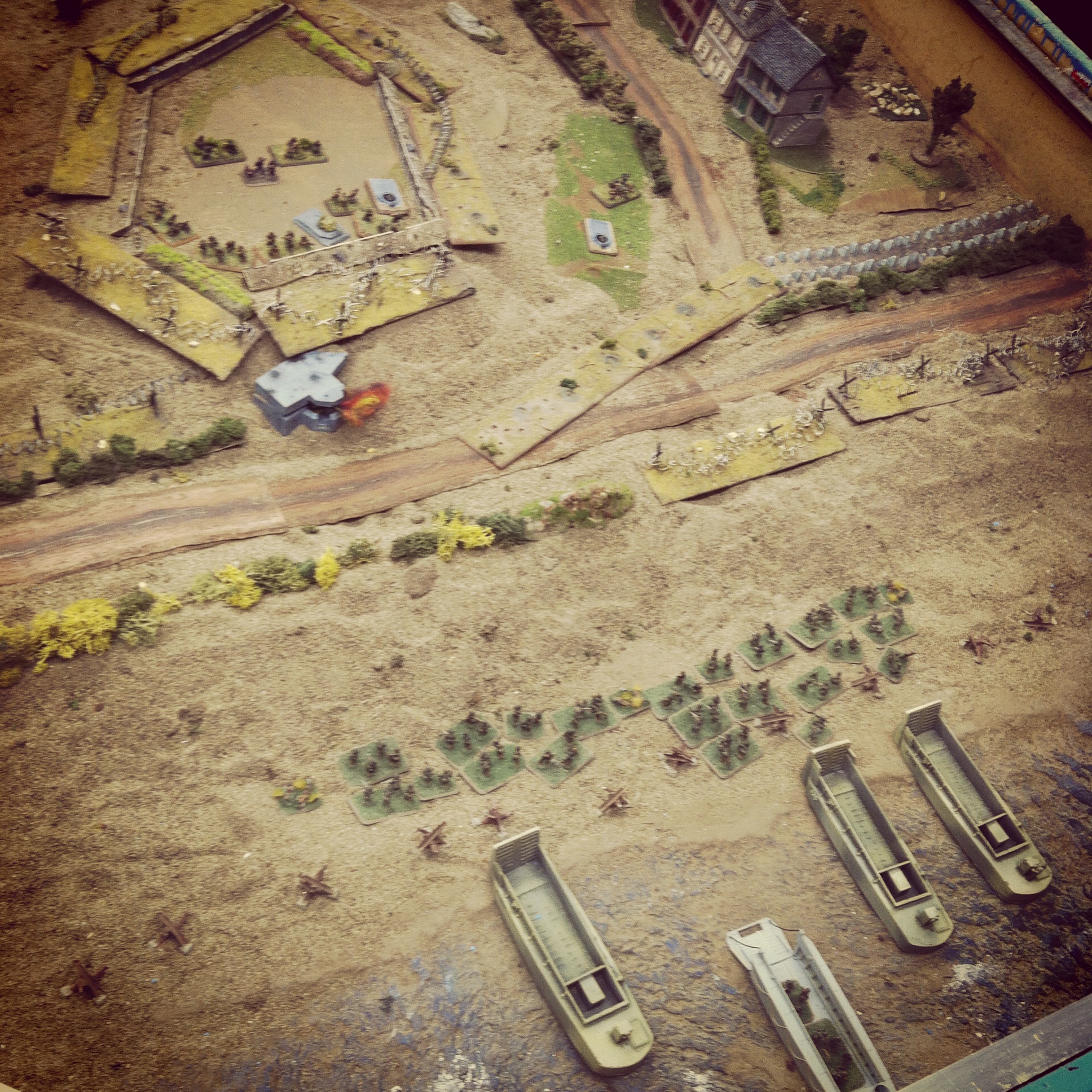
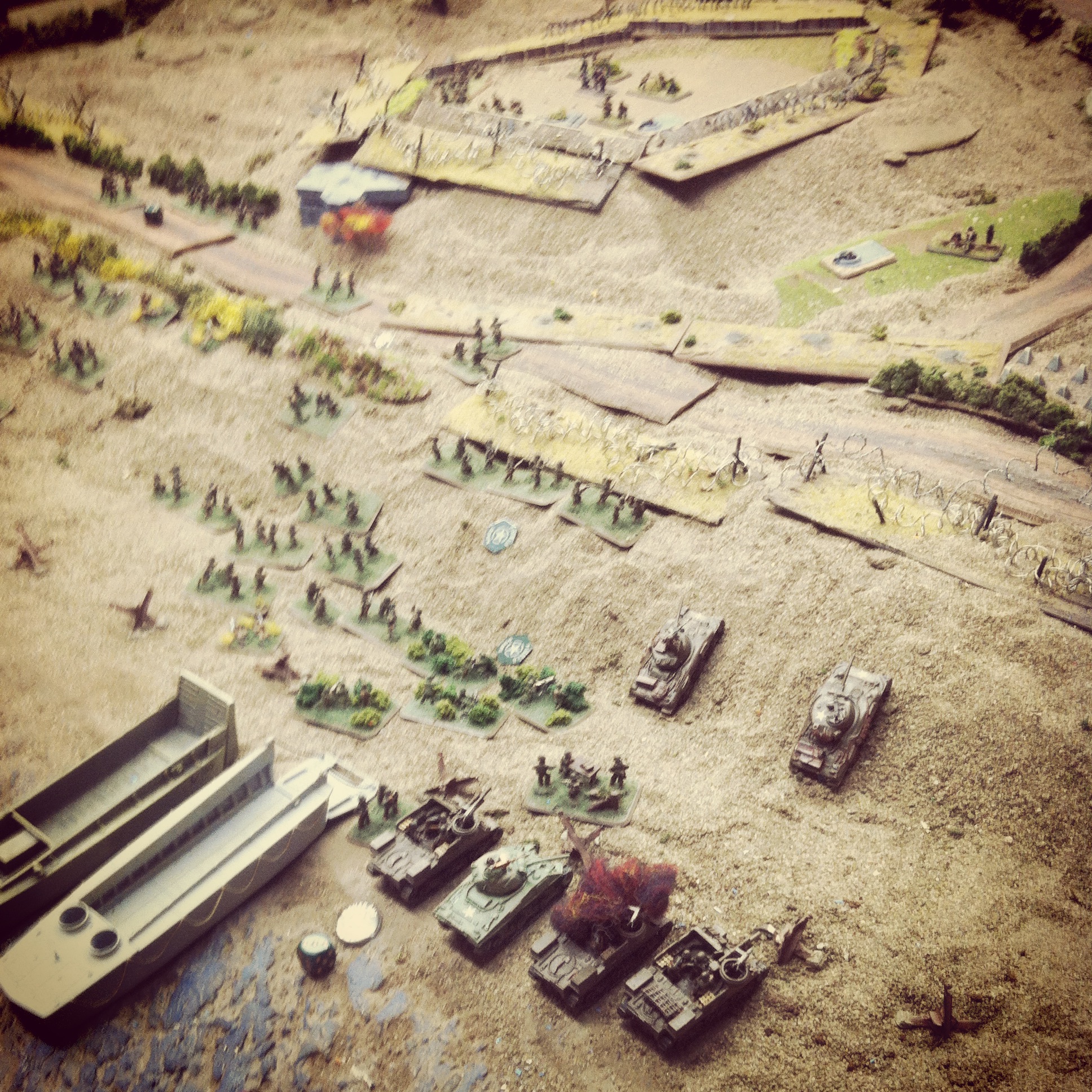
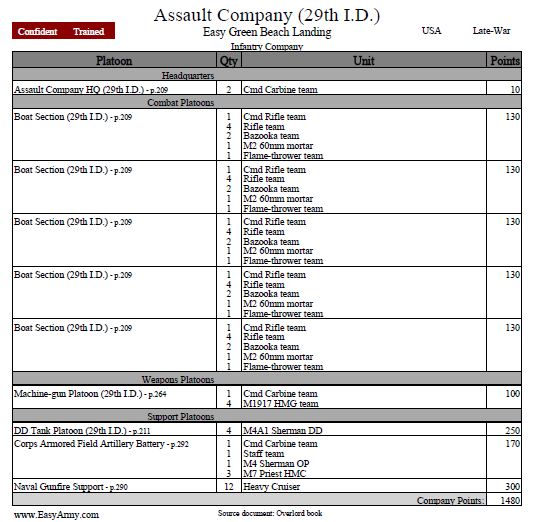
The next day kicked-off with a running of a FOW beach landing at Easy Green on Omaha Beach. We have been play testing the FOW scenario over the past two months, tweaking our forces and strategies to cope with the clumsy beach landing rules. In our past games, the US invaders only manage to win about a third of the time. Even so, we decided no D-Day weekend was complete without a return to “Bloody Omaha” on one of the club’s award-winning sand tables.

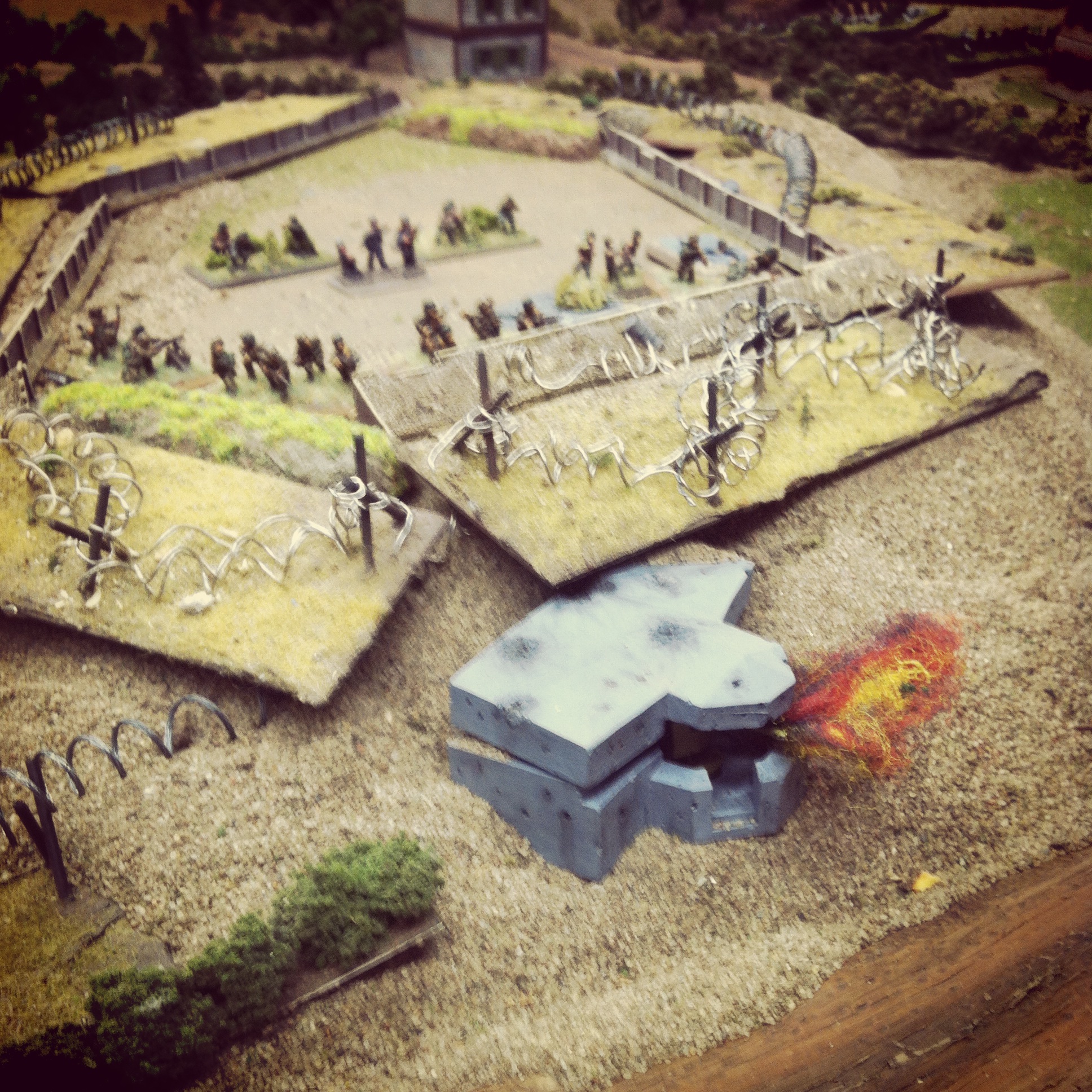
IMG_3604German defenders hold their positions behind a burning bunker

The opening turns found a lot of US boats on the beach and a quick push to the seawall. So early combined arms fire managed to destroy the main bunker at the beach, but the battle was far from over. The initial US push followed on to the left of the beach, but multiple turns at clearing the barbed wire stalled the advance as the Americans took heavy fire.

IMG_3606

American armor and artillery follow-up the infantry landings

As US armor arrived, several tanks managed to drive off the beach to the minefield position to lay down fire on the German trenches. One tank wound up spending three turns bobbing in the surf offshore only to arrive and bog for two more turns on the beach. As this most inexperienced tank crew in Normandy struggled, the other Shermans took fire from German rockets and reserve tank platoon which rolled to bulk up the beach defense. American artillery also arrived but proved pretty ineffective to the Germans at the trenches. Wave after wave of US infantry pushed to the trenches, eliminating most of the defenders but never managing to clear the barbed wire lines to seize the German position. At the final turn, the Americans just hadn’t made enough headway to control the beach.

IMG_3627World In Flames continued over D-Day weekend

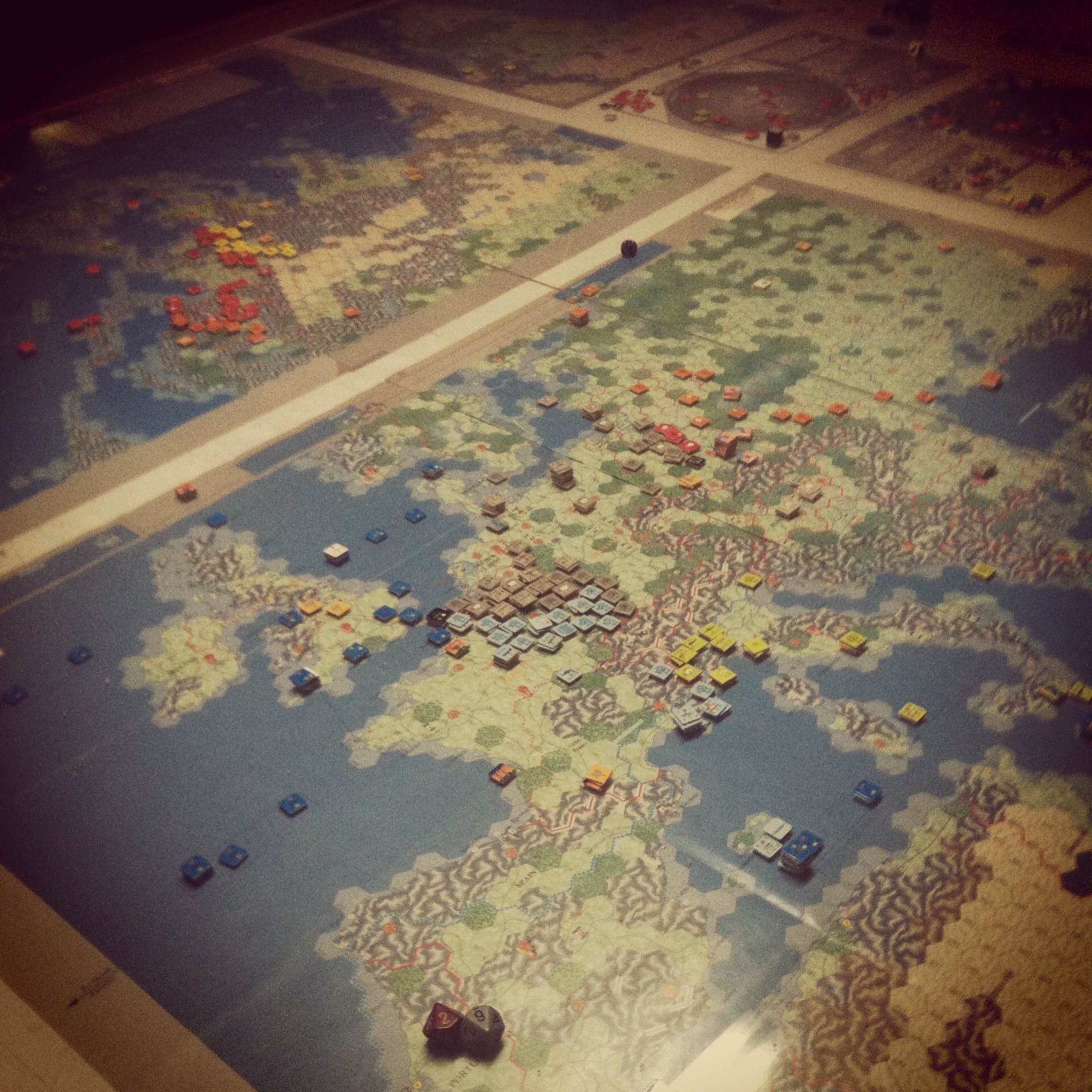
With action raging on the sand table, a group of club members showed up to continue playing their massive World In Flames game. Australian Design Group’s WIF from 1985 is the standard in grand-scale strategic fighting of the entire WWII period. The game’s rich playable detail, dizzying number of 1400 playing counters and sprawling maps makes it a commitment for only the most experienced gamers over many months of play.
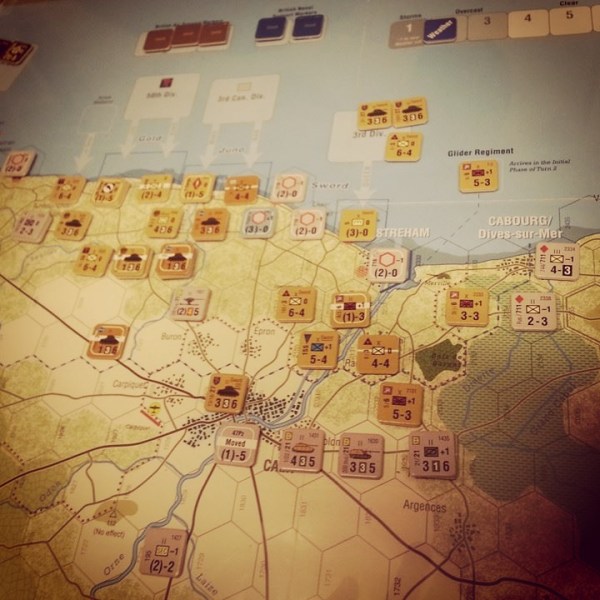
IMG_3630Allied forces push from the beaches inland to Caen in Normandy ’44

The Normandy ’44 game from the evening before concluded with a decisive Allied victory Saturday afternoon. Pushing the Germans back from all but Utah Beach, the Allies captured Bayeux and several smaller towns. With German defenders routed from roads leading inland from the landing beaches, the victors rolled in to control half of Caen by the game’s end.
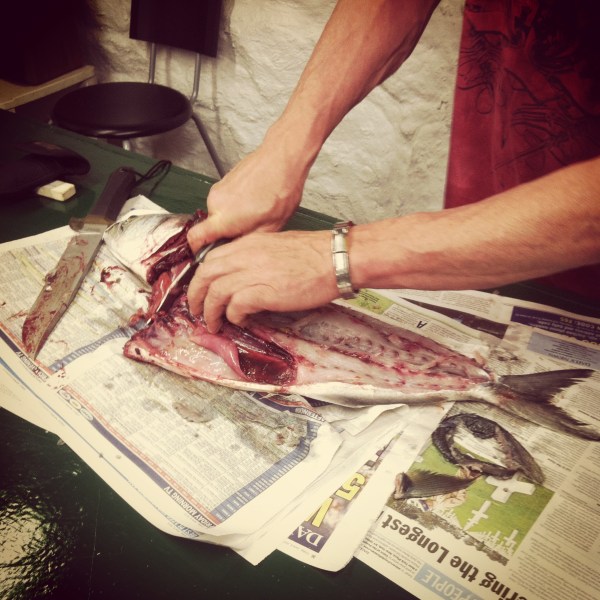
IMG_3625No one was going hungry at Metropolitan Wargamers over the weekend

Saturday also included a lot of other club members down for the usual variety of board, Euro and card games, making for a packed house. As the crowd rolled in, a longtime club member showed up with an enormous fresh-caught fish which he proceeded to gut with a huge military-style knife. With fish on the grill and food ordered in, there was plenty of food to sustain the crowd of gamers throughout the day.

We all took a mid-afternoon break to dice-off in a game, books, DVD and miniatures raffle to raise funds for the club. I was fortunate to score a copy of A Few Acres of Snow from Treefrog Games, and another lucky person picked up an unused copy of out-of-print the Games Workshop classic Dreadfleet.
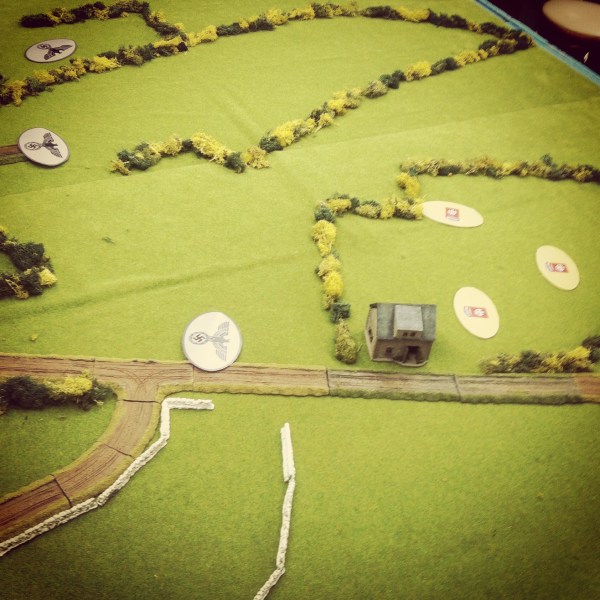
IMG_3631

Initial deployment of Allied and Axis blinds in our Saturday evening IABSM scenario

As the main crowd thinned out, we ran an evening IABSM game continuing the assault beyond Easy Green. The scenario found initial US forces deployed around a small French farm with the objective of moving men off the table on the roads beyond. The Germans were tasked with preventing the American advance and seizing the farmhouse stronghold.

IMG_3607

Settling in for a contested fight at the farmhouse above Omaha Beach

Using initial blind deployment, Germans quickly moved to the farm along thick hedgerows as the Americans drove into the building for cover. Turns followed with the Americans jumping from cover to fire on the dwindling German force which returned fire over the hedges to unfortunate US infantry hanging out in the open. A US flamethrower attack from the window of the farmhouse decimated another German squad sitting close behind a nearby hedge. Pressing their luck, a group from the farmhouse made a run for the road exit only to be stalled by a reinforcing German heavy machine gun squad. Returning fire, the German MG42s were eliminated from their position in the open field. However, the damage had been done. Although the Germans had not captured the farm objective, the Americans no longer had a sufficient force to push off the table. The night ended with a German victory beyond Easy Green.

Sunday Games
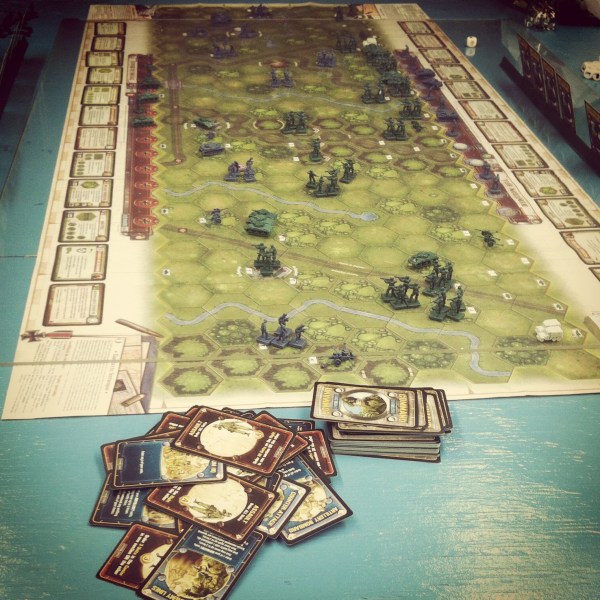
IMG_3620The war continues on the Memoir ’44 Hedgerow Hell battle map

With the first days of Operation Overlord behind us, Sunday’s game focused on the breakout actions. A couple visiting players showed up for the club’s Memoir ’44 game around noon on Sunday. Using the wide Hedgerow Hell expansion map, the Allies beat the scenario odds to win the game in the Overlord scenario. There was much talk of getting larger games of Memoir ’44 back in rotation at the club soon, so hopefully getting the game back on the table will bring some renewed interest in the coming months.

 IMG_3621

The initial armored encounter outside Lingevres leaves British tanks in flames

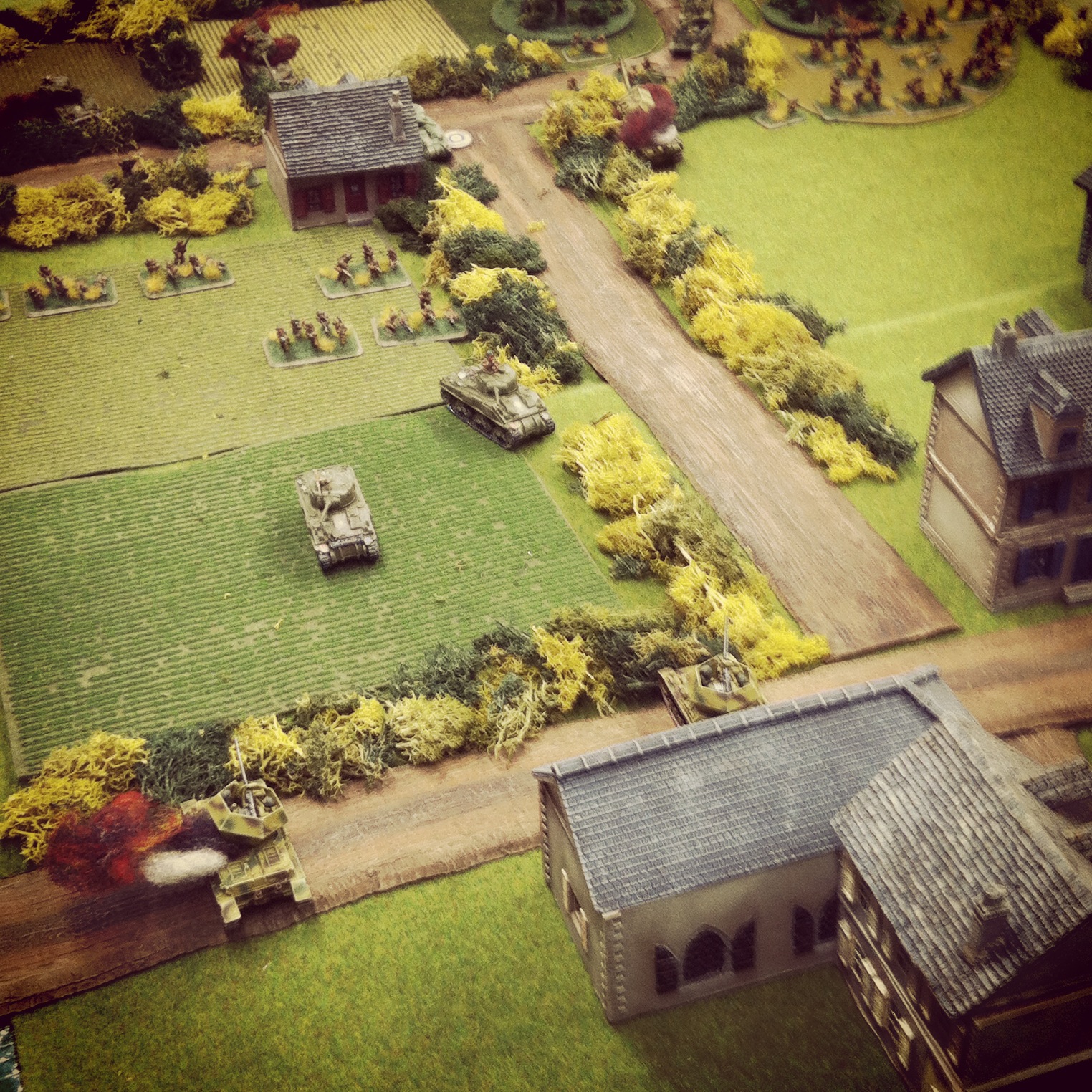
I finished off my weekend as the British at Lingevres using the same scenario I first ran at the club a few months ago. The mission ahead for the Brits was to move into the heavily defended town and take two of the buildings. Historically, the battle played out as a tank duel between UK Sherman Firefly and German Panther tanks, and our game this past weekend played out in a similar way.

IMG_3624

A Panther meets its end at the hand of the British Royal Artillery as a close assault is attempted on another in the woods nearby

At the outset, my first platoon of tanks got a bit overly aggressive and charged into contact with the full Panther platoon at the farm outside Lingevres. With the first Firefly destroyed in the opening turns, my remaining Shermans pulled back as the Panthers rattled to the middle of the field to hold off UK infantry advancing through the woods and bocage-lined fields beyond. One Panther bogged on a hedgerow and another was destroyed in an initial volley from the Royal Artillery in the fields outside town. Several turns became ensnared in attempted infantry assaults on the third Panther in the woods, but eventually the German tank rolled away to deal with the building reinforcing infantry and tank platoon in the fields on the other side of the table.

IMG_3622British Shermans and infantry break across a field toward Lingevres

With the Panthers moving away, fresh British infantry and the surviving Shermans moved to the farm and fields beyond. British artillery fire winnowed and pinned the German platoon in the church over several turns. Artillery fire also sought to keep the reinforcing German spotter pinned to limit the effectiveness of the reserve Nebelwerfer battery which as delayed reserves to the rear of Lingevres.

IMG_3623

The duel between the Panther and Firefly ends with the British tank in flames as the remaining Shermans destroy a Panzer IV platoon in the distance

In the meantime, a multi-turn tank duel had settled in between a lone Firefly and Panther while a reinforcing Panzer IV platoon arrived at the edge of town. Both tank groups traded fire, and in the end, the Panzers were routed with two or their three destroyed and the Firefly fell to the Panther’s gun. Back at the farm field, Shermans traded fire with Pak 40s and destroyed an anti-aircraft platoon defending the town’s flank. With two Panthers left on either side of the church, Shermans on each side of town and advancing British infantry, we called the game a draw.

 Weekend Debrief

After more than 20 hours of gaming over two nights and days, I was pretty worn out, but the interest in the D-Day event had made the weekend well worth it. WWII still holds enormous interest to this day, as demonstrated not only by our weekend of gaming but by the mainstream media’s coverage of D-Day over the week leading up. In the next week, we’re kicking off an FOW Infantry Aces campaign with fresh forces hitting the tables in rounds of Italy-themed WWII games. This fall we’ll be playing out some Market Garden battles and by the winter we hope to host some Battle of the Bulge engagements. It was a pretty special weekend in Brooklyn, but for regular visitors to Metropolitan Wargamers, there’s always the next game in this very unique New York City community.
New Game Weekend: I Ain’t Been Shot Mum

IABSMbook

As a World War II gamer, I have a newly-discovered love for a game which doubles my gaming possibilities with all the time and money I’ve  got invested in the 15mm Flames of War game which is the modern standard for the period. The past two weekends at Metropolitan Wargamers in Brooklyn, NY, I’ve been turned on to I Ain’t Been Shot Mum which is billed as “the other World War II miniatures game. For gamers with a lot of miniatures on hand and a hankering to play WWII at a different and more historical level, IABSM is well worth it.
TFLlogoNow in its third edition, IABSM has been published since 2002 by Too Fat Lardies, UK-based makers of a number of wargaming rules systems for a variety of historical periods. Overall, the game provides WWII wargamers with a simple, sleek set of skirmish rules that focuses far less on fielding shiny models and more on tactical decisions on the tabletop. IABSM is a true “what you see is what you get” system with a 1:1 scale at 15mm but easily adaptable to other model scales. One guy on the table equals one soldier in the field during battle, taking the game down to a level that really “feels” like commanding a group of troops. The smaller, less abstract scale of IABSM games provides a lot less “gaminess” to the systems, and relies a lot more on the decision-making skill of players commanding forces on each side. In many ways, the game is a throwback to original Kriegsspiel invented for use in Prussian army training two hundred years ago.
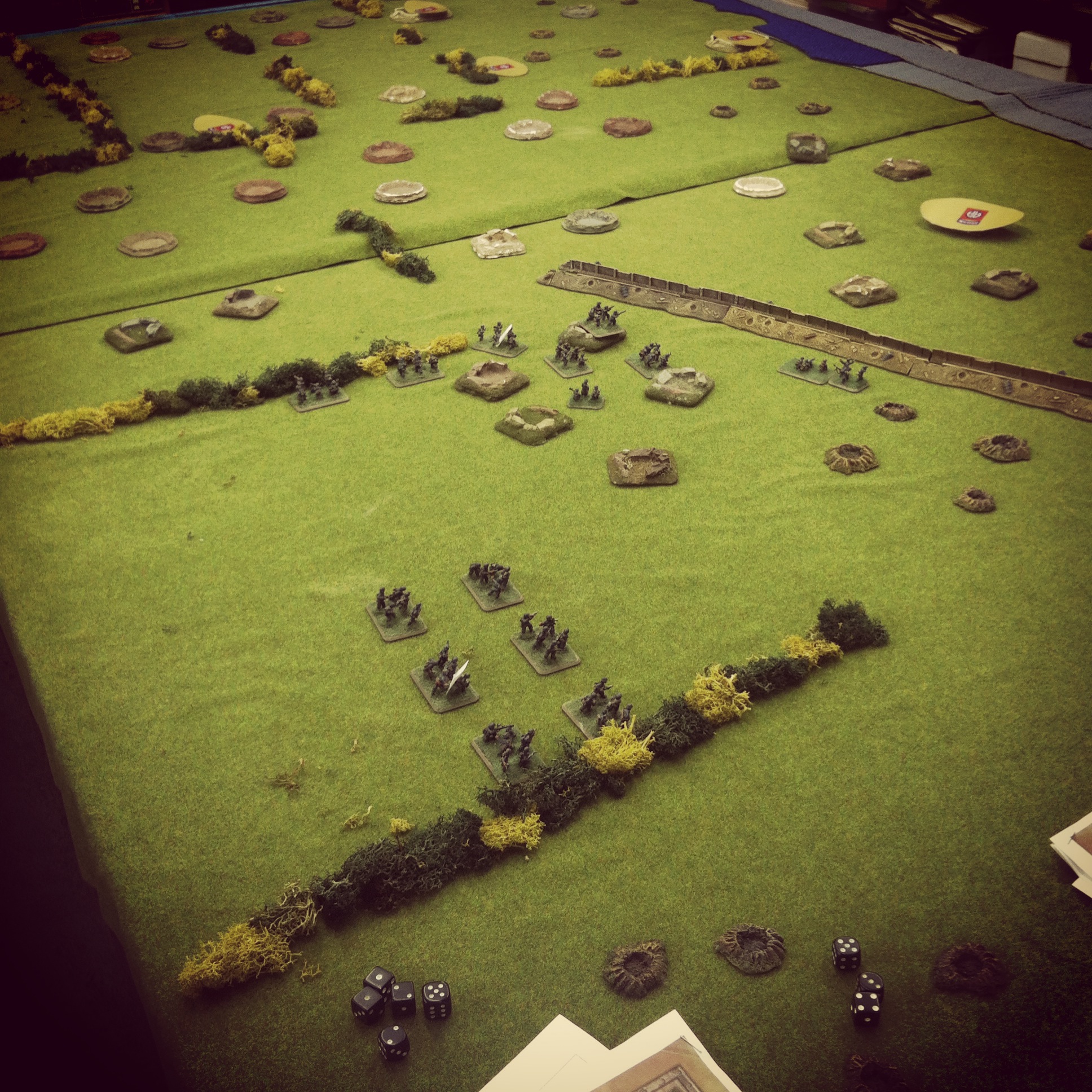
IABSMcardsSample cards from I Ain’t Been Shot Mum from Too Fat Lardies

The core rules of IABSM retail at under $20, and provide a number of basic underlying mechanics easily usable in any battle or theater of WWII. As an avid FOW player who is often faced with hundreds of pages of more grand-scale rules, army lists and ongoing modifications, the elegance of the skirmish-level IABSM comes down to five main areas:

1. Random Activation: Rather than playing by a simple “I go, you go” turn-based mechanic, IABSM games are powered by a set of cards which randomly activate deployed troops in the field. At the beginning of the game, a deck of cards is shuffled with each card representing a unit in the game. Cards are drawn and units are activated in turn, with units choosing a number of actions based on their quality. Highly-trained US Airborne troops may have four actions when activated, while less elite regulars may only have three. Actions include movement, firing, spotting the enemy and many other activities which makes commanding a unit’s turn one of many possible choices. Cards are added to the deck as new units arrive and removed if a unit is destroyed. Drawing a “tea break” card ends the turn with one final round of shooting for available inactivated units before the cards are shuffled a new turn begins.

2. Morale: Troop morale is nearly as important as firepower on actual battlefields. A well-armed but rattled group of soldiers may prove to be nearly ineffective in the field without some stalwart command leading the way. IABSM offers several levels of morale with pinning, shock and suppression which progressively eats into how effective a particular force can perform on the table. When being shot at, a simple table resolves possible kills as well as whether a unit is progressively shocked into poorer performance in subsequent turns or entirely immobilized due to overwhelming fire.

3. Command: Commanding and junior officers in IABSM are represented as “big men,” with individual cards allowing for their separate officer actions to drive gameplay. Through proximity or attachment to their forces, commanders can greatly affect morale by clearing shock from troops and boosting their strength in subsequent exchanges with the enemy. The presence of command also doubles the chance of troop activation, as a drawn “big man” card can press an attached unit into action without its own card being drawn.

4. Blinds: In real-world combat, knowing the enemy position through intelligence, observation or contact is almost as important as the engagements that result. While many miniatures games present an open table where nearly everything is known from the get-go, IABSM preserves a “fog of war” element with the deployment of “blinds” on the table. Represented by oval-shaped markers, blinds are able to move around the table without revealing their actual make-up. Thus, a player might move a small unit, a large platoon or even a false blind containing no troops around the table without the enemy knowing its true make-up until revealed. This allows players to add an element of diversion to the game, as an enemy way burn up several turns chasing a ghost across the table as real forces jockey into position.

5. The Game Referee: One of the hallmarks of wargames until recent decades was an all-seeing, all-controlling game referee. As a non-player, the referee not only provides clarifications on rules and contested play on the table, but they also are able to maintain a level of secrecy between each player as a scenario unfolds. The game can be played without a referee, but the presence of one adds yet another depth of to the “fog of war” randomness employed already with blinds and random card activation.

WTHbook

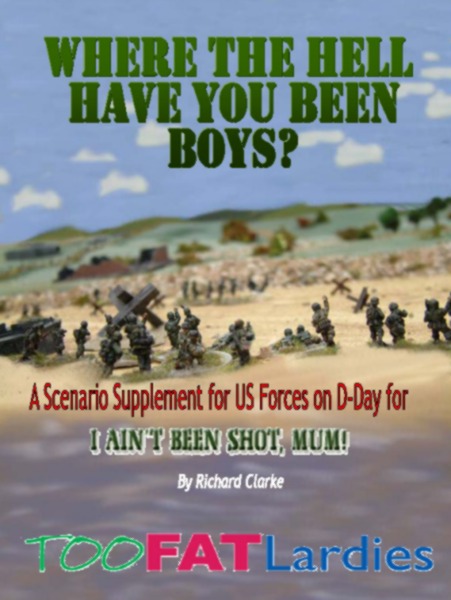
Beyond the base rules, Too Fat Lardies offers a number of IABSM scenario and guide books for Europe, Italy, North Africa and the Pacific. General lists allow for the creation of custom scenarios, but I really like the historically-specific books. The past two weekends, I played the first two games in the D-Day-themed Where The Hell Have You Been Boys? book which contains over twenty scenarios from Omaha and Utah beaches to the inland. Following the United States advance and subsequent German counterattacks, each scenario lays out a simple briefing for the German and US players along with a referee sheet, terrain map and a guide to forces and cards needed for play.

IMG_3554“Protect The Guns” scenario set-up for IABSM

IABSMGameScenes from the German defense above Pointe du Hoc in “Protect The Guns”

My first game — “Protect The Guns” — saw me playing as the defending Germans looking to hold off the Allied advance from Pointe du Hoc with a couple heavy machine guns, snipers and some off-board artillery. One of the remarkable things about IABSM is the vast amount of space represented on the table, making decisions of movement and firing  very important. My artillery was also very unreliable, representing some of the German communication challenges come alive. That said, with only a few men at my disposal, I was able to stave off and force the Americans to redirect through constant harassing fire until their reinforcements entered under a blind at my rear. With one of my machine guns and both snipers finally destroyed, the last of my Germans found themselves pinched on two sides of more-skilled US troops who took the game.

IMG_3553

“Holding The Pointe” scenario set-up from IABSM

In “Holding The Pointe,” my Germans were on the counter-offensive and looking to push the Americans back into the sea. With all my forces deployed at the game’s start and all American units under blinds, my Germans began in overwhelmed confusion. This disadvantage made the game play so much more like the actual action in Normandy as German forces scrambled to head-off the Allied attack inland. Rather than focus my attack, I made the poor gamble of splitting myself to chase two sets of US targets. By the time a large force of German reinforcements arrived in the seventh turn, my initial force had gotten chewed-up in a series of stand-off firefights amidst the thick bocage near my original deployment. My divided force tactics were ultimately my undoing, and I’m certain a more textbook massed attack may very well have giving me a greater shot at victory.

With a couple of games under our belts, we’re going to continue right through the IABSM D-Day scenarios and beyond. We’ve managed our games without a referee so far through some really good fair play, but we’re anxious to try some scenarios with the referee element. Overall, the up-close feel for command and the heightened tactical realism in IABSM has given me a second WWII game to love at the 15mm scale.

Flames of War: Omaha Beach “Easy Green” 1944 Scenario

OmahaBeachSandwiched between tall bluffs on either end, a five-mile stretch of Normandy coastline was designated Omaha Beach near the center of the Allied D-Day landings on June 6th, 1944. Landing at Omaha was the relatively fresh US 29th Infantry Division. With British and Canadian troops landing on beaches to the left and other US men landing at Omaha Beach to the right, the 40,000 Americans at Omaha met with the highest rate of casualties of the day with some 3,000 falling in the French surf and sand.

OmahaEasyGreen“Easy Green” sector on Omaha Beach, Normandy 1944

Lying in wait at Omaha was a mix of green recruits and older veterans in the German 352nd Infantry Division. Dug in at the coast in a wall of pillboxes, bunkers, gun pits and trenches, the German men (and unknown number of boys) met the US invaders with a storm of machine gun, artillery, mortar and rocket fire. For the US, little went right as landing craft drifted off course and special floating DD M4 Sherman tanks were swamped and sank offshore. Only through improvised efforts and a slow, methodical pace under withering fire did the American infantry finally make it through the German lines to control the beach by the close of the day.

EasyGreenFOWMap set-up for the Flames of War “Easy Green” scenario

In preparation for our upcoming D-Day Plus 70 weekend at Metropolitan Wargamers in Brooklyn, NY on June 6th-8th, a couple of us have been playing out beach landing practice games. Flames of War offers a specific outline for coastal assaults with their “Hit The Beach” rules, but we’ve found them to be very difficult to play with US invaders losing more often than not. Last summer we ran through our first beach landing on one of the club’s sand tables with a Utah Beach “Easy Red” scenario in which the US failed horribly. Since then we’ve been studying up, tweaking our forces and diving deep into the particular rules for a tabletop beach landing game.

German352

29thinf

This past week we ran through the Omaha Beach “Easy Green” scenario to what was probably our most evenly matched and played game to date. The scenario sticks pretty closely to the situation at Easy Green with one beach exit road guarded by lines of barbed wire, trenches, mines and anti-tank obstacles. Finally, a combined defense of heavy machine guns, a 5 cm KwK 39 gun bunkered at the coast and Nebelwerfer rockets at the rear provide a daunting nut for the US infantry to crack. For our game, my German opponent was able to field forces as outlined in the published FOW scenario but I had to modify my American list slightly to fit my model collection. Even with slight changes, our final lists had the US at a few more points stronger than the Germans as per the mission outline and the game rules.

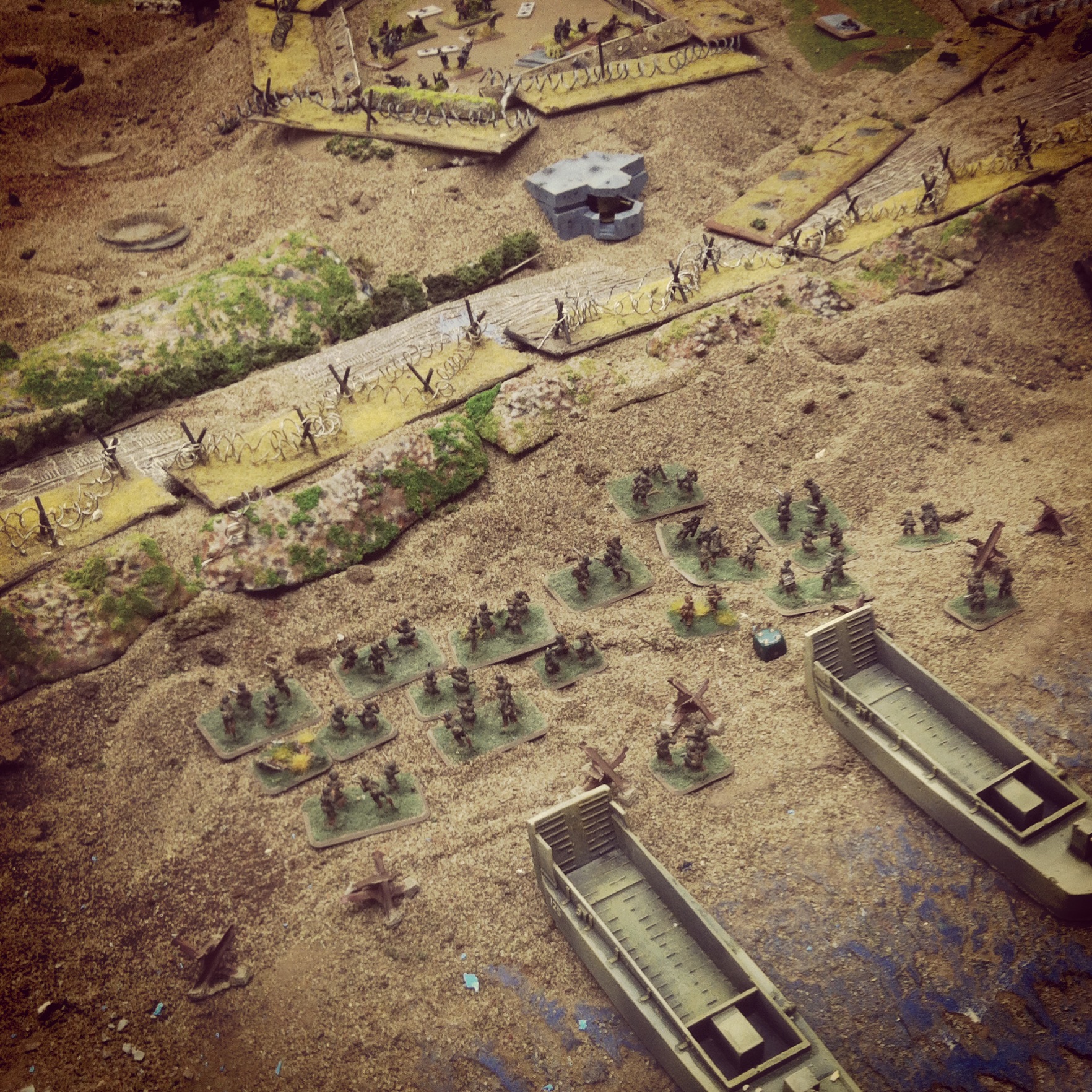
IMG_3452The first US boats land and platoons rush ashore

After an initial US naval bombardment which destroyed one stand of German infantry, my boats and DD tanks headed for the beach. In the initial wave, one DD tank sank in the water offshore and one boat was delayed in the bouncing surf. With two platoons of US infantry on French ground, they made way for the barb-wired seawall. Further down the beach to the right, my three surviving Shermans rolled to the one exit causeway from the beach.

IMG_3453DD Sherman tanks make it across the beach toward the exit ramp

In the opening salvo from the Germans, rocket fire came in from the rear of the table as entrenched guns fired from the beach defensive lines. US troops did well with dice roll saves and lost just a few teams before ending the turn pinned high on the beach.

IMG_3454German Nebelwerfers sit atop a hill overlooking the Allied objective

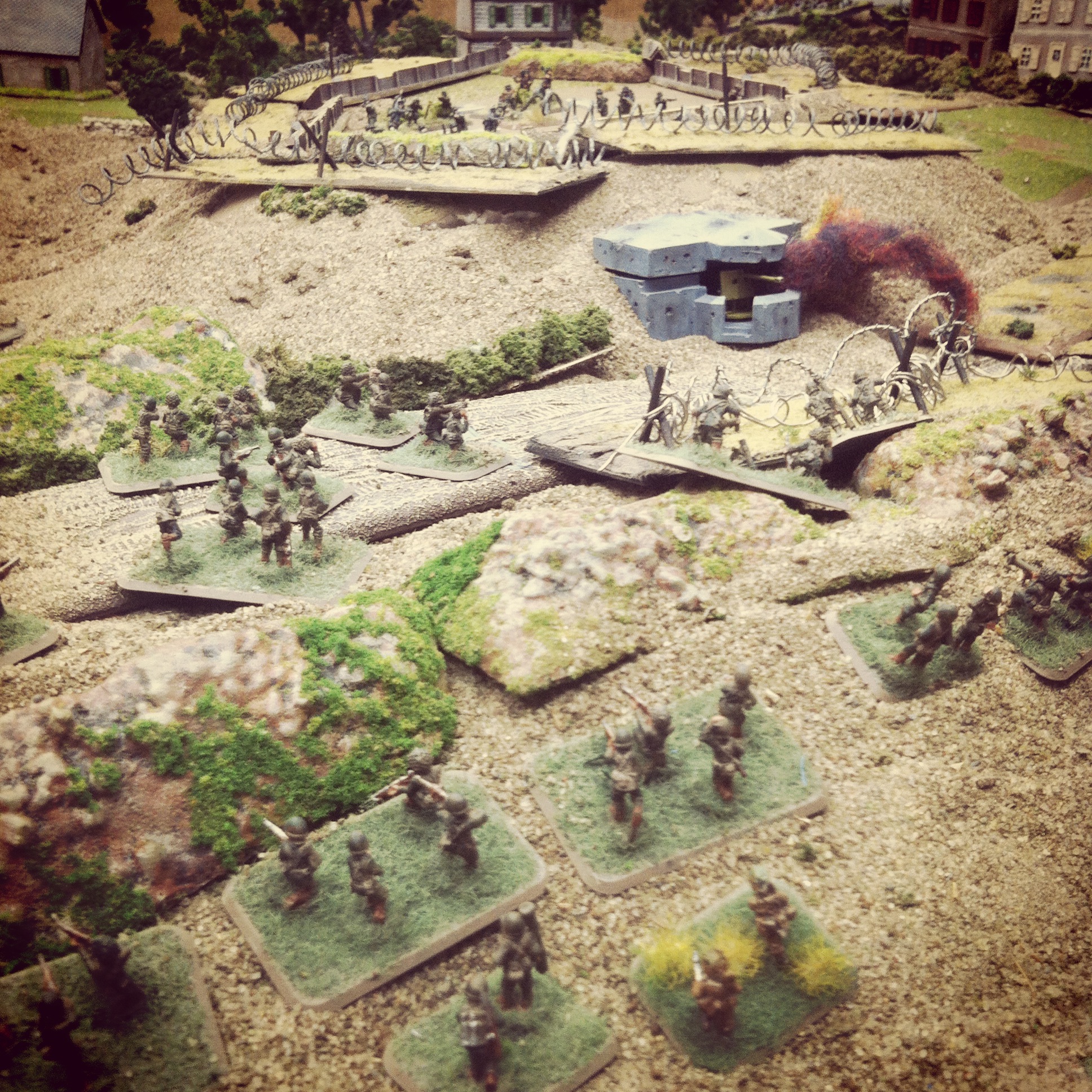
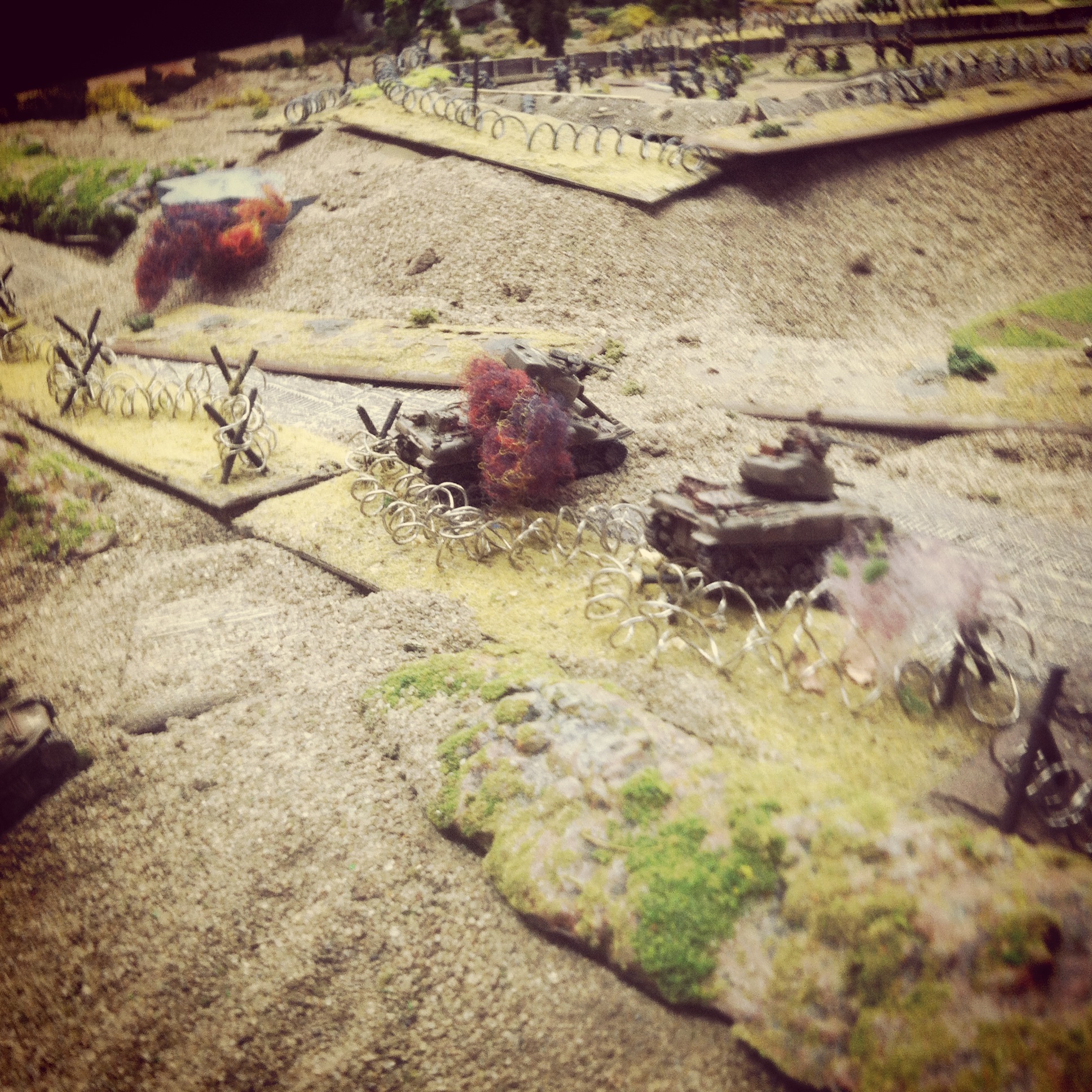
In the next couple turns, landing craft continued to meet mixed success in landing and stalling on the sea. Luckily, most boats didn’t drift too far down the beach, allowing me to execute my general plan of running infantry to the left while my tanks dealt with the heavier nests and pillbox to the center and right. One tank bogged in the sand but the other two rolled over the barbed wire to take up position at the line of minefields, sending fire into the Tobruk nests and gun bunker. A couple turns in, the bunker was in flames and the German machine guns had been dealt with. The way was clearing for the US infantry to push inward.

IMG_3455The 5 cm KwK burns in its bunker as US troops push over the seawall

IMG_3456DD tanks struggle through the coastal defenses and take heavy combined fire

With several US platoons whittled-down in their struggle through several tiers of barbwire, one platoon of German infantry arrived and made way for the row houses near the objective and remaining rockets on the hill. In the open, the Germans took fire from naval guns but most survived to find shelter in the buildings. Back on the beach, my final US reserves of M7 Priests landed at the center of the beach and one heavy machine gun section tramped forward at the extreme left. With these late arrivals so far back from the main action, it was up to the forces already inland to get the job done.

IMG_3475German defenders rain mortar and machine gun fire into oncoming US troops

IMG_3476With German defenders destroyed at the beach, the 29th Infantry Division hustles inland

With the major defenses eliminated at the beach, the Shermans turned their machine guns on the remaining German infantry manning the trench line high on the central hill. At the same time, US infantry began pushing into the German position after spending turns alternately being pinned by rocket and mortar fire, removing barbwire and shooting back with light machine gun, rifle and direct mortar fire. Despite their losses, the combined arms of my US troops really shined, as was often the fateful experience of their German opponents 70 years ago.

As the game moved into the second-to-last turn, the Americans were ultimately just too far away and too weakened to make the final push to the objective still held by the remaining German infantry comfortably defending from the nearby houses. It had been a pretty even match, but timing was everything. Luckily for the Allies on June 6th, 1944, the only limits on the day’s outcome at “Bloody Omaha” was the grit and dedication of the storm of humanity hitting the beach.

Metropolitan Wargamers D-Day Plus 70 Event – June 6th-8th 2014

MWGDDay

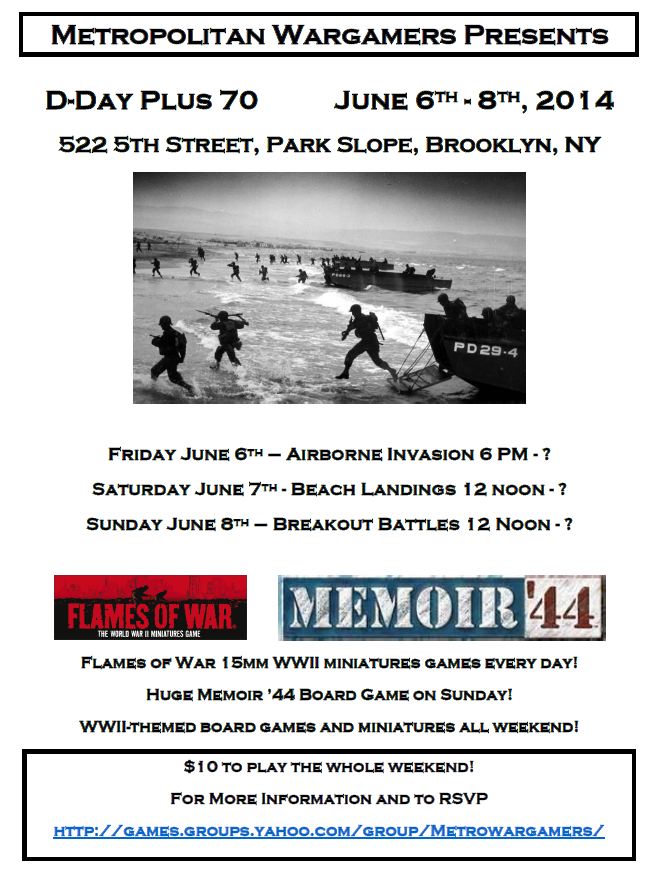
This June is the 70th Anniversary of the Allied D-Day landings at Normandy, and New York City’s oldest and largest wargaming club Metropolitan Wargamers is celebrating with a full weekend of events.

IMG_2161

La Fiere Causeway at Metropolitan Wargamers in Brooklyn, NY

Whether you’re new to the hobby or an experienced gamer, there will be plenty of WWII action the entire weekend. On the evening of Friday June 6th we’ll begin with Flames of War airborne landing scenarios. Saturday June 7th kicks off at noon with a FOW beach landing scenario on one of the club’s famed sand tables. Sunday wraps up the weekend with a couple FOW breakthrough battles and a large Memoir ’44 board game. Other WWII-themed games will run throughout the weekend.

IMG_2816

Utah Beach on one of the sand tables at Metropolitan Wargamers

We’ll have FOW scenarios set up for the weekend with plenty of miniatures and stunning terrain on the club’s tables, so all you need to bring is your passion for wargaming and history. Our FOW miniatures games are fun and a feast for the eyes, and you can get a sense of what’s in store for the weekend by viewing some of our past scenarios at the club here.

Admission for the full weekend of gaming is just $10 and a great opportunity to visit a very unique community of gamers in the heart of Brooklyn’s Park Slope neighborhood.

For more information and to RSVP for the D-Day Plus 70 weekend, check the Metropolitan Wargamers website or join our Yahoo group.

Flames of War: Dust Up Mission With “Blood, Guts and Glory”

tank3

Although actually made up of a number of battles and assaults during World War II, the post-D-Day breakout actions by the Allies in late 1944 in Northern France has become commonly known as the Lorraine Campaign to military historians. Frustrated by poor weather conditions and weak supply lines, the General George Patton’s 3rd Army push into Germany eventually led to the wintery and more famed German counteroffensive with the  Battle of the Bulge in the winter of 1944-1945.

bggbook

Flames of War offers a book outlining the Lorraine Campaign with Blood, Guts and Glory. US lists in the book focus on the powerful tank and armored rifle companies which made up the steely backbone of Patton’s daunting force. For the Germans, the cobbled-together 106 Panzerkorps Felderherrnhalle and 111 Panzer brigade are outlined with forces full of some of the best Late War armor and equipment albeit under somewhat challenging motivation and experience ratings.

A couple of weeks ago at Metropolitan Wargamers in Brooklyn, NY, two of us had a go at a fictional battle set during the Lorraine Campaign. We play against each other a fair amount, and both of us were looking to switch things up commanding some very different forces. The tabletop terrain was also different with a more open battlefield lined with fields, woods, gentle hills and two farms. All of this was quite a departure from the games we have most played set in the days and months after the Normandy Invasion in June of 1944.

dustup

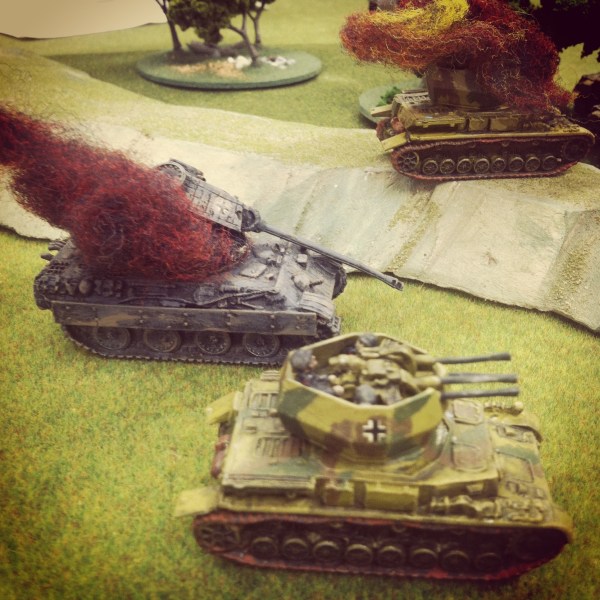
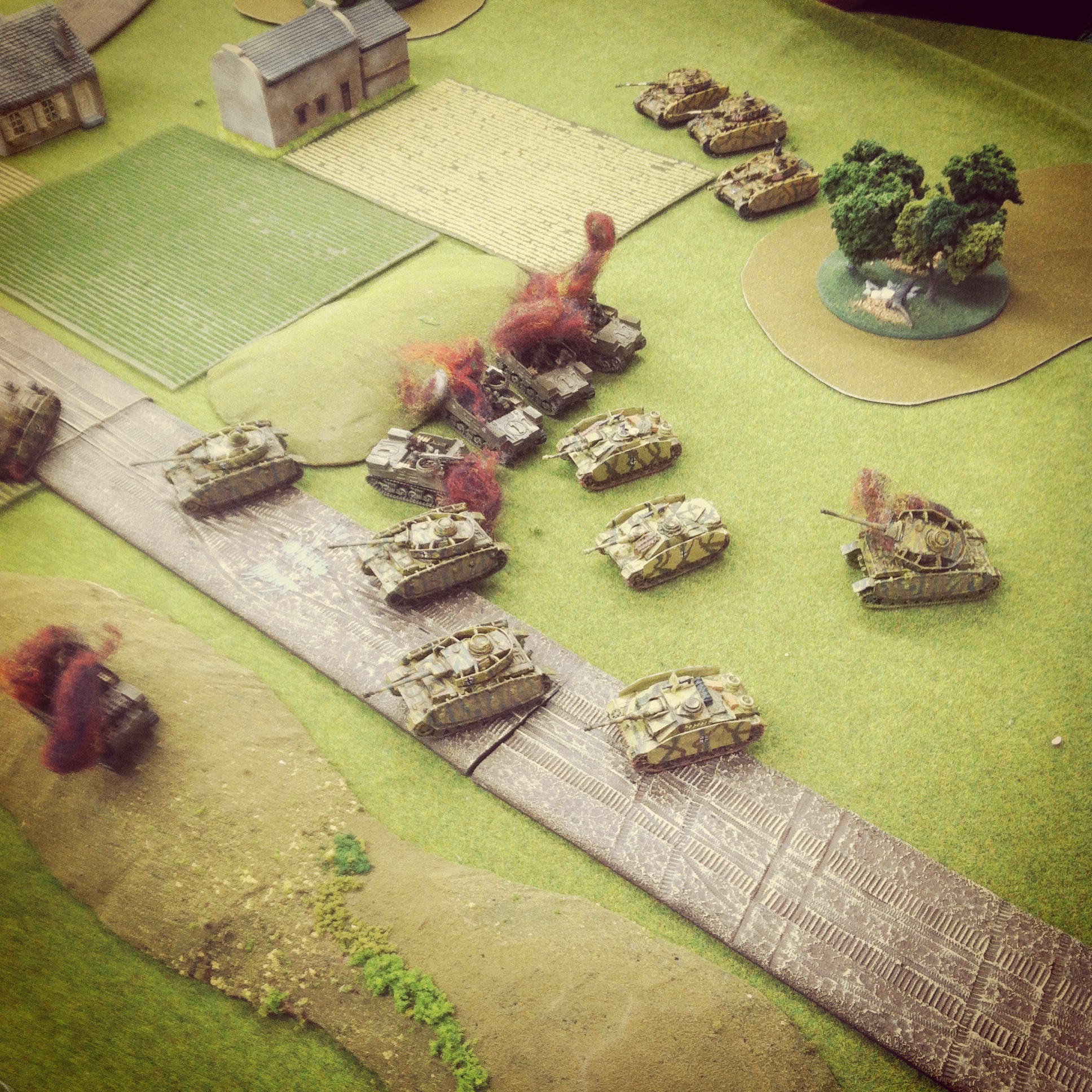
My opponent’s Panzerkompanie was  full of armor – Stugs, Panthers and Panzer IVs – and  supplemented by an Aufklärungs platoon and a couple Wirbelwinds to chase away any US aircraft. For my US force, I wanted to try out some underused rifle platoons which were supported by 105mm M7 Priests, some Shermans and a P-47 Thunderbolt buzzing overhead. We also chose a different game framework, opting for a somewhat complicated Dust Up scenario from the official Flames of War missions list.

pzco

us4th

IMG_3397

Our Dust Up scenario with my US forces in the foreground and Germans in the distance

Well, as the game played out, I quickly discovered I had brought infantry to a tank fight. With one of my infantry platoons camped out in the woods near two objectives, my hope was to stave off the German armor advance with repeated bombardments from my Priests and diving runs from the P-47.

IMG_3398US M7 Priest platoon taking up position

IMG_3399US rifles deploy in the woods to guard a nearby objective

Things went well for me in the early stages as Panthers stalled moving through the woods. A Wirbelwind and two Panthers were subsequently destroyed from 105mm volleys , but my P-47 failed to get any traction in stopping a group of Stugs creeping along the table edge. Even so, a couple turns in I was feeling fairly confident my artillery fire would whittle away the rolling German advance.

IMG_3401A German Panther and Wirbelwind are destroyed by incoming US 105mm fire
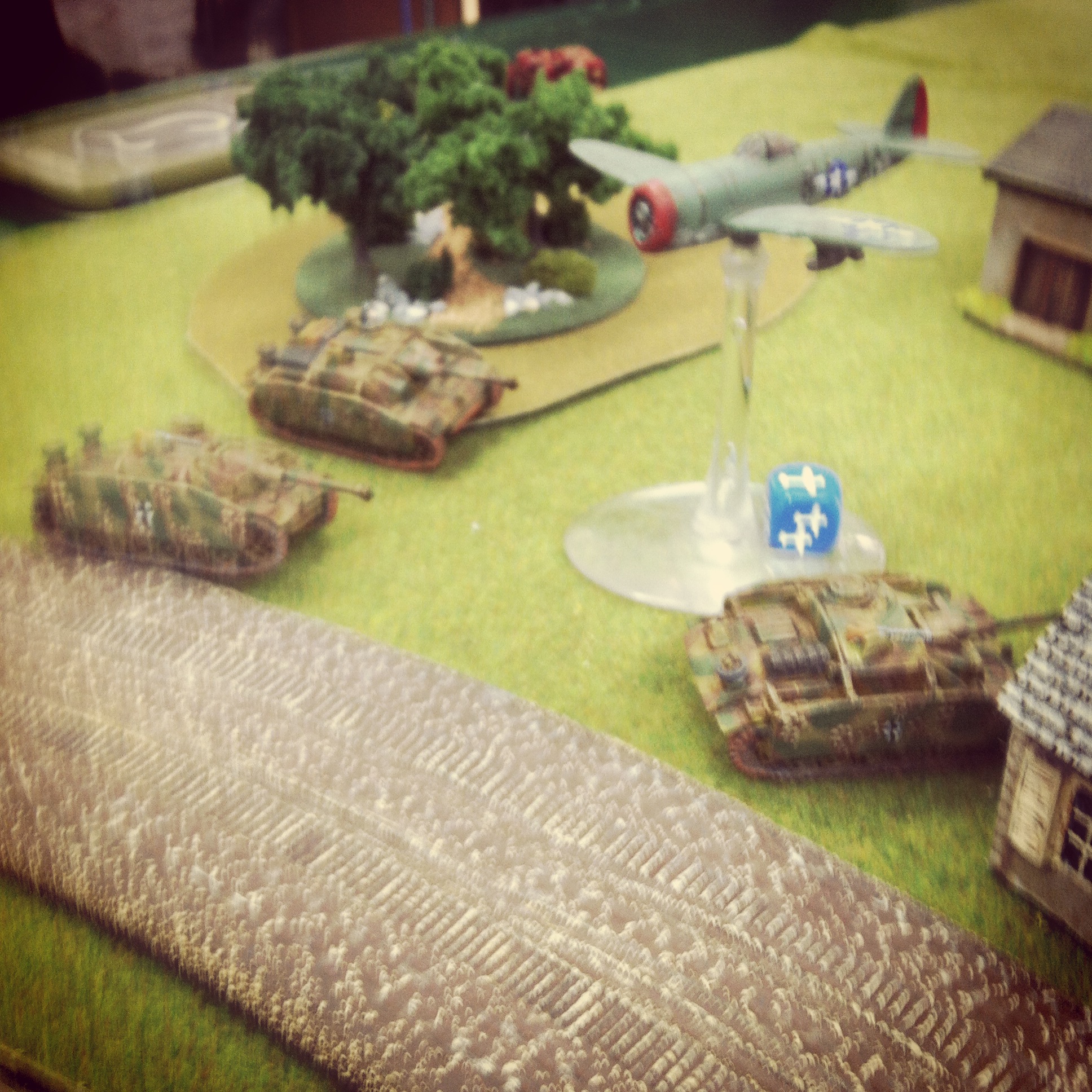
IMG_3400Panthers make through the woods but one bogs in the terrain

IMG_3402The P-47 Thunderbolt attempts a run at a Stug platoon

IMG_3403More fire from the Priests take out another Panther

My plan fell apart as the first German Panzer IV reserves came on the table at the corner behind my Priest battery and made quick work of the nearly-armorless US mobile artillery. I swung my surviving Priest and supporting Sherman around and engaged the Germans at close range with direct fire, but succeeded in only cracking open one German tank. In another turn, the Priests were wiped from the board and only my infantry platoon remained to defend my end of the table. The P-47 appeared again to control the center of the battlefield, but missed on its run. The US center and flank were crumbling by the time turn four approached.

IMG_3405Panzer IV reinforcements surprise the Priests from the rear

IMG_3406The Thunderbolt tries to stall the German armor in the middle of the field

My reserve Shermans came on the table near a farm and quickly engaged with the Panthers which swung to meet the US armor advance. Shots from my heavier 76mm guns lit up a Panther and bailed another’s crew. The German tanks returned fire, destroying all but one 76mm Sherman as more Panzer IVs showed up with the Aufklärungs platoon close behind.

IMG_3407Reserve American 75 and 76mm Shermans roll on the board

IMG_3409The last of the Priests burn as more Panzer IVs appear

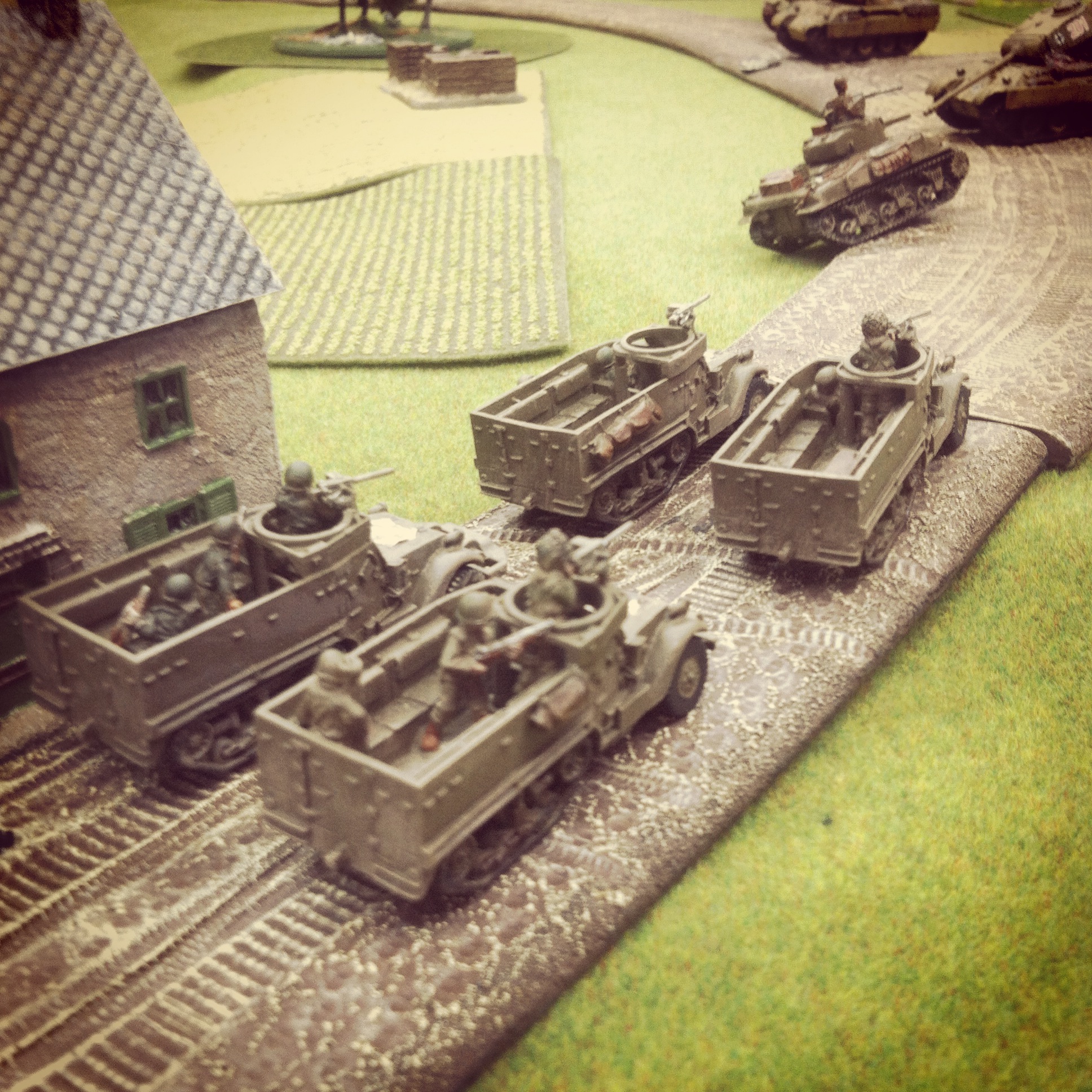
In the fifth turn, my final supporting infantry platoon arrived in their halftracks, dismounted and made a desperate run for an objective in the open field. The infantry on my side of the table also broke from the woods in a last-ditch assault on a mass of German tanks creeping toward an objective but were repulsed. With German armor swarming an objective, the game went to the Axis.

IMG_3410A reinforcing column of US rifles follows-up the Sherman advance

IMG_3413A lone Sherman survives as the US rifle company dismounts and heads for an objective

IMG_3414US riflemen break from the woods in a desperate assault on German tanks at an objective

IMG_3415With tanks aflame in the fields, the Germans take an objective

Clearly, my US plan from the outset was a stretch. Had I taken the more historic approach of Patton in the Lorraine Campaign of 1944, a fully-armored US force may very well have stood a fair chance against all the German tanks shuttling here and there on the tabletop. Balancing history and what-ifs is what makes playing Flames of war so engaging over and over again, but next time I’ll be careful not to second-guess the command decisions made in Northern France some 70 years ago.

Flames of War: Fielding the FOW M10 Tank Destroyer Platoon

m10

The Blitzkreig of German armored forces is one of the more enduring tactics introduced in World War II. Swarmed masses of German tanks and mechanized forces in the early war period rolled through Poland, France, Belgium and the Netherlands in Western Europe and punched into the Soviet Union with Operation Barbarossa in 1941. With early Panzer and later Panther and Tiger tanks ruling the battlefields of Europe, Allied forces struggled for solutions to crack the German tide of iron.

m10normandy

A US M10 tank destroyer comes ashore in Normandy after D-Day in 1944

By mid-war, the Americans had a solution with the M10 tank destroyer. Introduced first into the battlefields of North Africa in 1943, the M10 GMC (“gun motor carriage”) carried a big 3-inch/76mm gun and on a Sherman hull. After success in Africa against earlier model German tanks, M10s became part of the post-D-Day Allied breakthrough campaign. While effective against Panzer III and IV tanks, more heavily-armored Panther and Tiger tanks still proved problematic. Luckily, the M10 was supplemented by the British-modified Sherman 76mm Firefly and the later US-built M18 Hellcat which was quicker on the field. The combination of these three tank destroyers, along with the stalwart work of Allied infantry and deadly air support, turned the tide in Europe.

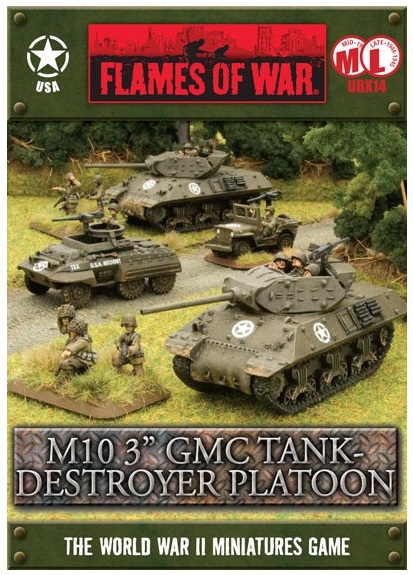
fowm10set

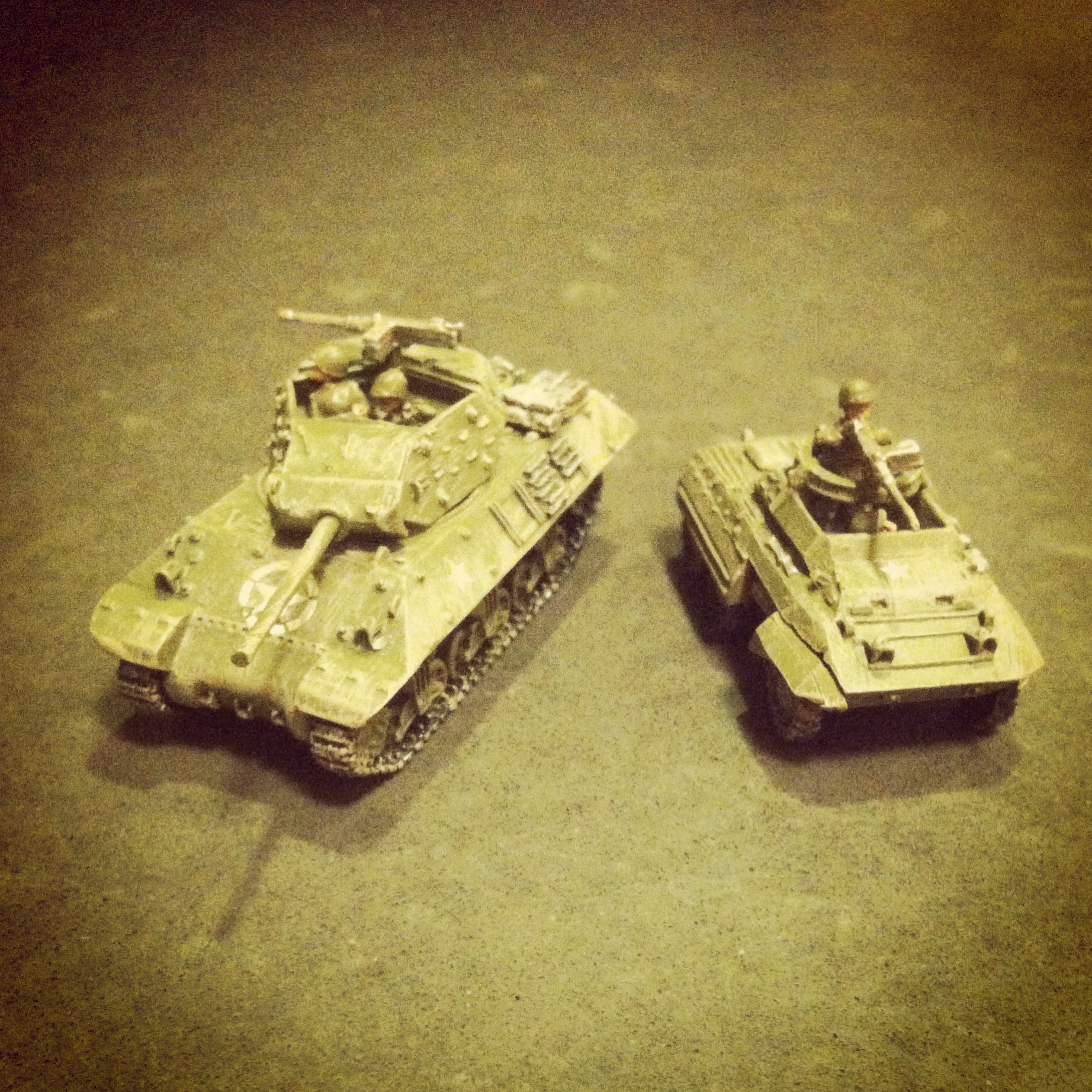
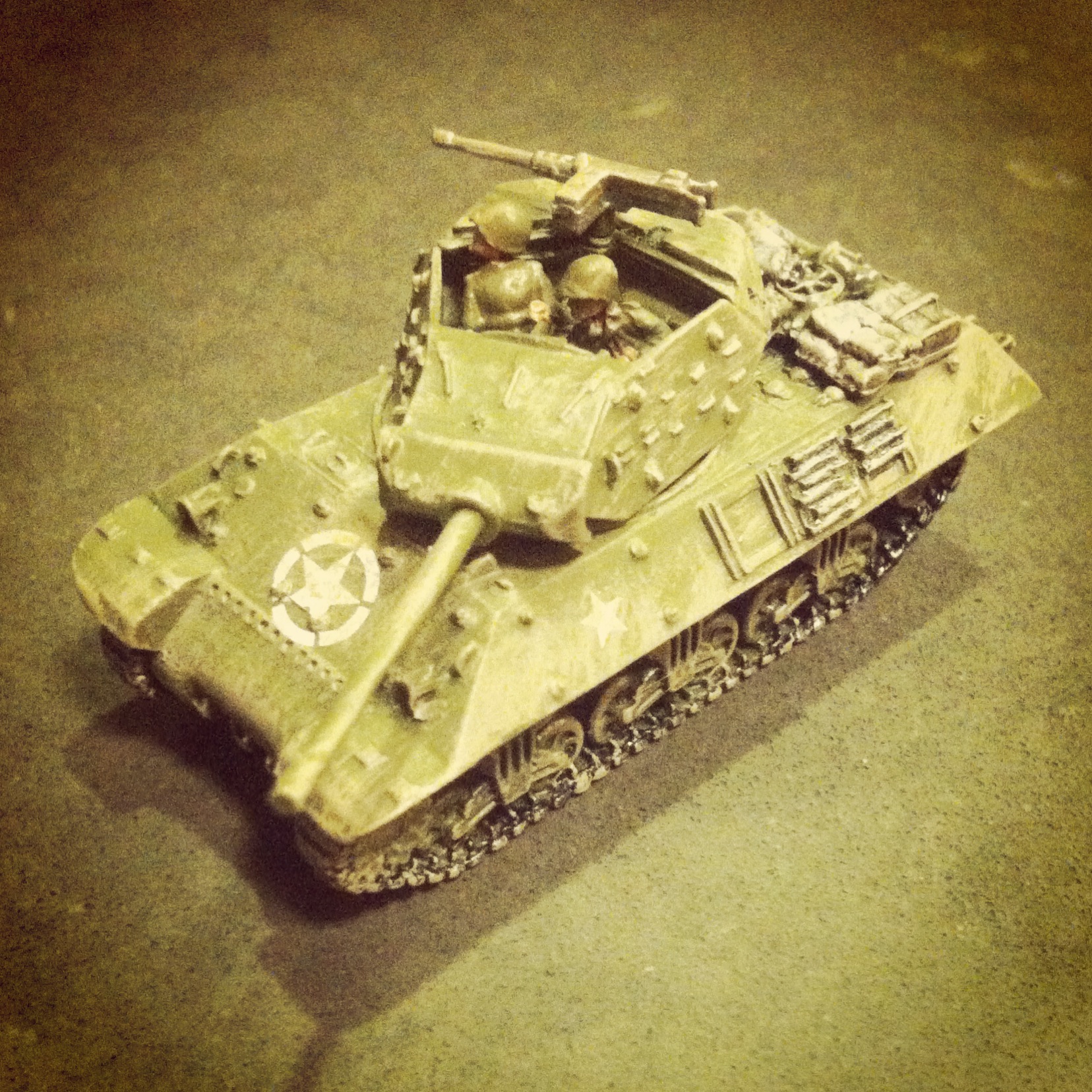
One of my earliest 15mm WWII purchases years ago, and somewhat at random, was the now-discontinued M10 Tank Destroyer Platoon set from Flames of War. I think at the time, I just liked the look of the models and I was looking to fill-out my new US forces with more variety. To get to a full platoon of four M10s, a fellow club member at Metropolitan Wargamers in Brooklyn, NY recently gave my two more M10s to which I’ve added an additional M20 scout car.

IMG_3389New M10 tank destroyer and M20 scout car

IMG_3388New M10 tank destroyer

IMG_3387New M20 scout car

IMG_3390US tank destroyer platoon with new models (left) and older models (right)

With my existing and new section sections, I now can field a full tank destroyer platoon using a variety of Allied Late War European lists. Anti-tank tactics in the game provide multiple opportunities for the M10 platoon to be used in combination with infantry and other Allied armor on the game table. With optional deployment as a recon platoon using the M20 scout cars, the M10s can create ambushes to wreak havoc on German tanks. Admittedly, using this full platoon will take some practice but I’m certain they’ll be causing headaches for my German opponents in the very near future.

Micro Armour: Getting Started

GHQlogo

After years of wargaming World War II with Flames of War, I’ve been looking for a change of pace for the period. I’ve recently caught up on the vast majority of my modelling projects, including fairly extensive American, British and German Late War forces as well as a bunch of terrain. I’ve also been interested in playing larger battles, something that becomes a bit unwieldy with FOW. In looking for a way to expand my WWII gaming experience, I’ve been weighing factors of scale, cost, storage and time. After a lot of thought, I’m going small and getting started with WWII in micro scale.

The standard in micro scale gaming is GHQ. Founded in the late 1960s and based just outside Minneapolis, Minnesota, GHQ manufactures an extensive line of pewter miniatures for WWII, Modern, Napoleonic, American Civil War and various naval eras. In the early 1990s, GHQ also began offering N and HO scale vehicles targeting model railroading enthusiasts. Along with their gaming models, the company has developed a number of rulesets and terrain-building supplies appropriate for various eras of combat at the micro scale level. For over 40 years GHQ’s models have been held in high regard by wargamers as well as the US military which uses the company’s products for training and planning excercises.

WWIIscales

World War II miniatures scale comparisons (from www.historicalwargames.net)

The 1/285th (6mm) scale of GHQ’s WWII models offers a number of differences and potential advantages to larger scales, such as 1/100th (15mm) FOW miniatures and 1/56 (28mm) models from the expanding Bolt Action game line from Warlord Games.

  • Scale: In 6mm micro scale, an entire infantry platoon can be represented with approximately 3-5 figures mounted to a small square or round base. An inch on the table approximates 100 yards on the battlefield. This allows for larger multi-company or battalion level games compared to smaller single company and platoon skirmish games at a 15mm or 28mm scales.
  • Cost: Wargaming at any scale is an investment, but micro scale allows for the depiction of large battles for a fraction of the cost of larger scales. The starter sets from GHQ provide around twenty tanks for $40, making individual armour models just a couple bucks each compared to the 15mm scale where tanks can run easily to triple that cost. Fielding an entire 6mm infantry and armor company might run just $10-20 while that same company at 15mm could run hundreds of dollars. And, since each micro scale tank represents a platoon and a platoon in FOW may run to maybe six tank models (or more), the game scales cheap and fast into grand scale engagements.
  • Storage: As the website says, I live in Brooklyn, NY, so storage is always an issue for my board games, cards games, miniatures, terrain and hobby supplies. I keep a lot of my miniatures at my local club, Metropolitan Wargamers, but I like having stuff around the apartment for when the gaming mood hits. At the micro scale level, dozens of tanks, infantry and vehicles can be carried in a shoulder bag or kept in a drawer. Compared to my FOW collection which sprawls over multiple bags and boxes, micro scale makes for some quick and easy game deployment just about anywhere.
  • Time: Painting micro scale takes a fraction of time compared to larger scales. A quick spray of white primer followed by a thinned color basecoat, a couple dots of detail, a wash and maybe a tiny decal is all that’s needed to get forces on the table and ready to game.

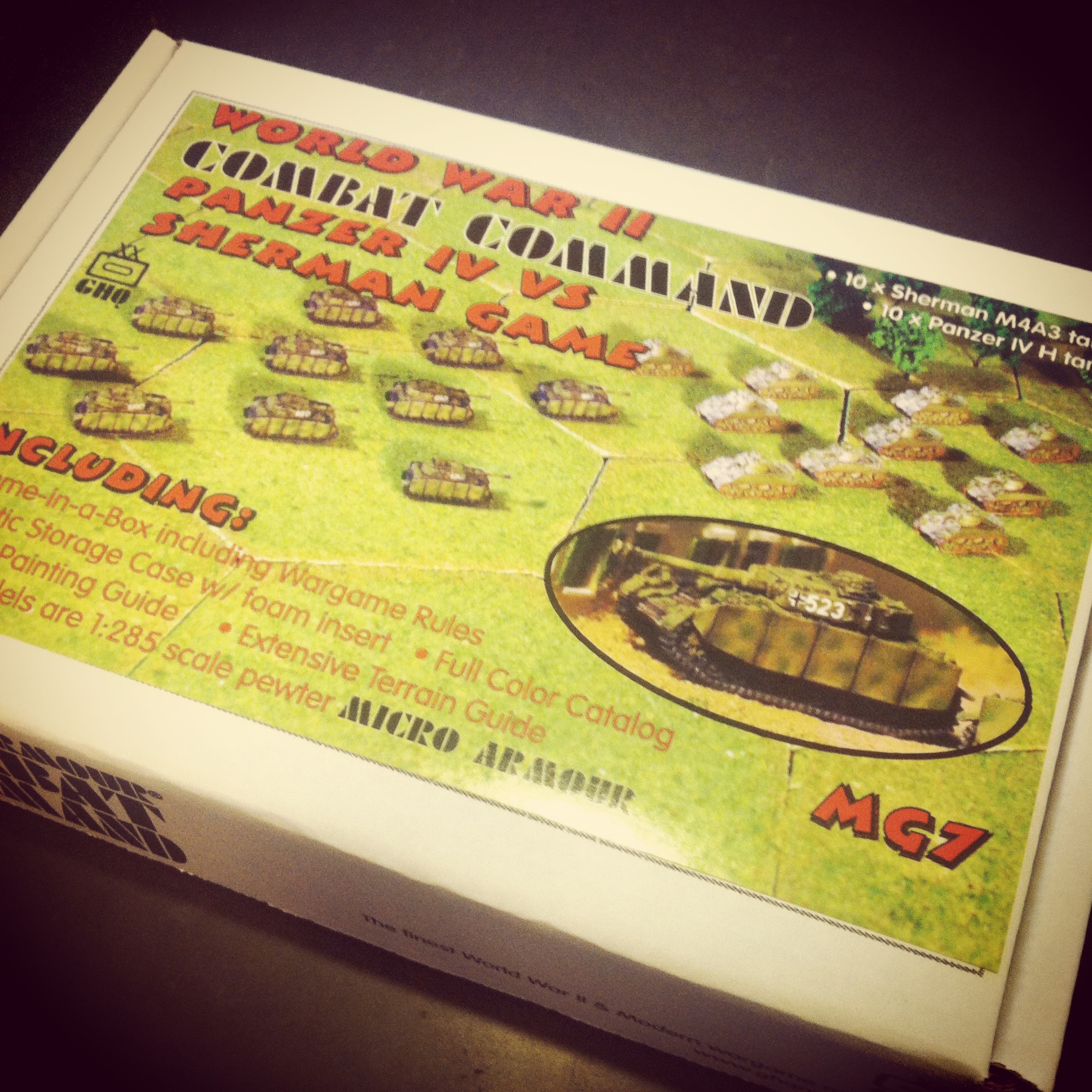
IMG_3211GHQ’s US Shermans vs. German Panzer IVs box set

IMG_3210GHQ’s US Armoured Infantry Command 1944 box set

To get started at the micro scale, I ordered two sets from GHQ. The Shermans vs. Panzer IVs Battle Box comes with ten tanks per side, a storage case and a set of rules — everything needed to get a game started. To this, I added the US Armoured Infantry Command 1944 set with additional tanks, half-tracks, jeeps, armoured cars and a bunch of infantry. To get some Germans into action, I think I’ll be going for the German Kampfgruppe 1944 for a nice mix of infantry, transport, Marders and even some horse and wagon teams.

IMG_3214Assembly of my first GHQ micro armour sets

In well under less than an hour’s initial work, my first sets of micro armour glued up fast with some careful organization of parts and assembly with superglue and tweezers. Already I’m loving getting so many models ready for paint and then on to the table in no time at all. The saying is “go big or go home” but my new micro armour project looks like its already going to be a massive amount of fun in a very small package.

Flames of War: Lingevres 1944 Scenario

lingevres1944

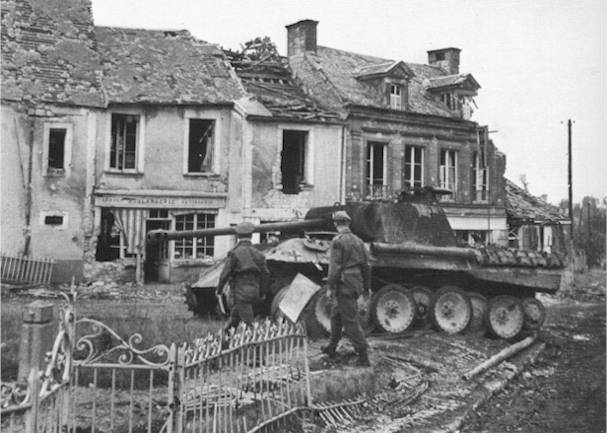
By D-Day +8 on June 14, 1944, the British 50th Infantry Division had pressed about 5 miles inland from Gold Beach to the outskirts of Lingevres. Dug in at the town were elements from the Panzer Lehr Division with several Panther tanks ready to force back the looming British attack. With 6-pdr anti-tank guns in tow, the British pushed into town mid-morning following a bombardment by 25-pound artillery and runs from supporting Typhoons above. A ferocious battle commenced between the 4th/7th Royal Dragoon Guards and the German Panthers. When the smoke cleared, several Panthers sat burning as victims of Sherman Firefly and anti-tank gun fire. At day’s end, the British controlled Lingevres.

lingevresAT

British 6-pdr anti-tank gun deployed outside Lingevres, June 14, 1944

The WWPD website has a Lingevres scenario available which two of us adapted for play this past weekend at Metropolitan Wargamers in Brooklyn, NY. Using the scenario as a guideline, we laid out the tabletop battlefield with cornfields stretching outside the town occupying two-thirds of the table. With our 1750-point forces on each side, the Germans began with two platoons of infantry and a heavy machine gun platoon inside two buildings and the church at the center of Lingevres. The British then deployed with their artillery battery, two rifle companies and a recon patrol. All other forces were held off table, with German delayed reserves set to arrive in turn three and British reserves eligible to arrive immediately at the beginning of the game.

Victory conditions as presented were simple — the British needed to take three buildings in the town and the Germans needed to drive the British from the field. How the game played was not simple and once again revealed my need to sink more work into creating accurate, playable scenarios for FOW.

IMG_3163Germans dug in at Lingevres in the town’s buildings while British artillery and infantry deployed from the cornfields in the distance
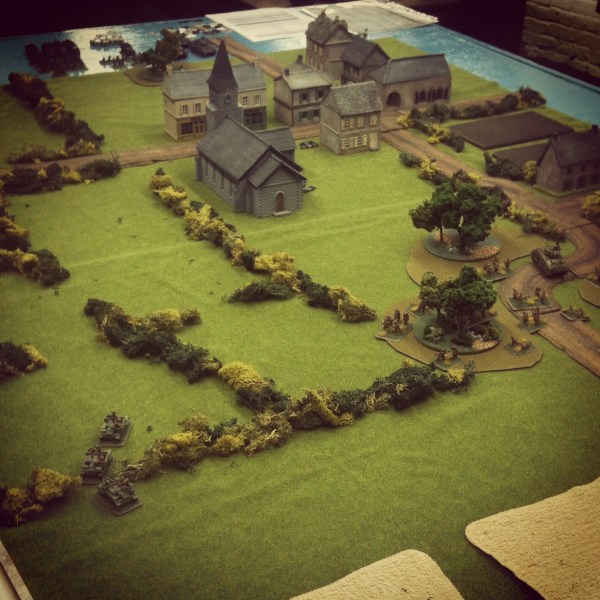
IMG_3164

Initial movement of British forces into Lingevres with recon carriers moving left and infantry moving into the woods near the church

The first two turns of the game saw the British marching from their edge of the table toward Lingevres. At the town, a German machine gun platoon sat waiting in a building at the crossroads while two other infantry platoons took up position in the church and shops across the road. By turn three, British artillery had opened fire on the machine gunners and pinned them. The first British tank platoon also rumbled onto the table, as did the German Panthers which made way for the center of town.

IMG_3165

Panther reserves roll into the center of Lingevres

IMG_3173

British infantry in the woods take fire and are pinned as armored reserves move from the rear

The first British infantry platoon made way through the woods at the center of the table but were pinned and cut down over two consecutive turns of fire from nearby Germans. The British recon patrol, edging its way through the bocaged fields near the church, was chased away with the appearance of the Panthers.

IMG_3167A British Sherman takes up position to spot for the artillery battery

IMG_3166

British infantry move from the farmhouse across the field

IMG_3169

Panthers destroy a Firefly and the Sherman spotter tank at the edge of town

IMG_3170

British infantry fall back after taking fire from the German half-tracks

On the main road to town, the British ran their Sherman spotter tank and lead Firefly toward the nearby farmhouse. On the other side of the farmhouse, a British infantry platoon moved into position using the building and nearby bocage as cover as they made way for the open field. The heavy British push around the farm was stymied with the arrival of German halftracks which fired machine guns into the field. By turn five, the Sherman spotter tank and spearheading Firefly also lay in flames after some quick shots from the German Panthers.

IMG_3168

British machine gun carriers and tank reserves roll on

IMG_3171

Armored reserves move to support infantry

IMG_3172 British infantry reserves move in near their artillery battery

By turns six and seven the inital British assualt had been repulsed at a safe distance from town. All German infantry platoons remained safely bunkered up in the town’s buildings, and the spotter for the German’s reserve 12cm mortar platoon was now camped out in the church’s bell tower. The three Panthers prowled back and forth at the center of town, and the incoming fire from the British artillery in the distance was the only real agitation to the occupying Germans. The Britsh rolled on their final reserves of machine gun carriers, Sherman/Firefly tanks and a fresh infantry platoon.

Even with all reserves on the table, the British attack was stumped. With one rifle platoon destroyed and a second whittled down, the British had just one intact infantry platoon on the field. One tank platoon struggled through the fields to one side of town, while the second sat idling on the road to town. Clear lines of fire around the church and town center presented open killing zones for the Germans in the town’s buidings and the three Panthers. All the Germans needed to do was sit in place and mow down the coming British.

I love playing wargames for historical scenarios, but our game this past weekend at Lingevres presented some serious limitations to the FOW rules as written. Playing an even match of 1750-point forces per side ultimately did not allow for a satisfying game for either player. What works for a head’s up FOW tournament game or randomly-rolled mission simply does not play well in recreating historic engagements.

In our Lingevres game, the British simply didn’t have enough units to create a critical mass to advance into town under what was sure to be withering fire from the Germans. We decided we liked the scenario, but perhaps the British needed a 50% increase in points, perhaps with additional rifle and tank platoons and a Typhoon providing air support.

With a three-day D-Day weekend being planned at our club this June, we’ve got multiple historic airborne, beach and inland fights to sketch out in the coming months. There’s going to be a lot of playtesting and tweaking to get our historic games to play well. With wargaming, striking the balance between a game that provides both historic accuracy and the potential for different outcomes is the real challenge that lies beyond just the roll fo the dice.