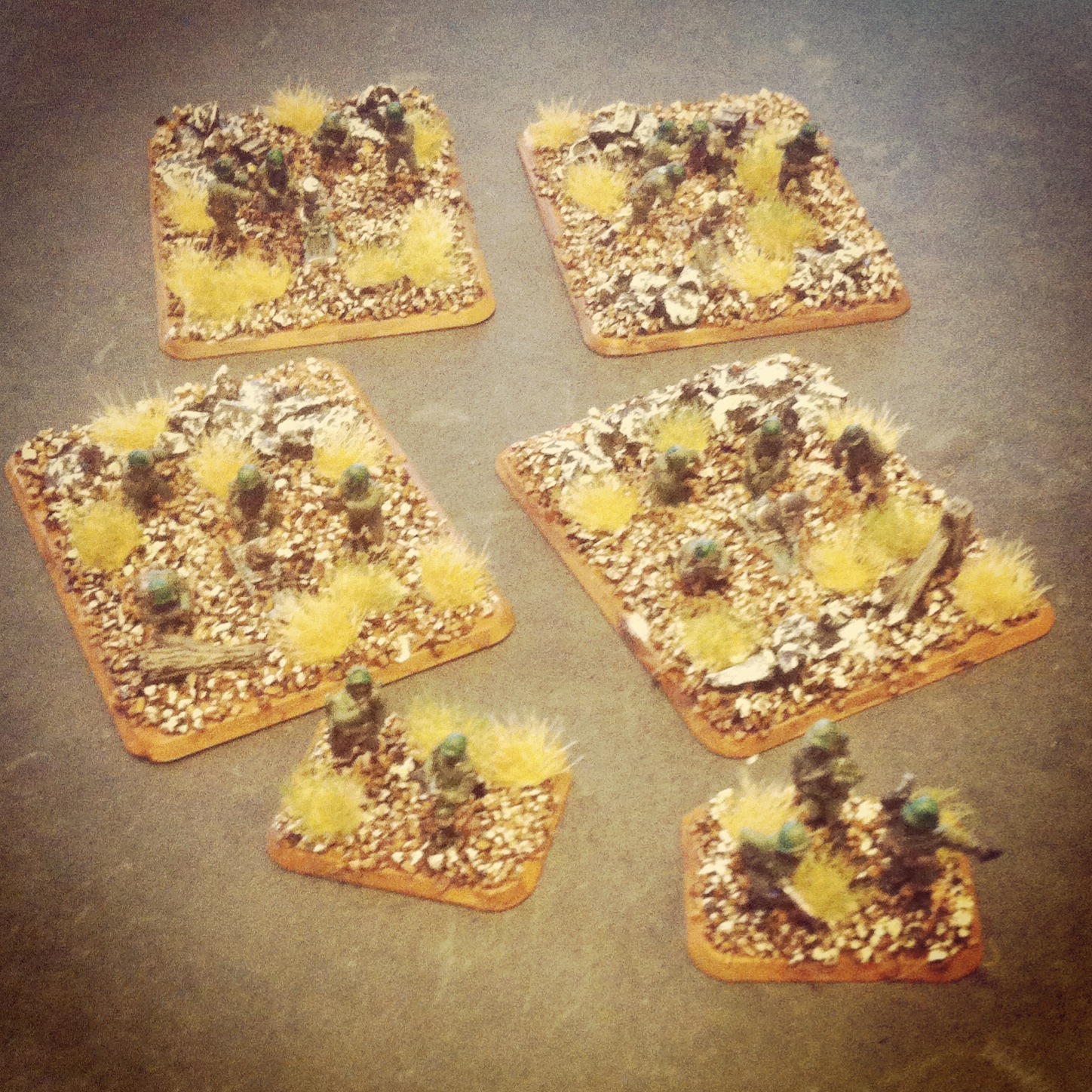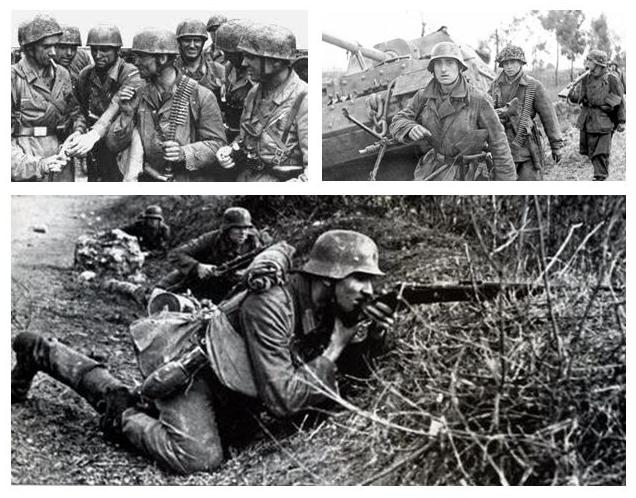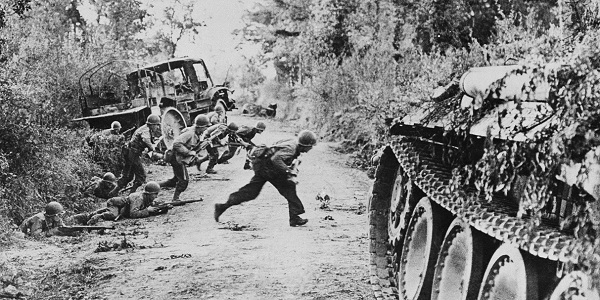
I Ain’t Been Shot Mum: Panzer Lehr Counterattack Campaign – ‘Hauts-Vents’ July 10, 1944 Scenario

NearStLo

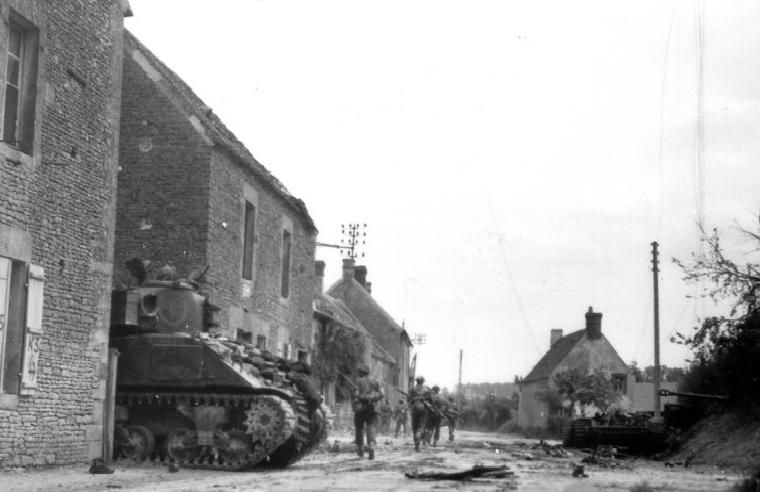
Although the Panzer Lehr Division was held out of action during the Allied D-Day landing at Normandy in June 1944 , they would go on to provide a number of important defensive, delaying and counterattack actions in the months following. They first distinguished themselves in the days immediately after, throwing up a hasty defense at Caen against encroaching British and Canadian forces. After battles at Tilly-sur-Seulles and Villers Bocage in mid-to-late June, the vastly depleted Panzer Lehr Division was called out of the fight. With only a short time to regroup, the war-worn division was ordered west to countetattack he Allied inland progress toward Saint-Lo. While the June battles had run the Germans up against British Commonwealth forces, the July engagements in the hilly fields and bocage-lined roads would be against the armored and infantry forces of the United States.

PLCounterattackJul44Map

Map of the Panzer Lehr Division counterattack in July 1944

(via US Army Center of Military History)

For a few months now at Metropolitan Wargamers in Brooklyn, NY, we’ve been playing a fair amount of I Ain’t Been Shot Mum rules system for World War II. After a number of one-offs and our recent North of Caen game, we finally decided to jump into a mini campaign focusing on the Allied push inland toward St Lo and the German defense following the D-Day landings in  Normandy in June 1944.

SCHeroesofOmahaSkirmish Campaigns  “Heroes of Omaha and Panzer Lehr” scenario book

For our campaign, we’re using the classic Heroes of Omaha and Panzer Lehr scenario book from Skirmish Campaigns. The Skirmish Campaigns series of books offers well-researched and detailed campaign scenarios full of detailed orders of battle, terrain layout maps and deeply descriptive narrative of how actual engagements unfolded during World War II. With just a little bit of work, the Skirmish Campaigns scenarios are easily adaptable to a variety of wargaming rules and scales including Battleground, Bolt Action, Flames of War and I Ain’t Been Shot Mum.

IMG_4207

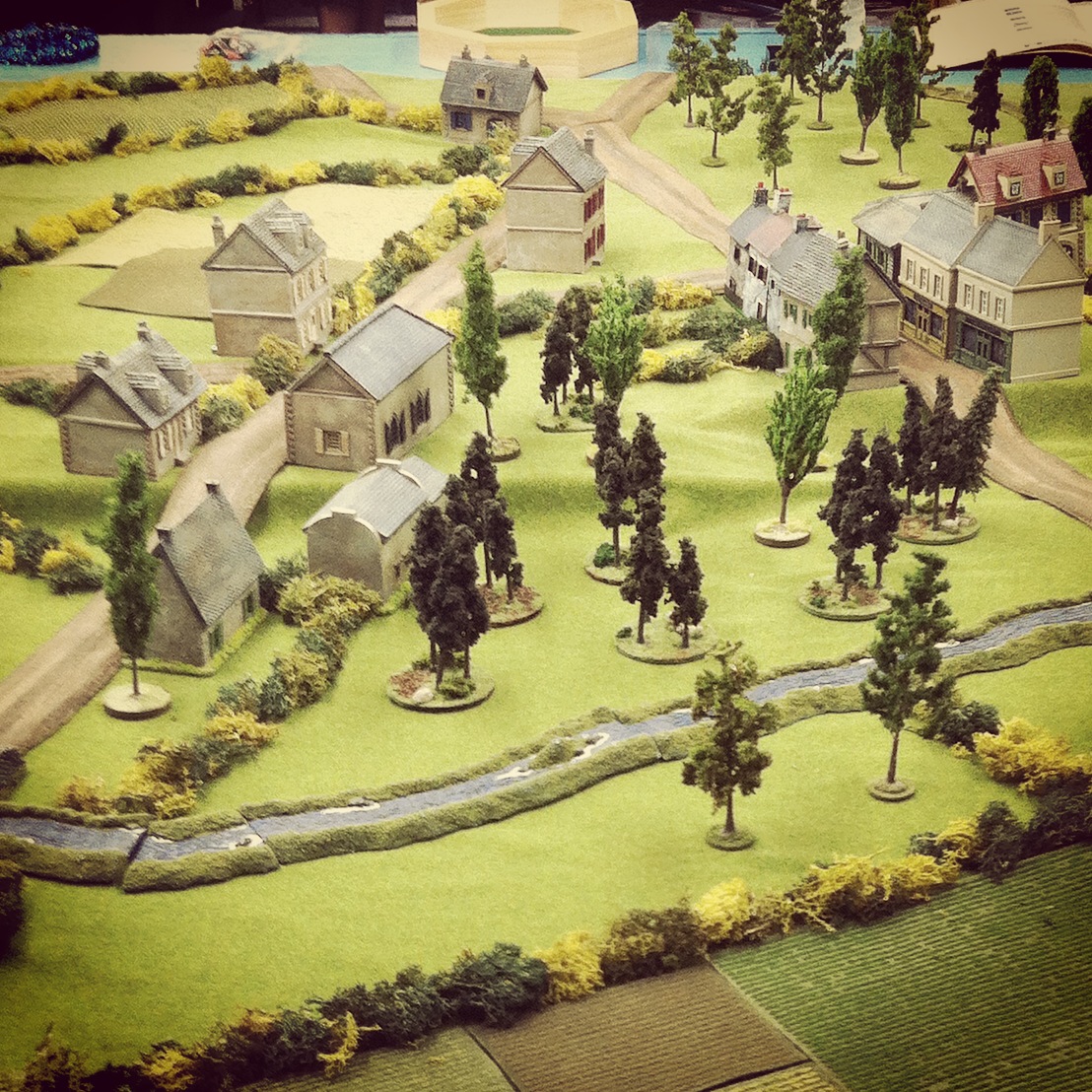
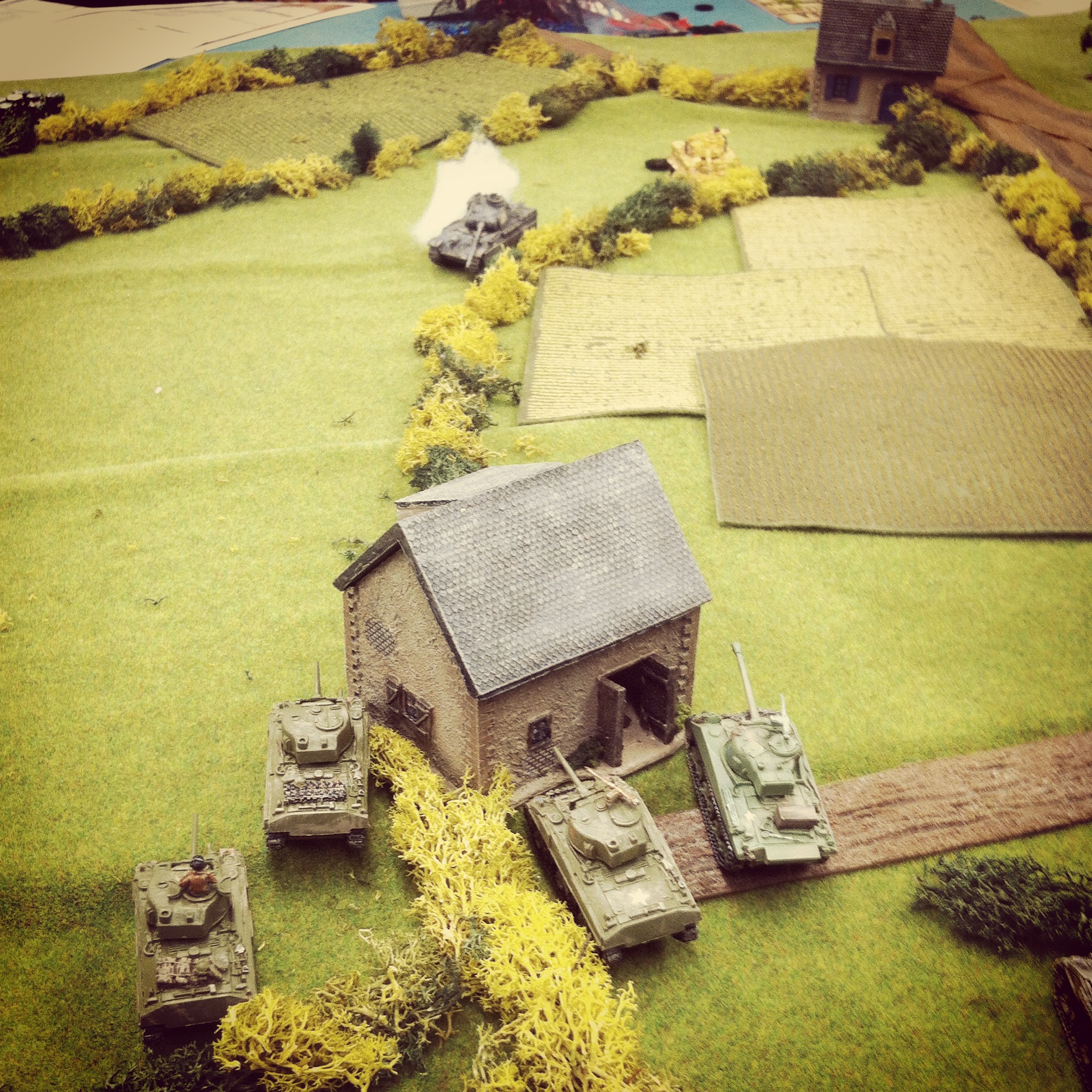
Scenario set-up with two small houses as objectives at the middle of the table set amid rolling hills, small farms and thick bocage

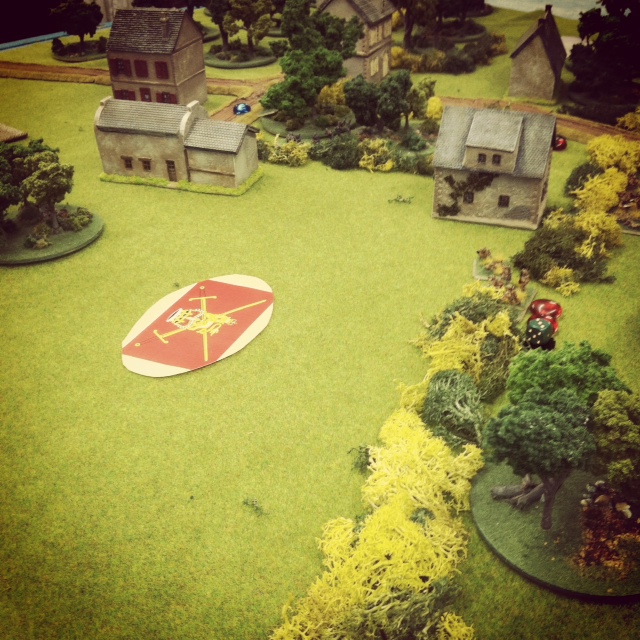
The scenario at Hauts-Vents is set up on a long table with hills rolling into a valley from either end. Roads cross the table among fields lined with heavy bocage hedgerows. At the center of the table are two farmhouse objectives that are the focus of the US mission. All German platoons are deployed on blinds nearly everywhere on the table, accepting the northeast corner from which the US advance begins.

My Germans deployed on blinds with a Pak 40, a Sdkfz 10/1 and an artillery spotter for the off-board 105mm artillery deployed around a farmhouse atop Hill 91 on the southern end of the table. German rifle platoons armed with Panzerfausts deployed in blinds in and around the objective farmhouses. One platoon also had a MG42 and another contained a Panzerschrek anti-tank team. To block the predicted US advance, one road was blocked with barbed wire and another was laid with mines.

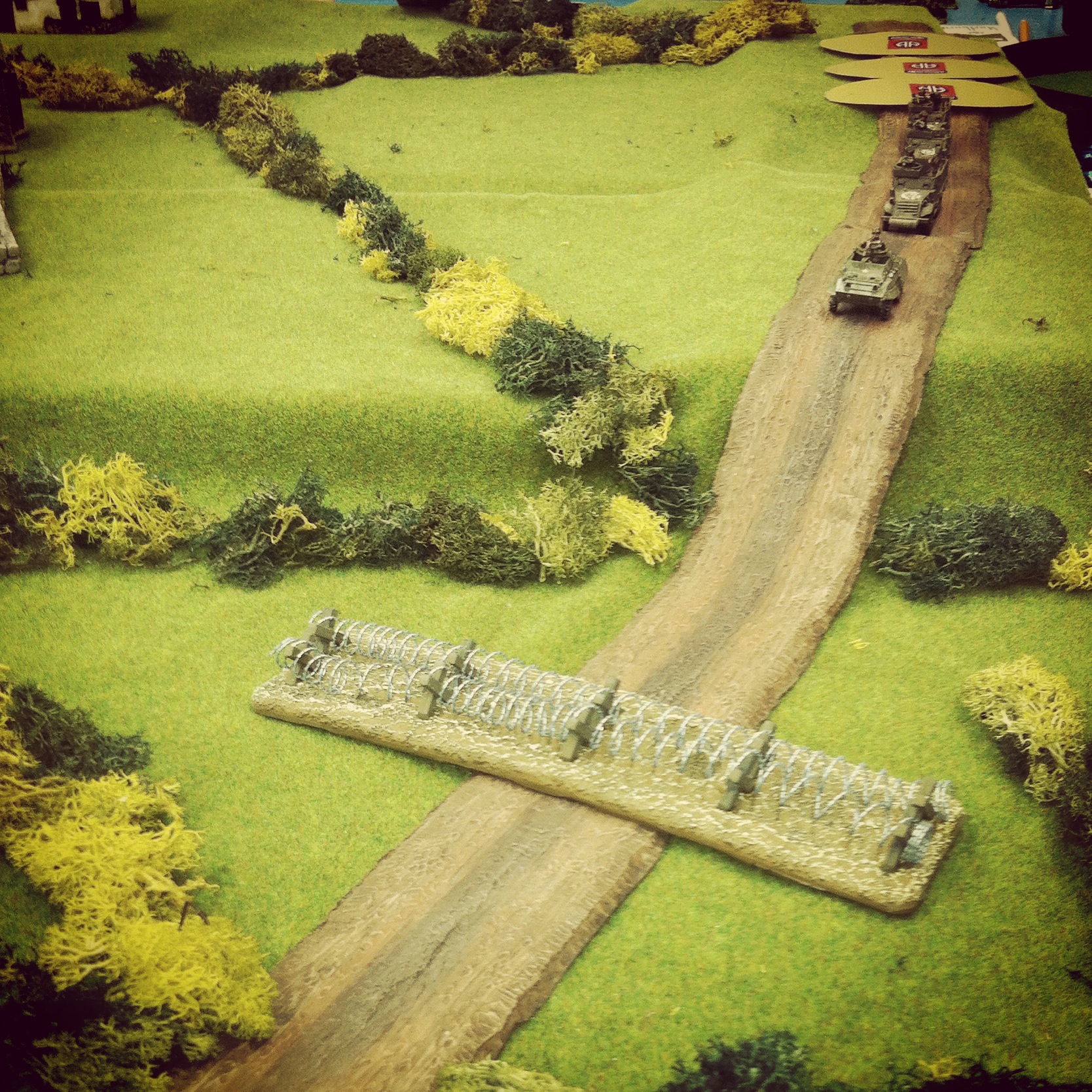
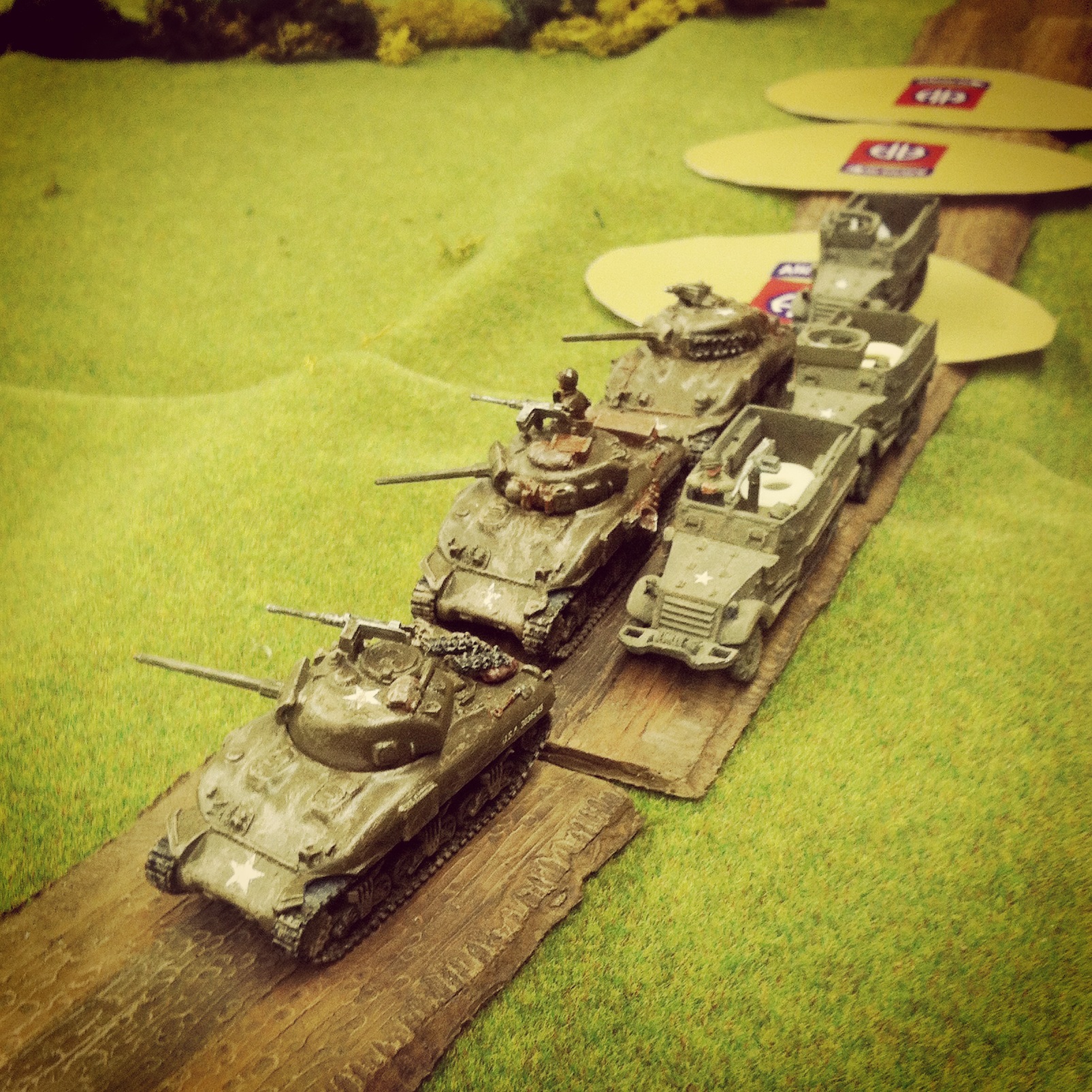
The American blinds moved in straight in column along the road sloping down toward the valley. Heading the advance was a US recon platoon led by an M8 Greyhound armored car. Three platoons of mechanized infantry loaded up in half tracks and a platoon of Sherman tanks fell into line behind.
IMG_4210

A US recon Greyhound at the head of the column exposes barbed wire laid to block passage on the road to the objectives
IMG_4212

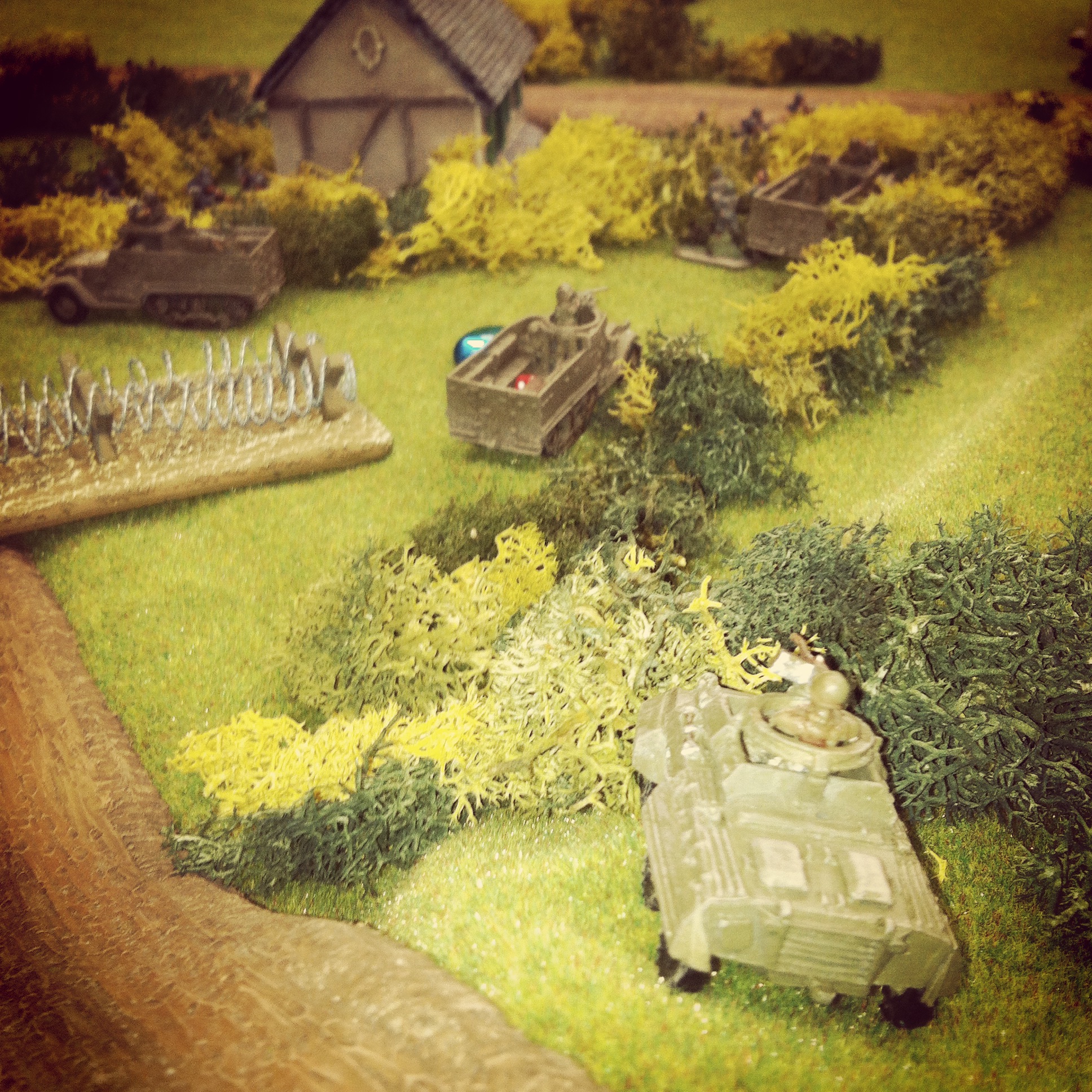
The recon unit moves to overlook the German position near the objective house as US half tracks roll into position

IMG_4211

 German infantry move out of the house to engage the US infantry

IMG_4213Fire from German Panzerfausts destroy two half tracks and their passengers

IMG_4215

Germans use their last Panzerfausts to destroy the remaining half track and its crew

The first few turns progressed quickly with the US column moving down the road under blinds while the Germans quietly defended from concealed positions. The lead Greyhound revealed the barbed wire blocking the road, forcing the first platoon of half tracks off the road toward the first objective. Closing in on the house, the German position was revealed and the Germans quickly destroyed two half tracks and their mounted infantry with shots from Panzerfausts. In subsequent turns, the US commander jumped from his vehicle and was followed in by the final half track which was also destroyed. With the lone US commander in the position, the Germans assaulted taking casualties before eliminating all Americans from the disastrous head-on assault on the objective.
IMG_4214

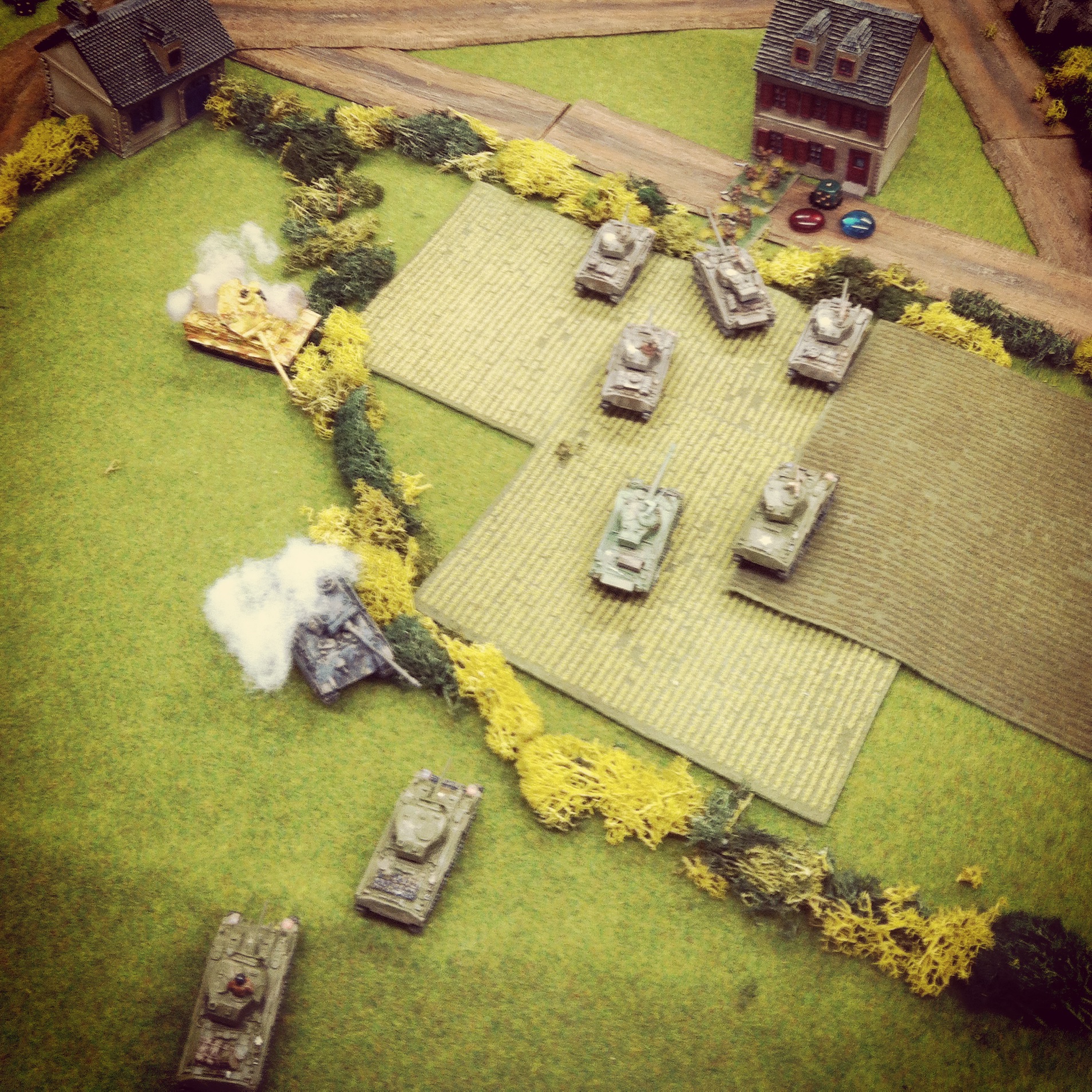
 The column of US Shermans and infantry mounted in half tracks rush down the road
IMG_4216

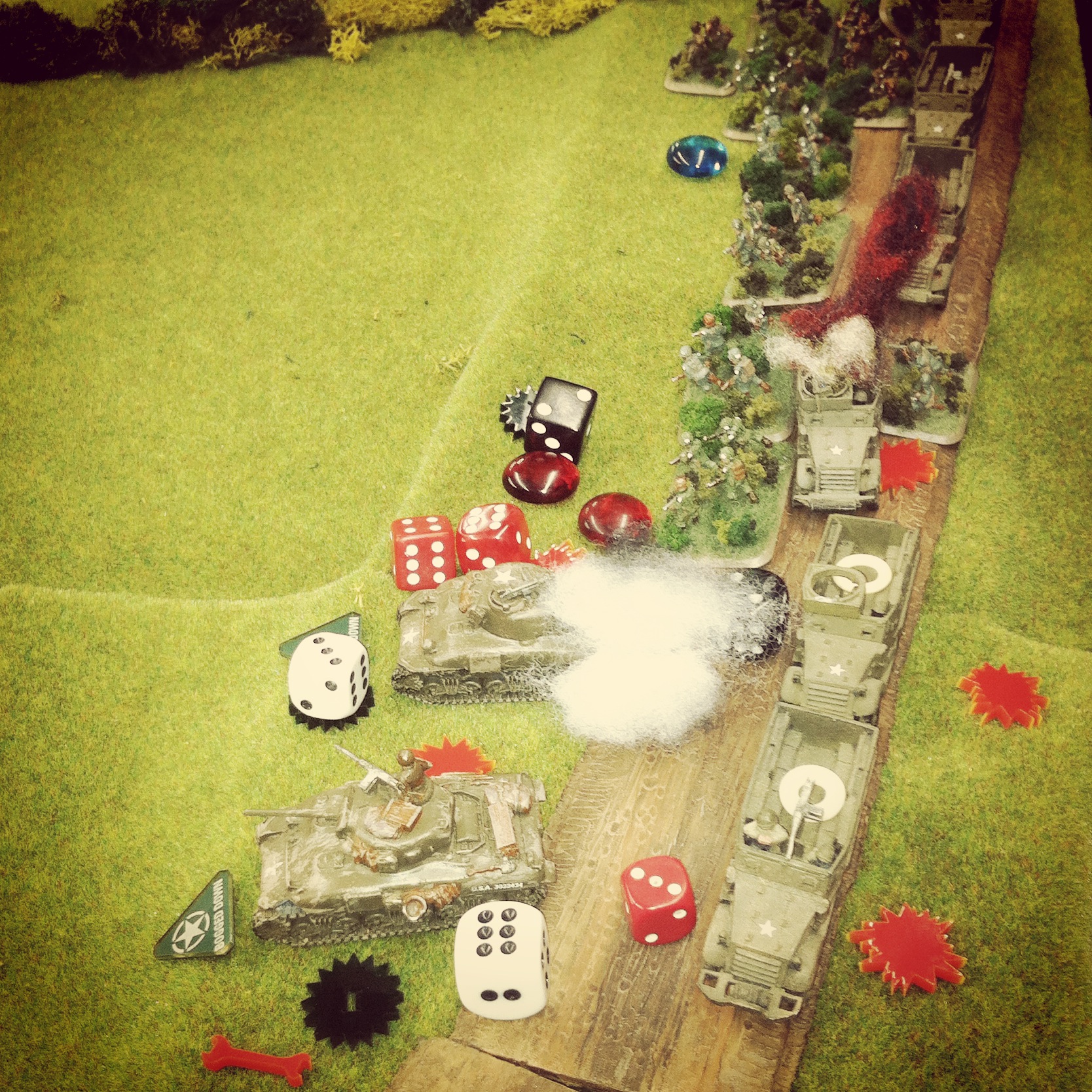
German 105mm artillery rains in from off the table wreaking havoc on the US column

IMG_4217

A German Pak 40 and Sdkfz 10/1 break their cover on Hill 91 to engage the paralyzed American column

As the first platoon of US infantry fell, the remainder of the column ran into problems of their own. The Shermans attempted a push into the field off the road but two of the three quickly bogged in the rain-soaked ground. With the Shermans stalled and the rest of the column bunched-up on the road, an off-board German 105mm artillery barrage made a direct hit to the US line. As a result, the tanks took severe damage to their sights, main guns and mobility. Infantry jumped from their half tracks and one platoon took immediate fire from German MG42s hidden in the bocage across the nearby field. As the Americans desperately attempted to spread out and move to cover, additional rounds of fire from the Pak 40 and Sdkfz 10/1 on the far hill continued to pour shots into the remnants of the burning US column.

IMG_4218

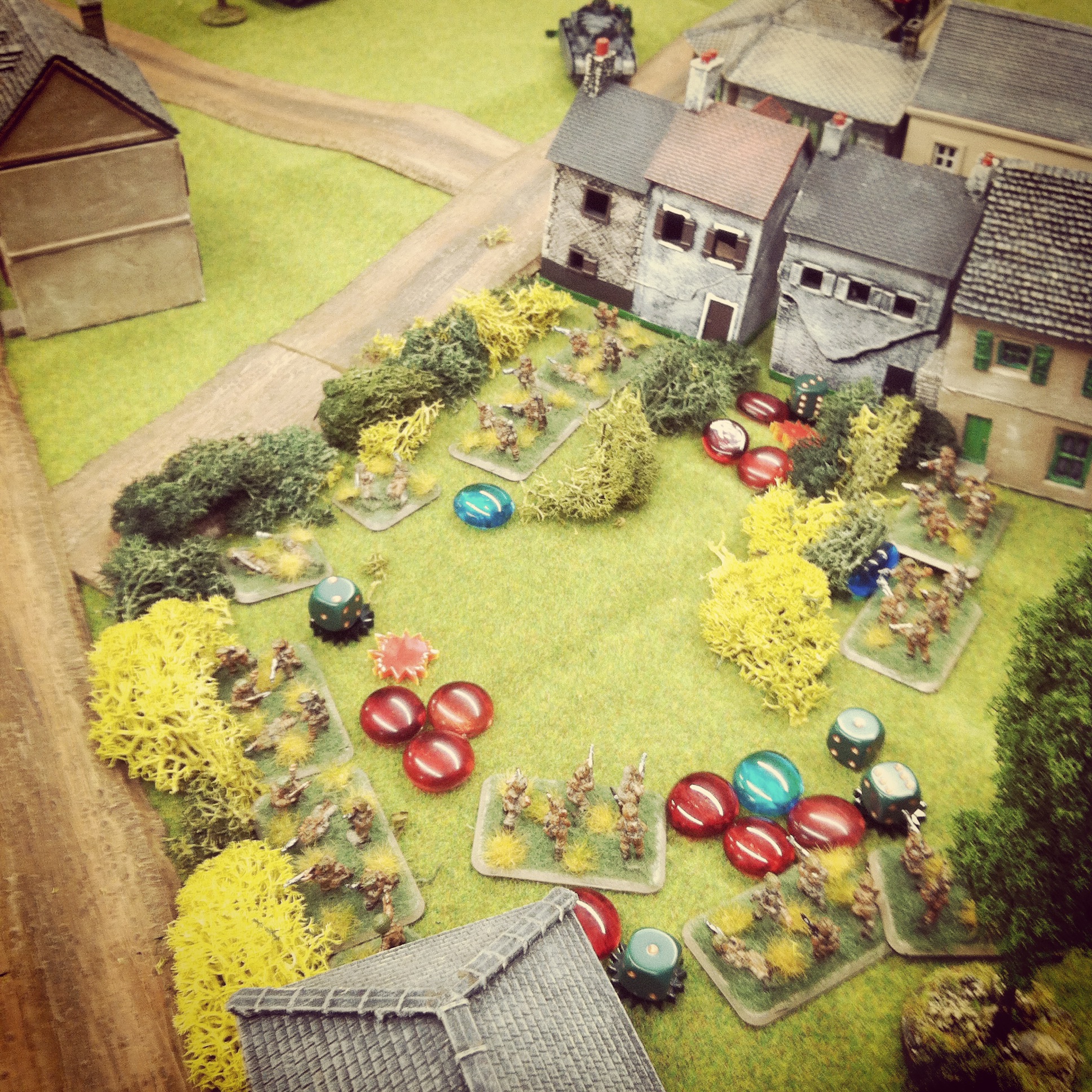
 US reinforcements arrive at the house and advance on the defending German left

IMG_4220

Germans attempt to hold the flank at the objective

IMG_4219

Smoke is laid down in front of the German position on Hill 91 to cover the US advance

IMG_4245A late game push up Hill 91 by the US Greyhound leaves it in flames

The survivors from the US column swiftly moved to position themselves for another round of assaults on the German position. Two surviving Shermans unbogged and rolled to position along the bocage, destroying the MG42 positions along the way. US infantry rushed in along both flanks of the German survivors at the farmhouse who were quickly reduced to a single operable fire team. US mortars followed up with a directly aimed smoke bombardment in front of the German guns on the hill, providing invaluable cover for the American ground advance. Pressure from the advancing Greyhound forced the Sdkfz 10/1 to fall back late in the game. As the armored car breached the crest of the hill, a quick shot from the Pak 40 eliminated it. Unfortunately for the Germans, this was one of their last bits of glory for the game.
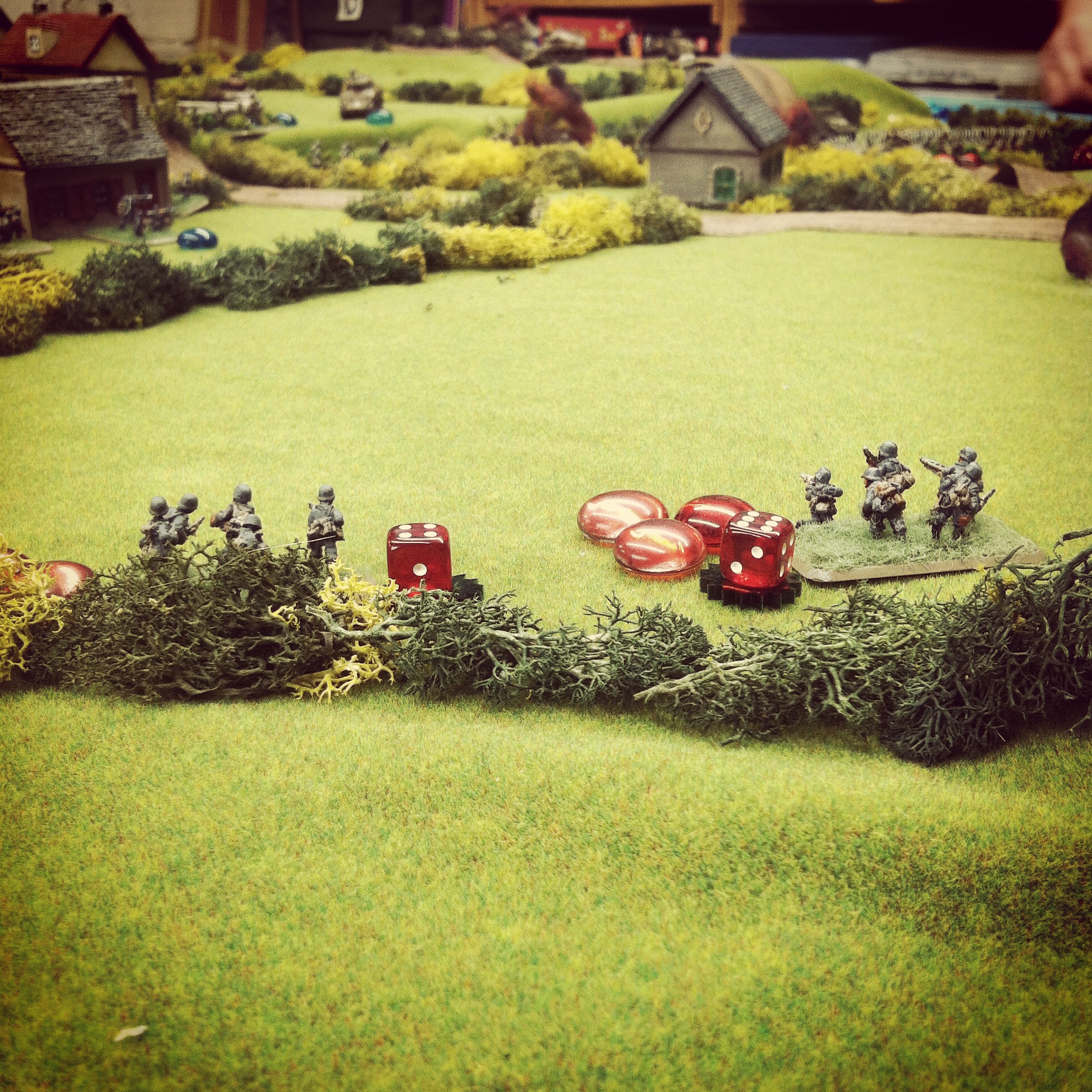
IMG_4242German defenders get routed at the first objective during close assault and fall back
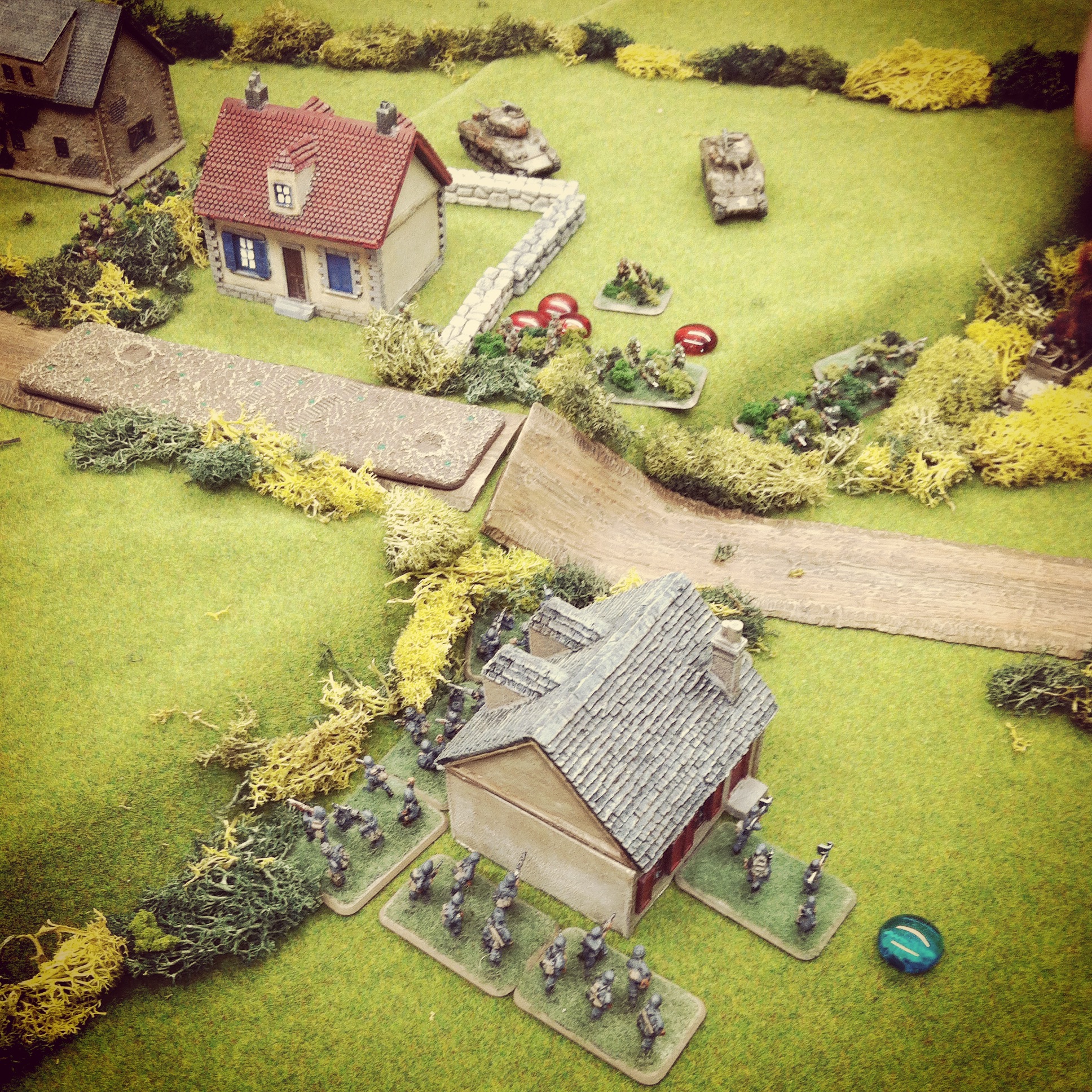
IMG_4243The last platoon of German defenders get spotted at the second objective

IMG_4244The final objective falls to the Americans as the German defenders are caught in combined infantry and artillery fire

Back at the two objectives, the US moved hard toward victory. A close assault at the first house sent the survivors of two German fire teams running for the rear with heavy casualties and all but eliminated from the game. With that, one lone German platoon was exposed at the second house objective, and all US focus turned toward them. Two turns of heavy US artillery strikes and small arms fire from the bocage across the road laid waste to all but a few of the last Germans holding out. With the US Shermans still working their way on the German left and US infantry closing on the front, my Germans threw up their hands in defeat.

The first day of battle at Hauts-Vents went to the Americans, but as dark was drawing near, another battle was already looming before dawn as more Germans rushed to the defense.

I Ain’t Been Shot Mum: North of Caen 1944 Scenario

BritsCaen1944The city of Caen presented a big target during the Allied invasion of Normandy in June 1944. One of the larger cities in the region of the invasion, it also occupied an important series of crossroads straddling the Orne River. Less than ten miles from the British Commonwealth forces landing zone of Sword Beach, Caen was a target for British and Canadians wading ashore on June 6th. Despite a relatively easy landing at the beach, Allies with their eye on Caen were met with a hastily-organized armored counterattack from the German 21st Panzer Division. By the end of the day, the British sat just halfway to their objective and Caen remained in Axis control.

CaenMap1944Map of the Battle for Caen, July 8-9 1944

Over the next two months, the area around Caen became a bogged-down front as Anglo-Canadian forces positioned themselves around the city. The eventual capture of the city on August 6th was costly for all involved. The ancient city was nearly leveled with Allied bombing campaigns and much of the French civilian population fled. The British forces suffered around 50,000 casualties, a devastating loss of men and equipment for British commander Bernard Montgomery. With the costly British victory, it had achieved not only the occupation of Caen but had also provided an enormous distraction for German forces which suffered even greater losses than the Allies.

iabsmlogo

This past weekend at Metropolitan Wargamers in Brooklyn, NY, a couple of us ran through a non-historical scenario typical of the British-Germany engagements just north of Caen in early July 1944. The “North of Caen” scenario is provided in the basic rule book for I Ain’t Been Shot Mum, the fantastic company-level World War II game that has fast become a favorite for some of us at the club.

Caen1British infantry advance through an orchard under blinds north of Caen

The small infantry engagement is set in the fictional hamlet of Le Moulin on a table of flat, open terrain with fields, orchards, low hedge rows and five stone buildings set at a crossroads. The game begins with three British infantry platoons entering from the north under blinds after an initial off-board artillery bombardment of the Germans dug under in around the farm and crossroads. The objective of the game is for the Germans to eliminate the British advance while the British are tasked with seizing four of the five buildings or otherwise eliminating the German troops.

Caen2A British rifle platoon takes heavy German MG42 fire and is pinned behind a barn

Following my initial bombardment, my British advanced under blinds for a few turns through the orchard northeast of the crossroads. The German blinds positioned themselves in a wood at the crossroads and in a small orchard southwest of the hamlet. Three of my blinds moved toward cover to my left behind a barn while my third false blind moved toward the road. My first blind was spotted behind the barn by a German platoon armed with three rifle sections and a deadly MG42. With the Germans deploying in a nearby barn and within the orchard, they opened up on the British rifles. With not enough cover behind the small barn, one British rifle section was all but eliminated in the first round of fire.

Caen4A British platoon runs bravely under a blind across an open field between two barns

The British survivors behind the barn returned fire, firing their rifles and 2″ mortar into the Germans in the orchards and nearby barn. In the meantime, my false blind was revealed as a second British platoon slipped to the hedge to the other side of the barn. Firing at the Germans from each side of the barn, the MG42 was forced to retreat back south of the crossroads. But the damage had been done to my first platoon at the barn, and two fire teams fell back to the orchard leaving one safely inside the barn. Sensing a brief opening, my final blind sprinted across the wide open field between the barn.

Caen3The British blind is exposed, take fire and break for hedge in the distance

Midway through the field, the German rifles in the second barn spotted and revealed my blind, slowing their run and forcing them to deploy in the open. The final German blind revealed itself among the buildings west of the crossroads. My fresh British platoon hopped the hedges and likewise crossed to the west of the road, opening fire at the Germans in the building just the other side of a small orchard. Subsequent turns of fire were exchanged and my British losses started to pile up on my right.

Back at the field on the British left, combined rifle and mortar fire poured into the Germans in the barn. Despite shock stocking up on the Germans, their position in the barn allowed great enough cover allowing them to slowly begin wearing down the exposed British platoon which became pinned from movement. With British taking losses to the right and less against well-protected Germans in the heavy stone buildings, it was not working out as a good day for the British who ceded the tiny hamlet to the Germans. More costly days were to come after this day just north of Caen, but a month off there would be victory for the British.

Micro Armour: 6mm Miniatures Storage Boxes

WWIIquartermaster

One of the constants of being a miniatures wargamer is the ongoing quest for solutions to store your models. After hours of painting, you’ve just got to have a way to safely store and transport your tiny soldiers and tanks to and from the tabletop battlefield. Models also need to stay in order so they are easily accessible when setting up a game.  Finally, living in cramped quarters in a Brooklyn apartment with a wife and two kids also makes neat, sturdy storage solutions a must if peace and organization is to be maintained on the homefront.

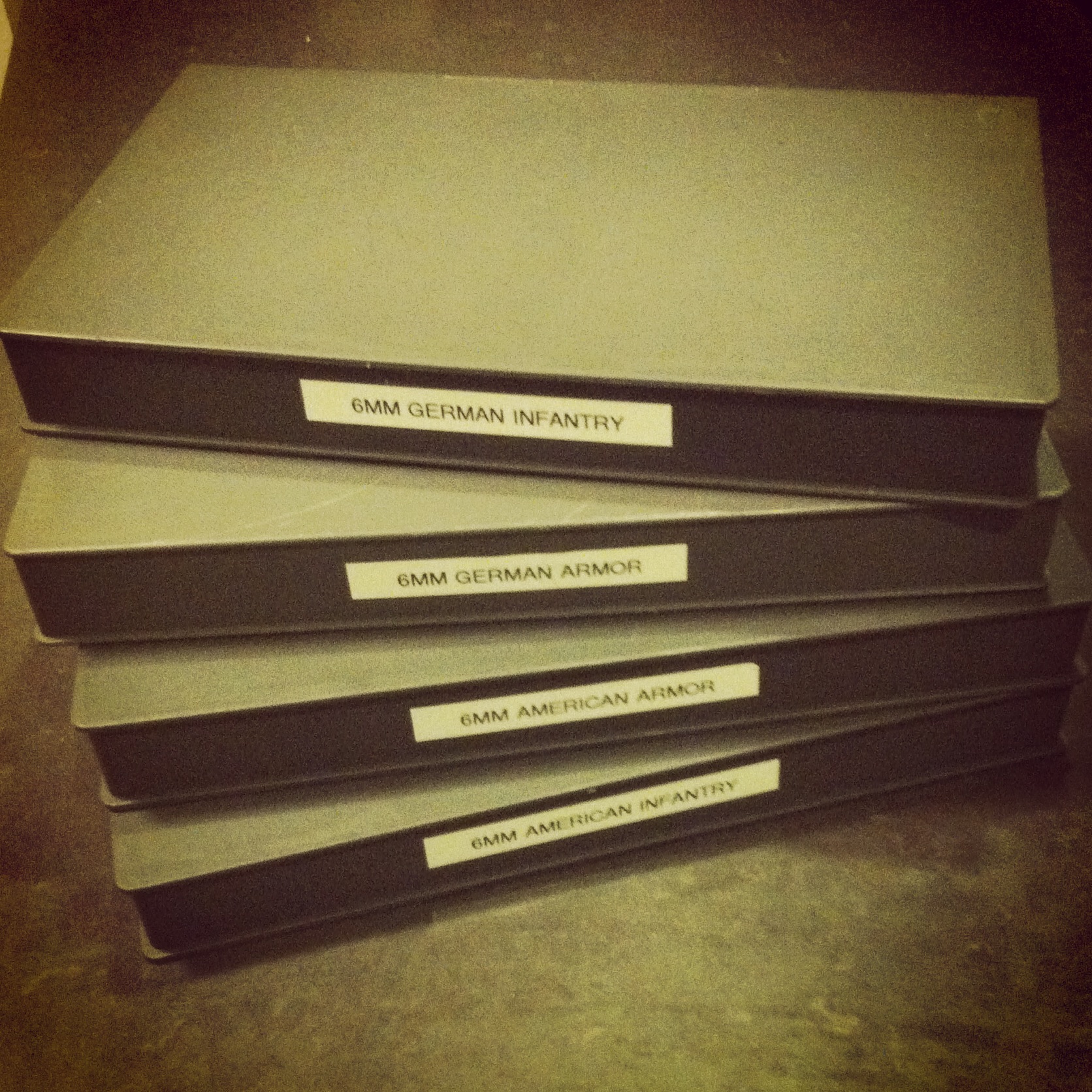
IMG_4179Storage for 6mm models using discarded plastic videotape cases

As a gamer of several decades, my eyes are constantly scanning store shelves, yard sales and piles on the curbside for discarded boxes, bins and packaging for just the right storage. On many an occasion I find myself wistfully rotating some neat container in my hands wondering if this is just the right thing to store models. Yes, storage is a bit of an obsession.

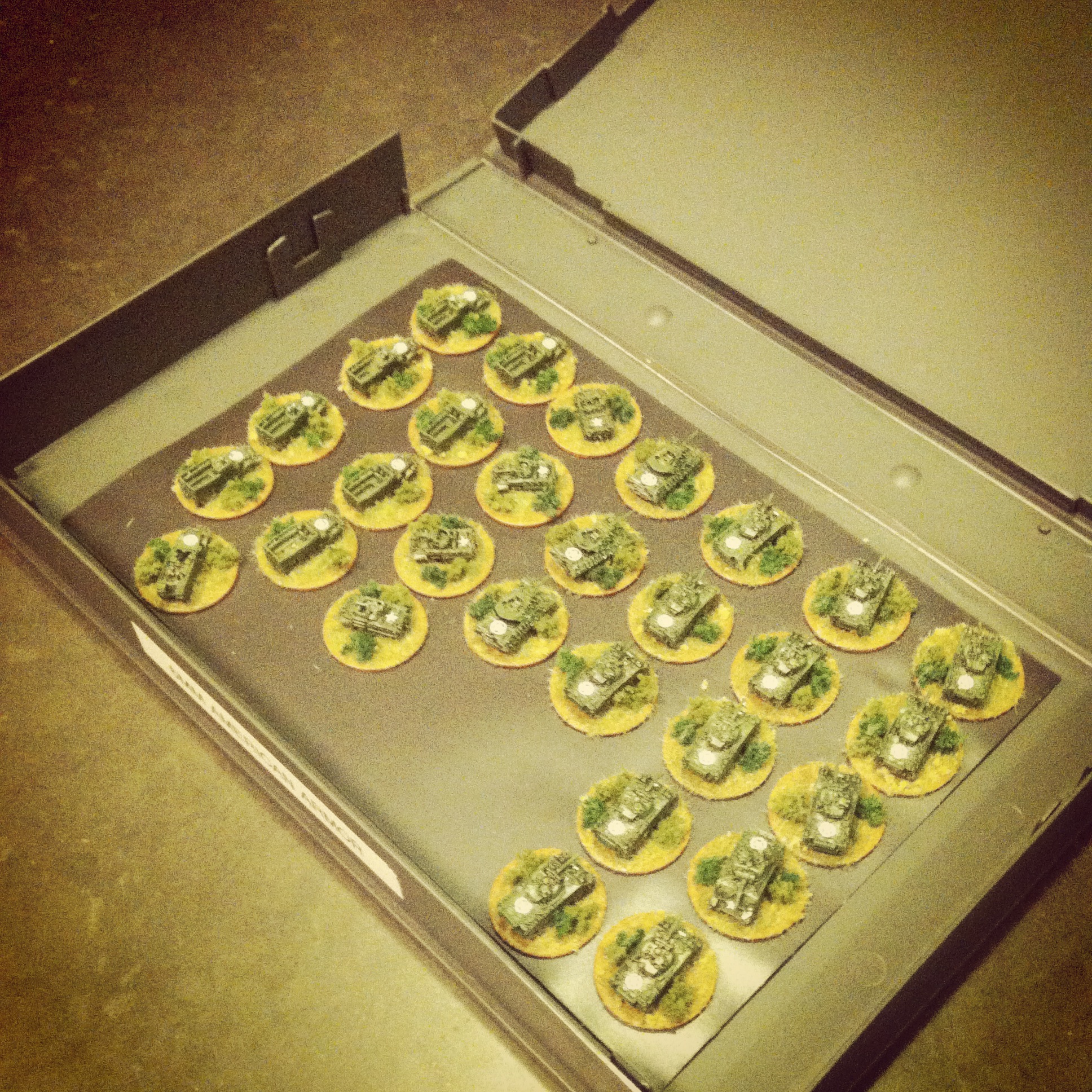
IMG_4178Magnetic sheets from an office supply store safely hold the miniatures on their metal washer bases

I work at one of the leading stock photography and film licensing companies in the world, and recently I came by two enormous rolling dumpsters sitting in a hallway by a freight elevator at the office. Spilling out of these bins were hundreds of plastic over-sized videotape cases destined for recycling. Pulling one case off the top of the pile, I realized what I was holding in my hands was just what I needed to store my newly-painted 6mm World War II micro armor models from GHQ.

IMG_4177Hinged lids and tight closure tabs make for handy access to the miniatures

After hauling a dozen of these cases home, I carefully removed old adhesive cataloging stickers and tabs before giving the cases a quick wash in the sink. A quick trip to an office supply store and about $15 later, I had some magnetic sheets and double-sided heavy-duty adhesive mounting squares. I cut a piece of magnetic sheeting to fit the bottom of each case and then affixed the sheets with the adhesive squares. Once I had a stack of boxes all made up, I labelled each case along one edge using a label maker. The labels not only clearly show what’s in each box but also help to indicate which end is up when opening the hinged lid.

IMG_4176Labels clearly mark what’s in case and allow them to be switched-out if needed

For a minimal cost, I’ve netted an easy storage solution for my 6mm models. The magnetic sheets are strong enough that I can carry the cases and even store them on end on a shelf without the models shifting around in the box. The one-piece cases with built-in hinged lids and closure tabs keep the boxes tightly closed. Everything is organized by nationality and unit type, and opening a box clearly displays the models when fielding a force for a game. As my collection grows (as any wargamer’s inevitably does), I can easily peel and replace the labels with new ones.

Cheap, sturdy and flexible — my new storage is a big victory for my little models.

New Game Weekend: Arkham Horror

ahcoverbox

Released in 1987 and then vastly revised in 2005 and 2007 by Fantasy Flight Games, Arkham Horror is one of the modern classics in horror-fantasy boardgames. This past weekend, the creatures of Arkham Horror invaded our home in Brooklyn, and my sons and I have a new favorite.

Based on the writings of H.P. Lovecraft and his Cthulhu Mythos, the game casts 2-8 players in the roles of investigators in the fictional town of Arkham, Massachusetts during the interwar period of the 1920s. The New England town has been beset by the terror of strange rumblings of monsters invading the streets accompanied by weird magic, supernatural beings and strange goings-on. The mission of the investigators is to travel through portals to Other Worlds and seal them before a great Ancient One emerges in the town. Along the way, investigators accumulate clues, arcane items, spells and skills by visiting various locations in the town. If the portals are not closed in time, the horrific Ancient One rises and squares off in a final epic battle with the investigators in a last-ditch effort to save Arkham and the world as we know it.

wtcoversIssues of Weird Tales magazine featuring the work of H.P. Lovecraft from 1927 to 1937

H.P. Lovecraft is a darling of gamers and science-fiction/horror fans, and his influence resonates throughout today’s pop culture of movies, comic books, fantasy literature and gaming. Throughout the 1920s and 1930s, Lovecraft published a series of short stories broadly placed in the weird fiction category combining elements of horror, science fiction, fantasy and crime genres. With its troubling themes of peril and unknown, weird fiction was perfectly suited for a broad mindset of American society just emerging from World War I, living through the Great Depression and watching the storm clouds of World War II gather on the horizon.

Weird fiction found a home with the cheap pulp-paper magazines popular in the first half of the 20th-century including dozens of titles such as Argosy Magazine, Amazing Stories, Western Story Magazine and Weird Tales. Within their wondrous and often racy covers, pulp magazines featured everything from western adventures, jungle stories, Victorian detective tales, sword and sorcery plots and science-fiction wonders. Authors such as Arthur Conan Doyle, Robert E. Howard, Edgar Rice Burroughs and Lovecraft could all be found side-by-side within these magazines. The stories from pulp magazines were of profound influence on countless later 20th-century writers and directors, perhaps most famously with Steven Spielberg and George Lucas. As kids in the 1970s and 80s, reprints of many of these pulp tales filled the heads of my circle of friends and informed our lifelong interests in all things weird and fantastic.

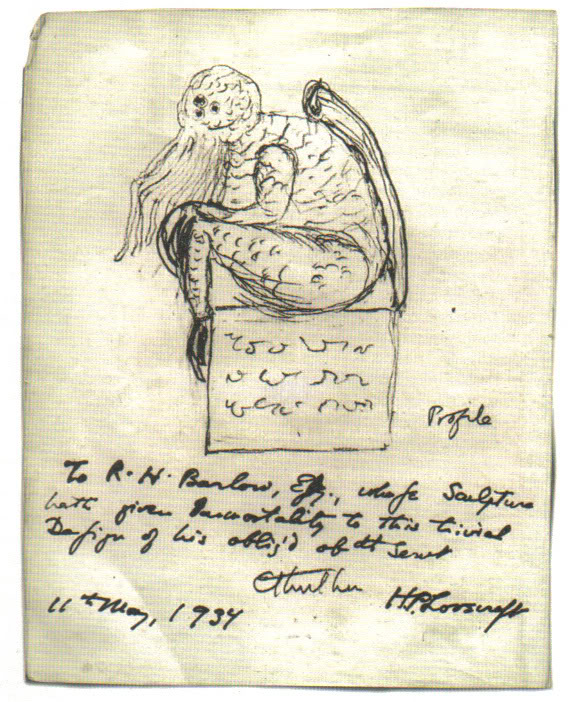
CsketchA 1934 sketch of Cthulhu by H.P. Lovecraft

One of Lovecraft’s most enduring stories, The Call of Cthulhu, was first published in Weird Tales in February 1928. The story recounts a mystery of an ancient cult of a mythic tentacled beast known as Cthulhu and the worldwide quest to uncover its origins and its new rise to plague the modern world. Through subsequent stories by Lovecraft and other writers, the world of the Cthulhu stories grew to be dizzyingly expansive in it depth of detail and plot. Today, Lovecraft’s Cthulhu universe serves as an insidery geek shorthand that stretches from stories, games, comic books and compendium reference books to clothing, statuettes, cupcakes, tattoos, jewelry and countless other collectibles.

10649826_10203907450141018_1116891535581886976_nArkham Horror from Fantasy Flight Games gets unboxed at our house

My older son recently scored a free copy of Arkham Horror after serving as a counselor in training during the summer day camp program at Brooklyn Game Lab, and we jumped into a full weekend of playing this wonderful game. People familiar with products from Fantasy Flight Games will find a box of incredibly well-designed pieces, with a richly-illustrated game board and hundreds of cards, playing pieces and reference sheets. The rules are daunting and require several plays to wrap one’s head around, but eventually Arkham Horror moves along briskly in a couple hours of gaming.

The game is basically a race against time until the Ancient One awakens to destroy the town. Much like an adventuring party in role-playing games like Dungeons & Dragons, players choose to play as one or two of sixteen roles such as a researcher, magician, gangster, nun, archaeologist or drifter. Each character begins with set standard and specialized equipment, money, spells, skills and allies laid out on a card depicting base abilities. The abilities — speed, sneak, luck, lore, will and fight — are each measured on a track that allows a player to boost or lesson their effectiveness at the beginning of each turn. Players move to various locations within Arkham where they find clues, engage in encounters or perform other actions like healing at the hospital, hiring allies at the boarding house or shopping for items at the general store or curiosity shop. Armed with items, skills and spells, characters either engage in combat with revealed monsters or attempt to slip by them. Taking damage from monsters or other encounters reduces an investigator’s Stamina (ie, health or hit points) or Sanity, driving the player closer and closer to death or madness.

At the end of each player round, a Mythos card is revealed opening a new portal to the Other Worlds, spawning new monsters and moving monsters already in the town. A character moving to a portal spends two turns journeying in one of eight Other Worlds where they may encounter more monsters or find objects. Upon emerging from the Other World, a character attempts to close or even seal the portal at the location. Each turn, the Ancient One moves on step closer to awakening. Players must either close or seal a set number of portals before the Ancient One arises for a final battle with all the players.

10639448_10203907820550278_4188666163549777050_nArkham Horror laid out for our first games this past weekend

 Like Lovecraft’s written work, there is an enormous amount of story in Arkham Horror. The game plays like a rich role-playing game with backstories on the investigator characters and detailed information on the various cards and monster pieces. Since the game is collaborative, everyone either wins or loses, making collective planning and playing to each character’s evolving set of equipment and abilities a must. For instance, certain characters may be more adept at moving quickly and acquiring valuable items while other characters may be better suited to go to battle with physical or magical beasts. In a battle with the Ancient One, the collective strengths of the entire group will combine to have any hope against defeating the creature and saving Arkham.

My sons — ages 14 and 9 — played three games of Arkham Horror with me this past weekend, and it’s a big hit at our house. We’re all fairly experienced gamers and we’ve logged many hours with some pretty heavy boardgames like Civilization, also from Fantasy Flight Games. Arkham Horror is suggested for ages 12 and up, and the flavor text on the game cards and mechanics were a bit on the challenging side for my younger son. With that said, with a little help on the heftier vocabulary words, he enjoyed the story, collecting items and using various combinations of gear, spells and skills to destroy some monsters and seal portals to the Other World. By the end of the weekend, my older son and I also started getting a handle on using characters in combination to effectively work through the rising tide of beasts and terror in the town. No matter the age, Arkham Horror is going to push any gamer’s skill and sanity to the limit.
I Ain’t Been Shot Mum: Saint Lambert-Sur-Dives 1944 Scenario

stlambertsurdives1944Just over two months after the Allied D-Day landings, the Normandy campaign marched toward a conclusion at the Battle of the Falaise Pocket in mid-August 1944. With orders not to withdraw, a last ditch German defense was cobbled together from surviving Panzer divisions in an area about 20 miles south of Caen. Over a nine day period desperate fighting, the German defenders were eventually encircled by overwhelming British, Canadian and US forces. Aside from tens-of-thousands of surrendering troops, Germany had suffered enormous losses in its dwindling tank forces. Elements of the German 7th Army managed to elude capture and slipped back to the German border, although they too took heavy losses in men and and equipment.

VCCurrieMajor David Currie, winner of the Victoria Cross for his actions at Saint Lambert-Sur-Dives in August 1944

On August 18, 1944, Canadians from the Argyll & Sutherland Highlanders and armored South Alberta Regiment made way for Saint Lambert-Sur-Dives. The objective was to take and hold the town, thus preventing more Germans from slipping out of the Allied encirclement. Over three days of infantry fighting and tank duels in and around the town, heavy losses piled up on both sides. With dozens of vehicles and tanks destroyed, the surviving Germans surrendered to Major David Currie. Currie’s actions at Saint Lambert-Sur-Dives earned him the Victoria Cross, the only one earned by a Canadian during the Normandy campaign.
IMG_4093
View from the north entry point for Canadian troops in the IABSM Saint Lambert-Sur-Dives scenario

The rulebook for I Ain’t Been Shot Mum from Too Fat Lardies includes a scenario for the battle at Saint Lambert-Sur-Dives which we recently ran at Metropolitan Wargamers in Brooklyn, NY. Using 15mm terrain, we set up the table with a series of roads intersecting at the town sitting at the edge of a hill surrounded by fields, orchards and hedgerows.

IMG_4092View from the south of the IABSM scenario — the Canadian objective is the crossroads at the lower right

My first Canadian platoons arrived under blinds along the road to the north heading straight for the town where the Germans waited. With several turns of movement under blinds, the plan for each side was quickly exposed in two main areas of the field. My two platoons of M4 Sherman and Firefly tanks made straight down the main road toward the crossroads objective. To stave off the Canadian armor, the Germans quickly set up their Panther A and Tiger tanks behind a hedge southeast of town. The other German armor, two Panzer IVs operating without a commander present, set up in the orchard south of town and covering the other main road to the objective.

IMG_4095German Panther and Tiger tanks overlook the main road into Saint Lambert-Sur-Dives

IMG_4096Panzer IVs occupy the orchard at the southwest corner of Saint Lambert-Sur-Dives

Two platoons of Canadian rifle infantry crossed the river. One made way to the orchard just north of town at the middle. Meeting them was a single, smaller German rifle platoon. The veteran Canadians quickly destroyed half of one fire team from the tired, German regulars. The surviving Germans pulled back to take up position in the buildings in town as the Canadians pursued.

IMG_4094Canadian and German troops open fire across the stream just north of Saint Lambert-Sur-Dives

IMG_4098Canadian infantry press forward through vicious fire at the center of town

The second Canadian rifle platoon made way through the buildings nearby their fellow Canadian tank platoons. Once close enough, the Canadian rifles exposed a German platoon armed with a frightful MG42 camped out in a farmhouse on the eastern edge of town. Thus all the infantry settled into a series of firing positions at the center of town with the Canadians taking fire from German rifles and machine guns on two sides.

IMG_4097Canadian and German tanks exchange fire to the southeast of Saint Lambert-Sur-Dives

At the farm to the east, a game-long tank duel erupted with the Canadian Shermans and Firefly tanks firing from positions behind the French farm’s buildings. The German Panther and Tiger fired from light cover of a hedgerow over the fields beyond. In two turns of fire, the Panther sat in flames and the Sherman platoons were able to focus on the Tiger which unsuccessfully returned fire over repeated tries. One Panzer IV shot harrassingly at the Sherman platoon closer to town which was forced to turn its guns away from the Tiger to return fire.

IMG_4100With German armor aflame, Canadian tanks roll to seize the objective

Back at the town’s center, the Canadian infantry took heavy casualties from German rifles shooting from building windows and the Panzer IVs firing from the orchard. The breakthrough for the Canadians came as the Tiger was destroyed and the Shermans were able to fire up their engines and make way across the fields. Turning the Sherman and Firefly guns to the orchard, the Panzer IVs were quickly destroyed. One more fresh German rifle platoon finally moved to occupy buildings in the town, but by then the path was wide open for the Canadian armor to roll unmolested to the crossroads objective and victory.

This was our first IABSM game using a lot of armor, and the unbalanced number of Canadian tanks firing and moving without a single loss clinched the game for the Allies. The veteran Canadian rifles had also served their purpose of locking down the town in a pitched battle with their numbers and quality allowing them to hold out against their German foes.

Seventy years ago at Saint Lambert-Sur-Dives the German surrender was captured by a a film crew, and bits of the film survive today (see below). The exploits of the Canadians in the Falaise Pocket led by Major David Currie helped seal victory for the Allies after months of fighting in Normandy, and his miniature tank crews won the battle again on our tabletop historical repeat of this important victory at one more crossroads in the French countryside.

Newsreel footage of Canadian troops in action and the German surrender at Saint Lambert-Sur-Dives in August 1944

Micro Armour: How To Apply Decals To 6mm Models

tankfactory

I’m working my way through my new 6mm micro armor modelling project using models from GHQ. After painting I arrived at the stage of applying decals which I also ordered from GHQ. Like many hobbyists, I have a love-hate relationship with decals at any scale. Cutting and applying decals can be frustrating as they fold, tear or wind up in the wrong positions on models. On the other hand, getting decals successfully applied to models adds a ton of personality to a paint job and can allow for easier identification during play on the tabletop.

An experienced micro armor modeller and player at Metropolitan Wargamers in Brooklyn, NY turned me on to his technique for applying decals to 6mm models which I’ve found to be fast and easy with great results. Being organized and methodical in an assembly line manner is key. Having the right equipment is also a necessity. Magnifying reading glasses keeps all the tiny decals and models in focus. Working off a clean, flat hobby mat provides an ideal surface to cut decals and also keeps things easy to see. A sharp hobby knife with a fresh blade, some very fine brushes, clean water, white glue, paper towels and a cotton swab round out the basic equipment. Finally, using a decal fixative (I use Walthers Solvaset) gives a good bond for decals once applied, nestling them into the uneven surfaces of the model.

Applying 6mm Decals

  1. Carefully cut around the shape of each decal with a very sharp hobby knife.
  2. Using a finger tip, dot several small beads of  clean water in a row on the work surface.
  3. Apply a small amount of watered-down white glue to the surface of the model where the decal will be applied.
  4. Carefully push a decal into a bead of water using a small brush.
  5. After a few seconds, roll the decal off its paper backing using a fine brush.
  6. Roll the decal onto the model’s surface and gently push it into position.
  7. After a few minutes of drying time, dab the decal area with a cotton swab to remove any excess water.
  8. Coat the decal and the immediate area with a decal fixative solvent.
  9. Once models are completely dry, spray with a protective matte finish.

IMG_4079Applying decals to 6mm American armor

Historic markings varied a lot during World War II, so I largely came up with my own simple plan for my decals. Each one of my half tracks got encircled white air-observation stars on the hood. My Shermans each received two stars, one plain star on the front hull and an encircled white star on the rear deck of the tank. The M10 Wolverines and armored cars likewise received white stars in circles on the rear deck area.

IMG_40776mm US armor and transports with decals applied

I was able to complete all my decals in just two evenings, totaling  just about two hours. I couldn’t be more pleased with the results, and I didn’t lose a single decal in the process. Now that I’ve got my newly-learned technique down, it’s on to my German armor and then the battlefield.

New York Harbor Defense History and Civil War Weekend at Governors Island

CastlewilliamsgiShuttling back and forth between Brooklyn and Manhattan every day on the New York City subway system, it’s sometimes easy to forget I live and work in area surrounded by coasts. This past weekend I hopped a free mid-morning ferry from Brooklyn to Governors Island National Monument for some immersion in NYC’s coastal defense history and annual Civil War Weekend sponsored by the National Park Service.

New York Harbor Defense History

From the beginning of European settlement of New Amsterdam on the island of Manhattan by the Dutch in the early 1600s, the importance of New York Harbor as a gateway to a system of  trade and military defense was clear. The Dutch colony’s main defense at Fort Amsterdam eventually ceded to the British who maintained fortifications on the spot until after the American Revolution. In the post-Revolution centuries, the defense of New York Harbor remained a focus of the US military against foreign and domestic would-be aggressors.

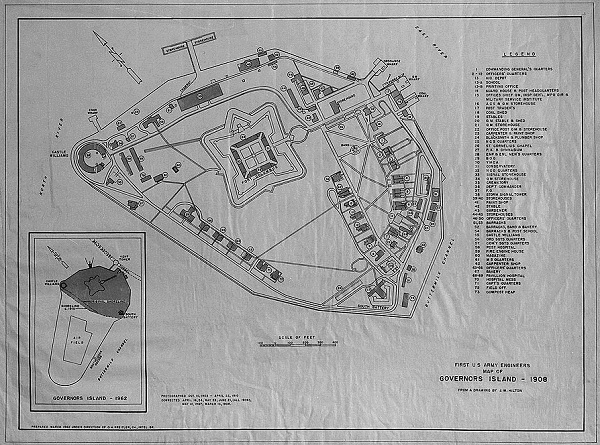
Governorsislandplan1908 US Army Corps of Engineers map of Governors Island with Fort Jay (center) and Castle Williams (left)

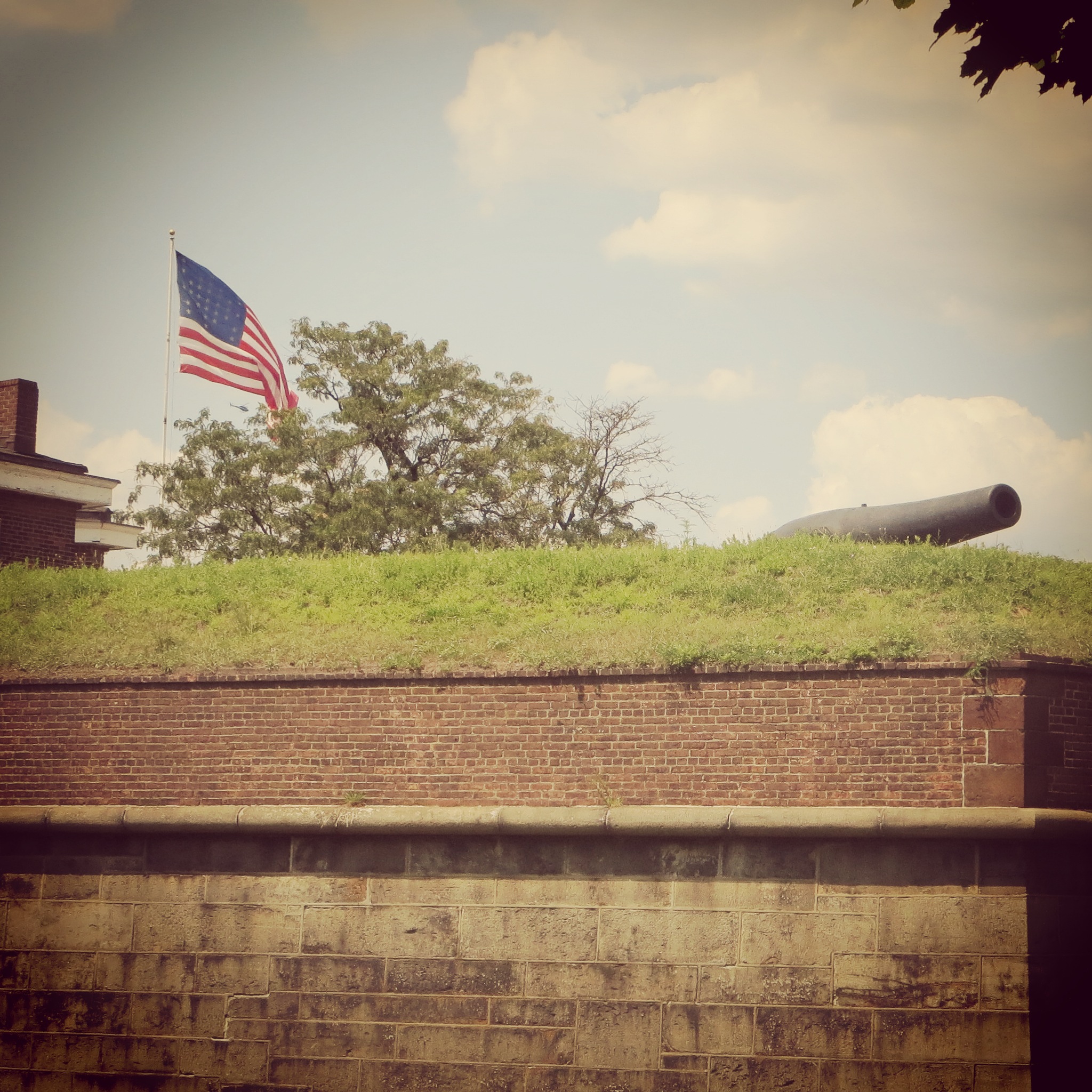
Governors Island offers a good historic overview of the development of New York’s coastal defense works from the 18th through 19th centuries. Fort Jay dates from the late 18th-century when American colonists and British troops exchanged control of the island with various earlier wood and earth forts. The existing facility is a classic European-style star fort with masonry and earthen walls is typical of the design built all over the world from the 15th through 19th centuries. Entering through elaborate gates, a visitor walks into a peacefully idyllic central courtyard surrounded by Greek Revival colonnaded buildings with welcoming porches. Several cast iron Civil War era 10 and 15 inch Rodman cannons survive on the fort’s walls, pointing toward the harbor.

IMG_4073Guns overlook New York Harbor from Fort Jay

The later Castle Williams was built between 1807 and 1811 as a fortification just ahead of the War of 1812. The state-of-the art, circular casemate sandstone pile was designed by Col. Jonathan Williams, at the time the chief of the US Army Corps of Engineers. The first fort designed by an American engineer, Castle Williams presents three tiers of gun ports from which a nearly 360-degree field of defensive fire across the harbor.

IMG_4074The imposing walls of Castle Williams

Together with Fort Wadsworth on Staten Island, Fort Wood (today the base of the Statue of Liberty on Liberty Island), Castle Clinton at the southern tip of Manhattan and Fort Gibson at today’s Ellis Island, Fort Jay and Castle Williams served as part of the interlacing network of forts protecting New York Harbor through the 19th-century. Both Fort Jay and Castle Williams would go on to other roles as the site of a Confederate prisoner of war camp during the Civil War, a US Army prison in the middle of the 20th-century and the site of a large US Coast Guard base until closing in 1996. Gone is the military use of Governors Island today, but the spaces still serve the public as place to walk amid important and usually unseen history of New York.

Civil War Weekend

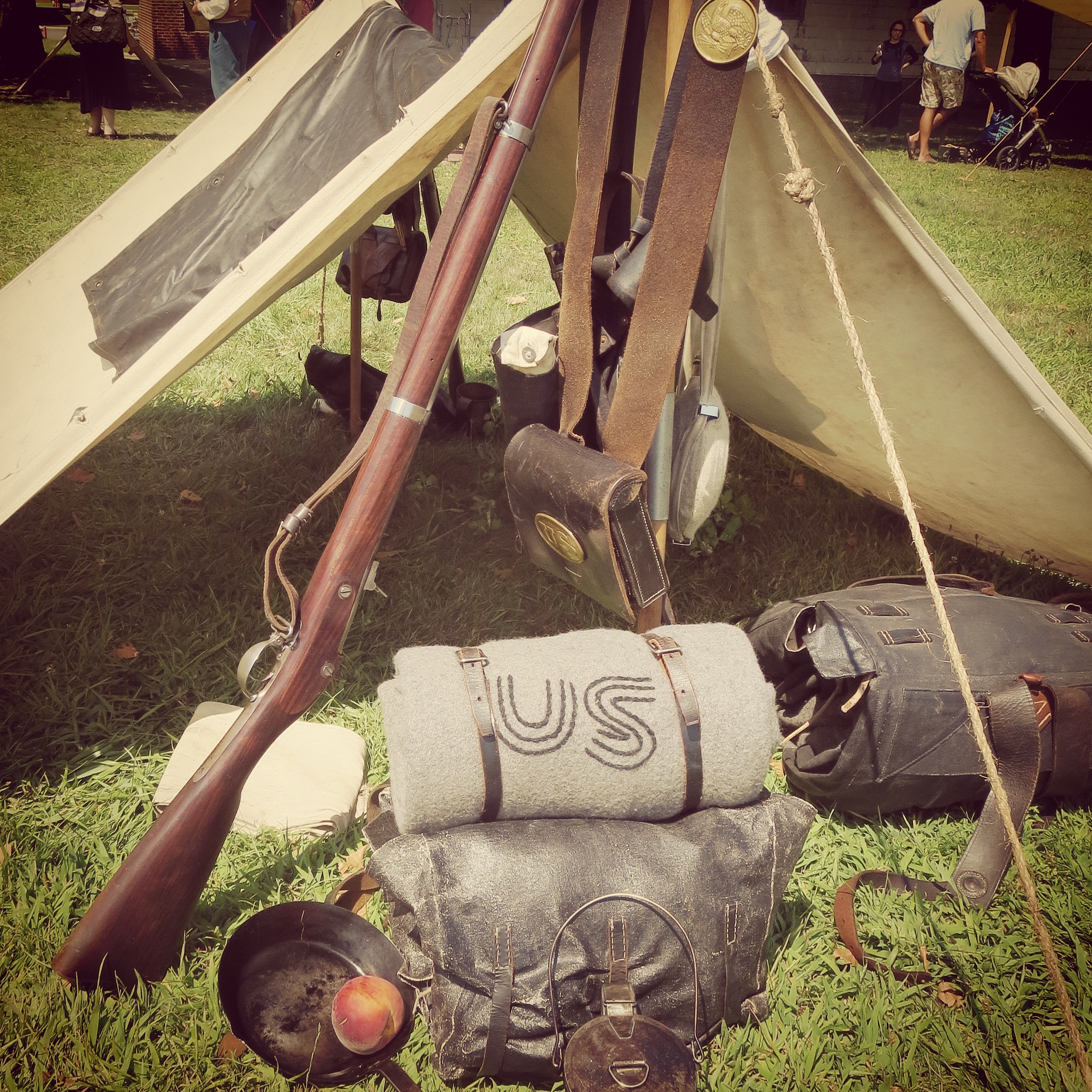
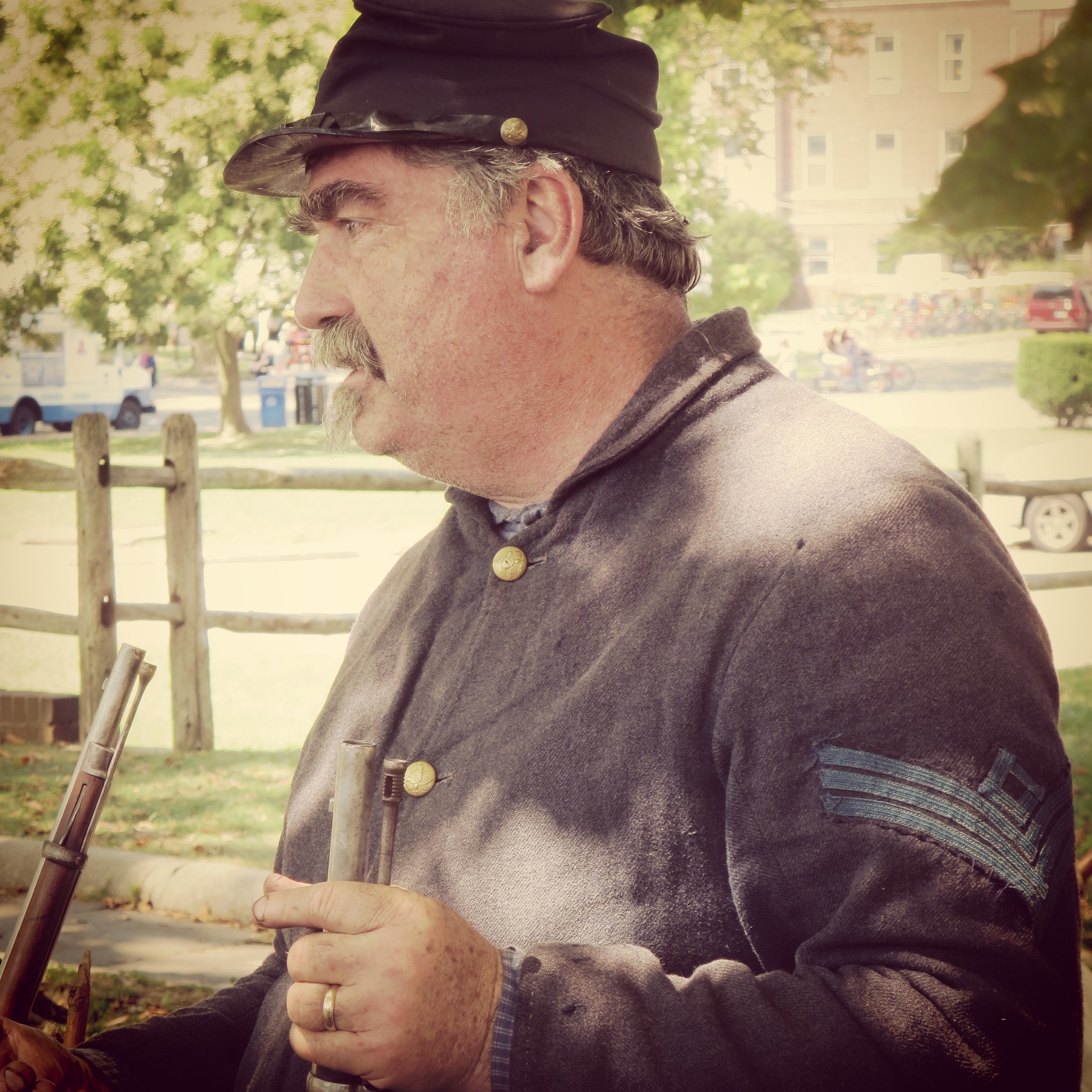
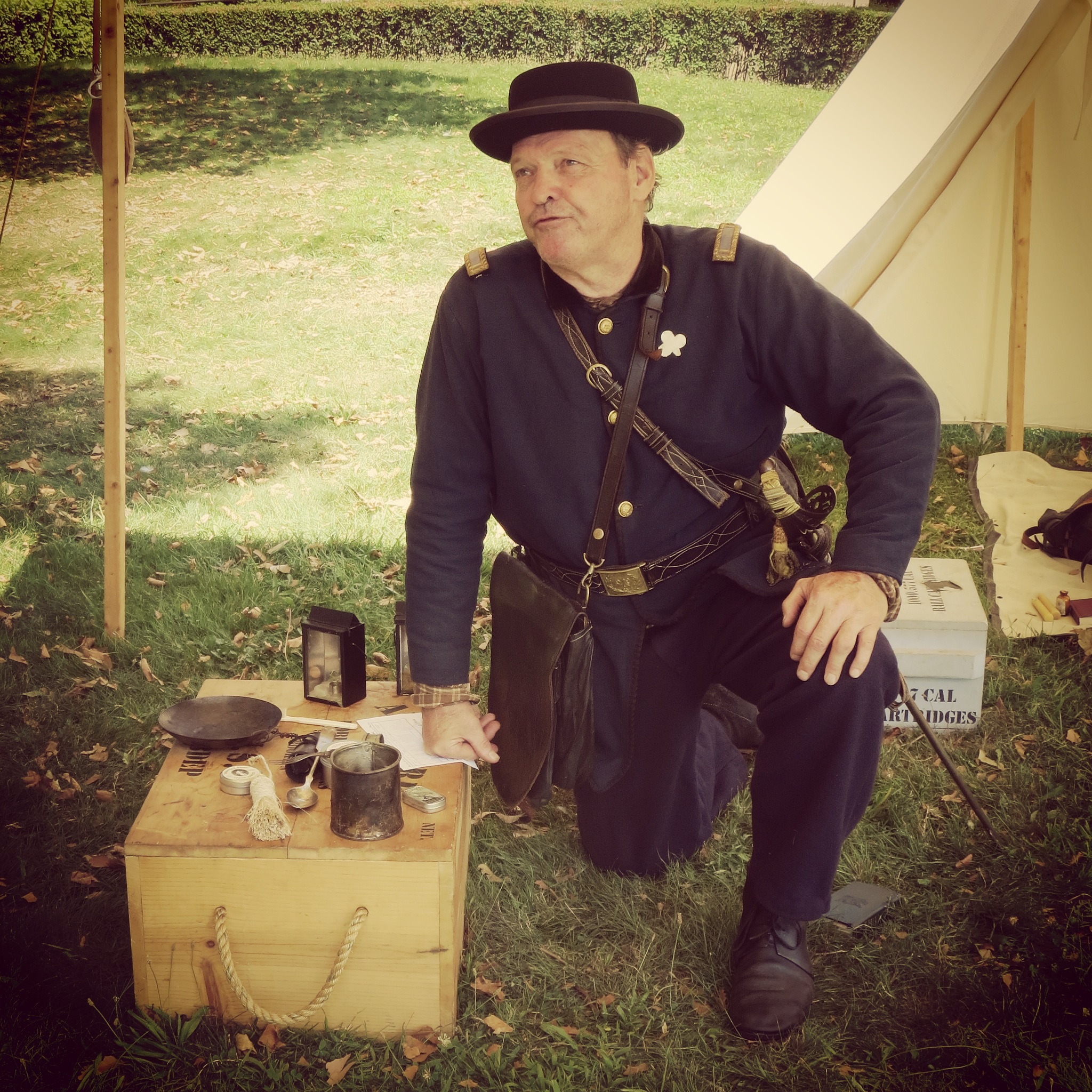
Each August the National Park Service presents the only Civil War encampment of reenactors in New York City. With about a dozen tents in a small camp and more than twenty staff and volunteer reenanctors, the weekend’s events gives New Yorkers an up-close glimpse of a solder’s life during the Civil War.

IMG_4068Reenactors encamped at Governors Island

IMG_4076A Civil War era soldier’s equipment sits at the ready in camp

IMG_4072A reenactor discusses a Civil War soldier’s life with visitors to Governors Island

IMG_4075An officer reenactor speaks with with visitors to Governors Island

Aside from an opportunity to speak with reenactors and view some typical soldier’s equipment and life in camp, demonstrations of canon firing, drilling and infantry weapons are presented. For the less militarily-minded, period music was also offered in the comfort of shaded grass and rocking chairs inside the walls of Fort Jay.

IMG_4069Officer inspection of the troops at Governors Island

IMG_4070Canon firing demonstration during Civil war Weekend at Governors Island

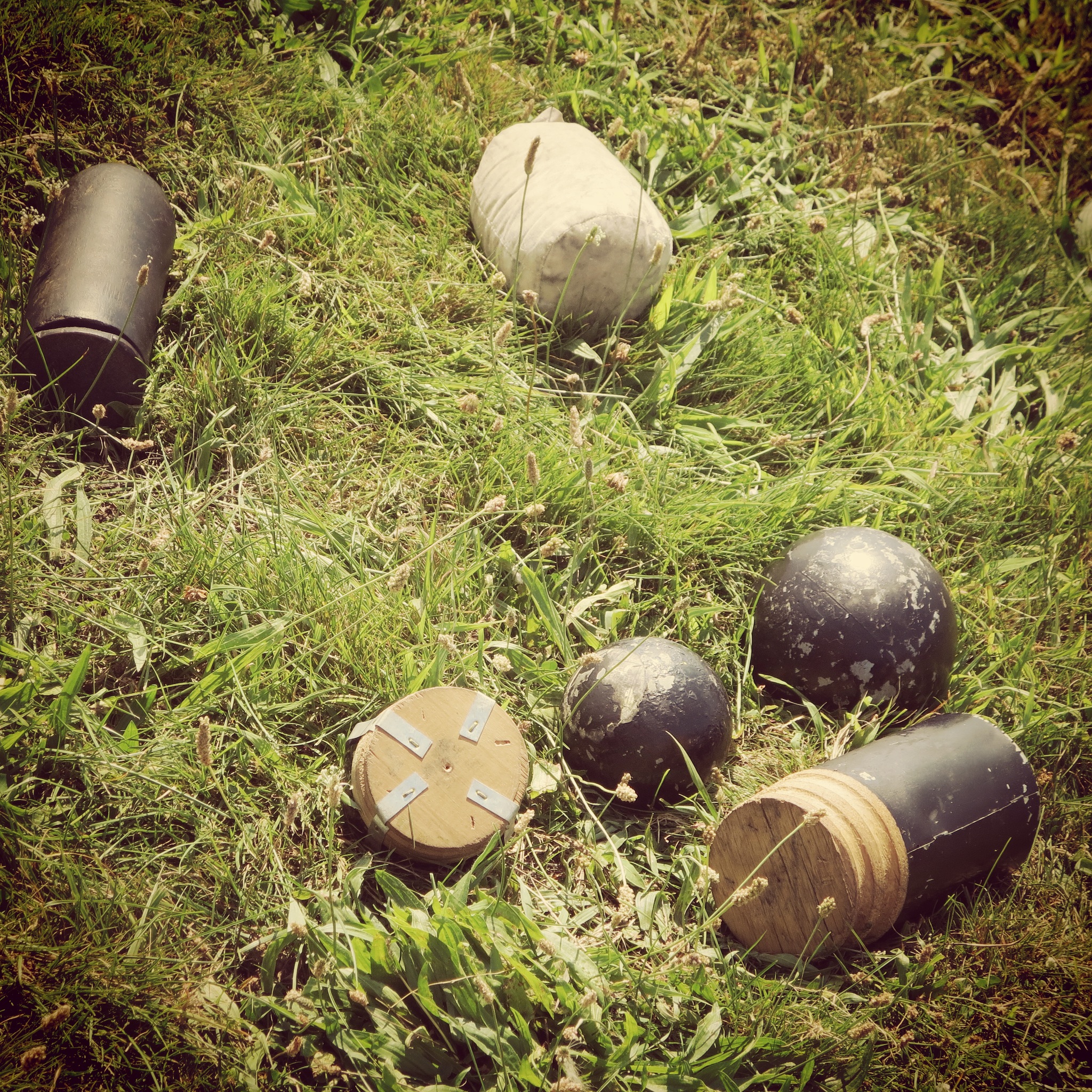
IMG_4071Civil War era cannon shot, canister and ordinance loads

Although the use of Governors Island has primarily been military for several centuries, visiting the island today serves up multiple experiences. While the historic forts and sites under the governance of the National Park Service occupy approximately 22 acres to the north, the remaining 150 acres is now overseen by the Trust for Governors Island. The Trust has worked to create an oasis of recreational areas for picnicking, play, bike riding, strolling and relaxing among historic buildings, allays of trees, wide grassy lawns, outdoor sculpture and newly designed landscapes. Whether you are a visitor looking for a step back into American history or just unwind from the city’s usual hustle, Governors Island can give a whole new perspective on New York at the center of the harbor and world.

Micro Armour: Fielding the GHQ US Armored Infantry and Sherman Tanks

USArmoredInf

A few months back I jumped into World War II 6mm micro armour with a few initial purchases from GHQ and a general post on getting started with the scale. With some other 15mm Flames of War projects taking precedent, my 6mm project has been sitting on the back burner until this past week.

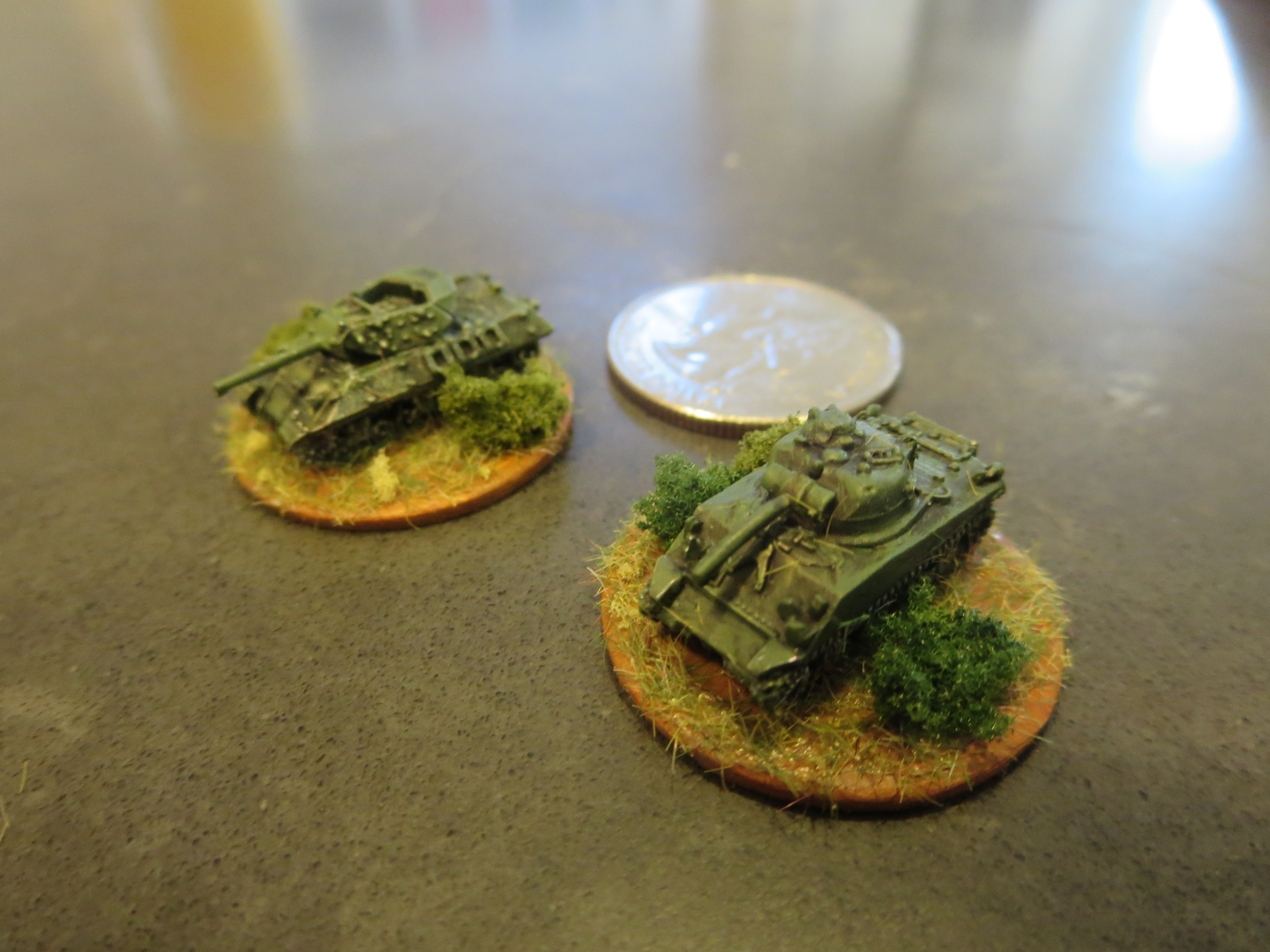
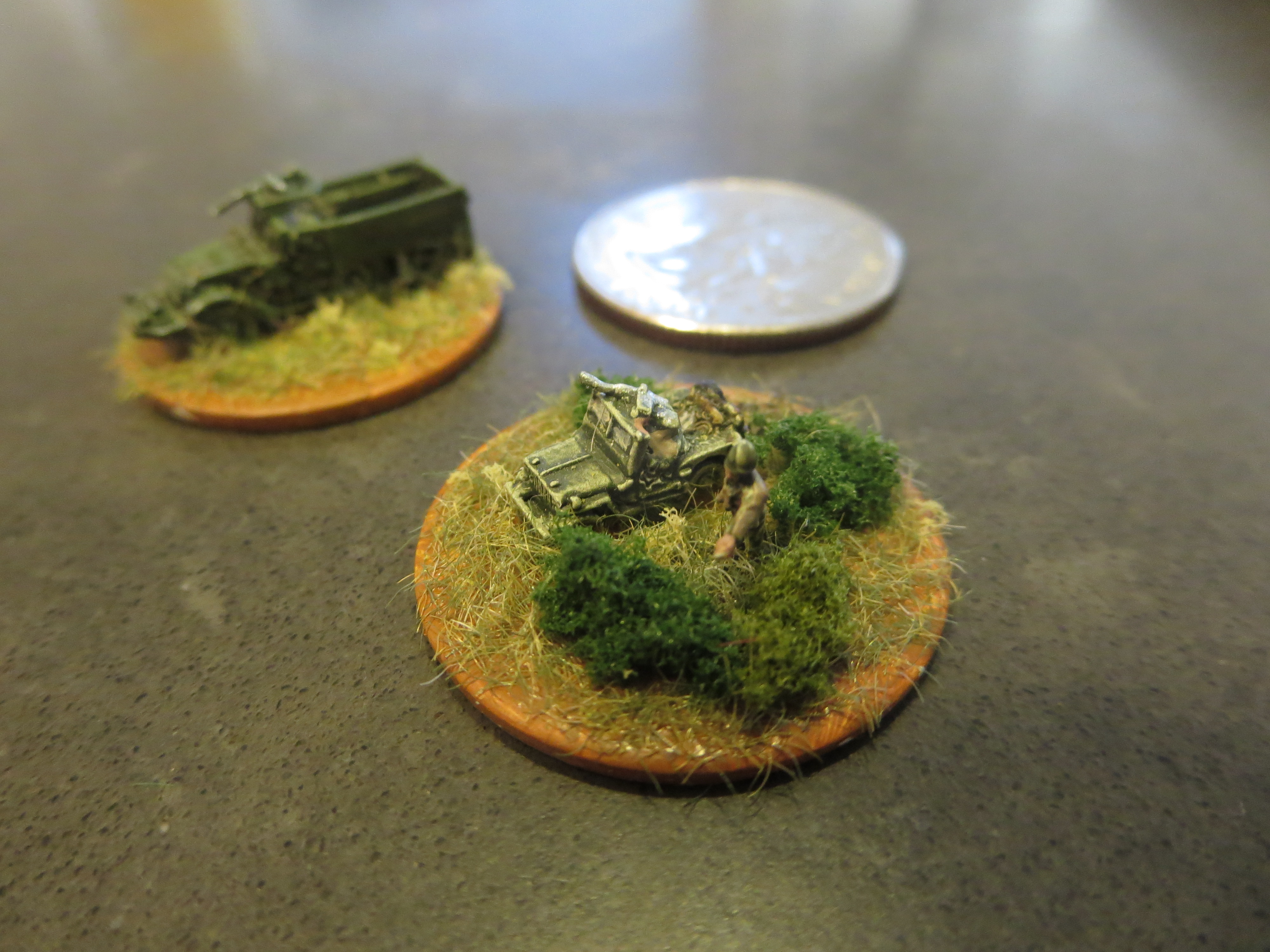
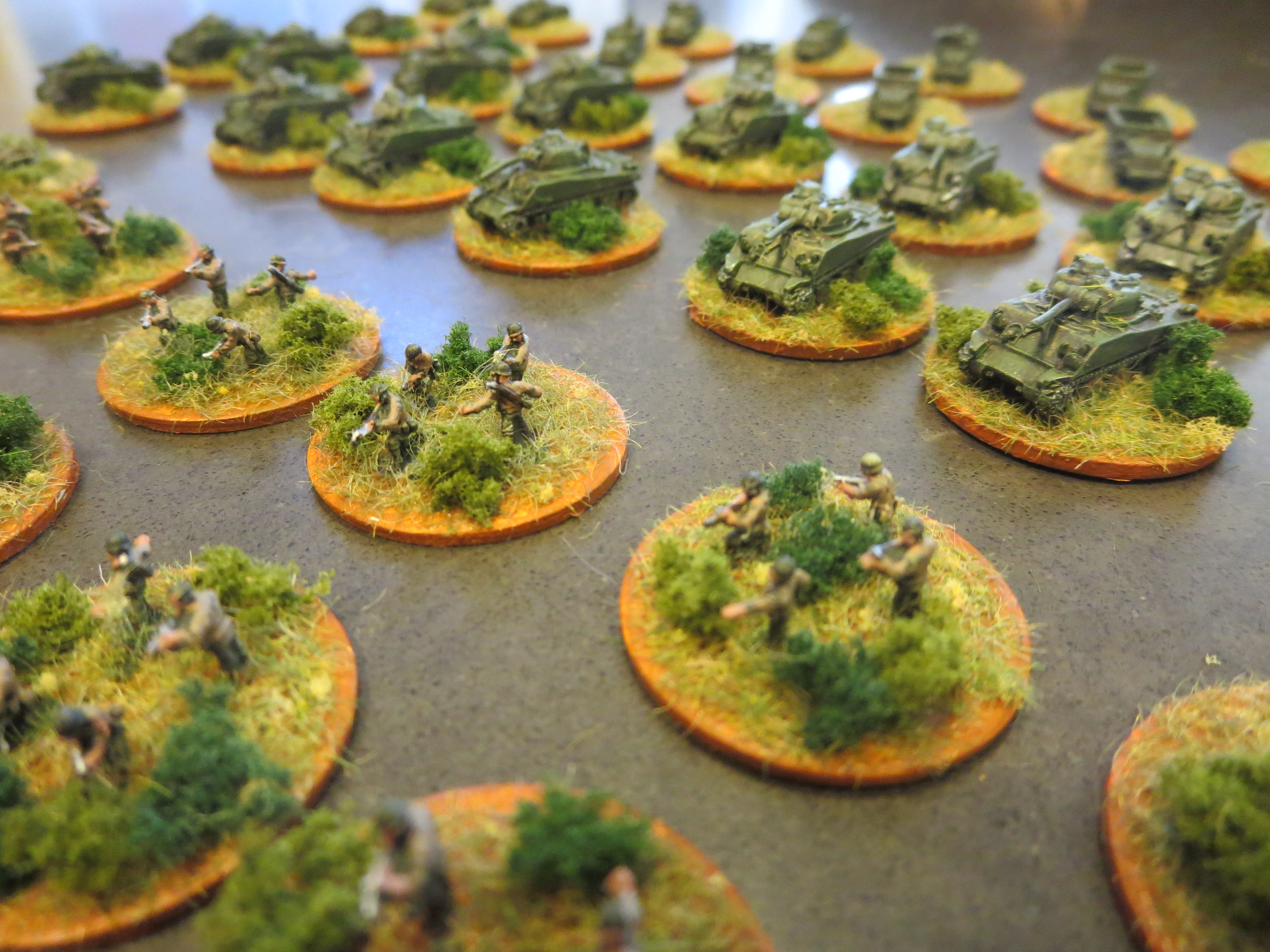
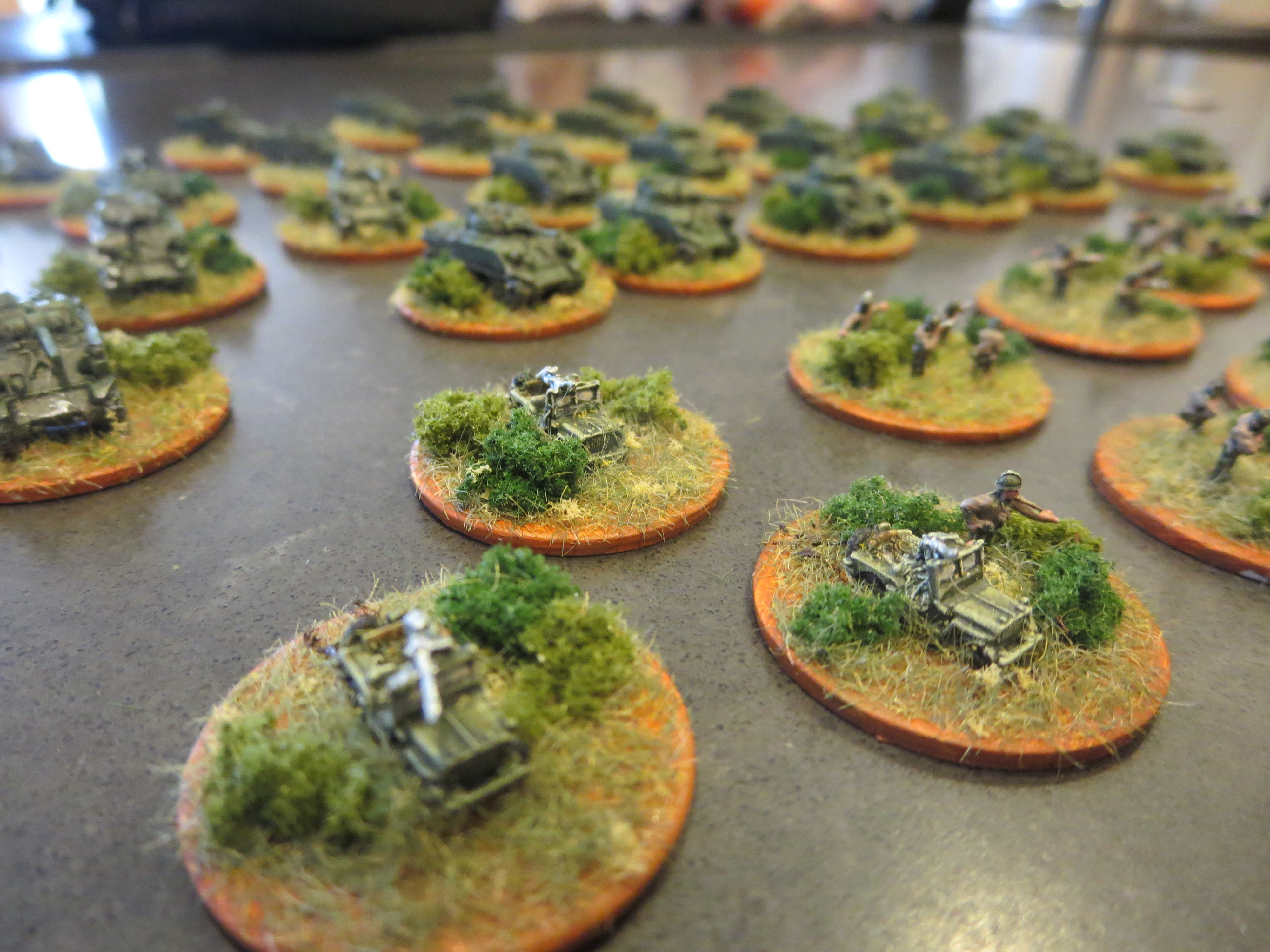
I started my US forces with models from the US Armored Infantry Command 1944 and Shermans vs. Panzer IVs Battle Box sets from GHQ. The infantry set gives me a bunch of infantry, bazookas, an M20 armored car, three M8 armored cars, eight half tracks, three M10 Wolverines, three 75mm Shermans and three jeeps. From the US/German box I get another ten Sherman tanks. All together, I’ve got a pretty sizable and inexpensive US force typical of the late war in Europe.

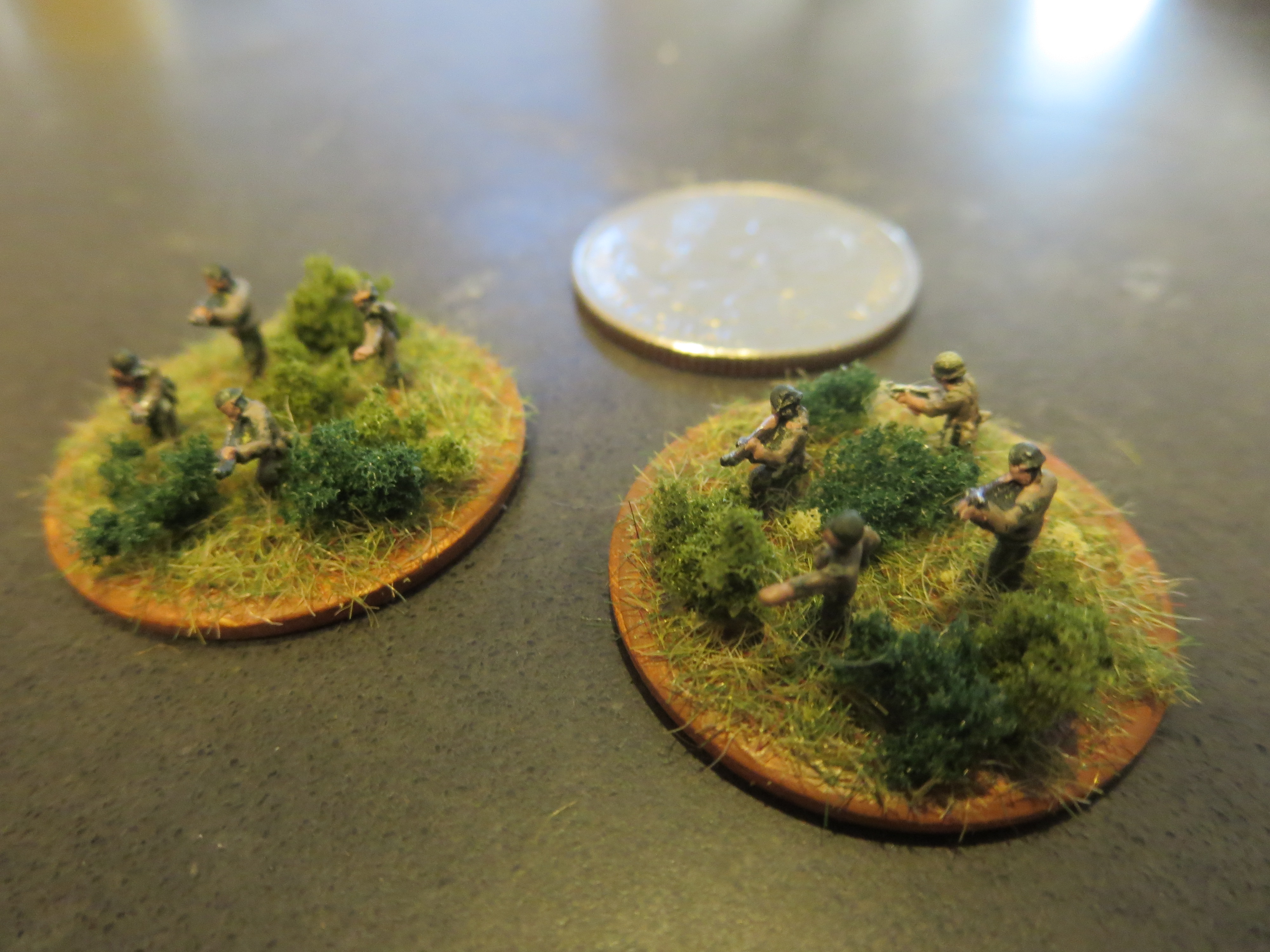
This was my first time painting 6mm models, so I worked out a quick technique for painting infantry, transports and armor that gave pretty great results. I picked up a pair of 1.5x strength reading glasses which really helped in bringing the models into focus as I dabbed paint to the models using an ultra fine brush. By gluing the models to metal washers I was able to affix the models to a strip of magnetic basing, allowing me to rotate the models easily to paint from every angle.

IMG_0552

Two completed stands of GHQ US infantry

Painting US Infantry

  1. Glue a small piece of card over the center hole of washers.
  2. Glue models to washer bases.
  3. Basecoat models and bases with white spray primer.
  4. Wash models in a mix of 1 part dark green, 1 part light green and 5 parts water.
  5. Paint jackets tan.
  6. Paint boots, gun stocks and equipment details dark brown,
  7. Paint hands and faces flesh.
  8. Paint gun barrels and equipment details gun-metal silver.
  9. Paint bases dirt brown.
  10. Cover bases in white glue and cover in 50/50 mix of fine light green and dark green grass flock.
  11. Glue small pieces of clump foliage to base.

IMG_0553

GHQ M10 Wolverine and Sherman tank

Painting US Armor and Transports

  1. Glue a small piece of card over the center hole of washers.
  2. Glue models to washer bases.
  3. Basecoat models and bases with white spray primer.
  4. Wash models in a mix of 1 part dark green, 1 part light green and 5 parts water.
  5. Lightly coat models in mud brown wash.
  6. Dry brush light green highlights to models.
  7. Dry brush tracks, machine guns and body details gun-metal silver.
  8. Paint bases dirt brown.
  9. Cover bases in white glue and cover in 50/50 mix of fine light green and dark green grass flock.
  10. Glue small pieces of clump foliage to base.
  11. Paint tire tracks on bases dark brown.

All that’s left now for my US force is to apply some tiny decals on my tanks, armored vehicles and transports. Up next, I’ve got my eye on some additional German armoured infantry to go along with the Panzer IVs I already have on hand. Once I have my Germans on the workbench I’ll get some pics and process notes on painting up my first Axis troops at this scale. Until then, have a look a more photos below of where I am so far on my wargaming project in 6mm.

IMG_0554

GHQ half track and command stand with Jeep and officer

IMG_0559

GHQ M10 Wolverines

IMG_0558

GHQ M8 and M20 armored cars

IMG_0556

Close-ups of my completed GHQ US armored infantry and Sherman tank force

IMG_0557

Another close-up of my completed GHQ US armored infantry and Sherman tank force

IMG_0555

My first completed US micro armor force from GHQ

Flames of War: Fielding the PSC US Mortar Support Platoons

USmortaritaly

As with so many armies past and present, the infantry man was the backbone of the US Army during World War II. Armed with the M1 rifle, his training and an enormous line of supply to the rear, the American soldier was arguably one of the most formidable combatants in the history of warfare.

That said, even the most effective foot soldier often needs support. Along with machine gun crews, US infantry companies commonly contained the M2 60mm mortar. Crewed by just two men, the M2 added explosive punch in a highly portable weapon which could move swiftly with ground advances through varied terrain.

wwIIchemmortar M2 4.2 inch chemical mortar in use during World War II

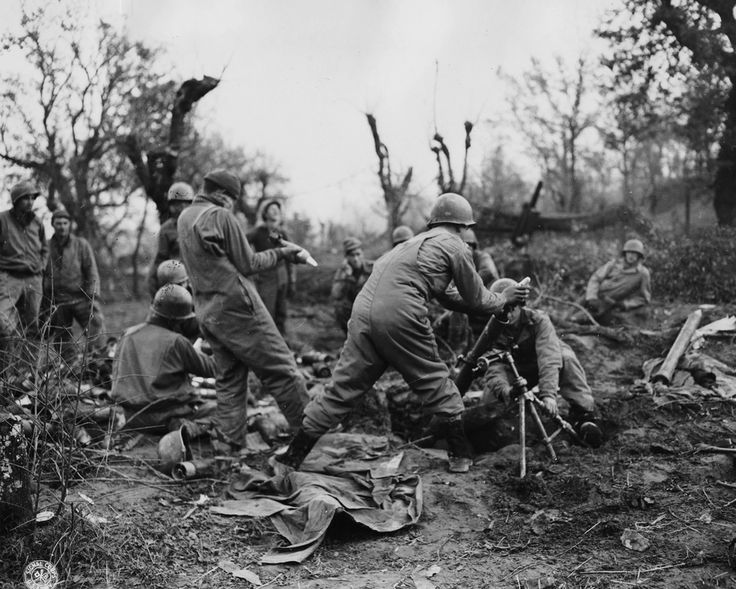
At the battalion level, larger mortars with more diverse ammunition, longer ranges and greater effectiveness were also available. The M1 81mm mortar (pictured at the top of this post) was used throughout the war with its 3000 yard range and mix of explosive shells. The larger mortar, weighing in at about 150 pounds, required a larger team and was commonly transported by cart or mounted in the back of a halftrack.

By the time of the Allied invasion of Italy in 1943, the even heftier M2 4.2 inch chemical mortar was added to the American arsenal. Designed but never used for lobbing various weaponized chemical payloads like poison gas, the M2 was set on a large rectangular base plate with a pinion-like stand to stabilize firing large explosive or smoke payloads over 4000 yards. The weight and over-sized shells of the M2 did limit its portability significantly, but even so, it helped to very effectively fill out the small artillery arsenal at the infantry level.

pscusheavyinstr

Sprue detail for the PSC US Heavy Weapons set with 60mm, 81mm and 4.2 inch chemical mortars

I’ve been diversifying my mortar support when building my US force for our Flames of War Infantry Aces Campaign at Metropolitan Wargamers in Brooklyn, NY. The Plastic Soldier Company’s Late War US Heavy Weapons 1944-45 box offers a whole host of extra weapons for my infantry, including three types of mortars. My 92nd Infantry Division started out with a weapons platoon containing a few standard 60mm mortars along with some M1919 machine guns.

To my initial force, I’ve recently added both 81mm and 4.2 chemical mortar platoons (photos below). I continue to be impressed by the PSC sets both for their sculpting as well as their value. I love the mortar crews holding their ears as the mortars fire and the guys crouching with binoculars. The tiny arms can often be a bit wonky when gluing the figures up, but this also allows some flexibility in poses. I set up one pair of figures in a little vignette of one guy reaching over to console his comrade who has been rattled by all the noise.

IMG_4003Completed 81mm mortar platoon

IMG_4002Detail of 81mm mortar and command

IMG_3998Completed 4.2 chemical mortar platoon

IMG_4004Chemical mortar platoon observer and command stands

IMG_3999Detail of a 4.2 chemical mortar squad

MWGInfantry Aces

I’m putting my new mortar support platoons to use already in the Infantry Aces Campaign we’ve been running at the club for more than a month now. Although their first outing this past weekend wasn’t very successful, I’ve been studying up on FOW mortar smoke tactics. With strength only in numbers with my relatively inexperienced Confident/Trained riflemen, I’m going to be giving my force another try soon with mortars raining smoke and pinning fire on my German opponents. My hope is the mortars will provide just the support my American infantry need to fight to another tabletop victory.

Flames of War: Metropolitan Wargamers Infantry Aces Campaign

MWGInfantry Aces

Two weekends ago we kicked off a Flames of War Infantry Aces campaign at Metropolitan Wargamers in Brooklyn, NY.

A friend of the club and organizer of the campaign has created a special Infantry Aces blog to track the campaign’s progress throughout the summer. The site will be updated weekly as the battle unfolds with after action reports, lots of photos and tracking of each player’s progress in the campaign.

While the battle rumbles on, here’s a brief look at the forces we’ve had fun researching, modelling and painting specifically for our campaign for Italy.

Allied Forces

FOWIAAllies

(clockwise from top left) 504th Parachute Infantry, 92nd Infantry “Buffalo Soldiers,” Gurkha Rifles and members of the 2nd New Zealand Division

Our Allied forces are a mixed group from the Road To Rome book and reflect the mutlinational forces which came together in the late war Italy campaign to break the Axis lines. From the United States, the 504th Parachute Infantry Regiment is bringing their experience to the field after having fought for years from North Africa and Sicily in 1943 to Operation Market Garden to The Battle of The Bulge in 1944. Joining them, are the untested 92nd Infantry Division “Buffalo Soldiers,” the first African-American infantry to fight as wholly-segregated unit in the war.

Allied with the US troops are some unique UK Commonwealth forces. The Indian Gurkha Rifles had a long history in service of the British dating back to the mid-19th-century, and their skill in close combat and rocky terrain would serve them well in Italy. The  2nd New Zealand Division served most of the war in North Africa and hopping around the islands of the Mediterranean until joining the Allied effort to break the Axis lines severing Italy from the rest of Europe.

Axis Forces

germanyia (clockwise from top left) Fallschirmjagers, Hermann Göring troops and Grenadiers

Using the updated Fortress Italy book, our Axis players have fielded some of the classic, war-hardened forces whose mission it was to hold the line against the Allied push up the Italian Peninsula. The 1. Fallschirmjägerdivision in Italy had already proven themselves throughout Europe with wide-ranging early war operations in Denmark and Norway, the Netherlands, Crete and the invasion of the Soviet Union with Operation Barbarossa.

Two other veteran companies fill out the Axis forces. The Hermann Göring Fallschirmpanzerdivision saw action throughout Europe and Africa before fighting in Italy. Finally, the 362.Infanterie-division had seen a long war (including the Battle of Stalingrad) by the time they joined the final Axis defense of Italy.

The Campaign Begins…

IMG_3685

Recent FOW Infantry Aces campaign action at Metropolitan Wargamers

We’ve got two weeks of campaign games in so far, and playing with small infantry forces of 500 points has been a refreshing break from the larger FOW games in which we all usually play. Special rules, varying troop ratings and small tables clogged with Italian terrain have also added to the challenges and enjoyment we’ve all had so far. There’s a lot of gaming to do as the campaign escalates over the coming weeks to 700 and 900 point companies with added support. Check back frequently for more of the action over at the Infantry Aces Metropolitan Wargamers Italian Flames of War site.