Flames of War: Fielding the FOW L-4 Grasshopper AOP

L4Grasshopper1944

Piper Aircraft was founded in the late 1920s with an eye toward building planes for general civilian use. From 1938 to 1947, Piper sold nearly 30,000 of their relatively inexpensive J-3 Cub models, making the plane one of the most ubiquitous non-commercial planes soaring over the United States by the mid-20th-century.

1943 industrial film of the building of a Piper Aircraft J-3 Cub

During World War II, Piper supplied the US Army Air Forces with nearly 6000 of their J-3 Cub planes in a modified military version known as the L-4 Grasshopper. The main modification of the light plane was the installation of wide banks of plexiglass windows, making it usable as a radio observer and reconnaissance plane during key missions like the Allied invasion of Normandy in June 1944. The Grasshopper also found varied service transporting supplies to the front, carrying wounded to the rear and ferrying military and political dignitaries. In rare cases later in the war, the plane was also equipped with light weapons for use as an air-to-ground attack platform.

IMG_4250My completed Flames of War US AOP Grasshopper

My modelling for Flames of War has been focusing as of late on filling in some odd little gaps in my forces. Since I run some US artillery from time to time, adding an air observation plane not only allowed me to add to my gaming but also take a break to model another plane. This time around I also decided to pay a bit more attention to basing my plane to add a bit of visual interest to an otherwise simple model. I like the quick work on the base so much that I’m going to go back and add the same to my US P-47 Thunderbolt and British Hawker Typhoon models. While relatively inexpensive and easy to assemble and paint like my other aircraft, my one criticism of the FOW Grasshopper model is the lack of decals.

Even with the one shortcoming in markings, my new Grasshopper will be a welcome addition to my FOW games. In most American army lists, adding an AOP is a cheap point spend while also greatly expanding the effectiveness of the already devastating US 105mm howitzer battery. Getting this little plane zipping over the heads of my Axis opponents on the tabletop battlefield may not prove to be a total game changer. It is, however, going to give the enemy one more thing to worry about and may just provide an edge like this classic of American engineering did some 70 years ago in the skies of Europe.

I Ain’t Been Shot Mum: North of Caen 1944 Scenario

BritsCaen1944The city of Caen presented a big target during the Allied invasion of Normandy in June 1944. One of the larger cities in the region of the invasion, it also occupied an important series of crossroads straddling the Orne River. Less than ten miles from the British Commonwealth forces landing zone of Sword Beach, Caen was a target for British and Canadians wading ashore on June 6th. Despite a relatively easy landing at the beach, Allies with their eye on Caen were met with a hastily-organized armored counterattack from the German 21st Panzer Division. By the end of the day, the British sat just halfway to their objective and Caen remained in Axis control.

CaenMap1944Map of the Battle for Caen, July 8-9 1944

Over the next two months, the area around Caen became a bogged-down front as Anglo-Canadian forces positioned themselves around the city. The eventual capture of the city on August 6th was costly for all involved. The ancient city was nearly leveled with Allied bombing campaigns and much of the French civilian population fled. The British forces suffered around 50,000 casualties, a devastating loss of men and equipment for British commander Bernard Montgomery. With the costly British victory, it had achieved not only the occupation of Caen but had also provided an enormous distraction for German forces which suffered even greater losses than the Allies.

iabsmlogo

This past weekend at Metropolitan Wargamers in Brooklyn, NY, a couple of us ran through a non-historical scenario typical of the British-Germany engagements just north of Caen in early July 1944. The “North of Caen” scenario is provided in the basic rule book for I Ain’t Been Shot Mum, the fantastic company-level World War II game that has fast become a favorite for some of us at the club.

Caen1British infantry advance through an orchard under blinds north of Caen

The small infantry engagement is set in the fictional hamlet of Le Moulin on a table of flat, open terrain with fields, orchards, low hedge rows and five stone buildings set at a crossroads. The game begins with three British infantry platoons entering from the north under blinds after an initial off-board artillery bombardment of the Germans dug under in around the farm and crossroads. The objective of the game is for the Germans to eliminate the British advance while the British are tasked with seizing four of the five buildings or otherwise eliminating the German troops.

Caen2A British rifle platoon takes heavy German MG42 fire and is pinned behind a barn

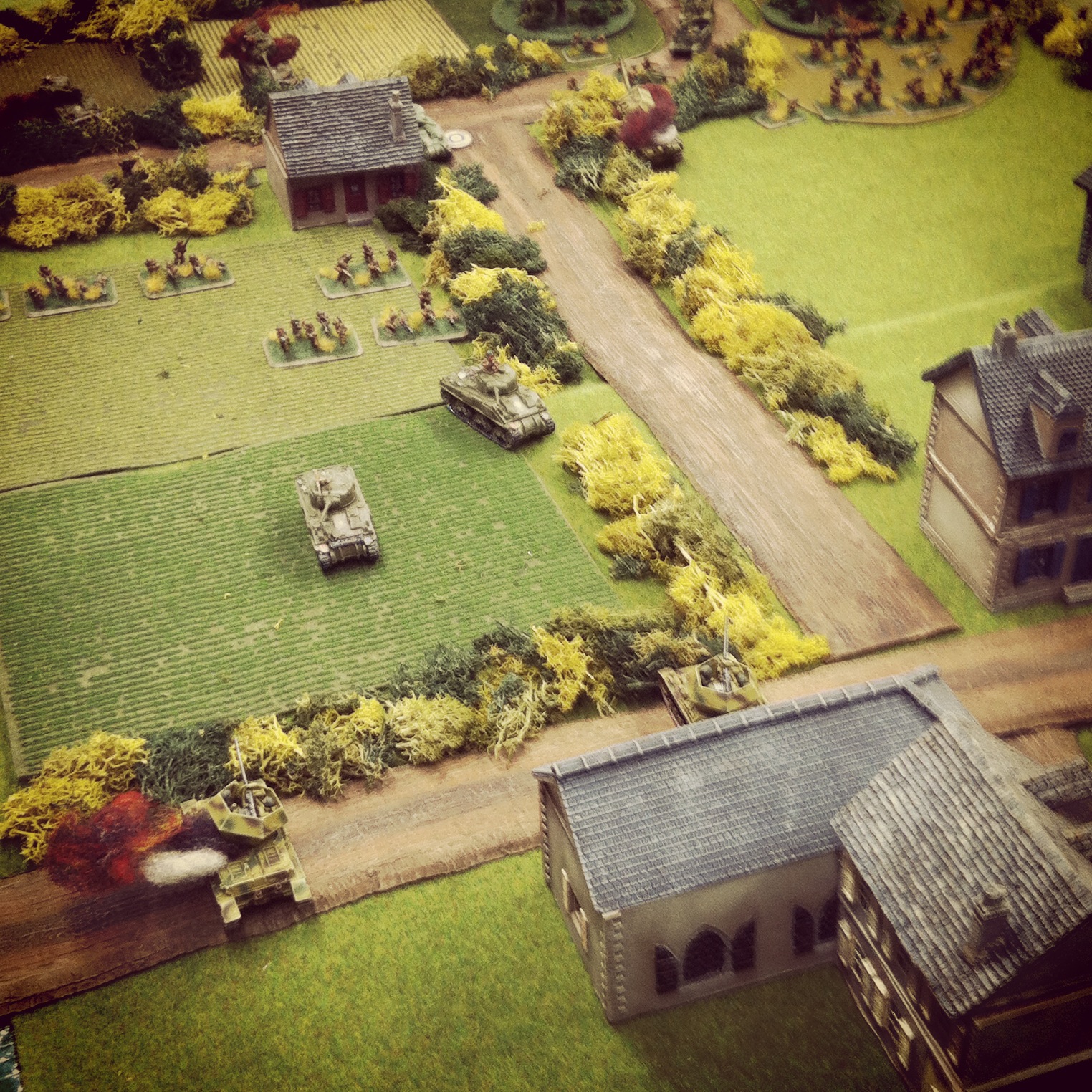
Following my initial bombardment, my British advanced under blinds for a few turns through the orchard northeast of the crossroads. The German blinds positioned themselves in a wood at the crossroads and in a small orchard southwest of the hamlet. Three of my blinds moved toward cover to my left behind a barn while my third false blind moved toward the road. My first blind was spotted behind the barn by a German platoon armed with three rifle sections and a deadly MG42. With the Germans deploying in a nearby barn and within the orchard, they opened up on the British rifles. With not enough cover behind the small barn, one British rifle section was all but eliminated in the first round of fire.

Caen4A British platoon runs bravely under a blind across an open field between two barns

The British survivors behind the barn returned fire, firing their rifles and 2″ mortar into the Germans in the orchards and nearby barn. In the meantime, my false blind was revealed as a second British platoon slipped to the hedge to the other side of the barn. Firing at the Germans from each side of the barn, the MG42 was forced to retreat back south of the crossroads. But the damage had been done to my first platoon at the barn, and two fire teams fell back to the orchard leaving one safely inside the barn. Sensing a brief opening, my final blind sprinted across the wide open field between the barn.

Caen3The British blind is exposed, take fire and break for hedge in the distance

Midway through the field, the German rifles in the second barn spotted and revealed my blind, slowing their run and forcing them to deploy in the open. The final German blind revealed itself among the buildings west of the crossroads. My fresh British platoon hopped the hedges and likewise crossed to the west of the road, opening fire at the Germans in the building just the other side of a small orchard. Subsequent turns of fire were exchanged and my British losses started to pile up on my right.

Back at the field on the British left, combined rifle and mortar fire poured into the Germans in the barn. Despite shock stocking up on the Germans, their position in the barn allowed great enough cover allowing them to slowly begin wearing down the exposed British platoon which became pinned from movement. With British taking losses to the right and less against well-protected Germans in the heavy stone buildings, it was not working out as a good day for the British who ceded the tiny hamlet to the Germans. More costly days were to come after this day just north of Caen, but a month off there would be victory for the British.

Micro Armour: 6mm Miniatures Storage Boxes

WWIIquartermaster

One of the constants of being a miniatures wargamer is the ongoing quest for solutions to store your models. After hours of painting, you’ve just got to have a way to safely store and transport your tiny soldiers and tanks to and from the tabletop battlefield. Models also need to stay in order so they are easily accessible when setting up a game.  Finally, living in cramped quarters in a Brooklyn apartment with a wife and two kids also makes neat, sturdy storage solutions a must if peace and organization is to be maintained on the homefront.

IMG_4179Storage for 6mm models using discarded plastic videotape cases

As a gamer of several decades, my eyes are constantly scanning store shelves, yard sales and piles on the curbside for discarded boxes, bins and packaging for just the right storage. On many an occasion I find myself wistfully rotating some neat container in my hands wondering if this is just the right thing to store models. Yes, storage is a bit of an obsession.

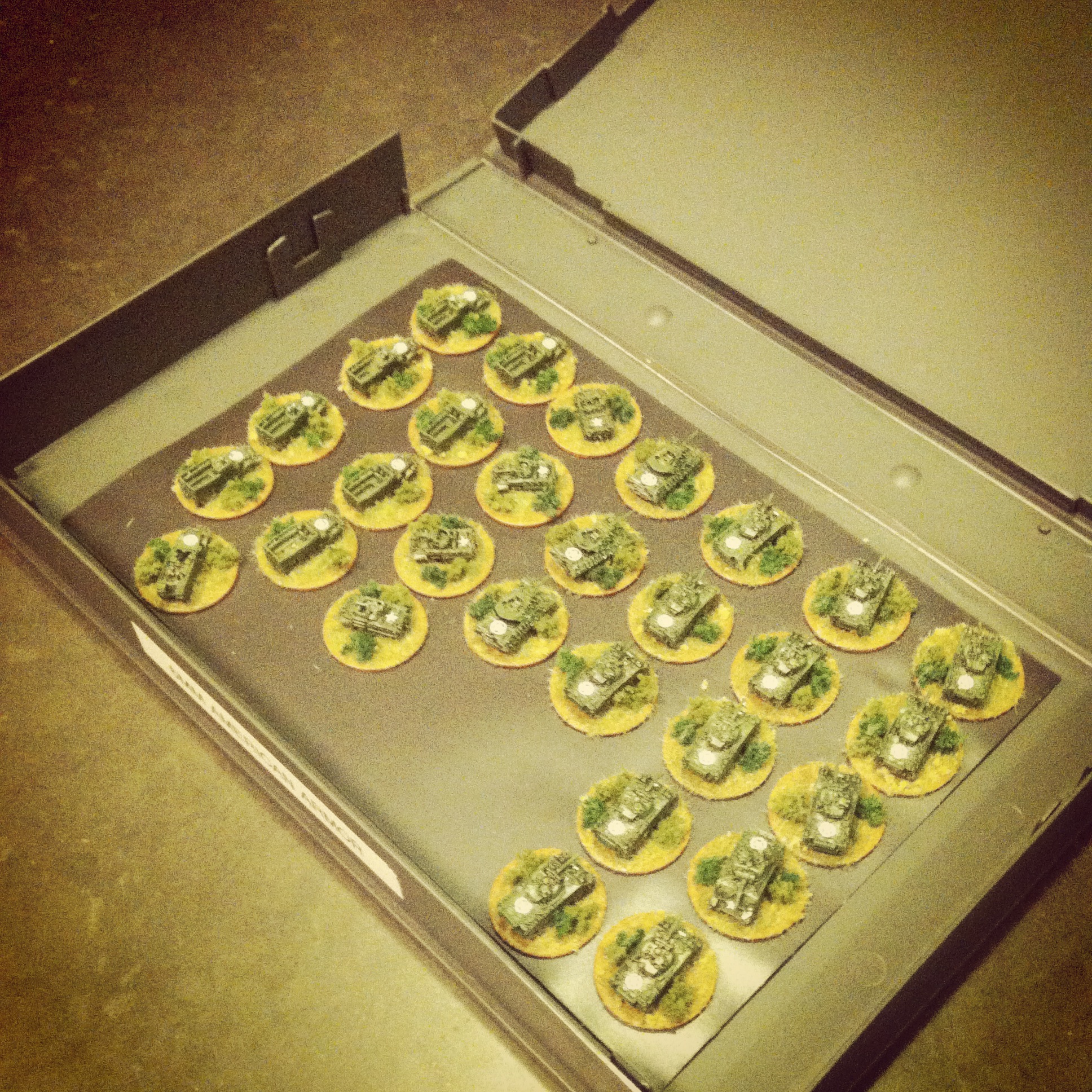
IMG_4178Magnetic sheets from an office supply store safely hold the miniatures on their metal washer bases

I work at one of the leading stock photography and film licensing companies in the world, and recently I came by two enormous rolling dumpsters sitting in a hallway by a freight elevator at the office. Spilling out of these bins were hundreds of plastic over-sized videotape cases destined for recycling. Pulling one case off the top of the pile, I realized what I was holding in my hands was just what I needed to store my newly-painted 6mm World War II micro armor models from GHQ.

IMG_4177Hinged lids and tight closure tabs make for handy access to the miniatures

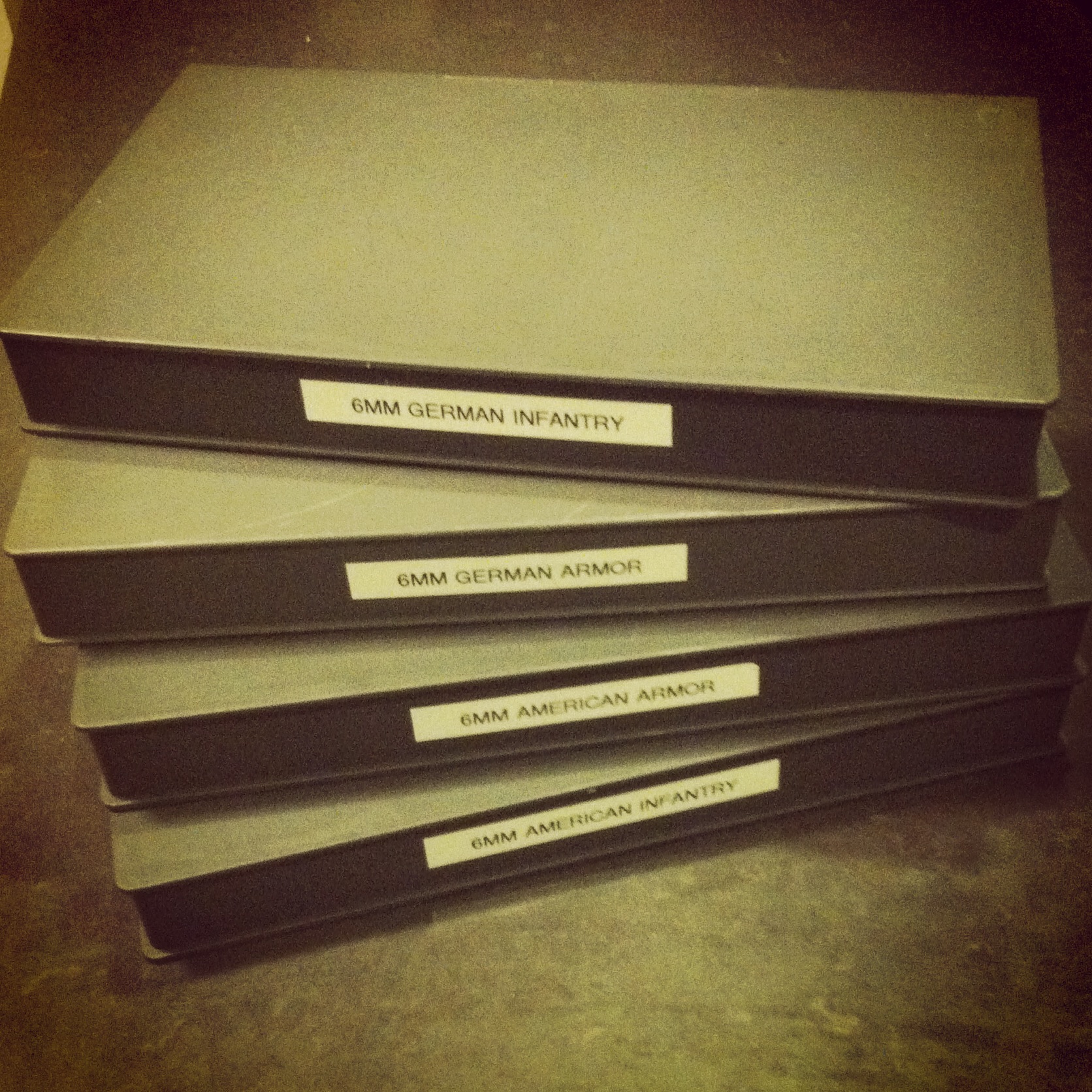
After hauling a dozen of these cases home, I carefully removed old adhesive cataloging stickers and tabs before giving the cases a quick wash in the sink. A quick trip to an office supply store and about $15 later, I had some magnetic sheets and double-sided heavy-duty adhesive mounting squares. I cut a piece of magnetic sheeting to fit the bottom of each case and then affixed the sheets with the adhesive squares. Once I had a stack of boxes all made up, I labelled each case along one edge using a label maker. The labels not only clearly show what’s in each box but also help to indicate which end is up when opening the hinged lid.

IMG_4176Labels clearly mark what’s in case and allow them to be switched-out if needed

For a minimal cost, I’ve netted an easy storage solution for my 6mm models. The magnetic sheets are strong enough that I can carry the cases and even store them on end on a shelf without the models shifting around in the box. The one-piece cases with built-in hinged lids and closure tabs keep the boxes tightly closed. Everything is organized by nationality and unit type, and opening a box clearly displays the models when fielding a force for a game. As my collection grows (as any wargamer’s inevitably does), I can easily peel and replace the labels with new ones.

Cheap, sturdy and flexible — my new storage is a big victory for my little models.

Micro Armour: How To Apply Decals To 6mm Models

tankfactory

I’m working my way through my new 6mm micro armor modelling project using models from GHQ. After painting I arrived at the stage of applying decals which I also ordered from GHQ. Like many hobbyists, I have a love-hate relationship with decals at any scale. Cutting and applying decals can be frustrating as they fold, tear or wind up in the wrong positions on models. On the other hand, getting decals successfully applied to models adds a ton of personality to a paint job and can allow for easier identification during play on the tabletop.

An experienced micro armor modeller and player at Metropolitan Wargamers in Brooklyn, NY turned me on to his technique for applying decals to 6mm models which I’ve found to be fast and easy with great results. Being organized and methodical in an assembly line manner is key. Having the right equipment is also a necessity. Magnifying reading glasses keeps all the tiny decals and models in focus. Working off a clean, flat hobby mat provides an ideal surface to cut decals and also keeps things easy to see. A sharp hobby knife with a fresh blade, some very fine brushes, clean water, white glue, paper towels and a cotton swab round out the basic equipment. Finally, using a decal fixative (I use Walthers Solvaset) gives a good bond for decals once applied, nestling them into the uneven surfaces of the model.

Applying 6mm Decals

  1. Carefully cut around the shape of each decal with a very sharp hobby knife.
  2. Using a finger tip, dot several small beads of  clean water in a row on the work surface.
  3. Apply a small amount of watered-down white glue to the surface of the model where the decal will be applied.
  4. Carefully push a decal into a bead of water using a small brush.
  5. After a few seconds, roll the decal off its paper backing using a fine brush.
  6. Roll the decal onto the model’s surface and gently push it into position.
  7. After a few minutes of drying time, dab the decal area with a cotton swab to remove any excess water.
  8. Coat the decal and the immediate area with a decal fixative solvent.
  9. Once models are completely dry, spray with a protective matte finish.

IMG_4079Applying decals to 6mm American armor

Historic markings varied a lot during World War II, so I largely came up with my own simple plan for my decals. Each one of my half tracks got encircled white air-observation stars on the hood. My Shermans each received two stars, one plain star on the front hull and an encircled white star on the rear deck of the tank. The M10 Wolverines and armored cars likewise received white stars in circles on the rear deck area.

IMG_40776mm US armor and transports with decals applied

I was able to complete all my decals in just two evenings, totaling  just about two hours. I couldn’t be more pleased with the results, and I didn’t lose a single decal in the process. Now that I’ve got my newly-learned technique down, it’s on to my German armor and then the battlefield.

Retro Gaming The 70s & 80s: Crossbows and Catapults

CandCBox

In 1983, I was 15 years old and living in a heyday of gaming. I already had a few years of Dungeons & Dragons under my belt and I was starting to stretch into some other fantasy role-playing, board and miniatures games. Video games had also become a big part of my social life, both in my friends’ living rooms and in the arcades popping up in the malls and main streets near where I grew up.

Sears1983CandC

Crossbows and Catapults as featured in a 1983 Sears catalog (only $12.99!)

Out of this early 80s mix of increasingly sophisticated RPG and video gaming came the decidedly low-tech Crossbows and Catapults from Lakeside Games. The basic play set came with a bunch of wonderful plastic toys representing enemy kingdoms of vikings and barbarians. Each side had a simple castle-like tower and loosely fitting bricks to construct a stronghold on a square mat depicting a moated island.

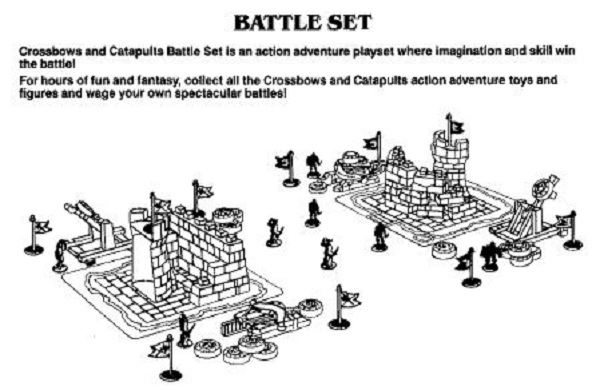
CandCbaseset

Crossbows and Catapults “Battle Set” components from basic instruction book

But the name of the game wasn’t Crossbows and Catapults for nothing, and that’s where the real fun of the game came in. The opposing sides were each armed with rubber band powered catapults and crossbows (really more like ballistas, but the alliterative name certainly looked better on the box). In alternating turns, players would fling and fire round carom discs at the opposing player’s stronghold and troops. Knocking over figures were scored as casualties and landing caroms in enemy territory allowed advances in raiding forces. The game was won when a player revealed and seized the treasure buried beneath the other player’s castle.

IMG_3949

Components from the Crossbows and Catapults “Battle Set”

I’m fortunate to have a massive archive of well-kept childhood toys stored at my boyhood home, and I was recently able to dig through my surviving Crossbows and Catapults sets. All the rubber bands needed to be replaced, but everything else survives in near-perfect working order. Pieces from my decades old collection are shown in the pictures throughout this post.

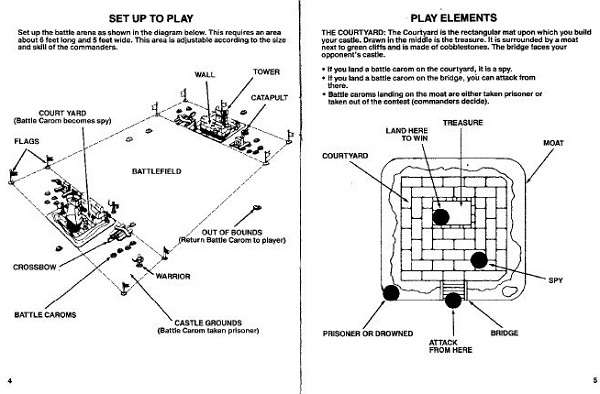
CandCsetup

Game set-up instructions from the Crossbows and Catapults “Battle Set”

I also managed to preserve all the original instruction books from the “Battle Set” base game and the various expansions which were subsequently released (some scans included here). The “Castle Outpost” contains larger towers with a rubber banded platform that pops figures and flags into the air if the door is hit by an incoming carom. In the “Trojan Horse” set, the catapult-tailed horse “explodes” from the sides when hit on the base of its front feet, and the accompanying crossbow-armed “battle shield” pops open when struck at the front. My favorite expansion, the “Battling Giants” set, came with 8-inch tall minotaur and cyclops models which fling caroms at the enemy by pushing a button at their backs.

IMG_3950

Crossbows and Catapults “Castle Outpost” expansion  set

IMG_3948

Crossbows and Catapults “Trojan Horse” expansion set

IMG_3947

Crossbows and Catapults “Battling Giants” expansion set

Every Crossbows and Catapults expansion came with new rules and components for each side, allowing for a lot of additional play options on the floor battlefield. The expanded rules for each set allowed for standalone games or for incorporating the new pieces into the base “Battle Set” game. All the instructions also encouraged players to make up their own rules, something my brothers, friends and I did endlessly in our brief period of Crossbows and Catapults obsession.

HGWLW

H.G. Wells, author of “Little Wars,” and his friends wargaming on a parlor floor

In revisiting my teen delight over Crossbows and Catapults my mind went straight to the descriptions of early 20th-century gaming laid out in Little Wars by H.G. Wells. The tiny 1913 book is seen today as the formative basis for what would become miniatures wargaming in the coming decades. Building on the more abstract Kriegsspiel tradition of the early 1800s, the genesis moment for using toys in wargaming is described in the book as an idea of one of Wells’s friends:

“I believe that if one set up a few obstacles on the floor, volumes of the British Encyclopedia and so forth, to make a Country, and moved these soldiers and guns about, one could have rather a good game…”

britains4.7navalgun

Early 20th-century die-cast Britains spring-loaded 4.7 naval gun

As you read through the game descriptions and rules set forth by Wells, quite a number of similarities to Crossbows and Catapults arise. Rudimentary buildings or forts are placed on small boards, much like the plastic mats provided in Crossbows and Catapults. Resolving combat in the games played by Wells and his gentlemanly friends was commonly achieved through the firing of wooden pegs with the spring-loaded Britains 4.7 naval gun at opponent’s infantry, calvary, buildings and walls constructed of wooden blocks.

Seventy years after Little Wars, Crossbows and Catapults presented a very similar floor game. The rubber-band catapults and ballistas firing caroms at the soldiers, castles and plastic brick walls. In both games, proximity of infantry to artillery — a naval gun of Wells’s day or a catapult in the modern game — determines whether that piece may fire. The measurement of the play area as set forth by Wells and outlined in the Crossbows and Catapults basic rules are uncannily similar.

BGCandC

“Battleground: Crossbows and Catapults” re-release from 2007

The Crossbows and Catapults license passed through a number of game publishers over the years and was re-released as “Battleground: Crossbows and Catapults” in 2007. The game was modified and updated with orcs versus knights plus some redesigned components and additional expansion sets.

I had a chance to play with my Crossbows and Catapults sets again this past week, some 30 years after I first I bent down on my teenaged knees to do battle between barbarians and vikings. Playing with my nine-year-old son, all the fun of launching plastic discs at opposing armies came back. The game is largely a shoot-out of skill and aim wrapped around some still-nifty game pieces. In the early 1980s I didn’t know about Wells and his Little Wars floor games, but a hundred years on now I can see the connection, tradition and joy in commanding armies on the floor and flinging attacks with Crossbows and Catapults.

Collector’s Note: You can find the 1983 “Crossbows and Catapults Battle Set” in the original box for $50-200 on eBay, and many of the expansions can be picked up for around $20. The re-released “Battleground: Crossbows and Catapults” set from 2007 can also be had for about $50.

Flames of War: Metropolitan Wargamers Infantry Aces Campaign

MWGInfantry Aces

Two weekends ago we kicked off a Flames of War Infantry Aces campaign at Metropolitan Wargamers in Brooklyn, NY.

A friend of the club and organizer of the campaign has created a special Infantry Aces blog to track the campaign’s progress throughout the summer. The site will be updated weekly as the battle unfolds with after action reports, lots of photos and tracking of each player’s progress in the campaign.

While the battle rumbles on, here’s a brief look at the forces we’ve had fun researching, modelling and painting specifically for our campaign for Italy.

Allied Forces

FOWIAAllies

(clockwise from top left) 504th Parachute Infantry, 92nd Infantry “Buffalo Soldiers,” Gurkha Rifles and members of the 2nd New Zealand Division

Our Allied forces are a mixed group from the Road To Rome book and reflect the mutlinational forces which came together in the late war Italy campaign to break the Axis lines. From the United States, the 504th Parachute Infantry Regiment is bringing their experience to the field after having fought for years from North Africa and Sicily in 1943 to Operation Market Garden to The Battle of The Bulge in 1944. Joining them, are the untested 92nd Infantry Division “Buffalo Soldiers,” the first African-American infantry to fight as wholly-segregated unit in the war.

Allied with the US troops are some unique UK Commonwealth forces. The Indian Gurkha Rifles had a long history in service of the British dating back to the mid-19th-century, and their skill in close combat and rocky terrain would serve them well in Italy. The  2nd New Zealand Division served most of the war in North Africa and hopping around the islands of the Mediterranean until joining the Allied effort to break the Axis lines severing Italy from the rest of Europe.

Axis Forces

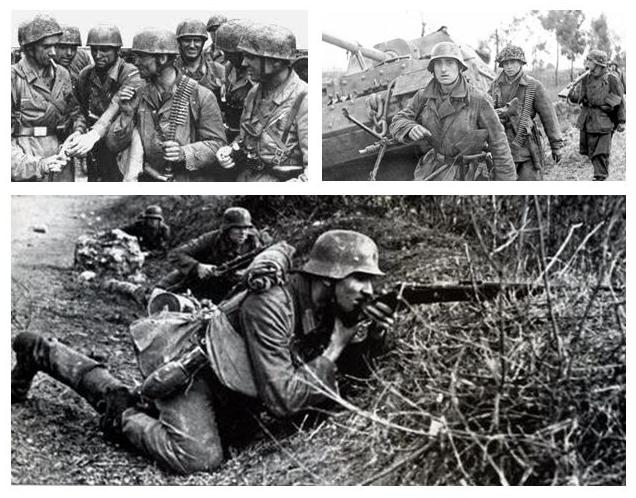
germanyia (clockwise from top left) Fallschirmjagers, Hermann Göring troops and Grenadiers

Using the updated Fortress Italy book, our Axis players have fielded some of the classic, war-hardened forces whose mission it was to hold the line against the Allied push up the Italian Peninsula. The 1. Fallschirmjägerdivision in Italy had already proven themselves throughout Europe with wide-ranging early war operations in Denmark and Norway, the Netherlands, Crete and the invasion of the Soviet Union with Operation Barbarossa.

Two other veteran companies fill out the Axis forces. The Hermann Göring Fallschirmpanzerdivision saw action throughout Europe and Africa before fighting in Italy. Finally, the 362.Infanterie-division had seen a long war (including the Battle of Stalingrad) by the time they joined the final Axis defense of Italy.

The Campaign Begins…

IMG_3685

Recent FOW Infantry Aces campaign action at Metropolitan Wargamers

We’ve got two weeks of campaign games in so far, and playing with small infantry forces of 500 points has been a refreshing break from the larger FOW games in which we all usually play. Special rules, varying troop ratings and small tables clogged with Italian terrain have also added to the challenges and enjoyment we’ve all had so far. There’s a lot of gaming to do as the campaign escalates over the coming weeks to 700 and 900 point companies with added support. Check back frequently for more of the action over at the Infantry Aces Metropolitan Wargamers Italian Flames of War site.

Flames of War: Fielding the 92nd Infantry Division Buffalo Soldiers

buffalsoldierscmnd

Although African-Americans have fought in every war in US history, their fight has often come on multiple fronts of prejudice and acceptance at home and abroad. Segregated units such as the famed 54th Massachusetts during the American Civil War and the 369th Infantry Regiment Harlem Hellfighters in World War I have received their due in popular culture in recent years, as have the WWII pilots of the Tuskegee Airmen.

On the ground, African-Americans in WWII were most often relegated to support roles early in the war as truck drivers, stevedores and cooks. By late in the war with reserves of Allied soldiers dwindling throughout the European campaigns, black soldiers were pressed into service at the front lines of the Battle of the Bulge and the Italian Campaign. It was in the actions in Italy where the famed 92nd Infantry Buffalo Soldiers added another chapter to their service history.

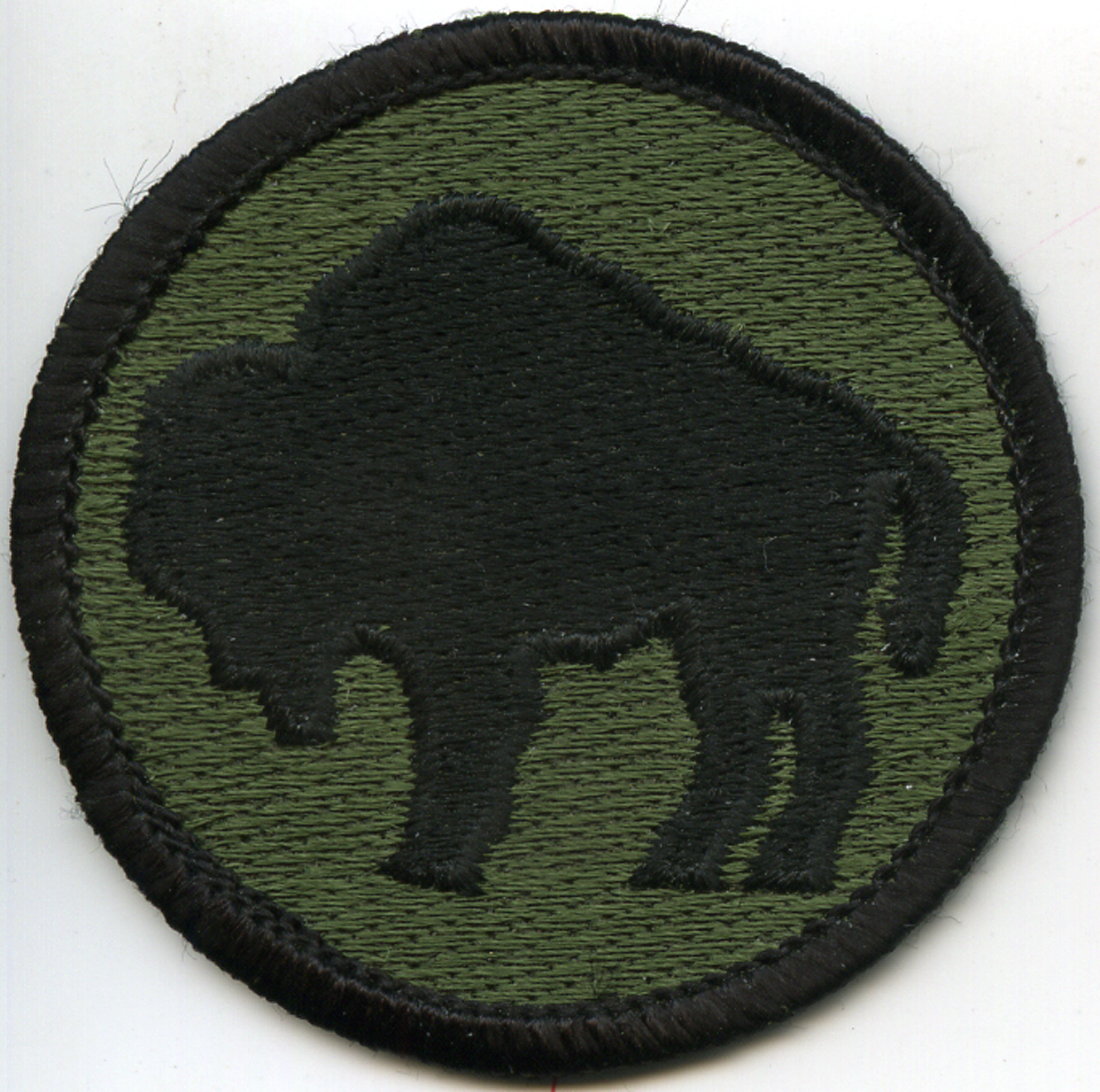
92ndpatch

Shoulder insignia of the 92nd Infantry Division ‘Buffalo Soldiers’

The Buffalo Soldiers in the Italian Campaign

The name “Buffalo Soldiers” dates back to the frontier Indian Wars of the 19th-century when post-Civil War free blacks volunteered for service in various US army capacities in the West. Later, these units continued serving in various capacities through the Spanish-American War and into WWI. Reactivated in 1942, the Buffalo Soldiers of the 92nd Infantry Division finally made their way to the war via Italy in the fall of 1944.

Video of the 92nd Infantry arriving in Italy in October 1944

As part of the US 5th Army, the 12,000 men of the 92nd Infantry made up part of the multinational Allied coalition of US, Brazilian, British and UK Commonwealth forces which sought to break the Gothic Line. Cutting across Italy, the Axis hoped to hold off any further Allied progress north to meet with other Allied forces pressing through Europe from Normandy inland toward Berlin.

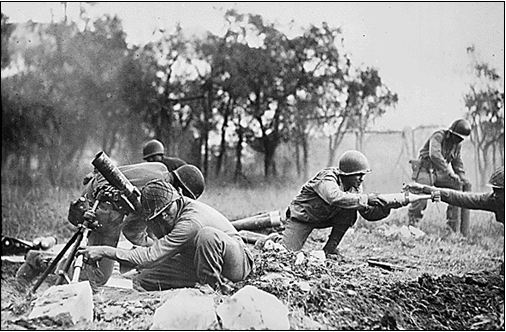
92mortar

A 92nd Infantry Division mortar crew firing near Massa, Italy

Led by senior white officers in otherwise segregated units, the 92nd Infantry made up a key element of the left flank of the Allied push up through the Italian peninsula. Crossing the Arno River and proceeding north, the 92nd made its way up the Mediterranean coast  through Lucca, Massa and on to La Spezia and Genoa by the time of Axis surrender in May 1945.

The legacy of the contributions of the 92nd Infantry Division’s effectiveness in Italy has been much-debated. A paper from the 1950s does what I read to be a good job in explaining the challenges the Buffalo Soldiers faced — delays in reinforcements,  shortages in re-supply and a lack of training for the kind of terrain encountered in Italy. I believe much of this can be chalked-up to the ingrained organizational racism against the segregated units. Post-war, the members of the Buffalo Soldiers also returned to a United States still entrenched in racial discrimination. It was not until the late 1990s that two members of the 92nd were recognized with Medal of Honor commendations, some fifty years after the war’s end.

Spike Lee’s Miracle At St. Anna

StAnna

As a wargamer and film fan, I often turn to the movies to cross-pollinate my interest in a period. Spike Lee’s Miracle At St. Anna from 2008 tells the story of four soldiers from the 92nd Infantry who hide out in a small Tuscan village and bond with its residents amid the oppression and danger of German occupiers. Lee’s movies often run hot and cold, and Miracle at St. Anna met with mixed reviews, poor box office results and a fair amount of criticism over the lack of historical accuracy. All that said, the Italian locations and strong individual performances makes the movie worth a view for a rare glimpse of African-American soldiers in WWII cinema.

Modelling the 92nd Infantry Division for Flames of War

fowroadtorome

In late February 2014, the revised Flames of War Road To Rome and Fortress Italy compilation was released as an updated and expanded guide to the Italy campaign of 1944 and 1945. The Fortress Italy book covers the German and Italian defenders, and Road To Rome outlines the Allied US, British, Polish, French and lesser-known UK Commonwealth forces from Canada, New Zealand, India and South Africa. A third book, Italy Battles, provides special mission rules, battle scenarios and campaign notes for Anzio (aka “Operation Shingle”) and Monte Cassino.

infantry aces

Having dedicated years of my FOW modelling and gaming to Western Europe, these books provided a great opportunity for myself and other members of Metropolitan Wargamers in Brooklyn, NY to dive into a club-wide Italian project. I’ve also been wanting to put together a unique company for my FOW collection, and I was pleased to find the 92nd Infantry Regiment outlined in the Road To Rome book. With all our focus on the Italy theater, we’ve decided to dive headlong into a multi-month FOW Infantry Aces campaign, and there will be more to come with updates on our new Infantry Aces blog.

PSCUSinf

For my 92nd Infantry I decided to snap up the two sets from the Plastic Soldier Company – Late War US Infantry 1944-45 and US Infantry Heavy Weapons. At about $26 a box from my favorite online dealer The Warstore, the PSC kits are a huge value in fielding an entire infantry company along with bazooka, machine gun and mortar supporting weapons. Assembly involves lots of small parts and bases must be purchased separately, but getting a whole company on the table for a fraction of the costs of FOW models can’t be beaten.

IMG_3669

Pvt. Fred “Radio” Rogers and Lt. Daniel McFeeley

To fill out my force, I picked of the FOW Infantry Aces set for about $12. The pack gives you nine stands of character models to create special Infantry Ace command stands for use in the Infantry Aces campaign. The blister pack includes general US, British and German models with special Fallschirmjäger, Japanese-American Nisei, Kiwi and turbaned Indian characters. I shared the models with my fellow players at our club, and modelling these guys really adds some nice personality to the game. For my Command Ace stand, I’ve modeled the fictional Pvt. Fred “Radio” Rogers and Lt. Daniel McFeeley leading the way for my company.

IMG_3670One of my three rifle platoons for the 92nd Infantry Division

In the FOW Italy campaign, the 92nd Infantry Division is rated as Confident-Trained making my force cheap and numerous. To start, I’ve constructed three rifle platoons with two rifle squads each plus a platoon command and bazooka in support. Along with my rifles and McFeeley and Rogers leading the way, I’m also bringing a weapons platoon in support. The platoon packs a punch with three 60mm mortars and four M1919 machine gun crews.

IMG_3671My Buffalo Soldiers mortar and machine gun weapons platoon

For all my models, I glued the PSC soldiers and equipment onto FOW bases and then hit them with an army green spray coat base. Boots, equipment, rifle stocks and flesh got a dark brown. Pants were done in a tan paint and leggings got a brownish off-white color. Guns were finished off in a metal coat. Basing involved a layer of fine gravel and larger rocks coated in a brown wash and then dry-brushed in a grey-white. Finally, tufts of brown-green grass completed the Mediterranean look of the models.

The beginnings of my platoon will be hitting the tabletop shores of Italy this coming weekend in their first round of our club’s Infantry Aces campaign. In the coming weeks I’ll be adding additional infantry weapons support with additional mortars, machine guns and more infantry. Even before these guys see their first action, I’m pretty thrilled to have put in the time to create some pretty unique models that I haven’t found modeled anywhere else at this scale. As in WWII years ago, I think the 92nd Infantry Buffalo Soldiers have been too often forgotten by mainstream history and many gamers alike. With my soldiers hitting the field again, I hope to bring a bit more glory back to these men who not only contributed to the fight against Axis fascism but also stood bravely against the tide of so much history against them.

Metropolitan Wargamers D-Day Plus 70 Event Report

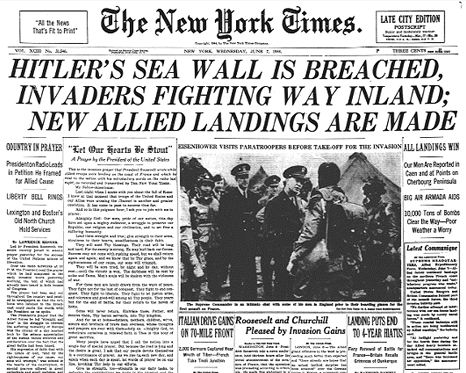
NYTimesDDay

This past weekend at Metropolitan Wargamers in Brooklyn, NY, dozens of gamers came together for three days commemorating the 70th anniversary of the Allied invasion of Normandy on June 6, 1944. Throughout the weekend, we ran multiple WWII-themed games, including Normandy ’44, I Ain’t Been Shot Mum, Flames of War, World In Flames and Memoir ’44. Dice were rolled, strategies were debated, prizes were won and Allied and Axis forces vied for control of France. In all, it was another great weekend full of gaming at our club’s space in the heart of Brooklyn.

Friday Games

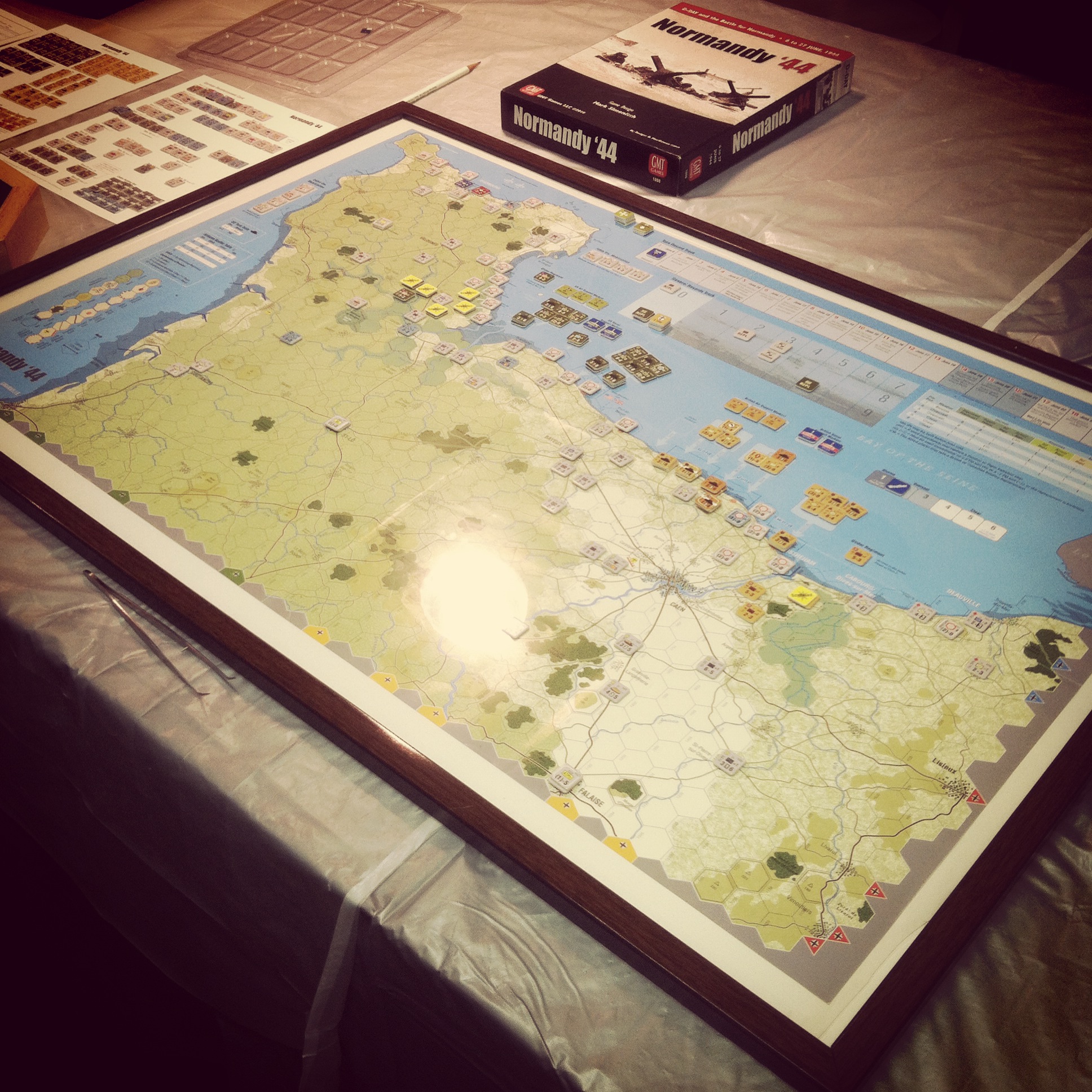
IMG_3586The invasion of France begins with Normandy ’44 at Metropolitan Wargamers

Friday kicked off after work with a few players unpacking a fresh copy of the classic Normandy ’44 from GMT Games. This one-map game covers the pre-dawn D-Day Airborne landing areas, five Allied invasion beaches and the charge to the initial inland objectives. The game scale plays with regiments and battalions with each turn representing one day of action. The small, self-contained game provides a great introduction to game mechanics at this scale with a tight, clear rules set. With a quick look at the game, I decided I’m going to have to personally give this one a shot sometime soon.

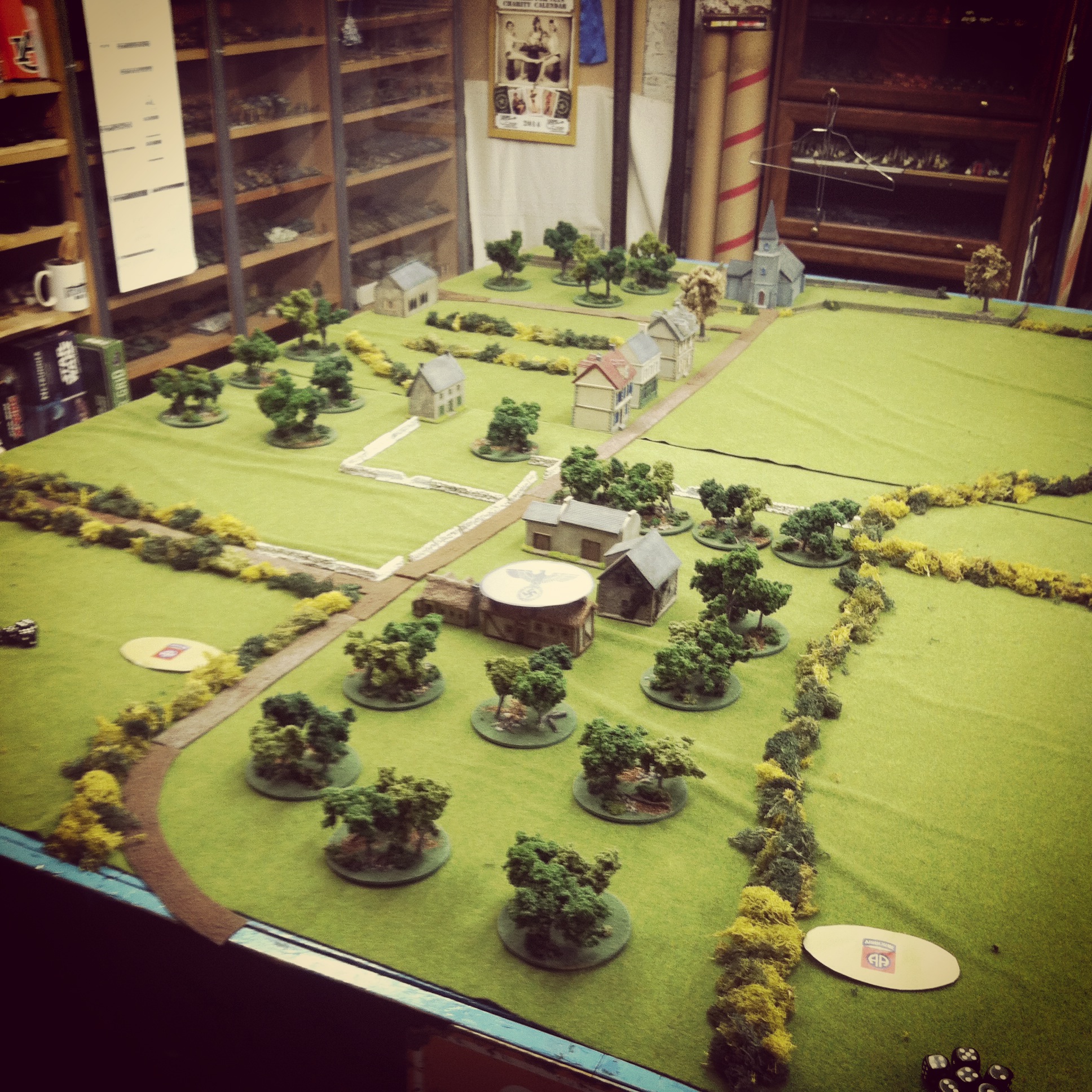
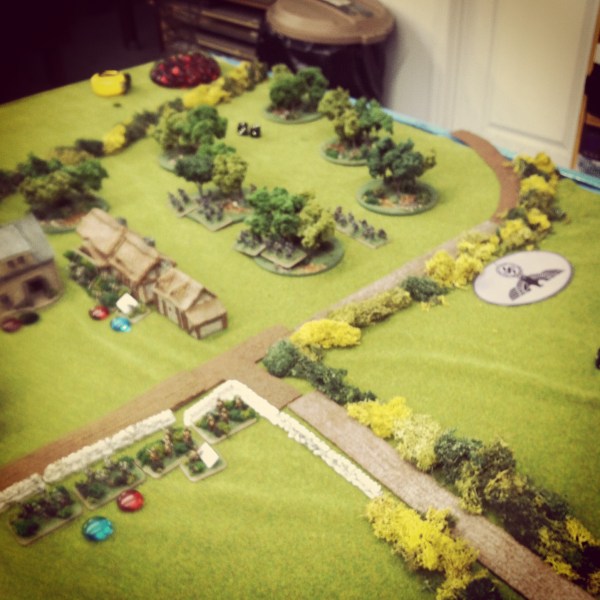
IMG_3587 US infantry blinds move toward unsuspecting German defenders at a farm outside Vierville

At the back of the club, we ran a game of our new favorite WWII tactical miniatures game, IABSM  from Too Fat Lardies. In our ongoing campaign of the Normandy scenarios in the IABSM Where The Hell Have You Been Boys? book, our game focused on the battle at Vierville-sur-Mer. With the 116th Infantry Division supported by the 5th Ranger Batallion, the Allied mission was to drive inland to capture and defend the church at Vierville.

IMG_3589

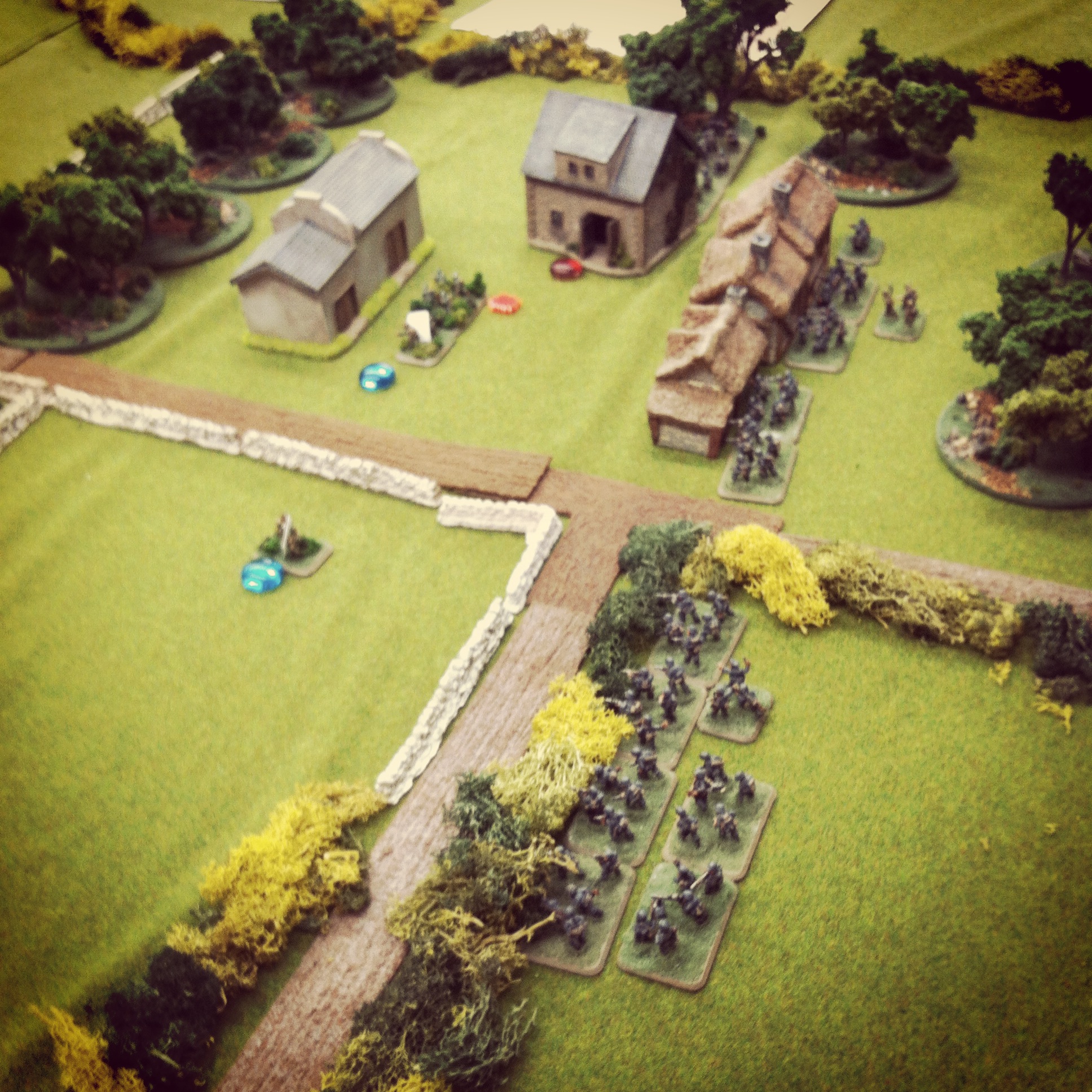
German and US units exchange fire in and around the farm at Vierville

As per the scenario, initial Allied blinds approach a farm outside Vierville where a German blind sits unknowingly in the complex of buildings. With Allied infantry closing in over dense bocage hedgerows and orchards, a firefight erupted and drove the German defenders through the buildings and into the orchard beyond.
IMG_3590

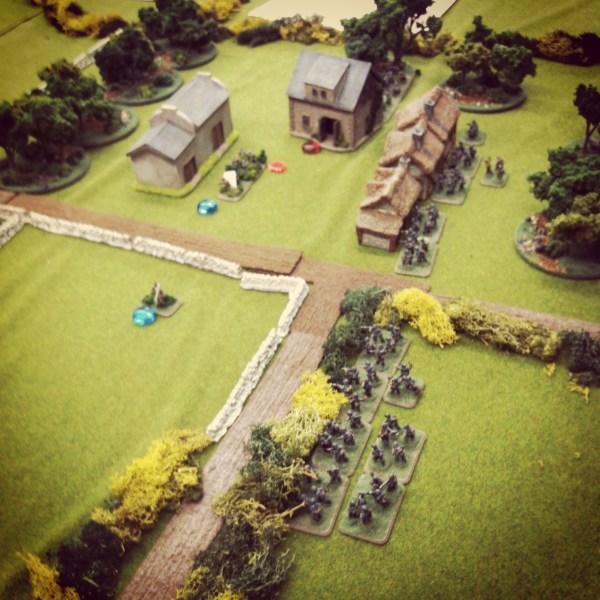
German reserves arrive at the flanks of the advancing US infantry outside Vierville
IMG_3633

Germans reinforcements push the Americans from the farm

As the first force of Germans fled the farm, their reinforcing comrades came on to the rear and flank of the US infantry. The Americans made consecutive moves of firing and moving back to defend at a series of stone walls across the road from the farm. The retreating defensive US actions held off the German onslaught until enough Americans could take up position amid Vierville’s houses. At the same time, the US Rangers moved in at the far end of town to hold the objective at the church.
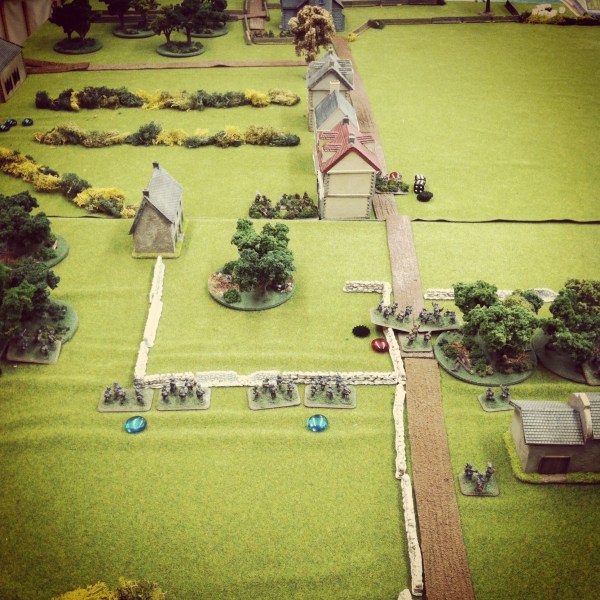
IMG_3632

Americans pull back from the farm to take position in Vierville

The game eventually settled into a bloody house-to-house and hedge-to-hedge fight along the road leading toward the church. Occasional lucky shots from US Ranger light machine guns at the church also harassed the Germans lying low behind their stone wall position at the farm’s orchard. By midnight, much of the initial American force had been destroyed or was retreating to a final stand at the church held by the Rangers. While the Germans had also lost a sizable amount of their force, their heavy machine guns were still in play as they closed in through the town. This time around, we called the action at Vierville a draw.

Saturday Games

IMG_3603The Americans hit the Easy Green sector of Omaha Beach

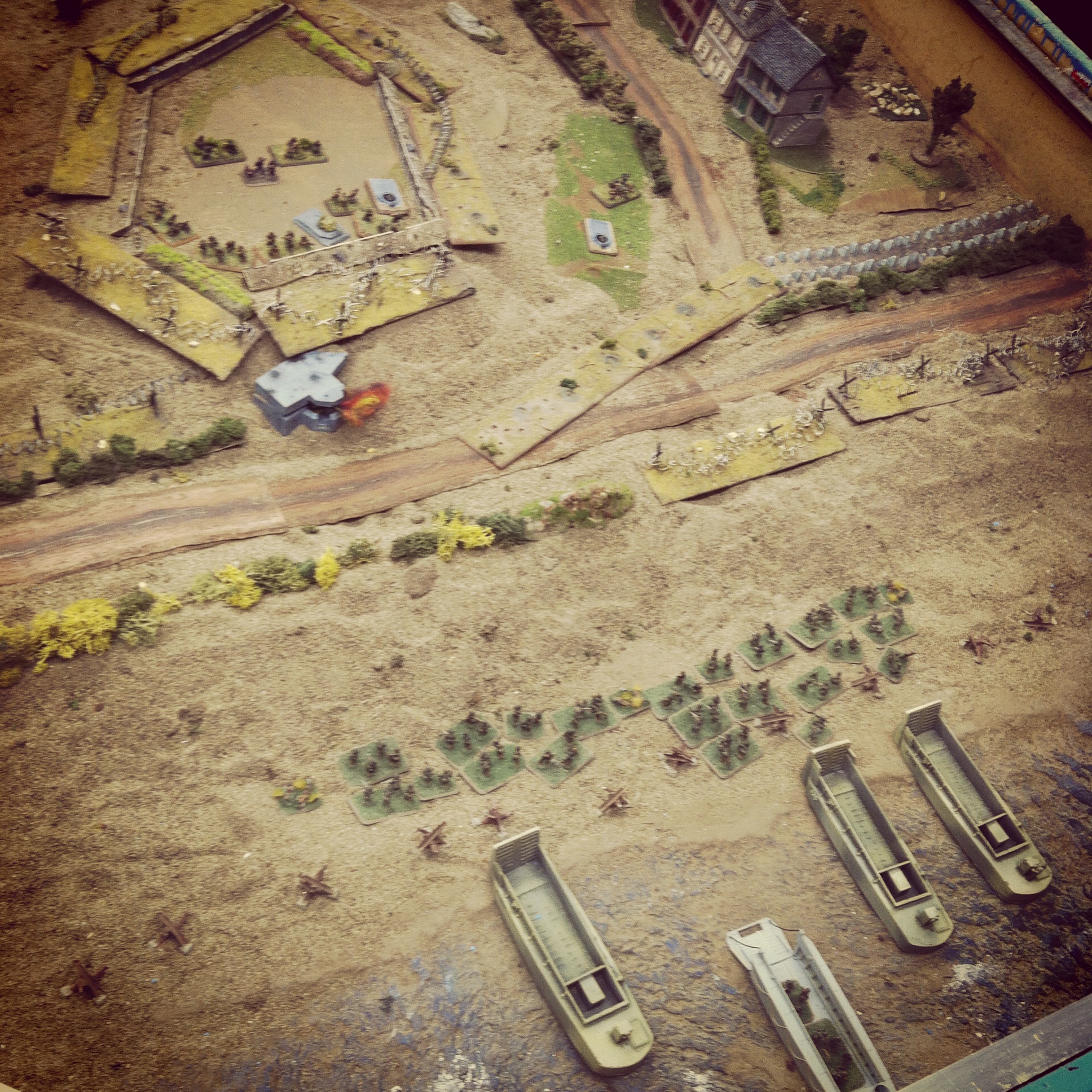
The next day kicked-off with a running of a FOW beach landing at Easy Green on Omaha Beach. We have been play testing the FOW scenario over the past two months, tweaking our forces and strategies to cope with the clumsy beach landing rules. In our past games, the US invaders only manage to win about a third of the time. Even so, we decided no D-Day weekend was complete without a return to “Bloody Omaha” on one of the club’s award-winning sand tables.

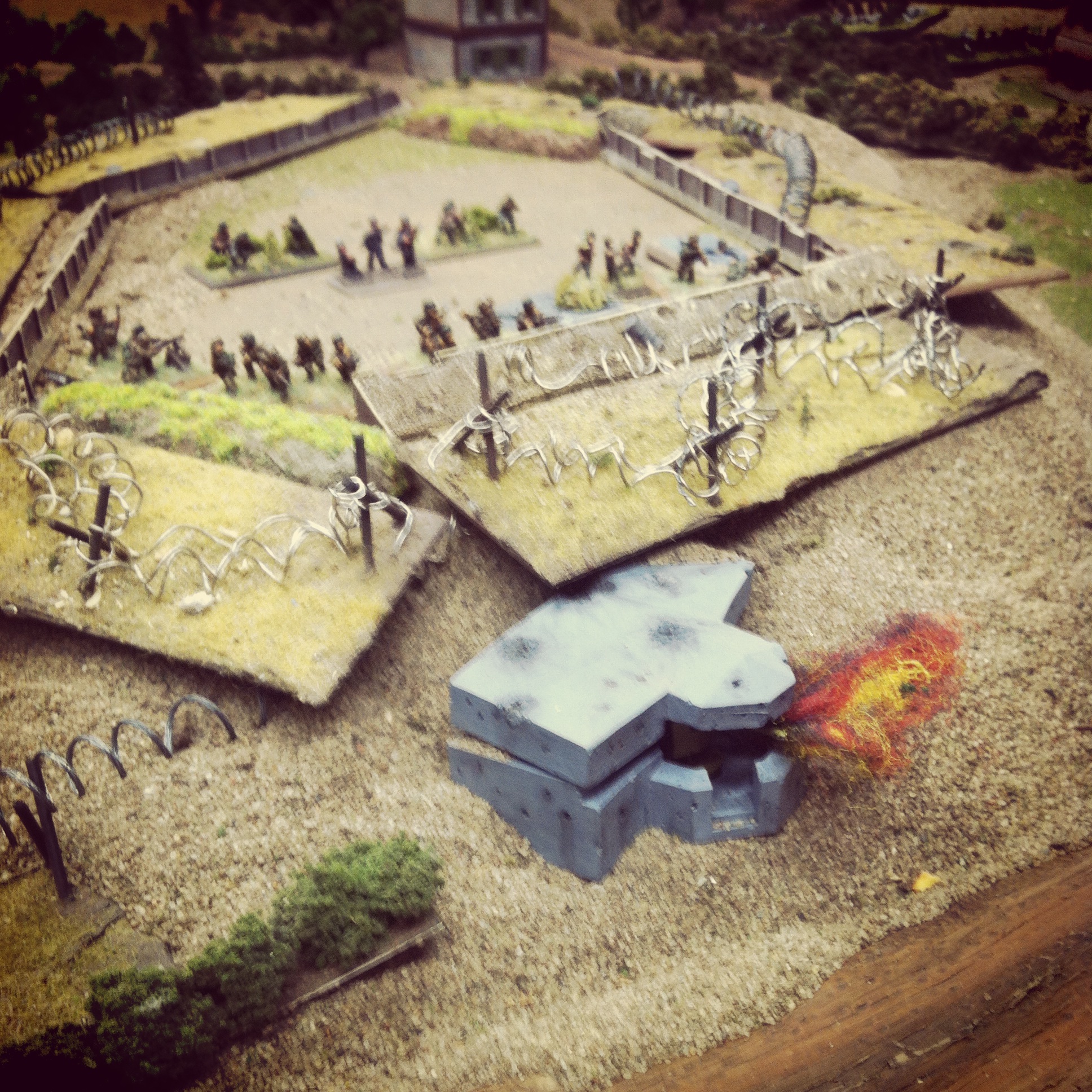
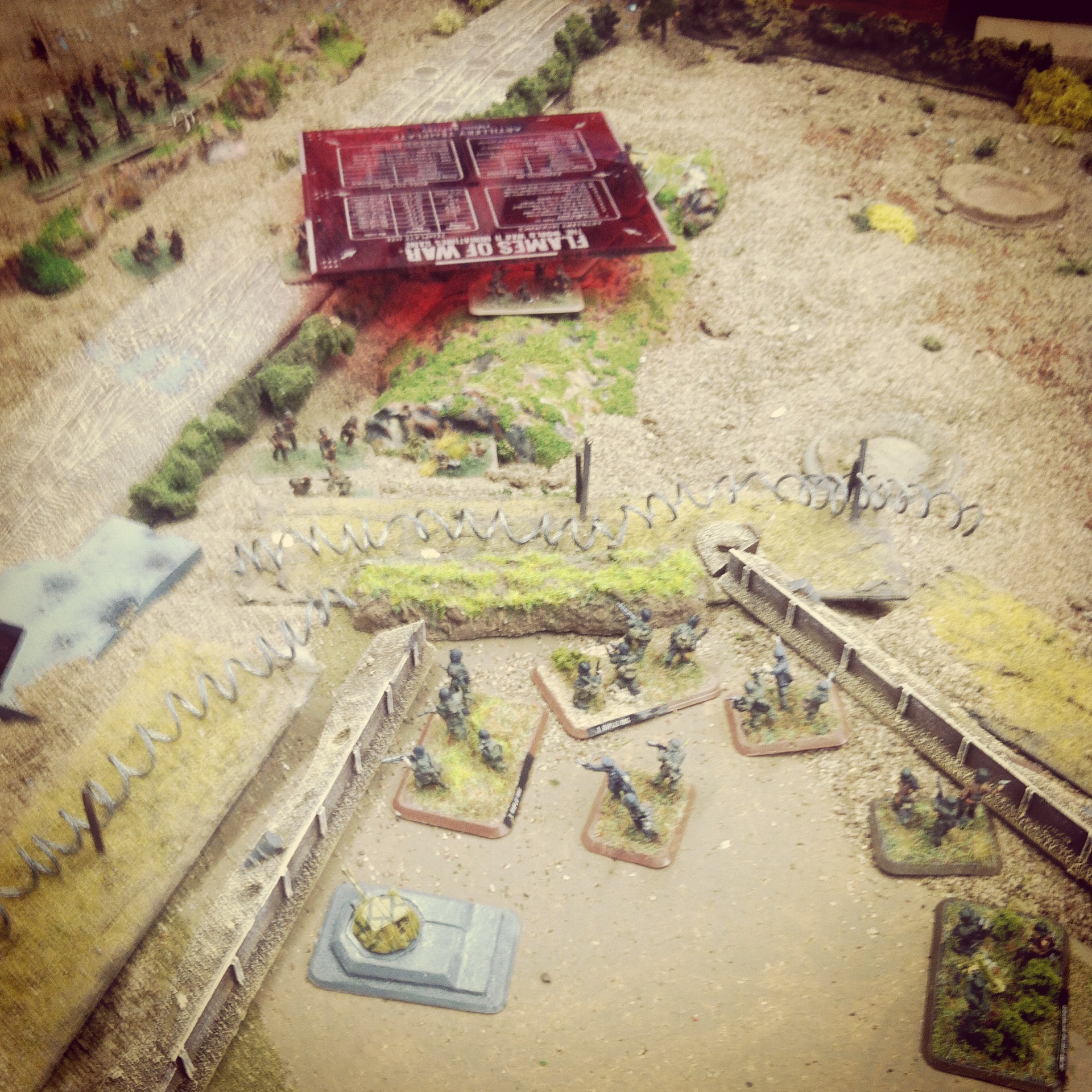
IMG_3604German defenders hold their positions behind a burning bunker

The opening turns found a lot of US boats on the beach and a quick push to the seawall. So early combined arms fire managed to destroy the main bunker at the beach, but the battle was far from over. The initial US push followed on to the left of the beach, but multiple turns at clearing the barbed wire stalled the advance as the Americans took heavy fire.

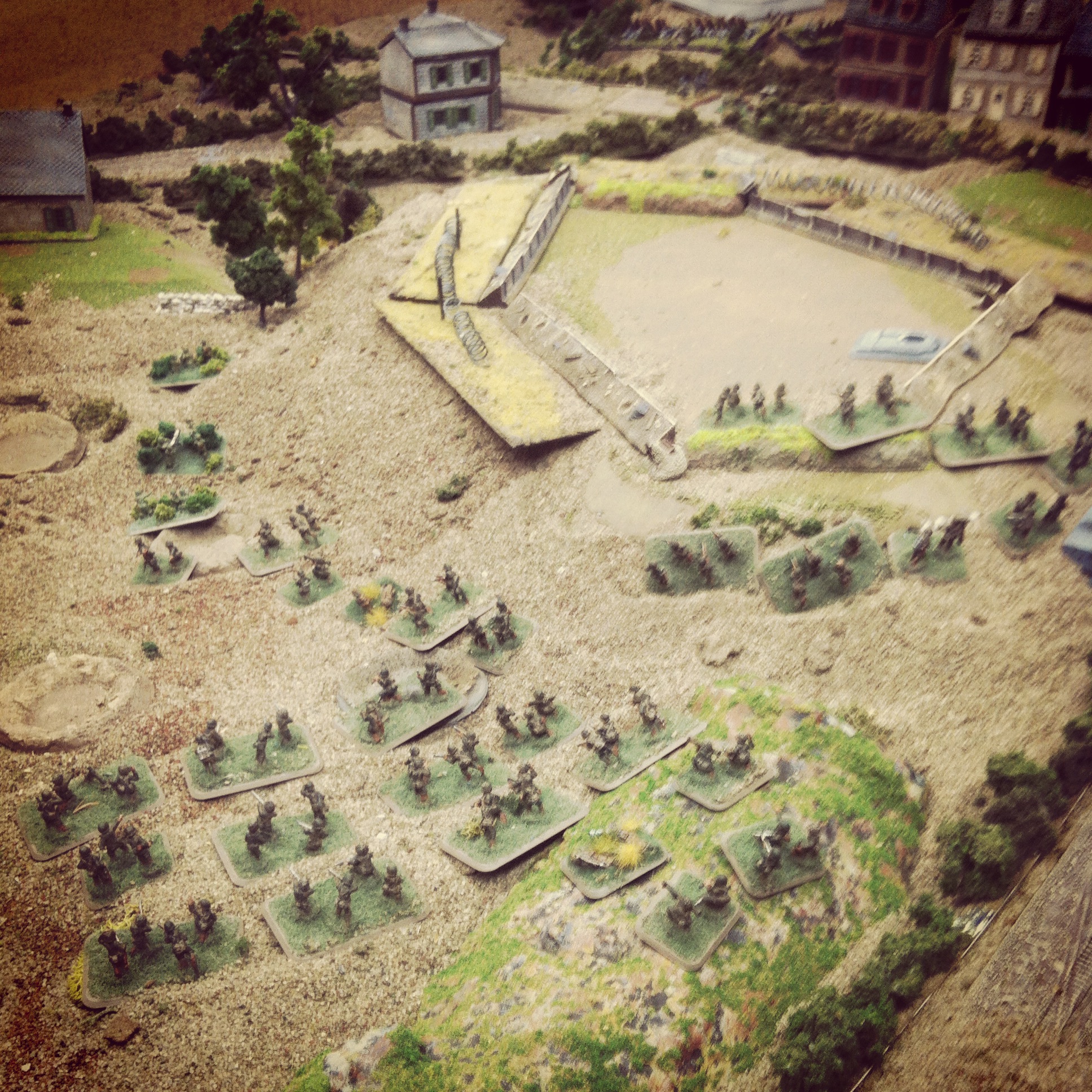
IMG_3606

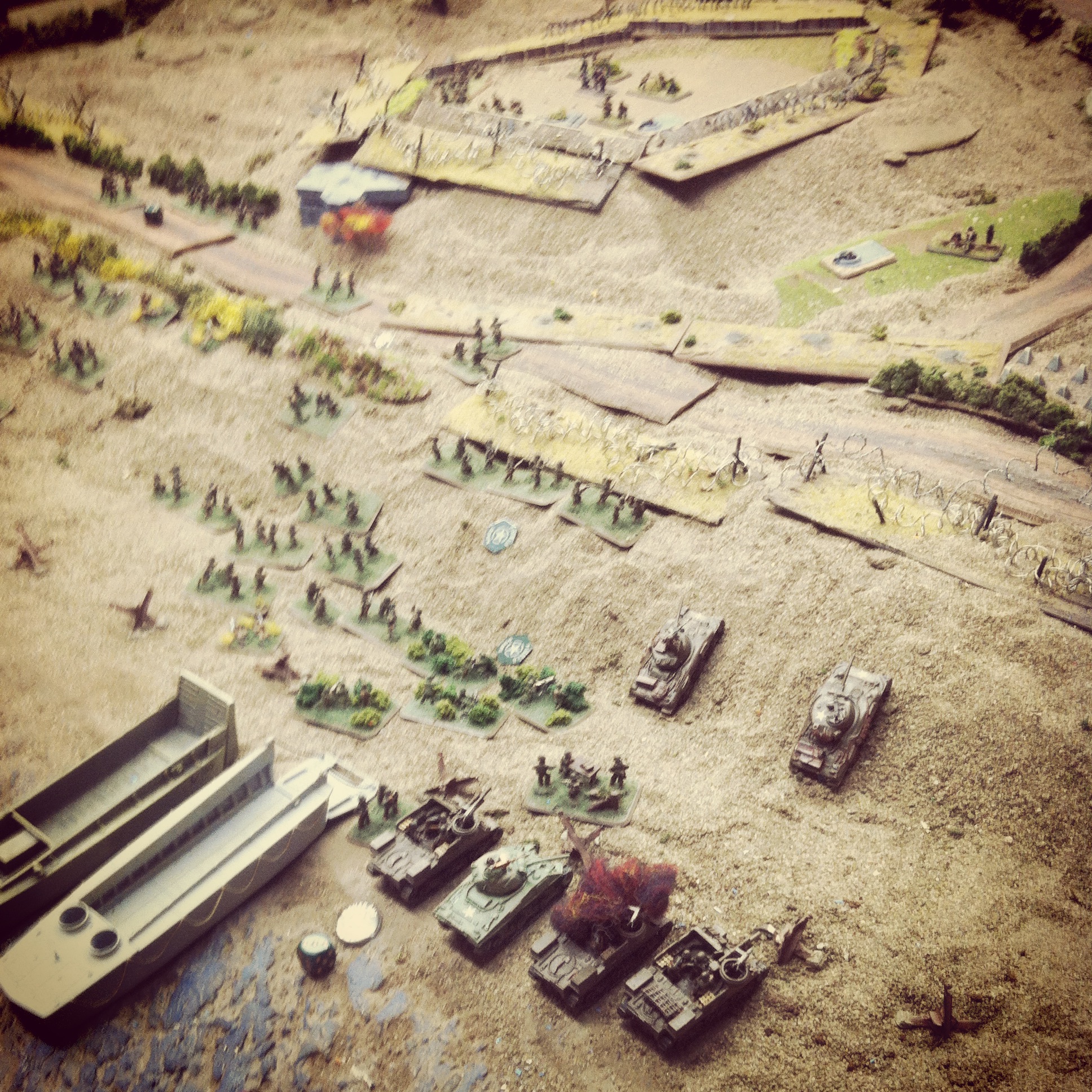
American armor and artillery follow-up the infantry landings

As US armor arrived, several tanks managed to drive off the beach to the minefield position to lay down fire on the German trenches. One tank wound up spending three turns bobbing in the surf offshore only to arrive and bog for two more turns on the beach. As this most inexperienced tank crew in Normandy struggled, the other Shermans took fire from German rockets and reserve tank platoon which rolled to bulk up the beach defense. American artillery also arrived but proved pretty ineffective to the Germans at the trenches. Wave after wave of US infantry pushed to the trenches, eliminating most of the defenders but never managing to clear the barbed wire lines to seize the German position. At the final turn, the Americans just hadn’t made enough headway to control the beach.

IMG_3627World In Flames continued over D-Day weekend

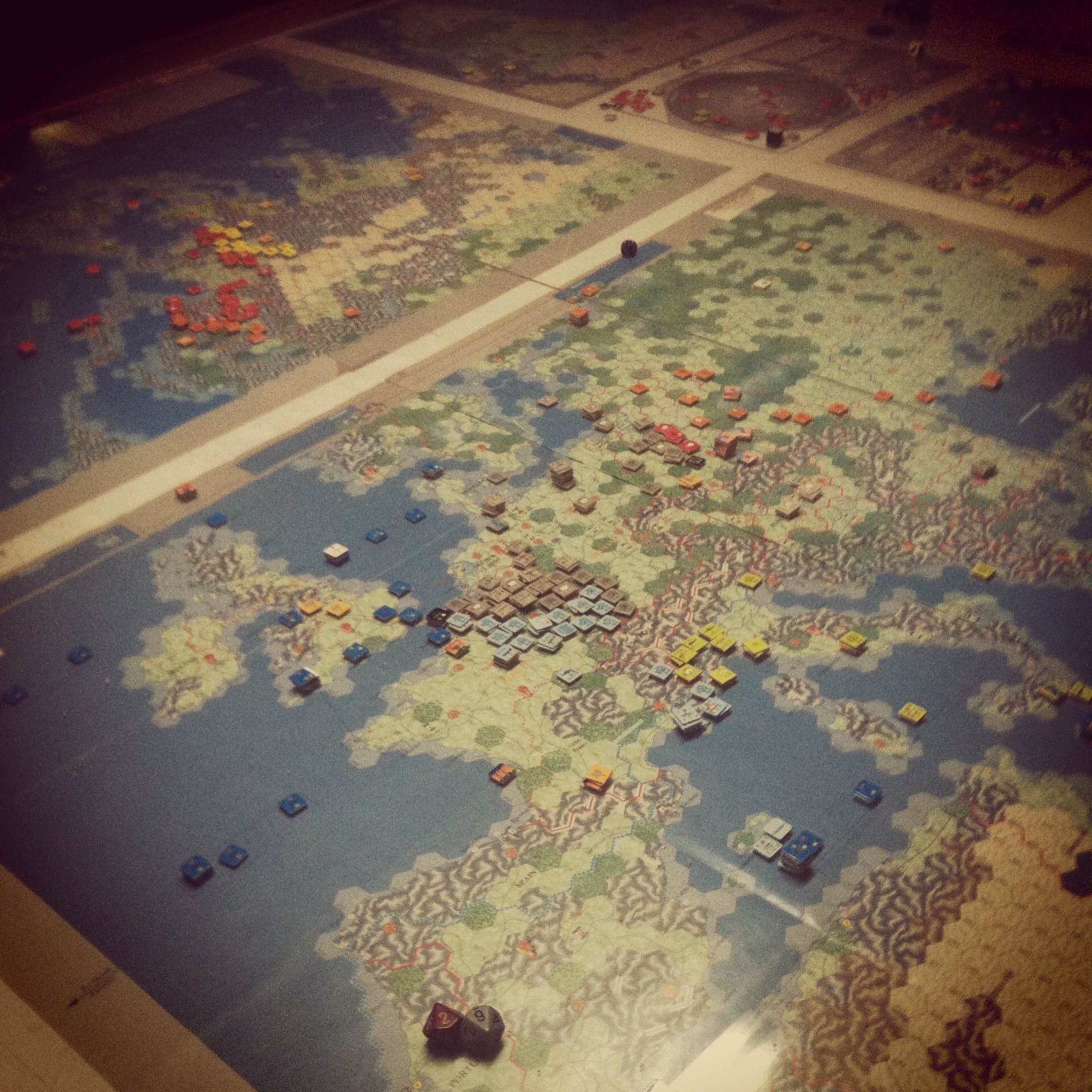
With action raging on the sand table, a group of club members showed up to continue playing their massive World In Flames game. Australian Design Group’s WIF from 1985 is the standard in grand-scale strategic fighting of the entire WWII period. The game’s rich playable detail, dizzying number of 1400 playing counters and sprawling maps makes it a commitment for only the most experienced gamers over many months of play.
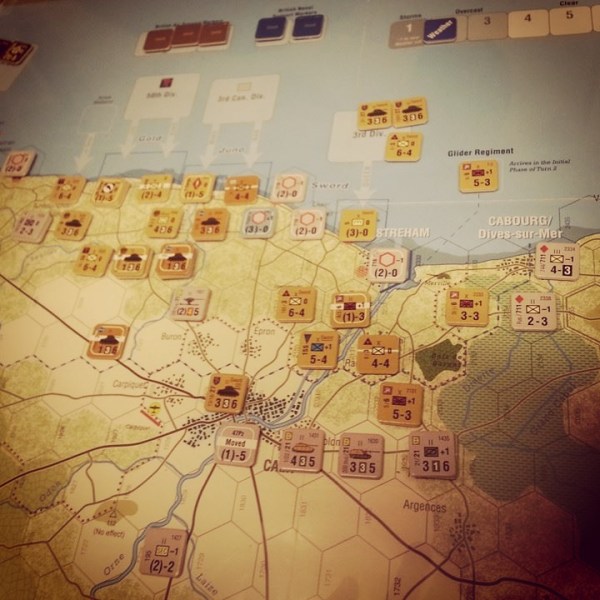
IMG_3630Allied forces push from the beaches inland to Caen in Normandy ’44

The Normandy ’44 game from the evening before concluded with a decisive Allied victory Saturday afternoon. Pushing the Germans back from all but Utah Beach, the Allies captured Bayeux and several smaller towns. With German defenders routed from roads leading inland from the landing beaches, the victors rolled in to control half of Caen by the game’s end.
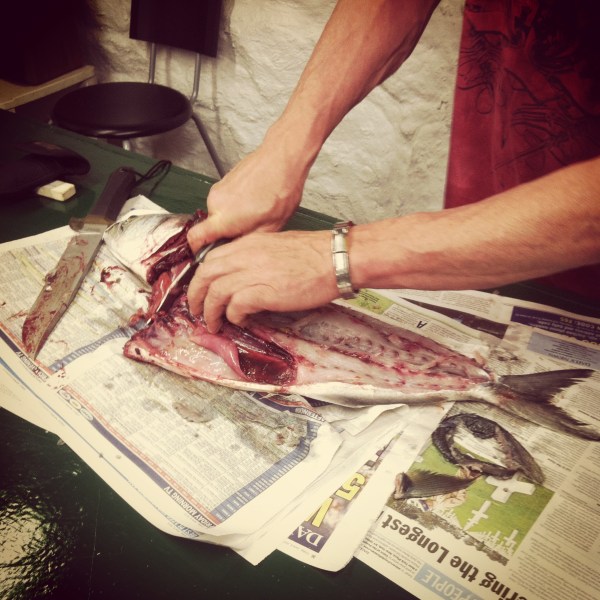
IMG_3625No one was going hungry at Metropolitan Wargamers over the weekend

Saturday also included a lot of other club members down for the usual variety of board, Euro and card games, making for a packed house. As the crowd rolled in, a longtime club member showed up with an enormous fresh-caught fish which he proceeded to gut with a huge military-style knife. With fish on the grill and food ordered in, there was plenty of food to sustain the crowd of gamers throughout the day.

We all took a mid-afternoon break to dice-off in a game, books, DVD and miniatures raffle to raise funds for the club. I was fortunate to score a copy of A Few Acres of Snow from Treefrog Games, and another lucky person picked up an unused copy of out-of-print the Games Workshop classic Dreadfleet.
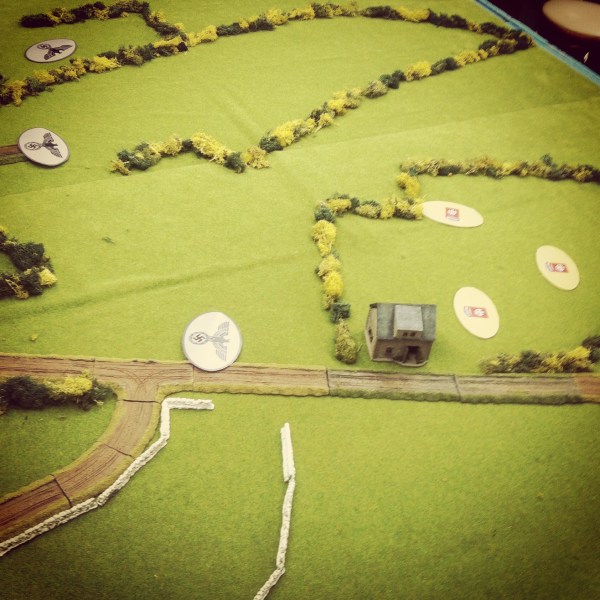
IMG_3631

Initial deployment of Allied and Axis blinds in our Saturday evening IABSM scenario

As the main crowd thinned out, we ran an evening IABSM game continuing the assault beyond Easy Green. The scenario found initial US forces deployed around a small French farm with the objective of moving men off the table on the roads beyond. The Germans were tasked with preventing the American advance and seizing the farmhouse stronghold.

IMG_3607

Settling in for a contested fight at the farmhouse above Omaha Beach

Using initial blind deployment, Germans quickly moved to the farm along thick hedgerows as the Americans drove into the building for cover. Turns followed with the Americans jumping from cover to fire on the dwindling German force which returned fire over the hedges to unfortunate US infantry hanging out in the open. A US flamethrower attack from the window of the farmhouse decimated another German squad sitting close behind a nearby hedge. Pressing their luck, a group from the farmhouse made a run for the road exit only to be stalled by a reinforcing German heavy machine gun squad. Returning fire, the German MG42s were eliminated from their position in the open field. However, the damage had been done. Although the Germans had not captured the farm objective, the Americans no longer had a sufficient force to push off the table. The night ended with a German victory beyond Easy Green.

Sunday Games
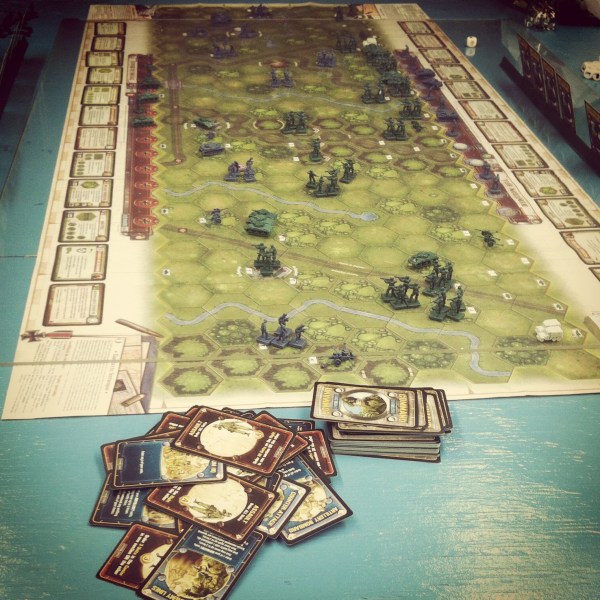
IMG_3620The war continues on the Memoir ’44 Hedgerow Hell battle map

With the first days of Operation Overlord behind us, Sunday’s game focused on the breakout actions. A couple visiting players showed up for the club’s Memoir ’44 game around noon on Sunday. Using the wide Hedgerow Hell expansion map, the Allies beat the scenario odds to win the game in the Overlord scenario. There was much talk of getting larger games of Memoir ’44 back in rotation at the club soon, so hopefully getting the game back on the table will bring some renewed interest in the coming months.

 IMG_3621

The initial armored encounter outside Lingevres leaves British tanks in flames

I finished off my weekend as the British at Lingevres using the same scenario I first ran at the club a few months ago. The mission ahead for the Brits was to move into the heavily defended town and take two of the buildings. Historically, the battle played out as a tank duel between UK Sherman Firefly and German Panther tanks, and our game this past weekend played out in a similar way.

IMG_3624

A Panther meets its end at the hand of the British Royal Artillery as a close assault is attempted on another in the woods nearby

At the outset, my first platoon of tanks got a bit overly aggressive and charged into contact with the full Panther platoon at the farm outside Lingevres. With the first Firefly destroyed in the opening turns, my remaining Shermans pulled back as the Panthers rattled to the middle of the field to hold off UK infantry advancing through the woods and bocage-lined fields beyond. One Panther bogged on a hedgerow and another was destroyed in an initial volley from the Royal Artillery in the fields outside town. Several turns became ensnared in attempted infantry assaults on the third Panther in the woods, but eventually the German tank rolled away to deal with the building reinforcing infantry and tank platoon in the fields on the other side of the table.

IMG_3622British Shermans and infantry break across a field toward Lingevres

With the Panthers moving away, fresh British infantry and the surviving Shermans moved to the farm and fields beyond. British artillery fire winnowed and pinned the German platoon in the church over several turns. Artillery fire also sought to keep the reinforcing German spotter pinned to limit the effectiveness of the reserve Nebelwerfer battery which as delayed reserves to the rear of Lingevres.

IMG_3623

The duel between the Panther and Firefly ends with the British tank in flames as the remaining Shermans destroy a Panzer IV platoon in the distance

In the meantime, a multi-turn tank duel had settled in between a lone Firefly and Panther while a reinforcing Panzer IV platoon arrived at the edge of town. Both tank groups traded fire, and in the end, the Panzers were routed with two or their three destroyed and the Firefly fell to the Panther’s gun. Back at the farm field, Shermans traded fire with Pak 40s and destroyed an anti-aircraft platoon defending the town’s flank. With two Panthers left on either side of the church, Shermans on each side of town and advancing British infantry, we called the game a draw.

 Weekend Debrief

After more than 20 hours of gaming over two nights and days, I was pretty worn out, but the interest in the D-Day event had made the weekend well worth it. WWII still holds enormous interest to this day, as demonstrated not only by our weekend of gaming but by the mainstream media’s coverage of D-Day over the week leading up. In the next week, we’re kicking off an FOW Infantry Aces campaign with fresh forces hitting the tables in rounds of Italy-themed WWII games. This fall we’ll be playing out some Market Garden battles and by the winter we hope to host some Battle of the Bulge engagements. It was a pretty special weekend in Brooklyn, but for regular visitors to Metropolitan Wargamers, there’s always the next game in this very unique New York City community.

New Game Weekend: I Ain’t Been Shot Mum

IABSMbook

As a World War II gamer, I have a newly-discovered love for a game which doubles my gaming possibilities with all the time and money I’ve  got invested in the 15mm Flames of War game which is the modern standard for the period. The past two weekends at Metropolitan Wargamers in Brooklyn, NY, I’ve been turned on to I Ain’t Been Shot Mum which is billed as “the other World War II miniatures game. For gamers with a lot of miniatures on hand and a hankering to play WWII at a different and more historical level, IABSM is well worth it.

TFLlogoNow in its third edition, IABSM has been published since 2002 by Too Fat Lardies, UK-based makers of a number of wargaming rules systems for a variety of historical periods. Overall, the game provides WWII wargamers with a simple, sleek set of skirmish rules that focuses far less on fielding shiny models and more on tactical decisions on the tabletop. IABSM is a true “what you see is what you get” system with a 1:1 scale at 15mm but easily adaptable to other model scales. One guy on the table equals one soldier in the field during battle, taking the game down to a level that really “feels” like commanding a group of troops. The smaller, less abstract scale of IABSM games provides a lot less “gaminess” to the systems, and relies a lot more on the decision-making skill of players commanding forces on each side. In many ways, the game is a throwback to original Kriegsspiel invented for use in Prussian army training two hundred years ago.

IABSMcardsSample cards from I Ain’t Been Shot Mum from Too Fat Lardies

The core rules of IABSM retail at under $20, and provide a number of basic underlying mechanics easily usable in any battle or theater of WWII. As an avid FOW player who is often faced with hundreds of pages of more grand-scale rules, army lists and ongoing modifications, the elegance of the skirmish-level IABSM comes down to five main areas:

1. Random Activation: Rather than playing by a simple “I go, you go” turn-based mechanic, IABSM games are powered by a set of cards which randomly activate deployed troops in the field. At the beginning of the game, a deck of cards is shuffled with each card representing a unit in the game. Cards are drawn and units are activated in turn, with units choosing a number of actions based on their quality. Highly-trained US Airborne troops may have four actions when activated, while less elite regulars may only have three. Actions include movement, firing, spotting the enemy and many other activities which makes commanding a unit’s turn one of many possible choices. Cards are added to the deck as new units arrive and removed if a unit is destroyed. Drawing a “tea break” card ends the turn with one final round of shooting for available inactivated units before the cards are shuffled a new turn begins.

2. Morale: Troop morale is nearly as important as firepower on actual battlefields. A well-armed but rattled group of soldiers may prove to be nearly ineffective in the field without some stalwart command leading the way. IABSM offers several levels of morale with pinning, shock and suppression which progressively eats into how effective a particular force can perform on the table. When being shot at, a simple table resolves possible kills as well as whether a unit is progressively shocked into poorer performance in subsequent turns or entirely immobilized due to overwhelming fire.

3. Command: Commanding and junior officers in IABSM are represented as “big men,” with individual cards allowing for their separate officer actions to drive gameplay. Through proximity or attachment to their forces, commanders can greatly affect morale by clearing shock from troops and boosting their strength in subsequent exchanges with the enemy. The presence of command also doubles the chance of troop activation, as a drawn “big man” card can press an attached unit into action without its own card being drawn.

4. Blinds: In real-world combat, knowing the enemy position through intelligence, observation or contact is almost as important as the engagements that result. While many miniatures games present an open table where nearly everything is known from the get-go, IABSM preserves a “fog of war” element with the deployment of “blinds” on the table. Represented by oval-shaped markers, blinds are able to move around the table without revealing their actual make-up. Thus, a player might move a small unit, a large platoon or even a false blind containing no troops around the table without the enemy knowing its true make-up until revealed. This allows players to add an element of diversion to the game, as an enemy way burn up several turns chasing a ghost across the table as real forces jockey into position.

5. The Game Referee: One of the hallmarks of wargames until recent decades was an all-seeing, all-controlling game referee. As a non-player, the referee not only provides clarifications on rules and contested play on the table, but they also are able to maintain a level of secrecy between each player as a scenario unfolds. The game can be played without a referee, but the presence of one adds yet another depth of to the “fog of war” randomness employed already with blinds and random card activation.

WTHbook

Beyond the base rules, Too Fat Lardies offers a number of IABSM scenario and guide books for Europe, Italy, North Africa and the Pacific. General lists allow for the creation of custom scenarios, but I really like the historically-specific books. The past two weekends, I played the first two games in the D-Day-themed Where The Hell Have You Been Boys? book which contains over twenty scenarios from Omaha and Utah beaches to the inland. Following the United States advance and subsequent German counterattacks, each scenario lays out a simple briefing for the German and US players along with a referee sheet, terrain map and a guide to forces and cards needed for play.

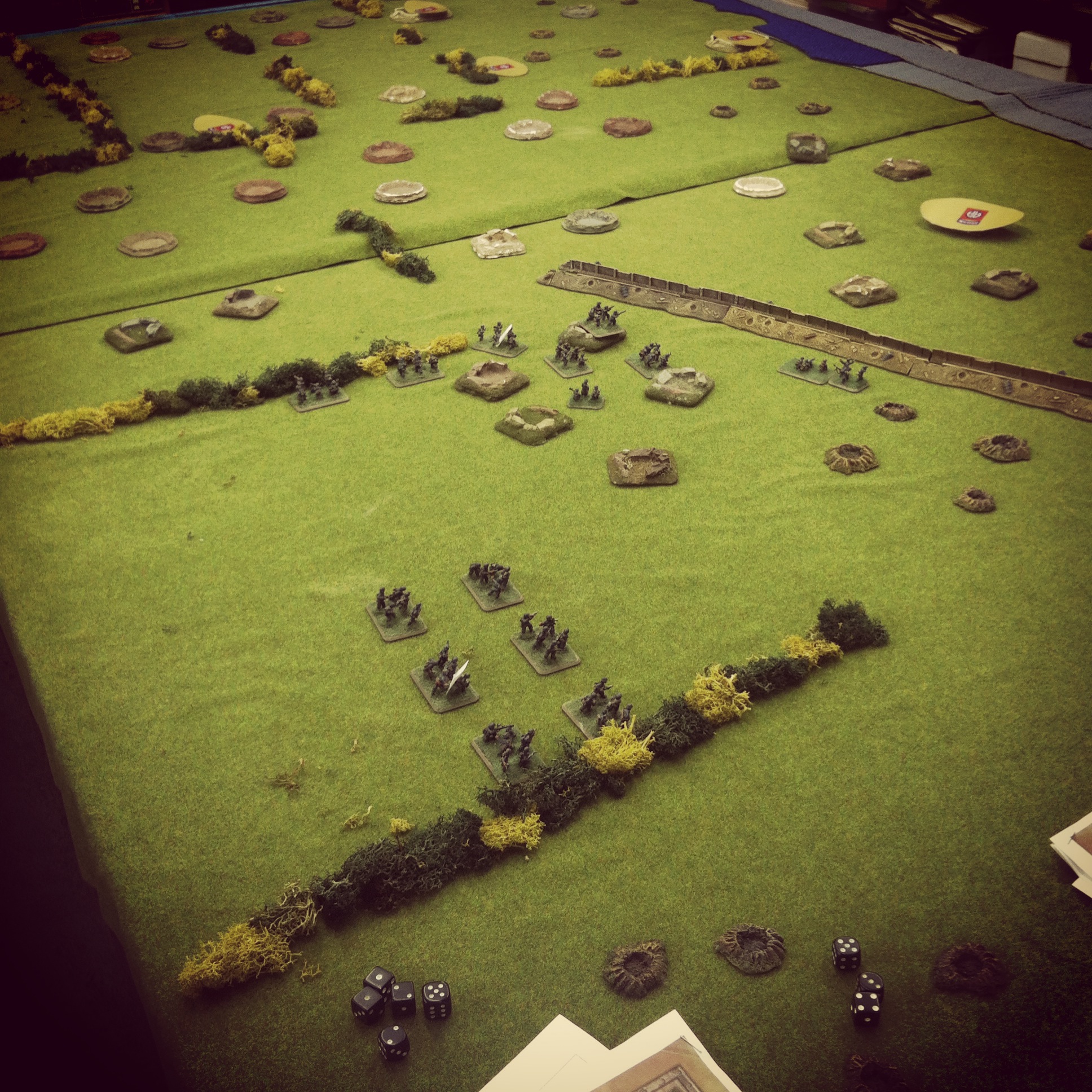
IMG_3554“Protect The Guns” scenario set-up for IABSM

IABSMGameScenes from the German defense above Pointe du Hoc in “Protect The Guns”

My first game — “Protect The Guns” — saw me playing as the defending Germans looking to hold off the Allied advance from Pointe du Hoc with a couple heavy machine guns, snipers and some off-board artillery. One of the remarkable things about IABSM is the vast amount of space represented on the table, making decisions of movement and firing  very important. My artillery was also very unreliable, representing some of the German communication challenges come alive. That said, with only a few men at my disposal, I was able to stave off and force the Americans to redirect through constant harassing fire until their reinforcements entered under a blind at my rear. With one of my machine guns and both snipers finally destroyed, the last of my Germans found themselves pinched on two sides of more-skilled US troops who took the game.

IMG_3553

“Holding The Pointe” scenario set-up from IABSM

In “Holding The Pointe,” my Germans were on the counter-offensive and looking to push the Americans back into the sea. With all my forces deployed at the game’s start and all American units under blinds, my Germans began in overwhelmed confusion. This disadvantage made the game play so much more like the actual action in Normandy as German forces scrambled to head-off the Allied attack inland. Rather than focus my attack, I made the poor gamble of splitting myself to chase two sets of US targets. By the time a large force of German reinforcements arrived in the seventh turn, my initial force had gotten chewed-up in a series of stand-off firefights amidst the thick bocage near my original deployment. My divided force tactics were ultimately my undoing, and I’m certain a more textbook massed attack may very well have giving me a greater shot at victory.

With a couple of games under our belts, we’re going to continue right through the IABSM D-Day scenarios and beyond. We’ve managed our games without a referee so far through some really good fair play, but we’re anxious to try some scenarios with the referee element. Overall, the up-close feel for command and the heightened tactical realism in IABSM has given me a second WWII game to love at the 15mm scale.

Flames of War: Omaha Beach “Easy Green” 1944 Scenario

OmahaBeachSandwiched between tall bluffs on either end, a five-mile stretch of Normandy coastline was designated Omaha Beach near the center of the Allied D-Day landings on June 6th, 1944. Landing at Omaha was the relatively fresh US 29th Infantry Division. With British and Canadian troops landing on beaches to the left and other US men landing at Omaha Beach to the right, the 40,000 Americans at Omaha met with the highest rate of casualties of the day with some 3,000 falling in the French surf and sand.

OmahaEasyGreen“Easy Green” sector on Omaha Beach, Normandy 1944

Lying in wait at Omaha was a mix of green recruits and older veterans in the German 352nd Infantry Division. Dug in at the coast in a wall of pillboxes, bunkers, gun pits and trenches, the German men (and unknown number of boys) met the US invaders with a storm of machine gun, artillery, mortar and rocket fire. For the US, little went right as landing craft drifted off course and special floating DD M4 Sherman tanks were swamped and sank offshore. Only through improvised efforts and a slow, methodical pace under withering fire did the American infantry finally make it through the German lines to control the beach by the close of the day.

EasyGreenFOWMap set-up for the Flames of War “Easy Green” scenario

In preparation for our upcoming D-Day Plus 70 weekend at Metropolitan Wargamers in Brooklyn, NY on June 6th-8th, a couple of us have been playing out beach landing practice games. Flames of War offers a specific outline for coastal assaults with their “Hit The Beach” rules, but we’ve found them to be very difficult to play with US invaders losing more often than not. Last summer we ran through our first beach landing on one of the club’s sand tables with a Utah Beach “Easy Red” scenario in which the US failed horribly. Since then we’ve been studying up, tweaking our forces and diving deep into the particular rules for a tabletop beach landing game.

German352

29thinf

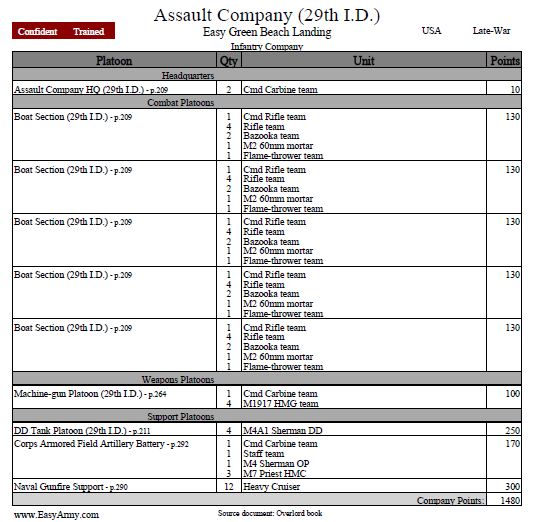
This past week we ran through the Omaha Beach “Easy Green” scenario to what was probably our most evenly matched and played game to date. The scenario sticks pretty closely to the situation at Easy Green with one beach exit road guarded by lines of barbed wire, trenches, mines and anti-tank obstacles. Finally, a combined defense of heavy machine guns, a 5 cm KwK 39 gun bunkered at the coast and Nebelwerfer rockets at the rear provide a daunting nut for the US infantry to crack. For our game, my German opponent was able to field forces as outlined in the published FOW scenario but I had to modify my American list slightly to fit my model collection. Even with slight changes, our final lists had the US at a few more points stronger than the Germans as per the mission outline and the game rules.
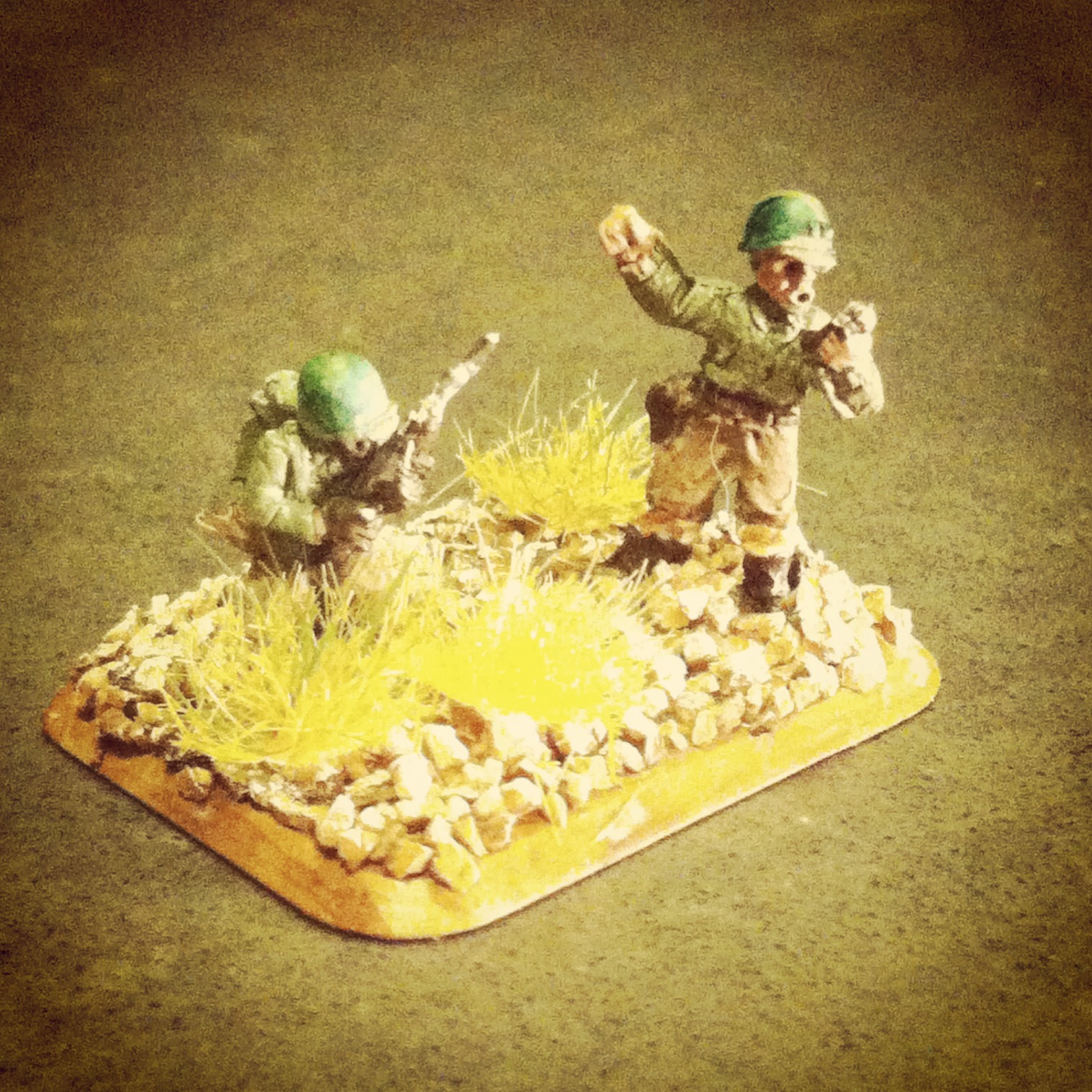
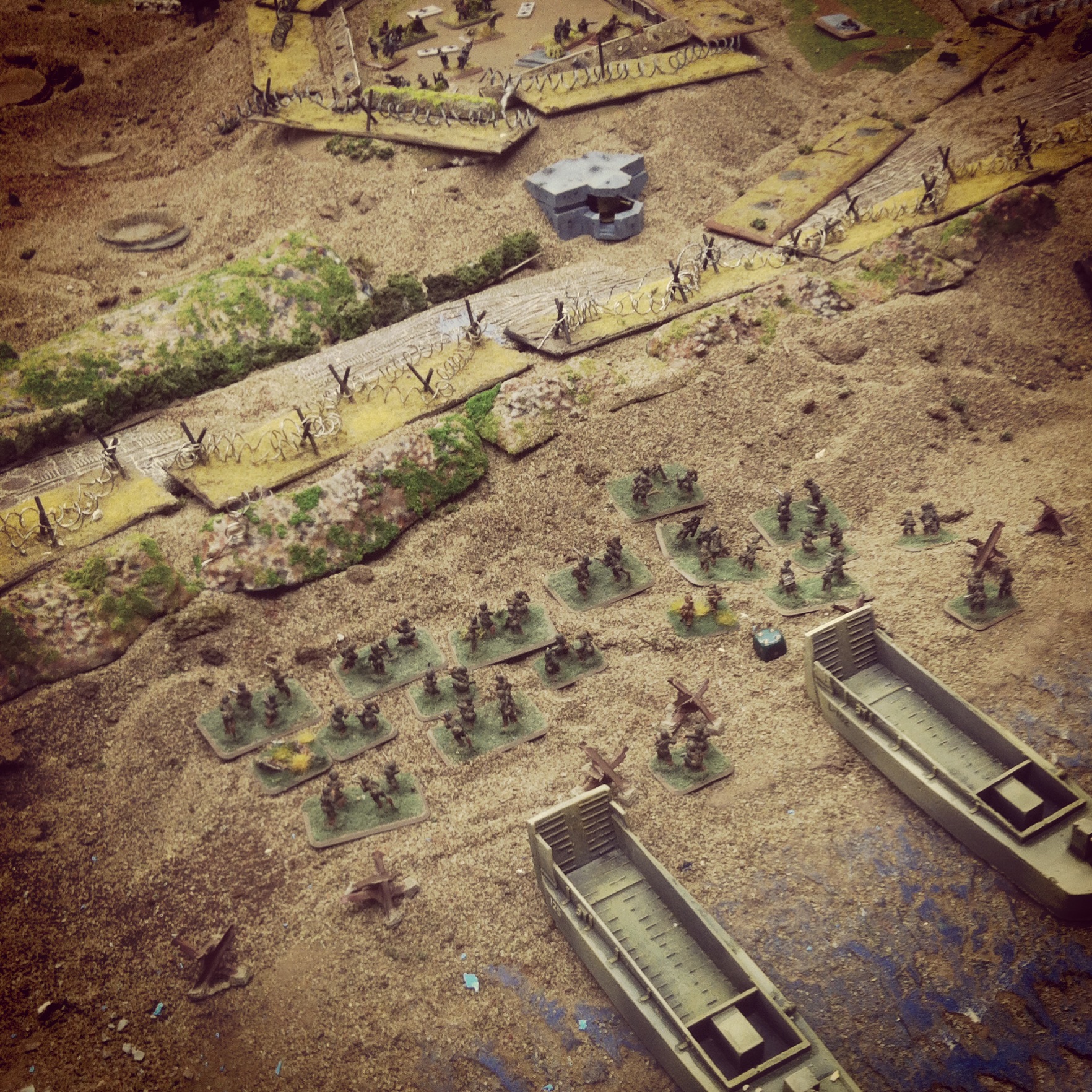
IMG_3452The first US boats land and platoons rush ashore

After an initial US naval bombardment which destroyed one stand of German infantry, my boats and DD tanks headed for the beach. In the initial wave, one DD tank sank in the water offshore and one boat was delayed in the bouncing surf. With two platoons of US infantry on French ground, they made way for the barb-wired seawall. Further down the beach to the right, my three surviving Shermans rolled to the one exit causeway from the beach.
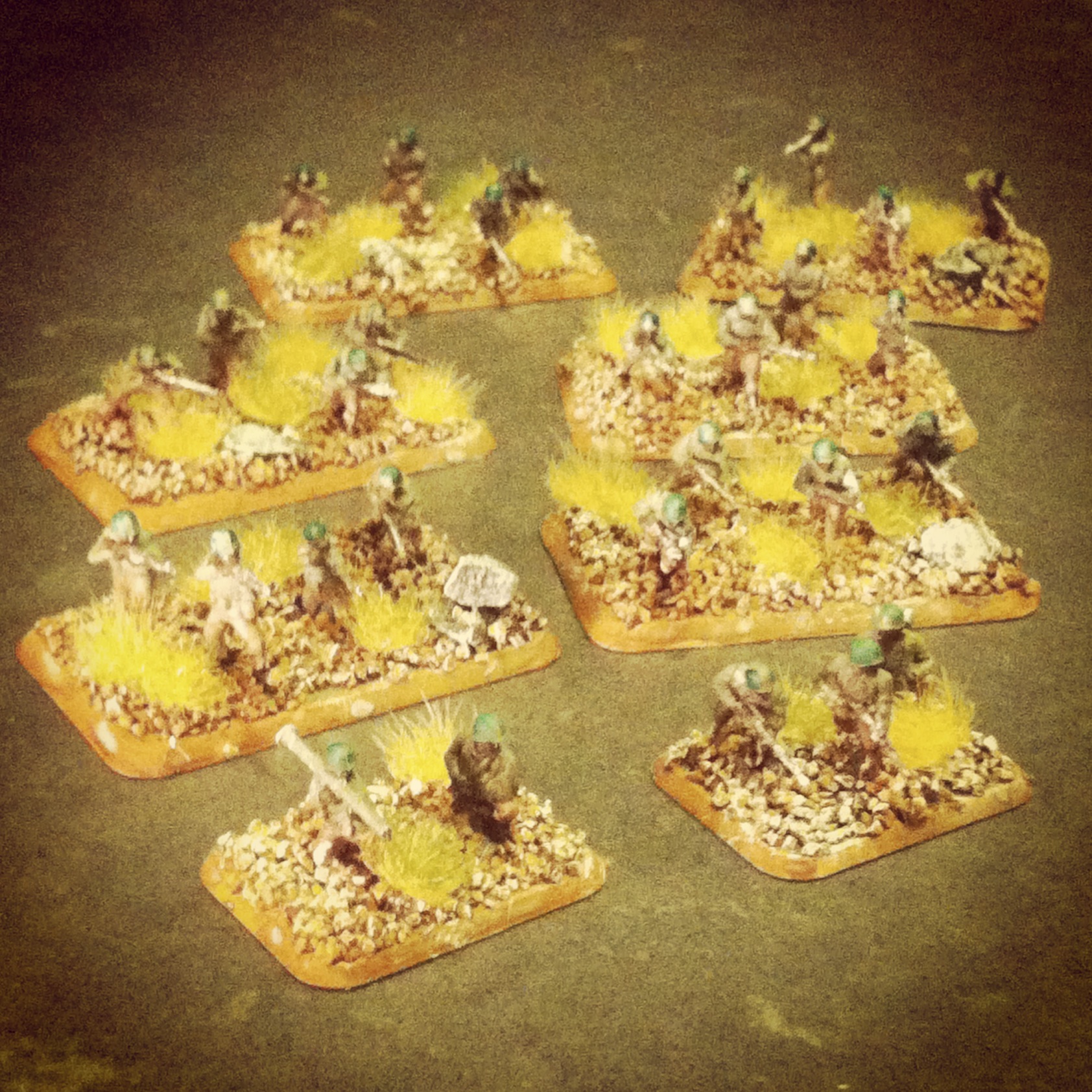
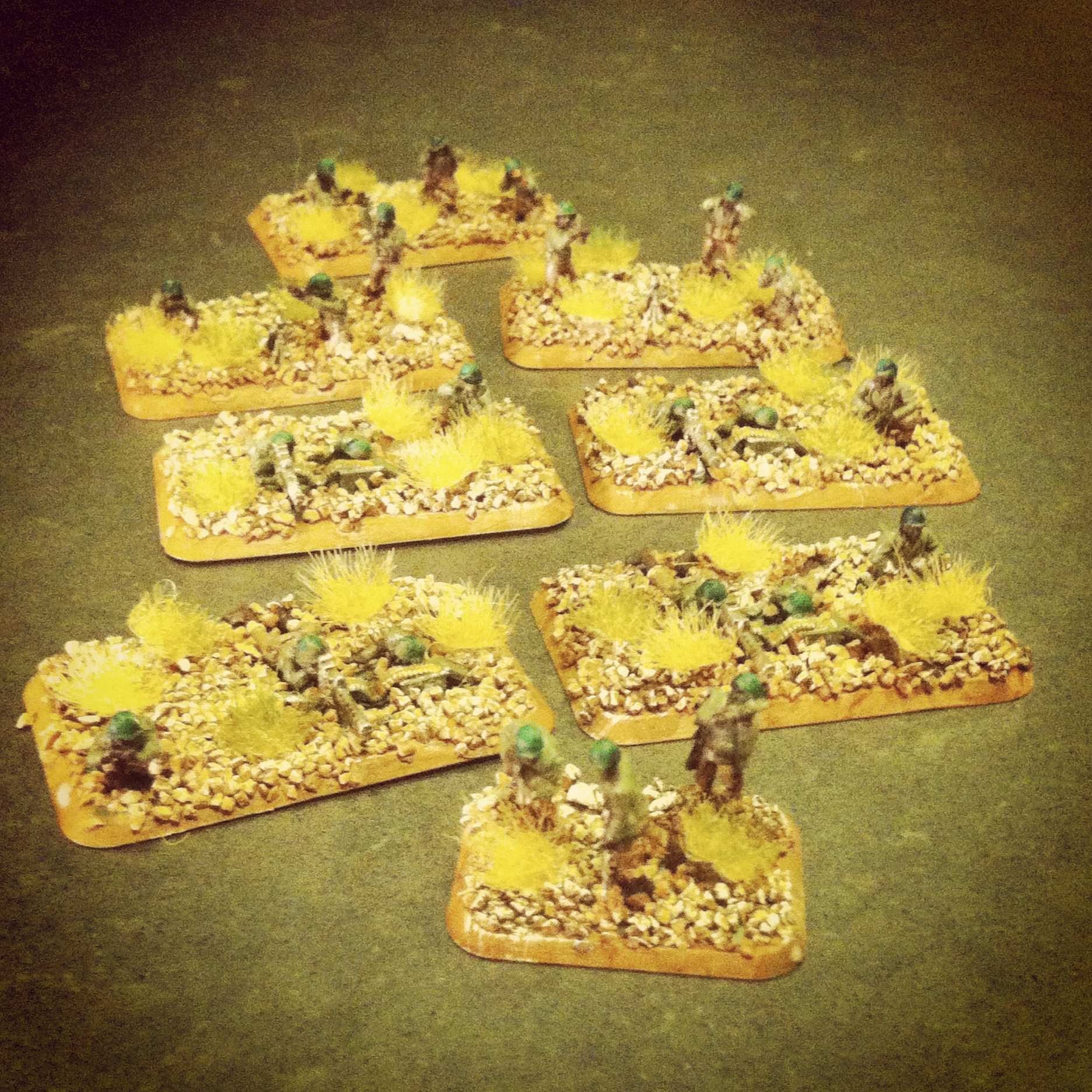
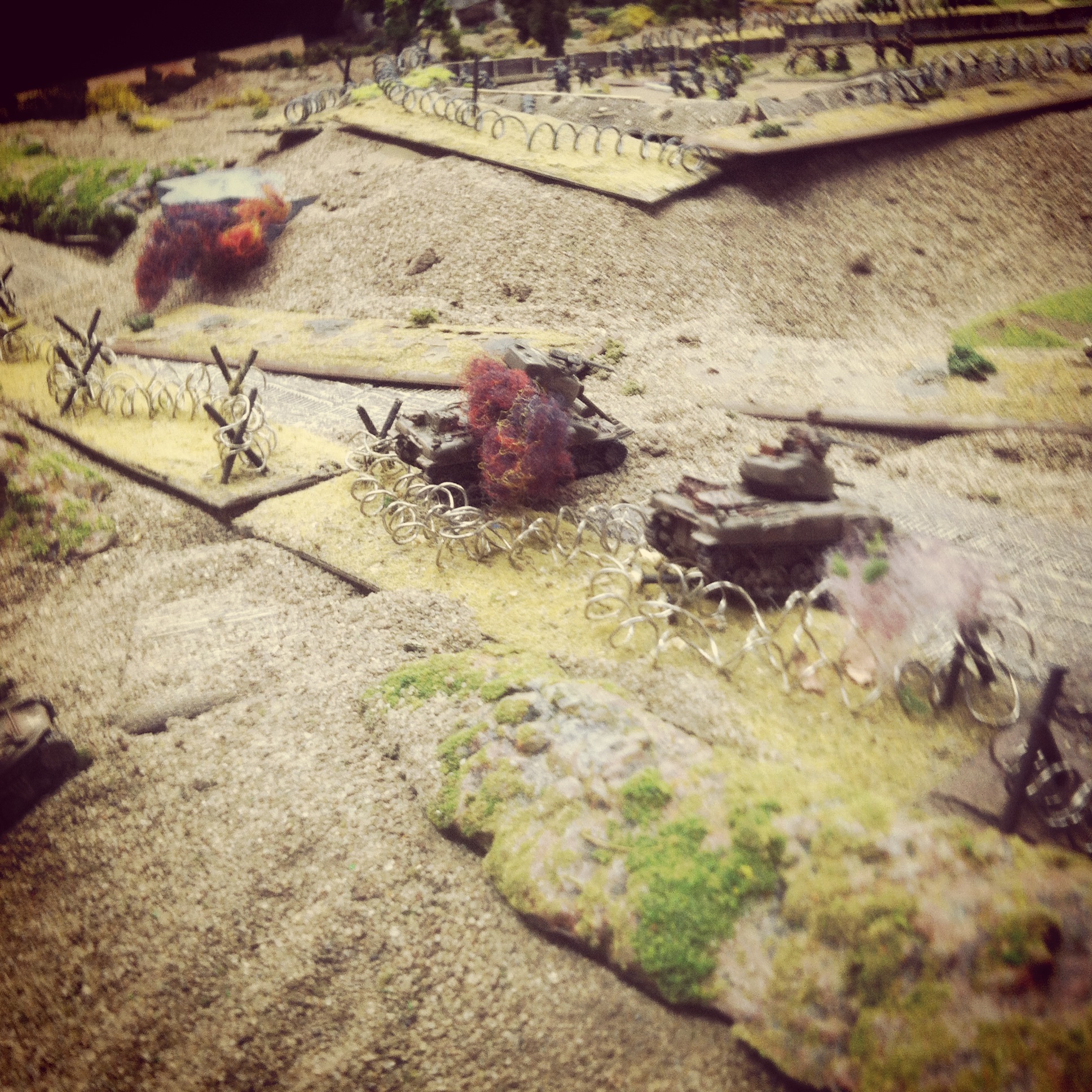
IMG_3453DD Sherman tanks make it across the beach toward the exit ramp

In the opening salvo from the Germans, rocket fire came in from the rear of the table as entrenched guns fired from the beach defensive lines. US troops did well with dice roll saves and lost just a few teams before ending the turn pinned high on the beach.

IMG_3454German Nebelwerfers sit atop a hill overlooking the Allied objective

In the next couple turns, landing craft continued to meet mixed success in landing and stalling on the sea. Luckily, most boats didn’t drift too far down the beach, allowing me to execute my general plan of running infantry to the left while my tanks dealt with the heavier nests and pillbox to the center and right. One tank bogged in the sand but the other two rolled over the barbed wire to take up position at the line of minefields, sending fire into the Tobruk nests and gun bunker. A couple turns in, the bunker was in flames and the German machine guns had been dealt with. The way was clearing for the US infantry to push inward.

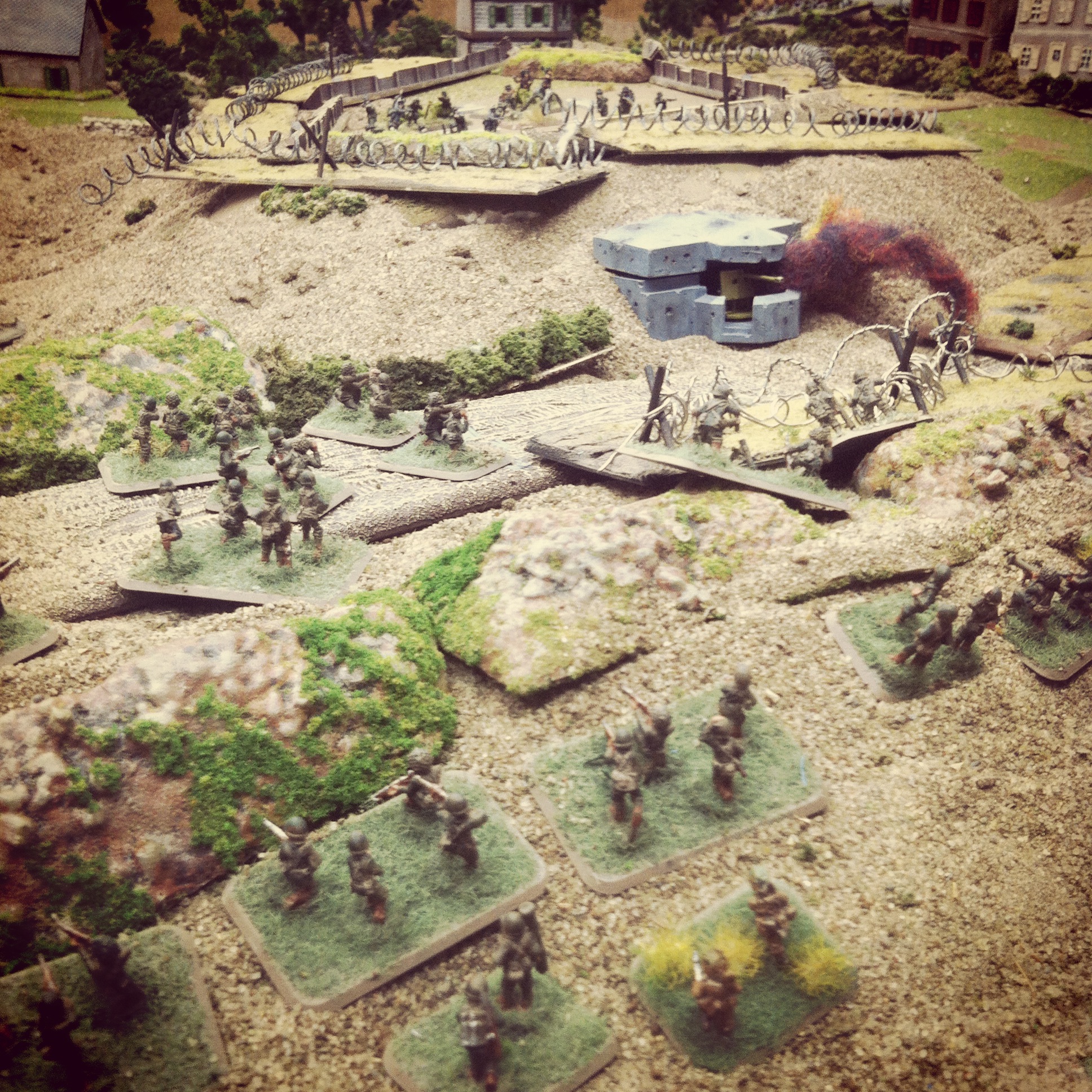
IMG_3455The 5 cm KwK burns in its bunker as US troops push over the seawall

IMG_3456DD tanks struggle through the coastal defenses and take heavy combined fire

With several US platoons whittled-down in their struggle through several tiers of barbwire, one platoon of German infantry arrived and made way for the row houses near the objective and remaining rockets on the hill. In the open, the Germans took fire from naval guns but most survived to find shelter in the buildings. Back on the beach, my final US reserves of M7 Priests landed at the center of the beach and one heavy machine gun section tramped forward at the extreme left. With these late arrivals so far back from the main action, it was up to the forces already inland to get the job done.

IMG_3475German defenders rain mortar and machine gun fire into oncoming US troops

IMG_3476With German defenders destroyed at the beach, the 29th Infantry Division hustles inland

With the major defenses eliminated at the beach, the Shermans turned their machine guns on the remaining German infantry manning the trench line high on the central hill. At the same time, US infantry began pushing into the German position after spending turns alternately being pinned by rocket and mortar fire, removing barbwire and shooting back with light machine gun, rifle and direct mortar fire. Despite their losses, the combined arms of my US troops really shined, as was often the fateful experience of their German opponents 70 years ago.

As the game moved into the second-to-last turn, the Americans were ultimately just too far away and too weakened to make the final push to the objective still held by the remaining German infantry comfortably defending from the nearby houses. It had been a pretty even match, but timing was everything. Luckily for the Allies on June 6th, 1944, the only limits on the day’s outcome at “Bloody Omaha” was the grit and dedication of the storm of humanity hitting the beach.