New Game Weekend: A Few Acres of Snow

AFewAcrescover

 “You know that these two nations are at war about a few acres of snow somewhere around Canada, and that they are spending on this beautiful war more than all Canada is worth.” — Voltaire, Candide (1758)

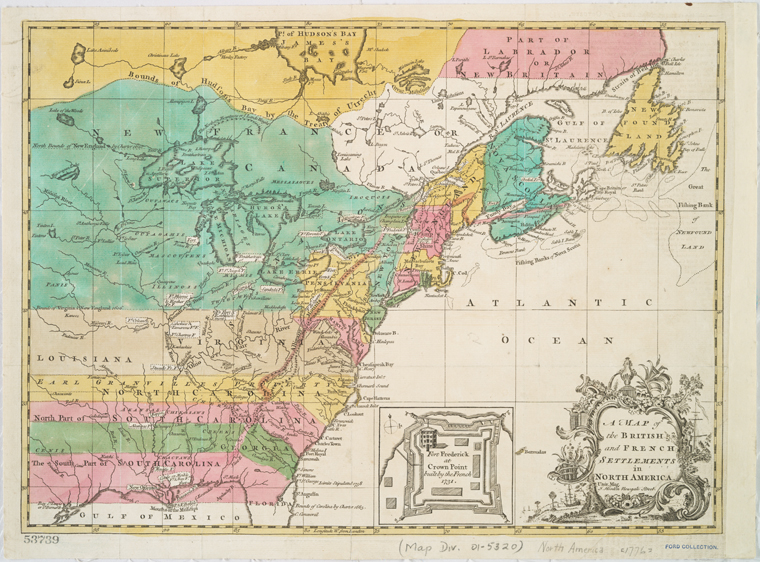
In the 17th and 18th centuries, the area of what would become the Northeastern United States and the neighboring Canadian Provinces of Ontario and Quebec were a battlefield for French, British and Native American control. With the two European empires locked in a protracted series of large and small wars around the globe, the American colonies were often a sideshow to the global conflict. In the colonies, King William’s War (1689–97), Queen Anne’s War (1702-13), King George’s War (1744–48) and the French and Indian War (1754–63) each played a role in shaping not only the birth of the United States of America but also the face of the entire globe for centuries to come.

Colonies

A mid-18th century map of British and French colonies in North America

(from New York Public Library Map Division)

I grew up in Western New York State, spent most of my twenties in Eastern Michigan and Western Pennsylvania, and finally settled in New York City nearly twenty years ago. In my life I’ve logged many a road trip to the landmarks of British and French military control at Fort Stanwix, Fort Ticonderoga, Fort William Henry and Fort Niagara, along with various battlefields and stops at roadside markers. In July, I’ll be swinging by Fort Necessity in Pennsylvania where a British officer named George Washington first commanded troops in an opening battle of the French and Indian War. I’ll also be swinging through Letchworth State Park which was occupied by the western edges of the Iroquois Confederacy which sided with the British during the era of European conflict. In short, I’ve spent my entire life living amid the ghosts of the contested colonial regions of the North American colonial wars.

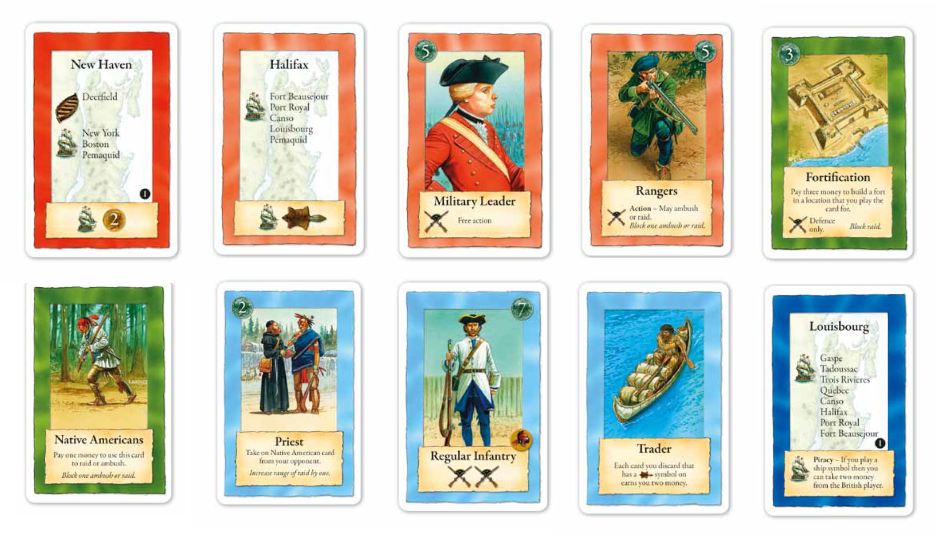
AcresCardsSample cards from A Few Acres of Snow

At the recent D-Day Plus 70 weekend at Metropolitan Wargamers in Brooklyn, NY I was fortunate to score a copy of A Few Acres of Snow in a dice-off raffle. Created by famed designer Martin Wallace and released by Treefrog Games in 2011, the game takes its name from a quote from Voltaire’s Candide commenting on the absurdity of European focus on colonial wars for territory. AFAOS takes players through the French-British colonial period in North America as each nation competed for control of the continent. Within the theme, the game is a rich mix of deck-building and area control mechanics as players seek to settle and defend key areas of the map.

snowsymbolsCard symbols from A Few Acres of Snow

(Wagon, Bateaux, Settler, Military Strength, Money, Fur, Ambush and Ship)

The two-player game begins with players choosing a side as the British or French with a set number of settled outposts in the wilderness of 17th and 18th century North America. British begin with their main settlements in New York and Boston while the French player starts with Quebec. Players begin with a draw deck from which they start with five cards. Playing cards in turns of two actions each, players perform a variety of actions including settlement, fortification, raids, sieges, trade, piracy and a number of card management options. Symbols depicted on each card allow for enormous flexibility in how each player executes their strategy of expansion. For example, a player might begin with a Location card setting off from an existing settlement. From there, a card is played with the appropriate movement symbol like a Bateaux along a river. Once at a new location, a card with a Settler might be played to create a new settlement. As a player’s holdings expand, their decks grow in size and options, leading to even more potential paths of empire growth. Once all settlement tokens are used or major settlements like Boston or Quebec are captured, the games ends and victory points are scored.

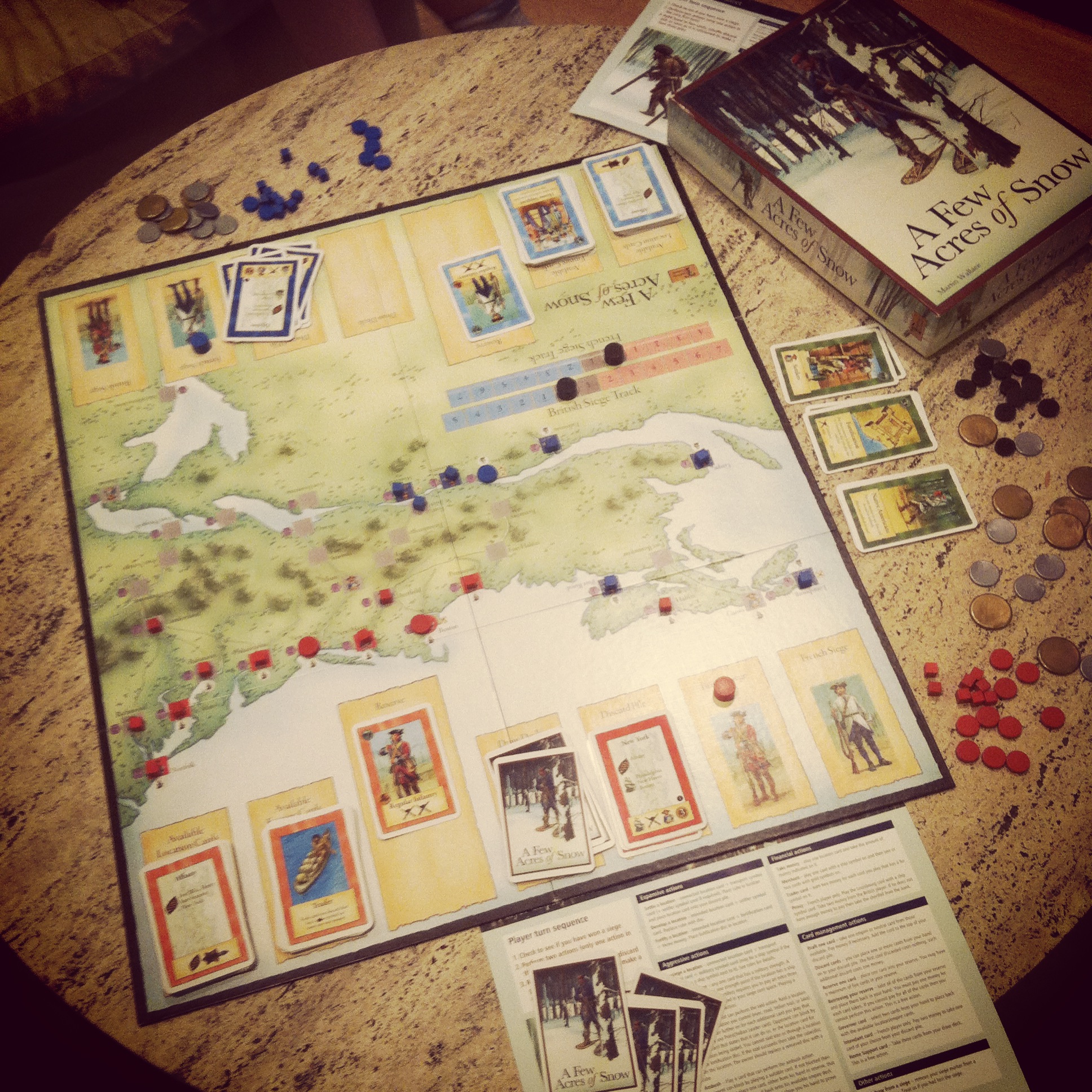
IMG_3640My first play of A Few Acres of Snow

In my first play through AFAOS, I faced off with my son playing the French and me playing as the British. The game plays in about an hour, but on our first run we went to a bit over 90 minutes as we wrapped our heads around the rules. After I quickly sailed to and settled Halifax well within the bounds of French country, several  sieges commenced. In his first siege attempt, my son was repelled by my superior military might powered by my store of money. He then took a few turns to quickly trade a lot of fur (one of the strengths of the French player) to buy additional forces for a second siege which chased my British from his territory.

IMG_3647My heavily-settled British Atlantic Coast in A Few Acres of Snow

In the meantime, I pushed inland with a string a settlements toward the Great Lakes in the hopes it would expose Quebec to a siege. However, my son quickly landed a stronghold in my coastal territory in a siege victory at Pemaquid. I retaliated with two failed attacks on Pemaquid using Native American raiding parties. Having held on, my son launched an attack on Boston and my British rule of the colonies fell.

Our first game showed us how quickly AFAOS can move once you get the mechanics. Getting the right cards in and out of your hand is key to winning the game, and the cards shift in importance as the game quickly unfolds. The balance of trade, expansion and military actions does a fantastic job in re-enacting the dynamics which played out between the British, French and shifting Native American allies over some 150 years. Even though we upset the course of history, we both walked away pretty thrilled over our new game and chatting up strategies for the next time we meet up in the woods and along the coasts of Colonial America.

afaosart

Metropolitan Wargamers D-Day Plus 70 Event Report

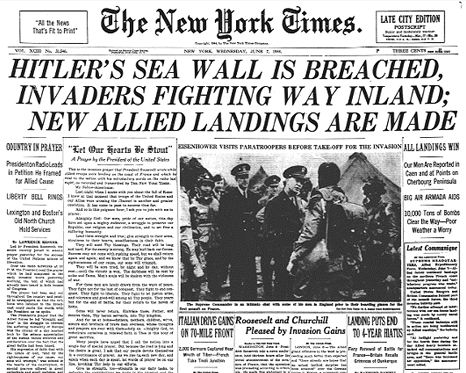
NYTimesDDay

This past weekend at Metropolitan Wargamers in Brooklyn, NY, dozens of gamers came together for three days commemorating the 70th anniversary of the Allied invasion of Normandy on June 6, 1944. Throughout the weekend, we ran multiple WWII-themed games, including Normandy ’44, I Ain’t Been Shot Mum, Flames of War, World In Flames and Memoir ’44. Dice were rolled, strategies were debated, prizes were won and Allied and Axis forces vied for control of France. In all, it was another great weekend full of gaming at our club’s space in the heart of Brooklyn.

Friday Games

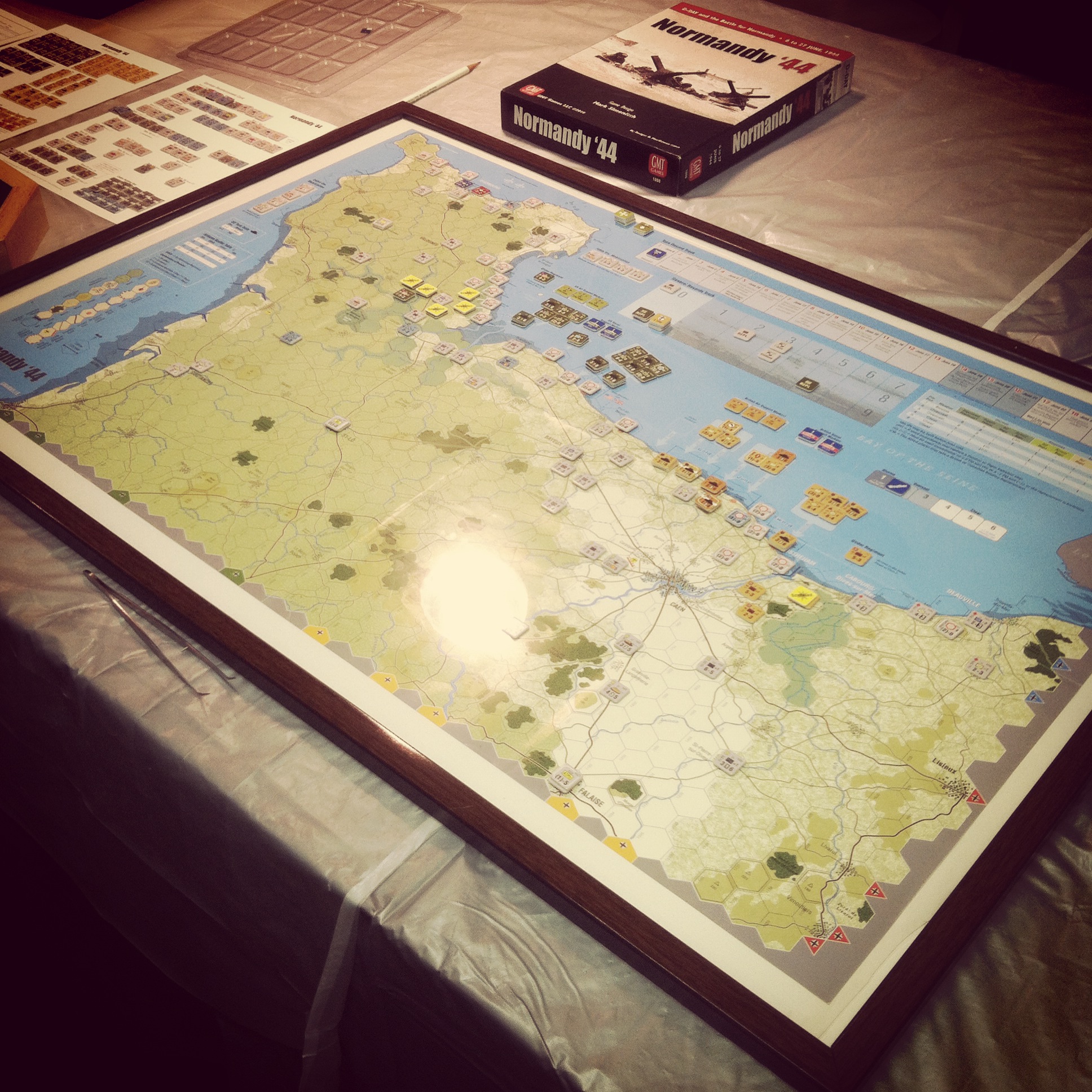
IMG_3586The invasion of France begins with Normandy ’44 at Metropolitan Wargamers

Friday kicked off after work with a few players unpacking a fresh copy of the classic Normandy ’44 from GMT Games. This one-map game covers the pre-dawn D-Day Airborne landing areas, five Allied invasion beaches and the charge to the initial inland objectives. The game scale plays with regiments and battalions with each turn representing one day of action. The small, self-contained game provides a great introduction to game mechanics at this scale with a tight, clear rules set. With a quick look at the game, I decided I’m going to have to personally give this one a shot sometime soon.

IMG_3587 US infantry blinds move toward unsuspecting German defenders at a farm outside Vierville

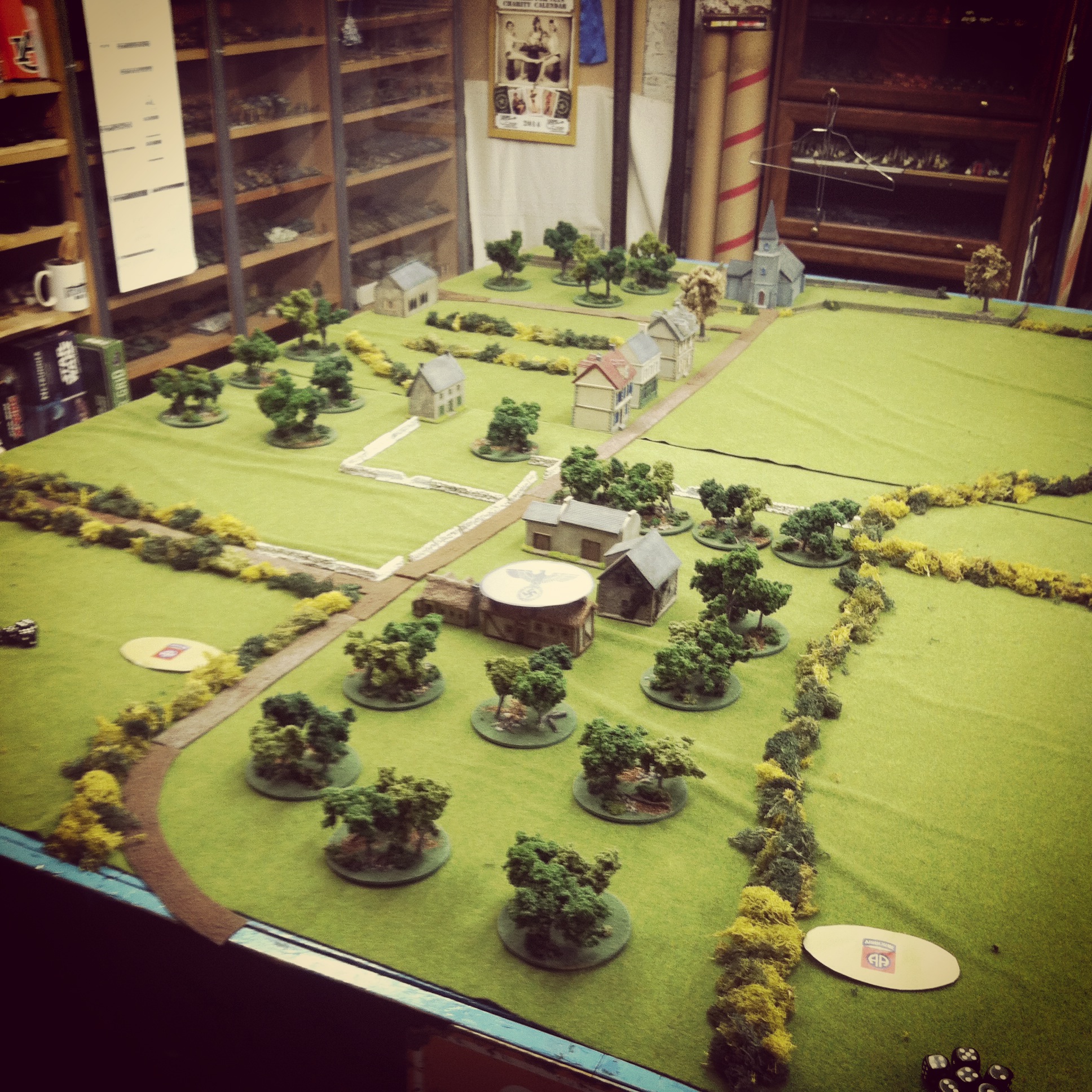
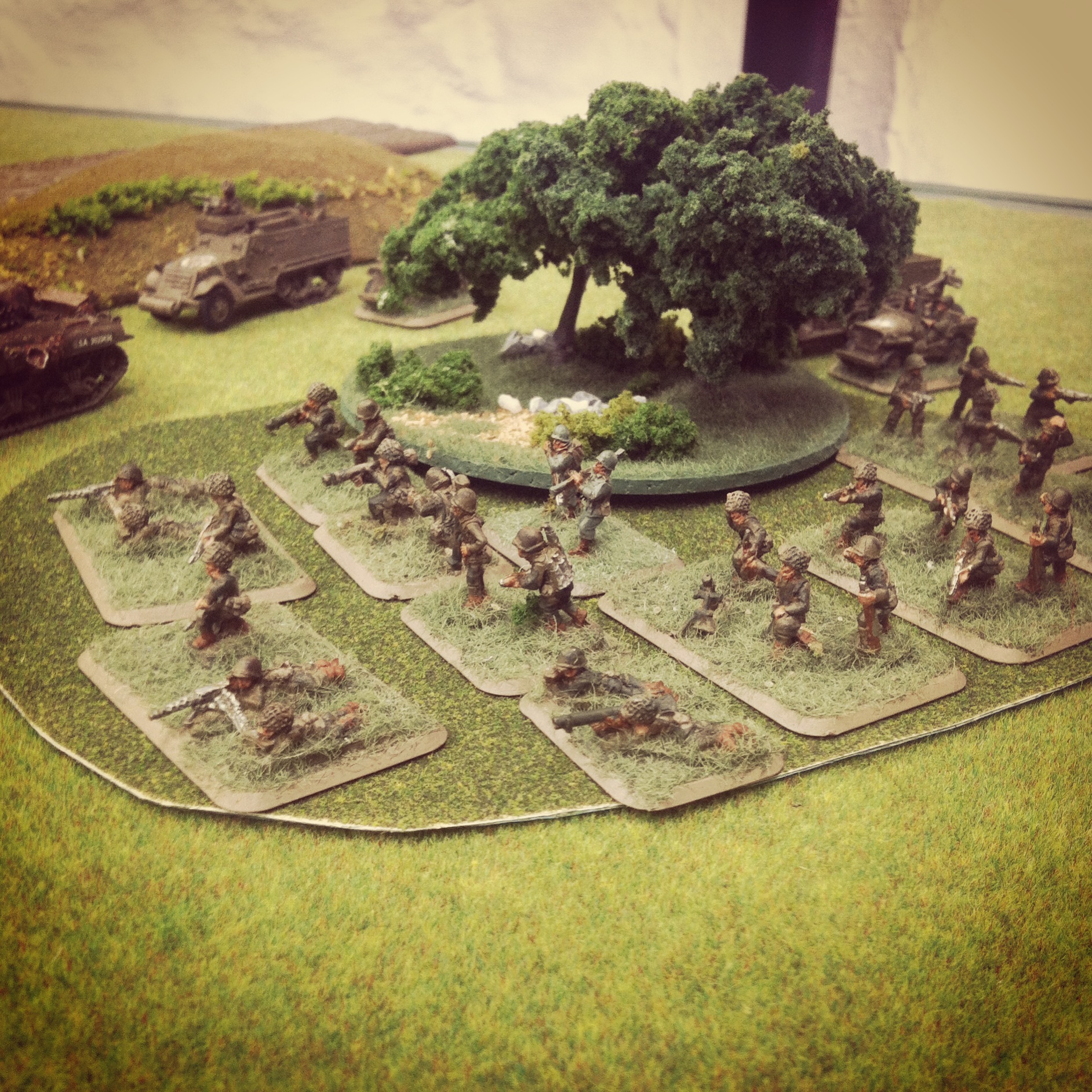
At the back of the club, we ran a game of our new favorite WWII tactical miniatures game, IABSM  from Too Fat Lardies. In our ongoing campaign of the Normandy scenarios in the IABSM Where The Hell Have You Been Boys? book, our game focused on the battle at Vierville-sur-Mer. With the 116th Infantry Division supported by the 5th Ranger Batallion, the Allied mission was to drive inland to capture and defend the church at Vierville.

IMG_3589

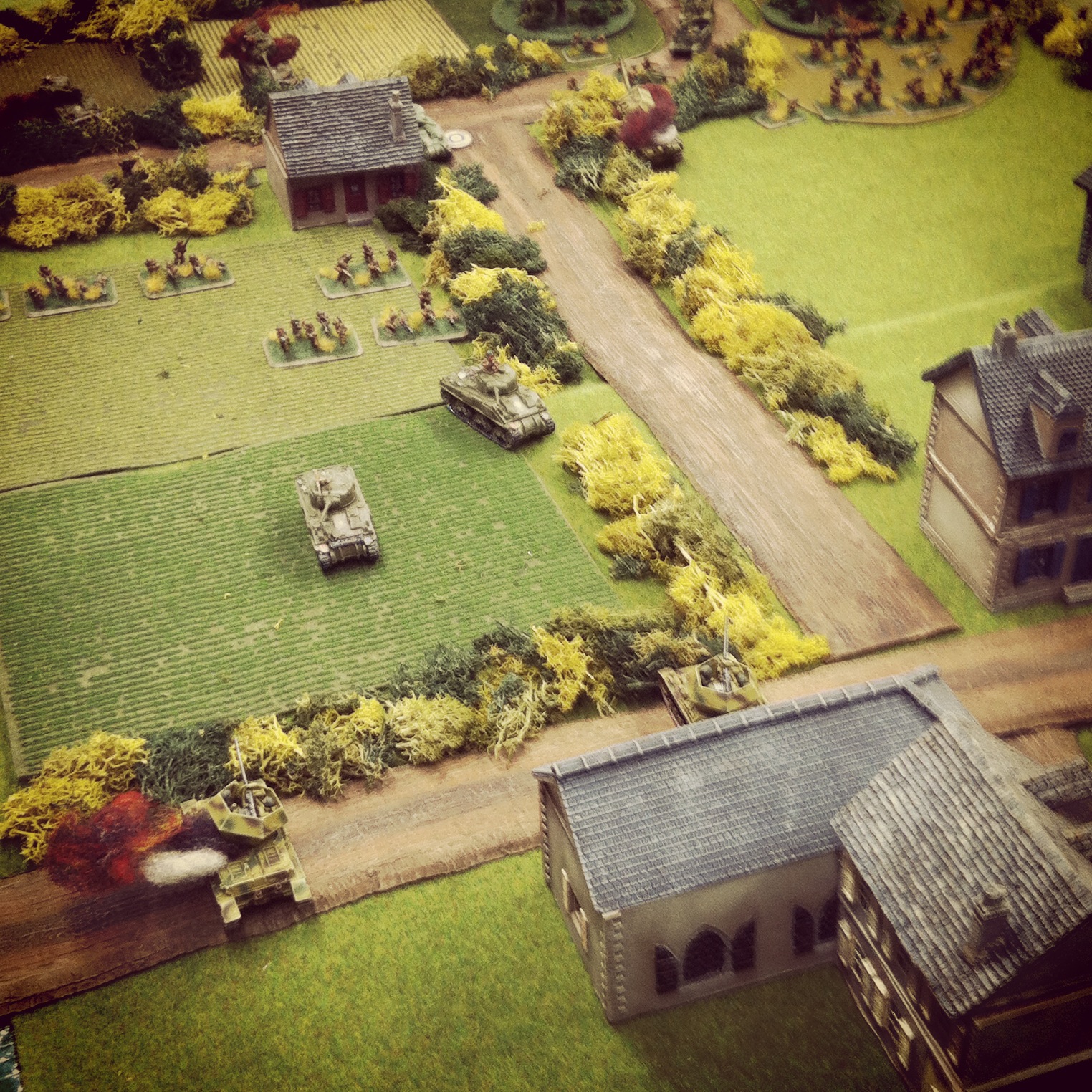
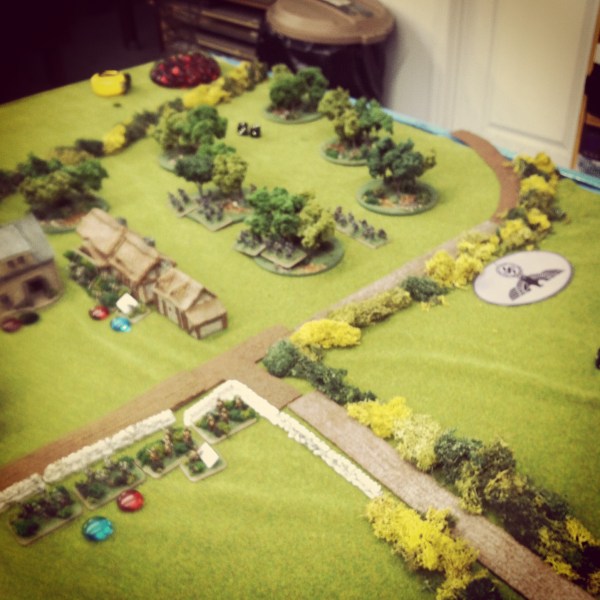
German and US units exchange fire in and around the farm at Vierville

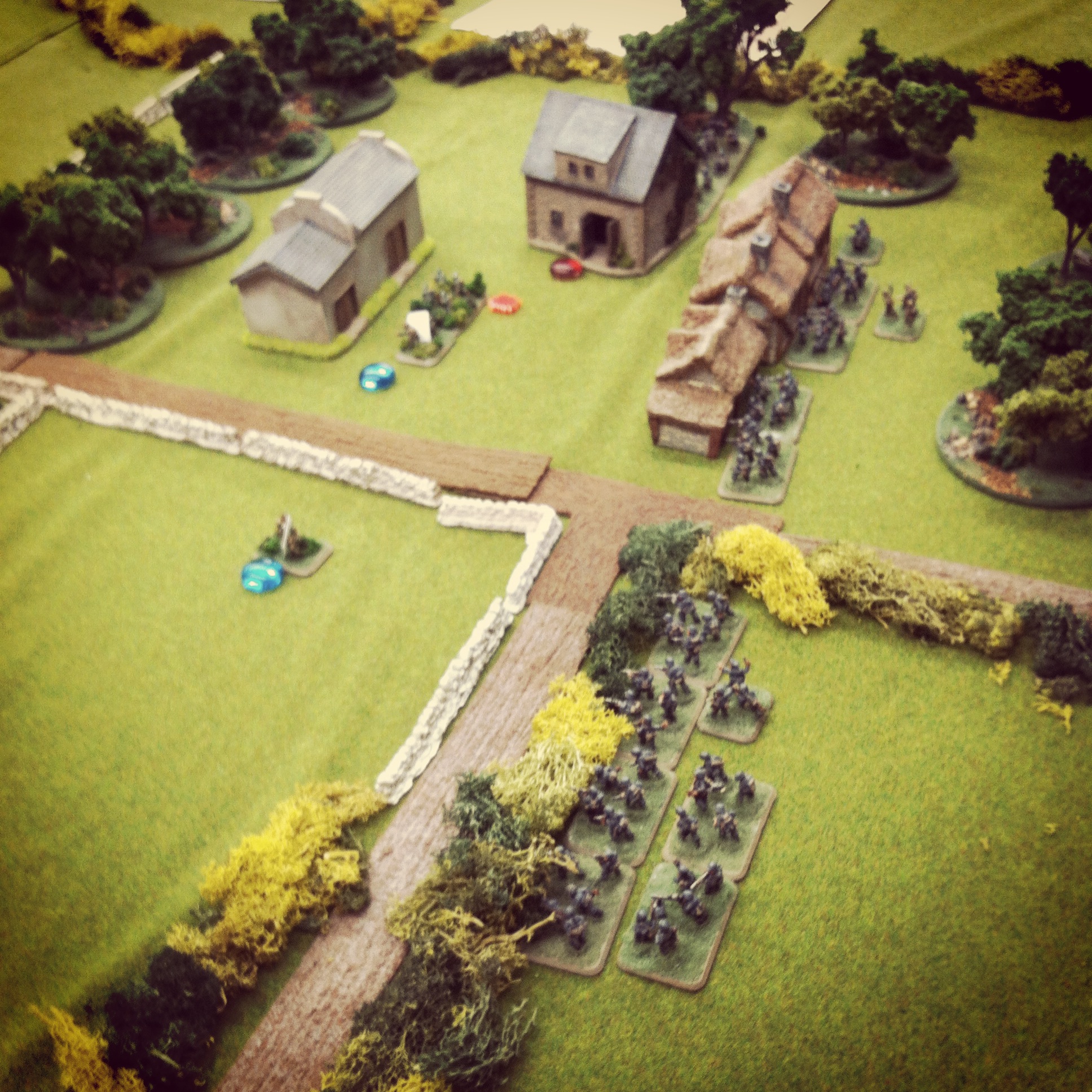
As per the scenario, initial Allied blinds approach a farm outside Vierville where a German blind sits unknowingly in the complex of buildings. With Allied infantry closing in over dense bocage hedgerows and orchards, a firefight erupted and drove the German defenders through the buildings and into the orchard beyond.
IMG_3590

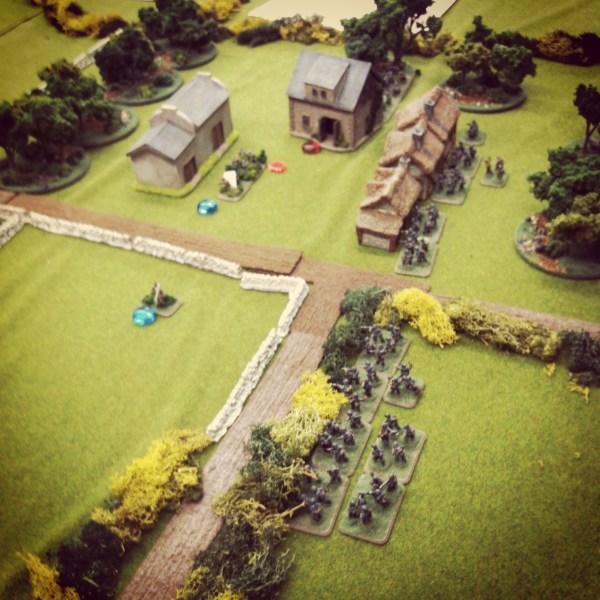
German reserves arrive at the flanks of the advancing US infantry outside Vierville
IMG_3633

Germans reinforcements push the Americans from the farm

As the first force of Germans fled the farm, their reinforcing comrades came on to the rear and flank of the US infantry. The Americans made consecutive moves of firing and moving back to defend at a series of stone walls across the road from the farm. The retreating defensive US actions held off the German onslaught until enough Americans could take up position amid Vierville’s houses. At the same time, the US Rangers moved in at the far end of town to hold the objective at the church.
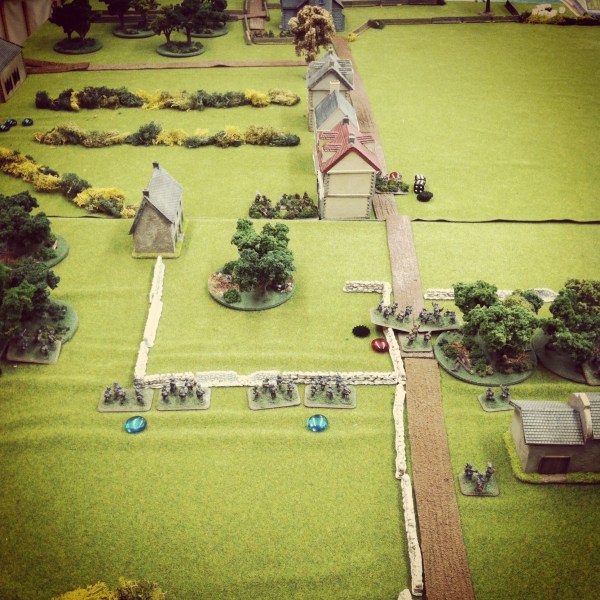
IMG_3632

Americans pull back from the farm to take position in Vierville

The game eventually settled into a bloody house-to-house and hedge-to-hedge fight along the road leading toward the church. Occasional lucky shots from US Ranger light machine guns at the church also harassed the Germans lying low behind their stone wall position at the farm’s orchard. By midnight, much of the initial American force had been destroyed or was retreating to a final stand at the church held by the Rangers. While the Germans had also lost a sizable amount of their force, their heavy machine guns were still in play as they closed in through the town. This time around, we called the action at Vierville a draw.

Saturday Games

IMG_3603The Americans hit the Easy Green sector of Omaha Beach

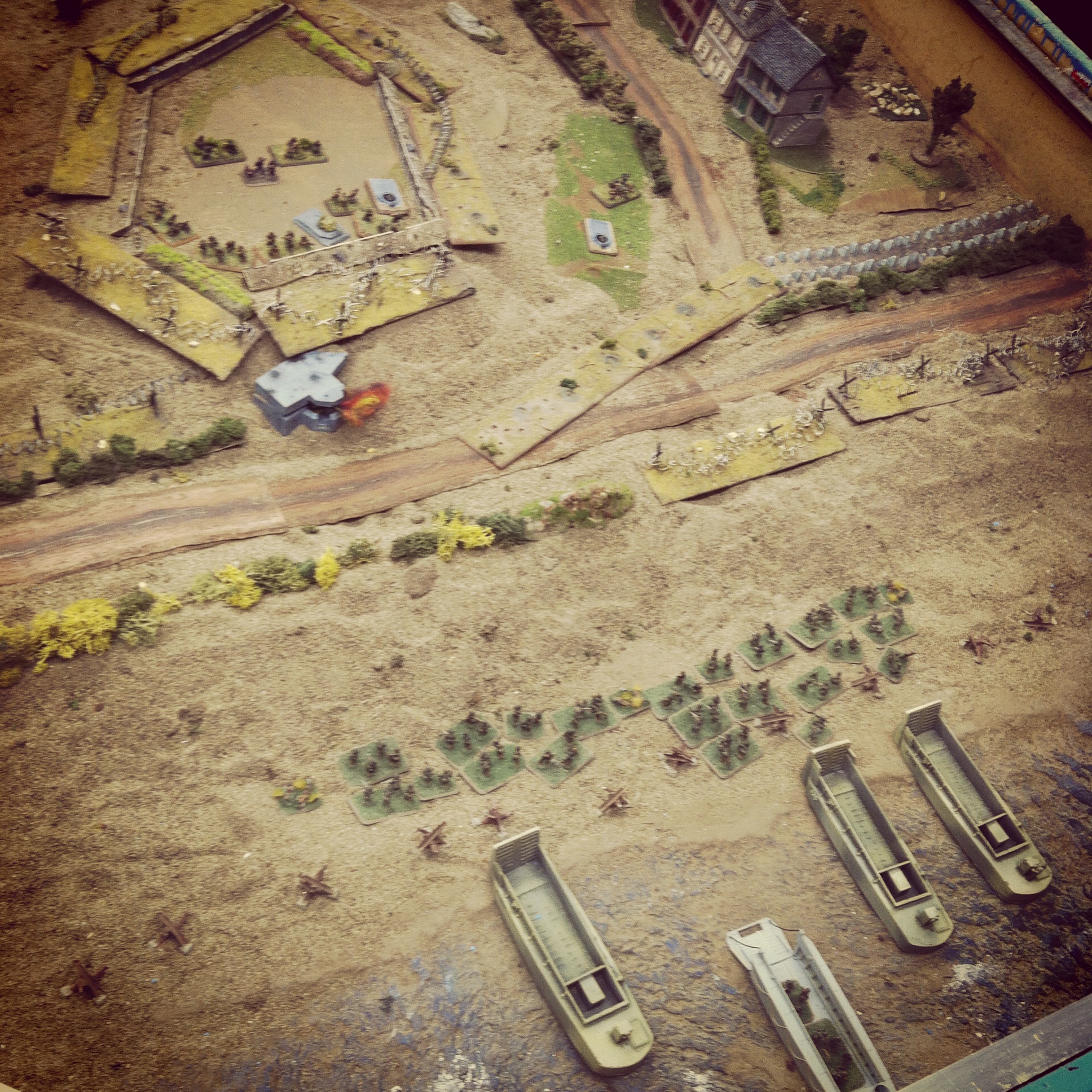
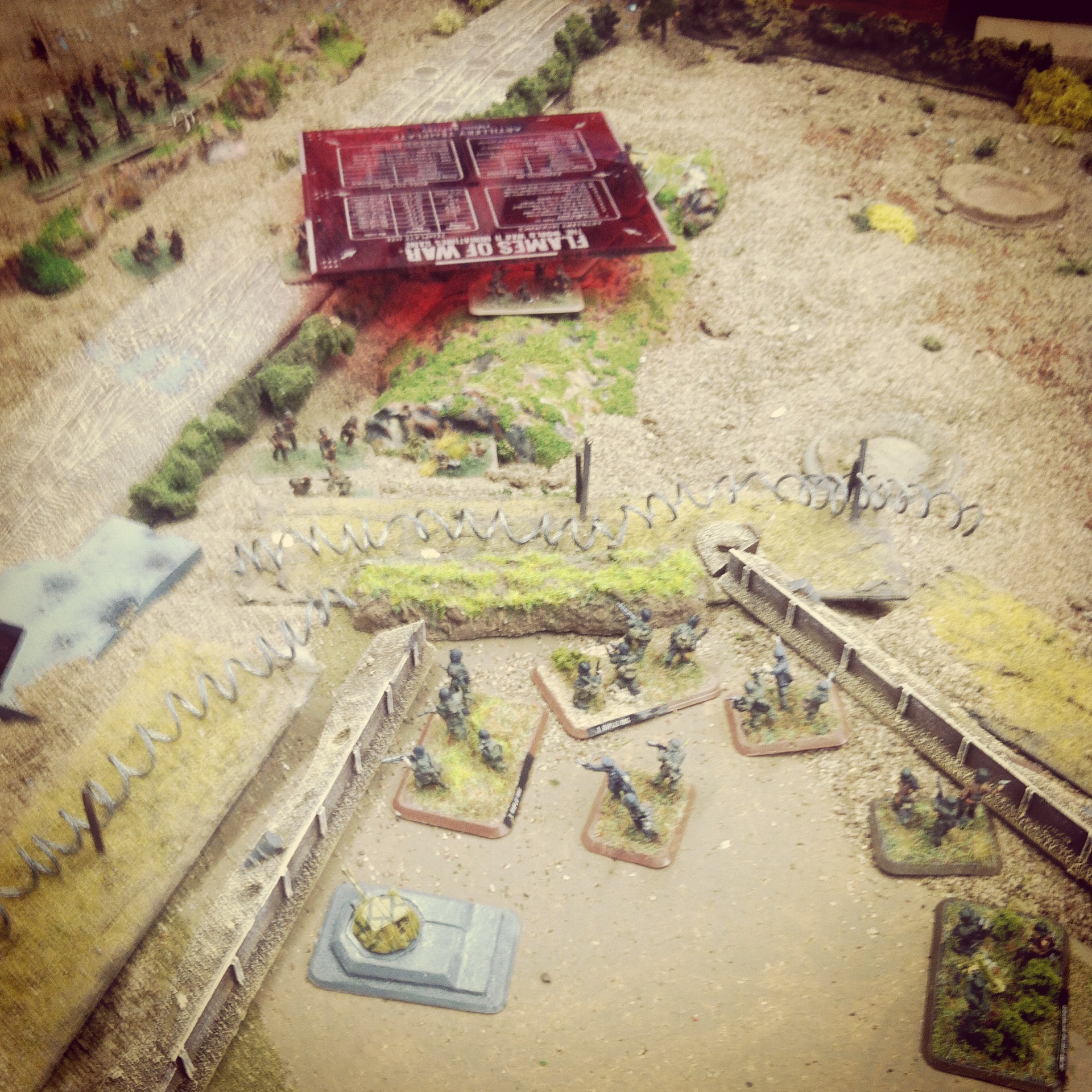
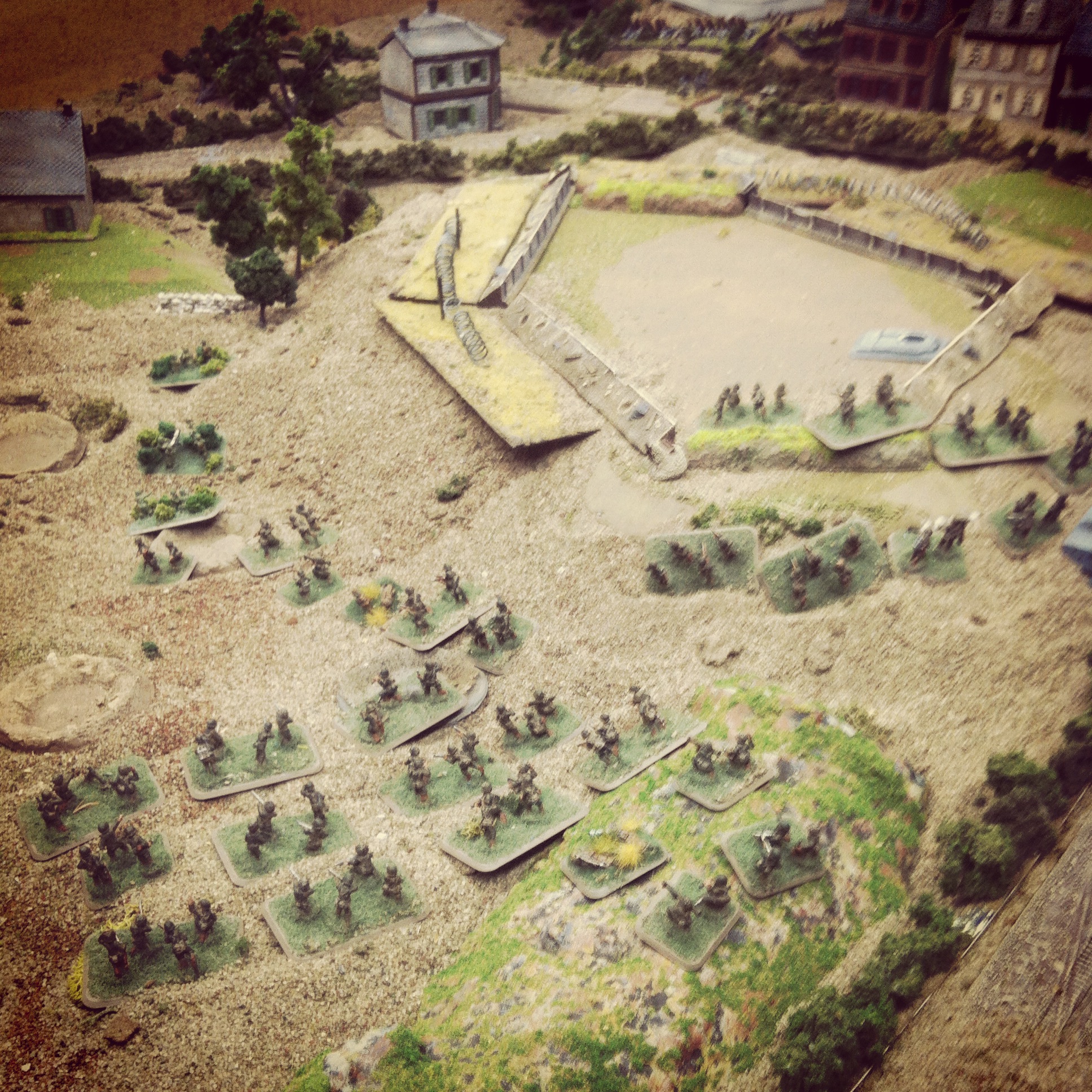
The next day kicked-off with a running of a FOW beach landing at Easy Green on Omaha Beach. We have been play testing the FOW scenario over the past two months, tweaking our forces and strategies to cope with the clumsy beach landing rules. In our past games, the US invaders only manage to win about a third of the time. Even so, we decided no D-Day weekend was complete without a return to “Bloody Omaha” on one of the club’s award-winning sand tables.

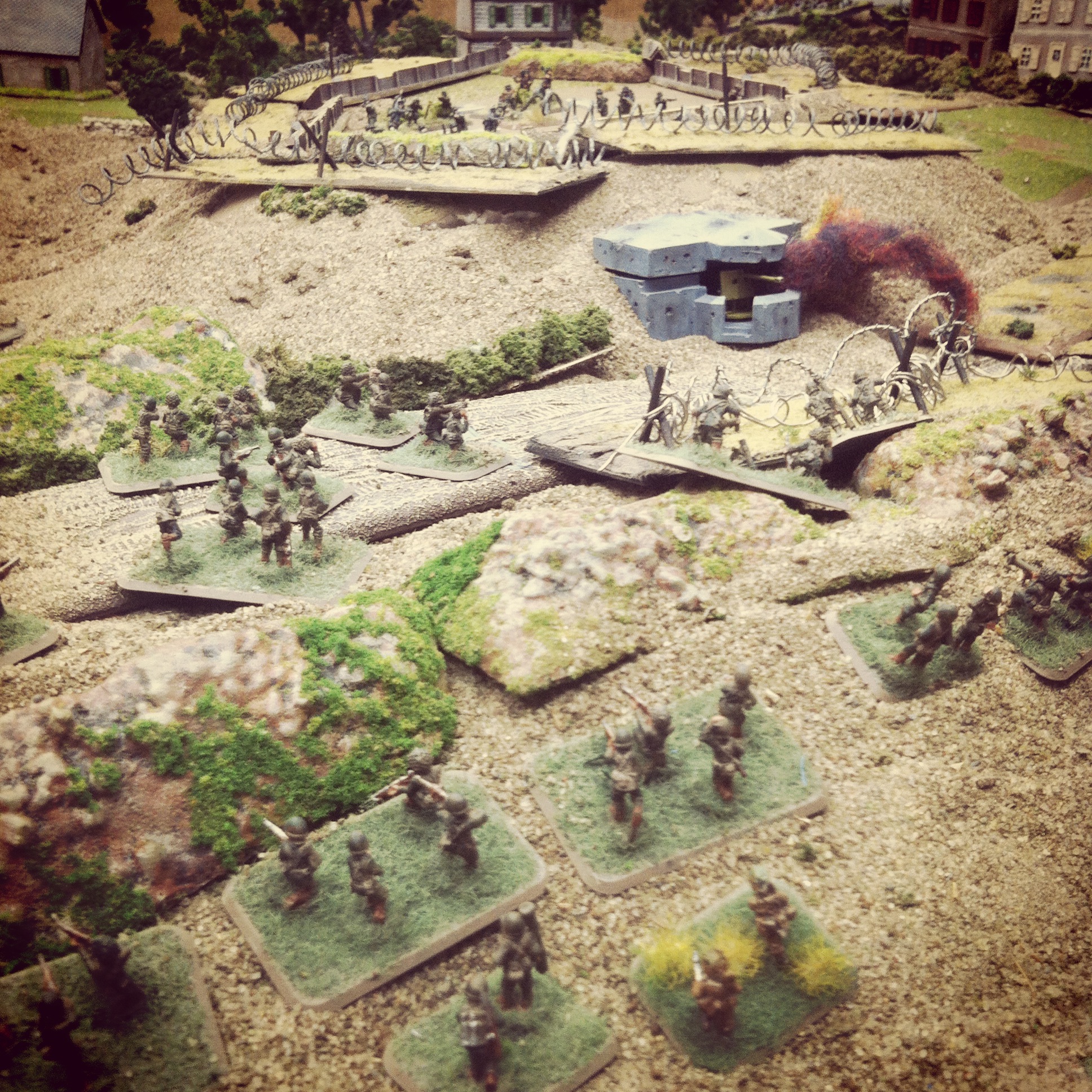
IMG_3604German defenders hold their positions behind a burning bunker

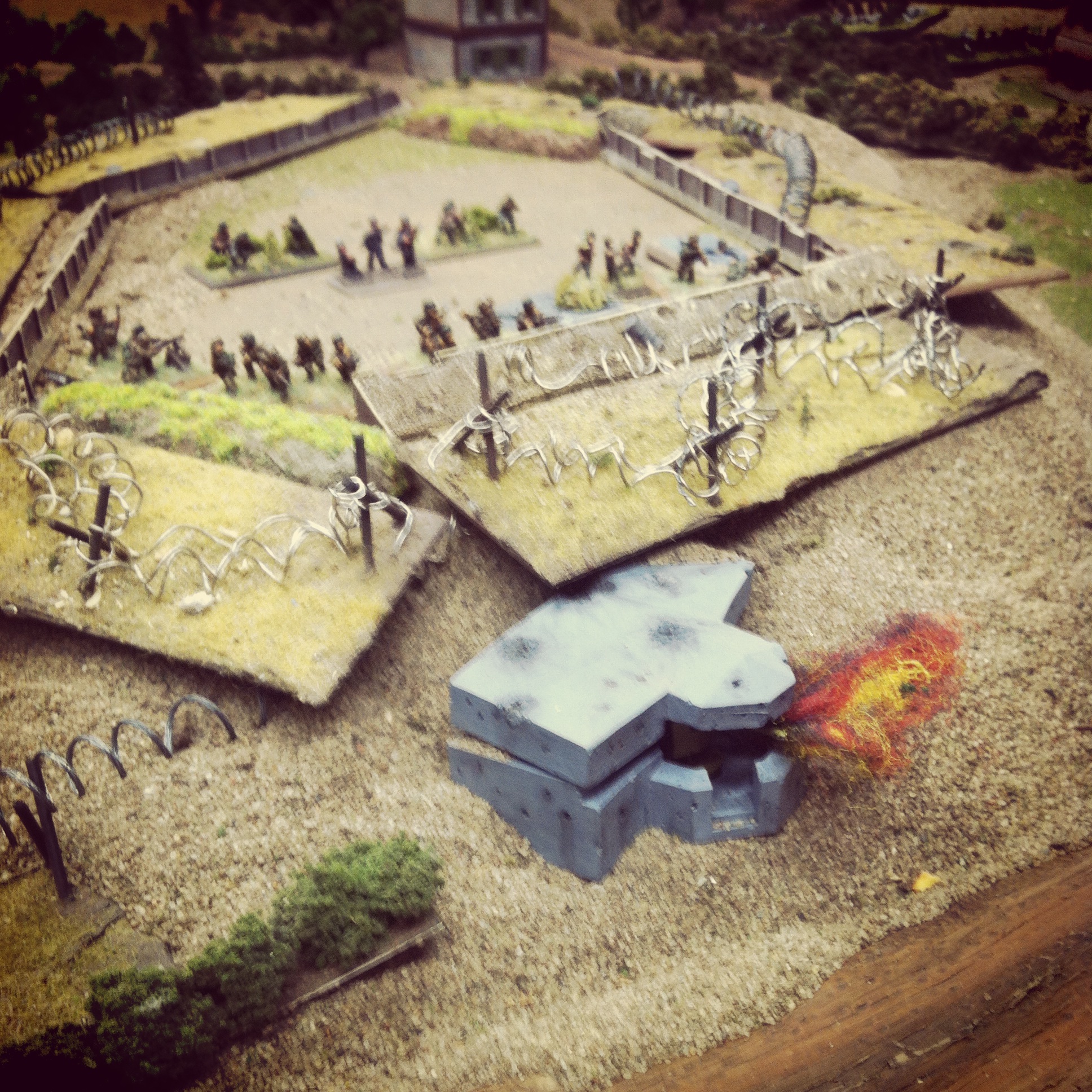
The opening turns found a lot of US boats on the beach and a quick push to the seawall. So early combined arms fire managed to destroy the main bunker at the beach, but the battle was far from over. The initial US push followed on to the left of the beach, but multiple turns at clearing the barbed wire stalled the advance as the Americans took heavy fire.

IMG_3606

American armor and artillery follow-up the infantry landings

As US armor arrived, several tanks managed to drive off the beach to the minefield position to lay down fire on the German trenches. One tank wound up spending three turns bobbing in the surf offshore only to arrive and bog for two more turns on the beach. As this most inexperienced tank crew in Normandy struggled, the other Shermans took fire from German rockets and reserve tank platoon which rolled to bulk up the beach defense. American artillery also arrived but proved pretty ineffective to the Germans at the trenches. Wave after wave of US infantry pushed to the trenches, eliminating most of the defenders but never managing to clear the barbed wire lines to seize the German position. At the final turn, the Americans just hadn’t made enough headway to control the beach.

IMG_3627World In Flames continued over D-Day weekend

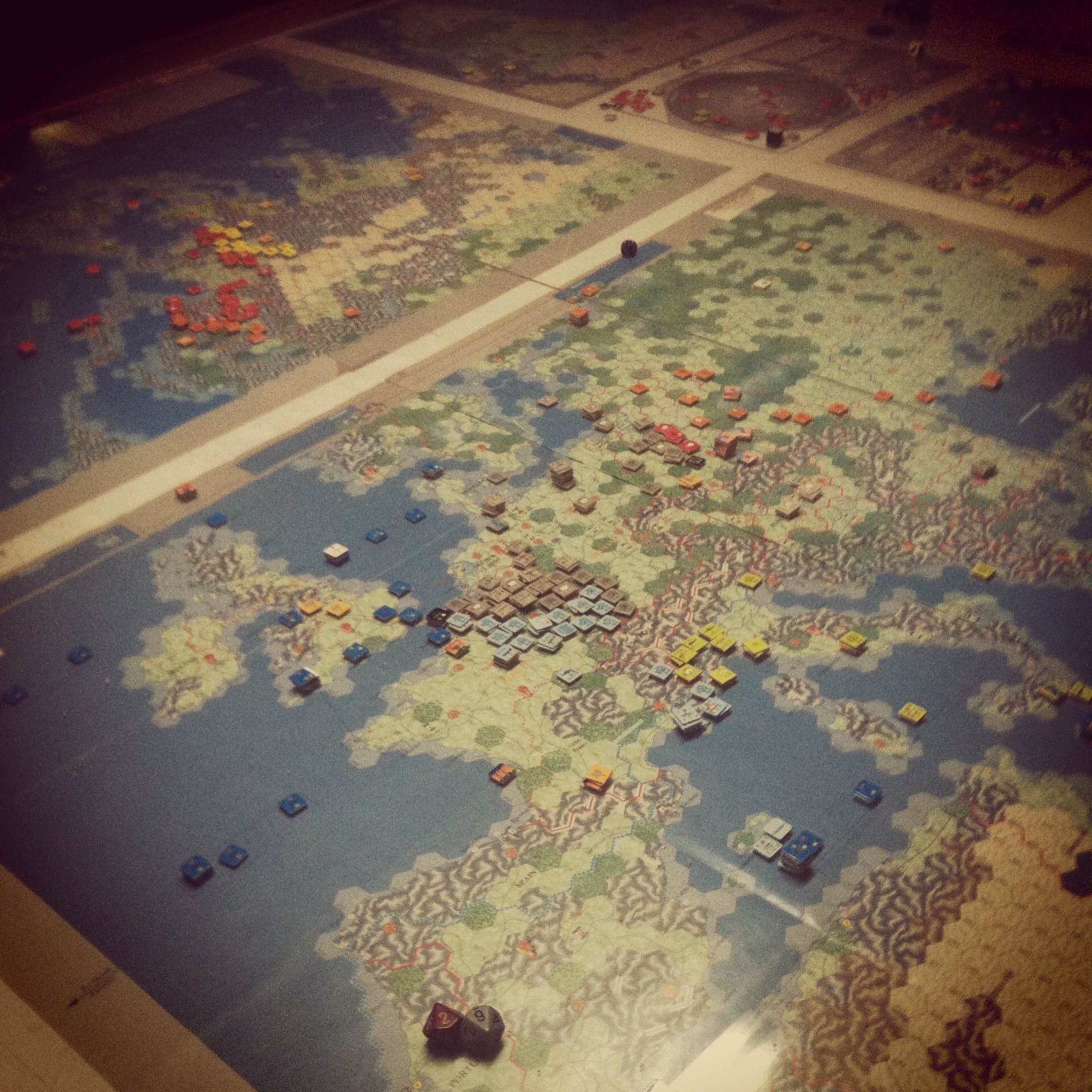
With action raging on the sand table, a group of club members showed up to continue playing their massive World In Flames game. Australian Design Group’s WIF from 1985 is the standard in grand-scale strategic fighting of the entire WWII period. The game’s rich playable detail, dizzying number of 1400 playing counters and sprawling maps makes it a commitment for only the most experienced gamers over many months of play.
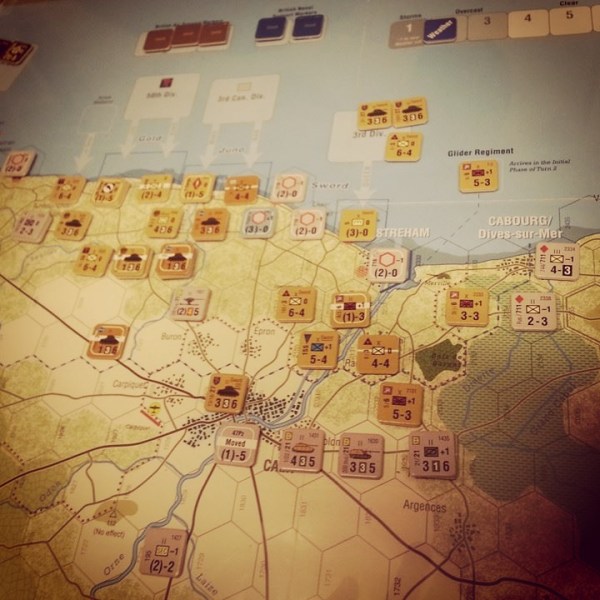
IMG_3630Allied forces push from the beaches inland to Caen in Normandy ’44

The Normandy ’44 game from the evening before concluded with a decisive Allied victory Saturday afternoon. Pushing the Germans back from all but Utah Beach, the Allies captured Bayeux and several smaller towns. With German defenders routed from roads leading inland from the landing beaches, the victors rolled in to control half of Caen by the game’s end.
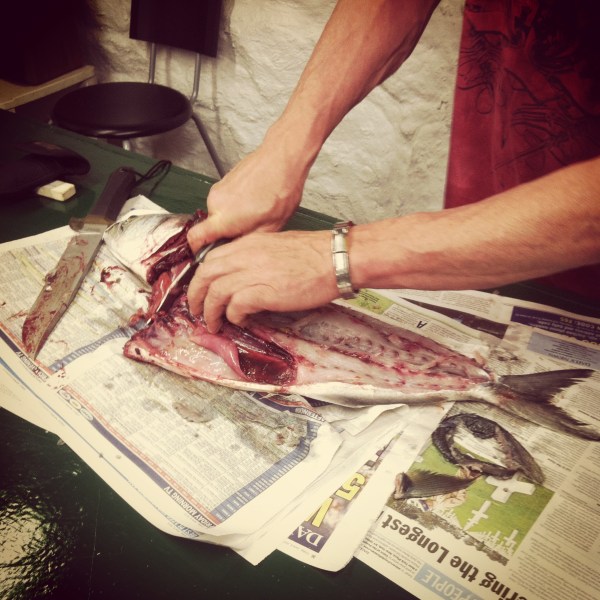
IMG_3625No one was going hungry at Metropolitan Wargamers over the weekend

Saturday also included a lot of other club members down for the usual variety of board, Euro and card games, making for a packed house. As the crowd rolled in, a longtime club member showed up with an enormous fresh-caught fish which he proceeded to gut with a huge military-style knife. With fish on the grill and food ordered in, there was plenty of food to sustain the crowd of gamers throughout the day.

We all took a mid-afternoon break to dice-off in a game, books, DVD and miniatures raffle to raise funds for the club. I was fortunate to score a copy of A Few Acres of Snow from Treefrog Games, and another lucky person picked up an unused copy of out-of-print the Games Workshop classic Dreadfleet.
IMG_3631

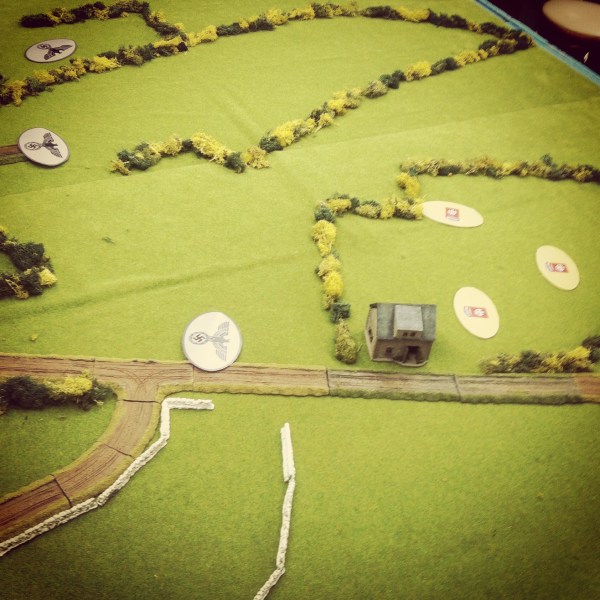
Initial deployment of Allied and Axis blinds in our Saturday evening IABSM scenario

As the main crowd thinned out, we ran an evening IABSM game continuing the assault beyond Easy Green. The scenario found initial US forces deployed around a small French farm with the objective of moving men off the table on the roads beyond. The Germans were tasked with preventing the American advance and seizing the farmhouse stronghold.

IMG_3607

Settling in for a contested fight at the farmhouse above Omaha Beach

Using initial blind deployment, Germans quickly moved to the farm along thick hedgerows as the Americans drove into the building for cover. Turns followed with the Americans jumping from cover to fire on the dwindling German force which returned fire over the hedges to unfortunate US infantry hanging out in the open. A US flamethrower attack from the window of the farmhouse decimated another German squad sitting close behind a nearby hedge. Pressing their luck, a group from the farmhouse made a run for the road exit only to be stalled by a reinforcing German heavy machine gun squad. Returning fire, the German MG42s were eliminated from their position in the open field. However, the damage had been done. Although the Germans had not captured the farm objective, the Americans no longer had a sufficient force to push off the table. The night ended with a German victory beyond Easy Green.

Sunday Games
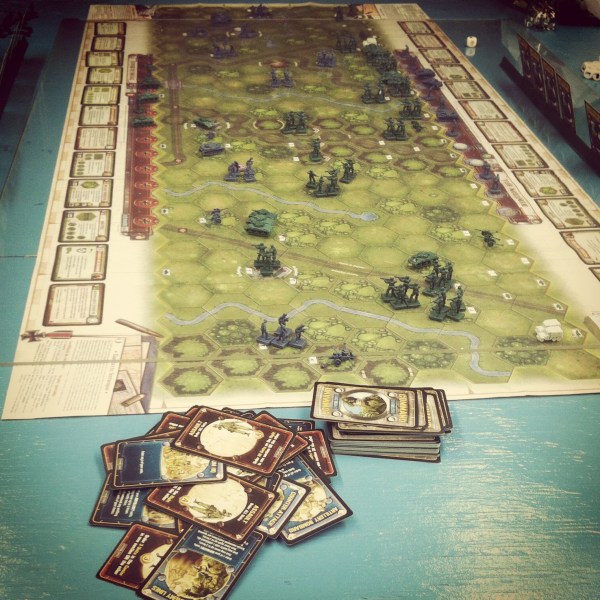
IMG_3620The war continues on the Memoir ’44 Hedgerow Hell battle map

With the first days of Operation Overlord behind us, Sunday’s game focused on the breakout actions. A couple visiting players showed up for the club’s Memoir ’44 game around noon on Sunday. Using the wide Hedgerow Hell expansion map, the Allies beat the scenario odds to win the game in the Overlord scenario. There was much talk of getting larger games of Memoir ’44 back in rotation at the club soon, so hopefully getting the game back on the table will bring some renewed interest in the coming months.

 IMG_3621

The initial armored encounter outside Lingevres leaves British tanks in flames

I finished off my weekend as the British at Lingevres using the same scenario I first ran at the club a few months ago. The mission ahead for the Brits was to move into the heavily defended town and take two of the buildings. Historically, the battle played out as a tank duel between UK Sherman Firefly and German Panther tanks, and our game this past weekend played out in a similar way.

IMG_3624

A Panther meets its end at the hand of the British Royal Artillery as a close assault is attempted on another in the woods nearby

At the outset, my first platoon of tanks got a bit overly aggressive and charged into contact with the full Panther platoon at the farm outside Lingevres. With the first Firefly destroyed in the opening turns, my remaining Shermans pulled back as the Panthers rattled to the middle of the field to hold off UK infantry advancing through the woods and bocage-lined fields beyond. One Panther bogged on a hedgerow and another was destroyed in an initial volley from the Royal Artillery in the fields outside town. Several turns became ensnared in attempted infantry assaults on the third Panther in the woods, but eventually the German tank rolled away to deal with the building reinforcing infantry and tank platoon in the fields on the other side of the table.

IMG_3622British Shermans and infantry break across a field toward Lingevres

With the Panthers moving away, fresh British infantry and the surviving Shermans moved to the farm and fields beyond. British artillery fire winnowed and pinned the German platoon in the church over several turns. Artillery fire also sought to keep the reinforcing German spotter pinned to limit the effectiveness of the reserve Nebelwerfer battery which as delayed reserves to the rear of Lingevres.

IMG_3623

The duel between the Panther and Firefly ends with the British tank in flames as the remaining Shermans destroy a Panzer IV platoon in the distance

In the meantime, a multi-turn tank duel had settled in between a lone Firefly and Panther while a reinforcing Panzer IV platoon arrived at the edge of town. Both tank groups traded fire, and in the end, the Panzers were routed with two or their three destroyed and the Firefly fell to the Panther’s gun. Back at the farm field, Shermans traded fire with Pak 40s and destroyed an anti-aircraft platoon defending the town’s flank. With two Panthers left on either side of the church, Shermans on each side of town and advancing British infantry, we called the game a draw.

 Weekend Debrief

After more than 20 hours of gaming over two nights and days, I was pretty worn out, but the interest in the D-Day event had made the weekend well worth it. WWII still holds enormous interest to this day, as demonstrated not only by our weekend of gaming but by the mainstream media’s coverage of D-Day over the week leading up. In the next week, we’re kicking off an FOW Infantry Aces campaign with fresh forces hitting the tables in rounds of Italy-themed WWII games. This fall we’ll be playing out some Market Garden battles and by the winter we hope to host some Battle of the Bulge engagements. It was a pretty special weekend in Brooklyn, but for regular visitors to Metropolitan Wargamers, there’s always the next game in this very unique New York City community.

New Game Weekend: I Ain’t Been Shot Mum

IABSMbook

As a World War II gamer, I have a newly-discovered love for a game which doubles my gaming possibilities with all the time and money I’ve  got invested in the 15mm Flames of War game which is the modern standard for the period. The past two weekends at Metropolitan Wargamers in Brooklyn, NY, I’ve been turned on to I Ain’t Been Shot Mum which is billed as “the other World War II miniatures game. For gamers with a lot of miniatures on hand and a hankering to play WWII at a different and more historical level, IABSM is well worth it.

TFLlogoNow in its third edition, IABSM has been published since 2002 by Too Fat Lardies, UK-based makers of a number of wargaming rules systems for a variety of historical periods. Overall, the game provides WWII wargamers with a simple, sleek set of skirmish rules that focuses far less on fielding shiny models and more on tactical decisions on the tabletop. IABSM is a true “what you see is what you get” system with a 1:1 scale at 15mm but easily adaptable to other model scales. One guy on the table equals one soldier in the field during battle, taking the game down to a level that really “feels” like commanding a group of troops. The smaller, less abstract scale of IABSM games provides a lot less “gaminess” to the systems, and relies a lot more on the decision-making skill of players commanding forces on each side. In many ways, the game is a throwback to original Kriegsspiel invented for use in Prussian army training two hundred years ago.

IABSMcardsSample cards from I Ain’t Been Shot Mum from Too Fat Lardies

The core rules of IABSM retail at under $20, and provide a number of basic underlying mechanics easily usable in any battle or theater of WWII. As an avid FOW player who is often faced with hundreds of pages of more grand-scale rules, army lists and ongoing modifications, the elegance of the skirmish-level IABSM comes down to five main areas:

1. Random Activation: Rather than playing by a simple “I go, you go” turn-based mechanic, IABSM games are powered by a set of cards which randomly activate deployed troops in the field. At the beginning of the game, a deck of cards is shuffled with each card representing a unit in the game. Cards are drawn and units are activated in turn, with units choosing a number of actions based on their quality. Highly-trained US Airborne troops may have four actions when activated, while less elite regulars may only have three. Actions include movement, firing, spotting the enemy and many other activities which makes commanding a unit’s turn one of many possible choices. Cards are added to the deck as new units arrive and removed if a unit is destroyed. Drawing a “tea break” card ends the turn with one final round of shooting for available inactivated units before the cards are shuffled a new turn begins.

2. Morale: Troop morale is nearly as important as firepower on actual battlefields. A well-armed but rattled group of soldiers may prove to be nearly ineffective in the field without some stalwart command leading the way. IABSM offers several levels of morale with pinning, shock and suppression which progressively eats into how effective a particular force can perform on the table. When being shot at, a simple table resolves possible kills as well as whether a unit is progressively shocked into poorer performance in subsequent turns or entirely immobilized due to overwhelming fire.

3. Command: Commanding and junior officers in IABSM are represented as “big men,” with individual cards allowing for their separate officer actions to drive gameplay. Through proximity or attachment to their forces, commanders can greatly affect morale by clearing shock from troops and boosting their strength in subsequent exchanges with the enemy. The presence of command also doubles the chance of troop activation, as a drawn “big man” card can press an attached unit into action without its own card being drawn.

4. Blinds: In real-world combat, knowing the enemy position through intelligence, observation or contact is almost as important as the engagements that result. While many miniatures games present an open table where nearly everything is known from the get-go, IABSM preserves a “fog of war” element with the deployment of “blinds” on the table. Represented by oval-shaped markers, blinds are able to move around the table without revealing their actual make-up. Thus, a player might move a small unit, a large platoon or even a false blind containing no troops around the table without the enemy knowing its true make-up until revealed. This allows players to add an element of diversion to the game, as an enemy way burn up several turns chasing a ghost across the table as real forces jockey into position.

5. The Game Referee: One of the hallmarks of wargames until recent decades was an all-seeing, all-controlling game referee. As a non-player, the referee not only provides clarifications on rules and contested play on the table, but they also are able to maintain a level of secrecy between each player as a scenario unfolds. The game can be played without a referee, but the presence of one adds yet another depth of to the “fog of war” randomness employed already with blinds and random card activation.

WTHbook

Beyond the base rules, Too Fat Lardies offers a number of IABSM scenario and guide books for Europe, Italy, North Africa and the Pacific. General lists allow for the creation of custom scenarios, but I really like the historically-specific books. The past two weekends, I played the first two games in the D-Day-themed Where The Hell Have You Been Boys? book which contains over twenty scenarios from Omaha and Utah beaches to the inland. Following the United States advance and subsequent German counterattacks, each scenario lays out a simple briefing for the German and US players along with a referee sheet, terrain map and a guide to forces and cards needed for play.

IMG_3554“Protect The Guns” scenario set-up for IABSM

IABSMGameScenes from the German defense above Pointe du Hoc in “Protect The Guns”

My first game — “Protect The Guns” — saw me playing as the defending Germans looking to hold off the Allied advance from Pointe du Hoc with a couple heavy machine guns, snipers and some off-board artillery. One of the remarkable things about IABSM is the vast amount of space represented on the table, making decisions of movement and firing  very important. My artillery was also very unreliable, representing some of the German communication challenges come alive. That said, with only a few men at my disposal, I was able to stave off and force the Americans to redirect through constant harassing fire until their reinforcements entered under a blind at my rear. With one of my machine guns and both snipers finally destroyed, the last of my Germans found themselves pinched on two sides of more-skilled US troops who took the game.

IMG_3553

“Holding The Pointe” scenario set-up from IABSM

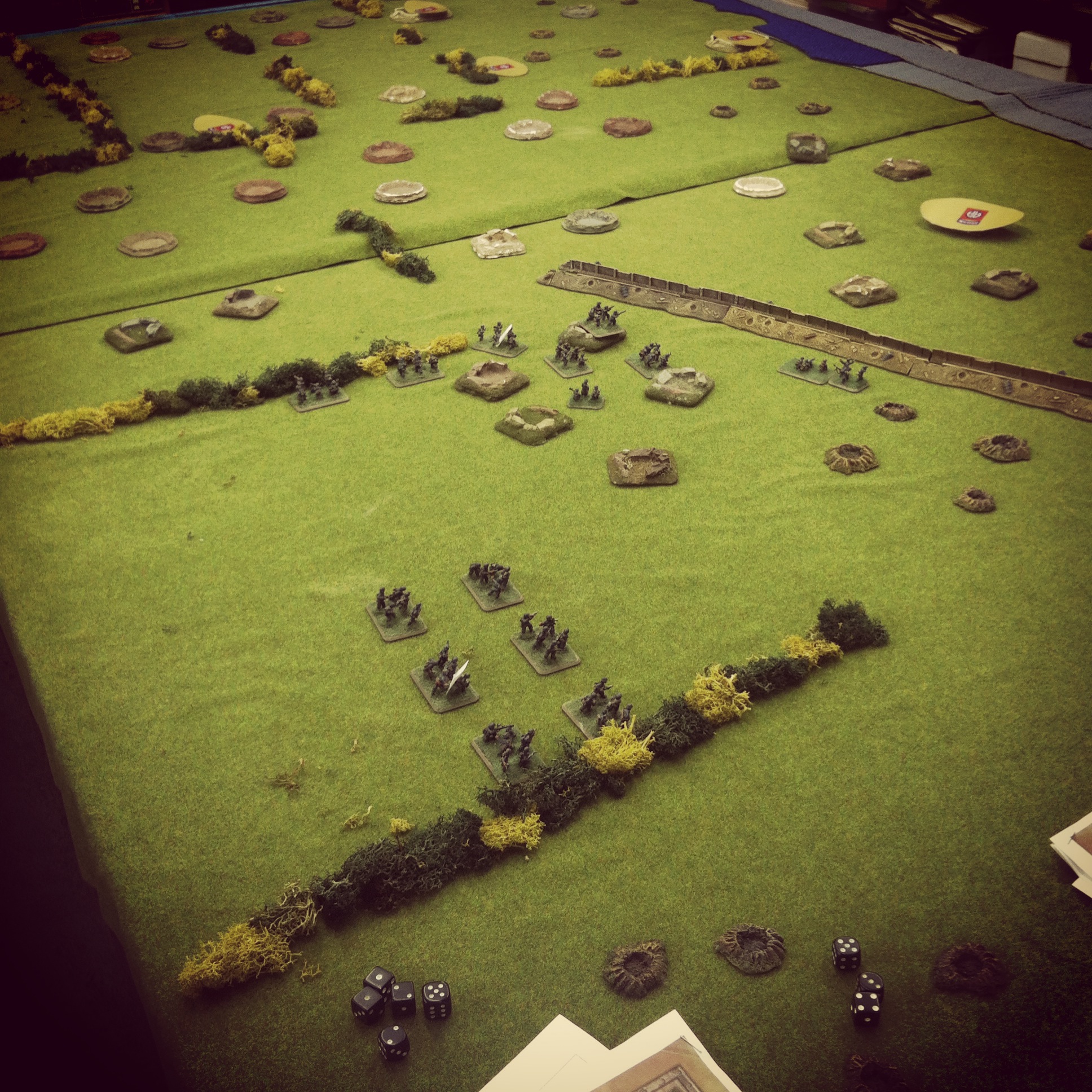
In “Holding The Pointe,” my Germans were on the counter-offensive and looking to push the Americans back into the sea. With all my forces deployed at the game’s start and all American units under blinds, my Germans began in overwhelmed confusion. This disadvantage made the game play so much more like the actual action in Normandy as German forces scrambled to head-off the Allied attack inland. Rather than focus my attack, I made the poor gamble of splitting myself to chase two sets of US targets. By the time a large force of German reinforcements arrived in the seventh turn, my initial force had gotten chewed-up in a series of stand-off firefights amidst the thick bocage near my original deployment. My divided force tactics were ultimately my undoing, and I’m certain a more textbook massed attack may very well have giving me a greater shot at victory.

With a couple of games under our belts, we’re going to continue right through the IABSM D-Day scenarios and beyond. We’ve managed our games without a referee so far through some really good fair play, but we’re anxious to try some scenarios with the referee element. Overall, the up-close feel for command and the heightened tactical realism in IABSM has given me a second WWII game to love at the 15mm scale.

Flames of War: Omaha Beach “Easy Green” 1944 Scenario

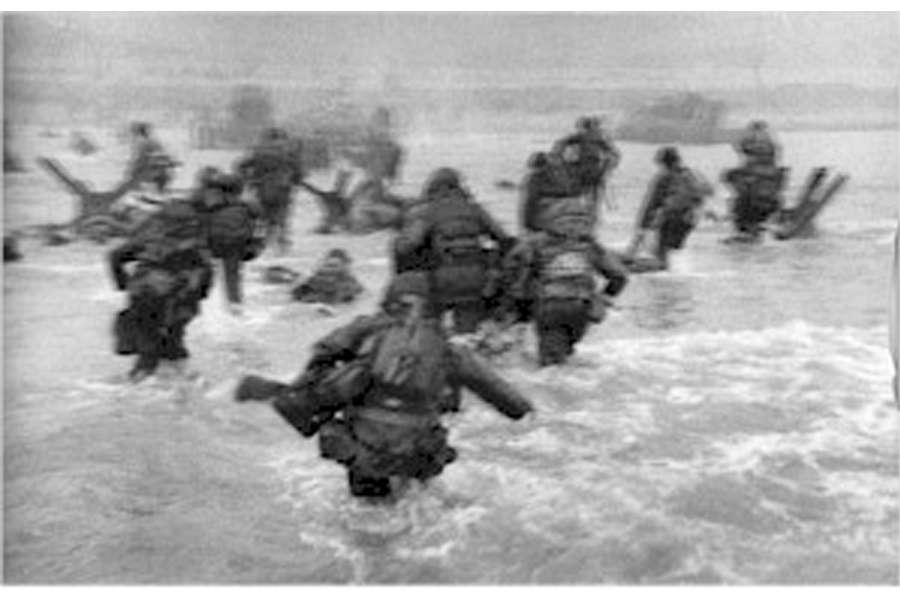
OmahaBeachSandwiched between tall bluffs on either end, a five-mile stretch of Normandy coastline was designated Omaha Beach near the center of the Allied D-Day landings on June 6th, 1944. Landing at Omaha was the relatively fresh US 29th Infantry Division. With British and Canadian troops landing on beaches to the left and other US men landing at Omaha Beach to the right, the 40,000 Americans at Omaha met with the highest rate of casualties of the day with some 3,000 falling in the French surf and sand.

OmahaEasyGreen“Easy Green” sector on Omaha Beach, Normandy 1944

Lying in wait at Omaha was a mix of green recruits and older veterans in the German 352nd Infantry Division. Dug in at the coast in a wall of pillboxes, bunkers, gun pits and trenches, the German men (and unknown number of boys) met the US invaders with a storm of machine gun, artillery, mortar and rocket fire. For the US, little went right as landing craft drifted off course and special floating DD M4 Sherman tanks were swamped and sank offshore. Only through improvised efforts and a slow, methodical pace under withering fire did the American infantry finally make it through the German lines to control the beach by the close of the day.

EasyGreenFOWMap set-up for the Flames of War “Easy Green” scenario

In preparation for our upcoming D-Day Plus 70 weekend at Metropolitan Wargamers in Brooklyn, NY on June 6th-8th, a couple of us have been playing out beach landing practice games. Flames of War offers a specific outline for coastal assaults with their “Hit The Beach” rules, but we’ve found them to be very difficult to play with US invaders losing more often than not. Last summer we ran through our first beach landing on one of the club’s sand tables with a Utah Beach “Easy Red” scenario in which the US failed horribly. Since then we’ve been studying up, tweaking our forces and diving deep into the particular rules for a tabletop beach landing game.

German352

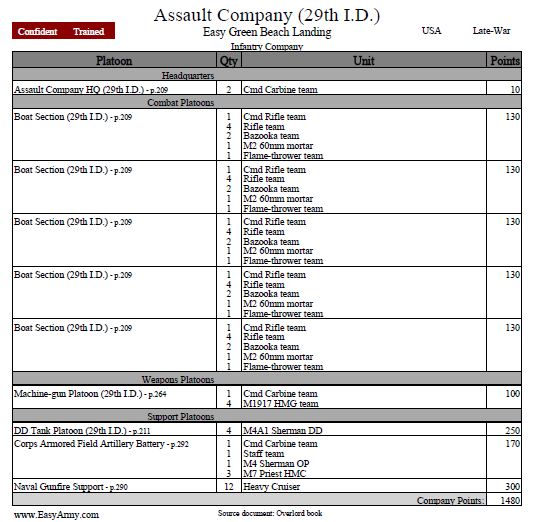
29thinf

This past week we ran through the Omaha Beach “Easy Green” scenario to what was probably our most evenly matched and played game to date. The scenario sticks pretty closely to the situation at Easy Green with one beach exit road guarded by lines of barbed wire, trenches, mines and anti-tank obstacles. Finally, a combined defense of heavy machine guns, a 5 cm KwK 39 gun bunkered at the coast and Nebelwerfer rockets at the rear provide a daunting nut for the US infantry to crack. For our game, my German opponent was able to field forces as outlined in the published FOW scenario but I had to modify my American list slightly to fit my model collection. Even with slight changes, our final lists had the US at a few more points stronger than the Germans as per the mission outline and the game rules.

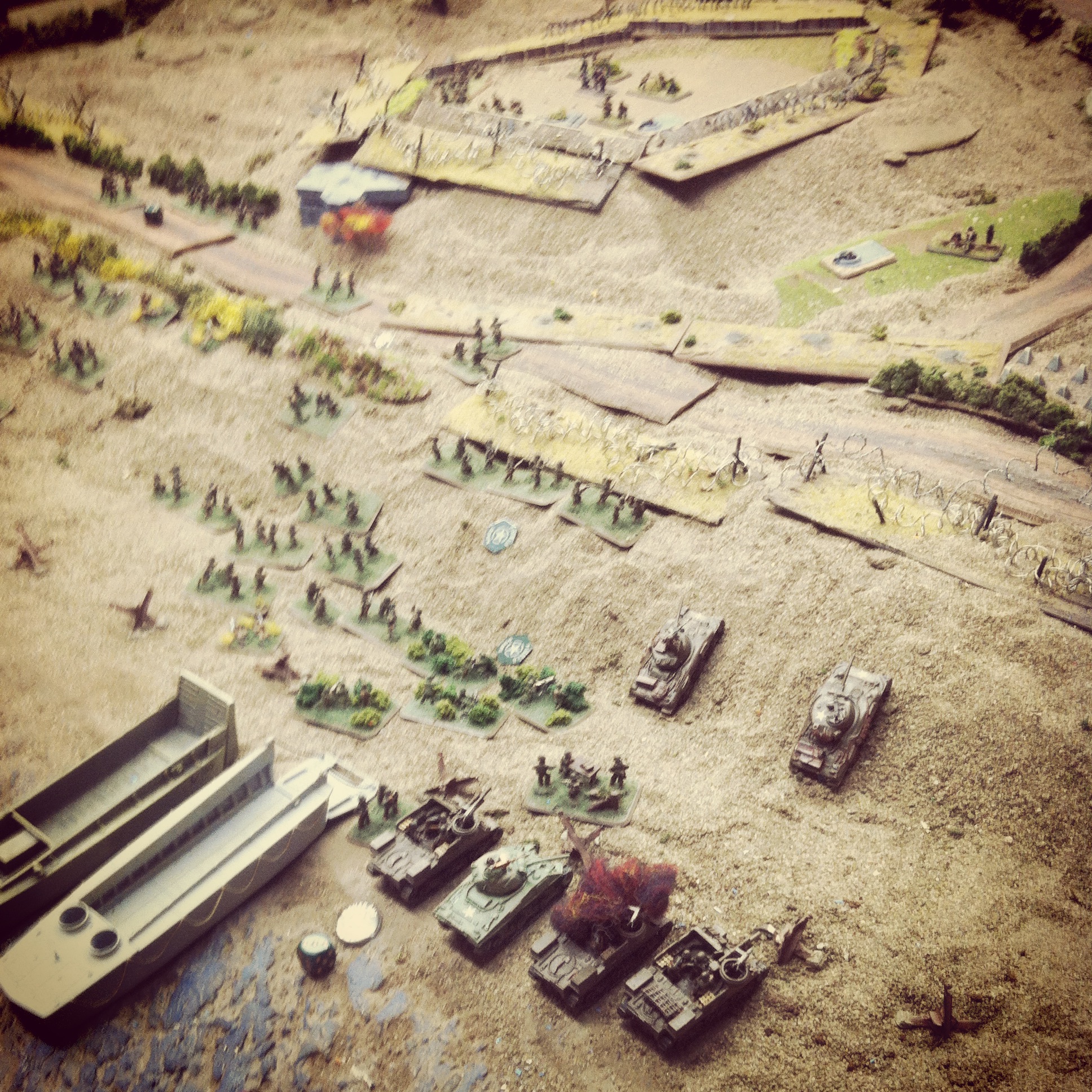
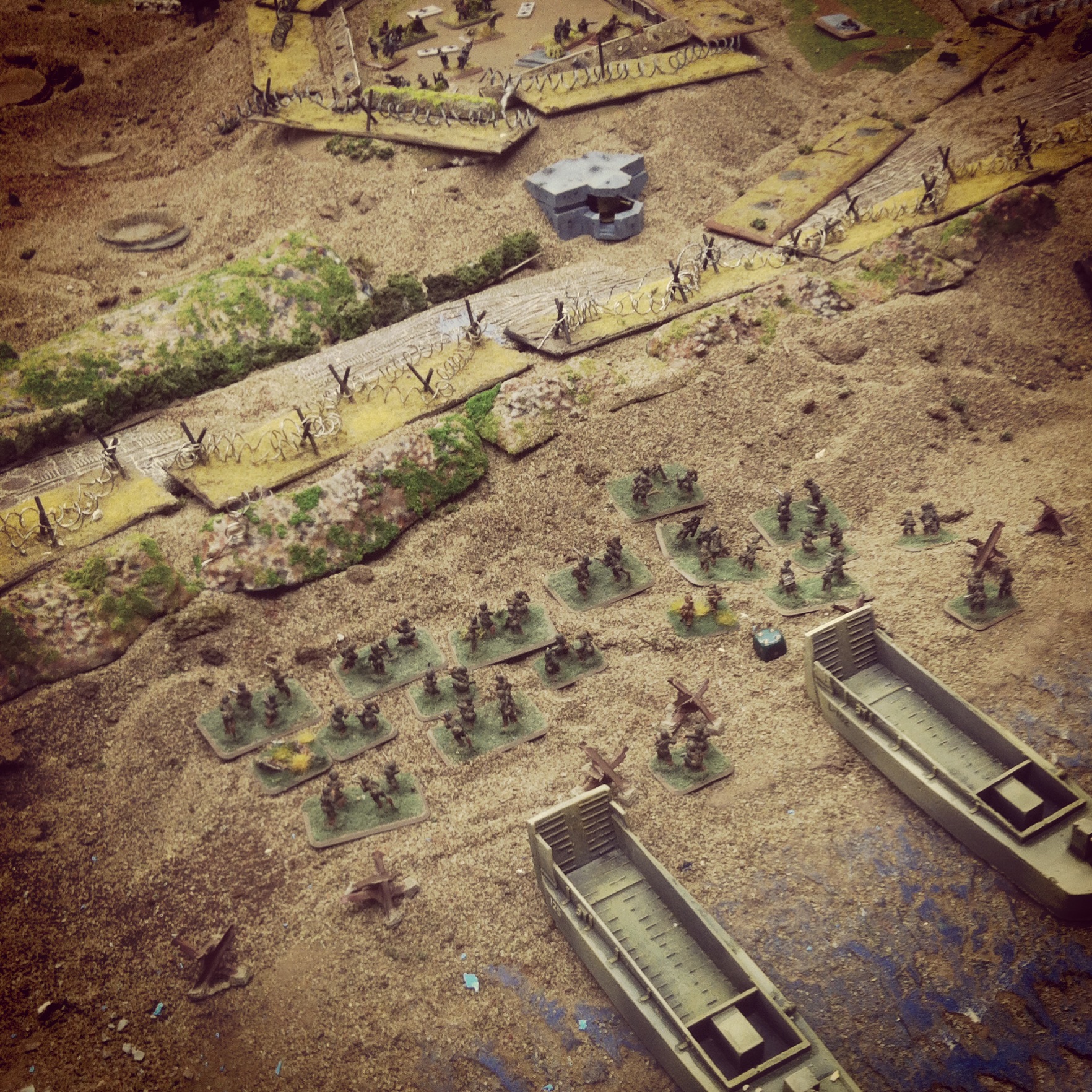
IMG_3452The first US boats land and platoons rush ashore

After an initial US naval bombardment which destroyed one stand of German infantry, my boats and DD tanks headed for the beach. In the initial wave, one DD tank sank in the water offshore and one boat was delayed in the bouncing surf. With two platoons of US infantry on French ground, they made way for the barb-wired seawall. Further down the beach to the right, my three surviving Shermans rolled to the one exit causeway from the beach.

IMG_3453DD Sherman tanks make it across the beach toward the exit ramp

In the opening salvo from the Germans, rocket fire came in from the rear of the table as entrenched guns fired from the beach defensive lines. US troops did well with dice roll saves and lost just a few teams before ending the turn pinned high on the beach.

IMG_3454German Nebelwerfers sit atop a hill overlooking the Allied objective

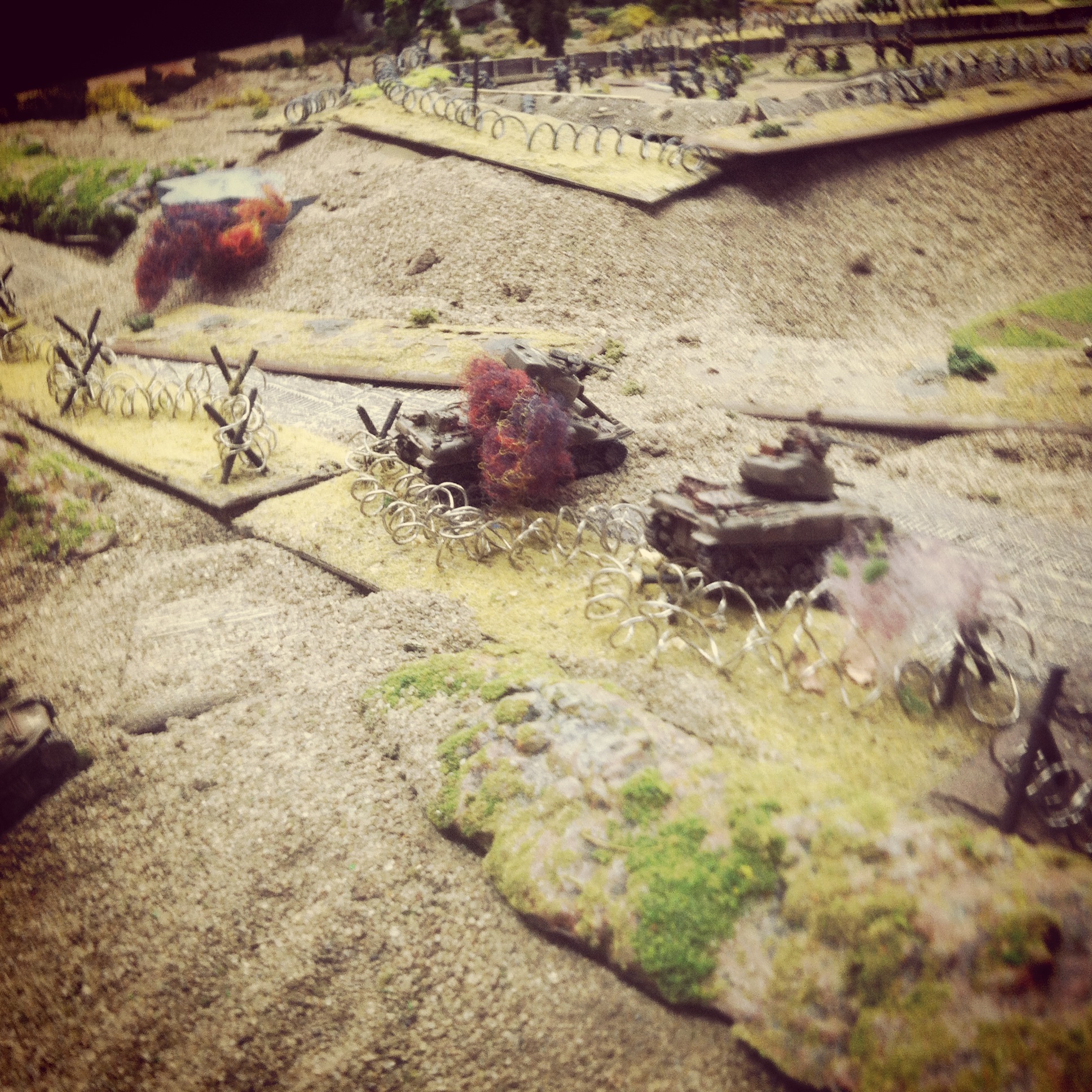
In the next couple turns, landing craft continued to meet mixed success in landing and stalling on the sea. Luckily, most boats didn’t drift too far down the beach, allowing me to execute my general plan of running infantry to the left while my tanks dealt with the heavier nests and pillbox to the center and right. One tank bogged in the sand but the other two rolled over the barbed wire to take up position at the line of minefields, sending fire into the Tobruk nests and gun bunker. A couple turns in, the bunker was in flames and the German machine guns had been dealt with. The way was clearing for the US infantry to push inward.

IMG_3455The 5 cm KwK burns in its bunker as US troops push over the seawall

IMG_3456DD tanks struggle through the coastal defenses and take heavy combined fire

With several US platoons whittled-down in their struggle through several tiers of barbwire, one platoon of German infantry arrived and made way for the row houses near the objective and remaining rockets on the hill. In the open, the Germans took fire from naval guns but most survived to find shelter in the buildings. Back on the beach, my final US reserves of M7 Priests landed at the center of the beach and one heavy machine gun section tramped forward at the extreme left. With these late arrivals so far back from the main action, it was up to the forces already inland to get the job done.

IMG_3475German defenders rain mortar and machine gun fire into oncoming US troops

IMG_3476With German defenders destroyed at the beach, the 29th Infantry Division hustles inland

With the major defenses eliminated at the beach, the Shermans turned their machine guns on the remaining German infantry manning the trench line high on the central hill. At the same time, US infantry began pushing into the German position after spending turns alternately being pinned by rocket and mortar fire, removing barbwire and shooting back with light machine gun, rifle and direct mortar fire. Despite their losses, the combined arms of my US troops really shined, as was often the fateful experience of their German opponents 70 years ago.

As the game moved into the second-to-last turn, the Americans were ultimately just too far away and too weakened to make the final push to the objective still held by the remaining German infantry comfortably defending from the nearby houses. It had been a pretty even match, but timing was everything. Luckily for the Allies on June 6th, 1944, the only limits on the day’s outcome at “Bloody Omaha” was the grit and dedication of the storm of humanity hitting the beach.

Metropolitan Wargamers D-Day Plus 70 Event – June 6th-8th 2014

MWGDDay

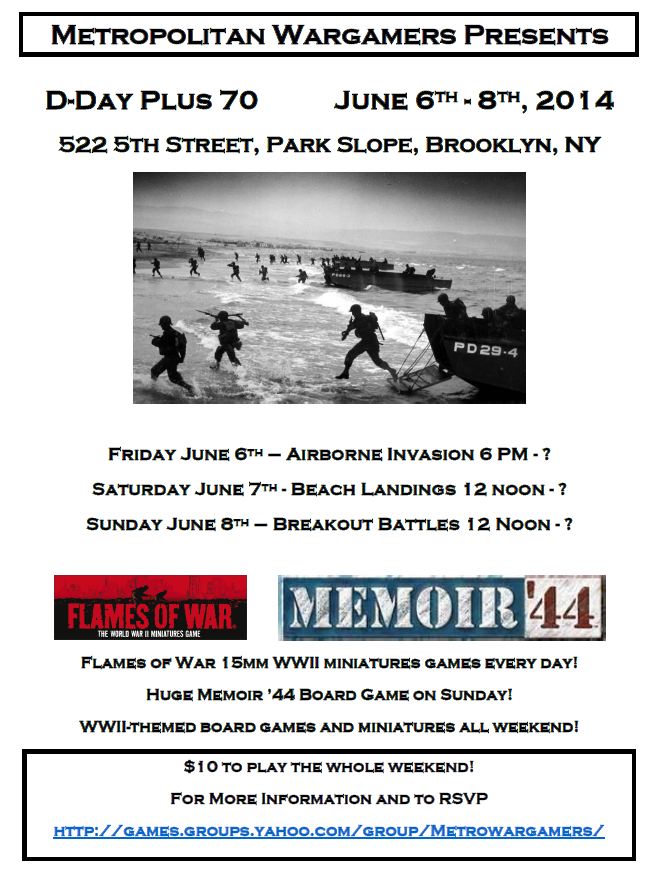
This June is the 70th Anniversary of the Allied D-Day landings at Normandy, and New York City’s oldest and largest wargaming club Metropolitan Wargamers is celebrating with a full weekend of events.

IMG_2161

La Fiere Causeway at Metropolitan Wargamers in Brooklyn, NY

Whether you’re new to the hobby or an experienced gamer, there will be plenty of WWII action the entire weekend. On the evening of Friday June 6th we’ll begin with Flames of War airborne landing scenarios. Saturday June 7th kicks off at noon with a FOW beach landing scenario on one of the club’s famed sand tables. Sunday wraps up the weekend with a couple FOW breakthrough battles and a large Memoir ’44 board game. Other WWII-themed games will run throughout the weekend.

IMG_2816

Utah Beach on one of the sand tables at Metropolitan Wargamers

We’ll have FOW scenarios set up for the weekend with plenty of miniatures and stunning terrain on the club’s tables, so all you need to bring is your passion for wargaming and history. Our FOW miniatures games are fun and a feast for the eyes, and you can get a sense of what’s in store for the weekend by viewing some of our past scenarios at the club here.

Admission for the full weekend of gaming is just $10 and a great opportunity to visit a very unique community of gamers in the heart of Brooklyn’s Park Slope neighborhood.

For more information and to RSVP for the D-Day Plus 70 weekend, check the Metropolitan Wargamers website or join our Yahoo group.

New Game Weekend: Joan Of Arc

joanwarbonds

For a story mixing heroicism, legend, Christian mysticism and epic battles of swords and armor, you really can’t beat Joan of Arc. Rising from storied French farmgirl  beginnings toward the end of the Hundred Years War, the teen-aged Joan of Arc is legendarily credited with turning the French tide against English invaders at the Siege of Orleans in 1429. Her later capture, trial, burning at the stake and eventual canonization as Saint Joan of Arc cemeted her place in world history as a military, feminist and religious icon.

joanofarcbox

In the six hundred years since she was executed, Joan of Arc has remained a prominent subject of film, plays, art, literature, and yes, games. With so few women in headline roles in the history of warfare, the chance to game the period of warring Europe in the waning days of chivalrous armored calvary can be all the nore interesting when Saint Joan is present.

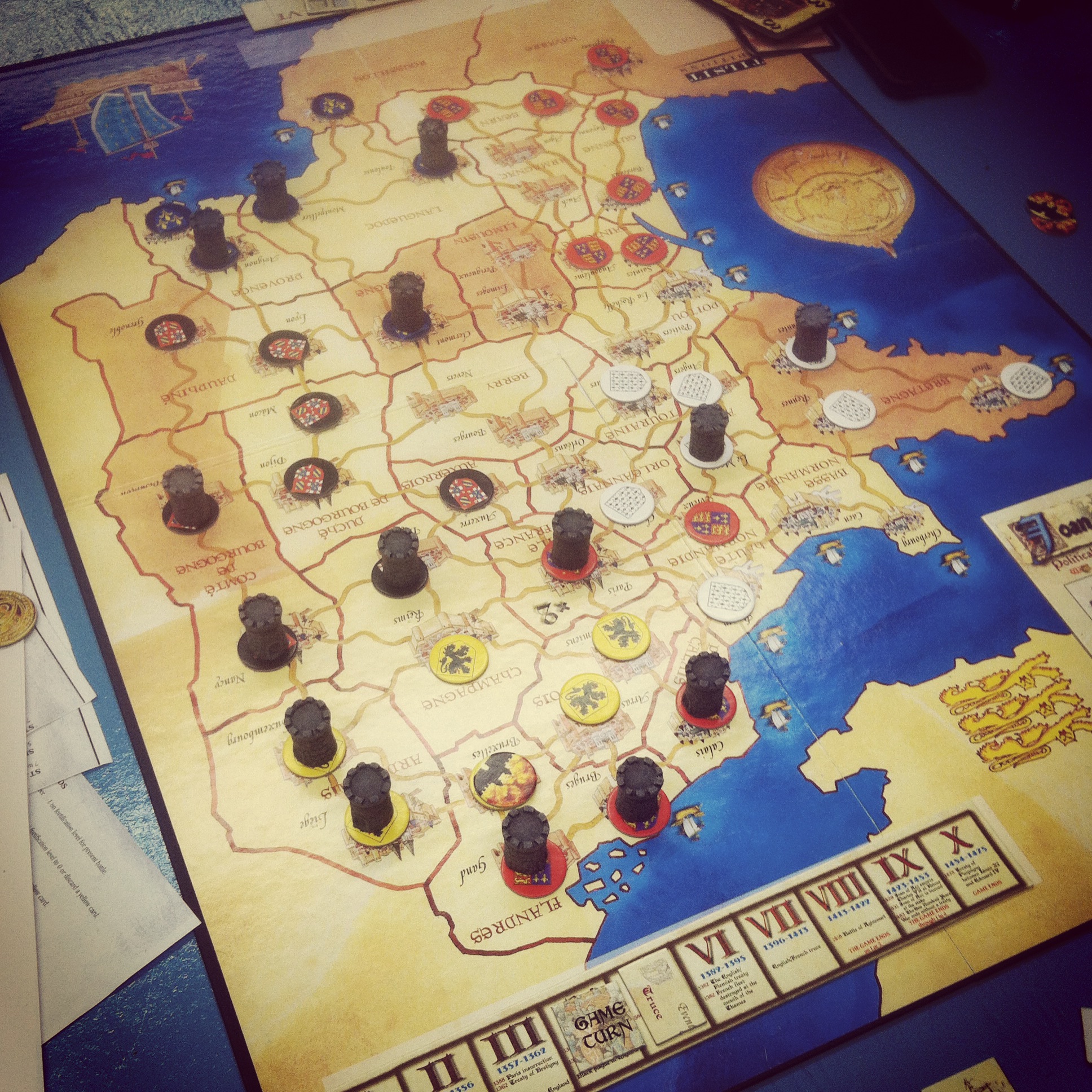
Released by Clash of Arms in 1998, Joan of Arc is at this point a classic board game which I recently had a chance to play for the first time at Metropolitan Wargamers in Brooklyn, NY. The game board presents the contested areas of the 100 Years War dotted with cities connected by roads. Players choose to represent on e of the warring kingdoms of France, England, Navarre, Brittany, Flanders and Burgundy. The game begins in a time of peace, and in each subsequent turn players vote in secret on whether the turn is to be one of peace or war. A time of peace causes one random event to be drawn and just one attack action per player, while a period of war brings two events and up to two battle actions from each player.

IMG_3434

 Joan of Arc at Metropolitan Wargamers

In random order at the beginning of each round, each player may expand into up to two free city locations along connecting roads or via seaport connections. Players draw a hand of large, tarot-like cards with which they can wage combat or cause other chance actions like the appearance of a hero of the kingdom such as St. Joan herself for the French. An attacking player draws cards from their hand, each carrying a numeric value, along with special actions such as Engineering which negates the defender’s bonuses from previously built castles and strongholds. A defeated city is occupied immediately by the attacking army, and the number of controlled cities and collective regions generates additional income in the following turn.

Throughout Joan of Arc, alliances are made, truces may be purchased through influence and battle for area control of the map marches through time. The player scoring the most points through controlled space on the board wins at the end of the game. Our group of savvy wargamers had the most fun in the alliances an double-crosses we meted out on each other’s kingdoms throughout the game.

There are a lot of better historically-based area-control games on the market at this point, and Joan of Arc’s connection to the historical record is pretty abstract at best. The game design looks great and it plays well once the somewhat imprecise rules are understood after a turn or two. Even with its minor faults and stretched thematic story, Joan of Arc more than engages a group of players in the era of Europe tipping away from its feudal centuries of warfare toward a more enlightened age on the continent we can still recognize today.

New Game Weekend: The Resistance: Avalon and One Night Ultimate Werewolf

avalonwerewolfThe mechanics of common and secret knowledge among players creates the basis for so many games we play. A game like chess has everything set on the board for everyone to see, and it is only a player’s skill and strategy that remains secret until revealed in a series of successive moves of action and reaction.

More typically games involve some level of secrecy either in cards hidden in a player’s hand or pieces set on a game board ready to be revealed at specific moments during play. Deduction, reason, probability, informed guesses, manipulation through bluffing and revelation of information drives much of the action of these games.

Almost 30 years ago, Mafia was created by a psychologist at Moscow University. In the game, two players act as the mafia with their identity known to each other but not the other players. The non-mafia participants take on a variety of other roles, each with select knowledge of the other players and abilities to effect other player roles. With starting roles assigned, the game enters a “night phase” with all players shutting their eyes. A non-player game moderator bears witness as the mafia players and any accomplices kill off other players in secret. Next, all players open their eyes for a “day phase” and changes in the situation of the game is revealed. Players still alive in the game discuss the new conditions of the game, and attempt to discern the mafia players among them in subsequent night and day phases.

As Mafia spread outside of the former Soviet Union in the mid-1990s, it took on a horror-themed variant known as Werewolf. In the new version, players act as werewolves or villagers attempting to identify and kill off each other in night and day phases. Once players have an understanding of the basics of Mafia or Werewolf, neither game really requires any special equipment. This had made these games popular as pick-up party games with hardcore and casual gamers alike (my wife recently played Werewolf on a company retreat as a team-building exercise).

wwcontentsCards, markers and free app from One Night Ultimate Werewolf

In the past two weeks, I had a chance to play two of the more popular modern versions of these games at Metropolitan Wargamers and Brooklyn Game Lab. One Night Ultimate Werewolf is the latest riff on the classic game from Bezier Games with werewolf players hiding among villagers with a variety of roles. These include colorful characters like the Minion who knows the werewolves and only wins if they survive, the Seer who secretly knows identities of other players and the Tanner who has a death wish and wants to be killed before the werewolves are found out. Along with the cartoon artwork on the heavy-carded playing pieces, this version of Werewolf comes with a free app which acts as a game moderator and timekeeper.

avaloncardartCard artwork from The Resistance: Avalon

The Resistance: Avalon is a the sequel to the sci-fi-themed The Resistance from four years ago from Indie Boards & Cards. Players of Avalon take on good and evil roles from Arthurian legend and set out on a series of quests to root out the opposition. After roles are set, a king is selected each round to select other players to participate in a quest. All players vote to approve or deny the selected party on their quest, and then players on the quest vote for the quest to succeed or fail. The evil players win if more quests fail than succeed, so each quest round is the chance to reveal who may be working alone or in concert to win the game for the evil side. Like the more traditional, Mafia game, Avalon involves a non-playing moderator.

With all these games, the colorful pieces and cards are just jumping-off points for the real action which takes place among the players. Accusations are slung, theories are posited and alliances are built and then dissolve in minutes. In the games I played recently, people spent a lot of time just staring into other people’s eyes, looking for a glint of deception or a sly twinkle of acknowledgement. What has made all these games in their various names and variations so enduring is that human nature itself becomes the mechanic of the game. Whether the game is Mafia, Werewolf, Resistance or Avalon, the only real equipment needed isn’t in a cardstock box but in what each player brings with them to the table.

Flames of War: Dust Up Mission With “Blood, Guts and Glory”

tank3

Although actually made up of a number of battles and assaults during World War II, the post-D-Day breakout actions by the Allies in late 1944 in Northern France has become commonly known as the Lorraine Campaign to military historians. Frustrated by poor weather conditions and weak supply lines, the General George Patton’s 3rd Army push into Germany eventually led to the wintery and more famed German counteroffensive with the  Battle of the Bulge in the winter of 1944-1945.

bggbook

Flames of War offers a book outlining the Lorraine Campaign with Blood, Guts and Glory. US lists in the book focus on the powerful tank and armored rifle companies which made up the steely backbone of Patton’s daunting force. For the Germans, the cobbled-together 106 Panzerkorps Felderherrnhalle and 111 Panzer brigade are outlined with forces full of some of the best Late War armor and equipment albeit under somewhat challenging motivation and experience ratings.

A couple of weeks ago at Metropolitan Wargamers in Brooklyn, NY, two of us had a go at a fictional battle set during the Lorraine Campaign. We play against each other a fair amount, and both of us were looking to switch things up commanding some very different forces. The tabletop terrain was also different with a more open battlefield lined with fields, woods, gentle hills and two farms. All of this was quite a departure from the games we have most played set in the days and months after the Normandy Invasion in June of 1944.

dustup

My opponent’s Panzerkompanie was  full of armor – Stugs, Panthers and Panzer IVs – and  supplemented by an Aufklärungs platoon and a couple Wirbelwinds to chase away any US aircraft. For my US force, I wanted to try out some underused rifle platoons which were supported by 105mm M7 Priests, some Shermans and a P-47 Thunderbolt buzzing overhead. We also chose a different game framework, opting for a somewhat complicated Dust Up scenario from the official Flames of War missions list.

pzco

us4th

IMG_3397

Our Dust Up scenario with my US forces in the foreground and Germans in the distance

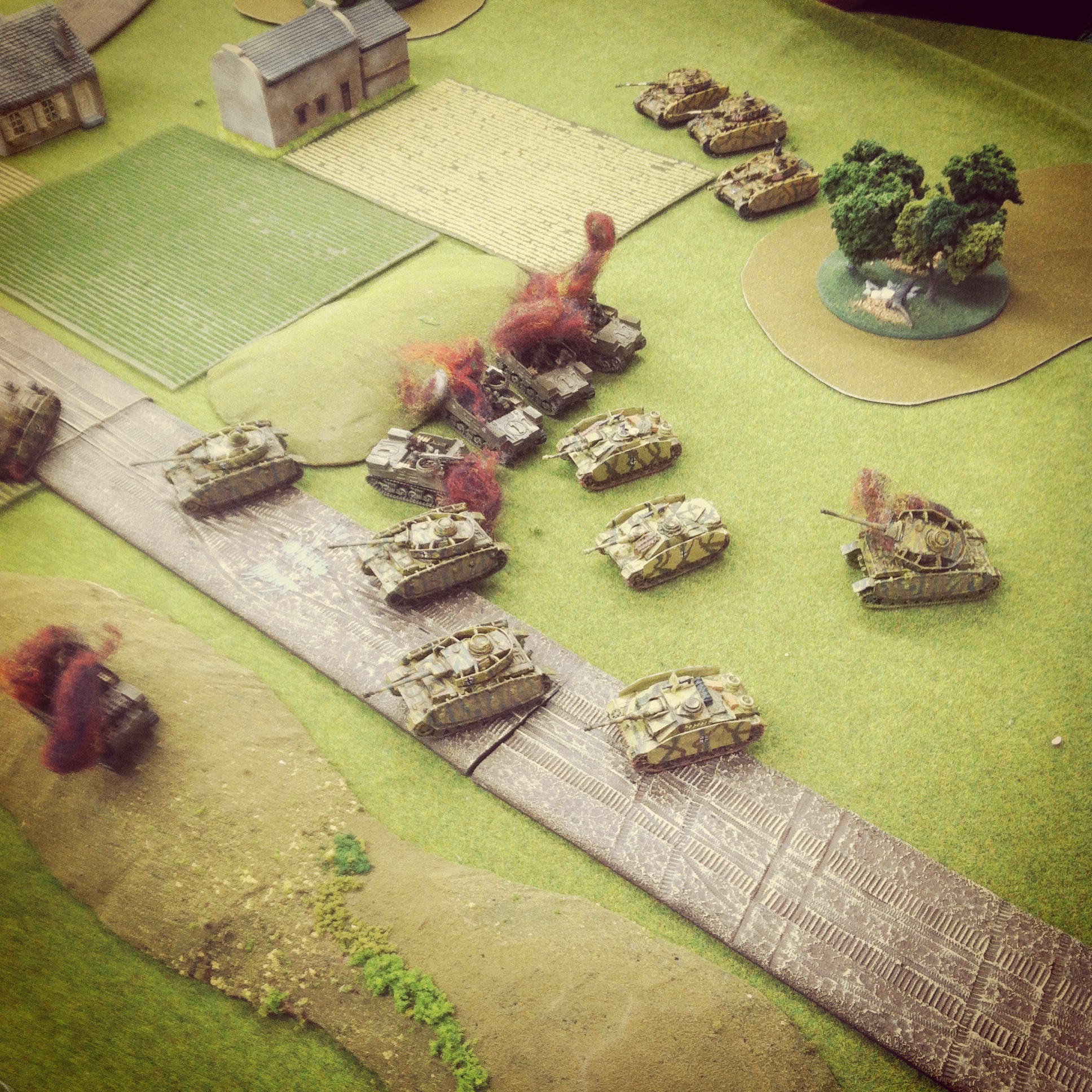
Well, as the game played out, I quickly discovered I had brought infantry to a tank fight. With one of my infantry platoons camped out in the woods near two objectives, my hope was to stave off the German armor advance with repeated bombardments from my Priests and diving runs from the P-47.

IMG_3398US M7 Priest platoon taking up position

IMG_3399US rifles deploy in the woods to guard a nearby objective

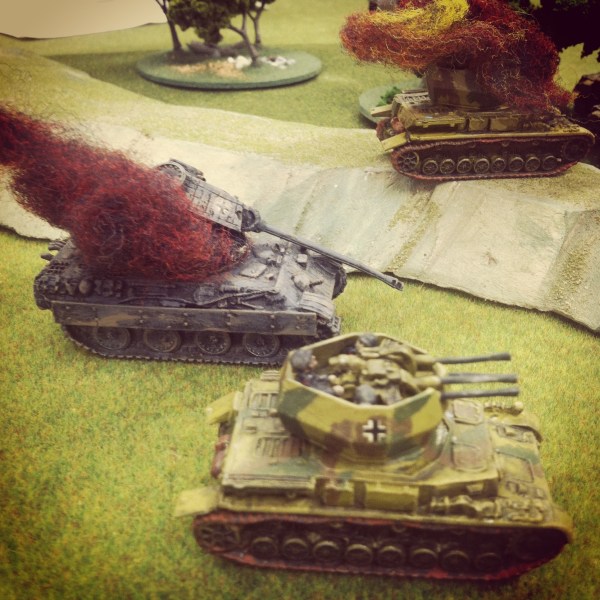
Things went well for me in the early stages as Panthers stalled moving through the woods. A Wirbelwind and two Panthers were subsequently destroyed from 105mm volleys , but my P-47 failed to get any traction in stopping a group of Stugs creeping along the table edge. Even so, a couple turns in I was feeling fairly confident my artillery fire would whittle away the rolling German advance.

IMG_3401A German Panther and Wirbelwind are destroyed by incoming US 105mm fire

IMG_3400Panthers make through the woods but one bogs in the terrain

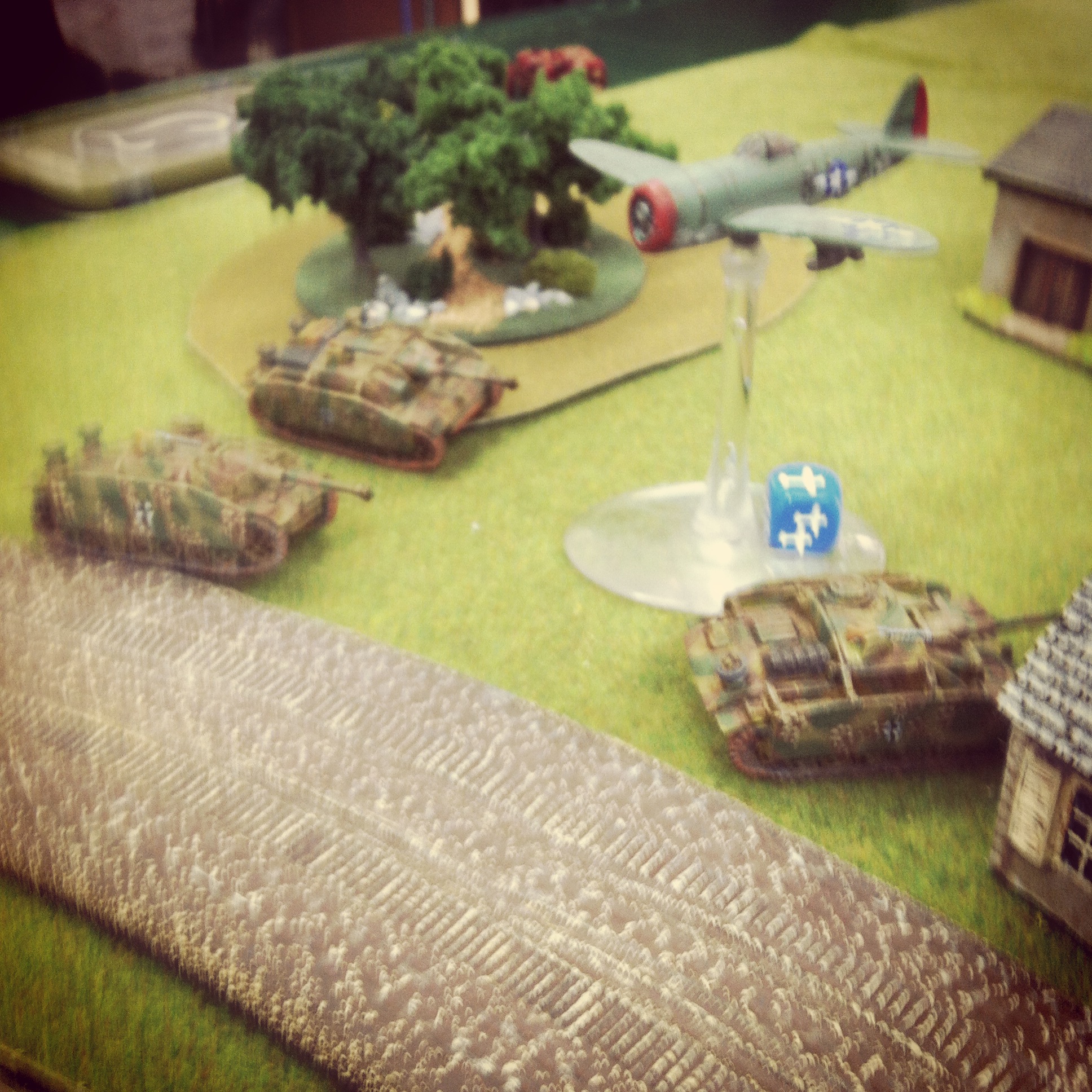
IMG_3402The P-47 Thunderbolt attempts a run at a Stug platoon

IMG_3403More fire from the Priests take out another Panther

My plan fell apart as the first German Panzer IV reserves came on the table at the corner behind my Priest battery and made quick work of the nearly-armorless US mobile artillery. I swung my surviving Priest and supporting Sherman around and engaged the Germans at close range with direct fire, but succeeded in only cracking open one German tank. In another turn, the Priests were wiped from the board and only my infantry platoon remained to defend my end of the table. The P-47 appeared again to control the center of the battlefield, but missed on its run. The US center and flank were crumbling by the time turn four approached.

IMG_3405Panzer IV reinforcements surprise the Priests from the rear

IMG_3406The Thunderbolt tries to stall the German armor in the middle of the field

My reserve Shermans came on the table near a farm and quickly engaged with the Panthers which swung to meet the US armor advance. Shots from my heavier 76mm guns lit up a Panther and bailed another’s crew. The German tanks returned fire, destroying all but one 76mm Sherman as more Panzer IVs showed up with the Aufklärungs platoon close behind.

IMG_3407Reserve American 75 and 76mm Shermans roll on the board

IMG_3409The last of the Priests burn as more Panzer IVs appear

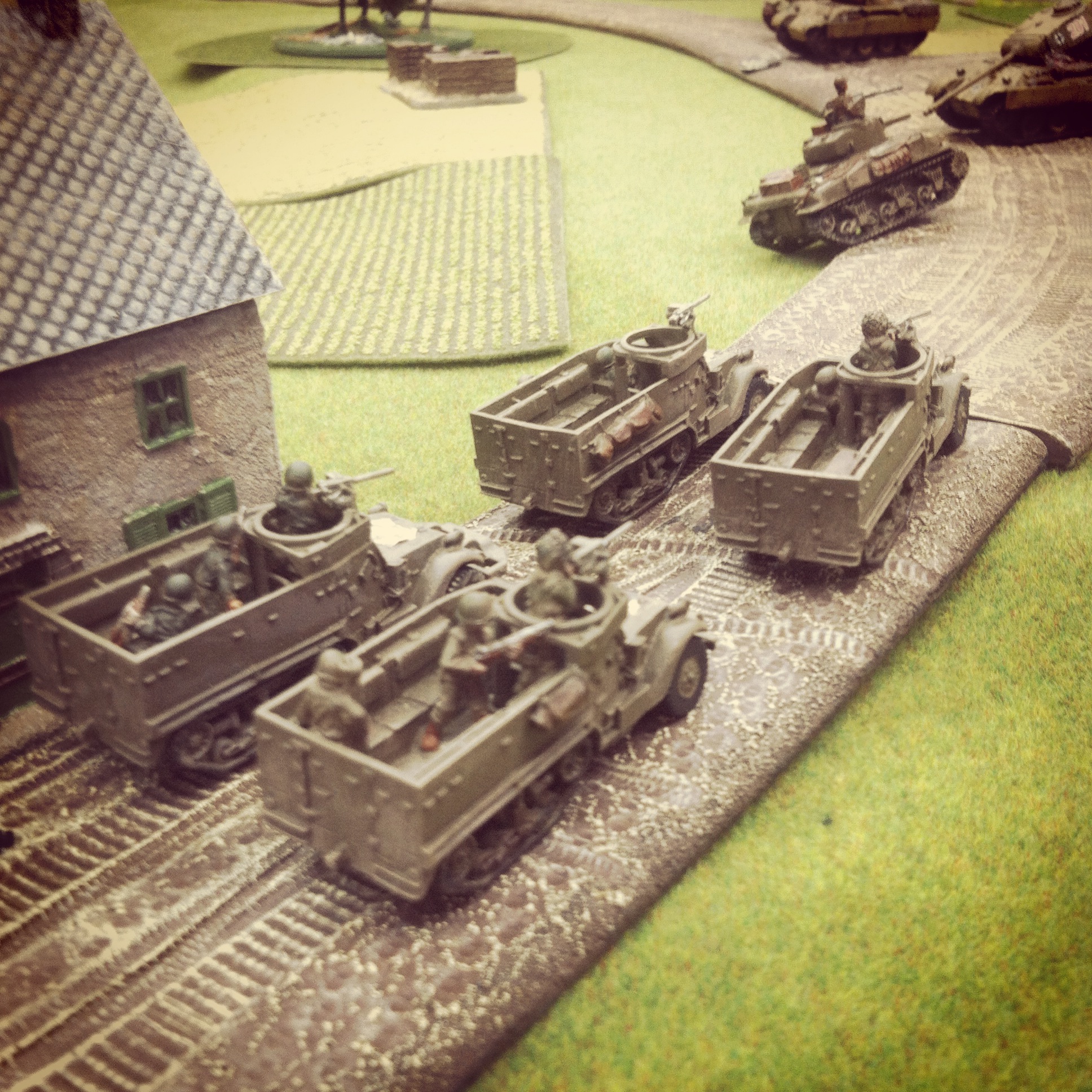
In the fifth turn, my final supporting infantry platoon arrived in their halftracks, dismounted and made a desperate run for an objective in the open field. The infantry on my side of the table also broke from the woods in a last-ditch assault on a mass of German tanks creeping toward an objective but were repulsed. With German armor swarming an objective, the game went to the Axis.

IMG_3410A reinforcing column of US rifles follows-up the Sherman advance

IMG_3413A lone Sherman survives as the US rifle company dismounts and heads for an objective

IMG_3414US riflemen break from the woods in a desperate assault on German tanks at an objective

IMG_3415With tanks aflame in the fields, the Germans take an objective

Clearly, my US plan from the outset was a stretch. Had I taken the more historic approach of Patton in the Lorraine Campaign of 1944, a fully-armored US force may very well have stood a fair chance against all the German tanks shuttling here and there on the tabletop. Balancing history and what-ifs is what makes playing Flames of war so engaging over and over again, but next time I’ll be careful not to second-guess the command decisions made in Northern France some 70 years ago.

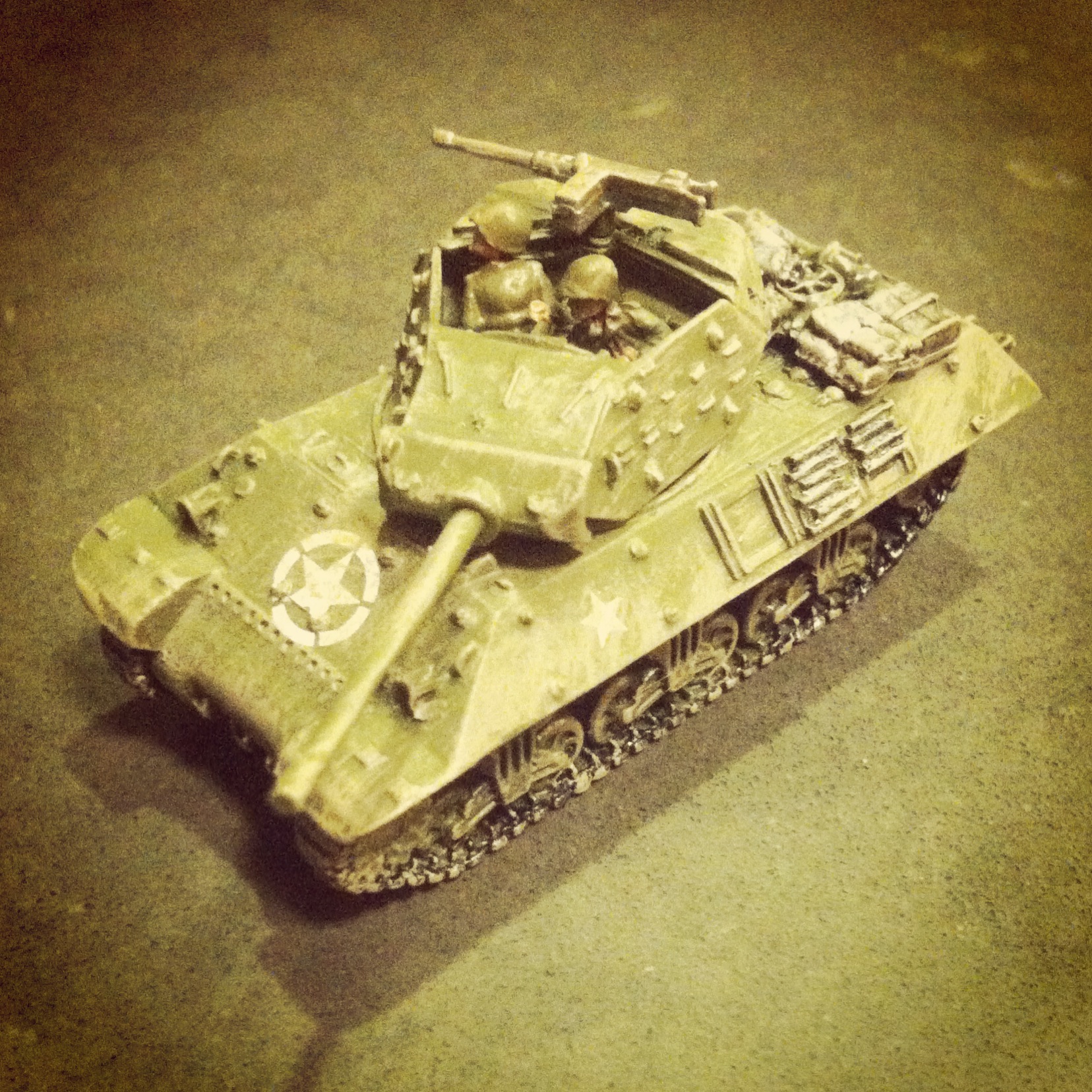
Flames of War: Fielding the FOW M10 Tank Destroyer Platoon

m10

The Blitzkreig of German armored forces is one of the more enduring tactics introduced in World War II. Swarmed masses of German tanks and mechanized forces in the early war period rolled through Poland, France, Belgium and the Netherlands in Western Europe and punched into the Soviet Union with Operation Barbarossa in 1941. With early Panzer and later Panther and Tiger tanks ruling the battlefields of Europe, Allied forces struggled for solutions to crack the German tide of iron.

m10normandy

A US M10 tank destroyer comes ashore in Normandy after D-Day in 1944

By mid-war, the Americans had a solution with the M10 tank destroyer. Introduced first into the battlefields of North Africa in 1943, the M10 GMC (“gun motor carriage”) carried a big 3-inch/76mm gun and on a Sherman hull. After success in Africa against earlier model German tanks, M10s became part of the post-D-Day Allied breakthrough campaign. While effective against Panzer III and IV tanks, more heavily-armored Panther and Tiger tanks still proved problematic. Luckily, the M10 was supplemented by the British-modified Sherman 76mm Firefly and the later US-built M18 Hellcat which was quicker on the field. The combination of these three tank destroyers, along with the stalwart work of Allied infantry and deadly air support, turned the tide in Europe.

fowm10set

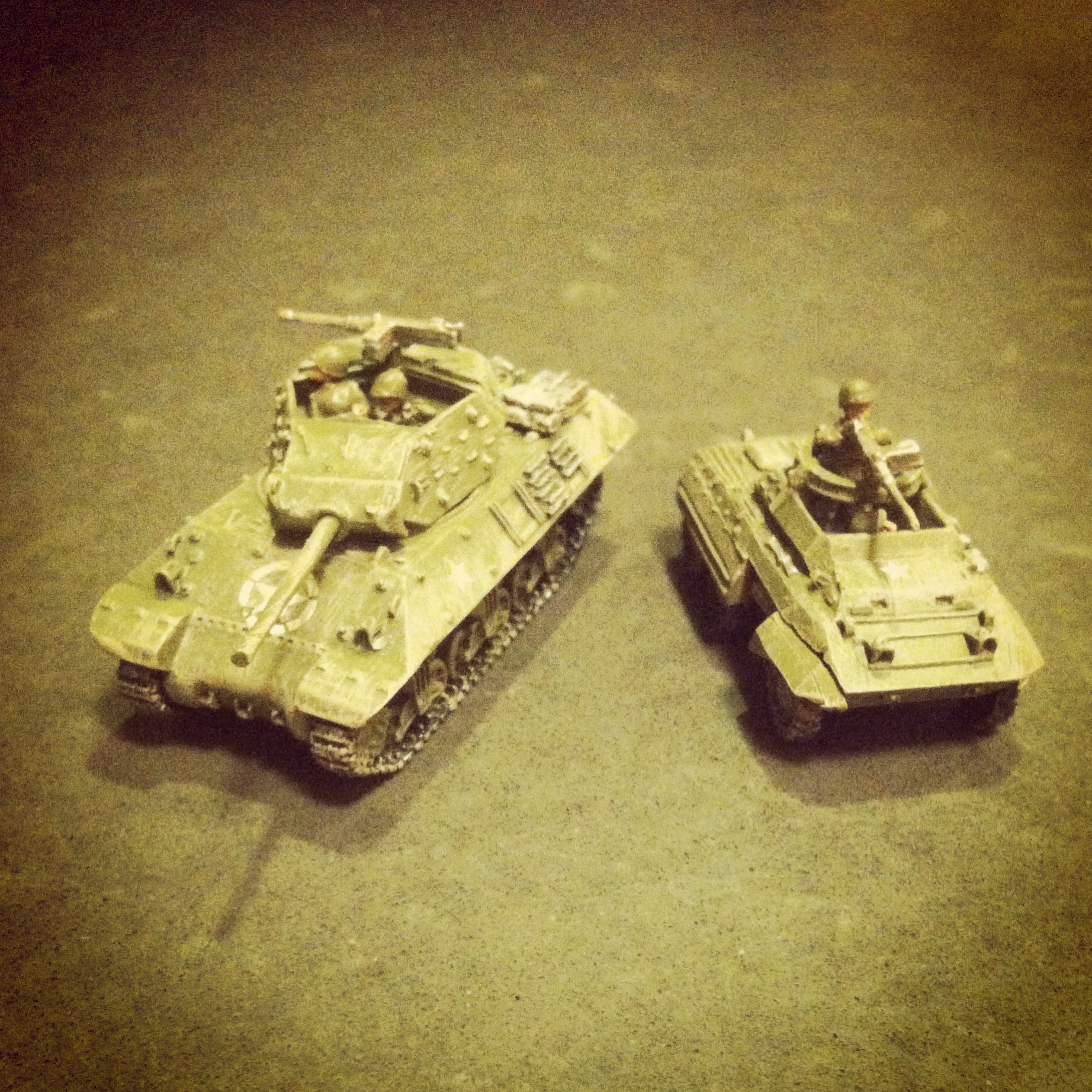
One of my earliest 15mm WWII purchases years ago, and somewhat at random, was the now-discontinued M10 Tank Destroyer Platoon set from Flames of War. I think at the time, I just liked the look of the models and I was looking to fill-out my new US forces with more variety. To get to a full platoon of four M10s, a fellow club member at Metropolitan Wargamers in Brooklyn, NY recently gave my two more M10s to which I’ve added an additional M20 scout car.

IMG_3389New M10 tank destroyer and M20 scout car

IMG_3388New M10 tank destroyer

IMG_3387New M20 scout car

IMG_3390US tank destroyer platoon with new models (left) and older models (right)

With my existing and new section sections, I now can field a full tank destroyer platoon using a variety of Allied Late War European lists. Anti-tank tactics in the game provide multiple opportunities for the M10 platoon to be used in combination with infantry and other Allied armor on the game table. With optional deployment as a recon platoon using the M20 scout cars, the M10s can create ambushes to wreak havoc on German tanks. Admittedly, using this full platoon will take some practice but I’m certain they’ll be causing headaches for my German opponents in the very near future.
New Game Weekend: Brass

Brassbox

Canals have been a part of human history for as long as people have sought to move large quantities of goods from one place to another along routes without natural waterways. Beginning in Mesopotamia in about 4000 BC, canals have fuelled the expansion of human settlement and trade just about everywhere. The Industrial Revolution of the 18th-and-19th-centuries saw an enormous boom in canal construction in Europe, North America, Africa and Asia. To this day, engineering marvels like the Suez Canal and Panama Canal are critical to moving goods around the world.

GVC

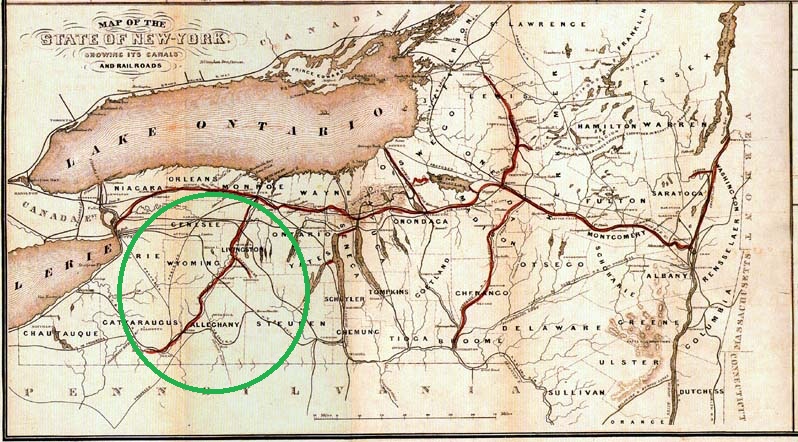
Map of New York State canals with Genessee Valley Canal (1840-1880)  in green

Growing up in the 1970s, every kid raised in Western New York State was surrounded by the mythology of the Erie Canal. Stretching 360 miles from Albany to Buffalo, the canal opened in 1825 and connected the ports of New York City with the booming Great Lakes region and the territories beyond.

Some of my earliest childhood memories of thrashing around in the woods in my hometown of Piffard, NY occured along the remnants of the Genesee Valley Canal which ran as a southern spur to the Erie Canal from 1840-1880. In my mid-20s I found myself living and working in Southwestern Pennsylvania, once again surrounded by the ghosts of canals and later railroad lines which fuelled the economic expansion of the old western frontier. Today, many these old canal lines have new lives serving as recreational arteries like the Genesee Valley Greenway and the Pittsburgh-To-Harrisburg Main Line Canal Greenway.

BrassBoard

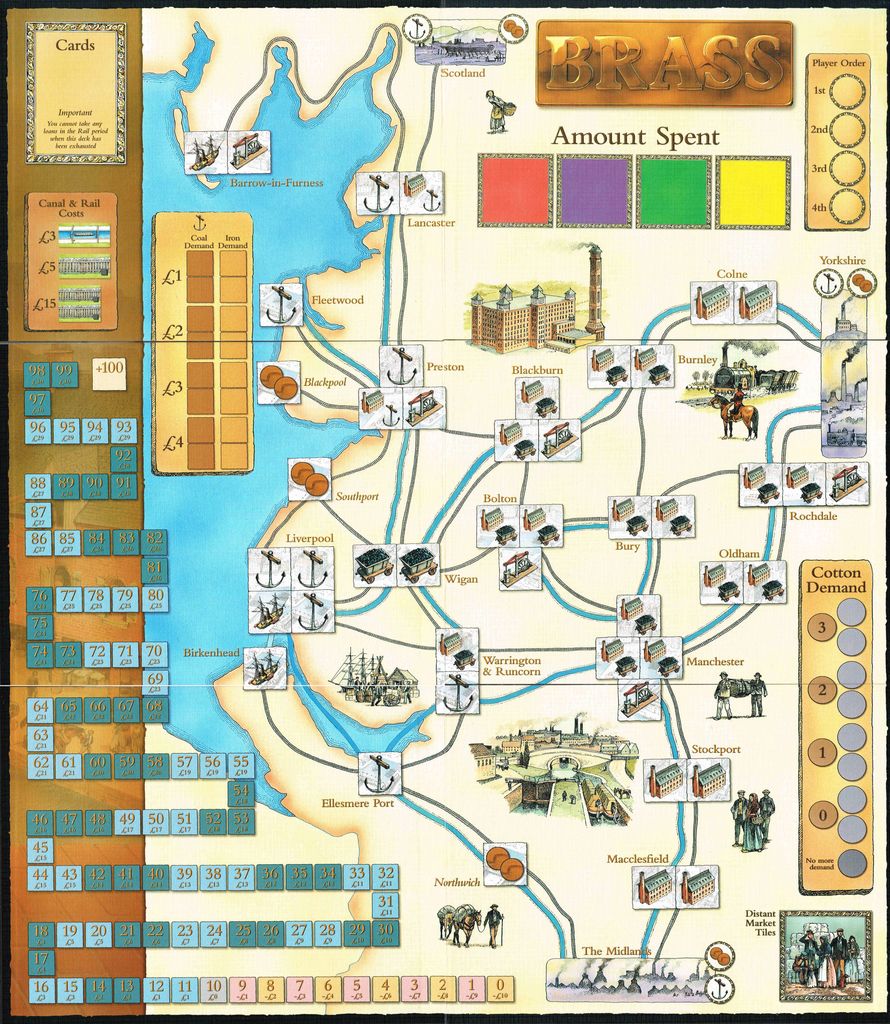
The Brass game board depicting Northern Engkand

My life has had a lot of canals running through it, and so it was great when I recently had a chance to try my hand at playing out the canal and railroad boom era in Brass. Produced by Treefrog Games in 2007, Brass takes players back to an England at the dawn of its massive industrial expansion. The game divides into two parts — a Canal Age and a Railroad Age — and is played on a map of Northern England cities and ports connected by transportation routes. When cards are used up points are scored at the end of the Canal Age for industries built, canal routes constructed and income earned. Canals and industries are then removed before play procedes through the Railroad Age after which there is a final tally of points for victory.

BrassCards2

Brass industy cards (left to right: coal mine, shipyard, iron works, port and cotton mill)

BrassCards3

Sample Brass location cards

Cards depicting cities and industries are dealt to players at the beginning of the game. Canals and lower tech industries are built in the first half of the game, and railroads and more advnaced technologies are built in the game’s second half. Each turn a player may develop industries, build canal or railroad sections, develop their existing industry, sell cotton or take loans for additional capital investment. The player who spends the least money on their turn gets to go first on the next turn, one of the game’s many mechanics which makes for a good balance of cautious and aggressive play.

IMG_2967

The “Canal Era” in our game of Brass at Metropolitan Wargamers

Industries are built on specific locations by playing both a location and industry card in combination and then spending the appropriate money and resources. Connecting canals and railroads may also be built to establish routes between cities and ports to transport goods and resources. Multiple industries built by multiple players may be built at the same location, allowing for some level of shared collaborative play. A hub city like Manchester holds four industries and connects along five separate routes, making it a potential key location for players. Building routes to ports and foreign export of cotton becomes important as the game develops and generating more income for construction is needed.

IMG_2968

The “Railroad Era” in our game of Brass

There’s a ton going on in Brass, and fortunately I had an experienced player walk me through my first game. I’ve heard the rules themselves are a bit hard to decipher, but playing the game my first time was pretty easy to follow. Brass plays like many Eurogames with a balance of area control, building, managing resources and playing cards. Ultimately the game becomes one of competition for routes and resources and biding one’s time to export cotton goods to foreign markets when demand is at its highest.

I won my first game of Brass in a three-player game, but I’d like to try it at its full four-player maximum. I managed to have an enormous amount of cash on hand to invest into developing my industries and transport routes pretty early in the game, a strategy that didn’t allow me to play first in most turns but paid off in the end. Playing an economic game like Brass makes for some very different play than my usual rolling of tanks and advancing platoons of soldiers. For a gamer like me with canals and railroads flowing through my blood, I’ll take an economic victory just as easily as a one won on the battlefield any day.