Downloading: Mapping the World at the New York Public Library

britishcolonies

As a lifelong gamer, I’ve spent many, many hours staring at maps or drawing my own. Most board games provide maps of sorts that define movement and area control. For players of Dungeons & Dragons and the like, adventure maps create much of the framework for how campaigns and role-played stories evolve. Miniature wargames, from ancients and historicals to fantasy and sci-fi, utilize three-dimensional set-ups driven by maps and the relationship of various features on the tabletop.

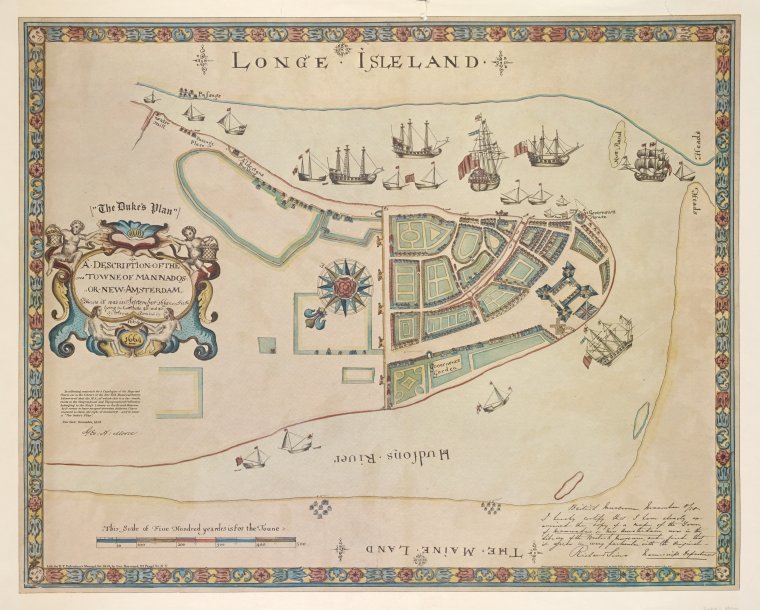
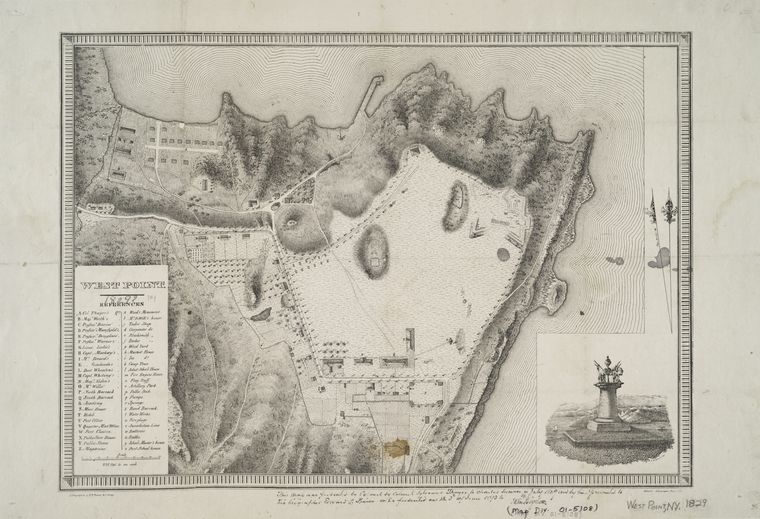
Late last month, the New York Public Library announced the availability of some 20,000 high resolution downloadable maps. The collection is an enormous resource for hardcore historians and hobbyists alike. Well over half the online collection naturally focuses on New York City, New York State and the surrounding areas. Beyond the New York area, the cartography goldmine grants access to hundreds of years of maps from around the world which can be viewed singly or within the context of their original books, atlases or folios.

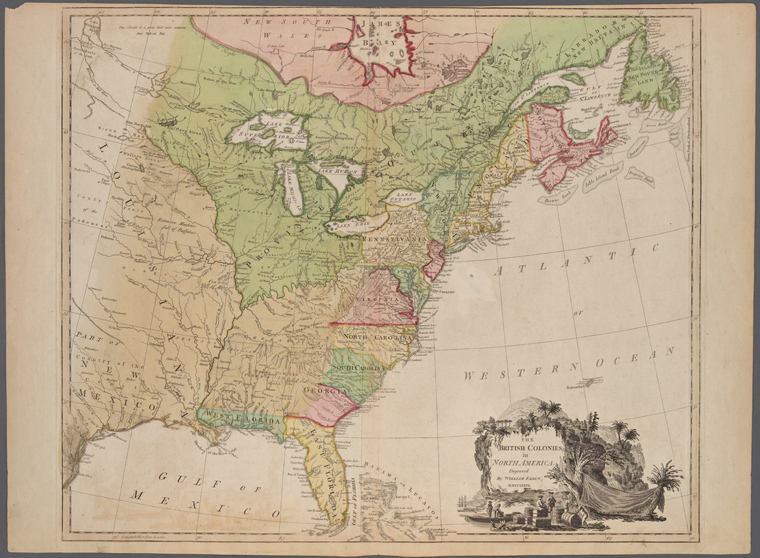
Digging into the archive, there’s a fair amount of material certain to be of interest for gamers. Maps of Europe, Africa, Asia and the Americas portray the development of civilizations and empires over the centuries. A fair amount of material is available on the American War of Independence, particularly in the areas around New York, New Jersey and Pennsylvania. Aside from maps, there are also some engraved plates of native societies encountered by European colonists, renderings of forts and some naval views.

The entire online collection is searchable here, but here are a few highlights I’ve come across on my digital travels.

New York

newamsterdam

New Amsterdam

navy yard

Brooklyn Navy Yard

American War of Independence

battleLI

Battle of Long Island

saratoga

Saratoga

Forts

westpoint2

West Point

fortalbany

Fort Albany

Naval History

dutchportships

Dutch and Portugese Ships

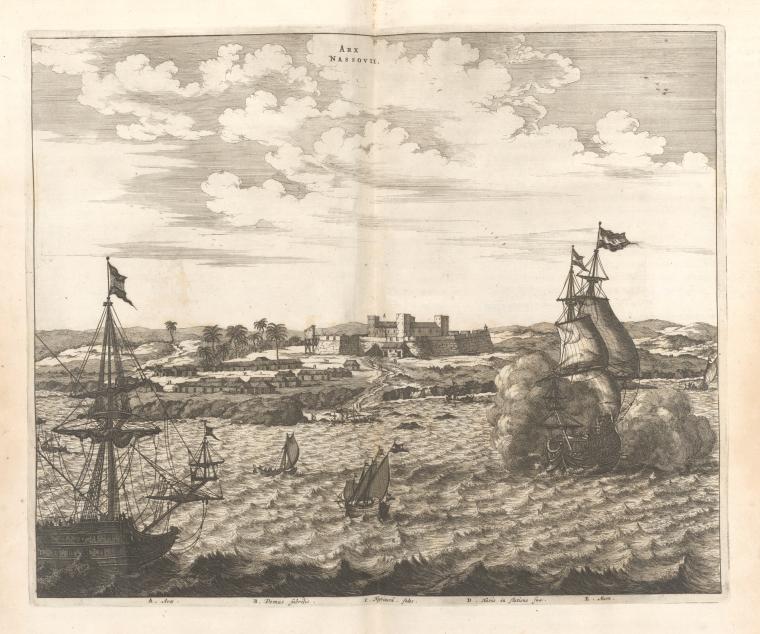
british1671

Ships in the British West Indies

Europe

ancientgreece

Ancient Greece

romanempire

Roman Empire

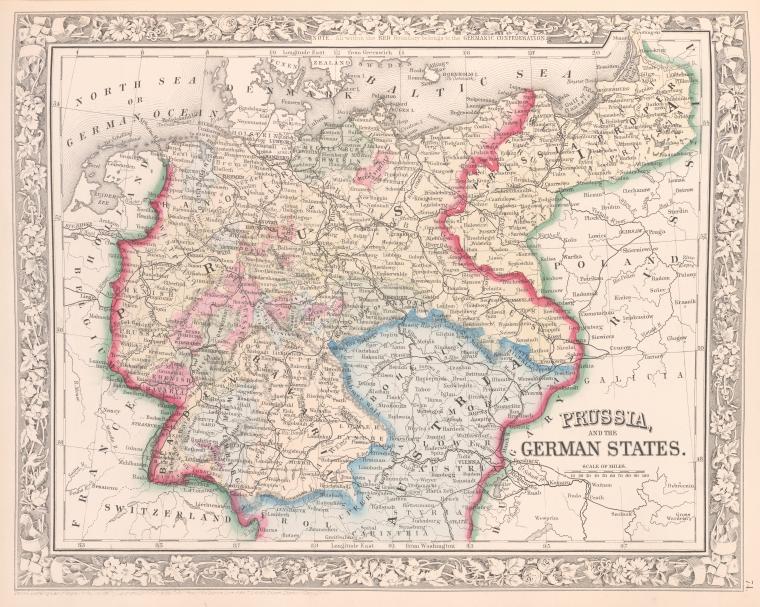
prussia1860

Prussia


Micro Armour: Getting Started

GHQlogo

After years of wargaming World War II with Flames of War, I’ve been looking for a change of pace for the period. I’ve recently caught up on the vast majority of my modelling projects, including fairly extensive American, British and German Late War forces as well as a bunch of terrain. I’ve also been interested in playing larger battles, something that becomes a bit unwieldy with FOW. In looking for a way to expand my WWII gaming experience, I’ve been weighing factors of scale, cost, storage and time. After a lot of thought, I’m going small and getting started with WWII in micro scale.

The standard in micro scale gaming is GHQ. Founded in the late 1960s and based just outside Minneapolis, Minnesota, GHQ manufactures an extensive line of pewter miniatures for WWII, Modern, Napoleonic, American Civil War and various naval eras. In the early 1990s, GHQ also began offering N and HO scale vehicles targeting model railroading enthusiasts. Along with their gaming models, the company has developed a number of rulesets and terrain-building supplies appropriate for various eras of combat at the micro scale level. For over 40 years GHQ’s models have been held in high regard by wargamers as well as the US military which uses the company’s products for training and planning excercises.

WWIIscales

World War II miniatures scale comparisons (from www.historicalwargames.net)

The 1/285th (6mm) scale of GHQ’s WWII models offers a number of differences and potential advantages to larger scales, such as 1/100th (15mm) FOW miniatures and 1/56 (28mm) models from the expanding Bolt Action game line from Warlord Games.

  • Scale: In 6mm micro scale, an entire infantry platoon can be represented with approximately 3-5 figures mounted to a small square or round base. An inch on the table approximates 100 yards on the battlefield. This allows for larger multi-company or battalion level games compared to smaller single company and platoon skirmish games at a 15mm or 28mm scales.
  • Cost: Wargaming at any scale is an investment, but micro scale allows for the depiction of large battles for a fraction of the cost of larger scales. The starter sets from GHQ provide around twenty tanks for $40, making individual armour models just a couple bucks each compared to the 15mm scale where tanks can run easily to triple that cost. Fielding an entire 6mm infantry and armor company might run just $10-20 while that same company at 15mm could run hundreds of dollars. And, since each micro scale tank represents a platoon and a platoon in FOW may run to maybe six tank models (or more), the game scales cheap and fast into grand scale engagements.
  • Storage: As the website says, I live in Brooklyn, NY, so storage is always an issue for my board games, cards games, miniatures, terrain and hobby supplies. I keep a lot of my miniatures at my local club, Metropolitan Wargamers, but I like having stuff around the apartment for when the gaming mood hits. At the micro scale level, dozens of tanks, infantry and vehicles can be carried in a shoulder bag or kept in a drawer. Compared to my FOW collection which sprawls over multiple bags and boxes, micro scale makes for some quick and easy game deployment just about anywhere.
  • Time: Painting micro scale takes a fraction of time compared to larger scales. A quick spray of white primer followed by a thinned color basecoat, a couple dots of detail, a wash and maybe a tiny decal is all that’s needed to get forces on the table and ready to game.

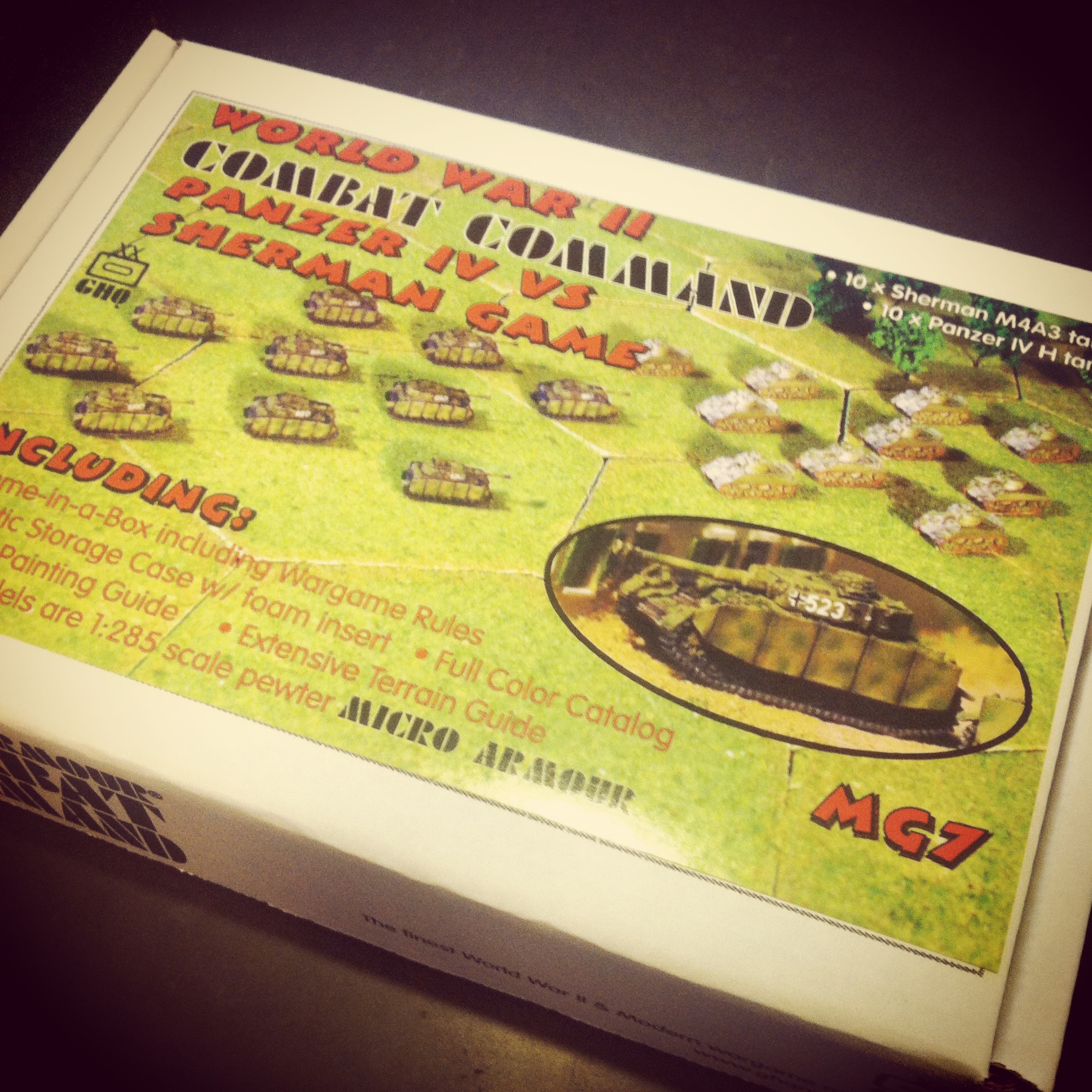
IMG_3211GHQ’s US Shermans vs. German Panzer IVs box set

IMG_3210GHQ’s US Armoured Infantry Command 1944 box set

To get started at the micro scale, I ordered two sets from GHQ. The Shermans vs. Panzer IVs Battle Box comes with ten tanks per side, a storage case and a set of rules — everything needed to get a game started. To this, I added the US Armoured Infantry Command 1944 set with additional tanks, half-tracks, jeeps, armoured cars and a bunch of infantry. To get some Germans into action, I think I’ll be going for the German Kampfgruppe 1944 for a nice mix of infantry, transport, Marders and even some horse and wagon teams.

IMG_3214Assembly of my first GHQ micro armour sets

In well under less than an hour’s initial work, my first sets of micro armour glued up fast with some careful organization of parts and assembly with superglue and tweezers. Already I’m loving getting so many models ready for paint and then on to the table in no time at all. The saying is “go big or go home” but my new micro armour project looks like its already going to be a massive amount of fun in a very small package.

Flames of War: Fielding the FOW Hawker Typhoon

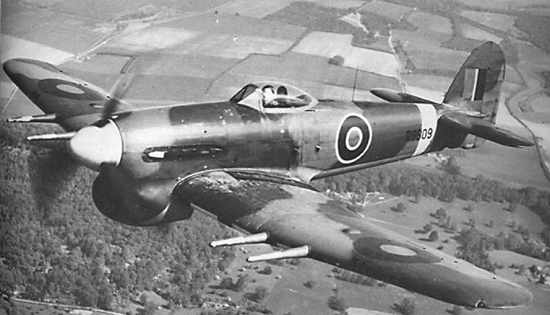
Typhoon

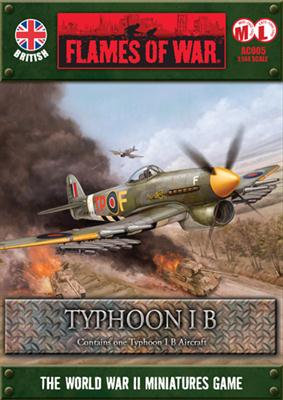
The story of the British Hawker Typhoon in WWII is one best told in two acts. Its early use beginning  in 1941 met with very mixed service results against superior planes in the German Luftwaffe  and production of the plane was nearly scrapped by the Royal Air Force. However, with a bit of re-purposing, the Typhoon’s speed was soon coupled with increasingly-heavy bomb payloads to become an effective fighter bomber against ground targets.

In 1943, the Typhoon really came into its own when armed with wing-mounted rockets and fuel tanks providing greater flight range. While of questionable effectiveness against tough-armored German tanks, a run from a squadron of  Typhoons with rockets firing struck fear into German forces and devastated supply lines and production facilities in Western Europe. The Typhoon’s role in D-Day, Operation Goodwood, Operation Varsity and other engagements was both disruptive and deadly in support of ground campaigns all the way to the war’s end.

fowtyphoon

Flames of War offers a model of the Typhoon as well as a short online guide to painting their model. With my British ground forces fairly well built out with artillery, tanks, infantry and support weapons, adding some air support seemed to be the next natural step as well as another interesting modelling project.

IMG_3206

I picked up my model online at a slight discount online and went straight to work. I painted the plane in a RAF grey and green camouflage pattern with yellow details to the nose and leading wing edges. Next, I added black and white “invasion stripes” which had been used on Typhoons since earlier in the war, although my plane was going to be flying over late war Normandy. The decals included with the kit finished off the plane with “V” markings, subtly allowing me to add my own initial to my completed plane. Finally, a little watery rusty brown wash brushed along the seams in the fuselage added a weathered look of many previously-flown missions.

IMG_3207

With my existing American P-47 Thunderbolt, having the Typhoon in my miniature Allied arsenal is sure to add more depth and choice to my Late War Western Europe gaming. With the Typhoon hitting the table in the near future, my hope is its presence above the battlefield will rain rocket-fueled terror and distraction on my German opponents just as they did over Europe some 70 years ago.

New Game Weekend: Brass

Brassbox

Canals have been a part of human history for as long as people have sought to move large quantities of goods from one place to another along routes without natural waterways. Beginning in Mesopotamia in about 4000 BC, canals have fuelled the expansion of human settlement and trade just about everywhere. The Industrial Revolution of the 18th-and-19th-centuries saw an enormous boom in canal construction in Europe, North America, Africa and Asia. To this day, engineering marvels like the Suez Canal and Panama Canal are critical to moving goods around the world.

GVC

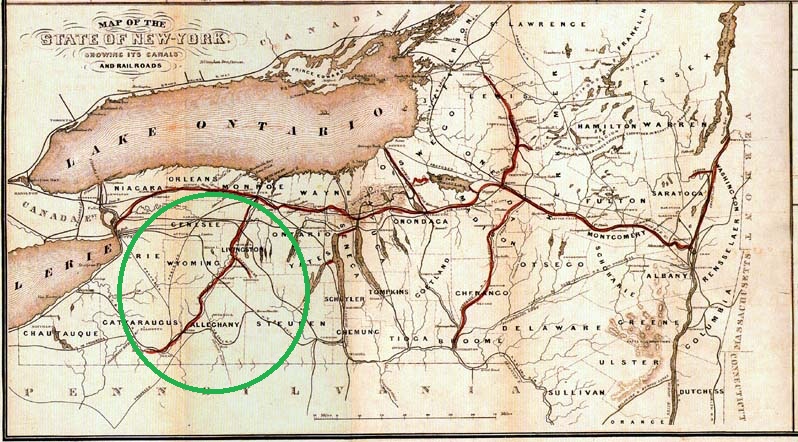
Map of New York State canals with Genessee Valley Canal (1840-1880)  in green

Growing up in the 1970s, every kid raised in Western New York State was surrounded by the mythology of the Erie Canal. Stretching 360 miles from Albany to Buffalo, the canal opened in 1825 and connected the ports of New York City with the booming Great Lakes region and the territories beyond.

Some of my earliest childhood memories of thrashing around in the woods in my hometown of Piffard, NY occured along the remnants of the Genesee Valley Canal which ran as a southern spur to the Erie Canal from 1840-1880. In my mid-20s I found myself living and working in Southwestern Pennsylvania, once again surrounded by the ghosts of canals and later railroad lines which fuelled the economic expansion of the old western frontier. Today, many these old canal lines have new lives serving as recreational arteries like the Genesee Valley Greenway and the Pittsburgh-To-Harrisburg Main Line Canal Greenway.

BrassBoard

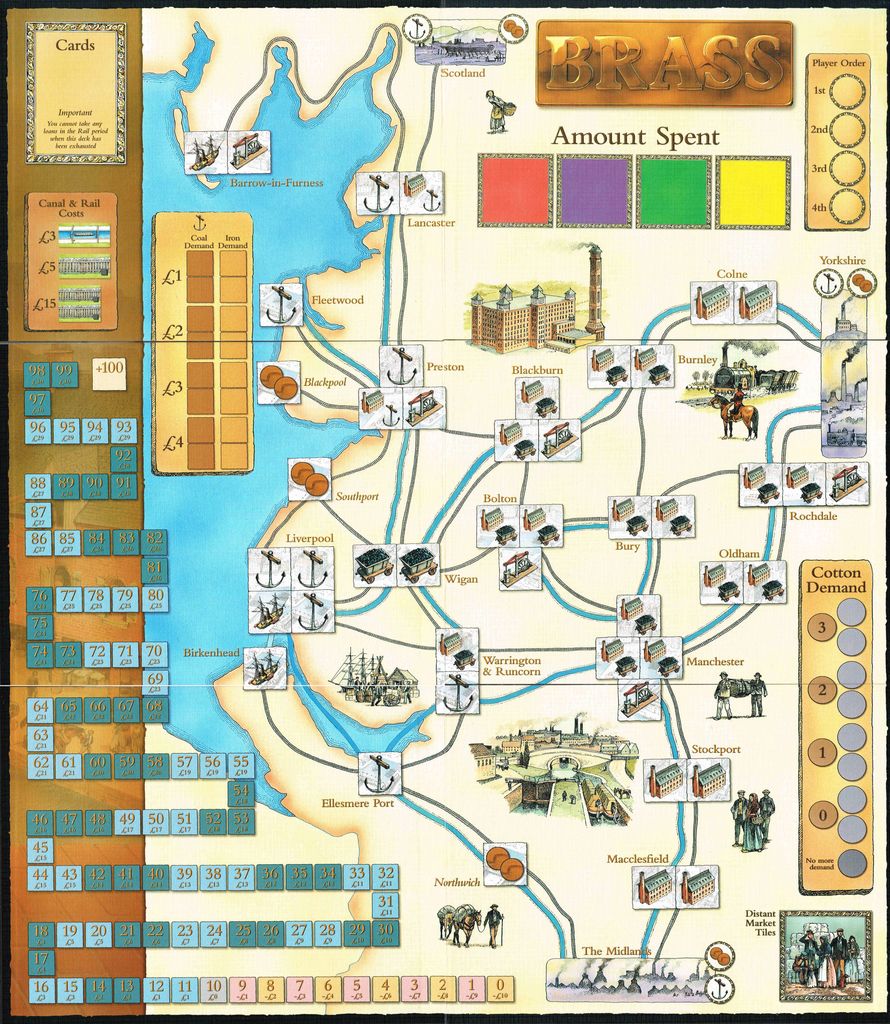
The Brass game board depicting Northern Engkand

My life has had a lot of canals running through it, and so it was great when I recently had a chance to try my hand at playing out the canal and railroad boom era in Brass. Produced by Treefrog Games in 2007, Brass takes players back to an England at the dawn of its massive industrial expansion. The game divides into two parts — a Canal Age and a Railroad Age — and is played on a map of Northern England cities and ports connected by transportation routes. When cards are used up points are scored at the end of the Canal Age for industries built, canal routes constructed and income earned. Canals and industries are then removed before play procedes through the Railroad Age after which there is a final tally of points for victory.

BrassCards2

Brass industy cards (left to right: coal mine, shipyard, iron works, port and cotton mill)

BrassCards3

Sample Brass location cards

Cards depicting cities and industries are dealt to players at the beginning of the game. Canals and lower tech industries are built in the first half of the game, and railroads and more advnaced technologies are built in the game’s second half. Each turn a player may develop industries, build canal or railroad sections, develop their existing industry, sell cotton or take loans for additional capital investment. The player who spends the least money on their turn gets to go first on the next turn, one of the game’s many mechanics which makes for a good balance of cautious and aggressive play.

IMG_2967

The “Canal Era” in our game of Brass at Metropolitan Wargamers

Industries are built on specific locations by playing both a location and industry card in combination and then spending the appropriate money and resources. Connecting canals and railroads may also be built to establish routes between cities and ports to transport goods and resources. Multiple industries built by multiple players may be built at the same location, allowing for some level of shared collaborative play. A hub city like Manchester holds four industries and connects along five separate routes, making it a potential key location for players. Building routes to ports and foreign export of cotton becomes important as the game develops and generating more income for construction is needed.

IMG_2968

The “Railroad Era” in our game of Brass

There’s a ton going on in Brass, and fortunately I had an experienced player walk me through my first game. I’ve heard the rules themselves are a bit hard to decipher, but playing the game my first time was pretty easy to follow. Brass plays like many Eurogames with a balance of area control, building, managing resources and playing cards. Ultimately the game becomes one of competition for routes and resources and biding one’s time to export cotton goods to foreign markets when demand is at its highest.

I won my first game of Brass in a three-player game, but I’d like to try it at its full four-player maximum. I managed to have an enormous amount of cash on hand to invest into developing my industries and transport routes pretty early in the game, a strategy that didn’t allow me to play first in most turns but paid off in the end. Playing an economic game like Brass makes for some very different play than my usual rolling of tanks and advancing platoons of soldiers. For a gamer like me with canals and railroads flowing through my blood, I’ll take an economic victory just as easily as a one won on the battlefield any day.

Flames of War: Lingevres 1944 Scenario

lingevres1944

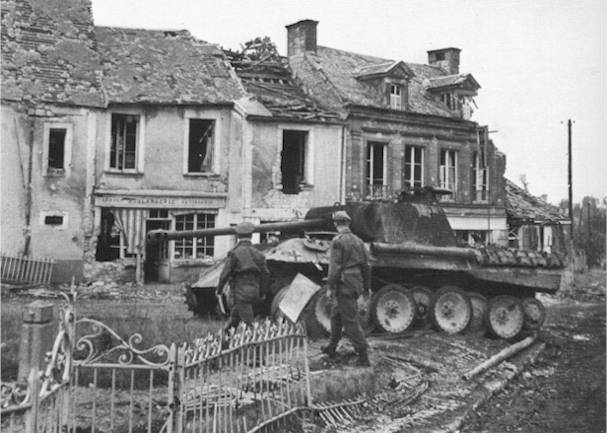
By D-Day +8 on June 14, 1944, the British 50th Infantry Division had pressed about 5 miles inland from Gold Beach to the outskirts of Lingevres. Dug in at the town were elements from the Panzer Lehr Division with several Panther tanks ready to force back the looming British attack. With 6-pdr anti-tank guns in tow, the British pushed into town mid-morning following a bombardment by 25-pound artillery and runs from supporting Typhoons above. A ferocious battle commenced between the 4th/7th Royal Dragoon Guards and the German Panthers. When the smoke cleared, several Panthers sat burning as victims of Sherman Firefly and anti-tank gun fire. At day’s end, the British controlled Lingevres.

lingevresAT

British 6-pdr anti-tank gun deployed outside Lingevres, June 14, 1944

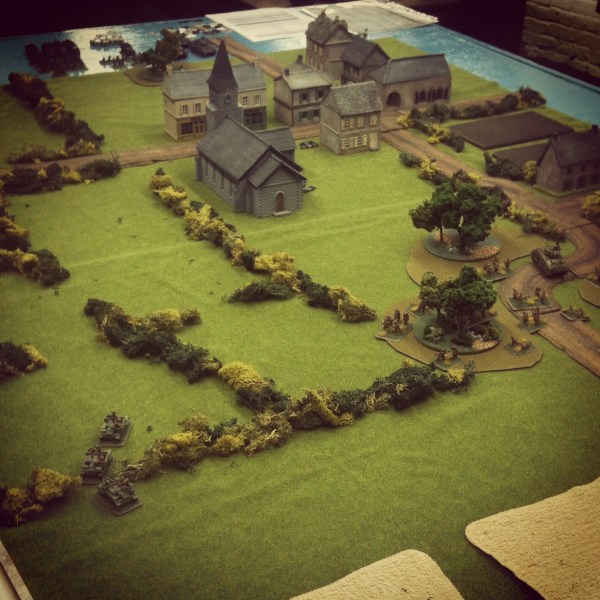
The WWPD website has a Lingevres scenario available which two of us adapted for play this past weekend at Metropolitan Wargamers in Brooklyn, NY. Using the scenario as a guideline, we laid out the tabletop battlefield with cornfields stretching outside the town occupying two-thirds of the table. With our 1750-point forces on each side, the Germans began with two platoons of infantry and a heavy machine gun platoon inside two buildings and the church at the center of Lingevres. The British then deployed with their artillery battery, two rifle companies and a recon patrol. All other forces were held off table, with German delayed reserves set to arrive in turn three and British reserves eligible to arrive immediately at the beginning of the game.

Victory conditions as presented were simple — the British needed to take three buildings in the town and the Germans needed to drive the British from the field. How the game played was not simple and once again revealed my need to sink more work into creating accurate, playable scenarios for FOW.

IMG_3163Germans dug in at Lingevres in the town’s buildings while British artillery and infantry deployed from the cornfields in the distance

IMG_3164

Initial movement of British forces into Lingevres with recon carriers moving left and infantry moving into the woods near the church

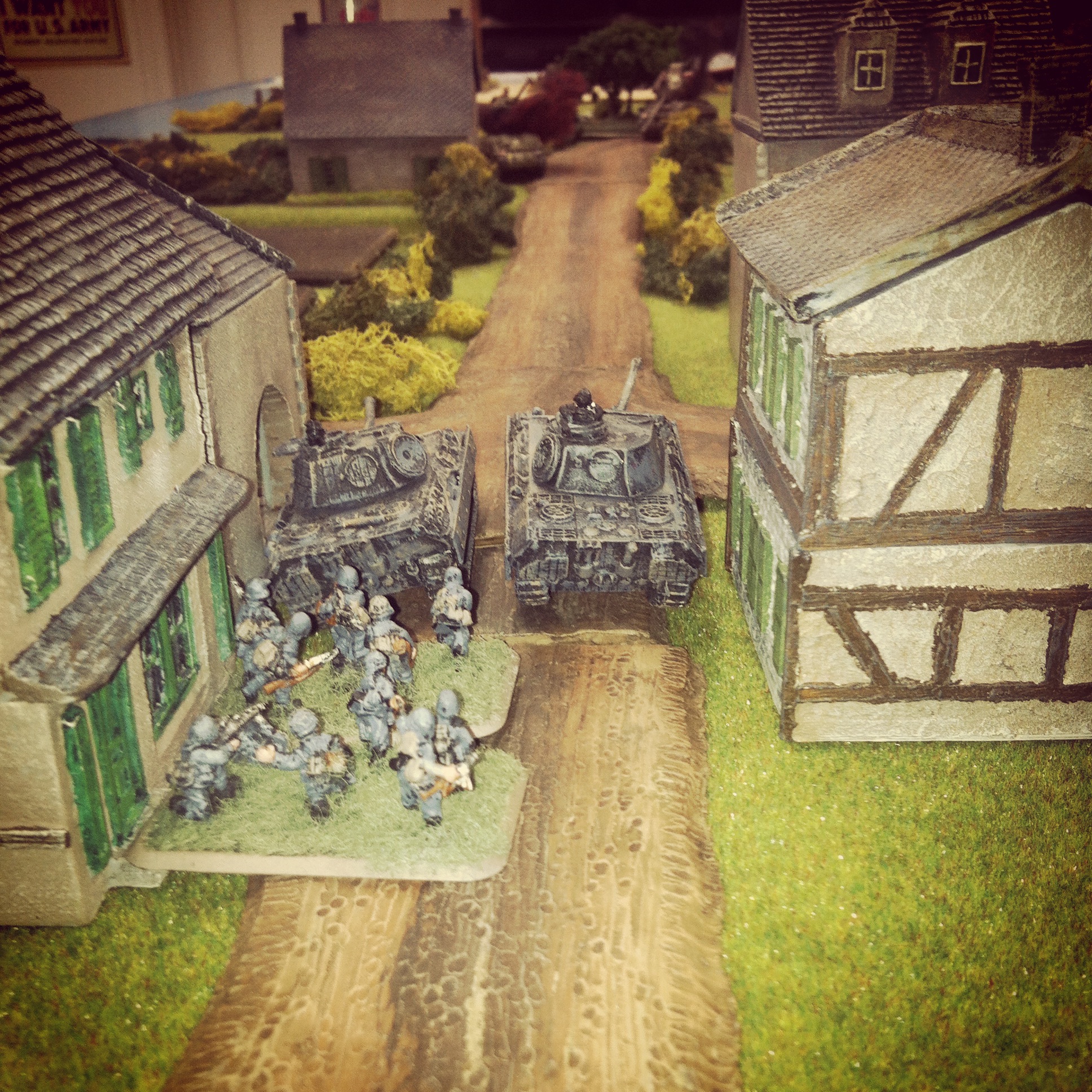
The first two turns of the game saw the British marching from their edge of the table toward Lingevres. At the town, a German machine gun platoon sat waiting in a building at the crossroads while two other infantry platoons took up position in the church and shops across the road. By turn three, British artillery had opened fire on the machine gunners and pinned them. The first British tank platoon also rumbled onto the table, as did the German Panthers which made way for the center of town.

IMG_3165

Panther reserves roll into the center of Lingevres

IMG_3173

British infantry in the woods take fire and are pinned as armored reserves move from the rear

The first British infantry platoon made way through the woods at the center of the table but were pinned and cut down over two consecutive turns of fire from nearby Germans. The British recon patrol, edging its way through the bocaged fields near the church, was chased away with the appearance of the Panthers.

IMG_3167A British Sherman takes up position to spot for the artillery battery

IMG_3166

British infantry move from the farmhouse across the field

IMG_3169

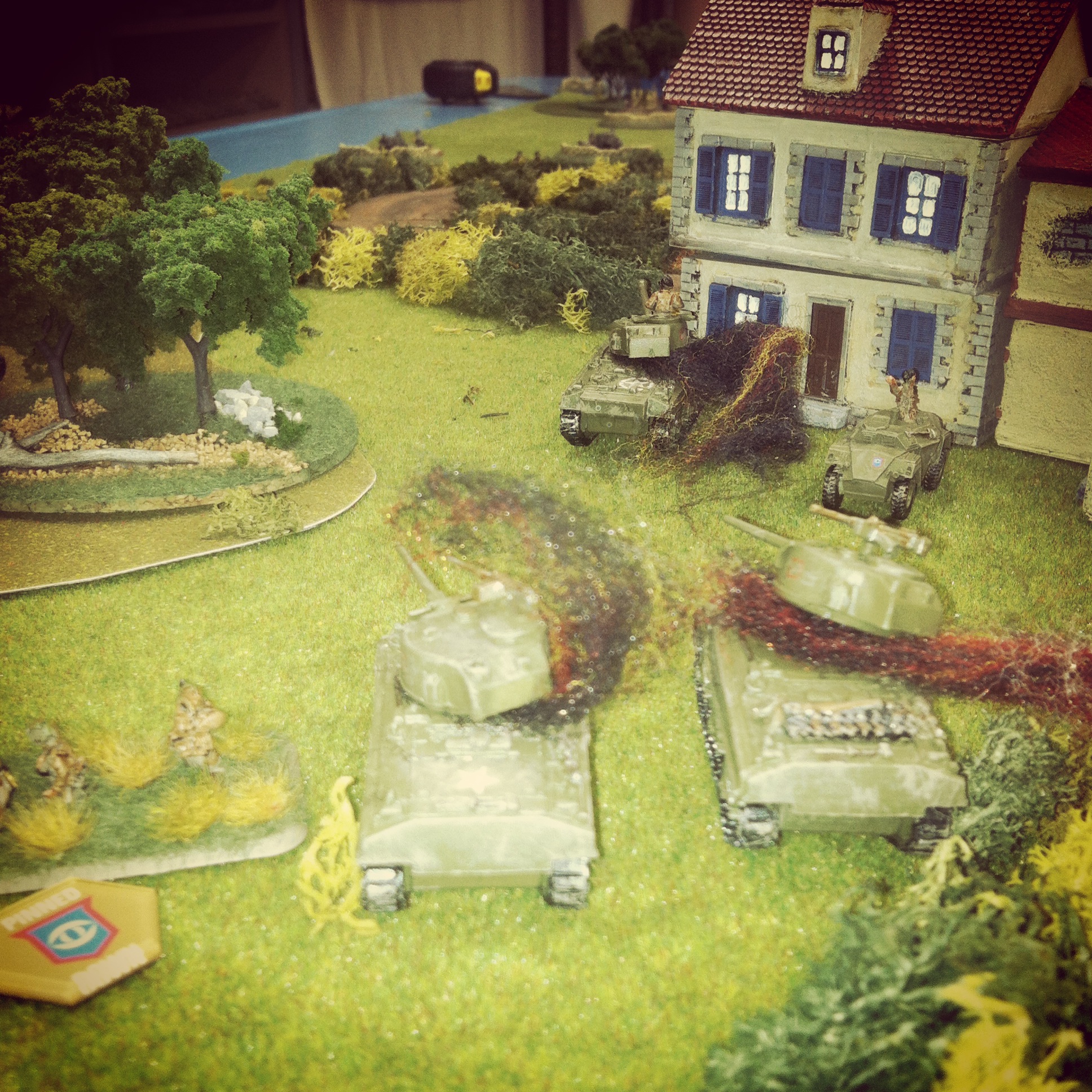
Panthers destroy a Firefly and the Sherman spotter tank at the edge of town

IMG_3170

British infantry fall back after taking fire from the German half-tracks

On the main road to town, the British ran their Sherman spotter tank and lead Firefly toward the nearby farmhouse. On the other side of the farmhouse, a British infantry platoon moved into position using the building and nearby bocage as cover as they made way for the open field. The heavy British push around the farm was stymied with the arrival of German halftracks which fired machine guns into the field. By turn five, the Sherman spotter tank and spearheading Firefly also lay in flames after some quick shots from the German Panthers.

IMG_3168

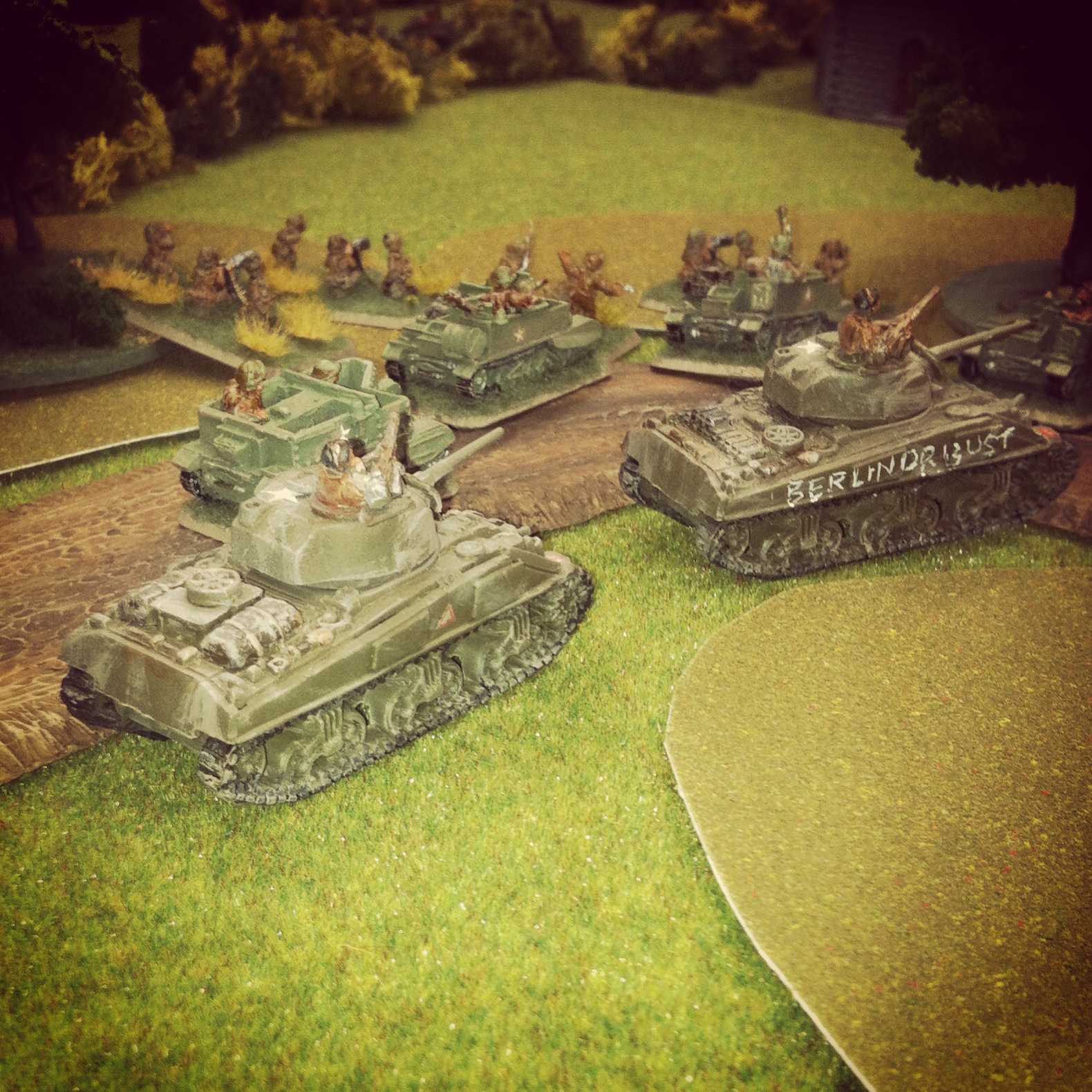
British machine gun carriers and tank reserves roll on

IMG_3171

Armored reserves move to support infantry

IMG_3172 British infantry reserves move in near their artillery battery

By turns six and seven the inital British assualt had been repulsed at a safe distance from town. All German infantry platoons remained safely bunkered up in the town’s buildings, and the spotter for the German’s reserve 12cm mortar platoon was now camped out in the church’s bell tower. The three Panthers prowled back and forth at the center of town, and the incoming fire from the British artillery in the distance was the only real agitation to the occupying Germans. The Britsh rolled on their final reserves of machine gun carriers, Sherman/Firefly tanks and a fresh infantry platoon.

Even with all reserves on the table, the British attack was stumped. With one rifle platoon destroyed and a second whittled down, the British had just one intact infantry platoon on the field. One tank platoon struggled through the fields to one side of town, while the second sat idling on the road to town. Clear lines of fire around the church and town center presented open killing zones for the Germans in the town’s buidings and the three Panthers. All the Germans needed to do was sit in place and mow down the coming British.

I love playing wargames for historical scenarios, but our game this past weekend at Lingevres presented some serious limitations to the FOW rules as written. Playing an even match of 1750-point forces per side ultimately did not allow for a satisfying game for either player. What works for a head’s up FOW tournament game or randomly-rolled mission simply does not play well in recreating historic engagements.

In our Lingevres game, the British simply didn’t have enough units to create a critical mass to advance into town under what was sure to be withering fire from the Germans. We decided we liked the scenario, but perhaps the British needed a 50% increase in points, perhaps with additional rifle and tank platoons and a Typhoon providing air support.

With a three-day D-Day weekend being planned at our club this June, we’ve got multiple historic airborne, beach and inland fights to sketch out in the coming months. There’s going to be a lot of playtesting and tweaking to get our historic games to play well. With wargaming, striking the balance between a game that provides both historic accuracy and the potential for different outcomes is the real challenge that lies beyond just the roll fo the dice.

Flames of War: Modelling Western European Terrain in 15mm

normandystuartterrain

I’ve had a lot of great feedback from the past year of posting after action reports for Flames of War games. Fellow players have been universally complimentary on the layout of my terrain used in my scenarios. With that, I’m increasingly being asked questions about the make of my models, where I buy them and how I achieve some of the other rerrain modelled  in my games.

Modelling terrain, like any aspect of miniatures wargaming, has to take into account the three main factors of skill, budget and time commitment. I find myself somewhere in the middle of all three categories, and I feel my level of personal investment in my terrain modelling is reflective of this. One of the many benefits of belonging to a club like Metropolitan Wargamers in Brooklyn, NY is the opportunity to share in our massed collections of terrain and create some pretty impressive-looking games.

As a longtime miniatures hobbyist with a passion for scale modelling, I wanted to share a quick round up of the current state of my 15mm terrain collection I use for Flames of War. To date, my FOW gaming has focused on the European Western Front, so the vast majority of my terrain focuses on buildings and other features appropriate for France, the Low Countries and Western Germany. All that said, let’s take a European tour in miniature…
markivposter

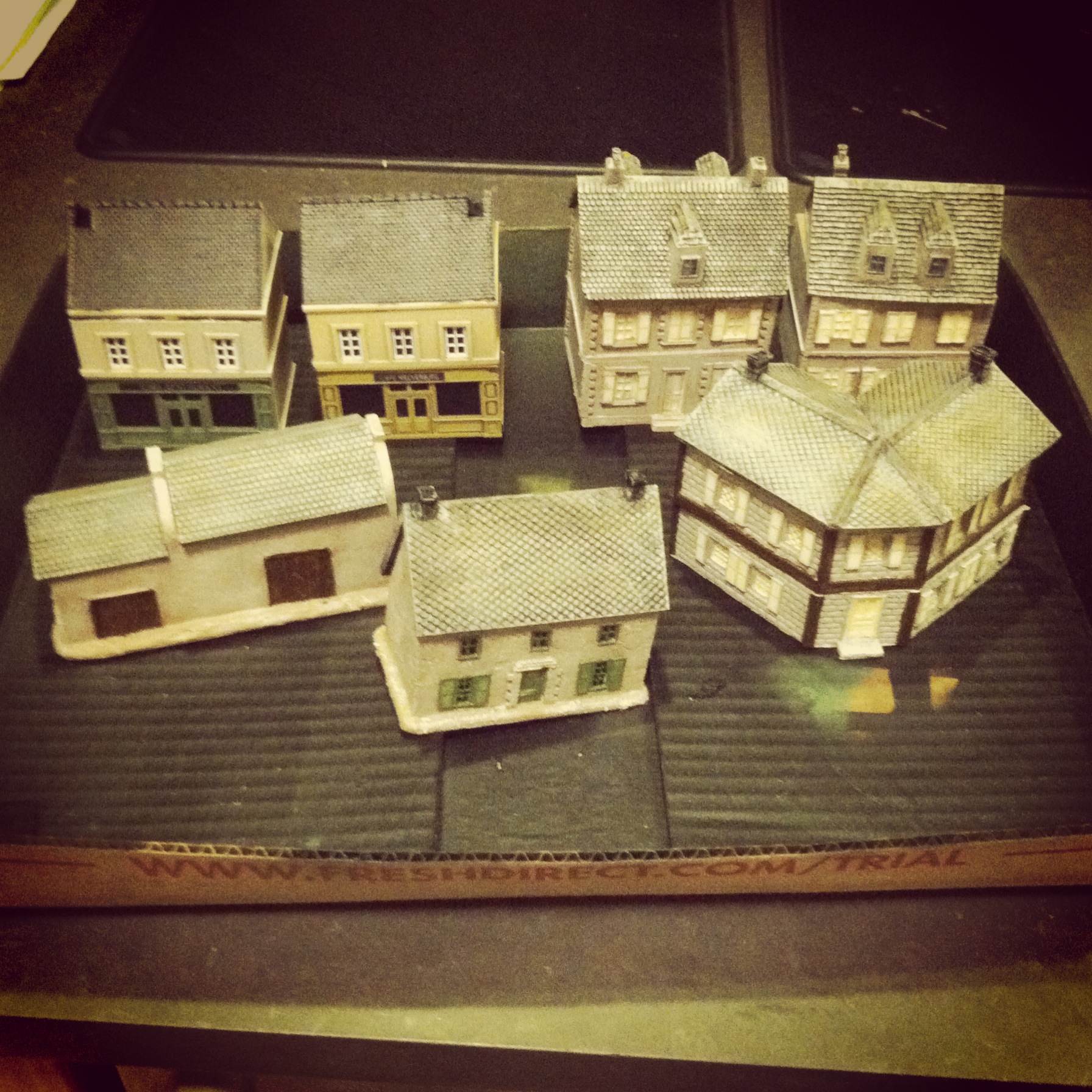
Any small town or rural tabletop Western European battlefield needs buildings — barns, houses, shops and cafes — not only for visual appeal, but to provide covering positions and even possible objectives during game play. FOW offers a fine line of pre-painted buildings but I find them to be a bit on the expensive side and toy-like. I also like to paint, so breaking up modelling little tanks and soldiers with some miniature real estate projects makes for a nice change to hobbying routine.

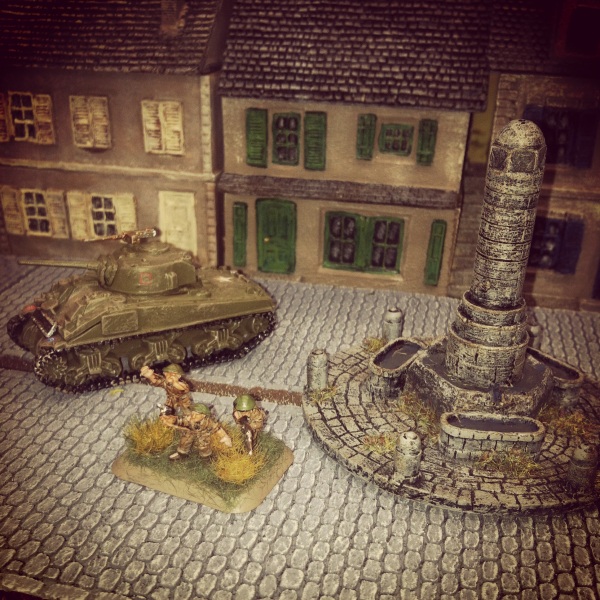
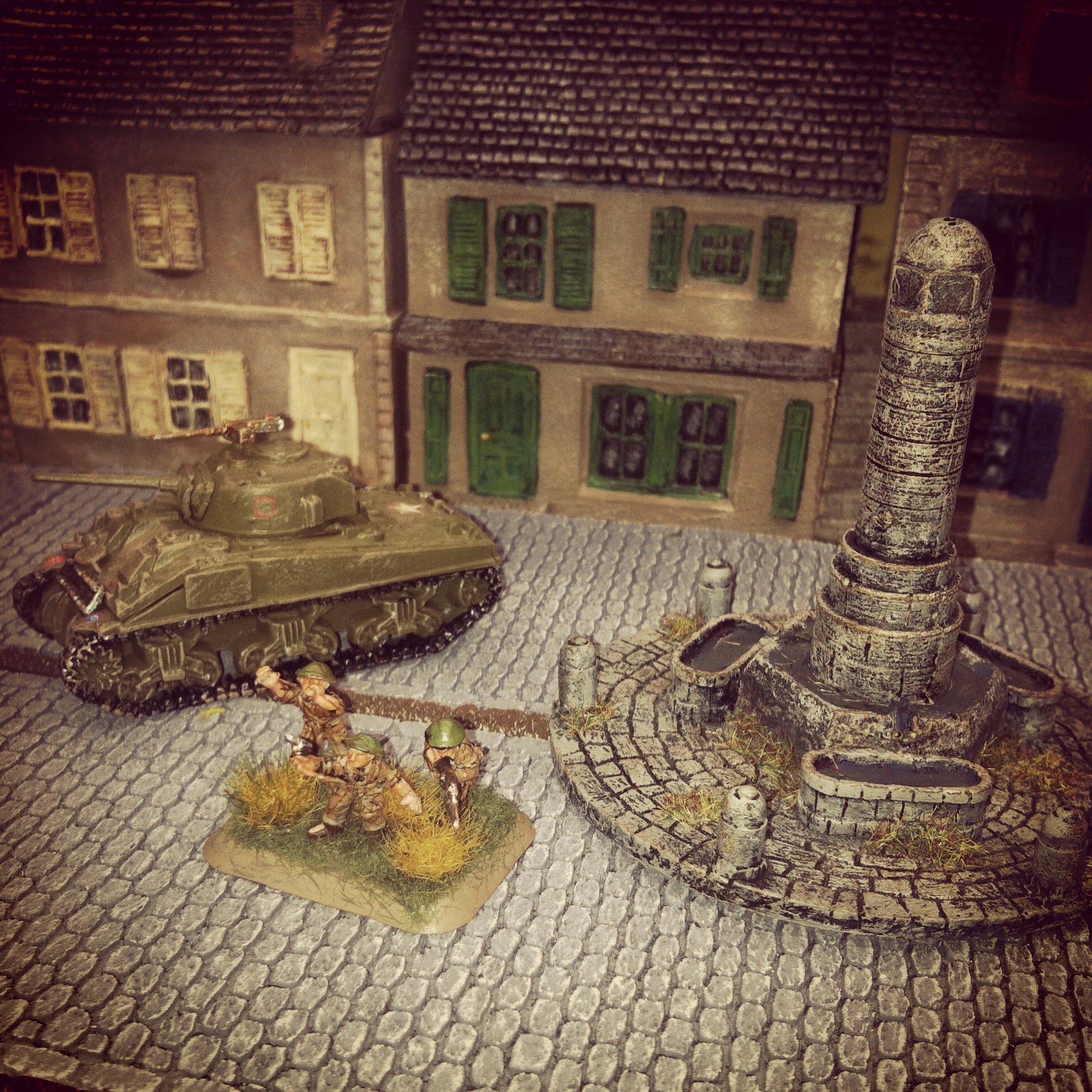
Last year I discovered the cast resin terrain produced by Mark IV Miniatures. As a second-generation wargamer, the owner of Mark IV obviously invests a great deal of care to his Western and Eastern front models. All the buildings come with removable multiple stories and roofs, making their use in FOW gaming a breeze. I just acquired my second set of models from Mark IV (ordered from Musket Miniatures), giving me a number of houses, barns and shops which I set close together as a village center or spread out for use in the countryside. For my towns, I also have a set of Mark IV  walls, a cobblestone courtyard and nifty fountain monument model. At about $18-24 per model, Mark IV’s offerings are my hands-down favorite in miniature buildings.

gowlogo

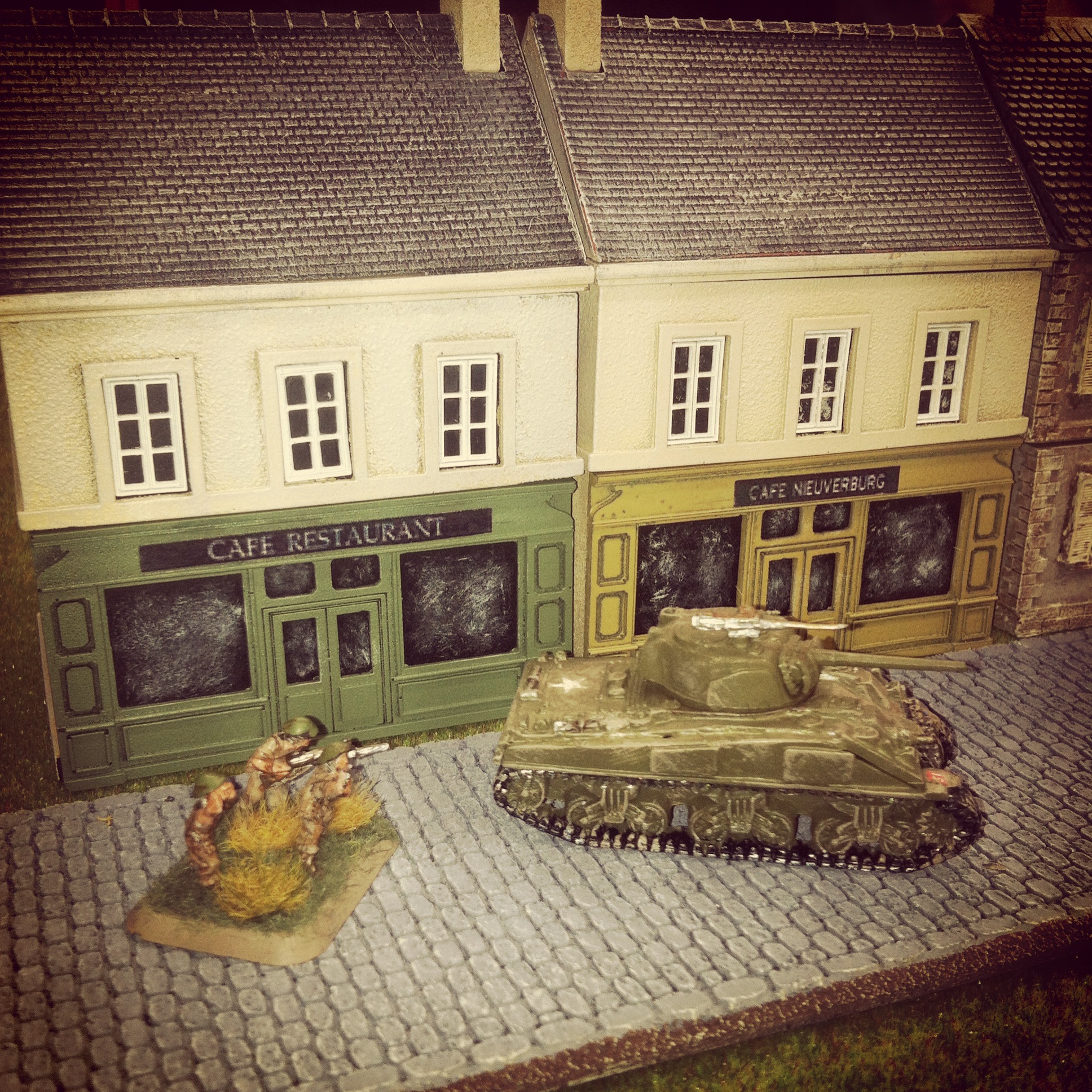
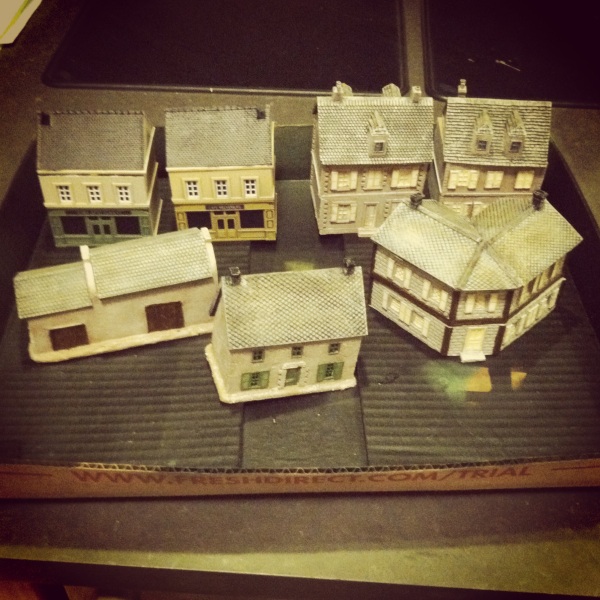
With so many Mark IV models on my shelf, I wanted to add in a few more commercial structures representing stores or cafes common to European towns small and large. The excellent Model Dads UK blog recently reviewed the 15mm town shop models from Games of War. Based on a shop in Caen, the GOW shops come in three different pre-painted varieties for about $24 each shipped from the UK.

The GOW buildings scale nicely with my Mark IV models, and just a little work weathering the existing paint blends them nicely into the streetscape. I also added some signage and posters to the exterior walls, bringing a bit more sense of liveliness to the townscape.
IMG_3111Painting Mark IV and Games of War buildings

jrlogo

The first 15mm buildings I ever bought were from JR Miniatures. An old standby in the hobby, JR offers a wide variety of scales and themes for eveything from Ancients to Historicals to Sci Fi. I have a small, roughly-cast farmhouse and outbuildings from JR which I use as area terrain. Overall, I find JR’s buildings to be a bit less crisp in detail than those from Mark IV and GOW, and many buildings don’t open for placement of figures.

Last year, I picked up a basic JR European stone bridge at a convention for about $14. The simplicity of the model made it easy to paint with a few stone-colored dry-brushed layers of paint. The model stretches over just about every river running through my gaming tables, and I may very well pick up another bridge in a different design from them soon.

MBAlogo

On the higher end of the terrain options, I’ve always had a thing for the Miniature Building Authority. MBA’s extensive 15mm European line comes pre-painted with lift-off sections to place units in the buildings or model them as destroyed structures. They also carry some rather unique structures and large set-pieces like a multiple-model farm complex or full train depot set-piece.

My brother and his gaming friends have been collecting MBA buildings for years, buying a few buildings a year and sharing in their collection. Taking their gradual approach, I recently started small and ordered a couple of their shops and a large, beautiful hotel model for my collection. Over time, I hope to add more from MBA and grow toward larger, more urban scenarios.
fowcobblestone

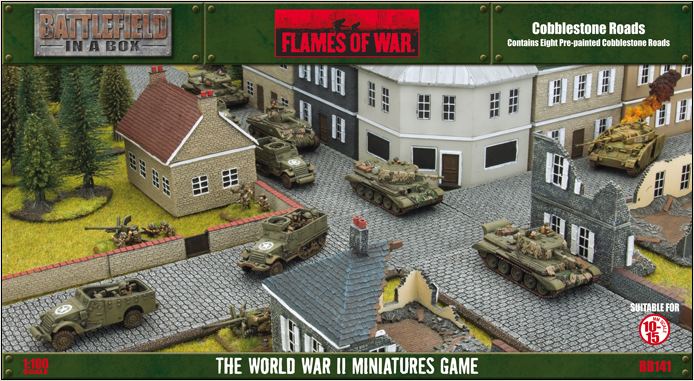
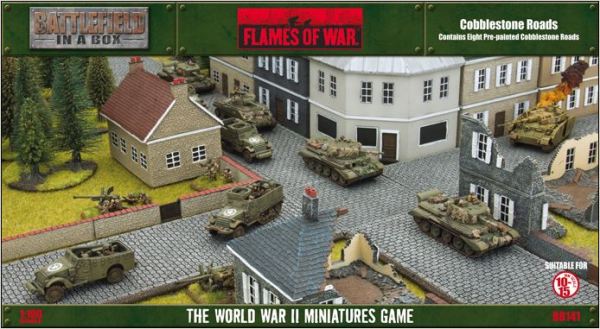
Laying out a gaming table almost always necessitates having roads. I bought some rubberized roads years ago at a convention which suit rural unpaved areas well. A small town or rural setting requires having paved streets, and cobblestones provide a suitable road surface for Western Europe at the time of WWII.

I experimented with stone-textured papers and looked at rubberized stone streets, but none of them provided the depth or the solidity inherent in a stone road. Finally, I’ve bitten the bullet and invested in a set of the FOW cobblestone roads  at a slight discount from a seller on eBay. With a total of more than 6-feet of pre-painted cast resin roads, the box has given me what I think to be plenty roadway for my tanks to rumble down.

wslogo

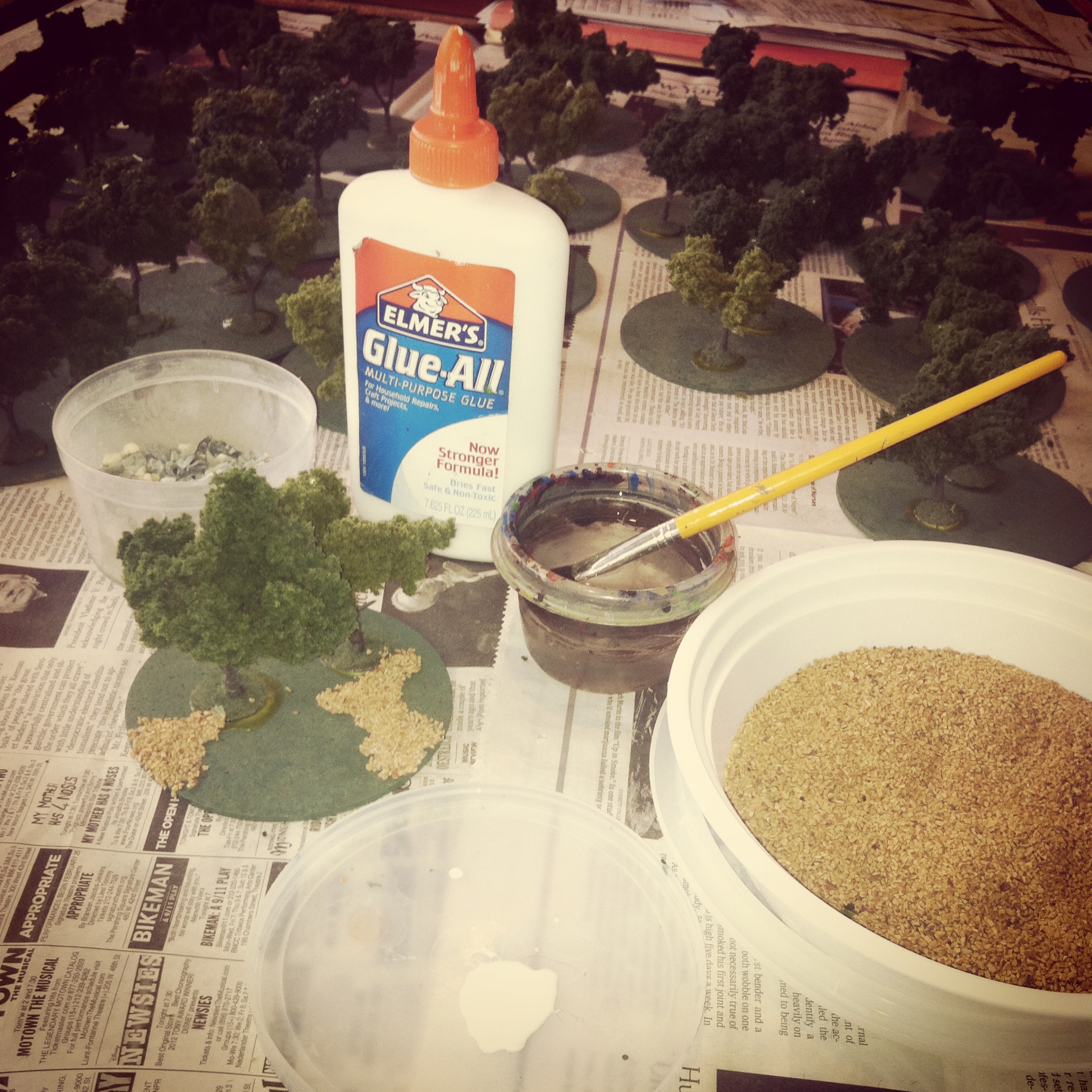
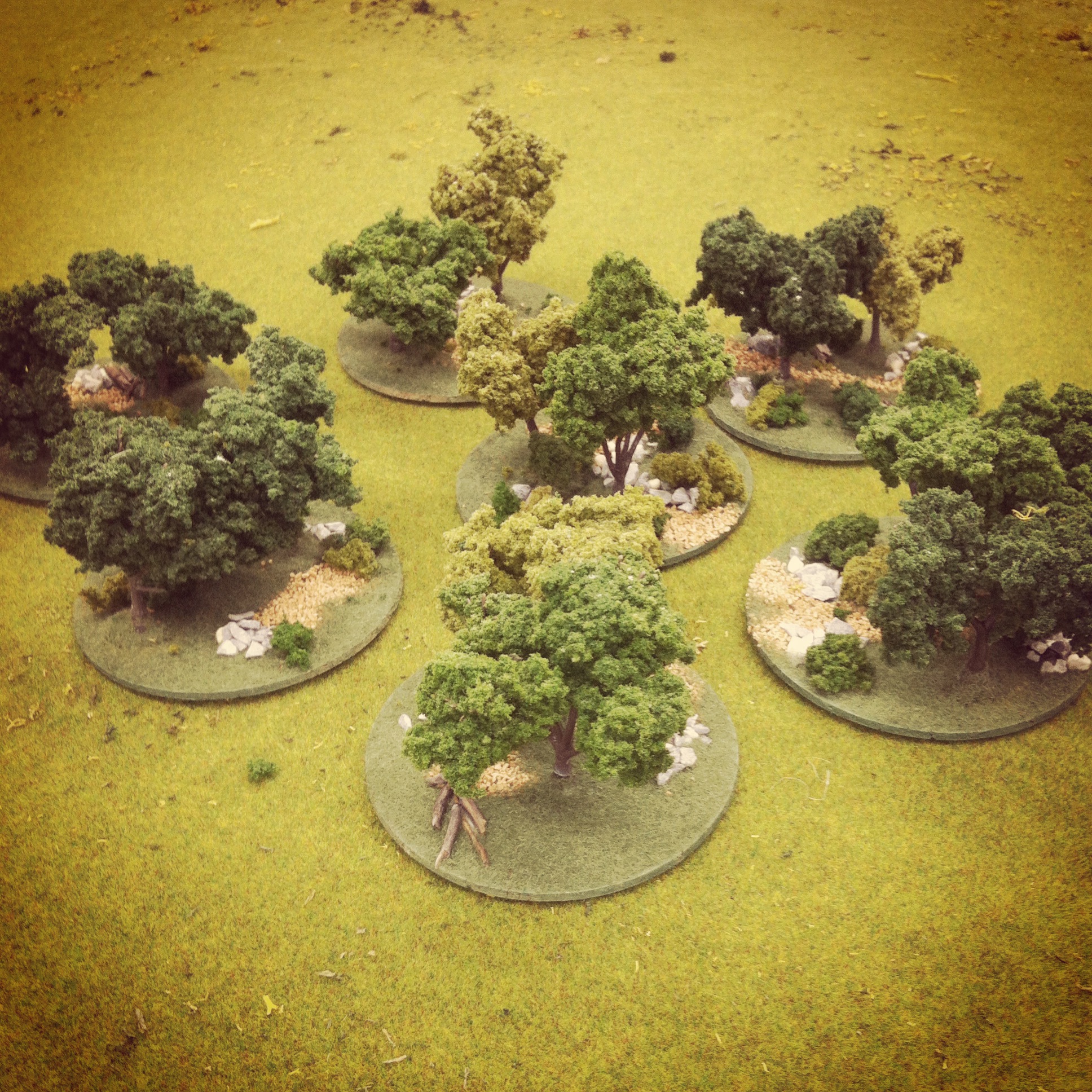
Trees are one of the standard needs for any miniatures wargaming table in any era. Several wargaming manufacturers offer boxes of pre-made tree stands and bases for around $35-40 for maybe a dozen trees. I choose to go the economic bulk route and make my own using trees, flocking and modelling details from Woodland Scenics. For about $75 I’ve been able to make more than enough to fill even the largest battlefields.
IMG_3040Tree-making assembly line

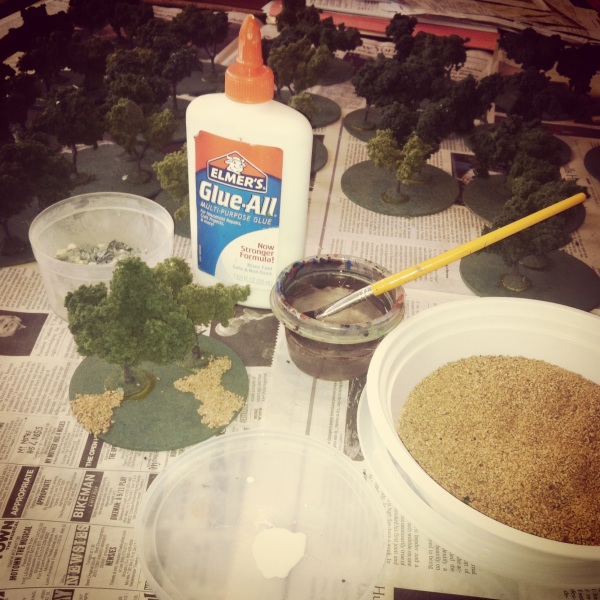
Using two different sized trees from the WS Ready Made Trees Value Pack line, I first glued groups of 2-3 trees to cork coasters picked up at a craft store. On top of the spray-painted green coaster bases, I apply white glue and sprinkles of gravel of varying sizes in random places. After dry, another coat of glue to the remainder of the bases is then flocked with a basic green grass flocking. A few twigs and larger rocks glued here and there add some more depth to the little mini-scenes on each base.
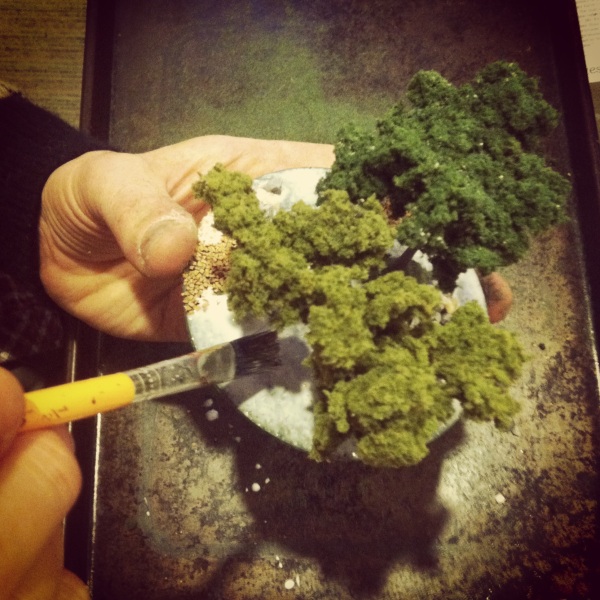
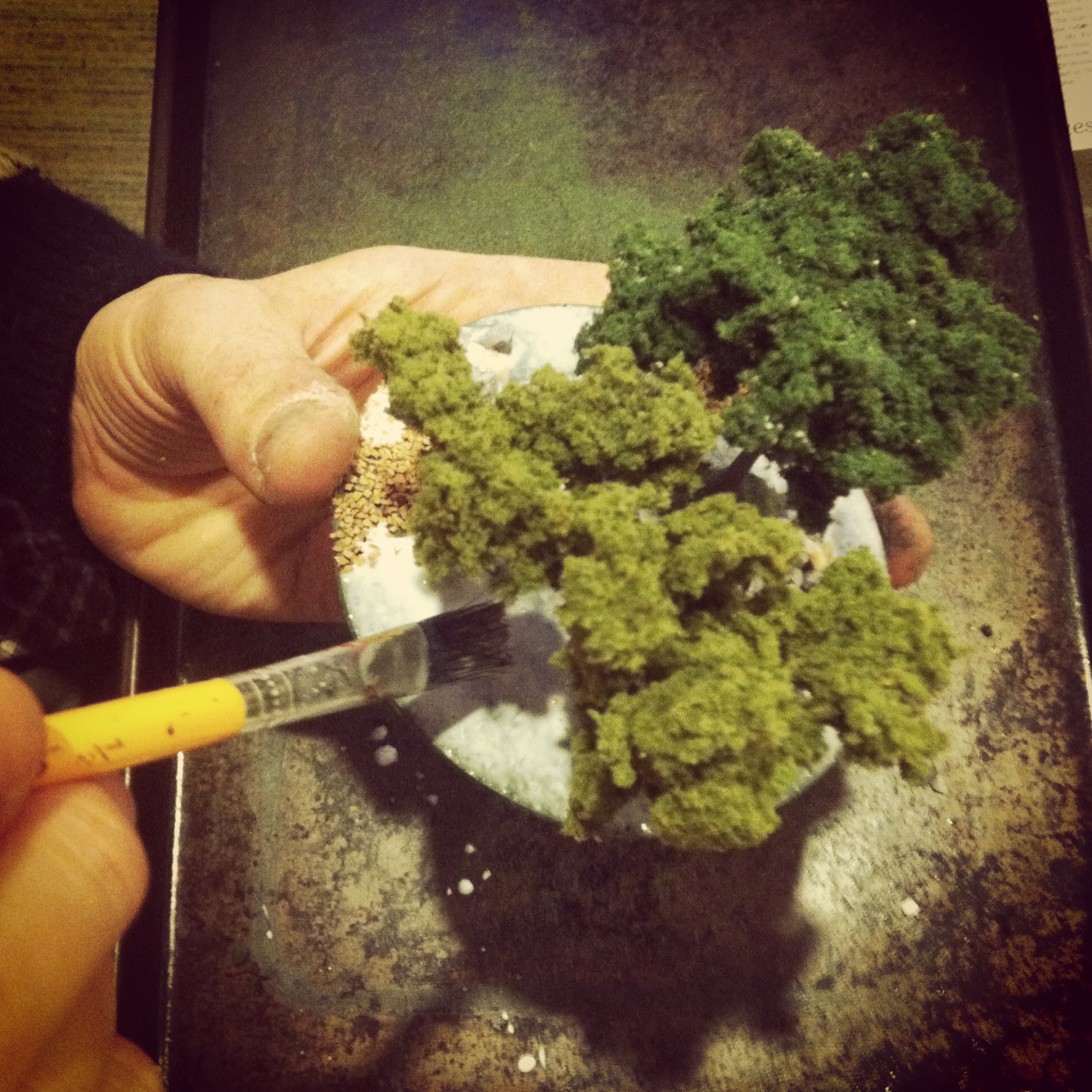
IMG_3041Applying white glue to the tree bases before flocking

Bases are finished off with coarse clumped foliage to represent bushes and undergrowth. Mixing colors of the trees and foliage provides a realistic look. Gravel and larger rocks get hit with some brown washes to tone down the glaring brightness of the paths and piles on each base. All my work is done assembly line style in stages over an old baking sheet so excess flock and gravel shaken from the bases can go back in their containers to use again. When finished, I hit the bases with a matte spray to hold everything in place. In just a few hours time, my model forest on some 30 bases is ready to provide cover for any troops seeking concealment from enemy fire.
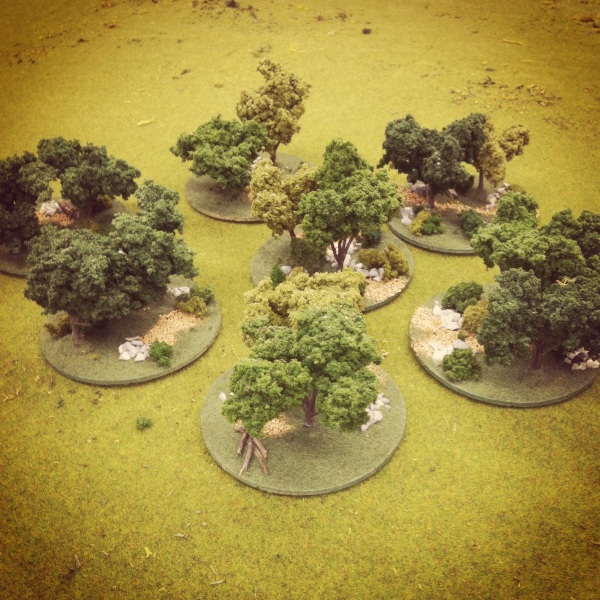
IMG_3156Completed homemade trees

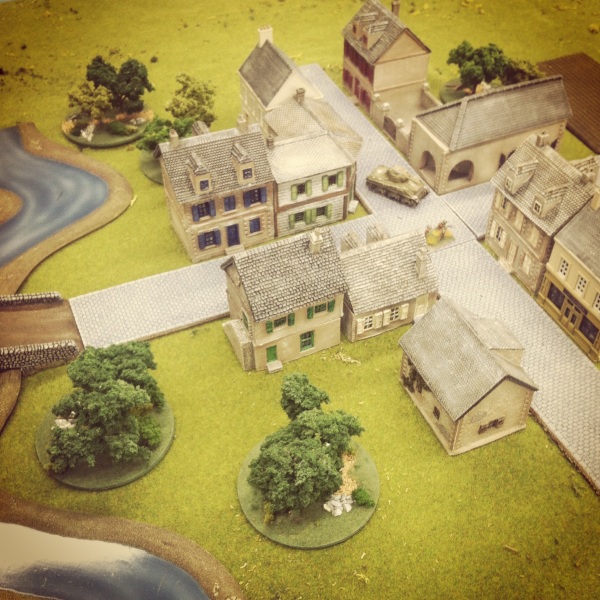
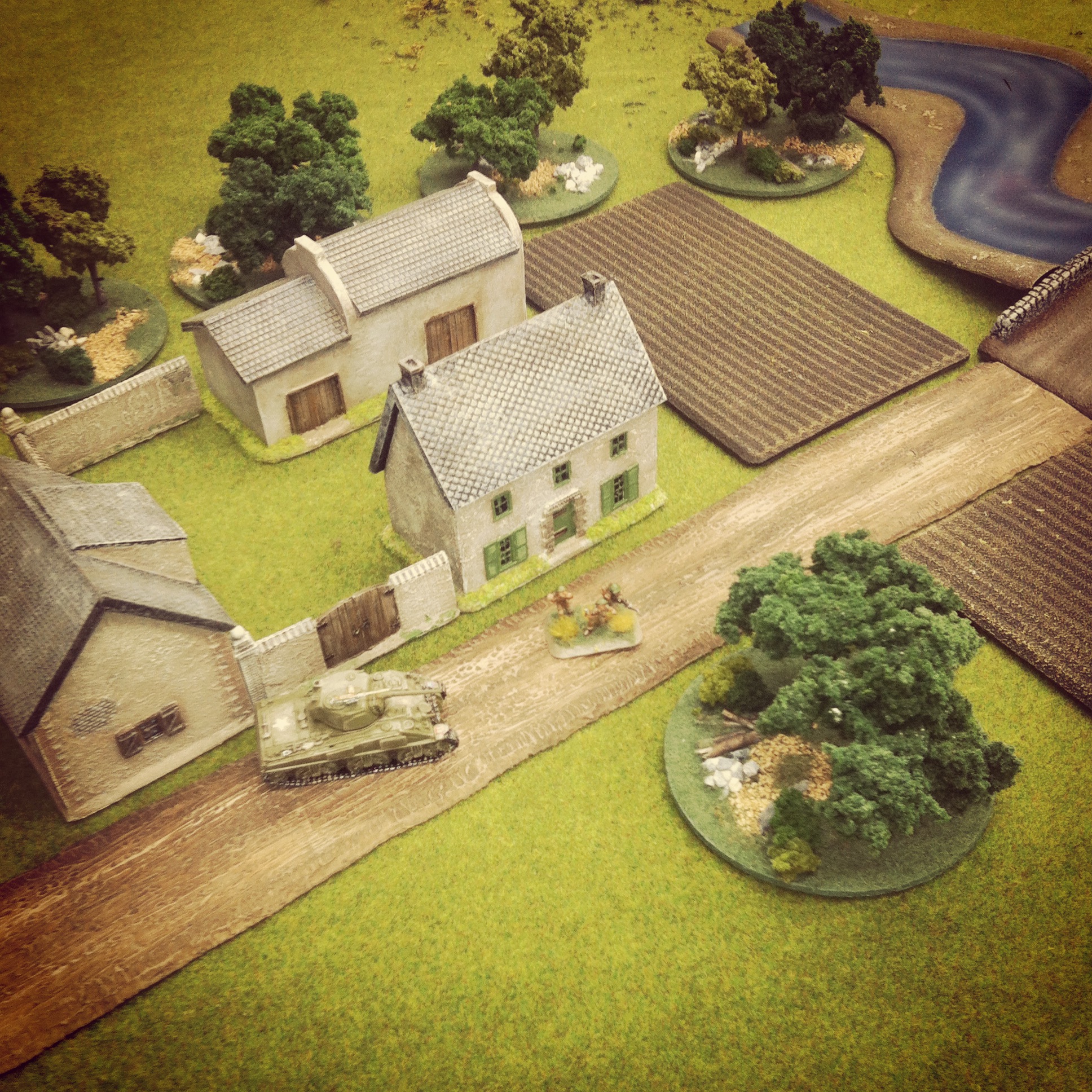
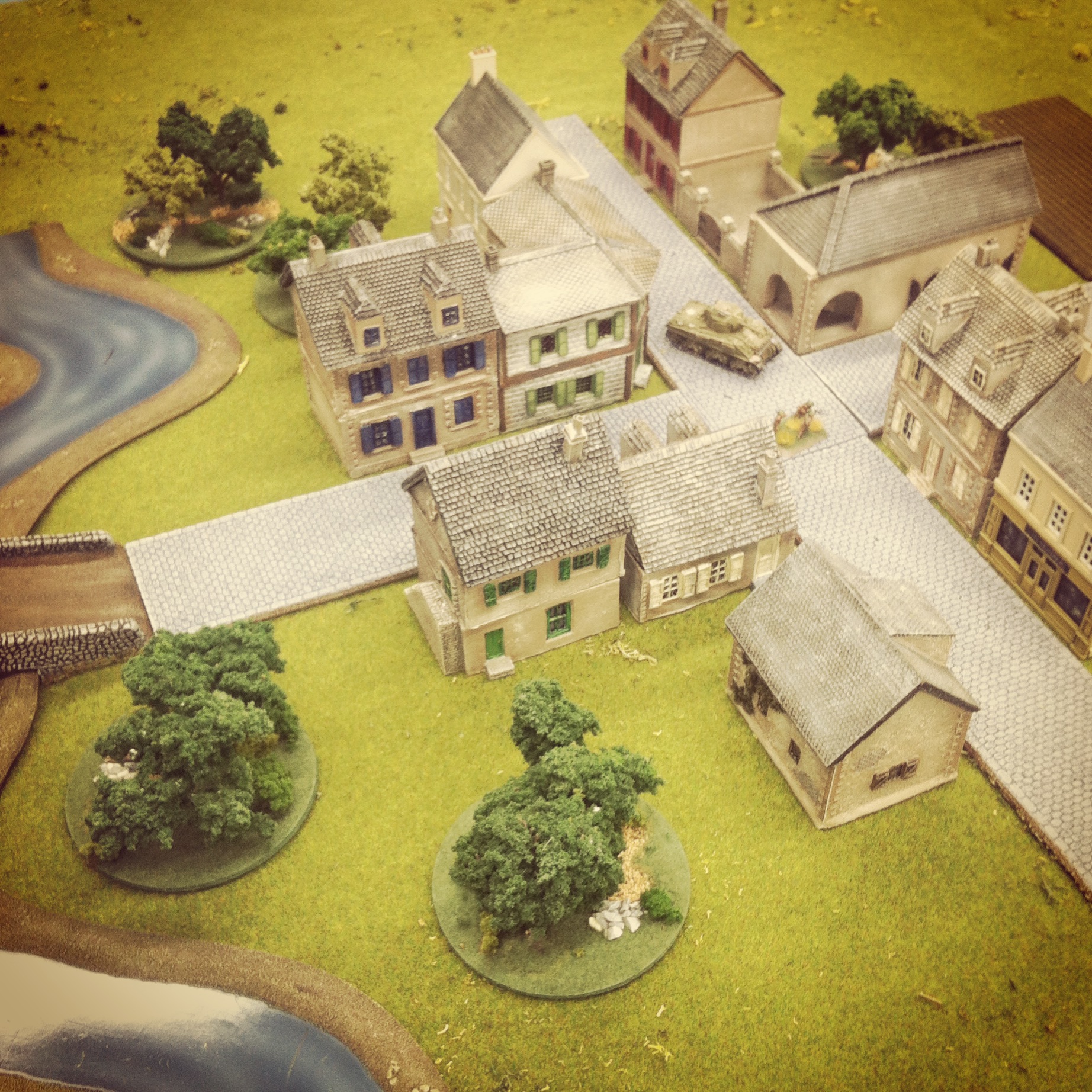
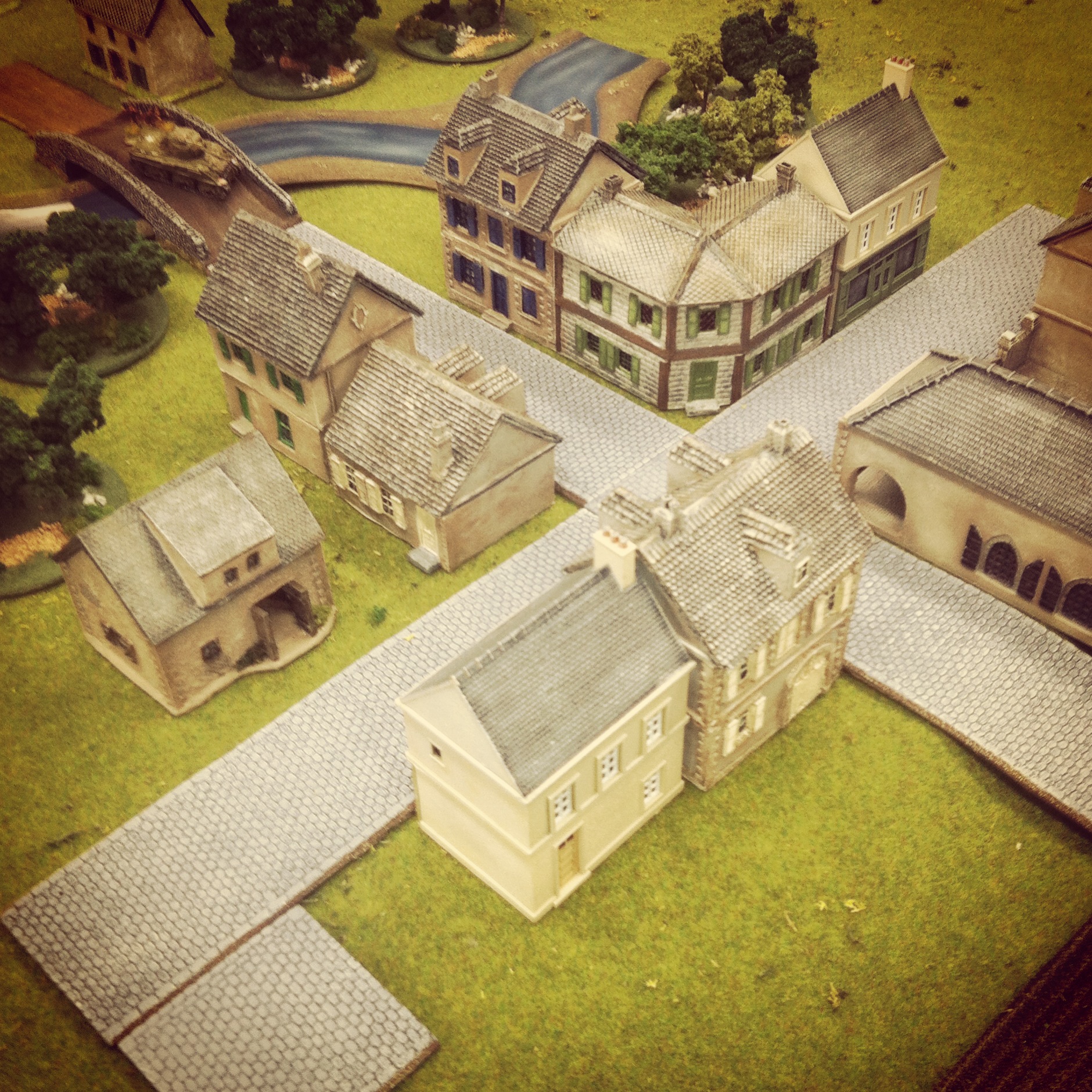
Putting it all together, a dozen buildings, cobblestone roads, a bridge and a bunch of my homemade trees gives me more than enough terrain to present rural and town landscapes in Western Europe. Adding in some river sections, dirt roads and fields from fellow club members completes the look of just about any inland battle scenario in Normandy. Check out the pictures below of the results, and keep an eye on my after action reports for future glimpses into my tiny tabletop fields of battle.
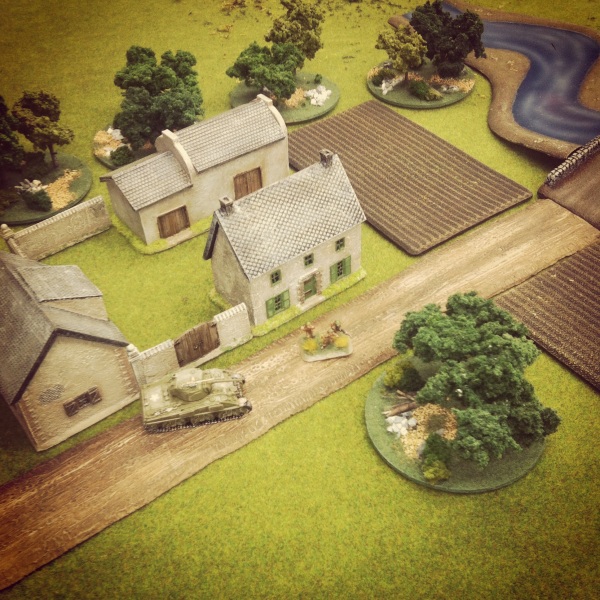
IMG_3161Farm complex with Mark IV buildings and walls, JR Mini bridge and FOW fields and river
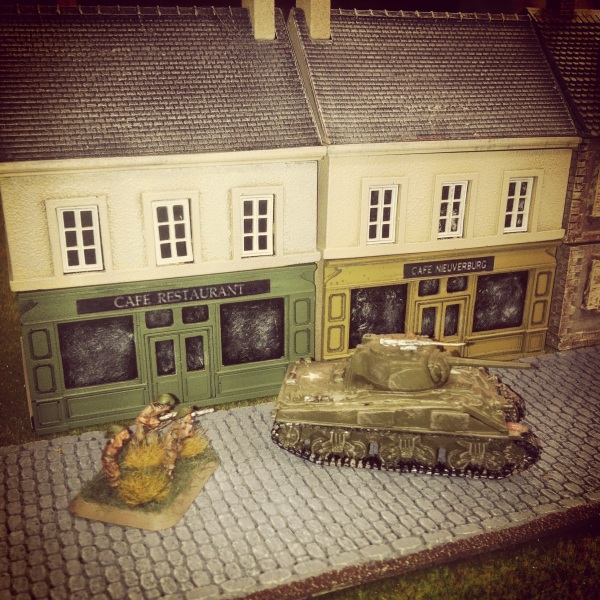
IMG_3159Games of War shops with added weathering and signage
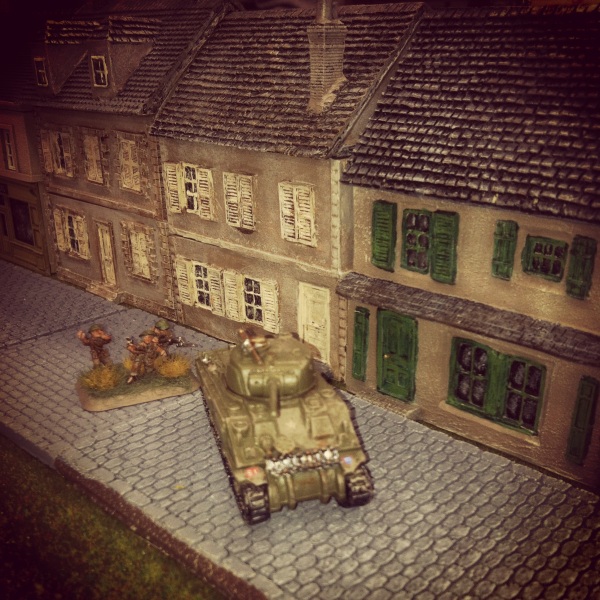
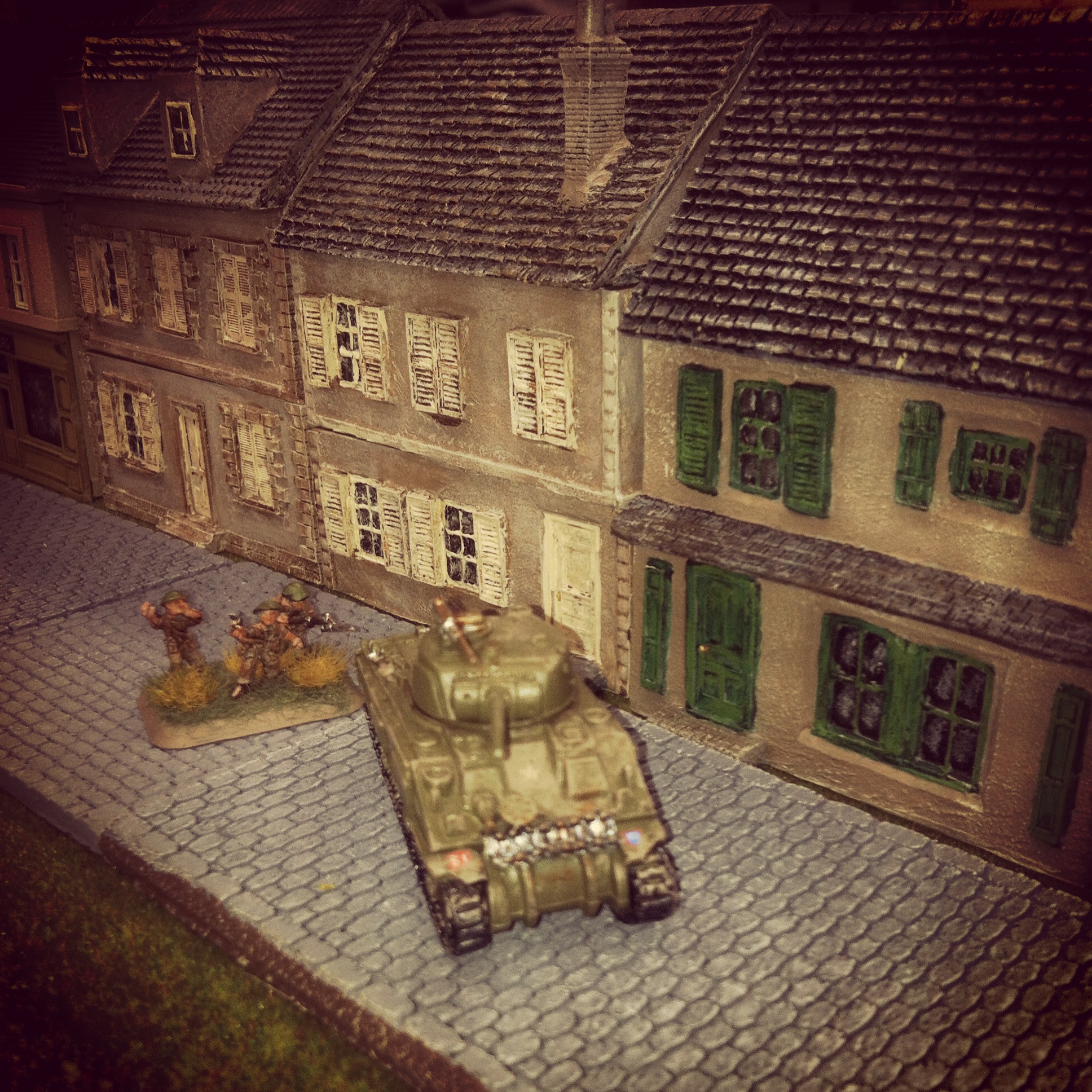
IMG_3162Row of Mark IV buildings

IMG_3160Mark IV buildings and monument

IMG_3158Town set-up with terrain from Mark IV, JR Mini, FOW, Games of War and my homemade trees
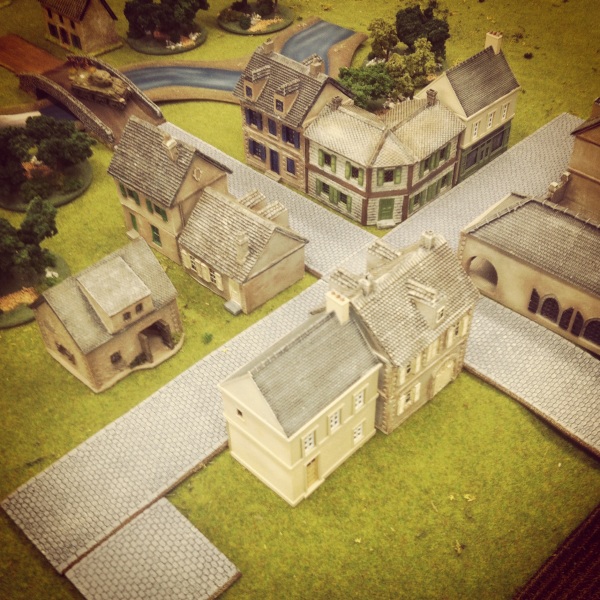
IMG_3157Town set-up with terrain from Mark IV, JR Mini, FOW, Games of War and my homemade trees
Flames of War: “Desperate Measures” Tanks On The Steppe

t34

Late in 2013, Flames of War re-launched their Late War Eastern European Front books and models with the release of Desperate Measures. The slim guide to the German and Soviet forces of 1945 is packed with lots of fun and flexibility in fielding tons of armor and mechanized troops slugging it out in the final months of World War II.

My usual FOW gaming opponent at Metropolitan Wargamers in Brooklyn, NY has made a sizable investment in Soviet models and Eastern Front terrain. His rural church model in particular looks fantastic on the table with real gold leaf applied to the classic onion dome. Playing from the Desperate Measures book for the first time this past week allowed me to field a bunch of German armor which has mostly sat idle for a year or two as I’ve focused on playing Allied forces in Western Europe.

dmlogo

My German list was a Confident-Trained Panzer Kampfgruppe with a Panther G HQ, two Jagdpanthers, two Panzer IVs and a Confident/Veteran Schwere Panzer platoon of three Tiger I Es. The Soviets rolled out a Confident-Trained Tankavoy Batalon with a T-34/84 obr 1944 HQ tank, a platoon of seven T-34/84 obr 1944 tanks, a ten-tank T-34 obr 1942 platoon and two four-gun platoons of the heavy SU-100 tank killers. At 1500-points on a side, there was a ton of Soviet hardware sitting on the tabletop against a small, but diverse German force.

FFAMission

This was my first time playing these lists, so we went with a straight-forward Free-For-All from the basic FOW missions list. The table presented a mix of woods and buildings for cover, and roads and a railway cutting across the table. We placed out objectives, deployed our lines of tanks and the Soviets rolled for the first turn.

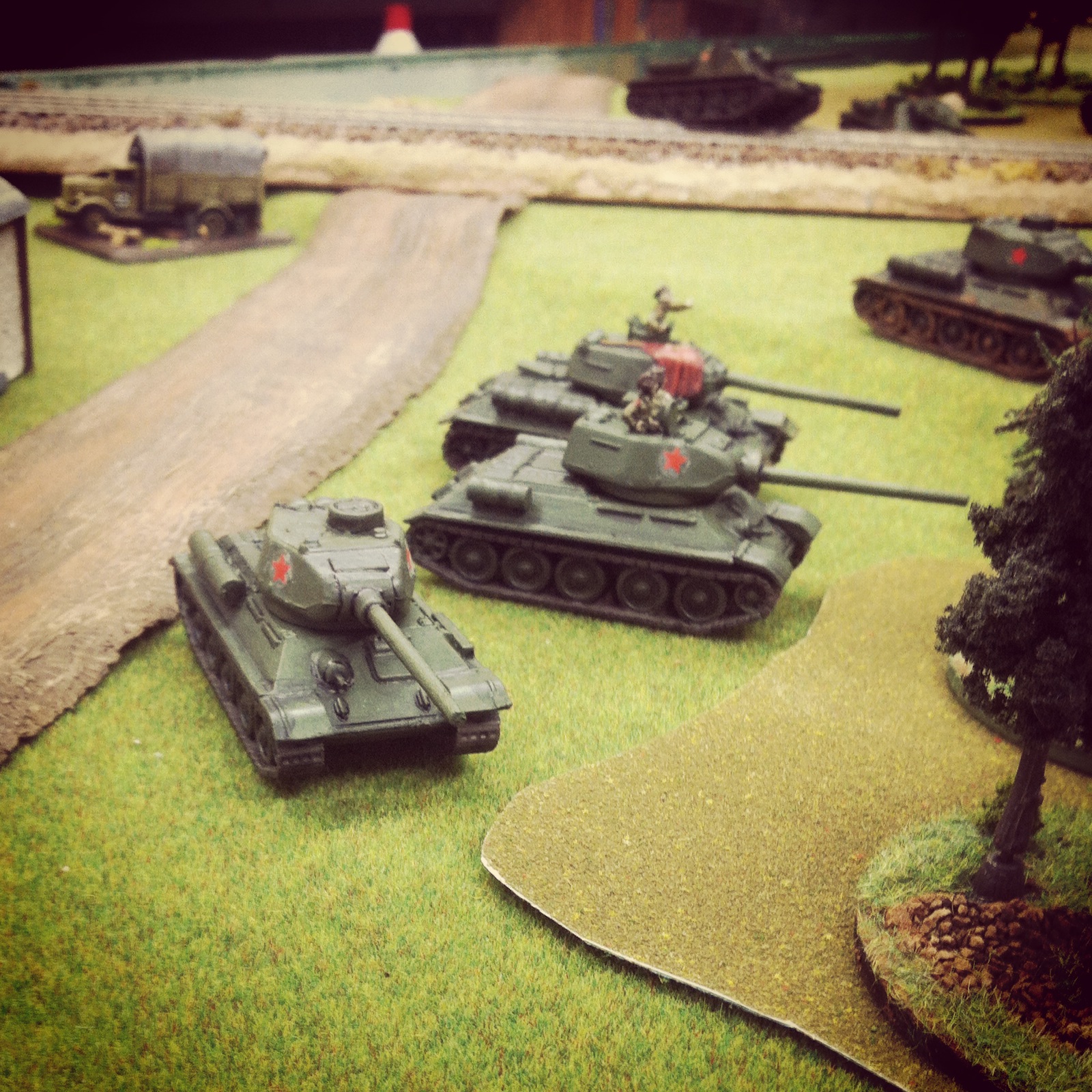
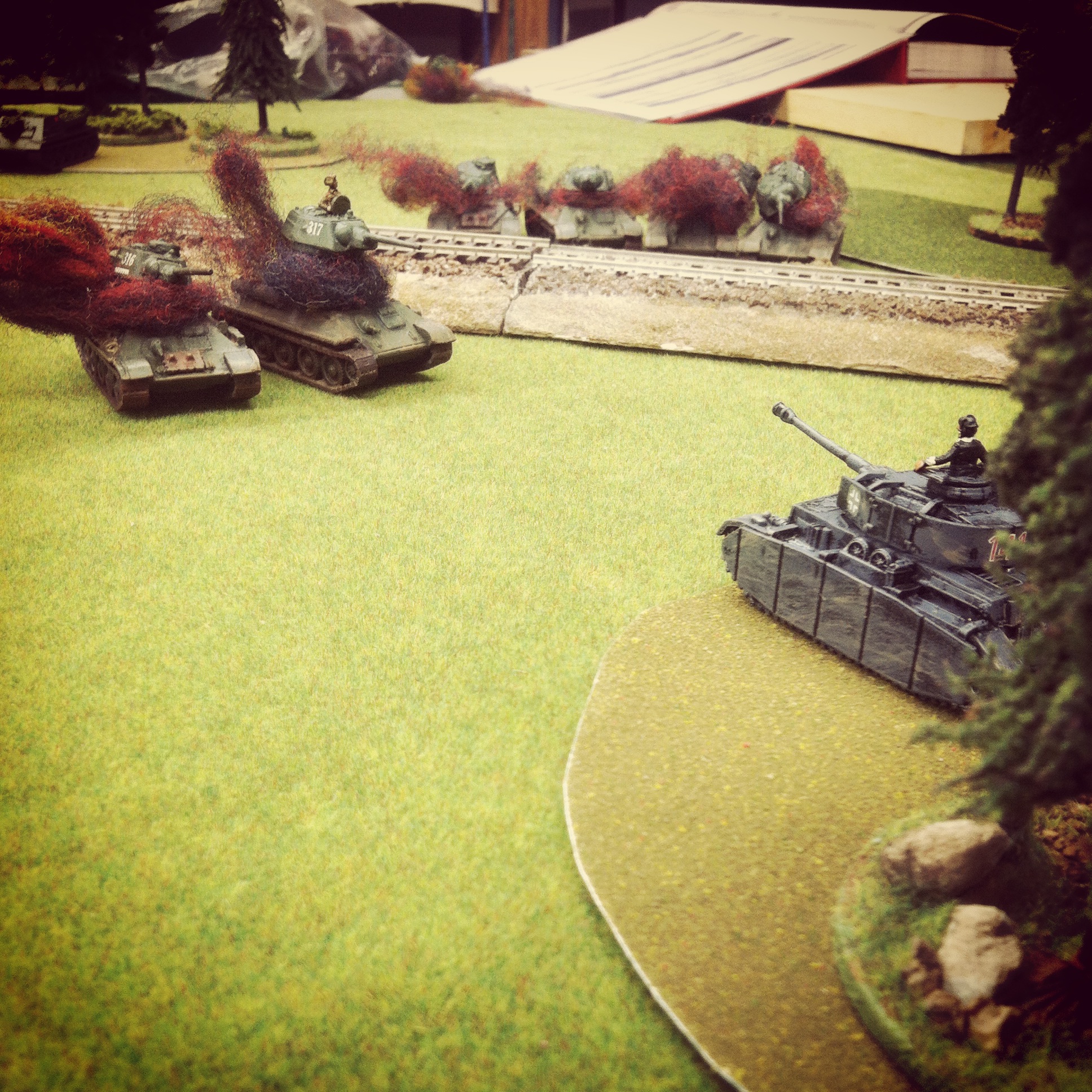
IMG_3092Following deployment, Soviet tanks roll forward on turn one

IMG_3094T-34s reach the railway and center with SU-100s in support

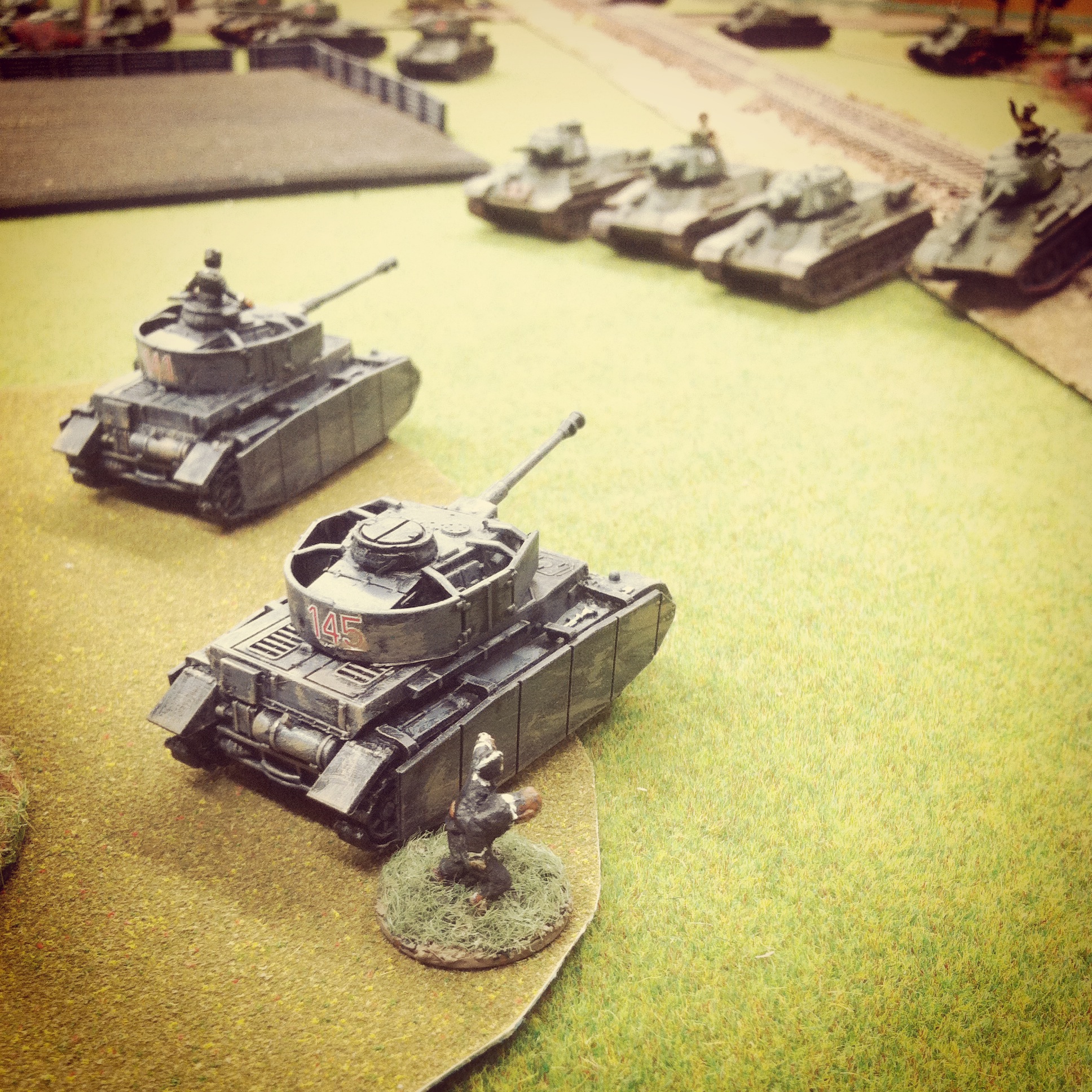
IMG_3093Panzer IV’s lie idling in the woods with Panther command tanks nearby

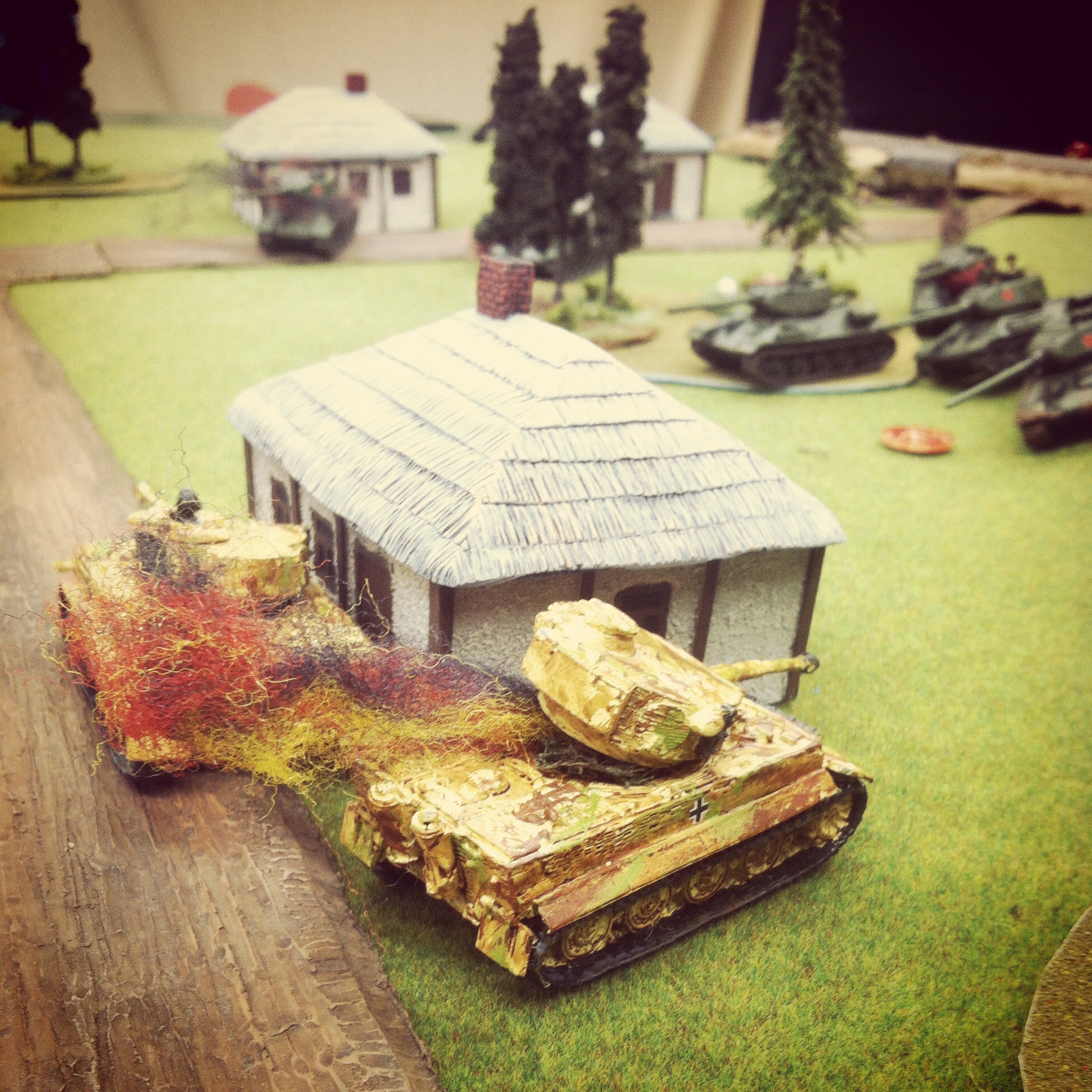
IMG_3096Tigers defend the objective at the middle of the table

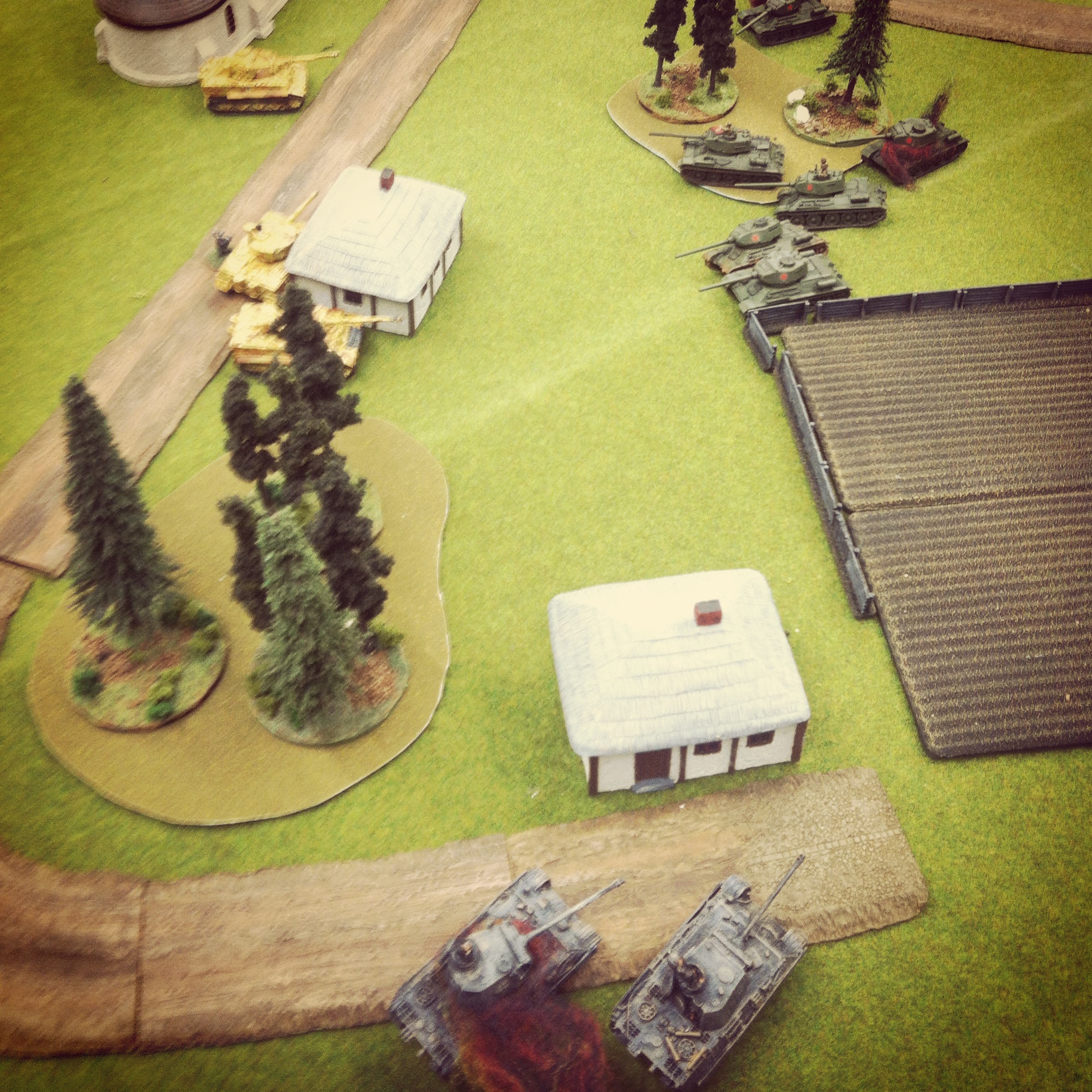
With the Soviets beginning the game as having moved, they weren’t able to take any valid shots. The T-34s pressed to the edge of the railroad tracks on their left and the central forested area at the middle of the table. On either flank, the SU-100s sat parked and looked to take advantage of their ability to re-roll misses by firing from stationary positions. I perched my Jagdpanthers in a wood at my left flank and aimed at one platoon of SU-100s in the distance. The Tigers sat at the middle of the table, looking to attack from behind two huts and defend an objective. My Panthers and Panzer IVs took up position on my right, hoping to stall the massed T-34 assault over the railway.

IMG_3097T-34/84 obr 1944 tanks take up position around the central woods

IMG_3099The T-34 obr 1942 platoon is lit up by  fire from the Panzer IVs and Panthers

IMG_3098A Panther explodes with returned fire from the surviving T-34s

IMG_3102With one Panzer IV crew bailed out, the T-34s press the attack

IMG_3104Surviving T-34s burn after closing on the Panzer IVs

The game quickly divided into three main fronts. The Panzer IVs and Panthers dueled over the railroad with the T-34 obr 1942s. In three successive turns, the advancing Russian tanks were hit twice and then fled the field with a failed morale test. Along the way, the Germans lost a Panther from the command HQ and a Panzer IV, cutting German tank force in half on that end of the table.

IMG_3103T-34/84 obr 1944 tanks roll to the center and engage the Tigers

IMG_3105Tigers burn on the field

At the table’s center, the T-34/84 obr 1944 tanks moved into position around the central forest and fields. The Tigers moved in and out of cover, taking deadly shots. By the third turn, two of the Tigers had been bailed by combined fire from the T-34/84 obr 1944s and the SU-100s on either side. Struggling to remount their tanks, two Tigers were destroyed and the remaining tank fled the field.

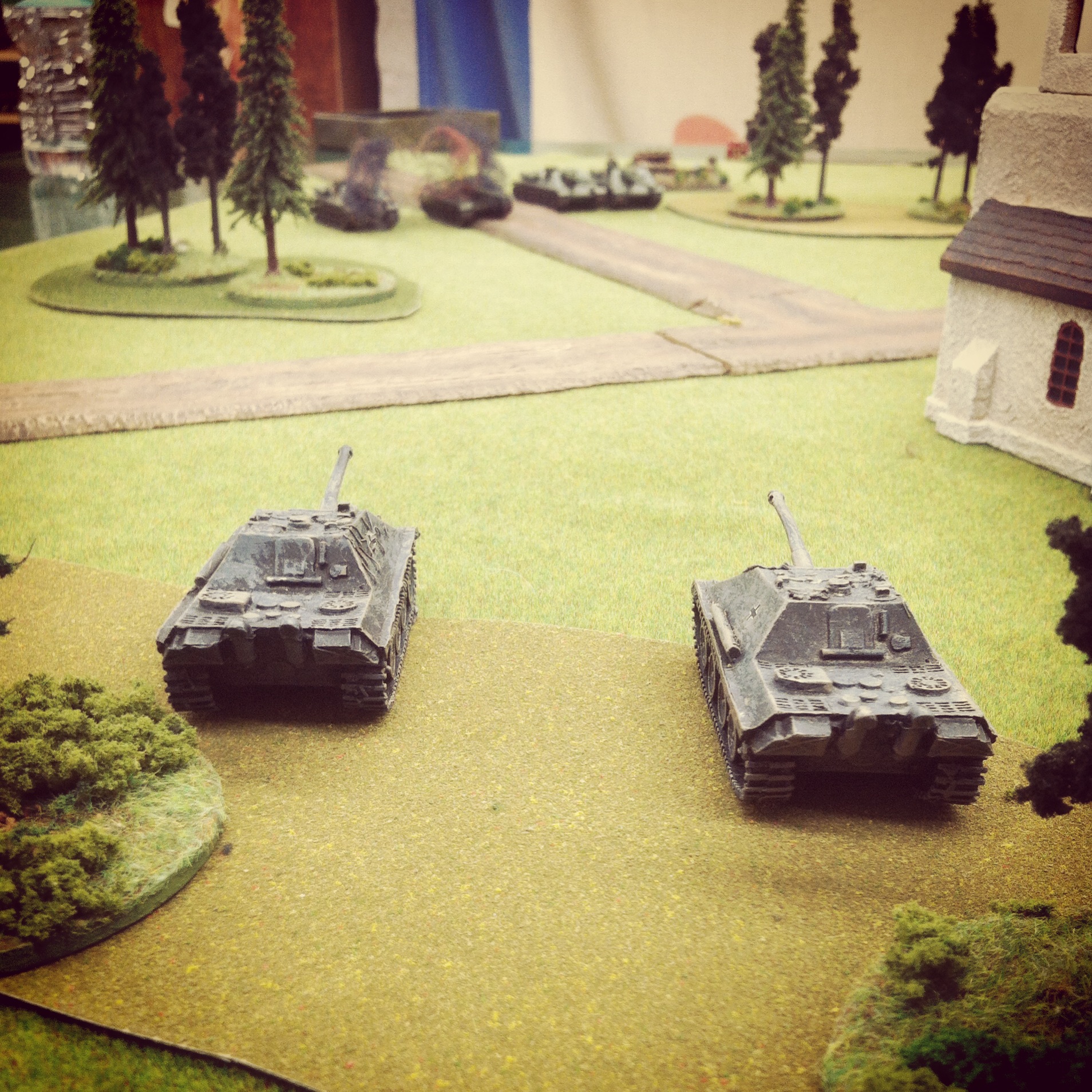
IMG_3101Jagdpanthers blaze away at SU-100s in the distance
Beyond the church at the German left, the two Jagdpanthers destroyed the SU-100 guns in front of them in two turns. With the flank open and the rest of the table locked in mobile tank duels, the Jagdpanthers fired their engines at the double to occupy the objective beyond the burning SU-100s. With the Germans below half-strength following the destruction of the final Panzer IV, the game came down to one company morale check which the Germans passed to win.

We were both pretty pleased with how evenly matched the game had been on the Eastern Front. The sheer number of tanks kept the Soviets in the game even as the Germans rolled devastating hits in almost every turn. The SU-100s at the railroad, on the other hand, managed to miss most of the game until their combined fire with the T-34/84 obr 1944 platoon ran the Tigers off the table.

I’ve spent the past couple years gaming back and forth across Western Europe from D-Day onward, so a new front and some new forces was a great change of pace. Leafing through the rest of Desperate Measures, I can see there’s plenty of opportunity to run around more tanks and maybe even some poor, unlucky troops on the Eastern Front again soon.

Downloading: Wargame Blogging With 35 Million Images

Embed from Getty Images

I’ve written previously about my longtime career in the photo and film licensing industry, starting out in the mid-1990s as a historic photo researcher. One of my former employers, Getty Images, made a surprise announcement this week that it was making available for free some 35 million images for non-commercial use in social media and blogging. The press release stated Getty Images’ acknowledgement of the widespread use of images without proper licensing, and the new system will allow for data-gathering and one would think some form of monetization long-term.

Using the new functionality is easy with a quick image search and copy/paste of the embed code into a website like Facebook or blog platform like WordPress. Images are importantly displayed with the proper photographer and collection attribution. The Getty Images logo is also prominently shown along with buttons to share the image via Twitter or Tumblr. Clicking on the image itself returns the user to the Getty Images website for full caption information. Because the image is never actually uploaded to the blog’s hosting site, there’s an additional cost savings in storage space. It’s all fast, neat and, again — free.

For wargame bloggers, there’s an enormous amount of iconic and more obscure photographs, maps, posters and illustrations available. The black and white and color historical offering is deep. Contemporary photos of equipment, re-enactments, memorials and sites relevant to military history should also be useful for reference for wargame bloggers like myself. Not every image Getty Images represents is available for free through the embed code, and users should be careful not to grab an image requiring a license fee.

Check out the below for just a glimpse of the breadth and depth in the Getty Images offering which may very well be popping up on some of your favorite blogs very soon.

Ancient & Medieval Warfare

Embed from Getty Images Embed from Getty Images Embed from Getty Images

American War of Independence

Embed from Getty Images Embed from Getty Images Embed from Getty Images Embed from Getty Images

Seven Years War

Embed from Getty Images Embed from Getty Images

Napoleonic Wars

Embed from Getty Images Embed from Getty Images

American Civil War

Embed from Getty Images Embed from Getty Images Embed from Getty Images Embed from Getty Images Embed from Getty Images

African Colonial Wars

Embed from Getty Images Embed from Getty Images

World War I

Embed from Getty Images Embed from Getty Images Embed from Getty Images Embed from Getty Images Embed from Getty Images

World War II

Embed from Getty Images Embed from Getty Images Embed from Getty Images Embed from Getty Images Embed from Getty Images Embed from Getty Images Embed from Getty Images Embed from Getty Images

Cuban Revolution

Embed from Getty Images Embed from Getty Images

War Concepts

Embed from Getty Images Embed from Getty Images

New Game Weekend: Memoir ’44

mem44box

I’m about 10 years late to the WWII board game Memoir ’44, but after a few first plays through it this past weekend I’m glad this modern classic is now part of my gaming arsenal. Released by Days of Wonder on the occasion of the 60th anniversary of the D-Day Normandy Invasion in 2004, the game has won numerous awards and remains high in the esteem of casual and serious wargamers alike.

mem44contentsContents of the basic Memoir ’44 game from Days of Wonder

The base Memoir ’44 game runs about $40 and contains over 300 playing pieces. The blue-grey Axis and green Allies tank, infantry, artillery and defensive features look fantastic, and playing with them evokes the little plastic toy soldiers of many a kid’s youth. The reversible game board with a beach on one side and countryside map on the other provides the basic layout for the more than a dozen historic scenarios included in the easily-read rulebook. Scenarios are laid out using hex tiles with various terrain features such as towns, forests, hills, rivers and hedgerows. Each historic game scenario is presented with a clear illustration on how to lay out the appropriate terrain tiles and initially deploy forces on each side.

M44cards

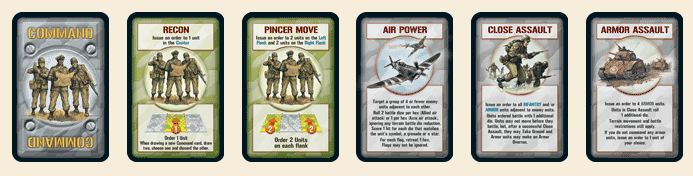
Sample Command Cards from Memoir ’44

Command cards and battle dice provide the basic drivers of game mechanics. Cards provide activation of one or more units in the left, right and/or center portions of the board. Infantry may move once and attack or move twice, artillery may move or shoot, and tanks may move up to three hexes and engage in combat. Attacks are resolved with a simple roll of special battle dice which hit units based on the icon results on each die face and what units are present in the combat. Die rolls may also result in misses of forced retreats. When a player finishes their moves and combats, they draw a fresh card and play passes to the opposite side of the board. Games are scored by destroying units or securing objectives like bridges.

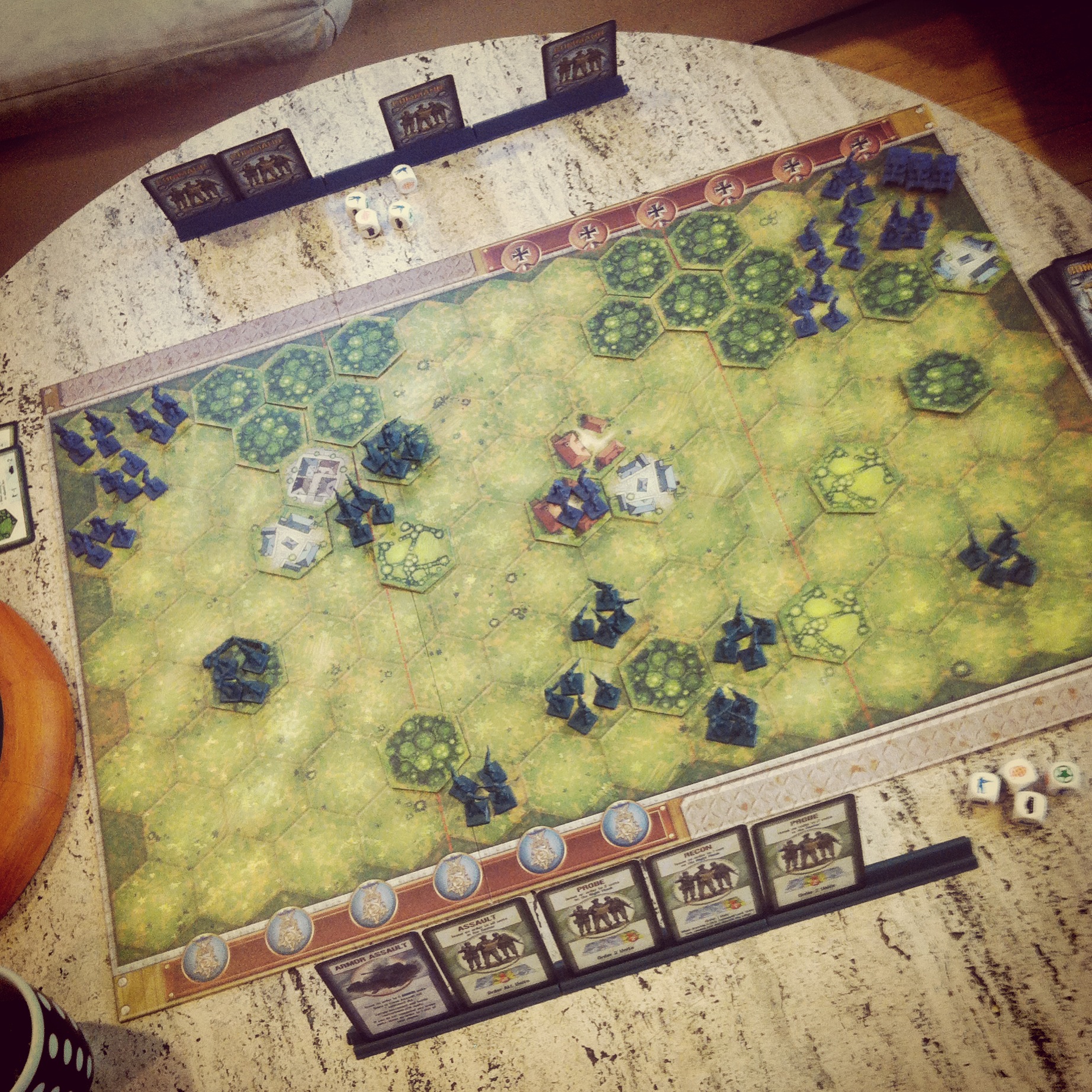
IMG_3022

The Sainte-Mère-Église scenario for Memoir ’44

As fairly experienced WWII historical miniatures players with Flames of War, both my son and I were pleasantly surprised by the fun to be had with Memoir ’44. The intro scenario is for Pegasus Bridge which we tackled in about 20 minutes to get a feel for the game. Next up, we tried Sainte-Mère-Église with a fun added feature of actually dropping a fistful of paratroopers onto the board. We both found the command cards to be a good mechanic to represent the effectiveness of delivering orders on the battlefield. In out second game, my son’s tanks lay parked at the corner of the board the entire game since he never drew a card allowing activation of units to his left. We each pulled a couple special cards, allowing things like airstrikes and close assaults to happen as the game quickly moved to a finish in about four or five turns. With the basic rules under our belts, we’re anxious to push on through the remaining scenarios included in the basic rules.

M44terrainContents of the Memoir ’44 Terrain Pack expansion

The scores of  available official scenarios, expansion editions, campaign books and army packs add an amazing amount of replay value to Memoir ’44’s basic rules and mechanics. A nifty online design scenario design tool also allows armchair historians to have a go at creating official-looking games of their own, and I can just imagine the educational possibilities in using it in school settings. Along with the base game, I snatched a copy of the Terrain Pack expansion which offers nearly 150 additional tiles, markers, special unit tokens and four additional scenarios. With the vast expansions of Memoir ’44, just about any interest in the air and land battles of every major front in WWII can be endlessly played and explored.

I realize I’ve just begun with Memoir ’44, and I’m certain to have both my boys playing along with me. There’s so much appeal in Memoir ’44 for kids or adults who have dabbled casually in war-themed board games like Risk or Stratego, plus the added interest of easily replaying historic WWII battles. Quick games, some real history and a fun box of toys — Memoir ’44 brings the complete package to the table.

Flames of War: Aalst 1944 Scenario

aalst

The ultimately unsuccessful week-long Operation Market Garden commenced on September 17, 1944 with an Allied push toward Germany. The ground “Market” portion of the campaign saw the British Guards Armoured Division taking point on the push into the Low Countries.

On the second day of the operation, a column of the Guards Armoured had rolled to the southern outskirts of Aalst, a Belgian town occupied by German forces since 1940. Led by Col. Joe Vandeleur, the division’s tanks encountered the remnants of German troops and guns which were dug in but heavily-damaged by the previous day’s Allied air bombings and artillery barrages. For the Germans, Aalst was a line in the sand protecting the Allied advance northeast to Antwerp and  the Netherlands beyond. For the Allies, keeping the long column of armour moving was key to reinforcing the Allied airborne troops already engaged with German forces along several bridges.

This past weekend at Metropolitan Wargamers in Brooklyn, NY we ran the Aalst scenario for Flames of War with 2000-point forces on either side of the table. We pulled our British and German lists from the Market Garden and Bridge By Bridge books. As a jumping off point for the game’s outline, we referenced an Aaalst scenario originally designed for Battlefront. We planned a 10-turn game with points scored for destroyed platoons and an immediate end to the game when the British rolled a platoon off the German-defended north end of the table.

IMG_3026

German set-up at Aalst

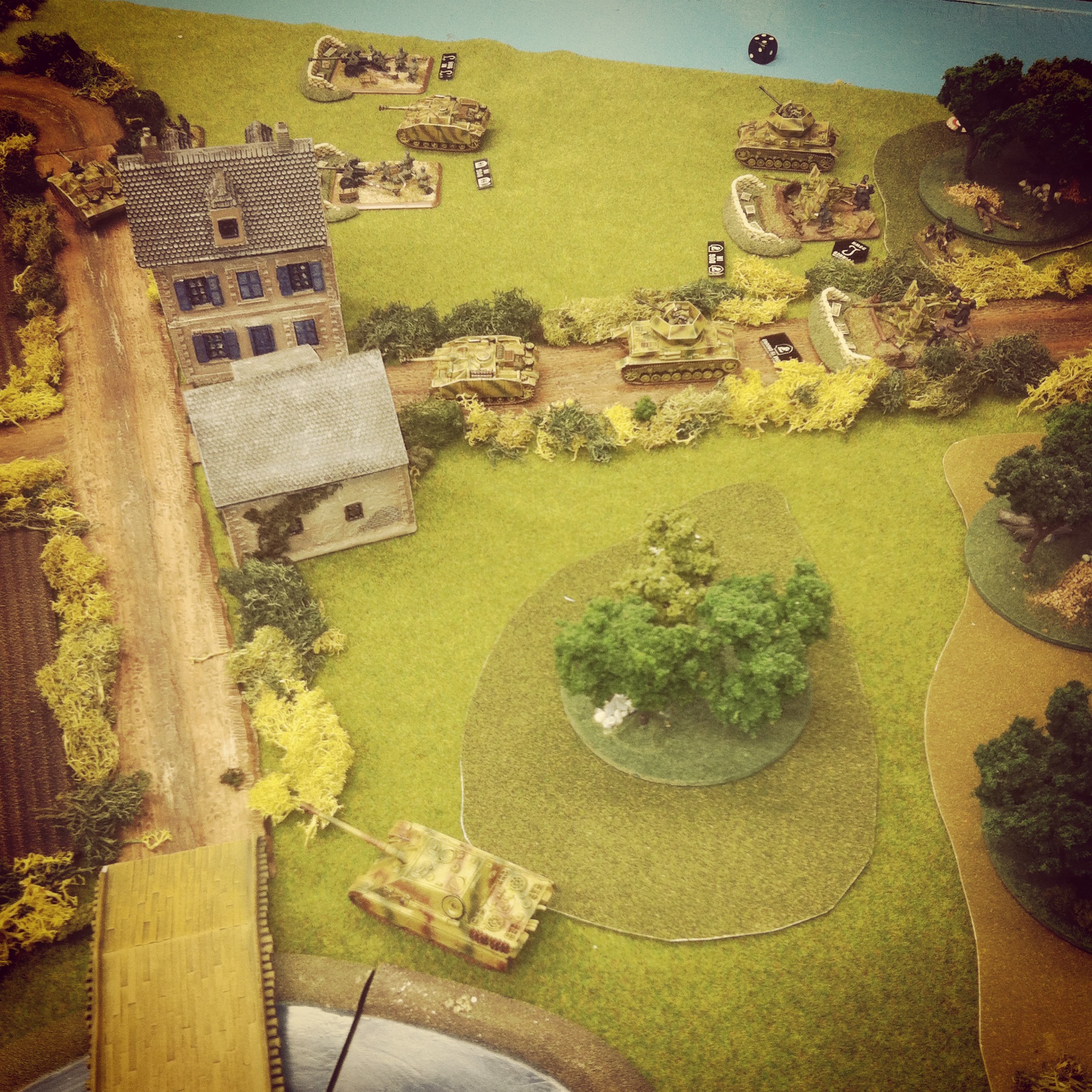
As per the actual situation at Aalst in 1944, the Germans began setting up with half their force heavily dug in just north of the town’s center. Deadly 8.8 cm Flak guns were positioned on roads to their right and left flanks, and 7.5 cm PaK 40 anti-tank guns stood closer to town. Infantry and heavy machine gun platoons hunkered down in the fields just outside of town, and a single Jagdpanther idled nearby. Expecting both ground and possible air forces, the German guns were well-prepared for the arriving British.
IMG_3027

German 88’s dug in at the northeast and northwest ends of town

IMG_3016

British set-up at Aalst

The British laid out their 8-gun 25 pdr battery at the rear of the table and rolled on two platoons from the Guards with Joe Vandeleur attached. Spotters for the artillery were deployed in Shermans to the right and left hoping to provide eyes across the entire table for. Towed 6 pdr anti-tank guns, infantry, machine gunners and additional tanks lay in reserve off-table to follow the initial wave of armour. The plan was to use Vandeleur’s special rules to rush tanks to the center of the table, saturate the Germans with artillery fire and pave the way from additional supporting platoons.

IMG_3029

 Vandeleur leads the Guards into position behind the town

IMG_3028

German infantry and Pagdpanther make for the church at the center of Aalst

In the first two turns, the Guards quickly rolled up to take position behind the town to the south with their Vickers machine gun platoon riding on the tanks. The British artillery spotter hopped from his Sherman tank and ran for back door of a building. The Germans made way to the north of town with infantry looking to occupy the church at Aalst with a lone Jagdpanther in support.

IMG_3031

A Firefly lays waste to the approaching Jagdpanther with its first shot

IMG_3032

The Guards take heavy fire and two Shermans and a Firefly sit in flames

Fire opened up in the next two turns with a well-positioned Firefly scoring a kill on the nearing Jagdpanther. Returning fire, German 88s destroyed the Firefly and PaK 40s bailed and subsequently wrecked two other Shermans. Machine gunners made their saves, jumped off their tanks and made way for cover in a nearby building at the town’s intersection. Meanwhile, British artillery lobbed a volley over the town hoping to slow down the German infantry and machine guns looking to take hold of the town’s buildings. The barrage resulted in a destroyed PaK 40 just to the north of the church, but the German infantry pressed on to take up positions in the church.

IMG_3034

British infantry move to assault the church as reserve armor rolls to the town center

With British infantry reserves moved at the double to the town and then moved in a subsequent turn to assault the church. At the same time, a reinforcing Guards tank platoon raced to the town center. Shots from the Shermans failed to destroy nearby PaK 40s but fire from the Vickers guns in a nearby building pinned the Germans in the church ahead of the assault. Despite all the British fire lighting up the center of town, the assault failed and the British infantry fell back to the other side of the street.

IMG_3033

German armored reserves arrive

With the British stalled at the crossroads in Aalst, German reserves moved onto the table. A Stug platoon, Wirbelwinds and a fresh Jagdpanther began closing in from the northwest of town, drawing fire from the British battery looking to slow their advance. Volleys from the 25-pound guns blew up an 88 and a PaK 40, but the mass of German hardware kept rolling forward.

IMG_3035

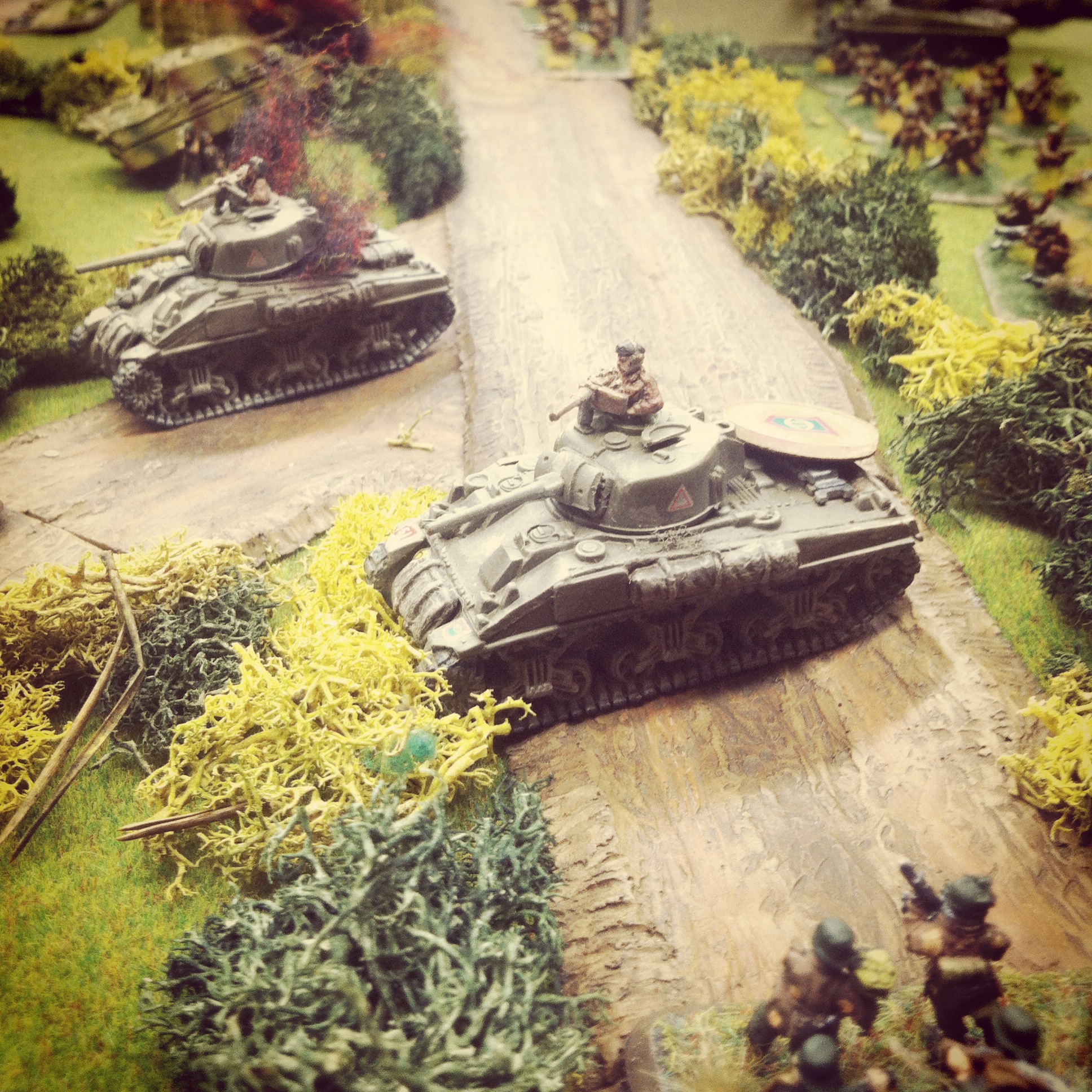
British command tanks move to engage the Germans

IMG_3036

A swarm of German armor and troops push forward under British artillery fire

IMG_3037

A Panzerfaust lights up a British command tank

Hoping for a hard push of combined arms on the German right, British command tanks followed by two platoons of infantry pressed forward from a nearby woods. The British tankies proved to be tough, surviving a turn of fire from nearby Stugs and an attempted infantry assault with  Panzerfaust-wielding infantry as British guns continued to range in and rain shells on the Germans to no effect.

IMG_3038

The lone surviving command British tank awaits its fate from the German onslought

Back at the center of town, the last tank platoon took fire from the 88s, PaK 40s and a Panzerfaust in the church steeple and was destroyed. The one lone command tank on the western outskirts of town was surrounded and destroyed by combined tank and artillery fire. With only the remnants two rifle platoons and the Vickers left spread through the town, the game was lost for the British. As the sun set in the west, Aalst remained in Axis hands.

In our discussion after, the British artillery had only been effective only about 50% of the time and only eliminated a few units throughout the game. Too many British tanks burned too quickly against overwhelming crossfire from German guns, and reinforcing British infantry could never make headway beyond Aalst’s crossroads. More British tank platoons with Fireflies might have gone a long way toward at least pushing through the town.

Fortunately for the people of Aalst, the engagement during Market Garden resulted in the liberation of the town by the British. Pictures from the victory show a very different outcome from our game with smiling faces all around. The very nature of wargaming sometimes just makes things go a different way, and this past weekend the dice rolled against the tide of history with a victory for the Germans at Aaalst.