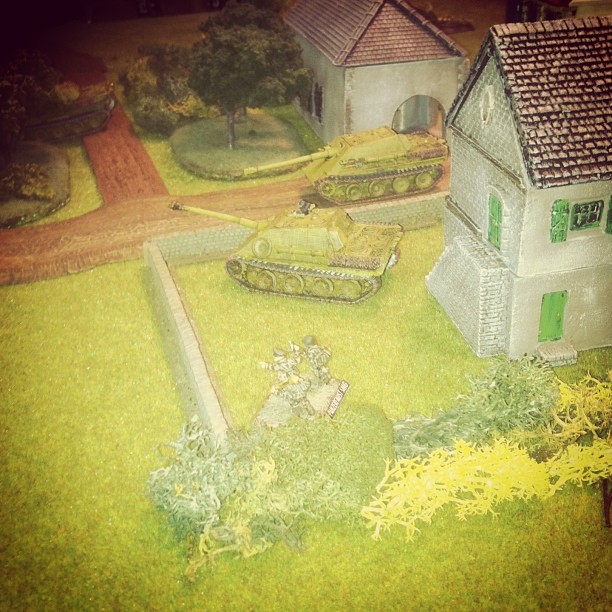
Flames of War: Fielding the FOW Cromwell and Firefly Tank

dratsBy the time of the Normandy Invasion in June 1944, the British 7th Armoured Division had already seen plenty of war. The division first distinguished itself early in the war in the dusty North African campaign, going brutally head-to-head with General Erwin Rommel’s tough Afrika Korps and earning the nickname “Desert Rats.” In the mid-war invasion of Italy, the division adapted to the southern terrain of Salerno and Naples and helped in securing the Allied push northward.

cromwellA British Cromwell in WWII Europe

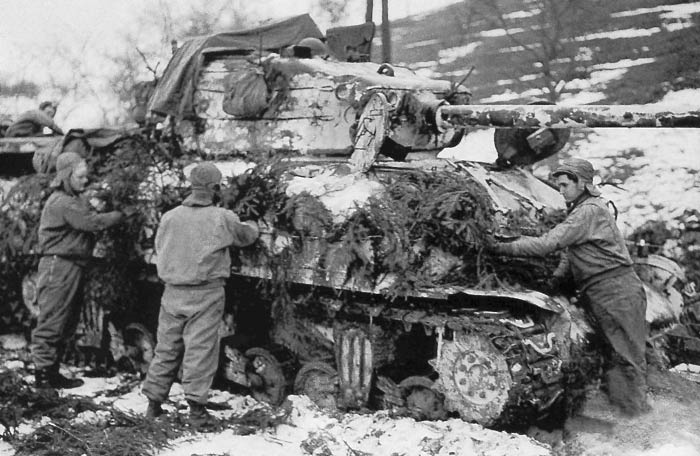
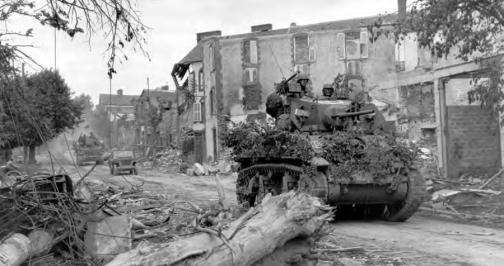
fftankSherman Firefly on a street during WWII

Back in the UK following its successes in Africa and Italy, the 7th Armoured rested and retrofitted with new Cromwell and Sherman Firefly tanks in preparation as a follow-on force in the D-Day landings in mid-1944. Over the next six months, the division’s 75mm-armed Cromwells and 17-pound-gunned Fireflies were present during Operation Perch, Operation Goodwood, the Battle of Villers-Bocage, Operation Spring, Operation Bluecoat, Operation Cobra and the final pushes into the Low Countries and Germany. By the war’s end, the battle-weary Desert Rats had cemented themselves as one of the most celebrated divisions in World War II.

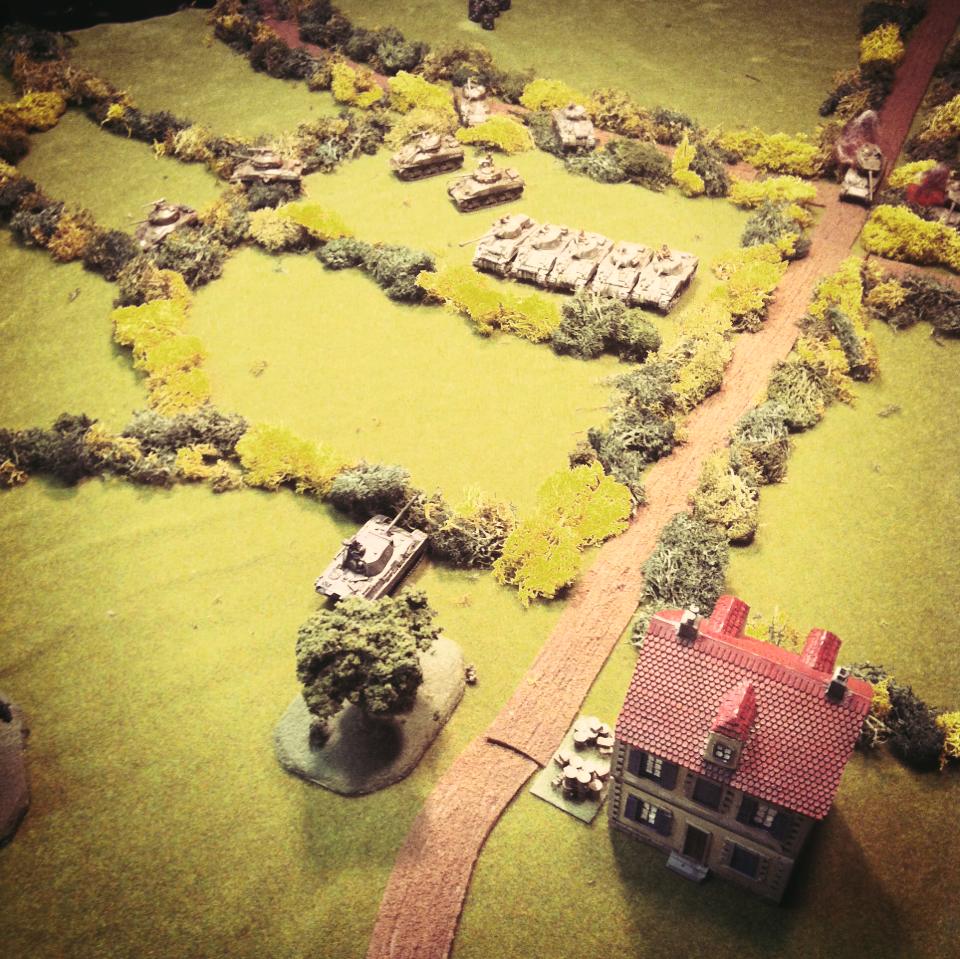
fowcromwellAfter being introduced to British Armoured forces with the excellent plastic Sherman and Firefly models included in Flames of War Open Fire! box set, I’ve recently swung some significant focus on building-out a decent amount of UK late-war forces. Modelling the storied 7th Armoured Division seemed like a logical next step in bringing the UK to my Allied forces on the table.

Through some serendipity, I happened to score a couple of half-price box sets of the FOW Cromwell Armoured Platoon from a fellow club member at Metropolitan Wargamers in Brooklyn, NY. Between the two boxes, I’ve been able to assemble a company command of two Cromwells plus two platoons of three Cromwells and one Firefly each. The models feature individually-cast resin tanks, each with their own detail of stowage and ragged camouflage, along with cast metal treads, gun barrels, crew and other details. Compared to curvaceous US Sherman tanks, I also really enjoy the flatter hull profile and boxy riveted turrets on the Cromwells. Although pricier than alternatives from makes like Plastic Soldier Company and Command Decision from Old Glory Miniatures, official FOW models are generally hard to beat for their heft and historical accuracy.

IMG_2334Primer and base coat on treads and stowage

After assembly, my models were hit with a green armor base coat. Tank treads start with a black coat followed a slight wash of metal. Tools, stowage, ropes and the other stuff on the tanks all get a mix of built-up layers of browns, greens and metallic colors. I especially liked the tiny tennis rackets strapped to a couple of the tanks, a nod to the British gentlemen who came to Europe not only equipped for war but for hopeful yet unlikely leisure pursuits. These details really create a lot of depth, interest and personality among the tanks which can otherwise get very visually redundant en masse on the table. Finally, the exposed crews get a a bit of brown-drab uniform color and some flesh tones to finish off those brave Brits.
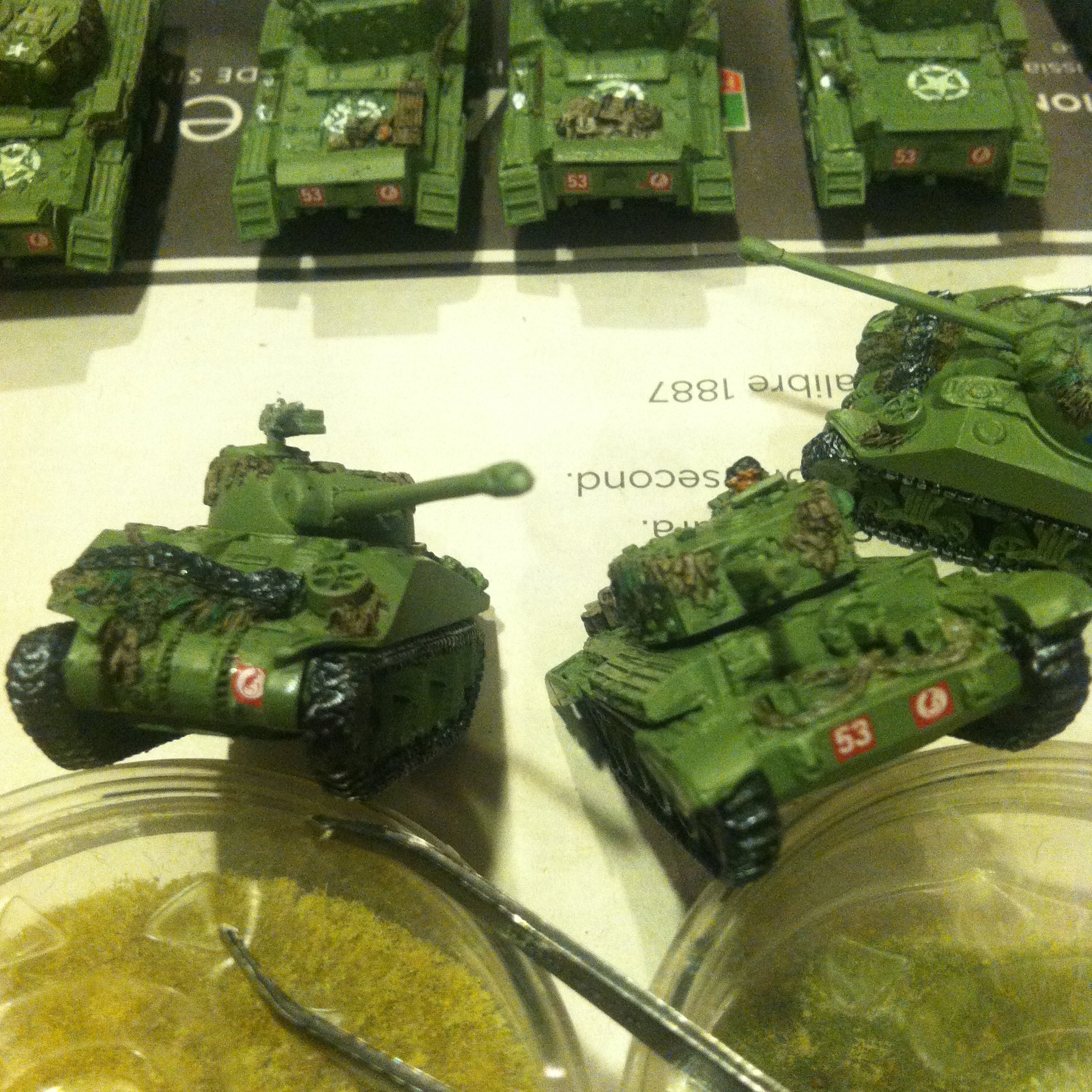
IMG_2344Decals being applied (grrrrrr….)

I do have to say, the red-and-white Desert Rats vehicle marking has a really big cool factor for me. The FOW kits conveniently come with appropriate decals for the 7th Armoured Division, making finishing off the tanks one step easier than with competitor model-makers that don’t generally supply decals with their models. That said, I find the FOW decals to be incredibly finicky and fragile, and I found myself re-applying several to get them on just right. Once the decals are dry, all the tanks got splashed with mud here and there with some earthy dry-brushing.

IMG_2350Cromwell command section

IMG_2352One platoon of three Cromwells and one Sherman Firefly

IMG_2354Cromwell close-up

IMG_2356Sherman Firefly close-up

In terms of gameplay, I can’t wait for the 7th Armoured Division to go up against some Germans. The combined one-two punch of the faster-moving Cromwells and the hefty-gunned Fireflies should reinvigorate my games away from the sameness I’ve had in just playing with my large group of US Shermans for a couple years. Already, I want more of these platoons to really get the division bulked-out. I’m thinking a follow-up with Cromwells and Fireflies from the Plastic Soldier Company will supplement the finished FOW models nicely. Until then, the 7thArmoured are ready to roll and there’ll be more to report soon on my post-D-Day British force project.
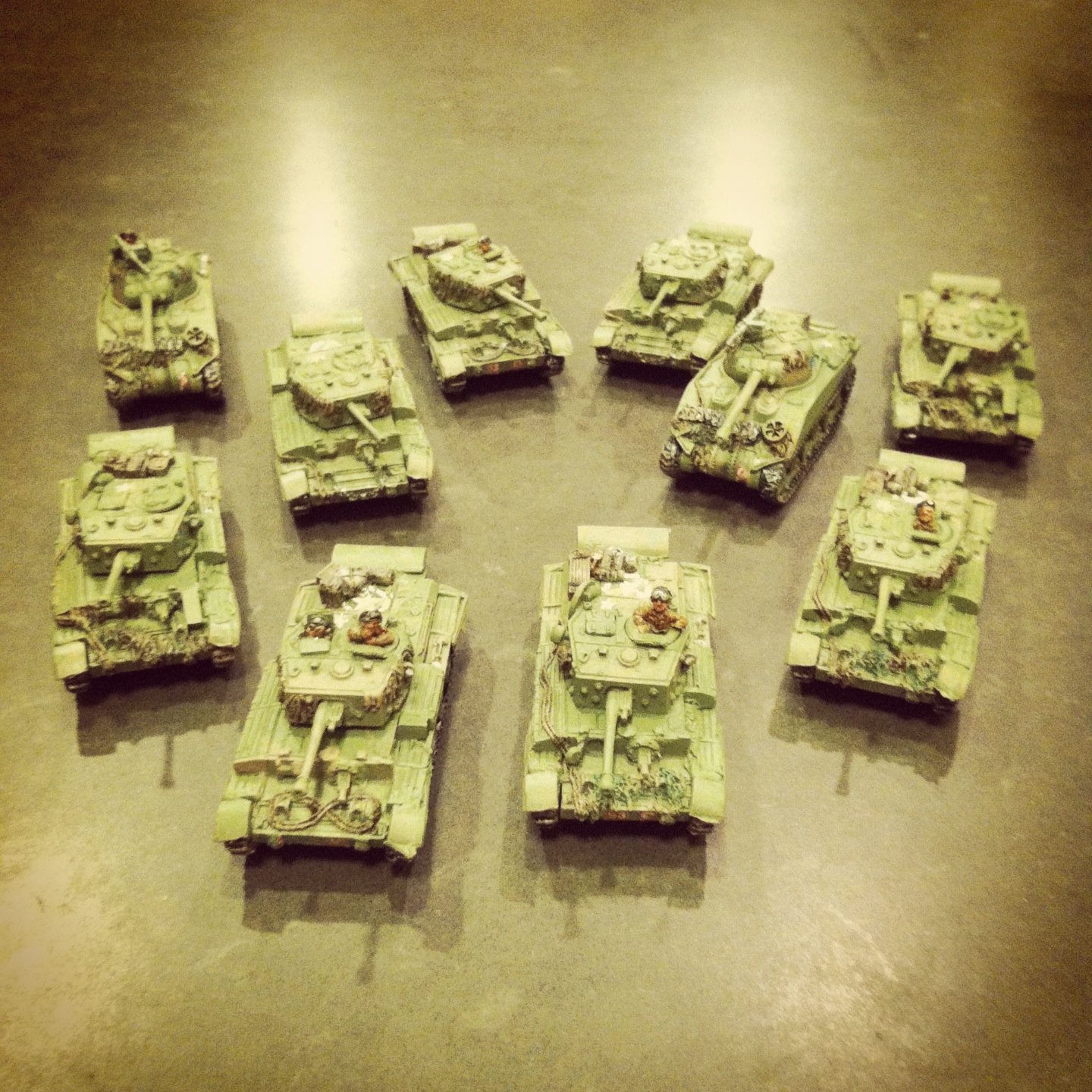
IMG_2348The Desert Rats ready for action in France and beyond…

Related articles

Flames of War: Sint-Oedenrode 1944 Scenario

StOAB

Like many cities in the Low Countries, the Dutch city of Sint-Oedenrode was occupied by German forces after their invasion of France, Belgium and the Netherlands in the spring of 1940. The southern Netherlands and Belgium were the area of focus for the Allied Operation Market Garden in September 1944 which hoped to take several river crossings before the push on to Germany. At Sint-Oedenrode, the famed US 101st Airborne Division seized the bridge over the Dommel River but were met with a counterattack by German Fallschrimjäger regiments and other supporting forces. The battle that would take place at the crossing of the Dommel was typical of the action of the Allied push along what became known as Hell’s Highway. While Market Garden would ultimately prove to be a fiasco for the Allies overall, the grateful people of Sint-Oedenrode were liberated by US troops after a week of brutal fighting against the German occupiers.

StOMap

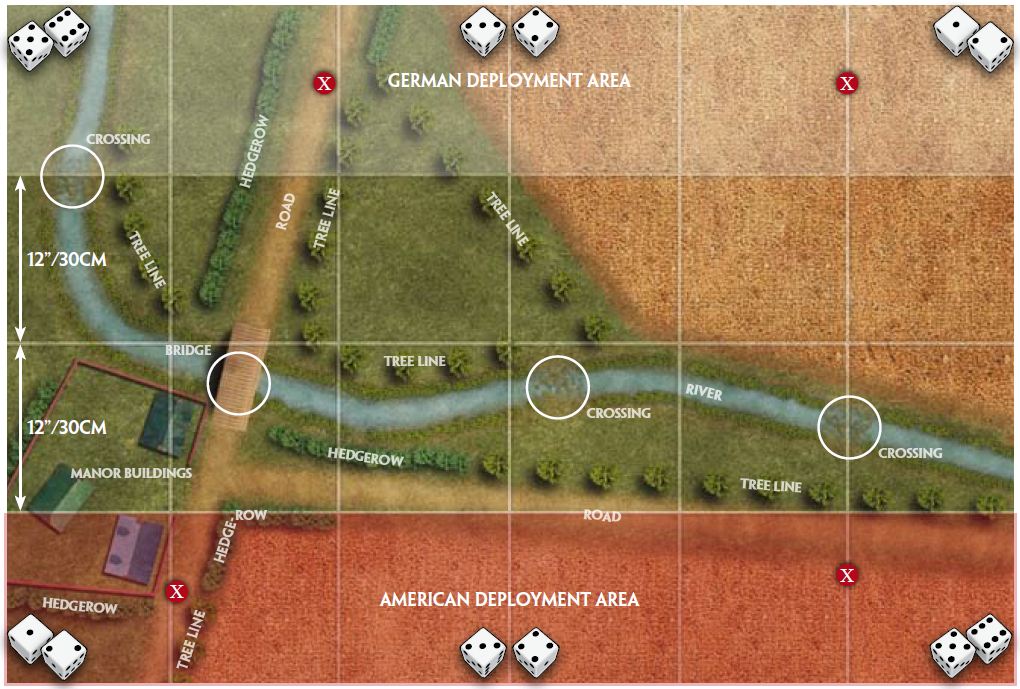
The Flames of War website has a scenario for the engagement at St. Oedenrode available in their list of historical scenarios on their website. The forces in the scenario were originally covered in the now out-of-print Hell’s Highway and A Bridge Too Far FOW books now available as Market Garden for the US, UK and Canadian forces and Bridge By Bridge for the Germans.

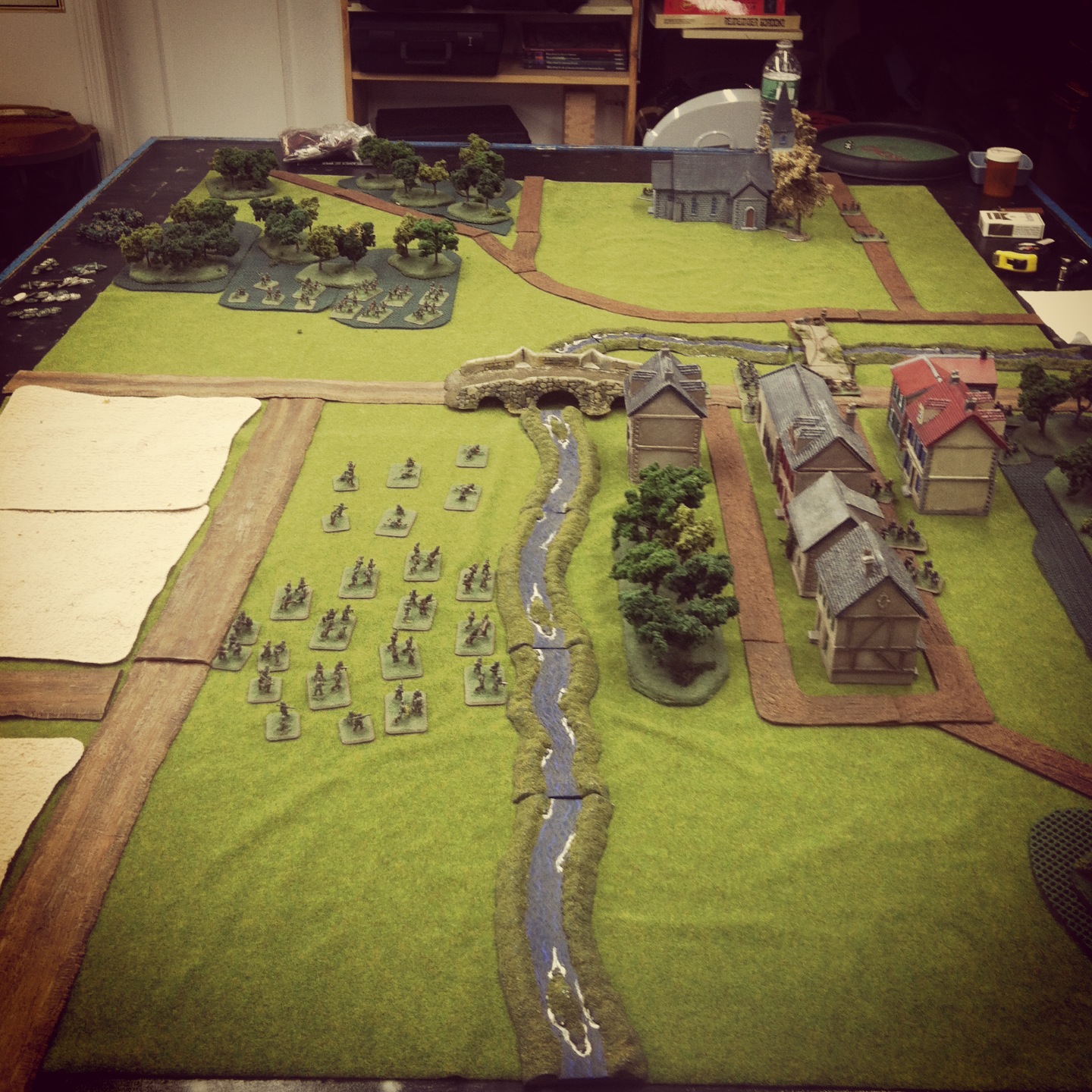
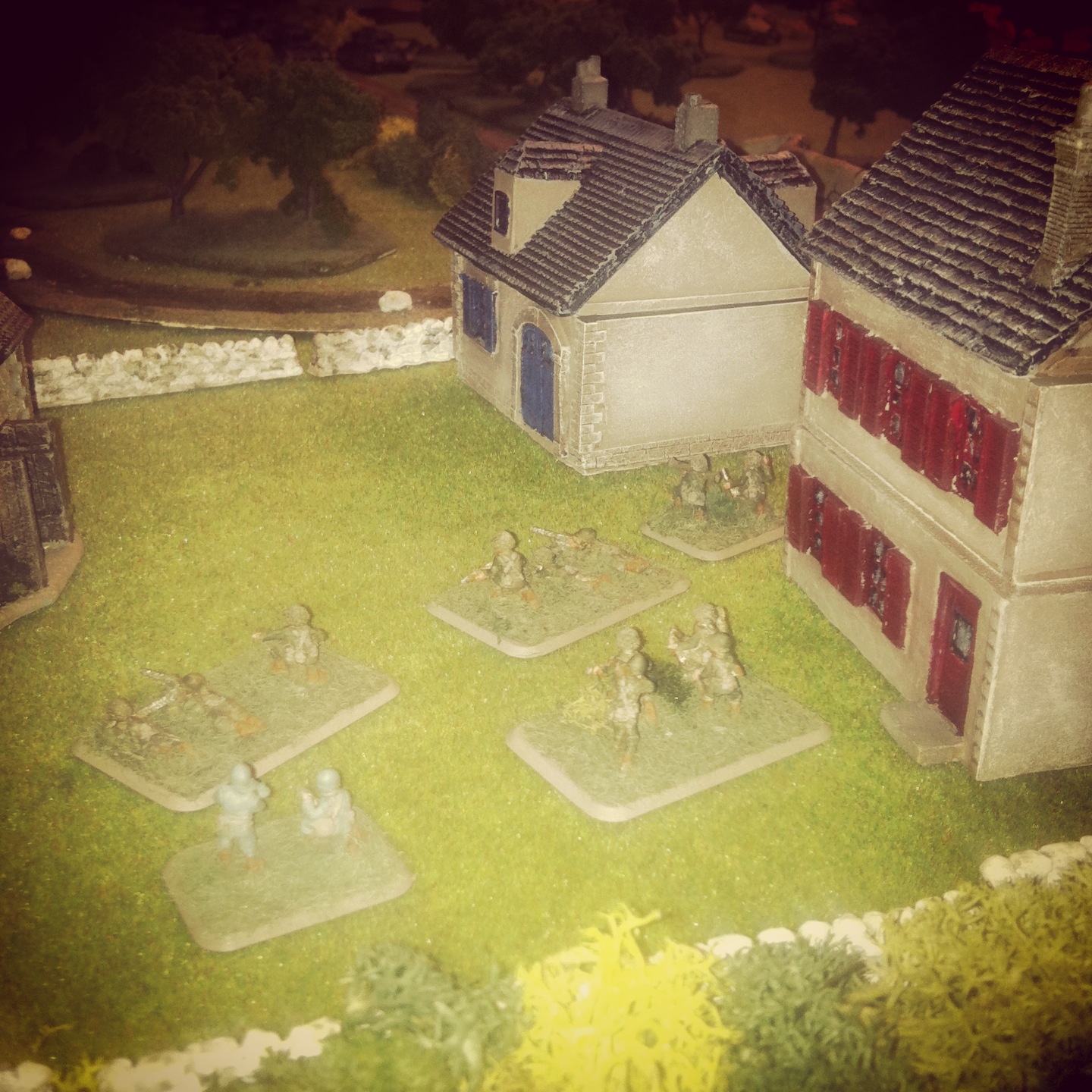
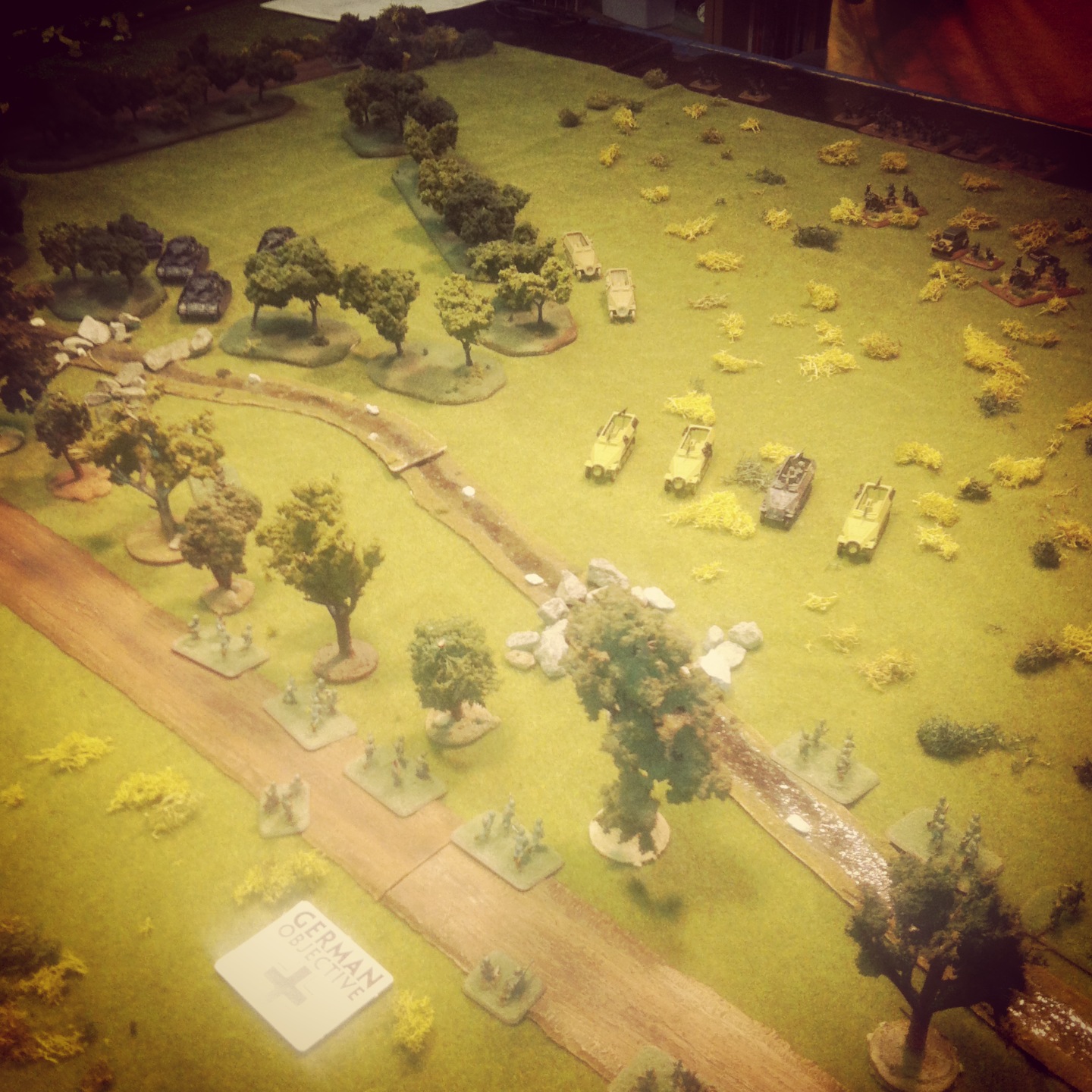
This past weekend at Metropolitan Wargamers in Brooklyn, NY we ran a modified Sint-Oedenrode scenario with the US 101st Airborne facing off against the German Fallschirmjägers. My paratroopers deployed in the fields and woods across the river with two rifle platoons and a light machine gun platoon. In reserve were US mortar and parachute howitzer platoons along with a delayed reserve Sherman and Firefly tank platoon from the Guards Armoured Division. The Germans started defending the two objectives at the bridges with a mortars, heavy machine guns and a rifle-machine gun platoon dug in around the town buildings.

IMG_2324In the first two turns, the Airborne units made way for the river and first bridge while avoiding shots coming from the defending Germans. The US light machine guns poured fire into the houses across the river, but shots missed on all accounts but did manage to pin the units. With little US progress toward the objectives, my German opponent remained solidly in control of the bridge points in the early third of the game.

IMG_2322By the third turn, the Germans successfully rolled on their a reserve rifle-machine gun platoon as well as their PaK 40 anti-tank guns. While the US lacked tanks of the board, the US platoon crossing the bridge took heavy combined arms fire from the German artillery outside of the town and the infantry platoons hidden among the town’s houses. Another US platoon made their way across the Dommel, through a small wood and attempted a quick assault on the Germans defending from the nearby buildings. Under heavy fire, the US charge was repulsed with some losses pushing them back into the treeline.

IMG_2326With the Airborne rifle companies pinned on the bridge and in the  trees over the river, I finally threw a successful roll for reserves on the fourth turn and brought in my mortars and howitzers. Firing at a distance from the fields, all my artillery missed their hard-to-hit German targets hidden in the buildings across the river. The platoon on the bridge took an additional round of combined German fire and fled the field. The US light machine guns to one side of the bridge likewise encountered heavy fire, finding themselves pinned and still unable to effectively knock the Germans from their defending positions in the town.

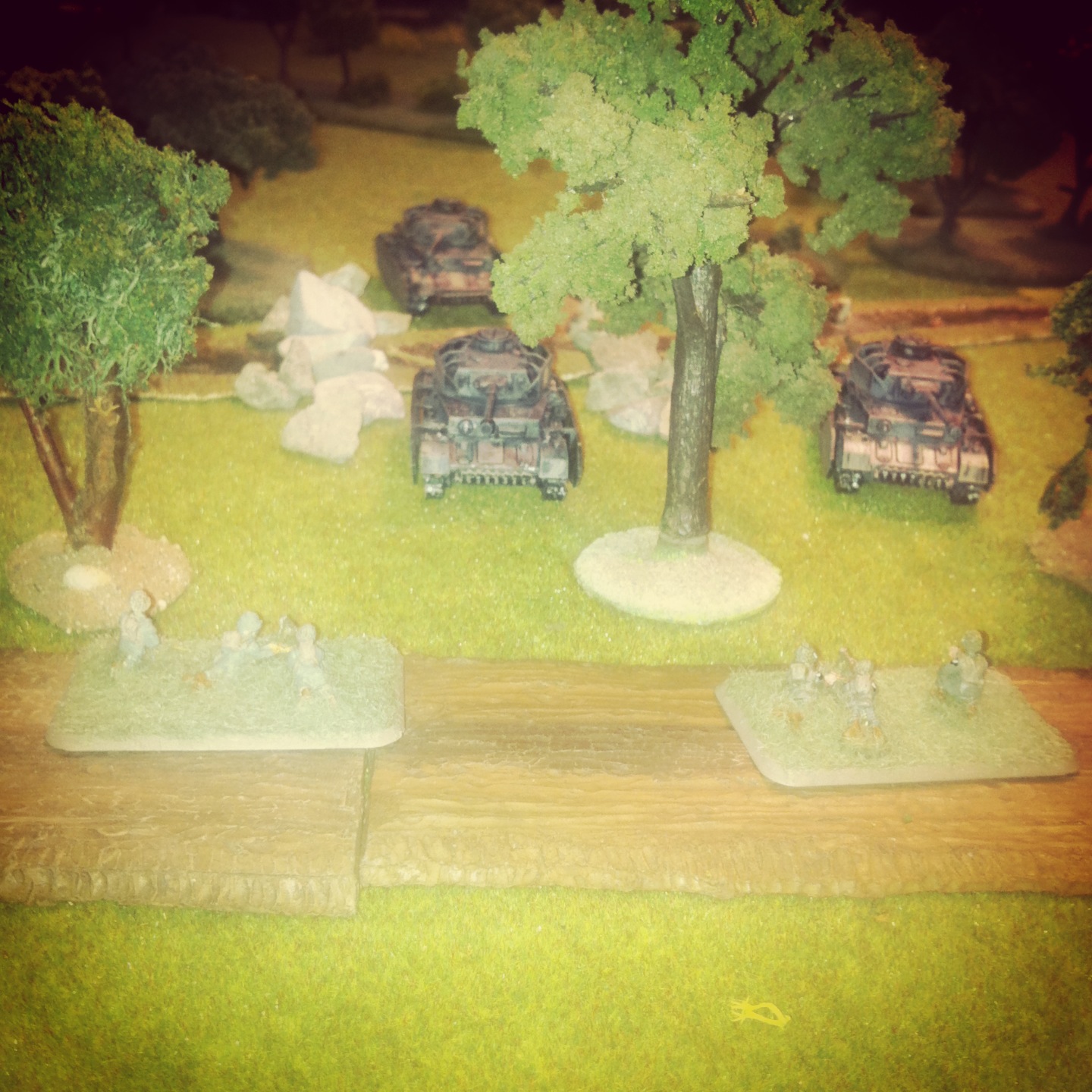
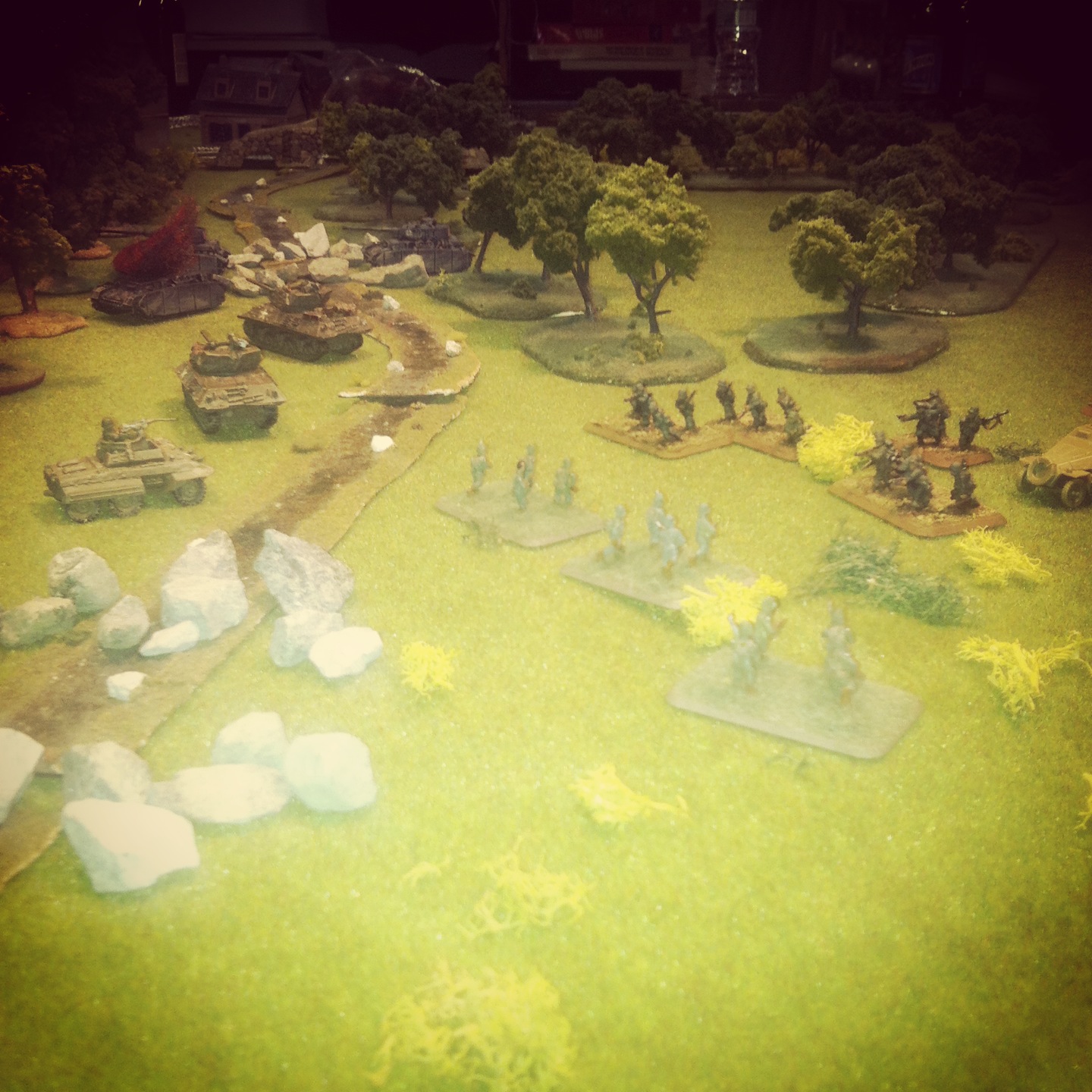
IMG_2328By turn four, things went from bad to worse for the Allies. With the Guards Armoured forces finally rolling in, they did quickly take out one of the German anti-tank guns. This was unfortunately quickly answered with two Allied tanks being destroyed with return fire from the crack shots from the German PaK 40s. With the beginning of the fifth turn, the US attempted a final series of artillery barrages and tank fire to chase the Germans from the town. Still at nearly full strength, the Germans had clearly overwhelmed the US and I conceded the game.

Even without their Panzer IVs on the table, the German position within the town proved hard to route. In retrospect, a concentrated Airborne end-run over the river and through the town might’ve proved more effective in chasing the Germans out of their defending positions near the bridge entry points. A lack of armoured and artillery reserves until late in the game also left the 101st outgunned and running on their own as German reserve strength mounted. Luckily for the Dutch people of Sint-Oedenrde things went much better for the Allies in 1944, but my replay of the attack just didn’t go my way this day.

Flames of War: Fielding the PSC German Heavy Weapons and FOW Artillery Command

ger8cmmortar

After focusing on my Flames of War (FOW) Allied forces for a while, I decided to throw some energy back into beefing-up and diversifying my late war Germans. Although my German troops seldom see play, getting some infantry punch on the table led me to a number of mortar and other support weapons platoons the FOW rules offer.
Battlefront, the maker of FOW, has a number of good platoons which run anywhere from about $12-20 each. Having recently tried my hand at the Allied Stuart Tank set from the growing line of 15mm WWII kits from the Plastic Soldier Company (PSC), I spotted the Late War German Heavy Weapons box. At around $25, the set looked to be an excellent and economic way to get a lot more German infantry on the table at perhaps a quarter to one-third the cost of the official FOW models.

pscgerhw

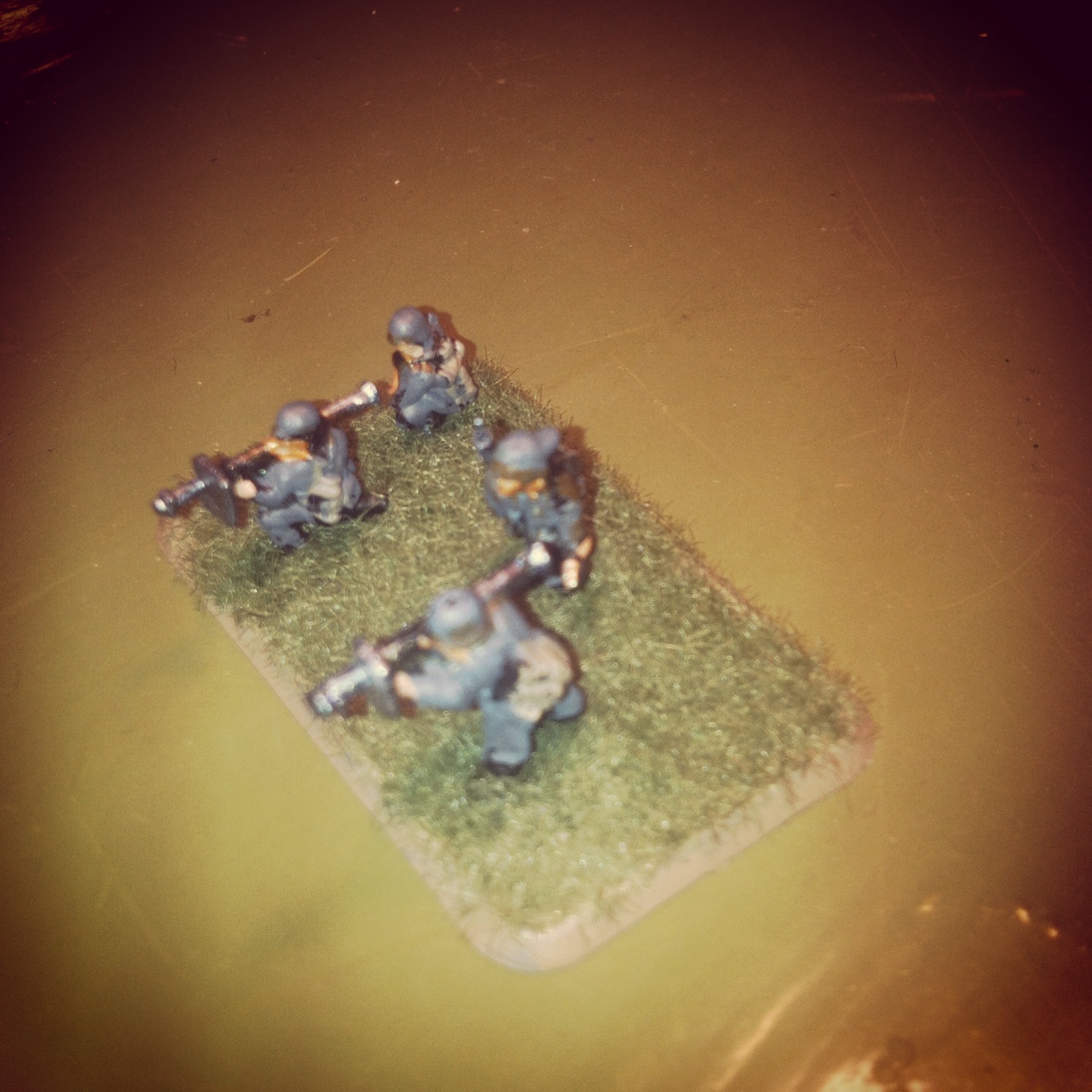
The PSC box comes with four MG 42 teams, four 8 cm mortar teams, four 12 cm mortar teams, eight Panzerschrecks and eight Panzerfausts. Also included are four Panzerschreck loaders and four ammo carriers. With about 70 bits on the sprues, this set was going to add a lot of action to my already extensive German infantry collection.

pscgerhwsheet

Cutting out and gluing-up the tiny pieces from the PSC sprues is a bit of nerve-racking task harkening back to my early years wrangling with assembling soft plastic HO scale Airfix soldiers. That said, following PSC’s simple assembly diagram (above) and keeping all the parts carefully organized on the workbench is key to getting the job done right and not losing anything along the way. Flames of War rules call for basing Panzerschreck teams in groups of four miniatures per medium stand, allowing for four total teams to be constructed from the PSC set with two Panzershrecks plus a loader and ammo carrier per team. The 8 cm mortar and MG teams likewise went on medium bases and the big 12 cm mortar teams were glued-up on larger bases. I had a few extra plastic FOW Germans on hand from a bonus promotional sprue I received from the Open Fire! box set, and adding those to the 12 cm mortar stands helped finished those off.

artycmdhw

With a bunch of new mortars in the field, I also needed to add some additional command and spotters to make them playable. FOW offers an artillery command headquarters blister pack which I added to the mix. The set comes with enough models that I was able to create three two-man spotting teams, a few command stands (adding in Panzerfausts from the PSC kit) and a nifty HQ vignette with a four figures surrounding a table with a radio operator.

IMG_2214

Painting Germans is a simple process for me with a base spraycoat in flat black followed by a darkish grey uniform and details picked out in flesh, blacks, browns and gun metal. The stands get finished off with some simple grass flocking and a matte varnish spray. Getting a consistent finish on the PSC models made them blend in nicely with my FOW models.

IMG_2226

For comparison’s sake, the PSC figures do tend to be a tad smaller and thinner than the typically-chunky FOW figures. Since most my PSC figures are being fielded on separate stands, I don’t see the minor scale differences being an issue at arm’s length on the tabletop battlefield. In addition, the extra poses in the PSC casting add some nice variety and animation in the troops once deployed.

IMG_2224

IMG_2217My FOW German force has long-relied on the strength of deploying large numbers of tanks in my games, so these new additions should be a nice compliment to getting more action from my German infantry. Now that it’s fall, I’m anxious to rush my new PSC and FOW Germans to the tables at Metropolitan Wargamers in Park Slope, Brooklyn and add a new season of playablity to my battleworn forces.

Flames of War: Breakthrough Mission

bocageShortly after fighting ashore and in the iair drop zones on D-Day, the Allies quickly discovered a new enemy awaiting them: bocage.

Lacing the Normandy countryside, bocage was a tight overgrown network of hedgerows of shrubbery, stone walls and copses of trees lining the rural French fields. All but impassable by Allied armor and difficult to fight through for infantry, bocage slowed the push inland and delayed the taking of key objectives. It was only through the quick-thinking and inventiveness of the Allies that new tactics were hastily developed. To free-up the passage of tanks, hedgerow cutters were welded to the front of armored platoons and demolition crews blasted gaps to continue the forward march. Fighting amidst the bocage would prove to be deadly for both sides, as recounted in the 1988 paper by Captain Michael Doubler. It’s required reading for anyone interested in the tactics of bocage warfare.

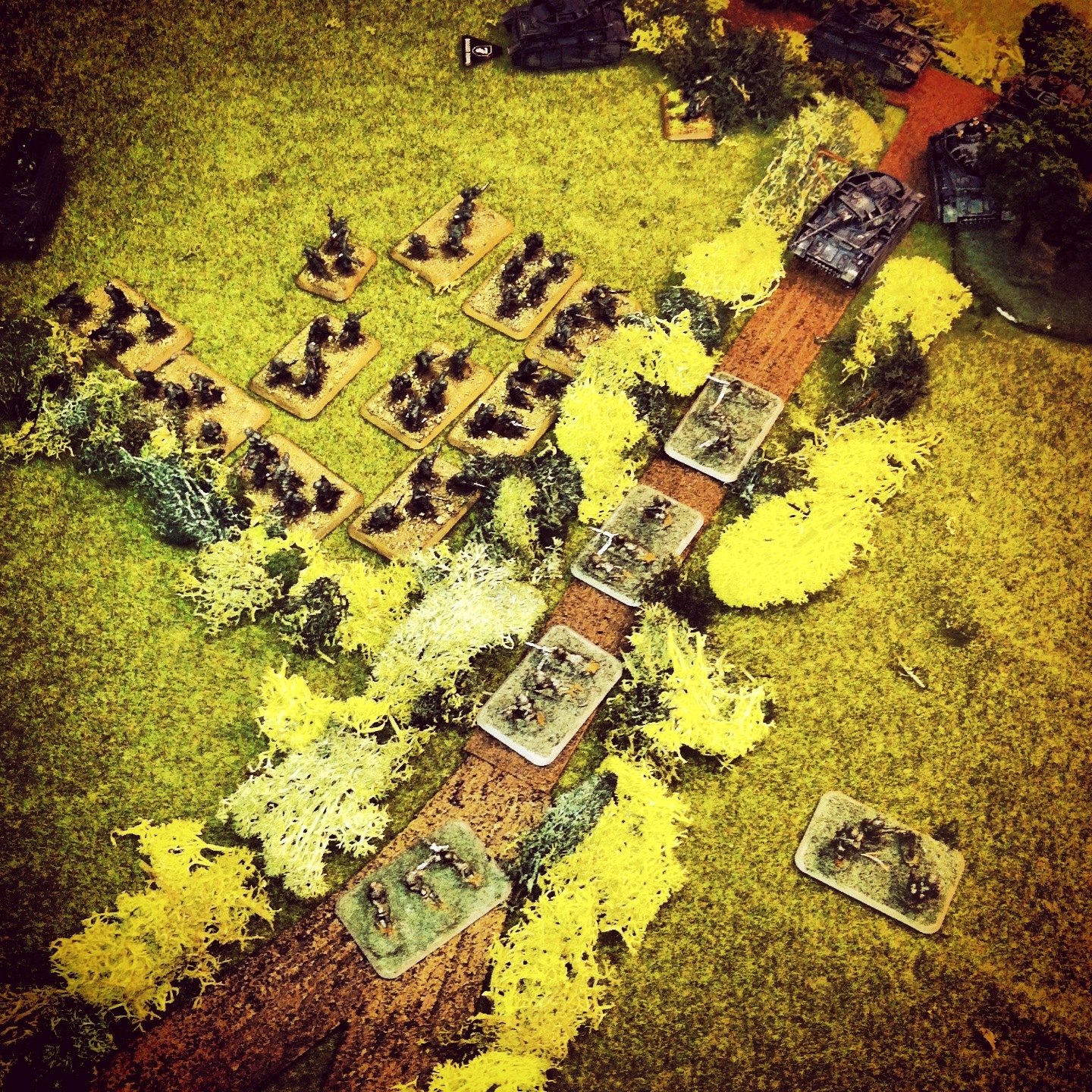
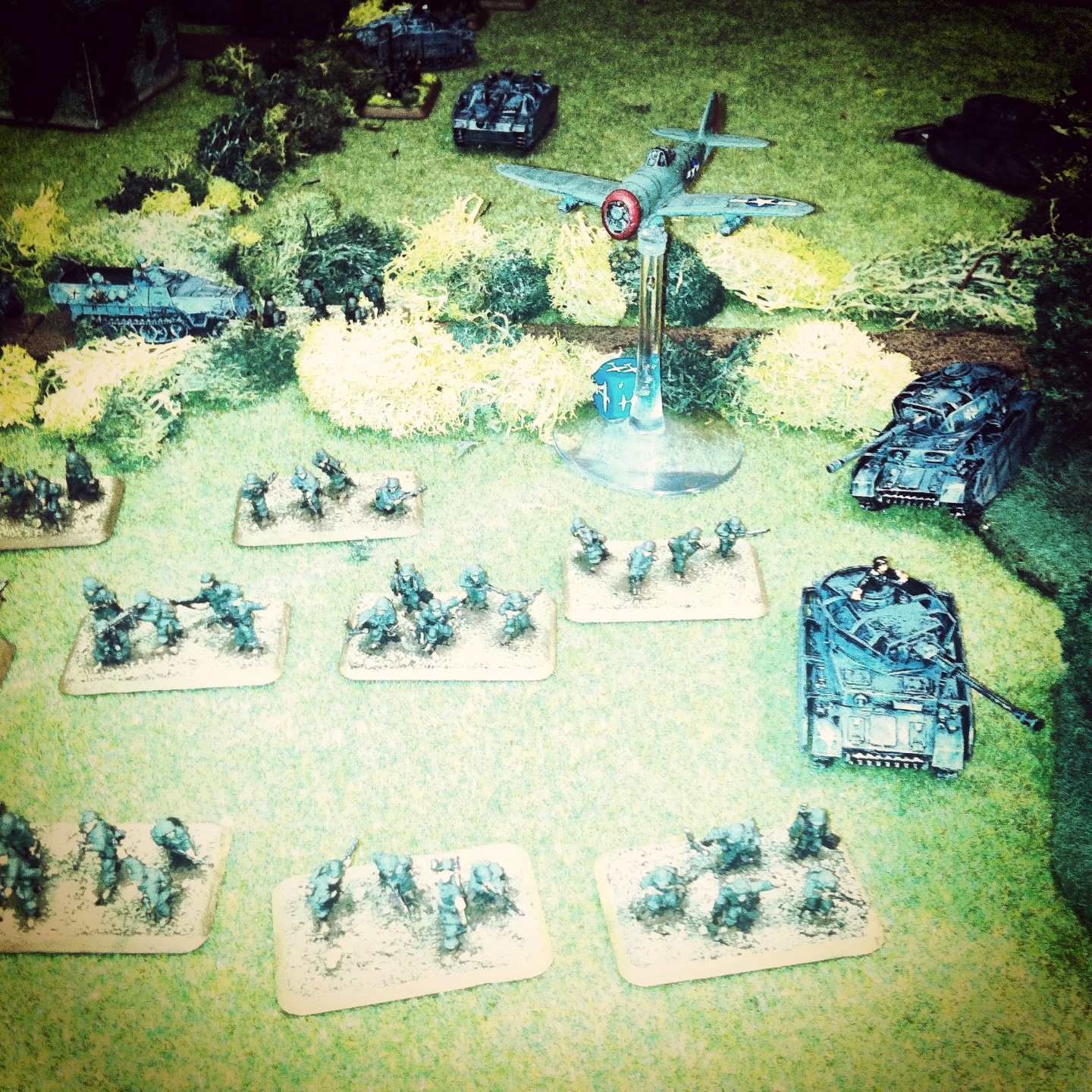
This past weekend at Metropolitan Wargamers in Brooklyn, four of us got together to slog it out in the bocage tabletop of a Breakthrough Mission as provided in the Flames of Wars rules. The mission scenario calls for use of the Mobile Reserves rule for the defenders and the Delayed Reserves rule for the attackers. The Germans chose to field a 1250-point Fallschirmjager company backed with heavy machine guns, a Nebelwerfer rocket battery, Stugs and Pak 40 anti-tank guns plus a 1250-point tank company armed with mechanized infantry, Panzer IVs, Stugs and one imposing Tiger tank. We Americans also fielded two companies beginning with a 1250-point rifle company with three infantry platoons, Shermans, a weapons platoon of light machine guns and mortars and a P-47 Thunderbolt for air support. The other US company was pulled from the 82nd Airborne with a Priest mobile artillery battery and Stuart light tanks. To aid in navigation of bocage, the US armor were outfitted with hedgerow cutters. The Germans had six turns to take an objective and it would be the Americans’ job to stop them.

BTMapThe table was laid out thick with bocage surrounding a small village and a nearby farm. Americans rolled as the defenders meaning all our mobile units — all the tanks and artillery we had — were going to be held off the board as reserves. I hid all my rifle platoons in the town’s buildings and stuck the machine guns and mortars in the field between the Germans and their nearest objective. In the opposite corner, the Airborne platoons deployed near the farm hoping to camp out on the German objectives for the duration of the game.

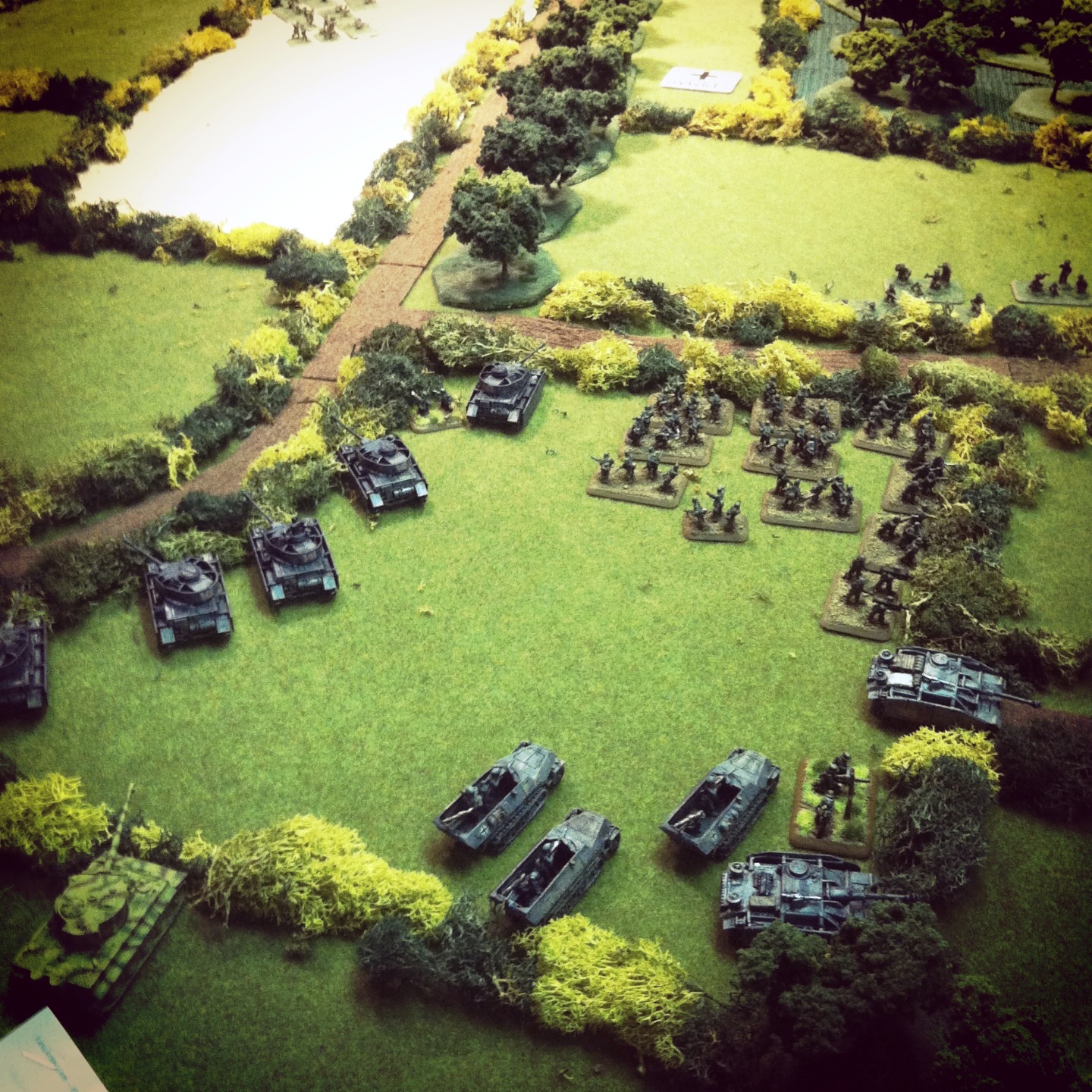
As the attackers, the Germans deployed in their assigned corner of the table. Their rocket battery, anti-tank guns, heavy machine guns and the majority of their infantry dug into the field outside of the town. The large tank company deployed in the adjacent field. Held off-table was a Stug and a Fallschirmjager platoon, hoping for the a delayed reserves roll beginning on the third turn to put them right on top of one of their objectives at the opposite corner.

IMG_2177As the attackers, the Germans got the first turn, quickly pressing their armor toward the center of the table while the rocket battery, heavy machine guns and anti-tank cannons poured fire into the town, pinning one US platoon. Reserves failed to arrive on the first US turn and the P-47’s first run came up empty. As per the plan, the US Airborne pushed into the farm buildings to hold the nearest objective.

IMG_2179

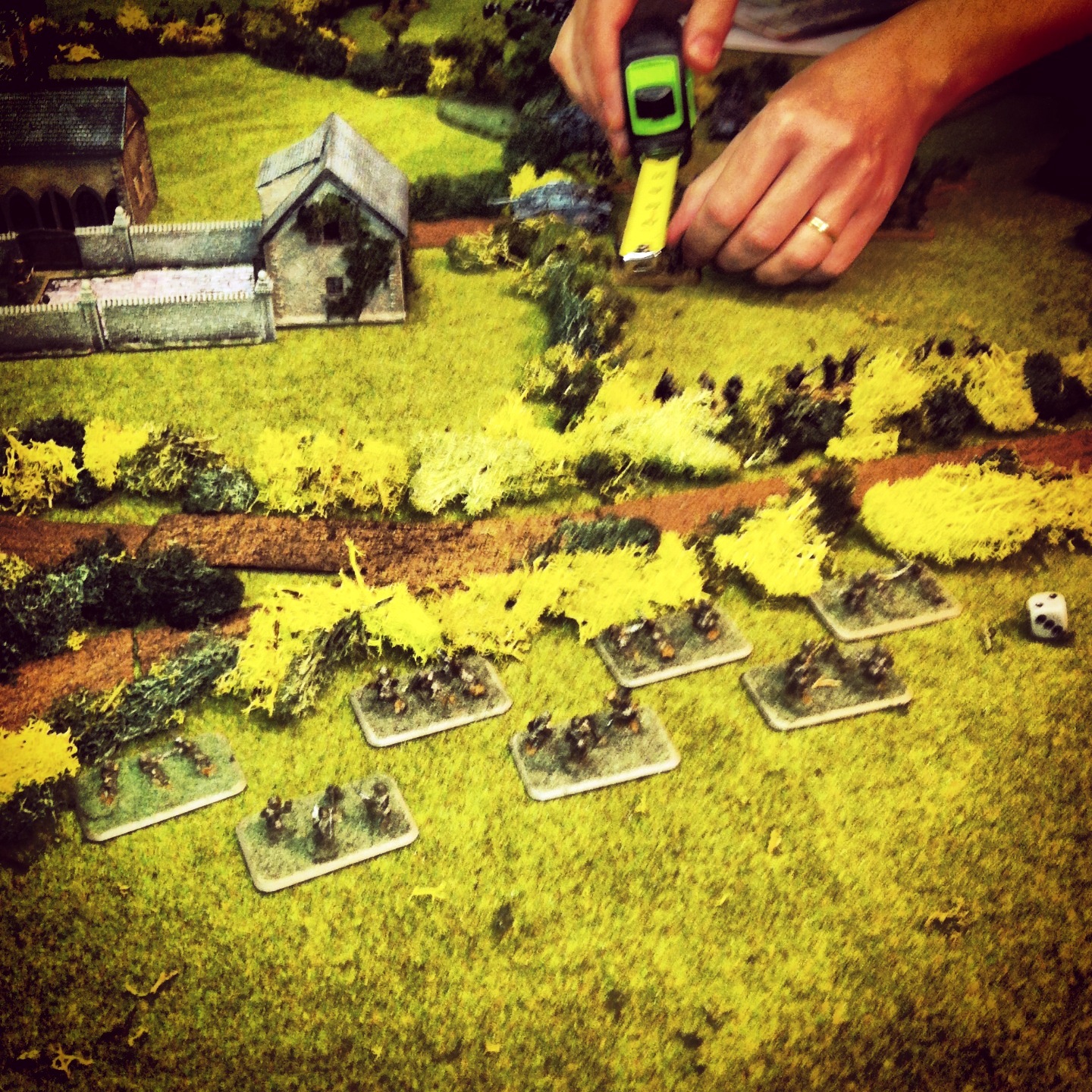
IMG_2181In the second turn, the Germans continued to light up the town with the US companies pinned in the buildings. A Stug opened fire down a lane but the Americans avoided being hit. US bazooka teams moved into the barn at the edge of town and took shots on the a German Stug and approaching half tracks but to no effect. The US machine gunners attempted to fire and then assault the nearing Germans but were thwarted by the thick bocage and failed terror test against a nearby Panzer. The Thunderbolt once again on did nothing its second run while the Airborne units at the farm ran across the road into the treeline, securing the second German objective.

IMG_2183

IMG_2185

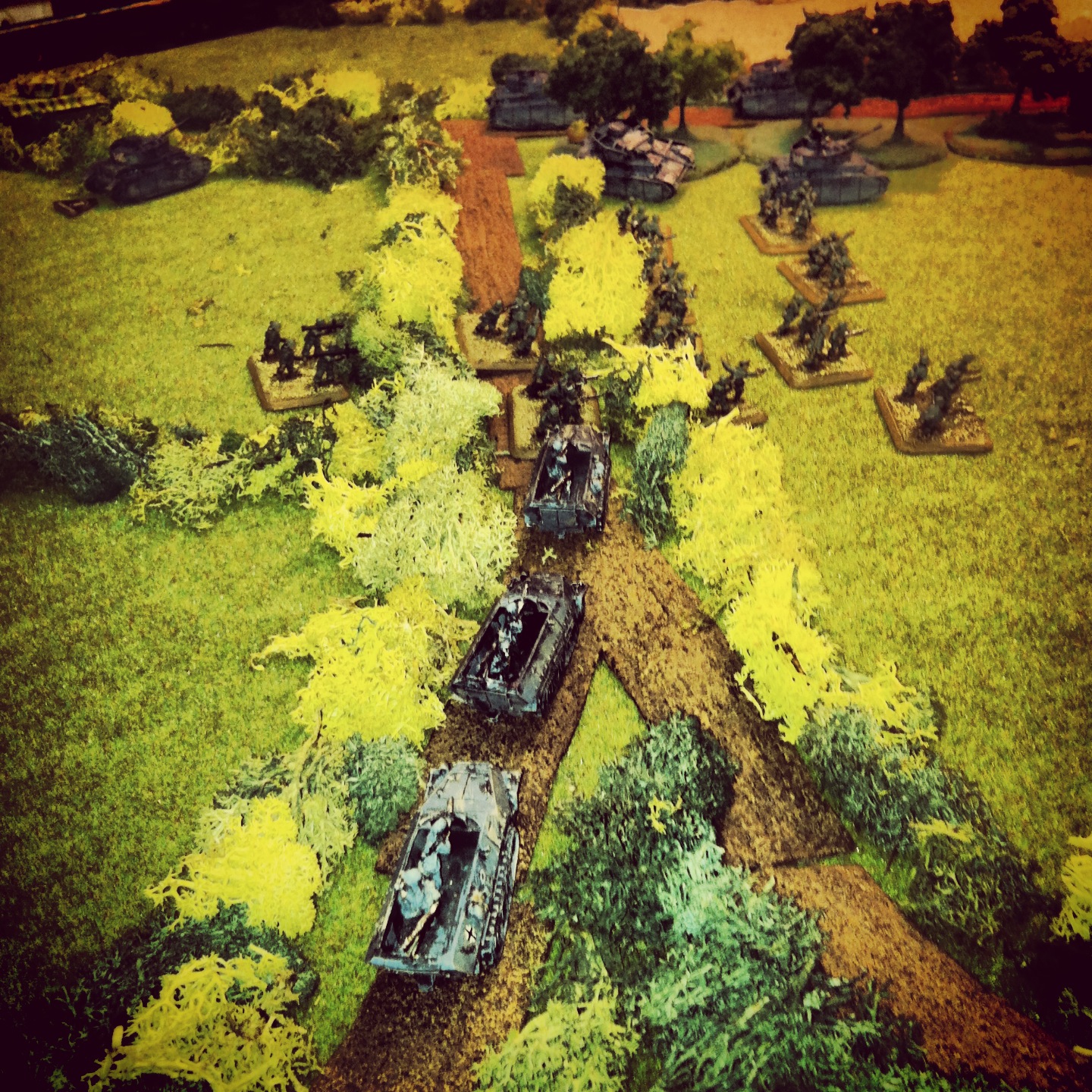
IMG_2191In turn three, the German players thankfully failed their first attempt at calling in reserves. Pressing on, German half tracks raced through the town toward the American weapons platoon which took heavy casualties and lost the machine gunners to fire from both sides. Stugs and artillery continued to pound the American rifle platoons in the town. At the top of their turn, the Shermans arrived and made a hasty path to cut a hole in the bocage standing between the rest of their reserves and the nearby road.

IMG_2185

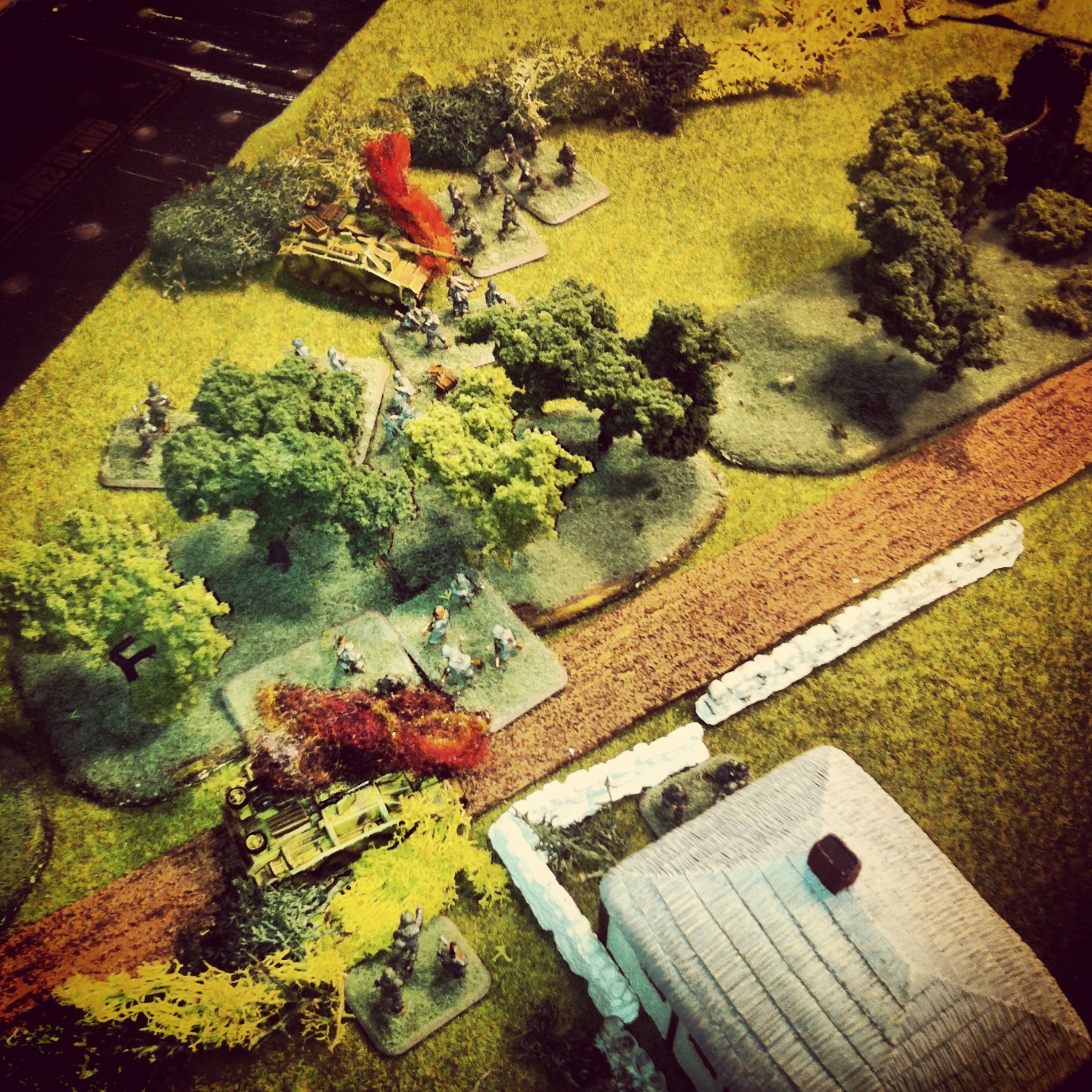
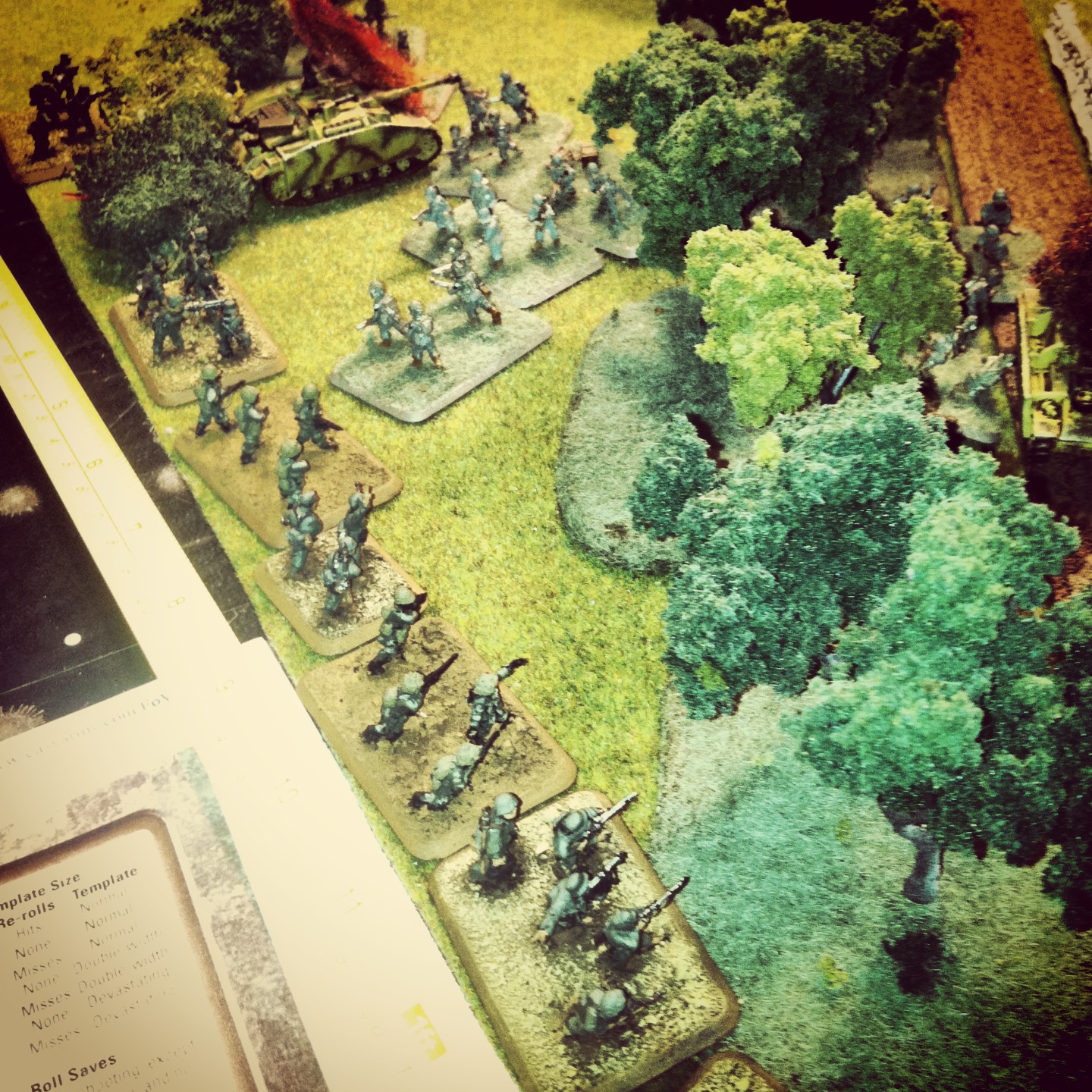
IMG_2189Things really heated up in turn four as the Germans rolled on their first reserved Stug platoon near one of the objectives and the awaiting US Airborne. German infantry and Panzers pushed into the next field, knocking out the US mortars and eliminating their first platoon. The Americans pulled in the rest of their reserves but immediately created a bottleneck of Shermans and Stuarts as paths were cleared through the bocage. The P-47 came in hard on the Germans in the field, knocking out several units and destroying a Panzer. Finally, the fearless Airborne did what they’re trained to do and burst from the treeline to assault the newly-arrived Stug platoon. Two Stugs were destroyed and the third fled the field after a failed morale test. The objective was still held by the Americans but things were looking dicey with Germans coming in from all sides.

IMG_2196

IMG_2187

IMG_2198

IMG_2193

IMG_2200The fifth turn started with the final German reserve platoon arriving amid their burning tanks and assaulting the US Airborne. Through a series of attacks and counterattacks, the two groups whittled each other down. The Germans were eventually ground down to two remaining stands, lost their morale check and were destroyed. The victory for the Americans was short-lived, however, and the heavily-damaged Airborne platoon also failed a morale save and likewise fled the battle. With the game nearing it’s end, a Sherman was destroyed and blocked the road. All the US armor and artillery was effectively shut-out of the game. As the Germans covered an objective, the American P-47 made one final run to force a German morale check but to no avail. The Germans had won the day.

IMG_2208

IMG_2210There were a number of things that had gone wrong for the Americans. The rifle platoons never got out of the town, contributing almost nothing to the battle. Had they hauled their way toward the forest in the middle of the board, pressure would been greater on one of the objectives. The restrictions on the reserves also hurt the Americans, with nearly half their force never getting a chance to get in the fight. The US Airborne were typically deadly in their assaulting enemy armor and ground troops and proved to be the one positive for the Allies. On the German side of the table, much of its large armor platoon, including the Tiger, was sidelined for much of the battle as they navigated the hedgerows and roads.

The game was a new experience for one of the German players who typically games in the wide-open spaces of the Northern Africa theater from earlier in the war. As in 1944, bocage played the role of a third unmovable enemy on the table. The bocage was frustrating for all players but this time sided more with the Germans in their breakthrough victory.

Flames of War: La Fiere Causeway 1944 Scenario

lafiere1944

In the late evening of June 5th and pre-dawn hours of June 6th, 1944, a steady flow of Allied paratroopers began dropping throughout the French countryside to clear the inland way for the D-Day beach landings to come later that morning. Like elsewhere, scheduled US Airborne drops near Sainte-Mère-Église left paratroopers scattered around the countryside. To the southwest of the town’s target area, a contingent from the 82nd Airborne found itself near a quaint French farm compound and a small bridge over the Merderet River. Recognizing the river crossing as a key defensive line, the assembled paratroopers established a perimeter along the river. A few hours later, the US troops were met by a German Grenadier and armored battallion hoping to stall the Allied invaders from moving inland. The battle that erupted at the river would rage for three days until the German force withdrew in time for the arrival of US infantry and Sherman forces rolling in from Utah Beach on June 9th.

causewaygamemap

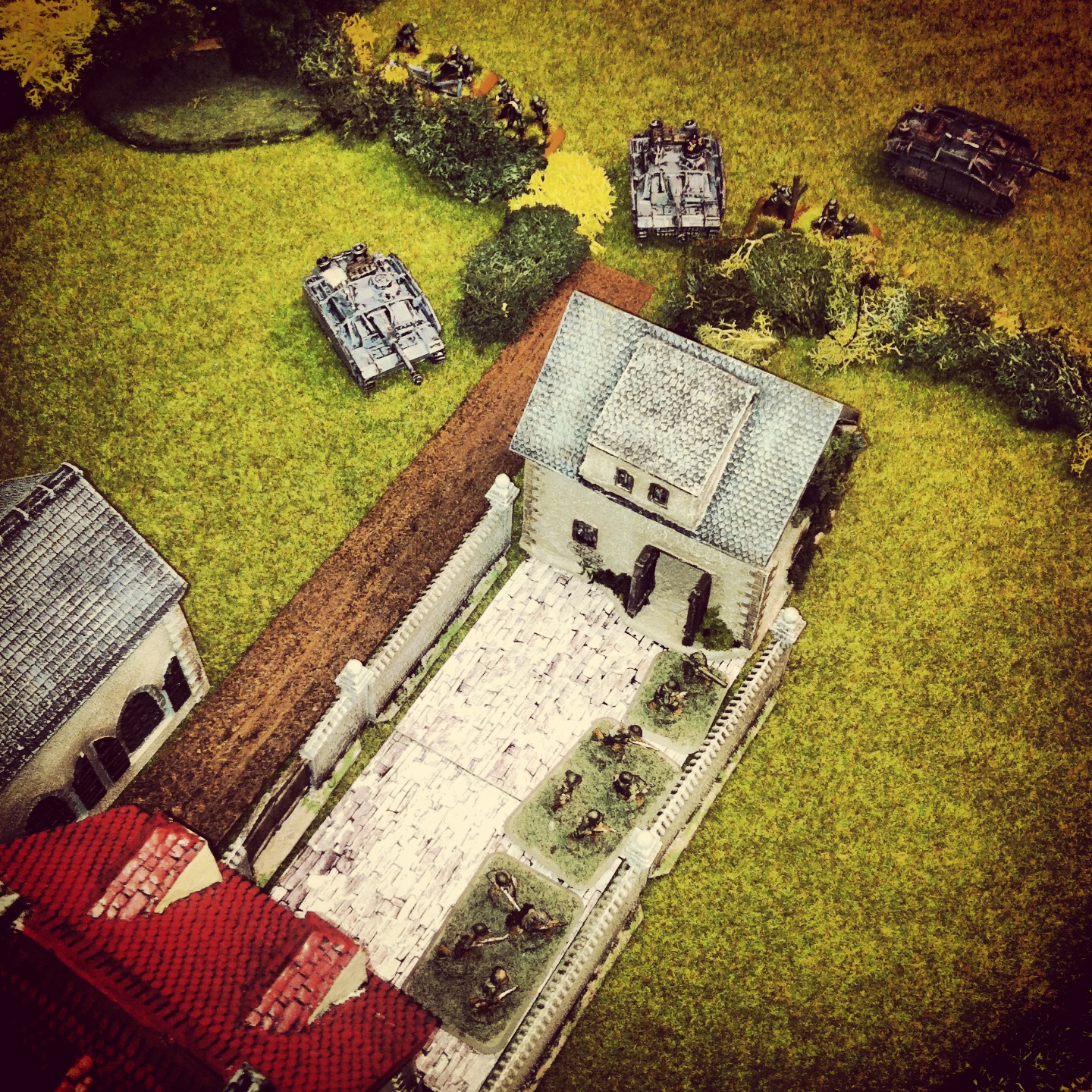
The Flames of War website offers a basic scenario of the encounter at La Fiere Causeway suitable for 1500 point forces on either side. This past weekend a visitor to Metropolitan Wargamers and I had a go at the scenario with my US Airborne facing off against his Germans. As with the historical record, my force held closely to the scenario’s outline with two parachute rifle platoons with plenty of bazookas supported by a platoon of light machine guns, parachute engineers, a glider artillery platoon and M18 tank destroyers. On the German side of the table, my opponent lacked the primitive French tanks that historically fought at the battle. Instead, he filled his force with a number of Grenadier platoons mounted in half tracks backed by two small platoons of Panzer IVs and a Nebelwerfer rocket battery.

IMG_2161

IMG_2163

As per the scenario rules, each of us chose half of our platoons to be held in off-table reserve. Beginning with the Germans, we alternated deploying our starting forces on the table. My American engineers took up position in the courtyard of the farm on my left flank, the machine guns lined the hedge on the other side of the bridge and a rifle platoon deployed on my far right flank. As expected, the Germans deployed a tank platoon at the road entry point and the rocket battery and a mounted Grenadier platoon in the field on their left flank.

IMG_2165With the Germans taking the first turn, the first Panzer IV platoon made way for the river crossing at the middle of the table while the half tracks rolled for the ford on the American right flank. Deployed in and around the farm buildings, the US engineers quickly laid down mines at the foot of the bridge and an Airborne platoon crossed the river to meet the approaching Grenadiers and the rocket battery beyond.

IMG_2169

IMG_2167With turn three, German tank and Grenadier reserves appeared on the table edge opposite the farm and pointed their way toward the French buildings and the nearby bridge. Four US bazookas bailed one Panzer in the clearing across  the river but three other Panzers made it across at the middle ford. US tank destroyer reserves came on the table and immediately poured machine gun fire into the half tracks across the river. The Grenadiers bailed from their transports and the half tracks raced to the rear while the Nebelwerfers failed to score effective shots in the hearty US Airborne troops.

IMG_2171With the Grenadiers on the run back to defend the rocket battery, the US tank destroyers turned their attention on the Panzers and quickly destroyed one while the others continued to push on unharmed due to the protection of their side Schurzen armor. At the farm, the approaching Panzer and Grenadier platoons exchanged fire with the engineers and riflemen defending behind the stone walls. Even with heavy casualties, the engineers repelled a direct assault by two Panzers as a fresh rifle platoon rushed to reinforce the farmyard strongpoint.

Alas, by the fifth turn the game was effectively over for the Americans as the late-arriving US howitzers once again failed to hit in one final volley against the Panzers rushing to seize the objective. The Americans had chased both Grenadier platoons from the field and destroyed a couple Panzers, but the Airborne focus on defending rather than seizing objectives allowed the Germans to take the table.

At the game’s outset, both of us shook our heads with the difficult mission ahead of us. The Airborne never effectively engaged in a close-quarters assault that might’ve taken out more of the tanks sooner on in the game, and artillery on both sides contributed nothing to the game. As with the last few FOW games I’ve played, the engagement at La Fiere once again pointed out the strength and tactical importance that infantry played in WWII. Keeping men moving and in the fight is key to victory, and this time around the German troops got the better of the day.

Flames of War: Fielding the PSC Panzer IV Tank

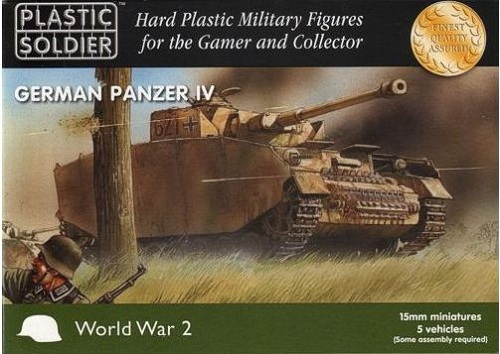
pniv

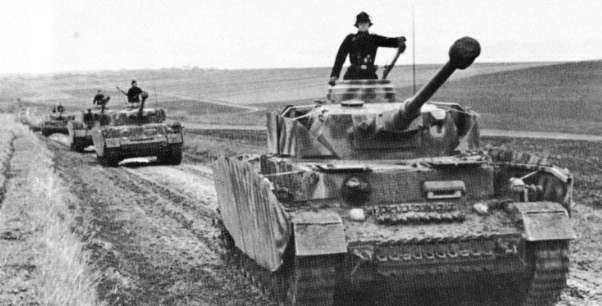
One of the greatest military impressions Germany left on the face of warfare during World War II was in its feared armored forces. The famed Tiger I heavy tank gets a lot of the glory for its independence and near idestructability, but the Panzer IV medium tank served as the real backbone of German armored forces throughout the war. With improvements to its armor and gunnery made throughout the war, the Panzer IV would prove to be a tough nut for the Allies to crack until very late in the war. Especially in the period from the D-Day landings through to the Battle of the Bulge, the Panzer IV played an ever-increasing role in attempting to stymie the Allied advance right up until the eventual fall of the Third Reich in the spring of 1945.

FOWpzIV

pscpziv

I already own a fair amount of German armor with Tigers, Panthers, Jagdpanzers and Stugs, but my force was sorely lacking in Panzer IVs. Most of my German tanks thus far have been from Battlefront, the makers of Flames of War (FOW). They offer a late war Panzer IV platoon in the pricey $50-60 range, depending on whether you pick the set up online or in a store. Going on some recent experience with the PSC Allied Stuart tank set, I went with the Panzer IVs from the Plastic Soldier Company (PSC) at about half the FOW cost.

pscpzivsheet

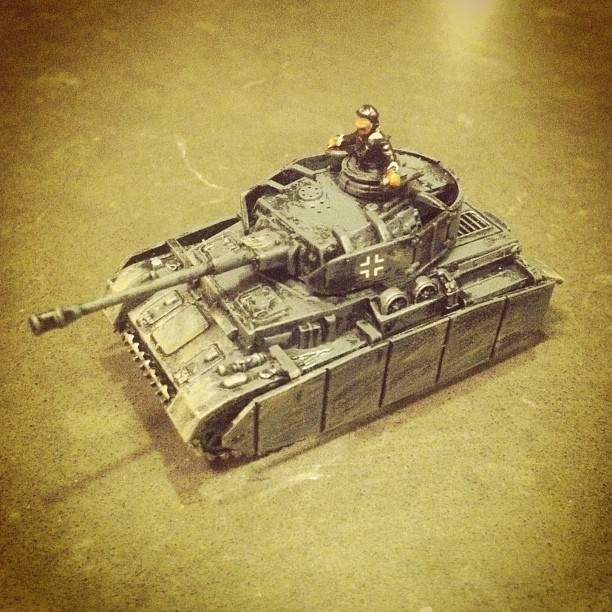
Unlike the FOW sets, PSC kits come with options to model miniatures in several periods. This allowed me to model my tanks as the later war Panzer IV Ausf H with its extra armor and gun power. Like the Airfix kits of my youth, the PSC tanks are comprised of lots of little parts. The diagrams included in the box offer clear color-coded keys to getting the correct pieces off the sprues and blow-up schematics for gluing the pieces together. If you’re like me, keeping your workspace clean and organized will prevent you from losing your mind during the multi-step assembly process. The sprues also leave some leftover parts which either go straight into the trash or into container of miscellaneous plastic for future modelling use.

Lots of parts means lots of steps. The turrets alone are compromised of 9-10 parts and aligning the tank tread sections needs to be done carefully. I also found the hole on which the turret sits to be a bit tight, so I carefully drilled those out slightly larger. My Panzer IVs were completed with a basic grey-schemed paint job over a flat black spray base to match my existing models. With assembly, painting, decals and a matte finish finishing coat, these tanks are ready to hit the table in just a couple work sessions.

Compared to FOW models, the PSC tanks take a bit longer to put together and parts can be finicky, but I really like the PSC models when complete. The PSC tanks offer crisper molding and some fine details like a slight sag in the upper parts of the treads and hangers for the  side and turret Schurzen. Models are light, making for easier storage and transport. Putting together kits from PSC just feels a lot more like model building than what you experience with FOW and some other manufacturers.

pzivcommand

pzivplatoon

With so much economic pressure on miniature wargame funding budgets, you can’t beat getting more armor in the field for the low cost and fine results from the Plastic Soldier Company’s Panzer IV kit.

Flames of War: Modelling European Western Front Buildings

153770I got into miniatures wargaming through a combined set of interests I developed as a kid: history, role-playing and scale modelling. One of the aspects of gaming I enjoy is setting up a realistic and engaging tabletop battlefield, both for the visual effect but also to reproduce the playable advantages and challenges found in waging scenarios within scenery.

I’ve been searching high and low for an affordable and well-made set of buildings to add to my 15mm Flames of War World War II gaming set in the post D-Day Western Front. Battlefront Miniatures, the makers of Flames of War, launched their own series of buildings last year. The pre-painted buildings are beautiful, albeit a bit too perfect and pretty expensive at $40-50 each. Miniature Building Authority (MBA) has been a long-time producer of fine pre-painted buildings. Like the structures from Battlefront, MBA models feature removable roofs but also convert into ruined bombed-out versions. At $40-50 for single large buildings or for pairs of smaller ones, the MBA buildings are also pretty pricey. MBA keeps a small line in stock, but they have dozens of out-of-production models which you can also find at conventions and occasionally online. JR Miniatures is another standby in the industry, but I find their relatively low-priced line of buildings is a bit of a mixed bag in terms of casting and playability.

markivWith building up my gaming real estate on my mind, I posted to the message boards at The Miniatures Page. Some suggestions pointed to the above manufacturers, but several posters also mentioned Mark IV Miniatures. The company is run by Jeff McCarron, a second-generation gaming modeller out of Colorado who obviously puts great care and passion into his work. McCarron sells his models directly and distributes them through Musket Miniatures, and I found him to be incredibly responsive to a couple questions I had before ordering. As it turned out, a fellow member of Metropolitan Wargamers had recently picked up the large church model and a couple houses from Mark IV. After playing with his models during our big Summer FOW event and Barkmann’s Corner scenario at the club, I decided these were the buildings to sink an investment into.

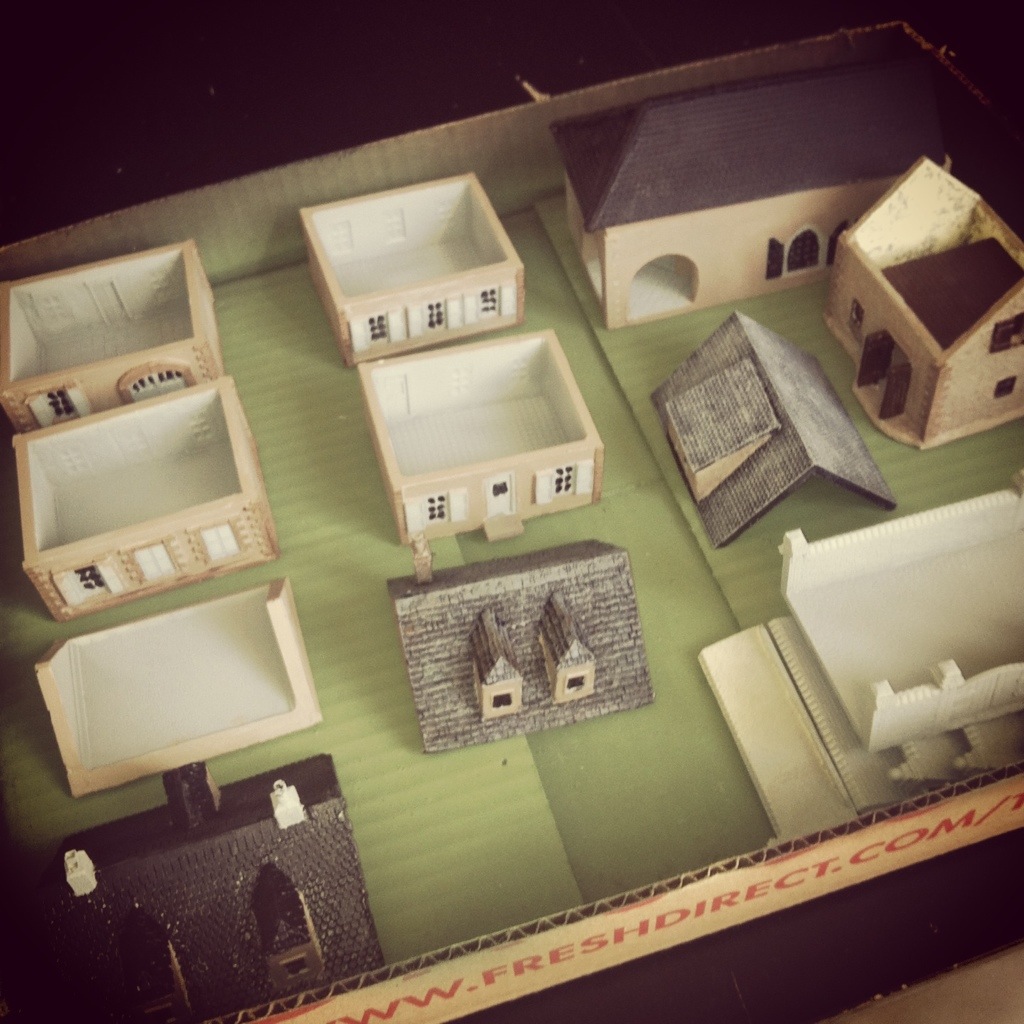
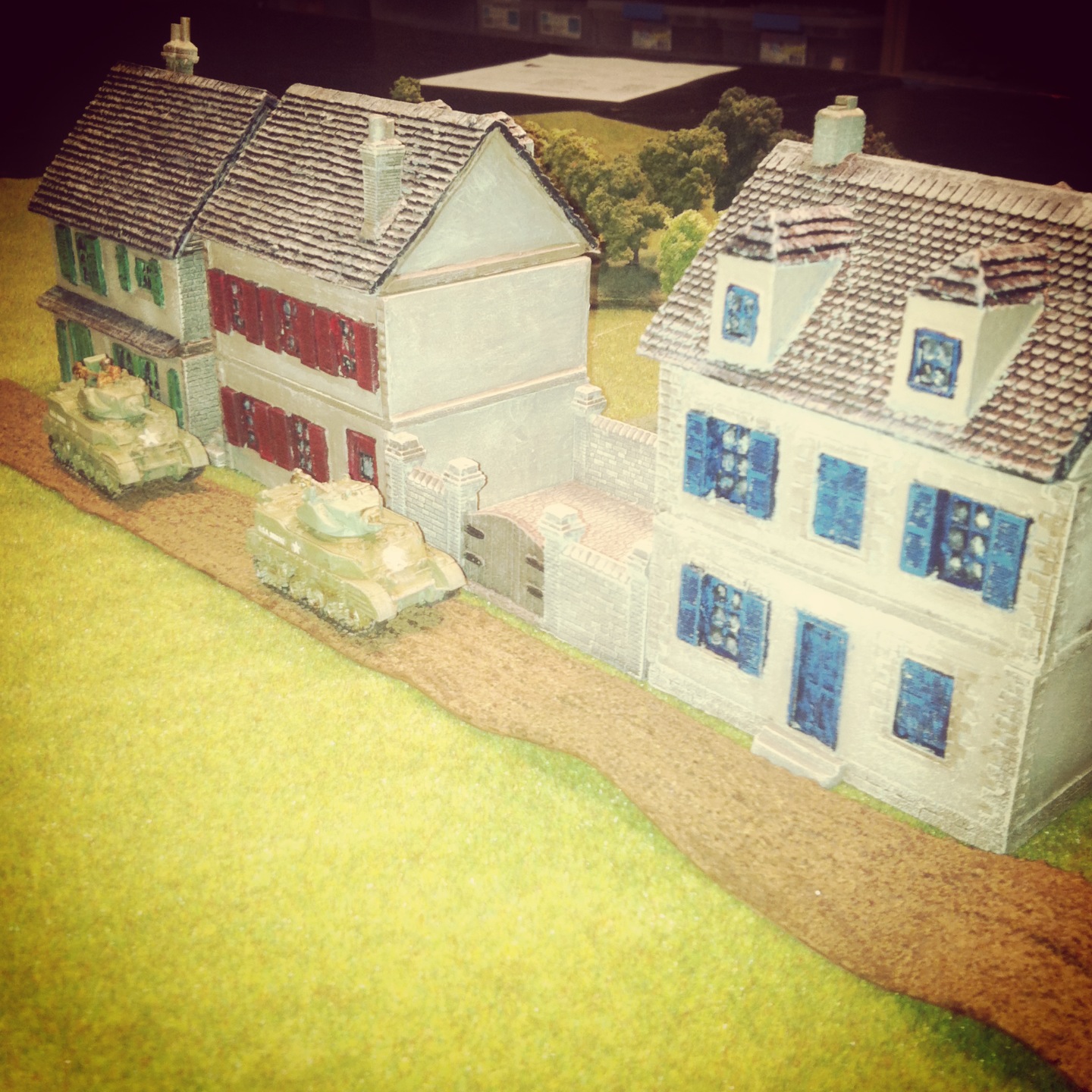
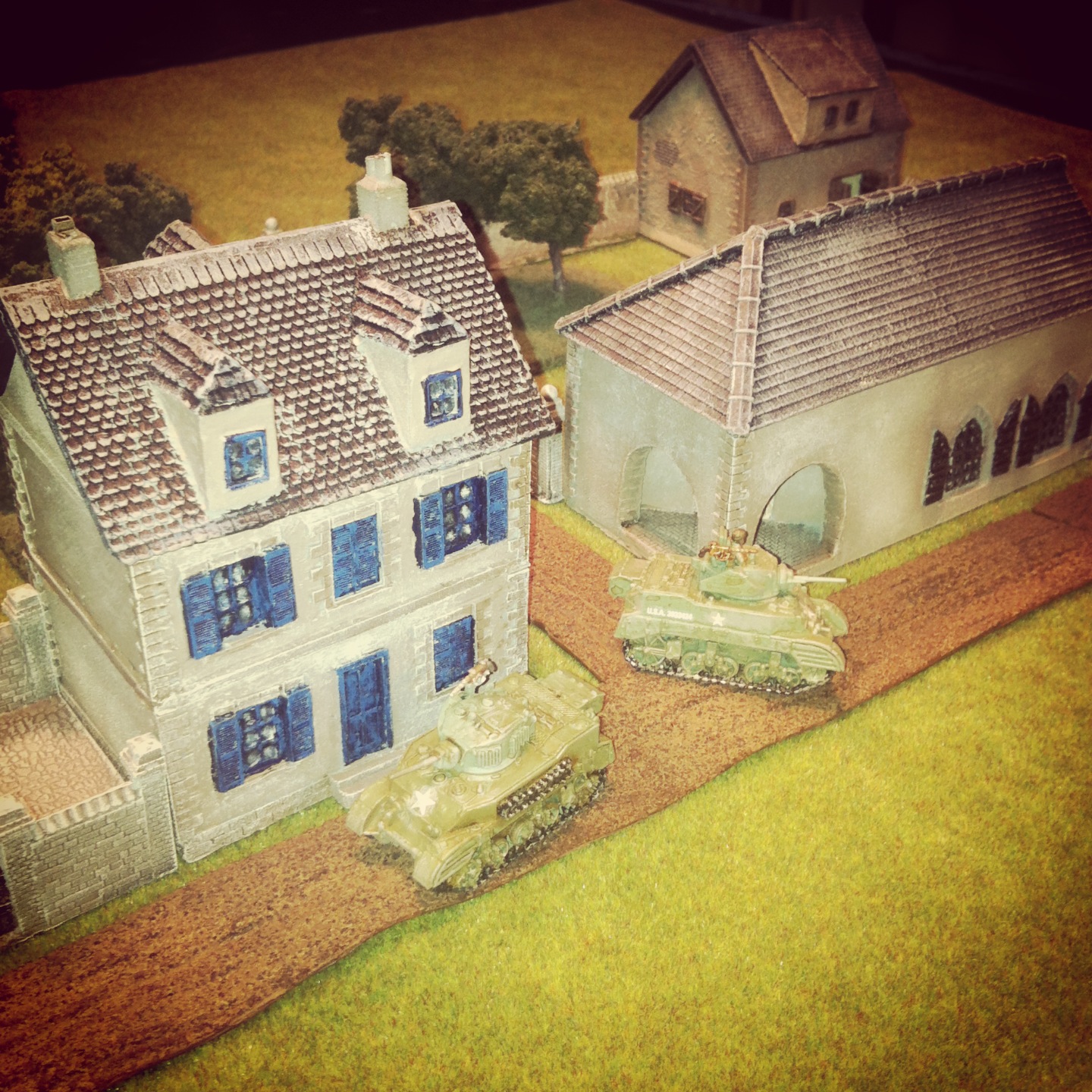
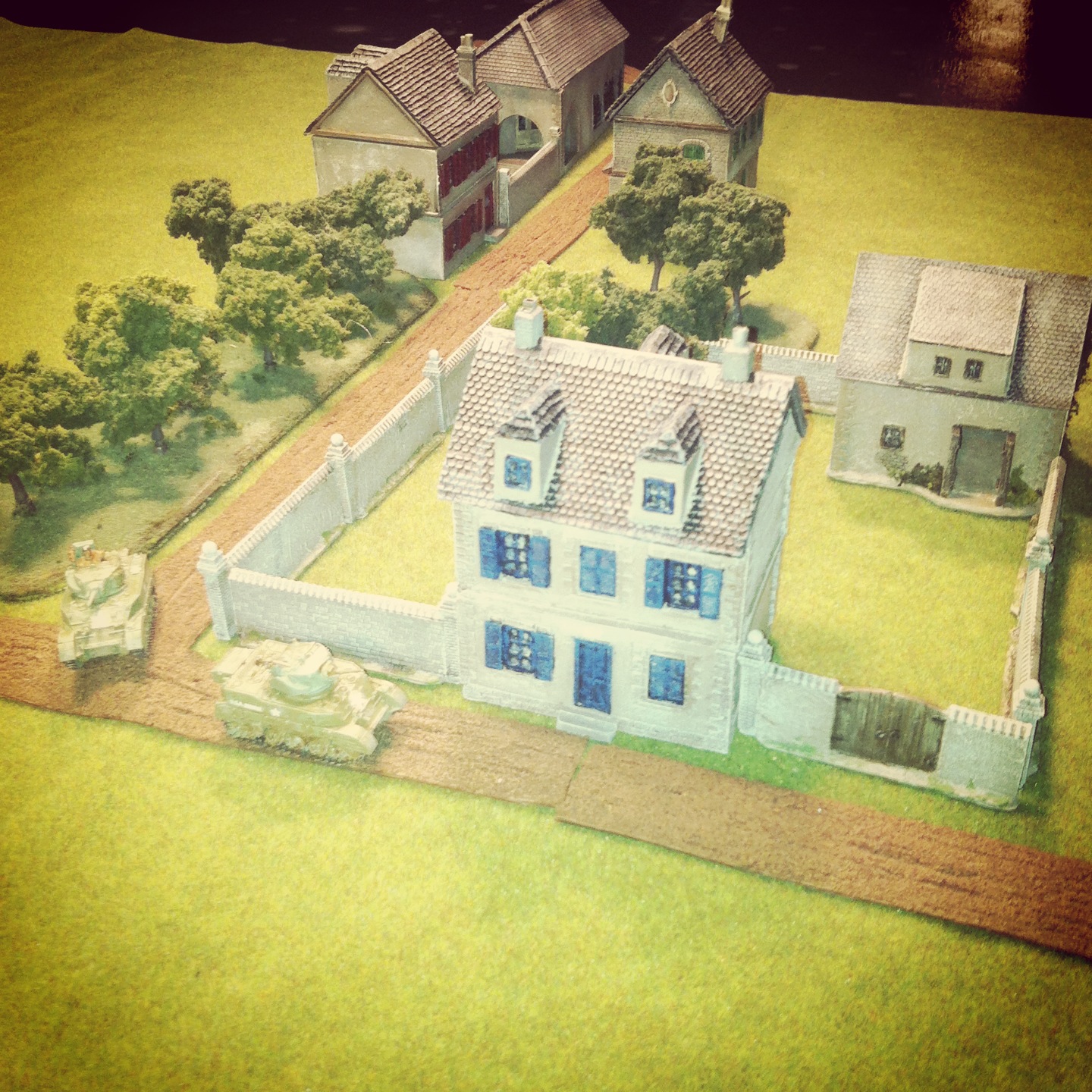
1148873_10201247963855523_305675209_nI decided to go with several two and three-story buildings, a barn, a courtyard and some walls, all ordered from Musket Miniatures. With all these models, I’d have the flexibility to set up a fairly decent-sized town or play with them as a separate farm estates. The castings arrived clean and required little tidying-up of residual flash with a knife.

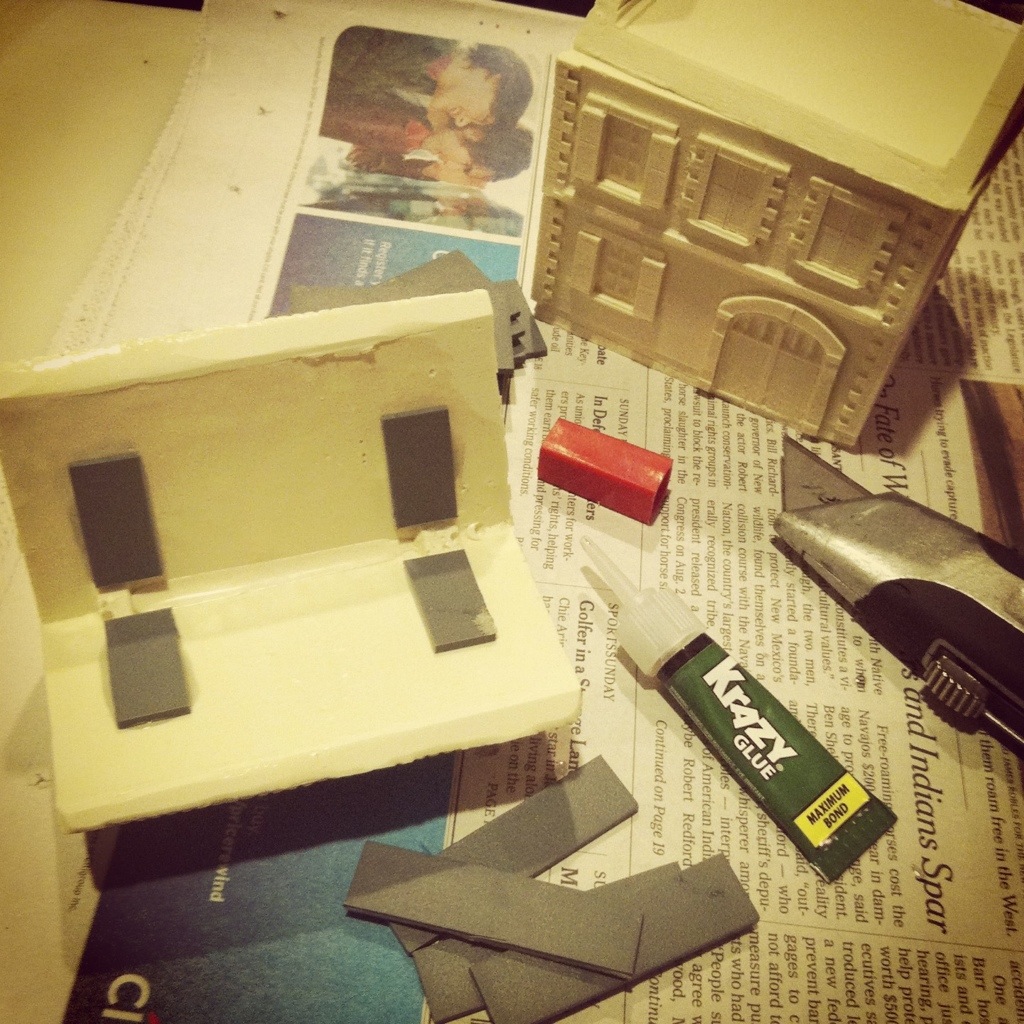
20130830-233936.jpgI did have to put in a bit of work gluing plastic tabs to the undersides of the floors and roofs to provide a snug fit for each story of the buildings. The larger one-story bank building also required a wall and metal cast windows to be glued in place.

20130830-234253.jpgFor painting reference, I searched online for photos of European villages. After a light grey spray basecoat, the stucco walls of the buildings were dabbed with a bit of foam sponge in sandy gray-brown stucco and then dry-brushed with an off-white paint to add variety to the wall surfaces. Exposed stonework, the courtyard cobbles and masonry details at the corners, doors and windows all got combinations of varying shades of grays, browns and whites to create some depth.

IMG_2115Shutters, doors and windows were painted with dull blue, white, green and red trim, mimicking some of the variety in paint schemes I had found in photos online. For the roofs, a black undercoat was dry brushed in a couple shades of grey with a bit of browns and dark green shades mixed in. On the barn model I glued on some thin pieces of lichen to add the look of vines covering part of the walls.

IMG_2117The walled courtyard and modular wall sections got a two-part paint scheme over the gray primer. A watered-down brown-black wash over the bricks and cobbles filled the cracks with a dark shading finished-off with an off-white dry-brushed highlighting coat. The courtyard and wall gates started with a dark brown base with a lighter brown adding aged detail to the wood. Iron hinges got a black undercoat with some rusty metal dabbed over it. The result was some very realistic stone and brickwork walls.

IMG_2112

IMG_2119

IMG_2123

IMG_2125I couldn’t be more pleased with the buildings. They’ve already seen some action on the tabletop in my recent Singling ’44 game and combining them with my existing trees, roads and lichen hedgerows really brings the battlefield to life. I’m already eying a few of the other models offered by Mark IV, including some ruined versions of the same buildings which come cast in some exciting bombed-out interior detail.

At Metropolitan Wargamers, there’s some early plans being laid for another big day of gaming to coincide with the fall’s Flames of War Tanksgiving 2013 event and there’s certain to be plenty of WWII action before then. With my new buildings from Mark IV on the table, these miniature landmarks are certain to add even more depth an interest to all out future games.

Flames of War: Singling 1944 Scenario

4tharmor

By the winter of 1944 the US 4th Armored Division had distinguished itself through a number of actions in France ranging from Operation Cobra in July and the Battle of Arracourt in September all the way through various engagements heading east toward the French-German border. Battleworn and bogged down in the wet winter slush of eastern France, the 4th Armored lumbered to the outskirts of Singling, Lorraine on December 6th, 1944. As part of the defensive Maginot Line, a hasty attack was thrown together to take the farm town with a small force of tanks and infantry. Finding themselves caught up fighting superior elements from the German 11th Panzer Division between the cottages and tight roads of the village, the day’s battle eventually fell to a stalemate and the 4th Armored pulled back. In the coming days, a hail of American artillery and subsequent ground force attacks eventually took Sibling.

SinglingMap44

The WWPD site has a handy Flames of War scenario available for the action at Singling called Abrams’ Folly. In addition, there’s some other gaming-freindly write-ups available online as well as some great historical documentation (including maps and photos) on the battle at Singling. Before heading off to an annual family vacation to Cape Cod, I had a chance to try my hand as the Americans in the Sibling scenario this past Wednesday evening at Metropolitan Wargamers in Brooklyn.

bggbookEach of us fielded 2500 points, sticking as close to possible with the forces outlined in the scenario. I used the Blood, Guts and Glory book which focuses on the armor-heavy battles in this region of France in late 1944 through early 1945. My force featured a mix of 75mm and 76mm Shermans, some tank destroyers, two armored rifle platoons and an off-table 105mm Priest battery. My German opponent started with a Panzer IV platoon, a Jagdpanther platoon, an 10.5cm leFH18 battery, a platoon of Pak 40s and a couple infantry platoons. As it was historically, the Americans were clearly in for a tough fight.

In December ’44, the US entered Sibling from the south but the scenario places the American point of entry at the western edge of the table. The Germans deployed first with infantry and Jagdpanthers in the town, the Panzer IVs to the northwest and the Pak 40s in prepared positions to the southwest. The artillery battery was positioned to the northeast of town with spotters stationed in the church belfry and the attic of a house near the town center.

siblingtable

With the first turn, the Americans rolled in around the main road to the west. Seeing the Pak 40s, all the armor rolled north toward the Panzer IVs parked around and behind a small copse of trees. Infantry platoons made way for the center and the orchard just south of the road. My US plan was to avoid the killing alley of the main road while the infantry would swoop toward an assault on the infantry and Pak 40s to the south and the armor would rumble to the north toward the German tanks.

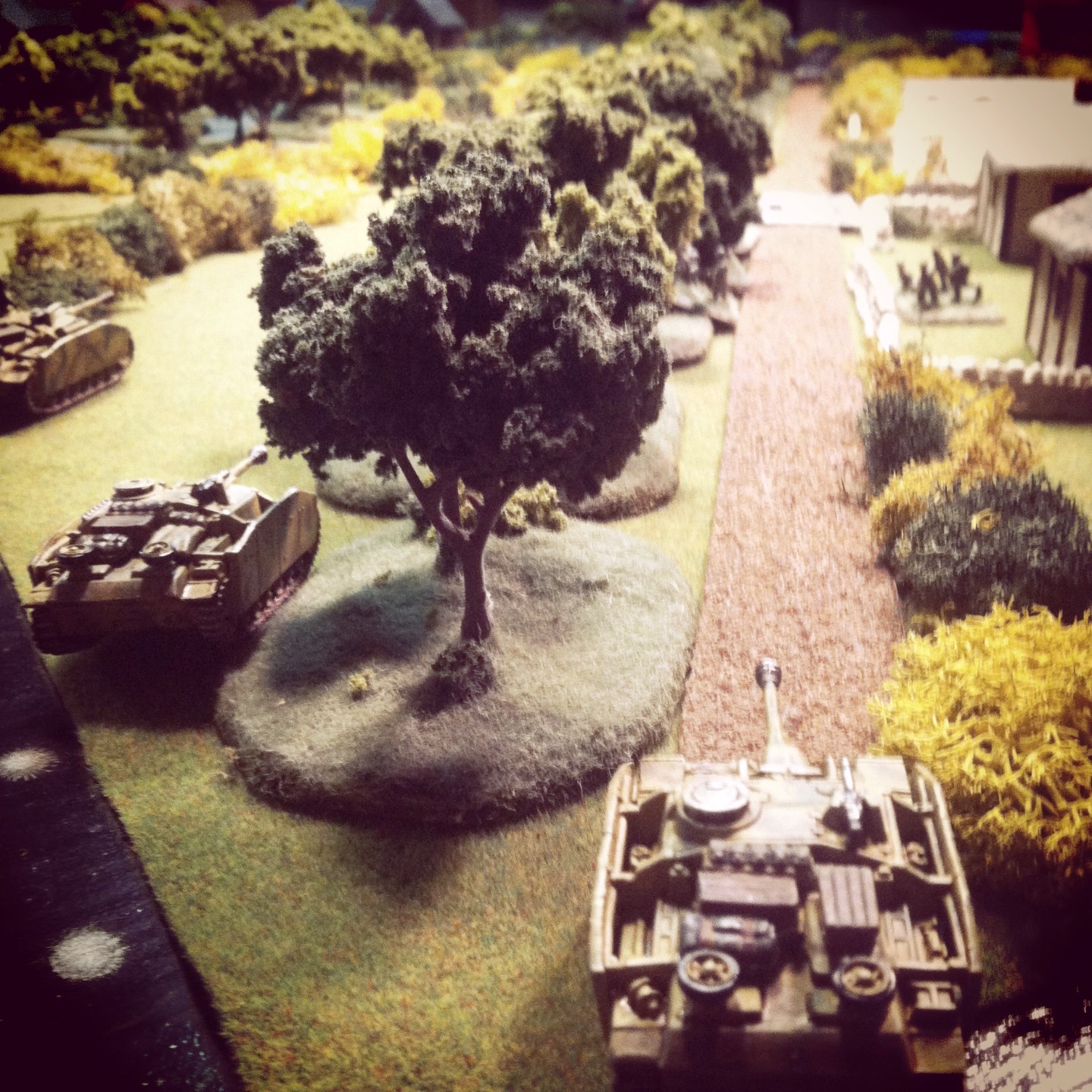
The US 76s made quick work of the Panzer IVs in the first two turns and then turned toward the center of town. The Jagdpanthers crept out from behind buildings and took a few a shots down the road, eliminating a Sherman. A German platoon camped out in a house at the western edge of town made a misbegotten attempt at an assault on the Shermans, bailing two with Panzerfaust fire but ultimately running off when faced with return attacks from the US armor. Another Panzerfaust-wielding squad popped out from an adjacent cottage and destroyed another Sherman with a quick rear shot before being machine-gunned down. By the end of the third turn, the northwest area of the table was a snarl of burning German tanks and shaken but advancing US Shermans.

32387_10201314045587525_1920471111_n

1185574_10201313808021586_457796402_n

To the south of the road, a stalemate which would run the whole game commenced. The Priest battery struggled to range in and hit the Pak 40s on every turn, proving to be a complete waste of points. The American armored infantry platoons to the south of the road spent most of the game being pinned by German sniper fire and artillery barages, all the while struggling to progress through the orchard. Not until the fourth turn of the game did the American infantry truly get in the fight, exchanging fire with two nearby platoons of Germans but losing nearly half their number to fire from the Pak 40s and German heavy machine guns.

In turn four, things got bad for the Germans. After littering the field north of town with charred wrecks of US armor, several American tanks broke to the middle of town toward the three remaining Jagdpanthers. A near-certain side blast to one Jagdpanther glanced off with no effect, but then an extremely lucky shot from a US 76 destroyed the Jagdpanther command tank. While the Germans scrambled to appoint a new command tank, the Americans ganged up to destroy one of the two remaining Jagdpanthers. With the platoon reduced to just one remaining tank, the German player rolled and failed a morale check and the last tank fled the center of town.

267391_10201314392956209_640393299_n

1235934_10201314392676202_1206092596_n

With the center of town secured, all German armor destroyed, a stalled infantry firefight to the southwest and the American tanks advancing to the German artillery battery, the game was called at the fifth turn. I was honestly surprised by the American victory, upsetting the historic outcome of the battle. We stood around for some after-action what-ifs for both sides while packing up the table, and clearly there could be improvements in choices of forces and tactics the next time we head back to Singling.

Flames of War: Fielding the PSC Stuart Tank

While the durable US M4 Sherman gets most of the glory in the annals of WWII Allied tank history, the M3 Stuart also played a significant role in providing valuable infantry and reconnaissance support throughout the war. The Stuart was originally supplied to the British ahead of the US entry into the war, but American tank crews would eventually use them throughout the European, African and Pacific war theaters. Armed with .30-calibre machine guns and a 37mm main gun, the Stuart proved itself to be a finicky yet effective part of many of the war’s major actions and campaigns, including the D-Day Normandy campaign of 1944.

Most of the US armor I use in Flames of War gaming comes directly from Battlefront, the makers of the popular 15mm WWII wargame. Battlefront manufactures beautiful models but the company is often criticized for its prices. I already own a fair number of Battlefront’s M4 Sherman tank models. With so much of my armor tied up in the sameness of my Sherman platoons, I’ve long wanted to add some diversity in my force with a light tank platoon option.

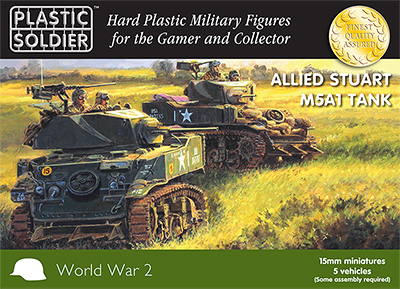
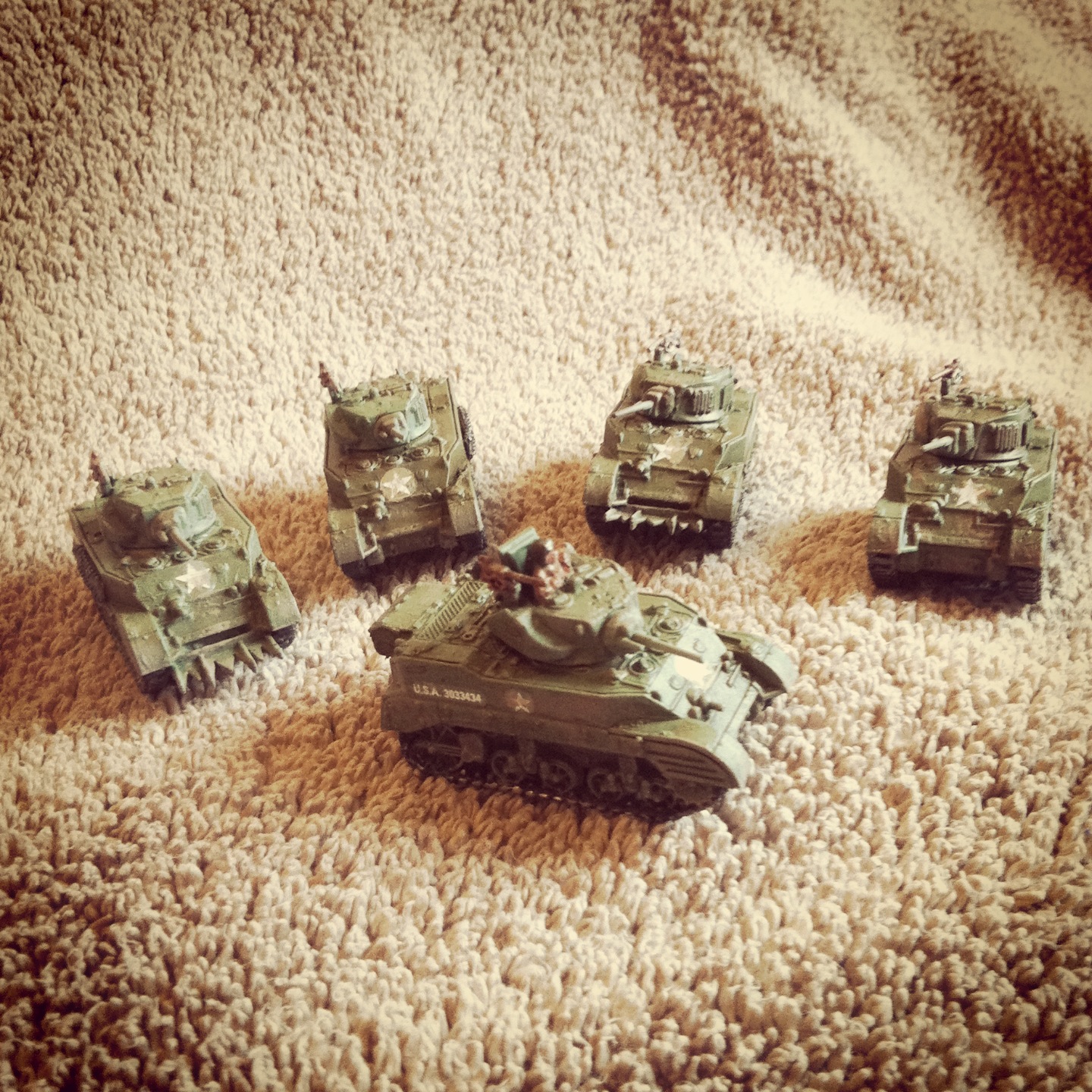
Coincidentally, the Plastic Soldier Company has recently been expanding its small but growing line of 1/72 and 15mm WWII hard plastic infantry, vehicle and armor sets. At nearly half the price of the FOW offerings, the 15mm Plastic Soldier Company boxed sets look to be a legitimate bargain alternative. As luck would have it, among their new releases from the past month was a 15mm Allied Stuart set containing five models which make up a perfect light tank platoon for my FOW force.

Despite the relative low cost, I approached my first go-around with the PSC with a critical eye. The Stuart set comes with enough parts for five tanks from the early, mid or late WWII periods. The flexibility of the modelling is fantastic, but it does result in a bunch of unusable waste parts left on the sprue. Gluing the models up for the late war was fast, with the finely-detailed casting going together smoothly. A relectuant criticism of these otherwise excellent models is the way in which the turrets fit to the hulls with tabs which were a bit tight for my liking. I wound up cutting the tabs off so the turrets move more freely, but this extra step did destroy the other strong points of the PSC models.

After the glue dried, the models got a coat of green armor spray followed by some black and metallic paint brushed on the treads. Tools and stowage attached to the hull were picked out in detail, and then all the tanks got a watered-down brown wash. I applied some appropriate US decals I had left over and then the tanks got some splattered mud details in a lighter mud color.

IMG_1956

The result of my Stuarts and my first experience with the Plastic Soldier Company is entirely satisfying. Not only can’t I wait to roll these fast, deadly tanks onto the table in my next game, I likewise will be anxiously awaiting what new releases the company has in store to further build-out my forces.

Flames of War: Barkmann’s Corner Scenario

panther

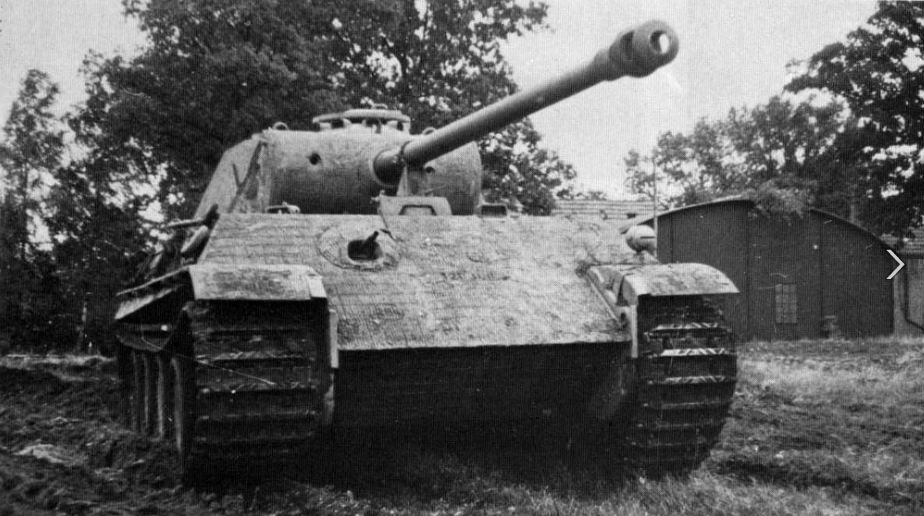
Ernst Barkmann was one of the top German tank aces to fight in World War II. Commanding a Panther tank, Barkmann served throughout the entire war on both the Eastern and Western Fronts. Not only was he deadly while at the command, but his crew became adept at making on-the-fly field repairs and getting back into action. By the time he surrendered to British forces in the spring of 1945, Barkmann had become one of the most decorated German tank commanders of the war. He was not yet 26 years of age.

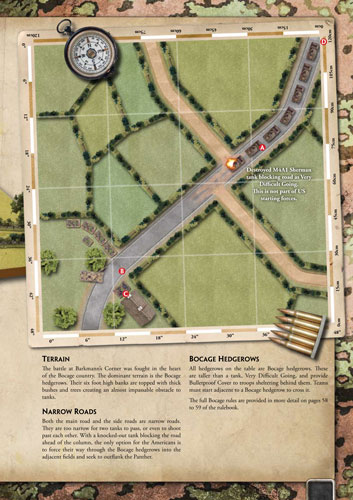
barkmannmapFlames of War offers a special Ernst Barkmann warrior set which includes Barkmann commanding his Panther plus a separate mobile repair shop. FOW also provides free scenario rules for the famed “Barkmann’s Corner” engagement from July 27, 1944. Fought in the Normandy region of France, the small battle is a classic in which Barkmann’s single tank went up against a column of over a dozen US Sherman tanks. In the end, nine Shermans and other vehicles were destroyed before Barkmann was able to slip away to safety. I’ve had the Barkmann model painted up for a few years, but I had never fielded it in a game of his most famed run-in with the Americans. With a frequent summer guest of the Metropolitan Wargamers club leaving NYC for home in Florida this coming week, the two of us got together this past weekend to have a go at the scenario.

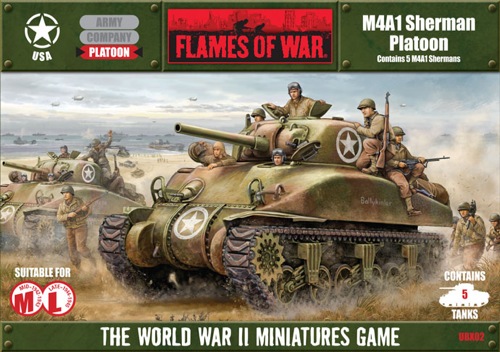
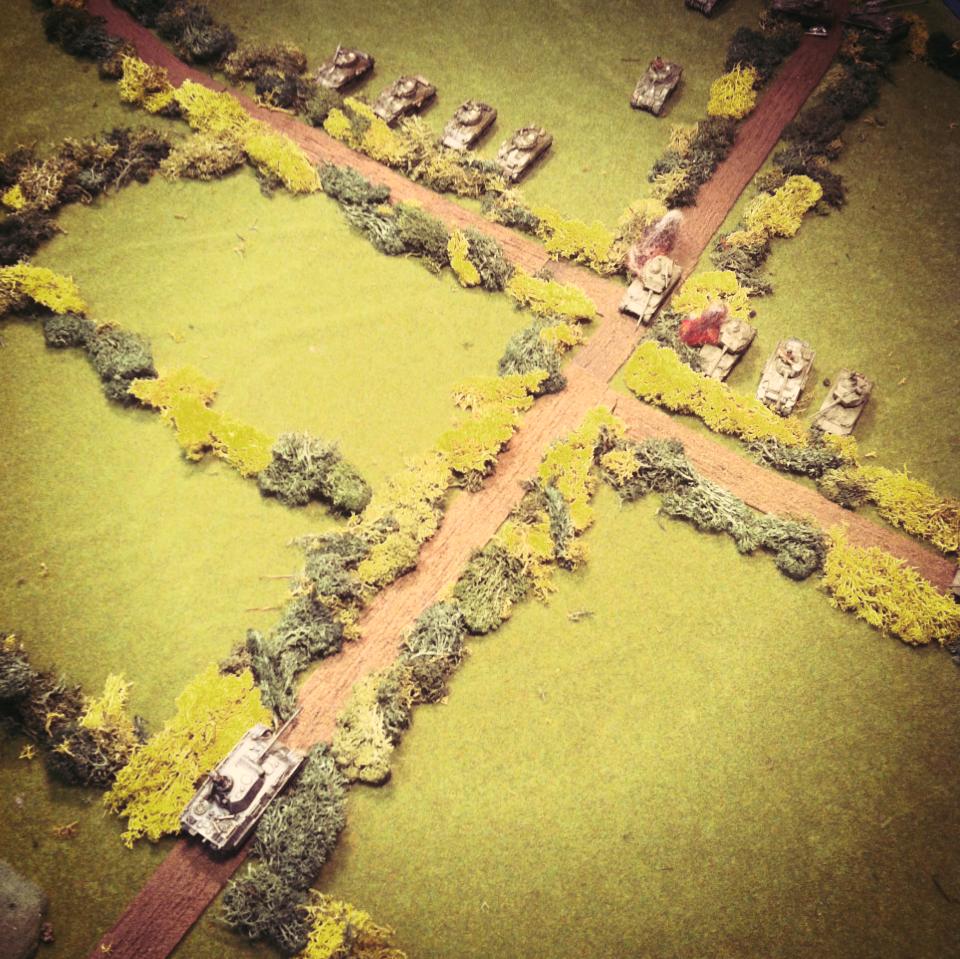
As per the rules, the small 4′ x 4′ playing area is set with fields and roads heavily crisscrossed with the high bocage hedgerows of Normandy in which I love to set my games. Barkmann’s tank and his supporting Panzergrenadier platoon begin dug into positions around a small farm at one end of the board. In the opposite corner, the US tank command group and their first platoon of M4A1s begin the game slowly rolling down the narrow road but blocked by a burning tank. The first platoon is strengthened by the presence of Staff Sgt. Lafayette Pool, another special figure offered from FOW. Historically, Pool wasn’t at this engagement but the inclusion of the hard-charging tank ace from Texas helps balance the scenario a bit. Two larger platoons of Shermans lie in the column off the board but enter on turn two and three. The Americans need to keep things moving and Barkmann’s there to stop them.

With the first turn, the US armor column begins down the road toward the farm objective in the near distance.

bark1Barkmann lies in wait behind a small copse of trees with the Panzergrenadiers gone to ground behind the bocage.

1075723_10201126852027803_1689119621_nIn the next few turns as the Americans slowly moved over the dense bocage lining the roads, the US plan became clear. The command tanks and Pool’s platoon headed toward the house and the German right flank. The remainder of the Shermans broke toward the German center and left, bogging repeatedly along the way. In the meantime, Barkmann moved to the far side of the farm house to protect his side and line up several shots on Pool’s platoon.

995453_10201126853307835_1344971388_n

3637_10201126853787847_675127225_nWith the Americans splitting in two directions and the German infantry safely in the house, Barkmann took several side shot’s at Pool’s platoon and then rode bravely to the road to begin taking shots at the approaching center Shermans. As Pool became the final survivor of his platoon, Barkmann swung his attention back to his left flank and the bulk of the closing US force which had freed itself from a series of challenging bogged turns.

992833_10201126854147856_848082758_n

538975_10201126854827873_1979156013_n

538971_10201126855507890_695500397_n

1012007_10201126856347911_1734345823_nAs the two largely-intact surviving Sherman platoons continued to attempt a flanking move on Barkmann, his Panther was forced into movement each turn to align shots and stay covered. Pool also managed to pour fire into the farmhouse with his main gun, eliminating some of the Panzergrenadiers before fleeing the table on a failed motivation test. With the twelfth and final turn, Barkmann had backed himself up to the house to protect the objective and eliminated a couple more tanks along the way. Had there been one more turn and roll of the dice, and the game would’ve gone for the Americans.

1011343_10201126857107930_1603972880_nAfter the large Total War scenarios at the club the previous weekend, it was a welcome break to play a small yet engaging battle with a limited amount of models to command. The bocage is the great equalizer in the scenario, providing alternate turns of benefit and frustration to each side as movement is stalled and lines of sight are blocked. Having read a number of historic accounts of the field-to-field fighting throughout Normandy in the spring and summer of 1944, the Barkmann’s Corner scenario went a long way in showing that choosing where you fight can be one of the most important factors in the outcome.

Related articles