Flames of War: Fielding the FOW Universal Carrier

UniversalC

British Universal Carriers in Normandy 1944

Used extensively by Commonwealth forces in all theaters throughout WWII, the Universal Carrier served as a transport, a towing vehicle and a quick-response weapons platform for machine guns, flamethrowers, anti-tank guns and mortars. So popular were these agile and flexible vehicles that production ran until 1960 and over 100,000 eventually rolled off the assembly line, making them the most-produced armoured combat vehicle ever produced.

With my new British forces moving along, I picked up a few inexpensive packages of Universal Carriers in the flea market at Fall In! this past weekend. The models from Battlefront come three to a carded package in solid-cast resin with metal crew and gun options. The packs I got were the early war models but I decided for gaming purposes I’d fudge them a bit to make them work in my late war gaming. Along with a carrier from my Royal Artillery battery I’m also working on, I’d wind up with seven vehicles to start.

IMG_2432

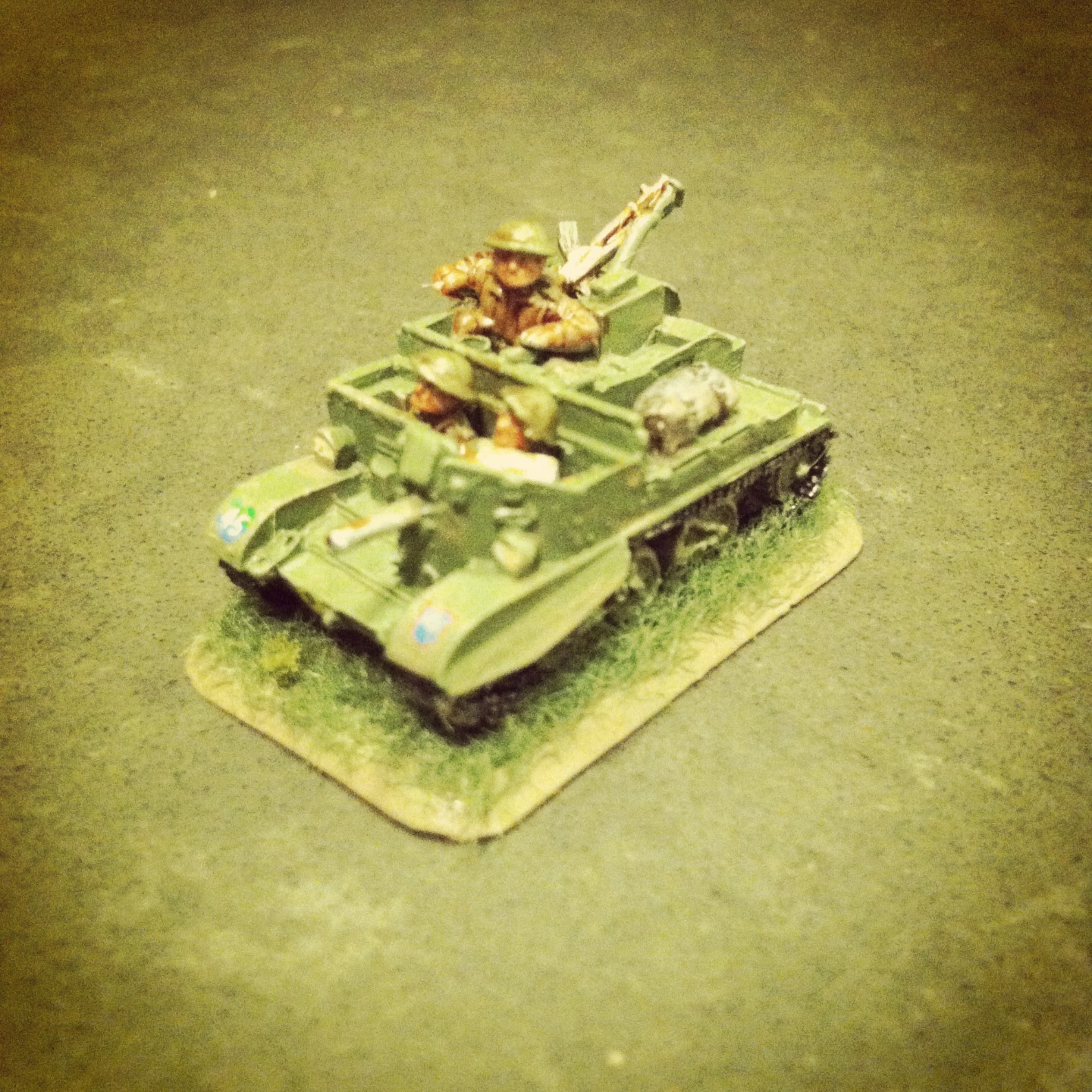
Carrier example with rear gun mounted

I chose to model my inital six carriers with extra 50 cal. machine guns, hoping to use them to quickly get into a fight and pin down German infantry with a hail of bullets. Adding the 50 cal. gun was a field modification during WWII, but without any extra parts on hand I simply clipped the barrels on the guns at the front and added a bit of plastic to make some semblence of a machine gun manned in the front seat.

IMG_2430

Carrier example with the rear gun carried in the back

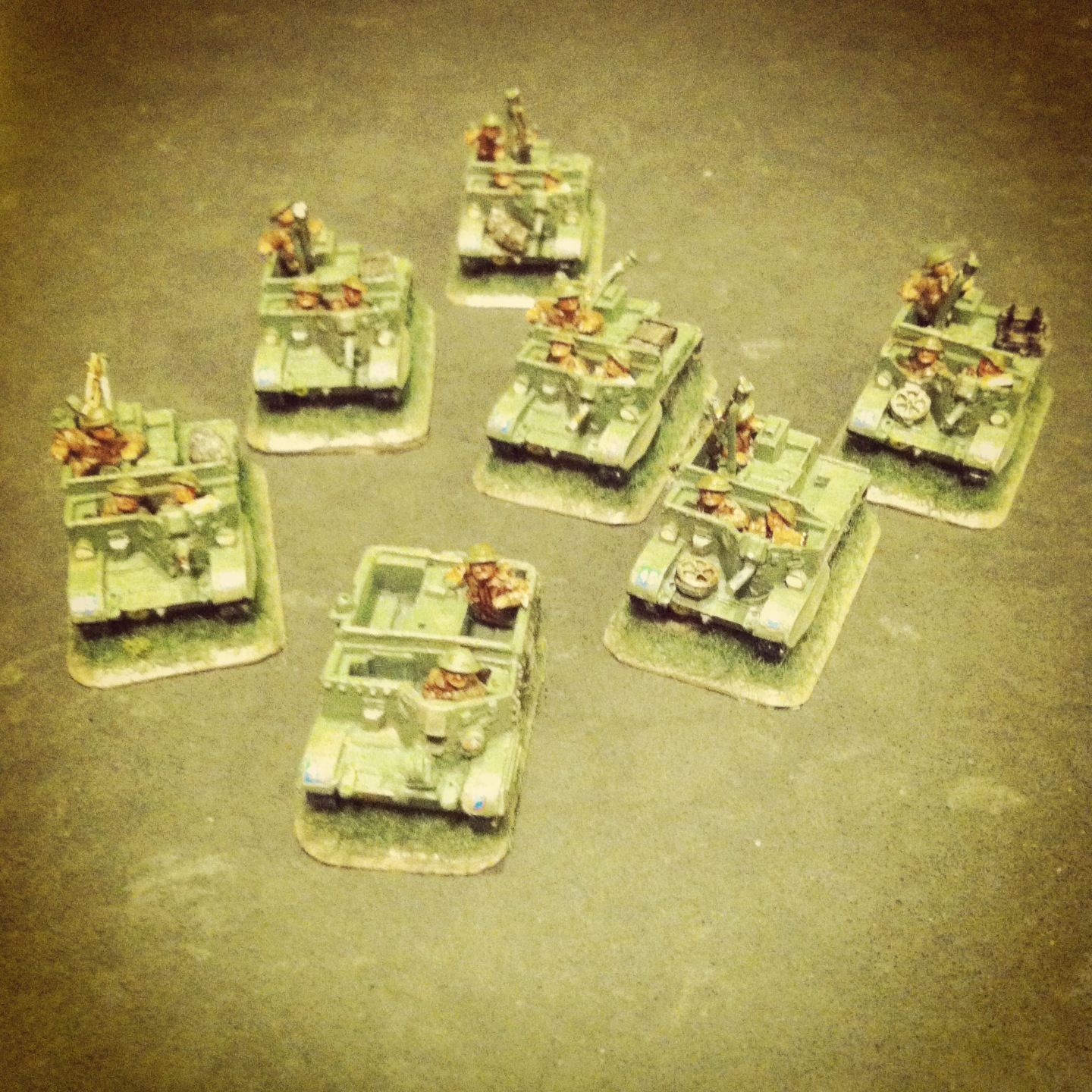
Since construction is minimal, these glue-up fast. I modelled a couple of the guns in the back thrown in the back seat as if those guys were moving fast to get into action before re-mounting their guns. After a quick spray of green armor basecoat, the crew get hit with some drab, brown and flesh paints and washes. Tracks get a black base followed on with some metallic dry-brushing. Guns and other details added from some leftover tank stowage get some gun metal, browns and weathering. I decalled the carriers with the Guards Armoured markings, and then everything got a splatter of muddy earth tones.

IMG_2427

Guards Armoured carrier platoon ready for the roads and fields of Europe

With so many British troops cruising around Europe in these vehicles during the war, adding just a few of these to my growing menu of options in creating British company lists for my FOW gaming at Metropolitan Wargamers in Brooklyn, NY was a good place to start. I’ll fill in these early war models with another three of the late war models at some point, making it into a nine carrier transitional platoon of old and new model vehicles. One of the reasons I wanted to expand my Allies with UK forces was the chance to model different infantry, armour and artillery. Getting these nifty little Universal Carriers into the mix will definitely give my games some new interest on the tabletop and hopefully wreak havoc on my German opponents.

Related articles

Flames of War: Sint-Oedenrode 1944 Scenario

StOAB

Like many cities in the Low Countries, the Dutch city of Sint-Oedenrode was occupied by German forces after their invasion of France, Belgium and the Netherlands in the spring of 1940. The southern Netherlands and Belgium were the area of focus for the Allied Operation Market Garden in September 1944 which hoped to take several river crossings before the push on to Germany. At Sint-Oedenrode, the famed US 101st Airborne Division seized the bridge over the Dommel River but were met with a counterattack by German Fallschrimjäger regiments and other supporting forces. The battle that would take place at the crossing of the Dommel was typical of the action of the Allied push along what became known as Hell’s Highway. While Market Garden would ultimately prove to be a fiasco for the Allies overall, the grateful people of Sint-Oedenrode were liberated by US troops after a week of brutal fighting against the German occupiers.

StOMap

The Flames of War website has a scenario for the engagement at St. Oedenrode available in their list of historical scenarios on their website. The forces in the scenario were originally covered in the now out-of-print Hell’s Highway and A Bridge Too Far FOW books now available as Market Garden for the US, UK and Canadian forces and Bridge By Bridge for the Germans.

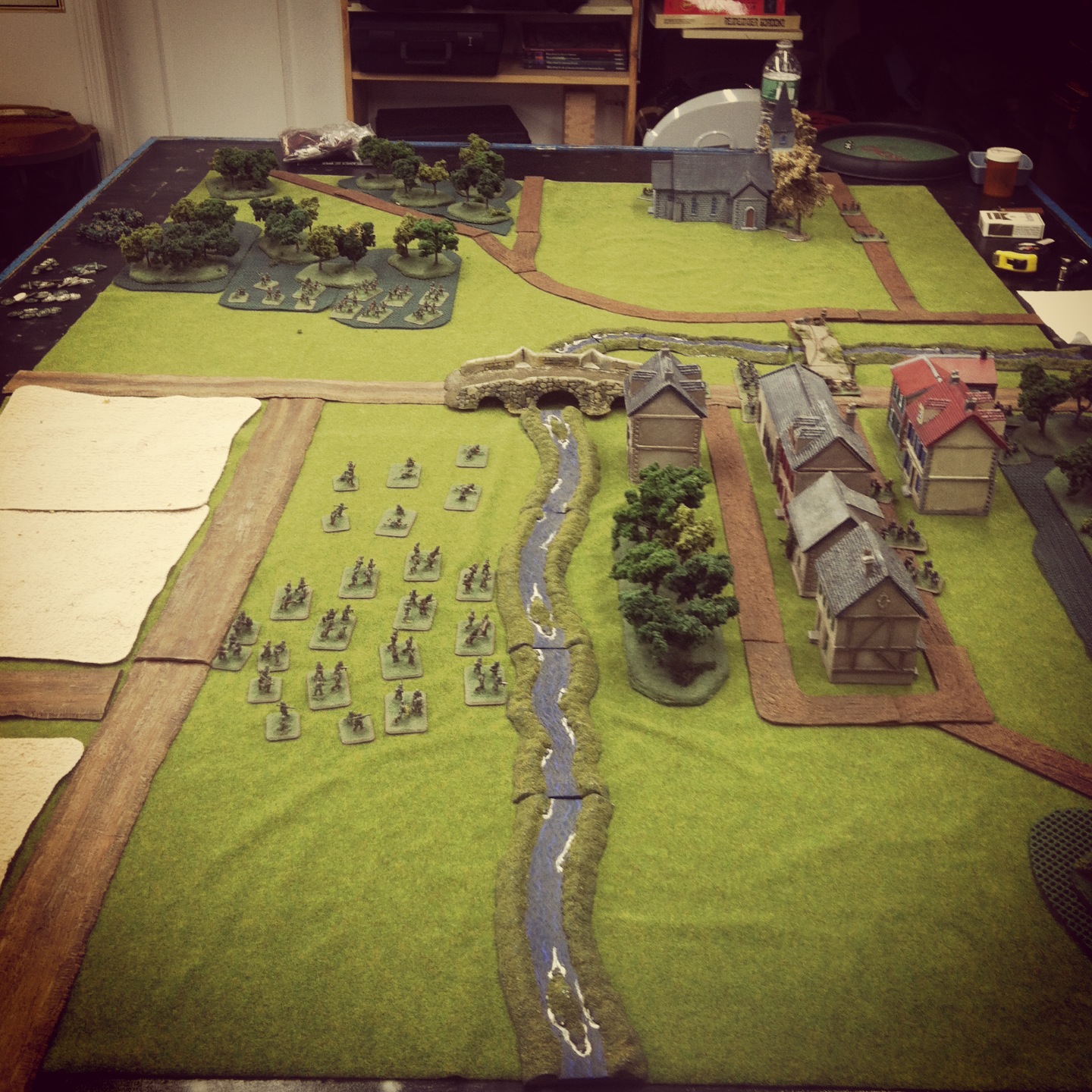
This past weekend at Metropolitan Wargamers in Brooklyn, NY we ran a modified Sint-Oedenrode scenario with the US 101st Airborne facing off against the German Fallschirmjägers. My paratroopers deployed in the fields and woods across the river with two rifle platoons and a light machine gun platoon. In reserve were US mortar and parachute howitzer platoons along with a delayed reserve Sherman and Firefly tank platoon from the Guards Armoured Division. The Germans started defending the two objectives at the bridges with a mortars, heavy machine guns and a rifle-machine gun platoon dug in around the town buildings.

IMG_2324In the first two turns, the Airborne units made way for the river and first bridge while avoiding shots coming from the defending Germans. The US light machine guns poured fire into the houses across the river, but shots missed on all accounts but did manage to pin the units. With little US progress toward the objectives, my German opponent remained solidly in control of the bridge points in the early third of the game.

IMG_2322By the third turn, the Germans successfully rolled on their a reserve rifle-machine gun platoon as well as their PaK 40 anti-tank guns. While the US lacked tanks of the board, the US platoon crossing the bridge took heavy combined arms fire from the German artillery outside of the town and the infantry platoons hidden among the town’s houses. Another US platoon made their way across the Dommel, through a small wood and attempted a quick assault on the Germans defending from the nearby buildings. Under heavy fire, the US charge was repulsed with some losses pushing them back into the treeline.

IMG_2326With the Airborne rifle companies pinned on the bridge and in the  trees over the river, I finally threw a successful roll for reserves on the fourth turn and brought in my mortars and howitzers. Firing at a distance from the fields, all my artillery missed their hard-to-hit German targets hidden in the buildings across the river. The platoon on the bridge took an additional round of combined German fire and fled the field. The US light machine guns to one side of the bridge likewise encountered heavy fire, finding themselves pinned and still unable to effectively knock the Germans from their defending positions in the town.

IMG_2328By turn four, things went from bad to worse for the Allies. With the Guards Armoured forces finally rolling in, they did quickly take out one of the German anti-tank guns. This was unfortunately quickly answered with two Allied tanks being destroyed with return fire from the crack shots from the German PaK 40s. With the beginning of the fifth turn, the US attempted a final series of artillery barrages and tank fire to chase the Germans from the town. Still at nearly full strength, the Germans had clearly overwhelmed the US and I conceded the game.

Even without their Panzer IVs on the table, the German position within the town proved hard to route. In retrospect, a concentrated Airborne end-run over the river and through the town might’ve proved more effective in chasing the Germans out of their defending positions near the bridge entry points. A lack of armoured and artillery reserves until late in the game also left the 101st outgunned and running on their own as German reserve strength mounted. Luckily for the Dutch people of Sint-Oedenrde things went much better for the Allies in 1944, but my replay of the attack just didn’t go my way this day.

Gaming The High Seas

bbpicFor as long as there have been people putting boats to sea, there have probably been pirates close behind. Even though the classic high period of piracy perhaps only spanned a few decades in the 1600 through 1700s, pirates have loomed large in popular culture from Robert Louis Stevenson’s Treasure Island all the way through to the Johnny Depp-fuelled blockbuster Pirates of the Caribbean film franchise. Piracy will also be the theme of the latest release in the Assassin’s Creed video game  series next month, and the game is already being lauded as a potential game of the year for its historical high seas combat.

Naturally, pirates find their way to gaming tables. I like checking in on the UK-based blog Shed Wars for a fellow gamer’s incredibly elaborate pirate miniatures gaming. While I’m rather certain pirate miniatures gaming is never going to be my thing, I have played my share of pirate games over the past thirty years.
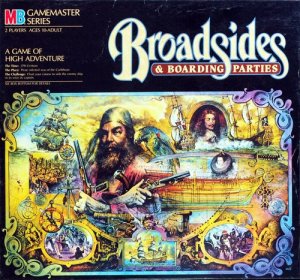
broadsidesIn the early 1980s, Milton Bradley launched their Gamemaster Series. While Axis and Allies would be the one game to catch on, the series also included other historically-themed wargames packed full of some nifty design, tons of plastic miniatures and varying levels of gameplay. The two player Broadsides & Boarding Parties featured a card-based maneuvering “broadsides” combat phase of the game which then led to a close-quarters “boarding parties” series of turns. During hand-to-hand attacks, each player moved their pirate, canon and captain figures among the two large ship models in an attempt to capture the opposing captain. Like many of the games in the series, Broadsides & Boarding Parties was a great looking game, but the play was a bit simplistic and it wound up collecting dust on my game shelf.

pirateconstJust over 20 years later, WizKids introduced the Pirates of the Spanish Main constructable miniatures game. This still-popular game consists of collectible packs of ships in plastic credit card-sized punch-out packs. Each pack contains a whole game with a couple ships, rules, islands and playing tokens. The system went through a number of expansions with additional ships from varying eras and nations along with special island island fortesses and even sea monsters. Along with the movie series, a Pirates of the Caribbean series was also released with the ships, characters and story pulled right from the films. The ships looked fantastic although proved to be a bit brittle during gameplay which involved trade, combat and double-crossing across an open tabletop board. Although the game was officially shuttered in 2008, a huge secondary market continues for unopened packs of game cards.

lootWhen my two sons were younger, we played the heck out of the 1992 card game Loot. This surprisingly engaging and award-winning kid’s game by Gamewright allows for play as a merchant or pirate. Pirate cards come in four colored “suits” with a captain card for each suit. Each pirate card carries an attack value denoted by a number of skull symbols. Pirates compete to attack merchant ships carrying different gold values, and an Admiral card shows up to protect merchant ship. Each player manages their hand through a series of draws, plays and discards as gold is collected and attacks by other pirates are thwarted. While the original Loot features cartoonish graphics, an updated more historically-themed version was introduced in 2010 under the name Korsar. Whichever version you get your hands on, Loot is a pretty simple but engaging card game for crews of all ages.

This past weekend at Metropolitan Wargamers in Brookln, NY, I had the chance to get my sea legs with two more pirate games: Cartagena and Merchants & Marauders.
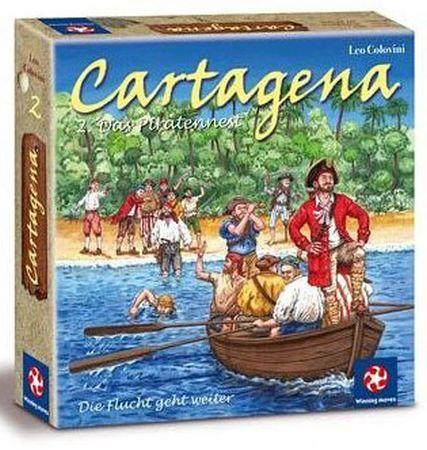
cartagenaCartagena is a quick game recreating the late-17th-century pirate jailbreak in Cartagena, Colombia. This wordless, diceless, easy-to-play game sets each player with five pirates making their way along a dock game board toward an awaiting getaway boat.
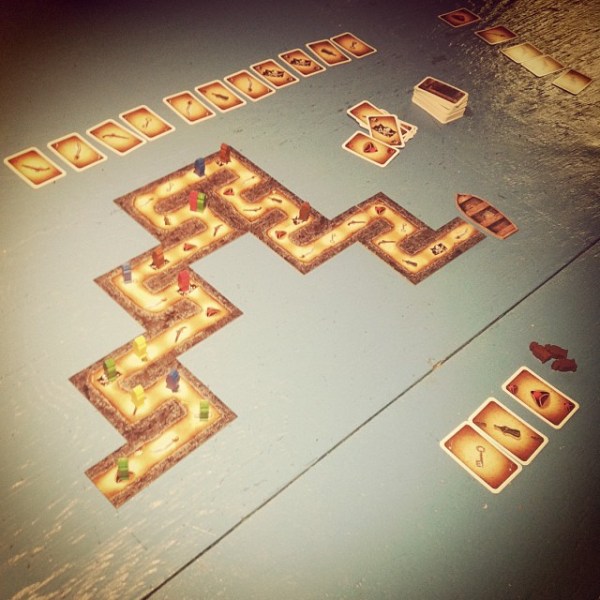
cartagenagame

Each player begins with six cards featuring hats, bottles, swords, keys, pistols and Jolly Roger flags. Playing a card allows a player to move one of their pirates along the board to the next empty space featuring that symbol. Players may double and triple-up placement on a space, and additional cards may be drawn from a face-up row of cards by moving backwards along the dock. Moving back to a space with one other purate gains a player one card, while moving back to a space with two pirates gets a maximum two-card draw. Players move forward and backward, acquiring cards and playing them as they progress toward the boat. Strategy comes in planning out your card moves with available spaces on the board, blocking other pirates and stealing in-demand cards from the draw row. The simplicity of Cartagena makes this a great choice for little pirates in your life while it also holds interest for some aggressive adult play like my first game this past weekend with some club members.

MMbox

Merchants & Marauders from ZMan Games is a beefier boardgame akin to the Viking exploration and conquest game Fire & Axe. Set among the islands and seazones of the Caribbean, the game allows players to play as merchant traders or dastardly pirate captains set on acquring gold, completing missions, following rumors and scoring points toward victory.
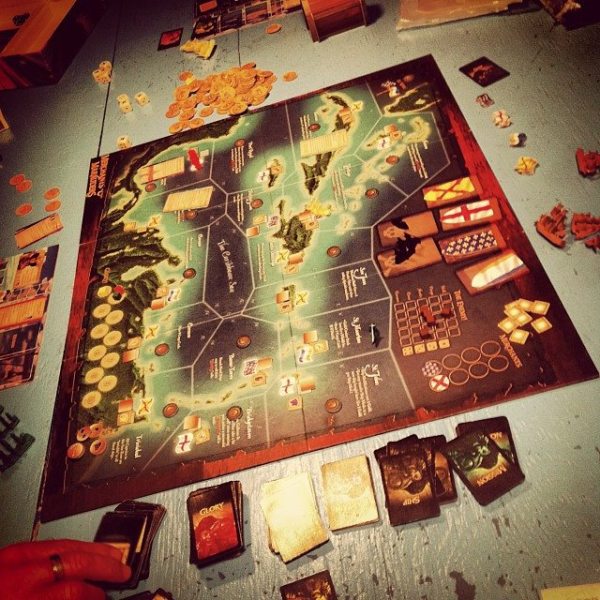
MMgame

Players begin with their ships at a home port island with each port offering varying bonuses to different types of players. In each turn, players may take three actions of movement, scouting or  port activities. While in port, captains may trade or sell goods, repair damaged vessels, acquire special crew and outfit or upgrade their ships with additional weapons and equipment. Each port shows goods that are in demand like tobacco, rum or spices, and trading in-demand goods scores extra victory points and special Glory cards that can add to a players effectiveness in particular situations. Pirates acquire goods agressively at sea but risk becoming wanted by the various nations looking to go to war with seafaring criminals.

There’s a lot of flexibility in the heading to victory a captain charts. Players may focus on trading or seizing goods, completing missions to other ports and attempting to chase down legendary rumors amid the islands. Attacking other ships can gain goods and gold but players run the risk of damaged or sunken ships that can set them back a few turns. Event cards at the top of each round inject additional elements to the game with storms and other sea-bound pitfalls reducing speed or even wrecking ships. Games of Merchants & Marauders typically run a couple of hours, and players must balance their own captain’s focus with what are other players are doing.

Like the legends of piracy, there’s a lot of variety to be found in pirate gaming. Aside from the games I’ve played and the many miniatures systems available, their are dozens of other pirate-themed games to suit an level of interest. The storied history and mythology of pirates yields a bounty of treasure for any gamer looking to raise a crew under the Jolly Roger and set out in quest of adventure, booty and intrigue on the Seven Seas.

Collector’s Note: Broadsides & Boarding Parties is available on eBay and elsewhere starting at around $50, Pirates of the Spanish Main is set to re-launch soon, but older expansion packs are likewise available via eBay in the $5-10 range and even cases of some card sets are available. Scalawags and bucaneers will find plenty of fellow pirate card, boargame and miniature action at most major gaming conventions. Arrrrrgh!

Flames of War: Fielding the PSC German Heavy Weapons and FOW Artillery Command

ger8cmmortar

After focusing on my Flames of War (FOW) Allied forces for a while, I decided to throw some energy back into beefing-up and diversifying my late war Germans. Although my German troops seldom see play, getting some infantry punch on the table led me to a number of mortar and other support weapons platoons the FOW rules offer.

Battlefront, the maker of FOW, has a number of good platoons which run anywhere from about $12-20 each. Having recently tried my hand at the Allied Stuart Tank set from the growing line of 15mm WWII kits from the Plastic Soldier Company (PSC), I spotted the Late War German Heavy Weapons box. At around $25, the set looked to be an excellent and economic way to get a lot more German infantry on the table at perhaps a quarter to one-third the cost of the official FOW models.

pscgerhw

The PSC box comes with four MG 42 teams, four 8 cm mortar teams, four 12 cm mortar teams, eight Panzerschrecks and eight Panzerfausts. Also included are four Panzerschreck loaders and four ammo carriers. With about 70 bits on the sprues, this set was going to add a lot of action to my already extensive German infantry collection.

pscgerhwsheet

Cutting out and gluing-up the tiny pieces from the PSC sprues is a bit of nerve-racking task harkening back to my early years wrangling with assembling soft plastic HO scale Airfix soldiers. That said, following PSC’s simple assembly diagram (above) and keeping all the parts carefully organized on the workbench is key to getting the job done right and not losing anything along the way. Flames of War rules call for basing Panzerschreck teams in groups of four miniatures per medium stand, allowing for four total teams to be constructed from the PSC set with two Panzershrecks plus a loader and ammo carrier per team. The 8 cm mortar and MG teams likewise went on medium bases and the big 12 cm mortar teams were glued-up on larger bases. I had a few extra plastic FOW Germans on hand from a bonus promotional sprue I received from the Open Fire! box set, and adding those to the 12 cm mortar stands helped finished those off.
artycmdhw

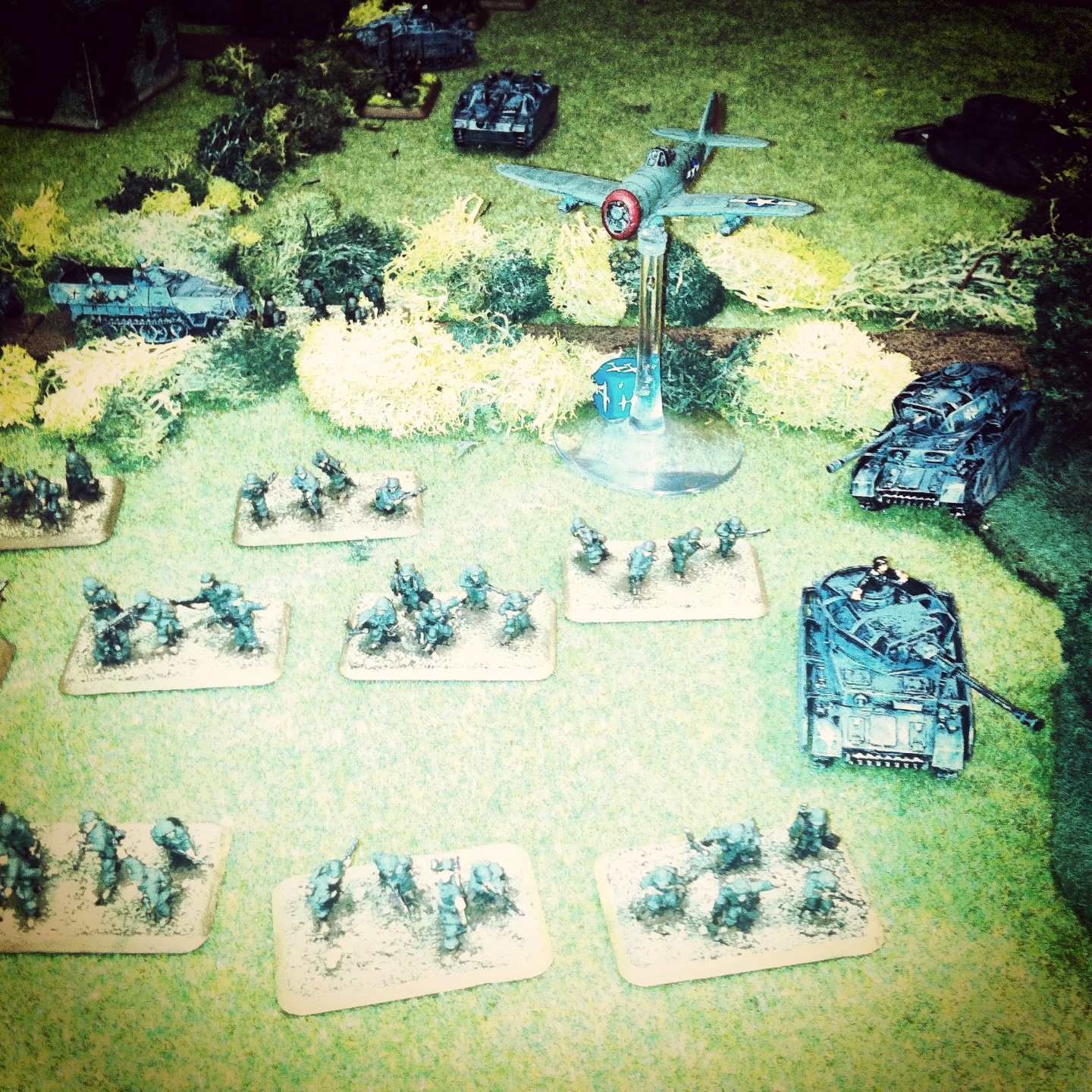
With a bunch of new mortars in the field, I also needed to add some additional command and spotters to make them playable. FOW offers an artillery command headquarters blister pack which I added to the mix. The set comes with enough models that I was able to create three two-man spotting teams, a few command stands (adding in Panzerfausts from the PSC kit) and a nifty HQ vignette with a four figures surrounding a table with a radio operator.

IMG_2214

Painting Germans is a simple process for me with a base spraycoat in flat black followed by a darkish grey uniform and details picked out in flesh, blacks, browns and gun metal. The stands get finished off with some simple grass flocking and a matte varnish spray. Getting a consistent finish on the PSC models made them blend in nicely with my FOW models.

IMG_2226

For comparison’s sake, the PSC figures do tend to be a tad smaller and thinner than the typically-chunky FOW figures. Since most my PSC figures are being fielded on separate stands, I don’t see the minor scale differences being an issue at arm’s length on the tabletop battlefield. In addition, the extra poses in the PSC casting add some nice variety and animation in the troops once deployed.

IMG_2224

IMG_2217My FOW German force has long-relied on the strength of deploying large numbers of tanks in my games, so these new additions should be a nice compliment to getting more action from my German infantry. Now that it’s fall, I’m anxious to rush my new PSC and FOW Germans to the tables at Metropolitan Wargamers in Park Slope, Brooklyn and add a new season of playablity to my battleworn forces.

Flames of War: Breakthrough Mission

bocageShortly after fighting ashore and in the iair drop zones on D-Day, the Allies quickly discovered a new enemy awaiting them: bocage.

Lacing the Normandy countryside, bocage was a tight overgrown network of hedgerows of shrubbery, stone walls and copses of trees lining the rural French fields. All but impassable by Allied armor and difficult to fight through for infantry, bocage slowed the push inland and delayed the taking of key objectives. It was only through the quick-thinking and inventiveness of the Allies that new tactics were hastily developed. To free-up the passage of tanks, hedgerow cutters were welded to the front of armored platoons and demolition crews blasted gaps to continue the forward march. Fighting amidst the bocage would prove to be deadly for both sides, as recounted in the 1988 paper by Captain Michael Doubler. It’s required reading for anyone interested in the tactics of bocage warfare.

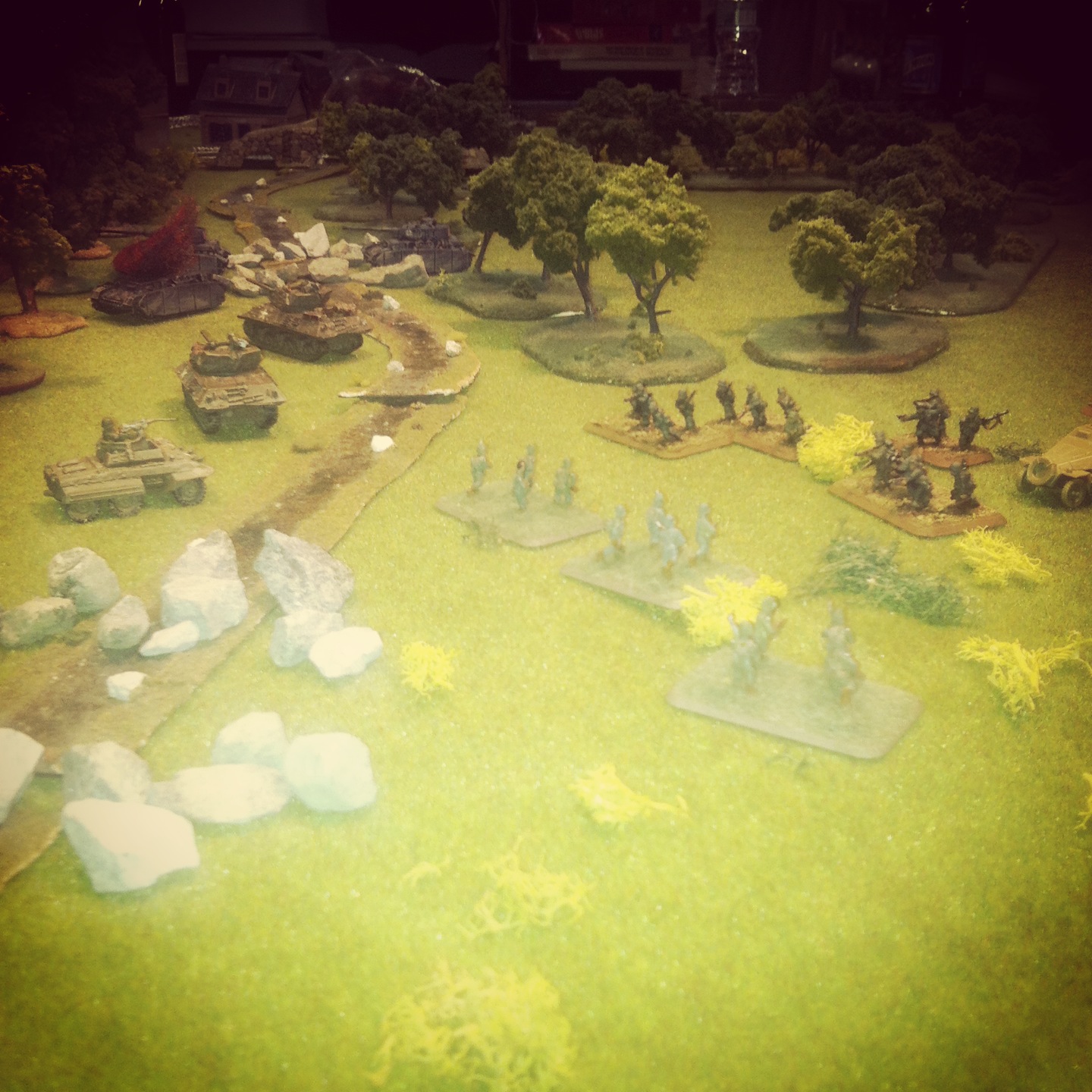
This past weekend at Metropolitan Wargamers in Brooklyn, four of us got together to slog it out in the bocage tabletop of a Breakthrough Mission as provided in the Flames of Wars rules. The mission scenario calls for use of the Mobile Reserves rule for the defenders and the Delayed Reserves rule for the attackers. The Germans chose to field a 1250-point Fallschirmjager company backed with heavy machine guns, a Nebelwerfer rocket battery, Stugs and Pak 40 anti-tank guns plus a 1250-point tank company armed with mechanized infantry, Panzer IVs, Stugs and one imposing Tiger tank. We Americans also fielded two companies beginning with a 1250-point rifle company with three infantry platoons, Shermans, a weapons platoon of light machine guns and mortars and a P-47 Thunderbolt for air support. The other US company was pulled from the 82nd Airborne with a Priest mobile artillery battery and Stuart light tanks. To aid in navigation of bocage, the US armor were outfitted with hedgerow cutters. The Germans had six turns to take an objective and it would be the Americans’ job to stop them.

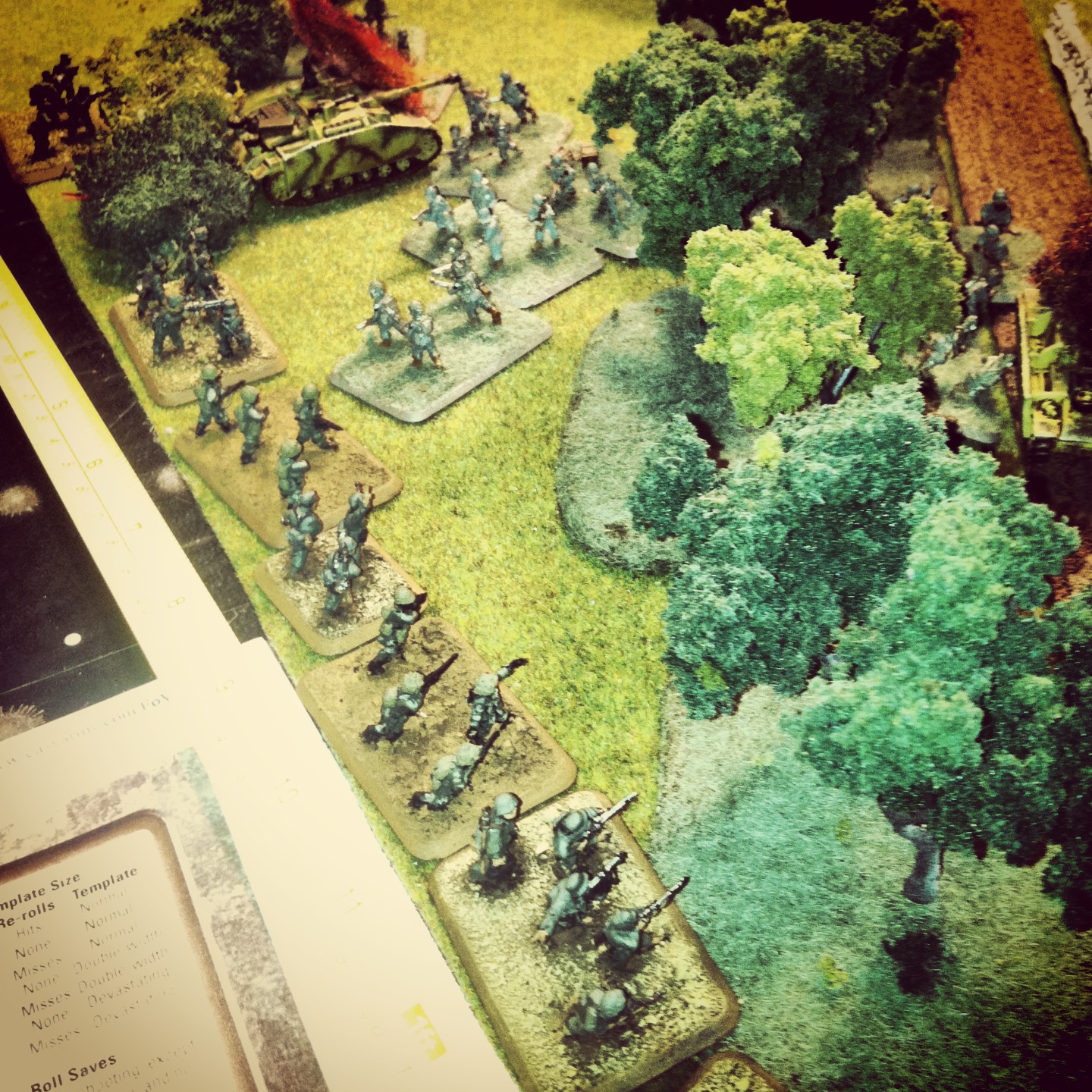
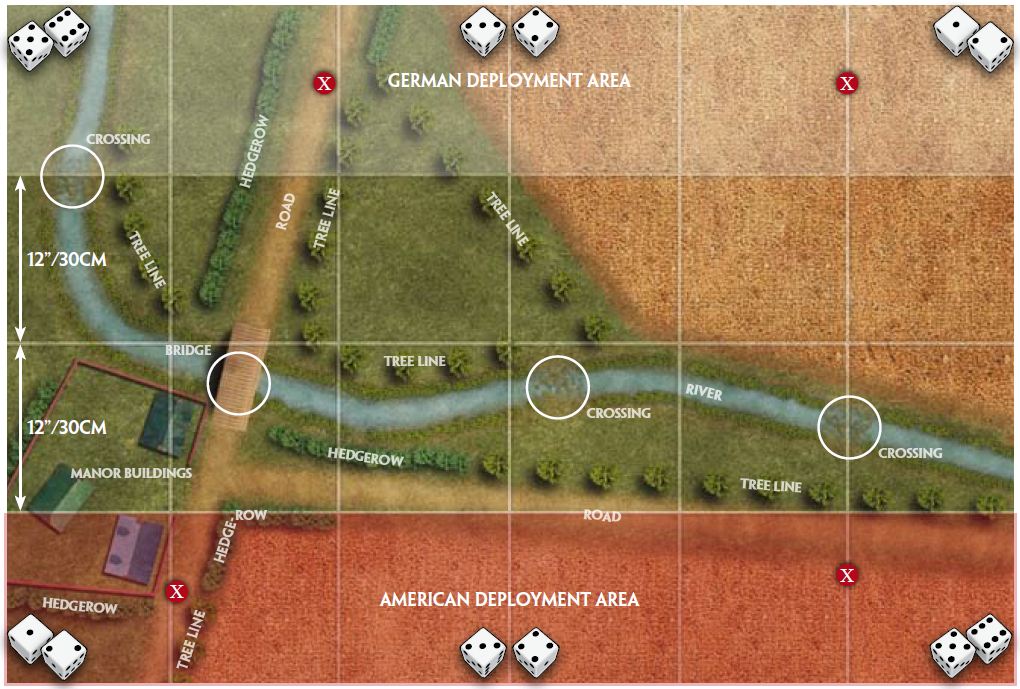
BTMapThe table was laid out thick with bocage surrounding a small village and a nearby farm. Americans rolled as the defenders meaning all our mobile units — all the tanks and artillery we had — were going to be held off the board as reserves. I hid all my rifle platoons in the town’s buildings and stuck the machine guns and mortars in the field between the Germans and their nearest objective. In the opposite corner, the Airborne platoons deployed near the farm hoping to camp out on the German objectives for the duration of the game.

As the attackers, the Germans deployed in their assigned corner of the table. Their rocket battery, anti-tank guns, heavy machine guns and the majority of their infantry dug into the field outside of the town. The large tank company deployed in the adjacent field. Held off-table was a Stug and a Fallschirmjager platoon, hoping for the a delayed reserves roll beginning on the third turn to put them right on top of one of their objectives at the opposite corner.

IMG_2177As the attackers, the Germans got the first turn, quickly pressing their armor toward the center of the table while the rocket battery, heavy machine guns and anti-tank cannons poured fire into the town, pinning one US platoon. Reserves failed to arrive on the first US turn and the P-47’s first run came up empty. As per the plan, the US Airborne pushed into the farm buildings to hold the nearest objective.

IMG_2179

IMG_2181In the second turn, the Germans continued to light up the town with the US companies pinned in the buildings. A Stug opened fire down a lane but the Americans avoided being hit. US bazooka teams moved into the barn at the edge of town and took shots on the a German Stug and approaching half tracks but to no effect. The US machine gunners attempted to fire and then assault the nearing Germans but were thwarted by the thick bocage and failed terror test against a nearby Panzer. The Thunderbolt once again on did nothing its second run while the Airborne units at the farm ran across the road into the treeline, securing the second German objective.

IMG_2183

IMG_2185

IMG_2191In turn three, the German players thankfully failed their first attempt at calling in reserves. Pressing on, German half tracks raced through the town toward the American weapons platoon which took heavy casualties and lost the machine gunners to fire from both sides. Stugs and artillery continued to pound the American rifle platoons in the town. At the top of their turn, the Shermans arrived and made a hasty path to cut a hole in the bocage standing between the rest of their reserves and the nearby road.

IMG_2185

IMG_2189Things really heated up in turn four as the Germans rolled on their first reserved Stug platoon near one of the objectives and the awaiting US Airborne. German infantry and Panzers pushed into the next field, knocking out the US mortars and eliminating their first platoon. The Americans pulled in the rest of their reserves but immediately created a bottleneck of Shermans and Stuarts as paths were cleared through the bocage. The P-47 came in hard on the Germans in the field, knocking out several units and destroying a Panzer. Finally, the fearless Airborne did what they’re trained to do and burst from the treeline to assault the newly-arrived Stug platoon. Two Stugs were destroyed and the third fled the field after a failed morale test. The objective was still held by the Americans but things were looking dicey with Germans coming in from all sides.

IMG_2196

IMG_2187

IMG_2198

IMG_2193

IMG_2200The fifth turn started with the final German reserve platoon arriving amid their burning tanks and assaulting the US Airborne. Through a series of attacks and counterattacks, the two groups whittled each other down. The Germans were eventually ground down to two remaining stands, lost their morale check and were destroyed. The victory for the Americans was short-lived, however, and the heavily-damaged Airborne platoon also failed a morale save and likewise fled the battle. With the game nearing it’s end, a Sherman was destroyed and blocked the road. All the US armor and artillery was effectively shut-out of the game. As the Germans covered an objective, the American P-47 made one final run to force a German morale check but to no avail. The Germans had won the day.

IMG_2208

IMG_2210There were a number of things that had gone wrong for the Americans. The rifle platoons never got out of the town, contributing almost nothing to the battle. Had they hauled their way toward the forest in the middle of the board, pressure would been greater on one of the objectives. The restrictions on the reserves also hurt the Americans, with nearly half their force never getting a chance to get in the fight. The US Airborne were typically deadly in their assaulting enemy armor and ground troops and proved to be the one positive for the Allies. On the German side of the table, much of its large armor platoon, including the Tiger, was sidelined for much of the battle as they navigated the hedgerows and roads.

The game was a new experience for one of the German players who typically games in the wide-open spaces of the Northern Africa theater from earlier in the war. As in 1944, bocage played the role of a third unmovable enemy on the table. The bocage was frustrating for all players but this time sided more with the Germans in their breakthrough victory.

Flames of War: La Fiere Causeway 1944 Scenario

lafiere1944

In the late evening of June 5th and pre-dawn hours of June 6th, 1944, a steady flow of Allied paratroopers began dropping throughout the French countryside to clear the inland way for the D-Day beach landings to come later that morning. Like elsewhere, scheduled US Airborne drops near Sainte-Mère-Église left paratroopers scattered around the countryside. To the southwest of the town’s target area, a contingent from the 82nd Airborne found itself near a quaint French farm compound and a small bridge over the Merderet River. Recognizing the river crossing as a key defensive line, the assembled paratroopers established a perimeter along the river. A few hours later, the US troops were met by a German Grenadier and armored battallion hoping to stall the Allied invaders from moving inland. The battle that erupted at the river would rage for three days until the German force withdrew in time for the arrival of US infantry and Sherman forces rolling in from Utah Beach on June 9th.

causewaygamemap

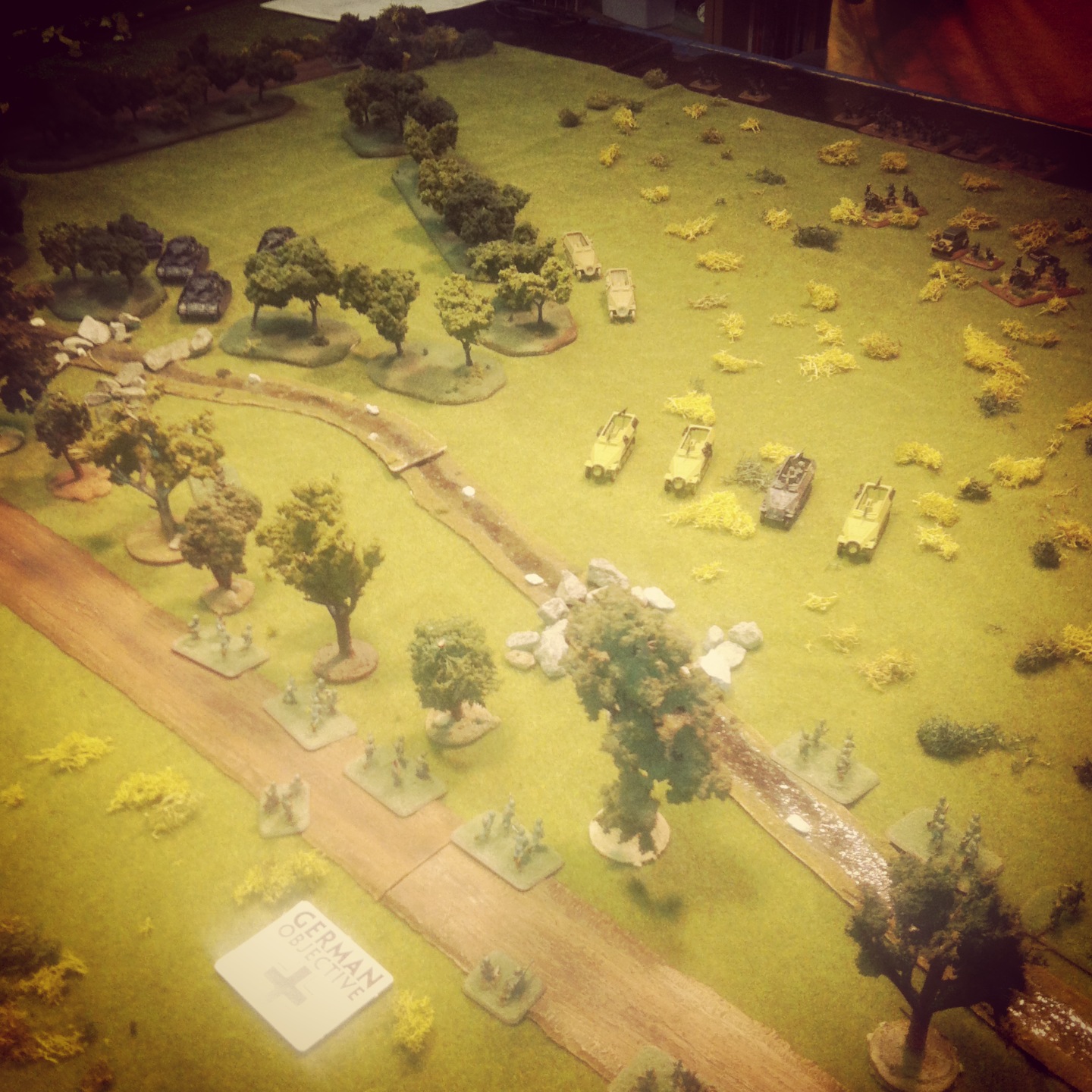
The Flames of War website offers a basic scenario of the encounter at La Fiere Causeway suitable for 1500 point forces on either side. This past weekend a visitor to Metropolitan Wargamers and I had a go at the scenario with my US Airborne facing off against his Germans. As with the historical record, my force held closely to the scenario’s outline with two parachute rifle platoons with plenty of bazookas supported by a platoon of light machine guns, parachute engineers, a glider artillery platoon and M18 tank destroyers. On the German side of the table, my opponent lacked the primitive French tanks that historically fought at the battle. Instead, he filled his force with a number of Grenadier platoons mounted in half tracks backed by two small platoons of Panzer IVs and a Nebelwerfer rocket battery.

IMG_2161

IMG_2163

As per the scenario rules, each of us chose half of our platoons to be held in off-table reserve. Beginning with the Germans, we alternated deploying our starting forces on the table. My American engineers took up position in the courtyard of the farm on my left flank, the machine guns lined the hedge on the other side of the bridge and a rifle platoon deployed on my far right flank. As expected, the Germans deployed a tank platoon at the road entry point and the rocket battery and a mounted Grenadier platoon in the field on their left flank.

IMG_2165With the Germans taking the first turn, the first Panzer IV platoon made way for the river crossing at the middle of the table while the half tracks rolled for the ford on the American right flank. Deployed in and around the farm buildings, the US engineers quickly laid down mines at the foot of the bridge and an Airborne platoon crossed the river to meet the approaching Grenadiers and the rocket battery beyond.

IMG_2169

IMG_2167With turn three, German tank and Grenadier reserves appeared on the table edge opposite the farm and pointed their way toward the French buildings and the nearby bridge. Four US bazookas bailed one Panzer in the clearing across  the river but three other Panzers made it across at the middle ford. US tank destroyer reserves came on the table and immediately poured machine gun fire into the half tracks across the river. The Grenadiers bailed from their transports and the half tracks raced to the rear while the Nebelwerfers failed to score effective shots in the hearty US Airborne troops.

IMG_2171With the Grenadiers on the run back to defend the rocket battery, the US tank destroyers turned their attention on the Panzers and quickly destroyed one while the others continued to push on unharmed due to the protection of their side Schurzen armor. At the farm, the approaching Panzer and Grenadier platoons exchanged fire with the engineers and riflemen defending behind the stone walls. Even with heavy casualties, the engineers repelled a direct assault by two Panzers as a fresh rifle platoon rushed to reinforce the farmyard strongpoint.

Alas, by the fifth turn the game was effectively over for the Americans as the late-arriving US howitzers once again failed to hit in one final volley against the Panzers rushing to seize the objective. The Americans had chased both Grenadier platoons from the field and destroyed a couple Panzers, but the Airborne focus on defending rather than seizing objectives allowed the Germans to take the table.

At the game’s outset, both of us shook our heads with the difficult mission ahead of us. The Airborne never effectively engaged in a close-quarters assault that might’ve taken out more of the tanks sooner on in the game, and artillery on both sides contributed nothing to the game. As with the last few FOW games I’ve played, the engagement at La Fiere once again pointed out the strength and tactical importance that infantry played in WWII. Keeping men moving and in the fight is key to victory, and this time around the German troops got the better of the day.

New Game Weekend: Power Grid

PGcontents

This year I’ve been fortunate to have both the time and a revolving line-up of patient opponents at Metropolitan Wargamers to introduce me to nearly 30 new games. Lots of times I’ll hear the name of a game or references to its mechanics tossed around by other members, and I’ll just file that name away in the back of my head for a future gaming option. One of the games I’ve heard come up again and again is Power Grid, and this past weekend I finally got my first shot at playing it.

What a fantastic game.

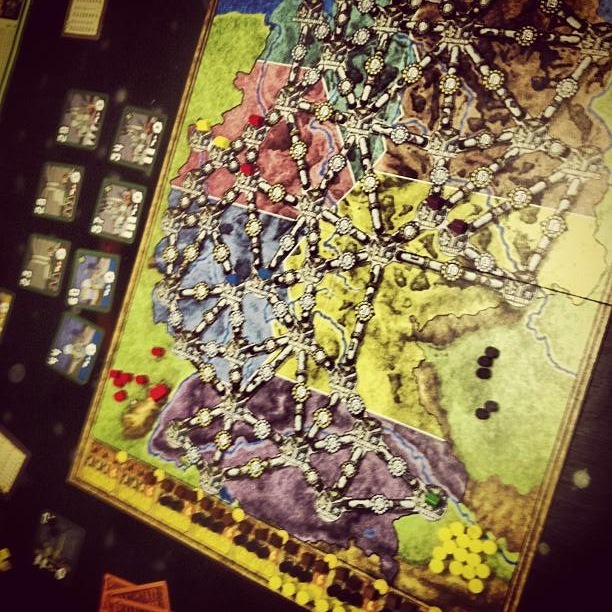
Power Grid is a game of building power plants along a grid among interconnected cities and managing the resources to power the system. Originally published in Germany over 10 years ago, Power Grid began as a crayon and paper game. The version available since 2004 from Rio Grande Games is a more typical Eurogame with a two-sided playing board (Germany and US maps on either side), cards and scores of wooden playing pieces.

The game play unfolds over a series of turn phases. First, player order is determined by the player with the most cities built. Player order is very important in the second phase when power plants are auctioned among players. Some primitive coal, wood or trash-burning plants may come cheap but power few cities or require lots of resources to fire them. Other plants, like solar fields and wind farms, come at a higher initial cost but require no resources to fuel them since the wind and sun come for free. At the far edge are high-tech nuclear plants which can power many cities but require the rare and costly uranium fuel.

And so that leads to the third phase of buying resources. In turn order, players buy coal, wood, trash and uranium which fluctuate in a market of varying demand and pricing throughout the game. Each player’s plant holds double the resources it requires, so a coal-fired plant that requires two coal to run it can hold four coal resources. In terms of strategy, players buy resources for use in their own plants, but they may also choose to stockpile resources and rob other players of the ability to buy resources for their plants.

In the fourth phase, players build cities and their grid. Building cities begins at a $10 value but rises to $15 and then $25 as the game progresses and the grid becomes more crowded with development. Connections between cities also costs money, so creating a close network of cities along a compact grid can make things cheaper for you and more expensive for your opponent as the game goes on. To wrap a turn, players fire up their grid, burn resources and collect income based on how many cities they are able to supply with power.

PGgame

Power grid is a fantastic game of economics, resource management and area control, hitting all the marks of a classic Eurogame. A mix of strategies of building and resource management makes for a realistic yet streamlined game requiring just some basic rules, no reading during the game and simple components. The

Numerous expansion sets are available for Power Grid, including additional power plant cards and additional two-sided regional maps from around the world such as France/Italy, Central Europe, Russia/Japan and China/Korea. A rabid international online fanbase has also created custom homebrewed maps of just about any country or region on the planet.

With the topic of energy and natural resource consumption on the front page of just about any paper in the world on any given day, it’s easy to see why Power Grid resonates so widely. The game also plays without any reading required (other than a basic understanding of one of the translated rulesets), adding to its international appeal. Not only is the game a huge draw for hardcore gamers, I could also see it as a very instructive tool in teaching any group of engaged kids on the challenges of managing ever-increasing power demands.

Flames of War: Fielding the PSC Panzer IV Tank

pniv

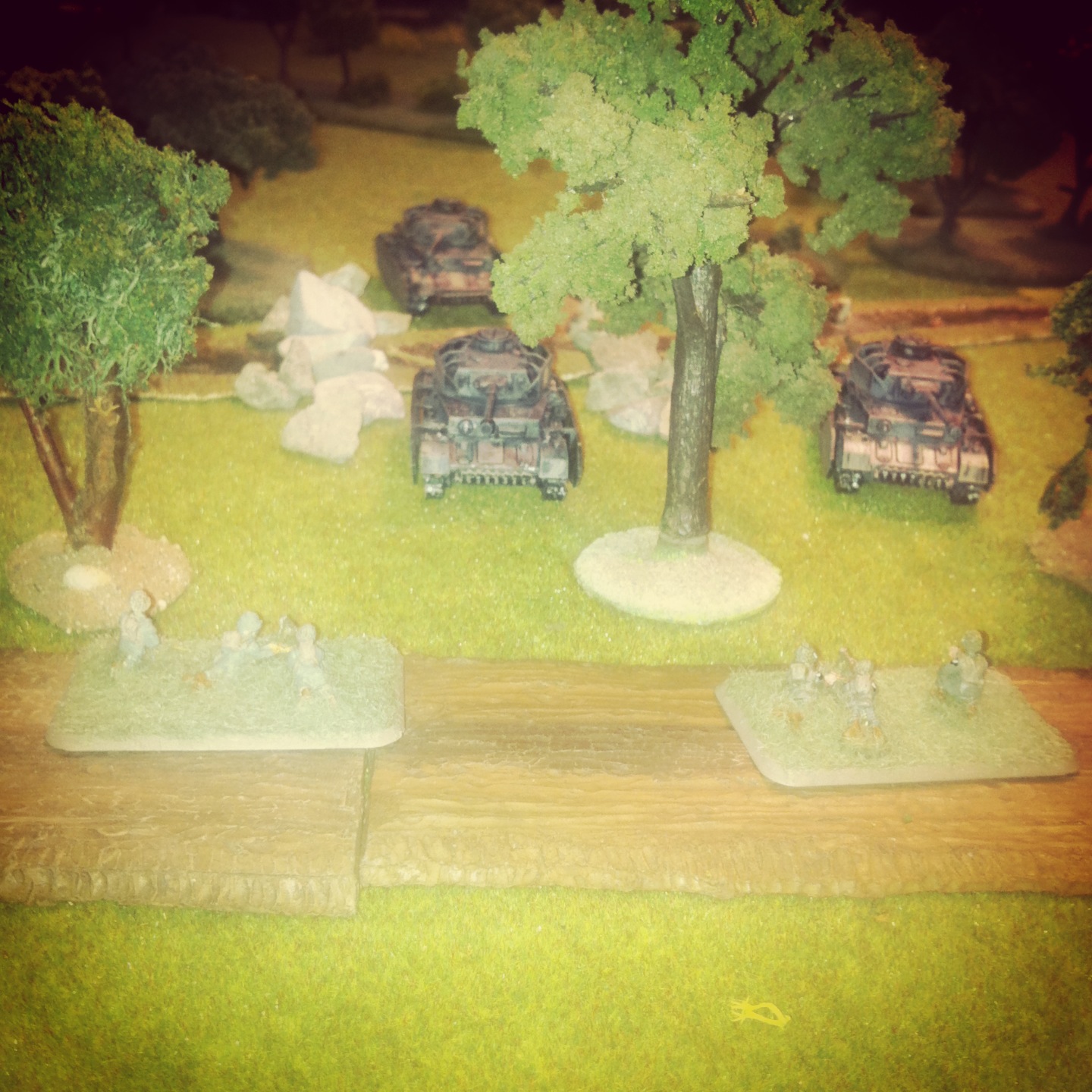
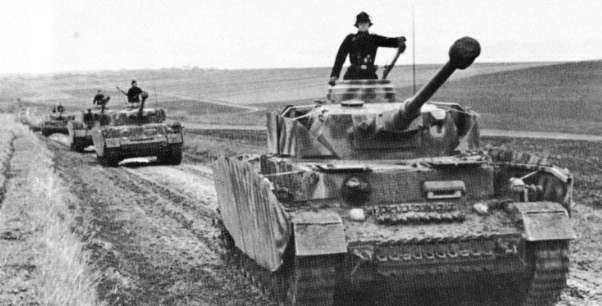
One of the greatest military impressions Germany left on the face of warfare during World War II was in its feared armored forces. The famed Tiger I heavy tank gets a lot of the glory for its independence and near idestructability, but the Panzer IV medium tank served as the real backbone of German armored forces throughout the war. With improvements to its armor and gunnery made throughout the war, the Panzer IV would prove to be a tough nut for the Allies to crack until very late in the war. Especially in the period from the D-Day landings through to the Battle of the Bulge, the Panzer IV played an ever-increasing role in attempting to stymie the Allied advance right up until the eventual fall of the Third Reich in the spring of 1945.

FOWpzIV

pscpziv

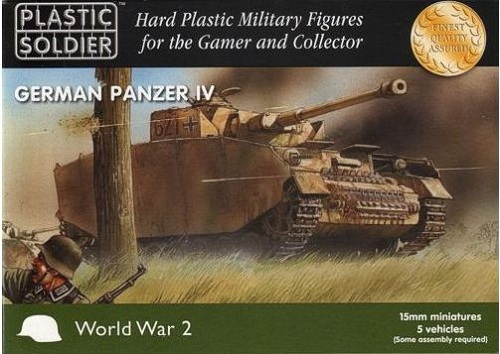
I already own a fair amount of German armor with Tigers, Panthers, Jagdpanzers and Stugs, but my force was sorely lacking in Panzer IVs. Most of my German tanks thus far have been from Battlefront, the makers of Flames of War (FOW). They offer a late war Panzer IV platoon in the pricey $50-60 range, depending on whether you pick the set up online or in a store. Going on some recent experience with the PSC Allied Stuart tank set, I went with the Panzer IVs from the Plastic Soldier Company (PSC) at about half the FOW cost.

pscpzivsheet

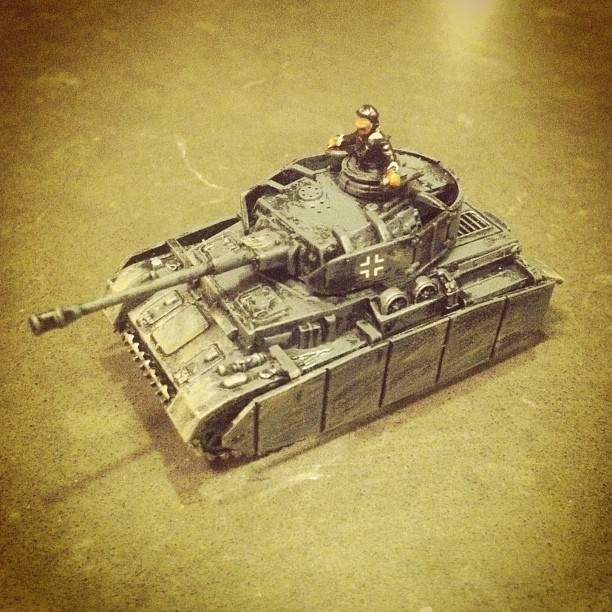
Unlike the FOW sets, PSC kits come with options to model miniatures in several periods. This allowed me to model my tanks as the later war Panzer IV Ausf H with its extra armor and gun power. Like the Airfix kits of my youth, the PSC tanks are comprised of lots of little parts. The diagrams included in the box offer clear color-coded keys to getting the correct pieces off the sprues and blow-up schematics for gluing the pieces together. If you’re like me, keeping your workspace clean and organized will prevent you from losing your mind during the multi-step assembly process. The sprues also leave some leftover parts which either go straight into the trash or into container of miscellaneous plastic for future modelling use.

Lots of parts means lots of steps. The turrets alone are compromised of 9-10 parts and aligning the tank tread sections needs to be done carefully. I also found the hole on which the turret sits to be a bit tight, so I carefully drilled those out slightly larger. My Panzer IVs were completed with a basic grey-schemed paint job over a flat black spray base to match my existing models. With assembly, painting, decals and a matte finish finishing coat, these tanks are ready to hit the table in just a couple work sessions.

Compared to FOW models, the PSC tanks take a bit longer to put together and parts can be finicky, but I really like the PSC models when complete. The PSC tanks offer crisper molding and some fine details like a slight sag in the upper parts of the treads and hangers for the  side and turret Schurzen. Models are light, making for easier storage and transport. Putting together kits from PSC just feels a lot more like model building than what you experience with FOW and some other manufacturers.

pzivcommand

pzivplatoon

With so much economic pressure on miniature wargame funding budgets, you can’t beat getting more armor in the field for the low cost and fine results from the Plastic Soldier Company’s Panzer IV kit.

New Game Weekend: Bioshock Infinite: The Siege of Columbia

bsboxAfter a week away on vacation I returned to Brooklyn and the Metropolitan Wargamers club in Park Slope this past weekend. The club was packed on the Labor Day weekend with lots of different games hitting the tables. I paired-off with one of my fellow members to try out his new copy of Bioshock Infinite: The Siege of Columbia.

Based on the latest game in the long-running Bioshock video game franchise, this 2013 boardgame is at its root an area control game. Players choose to play as one of the two factions – the Vox Populi led by Daisy Fitzroy and the Founders led by Zachary H. Comstock. The game plays in a one-on-one two-player game or in a four-player team version of the game.

Play begins with each faction placing their starting miniatures and Turret and Home Base building markers. Each turn begins with the draw of a victory point mission card followed by a World Event Card which kicks off a secret vote with each player committing influence points from their hand of five Action cards. Winning or defeating the vote varies in importance, as the neutral Booker and Elizabeth characters advance to different spaces on the board and other game-changing events are put into play.

bscontents

The winner of the vote also receives the first turn marker which is key to controlling the flow of the game. Starting with the first player, units are purchased or Action cards are upgraded with Silver Eagle coins. Action card upgrades give you greater influence in votes, stronger combat values or more purchasing power in subsequent turns. The player then moves up to four units to adjacent squares or takes a chnace gliding to neighboring territories across the Skyline. Most units move one space but the Founders’ Songbird and Voz Populi’s Airship models each move up to two spaces. Skyline moves are achieved through rolls of special dice sliding you to the next node or risking a fall into thin air with each roll.

Combat occurs next. Common, Special and Leader units each carry a different die value, with different colored dice being rolled to resolve combat situations. Loss of a combat results in a figure being removed. Playing Action cards and upgrades add to combat effectiveness as do the special Turret markers. Conquering unoccupied spaces earns additional Silver Eagle coins, and controlling all spaces in a territory earns victory points. Destroyed units are removed from play or returned to Home Base safe havens. A mix of controlling territories and completing missions of combined actions wins victory points, and the first player to ten victory points wins the game.

There’s a lot going on in this game, and well-played plans and strategies are forced to change as world events switch from turn to turn. In my first game, I found controlling the first player spot was key. However, controlling the first player role means spending lots of cards which can come back to haunt you in a heavy combat challenge later in a turn. As the game advances, the heroine Elizabeth moves along a timeline track which also alters how the game plays out. Her protector Booker is also a big spoiler in swaying votes and possibly attacking each faction at different points in the game. Unlike most area control games where occupying and defending a won territory is often enough to ensure victory, the Skyline allows an opposing player to drop right into or behind your defenses and attack.

For a bit more of an intro to the game’s actual gameplay, check out the video below from the alwyas-entertaining Watch It Played video series.

If you aren’t up on your Bioshock Infinite video game lore, I could see some initial challenges in wrapping your head around the interplay of the characters, factions and events in the boardgame. I’ve spent quite a few hours watching my son work his way through the spectacular action and storyline in the video game, making my understanding of the boardgame’s narrative a bit richer from the get-go. Whether you’re a fan of the video game already or just interested in a really rich and challenging area control board game experience, you should hop the next airship back in time for the floating nation of Columbia.

Flames of War: Modelling European Western Front Buildings

153770I got into miniatures wargaming through a combined set of interests I developed as a kid: history, role-playing and scale modelling. One of the aspects of gaming I enjoy is setting up a realistic and engaging tabletop battlefield, both for the visual effect but also to reproduce the playable advantages and challenges found in waging scenarios within scenery.

I’ve been searching high and low for an affordable and well-made set of buildings to add to my 15mm Flames of War World War II gaming set in the post D-Day Western Front. Battlefront Miniatures, the makers of Flames of War, launched their own series of buildings last year. The pre-painted buildings are beautiful, albeit a bit too perfect and pretty expensive at $40-50 each. Miniature Building Authority (MBA) has been a long-time producer of fine pre-painted buildings. Like the structures from Battlefront, MBA models feature removable roofs but also convert into ruined bombed-out versions. At $40-50 for single large buildings or for pairs of smaller ones, the MBA buildings are also pretty pricey. MBA keeps a small line in stock, but they have dozens of out-of-production models which you can also find at conventions and occasionally online. JR Miniatures is another standby in the industry, but I find their relatively low-priced line of buildings is a bit of a mixed bag in terms of casting and playability.

markivWith building up my gaming real estate on my mind, I posted to the message boards at The Miniatures Page. Some suggestions pointed to the above manufacturers, but several posters also mentioned Mark IV Miniatures. The company is run by Jeff McCarron, a second-generation gaming modeller out of Colorado who obviously puts great care and passion into his work. McCarron sells his models directly and distributes them through Musket Miniatures, and I found him to be incredibly responsive to a couple questions I had before ordering. As it turned out, a fellow member of Metropolitan Wargamers had recently picked up the large church model and a couple houses from Mark IV. After playing with his models during our big Summer FOW event and Barkmann’s Corner scenario at the club, I decided these were the buildings to sink an investment into.

1148873_10201247963855523_305675209_nI decided to go with several two and three-story buildings, a barn, a courtyard and some walls, all ordered from Musket Miniatures. With all these models, I’d have the flexibility to set up a fairly decent-sized town or play with them as a separate farm estates. The castings arrived clean and required little tidying-up of residual flash with a knife.

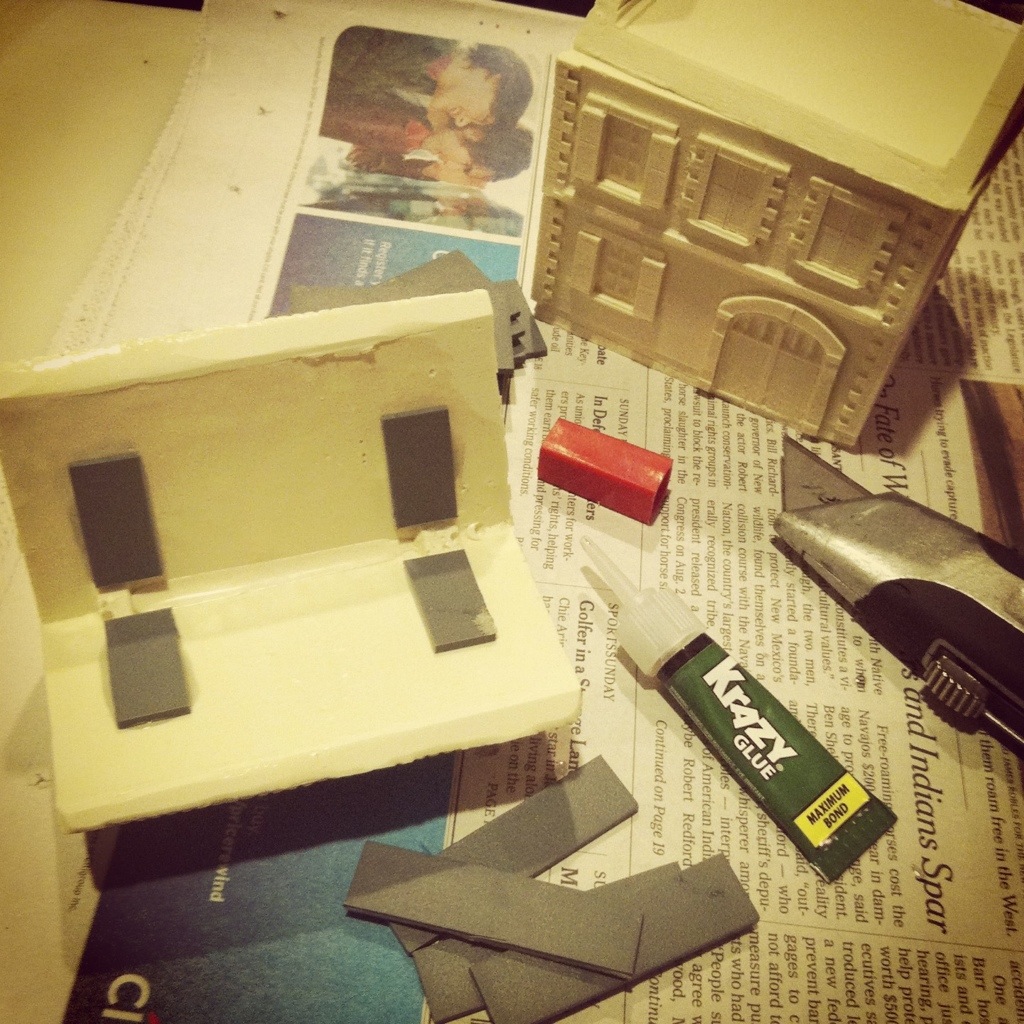
20130830-233936.jpgI did have to put in a bit of work gluing plastic tabs to the undersides of the floors and roofs to provide a snug fit for each story of the buildings. The larger one-story bank building also required a wall and metal cast windows to be glued in place.

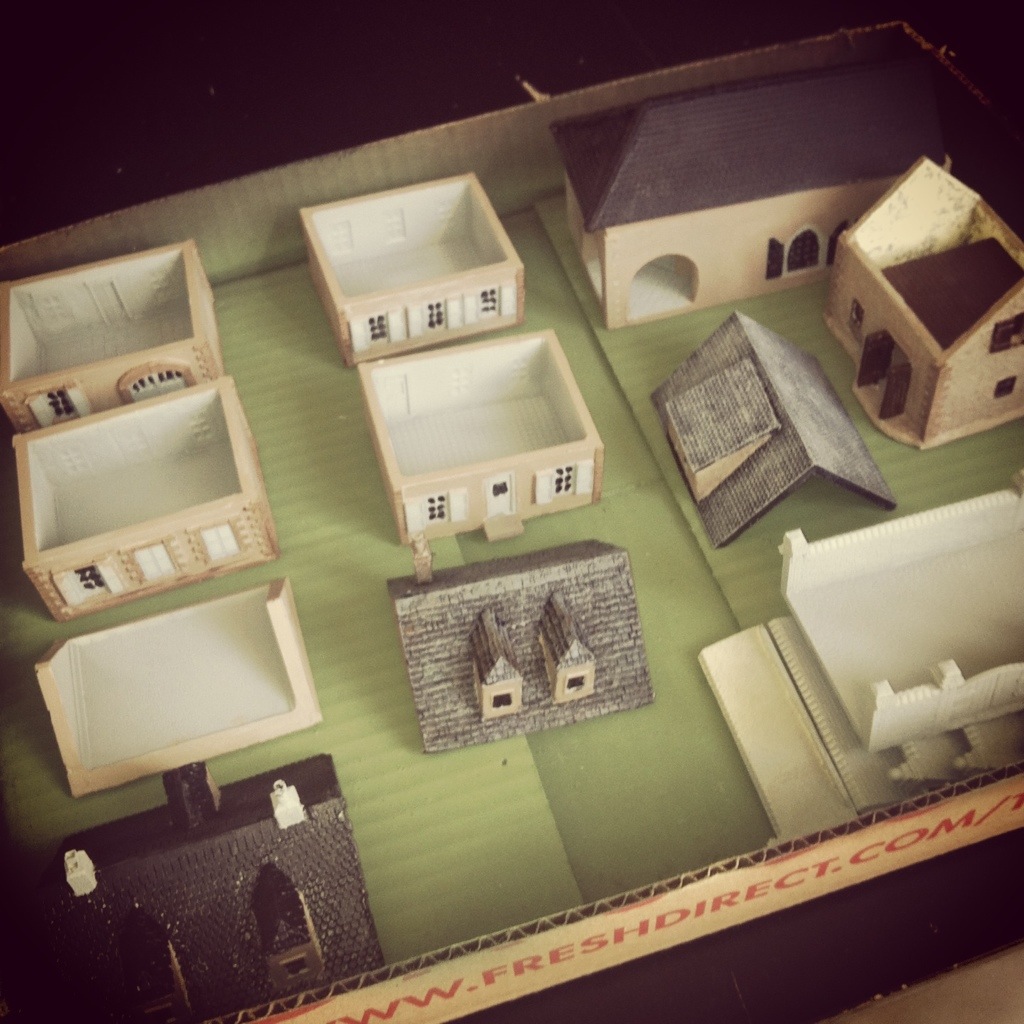
20130830-234253.jpgFor painting reference, I searched online for photos of European villages. After a light grey spray basecoat, the stucco walls of the buildings were dabbed with a bit of foam sponge in sandy gray-brown stucco and then dry-brushed with an off-white paint to add variety to the wall surfaces. Exposed stonework, the courtyard cobbles and masonry details at the corners, doors and windows all got combinations of varying shades of grays, browns and whites to create some depth.

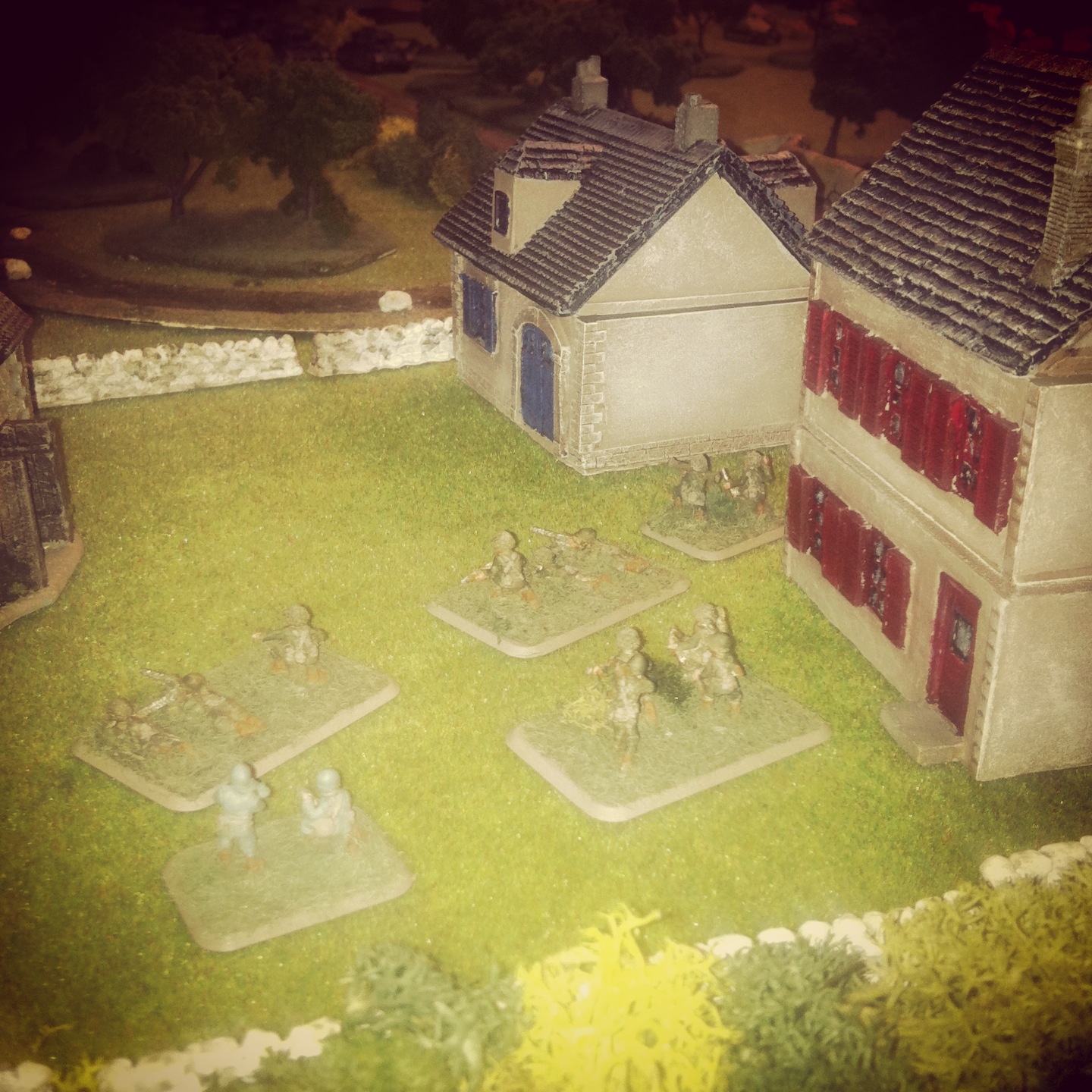
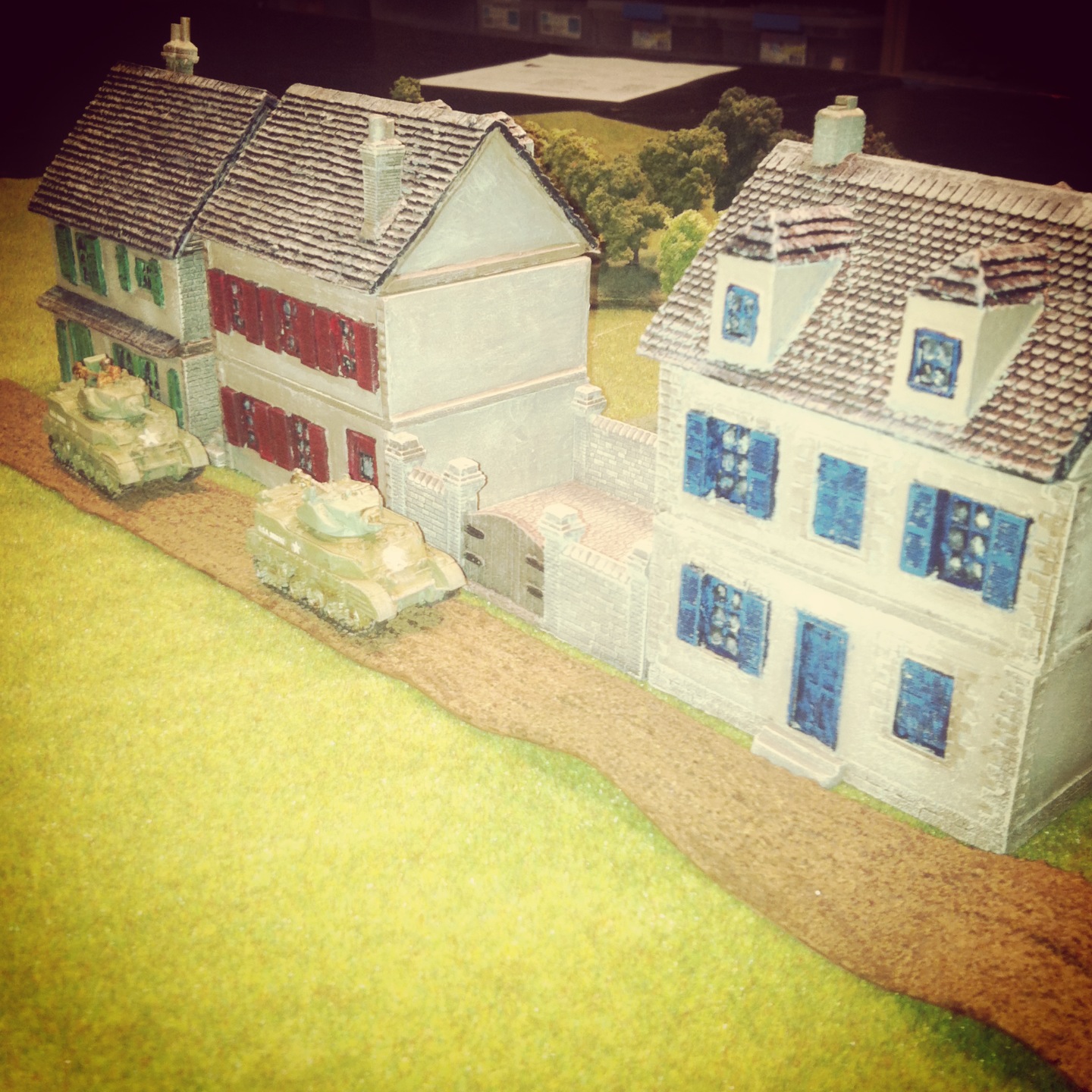
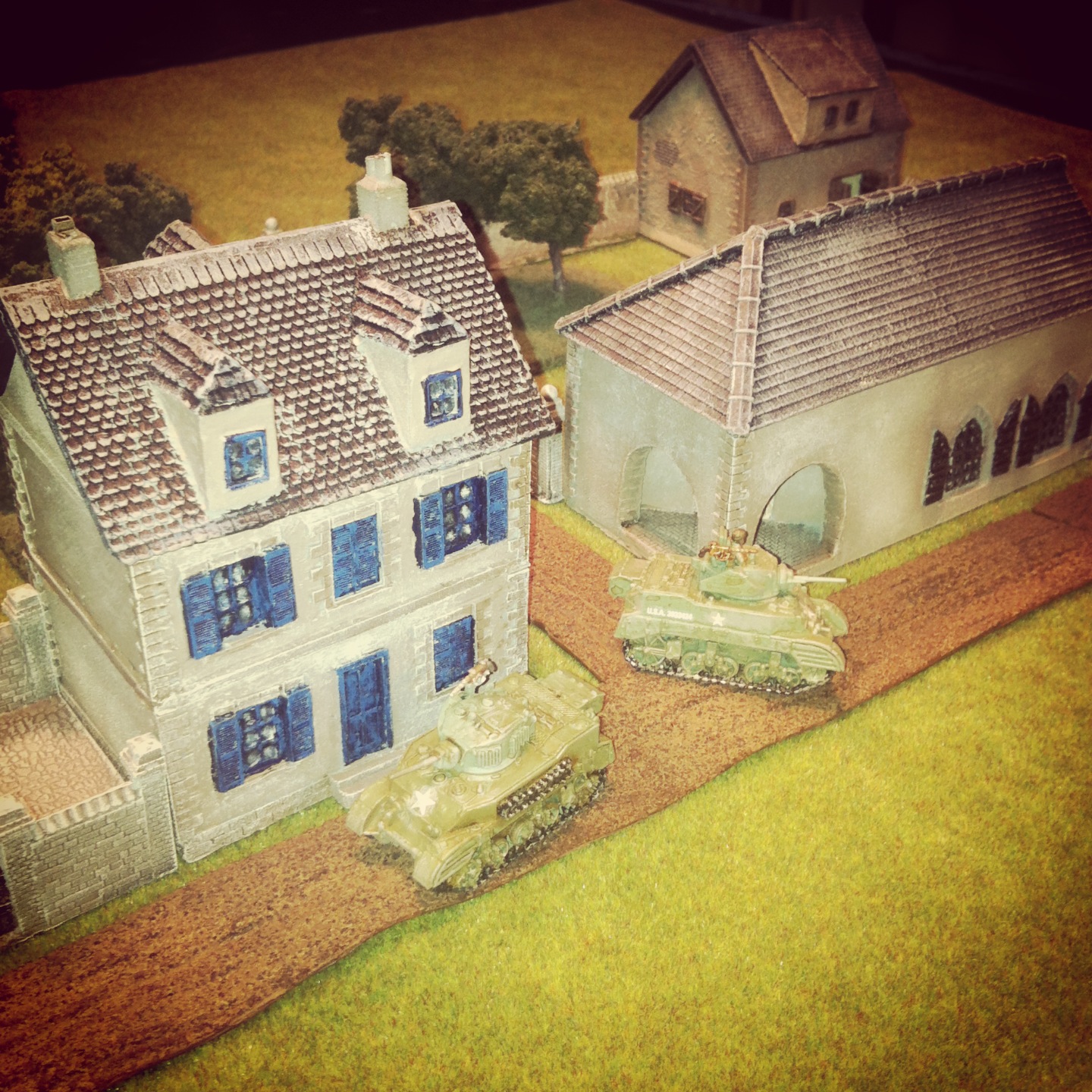
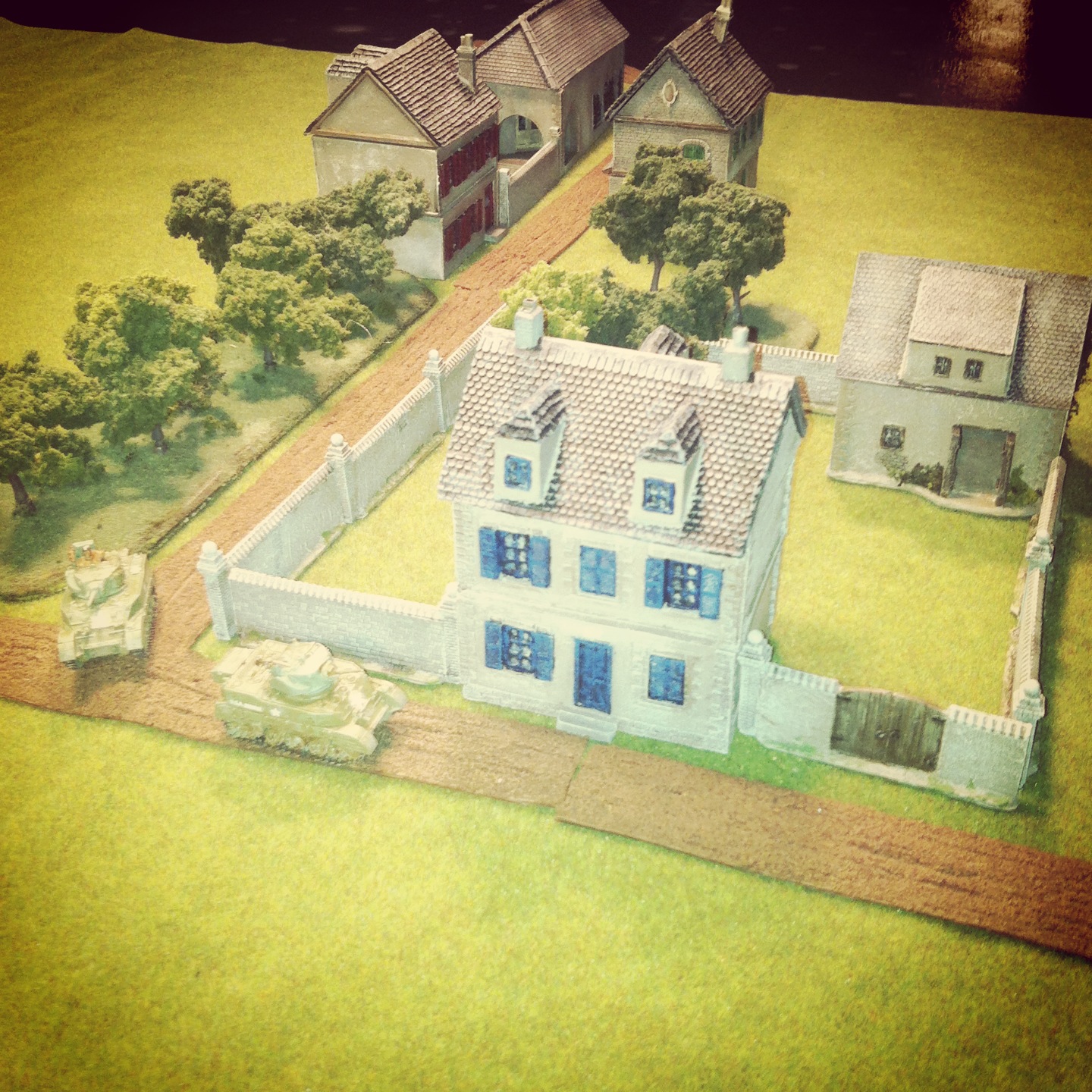
IMG_2115Shutters, doors and windows were painted with dull blue, white, green and red trim, mimicking some of the variety in paint schemes I had found in photos online. For the roofs, a black undercoat was dry brushed in a couple shades of grey with a bit of browns and dark green shades mixed in. On the barn model I glued on some thin pieces of lichen to add the look of vines covering part of the walls.

IMG_2117The walled courtyard and modular wall sections got a two-part paint scheme over the gray primer. A watered-down brown-black wash over the bricks and cobbles filled the cracks with a dark shading finished-off with an off-white dry-brushed highlighting coat. The courtyard and wall gates started with a dark brown base with a lighter brown adding aged detail to the wood. Iron hinges got a black undercoat with some rusty metal dabbed over it. The result was some very realistic stone and brickwork walls.

IMG_2112

IMG_2119

IMG_2123

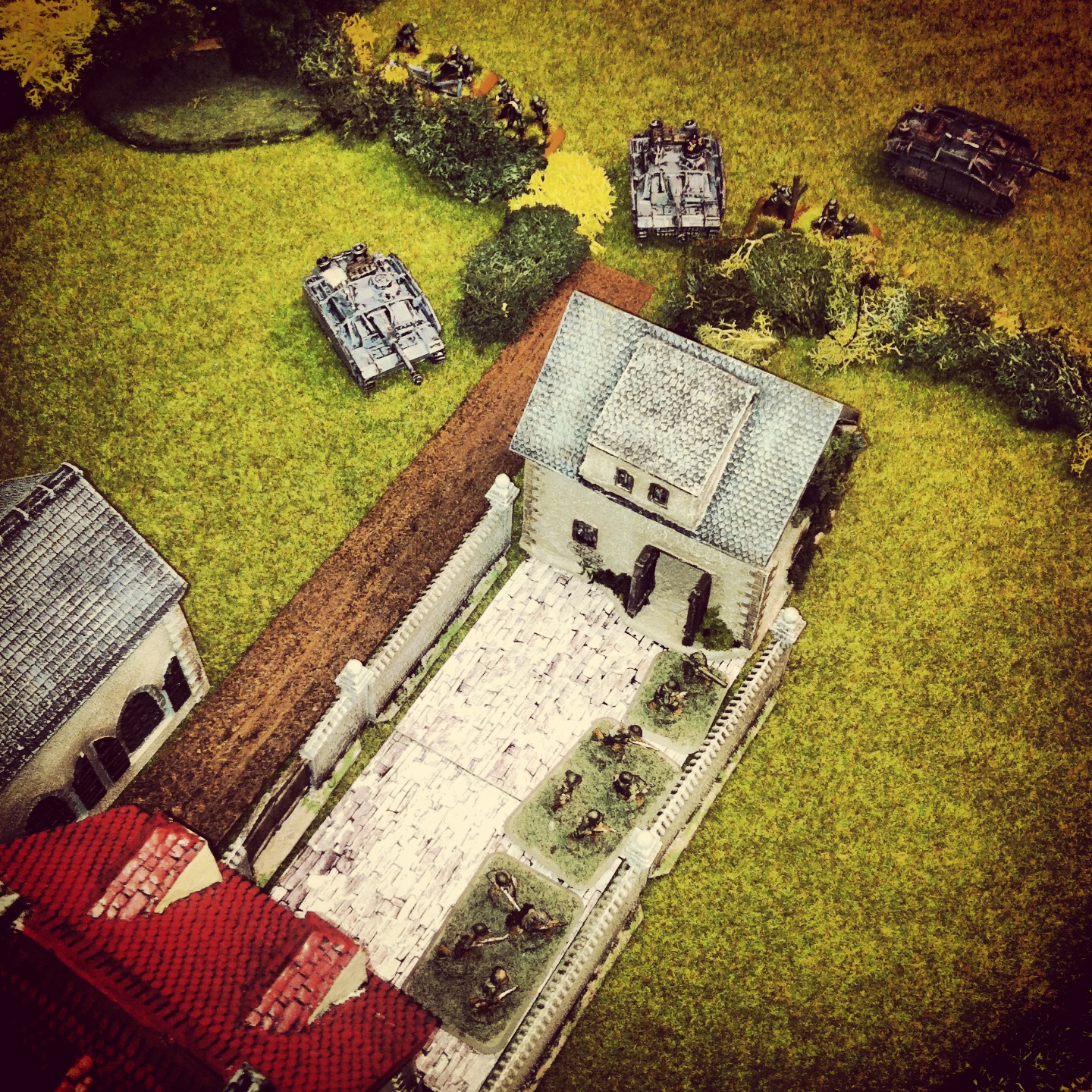
IMG_2125I couldn’t be more pleased with the buildings. They’ve already seen some action on the tabletop in my recent Singling ’44 game and combining them with my existing trees, roads and lichen hedgerows really brings the battlefield to life. I’m already eying a few of the other models offered by Mark IV, including some ruined versions of the same buildings which come cast in some exciting bombed-out interior detail.

At Metropolitan Wargamers, there’s some early plans being laid for another big day of gaming to coincide with the fall’s Flames of War Tanksgiving 2013 event and there’s certain to be plenty of WWII action before then. With my new buildings from Mark IV on the table, these miniature landmarks are certain to add even more depth an interest to all out future games.