Metropolitan Wargamers D-Day Plus 70 Event – June 6th-8th 2014

MWGDDay

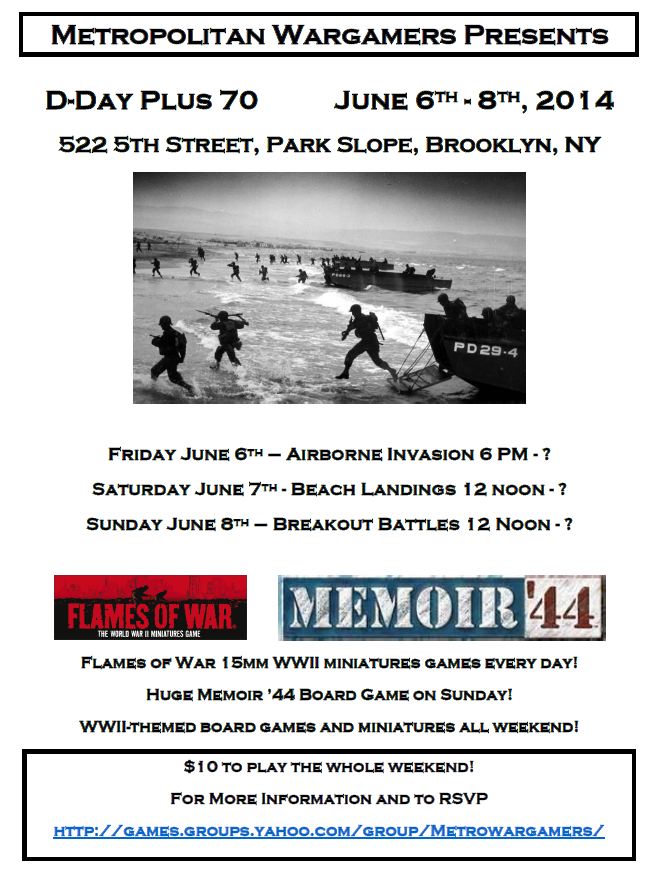
This June is the 70th Anniversary of the Allied D-Day landings at Normandy, and New York City’s oldest and largest wargaming club Metropolitan Wargamers is celebrating with a full weekend of events.

IMG_2161

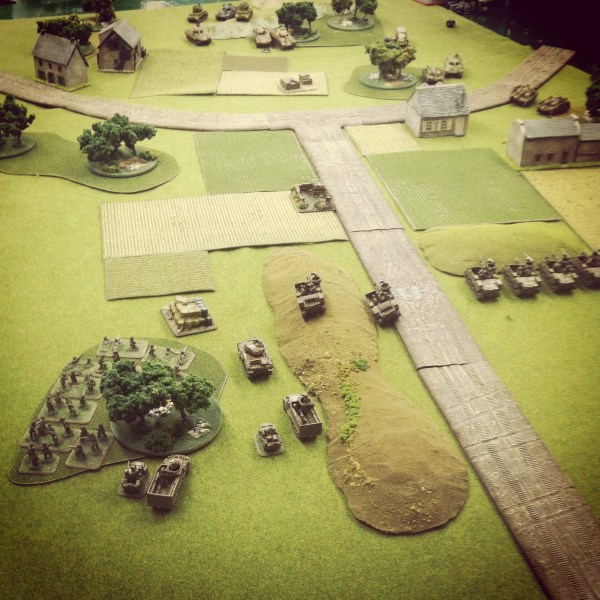
La Fiere Causeway at Metropolitan Wargamers in Brooklyn, NY

Whether you’re new to the hobby or an experienced gamer, there will be plenty of WWII action the entire weekend. On the evening of Friday June 6th we’ll begin with Flames of War airborne landing scenarios. Saturday June 7th kicks off at noon with a FOW beach landing scenario on one of the club’s famed sand tables. Sunday wraps up the weekend with a couple FOW breakthrough battles and a large Memoir ’44 board game. Other WWII-themed games will run throughout the weekend.

IMG_2816

Utah Beach on one of the sand tables at Metropolitan Wargamers

We’ll have FOW scenarios set up for the weekend with plenty of miniatures and stunning terrain on the club’s tables, so all you need to bring is your passion for wargaming and history. Our FOW miniatures games are fun and a feast for the eyes, and you can get a sense of what’s in store for the weekend by viewing some of our past scenarios at the club here.

Admission for the full weekend of gaming is just $10 and a great opportunity to visit a very unique community of gamers in the heart of Brooklyn’s Park Slope neighborhood.

For more information and to RSVP for the D-Day Plus 70 weekend, check the Metropolitan Wargamers website or join our Yahoo group.

New Game Weekend: Joan Of Arc

joanwarbonds

For a story mixing heroicism, legend, Christian mysticism and epic battles of swords and armor, you really can’t beat Joan of Arc. Rising from storied French farmgirl  beginnings toward the end of the Hundred Years War, the teen-aged Joan of Arc is legendarily credited with turning the French tide against English invaders at the Siege of Orleans in 1429. Her later capture, trial, burning at the stake and eventual canonization as Saint Joan of Arc cemeted her place in world history as a military, feminist and religious icon.

joanofarcbox

In the six hundred years since she was executed, Joan of Arc has remained a prominent subject of film, plays, art, literature, and yes, games. With so few women in headline roles in the history of warfare, the chance to game the period of warring Europe in the waning days of chivalrous armored calvary can be all the nore interesting when Saint Joan is present.

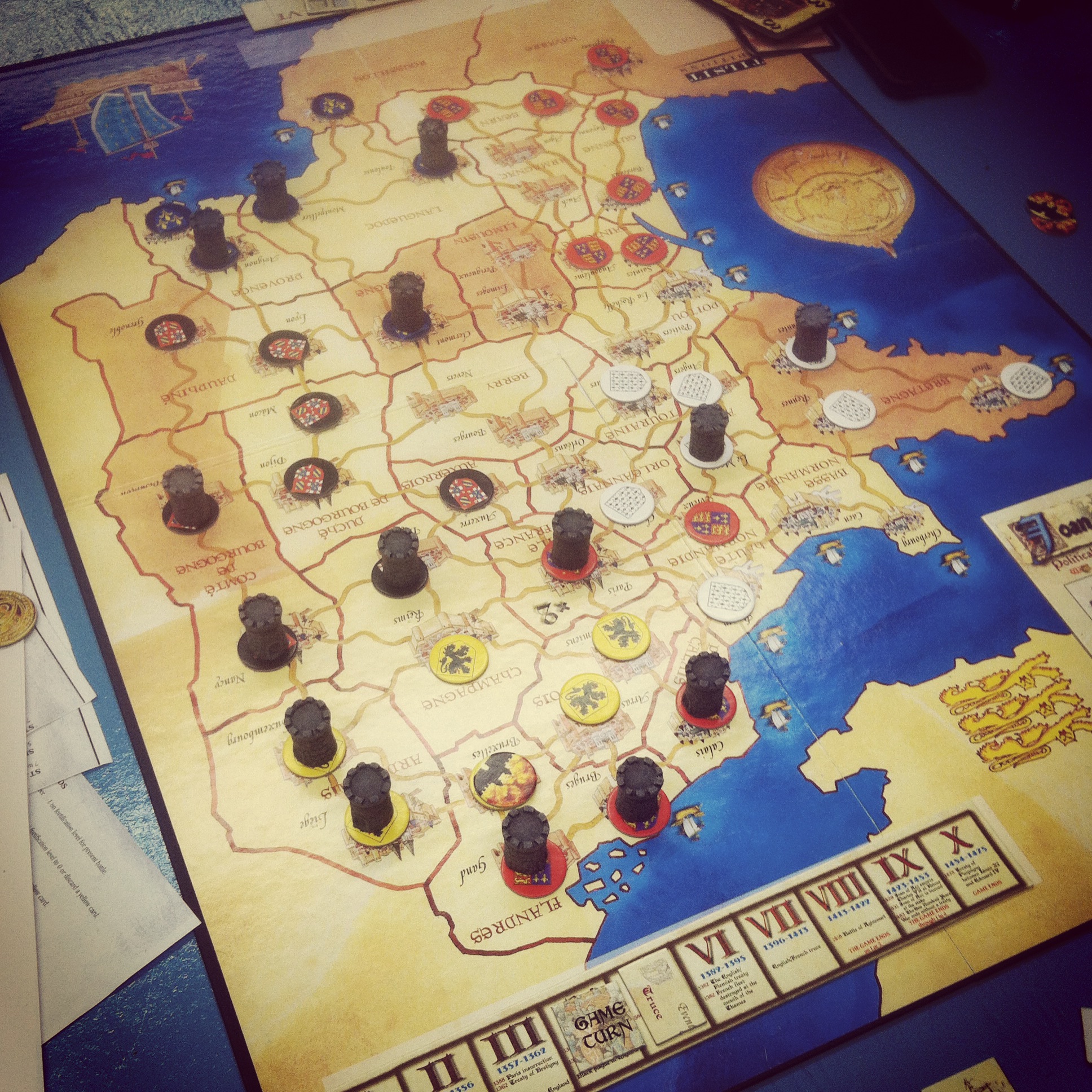
Released by Clash of Arms in 1998, Joan of Arc is at this point a classic board game which I recently had a chance to play for the first time at Metropolitan Wargamers in Brooklyn, NY. The game board presents the contested areas of the 100 Years War dotted with cities connected by roads. Players choose to represent on e of the warring kingdoms of France, England, Navarre, Brittany, Flanders and Burgundy. The game begins in a time of peace, and in each subsequent turn players vote in secret on whether the turn is to be one of peace or war. A time of peace causes one random event to be drawn and just one attack action per player, while a period of war brings two events and up to two battle actions from each player.

IMG_3434

 Joan of Arc at Metropolitan Wargamers

In random order at the beginning of each round, each player may expand into up to two free city locations along connecting roads or via seaport connections. Players draw a hand of large, tarot-like cards with which they can wage combat or cause other chance actions like the appearance of a hero of the kingdom such as St. Joan herself for the French. An attacking player draws cards from their hand, each carrying a numeric value, along with special actions such as Engineering which negates the defender’s bonuses from previously built castles and strongholds. A defeated city is occupied immediately by the attacking army, and the number of controlled cities and collective regions generates additional income in the following turn.

Throughout Joan of Arc, alliances are made, truces may be purchased through influence and battle for area control of the map marches through time. The player scoring the most points through controlled space on the board wins at the end of the game. Our group of savvy wargamers had the most fun in the alliances an double-crosses we meted out on each other’s kingdoms throughout the game.

There are a lot of better historically-based area-control games on the market at this point, and Joan of Arc’s connection to the historical record is pretty abstract at best. The game design looks great and it plays well once the somewhat imprecise rules are understood after a turn or two. Even with its minor faults and stretched thematic story, Joan of Arc more than engages a group of players in the era of Europe tipping away from its feudal centuries of warfare toward a more enlightened age on the continent we can still recognize today.

New Game Weekend: The Resistance: Avalon and One Night Ultimate Werewolf

avalonwerewolfThe mechanics of common and secret knowledge among players creates the basis for so many games we play. A game like chess has everything set on the board for everyone to see, and it is only a player’s skill and strategy that remains secret until revealed in a series of successive moves of action and reaction.

More typically games involve some level of secrecy either in cards hidden in a player’s hand or pieces set on a game board ready to be revealed at specific moments during play. Deduction, reason, probability, informed guesses, manipulation through bluffing and revelation of information drives much of the action of these games.

Almost 30 years ago, Mafia was created by a psychologist at Moscow University. In the game, two players act as the mafia with their identity known to each other but not the other players. The non-mafia participants take on a variety of other roles, each with select knowledge of the other players and abilities to effect other player roles. With starting roles assigned, the game enters a “night phase” with all players shutting their eyes. A non-player game moderator bears witness as the mafia players and any accomplices kill off other players in secret. Next, all players open their eyes for a “day phase” and changes in the situation of the game is revealed. Players still alive in the game discuss the new conditions of the game, and attempt to discern the mafia players among them in subsequent night and day phases.

As Mafia spread outside of the former Soviet Union in the mid-1990s, it took on a horror-themed variant known as Werewolf. In the new version, players act as werewolves or villagers attempting to identify and kill off each other in night and day phases. Once players have an understanding of the basics of Mafia or Werewolf, neither game really requires any special equipment. This had made these games popular as pick-up party games with hardcore and casual gamers alike (my wife recently played Werewolf on a company retreat as a team-building exercise).

wwcontentsCards, markers and free app from One Night Ultimate Werewolf

In the past two weeks, I had a chance to play two of the more popular modern versions of these games at Metropolitan Wargamers and Brooklyn Game Lab. One Night Ultimate Werewolf is the latest riff on the classic game from Bezier Games with werewolf players hiding among villagers with a variety of roles. These include colorful characters like the Minion who knows the werewolves and only wins if they survive, the Seer who secretly knows identities of other players and the Tanner who has a death wish and wants to be killed before the werewolves are found out. Along with the cartoon artwork on the heavy-carded playing pieces, this version of Werewolf comes with a free app which acts as a game moderator and timekeeper.

avaloncardartCard artwork from The Resistance: Avalon

The Resistance: Avalon is a the sequel to the sci-fi-themed The Resistance from four years ago from Indie Boards & Cards. Players of Avalon take on good and evil roles from Arthurian legend and set out on a series of quests to root out the opposition. After roles are set, a king is selected each round to select other players to participate in a quest. All players vote to approve or deny the selected party on their quest, and then players on the quest vote for the quest to succeed or fail. The evil players win if more quests fail than succeed, so each quest round is the chance to reveal who may be working alone or in concert to win the game for the evil side. Like the more traditional, Mafia game, Avalon involves a non-playing moderator.

With all these games, the colorful pieces and cards are just jumping-off points for the real action which takes place among the players. Accusations are slung, theories are posited and alliances are built and then dissolve in minutes. In the games I played recently, people spent a lot of time just staring into other people’s eyes, looking for a glint of deception or a sly twinkle of acknowledgement. What has made all these games in their various names and variations so enduring is that human nature itself becomes the mechanic of the game. Whether the game is Mafia, Werewolf, Resistance or Avalon, the only real equipment needed isn’t in a cardstock box but in what each player brings with them to the table.

Flames of War: Dust Up Mission With “Blood, Guts and Glory”

tank3

Although actually made up of a number of battles and assaults during World War II, the post-D-Day breakout actions by the Allies in late 1944 in Northern France has become commonly known as the Lorraine Campaign to military historians. Frustrated by poor weather conditions and weak supply lines, the General George Patton’s 3rd Army push into Germany eventually led to the wintery and more famed German counteroffensive with the  Battle of the Bulge in the winter of 1944-1945.

bggbook

Flames of War offers a book outlining the Lorraine Campaign with Blood, Guts and Glory. US lists in the book focus on the powerful tank and armored rifle companies which made up the steely backbone of Patton’s daunting force. For the Germans, the cobbled-together 106 Panzerkorps Felderherrnhalle and 111 Panzer brigade are outlined with forces full of some of the best Late War armor and equipment albeit under somewhat challenging motivation and experience ratings.

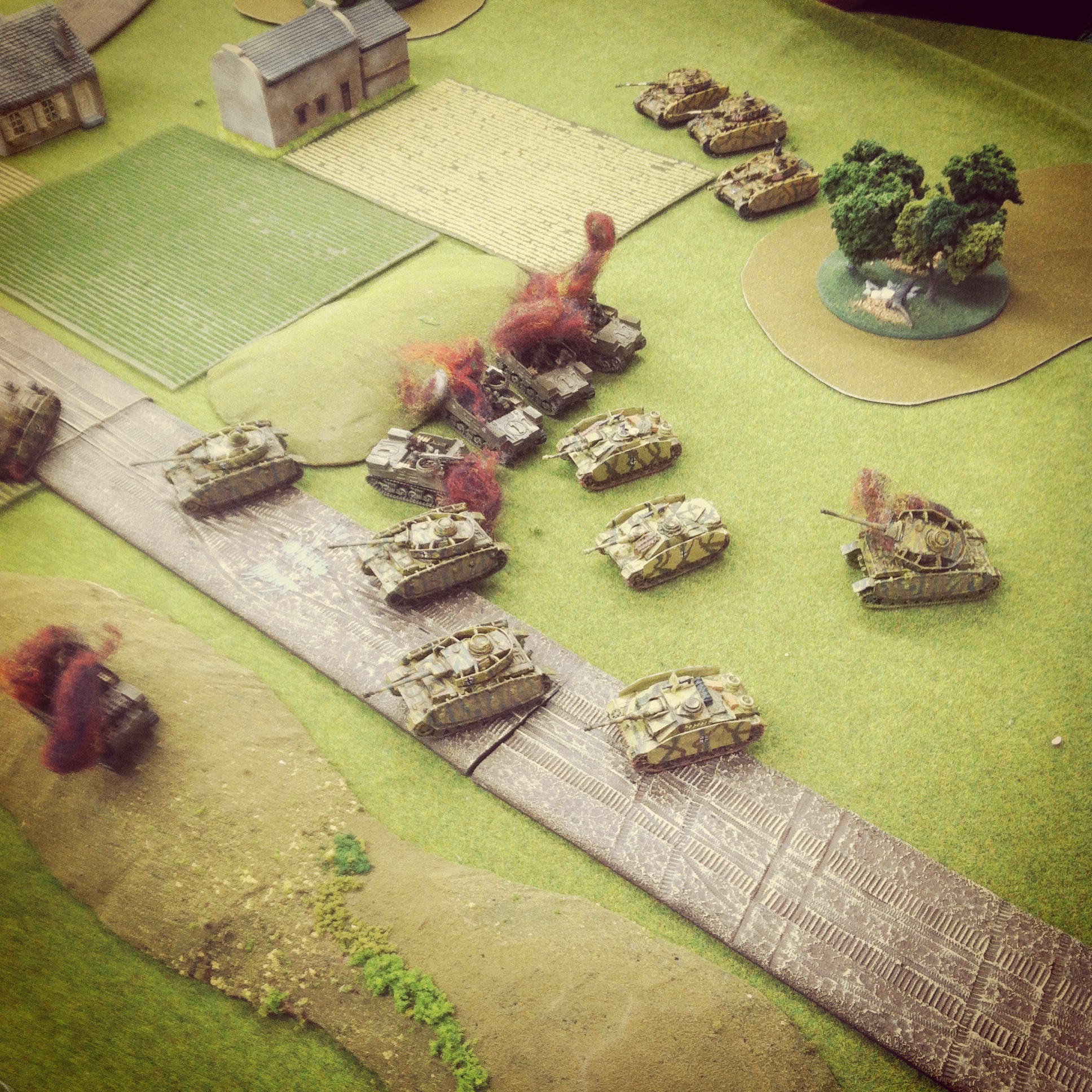
A couple of weeks ago at Metropolitan Wargamers in Brooklyn, NY, two of us had a go at a fictional battle set during the Lorraine Campaign. We play against each other a fair amount, and both of us were looking to switch things up commanding some very different forces. The tabletop terrain was also different with a more open battlefield lined with fields, woods, gentle hills and two farms. All of this was quite a departure from the games we have most played set in the days and months after the Normandy Invasion in June of 1944.

dustup

My opponent’s Panzerkompanie was  full of armor – Stugs, Panthers and Panzer IVs – and  supplemented by an Aufklärungs platoon and a couple Wirbelwinds to chase away any US aircraft. For my US force, I wanted to try out some underused rifle platoons which were supported by 105mm M7 Priests, some Shermans and a P-47 Thunderbolt buzzing overhead. We also chose a different game framework, opting for a somewhat complicated Dust Up scenario from the official Flames of War missions list.

pzco

us4th

IMG_3397

Our Dust Up scenario with my US forces in the foreground and Germans in the distance

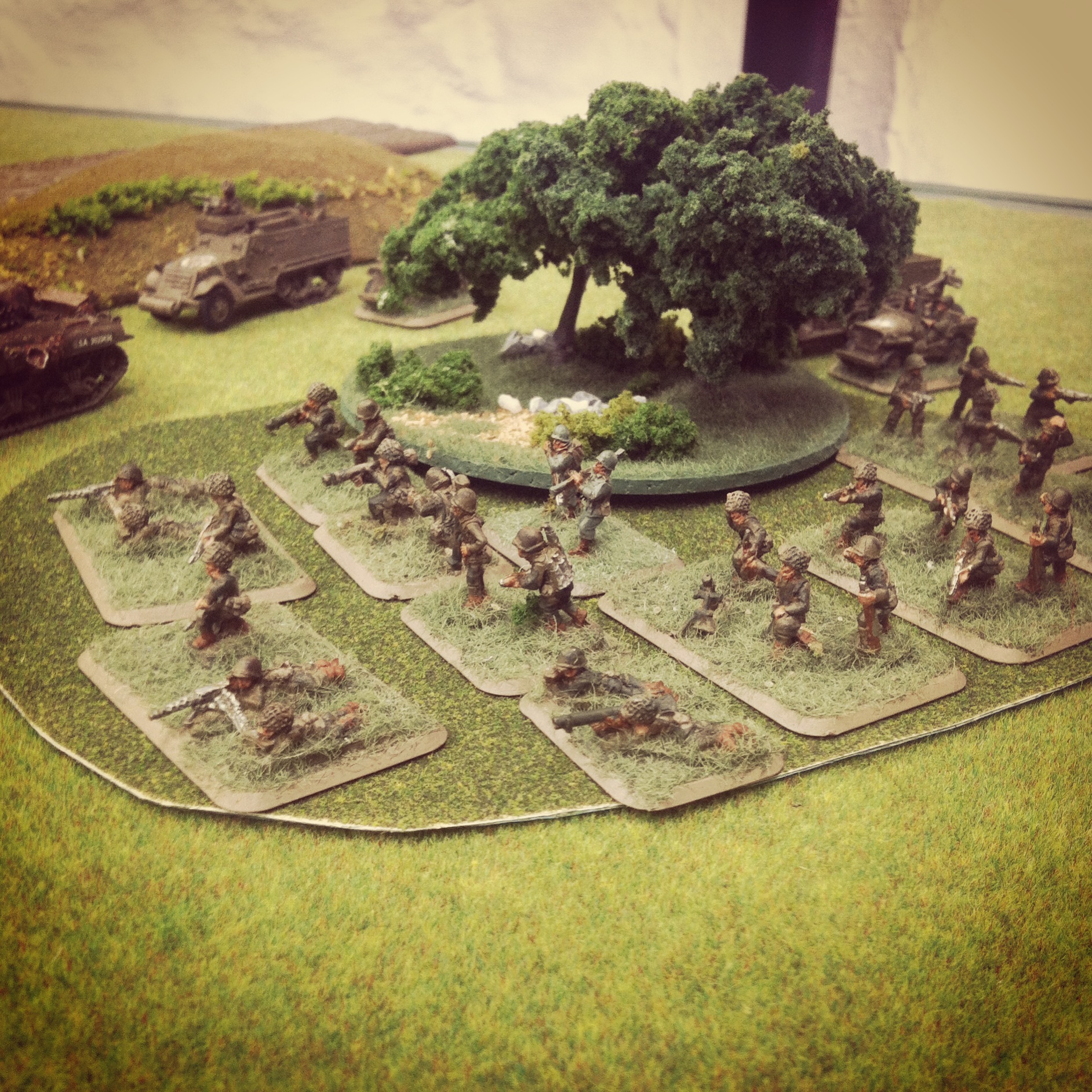
Well, as the game played out, I quickly discovered I had brought infantry to a tank fight. With one of my infantry platoons camped out in the woods near two objectives, my hope was to stave off the German armor advance with repeated bombardments from my Priests and diving runs from the P-47.
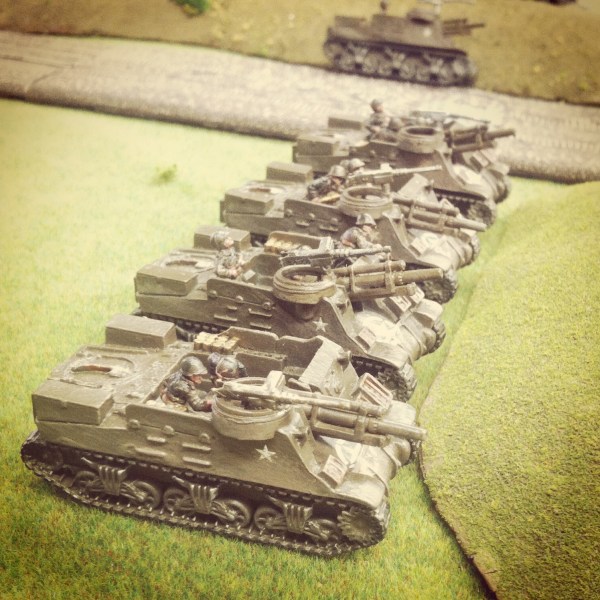
IMG_3398US M7 Priest platoon taking up position
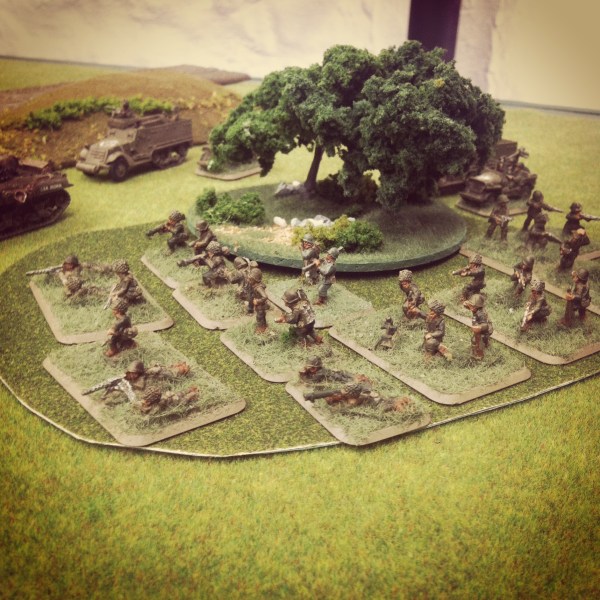
IMG_3399US rifles deploy in the woods to guard a nearby objective

Things went well for me in the early stages as Panthers stalled moving through the woods. A Wirbelwind and two Panthers were subsequently destroyed from 105mm volleys , but my P-47 failed to get any traction in stopping a group of Stugs creeping along the table edge. Even so, a couple turns in I was feeling fairly confident my artillery fire would whittle away the rolling German advance.
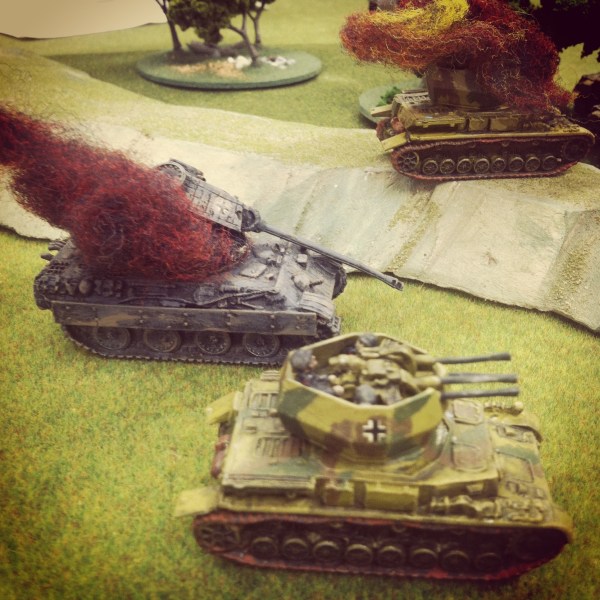
IMG_3401A German Panther and Wirbelwind are destroyed by incoming US 105mm fire
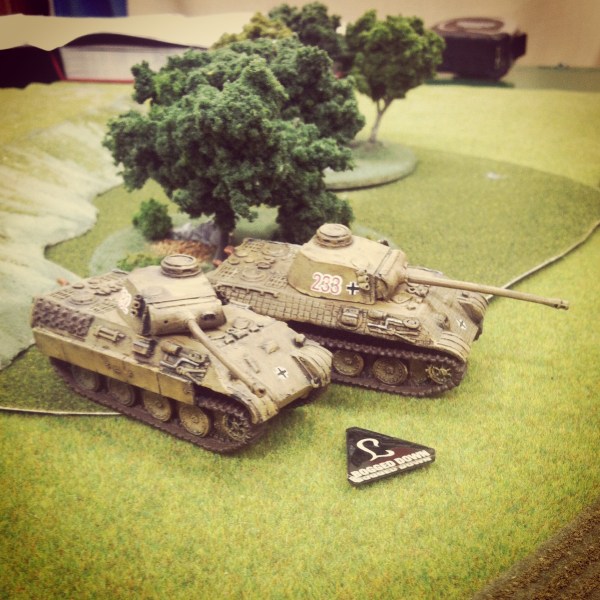
IMG_3400Panthers make through the woods but one bogs in the terrain
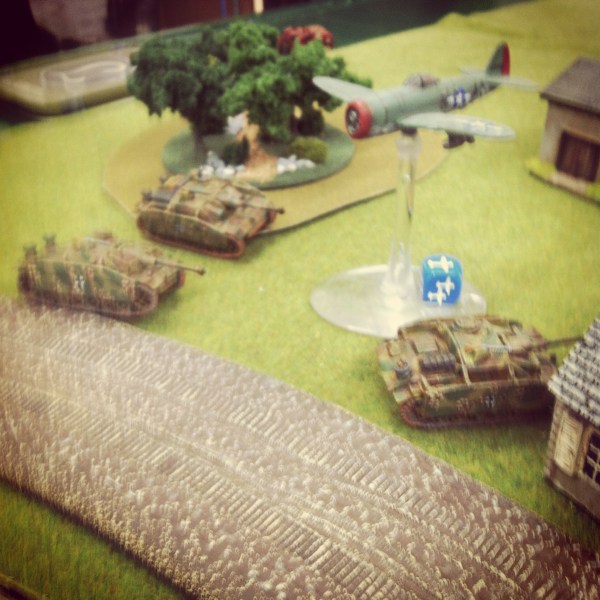
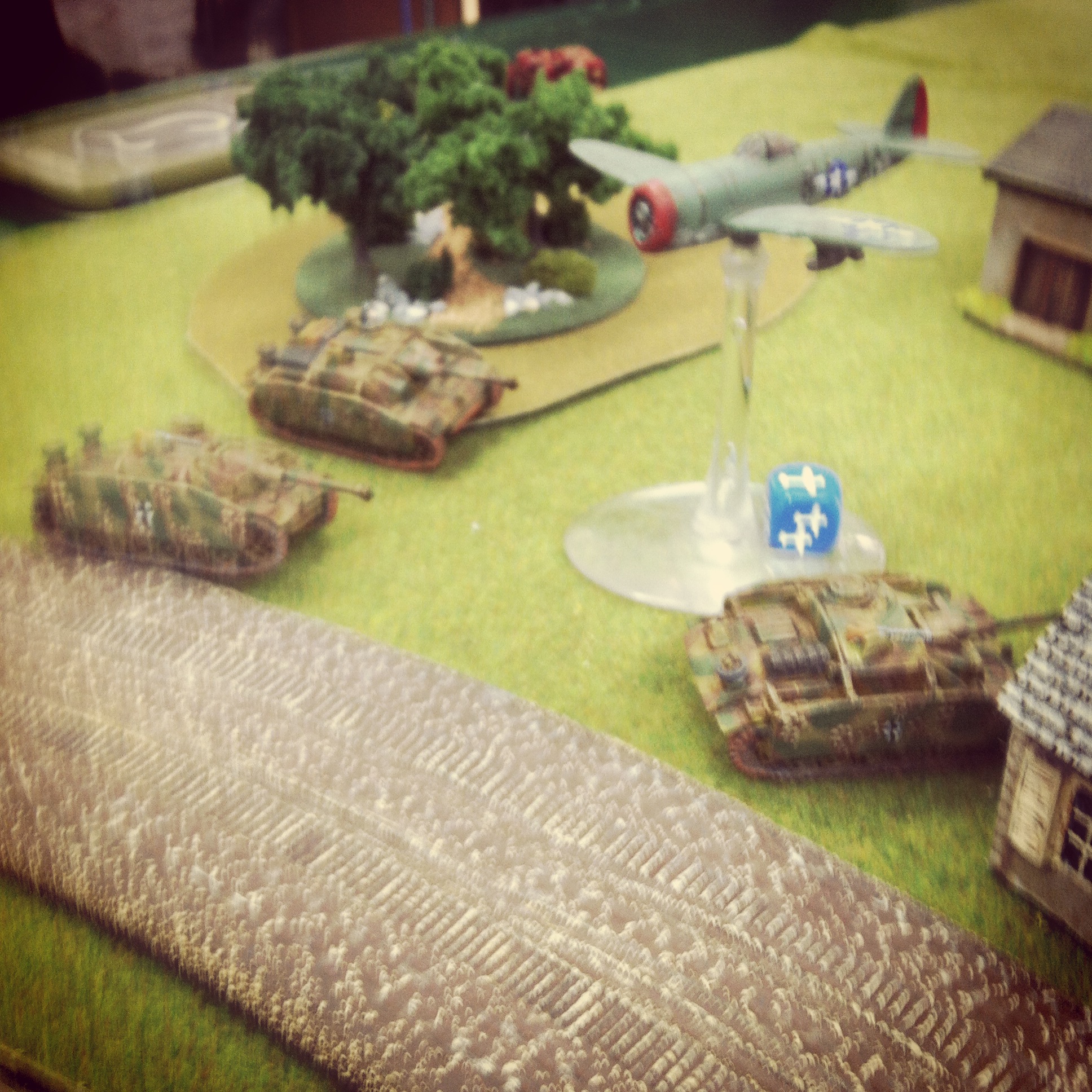
IMG_3402The P-47 Thunderbolt attempts a run at a Stug platoon
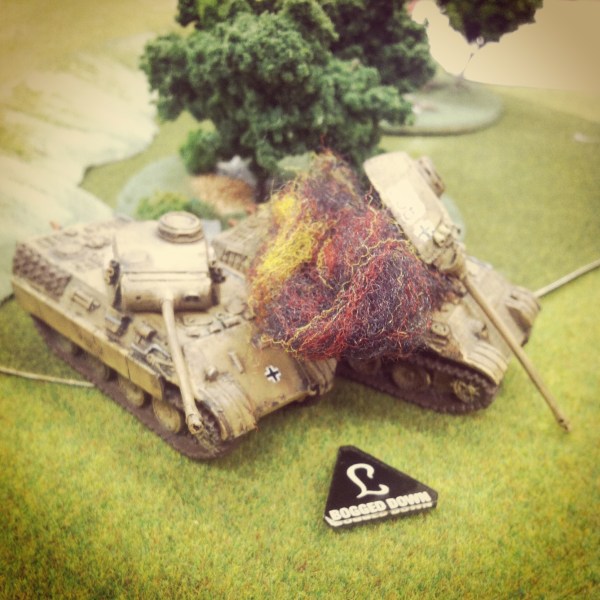
IMG_3403More fire from the Priests take out another Panther

My plan fell apart as the first German Panzer IV reserves came on the table at the corner behind my Priest battery and made quick work of the nearly-armorless US mobile artillery. I swung my surviving Priest and supporting Sherman around and engaged the Germans at close range with direct fire, but succeeded in only cracking open one German tank. In another turn, the Priests were wiped from the board and only my infantry platoon remained to defend my end of the table. The P-47 appeared again to control the center of the battlefield, but missed on its run. The US center and flank were crumbling by the time turn four approached.

IMG_3405Panzer IV reinforcements surprise the Priests from the rear

IMG_3406The Thunderbolt tries to stall the German armor in the middle of the field

My reserve Shermans came on the table near a farm and quickly engaged with the Panthers which swung to meet the US armor advance. Shots from my heavier 76mm guns lit up a Panther and bailed another’s crew. The German tanks returned fire, destroying all but one 76mm Sherman as more Panzer IVs showed up with the Aufklärungs platoon close behind.

IMG_3407Reserve American 75 and 76mm Shermans roll on the board

IMG_3409The last of the Priests burn as more Panzer IVs appear

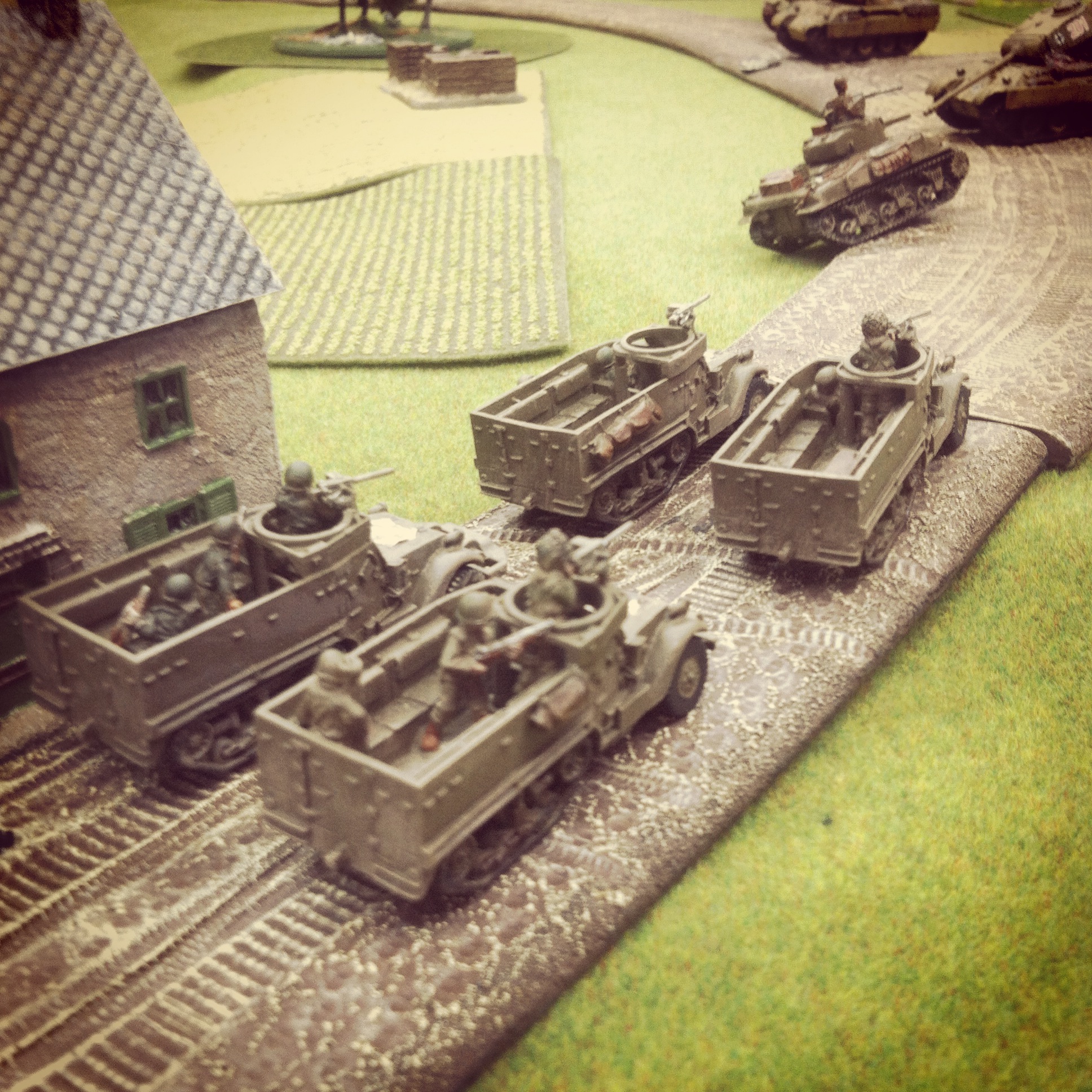
In the fifth turn, my final supporting infantry platoon arrived in their halftracks, dismounted and made a desperate run for an objective in the open field. The infantry on my side of the table also broke from the woods in a last-ditch assault on a mass of German tanks creeping toward an objective but were repulsed. With German armor swarming an objective, the game went to the Axis.

IMG_3410A reinforcing column of US rifles follows-up the Sherman advance

IMG_3413A lone Sherman survives as the US rifle company dismounts and heads for an objective
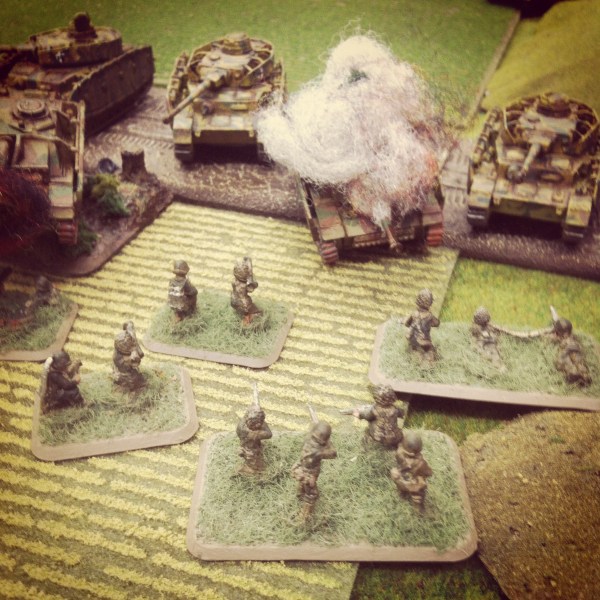
IMG_3414US riflemen break from the woods in a desperate assault on German tanks at an objective

IMG_3415With tanks aflame in the fields, the Germans take an objective

Clearly, my US plan from the outset was a stretch. Had I taken the more historic approach of Patton in the Lorraine Campaign of 1944, a fully-armored US force may very well have stood a fair chance against all the German tanks shuttling here and there on the tabletop. Balancing history and what-ifs is what makes playing Flames of war so engaging over and over again, but next time I’ll be careful not to second-guess the command decisions made in Northern France some 70 years ago.
Flames of War: Fielding the FOW M10 Tank Destroyer Platoon

m10

The Blitzkreig of German armored forces is one of the more enduring tactics introduced in World War II. Swarmed masses of German tanks and mechanized forces in the early war period rolled through Poland, France, Belgium and the Netherlands in Western Europe and punched into the Soviet Union with Operation Barbarossa in 1941. With early Panzer and later Panther and Tiger tanks ruling the battlefields of Europe, Allied forces struggled for solutions to crack the German tide of iron.

m10normandy

A US M10 tank destroyer comes ashore in Normandy after D-Day in 1944

By mid-war, the Americans had a solution with the M10 tank destroyer. Introduced first into the battlefields of North Africa in 1943, the M10 GMC (“gun motor carriage”) carried a big 3-inch/76mm gun and on a Sherman hull. After success in Africa against earlier model German tanks, M10s became part of the post-D-Day Allied breakthrough campaign. While effective against Panzer III and IV tanks, more heavily-armored Panther and Tiger tanks still proved problematic. Luckily, the M10 was supplemented by the British-modified Sherman 76mm Firefly and the later US-built M18 Hellcat which was quicker on the field. The combination of these three tank destroyers, along with the stalwart work of Allied infantry and deadly air support, turned the tide in Europe.

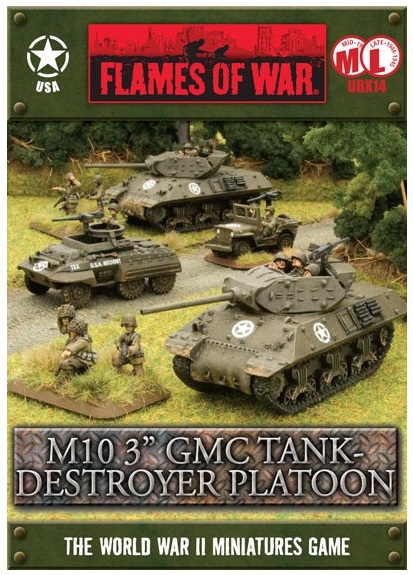
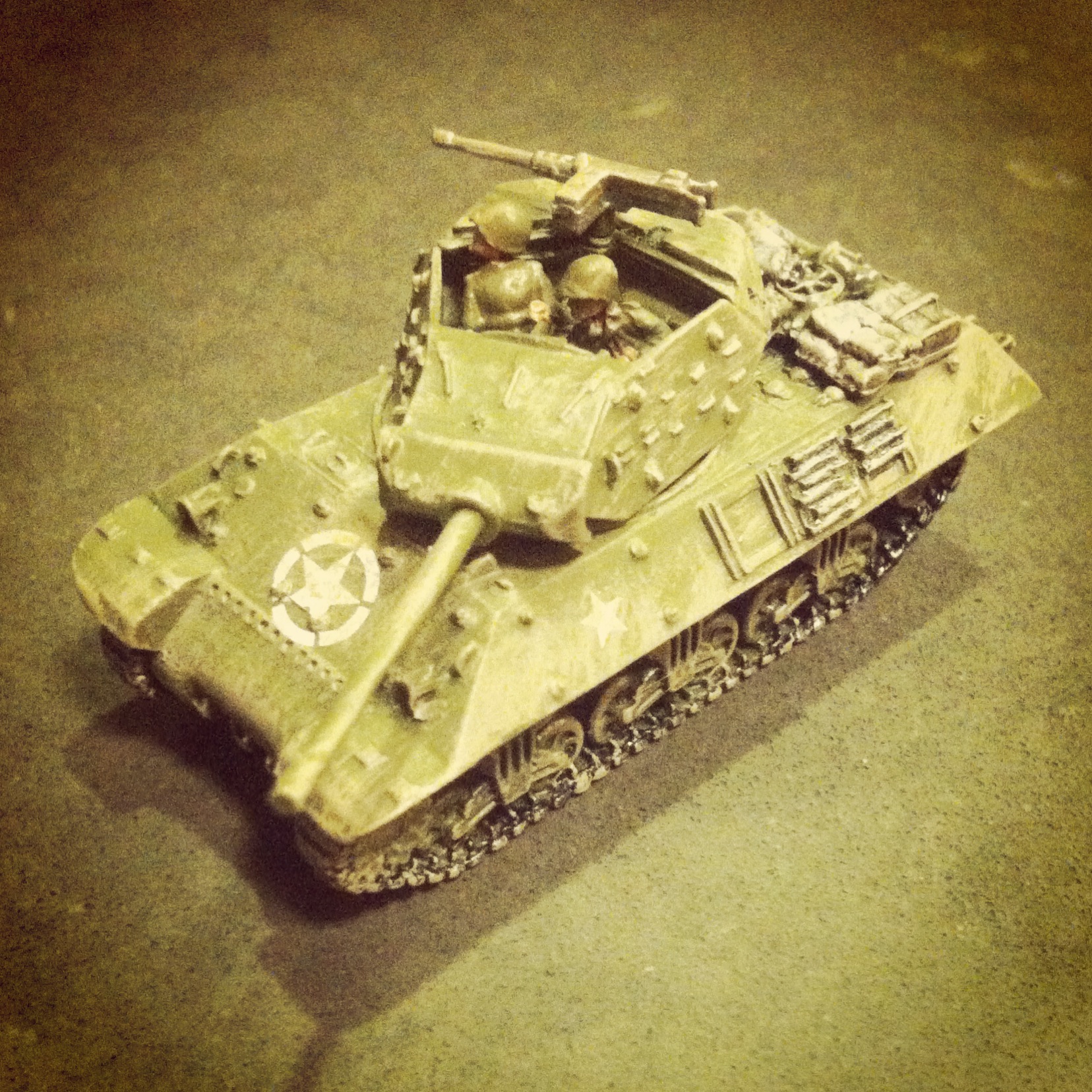
fowm10set

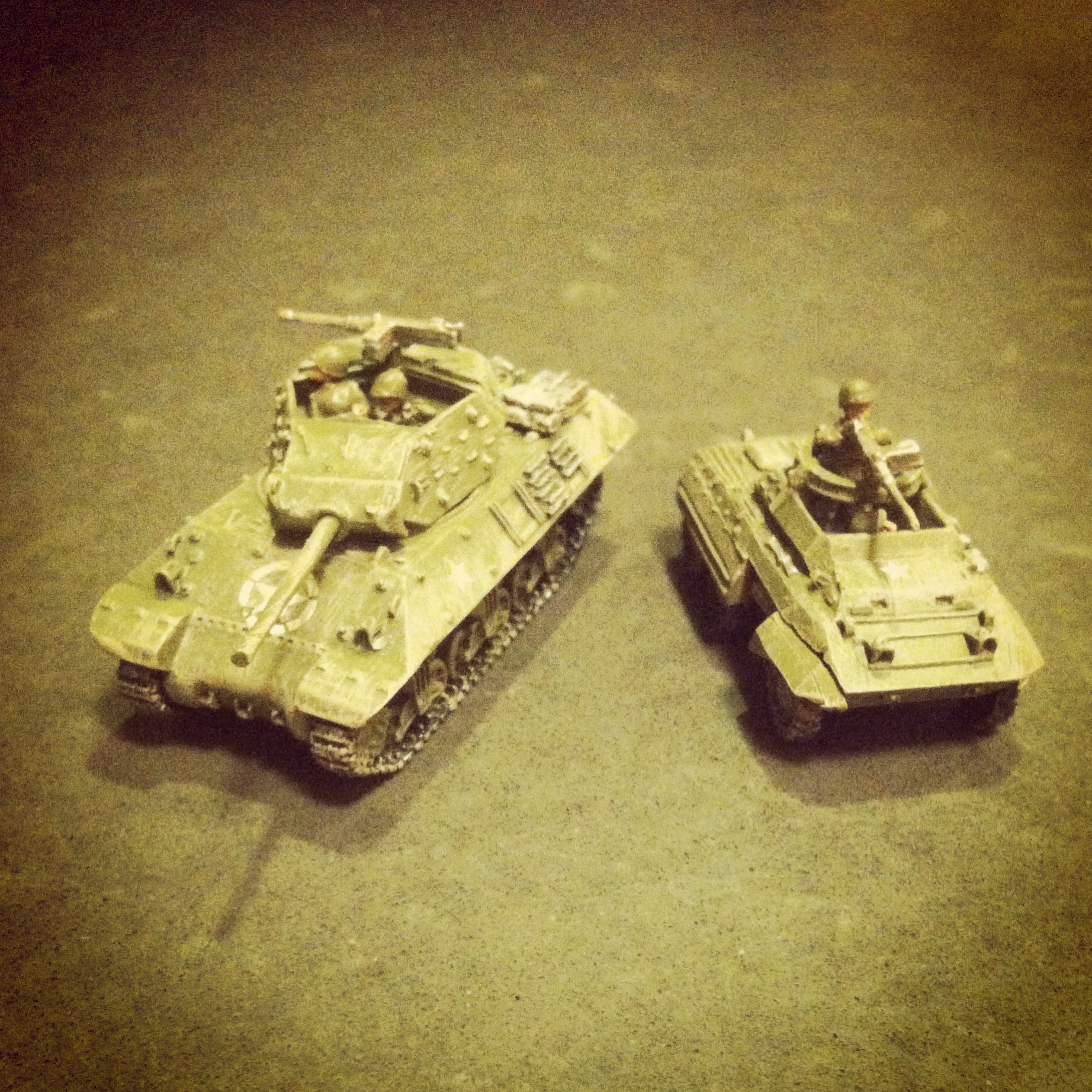
One of my earliest 15mm WWII purchases years ago, and somewhat at random, was the now-discontinued M10 Tank Destroyer Platoon set from Flames of War. I think at the time, I just liked the look of the models and I was looking to fill-out my new US forces with more variety. To get to a full platoon of four M10s, a fellow club member at Metropolitan Wargamers in Brooklyn, NY recently gave my two more M10s to which I’ve added an additional M20 scout car.

IMG_3389New M10 tank destroyer and M20 scout car

IMG_3388New M10 tank destroyer

IMG_3387New M20 scout car

IMG_3390US tank destroyer platoon with new models (left) and older models (right)

With my existing and new section sections, I now can field a full tank destroyer platoon using a variety of Allied Late War European lists. Anti-tank tactics in the game provide multiple opportunities for the M10 platoon to be used in combination with infantry and other Allied armor on the game table. With optional deployment as a recon platoon using the M20 scout cars, the M10s can create ambushes to wreak havoc on German tanks. Admittedly, using this full platoon will take some practice but I’m certain they’ll be causing headaches for my German opponents in the very near future.

New Game Weekend: Lego Heroica

heroicabox

Like a couple generations of kids around the world, I grew up on Lego. My childhood was heaped with thousands of little plastic building pieces produced in Denmark and strewn in endless piles on my bedroom floor. Lego have changed a lot over the years from its early days as an abstract, creative and flexible building system of my early years to the heavily-licensed and more rigid playsets my own kids have been raised on.

In 2011, Lego launched Heroica, a brick-based fantasy-themed dungeon crawl board game. Each set included a set of bricks to build a series of rooms, hallways, bridges, paths and outdoor areas with which several configurations of game boards could be assembled alone or in combination with other sets.

IMG_3372

My first game of Lego Heroica

This past weekend, I played Lego Heroica: Castle Fortaan with my 9-year-old son, a certified Lego and gaming addict. The game pieces go together nicely to create nifty modular rooms including a dungeon, castle walls, a hall with fireplace and a throne room. Four character adventurer figures and goblins in three varieties are depicted as tiny, rigid pawns which offer less interest than the very-popular Lego Minifigures common with most Lego sets. With a board built according to one of the included scenarios (or a game of your own making), players take turn rolling the special die, moving through the castle, collecting magic items and racing to the objective endpoint.

IMG_3371

Gaming components from Lego Heroica: Castle Fortaan

As expected from Lego, the Heroica sets look great. Each player has their own rack on which they track gold and magic items collected and damage received during combat with goblins lurking throughout the castle. A weapons rack allows for the purchase of special weapons which give bonuses and added abilities. The special die (also built from Lego) offers faces with dual purposes for movement, combat resolution and other results such as regaining health and randomized treasure.

IMG_3370

Our adventurers quest through the halls of Castle Fortaan

Despite the look of Heroica, gameplay leaves much to be desired. Unlike the collaborative spirit of most dungeon crawl games, Heroica is a straight-up competition and a race to the finish line. Strategy is also absent from the game, and the die-driven movement makes the game largely an exercise in die-rolling. Combat is overly-simple with any of the three goblins types easily destroyed on a single die result, no matter their strength. Purchasing an item from the weapons rack requires three collected gold, but finding three gold often doesn’t occur until late in the game when any bonus from an acquired item really doesn’t matter.

Lego suggests ages 8-and-up for Heroica, but this probably has more to do with safety issues with small parts than actual game complexity, interest or replay value. My son is a pretty experienced gamer, but he still liked the game most probably because of his overall passion for Lego. I’d peg the game more appropriate for 4 or 5-year-olds as a way of introduction to the basic concepts of dungeon crawlers including movement, melee and ranged combat, hit points, character abilities and collecting treasure and magic items.

Not surprisingly, Lego has announced the imminent discontinuation of the Heroica line of games. A fairly avid fanbase for the game exists using heavily-modified rules, but ultimately I really don’t think the game is worth the time and effort no matter how much customization is put into it. With so many engaging dungeon crawl games available and appropriate for a huge swath of ages, its pretty obvious why Heroica crashed in popularity in three short years.

As for dungeon crawling with my kids, I’m going to be heading back to my Dungeons & Dragons Basic Set from the late 1970s in the coming weeks — no plastic bricks required.

Downloading: A Century of British Pathé Newsreels

pathe_6da6dceb176b5785e86615b8619ffb28With today’s constant digital feed of news both major and minor, it’s fascinating to think back to an era where newsreels supplied much of the world’s news in motion. In an era still ruled by newspapers and radio, newsreel series from The March of Time, Fox Movietone News, Universal Newsreels, British Pathé and others brought events from far corners of the world to local movie house audiences. Presenting news in motion with dramatic music, voiceovers, selective edits and even reenactments, newsreels provided important foundations for how people would eventually consume video news via television in the latter half of the 20th-century and online in the 21st-century.

British Pathé announced this past week the availability of much of its archive of some 85,000+ HD videos available via YouTube. Some videos appear in their original full newsreels including iconic opening titles, graphics and voiceovers. The A Day That Shook The World series offers more modern edits of pivotal world events from a UK perspective. Other videos are mere snippets, often presented without sound or much context.

Topics covered in the British Pathé newsreels range from celebrity, politics and British royalty to industry, disasters, contemporary slices of life and news from the British Empire worldwide. From the historical to the humorous to the downright bizarre, the newsreel collection paints a wide picture of nearly 100 years of life on Earth.

For people with an interest in armed conflict of the 20th-century, the British Pathé collection has some gems. The Second Boer War gets a little coverage in some amazing footage from the years around the turn of the 20th-century. World War I is covered in major battles such as the Somme and Verdun, but also short features on new technologies like tanks and news from the home front.

Second Boer War

World War I

World War II coincided with the peak era of newsreels, and the British Pathé collection provides an amazing document. There are full newsreels covering the Battle of Dunkirk and the Battle of Arnhem from Operation Market Garden. The brutal siege and liberation of Stalingrad gets a lot of coverage, as does the major battles of the Pacific like Iwo Jima. Nail-biting aerial and naval combat from throughout the war is also documented in some stellar footage.

World War II

There’s a ton of additional military-themed footage in the post-WWII era covering the Cold War events, the Korean War, the Vietnam War, the Six Day War and the Falkands War. Seeing history come alive in video vignettes from British Pathé, often with more than a glint of heroic propagandist presentation, is just another opportunity to view history as contemporary audiences once saw it. With more and more archives enabling wide distribution of their photo, film, map and document collections online, armchair historians everywhere can tap into a wealth of information painting an ever-widening picture of our past.

Come Play Zombicide With Me At Brooklyn Game Lab April 29th

zombibox

I’m thrilled to be lending a hand hosting an evening of Zombicide at Brooklyn Game Lab in two weeks on Tuesday, April 29th, 2014.

Since opening a few months ago, Brooklyn Game Lab has been grabbing a lot of press as the latest space in New York City to take hold of the recent boom in tabletop gaming. Through its innovative afterschool programs, the Lab has provided space for children to not only play games but to stretch their minds in developing their own ideas into playable games of heir own. When the kids head home, the Lab has been filling up evenings and weekends with adult gamers on theme nights, singles mixers nights and a recently-packed International Tabletop Day.

zombicide contents

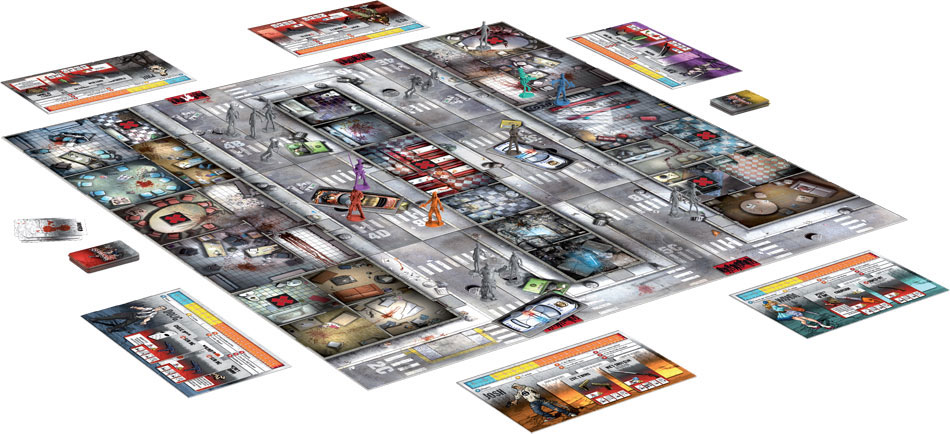
Zombicide: Season One base game from Guillotine Games

To kick off the summer, Brooklyn Game Lab (353 7th Avenue @ 10th street in Park Slope, Brooklyn) is hosting a night of the incredibly popular Zombicide board game from 7-10pm on the 29th of April. Admission for the evening is just five bucks, and I’ll be there to help run a couple simultaneous games of survival and zombie carnage.

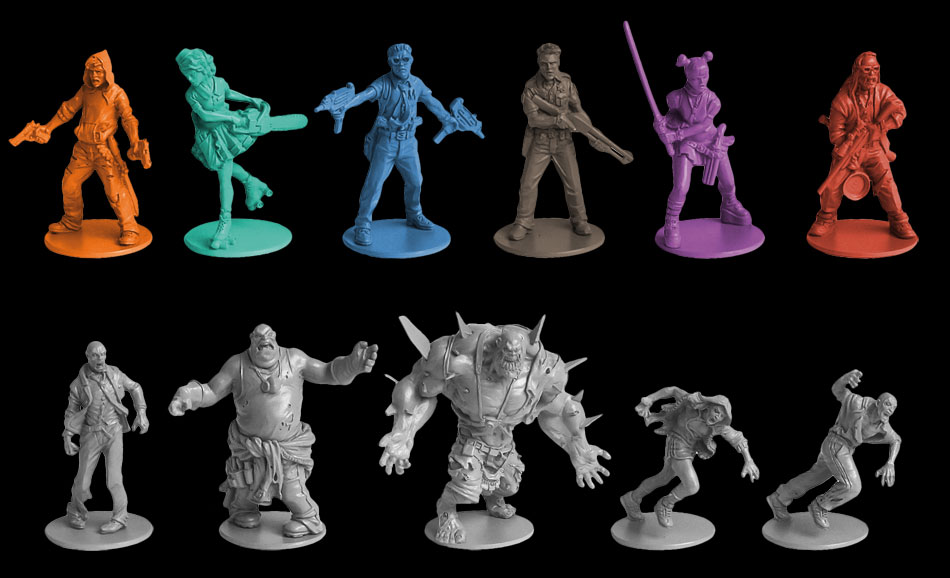
zombifigs

Zombicide survivor and zombie miniatures

I first played Zombicide about a year ago, and I can’t wait to drag some more people into this easy-to-learn and gorgeously-designed game where either everyone wins or everyone loses. Released in 2012 via a Kickstarter from Guillotine Games, Zombicide and its subsequent Toxic City Mall and Prison Outbreak expansions pits up to six survivors against a growing zombie horde. Players collaborate as they kick in doors, search for supplies, arm-up with a variety of weapons and mow down scores of zombies. If you’re a zombie fan, a game fan or just fascinated at the prospect of meeting some people and battling through the zombie apocalypse for an hour or two, you should definitely come by the Brooklyn Game Lab.

For more info on this an other upcoming events, check out the Brooklyn Game Lab calendar.

“The Harlem Hellfighters” by Max Brooks

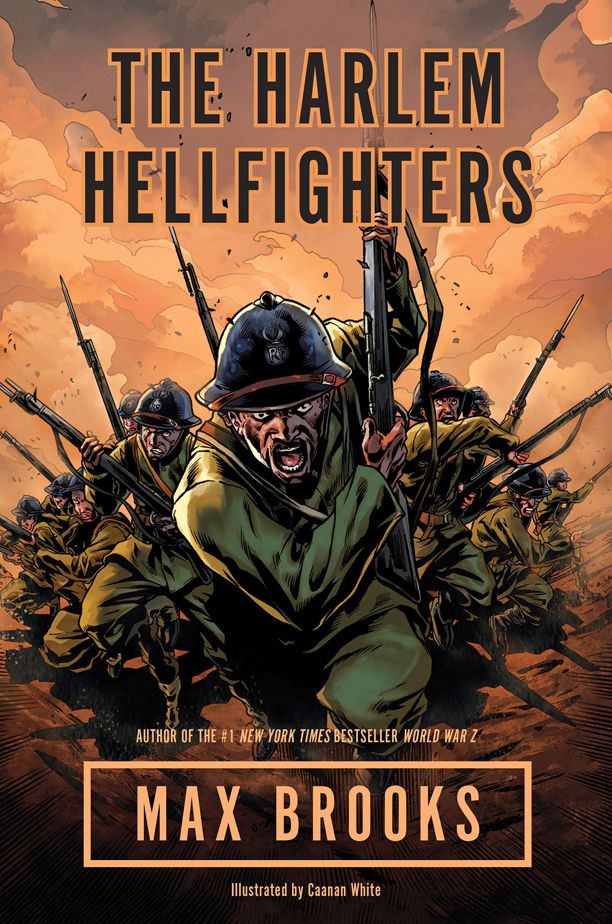
harlemhellfightersbook

My interests in American history, graphic novels and little-known accounts of war have recently intersected with gripping The Harlem Hellfighters by Max Brooks. Written by Brooks — the well-known author of World War Z — and illustrated by Caanan White, The Harlem Hellfighters recounts the struggles and victories of the 369th Infantry Division as the first African-American regiment to see combat in World War I.

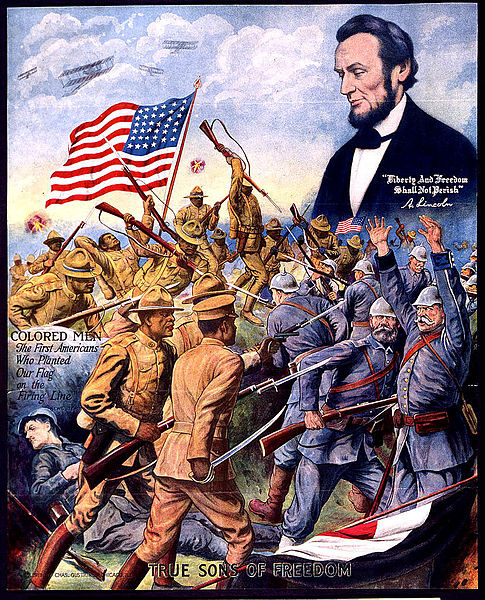
369th poster

Period poster for the 369th Infantry Regiment

The 369th was composed of a volunteers from many backgrounds reflective of the Harlem Renaissance era’s diverse black population crowding the streets of northern Manhattan. The volunteers included Caribbean and African immigrants, migrants from the American South and native-born New Yorkers. As a green fighting force, the urban laborers, artists, musicians, farm workers and students who fought as the Harlem Hellfighters went on to distinguish themselves in the late stages of WWI and became among the first American Expeditionary Forces to push over the hard-fought German lines.

369th band

James Reese Europe (left) and members of the 369th Infantry Regiment marching band

Brooks has a long-held interest in the Hellfighters, and he had tried unsuccessfully over the years to bring a script to movie or television production. Following on the international success of World War Z, Brooks decided on the graphic novel format to bring the Hellfighter story to a mass audience. Based on real characters in a fictionalized story, the book traces the regiment’s path from basic training in a Jim Crow American South to the trenches of Europe under the command of the French army. Even after winning distinction in early engagements, the members of the Hellfighters ran up against racism which followed them to Europe.

The story of band leader James Reese Europe forms just part of the tale, but is illustrative of both the acceptance of the arrival of black US troops and their rejection by the laws and traditions of white Europeans and their countrymen at home and abroad. Reese is largely credited with introducing jazz to European audiences, and although he would survive the war, he died soon after his return to the States at the hand of fellow band member. The mix of challenges, triumphs and tragedies on and off the field of battle makes the story of the 369th an incredibly compelling story every American should know.

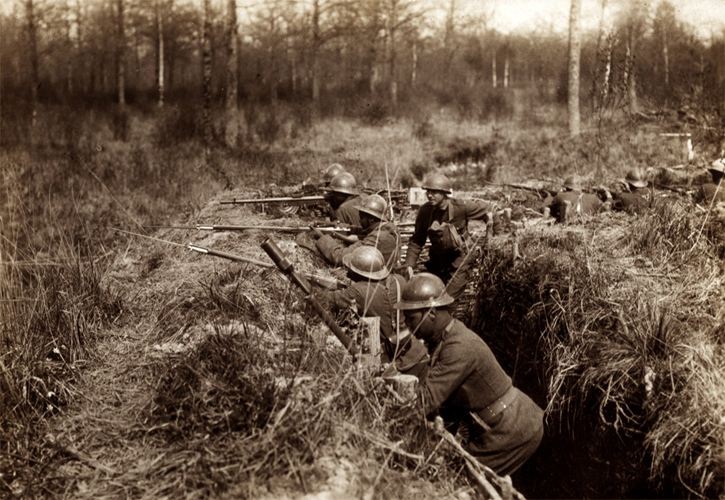
369th trenches

Troops from the 36th Infantry Regiment in the trenches

The Harlem Hellfighters is illustrated in a jagged, dark style by African-American artist White amid pages crowded with rich individual character stories and broader narratives of an era marked by the horrors of modernized warfare as well as lynchings and street-beatings. To the interested reader, there are many jumping-off points into a deeper story of the 369th and their ripple-effects on 20th-century American race history still being wrangled with today.

The 369th arrived back to the States and were celebrated with a heroic parade in New York City. The 369th Infantry Regiment Armory in northern Manhattan still stands today as one of the few monuments to this often-forgotten chapter in a war which is also largely-ignored in our teaching of US history. For the veterans of the Harlem Hellfighters, their fight in Europe would continue back home through the labor and civil rights movements in the decades to come.

Just ahead of the book’s publication in early April, Sony Pictures announced it had acquired the rights to bring the story of the 369th to the big screen with production backing from Will Smith’s Overbrook Entertainment. With the The Harlem Hellfighters and the promise of a movie adaptation, hope springs anew that 100 hundred years on the American men of the 369th get the recognition they earned in spirit and blood.


New Game Weekend: Revolution! and Carcassonne

ITD

This past Saturday was International Tabletop Day, a day where tens-of-thousands of people around the world crowd around tables in dining rooms, basements, clubs and hobby shops to do what many of us do year-round — play games. My youngest son and I spent the afternoon at Brooklyn Game Lab, a recent entry into the growing list of New York City venues dedicated to unplugging and playing tabletop games with friends and strangers alike. The scene in Brooklyn was like that played-out worldwide with a packed house of experienced gamers and newcomers joining together, rolling dice, racking up points, playing cards, placing tokens and role-playing through a massive variety of games. At Brooklyn Game Lab, players faced off with a variety of games like Betrayal at House on the Hill, Love Letter, The Resistance: Avalon, Tokaido and even a few games of Chess. My son and I had a go at two games which were new to us — Revolution! and Carcassonne.

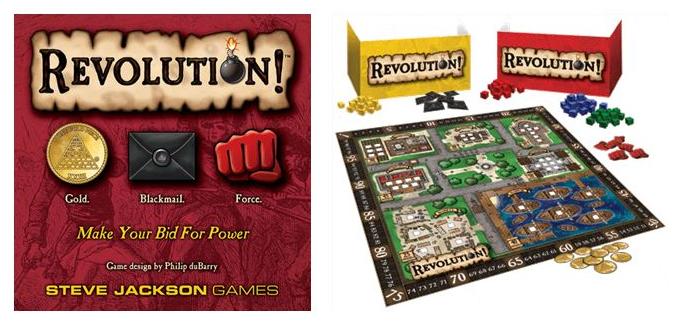
rev picIn Revolution! from the decades-old Steve Jackson Games  players vie for power in a town through a secretive combination of blackmail, strong-armed force and out-and-out bribery. With four new players at the table, Revolution! was a quick learn and exciting fast play in just under an hour’s time.

securedownload-1A player’s secret bidding card in Revolution with Gold, Blackmail and Force tokens

Revolution! has an interesting secret bidding mechanic where players simultaneously bid their Force, Blackmail and Gold tokens on a dozen citizens of the board’s town such as the General, Priest, Printer, Mercenary or Spy. Once bids are placed, players remove their screens to reveal their bids. Bids to influence the same character are resolved through a simple Force beats Blackmail, Blackmail beat Gold and ties result in no effect for the round. Once a player wins influence over a character, the effects dealt out through additional earned Force, Blackmail and Gold tokens, Support points or placement of Influence markers in one of the town’s areas such as the Tavern, Town Hall, Market or Harbor.

securedownloadOur game of Revolution! from Steve Jackson Games at Brooklyn Game Lab

The game continues with subsequent rounds of bidding which progress into evolving strategies and agendas as the town’s areas fill up with player Influence. As the board is filled, players in Revolution! shift in their need for Force, Blackmail and Gold tokens, seeking to not only control the board but shift and undermine their opponent’s already-placed pieces. Controlling an area of the town brings additional Support points when the game ends, and the player with the most points on the outer scoring track wins.

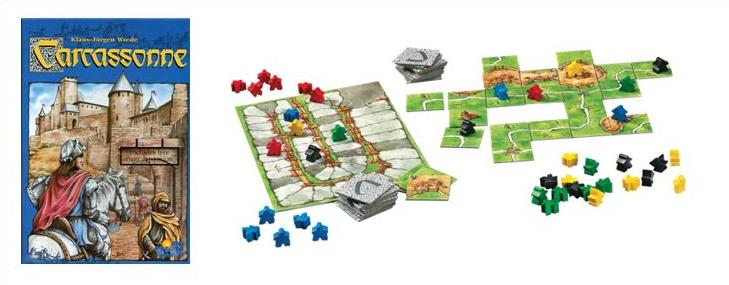
carcassonneFor our second game of the day, we got into the now-classic Carcassonne from 2000. Distributed by Z-Man Games in the United States, Carcassonne is a tile-placement game where players build-out and a kingdom dotted with cities, roads and monasteries. Carcassonne is a quick learn, and the random tile choice at the beginning of each player’s turn creates choices in matching the tile to the multiple potential fits on the table.

In placing a tile, a player also makes a choice in placing a meeple on the board and in doing so, placing a bet on potential points. In placing the first tile of a city, a player may place one of their colored meeple pieces with the hope of closing off the city with additional tile plays which score points on the number of subsequently connected city pieces at a two points apiece. A monastery scores nine points when the eight surrounding tiles are placed, and roads are scored at a tile each once a route is closed between two endpoints. Victory points are tracked on a scorecard next to the growing kingdom of Carcassonne, and each tile played reduces the chances from the finite number of potential tiles in the draw pile. Playing against three experienced players in my first game,  I was able to score highest on some chancy bets and lucky tile draws.

International Tabletop Day is 24 hours of celebration of games, chanced strategies played out and opportunities to try something new. At the Brooklyn Game Lab this past weekend I found myself in my element surrounded by passionate gamers questing for victory and fun and more than a few hours of play. Games focus on this one day per year, but for a lot of my fellow gamers, they play out week after week until next turn  rolls around on the calendar.