I Ain’t Been Shot Mum: South East of Butera July 11, 1943 Scenario

SicilyJuly1943Operation Husky, the Allied invasion of the island of Sicily, commenced on July 9th 1943 with combined naval, air, airborne and amphibious forces from the United States, England and UK colonial nations attacking a largely Italian force backed by their German allies. Over the next five weeks, the Allies took the arid and rocky island of Sicily and opened up the Mediterranean for the eventual invasion of mainland Italy.

HuskyMapOperation Husky, July-August 1943 (area around Butera in green)

The Sicilian Weekend campaign guide for I Ain’t Been Shot Mum offers 24 scenarios from the opening days of Operation Husky on July 10th and 11th 1943. Like the other scenario books from IABSM publisher Too Fat Lardies, the Sicilian book presents solid historical background and maps, along with force lists and detailed briefings for each side easily adaptable to a number of lines of 15mm WWII miniatures. The scenarios may be played individually or as part of a linked campaign, and so we recently started playing through a few of the Sicily scenarios at Metropolitan Wargamers in Brooklyn, NY.

Sicilianweekendcover‘Sicilian Weekend’ by Too Fat Lardies for their I Ain’t Been Shot Mum WWII rules

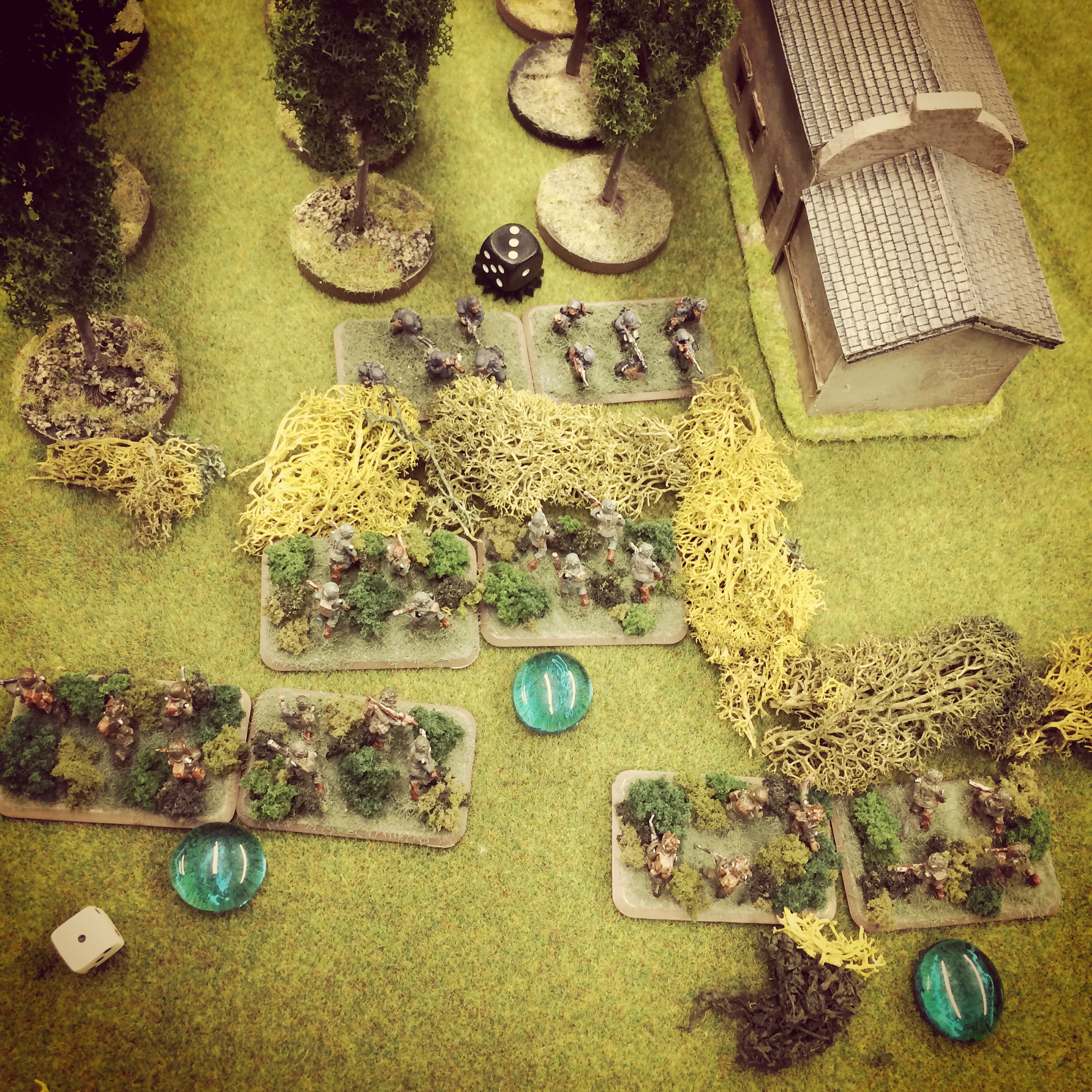
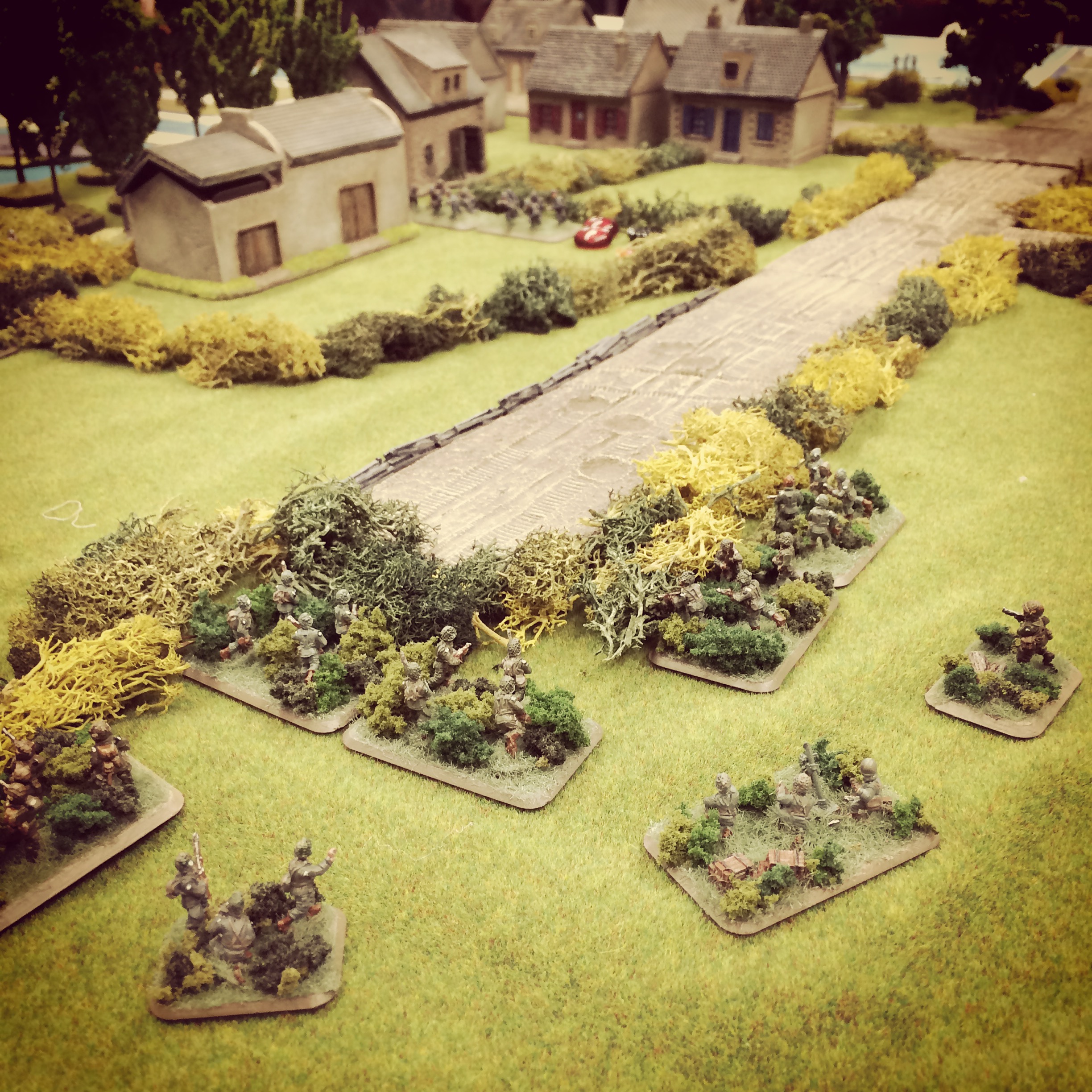
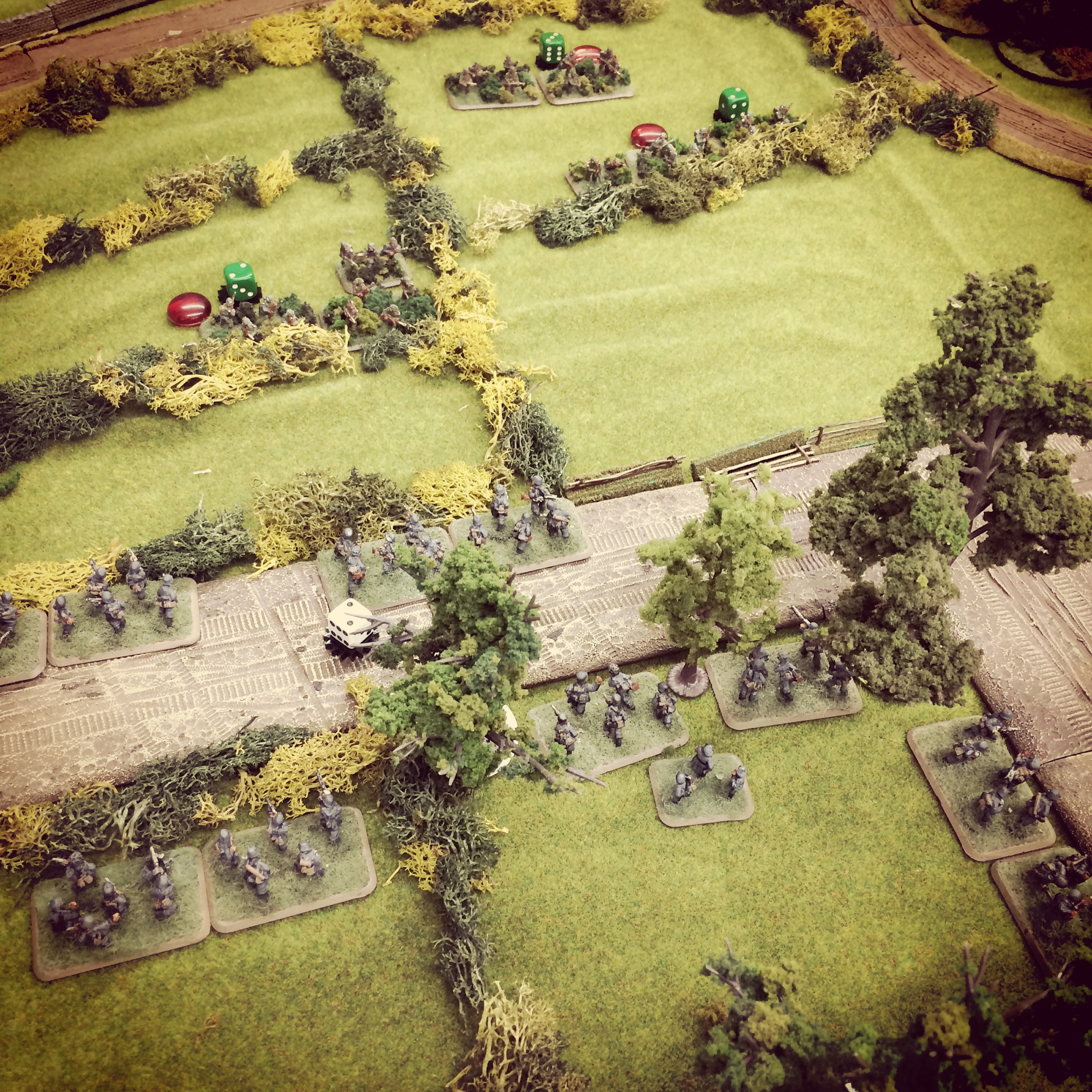
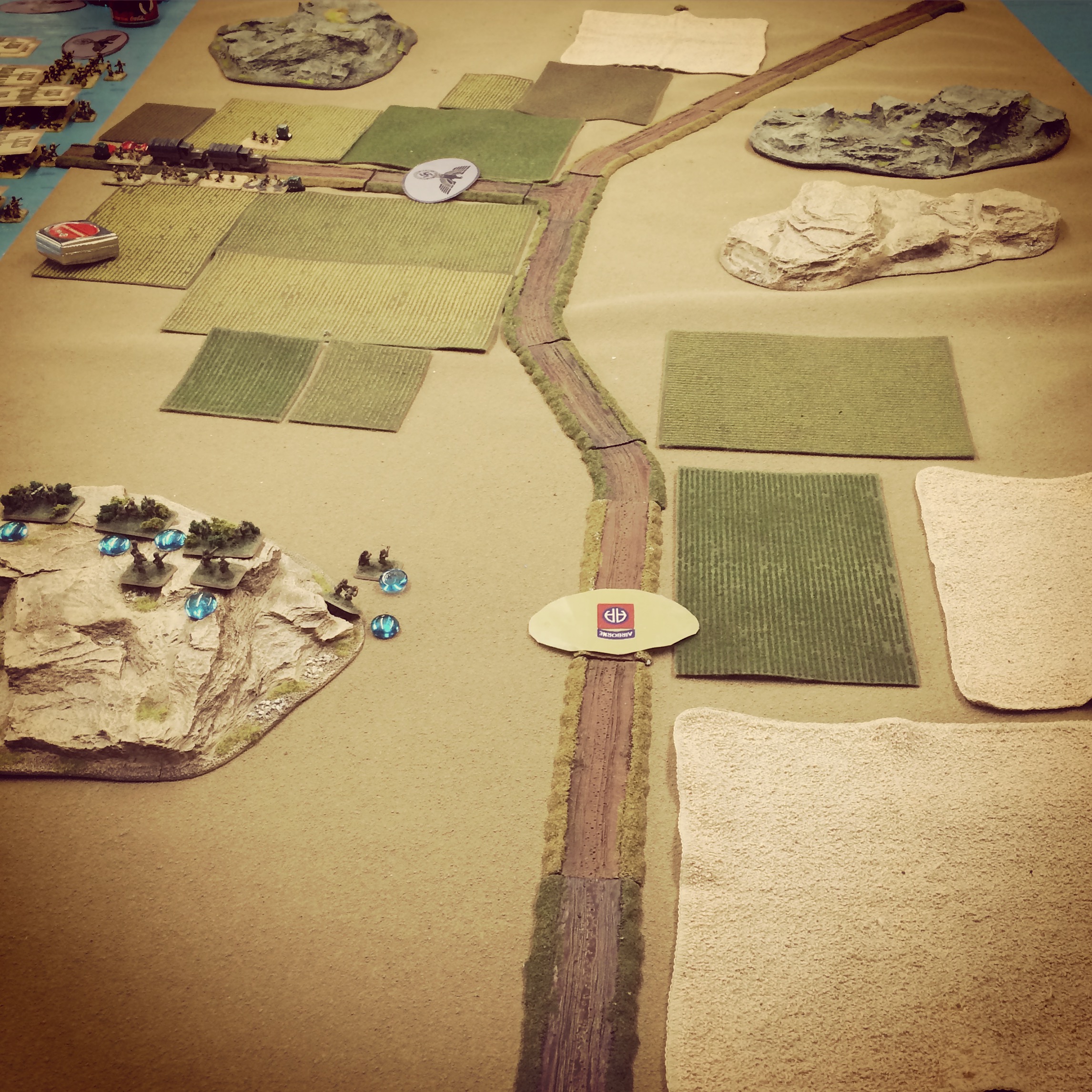
We began with the eighth scenario in the book, southeast of Butera on the morning of July 11th 1943. Members of US 3rd Infantry Division are presented with a simple mission of aggressively pushing through the field to link up with their fellow Americans at Gela. The Italian force from the 33rd Infantry Regiment of the Livorno Division, must hold the invading Americans back.The scenario presents the Italian and American forces each entering the table in column on blinds. The counter attacking Italians rolled in mounted in trucks at one road at the table edge, and the Americans arrived on foot at one end of the table.
IMG_5605Initial forces arrive on the field in the early turns

IMG_5606Italians rush to the battle and deploy from a column of trucks

My first to arrive American machine gunners and bazookas quickly took up position on a rocky hill overlooking the road and a crossroads in the distance. Italian trucks moved in with their heavy weapons likewise leading the away with machine guns and 81mm mortars deploying at the road edge. Initial long range fire from the US machine guns pushed some of the Italian line back over the road. The Italians offered several rounds combined of direct mortar and machine gun fire in return, spraying bullets and landing rounds amid the bunched-up US machine guns. The Americans scooted back over the crest of the hill and the bazookas ran off to meet the other Americans arriving by the road to their right.
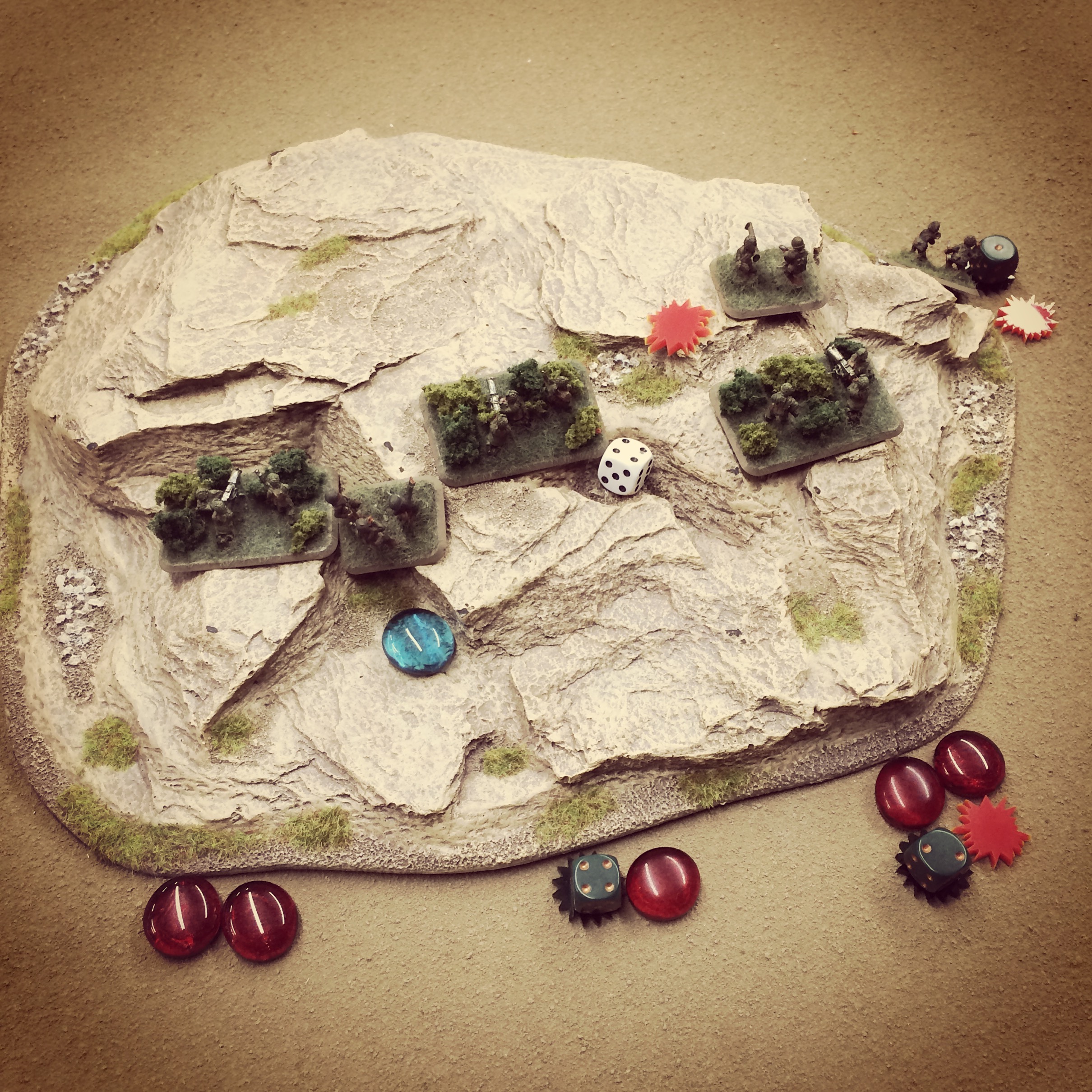
IMG_5608American machine guns take Italian mortar fire and fall back

IMG_5607US machine gunners rally back to their positions and pour fire into the Italian lines

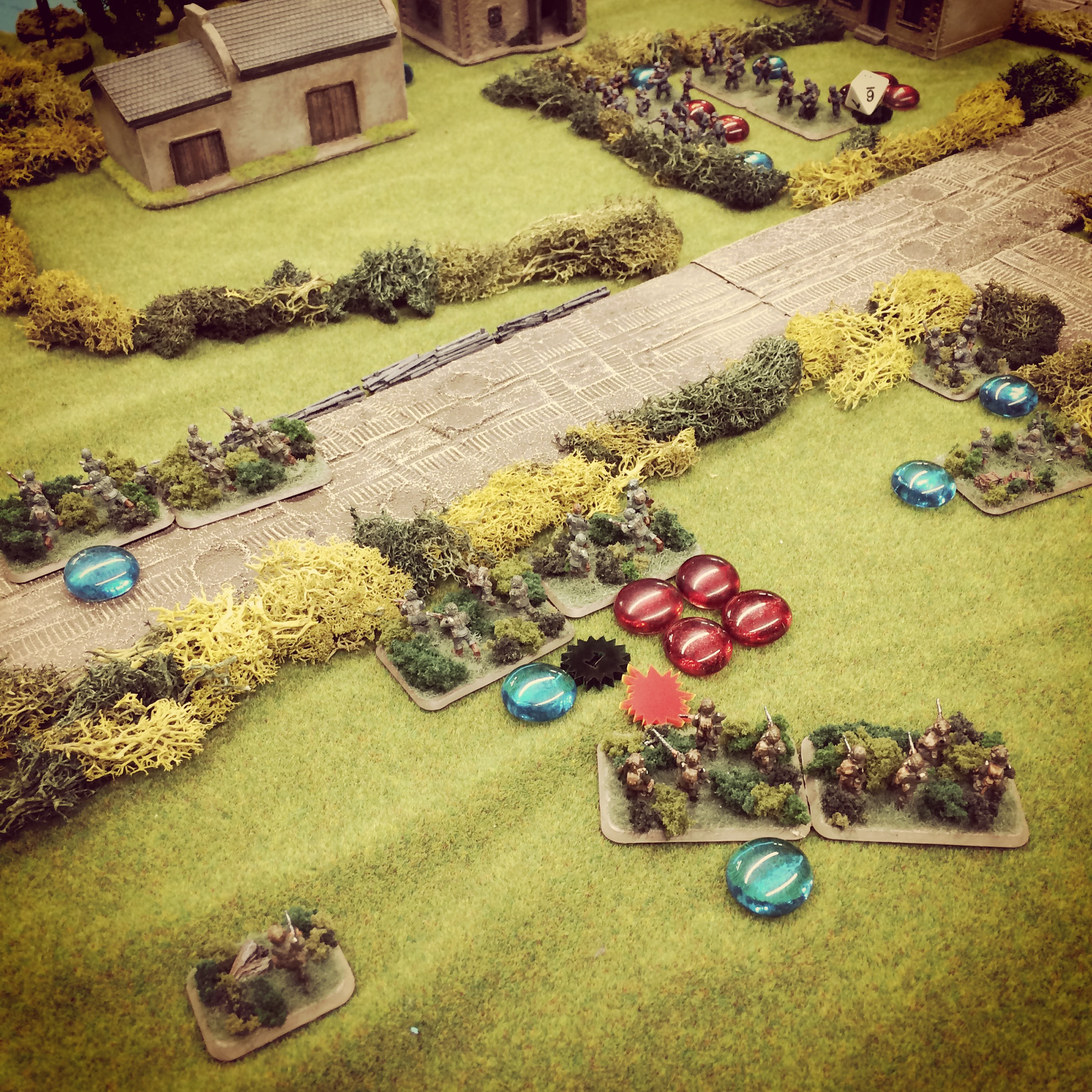
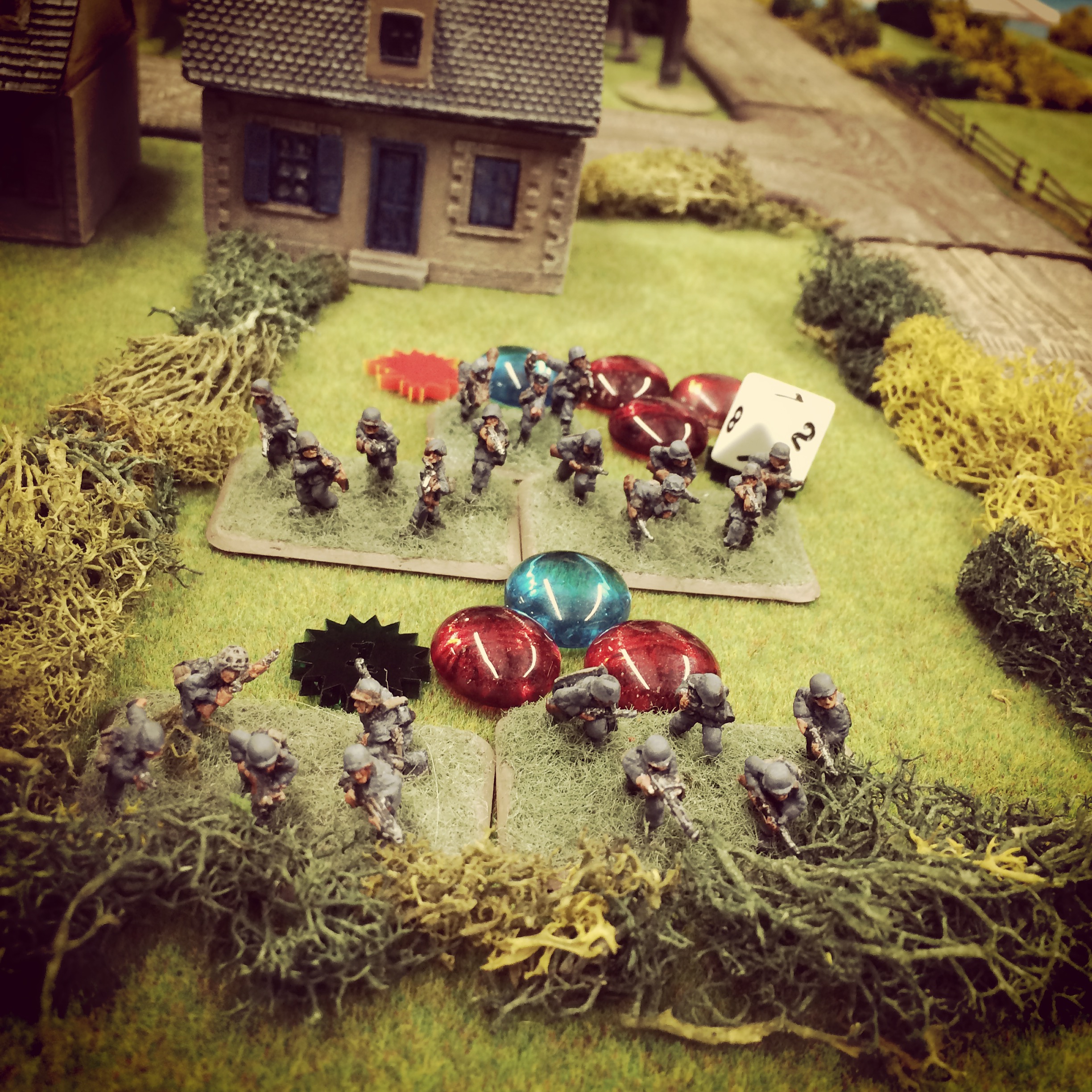
 As the heavily-damaged US machine guns rallied, the Italian column continued to advance on the board in force. Four Italian rifle platoons spread out from the road to run at the advancing American column ahead and to cover the crossroads overlooked by two rocky hills. As the Americans moved straight on to meet the Italian front line, a recon platoon accompanied by four bazookas made way for the hills and the Italian flank.

IMG_5609Italian rifle platoons sprint ahead through the open field
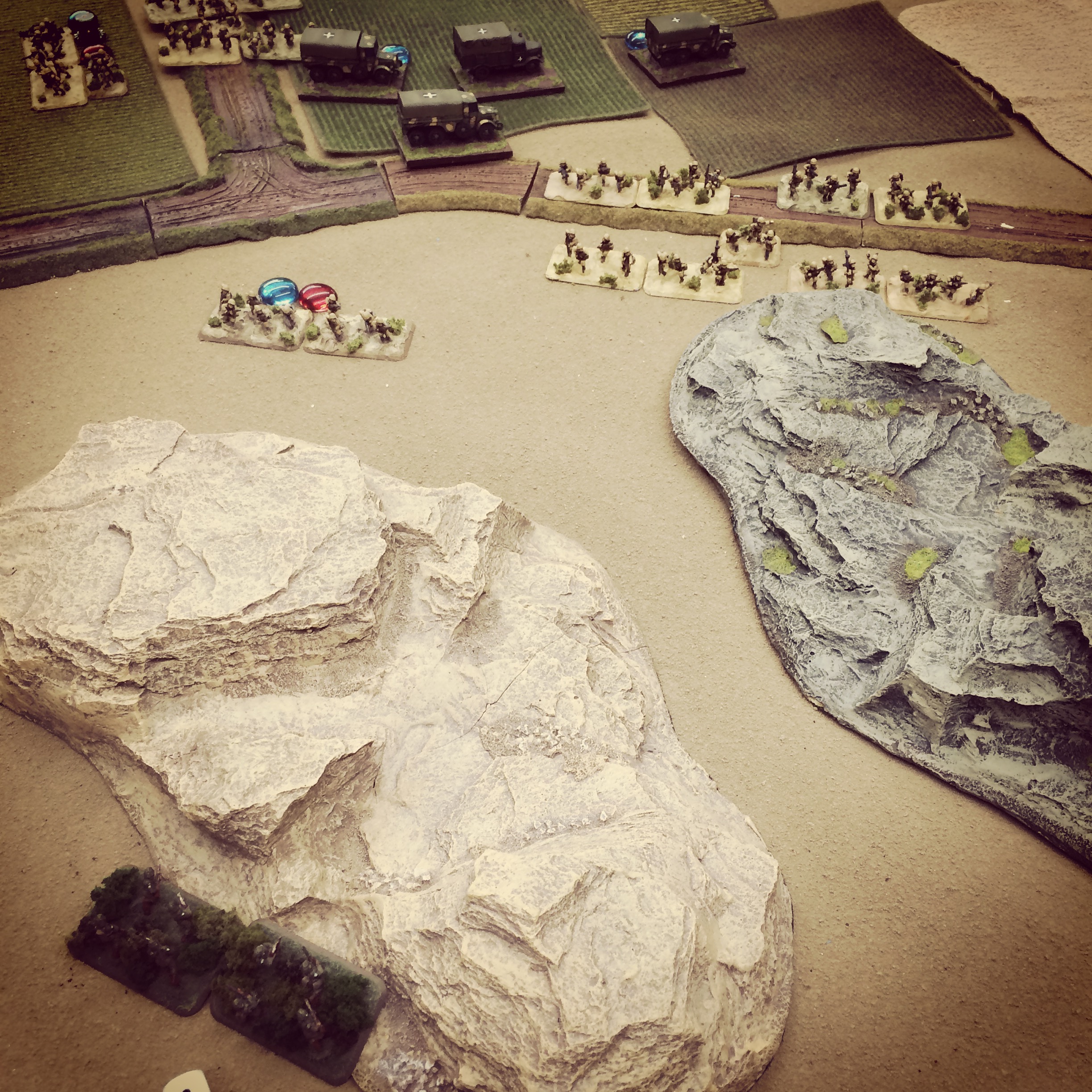
IMG_5611A US recon platoon moves to take position atop a hill as Italians deploy at the crossroads

IMG_5612A firefight erupts between two hills as American bazookas hump their way around the Italian flank
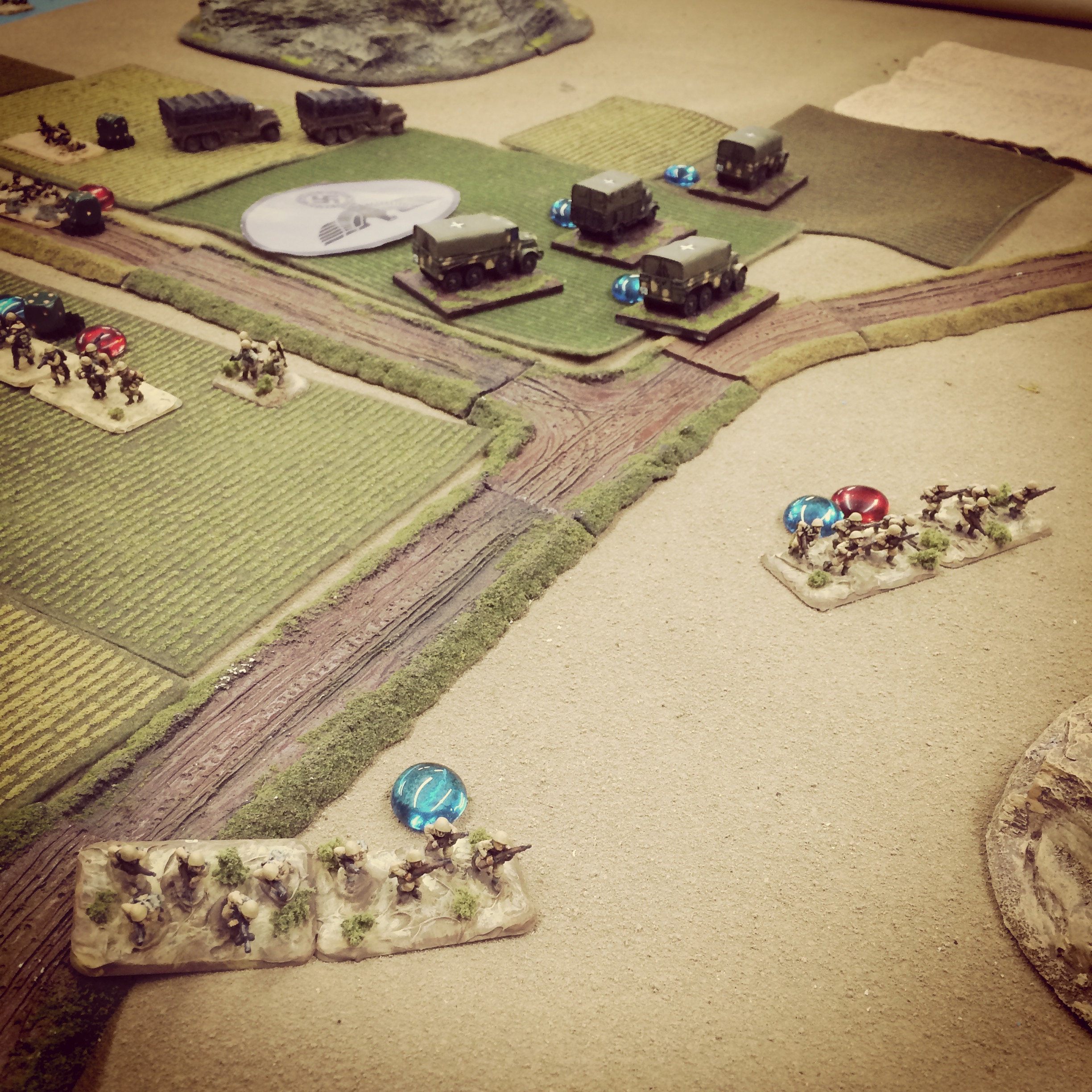
IMG_5613The Italian line folds back toward the road under US fire in the field

With an Italian front deployed across the field in several lines and more rifles rushing into the hills at their left, the battle settled into two main firefights. American rifles at the center gradually pushed through the field toward the overwhelming number of Italians. Between the two hills on the Italian left, Italian and American rifles echoed back and forth. As gunfire was exchanged across the lines, US bazookas attempted to run to engage the Italian trucks which had made their way to safety beyond the battle at the rear. Despite moderately mounting Italian casualties, the Americans just could not break through.

The US forces ultimately ceded the field to the Italians. Even with superior command quality, the initial deployment of the US machine guns had been a bit premature and was not met by the quick arrival of supporting rifle platoons. Rushing them to the hills at the crossroads might have made a difference. The Italians had also managed to get the vast majority of their troops on the board early in the game, and their neatly arranged front line allowed them to angle directly over a defense of the road. In our refighting of the early hours of July 11th, 1943 the massed Italian counterattack had stalled the US invaders southeast of Butera. What awaited at Gela later in the day would unfold in our next battle.
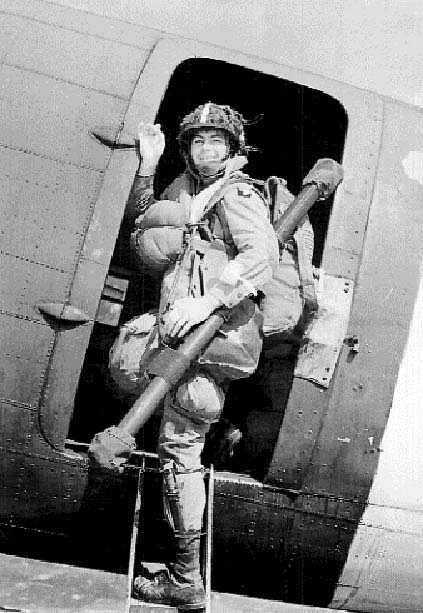
28mm: Artizan Designs US Airborne Support Weapons

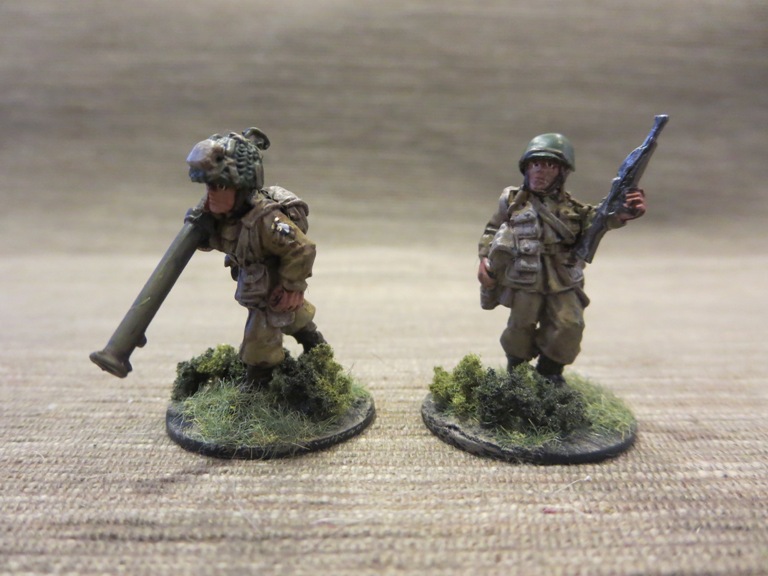
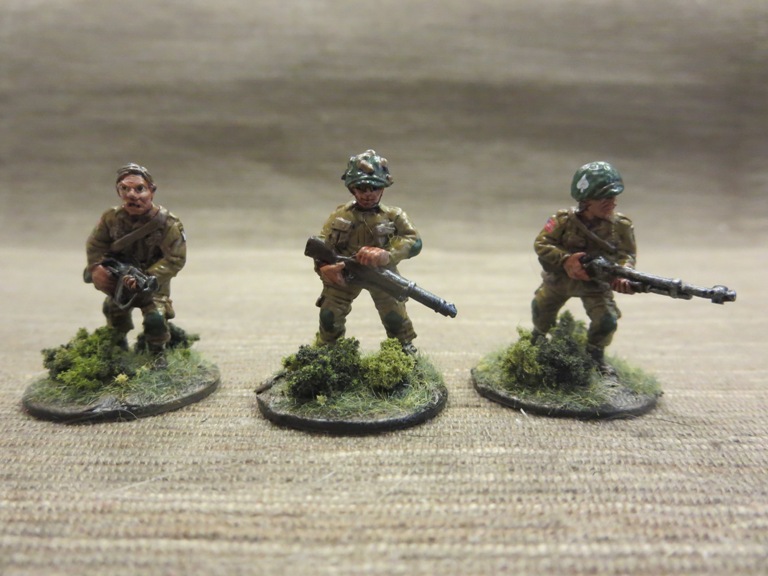
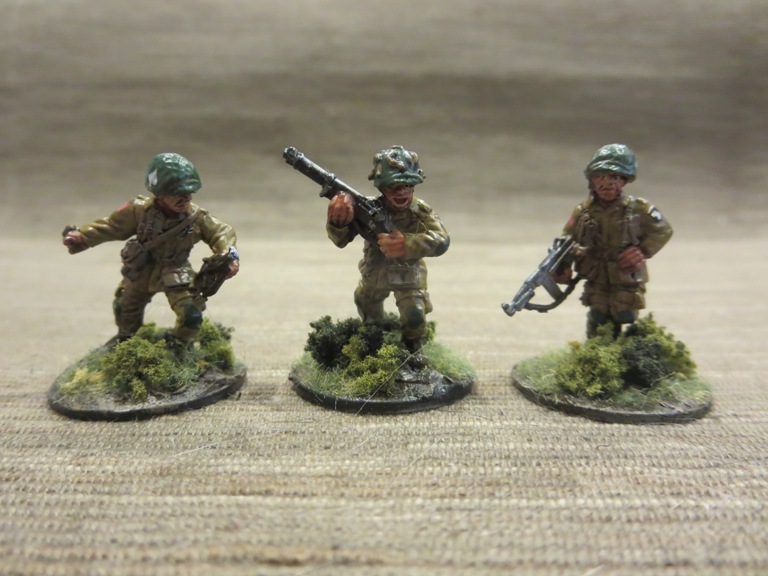
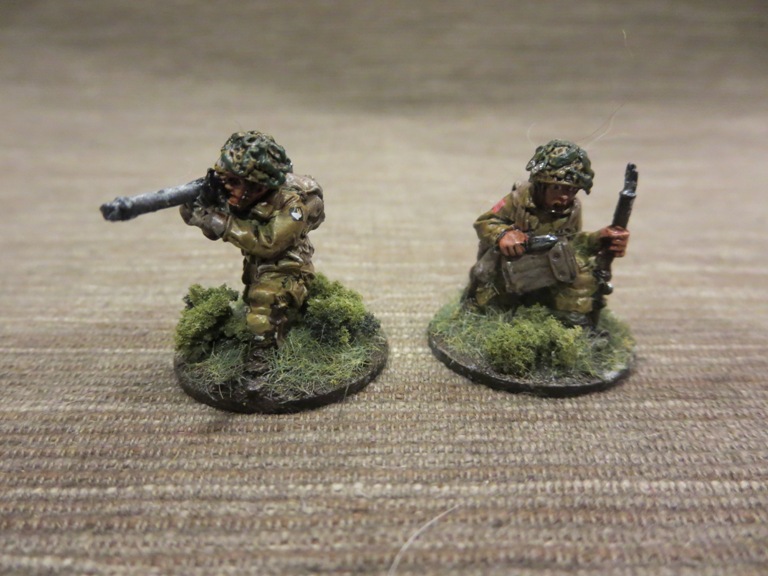
BazookaOne of my favorite blogs, War Is Boring, had a very timely article this past week on the history of the M-9 bazooka. I had just sat down to work on a small project of outfitting my growing US 101st Airborne 28mm force with some additional support weapons, and the article provided some great inspiration for getting my force outfitted with more explosive back-up with some two-man bazooka crews and a 60mm mortar from Artizan Designs.

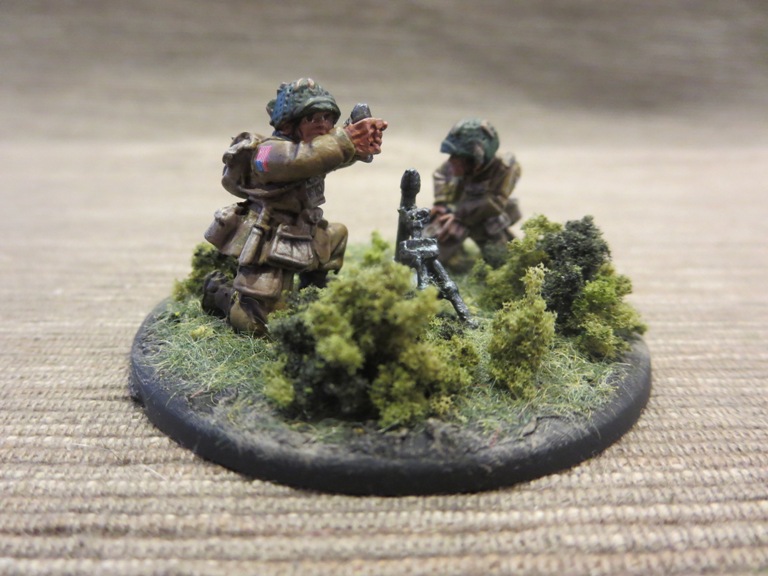
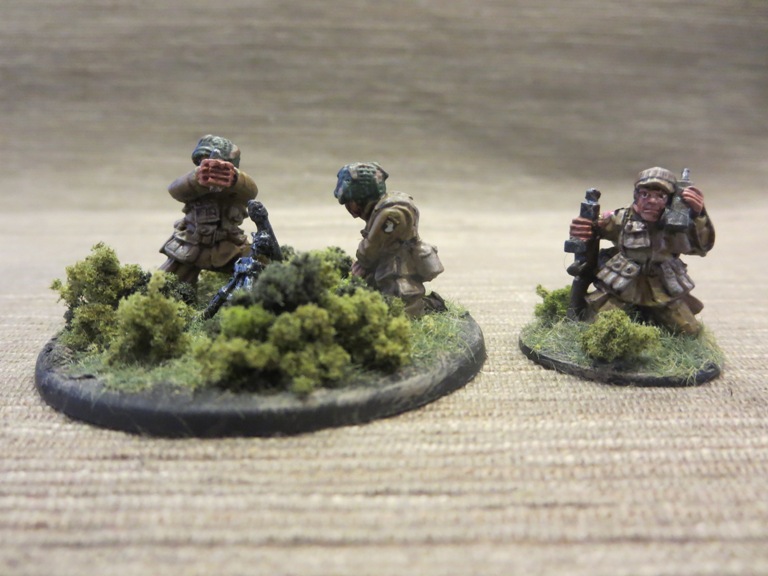
ADlogoI’d recently finished a bazooka team and mortar from Warlord Games, so two more bazookas and another mortar from AD not only fills out my gaming options but also allowed me to compare the metal models from two great manufacturers. The mortar stands look nearly indistinguishable side by side. As for the bazookas, the Warlord weapon is a bit thinner than the bulkier AD sculpts but the soldiers themselves look perfect together when painted using the consistent process below.

AB Paint Scheme

Painting 28mm US Airborne Support Weapons

  1. Clean flash from metal models with a sharp knife and glue to metal washer or plastic bases.
  2. Apply filler putty to bases. When dry, scrape off excess with a sharp knife.
  3. Base coat models and bases with flat black spray primer.
  4. Paint uniforms and bandages on helmets with Tallarn Sand.
  5. Paint helmets and knee and elbow patches with Waaagh! Flesh.
  6. Paint faces and hands with Tallarn Flesh.
  7. Paint webbing and packs with Baneblade Brown.
  8. Paint bases, boots, gun stocks and helmet straps with Dark Brown.
  9. Apply Agrax Earthshade wash to uniforms, helmet netting, webbing and packs.
  10. Mix 50/50 Baneblade Brown and Off White and lightly dry brush packs, webbing and socks.
  11. Lightly dry brush bases, gun stocks, helmet netting, holsters and elbow and knee patches with Baneblade Brown.
  12. Paint metal gun, bazooka and mortar parts with black and finish with a light dry brush of metallic silver.
  13. Paint eyes with small dots of Off White and Dark Brown. Clean up around eyes with Tallarn Flesh.
  14. Mix 50/50 Tallarn Flesh and Off White and brush highlights on cheekbones, chins, forehead, nose and hands.
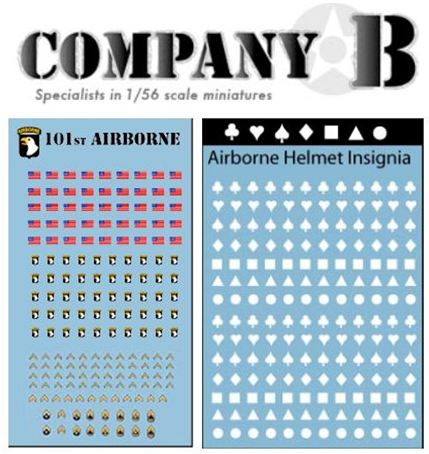
  15. Apply Company B decals to shoulders and helmets, followed by a coat of Solvaset decal fixative from Walthers.
  16. Cover bases in white glue and cover in 50/50 mix of fine light green and dark green grass flock.
  17. Glue small pieces of clump foliage to base.
  18. Spray coat completed models with matte finish.

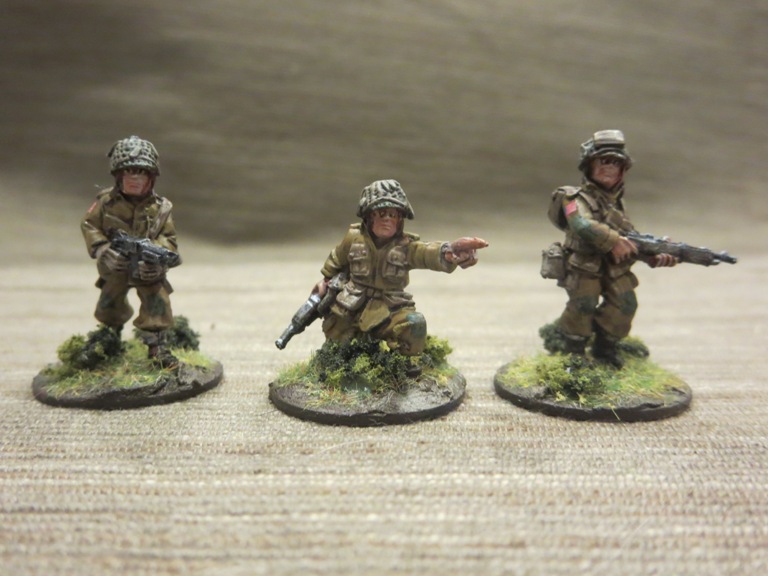
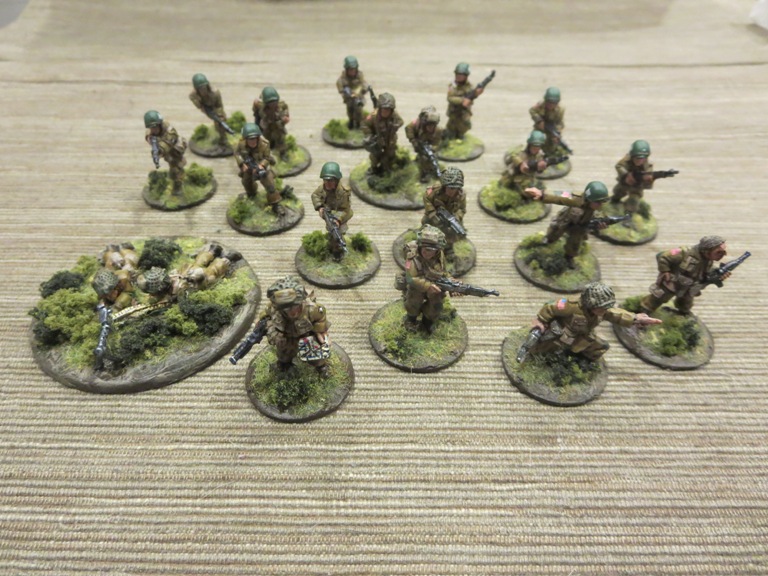
I really love the detail in the AD miniatures. The two bazooka teams each uniquely portray guys on the move or ready to fire. The figure kneeling with a radio to his ear is a new favorite of mine and will probably be used as a spotter to call in mortar support. Check out all the photos below for the results from the AD miniatures waiting to provide additional back-up to my US Airborne troops.

IMG_0678

IMG_0679

IMG_0681

IMG_0682IMG_0680

IMG_0683

28mm: German Infantry and MG 42 HMG By Artizan Designs

GermanwithMG42

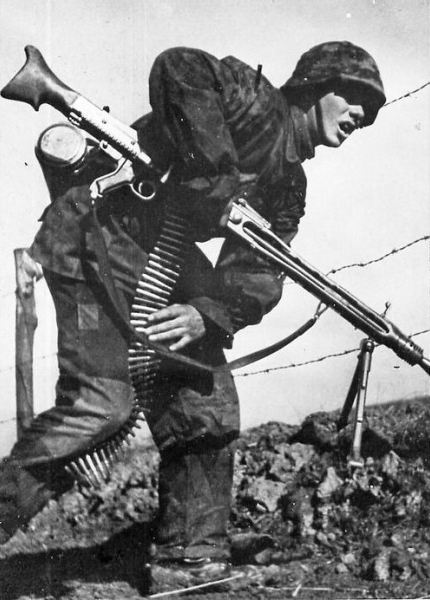
With my first set of German infantry and MG 42 machine gun complete, I’ve doubled my 28mm Axis force with more models from Artizan Designs. In just a few words, I’m loving the models from AD and my only complaint is that I’m quickly working my way through their figures so I’ll soon have a complete selection of their basic late war Germans.

ADlogo

paintgermanThis time around, there are a number of animated infantry figures in a mix of helmets and soft caps plus another MG 42 machine gun to supplement my arsenal. My German paint scheme has remained consistently fast and satisfying as per the below.

Painting 28mm German Infantry

  1. Clean flash from metal models with a sharp knife and glue to metal washer or plastic bases.
  2. Apply filler putty to bases. When dry, scrape off excess with a sharp knife.
  3. Basecoat models and bases with flat black spray primer.
  4. Paint smocks and helmets with Tallarn Sand.
  5. Paint pants, soft hats, officer greatcoat and gas mask containers with Skavenlight Dinge.
  6. Paint camouflage on helmets and smocks with alternating Waaagh! Flesh and Dark Brown.
  7. Paint faces and hands with Tallarn Flesh.
  8. Paint packs with Baneblade Brown.
  9. Paint boots and equipment straps Black.
  10. Paint bases, gun stocks, water bottles and helmet straps with Dark Brown.
  11. Apply Agrax Earthshade wash to uniforms, helmet netting, webbing and packs.
  12. Mix 50/50 Baneblade Brown and Off White and lightly dry brush packs, webbing, socks and holsters.
  13. Dry brush pants, soft hats and officer great coat with Light Grey.
  14. Lightly dry brush bases and gun stocks with Baneblade Brown.
  15. Paint metal gun and water bottle parts with black and finish with a light dry brush of Metallic Silver.
  16. Dry brush gasmask containers with metallic Silver.
  17. Paint eyes with small dots of Off White and Dark Brown. Clean up around eyes with Tallarn Flesh.
  18. Mix 50/50 Tallarn Flesh and Off White and brush highlights on cheekbones, chins, forehead, nose and hands.
  19. Cover bases in white glue and cover in 50/50 mix of fine light green and dark green grass flock.
  20. Glue small pieces of clump foliage to base.
  21. Spray coat completed models with matte finish.

And now, more photos of my Germans as my force builds up and looks toward hitting the table soon.

IMG_0670

IMG_0668

IMG_0672

IMG_0674

IMG_0675

IMG_0676

I Ain’t Been Shot Mum: West Of The Oktiabrski State Farm July 12, 1943 Scenario

t34OktiabrskiThis past week, two of us at Metropolitan Wargamers in Brooklyn, NY headed back to the summer of 1943 and the opening days of what would become known as the Battle of Kursk. The German offensive in Soviet territory, known as “Operation Citadel,” took place southwest of Moscow and led to one of the largest tank battles of all time, the Battle of Prokhorovka. It was south of Prokhorovka at the Oktiabrski State Farm where our game began.

BKCover‘Battlegroup Kursk’ from Iron Fist Publishing

Our 15mm battle was a mash-up of game systems, using Flames of War models, I Ain’t Been Shot Mum rules and a scenario lifted from the Battlegroup Kursk book by Iron Fist Publishing. Aside from its own set of tabletop rules, the Battlegroup Kursk book offers some well-drawn scenarios easily adaptable to a variety of gaming systems and scales. Our scenario, “West Of The Oktiabrski State Farm,” was the second of seven scenarios from the section entitled “The Inglorious 12th July.”

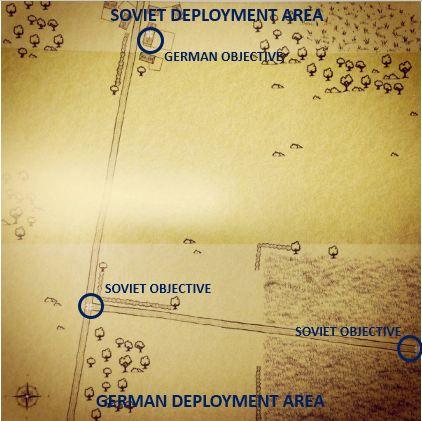
oktMAPMap of the West Of The Oktiabrski State Farm scenario

IMG_5577Soviet blinds deploy and move as T-34s are spotted pushing on the left

Our first Eastern Front and largest IABSM game to date started with the German infantry, Pak 40 anti-tank guns and two StuG III units deployed in hidden on a third of the table. Across a wide field, the Soviets deployed on blinds along the table edge in and around a collective farm complex. The initial Soviet blinds featured three infantry platoons at the center, a T-34 tank platoon to the left flank and one more tank platoon arriving on blinds in the second and third turns. Each side also featured off board artillery and the German side also had air fire to draw on throughout the game, although none of it would play a measurable role during the battle.

IMG_5547Soviet armor rumbles toward their first objective

IMG_5578A Pak 40 reveals itself to the approaching Soviet T-34s

IMG_5569The T-34s and Pak 40 exchange fire across the open field

IMG_5571The Soviet commander exposes Germans dug into the field just as his tank is destroyed

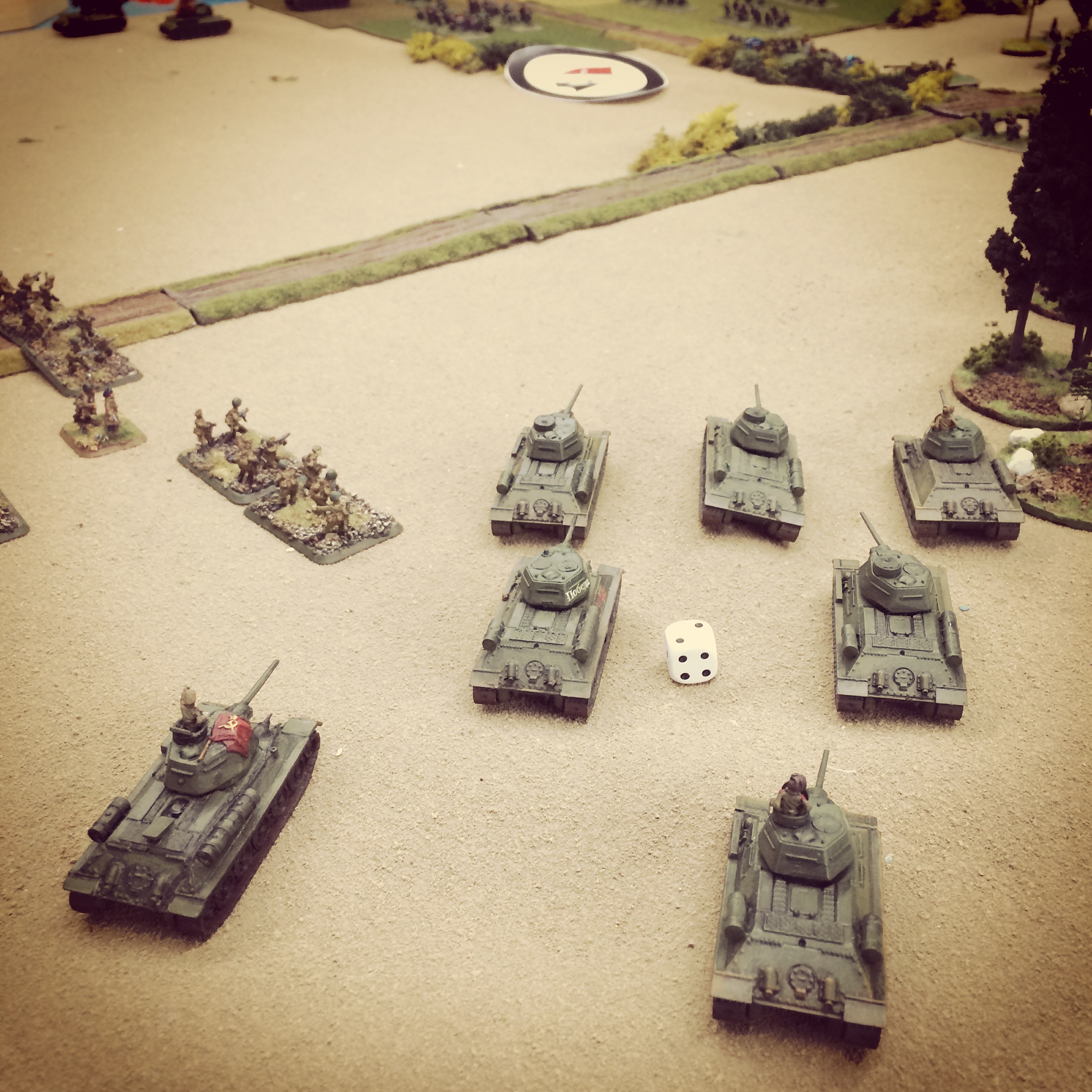
IMG_5575The first wave of Soviet armor burns in the field as reinforcements arrive on a blind to the rear

Soviet objectives sat at the German-defended crossroads, and so the T-34s pushed hard in the initial turns toward the road entry at the edge of the table at the Soviet left. Rolling quickly toward the road, the T-34s encountered a Pak 40 position at a hedge dominating a field of fire at the center of the table. The Pak 40s immediately hit the tanks, damaging the turrets, sights and mobility of the T-34s. Over several turns, fire was exchanged between the T-34s and the German anti-tank crews, leaving several burning tanks and a partially destroyed German gun position. Mid-game, a reinforcing platoon of T-34s moved to support the first wave of nearly-destroyed Soviet armor but were likewise halted in a crossfire from the surviving Pak 40s and three StuGs moving out their hidden positions and toward the road. The Soviet tank commander managed to close gloriously on the objective, but the StuGs and hidden German infantry positions stalled the advance and his tank went up in flames with those of his comrades, too.
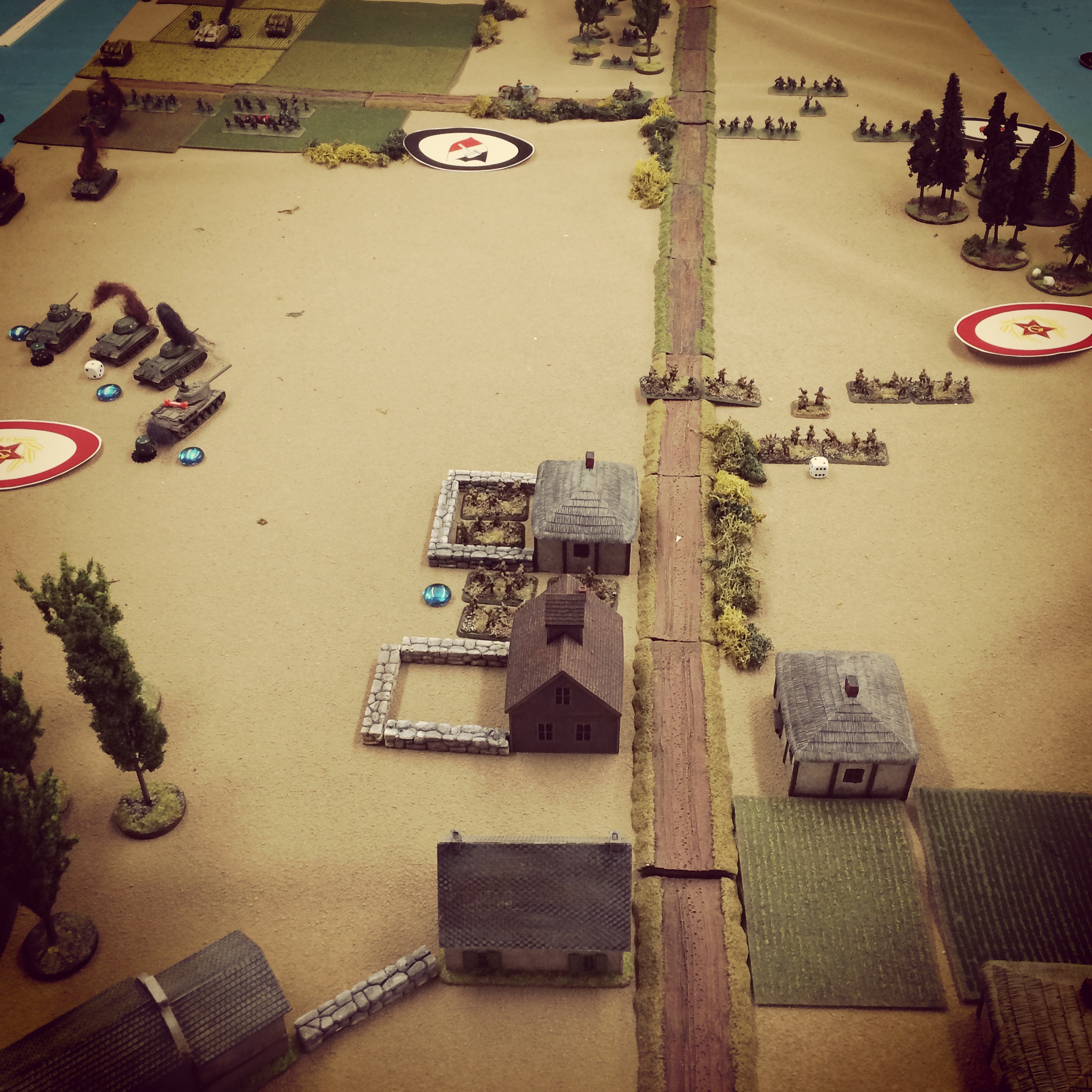
IMG_5570Mid-game with Soviet blinds arriving on each flank, infantry at the middle and thick lines of German defenders in the distance

IMG_5572German Pak 40s and MG42s hold the center

With the Soviet attack on the left completely at a standstill, infantry moved from the farm complex toward the crossroads objective in the distance as T-34s maneuvered to their right using a forested area to cover their advance. The Germans moved to strengthen their center with the deployment of MG42s which laid fire into the Soviet infantry. German infantry deployed across the crossroads objective and were buoyed by the support of another StuG platoon on the opposite side of the trees.

IMG_5573T-34s try to push from the right using the forest as cover

IMG_5574T-34s and StuGs duel at the edge of the forest as infantry begins to take heavy casualties on both sides

Between the road and forest, the battle for crossroads began. Soviet infantry were cut down in the open and the Soviet armor moved cautiously around the woods to fire into the German infantry and armor. As the T-34s rounded the edge of the forest, a crossfire of Pak 40 and StuG shots stalled the Soviet tank advance with the Germans suffering a loss of only one StuG in the firefight. With the objectives at the crossroads and road at the table edge still secure, the day tipped to a German win effectively repelling the Soviet attack.

I hardly ever play Soviets, and in a look at the battle afterward I reasoned a consolidated attack to the road on the German right may have provided the critical mass of armor needed to sway the victory. The German anti-tank guns had effectively pinned the center, and a replay with T-34s massing to one side may have provided just enough of a steel wall to allow the other tanks to move to the objective instead of dying in the open. With our largest IABSM battle played out over several hours, we thought having a crack at one of the other Eastern Front scenarios would be worth it to test if Soviet metal might prevail over the German invaders on another day.

28mm: US Airborne By Black Tree Design

101stabonplane

My new 28mm World War II project is marching on, and I’ve recently added some US 101st Airborne models from Black Tree Design. The UK-based BTD offers a diverse line of metal miniatures from various historical eras, fantasy, science fiction and a nifty Doctor Who offering. The WWII US Airborne line offers a nice selection of poses and weapons, so I bought into my first BTD models averaging about $2 USD per figure during one of their frequent online sales.

BTDIMG_4977Nice packaging from Black Tree Miniatures

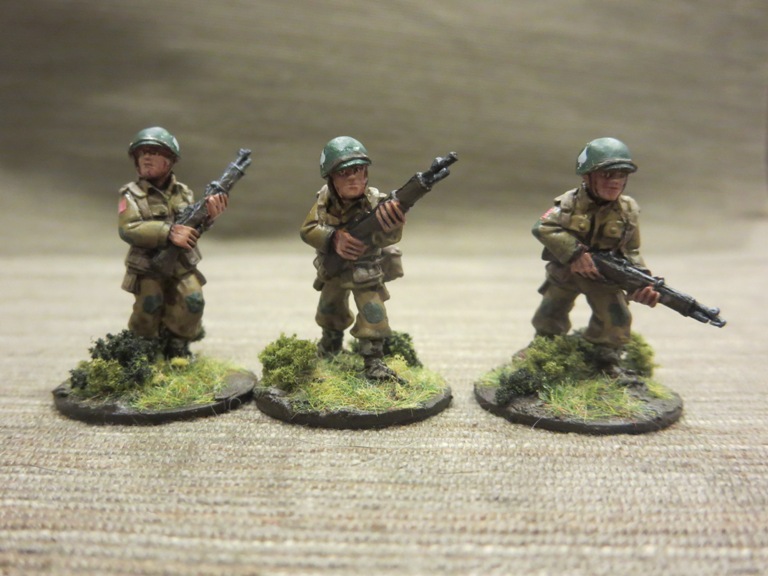
The BTD miniatures were quickly delivered in the US bagged and packaged in a little tin with a hand-written ‘thank you’ note. Compared to my earlier Airborne from Artizan Designs, the BTD models are a tad smaller and thinner but scale well on the table. Detail is a bit more sparse with less equipment slung on the backs of the paratroopers and rifles which read a bit more like that on toy soldiers. Aside from rifles, the models also came armed with Browning BARs, Thompson submachine guns and one guy hurling a hand grenade. While most of the models are set in generic poses, a few of the models show a lot of individual character with one officer calmly smoking a cigarette and another charging forward without a helmet.

AB Paint SchemeOne minor bummer was the delicate nature of some of the BTD models cast with both feet held tightly together, and one snapped off the base when I attempted to straighten his pose more upright. With the rest of the models successfully glued to bases, I painted up my first group of BTD miniatures using the same quick and simple process from my previous 28mm paratroopers.

Painting 28mm US Airborne

  1. Clean flash from metal models with a sharp knife and glue to metal washer or plastic bases.
  2. Apply filler putty to bases. When dry, scrape off excess with a sharp knife.
  3. Base coat models and bases with flat black spray primer.
  4. Paint uniforms and bandages on helmets with Tallarn Sand.
  5. Paint helmets and knee and elbow patches with Waaagh! Flesh.
  6. Paint faces and hands with Tallarn Flesh.
  7. Paint webbing and packs with Baneblade Brown.
  8. Paint bases, boots, gun stocks and helmet straps with Dark Brown.
  9. Apply Agrax Earthshade wash to uniforms, helmet netting, webbing and packs.
  10. Mix 50/50 Baneblade Brown and Off White and lightly dry brush packs, webbing and socks.
  11. Lightly dry brush bases, gun stocks, helmet netting, holsters and elbow and knee patches with Baneblade Brown.
  12. Paint metal gun, bazooka and mortar parts with black and finish with a light dry brush of metallic silver.
  13. Paint eyes with small dots of Off White and Dark Brown. Clean up around eyes with Tallarn Flesh.
  14. Mix 50/50 Tallarn Flesh and Off White and brush highlights on cheekbones, chins, forehead, nose and hands.
  15. Apply Company B decals to shoulders and helmets, followed by a coat of Solvaset decal fixative from Walthers.
  16. Cover bases in white glue and cover in 50/50 mix of fine light green and dark green grass flock.
  17. Glue small pieces of clump foliage to base.
  18. Spray coat completed models with matte finish.

Finally, a few photos of my finished BTD US Airborne ready to hit the Normandy tabletop.

IMG_0654

IMG_0657

IMG_0659

IMG_0660

IMG_0658  IMG_0744IMG_0662

IMG_0663

28mm: US Airborne Support Weapons By Warlord Games

usairborneweapons

With my first 101st Airborne troops completed in 28mm, I’ve moved on to adding some support weapons. As a relative newcomer to World War II at this scale, I’ve also taken the opportunity to try another manufacturer’s miniatures for the sake of comparison.

WarlordlogoIn 2008, Warlord Games launched a small selection of WWII miniatures acquired from another manufacturer. To compliment the line of models, about three years ago Bolt Action came to the game scene with a slickly-designed rule set published by Osprey Publishing and a now vastly-expanding line of miniatures from multiple nations and combat theaters of WWII. The Warlord Games plastic and metal line of soldiers, artillery, transports and armor, along with the Bolt Action game system, have come to dominate the market and tournament scene for gamers playing tactical-level WWII in the larger 28mm scale.

For my first figures from Warlord Games, I stuck with a few metal models which scale nicely with my figures from Artizan Designs. The castings display a lot of exaggerated poses, animated facial expressions and detailed equipment which look great on a wargaming tabletop and reveal the influence of the designers who hail from the world of Warhammer and Warhammer 40,000 from Games Workshop.

AB Paint SchemeIn painting my first Warlord Games miniatures, I went with my same quick and simple painting scheme I’ve been using so far:

Painting 28mm US Airborne Support Weapons

  1. Clean flash from metal models with a sharp knife and glue to metal washer or plastic bases.
  2. Apply filler putty to bases. When dry, scrape off excess with a sharp knife.
  3. Base coat models and bases with flat black spray primer.
  4. Paint uniforms and bandages on helmets with Tallarn Sand.
  5. Paint helmets and knee and elbow patches with Waaagh! Flesh.
  6. Paint faces and hands with Tallarn Flesh.
  7. Paint webbing and packs with Baneblade Brown.
  8. Paint bases, boots, gun stocks and helmet straps with Dark Brown.
  9. Apply Agrax Earthshade wash to uniforms, helmet netting, webbing and packs.
  10. Mix 50/50 Baneblade Brown and Off White and lightly dry brush packs, webbing and socks.
  11. Lightly dry brush bases, gun stocks, helmet netting, holsters and elbow and shoulder patches with Baneblade Brown.
  12. Paint metal gun, bazooka and mortar parts with black and finish with a light dry brush of metallic silver.
  13. Paint eyes with small dots of Off White and Dark Brown. Clean up around eyes with Tallarn Flesh.
  14. Mix 50/50 Tallarn Flesh and Off White and brush highlights on cheekbones, chins, forehead, nose and hands.
  15. Apply Company B decals to shoulders and helmets, followed by a coat of Solvaset decal fixative from Walthers.
  16. Cover bases in white glue and cover in 50/50 mix of fine light green and dark green grass flock.
  17. Glue small pieces of clump foliage to base.
  18. Spray coat completed models with matte finish.

To begin, I’ve painted up a 60mm mortar team and a bazooka crew. here’s a few photos of the final results:

IMG_0649

IMG_0648

IMG_0646

IMG_0647

I’ll probably add a light machine gun and some other models from Warlord Games soon, but for now my US Airborne forces will be able to pack a bit more punch in upcoming games.

28mm: German Infantry And MG 42 HMG By Artizan Designs

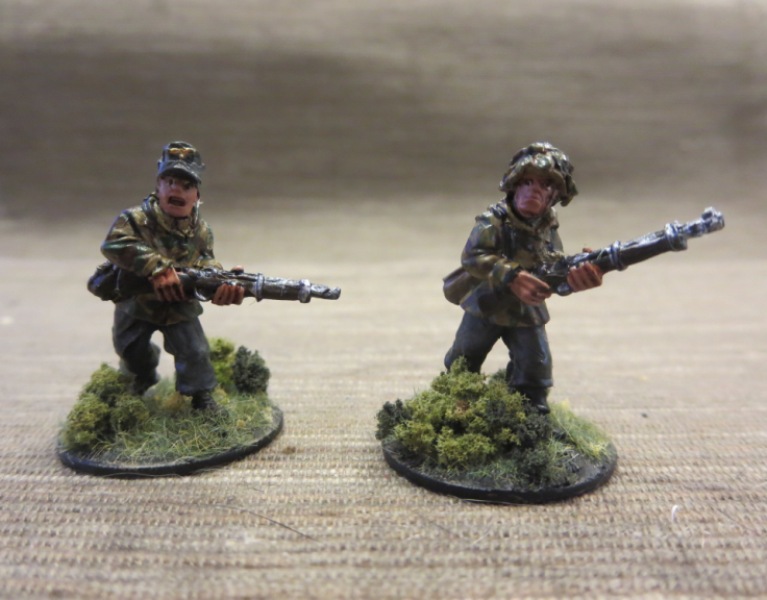
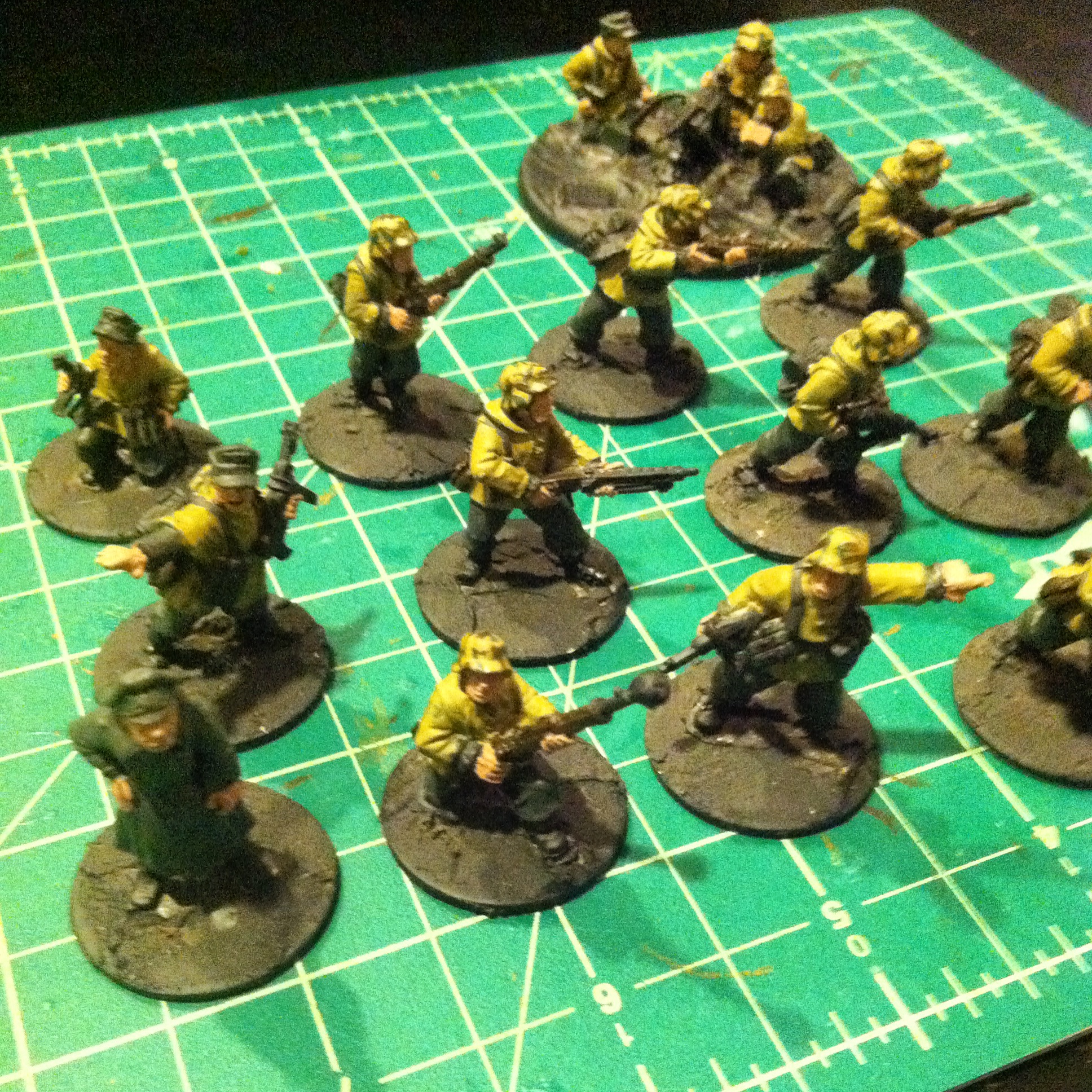
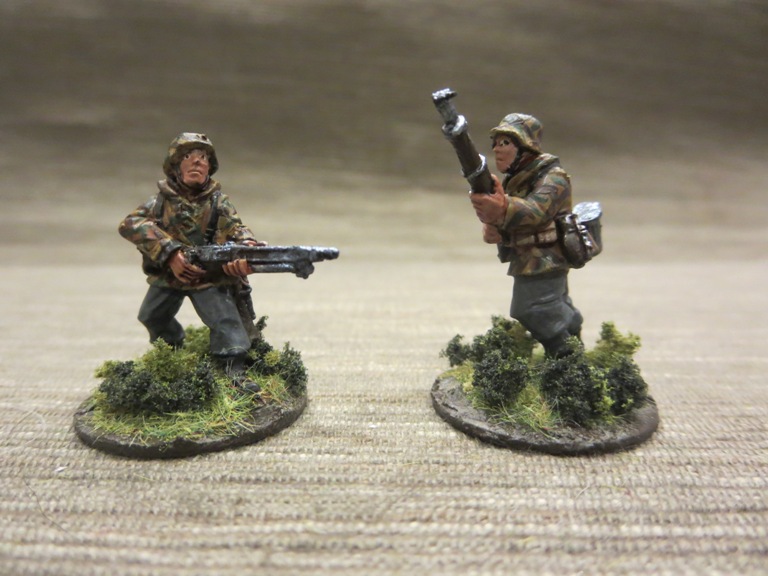
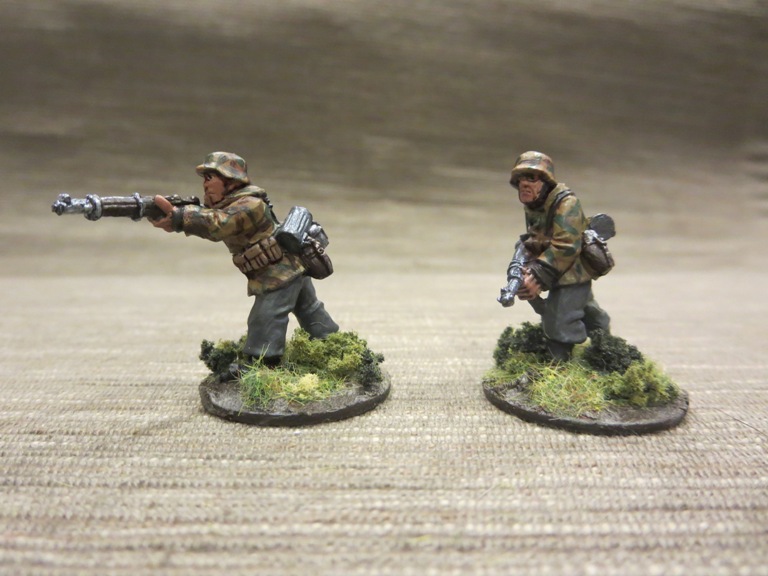
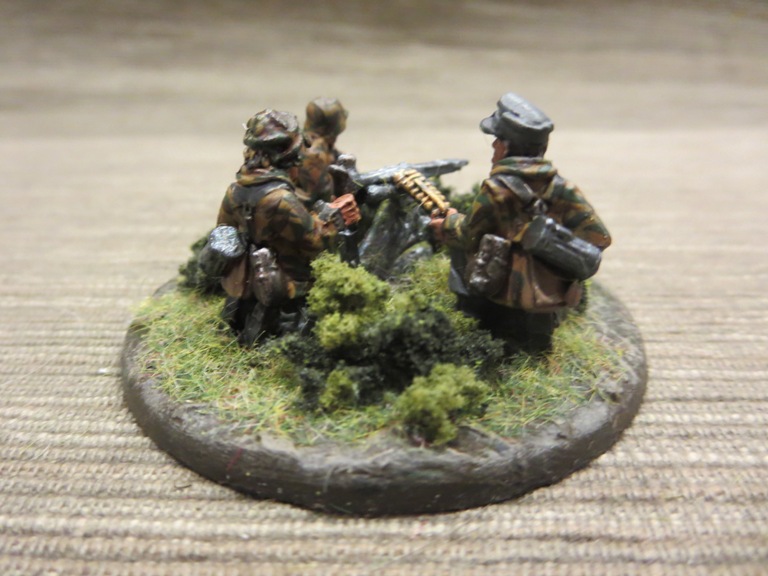
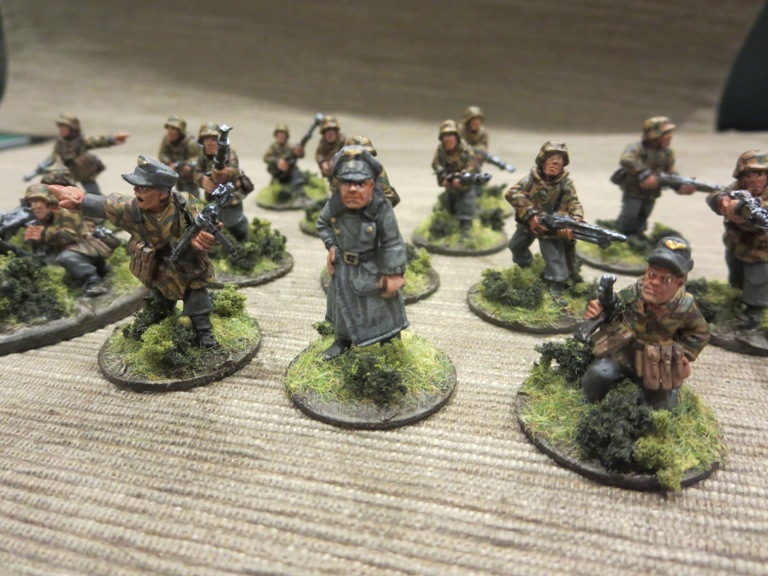
waffen After wrapping up my first 28mm US Airborne troops, I set to work on some Germans. I ordered a bunch of Late War German infantry and command, plus an MG 42 team by Artizan Designs from Brigade Games and received them speedily. The detail in the figures really pops, and the personality and variety in the poses make them really engaging at this scale. I particularly like the stern officer in his greatcoat and the other figures screaming out orders and gesturing on the move. ADlogo Painting WWII Germans for the first time at this scale, I really wanted to go for more detail than I do at 6mm or 15mm. Artizan Designs offers some great painting references on their website, including a general uniform guide and a lot of detail on German camoflage patterns. Using paints I had on hand plus a few more colors I picked up from Citadel’s paint line, I came up with a palette and painting scheme that produced some great results on my first go. paintgermanThe Artizan figures require little flash clean up before being glued to metal washers. The three man machine gun crew went on a 60mm plastic base I picked up from Proxie Models. Here’s the steps in detail for painting my German infantry.

Painting 28mm German Infantry

  1. Clean flash from metal models with a sharp knife and glue to metal washer or plastic bases.
  2. Apply filler putty to bases. When dry, scrape off excess with a sharp knife.
  3. Basecoat models and bases with flat black spray primer.
  4. Paint smocks and helmets with Tallarn Sand.
  5. Paint pants, soft hats, officer greatcoat and gas mask containers with Skavenlight Dinge.
  6. Paint camouflage on helmets and smocks with alternating Waaagh! Flesh and Dark Brown.
  7. Paint faces and hands with Tallarn Flesh.
  8. Paint packs with Baneblade Brown.
  9. Paint boots and equipment straps Black.
  10. Paint bases, gun stocks, water bottles and helmet straps with Dark Brown.
  11. Apply Agrax Earthshade wash to uniforms, helmet netting, webbing and packs.
  12. Mix 50/50 Baneblade Brown and Off White and lightly dry brush packs, webbing, socks and holsters.
  13. Dry brush pants, soft hats and officer great coat with Light Grey.
  14. Lightly dry brush bases and gun stocks with Baneblade Brown.
  15. Paint metal gun and water bottle parts with black and finish with a light dry brush of Metallic Silver.
  16. Dry brush gasmask containers with metallic Silver.
  17. Paint eyes with small dots of Off White and Dark Brown. Clean up around eyes with Tallarn Flesh.
  18. Mix 50/50 Tallarn Flesh and Off White and brush highlights on cheekbones, chins, forehead, nose and hands.
  19. Cover bases in white glue and cover in 50/50 mix of fine light green and dark green grass flock.
  20. Glue small pieces of clump foliage to base.
  21. Spray coat completed models with matte finish.

 IMG_4954 Helmets, smocks and pants base coated on the MG 42 team and infantry models

IMG_4958Infantry and officer uniforms base coated

IMG_4955Flesh base coats and helmet camouflage added to infantry and officer

IMG_4959Camouflage painted on helmets, and gun stocks and water bottles painted brown

IMG_5462

Equipment detail being painted

Here’s a round up of my finished German infantry from Artizan Designs…

IMG_0628

IMG_0630

IMG_0637

IMG_0636

IMG_0634

IMG_0632

IMG_0638

IMG_0639

IMG_0642

IMG_0643

IMG_0641

Now that I’ve got my core German and US forces completed, I’ll be looking to fill out forces on both sides with some additional support weapons and some more infantry from some other manufacturers. In no time at all, my 28mm force continues to grow.

I Ain’t Been Shot Mum: Cabourg June 6, 1944 Scenario

LandingatOmahaOn the morning of the Normandy Landings of June 6, 1944, taking the eastern sector of Omaha Beach fell to the United States 1st Infantry Division. Despite some missed targeted landing zones on the beach and heavy losses at the far ends, the exit “draws” were largely secured by mid-morning. As additional troops and supplies began to arrive, the push inland began.

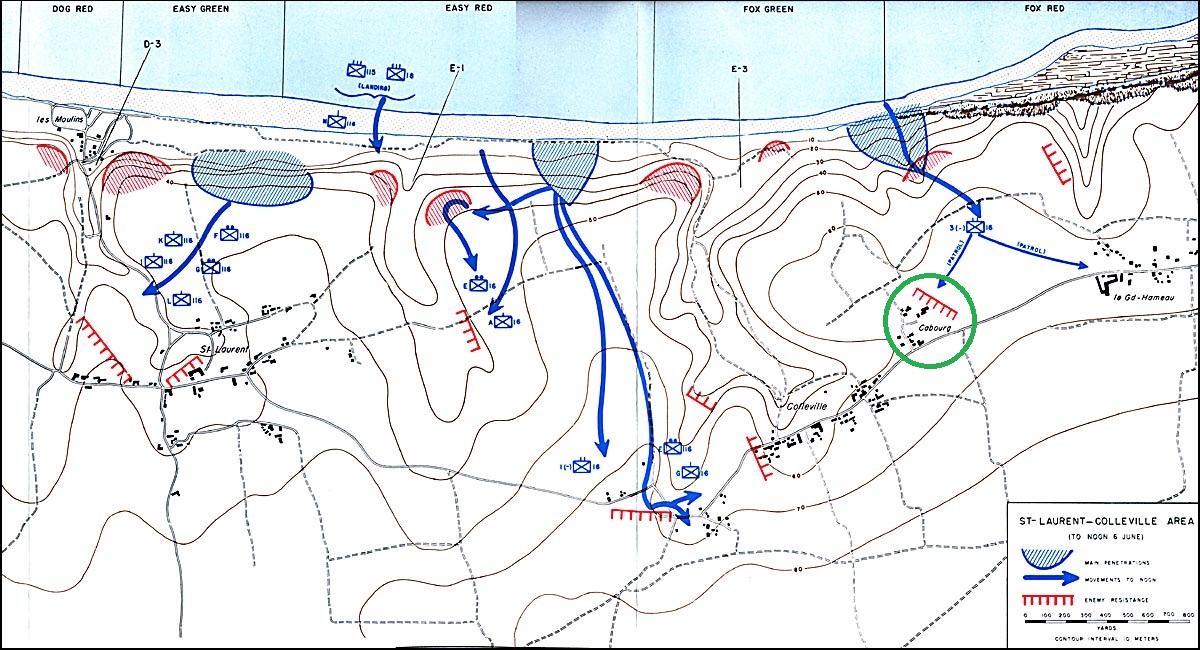
Omaha to CobourgMap of the US push to Cabourg from Omaha Beach, June 6, 1944

(via US Army Center of Military History)

Moving toward the objective of Colleville-sur-Mer, probing forces from the 1st Infantry Division pressed forward through the seaside fields of Normandy and began to encounter German defenders in various states of disarray. Tired from the fighting at the beach, the first group of Americans on patrol moved cautiously into Cabourg from the north and east while the German force scrambled to hold against any additional headway by the invaders. WhereTheHell After a couple of month hiatus, we jumped back into a 15mm World War II game at Metropolitan Wargamers in Brooklyn, NY this past weekend centering on the action at Cabourg. Using the I Ain’t Been Shot Mum rules and a post-D-Day scenario from the Where The Hell Have You Been Boys? book, all from Too Fat Lardies, our table was set to show the American advance and German defense at Cabourg.

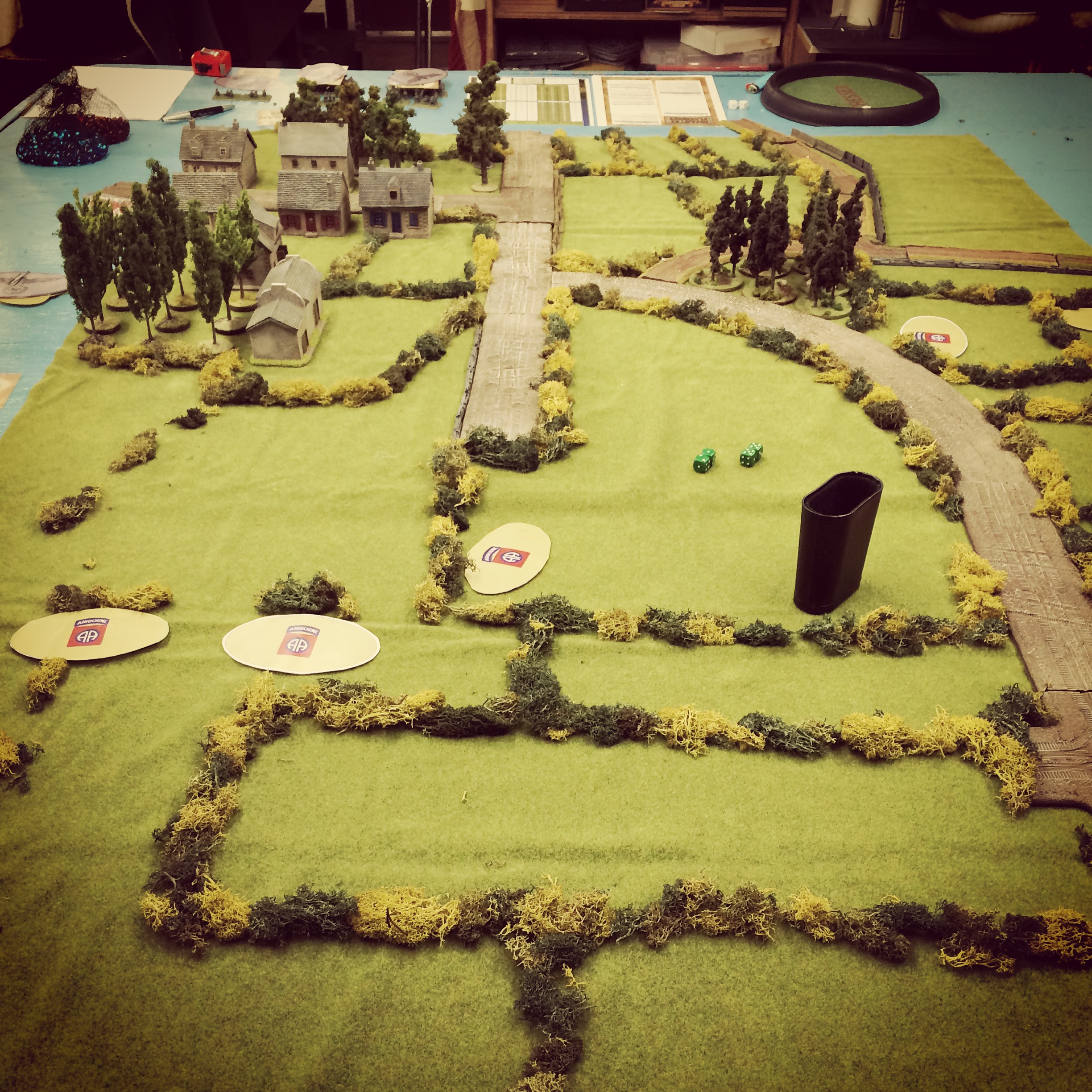
IMG_4940Initial advance of US forces on blinds from the east and north toward Cabourg

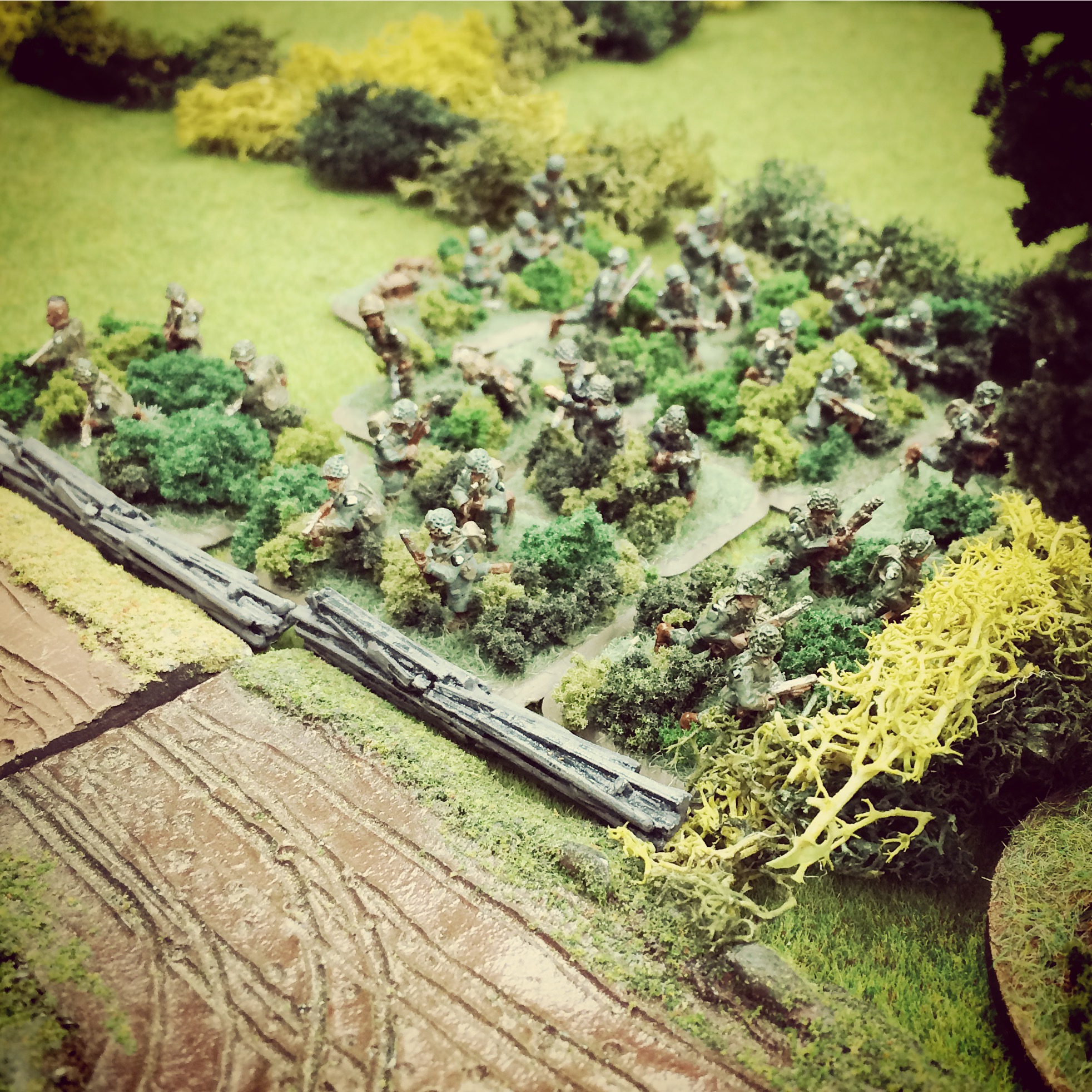
Playing on the US side, my partner and I divided our force of three rifle platoons under blinds plus three false blinds. I swung two platoons and a false blind directly at the village from the east while my teammate took the other two false blinds and a single platoon around to the north behind a copse of trees. The mass of US blinds hiding a force only half the actual size provided a great simulation of the confusion the Germans felt that morning as they also lay hidden in and around the village in defense.

IMG_4941US forces near Cabourg on blinds from the east

IMG_4942The first US forces are revealed beyond a wood north of Cabourg

After a couple turns of US movement and prodding for Germans outside the town, the Germans spotted the Americans moving cautiously to the north. With two false blinds exposed, the third American blind revealed a rifle platoon armed with a mortar and two officers present. A false blind was also revealed near a farm at the eastern edge of the town as the Germans continued to burn up turn actions trying to find out where the Americans actually were.

IMG_4943American and German forces simultaneously surprise each other near the farm

IMG_4944A close assault erupts in the woods behind the barn

In close proximity to each other to the rear of a barn at the farm, US and German blinds were exposed nearly simultaneously with American gunfire tearing into the outnumbered Germans. A close assault at a hedgerow quickly pushed the first German fire team to the rear and out the action for the game. The remainder of the German platoon stayed to continue on firing from within the first barn and a hede nearby.

IMG_4945The final American blind is exposed just north of the farm

IMG_4946Americans give and take fire at a hedgerow

On the other side of the farm, the final American blind revealed another rifle platoon hunkered behind a hedge lining a road to town. At long-range, shots were exchanged between German defenders in and around the barn and the Americans now shooting from both sides of the barn. The action at the east end of Cabourg settled into a stalemate of fire across the fields and around the barns.

IMG_4947US forces inch toward Cabourg across hedges and fields from the north

IMG_4949US forces stall out to the northeast of Cabourg

Back to the north of town, the lone US platoon on the moved cautiously along a road and over fields, fences and hedgerows. With the Americans creeping toward Cabourg, the Germans opened up with MG 42s positioned in an upper story of a second barn and from the garret of a farmhouse near the entry road to town. With a cross-fire of heavy machine gun pouring into the Americans at the north and east, the US advance stalled somewhat until something could be done about the German fire ripping from building windows.

IMG_4948The remnants of the first German rifle platoon look to reposition to cover

IMG_4950Americans move to assault the German machine guns at the second barn

Back at the two barns, one US platoon swung around to the rear of the barn to assault the German machine gun crew inside. With the MG 42 crew thrown back into a retreat from the barn, the surviving German rifles on the other side of the barn retreated from fire into a nearby house. Firing from their new position, the Germans stalled the Americans pushing around the barns to the village. At the same time, the other MG 42 continued to fire into the other US platoon now pinned with dwindling numbers behind a hedge.

IMG_4951German reserves arrive late in the day to defend against the American push from the north

As the engagement progressed late into the scenario, the game’s referee announced the arrival of reserves on both sides. From the west, a fresh German rifle platoon joined the fight at the road and tree line at the northern edge of town. At full strength, two German platoons focused fire on the lone American platoon which had so cautiously moved toward that end of the village. Taking casualties, the shrinking US force began to fall back over the hedges and fields from where they had just come.

On the far end of the table, three more American platoons arrived from the beach to the east. Looking to advance quickly on the road straight toward town, the US reserves just couldn’t get in the fight fast enough. With the US forces already near Cabourg greatly reduced and in retreat to defensive positions, the game was called with the Germans holding Cabourg from the American assault.

At Normandy in 1944, the result was the same and the German defense halted the US advance which broke off by mid afternoon. The IABSM scenario at Cabourg is a great illustration of the dozens of small inland battles which raged after the morning’s landings along the Normandy coast over 70 years ago, and we’ll be returning to more follow-up actions in the weeks to come.

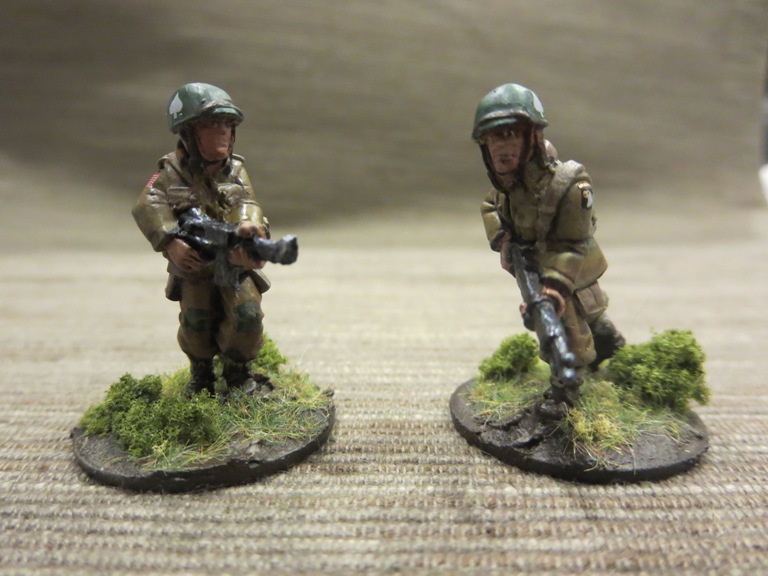
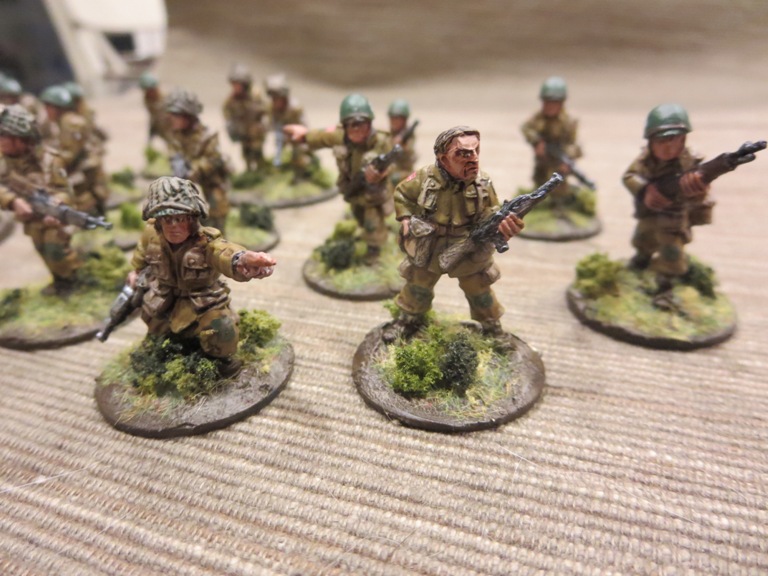
28mm: US Airborne By Artizan Designs

ABplane

After a lot of modelling and gaming World War II over the years at the 15mm scale and some toes dipped into 6mm last year, I decided to move up to 28mm at the beginning of 2015. At this larger scale, there’s a lot less needed in terms of getting numbers of models on the table and there’s an opportunity for much more detail and personality in the figures, too. At about $2 USD per metal figure on average across a number of manufacturers, a more than healthy sized force for squad level engagements can be had with 30-40 or so figures on a side for under $100 USD.

ADlogo

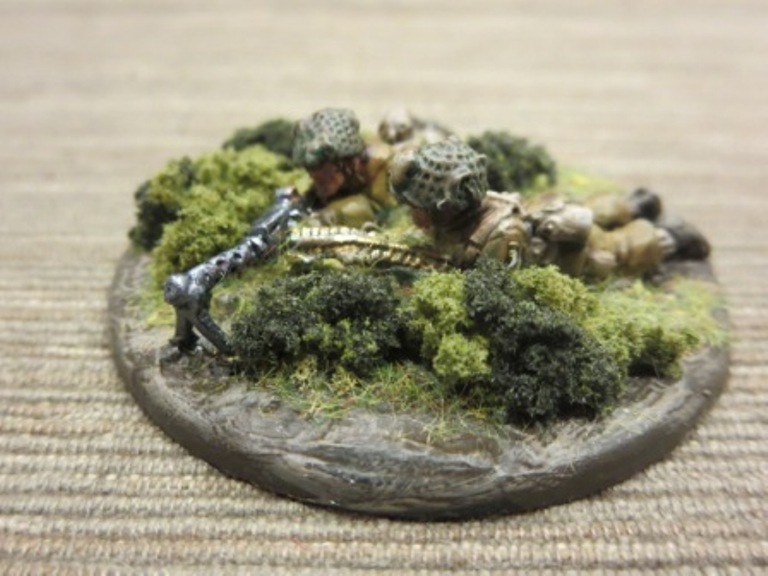
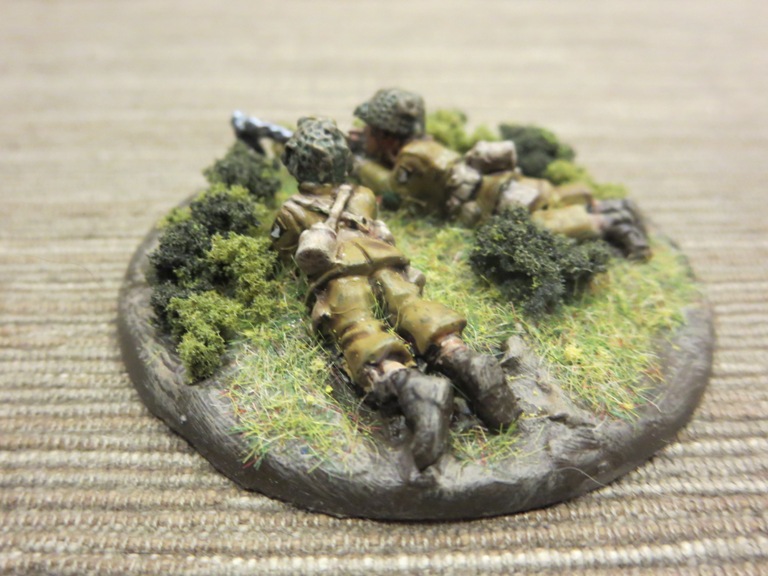
To get started, I happened a  timely sale deal for Artizan Designs miniatures ordered from Brigade Games. I’m very much a late war post-D-Day player, so I purchased a variety of US Airborne riflemen, officers, characters and a M1919 30 cal. machine gun team. I really like the detail in sculpts on the Artizan figures, so the prospect of getting these guys painted up was pretty exciting.

AB Paint Scheme
Artizan Designs provides a lot of painting reference information on their site, and the US Airborne painting guide gave me a good jumping off point. I have plenty of experience painting the US 101st Airborne Division in 15mm, and the larger 28mm scale gave me the opportunity to work through a lot more detail with my miniatures. My existing paint inventory as well as a few extra colors from Citadel gave me all I needed to whip up a solid painting scheme.

CoBDecals

US 101st Airborne decals from Company B

To finish off my figures, I really wanted to add that last bit of realism at this scale with the appropriate patches and uniform markings. Since my painting skills don’t extend to the level of detail needed in painting patches and insignia, I was pleased to come across decals at this scale from Company B.

After some minimal flash clean-up, the individual figures got glued to metal washer bases. The prone LMG team went on a 60mm plastic base from Proxie Models and the two-man team on the move was glued to a larger metal washer. Here’s the painting guide in detail for my US Airborne:

Painting 28mm US Airborne

  1. Clean flash from metal models with a sharp knife and glue to metal washer or plastic bases.
  2. Apply filler putty to bases. When dry, scrape off excess with a sharp knife.
  3. Base coat models and bases with flat black spray primer.
  4. Paint uniforms and bandages on helmets with Tallarn Sand.
  5. Paint helmets and knee and elbow patches with Waaagh! Flesh.
  6. Paint faces and hands with Tallarn Flesh.
  7. Paint webbing and packs with Baneblade Brown.
  8. Paint bases, boots, gun stocks and helmet straps with Dark Brown.
  9. Apply Agrax Earthshade wash to uniforms, helmet netting, webbing and packs.
  10. Mix 50/50 Baneblade Brown and Off White and lightly dry brush packs, webbing and socks.
  11. Lightly dry brush bases, gun stocks, helmet netting, holsters and elbow and shoulder patches with Baneblade Brown.
  12. Paint metal gun parts with black and finish with a light dry brush of metallic silver.
  13. Paint eyes with small dots of Off White and Dark Brown. Clean up around eyes with Tallarn Flesh.
  14. Mix 50/50 Tallarn Flesh and Off White and brush highlights on cheekbones, chins, forehead, nose and hands.
  15. Apply decals to shoulders and helmets, followed by a coat of Solvaset decal fixative from Walthers.
  16. Cover bases in white glue and cover in 50/50 mix of fine light green and dark green grass flock.
  17. Glue small pieces of clump foliage to base.
  18. Spray coat completed models with matte finish.

IMG_4918

Filler putty applied to US Airborne .30 cal machine gun teams

IMG_4915

Helmet and uniform base coats on US Airborne riflemen

IMG_4914

Flesh base coat on hands and faces on riflemen and command figures

IMG_4957

Uniform, helmet and flesh base coats on the .30 cal machine gun teams

IMG_4956

Washes and dry brush layers added to the .30 cal machine gun models and bases

And now, a whole series of my completed US airborne troops from Artizan Designs…

IMG_0609

IMG_0610

IMG_0611IMG_0614

IMG_0618

IMG_0621

IMG_0620

IMG_0616

IMG_0617

IMG_0615

IMG_0623

IMG_0624

IMG_0626

I still want to fill out my US forces with some additional troops and support weapons, so there will be more to come from Artizan and some other manufacturers. Getting some Germans ready for the table is another pending project on the workbench. Transport and armored vehicles are also very much on my mind. I’m also still debating rule sets, and I’ve been reading up on a variety including the popular Bolt Action from Warlord Games and Nuts! from Two Hour Wargames. With my first 28mm troops ready for action, WWII at a new scale is keeping the period exciting for what I’m certain will be another new year of painting and playing.

Touching History at the Military History Society of Rochester

mhsrlogo

I have logged many, many hours over the years visiting battlefields, historical homes, living heritage sites, reenactments, roadside markers and all sorts of art, history and military museums. Near the top of these experiences was a full day I spent at the Imperial War Museum a few years back while working in London for over a month. With over two million visitors a year and some 11 millions artifacts, the IWM is hard to beat for immersing yourself in the history of warfare.

This past week I had a very different, yet truly remarkable experience in my first visit to the Military History Society of Rochester. Located up a flight of stairs in a warehouse inhabited by various artist galleries and studios, the MHSR occupies roughly 2000 square feet of space packed with all manner of historical artifacts focused on telling the story of the US military through the local lens of Rochester, NY.

IMG_4891

A timeline of US long arms from the American War of Independence through the Korean War at the MHSR

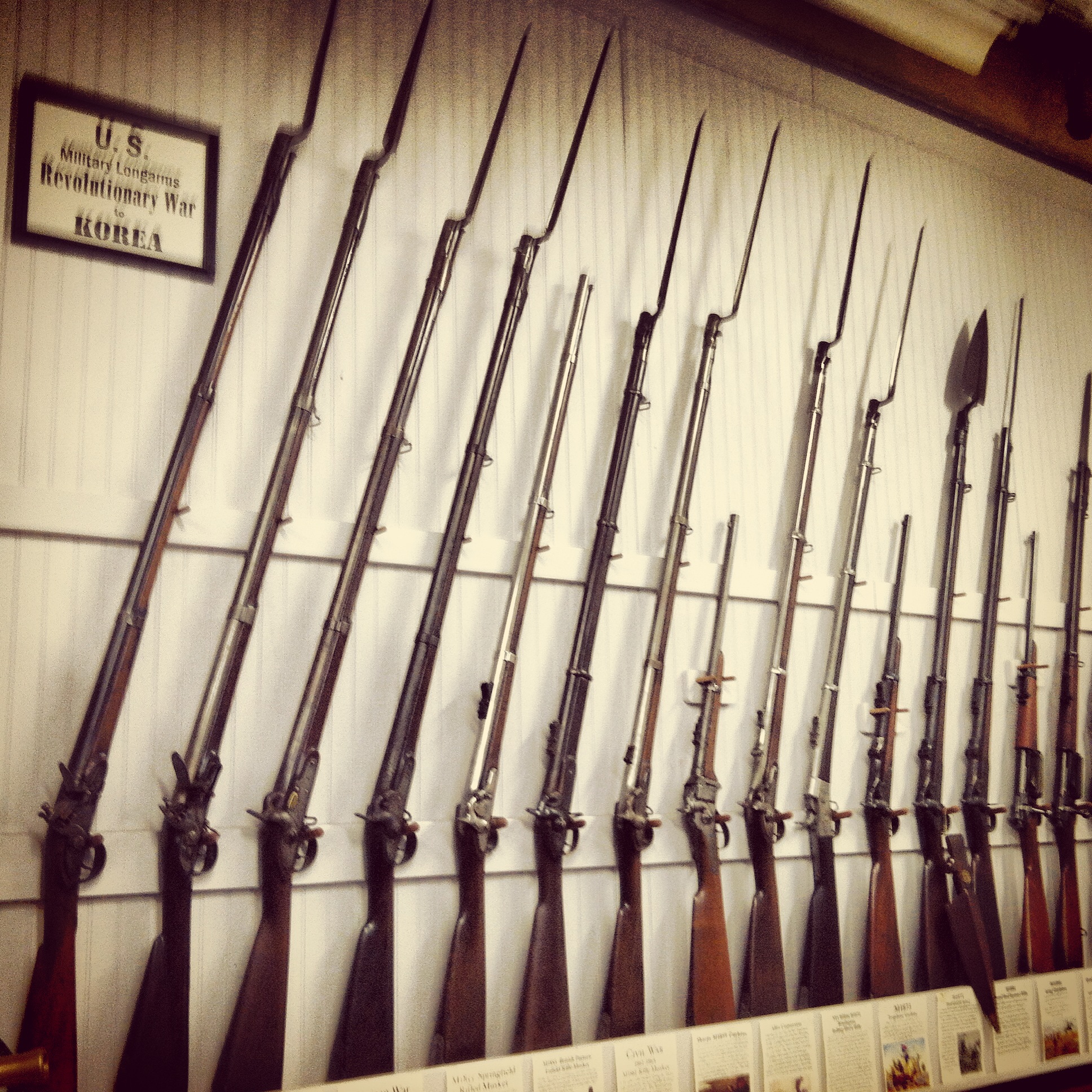
Founded several years ago by Chuck Baylis as the American Civil War Artillery Association, the group’s mission has since grown beyond his original collection of Civil War artifacts to encompass American wars from the Revolution to the present. The first room still focuses on the Civil War including detailed displays on artillery, uniforms and the 140th New York Volunteer Regiment formed in Rochester in 1862. A timeline of American long arms from the American War of Independence through the Korean War covers an entire wall.

IMG_4890

A timeline of military uniforms from the American War of Independence through the present at the MHSR

In the rear space of the museum, the focus swings to 20th-century with displays on World War I, World War II, the Korean War, Vietnam and present day wars. Uniforms, guns, swords, equipment hang from the walls, rest on shelves and lay slung over mannequins. Scale model airplanes hang from the ceiling, model vehicles rest on the floors and cases and a D-Day diorama sits nearby. Throughout the museum are some 2000 books as well as countless other letters, maps, photos, schematics, deck plans, prints, posters and other ephemera for perusal or research.

IMG_4887

 A US .50 caliber machine gun at the MHSR

Baylis has been joined by a number of passionate volunteers who can be found at the museum during its operating hours on Thursdays, Fridays and some Saturdays. Civil War reenactor, historian and wargamer Mike Vasile (co-author of the excellent Arena Games: Gladiatorial Combat rules) is responsible for many of the scale dioramas throughout the museum. Scale ship modeller Timothy Igoe of Historia Militaris Shipways has contributed several naval models to the collection and is currently undertaking a build of the USS Rochester (CA-2) for the museum. Retired Social Studies teacher Orton Begner rounds out the group with a deep knowledge of every object on hand.

IMG_4889

A US M1919 Browning machine gun at the MHSR

The one-to-one interaction with the MHSR’s members and the collection is what sets the museum apart from any other I’ve every visited. Everything has been well labeled, organized and put on display but hardly anything in the museum sits behind glass. Care to hold the various types of artillery rounds used in the Civil War? Want to feel the heft of a WWII era Thompson submachine gun or M-1 rifle? Would you like to take a look inside a pack carried by an American GI on D-Day? Want to lie down with a German MG-42? Ever wanted to hold a Japanese officer’s sword or 1913 “Patton Saber”? Just about everything in the museum, with the proper care, respect and assistance from one of the staff, can be touched, offering an incredibly rare opportunity to physically connect with past.

IMG_4888

 A German MG-42 and StG 44 at the MHSR

The mission to bring history alive beyond the walls of the museum also occurs with the exhibits members of the group bring to school groups and veteran events in the Rochester area. With its focus on celebrating the men and women of Western New York’s service in every branch of the military past and present, the museum is serving a unique and human mission of connecting today’s generations to a long tradition military service.

IMG_4892

My son gets some hands-on time with a Thompson submachine gun at the MHSR

In all my years of interest in history and military heritage, I have yet to find a museum as alive as the experience found at the Military History Society of Rochester. As a wargamer, the opportunity to see and handle so many objects up close is unparalleled. My time spent at the museum on my first visit was brief, but meeting the guys and seeing the collection at the museum will definitely bring me back my next time in Rochester.

Interview with Chuck Baylis of the MHSR

The Military History Society of Rochester is located in the Anderson Arts Building at 250 North Goodman Street on the second floor. Admission is free.