The Four-Decade History and Future of NYC’s Trailblazing Metropolitan Wargamers

Editorial note: I wrote this article in May of 2024 on the occasion of the 40th anniversary of Metropolitan Wargamers. The article was originally published by SDHist here.

Background

Metropolitan Wargamers (MWG) was founded in 1984. The club is New York City’s premier and longest-operating gaming organization in the five boroughs with its own dedicated private gaming spaces.

MWG grew out of of the New York Wargamers Association (NYWA), founded in the early 1970s as an affiliation of local Napoleonic miniatures players. By the early 80s, some members of the group split off to form what would become MWG. The club’s first permanent yet short-lived home was on Steinway Street in Queens in a cramped second-story apartment with a couple of small tables and a leaky hole in the roof.

After losing this space, the club moved to its largest space at 20 Broadway in Williamsburg, Brooklyn. In the early 90s, the club was regularly listed in the “Opponents Wanted” section of Avalon Hill’s The General magazine. It touted “its own 2,000 square foot loft for boardgames and miniatures” and “facilities and members to play any game, anytime.”

Occupying the entire second floor of a warehouse, the Broadway space held six tables (plus a poker table) and lines of shelves along the walls holding miniatures, games and an enormous collection of military and history books and magazines. With a dingy couch, a threadbare area rug, peeling linoleum floors, overhead fluorescent lighting, a closet with a cold-water sink and toilet, and an industrial heater mounted to the corner of the ceiling, the Metropolitan Wargamers in Williamsburg reflected the grit of a Brooklyn since largely faded into memory.

For years, a small, dedicated group of about a dozen members struggled to scrape together money to cover rent and keep the club operating. The Broadway building was sold (and subsequently demolished) during the Brooklyn real estate development boom of the early 2000s.,After that, the club moved to its current location in the basement of a four-story, eight-unit 1920 apartment building at 522 Fifth Street in the heart of Park Slope, Brooklyn. (Entrance door pictured above.)

Set-Up

When the club arrived at its new Park Slope home, it was a raw, unused space. About $300 was initially invested in building new tables and shelves. It is still very much a semi-raw basement with a painted concrete floor and brick and stone foundation walls.

We have a front room with three 4’ x 5’ tables, each with multiple racks underneath to hold games in progress, plus a small 4’ x 4’ kitchen style table we salvaged off the street.

The front room at Metropolitan Wargamers.

Moving down a narrow hall, we have our “monster game” table measuring 8’ x 8’ which plays host to large footprint multi-month games such as World In Flames or Pacific War. The three tables at the rear of the club (two at 5’ x 8’ and one at 5’ x 10’) all have removable tops, handy for hosting months-long games like Empires In Arms or a big RPG dungeon crawl miniatures campaign.

The back room at Metropolitan Wargamers, featuring sand tables and walls of lined with miniatures and games.

Most uniquely, lifting the covers off two of the tables reveals sand tables for miniatures gaming. World War II miniatures games such as Battleground, Flames of War, O Group and Bolt Action have often been played on these sand tables.

A recent game of O Group in 15mm, with members and visiting guest from Detroit, on one of the club’s sand tables.

Shelves line the walls of the club, and first-time visitors usually gaze in awe at their contents of hundreds of games and thousands of miniatures. Shelves in the rear hold club-owned terrain – trees, buildings, gaming mats, rivers, roads, hills, and buildings ranging from historical periods to sci-fi and fantasy in multiple scales. A tall rack holds a dozen 4’ x 4’ sheets of plywood where more in-progress games can be stowed. Most of the shelves are rented by members to store personal collections of games and miniatures.

A 20mm Battleground game on one of the club’s sand tables.

Creature comforts at the club are few. There’s a refrigerator, microwave and coffee maker at the front, a tiny bathroom at the rear, and stairs up and out the back to a small private yard. The yard is used to spray-paint miniatures, and is where we’ll throw food on the grill during warm months.

The Battle of the Monongahela in 28mm using Muskets & Tomahawks rules at the club (figures and scenario by the author).

We finally installed free Wi-Fi within the past two years. Other than that, not a lot has changed since we made the move twenty years ago, and the club remains a bare-bones space solely focused on gaming.

Rules

So how do we manage this gamer’s paradise nestled on a side street in one of the more expensive neighborhoods in Brooklyn? We are fortunate to have a very good relationship with our landlord, who rents us the space for what is far below what he charges for one of his $3200 per month two-bedroom apartments upstairs.

Visitors attend for free as guests their first time at the club, and then pay a weekly fee of $15 whenever they stop by to play again. There’s an option for regular guest players to pay $40 per month for as much gaming as they want, provided they are there with one of our members.

Members and guest playing Root at the club.

The real magic comes in being voted in as a member of MWG after a 3-month probationary period of paying a monthly fee. With membership comes a set of keys to the club, granting 24/7 access to the space. That said, some visitors pay at the weekly rate for years without becoming members. For gamers largely living in small NYC apartments, the monthly fee of $40 for membership and $20 for a private shelf is a real deal.

Over the past ten years, membership has held steady at around 35 in number, give or take. We each pay our nominal fees, which pays for rent, utilities, cleaning supplies (one member pays no fees and handles all our cleaning and maintenance work) and whatever else comes up like building new shelves or replacing major things like the sink. Because our costs are relatively fixed, we’ve been able to maintain our very reasonable fee structure for years.
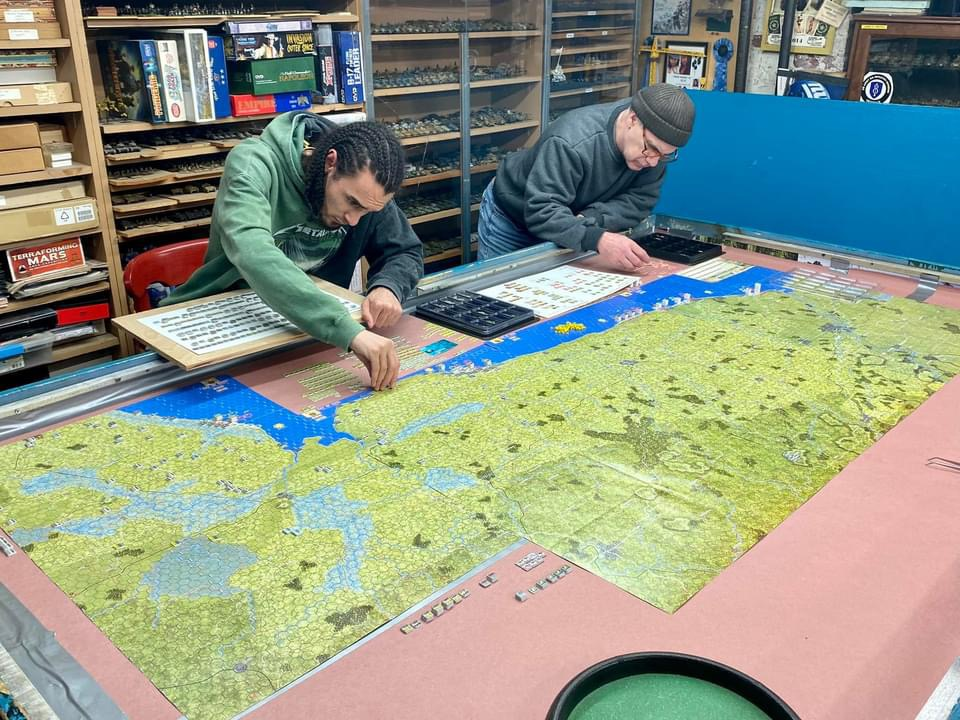
Father and son team James Jr. and James Sr. are often found playing big WWII hex and counter games, like Day of Days, over weeks on the club’s tables. James Jr. is just one of the people who have grown up in the club.

Modern gaming cafes in the city typically charge $15 for three to four hours of play, so the club is a bargain for serious gamers looking to clock many hours or even entire days of gaming. Unlike these café spaces, however, we are not open to walk-in traffic.And we don’t keep regular hours, so arrangements to visit are coordinated through an online club message board and via our social media channels on Facebook and Instagram.

Leviathans on the table surrounded by brick arches in the front room of the club. Second from left is Frank, our venerable eldest member and honorary Master of Arms.

Minors aren’t allowed without parents, but we’ve seen a few kids grow up within the club and come back to visit and play. We also don’t rent our space out, although we’ve been asked many times over the years.

Historical Notes

Membership has evolved greatly over the decades at MWG. Our founding members were largely working class first- and second-generation Italian, Irish and Greek New Yorkers who came of age in the 60s, 70s and 80s when New York City was a very different place. Stories abound with some members carrying knives and guns coming to and from the club in Williamsburg.
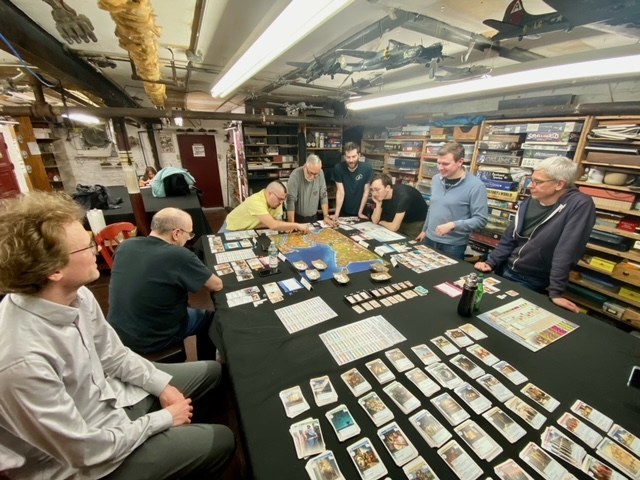
A day-long, 10-player game of MegaCiv at the club. Club founder Tony is second from left.

Today, about half our current membership reflects the modern influx of GenXers and Millennials who flocked to the city since the mid-90s. Our membership ranges in age from mid-20s to mid-80s. We’ve only ever had a few women as members at any given time. We’re fortunate to have many of the old guard around to share our history and that of the hobby with newer arrivals.

The games we play at MWG have also changed significantly. In its first decade, the club was almost exclusively home to historical miniatures gaming including Ancients, Hundred Years War, Napoleonic, American Civil War and World War II, all at multiple scales. Some board gaming from classic publishers like Avalon Hill and SPI also made regular appearances. Through the 1990s and into the 2000s, Warhammer Fantasy, Ancients and 40K rose to prominence, as did a greater interest in emerging Eurogames.
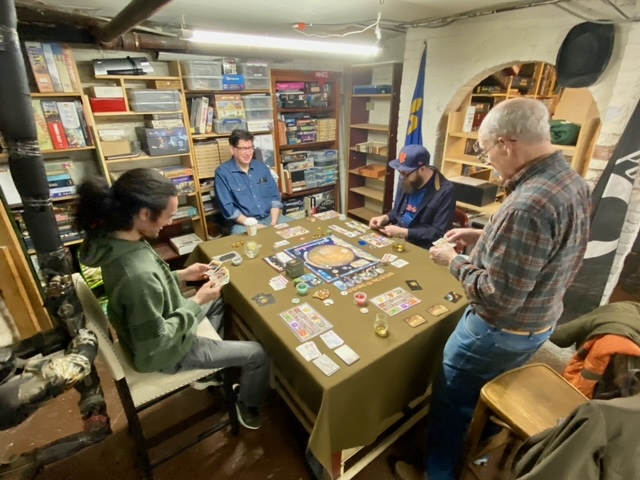
Club favorite Terraforming Mars shows up on the tables about once a week. Club founder Joe is at right.

While miniatures, including WWII, ACW, French & Indian War, Robotech, Epic 40K, Star Wars: Legion and Marvel: Crisis Protocol, have been played recently, most of the club’s gaming interests have moved toward a focus on modern board games and wargames in the past 10 years. RPGs have also continued to have a small but consistent presence at the club throughout its history.

Over its history, MWG has also been an incubator for game design and playtesting. A number of our earliest members spent time at the offices of SPI here in NYC in the 70s and 80s playtesting now-classic games. The club has included prominent designers in its membership, including Adam Starkweather (IGS, MMP) and Carl Fung (SCS and BCS, MMP), newer designers like Mike Willner (Prelude to Revolution, Compass Games) and Mike Lorino (Seminal Catastrophe, Vuca Simulations), and GMT Games Art Director Justin Martinez.

Members have won multiple awards at regional Historical Miniatures Gaming Society (HMGS) conventions. And the club continues to host visitors from across the country and around the world. That has included gamers from Spain, the UK and Australia.

Running an organization like ours has not been without its challenges. We’ve had more than a couple floods, weathered some internal controversies, and survived an extended shutdown during the COVID-19 pandemic (during which time most members continued paying dues and we received a grant from HMGS to offset a financial shortfall). Most recently there has been some conversation about changing our name to Metropolitan Tabletop Gamers to potentially broaden our appeal, but we continue to see new people show up almost every week just as we are.
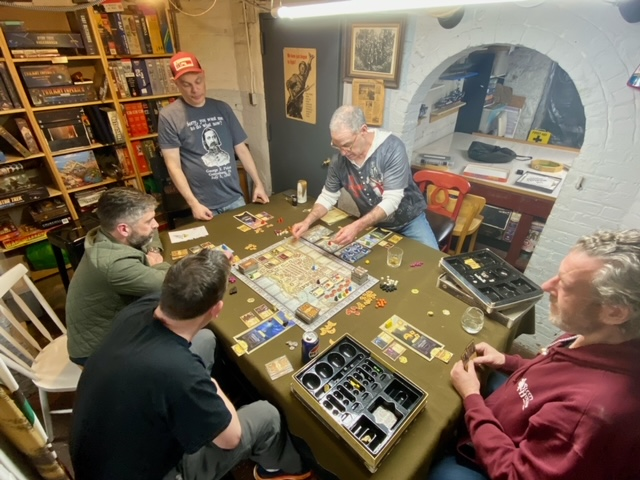
Another club favorite, Lords of Waterdeep, often serves as the opening or closing game of a day.

In 2024, Metropolitan Wargamers is celebrating its 40th anniversary. I’ve been fortunate to serve as President of MWG for the past ten years, and it remains one of the more unique communities of which I’ve been a part. The hobby, the city, the club, and its members have all changed over the years, but our core personality has remained intact as a community of dedicated gamers.

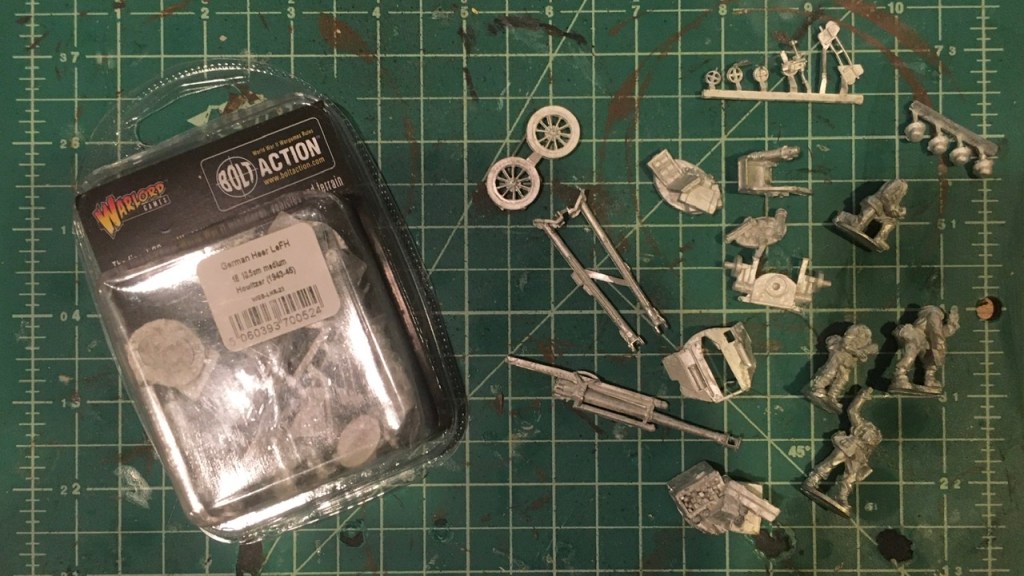
28mm: German 10.5cm leFH 18/40 Howitzers from Warlord Games

Pin on Artillery

I’ve had a project on my list for a long time to fully model a game of the Brecourt Manor Assault from June 6, 1944 (made famous by HBO’s Band of Brothers series) in 28mm. I’ve had all the individual German and American 101st Airborne figures for quite a while but on of the primary obstacles was modelling the four 10.5cm leFH 18/40 howitzers which were the objectives in the famed US assault.

Unassembled German Heer leFH 18/40 10.5cm howitzer (1943-45) from Warlord Games

I finally broke down and picked up four of the models from Warlord Games at about $30 USD each. As pure objectives, this was a high rice to pay for models that were going to serve no game purpose other than table decoration.

Assembled German Heer leFH 18/40 10.5cm howitzer (1943-45) from Warlord Games

I have a lot of Warlord’s metal (always metal) models from their Bolt Action line, and I’ve always found the casts to be detailed and clean. The package comes with the gun, four crew figures and a couple pieces of crates to add flavor to the set-up. Assembly of the howitzers is a bit finicky but Warlord offers a diagram online to guide gluing up the kit. My one knock is there is no option for variation in the crew, given I’m fielding four of these, but this is a minor complaint.

Primed German Heer leFH 18/40 10.5cm howitzer (1943-45) from Warlord Games

I mounted up the figures and extra pieces on washers, filled the bases and primed black. Once I got to the painting, the work went fast with simple color schemes and just a few details picked out on the crew. Assembled and painted, the howitzer and crew really pay off. With one done, I had three more to go to get another step closer to getting my vision for the scenario closer to a gaming reality.

28mm: US Airborne HQ, Jeeps and 57mm Anti-Tank Gun from Warlord Games

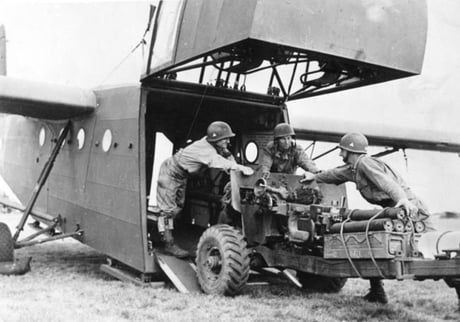
Paratroopers of the 82nd Airborne Division load an M1 57mm Anti ...

I took the occasion of the 75th anniversary of VE Day recently to revisit some long-neglected World War II US Airborne models from Warlord Games. I model all my 28mm WWII figures in metal from a variety of manufacturers, preferring the heft, durability, speed to complete and detail to that of miniatures cast in plastic.

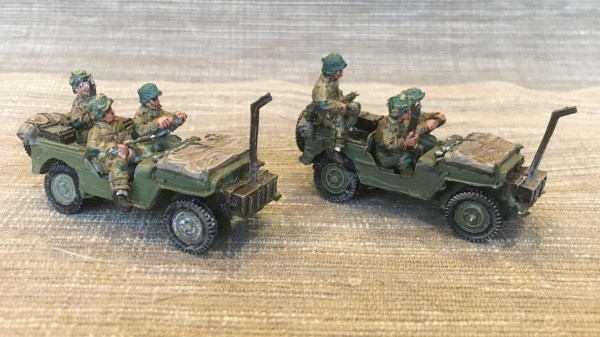
Warlord sells their models in conjunction with their Bolt Action game, but I use the miniatures in a variety of systems. The HQ set includes a radio operator, medic and two officers, including one chomping on the stub of a cigar. Each of the jeeps (sold individually) have a group of soldiers piled in and a wire catcher extending up from the front to prevent wire traps from injuring the riders. Finally, the M1 57mm anti tank gun features two loaders I mounted directly to the gun’s base while keeping the command figure separate in case I want to field him separately.

These models paint quickly and I finish them off with appropriate 101st Airborne insignia decals from Company B. As with all Warlord casts, these models all feature some great detail, poses and personality, making them a great mix and addition to my miniature WWII allied forces.

US Airborne HQ (1944-45) from Warlord Games
US Airborne Jeep (1944-45) from Warlord Games
US Airborne 57mm Anti-Tank Gun (1944-45) from Warlord Games

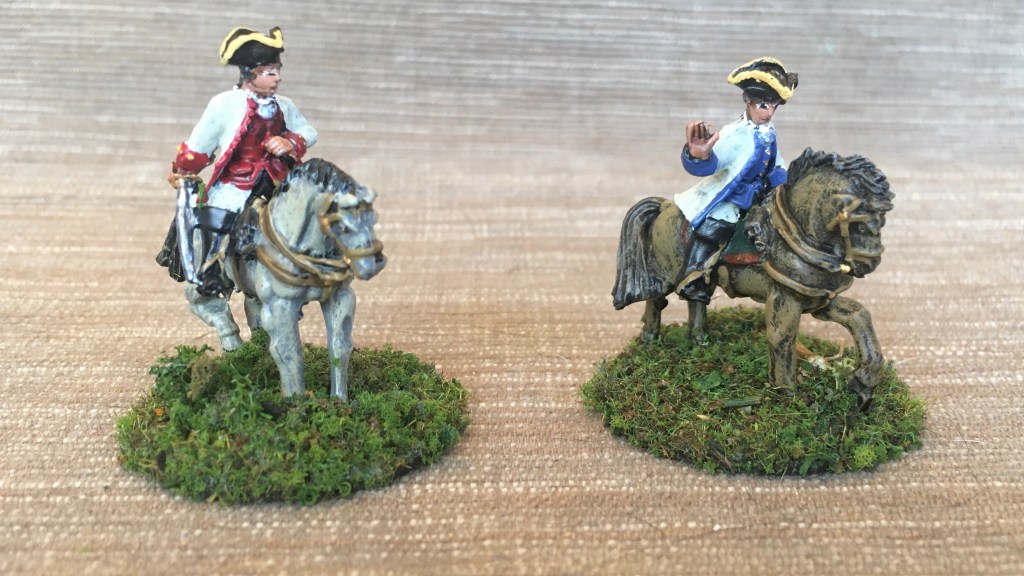
French and Indian War: Mounted Officers and Characters from Sash and Saber Castings and Warlord Games

In the close forests on 18th-century North America during the French and Indian War, the vast majority of the skirmishes and battles among French, Briitsh and Indian forces took place on foot among individual warriors. That said, especially among Europeans, mounted officers still held a place on many battlefields.

Of the hundreds of figures in my collection, few are mounted for this very reason. Aside from that, I’m not a big fan of painting horses although I’ve developed some quick techniques to get tabletop quality mounted models on the table. With this in mind, I recently set to fiishing up some horses and riders for the period.

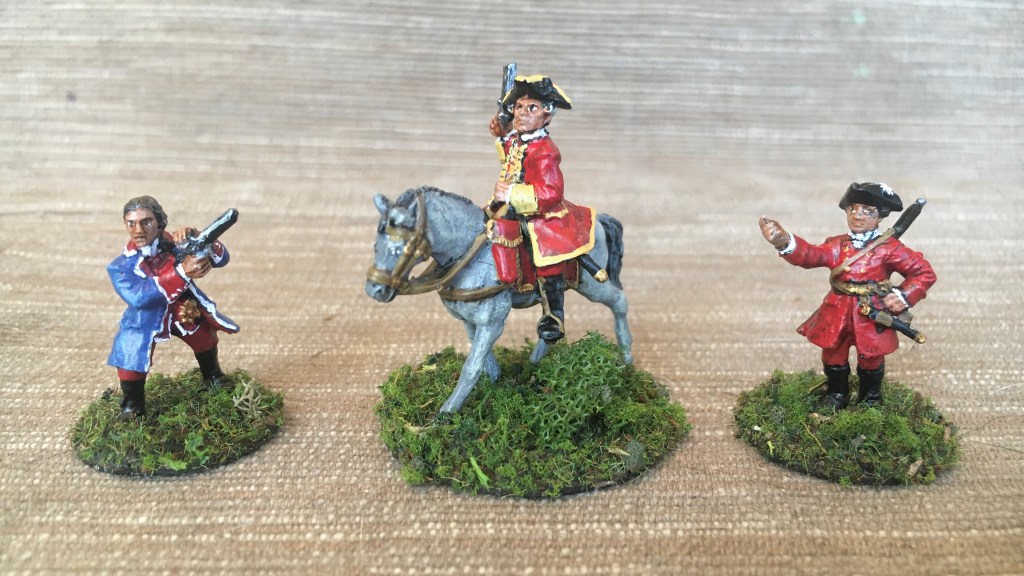
First up, I bought the excellent three-figure set of British Characters from Warlord Games. This trio includes the young Virginia Colonial Militia officer Lt. Col. George Washington, a mounted figure of British Lt. Col. George Munro and General James Wolfe on foot. These metal figures each come packed with some real animated personality, and I’m a particular fan of the young Washington brazenlt cocking his pistoal as he charges forward.

One other Warlord figure is a plastic officer on a rearing horse. I pulled this figure from the Field Artillery and Army Commanders box made for the American War of Independence. This is one of the few plastic figures in my entire collection, but its sprue provided some options for choices in heads and poses. I’ve modelled mine as a British officer, and atop his bucking horse he is serviceable as a command figure for the earlier period.

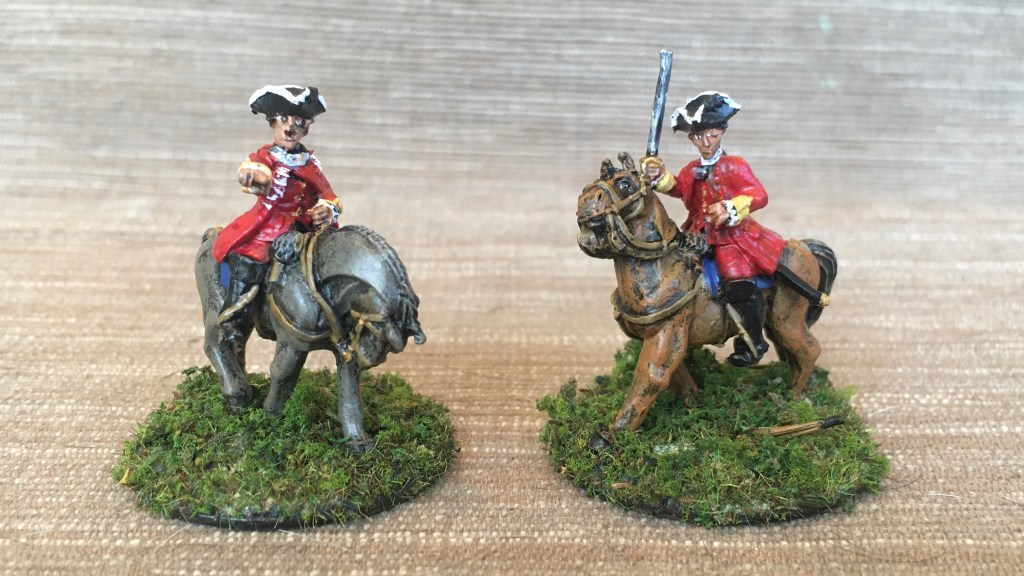
To these Warlord figures, I also added four figures — two more British and two French — from Sash and Saber Castings. These sculpts are from the huge line of FIW figures launched via Kickstarter that makes it one of the broadest lines currently available for the period. Like the Warlord models, the Sash and Saber figures tend more toward a leaner, smaller 28mm scale. The horses reveal a lot of detail and varied poses while riders can be a bit flat in their facial expressions.

Together, this half-dozen mounted officers made for a bit of a break in my usual rotation of purely foot figures. Set at the lead of dozens of other soldiers in the American wilderness, they’ll be a great fit with any number of units of my tabletop.

In Memoriam of Neal Catapano and The WarStore

If you’ve been a miniatures hobbyist over the past twenty years, chances are you may have had dealing with the The WarStore. What you may or may not have heard was the passing of the owner, Neal Catapano, this past week.

Housed on the property of Catapano Farms, on the North Fork of Long Island in Southold, NY, the online store had a two-decade history of serving customers near and far before closing suddenly in 2019. Founded in 1999 and just a few years behind online retail giants like eBay and Amazon, Neal’s online store was a bit ahead of its time in the gaming community. The modest online store held a broad inventory of modeling paint, brushes and supplies as well rule books, player aids and miniatures and terrain covering multiple eras, scales and interest from fantasy to sci-fi to historical. Neal was always my first stop before I had a look elsewhere.

Living in nearby Brooklyn and less than a three hour drive away, I regret I never made the pilgrimage to Southold but I was always grateful I received speedy responses to my inquiries and quick delivery of my orders. People notoriously groused online (as people do) about poor customer service, but this was never my experience in my dozens of orders over the years. To the contrary, I found Neal and the staff to be incredibly responsive to inquiries, order updates and special orders — an unfortunate rarity in today’s lowered expectations of impersonal customer service in an ecommerce world. With every online order, my heart always soared with the very personal email verfication:

Hi! This is Neal at TheWarstore.com. Thank you Very Much for placing your order with us! This email is to confirm that we have received your order, an actual human being has reviewed it here at the store, and we will ship as soon as all of your ordered items can be readied.”

With the decline of local NYC hobby stores, Neal’s WarStore split the difference with a small, independently owned shop feel and the convenience of a 24/7 website. I looked forward to his quirky sale announcements, pre-release specials and holiday shopping messages. The online store wasn’t always the easiest to navigate, although it had improved by leaps and bounds over the past few years. Neal’s title of “Grand Pooh Bah” and his personal email of neal@thewarstore.com in all communication contributed to the small store experience increasingly absent from the modern world. Although a brick and mortar store had been an extension of The Warstore at one point in its history, it was through the unique online presence that Neal’s legacy was made.

When Neal announced an abrupt shuttering of the business in the middle of last year and a hurried final sale, I felt in the pit of my stomach there was most likely something deeper behind the decision. This past week’s news of his passing confirmed that feeling and charted the true passing of an era.

Rest in peace Neal and The WarStore where their motto spoke volumes to thousands of loyal customers: “We Bring the War to Your Door, For Less!”

French and Indian War: Comparing 28mm Miniatures Scales – Indians

Sometimes it seems the #1 topic all miniatures gamers have is one of scale and how miniatures from different manufacturers scale together. When I run convention games or post photos of scenarios online, people don’t ask about what books I used in my research or what sites, museums or archives I’ve visited. What they do ask about is manufacturers and scale.

So here it is, taking the first of a couple swings at addressing scale for French and Indian War tabletop gaming with a look at Indians from my collection. After some visual comparisons, I’ll weigh in at the end with some commentary about how I feel about the scale conversation.

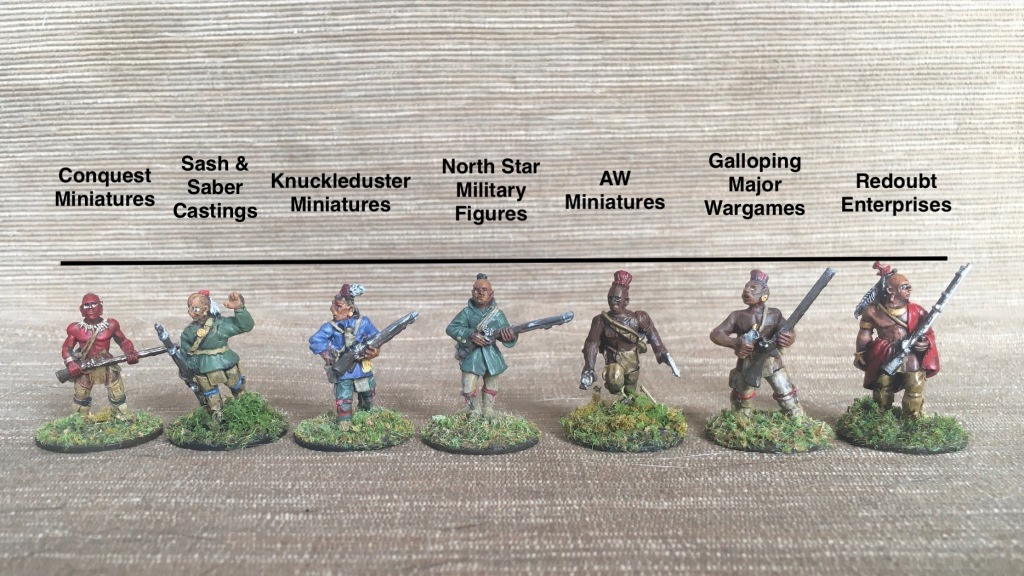
Currently I have Indians miniatures from seven manufactures, each of which can be viewed in detail on separate posts: AW Miniatures, Conquest Miniatures, Galloping Major Wargames, Knuckleduster Miniatures, North Star Military Figures, Redoubt Enterprises and Sash and Saber Castings. In the photo below, I’ve lined up a sample from each manufacturer from what I see as the smallest on the left with Conquest all the way up to the largest with Redoubt.

In the next photo, I’m showing a zoomed-in look at the manufacturers on the smlaller side — Conquest, Sash and Saber and Knuckleduster. I find these three hew more toward a thinner, more traditional 25mm scale.

On the larger end of the spectrum, I’ve shown a line-up of North Star, AW, Galloping Major and Redoubt as the modern 28mm “heroic” scale.

Finally, I’ve placed two Indian leaders side by side with the Conquest model at one extreme and the towering Redoubt figure on the other.

So there you have it, some visual comparisons of what are broadly viewed as 28mm Indian miniatures. And with that, I have a lot of opinions.

The first one is that many manufacturers use different sculptors over time, creating variations even within one company’s lines of figures. For example, Warlord Games uses older Conquest sculpts in their FIW offering but have also added work from other artists. Companies like AW, Galloping Major and Sash and Saber have a lot of consistency in their models since they are owned and operated by the sculptors themselves. So, broad statements like “X manufacturer always scales well with Y manufacturer” are not always 100% accurate.

Next, my bias is toward metal castings and I try to avoid plastics. I like the heft of metal on the table, I don’t like to put in assembly time and I like how metal takes paint. This means I’m not looking at a very popular manufacturer like Perry Miniatures in the photos above. I have played with Perry plastics and I own some of their wagons cast in metal. Mostly, I find their sculpts are thin, with very acurate real-life scaling that tends toward the smaller end of the 25mm scale.

As a third point, few players I know put their heads right down on the table at figure eye level when playing. Figures used in actual play are seen at arm’s length or table distance of some three feet or more, obscuring fine differences of a millilmeter or two between models. Differences in models on the table can be further obscuredby keeping manufacturers together in cohesive units. I use the approach, and my “tabletop quality” of painting allows my miniatures to fight just fine (provided the dice are cooperating on any given day).

Finally, variety to me is so much more important than scale. With over 120 Indians painted up in my collection (and probably more on the way), I’ve always been more focused on the visual interest of the sculpts than height of one versus another. By stretching across seven manufacturers I’m supporting more companies and artists feeding the hobby and getting a ton more interesting looking Indian units on my table.

French and Indian War: Woodland Indians from Redoubt Enterprises – Raiders and Sachems

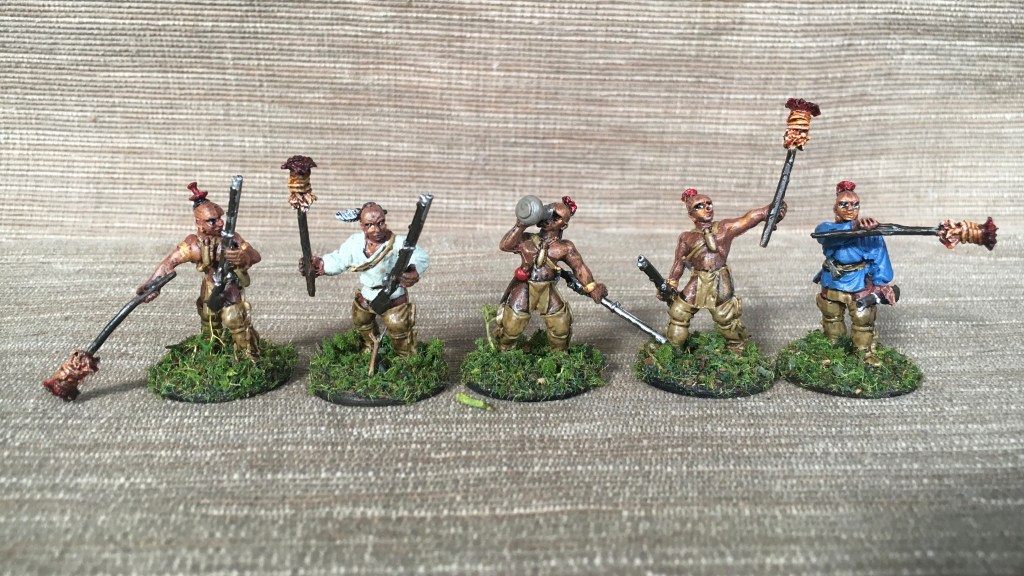
The UK-based Redoubt Enterprises carries an enormous variety of metal miniatures including pirates, ancients, Renaissance, English Civil War, American Civil War, Napoleonics and several ranges of colonials figures, icluding nearly 200 separate choices of models for the French and Indian War.

Their FIW line includes vast selections of British, French and Indian models, including warriors, canoes and civillians. Sculpts from Redoubt tend toward a traditional, heroic scale that tips heavily toward 28mm with chunky casts filled with unique personality that are a joy to paint and really pop on the table.

The ‘warriors with firebrands’ pack includes a raiding party, armed with blazing torches and a leader drinking from a clay vessel. The models are great for attacks on villages, farms and fortifications on the frontier. These are unique, ferocious characters modelled to bring high drama to the tabletop.

Another favorite is the ‘sachems and warchiefs’ set. These models are a mix of calm Indian leaders wrapped in a blanket with a mystical crow’s wing, holding forth a wampum belt and standing gracefully in a commanding pose. Others in the pack show more agressive leaders on the run and commanding their people in the field, looking to roll back the onslaught of European incurisions into their lands.

Both sets have brought a great deal of variety and personality to the regular warrior models from other manufacturers in my collection — moreso than just about almost any other company. For miniatures wargaming, they offer an opportunity to inject roleplay into games with the story each sculpt looks to tell — a welcome place in any gaming session with a wide range of characters to act.

Boardgames of the French and Indian War – Part II

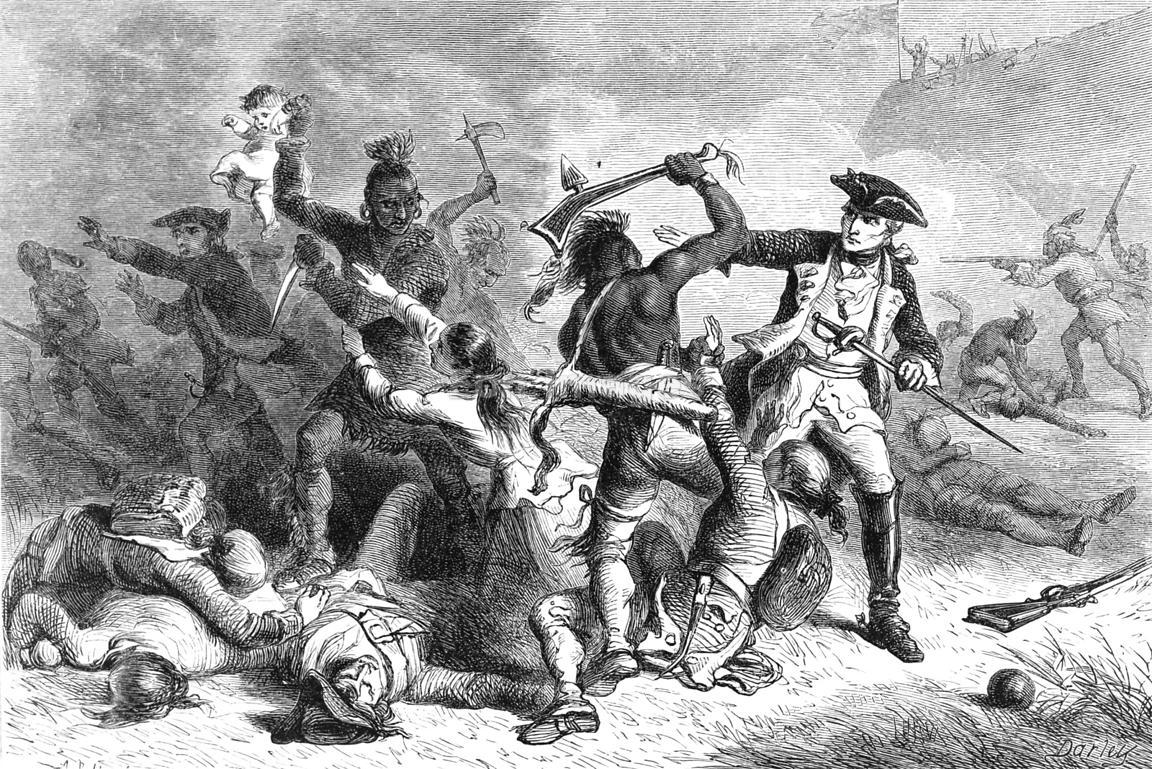
Battle of Fort William McHenry during French and Indian War

Quite some time ago, I wrote a round-up of my favorite boardgames of the French and Indian War. Since then I’ve been focusing pretty exclusively on the FIW using 28mm miniatures and Muskets & Tomahawks. I’ve also spent a lot of time over the past year reading about the period and visiting historic sites in New York, Pennsylvania, Virginia, Maryland and West Virginia that tell the story of the FIW.

Between travel, research, painting miniatures, building scenery and running through tabletop scenarios of the period, I’ve continued to build up my collection of FIW-themed boardgames. With that, I have a second list of more of my favorites from this empire-defining conflict in North America.

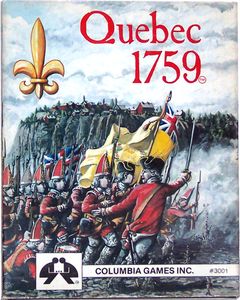
Image result for quebec 1759 game columbia

Quebec 1759 (Columbia Games)

You can’t beat Columbia Games for their quick-playing and unique block games for which they are known. I have Liberty: The American Revolution 1775-83, their American Revolution game, on my shelf, and about a year ago I finally to picked up a copy of their FIW game Quebec 1759.

Released in 1972, Quebec 1759 was one of the first block wargames produced and has remained in print for 45 years as a game perfect for entry level players as well as those experienced in the hobby. I’ve been trying to track down a first printing of the game for a while for the embossed blocks, but I couldn’t pass up a great deal on a 1980s edition with 50 stickered blocks for $20 at a convention flea market a couple years back.

IMG_1378

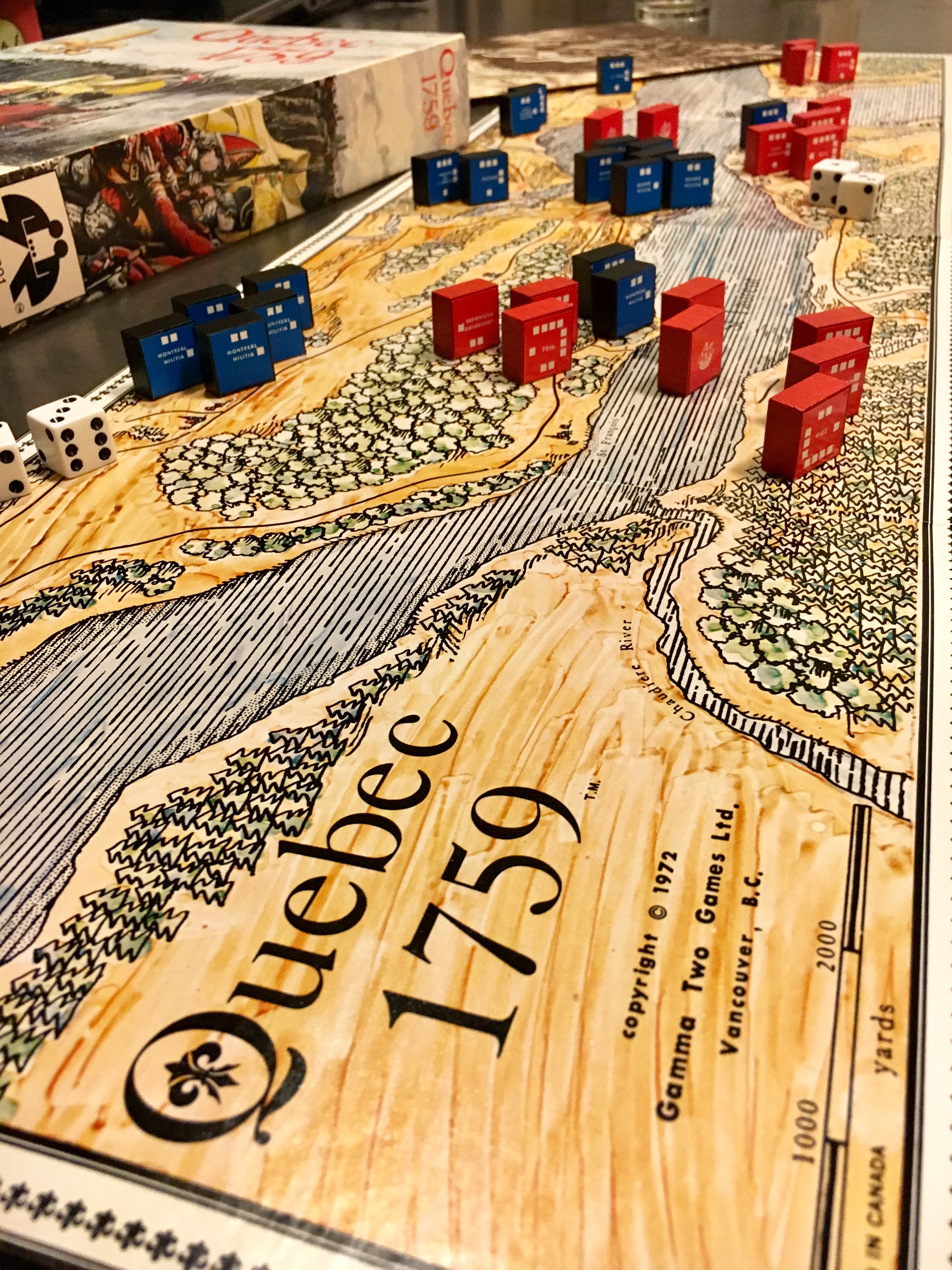
Map and wooden blocks from Quebec 1759

Playable in about an hour or so, this classic abstractly captures the meeting of the British forces led by James Wolfe and the French defenders commanded by Louis-Joseph de Montcalm in September 1759. The decisive Battle of the Plains of Abraham outside Quebec City left both men dead and was the beginning of the end of French rule in North America.

IMG_1379

Typical stickered wooden blocks from a mid-1980s edition of Quebec 1759

My near perfect copy captures the charm of the original edition with its signature wooden blocks, 10″ x 32″ elongated heavy cardboard map and a mere four pages of rules. The game is played over 16 turns with each side — British and French — plotting their moves in advance on paper and then simultaneously revealing them. There are no spaces on the map. Instead ten road-connected land zones and a bisected St. Lawrence River.

The game has remained a classic for a reason, notably its fast play that rewards numerous replays and taking turns on either side.

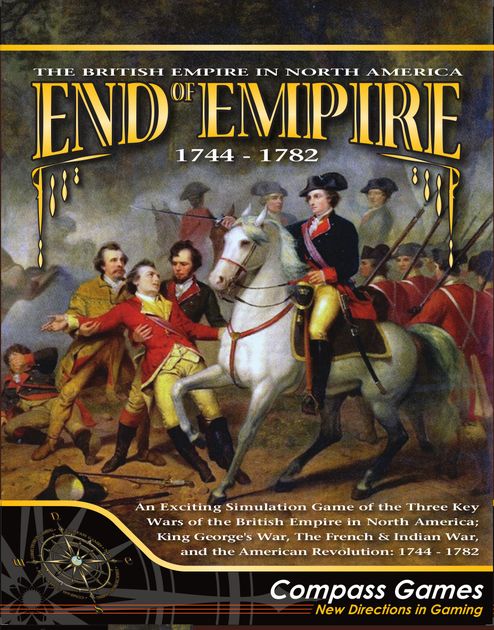
Related image

End of Empire: 1744-1782 (Compass Games)

Command was a bi-monthly magazine published between 1989 and 2001 which focused on military history, strategy and gaming. Issue 46 from December 1997 features articles on New France, the American Revolution, George Washington and his spy network, and famed traitor Benedict Arnold. The issue also contains a full hex and counter game called End of Empire which captures the grand sweep of North American history from the 1740s through early 1780s. The game was subsequently reprinted as a box game from Compass Games as End of Empire:1744-1782.

IMG_1375

My copy of Command #46 featuring End of Empire just prior to punching the counters

End of Empire covers a wide period from King George’s War, FIW and the American Revolution. Over a dozen scenarios allows play of specific conflicts or campaigns in a few hours, and a full game is playable over the whole period that will run to more than 15 hours for truly committed players. The game is regimental in scope with a huge hex map spanning the entire North American East Coast and contains hundreds of color counters representing British, French, Spanish, Indian and Colonial forces. For a real deep dive into nearly 40 years of colonial conflict, this is the game.

Wilderness Empires (Worthington Publishing)

I’m a big fan of Worthington Publishing’s games. I have three of their American Revolution games – New York 1776, Trenton 1776 and their latest, Saratoga 1777. The simple graphic maps and wooden blocks make Worthington’s games easy to grasp while also providing some great strategic play specific to the conditions of certain battles and campaigns.

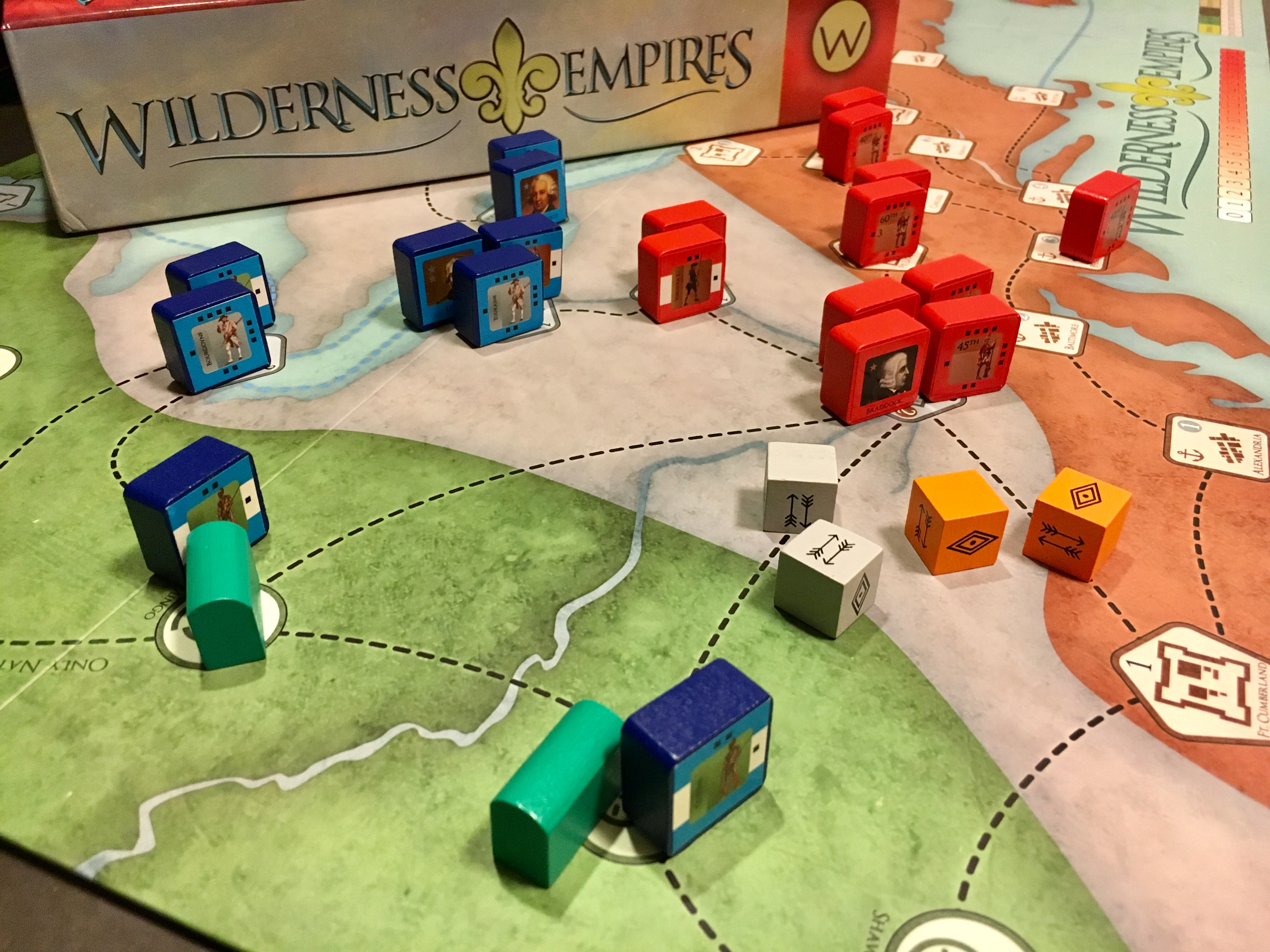
IMG_1380

Map detail and wooden playing pieces from Wilderness Empires

With Wilderness Empires, most recently reprinted in 2016, Worthington captures the larger scope of the grand strategy of the FIW in a mix of point-to-point movement, blocks and cards. Designed by my pal Bill Molyneaux, a FIW reenactor and game designer, the game is steeped in real history while producing introductory level play of the period for 2-4 players.

IMG_1382

French (top) and British (bottom) cards from Wilderness Empire featuring original art by Don Troiani

The components are hefty 1″ wooden blocks with nicely rounded corners representing French, British and Indian forces. Indian towns, special wood dice, a large board and cards featuring beautiful original art by Don Troiani round out what’s in the box. Their artwork aside, the cards provide tactical play of reinforcements, leaders, campaign actions and specific play of historical units such as Rogers Rangers and Indian allies.

If you’re lucky, you can track down this recently out of print game in gift shops at various historical sites and forts in the northeast for a great intro to the period.

1759: The Siege of Quebec

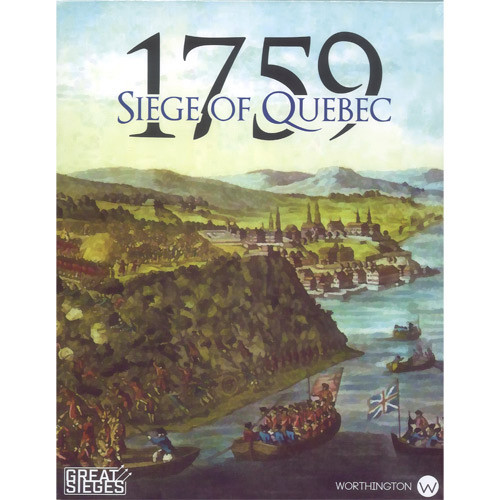
1759: Siege of Quebec (Worthington Publishing)

Worthington has also produced a new spin on the famed siege of the era with 1759: Siege of Quebec. The game presents a bit like the classic Columbia game covering the same battle but with a unique 2-in-1 package that allows for both 2-player and solo play, a rarity for games of the period.

Sample of Gameboard

The beautiful map for Worthington’s 1759: Siege of Quebec

This game is gorgeous. The area movement map is bisected with by the St. Lawrence River and has defined deployment areas for stickerless blue (French) and red (British) blocks. In the 2-player game, separate hands of Command Decision cards and Command Field Orders books allow each side to make selections on what they do each turn. Cards are revealed and resolved, with casualties and morale tracked toward victory. The solitaire game uses a separate set of cards but plays out in a similar way.

The game falls into the modern string of fast-play “lunchtime games” which typically run less than a half-hour, making 1759 a great modern spin on the often-covered battle.

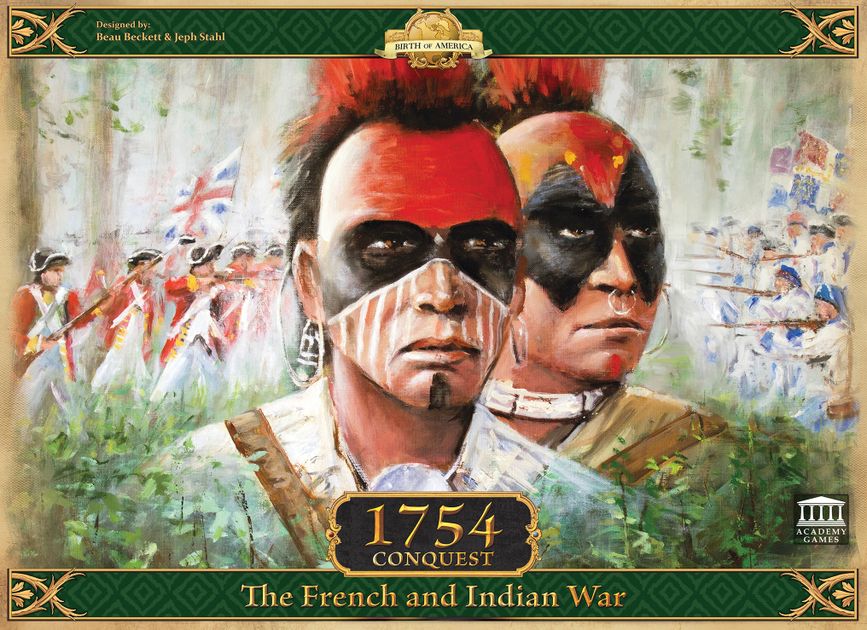
Image result for 1754 conquest academy games

1754: Conquest – The French and Indian War (Academy Games)

I’ve long been a devotee of Academy Games and their take on American history through their highly accessible and educational games. I have copies of their American Revolution game 1775: Rebellion, 1812:The Invasion of Canada and the immensely challenging Freedom: The Underground Railroad, so when I heard they were producing a FIW game, I knew I’d be getting a copy.

16681548_1298610760161843_8458888921304871472_n.jpg

Set-up of 1754: Conquest from Academy Games

The game, 1754: Conquest, follows the same basic mechanics of 1775 and 1812 and rounds out Academy’s trilogy from their “Birth of America” game series. All three games feature wonderfully colorful maps with area movement of small cubes using small hands of action cards keyed to historical events and personalities.

IMG_1377

One of my many plays through 1754: Conquest

In multiple plays of 1754, I’ve found it to be the most challenging in the series. Fortifications, muster points for militia and harbors for arriving British and French reinforcements all reflect the major points of control important to the war. As with all games in the series, this one serves as a great entry into wargaming the period while also providing a challenge to more experienced gamers.

Bayonets & Tomahawks (GMT Games)

One of my most anxiously-anticipated games is GMT’s Bayonets & Tomahawks which has been on their P500 pre-order since 2015. There’s been a steady drip of development and playtesting articles over the game’s long gestation, and in late 2019 some near-final box art was made available.

A 2018 playtest map for Bayonets & Tomahawks, slated for delivery in late 2020

As with all things that come out of GMT, the looks like its going to be a beauty with custom dice supporting a unique battle system and full-color round, square and triangular counters for different forces, fleets, forts and game conditions. The playtest map looks stunning. The game will play over shorter scenarios or the full war with raids, battles, construction, sieges and naval actions. Cards will support historical events and military actions. Having not gotten my hands on it as of yet, I can’t wait to unpack and punch this game when it becomes available, hopefully in late 2020.

The 2010s in Review: My Favorite Games

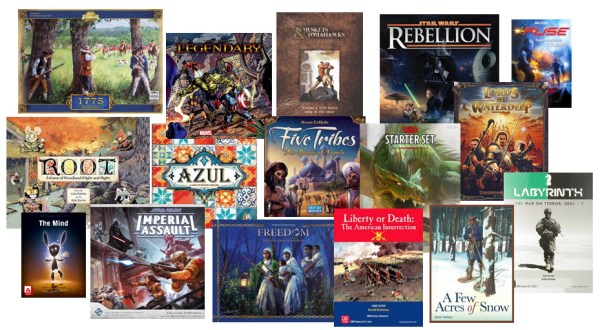
TopGames.jpg

The past ten years have been a big decade for gaming and for me as a gamer. I launched this blog (which I haven’t posted to in more than two years). I became president of Metropolitan Wargamers in Brooklyn, NY, NYC’s oldest continuously active gaming group, now in its fourth decade. And, I played a lot of games.

So, here’s my oddball list of 16 games I deem as my favorite of the 2010s. My list isn’t necessarily the most innovative games of the past ten years (although some are) and many are not widely popular (again, some are). These are the games that got back to the table over and over again as other new games came and went.

First up are a few games that capture my love of Marvel comic books and Star Wars from my 1970s childhood. Fantasy Flight Games has really exploded with Star Wars games over the past decade, and while I’ve played most of them, Rebellion and Imperial Assault are my standouts for capturing the story of Star Wars at the epic interplanetary level and as a sci-fi adventure campaign. Both games have incredible design, artwork and plastic miniatures which really speak to the toy nerd in me. The deck-builder Marvel Legendary also captures the teamwork which is the hallmark of Marvel heroes and villains. All three games take me deep into the real storytelling feel of being in the pages of a comic book or a movie.

My other childhood obsession was Dungeons & Dragons. Lords of Waterdeep captures the flavor of D&D within one its most fabled campaign settings dropped into a boardgame that feels like an adventure quest. Back to the classic RPG style of play, the D&D 5th Edition Starter Set brought me back to the table for the first time in years with a slimmed down all-in-one boxed rule set that felt akin to the fast-moving games of my childhood.

From superheroes, science fiction and fantasy, my love swings to American history. The American War of Independence plays out n my two favorite games of that period — Liberty or Death: The American Insurrection and 1775: Rebellion. In 1775, a simple block, card and dice mechanic allows play of the entire war in about 90-minutes and serves as a fantastic entry into the period and wargaming. With LOD, GMT’s COIN (counterinsurgency) mechanic of asymmetric conflict breathes new and nuanced complexity of the often-simplified formative American story.

From the American Revolution, my interest stepped back to the French and Indian War. This was the period that really fired my imagination the past few years with a dive into dozens of books and several long trips visiting historic sites of the era in Virginia, Pennsylvania, Maryland, West Virginia and New York. A Few Acres of Snow was my first game of the period and remains one of hands-down favorites with its two player asymmetric, deck building that still challenges over multiple plays as the French and British. My miniatures wargaming interest also swung heavily to the FIW with Muskets & Tomahawks. The quick-playing, card-driven mechanics of the game really captures the clash of British, Indian, French and Canadian forces, and I’ve spent countless hours researching and writing historic scenarios for significant engagements of the period which I’ve run at multiple miniatures gaming conventions as well as my club. A new version of the long out-of-print rules is due in 2020, so I’m very much looking forward to what the game brings next.

Two other historical games I’ve loved deal with two difficult subjects that have significantly shaped American history. Freedom: The Underground Railroad tackles slavery and the fight of abolitionists to bring it to its end through exceedingly challenging gameplay that involves often heartbreaking choices of who does and doesn’t make it to freedom in Canada. Fast-forwarding to the 21st-century, Labyrinth: The War On Terror covers the endless war of the US and coalition forces in the Middle East. As the wars continue, the game has received updated expansions bringing the game’s events and mechanics right up to the current news of the day from the 9/11 attacks to the Arab Spring to today. Both games show the power of games as tools to model and understand history ways few others do.

With time at a premium, there were a few games that filled the gap for 30-minute or less time slots at the beginning or end of a long evening’s game session or when a quick game just fits the bill. The patterned tile placement in a Azul is great for my non-gamer friends as well as experienced players, plus, it has my favorite mechanic of pulling the very satisfying heavy tiles out of a bag. Fuse also has a tactile angle with fast rolls of dice placed into patterned puzzles to be solved against a nerve-wracking countdown app. Finally, The Mind takes a super simple deck of 100 chronologically numbered cards and turns it into a really interesting exercise in how we play collaboratively with others without the benefit of verbal communication.

I play a lot of the above games and others with my family, and one we’ve returned to repeatedly is Five Tribes. The game, set in a fantasy sultanate, scratches all the Eurogame itches of colorful wooden meeples, a modular board, beautiful card artwork and some easy to grasp but hard to master strategies. We’ve taken this game on the road more than just about any game in my collection.

Finally, I wasn’t alone in my obsession with the wildly-popular Root. The game combines so many things I love about games — fantasy, adventure, great art — in an asymmetric clash of woodland animals. With what it presents simply on the surface, the game taps into a wargaming feel that bridges all the games I’ve enjoyed so much over the past ten years.

Aside from all the games above I’ve enjoyed, I have to also celebrate the 2010s coming to a close on a personal gaming note. After some fours decades as a gamer, I was thrilled to co-found Campaign Games and launch a successful Kickstarter in the late summer of 2019 for Forts & Frontiers: The Feast of the Dead Deluxe. Combining the mechanics of D&D 5th Edition with my love for the story of 17th-century European-Indian history in North America, the game was well-received during Free RPG Day 2019 and continues to playtest well at conventions. To end the year and decade on the other side of the table as a game creator is a thrill I’ll watch unfold over the coming year and into the 2020s.

French and Indian War: Woodland Indians from Galloping Major Wargames

 IMG_1602
To add yet more Indians to my French and Indian War 28mm collection, I’ve turned again to a current favorite miniatures manufacturers — Galloping Major Wargames. After a recent project using GM’s Provincials and supporting their recent French Marines Kickstarter, I filled out a direct order from the UK with a few of their Indian models which didn’t disappoint.
 GMLogo2
GM miniatures are the among the largest in my collection, cast at a 28mm heroic scale. That said, I found my first purchase of their Indians to be just a bit smaller than their other figures I own. The size of the models presents the opportunity for a lot of detail and individual personality, especially in some great facial expressions.
These Indians present a more traditional look with chests bared and dress in leather loincloths and leggings. Knives, hatchets, jewelry, powder horns and various shoulder-slung bags equip these figures nicely for any campaign. As a bonus, the six figures I ordered were supplemented with a seventh figure thrown in for free, a nice thing GM offers to larger orders. And with these Indians complete, I’m sure there will be more of those orders to Galloping Major Wargames in my future.
 IMG_1656
IMG_1655
IMG_1654
IMG_1653