Retro Gaming The 70s & 80s: DC Heroes Role Playing Game

dcheroes

Households tend to gravitate to fan divisions. There are Star Trek people and Star Wars people. In New York City, you’re a Mets fan or a Yankees supporter. With comic books, divisions have fallen for decades between Marvel Comics and DC Comics with endless nerdy debates of the pros and cons for each.

In my home growing up, my brothers and I were Marvel guys. Our cardboard storage boxes were chocked full of bagged and boarded books from the Fantastic Four, The Avengers, Captain America, The Uncanny X-Men, Doctor Strange, Iron Man, The Incredible Hulk and Alpha Flight. The occasional Batman or Justice League story grabbed our interest, but superheroes who dwelled in the real-world embattled streets of New York City always won our hearts over the denizens of Gotham, Metropolis and Star City.

When we got around to superhero gaming we likewise threw our fandom (and dollars) behind TSR’s Marvel Super Heroes Role-Playing Game. While role-playing our favorite Marvel characters never took off with the passion we had for Dungeons & Dragons, we loved the modules and expanions chocked full of great art, stories and cut-out scenery and foldable heroes.

In 1985, a year after TSR’s comic-themed release, Mayfair Games answered with DC Heroes Role Playing Game. The game was released just as DC’s monumental Crisis On Infinite Earths series hit the comic racks garnering wide praise from long-time fans and the straight press alike. For a tepid DC fan like myself, Crisis was a crash course in DC lore and injected significant emotional realism to the character storylines mimicking much of what Marvel had been up to for a couple decades. The one-two punch of Crisis and the new game had me running to the store to add yet another RPG system to my shelf.

dcheroescontents

Like the Marvel role-playing game, the DC system never became a big part of my gaming time but its mechanics had some merits which retain a significant fan base to this day. At its root, the game used a unified “attributes points” design from which all manner of super powers, skills, wealth, time and distance variables could be calculated. Within this single framework, the game could contextually handle normal human characters such as Lois Lane and Jimmy Olsen side-by-side with epic heroes like Superman and Shazam.

Similar to TSR’s Marvel game, Mayfair’s DC game box came with a group of manuals for the players and gamemaster as well as a gamemaster’s screen, starter character cards and a manual of powers and skills. While the primary color design was more spare, the DC game’s mechanics and information offered a quicker start than wading through the uneven and occassionally frustrating complexities of the Marvel game.

Despite the surface comic book character interest in the DC game and the earlier Marvel one, my interest in superhero gaming waned pretty quickly. With positives and negatives to each RPG super hero system, what I always walked away with was a feeling of constraint within the boundaries of massive established narrative comic universes. While both games offered rules for creating new characters and scenarios (more effectively in the DC one), my mind inevitably drifted back to known caharacters and storylines I couldn’t imagine breaking into new realms and threads. With plenty of more satisfying fantasy RPG and historical miniature gaming options available to me, one thing I could always reconcile about Marvel and DC alike was that I preferred my comic heroes on the page rather than the tabletop.

Collector’s Note: Mayfair’s DC Heroes Role Playing Game and its expansion modules can be easily found online in the non-heroic $10-30 price range at eBay and elsewhere.

New Game Weekend: Canterbury

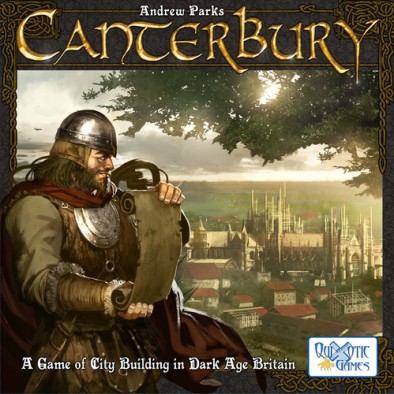
CanterburyBox

This past week I arrived home from work one evening to find a package in the mail containing the first game I’ve received from backing a Kickstarter campaign. Canterbury from Quixotic Games was successfully funded at just over $58,000, a relatively small game when compared to recent runaway Kickstarter hits like Zombicide: Season 2 at $2.2 million, All Quite On The Martian Front with just over $300,000 in funding and the current it-game Mars Attacks which looks to be cruising to a finish over a half-million dollars.

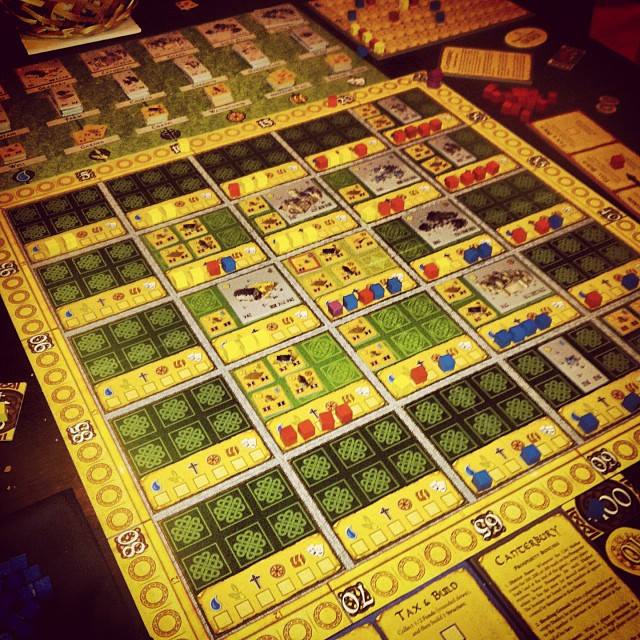
As promised in the steady stream of updates from the game makers, Canterbury is an exceedingly well-manufactured board game with tons of sturdy cardboard playing pieces and typical colorful wooden markers. The game presents a board containing 25 districts, each with six building lots. Each lot contains spaces to indicate water, food, religion, defense, commerce, and culture services which are provided as players build out the board.

canterburydist

Beginning with a simple well providing water to the central district, players take turns performing one of three actions. A full build action allows 1-2 buildings to be constructed, depending on size and moneies available. Levying taxes gains a full monetrary collection based on the current economic strength of the entire kingdom, and a player using a levy play must perform on full build of 1-2 structures on their following turn. A third option allows a player to collect half the avilable taxes and build a single structure.

Building and placing structures provide services to the board. A small, single-lot building gives that distruct the available service while a medium-sized two-lot building provides the service to that district plus the districts surrounding at right angles. The five largest structures are built at a high cost, cover four building lots and provide their service to the local district plus any five other districts on the board. Planning comes into play as buildings may only be built when previous services are available in a district. For example, religious structures may only be placed when the prerequisite water and food services are already present in the district. Previously-constructed buildings may be demolished to upgrade existing services or expand on already-provided services.

There are lots of points to keep track of in Canterbury, adding up to many strategies toward winning at the game’s end. Erecting a structure gains points for the player as well as the kingdom, and players receive bonus points when breaking ground and building in empty districts. Once the kingdom passes the 100-point mark, players score “district favor” points based on the prominence of providing services to each district. Providing services also moves each player up an additional scoring track with those points scored at the end of the game. Points are again counted at the 200-point mark. Once the kingdom’s wealth takes three laps around the edge of the board to 300 points, the game ends with a final tally of points.

CanterburyGame

The game is a bit lighter and faster than other civilization-building games I’ve played like Settlers of Catan, Civilization, Clash of Cultures and Village. That said, even with the brisk pace of the game, there’s a lot of strategy to be had. Players must always balance their own plays for points with the riches and services they are providing the kingdom (and other players) as a whole. Racing to provide services, build structures and gain an early lead on district favor points looked to be the key path to victory in the first game I played with my sons. Collecting and spending money at a balanced rate was also important since sitting on a pile of coins at the end of the game doesn’t provide much in the way of points.

Like any civilization-building game, Canterbury strikes a great balance of real-world competitive and collaborative construction play. My older son thought injecting the game with random events like floods or droughts might spice up the straightforward play a bit, but overall the three of us really liked the quick, well-structured play and progressive organization on the board. As a Kickstarter supporter, I’m really pleased with the results of Canterbury and I’m glad to have been there to see the kingdom’s development from that lone well in the wilderness.

New Game Weekend: Africana

westsideFor the second time this year I found myself in Los Angeles for work this past week, and once again I also wound up linking up with the West Side Gamers. The meeting of the group I attended at an IHOP just south of Culver City was the organization’s 510th consecutive club get-together. The group meets weekly in local restaurants, camping out over several tables and booths chocked full of dozens of games toted along by attendees. A weekly theme game is featured, but players split into groups to play whatever people are up for from about 6pm until well past midnight.

This past week’s featured game was Power Grid played on the recently-released Quebec map, although more than a dozen different board and card games were played throughout the evening. More than a couple dozen players spent the evening munching on diner food and hunched over tables of games.

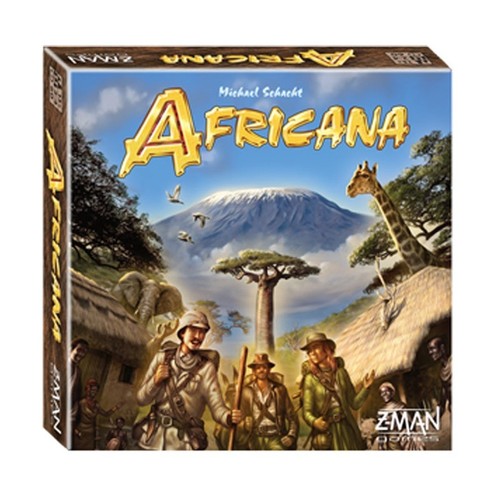
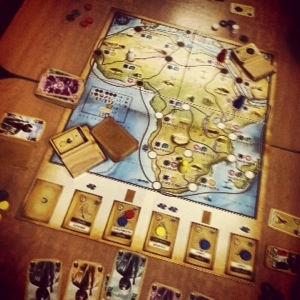
20131010-233030.jpgOf the many games being played that evening, I  had the opportunity to play a game new to me, 2012’s Africana from Z-Man Games. Playable by up to four participants, Africana uses a few familiar card-driven mechanics within the context of the travel and exploration of the African continent. The game board features a map of Africa divided in two by the equator and laced with routes between cities. Each player’s expedition uses color-coded movement cards to trek between locations. A series of five adventure cards at the bottom of the board allows a player to pick a starting point for a research expedition to another location. Setting off on an adventure gains either a movement card or silver coins used to buy from the two adventure books.

africanaEach turn, players may either draw movement cards, move their explorer aroundthe board or purchase up to three pages from the wooden book racks. Purchasing pages from the adventure books north and south of the equator provides another quest opportunity to gather artifacts or hire additional workers to help move your expedition along the board. Collecting combinations of artifacts and completing adventure routes gain more coins and score victory points at the game’s end. While having multiple workers in your hand can help move you quickly around the board, holding too many at the game’s end deducts points from your total. As the game progresses, adventures become more valuable and players may be working on several adventures at once. Once all the adventures are drawn from the deck, the game ends and the player with the most victory points wins.

20131010-232920.jpgThe travel mechanics of Africana don’t allow for a lot of opportunity to really block other players on the board, although completing adventures ahead of the competition or acquiring valued artifacts from the books does allow for some strategic play. Moving your pawn to key port cities such as Cape Town allow for quick moves around the continent while moving inland is a bit more circuitous, so choosing adventures wisely is also key. The player who won our game focused on high-value adventures late in the game while my second place finish was scored mainly through the collection of artifacts. Even in this relatively light travel game, akin to something like Ticket To Ride, I could see the possibility of trying varying strategies.

Deep down I dislike just about everything about traveling for work — cabs, hotels, airports, living out of a suitcase — but heading to Los Angeles and a chance to meet-up with the folks at West Side Gamers makes the trips to the West Coast a bit more worth the journey.

Gaming The High Seas

bbpicFor as long as there have been people putting boats to sea, there have probably been pirates close behind. Even though the classic high period of piracy perhaps only spanned a few decades in the 1600 through 1700s, pirates have loomed large in popular culture from Robert Louis Stevenson’s Treasure Island all the way through to the Johnny Depp-fuelled blockbuster Pirates of the Caribbean film franchise. Piracy will also be the theme of the latest release in the Assassin’s Creed video game  series next month, and the game is already being lauded as a potential game of the year for its historical high seas combat.

Naturally, pirates find their way to gaming tables. I like checking in on the UK-based blog Shed Wars for a fellow gamer’s incredibly elaborate pirate miniatures gaming. While I’m rather certain pirate miniatures gaming is never going to be my thing, I have played my share of pirate games over the past thirty years.
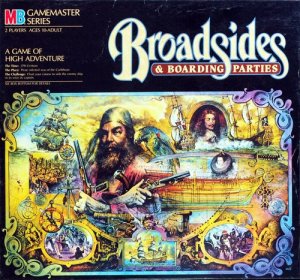
broadsidesIn the early 1980s, Milton Bradley launched their Gamemaster Series. While Axis and Allies would be the one game to catch on, the series also included other historically-themed wargames packed full of some nifty design, tons of plastic miniatures and varying levels of gameplay. The two player Broadsides & Boarding Parties featured a card-based maneuvering “broadsides” combat phase of the game which then led to a close-quarters “boarding parties” series of turns. During hand-to-hand attacks, each player moved their pirate, canon and captain figures among the two large ship models in an attempt to capture the opposing captain. Like many of the games in the series, Broadsides & Boarding Parties was a great looking game, but the play was a bit simplistic and it wound up collecting dust on my game shelf.

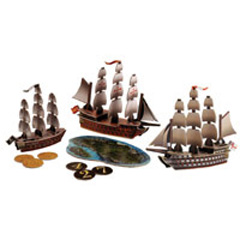
pirateconstJust over 20 years later, WizKids introduced the Pirates of the Spanish Main constructable miniatures game. This still-popular game consists of collectible packs of ships in plastic credit card-sized punch-out packs. Each pack contains a whole game with a couple ships, rules, islands and playing tokens. The system went through a number of expansions with additional ships from varying eras and nations along with special island island fortesses and even sea monsters. Along with the movie series, a Pirates of the Caribbean series was also released with the ships, characters and story pulled right from the films. The ships looked fantastic although proved to be a bit brittle during gameplay which involved trade, combat and double-crossing across an open tabletop board. Although the game was officially shuttered in 2008, a huge secondary market continues for unopened packs of game cards.

lootWhen my two sons were younger, we played the heck out of the 1992 card game Loot. This surprisingly engaging and award-winning kid’s game by Gamewright allows for play as a merchant or pirate. Pirate cards come in four colored “suits” with a captain card for each suit. Each pirate card carries an attack value denoted by a number of skull symbols. Pirates compete to attack merchant ships carrying different gold values, and an Admiral card shows up to protect merchant ship. Each player manages their hand through a series of draws, plays and discards as gold is collected and attacks by other pirates are thwarted. While the original Loot features cartoonish graphics, an updated more historically-themed version was introduced in 2010 under the name Korsar. Whichever version you get your hands on, Loot is a pretty simple but engaging card game for crews of all ages.

This past weekend at Metropolitan Wargamers in Brookln, NY, I had the chance to get my sea legs with two more pirate games: Cartagena and Merchants & Marauders.
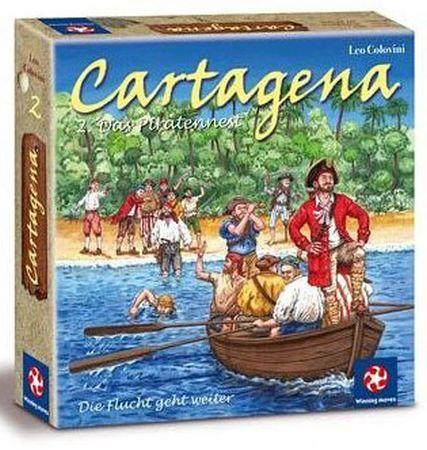
cartagenaCartagena is a quick game recreating the late-17th-century pirate jailbreak in Cartagena, Colombia. This wordless, diceless, easy-to-play game sets each player with five pirates making their way along a dock game board toward an awaiting getaway boat.
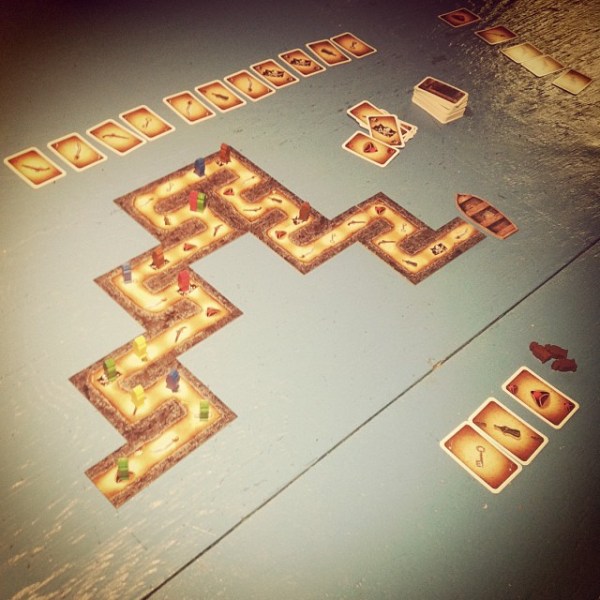
cartagenagame

Each player begins with six cards featuring hats, bottles, swords, keys, pistols and Jolly Roger flags. Playing a card allows a player to move one of their pirates along the board to the next empty space featuring that symbol. Players may double and triple-up placement on a space, and additional cards may be drawn from a face-up row of cards by moving backwards along the dock. Moving back to a space with one other purate gains a player one card, while moving back to a space with two pirates gets a maximum two-card draw. Players move forward and backward, acquiring cards and playing them as they progress toward the boat. Strategy comes in planning out your card moves with available spaces on the board, blocking other pirates and stealing in-demand cards from the draw row. The simplicity of Cartagena makes this a great choice for little pirates in your life while it also holds interest for some aggressive adult play like my first game this past weekend with some club members.

MMbox

Merchants & Marauders from ZMan Games is a beefier boardgame akin to the Viking exploration and conquest game Fire & Axe. Set among the islands and seazones of the Caribbean, the game allows players to play as merchant traders or dastardly pirate captains set on acquring gold, completing missions, following rumors and scoring points toward victory.
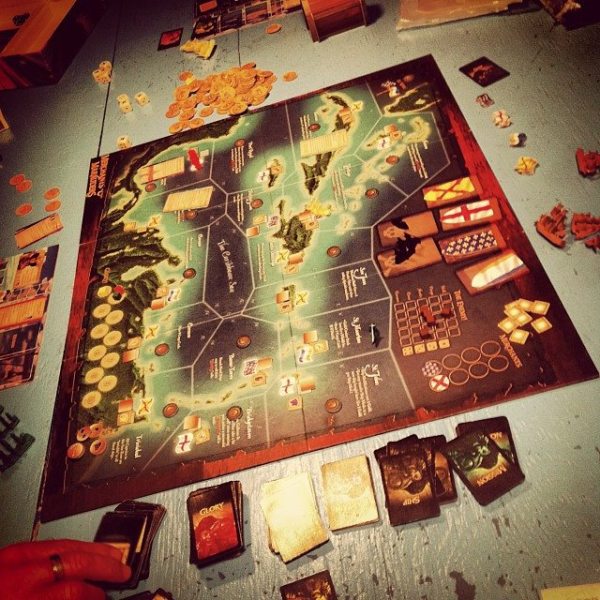
MMgame

Players begin with their ships at a home port island with each port offering varying bonuses to different types of players. In each turn, players may take three actions of movement, scouting or  port activities. While in port, captains may trade or sell goods, repair damaged vessels, acquire special crew and outfit or upgrade their ships with additional weapons and equipment. Each port shows goods that are in demand like tobacco, rum or spices, and trading in-demand goods scores extra victory points and special Glory cards that can add to a players effectiveness in particular situations. Pirates acquire goods agressively at sea but risk becoming wanted by the various nations looking to go to war with seafaring criminals.

There’s a lot of flexibility in the heading to victory a captain charts. Players may focus on trading or seizing goods, completing missions to other ports and attempting to chase down legendary rumors amid the islands. Attacking other ships can gain goods and gold but players run the risk of damaged or sunken ships that can set them back a few turns. Event cards at the top of each round inject additional elements to the game with storms and other sea-bound pitfalls reducing speed or even wrecking ships. Games of Merchants & Marauders typically run a couple of hours, and players must balance their own captain’s focus with what are other players are doing.

Like the legends of piracy, there’s a lot of variety to be found in pirate gaming. Aside from the games I’ve played and the many miniatures systems available, their are dozens of other pirate-themed games to suit an level of interest. The storied history and mythology of pirates yields a bounty of treasure for any gamer looking to raise a crew under the Jolly Roger and set out in quest of adventure, booty and intrigue on the Seven Seas.

Collector’s Note: Broadsides & Boarding Parties is available on eBay and elsewhere starting at around $50, Pirates of the Spanish Main is set to re-launch soon, but older expansion packs are likewise available via eBay in the $5-10 range and even cases of some card sets are available. Scalawags and bucaneers will find plenty of fellow pirate card, boargame and miniature action at most major gaming conventions. Arrrrrgh!

Flames of War: Fielding the PSC German Heavy Weapons and FOW Artillery Command

ger8cmmortar

After focusing on my Flames of War (FOW) Allied forces for a while, I decided to throw some energy back into beefing-up and diversifying my late war Germans. Although my German troops seldom see play, getting some infantry punch on the table led me to a number of mortar and other support weapons platoons the FOW rules offer.

Battlefront, the maker of FOW, has a number of good platoons which run anywhere from about $12-20 each. Having recently tried my hand at the Allied Stuart Tank set from the growing line of 15mm WWII kits from the Plastic Soldier Company (PSC), I spotted the Late War German Heavy Weapons box. At around $25, the set looked to be an excellent and economic way to get a lot more German infantry on the table at perhaps a quarter to one-third the cost of the official FOW models.

pscgerhw

The PSC box comes with four MG 42 teams, four 8 cm mortar teams, four 12 cm mortar teams, eight Panzerschrecks and eight Panzerfausts. Also included are four Panzerschreck loaders and four ammo carriers. With about 70 bits on the sprues, this set was going to add a lot of action to my already extensive German infantry collection.

pscgerhwsheet

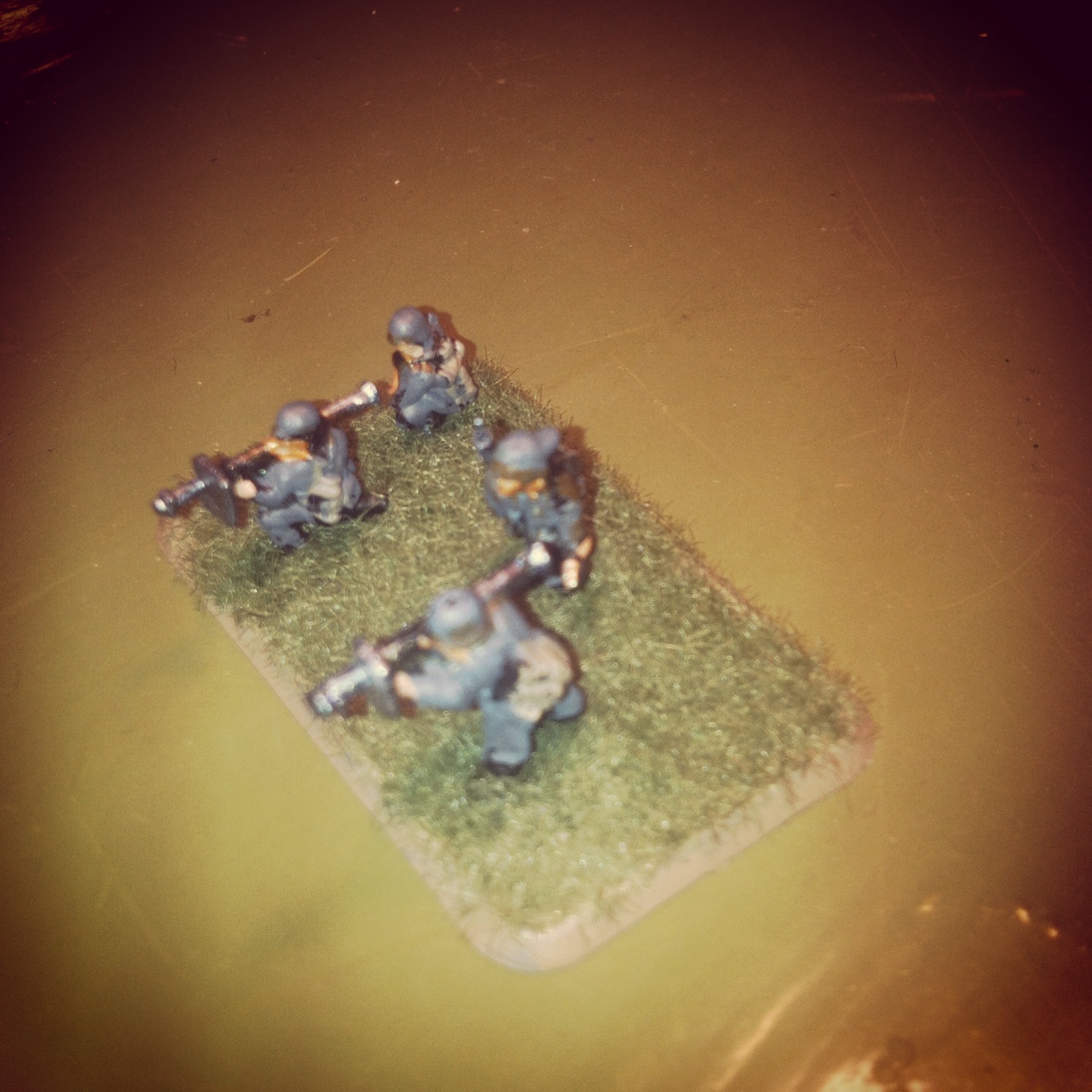
Cutting out and gluing-up the tiny pieces from the PSC sprues is a bit of nerve-racking task harkening back to my early years wrangling with assembling soft plastic HO scale Airfix soldiers. That said, following PSC’s simple assembly diagram (above) and keeping all the parts carefully organized on the workbench is key to getting the job done right and not losing anything along the way. Flames of War rules call for basing Panzerschreck teams in groups of four miniatures per medium stand, allowing for four total teams to be constructed from the PSC set with two Panzershrecks plus a loader and ammo carrier per team. The 8 cm mortar and MG teams likewise went on medium bases and the big 12 cm mortar teams were glued-up on larger bases. I had a few extra plastic FOW Germans on hand from a bonus promotional sprue I received from the Open Fire! box set, and adding those to the 12 cm mortar stands helped finished those off.
artycmdhw

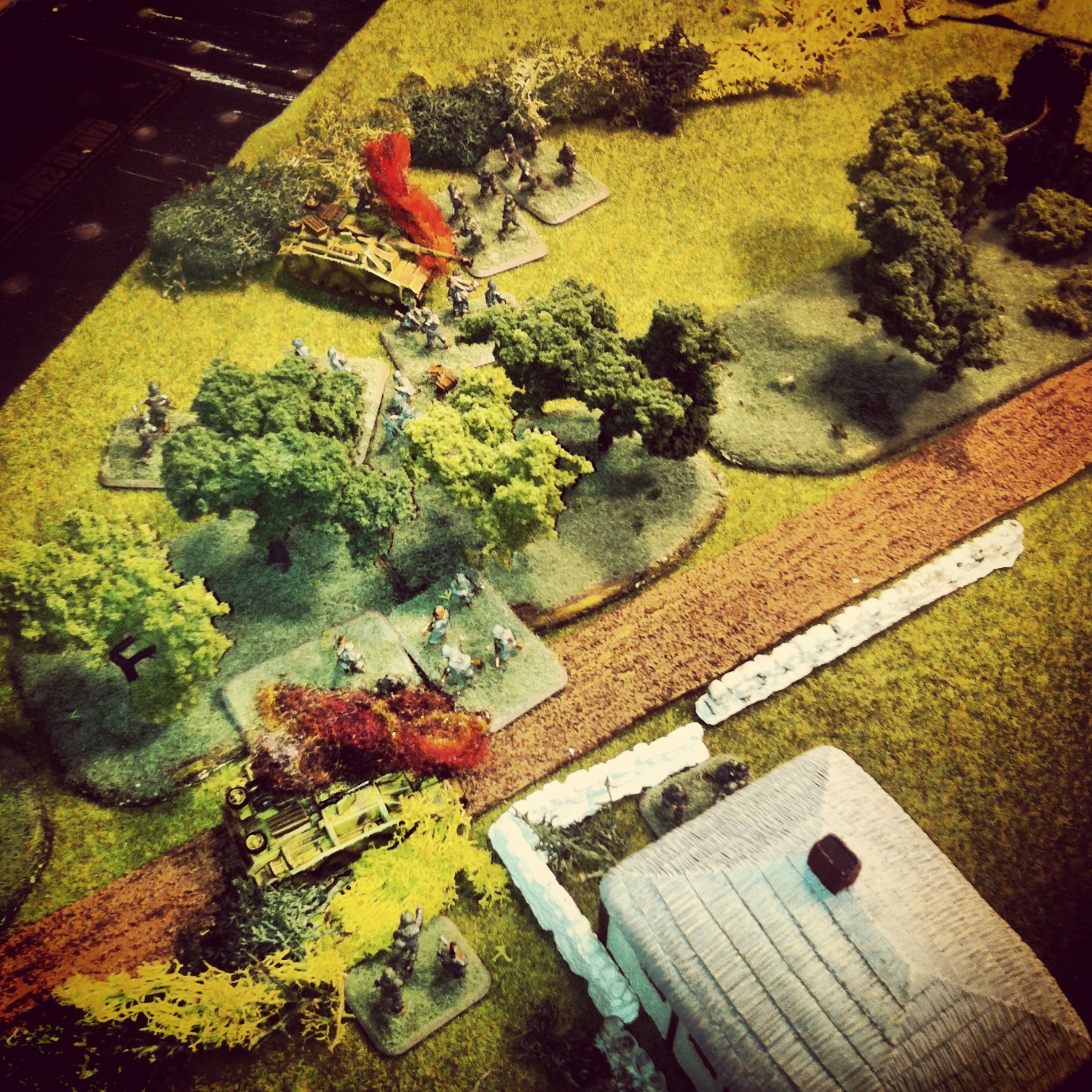
With a bunch of new mortars in the field, I also needed to add some additional command and spotters to make them playable. FOW offers an artillery command headquarters blister pack which I added to the mix. The set comes with enough models that I was able to create three two-man spotting teams, a few command stands (adding in Panzerfausts from the PSC kit) and a nifty HQ vignette with a four figures surrounding a table with a radio operator.

IMG_2214

Painting Germans is a simple process for me with a base spraycoat in flat black followed by a darkish grey uniform and details picked out in flesh, blacks, browns and gun metal. The stands get finished off with some simple grass flocking and a matte varnish spray. Getting a consistent finish on the PSC models made them blend in nicely with my FOW models.

IMG_2226

For comparison’s sake, the PSC figures do tend to be a tad smaller and thinner than the typically-chunky FOW figures. Since most my PSC figures are being fielded on separate stands, I don’t see the minor scale differences being an issue at arm’s length on the tabletop battlefield. In addition, the extra poses in the PSC casting add some nice variety and animation in the troops once deployed.

IMG_2224

IMG_2217My FOW German force has long-relied on the strength of deploying large numbers of tanks in my games, so these new additions should be a nice compliment to getting more action from my German infantry. Now that it’s fall, I’m anxious to rush my new PSC and FOW Germans to the tables at Metropolitan Wargamers in Park Slope, Brooklyn and add a new season of playablity to my battleworn forces.

Flames of War: Breakthrough Mission

bocageShortly after fighting ashore and in the iair drop zones on D-Day, the Allies quickly discovered a new enemy awaiting them: bocage.

Lacing the Normandy countryside, bocage was a tight overgrown network of hedgerows of shrubbery, stone walls and copses of trees lining the rural French fields. All but impassable by Allied armor and difficult to fight through for infantry, bocage slowed the push inland and delayed the taking of key objectives. It was only through the quick-thinking and inventiveness of the Allies that new tactics were hastily developed. To free-up the passage of tanks, hedgerow cutters were welded to the front of armored platoons and demolition crews blasted gaps to continue the forward march. Fighting amidst the bocage would prove to be deadly for both sides, as recounted in the 1988 paper by Captain Michael Doubler. It’s required reading for anyone interested in the tactics of bocage warfare.

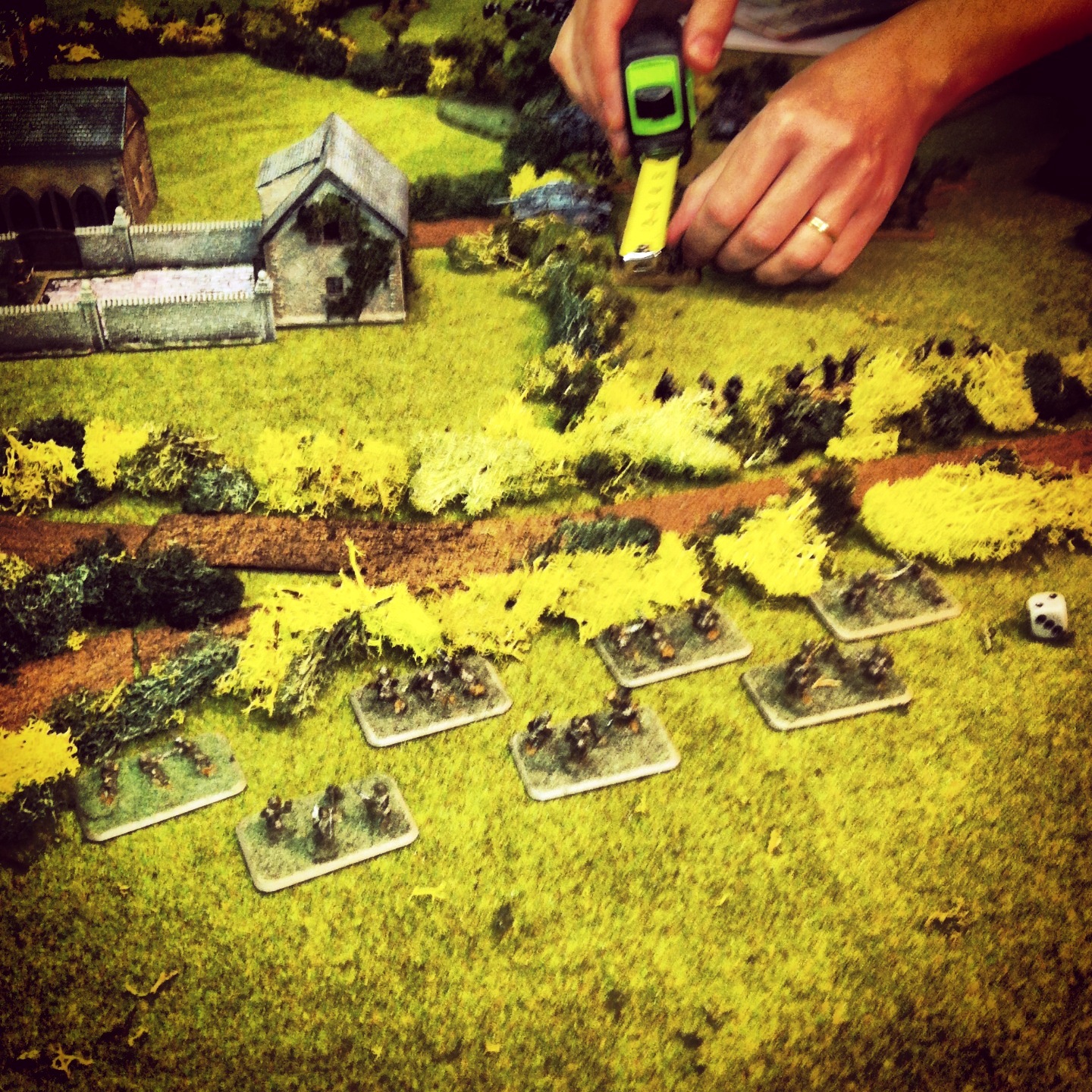
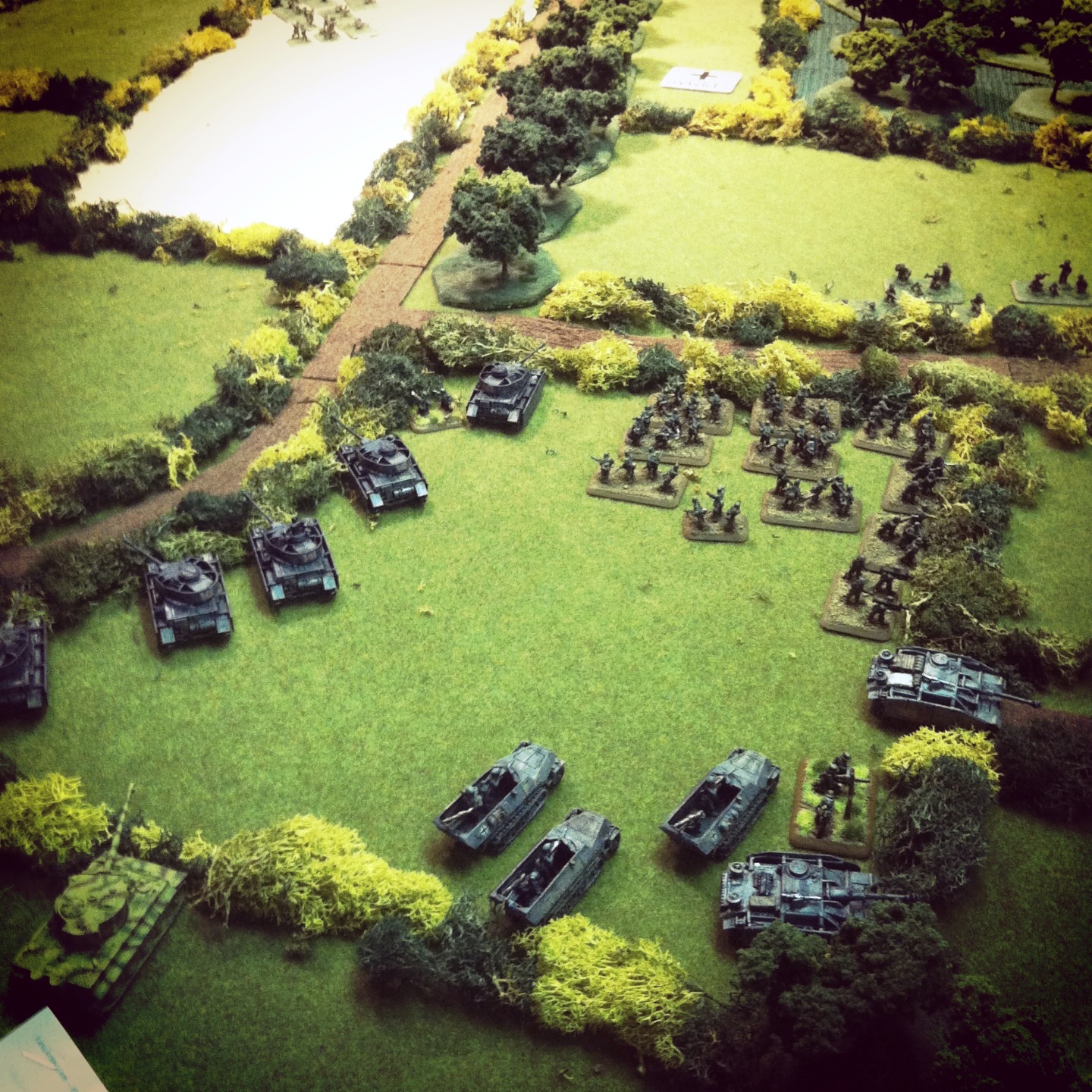
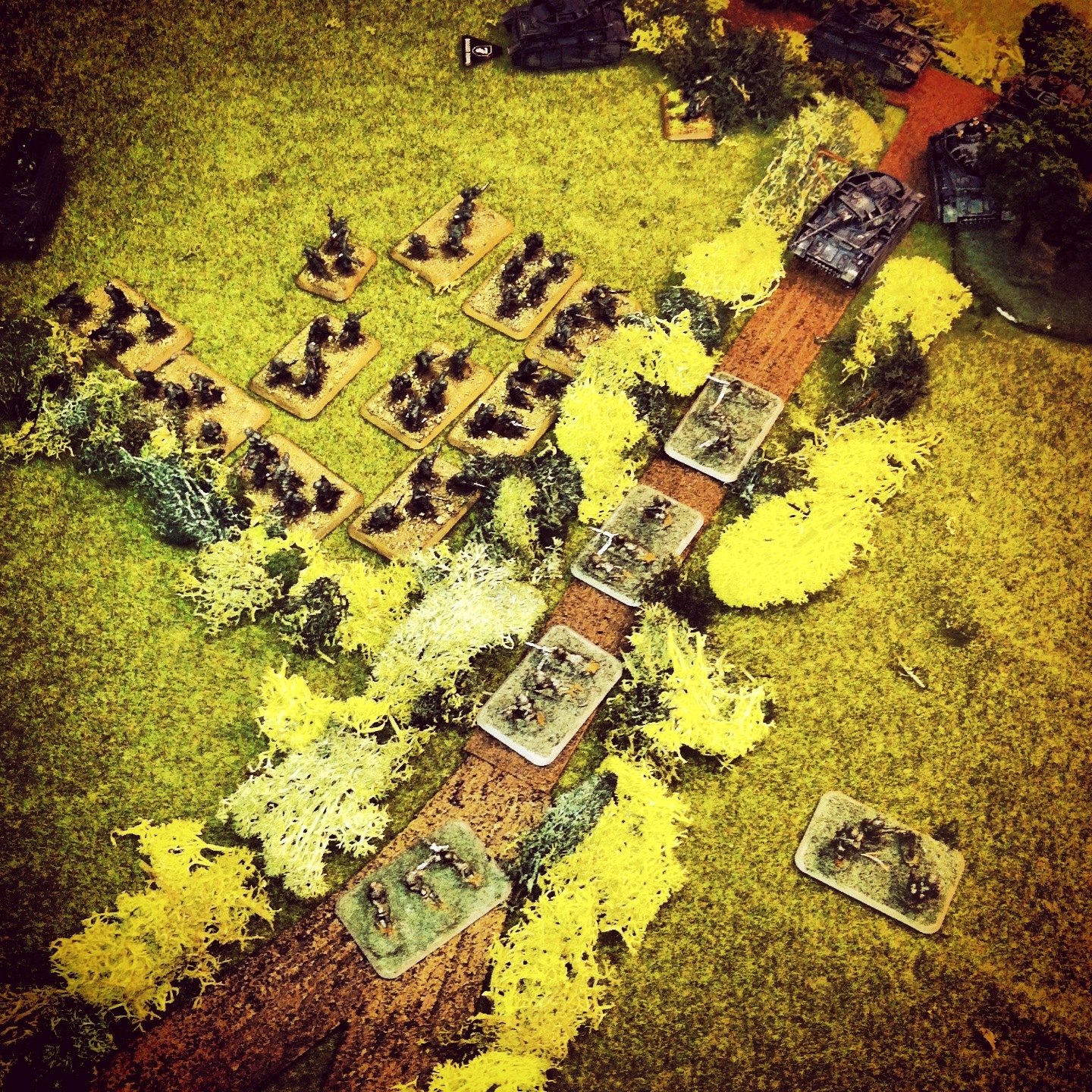
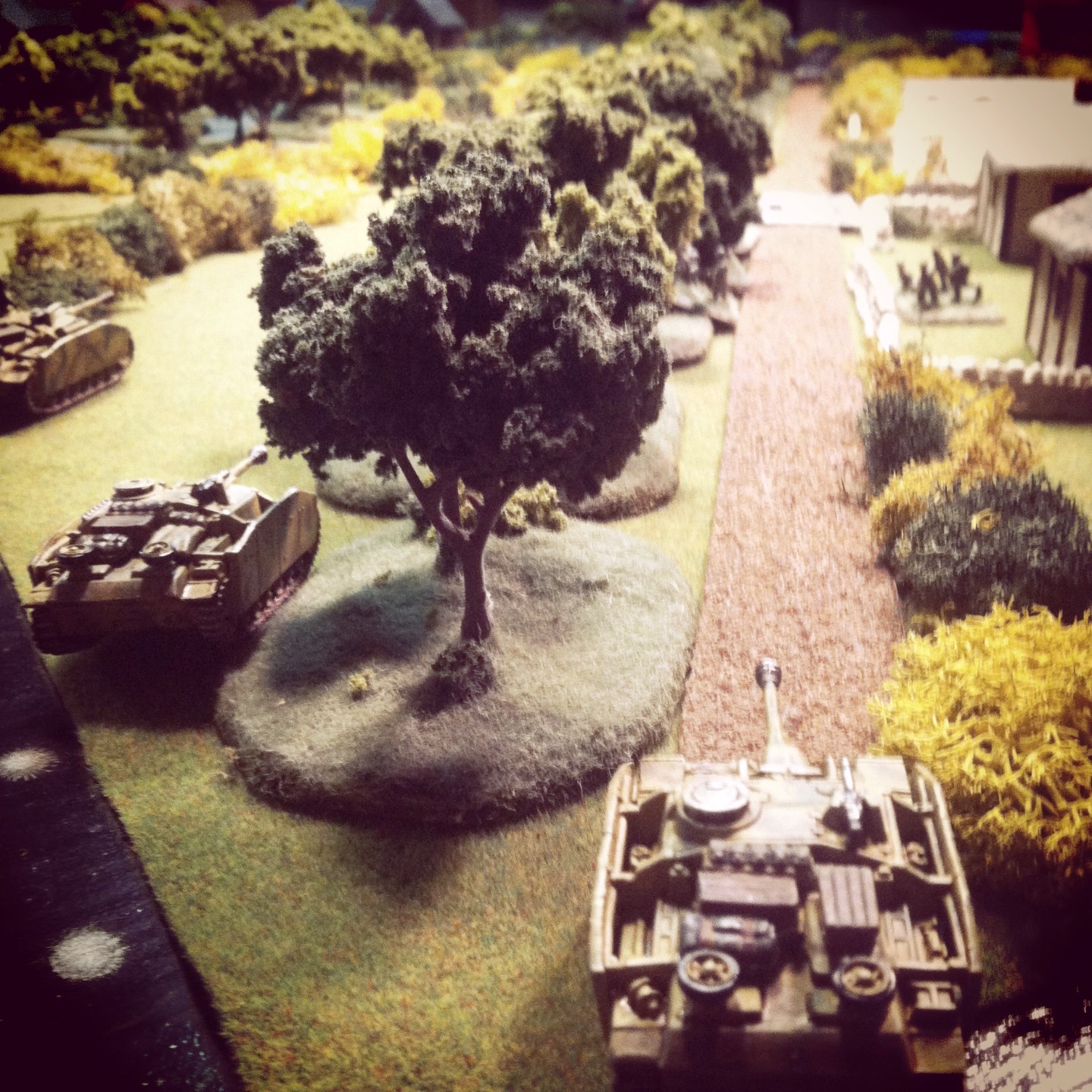
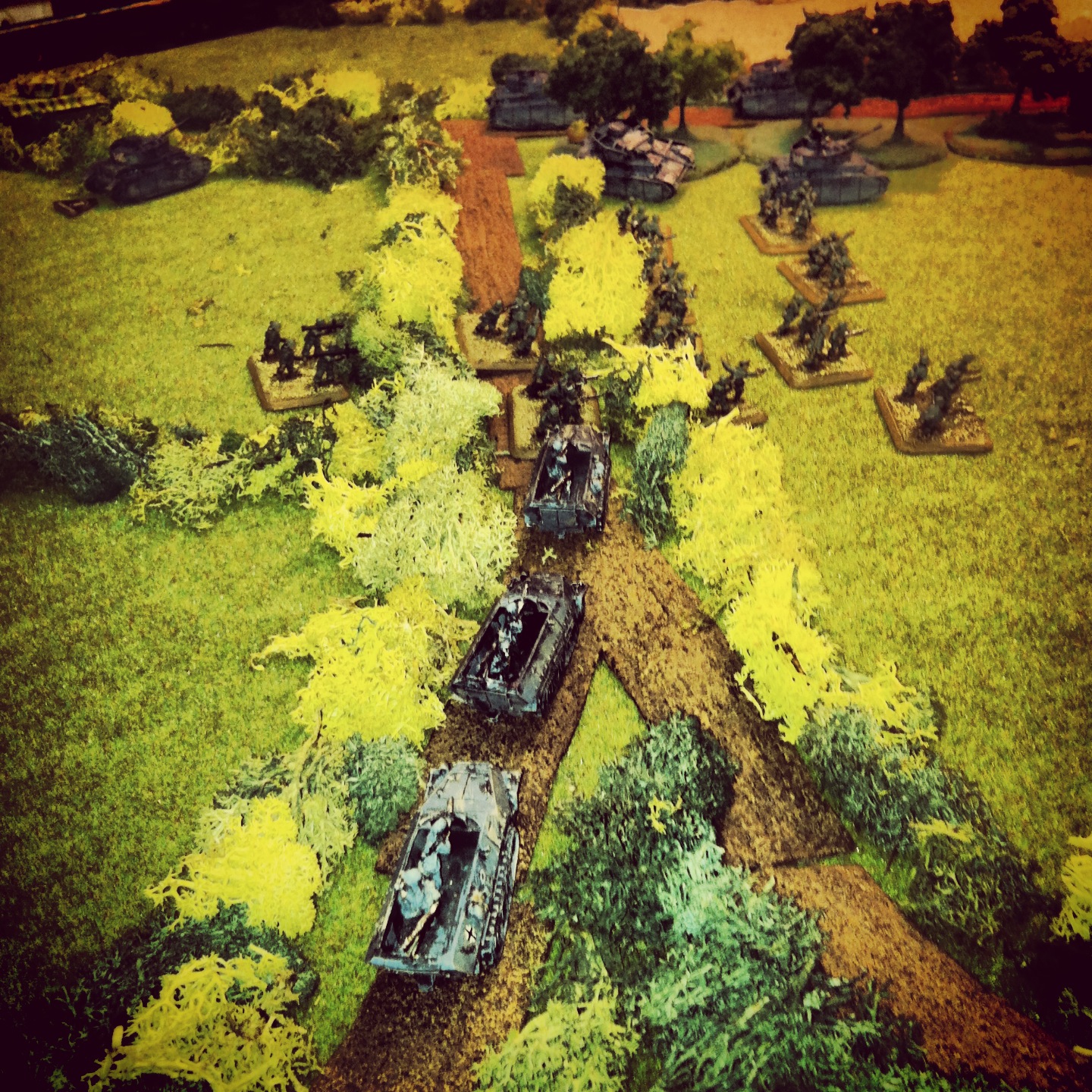
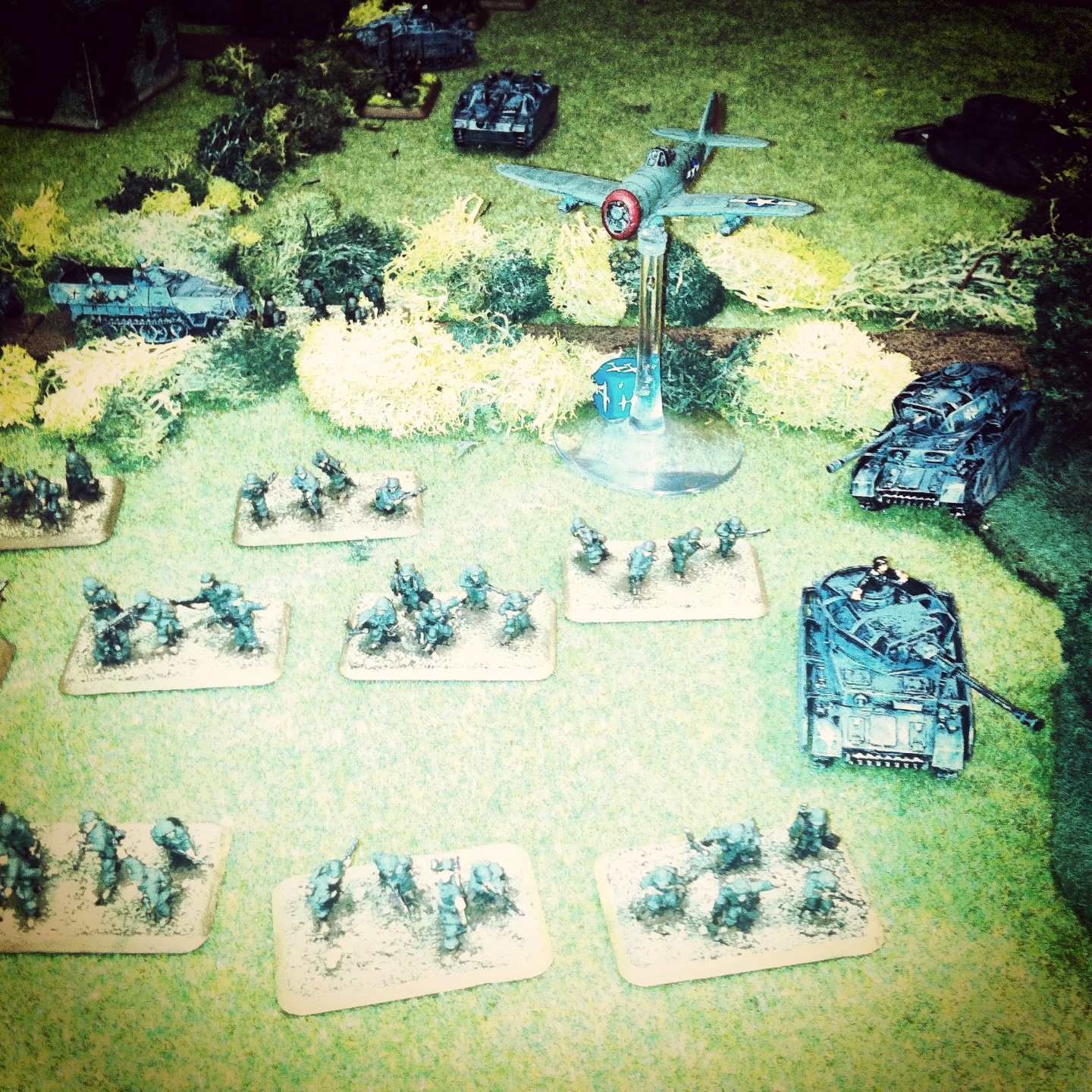
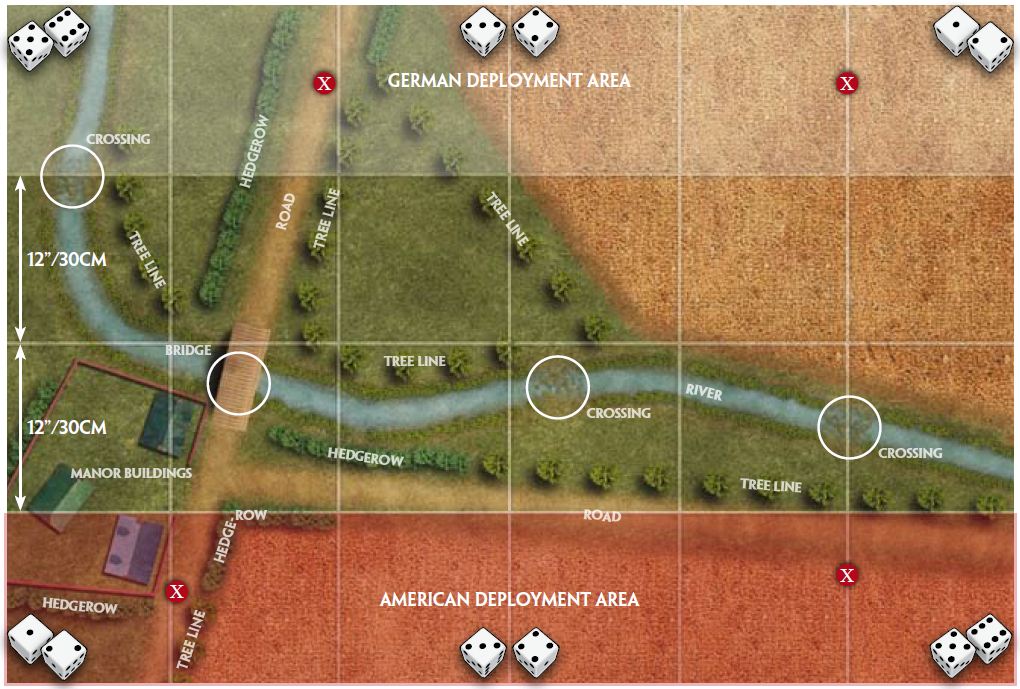
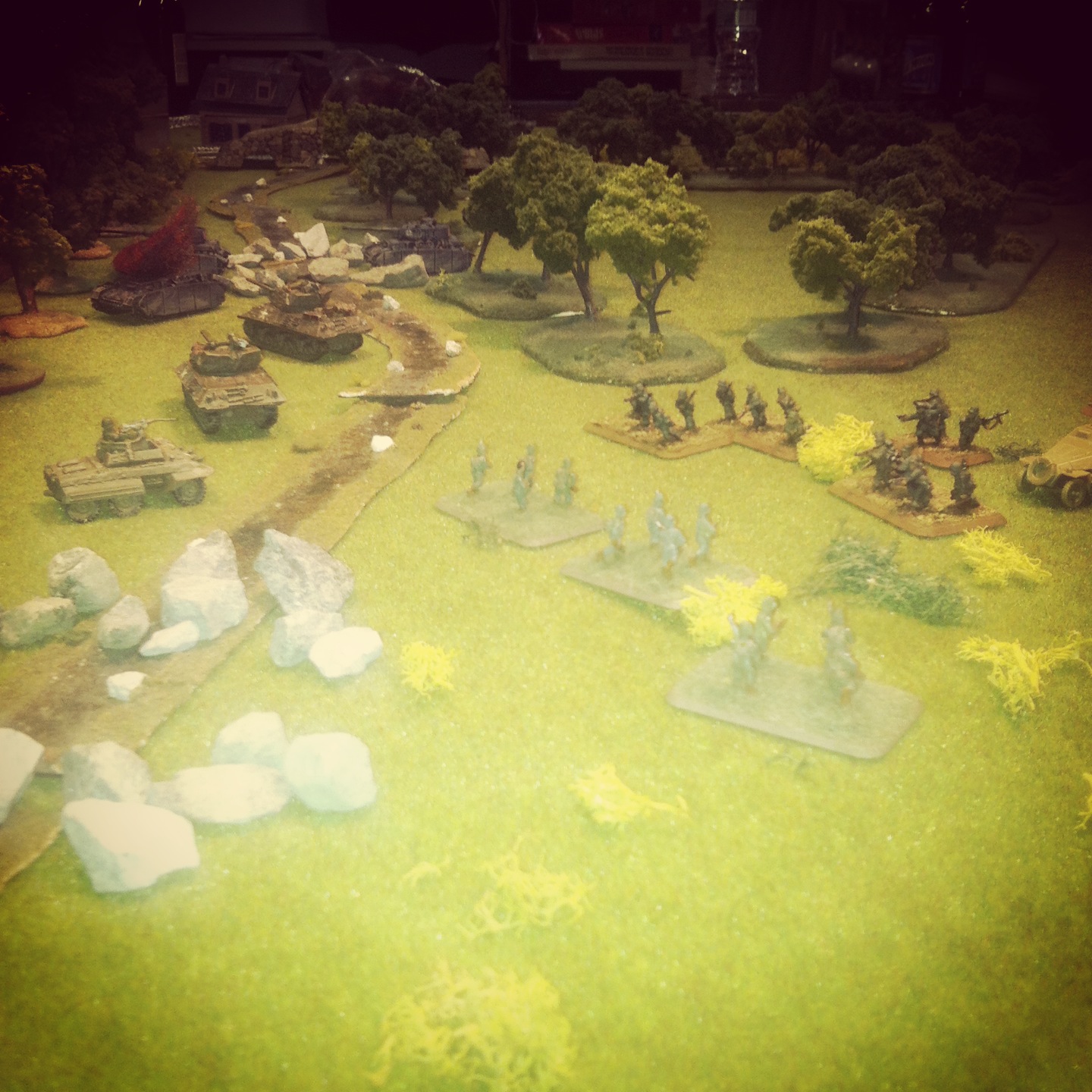
This past weekend at Metropolitan Wargamers in Brooklyn, four of us got together to slog it out in the bocage tabletop of a Breakthrough Mission as provided in the Flames of Wars rules. The mission scenario calls for use of the Mobile Reserves rule for the defenders and the Delayed Reserves rule for the attackers. The Germans chose to field a 1250-point Fallschirmjager company backed with heavy machine guns, a Nebelwerfer rocket battery, Stugs and Pak 40 anti-tank guns plus a 1250-point tank company armed with mechanized infantry, Panzer IVs, Stugs and one imposing Tiger tank. We Americans also fielded two companies beginning with a 1250-point rifle company with three infantry platoons, Shermans, a weapons platoon of light machine guns and mortars and a P-47 Thunderbolt for air support. The other US company was pulled from the 82nd Airborne with a Priest mobile artillery battery and Stuart light tanks. To aid in navigation of bocage, the US armor were outfitted with hedgerow cutters. The Germans had six turns to take an objective and it would be the Americans’ job to stop them.

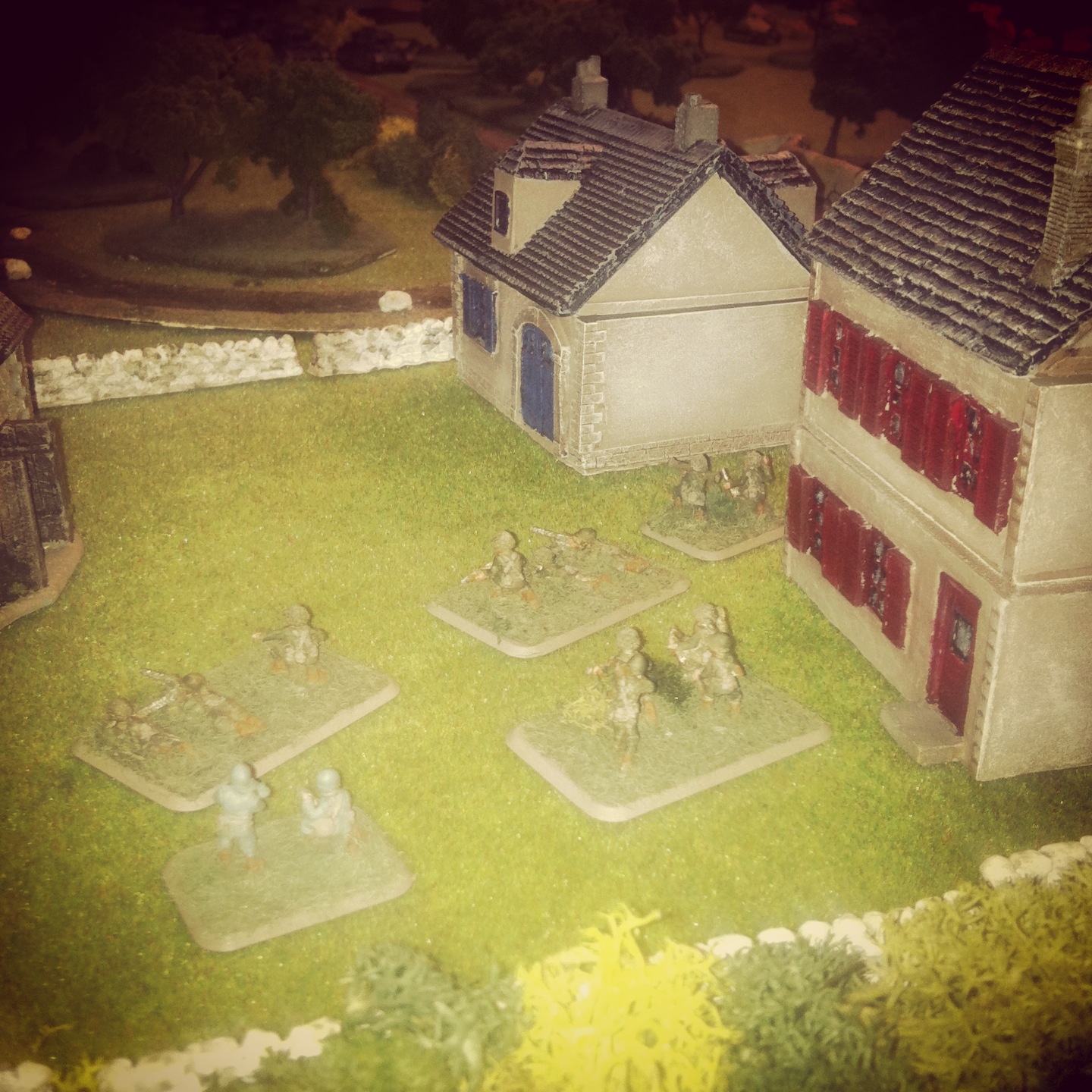
BTMapThe table was laid out thick with bocage surrounding a small village and a nearby farm. Americans rolled as the defenders meaning all our mobile units — all the tanks and artillery we had — were going to be held off the board as reserves. I hid all my rifle platoons in the town’s buildings and stuck the machine guns and mortars in the field between the Germans and their nearest objective. In the opposite corner, the Airborne platoons deployed near the farm hoping to camp out on the German objectives for the duration of the game.

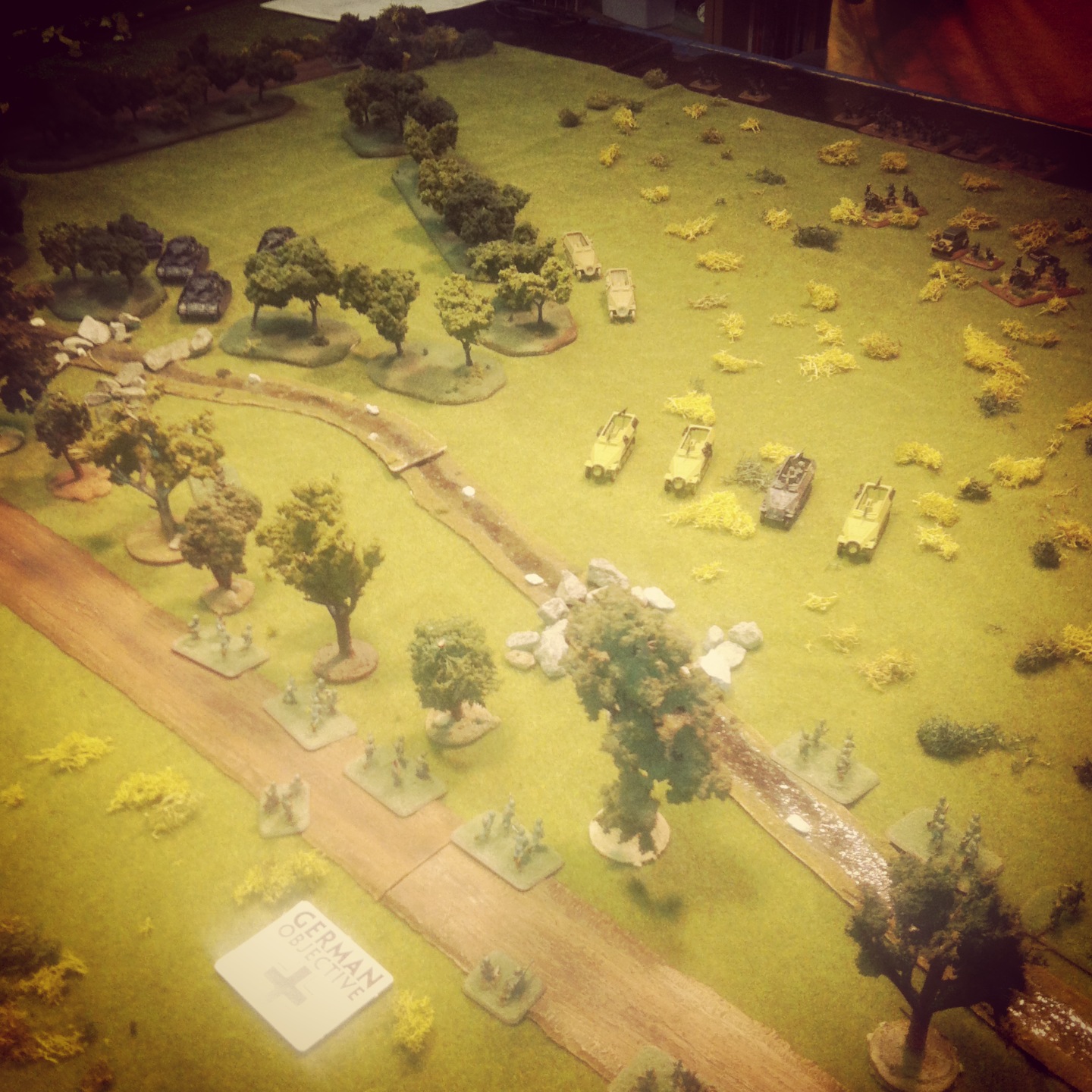
As the attackers, the Germans deployed in their assigned corner of the table. Their rocket battery, anti-tank guns, heavy machine guns and the majority of their infantry dug into the field outside of the town. The large tank company deployed in the adjacent field. Held off-table was a Stug and a Fallschirmjager platoon, hoping for the a delayed reserves roll beginning on the third turn to put them right on top of one of their objectives at the opposite corner.

IMG_2177As the attackers, the Germans got the first turn, quickly pressing their armor toward the center of the table while the rocket battery, heavy machine guns and anti-tank cannons poured fire into the town, pinning one US platoon. Reserves failed to arrive on the first US turn and the P-47’s first run came up empty. As per the plan, the US Airborne pushed into the farm buildings to hold the nearest objective.

IMG_2179

IMG_2181In the second turn, the Germans continued to light up the town with the US companies pinned in the buildings. A Stug opened fire down a lane but the Americans avoided being hit. US bazooka teams moved into the barn at the edge of town and took shots on the a German Stug and approaching half tracks but to no effect. The US machine gunners attempted to fire and then assault the nearing Germans but were thwarted by the thick bocage and failed terror test against a nearby Panzer. The Thunderbolt once again on did nothing its second run while the Airborne units at the farm ran across the road into the treeline, securing the second German objective.

IMG_2183

IMG_2185

IMG_2191In turn three, the German players thankfully failed their first attempt at calling in reserves. Pressing on, German half tracks raced through the town toward the American weapons platoon which took heavy casualties and lost the machine gunners to fire from both sides. Stugs and artillery continued to pound the American rifle platoons in the town. At the top of their turn, the Shermans arrived and made a hasty path to cut a hole in the bocage standing between the rest of their reserves and the nearby road.

IMG_2185

IMG_2189Things really heated up in turn four as the Germans rolled on their first reserved Stug platoon near one of the objectives and the awaiting US Airborne. German infantry and Panzers pushed into the next field, knocking out the US mortars and eliminating their first platoon. The Americans pulled in the rest of their reserves but immediately created a bottleneck of Shermans and Stuarts as paths were cleared through the bocage. The P-47 came in hard on the Germans in the field, knocking out several units and destroying a Panzer. Finally, the fearless Airborne did what they’re trained to do and burst from the treeline to assault the newly-arrived Stug platoon. Two Stugs were destroyed and the third fled the field after a failed morale test. The objective was still held by the Americans but things were looking dicey with Germans coming in from all sides.

IMG_2196

IMG_2187

IMG_2198

IMG_2193

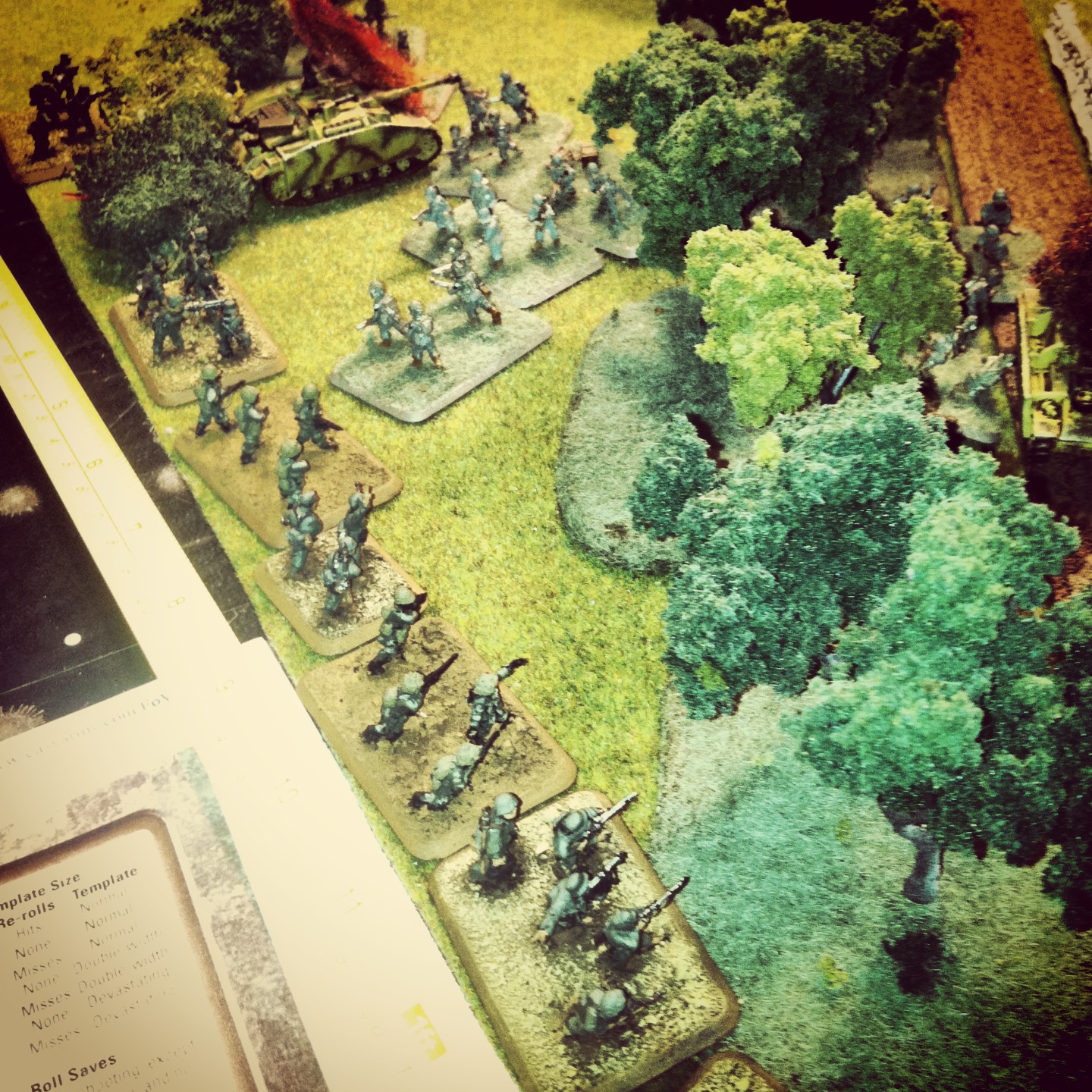
IMG_2200The fifth turn started with the final German reserve platoon arriving amid their burning tanks and assaulting the US Airborne. Through a series of attacks and counterattacks, the two groups whittled each other down. The Germans were eventually ground down to two remaining stands, lost their morale check and were destroyed. The victory for the Americans was short-lived, however, and the heavily-damaged Airborne platoon also failed a morale save and likewise fled the battle. With the game nearing it’s end, a Sherman was destroyed and blocked the road. All the US armor and artillery was effectively shut-out of the game. As the Germans covered an objective, the American P-47 made one final run to force a German morale check but to no avail. The Germans had won the day.

IMG_2208

IMG_2210There were a number of things that had gone wrong for the Americans. The rifle platoons never got out of the town, contributing almost nothing to the battle. Had they hauled their way toward the forest in the middle of the board, pressure would been greater on one of the objectives. The restrictions on the reserves also hurt the Americans, with nearly half their force never getting a chance to get in the fight. The US Airborne were typically deadly in their assaulting enemy armor and ground troops and proved to be the one positive for the Allies. On the German side of the table, much of its large armor platoon, including the Tiger, was sidelined for much of the battle as they navigated the hedgerows and roads.

The game was a new experience for one of the German players who typically games in the wide-open spaces of the Northern Africa theater from earlier in the war. As in 1944, bocage played the role of a third unmovable enemy on the table. The bocage was frustrating for all players but this time sided more with the Germans in their breakthrough victory.

Playing War

179892_1760799734172_551897_n

Like so many kids, I grew up playing an abstract outdoor game called War. Spend any amount of time with a group of young boys and play aggression often naturally emerges, lines are drawn and any object within arm’s reach becomes a surrogate weapon. War takes this to the next level. Through the application of ever-shifting rules , a broad framework is created within which you split into teams and then spend hours hunting down your friends. Sometimes finding a secret base in a capture-the-flag scenario is the objective. In larger group games, a tag-like game of collecting kills can determine who wins.

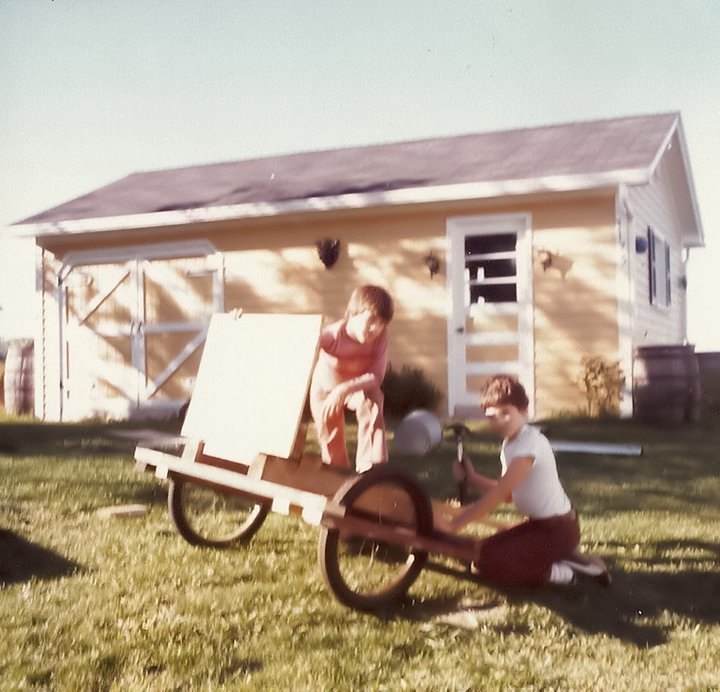
For my childhood friends and me, anything from sticks to hand-made weapon replicas to store-bought plastic toy arms made up the main equipment for the game, and our imaginations filled in the rest. One summer in the late 1970s, my brother and I (that’s me in the blurry snapshot above on the right) built an estimation of a howitzer from some scrap wood, bicycle tires and the side exhaust pipe from a sports car. A friend of mine had a fort built in the woods adjacent to his house, complete with a lockable below-ground prison and a series of three-foot-deep foxholes dug at the defense perimeter. Other pals checked books out of the library to study old photographs of guns they would carve out of left-over 2′ x 4’s.

I logged many hours playing War among the fields, woods and buildings in and around my rural hometown in Western New York. One weekend I spent the majority of a Saturday hunting down one of my friends on a nearby SUNY campus in a one-on-one scenario where the first one to spot the other won the war. I found a set of shrubs to hide in where I sat for an hour until I saw my friend creeping through an open plaza. On another day, I was captured and locked in my other friend’s dungeon with another comrade. While more than ten other guys ran around shouting in the nearby fields, we two prisoners spent more than two hours digging a tight hole under the plywood wall to escape. Other times there were weekend sleepovers and night games chasing each other through the woods and over creeks in the darkness lit by flashlights.

idw-poster-final-web__large

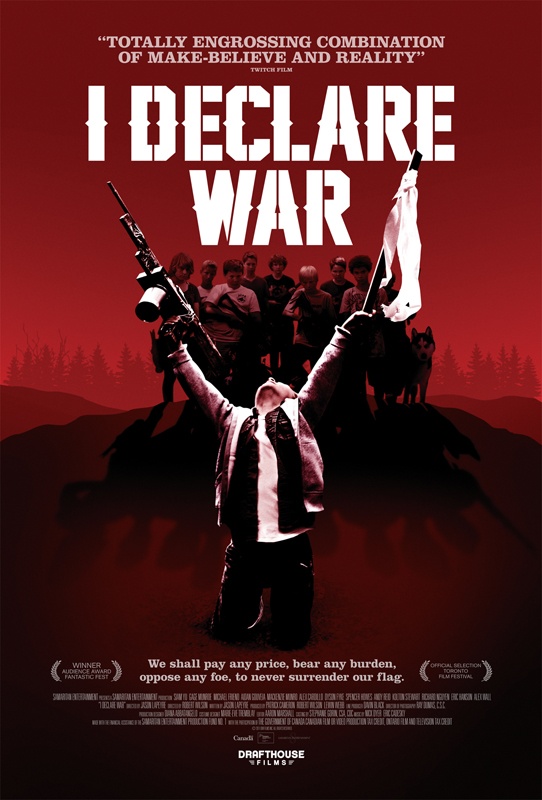
The new movie “I Declare War” from Drafthouse Films should resonate like a carpet bombing for anyone like me who can look back wistfully to hot summer days of trying to kill their best friends in a game of War. This isn’t a great piece of filmmaking, but its the sort of thing that’s sure to light up parental discussions and also conjure youthful memories of when play involved something without digital graphics.

Now in limited release and available through some streaming services, “I Declare War” focuses on a day-long game of War between two groups of adolescent boys (plus one girl). The serious intensity of the day’s game depicted in the movie captures the complexity of the time in life of being a care-free kid teetering on the edge of the ages to come.

Most of the kids in the film approach the game with the expected intensity of children whose imaginations are running full-on, transforming sticks and plastic guns into actual weapons. One boy adds a sci-fi flair with imagined lightning bolts streaming explosive death rays from his eyes. There’s also a clumsy protracted love interest that evolves with the young girl’s arrival in the game, but she too winds up being a skilled player in the game. And finally, there’s one truly sadistic kid who treats the game a bit too seriously, bordering on psychological and physical harm to a few unfortunate victims.

There’s a lot in this movie, and the game of War presents as merely a mechanic for the kids to work out their emerging pre-adult personalities. Within the group there are plotters, double-crossers, bullies, romantics, innocents and leaders. The kids yell, cry, laugh, fantasize, threaten and swear like kids do — a hot stew of thoughts and emotions most mainstream movies (and many parents) would rather avoid.

A couple of the guys I played War with in the 70s and early 80s wound up serving in the real-life military but the majority of us went off to college or started regular jobs after school. For the most part, I’d say we all grew up to be relatively decent human beings. On the balance playing War didn’t warp any of us in a negative way and it quite possibly taught us some early lessons in teamwork, negotiation, problem-solving and communication. For me, it mostly built something along the lines of friendship or strangely, compassion.

“I Declare War” captures the spirit of the kind of play which mostly exists now in an abstract virtual world for my own kids and their peers. Did my friends and I rack-up more life lessons playing War in the woods than my sons do playing war on screens with people who they’ll never meet? That question is going to be answered in a generation or so, but “I Declare War” is worth considering in how playing War shaped us a generation ago.

Flames of War: La Fiere Causeway 1944 Scenario

lafiere1944

In the late evening of June 5th and pre-dawn hours of June 6th, 1944, a steady flow of Allied paratroopers began dropping throughout the French countryside to clear the inland way for the D-Day beach landings to come later that morning. Like elsewhere, scheduled US Airborne drops near Sainte-Mère-Église left paratroopers scattered around the countryside. To the southwest of the town’s target area, a contingent from the 82nd Airborne found itself near a quaint French farm compound and a small bridge over the Merderet River. Recognizing the river crossing as a key defensive line, the assembled paratroopers established a perimeter along the river. A few hours later, the US troops were met by a German Grenadier and armored battallion hoping to stall the Allied invaders from moving inland. The battle that erupted at the river would rage for three days until the German force withdrew in time for the arrival of US infantry and Sherman forces rolling in from Utah Beach on June 9th.

causewaygamemap

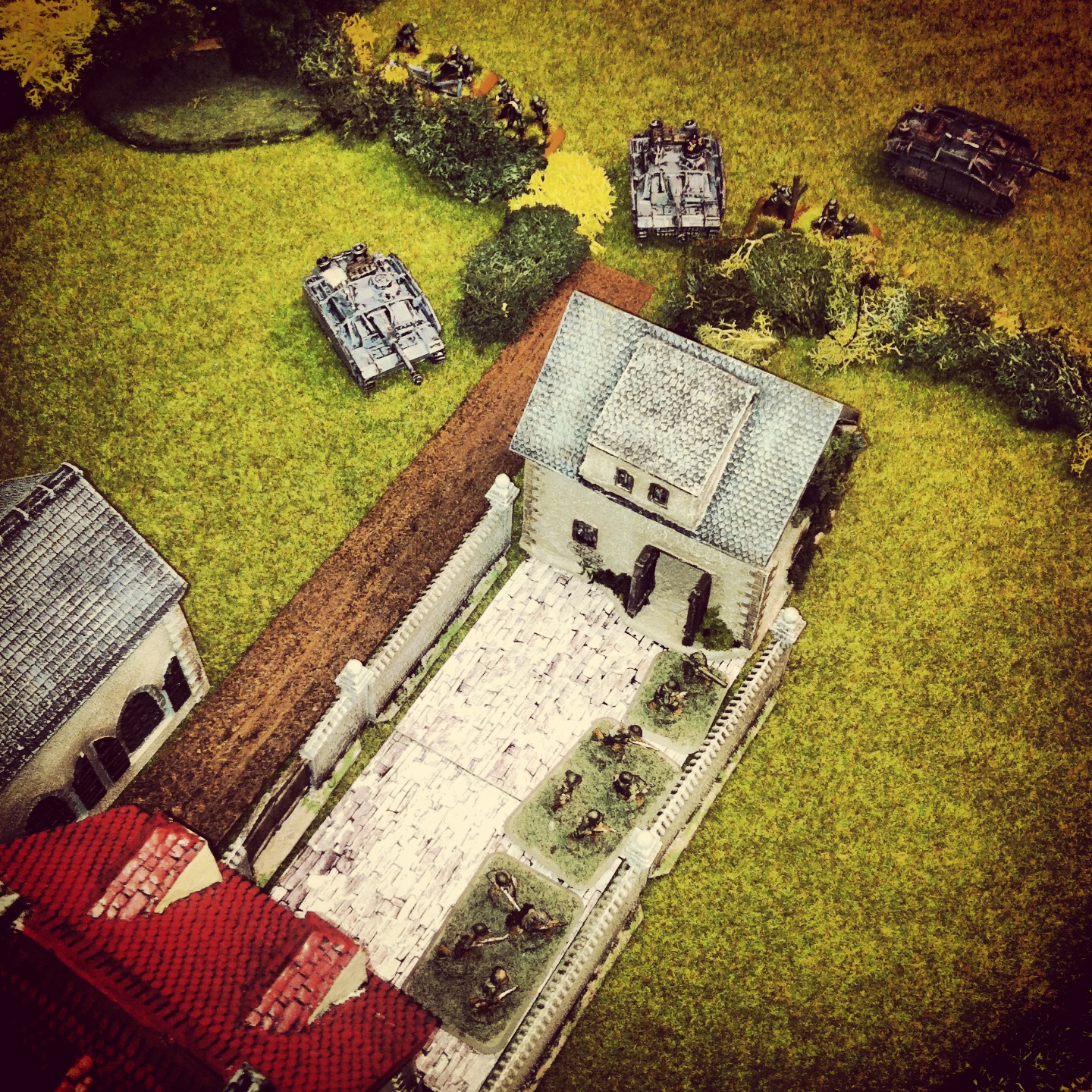
The Flames of War website offers a basic scenario of the encounter at La Fiere Causeway suitable for 1500 point forces on either side. This past weekend a visitor to Metropolitan Wargamers and I had a go at the scenario with my US Airborne facing off against his Germans. As with the historical record, my force held closely to the scenario’s outline with two parachute rifle platoons with plenty of bazookas supported by a platoon of light machine guns, parachute engineers, a glider artillery platoon and M18 tank destroyers. On the German side of the table, my opponent lacked the primitive French tanks that historically fought at the battle. Instead, he filled his force with a number of Grenadier platoons mounted in half tracks backed by two small platoons of Panzer IVs and a Nebelwerfer rocket battery.

IMG_2161

IMG_2163

As per the scenario rules, each of us chose half of our platoons to be held in off-table reserve. Beginning with the Germans, we alternated deploying our starting forces on the table. My American engineers took up position in the courtyard of the farm on my left flank, the machine guns lined the hedge on the other side of the bridge and a rifle platoon deployed on my far right flank. As expected, the Germans deployed a tank platoon at the road entry point and the rocket battery and a mounted Grenadier platoon in the field on their left flank.

IMG_2165With the Germans taking the first turn, the first Panzer IV platoon made way for the river crossing at the middle of the table while the half tracks rolled for the ford on the American right flank. Deployed in and around the farm buildings, the US engineers quickly laid down mines at the foot of the bridge and an Airborne platoon crossed the river to meet the approaching Grenadiers and the rocket battery beyond.

IMG_2169

IMG_2167With turn three, German tank and Grenadier reserves appeared on the table edge opposite the farm and pointed their way toward the French buildings and the nearby bridge. Four US bazookas bailed one Panzer in the clearing across  the river but three other Panzers made it across at the middle ford. US tank destroyer reserves came on the table and immediately poured machine gun fire into the half tracks across the river. The Grenadiers bailed from their transports and the half tracks raced to the rear while the Nebelwerfers failed to score effective shots in the hearty US Airborne troops.

IMG_2171With the Grenadiers on the run back to defend the rocket battery, the US tank destroyers turned their attention on the Panzers and quickly destroyed one while the others continued to push on unharmed due to the protection of their side Schurzen armor. At the farm, the approaching Panzer and Grenadier platoons exchanged fire with the engineers and riflemen defending behind the stone walls. Even with heavy casualties, the engineers repelled a direct assault by two Panzers as a fresh rifle platoon rushed to reinforce the farmyard strongpoint.

Alas, by the fifth turn the game was effectively over for the Americans as the late-arriving US howitzers once again failed to hit in one final volley against the Panzers rushing to seize the objective. The Americans had chased both Grenadier platoons from the field and destroyed a couple Panzers, but the Airborne focus on defending rather than seizing objectives allowed the Germans to take the table.

At the game’s outset, both of us shook our heads with the difficult mission ahead of us. The Airborne never effectively engaged in a close-quarters assault that might’ve taken out more of the tanks sooner on in the game, and artillery on both sides contributed nothing to the game. As with the last few FOW games I’ve played, the engagement at La Fiere once again pointed out the strength and tactical importance that infantry played in WWII. Keeping men moving and in the fight is key to victory, and this time around the German troops got the better of the day.

New Game Weekend: Power Grid

PGcontents

This year I’ve been fortunate to have both the time and a revolving line-up of patient opponents at Metropolitan Wargamers to introduce me to nearly 30 new games. Lots of times I’ll hear the name of a game or references to its mechanics tossed around by other members, and I’ll just file that name away in the back of my head for a future gaming option. One of the games I’ve heard come up again and again is Power Grid, and this past weekend I finally got my first shot at playing it.

What a fantastic game.

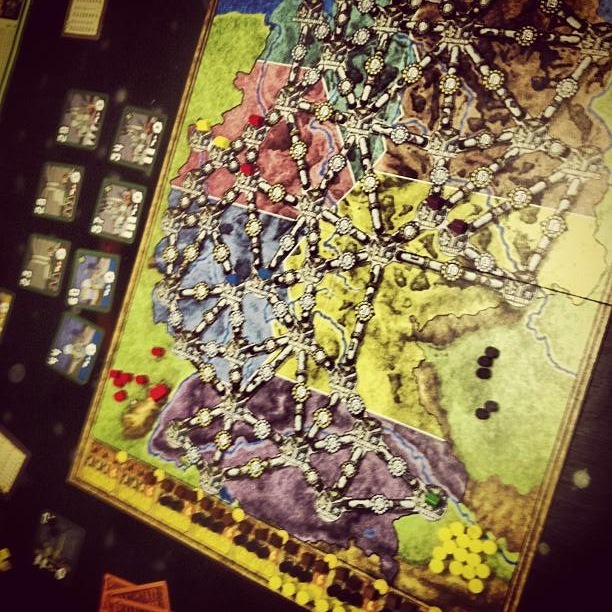
Power Grid is a game of building power plants along a grid among interconnected cities and managing the resources to power the system. Originally published in Germany over 10 years ago, Power Grid began as a crayon and paper game. The version available since 2004 from Rio Grande Games is a more typical Eurogame with a two-sided playing board (Germany and US maps on either side), cards and scores of wooden playing pieces.

The game play unfolds over a series of turn phases. First, player order is determined by the player with the most cities built. Player order is very important in the second phase when power plants are auctioned among players. Some primitive coal, wood or trash-burning plants may come cheap but power few cities or require lots of resources to fire them. Other plants, like solar fields and wind farms, come at a higher initial cost but require no resources to fuel them since the wind and sun come for free. At the far edge are high-tech nuclear plants which can power many cities but require the rare and costly uranium fuel.

And so that leads to the third phase of buying resources. In turn order, players buy coal, wood, trash and uranium which fluctuate in a market of varying demand and pricing throughout the game. Each player’s plant holds double the resources it requires, so a coal-fired plant that requires two coal to run it can hold four coal resources. In terms of strategy, players buy resources for use in their own plants, but they may also choose to stockpile resources and rob other players of the ability to buy resources for their plants.

In the fourth phase, players build cities and their grid. Building cities begins at a $10 value but rises to $15 and then $25 as the game progresses and the grid becomes more crowded with development. Connections between cities also costs money, so creating a close network of cities along a compact grid can make things cheaper for you and more expensive for your opponent as the game goes on. To wrap a turn, players fire up their grid, burn resources and collect income based on how many cities they are able to supply with power.

PGgame

Power grid is a fantastic game of economics, resource management and area control, hitting all the marks of a classic Eurogame. A mix of strategies of building and resource management makes for a realistic yet streamlined game requiring just some basic rules, no reading during the game and simple components. The

Numerous expansion sets are available for Power Grid, including additional power plant cards and additional two-sided regional maps from around the world such as France/Italy, Central Europe, Russia/Japan and China/Korea. A rabid international online fanbase has also created custom homebrewed maps of just about any country or region on the planet.

With the topic of energy and natural resource consumption on the front page of just about any paper in the world on any given day, it’s easy to see why Power Grid resonates so widely. The game also plays without any reading required (other than a basic understanding of one of the translated rulesets), adding to its international appeal. Not only is the game a huge draw for hardcore gamers, I could also see it as a very instructive tool in teaching any group of engaged kids on the challenges of managing ever-increasing power demands.

Flames of War: Fielding the PSC Panzer IV Tank

pniv

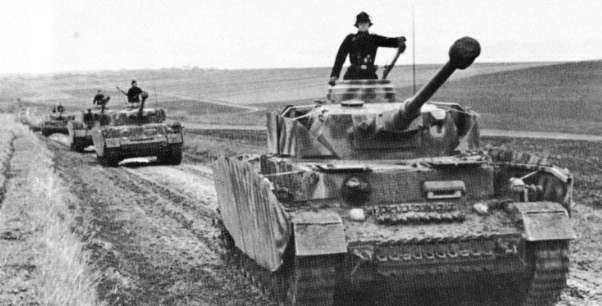
One of the greatest military impressions Germany left on the face of warfare during World War II was in its feared armored forces. The famed Tiger I heavy tank gets a lot of the glory for its independence and near idestructability, but the Panzer IV medium tank served as the real backbone of German armored forces throughout the war. With improvements to its armor and gunnery made throughout the war, the Panzer IV would prove to be a tough nut for the Allies to crack until very late in the war. Especially in the period from the D-Day landings through to the Battle of the Bulge, the Panzer IV played an ever-increasing role in attempting to stymie the Allied advance right up until the eventual fall of the Third Reich in the spring of 1945.

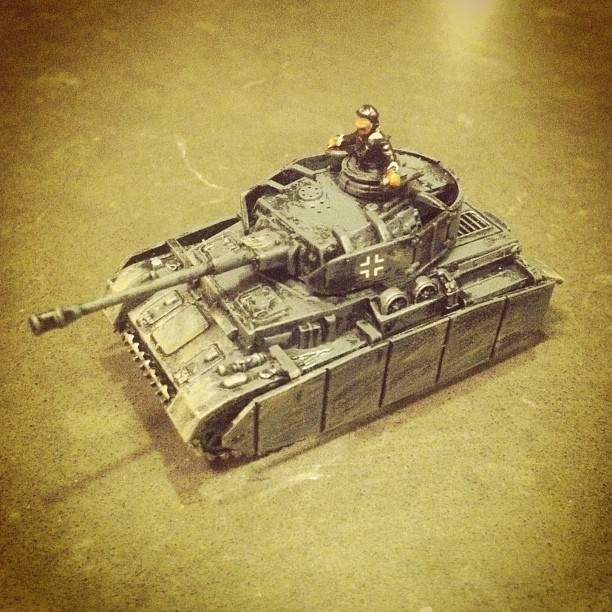
FOWpzIV

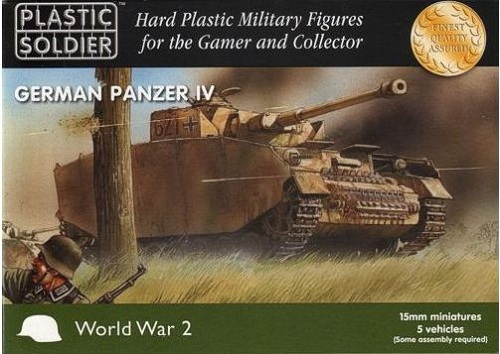
pscpziv

I already own a fair amount of German armor with Tigers, Panthers, Jagdpanzers and Stugs, but my force was sorely lacking in Panzer IVs. Most of my German tanks thus far have been from Battlefront, the makers of Flames of War (FOW). They offer a late war Panzer IV platoon in the pricey $50-60 range, depending on whether you pick the set up online or in a store. Going on some recent experience with the PSC Allied Stuart tank set, I went with the Panzer IVs from the Plastic Soldier Company (PSC) at about half the FOW cost.

pscpzivsheet

Unlike the FOW sets, PSC kits come with options to model miniatures in several periods. This allowed me to model my tanks as the later war Panzer IV Ausf H with its extra armor and gun power. Like the Airfix kits of my youth, the PSC tanks are comprised of lots of little parts. The diagrams included in the box offer clear color-coded keys to getting the correct pieces off the sprues and blow-up schematics for gluing the pieces together. If you’re like me, keeping your workspace clean and organized will prevent you from losing your mind during the multi-step assembly process. The sprues also leave some leftover parts which either go straight into the trash or into container of miscellaneous plastic for future modelling use.

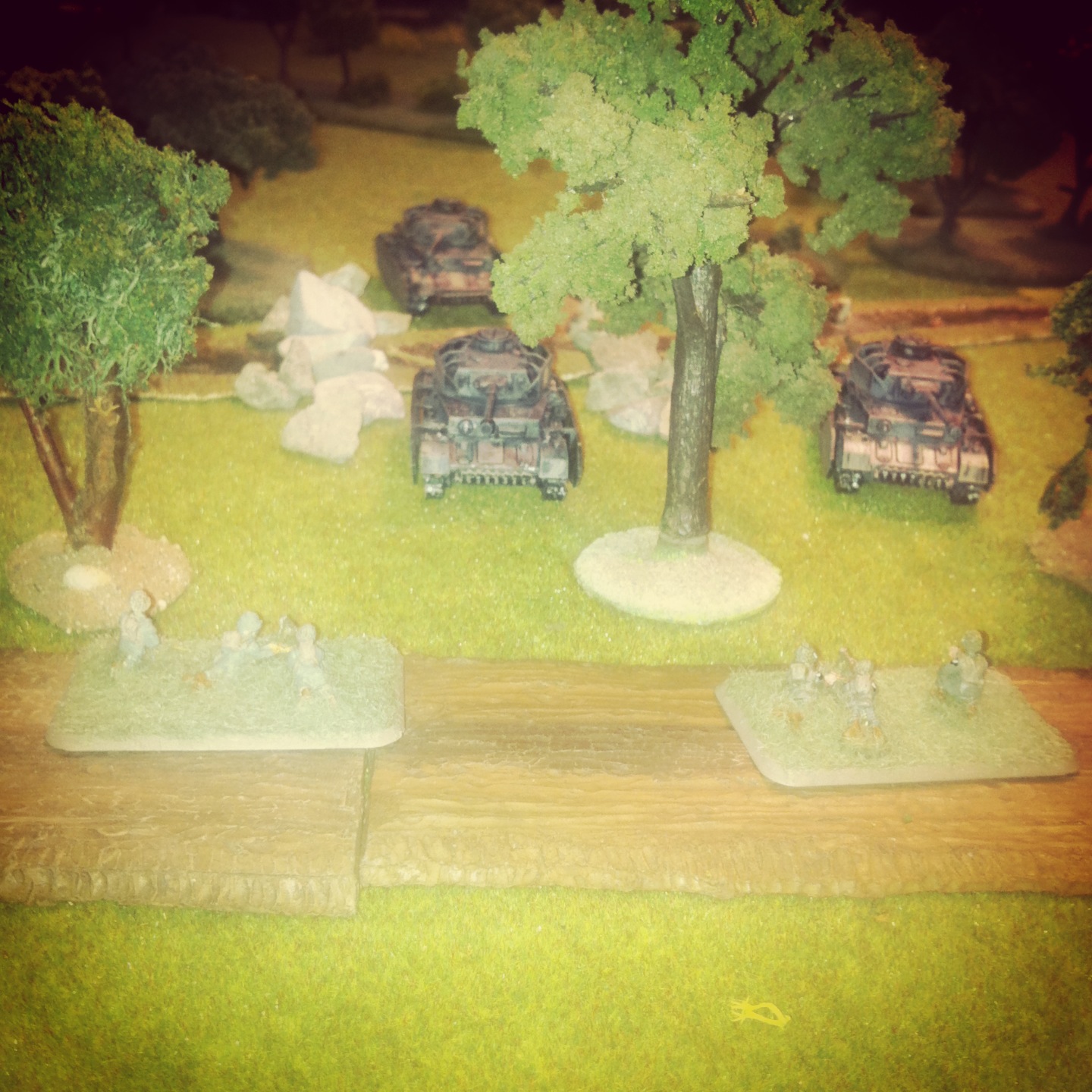
Lots of parts means lots of steps. The turrets alone are compromised of 9-10 parts and aligning the tank tread sections needs to be done carefully. I also found the hole on which the turret sits to be a bit tight, so I carefully drilled those out slightly larger. My Panzer IVs were completed with a basic grey-schemed paint job over a flat black spray base to match my existing models. With assembly, painting, decals and a matte finish finishing coat, these tanks are ready to hit the table in just a couple work sessions.

Compared to FOW models, the PSC tanks take a bit longer to put together and parts can be finicky, but I really like the PSC models when complete. The PSC tanks offer crisper molding and some fine details like a slight sag in the upper parts of the treads and hangers for the  side and turret Schurzen. Models are light, making for easier storage and transport. Putting together kits from PSC just feels a lot more like model building than what you experience with FOW and some other manufacturers.

pzivcommand

pzivplatoon

With so much economic pressure on miniature wargame funding budgets, you can’t beat getting more armor in the field for the low cost and fine results from the Plastic Soldier Company’s Panzer IV kit.