Flames of War: Singling 1944 Scenario

4tharmor

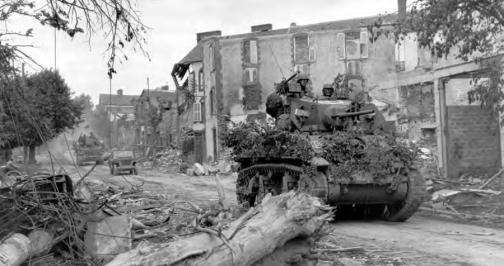
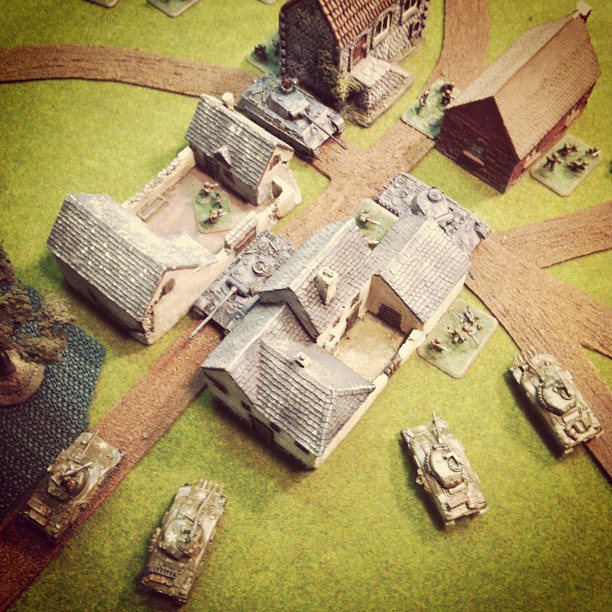
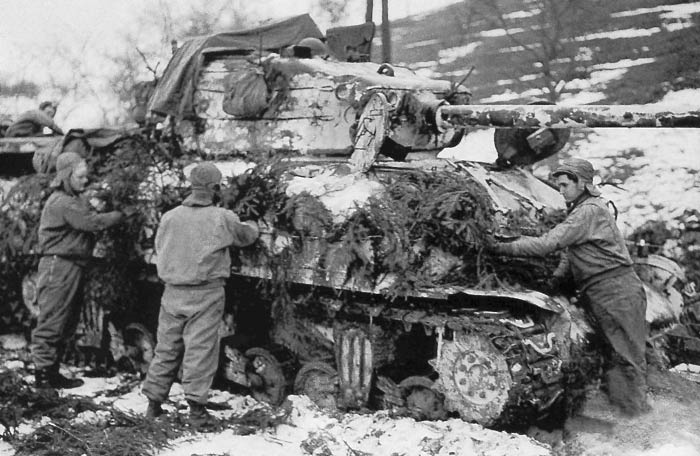
By the winter of 1944 the US 4th Armored Division had distinguished itself through a number of actions in France ranging from Operation Cobra in July and the Battle of Arracourt in September all the way through various engagements heading east toward the French-German border. Battleworn and bogged down in the wet winter slush of eastern France, the 4th Armored lumbered to the outskirts of Singling, Lorraine on December 6th, 1944. As part of the defensive Maginot Line, a hasty attack was thrown together to take the farm town with a small force of tanks and infantry. Finding themselves caught up fighting superior elements from the German 11th Panzer Division between the cottages and tight roads of the village, the day’s battle eventually fell to a stalemate and the 4th Armored pulled back. In the coming days, a hail of American artillery and subsequent ground force attacks eventually took Sibling.

SinglingMap44

The WWPD site has a handy Flames of War scenario available for the action at Singling called Abrams’ Folly. In addition, there’s some other gaming-freindly write-ups available online as well as some great historical documentation (including maps and photos) on the battle at Singling. Before heading off to an annual family vacation to Cape Cod, I had a chance to try my hand as the Americans in the Sibling scenario this past Wednesday evening at Metropolitan Wargamers in Brooklyn.

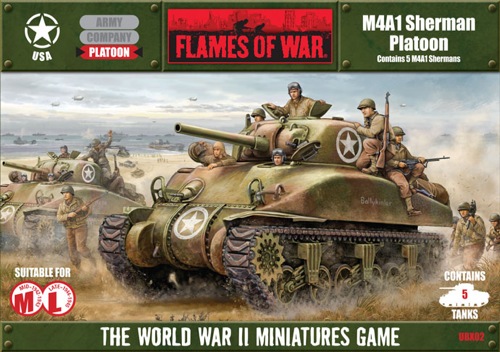
bggbookEach of us fielded 2500 points, sticking as close to possible with the forces outlined in the scenario. I used the Blood, Guts and Glory book which focuses on the armor-heavy battles in this region of France in late 1944 through early 1945. My force featured a mix of 75mm and 76mm Shermans, some tank destroyers, two armored rifle platoons and an off-table 105mm Priest battery. My German opponent started with a Panzer IV platoon, a Jagdpanther platoon, an 10.5cm leFH18 battery, a platoon of Pak 40s and a couple infantry platoons. As it was historically, the Americans were clearly in for a tough fight.

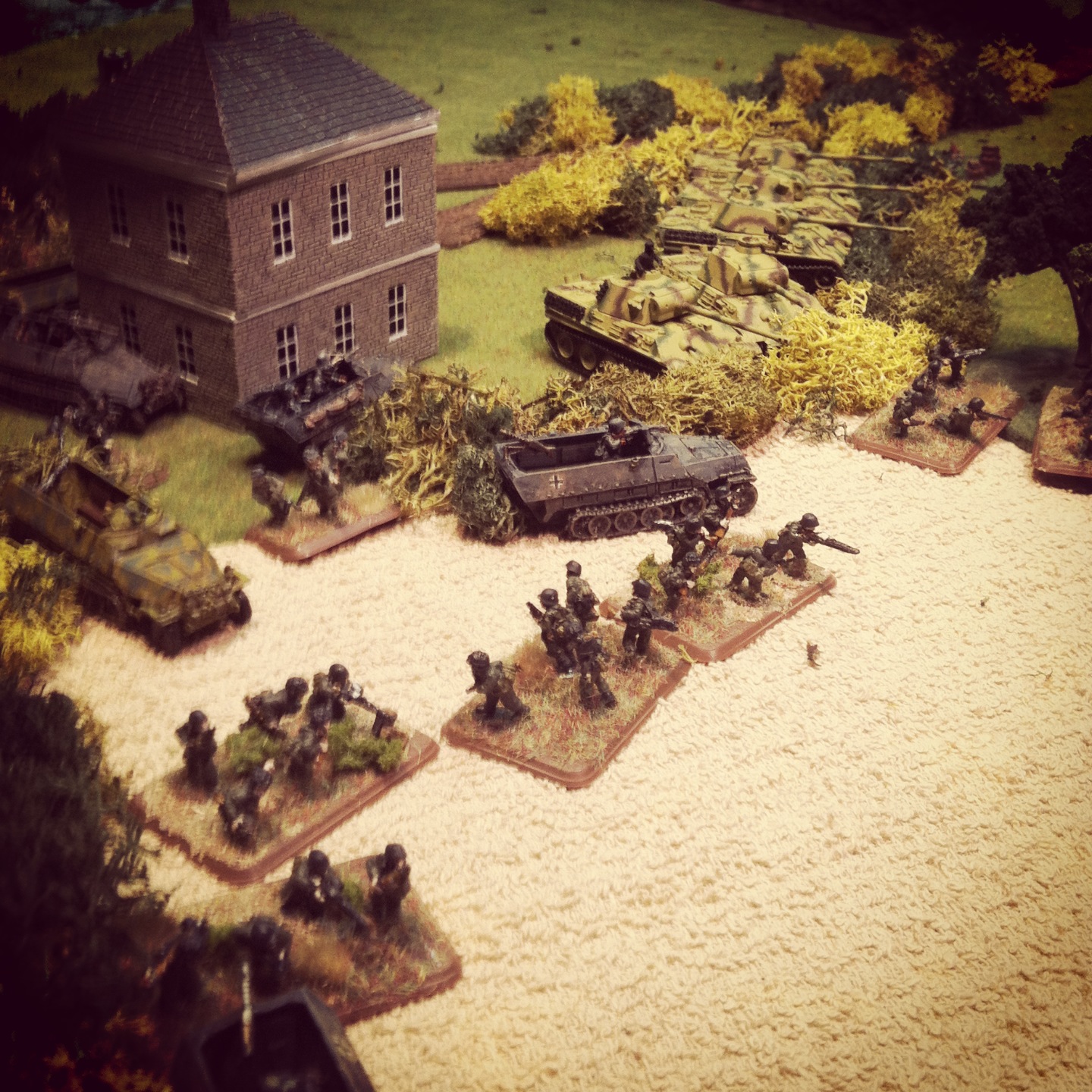
In December ’44, the US entered Sibling from the south but the scenario places the American point of entry at the western edge of the table. The Germans deployed first with infantry and Jagdpanthers in the town, the Panzer IVs to the northwest and the Pak 40s in prepared positions to the southwest. The artillery battery was positioned to the northeast of town with spotters stationed in the church belfry and the attic of a house near the town center.

siblingtable

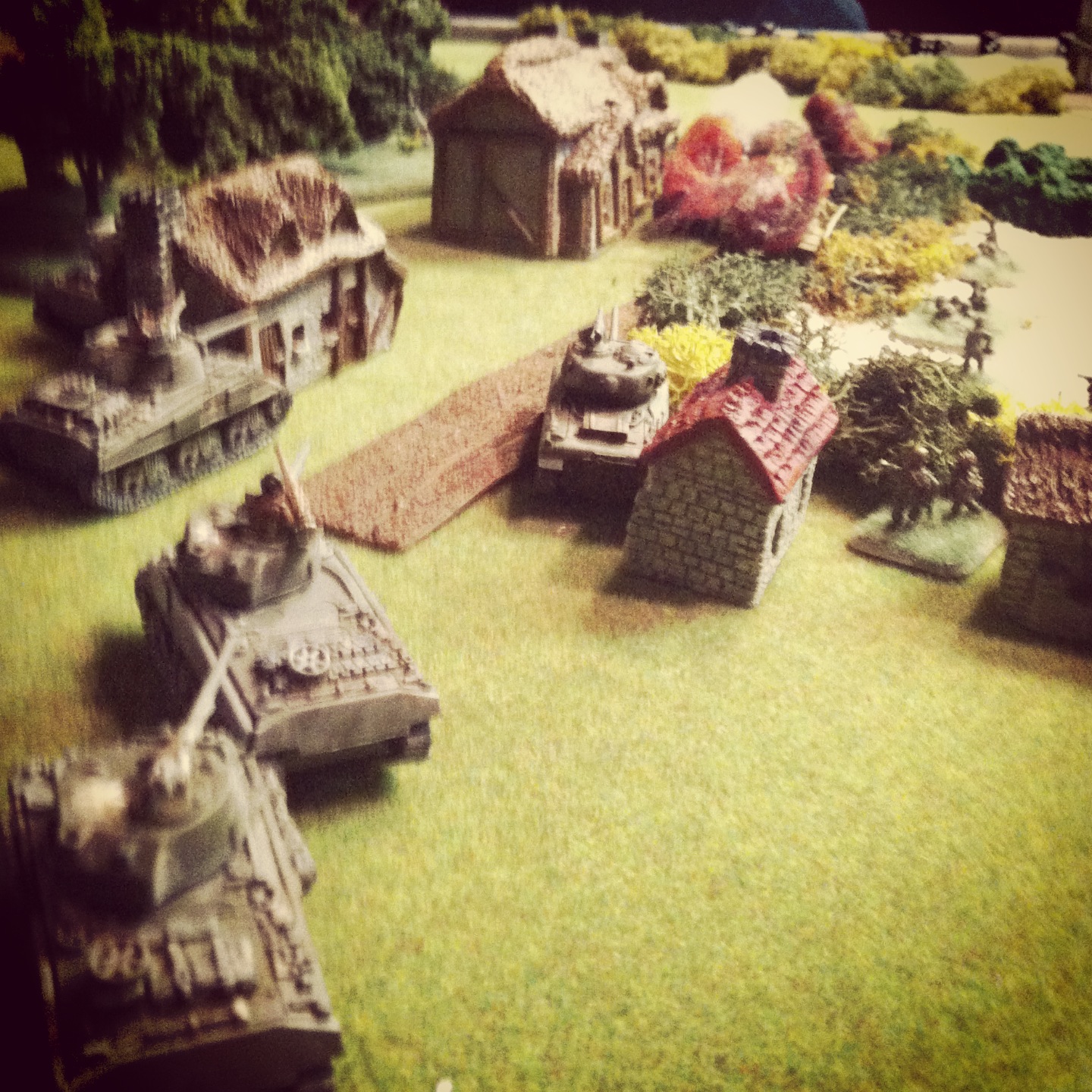
With the first turn, the Americans rolled in around the main road to the west. Seeing the Pak 40s, all the armor rolled north toward the Panzer IVs parked around and behind a small copse of trees. Infantry platoons made way for the center and the orchard just south of the road. My US plan was to avoid the killing alley of the main road while the infantry would swoop toward an assault on the infantry and Pak 40s to the south and the armor would rumble to the north toward the German tanks.

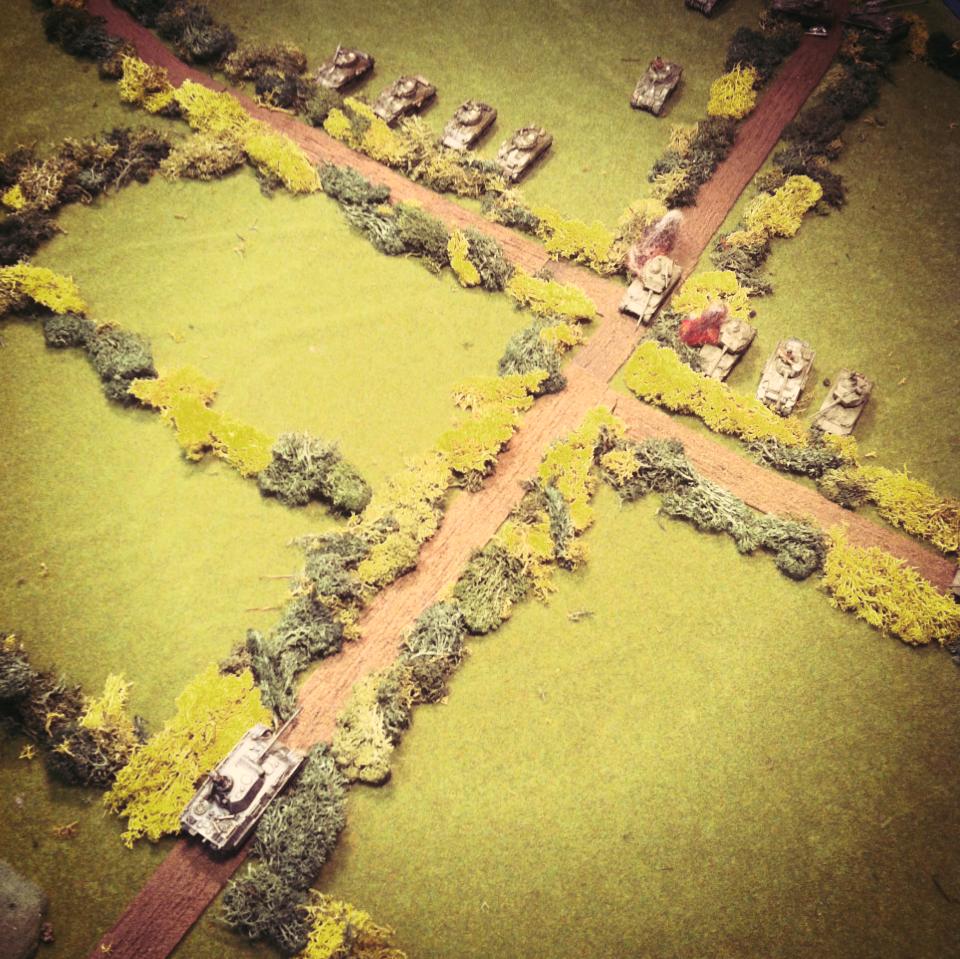
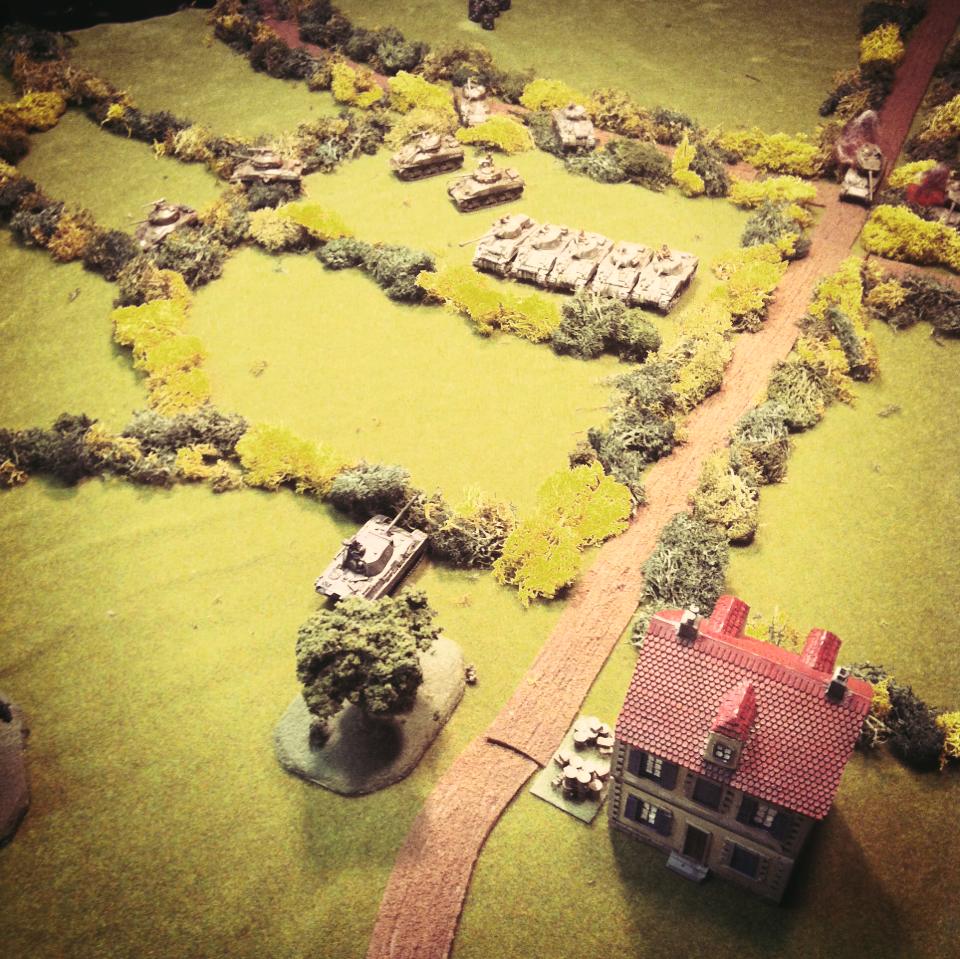
The US 76s made quick work of the Panzer IVs in the first two turns and then turned toward the center of town. The Jagdpanthers crept out from behind buildings and took a few a shots down the road, eliminating a Sherman. A German platoon camped out in a house at the western edge of town made a misbegotten attempt at an assault on the Shermans, bailing two with Panzerfaust fire but ultimately running off when faced with return attacks from the US armor. Another Panzerfaust-wielding squad popped out from an adjacent cottage and destroyed another Sherman with a quick rear shot before being machine-gunned down. By the end of the third turn, the northwest area of the table was a snarl of burning German tanks and shaken but advancing US Shermans.

32387_10201314045587525_1920471111_n

1185574_10201313808021586_457796402_n

To the south of the road, a stalemate which would run the whole game commenced. The Priest battery struggled to range in and hit the Pak 40s on every turn, proving to be a complete waste of points. The American armored infantry platoons to the south of the road spent most of the game being pinned by German sniper fire and artillery barages, all the while struggling to progress through the orchard. Not until the fourth turn of the game did the American infantry truly get in the fight, exchanging fire with two nearby platoons of Germans but losing nearly half their number to fire from the Pak 40s and German heavy machine guns.

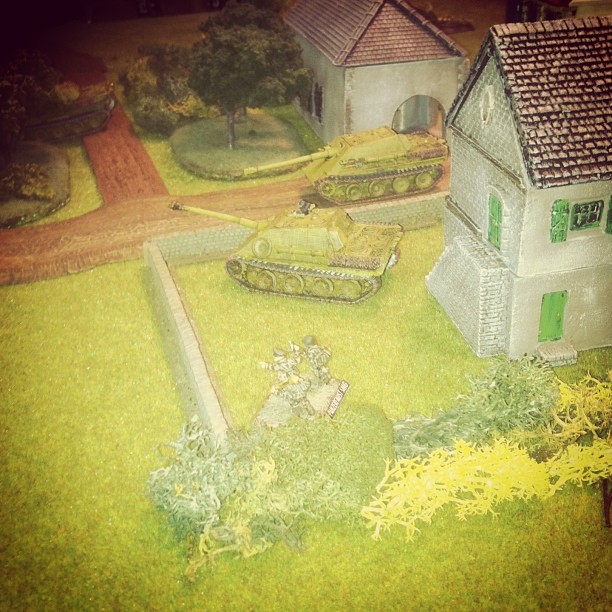
In turn four, things got bad for the Germans. After littering the field north of town with charred wrecks of US armor, several American tanks broke to the middle of town toward the three remaining Jagdpanthers. A near-certain side blast to one Jagdpanther glanced off with no effect, but then an extremely lucky shot from a US 76 destroyed the Jagdpanther command tank. While the Germans scrambled to appoint a new command tank, the Americans ganged up to destroy one of the two remaining Jagdpanthers. With the platoon reduced to just one remaining tank, the German player rolled and failed a morale check and the last tank fled the center of town.
267391_10201314392956209_640393299_n

1235934_10201314392676202_1206092596_n

With the center of town secured, all German armor destroyed, a stalled infantry firefight to the southwest and the American tanks advancing to the German artillery battery, the game was called at the fifth turn. I was honestly surprised by the American victory, upsetting the historic outcome of the battle. We stood around for some after-action what-ifs for both sides while packing up the table, and clearly there could be improvements in choices of forces and tactics the next time we head back to Singling.

Favorite Kickstarters of the Month (August 2013)
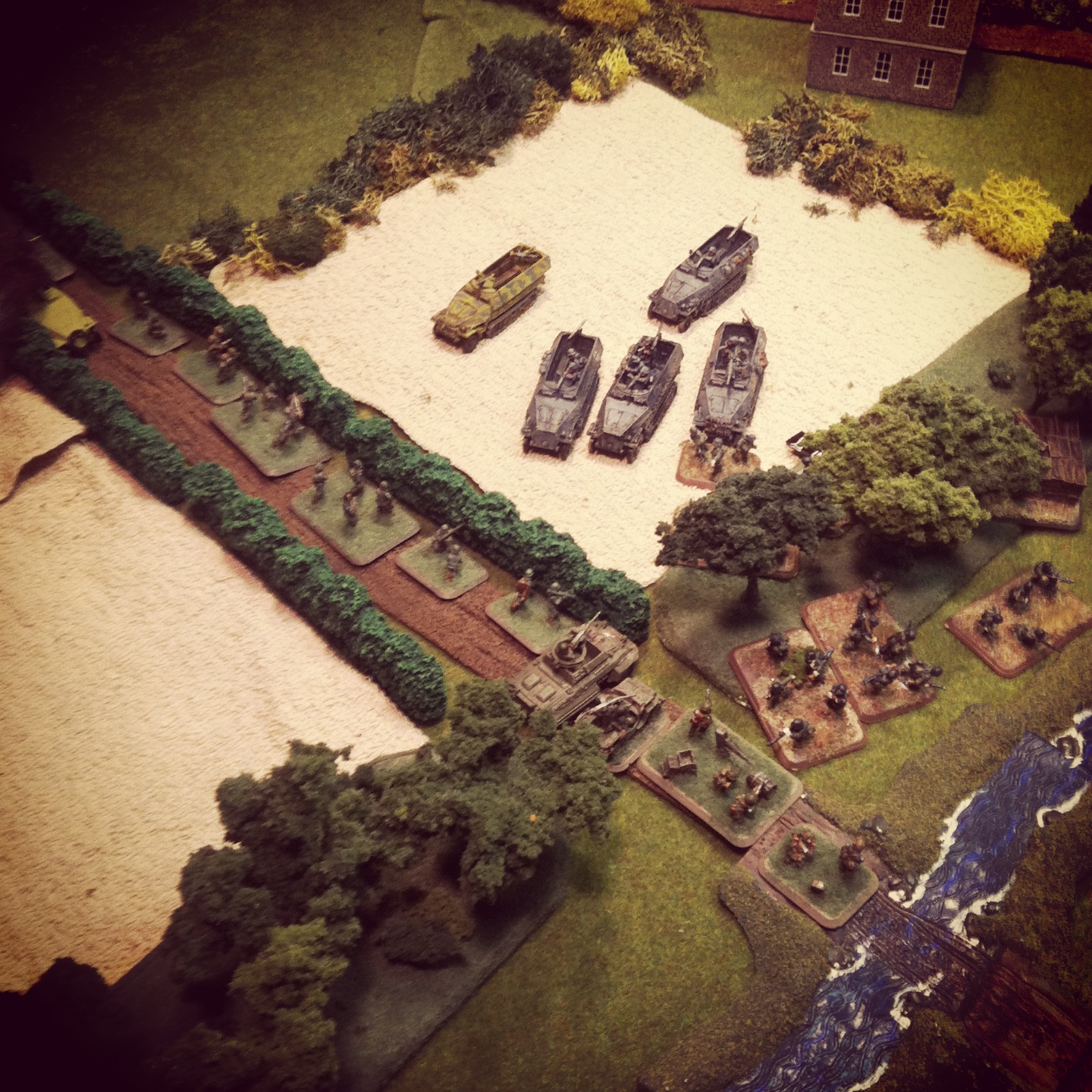
These days it seems like a month doesn’t go by that some Kickstarter horror story makes the rounds. Projects vanish, people lose money to scams or entrepreneurs running Kickstarters go belly-up with their success. This past week, the owner of a successfully-Kickstarted game called Corporate America wrote about his experience. The piece gives a solid, balanced look at the real economics behind running a Kickstarter game campaign. It’s a good read and worth bearing in mind while taking a look through the game campaigns I’ll be watching this month.

duelA Duel Betwixt Us: This two-player card game pits two 19th-century gentleman in a game of manly combat. By using their workers, each player is able to mine for ingots used to create weaponry and armor for combat. Once ready, a player selects a duel and then brings their arms, armor and stack of dirty tricks to the fight. The very Victorian artwork reveals a hilarious game of codpieces, drunken miners, oddball weaponry and double-crossing at every turn in the quest of woman’s favor.

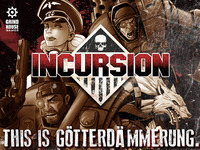
incursionIncursion: Released by Grindhouse Games in 2009, Incursion is yet another take on an alternative post-WWII world where Nazis and Allied forces persist in protracted combat as a Doomsday Device threatens world destruction for all. This sci-fi-fuelled game is full of fantastic weapons, evil scientists, daring heroes plus zombie Nazis and combat gorillas. This second edition and expansion of the game adds all sorts of plastic miniatures to the game, new missions and rules for three players.

freedomFreedom – The Underground Railroad: I grew up in Western New York, a hotbed of the Abolitionist movement and gateway to Canada for escaping slaves. Academy Games is adding the story of the Underground Railroad to their Birth of America Series of games that has already covered the American War of Independence and the War of 1812. There’s a lot of real history packed into this intense strategy game as players take on the role of allied abolitionists alluding slave trackers while escorting escaped slaves north to Canada along eight routes. Historical events and people shape the game along the way, making this game a really fascinating vehicle for retelling the story of the Underground Railroad.

TemplarTemplar – The Secret Treasures: I’m a fan of a number of the Eurogames produced by Queen Games, and Templar looks to be another fun hit. The game plays on two boards, a “harbor board” of warehouses and the other a detailed floorplan “abbey board.” Moving between the boards, players seek to find and hide treasure relics throughout the abbey by playing different character cards. Characters like the Prior, Abbot or Spy act to either aid or foil the Templar’s plans.

zerohourZero Hour – Survivor Horror Card Game: Aside from the occasional run-in with some zombies, I’m not generally a horror gamer. Zero Hour could change that. Play begins with 30 children stranded in the woods after their bus driver dies. Soon, weird things begin to happen in the woods, pushing each child closer and closer to insanity. Somehow, the children have to survive the night until the zero hour at dawn. The gothic design and theme of the entire game makes this look to be creepily attractive. A bonus part of the campaign is a tall plush Slenderman doll, certain to please the darkest child within you.

Flames of War: Fielding the PSC Stuart Tank

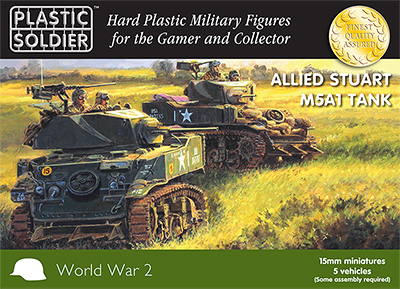
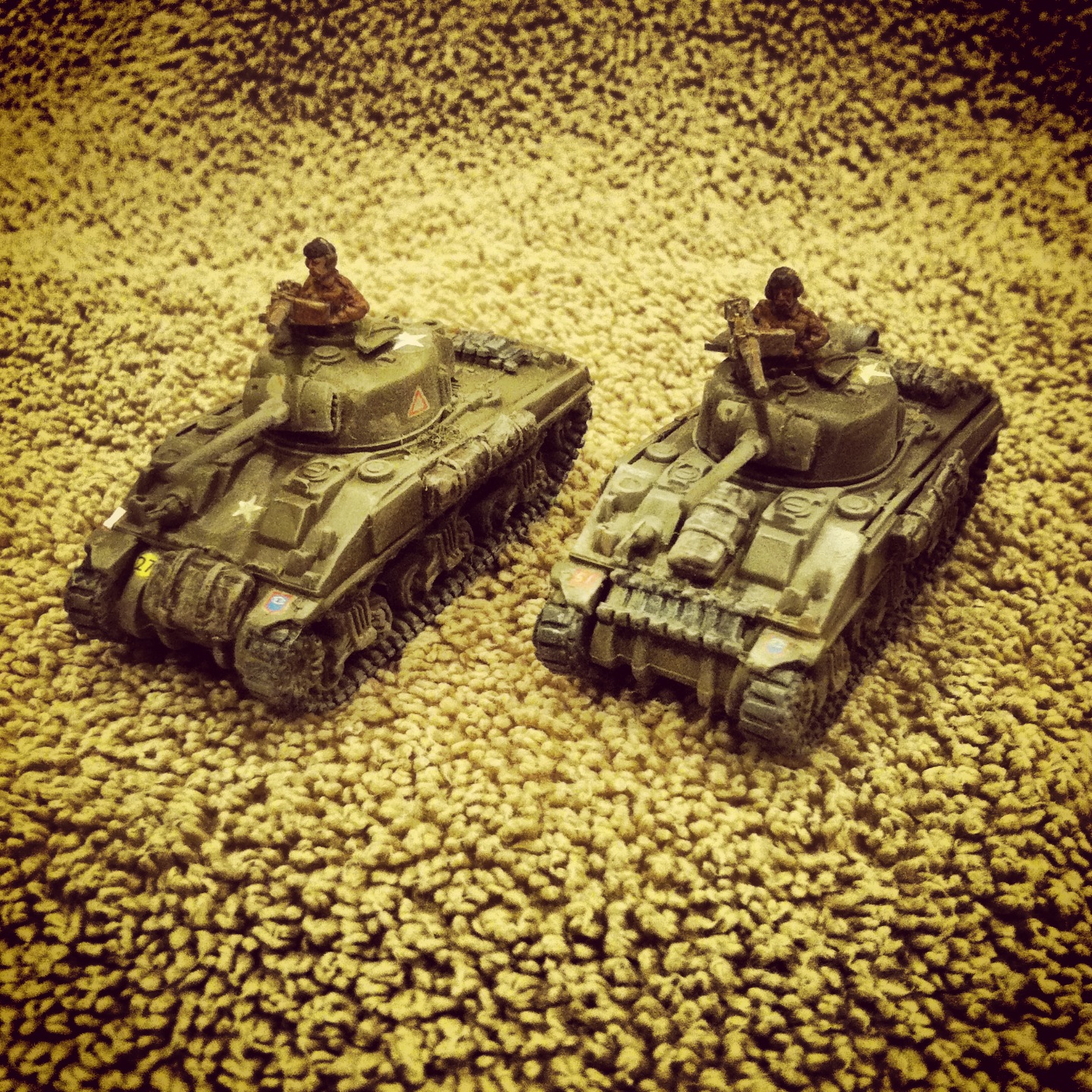
While the durable US M4 Sherman gets most of the glory in the annals of WWII Allied tank history, the M3 Stuart also played a significant role in providing valuable infantry and reconnaissance support throughout the war. The Stuart was originally supplied to the British ahead of the US entry into the war, but American tank crews would eventually use them throughout the European, African and Pacific war theaters. Armed with .30-calibre machine guns and a 37mm main gun, the Stuart proved itself to be a finicky yet effective part of many of the war’s major actions and campaigns, including the D-Day Normandy campaign of 1944.

Most of the US armor I use in Flames of War gaming comes directly from Battlefront, the makers of the popular 15mm WWII wargame. Battlefront manufactures beautiful models but the company is often criticized for its prices. I already own a fair number of Battlefront’s M4 Sherman tank models. With so much of my armor tied up in the sameness of my Sherman platoons, I’ve long wanted to add some diversity in my force with a light tank platoon option.

Coincidentally, the Plastic Soldier Company has recently been expanding its small but growing line of 1/72 and 15mm WWII hard plastic infantry, vehicle and armor sets. At nearly half the price of the FOW offerings, the 15mm Plastic Soldier Company boxed sets look to be a legitimate bargain alternative. As luck would have it, among their new releases from the past month was a 15mm Allied Stuart set containing five models which make up a perfect light tank platoon for my FOW force.

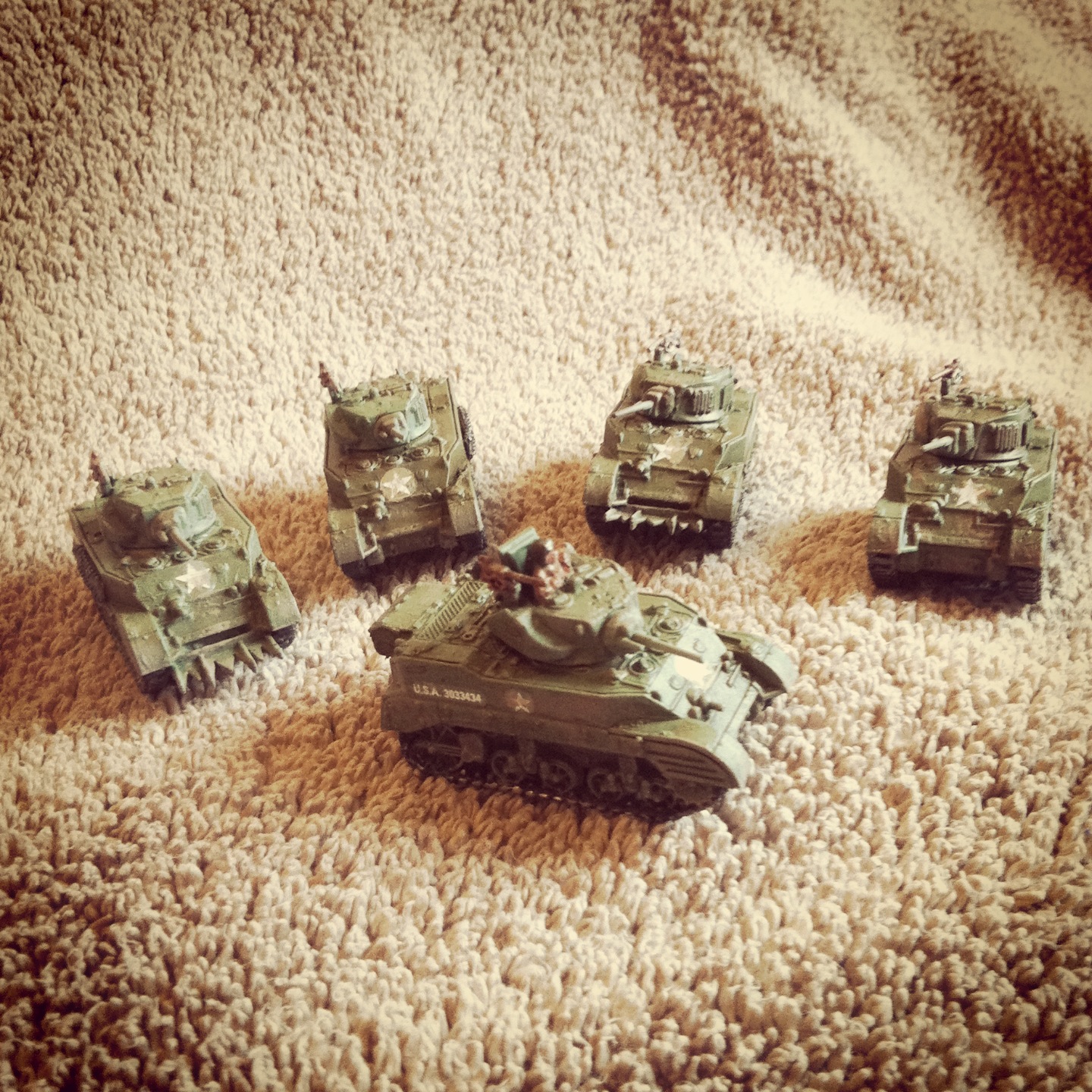
Despite the relative low cost, I approached my first go-around with the PSC with a critical eye. The Stuart set comes with enough parts for five tanks from the early, mid or late WWII periods. The flexibility of the modelling is fantastic, but it does result in a bunch of unusable waste parts left on the sprue. Gluing the models up for the late war was fast, with the finely-detailed casting going together smoothly. A relectuant criticism of these otherwise excellent models is the way in which the turrets fit to the hulls with tabs which were a bit tight for my liking. I wound up cutting the tabs off so the turrets move more freely, but this extra step did destroy the other strong points of the PSC models.

After the glue dried, the models got a coat of green armor spray followed by some black and metallic paint brushed on the treads. Tools and stowage attached to the hull were picked out in detail, and then all the tanks got a watered-down brown wash. I applied some appropriate US decals I had left over and then the tanks got some splattered mud details in a lighter mud color.

IMG_1956

The result of my Stuarts and my first experience with the Plastic Soldier Company is entirely satisfying. Not only can’t I wait to roll these fast, deadly tanks onto the table in my next game, I likewise will be anxiously awaiting what new releases the company has in store to further build-out my forces.

Flames of War: Barkmann’s Corner Scenario

panther

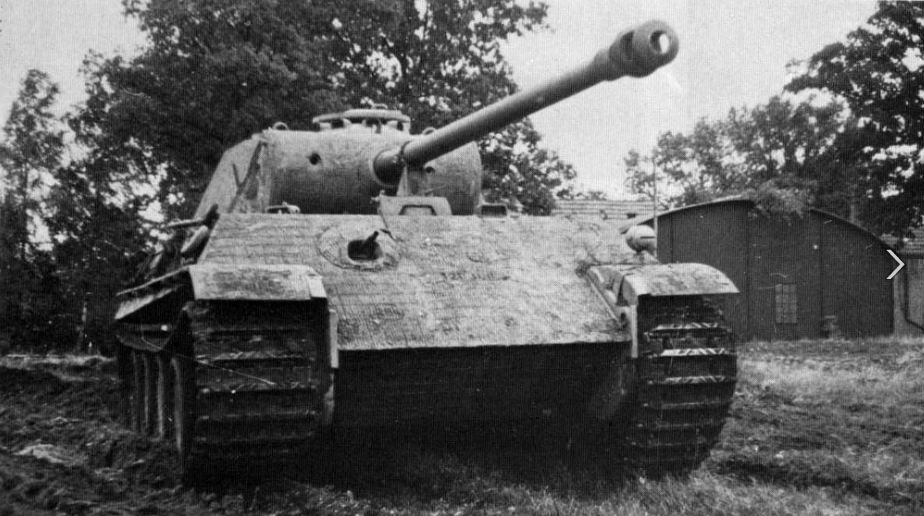
Ernst Barkmann was one of the top German tank aces to fight in World War II. Commanding a Panther tank, Barkmann served throughout the entire war on both the Eastern and Western Fronts. Not only was he deadly while at the command, but his crew became adept at making on-the-fly field repairs and getting back into action. By the time he surrendered to British forces in the spring of 1945, Barkmann had become one of the most decorated German tank commanders of the war. He was not yet 26 years of age.

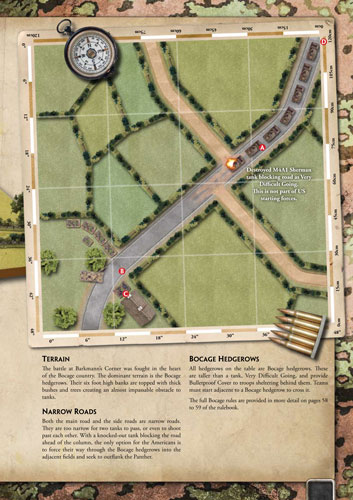
barkmannmapFlames of War offers a special Ernst Barkmann warrior set which includes Barkmann commanding his Panther plus a separate mobile repair shop. FOW also provides free scenario rules for the famed “Barkmann’s Corner” engagement from July 27, 1944. Fought in the Normandy region of France, the small battle is a classic in which Barkmann’s single tank went up against a column of over a dozen US Sherman tanks. In the end, nine Shermans and other vehicles were destroyed before Barkmann was able to slip away to safety. I’ve had the Barkmann model painted up for a few years, but I had never fielded it in a game of his most famed run-in with the Americans. With a frequent summer guest of the Metropolitan Wargamers club leaving NYC for home in Florida this coming week, the two of us got together this past weekend to have a go at the scenario.

As per the rules, the small 4′ x 4′ playing area is set with fields and roads heavily crisscrossed with the high bocage hedgerows of Normandy in which I love to set my games. Barkmann’s tank and his supporting Panzergrenadier platoon begin dug into positions around a small farm at one end of the board. In the opposite corner, the US tank command group and their first platoon of M4A1s begin the game slowly rolling down the narrow road but blocked by a burning tank. The first platoon is strengthened by the presence of Staff Sgt. Lafayette Pool, another special figure offered from FOW. Historically, Pool wasn’t at this engagement but the inclusion of the hard-charging tank ace from Texas helps balance the scenario a bit. Two larger platoons of Shermans lie in the column off the board but enter on turn two and three. The Americans need to keep things moving and Barkmann’s there to stop them.

With the first turn, the US armor column begins down the road toward the farm objective in the near distance.

bark1Barkmann lies in wait behind a small copse of trees with the Panzergrenadiers gone to ground behind the bocage.

1075723_10201126852027803_1689119621_nIn the next few turns as the Americans slowly moved over the dense bocage lining the roads, the US plan became clear. The command tanks and Pool’s platoon headed toward the house and the German right flank. The remainder of the Shermans broke toward the German center and left, bogging repeatedly along the way. In the meantime, Barkmann moved to the far side of the farm house to protect his side and line up several shots on Pool’s platoon.

995453_10201126853307835_1344971388_n

3637_10201126853787847_675127225_nWith the Americans splitting in two directions and the German infantry safely in the house, Barkmann took several side shot’s at Pool’s platoon and then rode bravely to the road to begin taking shots at the approaching center Shermans. As Pool became the final survivor of his platoon, Barkmann swung his attention back to his left flank and the bulk of the closing US force which had freed itself from a series of challenging bogged turns.

992833_10201126854147856_848082758_n

538975_10201126854827873_1979156013_n

538971_10201126855507890_695500397_n

1012007_10201126856347911_1734345823_nAs the two largely-intact surviving Sherman platoons continued to attempt a flanking move on Barkmann, his Panther was forced into movement each turn to align shots and stay covered. Pool also managed to pour fire into the farmhouse with his main gun, eliminating some of the Panzergrenadiers before fleeing the table on a failed motivation test. With the twelfth and final turn, Barkmann had backed himself up to the house to protect the objective and eliminated a couple more tanks along the way. Had there been one more turn and roll of the dice, and the game would’ve gone for the Americans.

1011343_10201126857107930_1603972880_nAfter the large Total War scenarios at the club the previous weekend, it was a welcome break to play a small yet engaging battle with a limited amount of models to command. The bocage is the great equalizer in the scenario, providing alternate turns of benefit and frustration to each side as movement is stalled and lines of sight are blocked. Having read a number of historic accounts of the field-to-field fighting throughout Normandy in the spring and summer of 1944, the Barkmann’s Corner scenario went a long way in showing that choosing where you fight can be one of the most important factors in the outcome.

Related articles

New Game Weekend: Sid Meier’s Civilization: The Board Game

CivBox

Unlike myself, electronic games have been a constant presence with both my sons since they were born. Now aged 8 and 13, my boys have graduated up through a host of platforms and games with the Leapster, DS, PS2, Wii, PS3, online through sites like Steam and on the iPhone. Over the past year, their obsessive play over Minecraft has been gradually replaced with scores of hours logged with the wildy-popular Civilization V.

Developed more than 20 years ago by Sid Meier and Bruce Shelley, the Civilization franchise has evolved from a PC-only DOS game to occupy a variety of gaming platforms. The turn-based civilization-building mechanic and historical theme sets up an incredibly-engaging and educational universe for players to plan and play out a nearly-endless variety of paths in human advancement from the ancient era to the near future. The latest iteration, Civilization V, broke on the scene in 2010 with two expansions since. Worldwide, the game has sold millions of copies and has continuously won accolades from a couple generations gaming critics and devoted fans alike.

Even though my kids are devoted electronic gamers, they’ve also been raised with a healthy love for card, board and miniatures gaming. So, when my 8-year-old caught wind last week that a boardgame version of Civilization existed, I leapt at the chance to introduce the boys to the game. I’ve played a number of civilization-building games such as Clash of Cultures but hadn’t yet played Civilization.

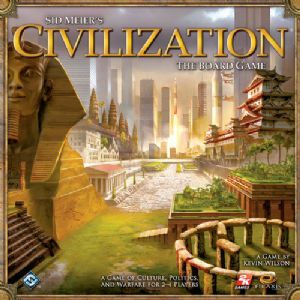
Now published by Fantasy Flight Games, Sid Meier’s Civilization: The Board Game has been around since 2002 and can be found at your local Barnes and Noble for $60 or cheaper online. Like many games of this type, the box comes stuffed with hundreds of components plus more than 300 cards. Geared for 2-4 players ages 14 and up, Civilization takes 3+ hours to play. Fortunately, my boys have been exposed to enough games, both online and on the tabletop, that they’ve been able to quickly pick up on the basic play and strategy Civilization offers.

CivContentsCivilization involves a march toward victory in one of four ways: Economic, Military, Cultural or Technological. Players begin by selecting a civilization such as the Americans, Egyptians, Romans or Russians. Each starting civilization carries its own strengths in play, making this first choice an important one in setting your strategy for the game. Based on the number of players, a map of hidden tiles is laid out and the market area is set up to the side of the board.

After set-up, the game progresses through a series of turns. In the Start Turn, a player may build a city or change their government type – an important choice which can greatly affect the path of a player’s civilization. Next, the Trade Phase allows a player to reap trade points from the areas around their cities and offer trades in resources with other players.

In the City Management Phase, the player may build units or buildings, harvest resources or focus on developing their culture. Building units – Scouts or Armies – allows the player to explore and conquer areas of the board. Constructing buildings such as Markets, Temples or Baracks allows a variety of bonuses to your civilization. At a higher price, Wonders like The Oracle, The Hanging Gardens or Angkor Wat may be built. Finally, a player may pay to build their military prowess through a progression from simple archers and pikemen to tanks and aircraft. Aside from building, a player may harvest resources such as silk, iron, incense or wheat to be later spent to activate certain technologies already researched. A player may also choose to focus on culture, with gained cultural points moving the player up the culture track while also earning special cultural event cards played to change different courses of the game’s play.

Next, in the Movement Phase a players may move their Scouts and/or Armies to explore, claim new territory or engage in combat with a barbarian village or another player. In the final Research Phase, players may spend their earned trade points to develop new technologies. The game’s “technology pyramid” is built progressively by each player as they grow from simple technologies such as Metalurgy and Horseback Riding toward higher level advancements all the way up to Flight and Nuclear Energy.

The play adavances through the above turns until a player arrives at a victory condition. Cultural victory is earned by completing progress on the culture track. A military victory is won by conquering an opponent’s capital city. Earning a technological win is done by completing the technology pyramid all the way up to Space Flight. Finally, an economic outcome is reached by collecting 15 gold coins earned through various actions your civilization makes throughout the game.

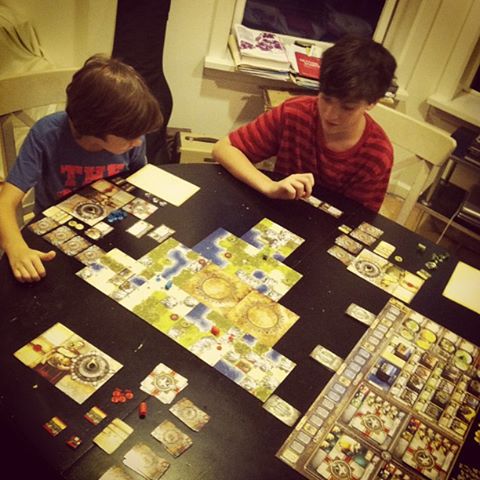
To summarize the game in a couple paragraphs is hard, as the variation of play in the game is boundless. This weekend, my younger son and I played through our first quick starter game on an eight-tile two player-map (pic below). Despite over twenty pages or rules and scores of playing pieces to manage, he picked up the game really fast. Along the way, there’s a ton of reading I’m certain is not covered in the general elementary curriculum with stops along the way to have side conversations on the meanings of words such as “despotism” and “anarchy.” At his age, my son’s memory is quite amazing and our discussions of the finer points of the rules has continued even away from the game table.

1001022_10201084784976153_1277385001_n

In our second game (pic below), three of us played on a larger map. My older son, a pretty experienced gamer at this point, blew threw a ten minute intro to the rules and played as the Prussians with an aggressively militaristic strategy I’ve grown used to over the years. Using the Egyptians, my younger son focused on culture and building construction. For my own strategy, I played as the Romans with a healthy mix of the military and cultural expansionism for which their empire was known.

1004654_10201085941885075_1372920330_n

For parents and critics of them who decry the falling attention spans of today’s kids, weekends like this past one show how with a bit of parental creativity all the stereotypes simply fall away. A game like Civilization — both online and off — offers so many opportunities to build vocabulary, learn history and develop some complex multi-layered management skills I see sorely lacking in many of the adults I encounter. Over hours of focused play, not only are my sons and I developing our civilizations but we’re also developing each other — an investment in time together well-spent.

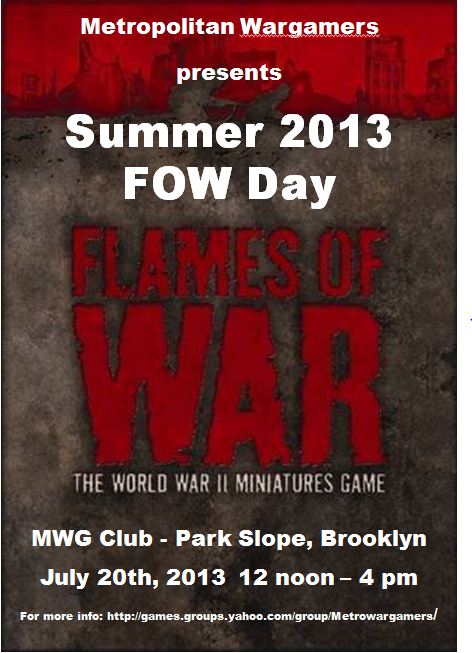
Flames of War: Metropolitan Wargamers Summer 2013 FOW Day

Taking advantage of a renewed interest in the popular Flames of War 15mm miniatures WWII wargame, Metropolitan Wargamers in Park Slope, Brooklyn hosted a big day of gaming this past weekend. Both experienced and new players alike came together on two of the club’s largest tables to play to big scenarios over the better part of Saturday afternoon.

Metropolitan Wargamers

MWGFOWI mention it often, but the amazing group of people who make up the Metropolitan Wargamers club bears mentioning again. The club will celebrate its 20th anniversary next year, and it’s a real gamers paradise for those of us living in New York City. Visitors and a core group of long-time members drop by the club throughout the week and engage in all manner of games, from boardgame favorites and card games to large scale historical miniatures battles and grand strategic campaigns. The club’s space occupies an entire basement-level of a typical Brooklyn rowhouse and is lined with shelves full of games and miniatures collected by members over two decades. Playing space includes a number of the club’s award-winning sand tables, regular tables and racks on which ongoing games can be stored as they are played out over the course of weeks or even months.

The club is an incredibly diverse and supportive environment for those of us who share our common passion in gaming. With 2014’s anniversary coming up, I hope to dedicate more space here in the near future with some history and perspectives from members.

Summer 2013 FOW Day

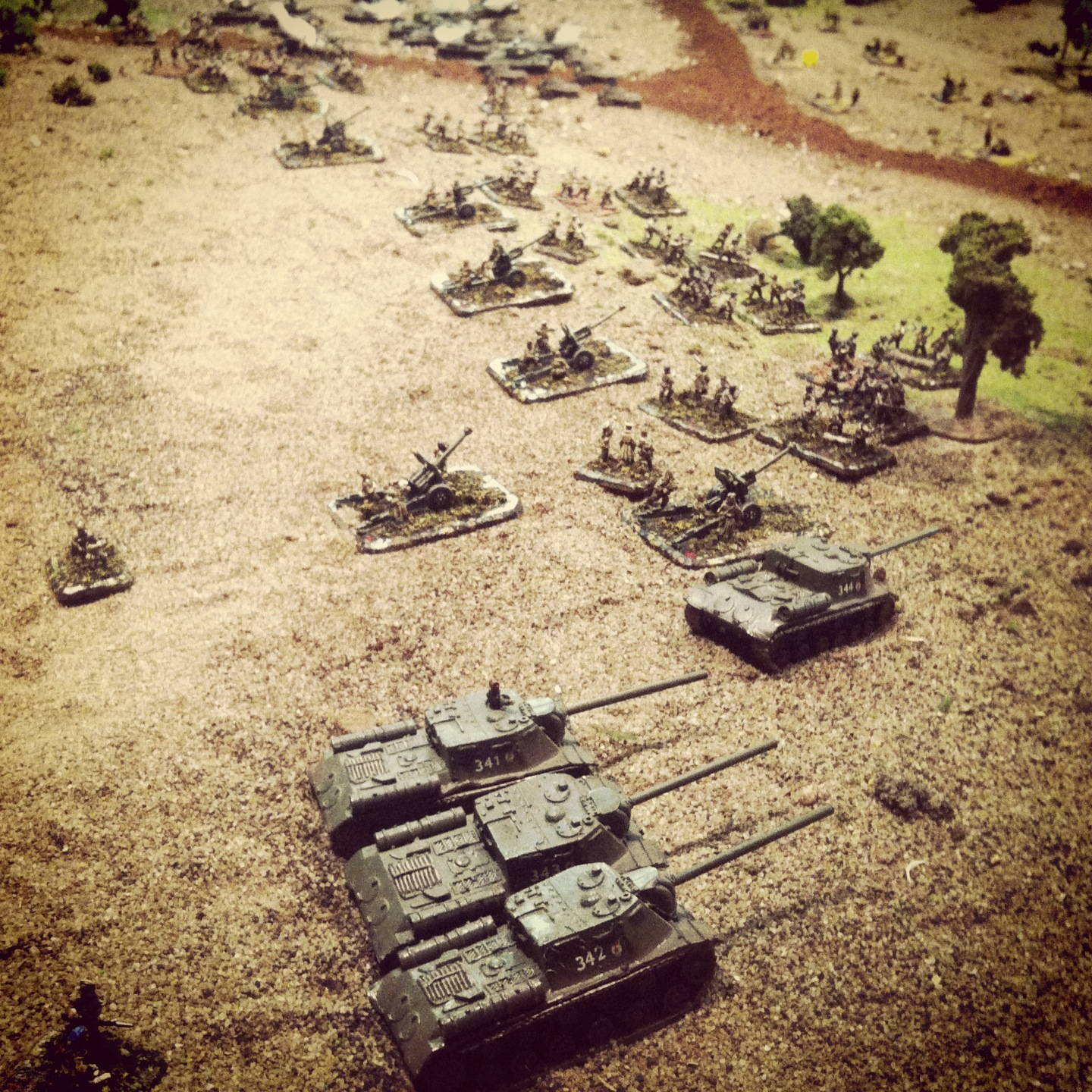
totalwarThe folks at Flames of War provide special Total War rules for gaming large-scale matches like those we played this past weekend. With a few weeks of planning, I helped round up 10 players for the day’s game. We settled on two games from the late war, one each on the Eastern and Western Front. The Western Front game featured two teams of two players each on the German and US sides with each team running 3000 points on a 4’x8′ table. On the Eastern Front, two three-player teams squared off in a tank-heavy scenario on one of the club’s famed sand tables with each team compromised of 5000 points. Each game featured endgame objectives and were slated to run to eight turns. With games these large, we were up for a very long day of action.

On the Eastern Front, the table was wide open with widely-sloping sculpted sand hills, small copses of trees along each long side and a Y-shaped road bisecting the table. I spent the day riveted to my own game on the Western Front table, but the German and Russian armor spent the day pounding away at each other. By mid-day, things had looked pretty good for the Germans as many destroyed Russian tanks stood smouldering midfield. All that changed in the latter half of the game as the Russians rallied to victory.

IMG_1908

IMG_1912

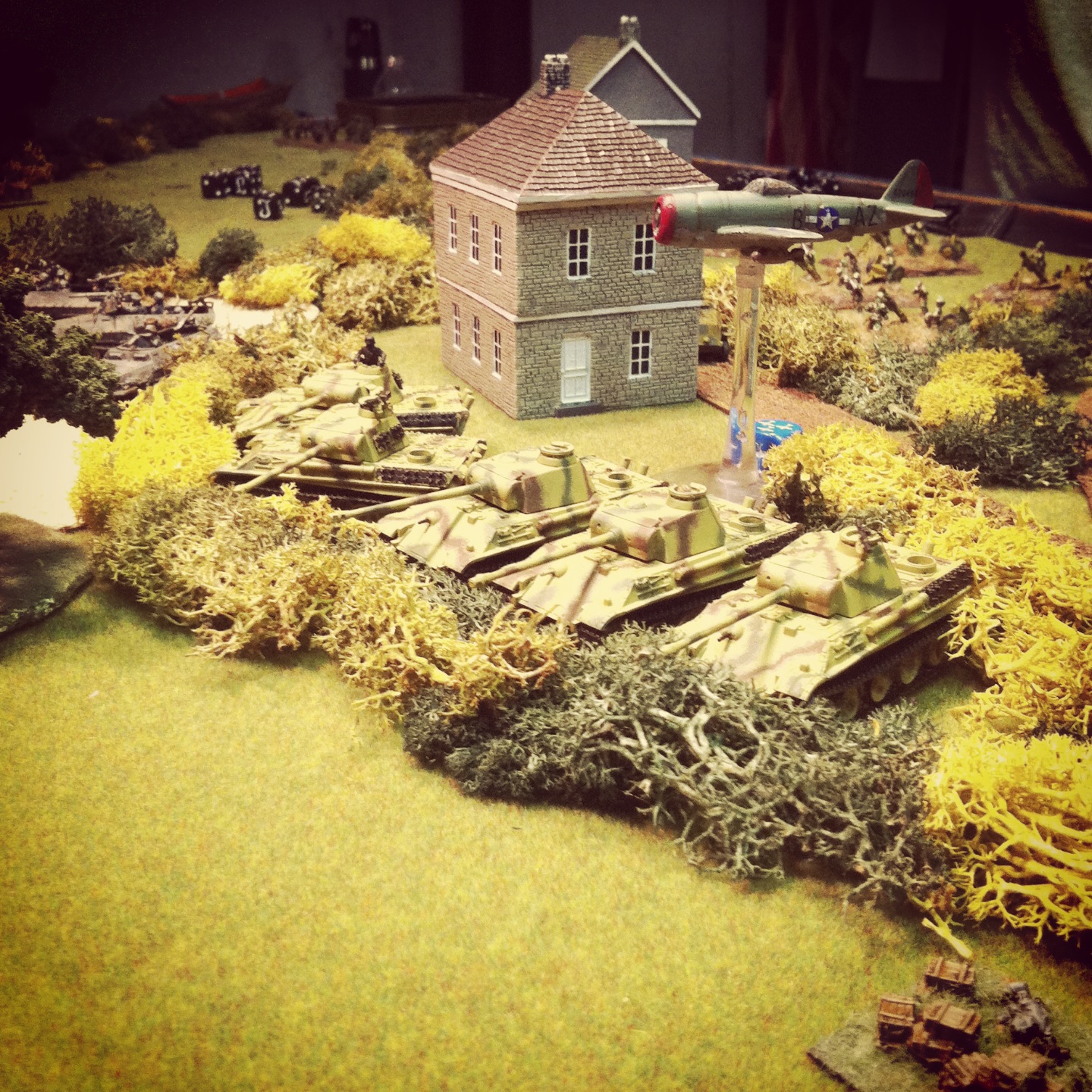
My game on the Western Front featured a generic French landscape cut up into winding narrow roads lined with the notoriously difficult bocage hedgerows which stymied both sides in the engagements fought in the region throughout 1944 and 1945. A church stared across the board to a stone bridge crossing a narrow stream to a small village. On the other end of the table, a small farm was set beside two wheatfields with two more rural stone houses in the near distance.

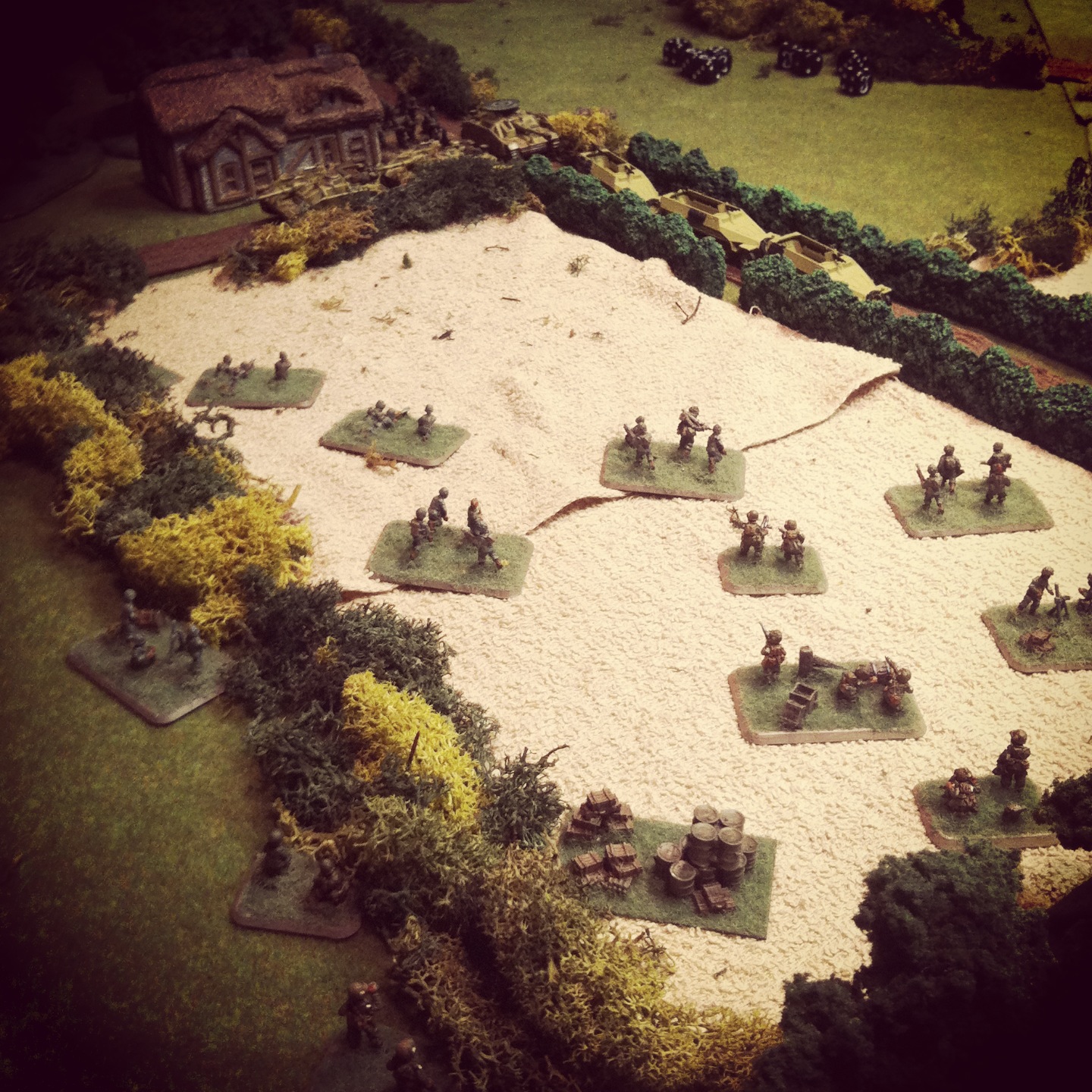
IMG_1903Our US plan was to place the majority of our armor on our right flank, supported by mobile infantry deployed in a small wood. On the left flank, the US Airborne deployed just outside the wheatfields with its small parachute battery to the rear. At the center of the board, our M7 Priests with their 105mm guns formed another battery while one lone Airborne platoon pushed to hold the buildings in the town with a vantage covering the bridge.

The game started poorly for the Americans as the Germans quickly pummeled the American Shermans and kept the infantry hiding in the woods. In the center, the US infantry struggled to occupy the buildings as the Germans quickly rolled five exceedingly threatening tanks behind a row of bocage overlooking two objectives. The American’s P7 Thunderbolt was likewise ineffective through the first few turns of the gaming, missing all targets except on German tank which burst into flames while bogged over a hedgerow.

IMG_1918

IMG_1906

IMG_1916

The fight on the American left went better from the start as the US Airborne filled the wheatfields and headed for the hedge and road beyond. A brief scare from a platoon of German Stugs, a row of halftracks and a platoon occupying the farmhouse  was solved with our trusty American Shermans. With a combination of artillery bombardments, heavy fire from the US tanks and some shooting from the advancing Airborne, the crossroads in front of the farm was turned into a smoking mass of destroyed German armor. Just as the German right flank stood wide open to the rolling Shermans, the command tank bogged in the woods where it and its entire platoon would remain for the rest of the game.

IMG_1914

IMG_1924By mid-game things looked good for the Germans, but the resilience of the Americans would prove to be the edge in the second half. The American armor was pretty torn up on our right flank, but the US kept making some remarkable morale rolls to stay on in the fight with the dwindling German tanks. At the center, the Priests had lost one of their guns but snuck back into cover to continue taking direct shots across the river at the remaining German armor. The US Airborne platoon occupying the town’s buildings risked a run toward the river, taking casualties along the way despite the smoke covering the German line on the far side. The fight between the wheatfields and adjoining treeline saw the Germans and Americans whittling each other down.

IMG_1926

IMG_1910

IMG_1920

IMG_1928

In the final turn, the 101st Airborne finally got in close enough for a tank assault, destroying one tank and pushing another back from an objective. It was a bloody fight, but in the end it was an American victory with four of six objectives held. On both tables, it had been a good day for the Allies.

And it was a long one, too. With a nearly eight hours of gaming and only brief breaks to grab a drink from the fridge up front or a hotdog off the grill out back, the two games had been exhausting but enjoyed by everyone – win or lose. That’s the kind of spirit we at the club experience every week, and already there’s some after-action discussion about when we’re planning our next big Flames of War day in Brooklyn.

Flames of War: Fielding the Guards Armoured Division

guardstanks

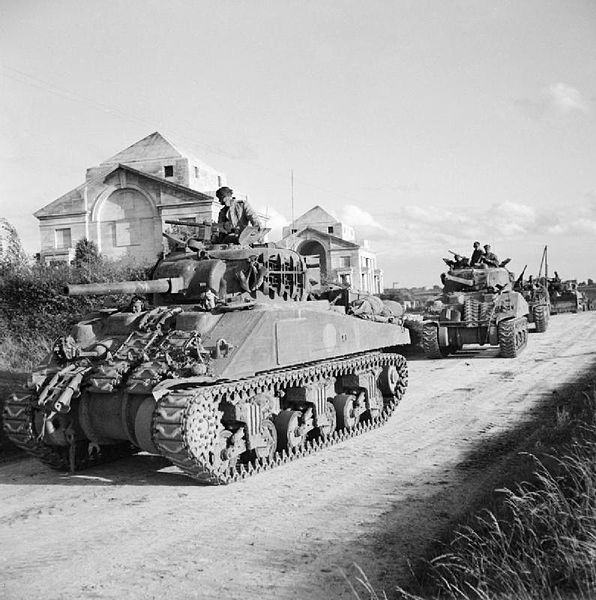
Among the multi-national Allied forces that participated in the campaign following Operation Overlord on D-Day on June 6, 1944 were the British Guards Armoured Division. Arriving a couple weeks late to the party on June 26, the Guards would roll on to participate in many of the key post-D-Day engagements including Operation Goodwood, Operation Market Garden and the Battle of the Bulge. I’ve been encountering the Guards over and over again in Rick Atkinson’s engaging The Guns At Last Light, the latest and final volume in his “Liberation Trilogy” telling of the Allied march to victory in World War II. And so, it is great timing that I’m finally getting around to adding the Guards as my first allied group supplementing my already extensive US forces in my Flames of War gaming.

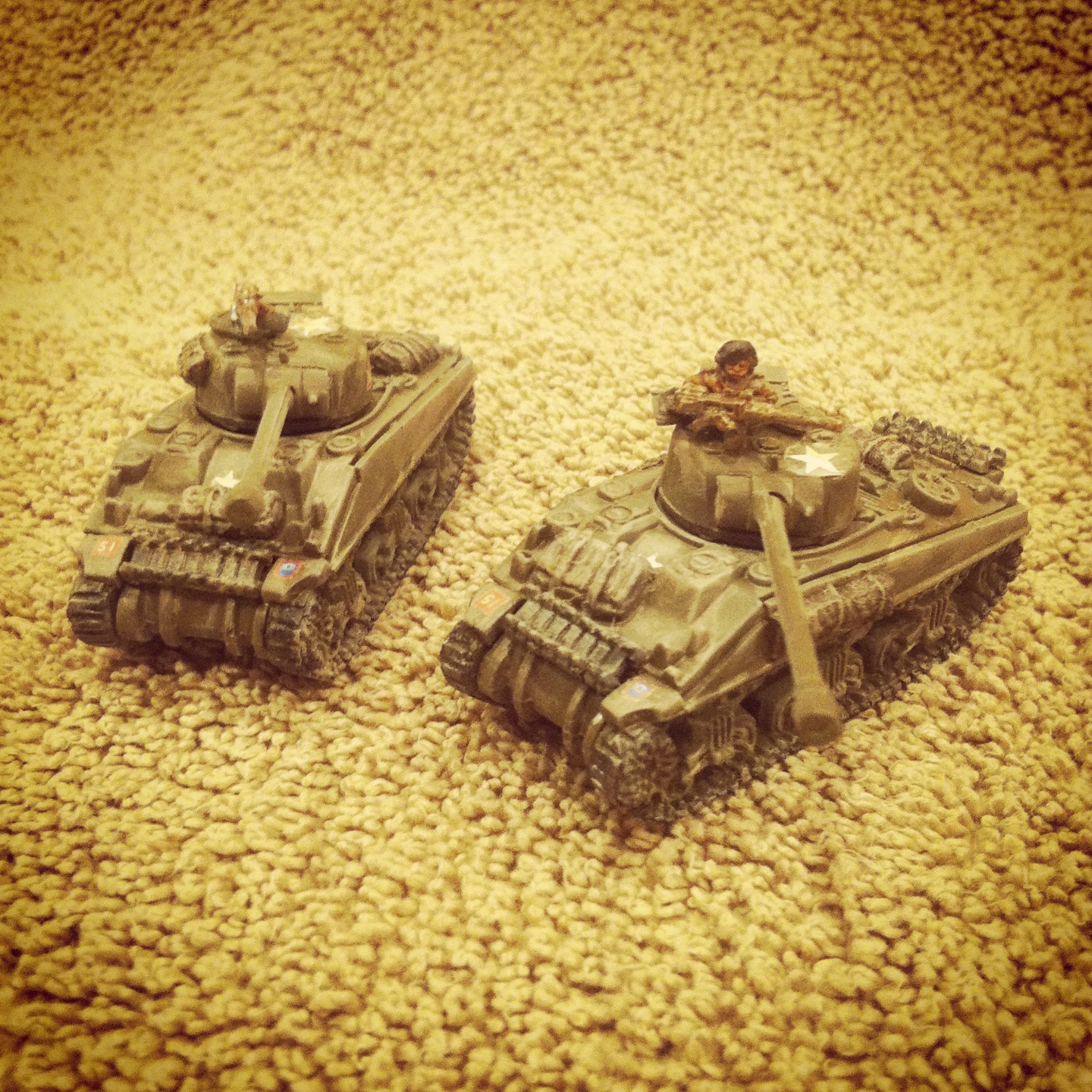
FWOFBoxI’ve been working away for half this year on finishing up the models included in the excellent Flames of War Open Fire! box set. Among all the plastic goodies included, the set offers up a nice Guards platoon to provide support to their allied US Airborne infantry. The eight models include six of the US-supplied Sherman V tanks and two of the famed Sherman Firefly tanks, retrofitted by the British with a massive 17-pound anti-tank gun.

Aside from a rather significant and well-documented issue with some parts fitting together, the models glue up pretty nicely. To the included stowage and gear included on the sprues I also added some leftover bits. A quick coat of green armor spray paint followed by black and silver lightly brushed on the treads made up the majority of the painting work. The exposed drivers received a tan uniform, black beret and radio headset picked out in detail. Crates and tool handles strapped to the hull got a quick touch of brown.

IMG_1894For decals — a big oversight in not being a part of the Open Fire! kit — I used a set from the Plastic Soldier Company and guidelines found on the Flames of War site. I found the decals from PSC to be easier to apply than those I had used from FOW in the past, but I did still use a few Allied “star” markings I had lying around from previous US tank models from FOW. With the decals dry, a bit of dried mud color and watered-down brown wash added some wear and tear around the tanks before they were hit with a matte finish.

IMG_1896

IMG_1898Now that I’ve got some Brits on the table, I’m eying some UK infantry to add some depth to my collection and flavor to my games. There’s a big full-day Flames of War gaming event coming up in just a few days at Metropolitan Wargamers, but I don’t think the Guards will be making an appearance this time around. Still, it will be good to know they’re waiting to throw in with the Yanks on another day in the near future.

Flames of War: Hunner Park 1944 Scenario

nijmeganab

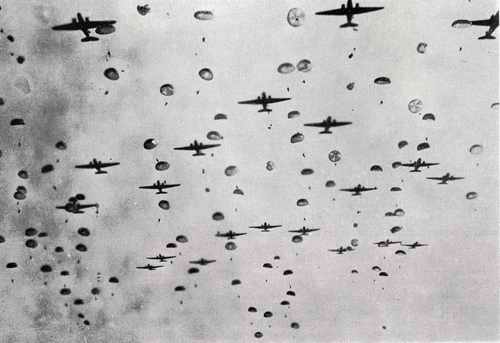
In September 1944, Allied forces launched the now-infamous Operation Market Garden. Fought in the Netherlands and Germany, the ill-fated plan was an attempt to aggressively take and control various river crossings through a series of bold airborne and armored assaults along key German strongpoints.

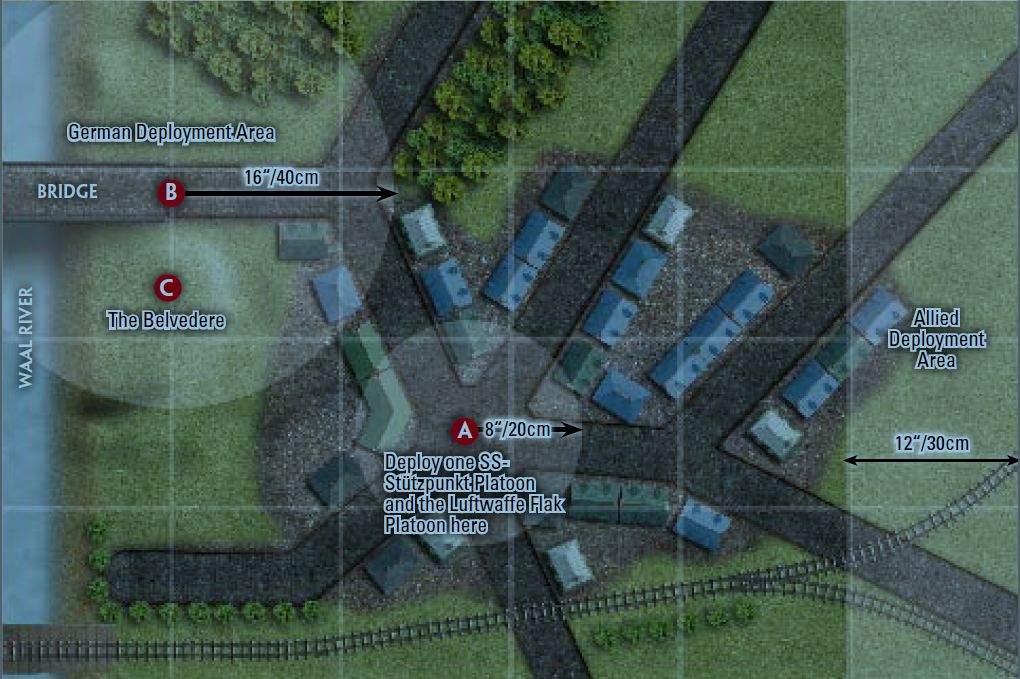
This past weekend at Metropolitan Wargamers, two of us threw together a quick Flames of War game based on the doomed Allied attempt to take the large bridge over the Waal River at Nijmegen, the oldest city in the Netherlands. Battlefront Miniatures, the makers of Flames of War, offer a PDF of the Hunner Park scenario which we used to broadly set the scene using the diagram below.

hpmap

We each fielded small, relatively balanced 1000 point forces. My US Airborne company consisted of two parachute rifle platoons, a machine gun support platoon and a US tank platoon consisting of four Shermans. The German Fallschirmjägers fielded two rifle-machine gun platoons, a heavy-machine gun support platoon and a three-tank Panzer IV platoon. The Germans deployed one rifle-machine gun platoon in the center of the town and the rest near the bridge, as per the scenario rules. My US Airborne deployed fully along the far edge.

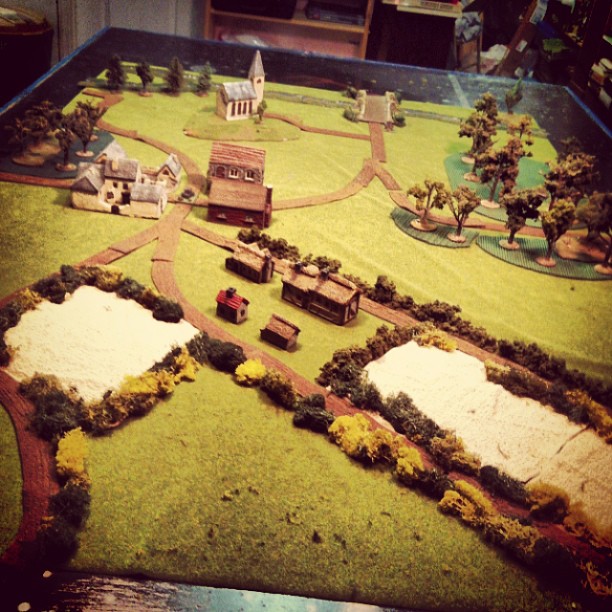
1017331_10201039903174136_1883265778_nThe scenario’s goals call for the US Airborne to take the bridge and center of town with the Germans playing a defensive game, all within the six turn time limit. Since the Allies are at a pretty clear historical disadvantage in the scenario, I modified the game’s terrain to include some additional bocage and cover at the American end of the table to help balance the game.

My plan was to quickly run one parachute rifle platoon along the side of the table, into the woods and up the road to the bridge while the remainder of my force would slug it out against the German platoons hunkered down in the town. After one turn of movement, the second turn found the US Shermans and machine gun platoon pouring fire into the Germans occupying the town’s buildings but with no result. My other rifle platoon ran at the double to occupy the woods opposite the town while a German rifle-MG platoon and their heavy MG platoon converged to meet them.

227419_10201040232582371_1708827010_nBy the third turn, the Panzers showed up in the middle of town and quickly destroyed their first Sherman tank. In the woods, the German and US platoons began exchanging fire with the Americans finding themselves pinned after the first firefight and the Germans already taking heavy casulties. Through turns four and five, the Panzers went on to destroy two more Shermans while the American machine gun platoon and additional rifle platoon began to make headway with the German infantry hidden in the buildings. Over in the woods, the tough American Airborne managed to destroy the two German platoons and finally rolled to unpin themselves. It was a bit too little too, late. By the time of the sixth and final turn, the game was pretty well lost for the Americans as the final Sherman fled the field, a last-ditch US assault on the pinned Germans holding the  town was repulsed and the German armor rolled back to meet the Americans just emerging from the woods.

Historically, Operation Market Garden was an Allied debacle, so our game play of the scenario near the Nijmegen bridge wasn’t too far off. With just under three hours to play, the game did offer a quick, varied bit of play with plenty of opportunity for both sides to get some decent shots in. It was also a good warm-up as we prepare for a large all-day Flames of War event next Saturday at the club when I hope my US Airborne roll a bit better toward victory in Europe.

Military Terrain Making in World War II

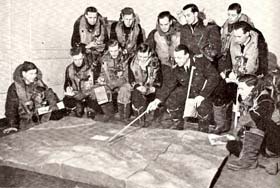
In the opening pages of the recently-released and well-reviewed final book of his World War II “Liberation Trilogy,” The Guns At Last Light: The War In Western Europe, 1944-1945, author Rick Atkinson takes the reader swiftly to St. Paul’s School in west London on the fateful morning of May 15, 1944. In a darkened room, the secret council of the Supreme Headquarters Allied Expeditionary Force (SHAEF) were awaiting a presentation on the final plans for the impending Normandy invasion. With the 145 collected commanders and dignitaries (including Prime Minister Winston Churchill and King George IV) seated, the meeting is brought to order by Supreme Allied Commander, US General Dwight D. Eisenhower:

Behind him in the cockpit of the Model Room lay an immense plaster relief map of the Normandy coast where the river Seine spilled into the Atlantic. Thirty feet wide and set on a tilted platform visible from the back benches, this apparition depicted, in bright colors and on a scale of six inches to the mile, the rivers, villages, beaches, and uplands of what would become the world’s most famous battlefield. A brigadier wearing skid-proof socks and armed with a pointer stood at port arms, ready to indicate locales soon to achieve household notoriety: Cherbourg, St.-Lo, Caen, Omaha Beach.

Over the next several hundred pages, Atkinson’s book goes onto to recount the trials, travails and eventual success of Operation Overlord and the eventual Allied victory in Europe. Although I’ve read accounts of the period before, the book is incredibly gripping and moves surprisingly briskly. In reading though, my mind keeps wandering back to that brief description of that enormous model of the invasion laid out before so many great military leaders nearly 70 years ago.

No one knows for certain when terrain models were first used in warfare. One might easily envision some leader of a primitive warband arranging sticks in the dirt before his subordinates as a way of planning for an upcoming attack on a rival force. What we do know is that by a few hundred years ago models were being used frequently by commanders and in military schools throughout Europe. It was out of these same elite war colleges that modern miniature wargaming would eventually spring.

It’s from this place where my mind keeps turning back to that plaster model in 1944 London. As a wargamer, I’ve previously written here about my passion for creating a well-laid-out terrain board for my gaming. With a bit of digging around online, I managed to uncover quite a few resources outlining the this bit of military craftwork and its importance in 20th-century war planning.

Terrain Models, a joint Swiss-American scholarly site dedicated to the European history of military topographic modelling, gives a great overview of how the tradition grew through the ages. With a bit of a slant toward Swiss model-making history, the site does provide a lengthy bibliography, a rundown of model types and a number of photos (sample, right).

In a 2002 article entitled “Allied Military Model Making During World War II” from the journal of Geography and Geographic Information Science, English lecturer Alastair W. Peterson also offers a bit of historical context before detailing the specific importance of models to Allied forces in WWII. Peterson outlines the evolution of methods and materials and also presents a nice chart of common scales and military uses for each (below).

The article also presents personal accounts of the people recruited for model making during the war, and the challenges they too faced far and away from the actual fighting. A recent interview in the Cleveland Plain Dealer provides another set of remembrances from a veteran who spent the war making topographic models, including one used ahead of the Normandy invasion.

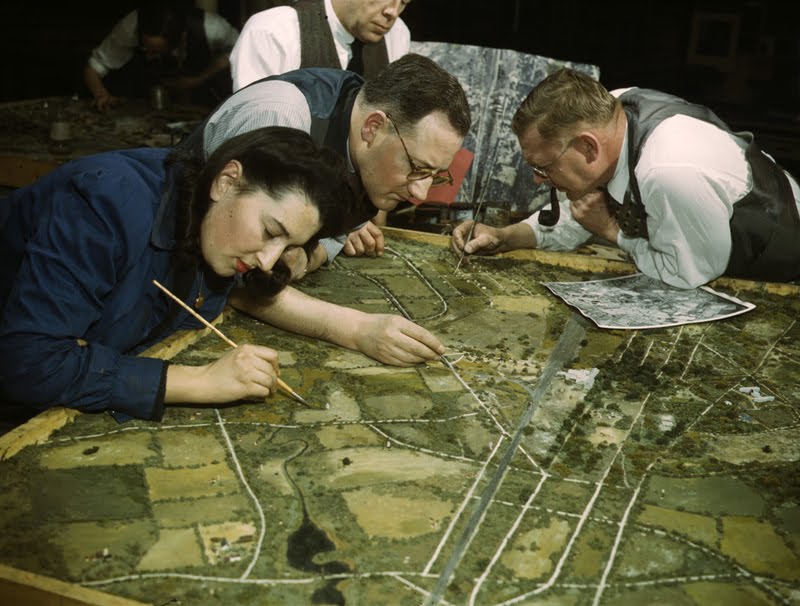
Other discoveries I made include a 1945 Universal Newsreel entitled “Secret Maps Guided US Bombers” which offers up a rare behind-the-scenes look at the construction of massive 80 foot 3D map used in planning late war air raids on Japan. And the undated color photo at left shows what purports to be a group of students learning techniques in creating a terrain map for military use during or immediately following WWII.

The articles, sites and photos I’ve uncovered give a cursory overview of military terrain making and their role in WWII. There are some lost gems I’d like to dig into more, including tracking down an actual copy of the 1956 US Army training manual Terrain Models and Relief Map Making (TM 5-249) which is referred to in a number of online bibliographies. But for now, I’ll carry all this history with me as I lay out my next wargaming battlefield in the context of all the historic importance many of the same skills and techniques have played in the wars of the past.

Favorite Kickstarters of the Month (July 2013)

Kickstarter can be a weird, volatile environment. Some projects come and go with little fanfare while others soar into the stratosphere with backer support. There can be all manner of highs, lows and outright trouble for projects on their journey from idea to funding to delivery. That said, four of the projects I wrote about in June wound up successfully funded in the past month. The fifth, the seafaring game Admiral, was funded but the project was then suspended inexplicably with a day to go. No doubt there’s a story there, but for now, here are the projects I’ll be watching as we hit the first hot month of the summer in July.

Cthulhu Wars: Drawing on the Cthulhu Mythos of H.P. Lovecraft, this game is the big story in games on Kickstarter right now. With dozens of gorgeously grotesque miniatures and many planned expansions, this strategy board game turns the tables and allows the players to play as Lovecraft’s beastly horde seeking to control the surface of a ruined Earth. Many of the pledgers have bought in at the higher funding levels of $200-500+, no doubt attracted by not only the theme but the tons of extra maps, gaming pieces and figures rewards. The project is trending toward nearly $1 million in funding in its closing days, and the more than 3300 backers are delivering a built-in fan base of this classic horror genre already popular with gamers.

Seas of Iron: I’m not a big naval gaming fan, but I really like the looks of this very modest battleship wargame from Battle Bunker Games. The battleships are comprised of two-sided cards defining the sections of each ship where you deploy your crew and fire volleys at your opponent. When a section is destroyed, cards are flipped over to show that part of your ship aflame. The Kickstarter exclusives include the famed Yamato and Bismarck warships. Just $20 allows for a backer to get a full version of the game which allows enough flexibility for 1-on-1 or small fleet play with combined sets.

Devil Dogs and Dragons: I’ve invested in more than a few of the Anglo-Zulu War 28mm miniatures from Empress Miniatures. They make quality, spirited and detailed miniatures, so its great to see them expanding their Modern Combat line. There’s a lot of interest in gaming modern warfare right now, and the 28mm scale seems to be a clear favorite with small squad-level engagements in the dusty and hot embattled corners of the world. These 28mm figures fill out modern US Marine Corps and Chinese People’s Liberation Army options for deployment in the Asia-Pacific desert and jungle regions. With a bit more imagination, these guys will even find a home in various zombie, alien invasion or post-apocalyptic scenarios.

Fife & Drum American Revolution Range: Just in time for the 4th of July weekend, Fife & Drum Miniatures is also expanding their established line of miniatures. Sculpted in a large 30mm or 1/56 scale, these majestic figures offer incredible detail for the Colonial Period ranging from the Seven Years War to the American War of Independence. The Kickstarter campaign will help fund the company’s expansion into new British cavalry, Hessian, Highlander and French infantry offerings. At the $50 level, backers receive a special three-figure “Spirit of ’76” vignette, making this project perfect for any patriot and fan of the AWI period.

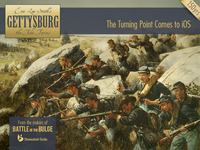
Gettysburg: The Tide Turns: Finally, and in keeping with the theme of American military history, I’m throwing in one video game offering to round out the list. The Battle of Gettysburg is celebrating its 150th anniversary this month, and so this timely iOS game for the iPad and iPhone looks to be a deal at just $10 to back the project. Developed by Shenandoah Studio, the makers of the previously Kickstarted Battle of the Bulge iOS game, this simulation looks to be a very promising 21st-century tribute to the strategy, tactics and heroics found on the famed Pennsylvania battlefield 150 years ago.