Flames of War: La Fiere Causeway 1944 Scenario

lafiere1944

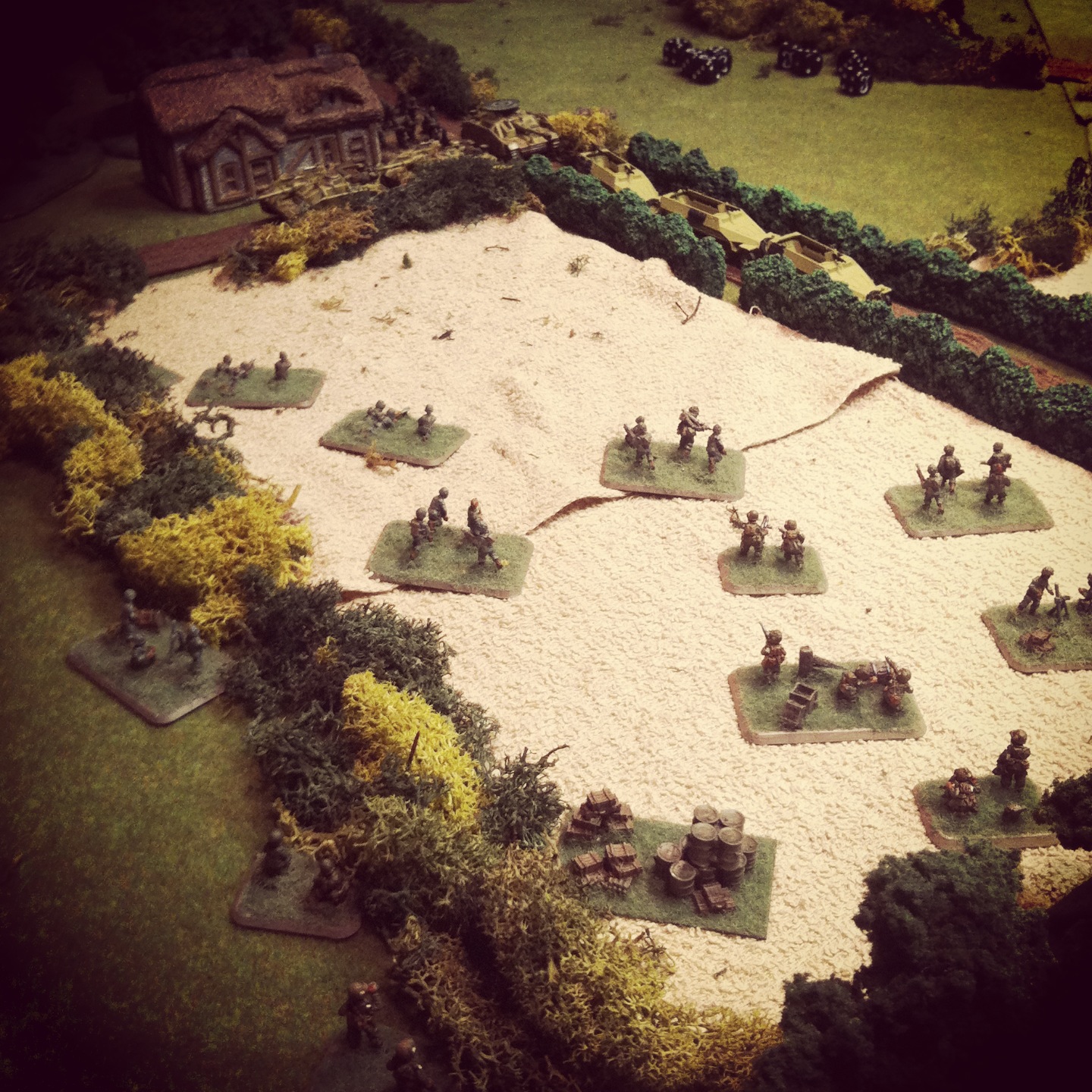
In the late evening of June 5th and pre-dawn hours of June 6th, 1944, a steady flow of Allied paratroopers began dropping throughout the French countryside to clear the inland way for the D-Day beach landings to come later that morning. Like elsewhere, scheduled US Airborne drops near Sainte-Mère-Église left paratroopers scattered around the countryside. To the southwest of the town’s target area, a contingent from the 82nd Airborne found itself near a quaint French farm compound and a small bridge over the Merderet River. Recognizing the river crossing as a key defensive line, the assembled paratroopers established a perimeter along the river. A few hours later, the US troops were met by a German Grenadier and armored battallion hoping to stall the Allied invaders from moving inland. The battle that erupted at the river would rage for three days until the German force withdrew in time for the arrival of US infantry and Sherman forces rolling in from Utah Beach on June 9th.
causewaygamemap

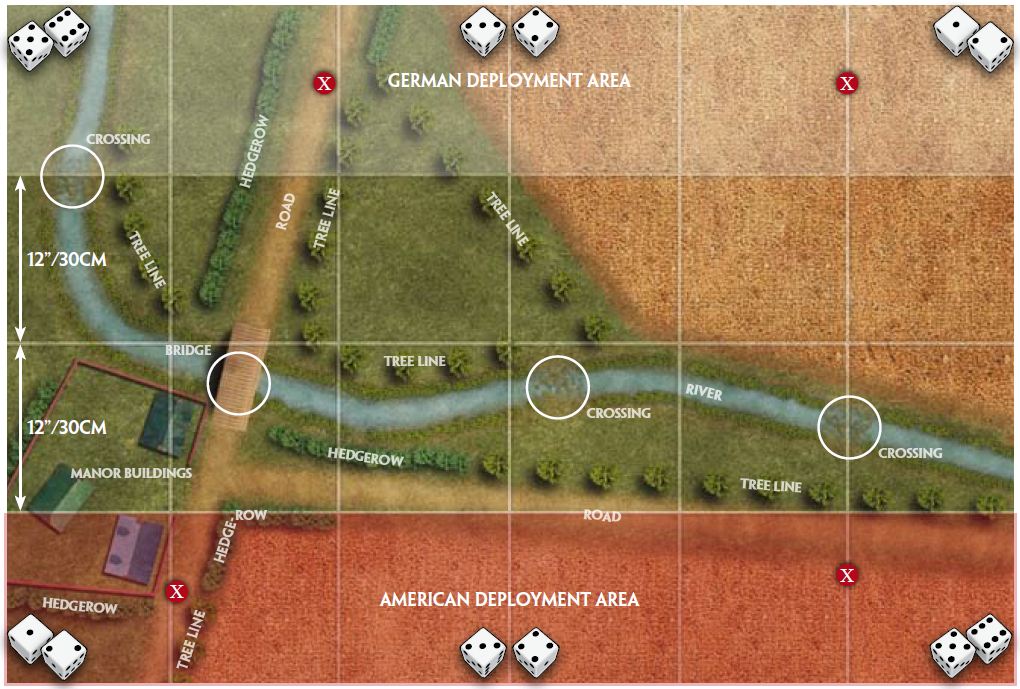
The Flames of War website offers a basic scenario of the encounter at La Fiere Causeway suitable for 1500 point forces on either side. This past weekend a visitor to Metropolitan Wargamers and I had a go at the scenario with my US Airborne facing off against his Germans. As with the historical record, my force held closely to the scenario’s outline with two parachute rifle platoons with plenty of bazookas supported by a platoon of light machine guns, parachute engineers, a glider artillery platoon and M18 tank destroyers. On the German side of the table, my opponent lacked the primitive French tanks that historically fought at the battle. Instead, he filled his force with a number of Grenadier platoons mounted in half tracks backed by two small platoons of Panzer IVs and a Nebelwerfer rocket battery.

IMG_2161

IMG_2163

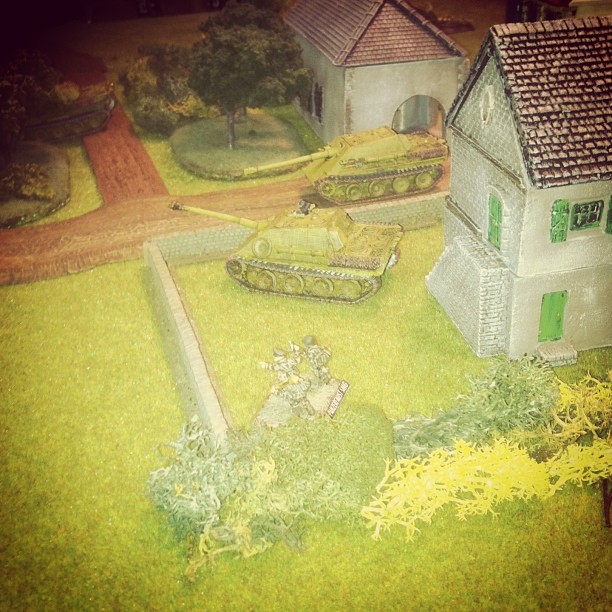
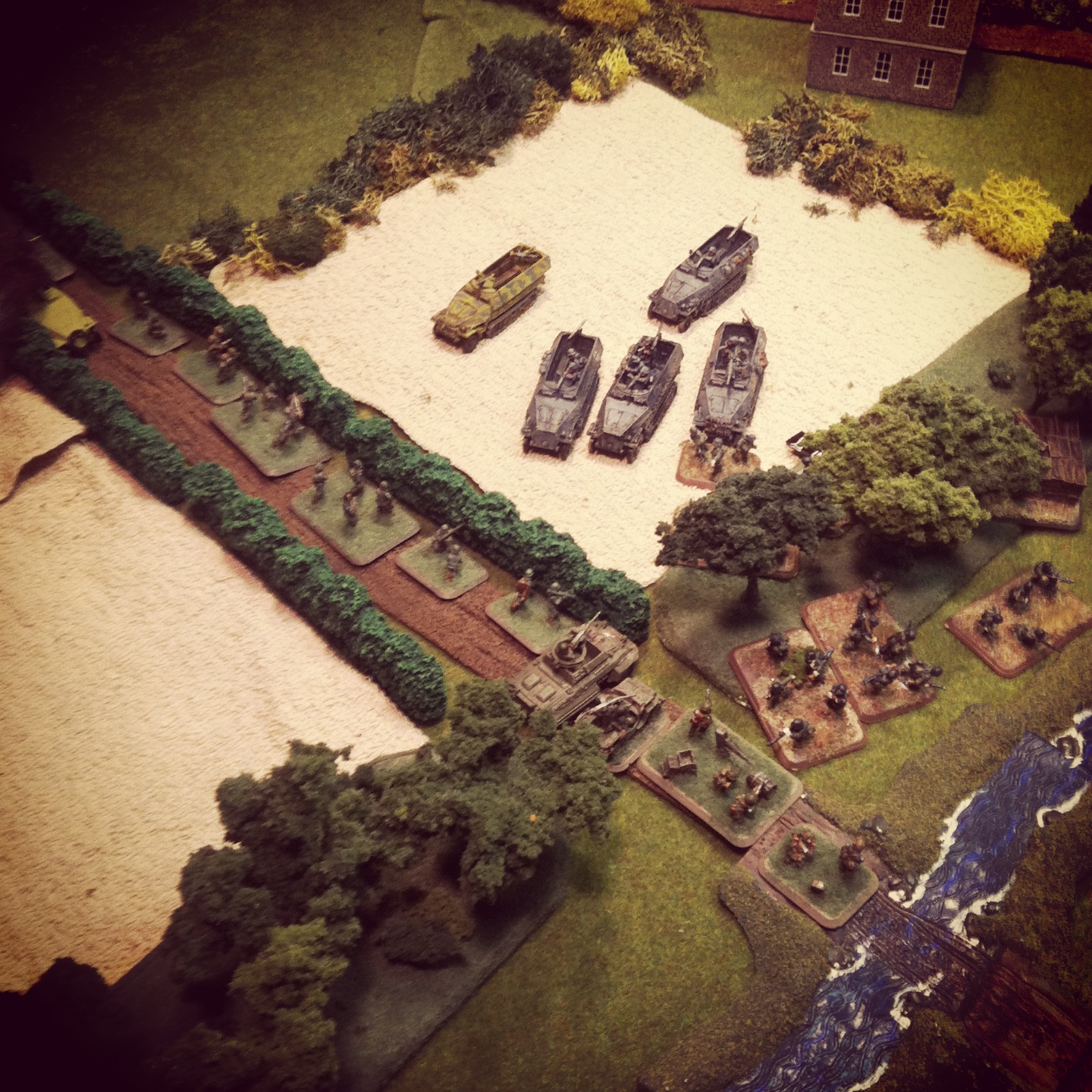
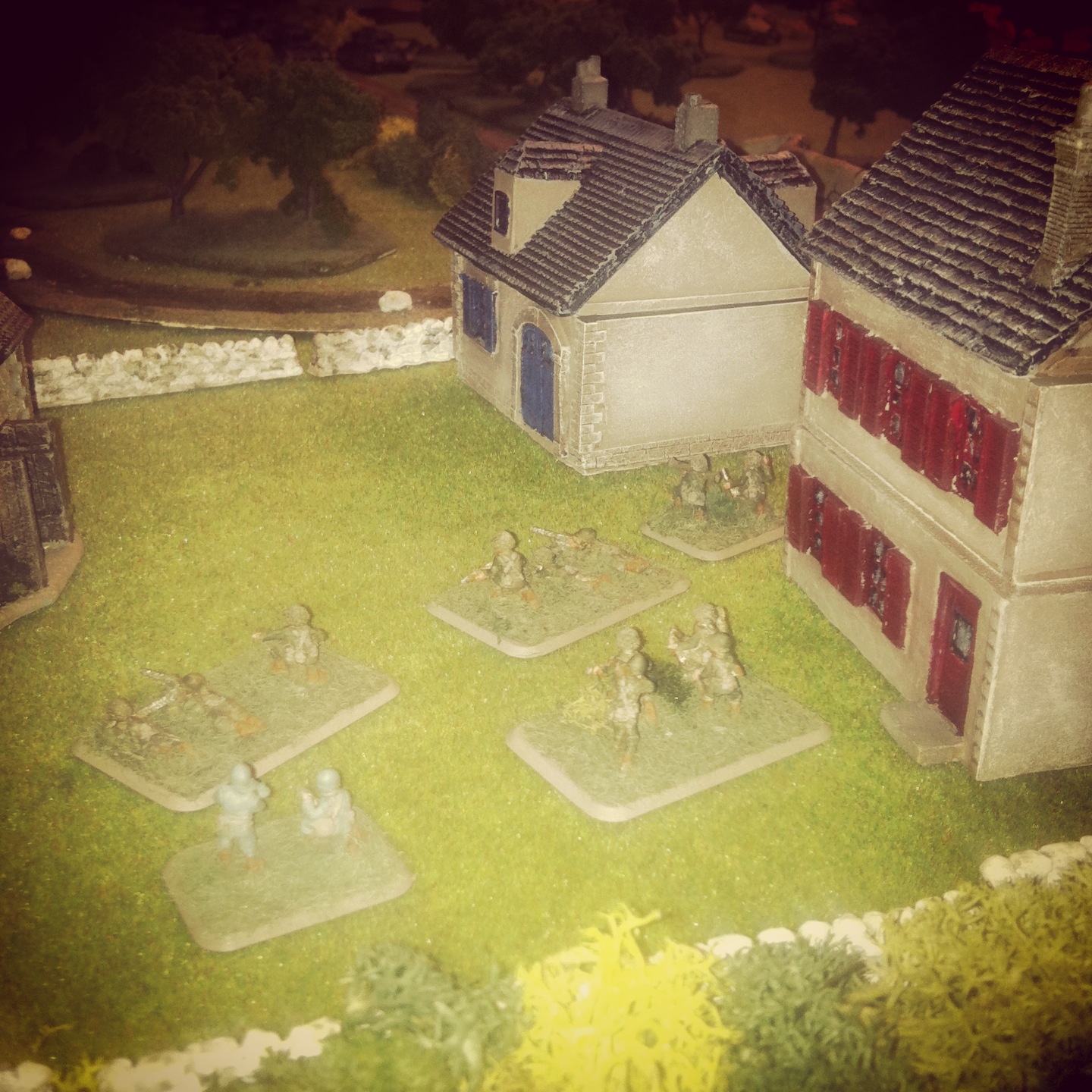
As per the scenario rules, each of us chose half of our platoons to be held in off-table reserve. Beginning with the Germans, we alternated deploying our starting forces on the table. My American engineers took up position in the courtyard of the farm on my left flank, the machine guns lined the hedge on the other side of the bridge and a rifle platoon deployed on my far right flank. As expected, the Germans deployed a tank platoon at the road entry point and the rocket battery and a mounted Grenadier platoon in the field on their left flank.
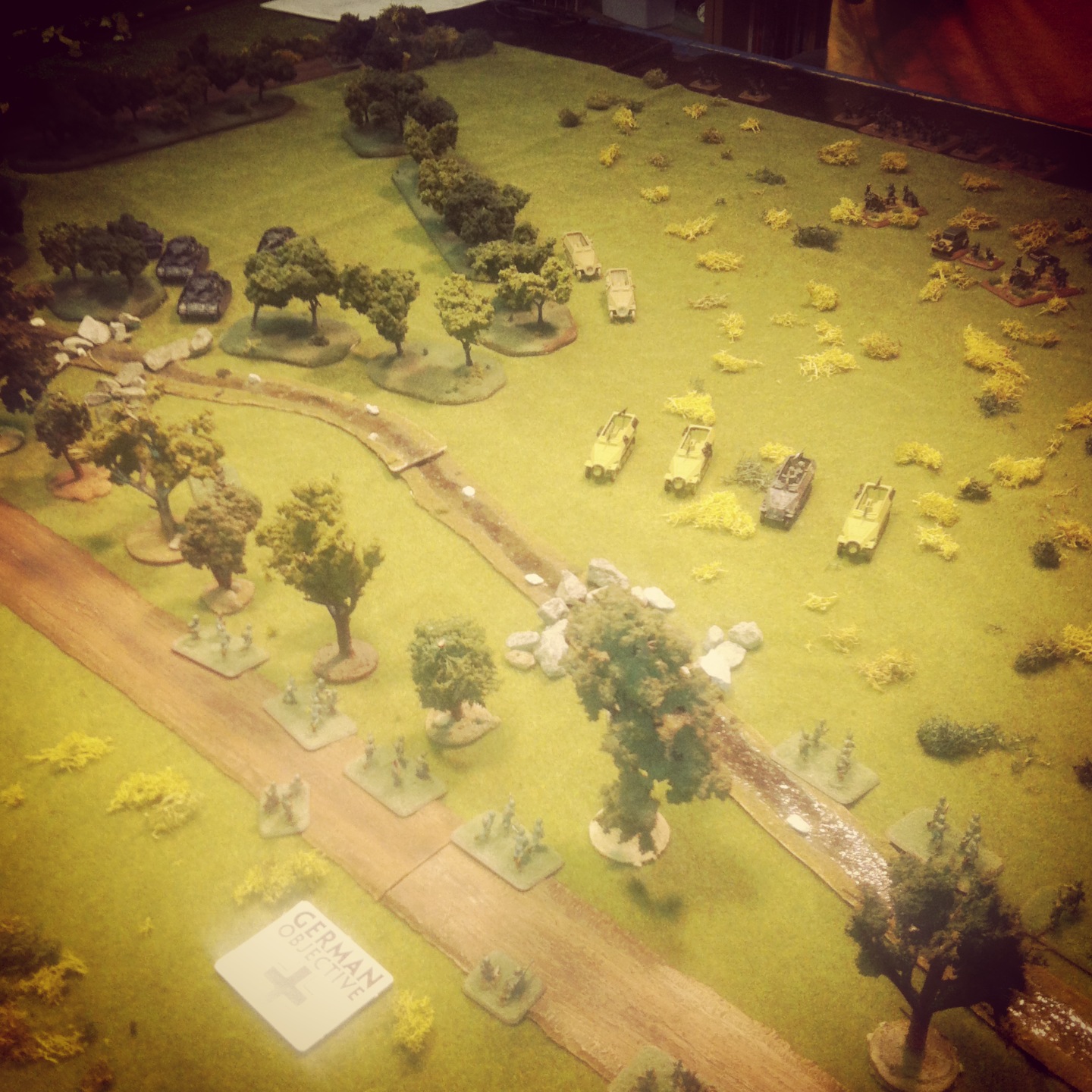
IMG_2165With the Germans taking the first turn, the first Panzer IV platoon made way for the river crossing at the middle of the table while the half tracks rolled for the ford on the American right flank. Deployed in and around the farm buildings, the US engineers quickly laid down mines at the foot of the bridge and an Airborne platoon crossed the river to meet the approaching Grenadiers and the rocket battery beyond.
IMG_2169

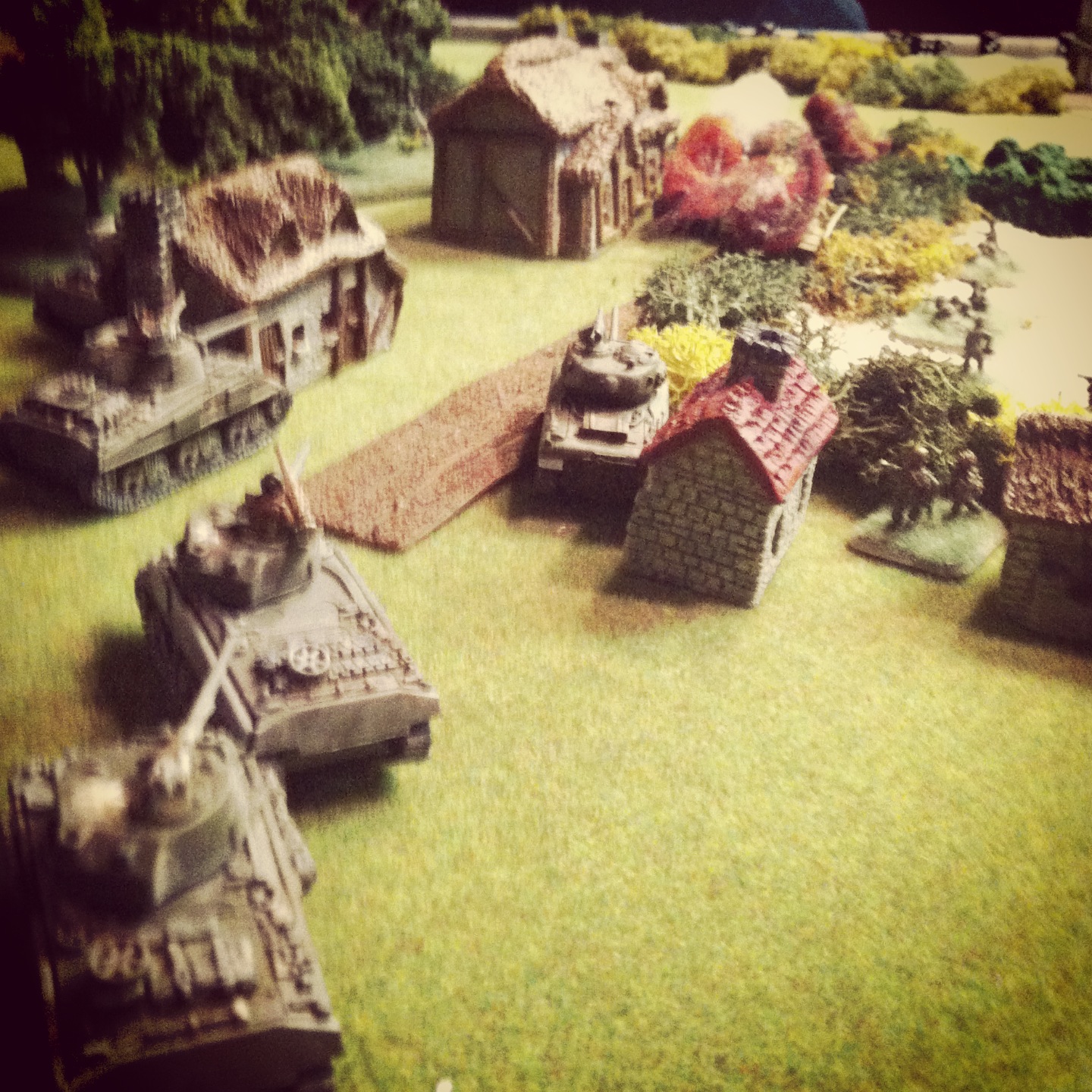
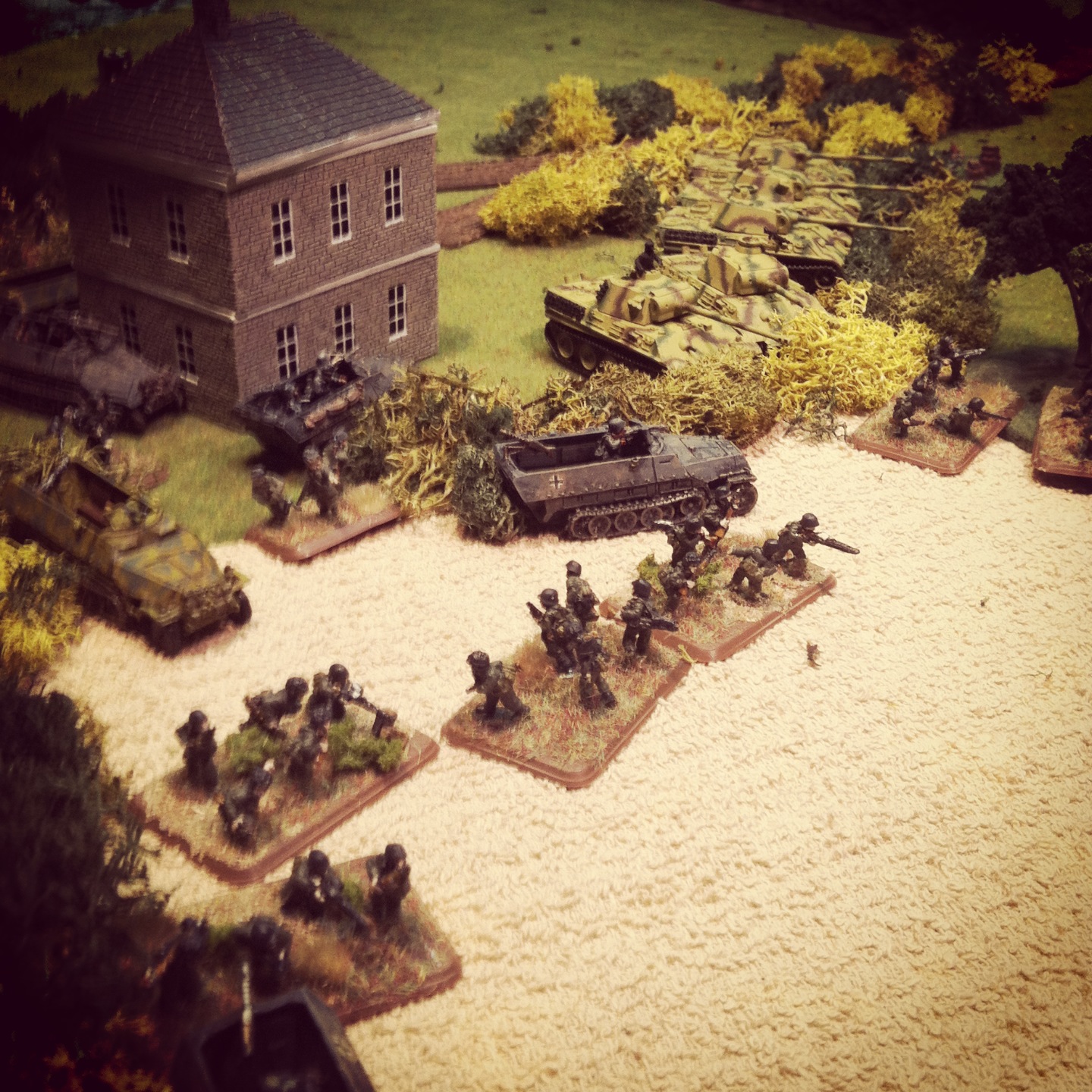
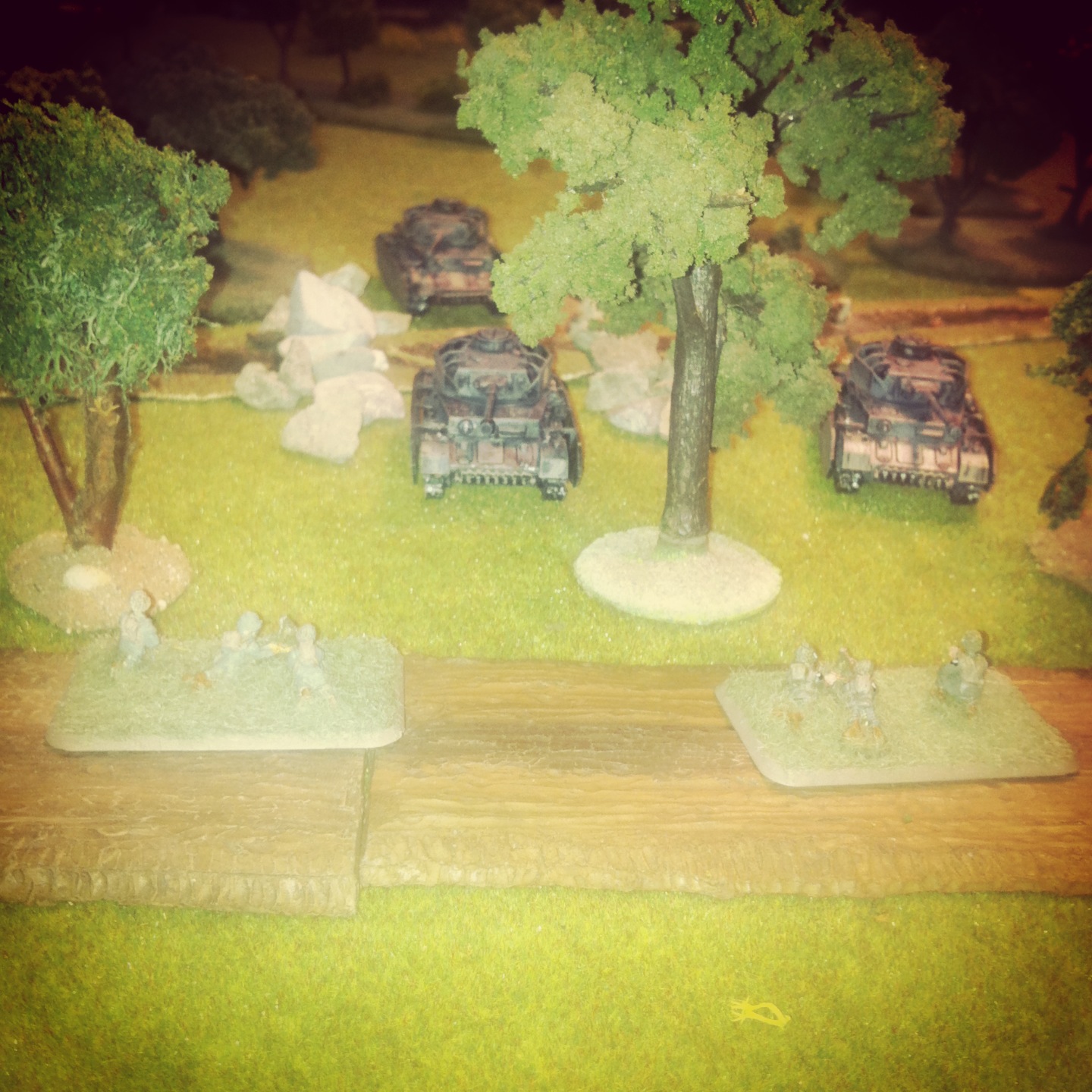
IMG_2167With turn three, German tank and Grenadier reserves appeared on the table edge opposite the farm and pointed their way toward the French buildings and the nearby bridge. Four US bazookas bailed one Panzer in the clearing across  the river but three other Panzers made it across at the middle ford. US tank destroyer reserves came on the table and immediately poured machine gun fire into the half tracks across the river. The Grenadiers bailed from their transports and the half tracks raced to the rear while the Nebelwerfers failed to score effective shots in the hearty US Airborne troops.
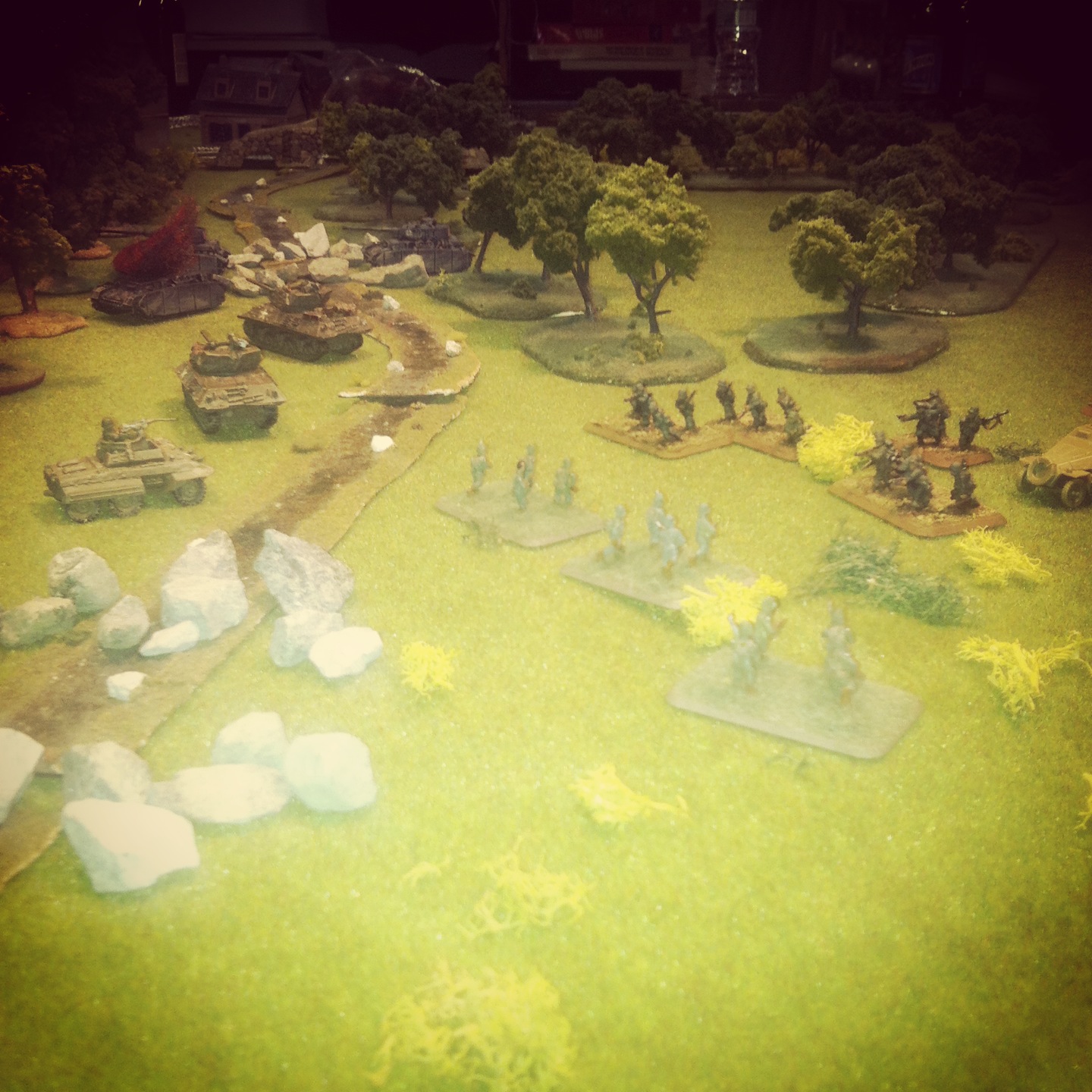
IMG_2171With the Grenadiers on the run back to defend the rocket battery, the US tank destroyers turned their attention on the Panzers and quickly destroyed one while the others continued to push on unharmed due to the protection of their side Schurzen armor. At the farm, the approaching Panzer and Grenadier platoons exchanged fire with the engineers and riflemen defending behind the stone walls. Even with heavy casualties, the engineers repelled a direct assault by two Panzers as a fresh rifle platoon rushed to reinforce the farmyard strongpoint.

Alas, by the fifth turn the game was effectively over for the Americans as the late-arriving US howitzers once again failed to hit in one final volley against the Panzers rushing to seize the objective. The Americans had chased both Grenadier platoons from the field and destroyed a couple Panzers, but the Airborne focus on defending rather than seizing objectives allowed the Germans to take the table.

At the game’s outset, both of us shook our heads with the difficult mission ahead of us. The Airborne never effectively engaged in a close-quarters assault that might’ve taken out more of the tanks sooner on in the game, and artillery on both sides contributed nothing to the game. As with the last few FOW games I’ve played, the engagement at La Fiere once again pointed out the strength and tactical importance that infantry played in WWII. Keeping men moving and in the fight is key to victory, and this time around the German troops got the better of the day.

Flames of War: Fielding the PSC Panzer IV Tank

pniv

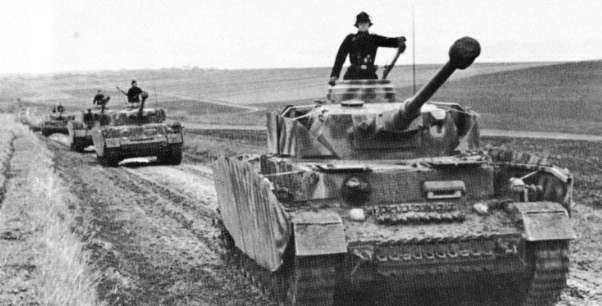
One of the greatest military impressions Germany left on the face of warfare during World War II was in its feared armored forces. The famed Tiger I heavy tank gets a lot of the glory for its independence and near idestructability, but the Panzer IV medium tank served as the real backbone of German armored forces throughout the war. With improvements to its armor and gunnery made throughout the war, the Panzer IV would prove to be a tough nut for the Allies to crack until very late in the war. Especially in the period from the D-Day landings through to the Battle of the Bulge, the Panzer IV played an ever-increasing role in attempting to stymie the Allied advance right up until the eventual fall of the Third Reich in the spring of 1945.

FOWpzIV

pscpziv

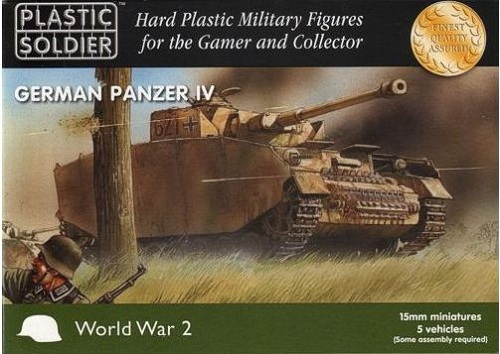
I already own a fair amount of German armor with Tigers, Panthers, Jagdpanzers and Stugs, but my force was sorely lacking in Panzer IVs. Most of my German tanks thus far have been from Battlefront, the makers of Flames of War (FOW). They offer a late war Panzer IV platoon in the pricey $50-60 range, depending on whether you pick the set up online or in a store. Going on some recent experience with the PSC Allied Stuart tank set, I went with the Panzer IVs from the Plastic Soldier Company (PSC) at about half the FOW cost.

pscpzivsheet

Unlike the FOW sets, PSC kits come with options to model miniatures in several periods. This allowed me to model my tanks as the later war Panzer IV Ausf H with its extra armor and gun power. Like the Airfix kits of my youth, the PSC tanks are comprised of lots of little parts. The diagrams included in the box offer clear color-coded keys to getting the correct pieces off the sprues and blow-up schematics for gluing the pieces together. If you’re like me, keeping your workspace clean and organized will prevent you from losing your mind during the multi-step assembly process. The sprues also leave some leftover parts which either go straight into the trash or into container of miscellaneous plastic for future modelling use.

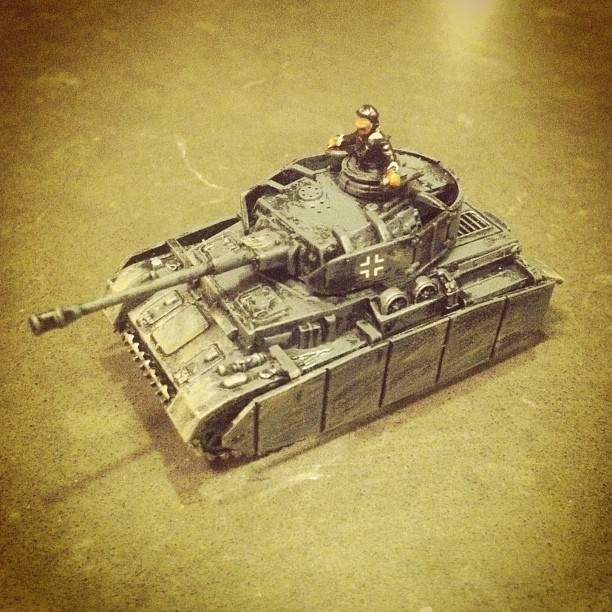
Lots of parts means lots of steps. The turrets alone are compromised of 9-10 parts and aligning the tank tread sections needs to be done carefully. I also found the hole on which the turret sits to be a bit tight, so I carefully drilled those out slightly larger. My Panzer IVs were completed with a basic grey-schemed paint job over a flat black spray base to match my existing models. With assembly, painting, decals and a matte finish finishing coat, these tanks are ready to hit the table in just a couple work sessions.

Compared to FOW models, the PSC tanks take a bit longer to put together and parts can be finicky, but I really like the PSC models when complete. The PSC tanks offer crisper molding and some fine details like a slight sag in the upper parts of the treads and hangers for the  side and turret Schurzen. Models are light, making for easier storage and transport. Putting together kits from PSC just feels a lot more like model building than what you experience with FOW and some other manufacturers.

pzivcommand

pzivplatoon

With so much economic pressure on miniature wargame funding budgets, you can’t beat getting more armor in the field for the low cost and fine results from the Plastic Soldier Company’s Panzer IV kit.

New Game Weekend: Bioshock Infinite: The Siege of Columbia

bsboxAfter a week away on vacation I returned to Brooklyn and the Metropolitan Wargamers club in Park Slope this past weekend. The club was packed on the Labor Day weekend with lots of different games hitting the tables. I paired-off with one of my fellow members to try out his new copy of Bioshock Infinite: The Siege of Columbia.

Based on the latest game in the long-running Bioshock video game franchise, this 2013 boardgame is at its root an area control game. Players choose to play as one of the two factions – the Vox Populi led by Daisy Fitzroy and the Founders led by Zachary H. Comstock. The game plays in a one-on-one two-player game or in a four-player team version of the game.

Play begins with each faction placing their starting miniatures and Turret and Home Base building markers. Each turn begins with the draw of a victory point mission card followed by a World Event Card which kicks off a secret vote with each player committing influence points from their hand of five Action cards. Winning or defeating the vote varies in importance, as the neutral Booker and Elizabeth characters advance to different spaces on the board and other game-changing events are put into play.

bscontents

The winner of the vote also receives the first turn marker which is key to controlling the flow of the game. Starting with the first player, units are purchased or Action cards are upgraded with Silver Eagle coins. Action card upgrades give you greater influence in votes, stronger combat values or more purchasing power in subsequent turns. The player then moves up to four units to adjacent squares or takes a chnace gliding to neighboring territories across the Skyline. Most units move one space but the Founders’ Songbird and Voz Populi’s Airship models each move up to two spaces. Skyline moves are achieved through rolls of special dice sliding you to the next node or risking a fall into thin air with each roll.

Combat occurs next. Common, Special and Leader units each carry a different die value, with different colored dice being rolled to resolve combat situations. Loss of a combat results in a figure being removed. Playing Action cards and upgrades add to combat effectiveness as do the special Turret markers. Conquering unoccupied spaces earns additional Silver Eagle coins, and controlling all spaces in a territory earns victory points. Destroyed units are removed from play or returned to Home Base safe havens. A mix of controlling territories and completing missions of combined actions wins victory points, and the first player to ten victory points wins the game.

There’s a lot going on in this game, and well-played plans and strategies are forced to change as world events switch from turn to turn. In my first game, I found controlling the first player spot was key. However, controlling the first player role means spending lots of cards which can come back to haunt you in a heavy combat challenge later in a turn. As the game advances, the heroine Elizabeth moves along a timeline track which also alters how the game plays out. Her protector Booker is also a big spoiler in swaying votes and possibly attacking each faction at different points in the game. Unlike most area control games where occupying and defending a won territory is often enough to ensure victory, the Skyline allows an opposing player to drop right into or behind your defenses and attack.

For a bit more of an intro to the game’s actual gameplay, check out the video below from the alwyas-entertaining Watch It Played video series.

If you aren’t up on your Bioshock Infinite video game lore, I could see some initial challenges in wrapping your head around the interplay of the characters, factions and events in the boardgame. I’ve spent quite a few hours watching my son work his way through the spectacular action and storyline in the video game, making my understanding of the boardgame’s narrative a bit richer from the get-go. Whether you’re a fan of the video game already or just interested in a really rich and challenging area control board game experience, you should hop the next airship back in time for the floating nation of Columbia.

Flames of War: Modelling European Western Front Buildings

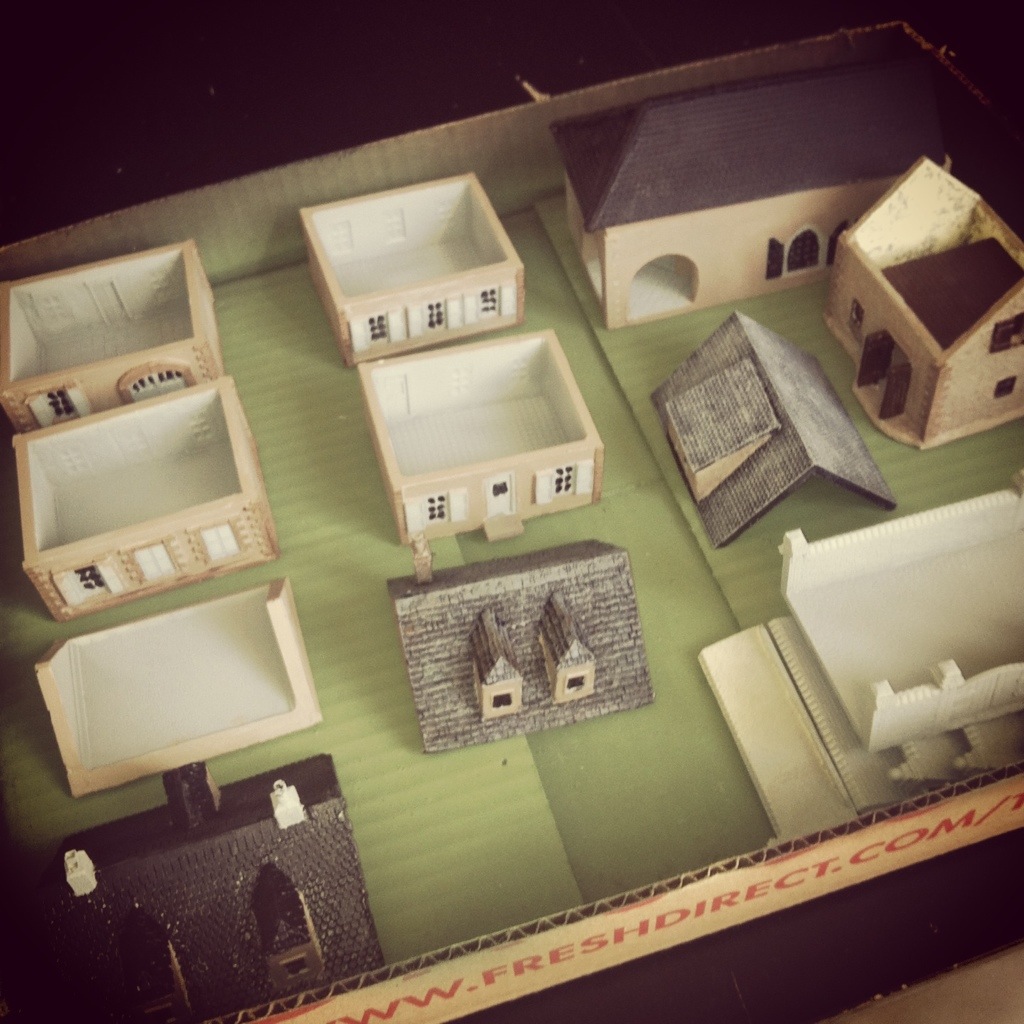
153770I got into miniatures wargaming through a combined set of interests I developed as a kid: history, role-playing and scale modelling. One of the aspects of gaming I enjoy is setting up a realistic and engaging tabletop battlefield, both for the visual effect but also to reproduce the playable advantages and challenges found in waging scenarios within scenery.

I’ve been searching high and low for an affordable and well-made set of buildings to add to my 15mm Flames of War World War II gaming set in the post D-Day Western Front. Battlefront Miniatures, the makers of Flames of War, launched their own series of buildings last year. The pre-painted buildings are beautiful, albeit a bit too perfect and pretty expensive at $40-50 each. Miniature Building Authority (MBA) has been a long-time producer of fine pre-painted buildings. Like the structures from Battlefront, MBA models feature removable roofs but also convert into ruined bombed-out versions. At $40-50 for single large buildings or for pairs of smaller ones, the MBA buildings are also pretty pricey. MBA keeps a small line in stock, but they have dozens of out-of-production models which you can also find at conventions and occasionally online. JR Miniatures is another standby in the industry, but I find their relatively low-priced line of buildings is a bit of a mixed bag in terms of casting and playability.

markivWith building up my gaming real estate on my mind, I posted to the message boards at The Miniatures Page. Some suggestions pointed to the above manufacturers, but several posters also mentioned Mark IV Miniatures. The company is run by Jeff McCarron, a second-generation gaming modeller out of Colorado who obviously puts great care and passion into his work. McCarron sells his models directly and distributes them through Musket Miniatures, and I found him to be incredibly responsive to a couple questions I had before ordering. As it turned out, a fellow member of Metropolitan Wargamers had recently picked up the large church model and a couple houses from Mark IV. After playing with his models during our big Summer FOW event and Barkmann’s Corner scenario at the club, I decided these were the buildings to sink an investment into.

1148873_10201247963855523_305675209_nI decided to go with several two and three-story buildings, a barn, a courtyard and some walls, all ordered from Musket Miniatures. With all these models, I’d have the flexibility to set up a fairly decent-sized town or play with them as a separate farm estates. The castings arrived clean and required little tidying-up of residual flash with a knife.

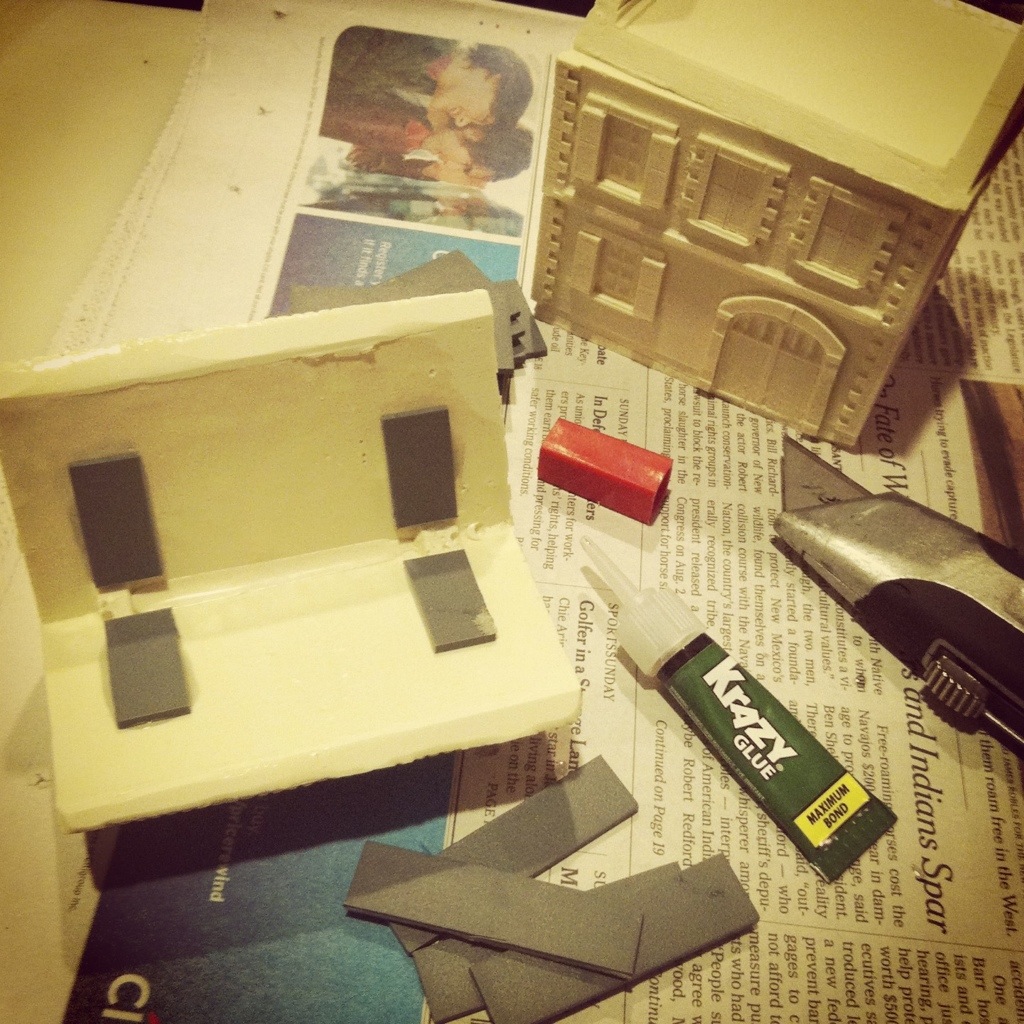
20130830-233936.jpgI did have to put in a bit of work gluing plastic tabs to the undersides of the floors and roofs to provide a snug fit for each story of the buildings. The larger one-story bank building also required a wall and metal cast windows to be glued in place.

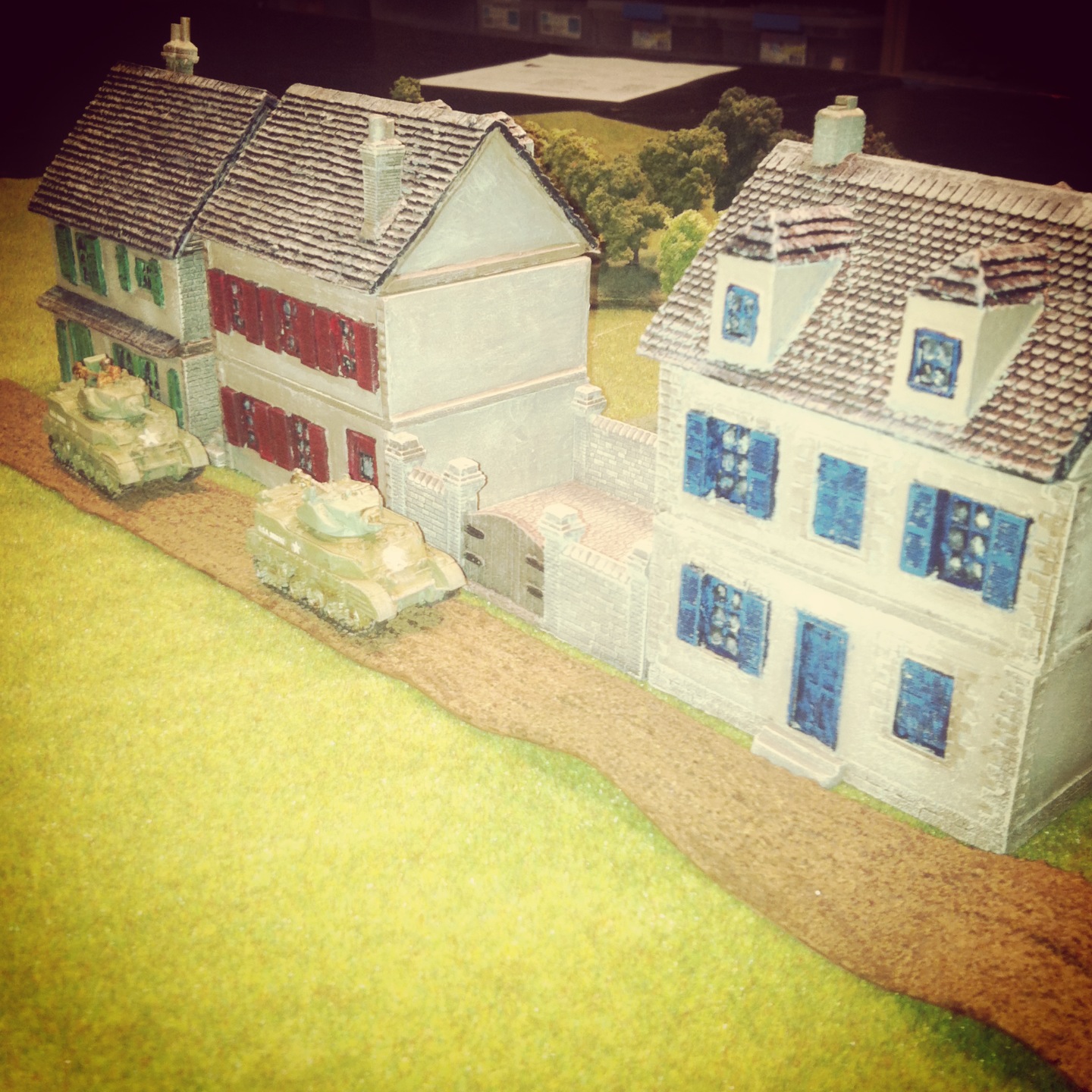
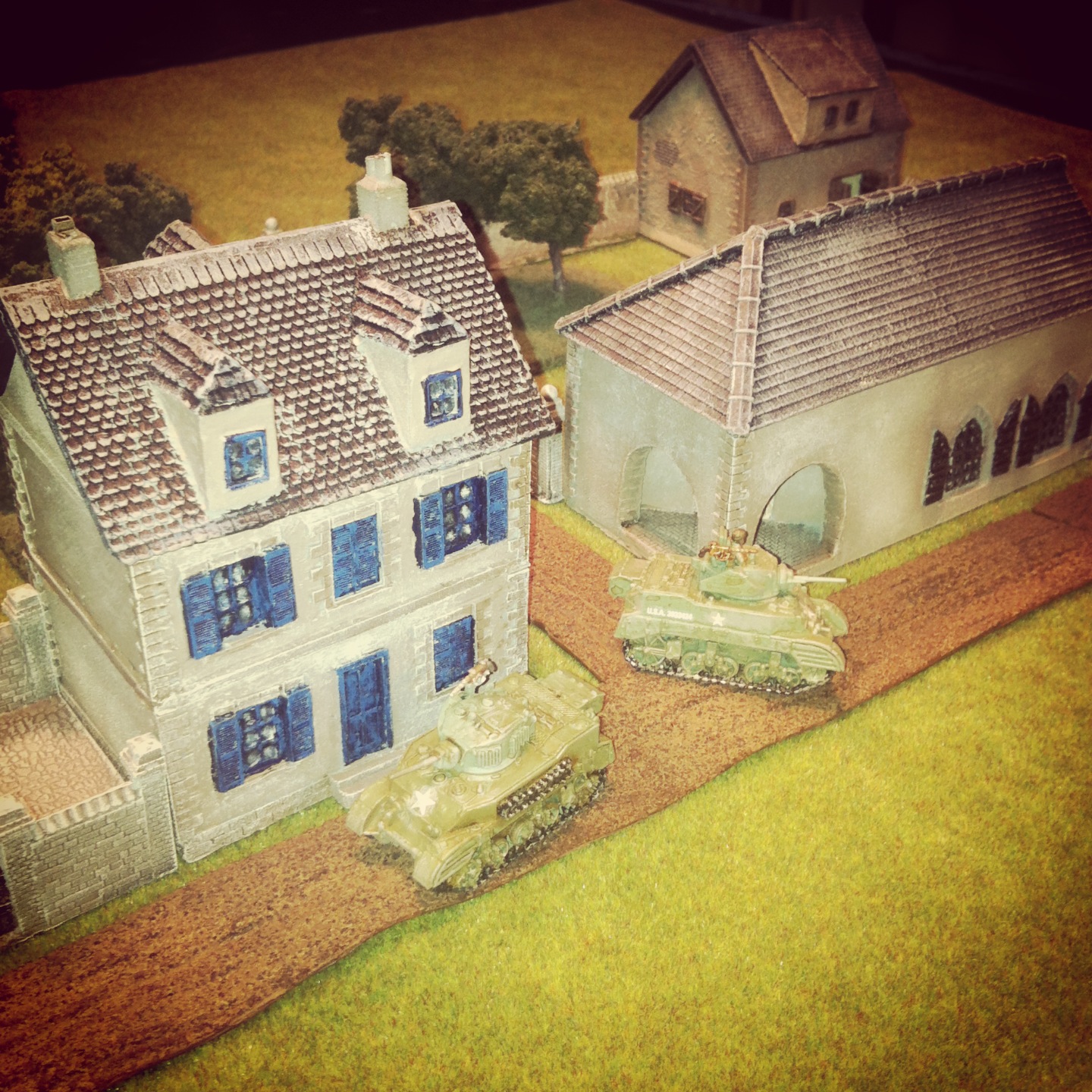
20130830-234253.jpgFor painting reference, I searched online for photos of European villages. After a light grey spray basecoat, the stucco walls of the buildings were dabbed with a bit of foam sponge in sandy gray-brown stucco and then dry-brushed with an off-white paint to add variety to the wall surfaces. Exposed stonework, the courtyard cobbles and masonry details at the corners, doors and windows all got combinations of varying shades of grays, browns and whites to create some depth.

IMG_2115Shutters, doors and windows were painted with dull blue, white, green and red trim, mimicking some of the variety in paint schemes I had found in photos online. For the roofs, a black undercoat was dry brushed in a couple shades of grey with a bit of browns and dark green shades mixed in. On the barn model I glued on some thin pieces of lichen to add the look of vines covering part of the walls.

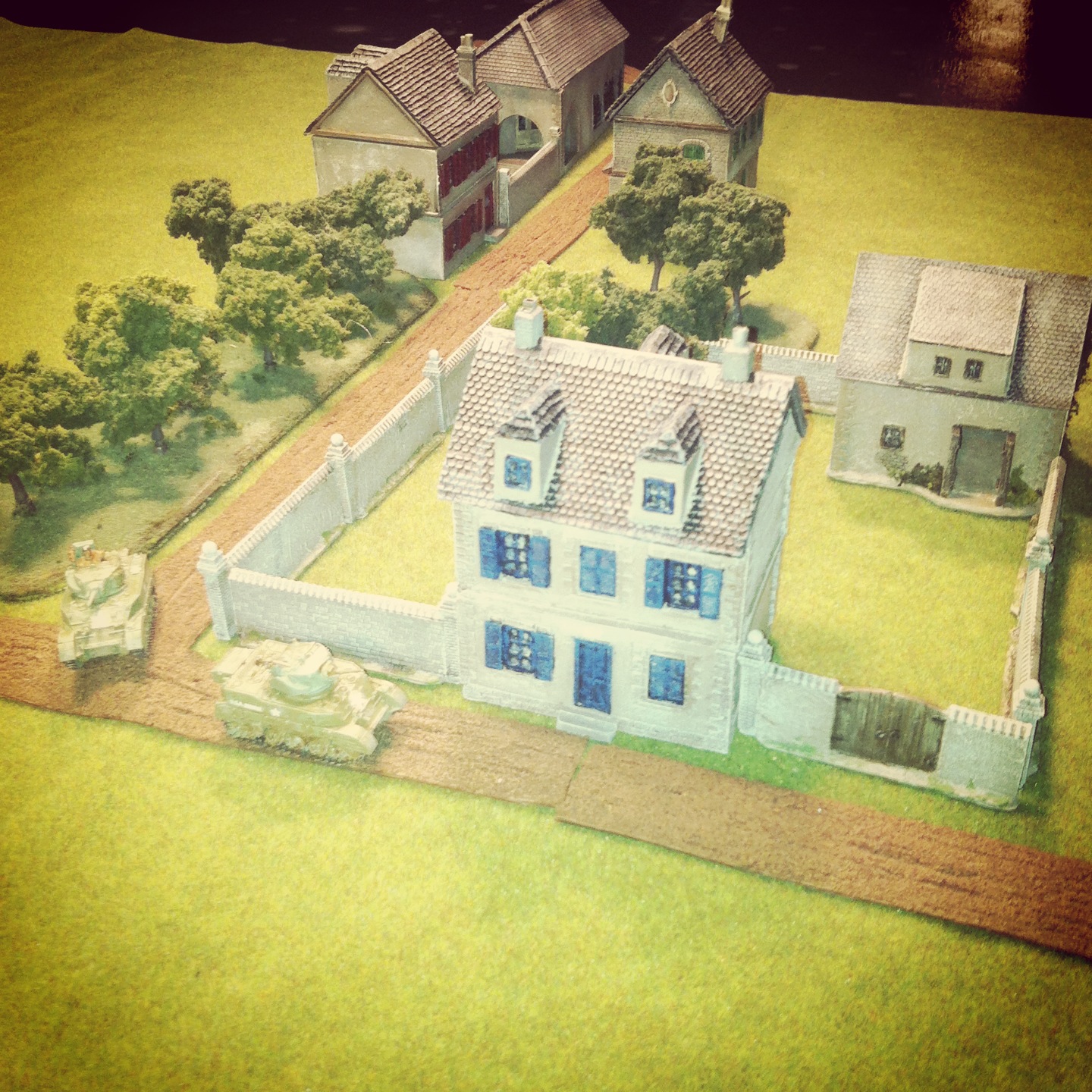
IMG_2117The walled courtyard and modular wall sections got a two-part paint scheme over the gray primer. A watered-down brown-black wash over the bricks and cobbles filled the cracks with a dark shading finished-off with an off-white dry-brushed highlighting coat. The courtyard and wall gates started with a dark brown base with a lighter brown adding aged detail to the wood. Iron hinges got a black undercoat with some rusty metal dabbed over it. The result was some very realistic stone and brickwork walls.

IMG_2112

IMG_2119

IMG_2123

IMG_2125I couldn’t be more pleased with the buildings. They’ve already seen some action on the tabletop in my recent Singling ’44 game and combining them with my existing trees, roads and lichen hedgerows really brings the battlefield to life. I’m already eying a few of the other models offered by Mark IV, including some ruined versions of the same buildings which come cast in some exciting bombed-out interior detail.

At Metropolitan Wargamers, there’s some early plans being laid for another big day of gaming to coincide with the fall’s Flames of War Tanksgiving 2013 event and there’s certain to be plenty of WWII action before then. With my new buildings from Mark IV on the table, these miniature landmarks are certain to add even more depth an interest to all out future games.

Flames of War: Singling 1944 Scenario

4tharmor

By the winter of 1944 the US 4th Armored Division had distinguished itself through a number of actions in France ranging from Operation Cobra in July and the Battle of Arracourt in September all the way through various engagements heading east toward the French-German border. Battleworn and bogged down in the wet winter slush of eastern France, the 4th Armored lumbered to the outskirts of Singling, Lorraine on December 6th, 1944. As part of the defensive Maginot Line, a hasty attack was thrown together to take the farm town with a small force of tanks and infantry. Finding themselves caught up fighting superior elements from the German 11th Panzer Division between the cottages and tight roads of the village, the day’s battle eventually fell to a stalemate and the 4th Armored pulled back. In the coming days, a hail of American artillery and subsequent ground force attacks eventually took Sibling.

SinglingMap44

The WWPD site has a handy Flames of War scenario available for the action at Singling called Abrams’ Folly. In addition, there’s some other gaming-freindly write-ups available online as well as some great historical documentation (including maps and photos) on the battle at Singling. Before heading off to an annual family vacation to Cape Cod, I had a chance to try my hand as the Americans in the Sibling scenario this past Wednesday evening at Metropolitan Wargamers in Brooklyn.

bggbookEach of us fielded 2500 points, sticking as close to possible with the forces outlined in the scenario. I used the Blood, Guts and Glory book which focuses on the armor-heavy battles in this region of France in late 1944 through early 1945. My force featured a mix of 75mm and 76mm Shermans, some tank destroyers, two armored rifle platoons and an off-table 105mm Priest battery. My German opponent started with a Panzer IV platoon, a Jagdpanther platoon, an 10.5cm leFH18 battery, a platoon of Pak 40s and a couple infantry platoons. As it was historically, the Americans were clearly in for a tough fight.

In December ’44, the US entered Sibling from the south but the scenario places the American point of entry at the western edge of the table. The Germans deployed first with infantry and Jagdpanthers in the town, the Panzer IVs to the northwest and the Pak 40s in prepared positions to the southwest. The artillery battery was positioned to the northeast of town with spotters stationed in the church belfry and the attic of a house near the town center.

siblingtable

With the first turn, the Americans rolled in around the main road to the west. Seeing the Pak 40s, all the armor rolled north toward the Panzer IVs parked around and behind a small copse of trees. Infantry platoons made way for the center and the orchard just south of the road. My US plan was to avoid the killing alley of the main road while the infantry would swoop toward an assault on the infantry and Pak 40s to the south and the armor would rumble to the north toward the German tanks.

The US 76s made quick work of the Panzer IVs in the first two turns and then turned toward the center of town. The Jagdpanthers crept out from behind buildings and took a few a shots down the road, eliminating a Sherman. A German platoon camped out in a house at the western edge of town made a misbegotten attempt at an assault on the Shermans, bailing two with Panzerfaust fire but ultimately running off when faced with return attacks from the US armor. Another Panzerfaust-wielding squad popped out from an adjacent cottage and destroyed another Sherman with a quick rear shot before being machine-gunned down. By the end of the third turn, the northwest area of the table was a snarl of burning German tanks and shaken but advancing US Shermans.

32387_10201314045587525_1920471111_n

1185574_10201313808021586_457796402_n

To the south of the road, a stalemate which would run the whole game commenced. The Priest battery struggled to range in and hit the Pak 40s on every turn, proving to be a complete waste of points. The American armored infantry platoons to the south of the road spent most of the game being pinned by German sniper fire and artillery barages, all the while struggling to progress through the orchard. Not until the fourth turn of the game did the American infantry truly get in the fight, exchanging fire with two nearby platoons of Germans but losing nearly half their number to fire from the Pak 40s and German heavy machine guns.

In turn four, things got bad for the Germans. After littering the field north of town with charred wrecks of US armor, several American tanks broke to the middle of town toward the three remaining Jagdpanthers. A near-certain side blast to one Jagdpanther glanced off with no effect, but then an extremely lucky shot from a US 76 destroyed the Jagdpanther command tank. While the Germans scrambled to appoint a new command tank, the Americans ganged up to destroy one of the two remaining Jagdpanthers. With the platoon reduced to just one remaining tank, the German player rolled and failed a morale check and the last tank fled the center of town.

267391_10201314392956209_640393299_n

1235934_10201314392676202_1206092596_n

With the center of town secured, all German armor destroyed, a stalled infantry firefight to the southwest and the American tanks advancing to the German artillery battery, the game was called at the fifth turn. I was honestly surprised by the American victory, upsetting the historic outcome of the battle. We stood around for some after-action what-ifs for both sides while packing up the table, and clearly there could be improvements in choices of forces and tactics the next time we head back to Singling.

Loving The Evil Dead: Why Do We Like Nazi Zombies?

Gaming, at its core, is a matter of pitting at least two sides against each other in a test of tactics and strategy. Whether you’re playing chess or moving hundreds of miniature soldiers around on a tabletop battlefield, you have to pick a side. In most games, there isn’t necessarily a “good” side or a “bad” side. But then you get to Nazis and from there you go to Nazi zombies.

Nazis are the bad guys of the 20th-century, and Nazi zombies take their evil to another level. Maybe its because there’s no way anyone can feel badly about slaughtering a horde of Nazi zombies that makes them so appealing as a foe. There’s also a horrific visual impact of Nazi zombies, as well as some conjecture the Nazis actually had some relation to the supernatural. For whatever reason, Nazi zombies are swarming everywhere and have been creeping up on us for some time.

Nazis And The Occult

Beginning in the 1950s, a spin-off post-WWII historical narrative began to emerge involving the real or supposed fascination that Adolph Hitler and his Third Reich held for the occult. While the Nazi obsession with ceremony and iconography can’t be denied, most of the Nazi-occult conspiracy theories seem to be more about trying to explain how something as evil as Hitler’s Reich could be allowed to rise to power right in front of a watching world. Books, fictional movies and documentaries have delved extensively into this topic of Nazi fascination with weird science and magic. Numerous movies like The Boys From Brazil, Hellboy, Captain America and my favorite, Raiders of the Lost Ark, have all used Nazism and the occult as main plot points. Throwing the dark arts into the mix with the already-hated Nazi bad guys is just one more way pop culture has amped-up the inherent evil of Nazis and their doomed quest for world domination.

Nazi Zombies On Film

shockwaves     zombielake

About a decade after the first scholarship on Nazism and the occult emerged, George Romero launched the first wave of modern zombie films with his classic Night Of The Living Dead in 1968. Through a series of sequels and other Romero-influenced movies, the zombie genre slowly grew worldwide during the rise of horror and slasher films in the 1970s and 80s. The Nazi zombie movie subgenre probably arrived in 1977 with Shockwaves starring British horror screen veteran Peter Cushing in the role of a SS commander breeding Nazi zombies who attack a yacht’s shipwrecked crew. The movie began a minor trend almost exclusive to European filmmakers in the 1980s with the B-movies Zombie Lake and Oasis Of the Zombies.

outpost      dead snow

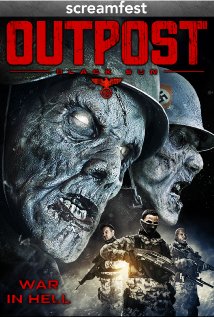
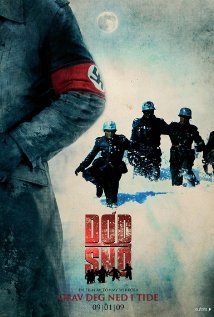
The second life of all things zombie came post-9/11 in a surge of movies, comic books, novels and the critically-acclaimed The Walking Dead TV show. Again, European movies led the way on the Nazi zombie theme with Horrors of War, Outpost and War Of The Dead. My personal favorite in the modern wave of Nazi zombie cinema is 2008’s Dead Snow, a Norwegian film that made the rounds on the art film circuit. The dark uniforms and red, white and black swastika armbands against the mountain snow makes for striking visuals, even more-so as the blood begins to splatter. The film is a tight amalgam of themes from the genre — cursed treasure, local legend and, of course, unsuspecting good-looking vacationers winding up smack in the middle of a battle to the death with Nazi zombies.

Next up on the still-growing list of Nazi zombie movies is this year’s Frankenstein’s Army, which offers a riff on the Nazi zombie theme with a heavy dose of classic horror, science fiction and even steampunk thrown in. Again, the makers of this latest entry in the Nazi zombie genre are European. I don’t think its a coincidence that most Nazi zombie movies have risen out of many of the countries once occupied by the Axis forces. Since many Europeans live most directly with the spaces and stories of WWII all around them, clearly the Nazi zombie storylines of these films are tapping into a vein of horror that still resonates today.

Nazi Zombie Video Games

As a kid, one of my earliest video game memories on my Apple II computer was Castle Wolfenstein. While there were no zombies in the game way back in 1981, the modern iterations of the Wolfensetin video game series have included zombies. Not only did the new Wolfenstein games help popularize the now-ubiquitous first person shooter (FPS) game mechanic, but they fired some of the earliest shots in the escalating video game Nazi zombie wars.  Call Of Duty has risen to become one of the most successful franchises in the FPS genre, and a big part of its success can be tied to its Nazi zombie expansions. I would argue that without Nazi zombies as targets, many more wary parents may have kept FPS games out of their children’s hands. Hurling grenades and unloading clips into crowds of Third Reich undead is something to which even the most cautious parents may very well have turned a blind eye.

Nazi Zombies Tabletop Games

suicide squad

With the 21st-century rise of all things zombie, tabletop games have also become infected with the undead. Zombicide, Zombies!!! and Last Night On Earth are among the host of gamer favorites pitting the living versus the unliving. Naturally, Nazi zombies have found their way to the tabletop, too. Two popular games — Dust Tactics and Incursion — take an alternative history approach to incorporating zombies into Axis powers. Among all the futuristic technology available in the miniatures game Dust Tactics are squads of zombie soldiers which prove to be fast and incredibly deadly in the game. Similarly, the game Incursion include zombies in the living arsenal created by evil Nazi scientists.

zombieminis

Beyond packaged boardgames, wargaming has followed the zombie trend. The “weird World War II” genre of miniature and RPG games offers some monstrously fun modelling and play possibilities with such things as bizarre zombie battlescapes, fantasy technology, magic-using stormtroopers and lycanthropic soldiers in a WWII alternate universe. Weird War II: Blood On The Rhine from 2001 was one of the early RPG systems incorporating zombies and occult alternatives to the WWII time period. Nazi zombie miniatures in both 15mm and 28mm scales are now mainstays in online gaming forums and at regional conventions. Rules systems have been written to accommodate the Nazi zombie craze and players regularly create house rules for other regular WWII-themed games such as Flames of War and Bolt Action.

Nazi zombies have their own history now, rising out of theories of Nazi-occultism and then mined as the nightmare bedtime story for European horror filmmakers for nearly four decades. As the ultimate in evil, Nazi zombies now lurk in every corner of popular culture, much of it overlapping with the gaming hobby onscreen and on the table. Debates will continue to rage between the historical gaming purists and those who love their Nazi zombies. Honestly, playing with Nazi zombies has become just too fun to ignore and the horde just keeps coming.

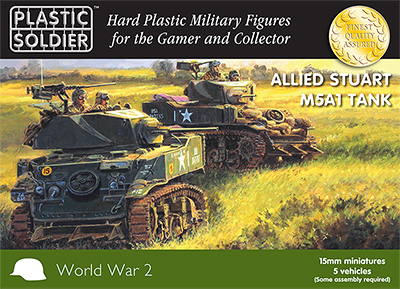
Flames of War: Fielding the PSC Stuart Tank

While the durable US M4 Sherman gets most of the glory in the annals of WWII Allied tank history, the M3 Stuart also played a significant role in providing valuable infantry and reconnaissance support throughout the war. The Stuart was originally supplied to the British ahead of the US entry into the war, but American tank crews would eventually use them throughout the European, African and Pacific war theaters. Armed with .30-calibre machine guns and a 37mm main gun, the Stuart proved itself to be a finicky yet effective part of many of the war’s major actions and campaigns, including the D-Day Normandy campaign of 1944.

Most of the US armor I use in Flames of War gaming comes directly from Battlefront, the makers of the popular 15mm WWII wargame. Battlefront manufactures beautiful models but the company is often criticized for its prices. I already own a fair number of Battlefront’s M4 Sherman tank models. With so much of my armor tied up in the sameness of my Sherman platoons, I’ve long wanted to add some diversity in my force with a light tank platoon option.

Coincidentally, the Plastic Soldier Company has recently been expanding its small but growing line of 1/72 and 15mm WWII hard plastic infantry, vehicle and armor sets. At nearly half the price of the FOW offerings, the 15mm Plastic Soldier Company boxed sets look to be a legitimate bargain alternative. As luck would have it, among their new releases from the past month was a 15mm Allied Stuart set containing five models which make up a perfect light tank platoon for my FOW force.

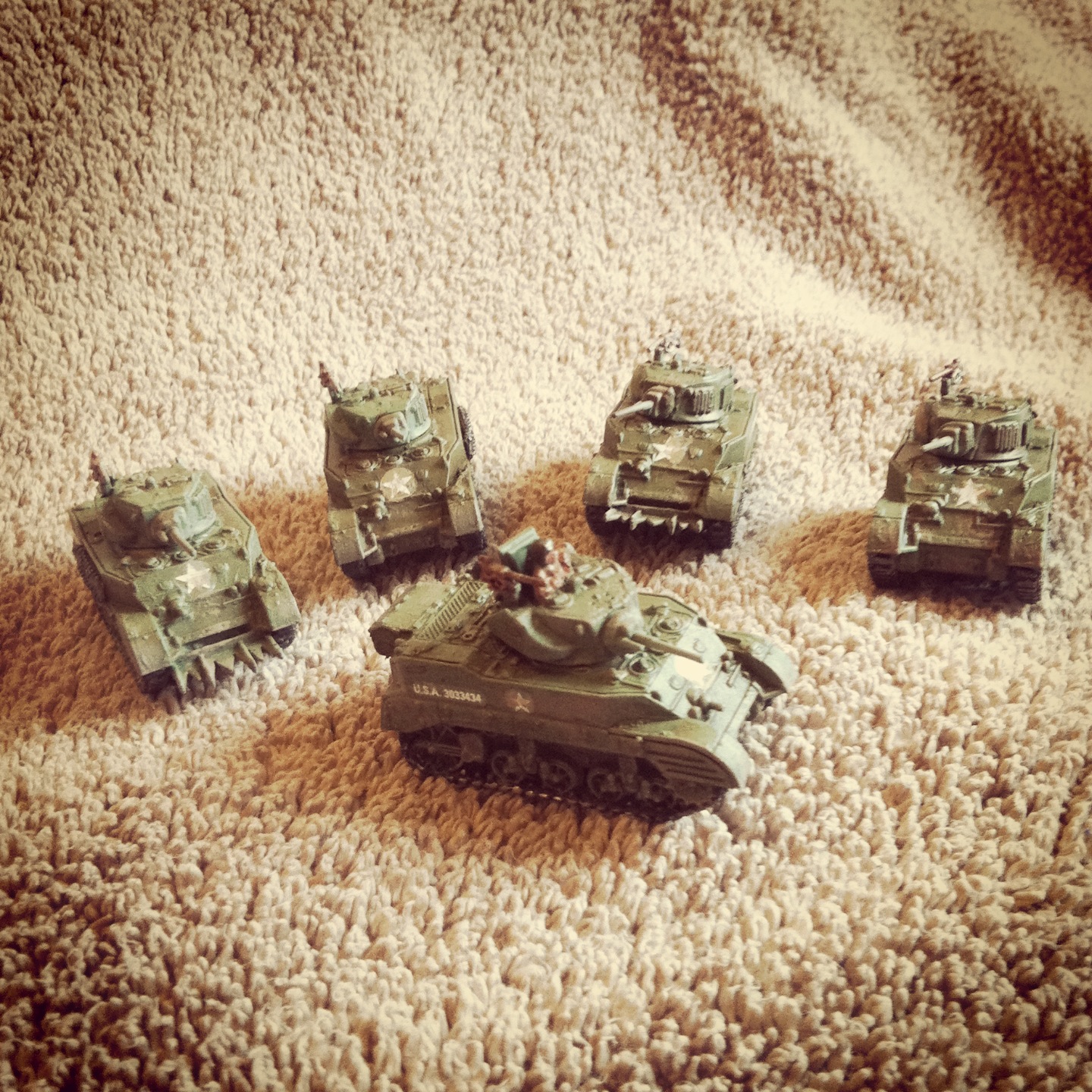
Despite the relative low cost, I approached my first go-around with the PSC with a critical eye. The Stuart set comes with enough parts for five tanks from the early, mid or late WWII periods. The flexibility of the modelling is fantastic, but it does result in a bunch of unusable waste parts left on the sprue. Gluing the models up for the late war was fast, with the finely-detailed casting going together smoothly. A relectuant criticism of these otherwise excellent models is the way in which the turrets fit to the hulls with tabs which were a bit tight for my liking. I wound up cutting the tabs off so the turrets move more freely, but this extra step did destroy the other strong points of the PSC models.

After the glue dried, the models got a coat of green armor spray followed by some black and metallic paint brushed on the treads. Tools and stowage attached to the hull were picked out in detail, and then all the tanks got a watered-down brown wash. I applied some appropriate US decals I had left over and then the tanks got some splattered mud details in a lighter mud color.

IMG_1956

The result of my Stuarts and my first experience with the Plastic Soldier Company is entirely satisfying. Not only can’t I wait to roll these fast, deadly tanks onto the table in my next game, I likewise will be anxiously awaiting what new releases the company has in store to further build-out my forces.

Retro Gaming The 70s & 80s: Marvel Super Heroes Role-Playing Game

marvelbox

Way back in the late 1970s, well before we had summers filled with superhero movies, I was a comic book collector. Those were the days when my younger brother and I bought our weekly fix of Marvel and DC superheroes off a squeaky rotating rack in a corner store, all for under a dollar each. Eventually our collecting graduated to visiting comic book shops, flea markets, yard sales and small regional comic book conventions in Western New York. As our collection grew into thousands of books by the mid-1980s, my brother and I were receiving weekly warehouse wholesale shipments and were bidding on lots of older books through auctions by mail. Both of us sold-off the majority of our collections in the late 1980s and early 1990s before the market became glutted, eBay arrived on the scene and CCG-graded comics became the new collecting norm.

timetrapI still have a significant, albeit more scaled-down, interest in comic books to this day. Yet as I recall those peak collecting years in the early 80s, my mind eventually takes me to memories of 1984 and TSR’s release of Marvel Super Heroes: The Heroic Roleplaying Game. The game arrived during big expansion years for TSR as the popularity of their flagship Dungeons & Dragons franchise continued to grow in player fandom and pop culture infamy. Winning the Marvel license allowed TSR to launch a new game with a built-in base of players which had a lot of cross-over interest in comic books and gaming (like myself). Despite the promise of the total package of the Marvel Universe delivered in a RPG by the makers of D&D, the Marvel Super Heroes game never really delivered.

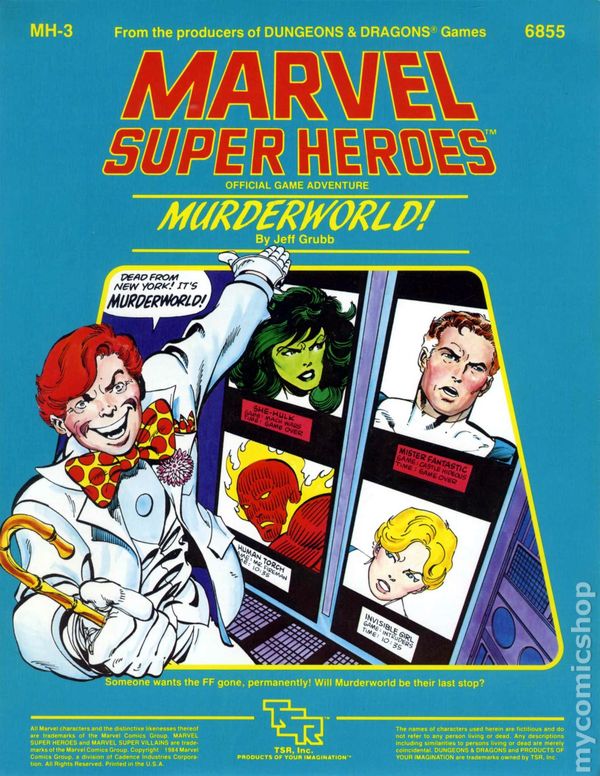
murderworldThe core box came with a quick start “Battle Book” and a more detailed “Campaign Book.” Also included was an introductory scenario, “Day of the Octopus,” plus a fold-out map, character reference cards and some rudimentary markers. TSR quickly expanded the game with a number of accessories including a couple sets of poor quality metal miniatures and quite a number of game adventures following the module model which had proven so successful with D&D. An eager collector, I snapped up a bunch of adventure books, including “Time Trap” featuring the Avengers and “Murderworld!” starring the Fantastic Four. Expansions also included a number of adventures which featured “adventure fold-up figures.” Unable to help myself, I happily bought the Hydra-themed “Pit of the Viper” edition along with a few others.

pitofviperDrawing on the stable of established Marvel characters, the game looked great. Mechanics borrowed broadly from D&D with “Attributes” establishing the primary strengths of a super hero on a scale of 1-100. “Superpowers” defined unique abilities while “Talents” were a set of skills a character could draw upon. A system of “Karma” (similar to D&D Experience) allowed for character upgrades. The problem I quickly found with the game was that you played characters within an established set of backgrounds and relationships. Spider-Man, Thor or The Human Torch carried enormous backstories, robbing players of the opportunity to create and grow a character from the ground up like in the more pure RPG realm of D&D. Eventually, I was buying the expansions simply to read the text and assemble the little cardboard figures and terrain pieces.

Despite the mediocre quality of the game overall, TSR went on the release a revised version of the game in the late 1990s. More than anything else, the second edition of the game was probably an effort to retain the license from Marvel. Even so, Marvel and TSR eventually parted ways by the early 2000s.

So much of my generation was defined by the first modern wave of toy licensing with Star Wars that I can hardly fault TSR for jumping on the brand-extending bandwagon with Marvel. It’s amazing to me the game lasted so long given my memory of its lack of interesting play. This is one game I can’t foresee ever returning to. Its true superpower lay in how deep the marketing of those characters was a part of me then and stays with me today.

Collector’s Note: Most probably owing to the low quality of the game, the original TSR  Marvel Super Heroes game starter box set and most expansions can be found on eBay for under $20 each.

Flames of War: Metropolitan Wargamers Summer 2013 FOW Day

Taking advantage of a renewed interest in the popular Flames of War 15mm miniatures WWII wargame, Metropolitan Wargamers in Park Slope, Brooklyn hosted a big day of gaming this past weekend. Both experienced and new players alike came together on two of the club’s largest tables to play to big scenarios over the better part of Saturday afternoon.

Metropolitan Wargamers

MWGFOWI mention it often, but the amazing group of people who make up the Metropolitan Wargamers club bears mentioning again. The club will celebrate its 20th anniversary next year, and it’s a real gamers paradise for those of us living in New York City. Visitors and a core group of long-time members drop by the club throughout the week and engage in all manner of games, from boardgame favorites and card games to large scale historical miniatures battles and grand strategic campaigns. The club’s space occupies an entire basement-level of a typical Brooklyn rowhouse and is lined with shelves full of games and miniatures collected by members over two decades. Playing space includes a number of the club’s award-winning sand tables, regular tables and racks on which ongoing games can be stored as they are played out over the course of weeks or even months.

The club is an incredibly diverse and supportive environment for those of us who share our common passion in gaming. With 2014’s anniversary coming up, I hope to dedicate more space here in the near future with some history and perspectives from members.

Summer 2013 FOW Day

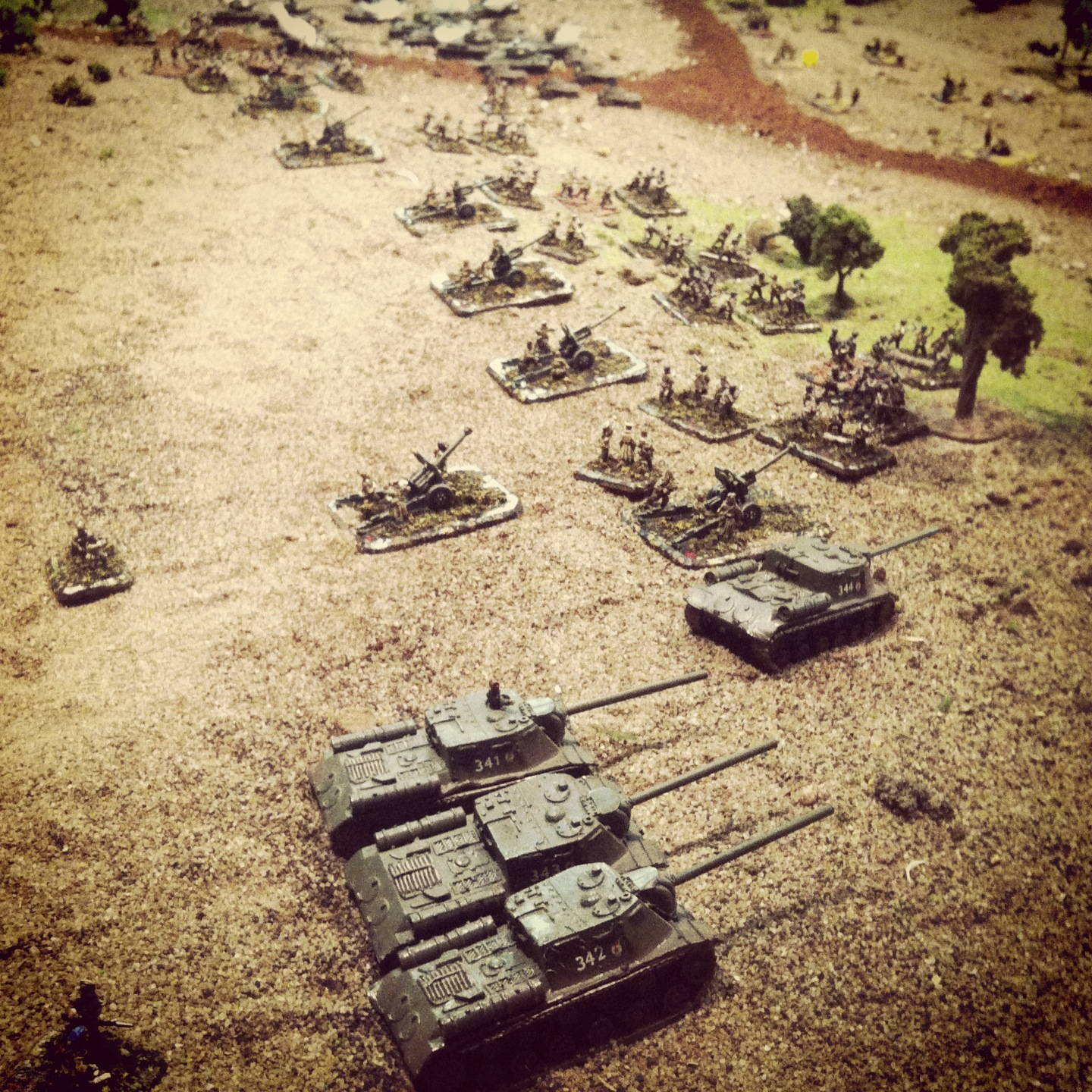
totalwarThe folks at Flames of War provide special Total War rules for gaming large-scale matches like those we played this past weekend. With a few weeks of planning, I helped round up 10 players for the day’s game. We settled on two games from the late war, one each on the Eastern and Western Front. The Western Front game featured two teams of two players each on the German and US sides with each team running 3000 points on a 4’x8′ table. On the Eastern Front, two three-player teams squared off in a tank-heavy scenario on one of the club’s famed sand tables with each team compromised of 5000 points. Each game featured endgame objectives and were slated to run to eight turns. With games these large, we were up for a very long day of action.

On the Eastern Front, the table was wide open with widely-sloping sculpted sand hills, small copses of trees along each long side and a Y-shaped road bisecting the table. I spent the day riveted to my own game on the Western Front table, but the German and Russian armor spent the day pounding away at each other. By mid-day, things had looked pretty good for the Germans as many destroyed Russian tanks stood smouldering midfield. All that changed in the latter half of the game as the Russians rallied to victory.

IMG_1908

IMG_1912

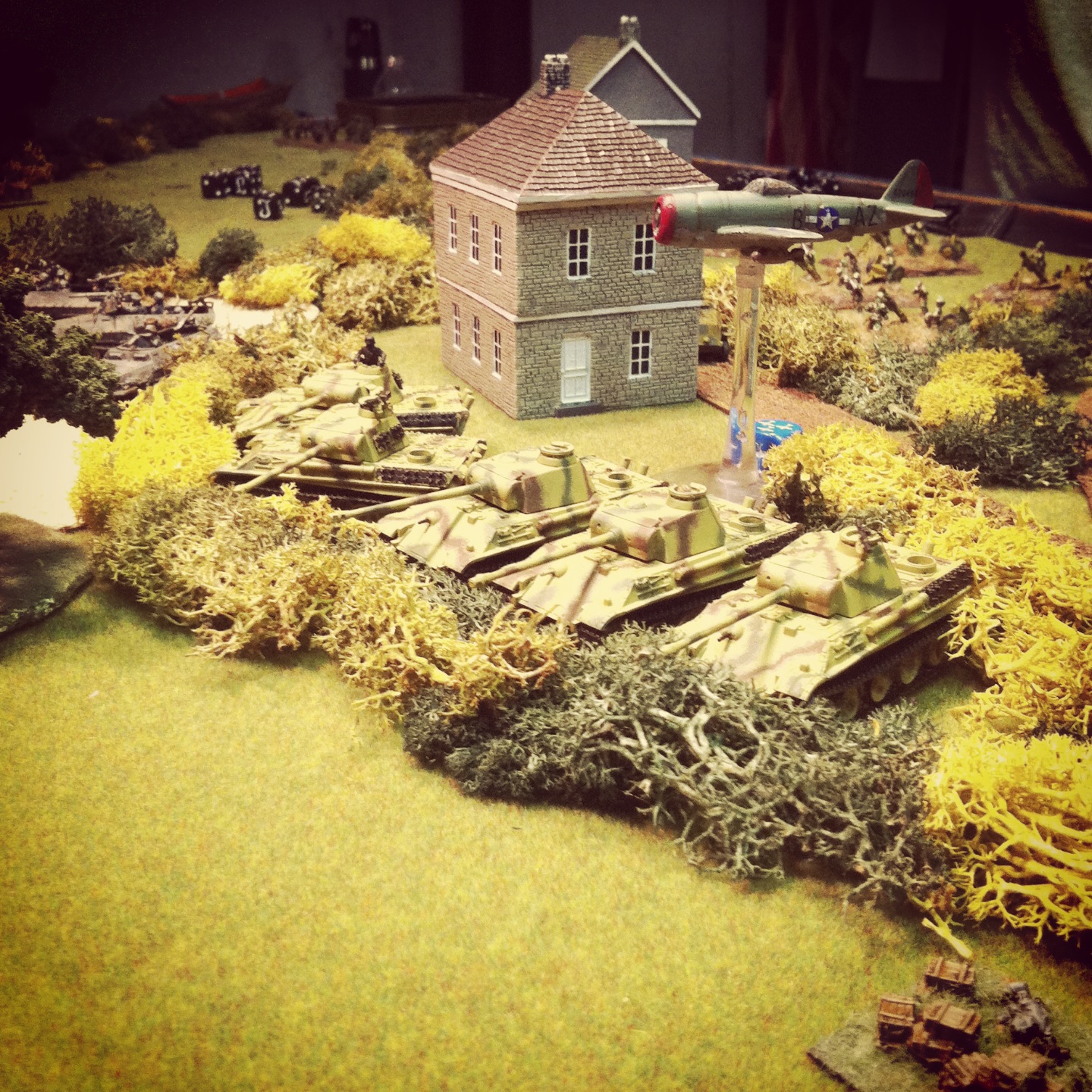
My game on the Western Front featured a generic French landscape cut up into winding narrow roads lined with the notoriously difficult bocage hedgerows which stymied both sides in the engagements fought in the region throughout 1944 and 1945. A church stared across the board to a stone bridge crossing a narrow stream to a small village. On the other end of the table, a small farm was set beside two wheatfields with two more rural stone houses in the near distance.

IMG_1903Our US plan was to place the majority of our armor on our right flank, supported by mobile infantry deployed in a small wood. On the left flank, the US Airborne deployed just outside the wheatfields with its small parachute battery to the rear. At the center of the board, our M7 Priests with their 105mm guns formed another battery while one lone Airborne platoon pushed to hold the buildings in the town with a vantage covering the bridge.

The game started poorly for the Americans as the Germans quickly pummeled the American Shermans and kept the infantry hiding in the woods. In the center, the US infantry struggled to occupy the buildings as the Germans quickly rolled five exceedingly threatening tanks behind a row of bocage overlooking two objectives. The American’s P7 Thunderbolt was likewise ineffective through the first few turns of the gaming, missing all targets except on German tank which burst into flames while bogged over a hedgerow.

IMG_1918

IMG_1906

IMG_1916

The fight on the American left went better from the start as the US Airborne filled the wheatfields and headed for the hedge and road beyond. A brief scare from a platoon of German Stugs, a row of halftracks and a platoon occupying the farmhouse  was solved with our trusty American Shermans. With a combination of artillery bombardments, heavy fire from the US tanks and some shooting from the advancing Airborne, the crossroads in front of the farm was turned into a smoking mass of destroyed German armor. Just as the German right flank stood wide open to the rolling Shermans, the command tank bogged in the woods where it and its entire platoon would remain for the rest of the game.

IMG_1914

IMG_1924By mid-game things looked good for the Germans, but the resilience of the Americans would prove to be the edge in the second half. The American armor was pretty torn up on our right flank, but the US kept making some remarkable morale rolls to stay on in the fight with the dwindling German tanks. At the center, the Priests had lost one of their guns but snuck back into cover to continue taking direct shots across the river at the remaining German armor. The US Airborne platoon occupying the town’s buildings risked a run toward the river, taking casualties along the way despite the smoke covering the German line on the far side. The fight between the wheatfields and adjoining treeline saw the Germans and Americans whittling each other down.

IMG_1926

IMG_1910

IMG_1920

IMG_1928

In the final turn, the 101st Airborne finally got in close enough for a tank assault, destroying one tank and pushing another back from an objective. It was a bloody fight, but in the end it was an American victory with four of six objectives held. On both tables, it had been a good day for the Allies.

And it was a long one, too. With a nearly eight hours of gaming and only brief breaks to grab a drink from the fridge up front or a hotdog off the grill out back, the two games had been exhausting but enjoyed by everyone – win or lose. That’s the kind of spirit we at the club experience every week, and already there’s some after-action discussion about when we’re planning our next big Flames of War day in Brooklyn.

Flames of War: Fielding the Guards Armoured Division

guardstanks

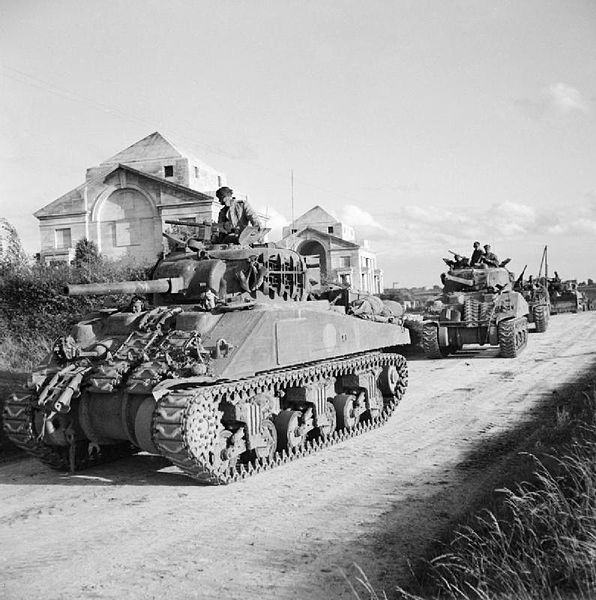
Among the multi-national Allied forces that participated in the campaign following Operation Overlord on D-Day on June 6, 1944 were the British Guards Armoured Division. Arriving a couple weeks late to the party on June 26, the Guards would roll on to participate in many of the key post-D-Day engagements including Operation Goodwood, Operation Market Garden and the Battle of the Bulge. I’ve been encountering the Guards over and over again in Rick Atkinson’s engaging The Guns At Last Light, the latest and final volume in his “Liberation Trilogy” telling of the Allied march to victory in World War II. And so, it is great timing that I’m finally getting around to adding the Guards as my first allied group supplementing my already extensive US forces in my Flames of War gaming.

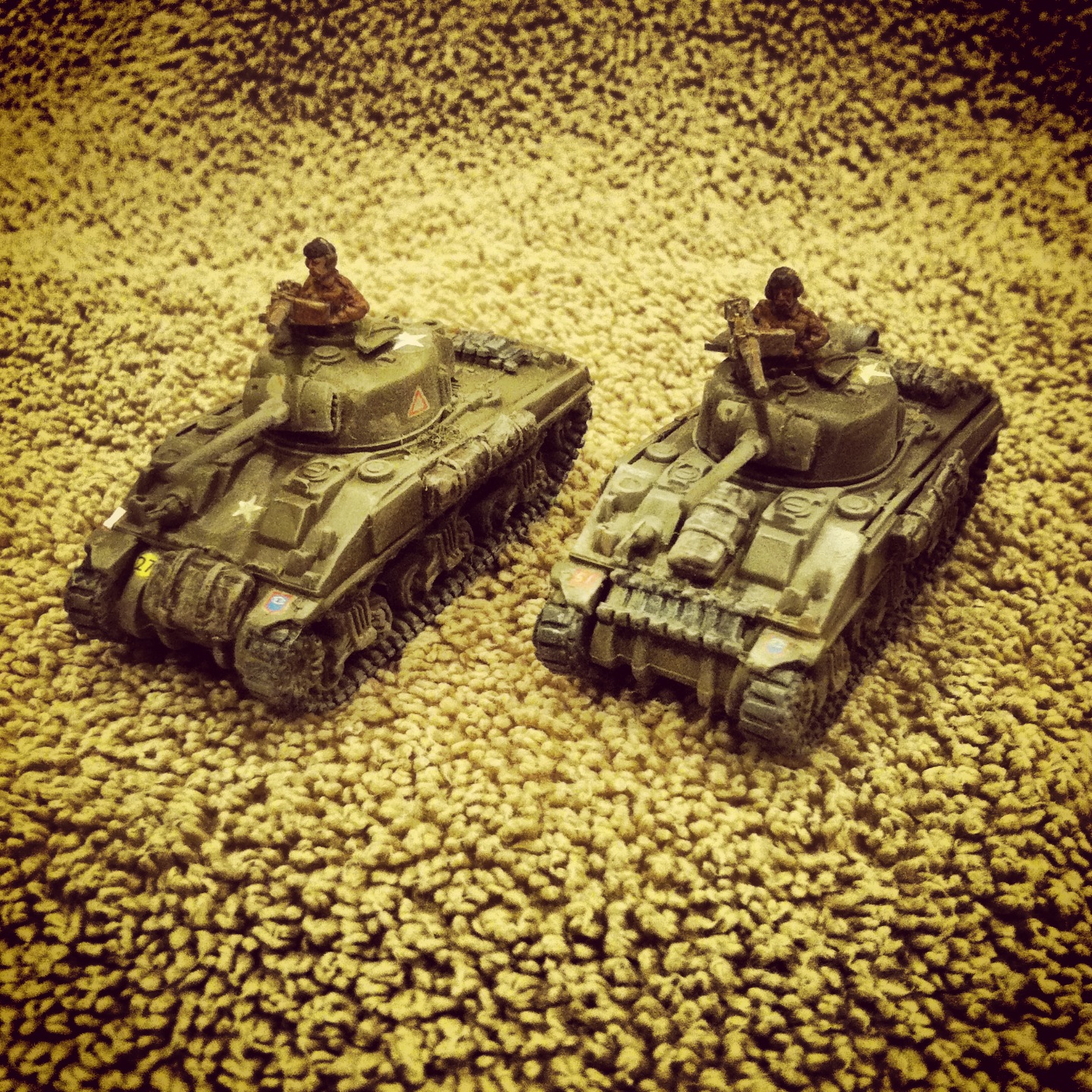
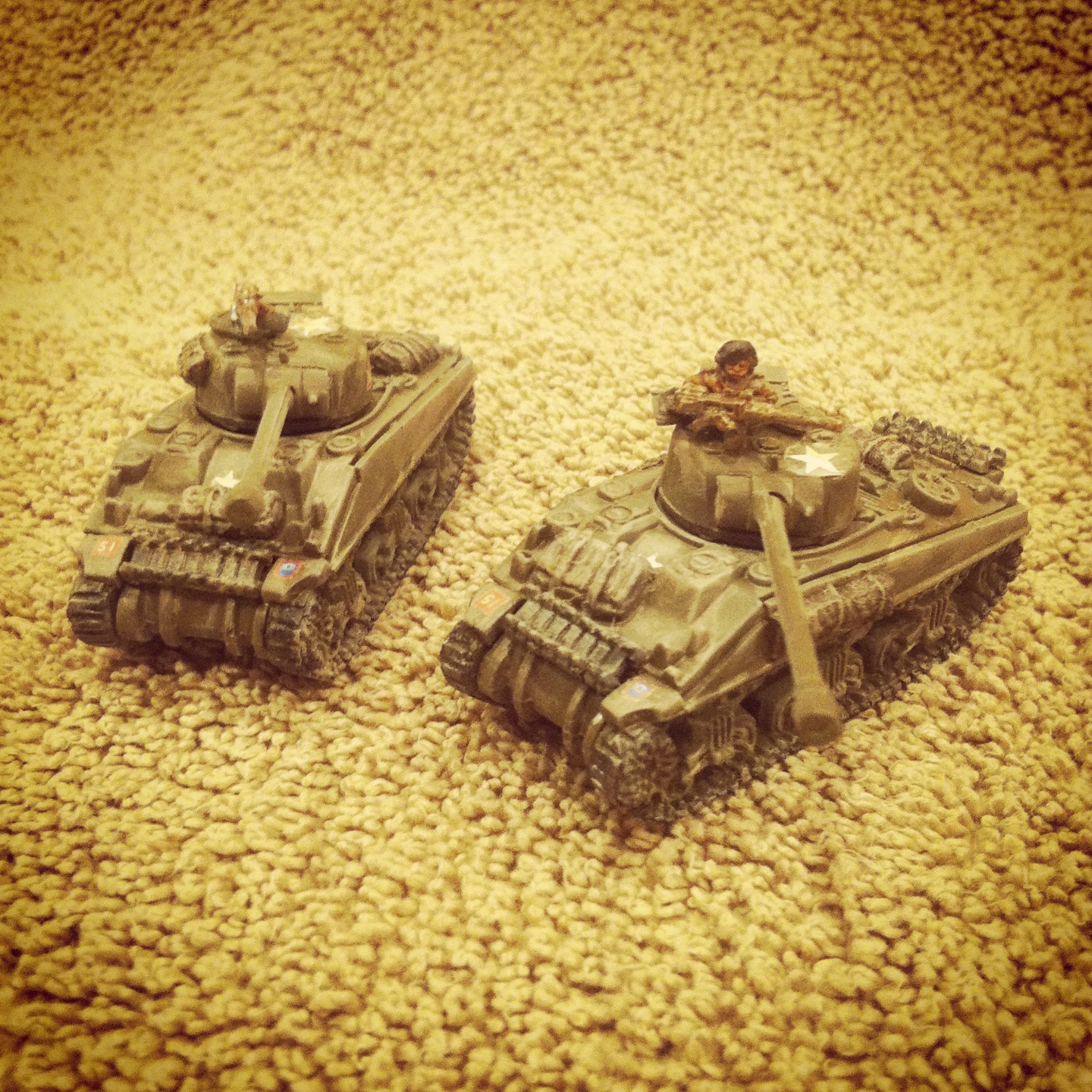
FWOFBoxI’ve been working away for half this year on finishing up the models included in the excellent Flames of War Open Fire! box set. Among all the plastic goodies included, the set offers up a nice Guards platoon to provide support to their allied US Airborne infantry. The eight models include six of the US-supplied Sherman V tanks and two of the famed Sherman Firefly tanks, retrofitted by the British with a massive 17-pound anti-tank gun.

Aside from a rather significant and well-documented issue with some parts fitting together, the models glue up pretty nicely. To the included stowage and gear included on the sprues I also added some leftover bits. A quick coat of green armor spray paint followed by black and silver lightly brushed on the treads made up the majority of the painting work. The exposed drivers received a tan uniform, black beret and radio headset picked out in detail. Crates and tool handles strapped to the hull got a quick touch of brown.

IMG_1894For decals — a big oversight in not being a part of the Open Fire! kit — I used a set from the Plastic Soldier Company and guidelines found on the Flames of War site. I found the decals from PSC to be easier to apply than those I had used from FOW in the past, but I did still use a few Allied “star” markings I had lying around from previous US tank models from FOW. With the decals dry, a bit of dried mud color and watered-down brown wash added some wear and tear around the tanks before they were hit with a matte finish.

IMG_1896

IMG_1898Now that I’ve got some Brits on the table, I’m eying some UK infantry to add some depth to my collection and flavor to my games. There’s a big full-day Flames of War gaming event coming up in just a few days at Metropolitan Wargamers, but I don’t think the Guards will be making an appearance this time around. Still, it will be good to know they’re waiting to throw in with the Yanks on another day in the near future.