New Game Weekend: Arkham Horror

ahcoverbox

Released in 1987 and then vastly revised in 2005 and 2007 by Fantasy Flight Games, Arkham Horror is one of the modern classics in horror-fantasy boardgames. This past weekend, the creatures of Arkham Horror invaded our home in Brooklyn, and my sons and I have a new favorite.

Based on the writings of H.P. Lovecraft and his Cthulhu Mythos, the game casts 2-8 players in the roles of investigators in the fictional town of Arkham, Massachusetts during the interwar period of the 1920s. The New England town has been beset by the terror of strange rumblings of monsters invading the streets accompanied by weird magic, supernatural beings and strange goings-on. The mission of the investigators is to travel through portals to Other Worlds and seal them before a great Ancient One emerges in the town. Along the way, investigators accumulate clues, arcane items, spells and skills by visiting various locations in the town. If the portals are not closed in time, the horrific Ancient One rises and squares off in a final epic battle with the investigators in a last-ditch effort to save Arkham and the world as we know it.
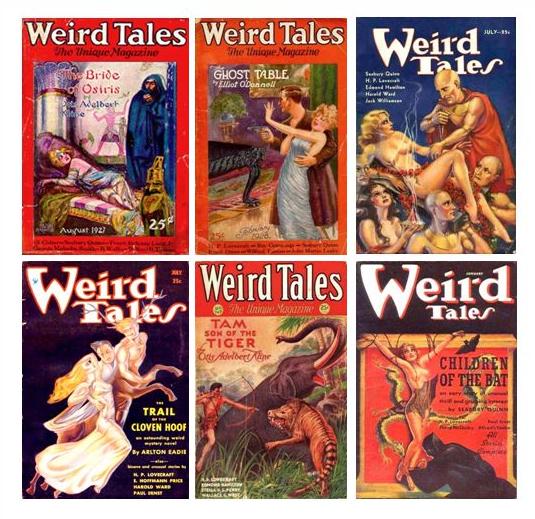
wtcoversIssues of Weird Tales magazine featuring the work of H.P. Lovecraft from 1927 to 1937

H.P. Lovecraft is a darling of gamers and science-fiction/horror fans, and his influence resonates throughout today’s pop culture of movies, comic books, fantasy literature and gaming. Throughout the 1920s and 1930s, Lovecraft published a series of short stories broadly placed in the weird fiction category combining elements of horror, science fiction, fantasy and crime genres. With its troubling themes of peril and unknown, weird fiction was perfectly suited for a broad mindset of American society just emerging from World War I, living through the Great Depression and watching the storm clouds of World War II gather on the horizon.

Weird fiction found a home with the cheap pulp-paper magazines popular in the first half of the 20th-century including dozens of titles such as Argosy Magazine, Amazing Stories, Western Story Magazine and Weird Tales. Within their wondrous and often racy covers, pulp magazines featured everything from western adventures, jungle stories, Victorian detective tales, sword and sorcery plots and science-fiction wonders. Authors such as Arthur Conan Doyle, Robert E. Howard, Edgar Rice Burroughs and Lovecraft could all be found side-by-side within these magazines. The stories from pulp magazines were of profound influence on countless later 20th-century writers and directors, perhaps most famously with Steven Spielberg and George Lucas. As kids in the 1970s and 80s, reprints of many of these pulp tales filled the heads of my circle of friends and informed our lifelong interests in all things weird and fantastic.
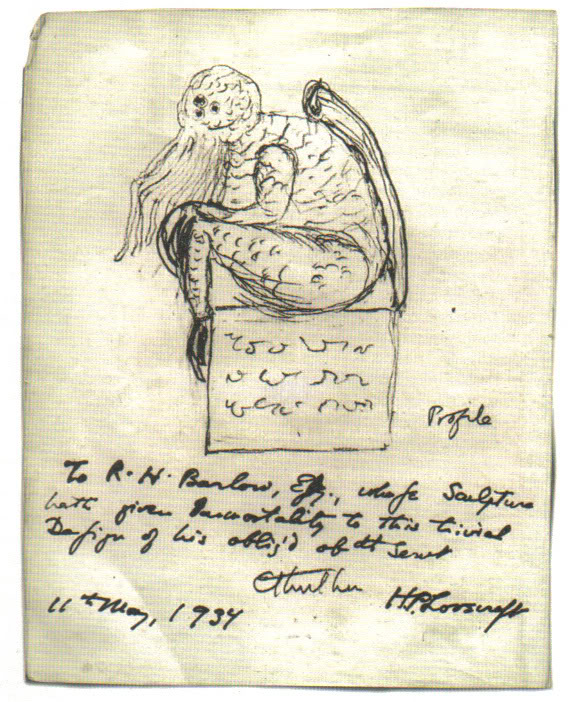
CsketchA 1934 sketch of Cthulhu by H.P. Lovecraft

One of Lovecraft’s most enduring stories, The Call of Cthulhu, was first published in Weird Tales in February 1928. The story recounts a mystery of an ancient cult of a mythic tentacled beast known as Cthulhu and the worldwide quest to uncover its origins and its new rise to plague the modern world. Through subsequent stories by Lovecraft and other writers, the world of the Cthulhu stories grew to be dizzyingly expansive in it depth of detail and plot. Today, Lovecraft’s Cthulhu universe serves as an insidery geek shorthand that stretches from stories, games, comic books and compendium reference books to clothing, statuettes, cupcakes, tattoos, jewelry and countless other collectibles.

10649826_10203907450141018_1116891535581886976_nArkham Horror from Fantasy Flight Games gets unboxed at our house

My older son recently scored a free copy of Arkham Horror after serving as a counselor in training during the summer day camp program at Brooklyn Game Lab, and we jumped into a full weekend of playing this wonderful game. People familiar with products from Fantasy Flight Games will find a box of incredibly well-designed pieces, with a richly-illustrated game board and hundreds of cards, playing pieces and reference sheets. The rules are daunting and require several plays to wrap one’s head around, but eventually Arkham Horror moves along briskly in a couple hours of gaming.

The game is basically a race against time until the Ancient One awakens to destroy the town. Much like an adventuring party in role-playing games like Dungeons & Dragons, players choose to play as one or two of sixteen roles such as a researcher, magician, gangster, nun, archaeologist or drifter. Each character begins with set standard and specialized equipment, money, spells, skills and allies laid out on a card depicting base abilities. The abilities — speed, sneak, luck, lore, will and fight — are each measured on a track that allows a player to boost or lesson their effectiveness at the beginning of each turn. Players move to various locations within Arkham where they find clues, engage in encounters or perform other actions like healing at the hospital, hiring allies at the boarding house or shopping for items at the general store or curiosity shop. Armed with items, skills and spells, characters either engage in combat with revealed monsters or attempt to slip by them. Taking damage from monsters or other encounters reduces an investigator’s Stamina (ie, health or hit points) or Sanity, driving the player closer and closer to death or madness.

At the end of each player round, a Mythos card is revealed opening a new portal to the Other Worlds, spawning new monsters and moving monsters already in the town. A character moving to a portal spends two turns journeying in one of eight Other Worlds where they may encounter more monsters or find objects. Upon emerging from the Other World, a character attempts to close or even seal the portal at the location. Each turn, the Ancient One moves on step closer to awakening. Players must either close or seal a set number of portals before the Ancient One arises for a final battle with all the players.

10639448_10203907820550278_4188666163549777050_nArkham Horror laid out for our first games this past weekend

 Like Lovecraft’s written work, there is an enormous amount of story in Arkham Horror. The game plays like a rich role-playing game with backstories on the investigator characters and detailed information on the various cards and monster pieces. Since the game is collaborative, everyone either wins or loses, making collective planning and playing to each character’s evolving set of equipment and abilities a must. For instance, certain characters may be more adept at moving quickly and acquiring valuable items while other characters may be better suited to go to battle with physical or magical beasts. In a battle with the Ancient One, the collective strengths of the entire group will combine to have any hope against defeating the creature and saving Arkham.

My sons — ages 14 and 9 — played three games of Arkham Horror with me this past weekend, and it’s a big hit at our house. We’re all fairly experienced gamers and we’ve logged many hours with some pretty heavy boardgames like Civilization, also from Fantasy Flight Games. Arkham Horror is suggested for ages 12 and up, and the flavor text on the game cards and mechanics were a bit on the challenging side for my younger son. With that said, with a little help on the heftier vocabulary words, he enjoyed the story, collecting items and using various combinations of gear, spells and skills to destroy some monsters and seal portals to the Other World. By the end of the weekend, my older son and I also started getting a handle on using characters in combination to effectively work through the rising tide of beasts and terror in the town. No matter the age, Arkham Horror is going to push any gamer’s skill and sanity to the limit.

New Game Weekend: A Few Acres of Snow

AFewAcrescover

 “You know that these two nations are at war about a few acres of snow somewhere around Canada, and that they are spending on this beautiful war more than all Canada is worth.” — Voltaire, Candide (1758)

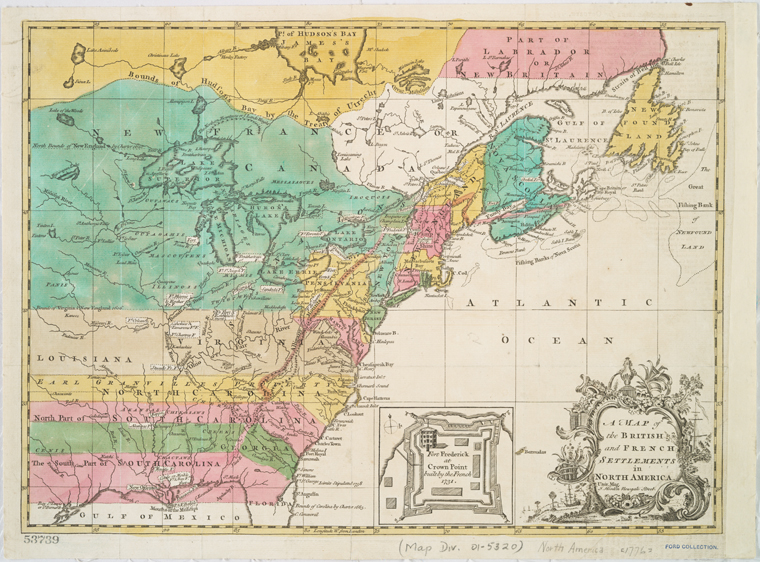
In the 17th and 18th centuries, the area of what would become the Northeastern United States and the neighboring Canadian Provinces of Ontario and Quebec were a battlefield for French, British and Native American control. With the two European empires locked in a protracted series of large and small wars around the globe, the American colonies were often a sideshow to the global conflict. In the colonies, King William’s War (1689–97), Queen Anne’s War (1702-13), King George’s War (1744–48) and the French and Indian War (1754–63) each played a role in shaping not only the birth of the United States of America but also the face of the entire globe for centuries to come.

Colonies

A mid-18th century map of British and French colonies in North America

(from New York Public Library Map Division)

I grew up in Western New York State, spent most of my twenties in Eastern Michigan and Western Pennsylvania, and finally settled in New York City nearly twenty years ago. In my life I’ve logged many a road trip to the landmarks of British and French military control at Fort Stanwix, Fort Ticonderoga, Fort William Henry and Fort Niagara, along with various battlefields and stops at roadside markers. In July, I’ll be swinging by Fort Necessity in Pennsylvania where a British officer named George Washington first commanded troops in an opening battle of the French and Indian War. I’ll also be swinging through Letchworth State Park which was occupied by the western edges of the Iroquois Confederacy which sided with the British during the era of European conflict. In short, I’ve spent my entire life living amid the ghosts of the contested colonial regions of the North American colonial wars.

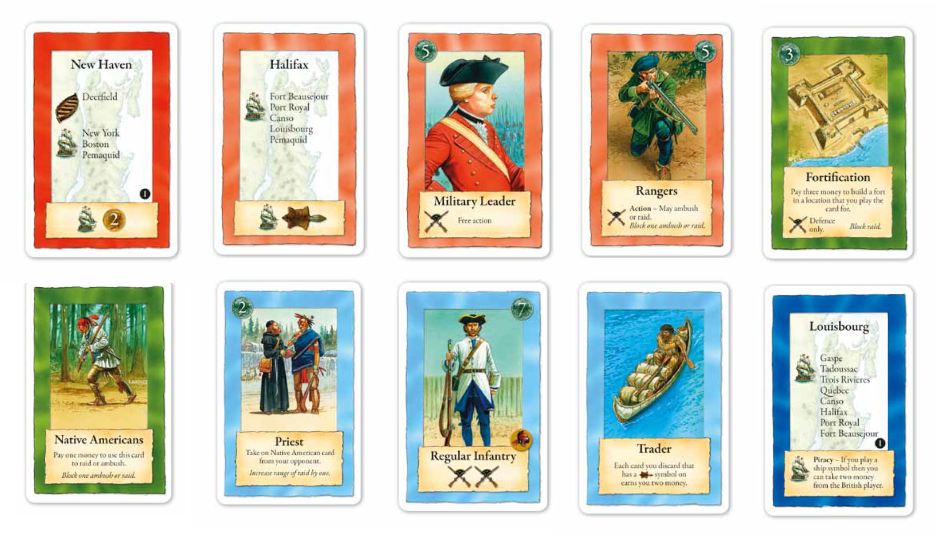
AcresCardsSample cards from A Few Acres of Snow

At the recent D-Day Plus 70 weekend at Metropolitan Wargamers in Brooklyn, NY I was fortunate to score a copy of A Few Acres of Snow in a dice-off raffle. Created by famed designer Martin Wallace and released by Treefrog Games in 2011, the game takes its name from a quote from Voltaire’s Candide commenting on the absurdity of European focus on colonial wars for territory. AFAOS takes players through the French-British colonial period in North America as each nation competed for control of the continent. Within the theme, the game is a rich mix of deck-building and area control mechanics as players seek to settle and defend key areas of the map.

snowsymbolsCard symbols from A Few Acres of Snow

(Wagon, Bateaux, Settler, Military Strength, Money, Fur, Ambush and Ship)

The two-player game begins with players choosing a side as the British or French with a set number of settled outposts in the wilderness of 17th and 18th century North America. British begin with their main settlements in New York and Boston while the French player starts with Quebec. Players begin with a draw deck from which they start with five cards. Playing cards in turns of two actions each, players perform a variety of actions including settlement, fortification, raids, sieges, trade, piracy and a number of card management options. Symbols depicted on each card allow for enormous flexibility in how each player executes their strategy of expansion. For example, a player might begin with a Location card setting off from an existing settlement. From there, a card is played with the appropriate movement symbol like a Bateaux along a river. Once at a new location, a card with a Settler might be played to create a new settlement. As a player’s holdings expand, their decks grow in size and options, leading to even more potential paths of empire growth. Once all settlement tokens are used or major settlements like Boston or Quebec are captured, the games ends and victory points are scored.

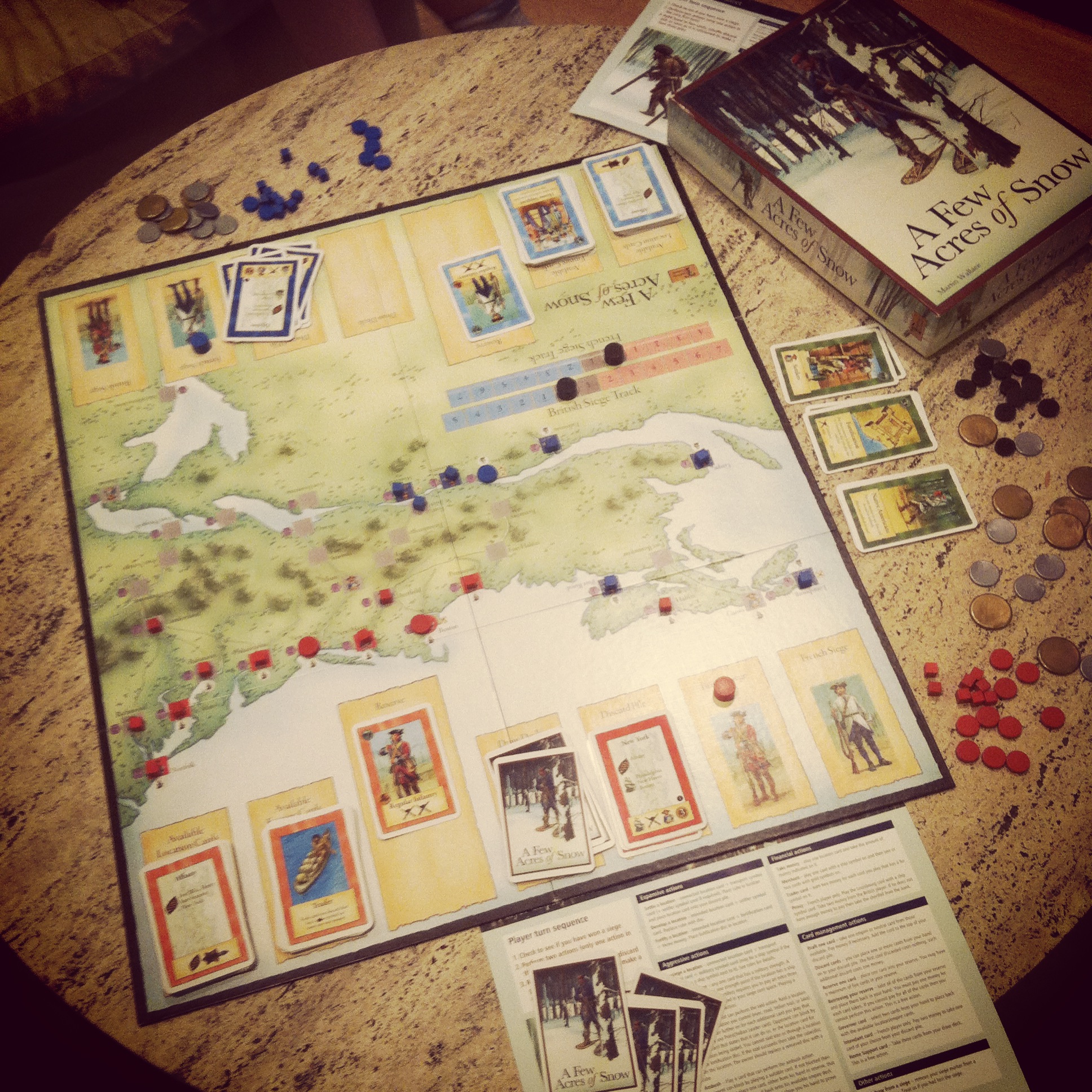
IMG_3640My first play of A Few Acres of Snow

In my first play through AFAOS, I faced off with my son playing the French and me playing as the British. The game plays in about an hour, but on our first run we went to a bit over 90 minutes as we wrapped our heads around the rules. After I quickly sailed to and settled Halifax well within the bounds of French country, several  sieges commenced. In his first siege attempt, my son was repelled by my superior military might powered by my store of money. He then took a few turns to quickly trade a lot of fur (one of the strengths of the French player) to buy additional forces for a second siege which chased my British from his territory.

IMG_3647My heavily-settled British Atlantic Coast in A Few Acres of Snow

In the meantime, I pushed inland with a string a settlements toward the Great Lakes in the hopes it would expose Quebec to a siege. However, my son quickly landed a stronghold in my coastal territory in a siege victory at Pemaquid. I retaliated with two failed attacks on Pemaquid using Native American raiding parties. Having held on, my son launched an attack on Boston and my British rule of the colonies fell.

Our first game showed us how quickly AFAOS can move once you get the mechanics. Getting the right cards in and out of your hand is key to winning the game, and the cards shift in importance as the game quickly unfolds. The balance of trade, expansion and military actions does a fantastic job in re-enacting the dynamics which played out between the British, French and shifting Native American allies over some 150 years. Even though we upset the course of history, we both walked away pretty thrilled over our new game and chatting up strategies for the next time we meet up in the woods and along the coasts of Colonial America.

afaosart

New Game Weekend: I Ain’t Been Shot Mum

IABSMbook

As a World War II gamer, I have a newly-discovered love for a game which doubles my gaming possibilities with all the time and money I’ve  got invested in the 15mm Flames of War game which is the modern standard for the period. The past two weekends at Metropolitan Wargamers in Brooklyn, NY, I’ve been turned on to I Ain’t Been Shot Mum which is billed as “the other World War II miniatures game. For gamers with a lot of miniatures on hand and a hankering to play WWII at a different and more historical level, IABSM is well worth it.

TFLlogoNow in its third edition, IABSM has been published since 2002 by Too Fat Lardies, UK-based makers of a number of wargaming rules systems for a variety of historical periods. Overall, the game provides WWII wargamers with a simple, sleek set of skirmish rules that focuses far less on fielding shiny models and more on tactical decisions on the tabletop. IABSM is a true “what you see is what you get” system with a 1:1 scale at 15mm but easily adaptable to other model scales. One guy on the table equals one soldier in the field during battle, taking the game down to a level that really “feels” like commanding a group of troops. The smaller, less abstract scale of IABSM games provides a lot less “gaminess” to the systems, and relies a lot more on the decision-making skill of players commanding forces on each side. In many ways, the game is a throwback to original Kriegsspiel invented for use in Prussian army training two hundred years ago.

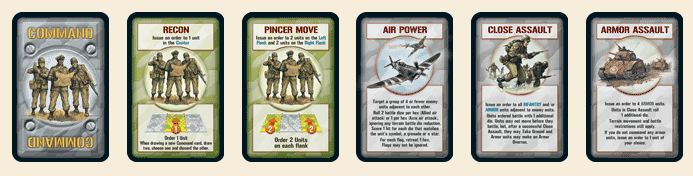
IABSMcardsSample cards from I Ain’t Been Shot Mum from Too Fat Lardies

The core rules of IABSM retail at under $20, and provide a number of basic underlying mechanics easily usable in any battle or theater of WWII. As an avid FOW player who is often faced with hundreds of pages of more grand-scale rules, army lists and ongoing modifications, the elegance of the skirmish-level IABSM comes down to five main areas:

1. Random Activation: Rather than playing by a simple “I go, you go” turn-based mechanic, IABSM games are powered by a set of cards which randomly activate deployed troops in the field. At the beginning of the game, a deck of cards is shuffled with each card representing a unit in the game. Cards are drawn and units are activated in turn, with units choosing a number of actions based on their quality. Highly-trained US Airborne troops may have four actions when activated, while less elite regulars may only have three. Actions include movement, firing, spotting the enemy and many other activities which makes commanding a unit’s turn one of many possible choices. Cards are added to the deck as new units arrive and removed if a unit is destroyed. Drawing a “tea break” card ends the turn with one final round of shooting for available inactivated units before the cards are shuffled a new turn begins.

2. Morale: Troop morale is nearly as important as firepower on actual battlefields. A well-armed but rattled group of soldiers may prove to be nearly ineffective in the field without some stalwart command leading the way. IABSM offers several levels of morale with pinning, shock and suppression which progressively eats into how effective a particular force can perform on the table. When being shot at, a simple table resolves possible kills as well as whether a unit is progressively shocked into poorer performance in subsequent turns or entirely immobilized due to overwhelming fire.

3. Command: Commanding and junior officers in IABSM are represented as “big men,” with individual cards allowing for their separate officer actions to drive gameplay. Through proximity or attachment to their forces, commanders can greatly affect morale by clearing shock from troops and boosting their strength in subsequent exchanges with the enemy. The presence of command also doubles the chance of troop activation, as a drawn “big man” card can press an attached unit into action without its own card being drawn.

4. Blinds: In real-world combat, knowing the enemy position through intelligence, observation or contact is almost as important as the engagements that result. While many miniatures games present an open table where nearly everything is known from the get-go, IABSM preserves a “fog of war” element with the deployment of “blinds” on the table. Represented by oval-shaped markers, blinds are able to move around the table without revealing their actual make-up. Thus, a player might move a small unit, a large platoon or even a false blind containing no troops around the table without the enemy knowing its true make-up until revealed. This allows players to add an element of diversion to the game, as an enemy way burn up several turns chasing a ghost across the table as real forces jockey into position.
5. The Game Referee: One of the hallmarks of wargames until recent decades was an all-seeing, all-controlling game referee. As a non-player, the referee not only provides clarifications on rules and contested play on the table, but they also are able to maintain a level of secrecy between each player as a scenario unfolds. The game can be played without a referee, but the presence of one adds yet another depth of to the “fog of war” randomness employed already with blinds and random card activation.

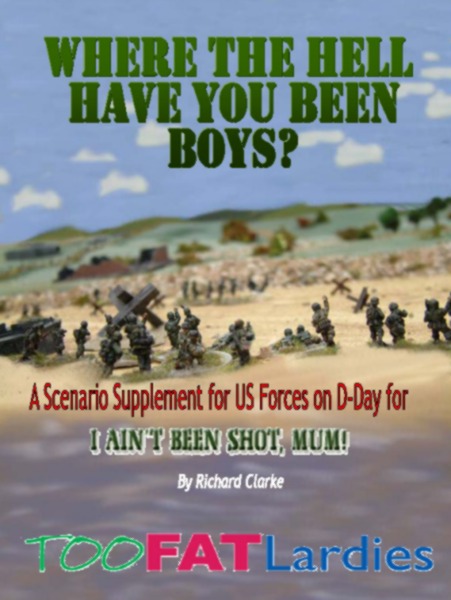
WTHbook

Beyond the base rules, Too Fat Lardies offers a number of IABSM scenario and guide books for Europe, Italy, North Africa and the Pacific. General lists allow for the creation of custom scenarios, but I really like the historically-specific books. The past two weekends, I played the first two games in the D-Day-themed Where The Hell Have You Been Boys? book which contains over twenty scenarios from Omaha and Utah beaches to the inland. Following the United States advance and subsequent German counterattacks, each scenario lays out a simple briefing for the German and US players along with a referee sheet, terrain map and a guide to forces and cards needed for play.

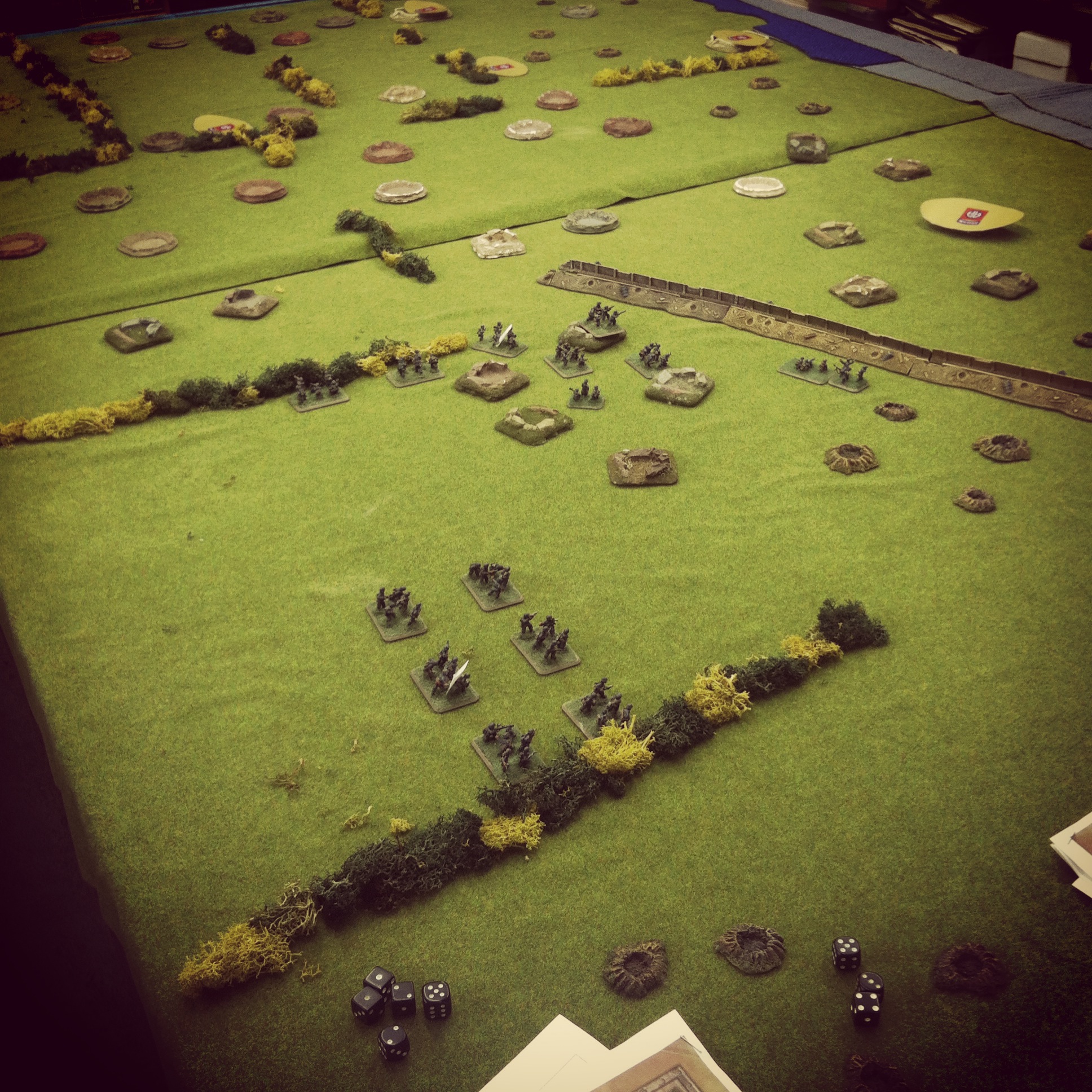
IMG_3554“Protect The Guns” scenario set-up for IABSM

IABSMGameScenes from the German defense above Pointe du Hoc in “Protect The Guns”

My first game — “Protect The Guns” — saw me playing as the defending Germans looking to hold off the Allied advance from Pointe du Hoc with a couple heavy machine guns, snipers and some off-board artillery. One of the remarkable things about IABSM is the vast amount of space represented on the table, making decisions of movement and firing  very important. My artillery was also very unreliable, representing some of the German communication challenges come alive. That said, with only a few men at my disposal, I was able to stave off and force the Americans to redirect through constant harassing fire until their reinforcements entered under a blind at my rear. With one of my machine guns and both snipers finally destroyed, the last of my Germans found themselves pinched on two sides of more-skilled US troops who took the game.

IMG_3553

“Holding The Pointe” scenario set-up from IABSM

In “Holding The Pointe,” my Germans were on the counter-offensive and looking to push the Americans back into the sea. With all my forces deployed at the game’s start and all American units under blinds, my Germans began in overwhelmed confusion. This disadvantage made the game play so much more like the actual action in Normandy as German forces scrambled to head-off the Allied attack inland. Rather than focus my attack, I made the poor gamble of splitting myself to chase two sets of US targets. By the time a large force of German reinforcements arrived in the seventh turn, my initial force had gotten chewed-up in a series of stand-off firefights amidst the thick bocage near my original deployment. My divided force tactics were ultimately my undoing, and I’m certain a more textbook massed attack may very well have giving me a greater shot at victory.

With a couple of games under our belts, we’re going to continue right through the IABSM D-Day scenarios and beyond. We’ve managed our games without a referee so far through some really good fair play, but we’re anxious to try some scenarios with the referee element. Overall, the up-close feel for command and the heightened tactical realism in IABSM has given me a second WWII game to love at the 15mm scale.

New Game Weekend: Joan Of Arc

joanwarbonds

For a story mixing heroicism, legend, Christian mysticism and epic battles of swords and armor, you really can’t beat Joan of Arc. Rising from storied French farmgirl  beginnings toward the end of the Hundred Years War, the teen-aged Joan of Arc is legendarily credited with turning the French tide against English invaders at the Siege of Orleans in 1429. Her later capture, trial, burning at the stake and eventual canonization as Saint Joan of Arc cemeted her place in world history as a military, feminist and religious icon.

joanofarcbox

In the six hundred years since she was executed, Joan of Arc has remained a prominent subject of film, plays, art, literature, and yes, games. With so few women in headline roles in the history of warfare, the chance to game the period of warring Europe in the waning days of chivalrous armored calvary can be all the nore interesting when Saint Joan is present.

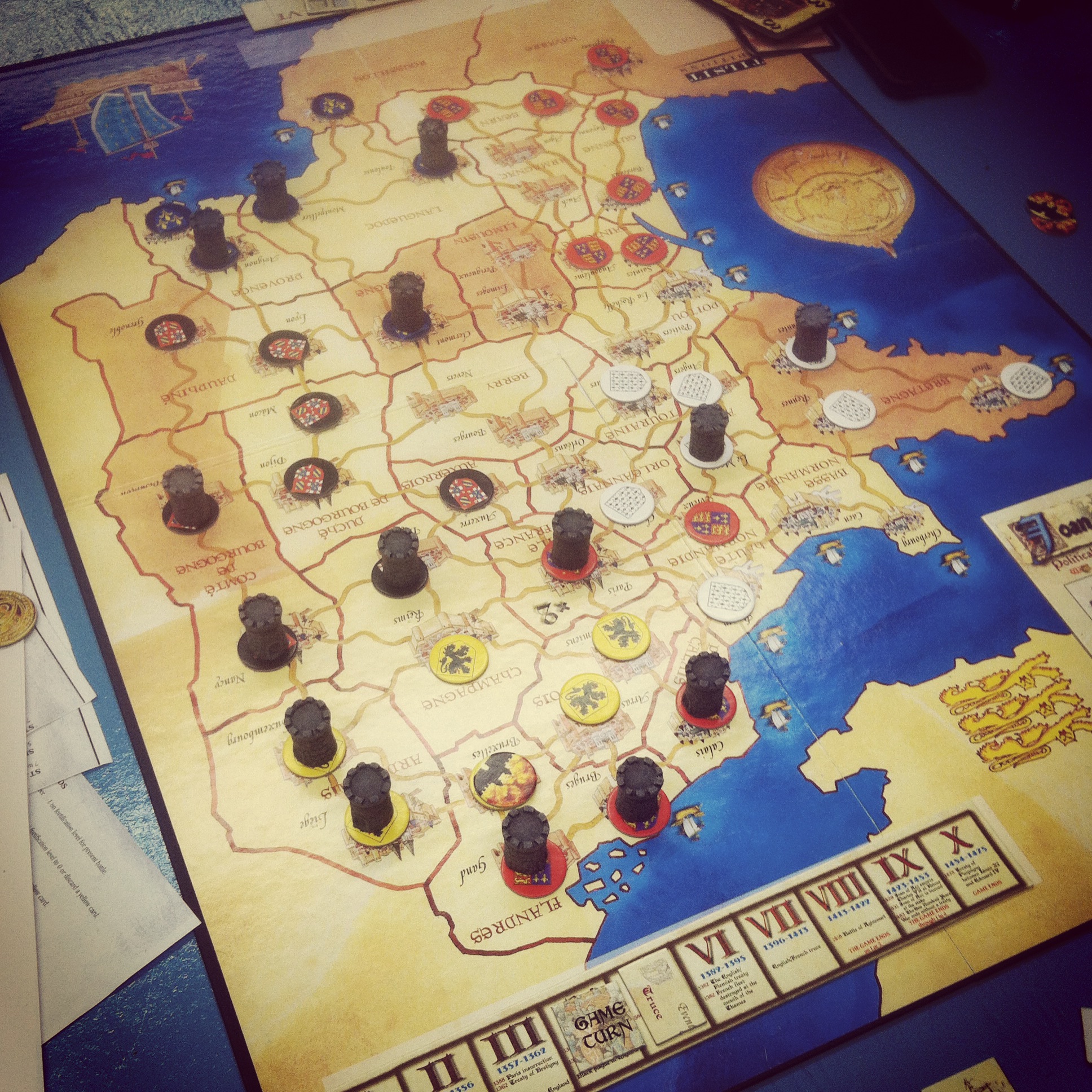
Released by Clash of Arms in 1998, Joan of Arc is at this point a classic board game which I recently had a chance to play for the first time at Metropolitan Wargamers in Brooklyn, NY. The game board presents the contested areas of the 100 Years War dotted with cities connected by roads. Players choose to represent on e of the warring kingdoms of France, England, Navarre, Brittany, Flanders and Burgundy. The game begins in a time of peace, and in each subsequent turn players vote in secret on whether the turn is to be one of peace or war. A time of peace causes one random event to be drawn and just one attack action per player, while a period of war brings two events and up to two battle actions from each player.

IMG_3434

 Joan of Arc at Metropolitan Wargamers

In random order at the beginning of each round, each player may expand into up to two free city locations along connecting roads or via seaport connections. Players draw a hand of large, tarot-like cards with which they can wage combat or cause other chance actions like the appearance of a hero of the kingdom such as St. Joan herself for the French. An attacking player draws cards from their hand, each carrying a numeric value, along with special actions such as Engineering which negates the defender’s bonuses from previously built castles and strongholds. A defeated city is occupied immediately by the attacking army, and the number of controlled cities and collective regions generates additional income in the following turn.

Throughout Joan of Arc, alliances are made, truces may be purchased through influence and battle for area control of the map marches through time. The player scoring the most points through controlled space on the board wins at the end of the game. Our group of savvy wargamers had the most fun in the alliances an double-crosses we meted out on each other’s kingdoms throughout the game.

There are a lot of better historically-based area-control games on the market at this point, and Joan of Arc’s connection to the historical record is pretty abstract at best. The game design looks great and it plays well once the somewhat imprecise rules are understood after a turn or two. Even with its minor faults and stretched thematic story, Joan of Arc more than engages a group of players in the era of Europe tipping away from its feudal centuries of warfare toward a more enlightened age on the continent we can still recognize today.

New Game Weekend: The Resistance: Avalon and One Night Ultimate Werewolf

avalonwerewolfThe mechanics of common and secret knowledge among players creates the basis for so many games we play. A game like chess has everything set on the board for everyone to see, and it is only a player’s skill and strategy that remains secret until revealed in a series of successive moves of action and reaction.

More typically games involve some level of secrecy either in cards hidden in a player’s hand or pieces set on a game board ready to be revealed at specific moments during play. Deduction, reason, probability, informed guesses, manipulation through bluffing and revelation of information drives much of the action of these games.

Almost 30 years ago, Mafia was created by a psychologist at Moscow University. In the game, two players act as the mafia with their identity known to each other but not the other players. The non-mafia participants take on a variety of other roles, each with select knowledge of the other players and abilities to effect other player roles. With starting roles assigned, the game enters a “night phase” with all players shutting their eyes. A non-player game moderator bears witness as the mafia players and any accomplices kill off other players in secret. Next, all players open their eyes for a “day phase” and changes in the situation of the game is revealed. Players still alive in the game discuss the new conditions of the game, and attempt to discern the mafia players among them in subsequent night and day phases.

As Mafia spread outside of the former Soviet Union in the mid-1990s, it took on a horror-themed variant known as Werewolf. In the new version, players act as werewolves or villagers attempting to identify and kill off each other in night and day phases. Once players have an understanding of the basics of Mafia or Werewolf, neither game really requires any special equipment. This had made these games popular as pick-up party games with hardcore and casual gamers alike (my wife recently played Werewolf on a company retreat as a team-building exercise).

wwcontentsCards, markers and free app from One Night Ultimate Werewolf

In the past two weeks, I had a chance to play two of the more popular modern versions of these games at Metropolitan Wargamers and Brooklyn Game Lab. One Night Ultimate Werewolf is the latest riff on the classic game from Bezier Games with werewolf players hiding among villagers with a variety of roles. These include colorful characters like the Minion who knows the werewolves and only wins if they survive, the Seer who secretly knows identities of other players and the Tanner who has a death wish and wants to be killed before the werewolves are found out. Along with the cartoon artwork on the heavy-carded playing pieces, this version of Werewolf comes with a free app which acts as a game moderator and timekeeper.

avaloncardartCard artwork from The Resistance: Avalon

The Resistance: Avalon is a the sequel to the sci-fi-themed The Resistance from four years ago from Indie Boards & Cards. Players of Avalon take on good and evil roles from Arthurian legend and set out on a series of quests to root out the opposition. After roles are set, a king is selected each round to select other players to participate in a quest. All players vote to approve or deny the selected party on their quest, and then players on the quest vote for the quest to succeed or fail. The evil players win if more quests fail than succeed, so each quest round is the chance to reveal who may be working alone or in concert to win the game for the evil side. Like the more traditional, Mafia game, Avalon involves a non-playing moderator.

With all these games, the colorful pieces and cards are just jumping-off points for the real action which takes place among the players. Accusations are slung, theories are posited and alliances are built and then dissolve in minutes. In the games I played recently, people spent a lot of time just staring into other people’s eyes, looking for a glint of deception or a sly twinkle of acknowledgement. What has made all these games in their various names and variations so enduring is that human nature itself becomes the mechanic of the game. Whether the game is Mafia, Werewolf, Resistance or Avalon, the only real equipment needed isn’t in a cardstock box but in what each player brings with them to the table.

New Game Weekend: Lego Heroica

heroicabox

Like a couple generations of kids around the world, I grew up on Lego. My childhood was heaped with thousands of little plastic building pieces produced in Denmark and strewn in endless piles on my bedroom floor. Lego have changed a lot over the years from its early days as an abstract, creative and flexible building system of my early years to the heavily-licensed and more rigid playsets my own kids have been raised on.

In 2011, Lego launched Heroica, a brick-based fantasy-themed dungeon crawl board game. Each set included a set of bricks to build a series of rooms, hallways, bridges, paths and outdoor areas with which several configurations of game boards could be assembled alone or in combination with other sets.

IMG_3372

My first game of Lego Heroica

This past weekend, I played Lego Heroica: Castle Fortaan with my 9-year-old son, a certified Lego and gaming addict. The game pieces go together nicely to create nifty modular rooms including a dungeon, castle walls, a hall with fireplace and a throne room. Four character adventurer figures and goblins in three varieties are depicted as tiny, rigid pawns which offer less interest than the very-popular Lego Minifigures common with most Lego sets. With a board built according to one of the included scenarios (or a game of your own making), players take turn rolling the special die, moving through the castle, collecting magic items and racing to the objective endpoint.

IMG_3371

Gaming components from Lego Heroica: Castle Fortaan

As expected from Lego, the Heroica sets look great. Each player has their own rack on which they track gold and magic items collected and damage received during combat with goblins lurking throughout the castle. A weapons rack allows for the purchase of special weapons which give bonuses and added abilities. The special die (also built from Lego) offers faces with dual purposes for movement, combat resolution and other results such as regaining health and randomized treasure.

IMG_3370

Our adventurers quest through the halls of Castle Fortaan

Despite the look of Heroica, gameplay leaves much to be desired. Unlike the collaborative spirit of most dungeon crawl games, Heroica is a straight-up competition and a race to the finish line. Strategy is also absent from the game, and the die-driven movement makes the game largely an exercise in die-rolling. Combat is overly-simple with any of the three goblins types easily destroyed on a single die result, no matter their strength. Purchasing an item from the weapons rack requires three collected gold, but finding three gold often doesn’t occur until late in the game when any bonus from an acquired item really doesn’t matter.

Lego suggests ages 8-and-up for Heroica, but this probably has more to do with safety issues with small parts than actual game complexity, interest or replay value. My son is a pretty experienced gamer, but he still liked the game most probably because of his overall passion for Lego. I’d peg the game more appropriate for 4 or 5-year-olds as a way of introduction to the basic concepts of dungeon crawlers including movement, melee and ranged combat, hit points, character abilities and collecting treasure and magic items.

Not surprisingly, Lego has announced the imminent discontinuation of the Heroica line of games. A fairly avid fanbase for the game exists using heavily-modified rules, but ultimately I really don’t think the game is worth the time and effort no matter how much customization is put into it. With so many engaging dungeon crawl games available and appropriate for a huge swath of ages, its pretty obvious why Heroica crashed in popularity in three short years.

As for dungeon crawling with my kids, I’m going to be heading back to my Dungeons & Dragons Basic Set from the late 1970s in the coming weeks — no plastic bricks required.

New Game Weekend: Revolution! and Carcassonne

ITD

This past Saturday was International Tabletop Day, a day where tens-of-thousands of people around the world crowd around tables in dining rooms, basements, clubs and hobby shops to do what many of us do year-round — play games. My youngest son and I spent the afternoon at Brooklyn Game Lab, a recent entry into the growing list of New York City venues dedicated to unplugging and playing tabletop games with friends and strangers alike. The scene in Brooklyn was like that played-out worldwide with a packed house of experienced gamers and newcomers joining together, rolling dice, racking up points, playing cards, placing tokens and role-playing through a massive variety of games. At Brooklyn Game Lab, players faced off with a variety of games like Betrayal at House on the Hill, Love Letter, The Resistance: Avalon, Tokaido and even a few games of Chess. My son and I had a go at two games which were new to us — Revolution! and Carcassonne.

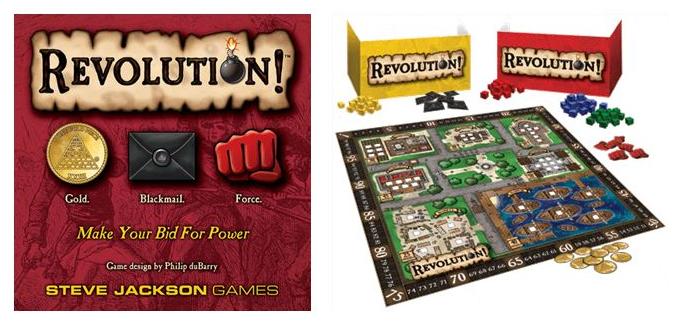
rev picIn Revolution! from the decades-old Steve Jackson Games  players vie for power in a town through a secretive combination of blackmail, strong-armed force and out-and-out bribery. With four new players at the table, Revolution! was a quick learn and exciting fast play in just under an hour’s time.

securedownload-1A player’s secret bidding card in Revolution with Gold, Blackmail and Force tokens

Revolution! has an interesting secret bidding mechanic where players simultaneously bid their Force, Blackmail and Gold tokens on a dozen citizens of the board’s town such as the General, Priest, Printer, Mercenary or Spy. Once bids are placed, players remove their screens to reveal their bids. Bids to influence the same character are resolved through a simple Force beats Blackmail, Blackmail beat Gold and ties result in no effect for the round. Once a player wins influence over a character, the effects dealt out through additional earned Force, Blackmail and Gold tokens, Support points or placement of Influence markers in one of the town’s areas such as the Tavern, Town Hall, Market or Harbor.

securedownloadOur game of Revolution! from Steve Jackson Games at Brooklyn Game Lab

The game continues with subsequent rounds of bidding which progress into evolving strategies and agendas as the town’s areas fill up with player Influence. As the board is filled, players in Revolution! shift in their need for Force, Blackmail and Gold tokens, seeking to not only control the board but shift and undermine their opponent’s already-placed pieces. Controlling an area of the town brings additional Support points when the game ends, and the player with the most points on the outer scoring track wins.

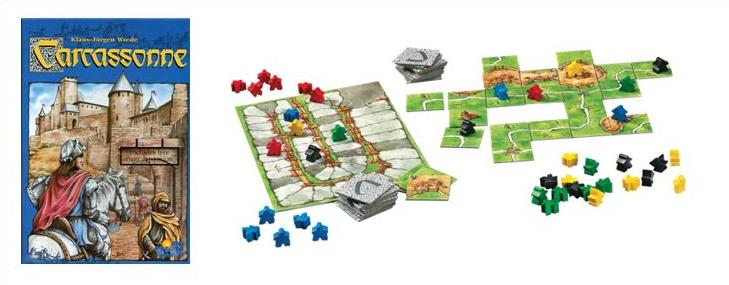
carcassonneFor our second game of the day, we got into the now-classic Carcassonne from 2000. Distributed by Z-Man Games in the United States, Carcassonne is a tile-placement game where players build-out and a kingdom dotted with cities, roads and monasteries. Carcassonne is a quick learn, and the random tile choice at the beginning of each player’s turn creates choices in matching the tile to the multiple potential fits on the table.

In placing a tile, a player also makes a choice in placing a meeple on the board and in doing so, placing a bet on potential points. In placing the first tile of a city, a player may place one of their colored meeple pieces with the hope of closing off the city with additional tile plays which score points on the number of subsequently connected city pieces at a two points apiece. A monastery scores nine points when the eight surrounding tiles are placed, and roads are scored at a tile each once a route is closed between two endpoints. Victory points are tracked on a scorecard next to the growing kingdom of Carcassonne, and each tile played reduces the chances from the finite number of potential tiles in the draw pile. Playing against three experienced players in my first game,  I was able to score highest on some chancy bets and lucky tile draws.

International Tabletop Day is 24 hours of celebration of games, chanced strategies played out and opportunities to try something new. At the Brooklyn Game Lab this past weekend I found myself in my element surrounded by passionate gamers questing for victory and fun and more than a few hours of play. Games focus on this one day per year, but for a lot of my fellow gamers, they play out week after week until next turn  rolls around on the calendar.

New Game Weekend: Brass

Brassbox

Canals have been a part of human history for as long as people have sought to move large quantities of goods from one place to another along routes without natural waterways. Beginning in Mesopotamia in about 4000 BC, canals have fuelled the expansion of human settlement and trade just about everywhere. The Industrial Revolution of the 18th-and-19th-centuries saw an enormous boom in canal construction in Europe, North America, Africa and Asia. To this day, engineering marvels like the Suez Canal and Panama Canal are critical to moving goods around the world.

GVC

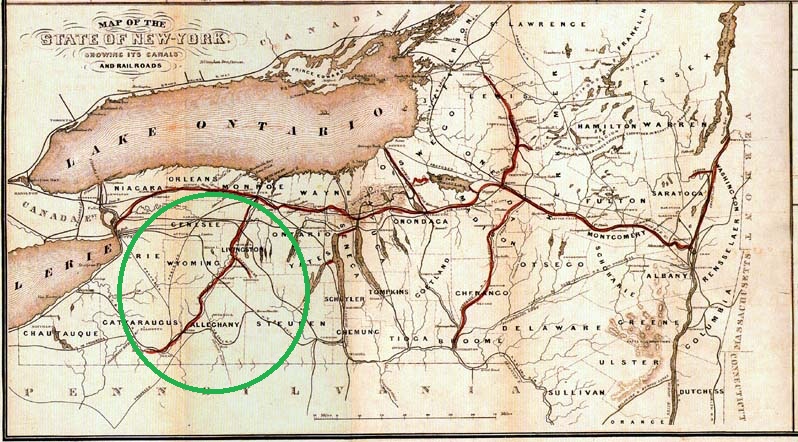
Map of New York State canals with Genessee Valley Canal (1840-1880)  in green

Growing up in the 1970s, every kid raised in Western New York State was surrounded by the mythology of the Erie Canal. Stretching 360 miles from Albany to Buffalo, the canal opened in 1825 and connected the ports of New York City with the booming Great Lakes region and the territories beyond.

Some of my earliest childhood memories of thrashing around in the woods in my hometown of Piffard, NY occured along the remnants of the Genesee Valley Canal which ran as a southern spur to the Erie Canal from 1840-1880. In my mid-20s I found myself living and working in Southwestern Pennsylvania, once again surrounded by the ghosts of canals and later railroad lines which fuelled the economic expansion of the old western frontier. Today, many these old canal lines have new lives serving as recreational arteries like the Genesee Valley Greenway and the Pittsburgh-To-Harrisburg Main Line Canal Greenway.

BrassBoard

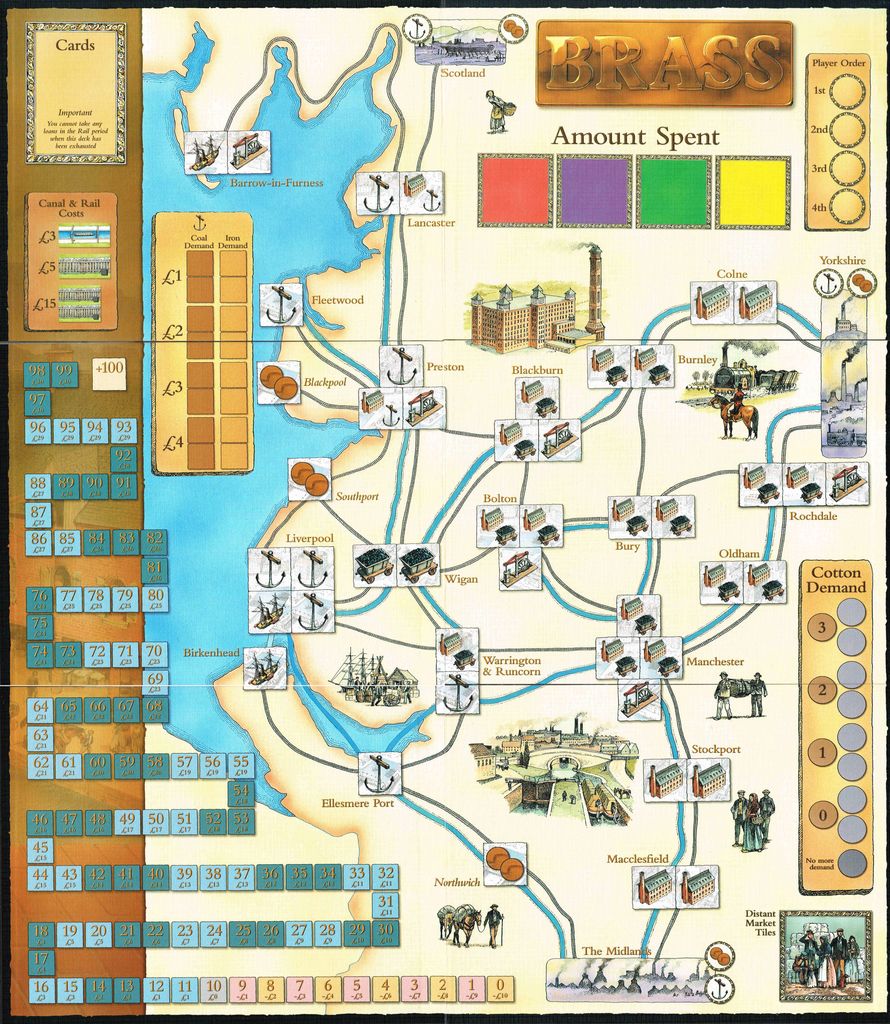
The Brass game board depicting Northern Engkand

My life has had a lot of canals running through it, and so it was great when I recently had a chance to try my hand at playing out the canal and railroad boom era in Brass. Produced by Treefrog Games in 2007, Brass takes players back to an England at the dawn of its massive industrial expansion. The game divides into two parts — a Canal Age and a Railroad Age — and is played on a map of Northern England cities and ports connected by transportation routes. When cards are used up points are scored at the end of the Canal Age for industries built, canal routes constructed and income earned. Canals and industries are then removed before play procedes through the Railroad Age after which there is a final tally of points for victory.

BrassCards2

Brass industy cards (left to right: coal mine, shipyard, iron works, port and cotton mill)

BrassCards3

Sample Brass location cards

Cards depicting cities and industries are dealt to players at the beginning of the game. Canals and lower tech industries are built in the first half of the game, and railroads and more advnaced technologies are built in the game’s second half. Each turn a player may develop industries, build canal or railroad sections, develop their existing industry, sell cotton or take loans for additional capital investment. The player who spends the least money on their turn gets to go first on the next turn, one of the game’s many mechanics which makes for a good balance of cautious and aggressive play.

IMG_2967

The “Canal Era” in our game of Brass at Metropolitan Wargamers

Industries are built on specific locations by playing both a location and industry card in combination and then spending the appropriate money and resources. Connecting canals and railroads may also be built to establish routes between cities and ports to transport goods and resources. Multiple industries built by multiple players may be built at the same location, allowing for some level of shared collaborative play. A hub city like Manchester holds four industries and connects along five separate routes, making it a potential key location for players. Building routes to ports and foreign export of cotton becomes important as the game develops and generating more income for construction is needed.

IMG_2968

The “Railroad Era” in our game of Brass

There’s a ton going on in Brass, and fortunately I had an experienced player walk me through my first game. I’ve heard the rules themselves are a bit hard to decipher, but playing the game my first time was pretty easy to follow. Brass plays like many Eurogames with a balance of area control, building, managing resources and playing cards. Ultimately the game becomes one of competition for routes and resources and biding one’s time to export cotton goods to foreign markets when demand is at its highest.

I won my first game of Brass in a three-player game, but I’d like to try it at its full four-player maximum. I managed to have an enormous amount of cash on hand to invest into developing my industries and transport routes pretty early in the game, a strategy that didn’t allow me to play first in most turns but paid off in the end. Playing an economic game like Brass makes for some very different play than my usual rolling of tanks and advancing platoons of soldiers. For a gamer like me with canals and railroads flowing through my blood, I’ll take an economic victory just as easily as a one won on the battlefield any day.

New Game Weekend: Memoir ’44

mem44box

I’m about 10 years late to the WWII board game Memoir ’44, but after a few first plays through it this past weekend I’m glad this modern classic is now part of my gaming arsenal. Released by Days of Wonder on the occasion of the 60th anniversary of the D-Day Normandy Invasion in 2004, the game has won numerous awards and remains high in the esteem of casual and serious wargamers alike.

mem44contentsContents of the basic Memoir ’44 game from Days of Wonder

The base Memoir ’44 game runs about $40 and contains over 300 playing pieces. The blue-grey Axis and green Allies tank, infantry, artillery and defensive features look fantastic, and playing with them evokes the little plastic toy soldiers of many a kid’s youth. The reversible game board with a beach on one side and countryside map on the other provides the basic layout for the more than a dozen historic scenarios included in the easily-read rulebook. Scenarios are laid out using hex tiles with various terrain features such as towns, forests, hills, rivers and hedgerows. Each historic game scenario is presented with a clear illustration on how to lay out the appropriate terrain tiles and initially deploy forces on each side.

M44cards

Sample Command Cards from Memoir ’44

Command cards and battle dice provide the basic drivers of game mechanics. Cards provide activation of one or more units in the left, right and/or center portions of the board. Infantry may move once and attack or move twice, artillery may move or shoot, and tanks may move up to three hexes and engage in combat. Attacks are resolved with a simple roll of special battle dice which hit units based on the icon results on each die face and what units are present in the combat. Die rolls may also result in misses of forced retreats. When a player finishes their moves and combats, they draw a fresh card and play passes to the opposite side of the board. Games are scored by destroying units or securing objectives like bridges.

IMG_3022

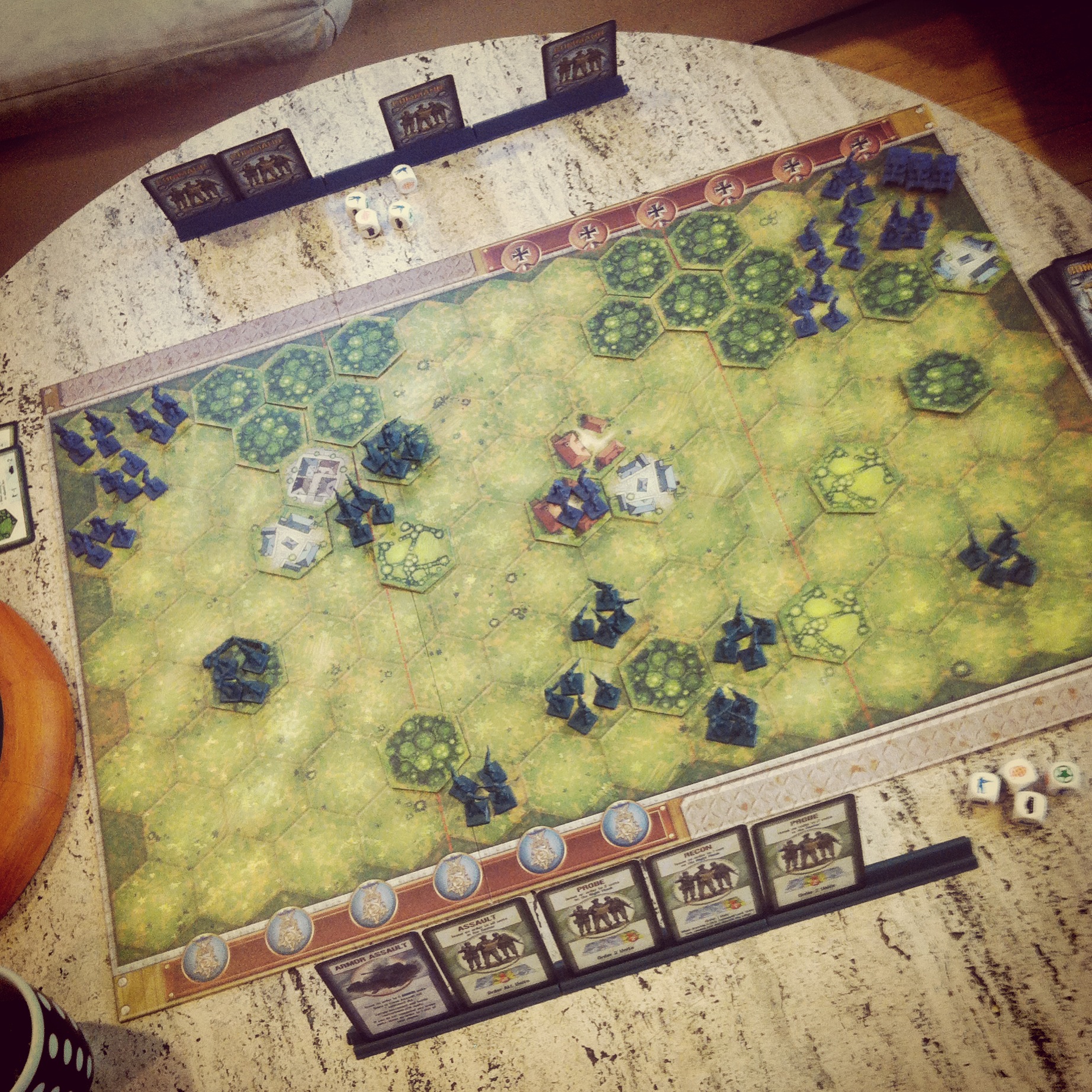
The Sainte-Mère-Église scenario for Memoir ’44

As fairly experienced WWII historical miniatures players with Flames of War, both my son and I were pleasantly surprised by the fun to be had with Memoir ’44. The intro scenario is for Pegasus Bridge which we tackled in about 20 minutes to get a feel for the game. Next up, we tried Sainte-Mère-Église with a fun added feature of actually dropping a fistful of paratroopers onto the board. We both found the command cards to be a good mechanic to represent the effectiveness of delivering orders on the battlefield. In out second game, my son’s tanks lay parked at the corner of the board the entire game since he never drew a card allowing activation of units to his left. We each pulled a couple special cards, allowing things like airstrikes and close assaults to happen as the game quickly moved to a finish in about four or five turns. With the basic rules under our belts, we’re anxious to push on through the remaining scenarios included in the basic rules.

M44terrainContents of the Memoir ’44 Terrain Pack expansion

The scores of  available official scenarios, expansion editions, campaign books and army packs add an amazing amount of replay value to Memoir ’44’s basic rules and mechanics. A nifty online design scenario design tool also allows armchair historians to have a go at creating official-looking games of their own, and I can just imagine the educational possibilities in using it in school settings. Along with the base game, I snatched a copy of the Terrain Pack expansion which offers nearly 150 additional tiles, markers, special unit tokens and four additional scenarios. With the vast expansions of Memoir ’44, just about any interest in the air and land battles of every major front in WWII can be endlessly played and explored.

I realize I’ve just begun with Memoir ’44, and I’m certain to have both my boys playing along with me. There’s so much appeal in Memoir ’44 for kids or adults who have dabbled casually in war-themed board games like Risk or Stratego, plus the added interest of easily replaying historic WWII battles. Quick games, some real history and a fun box of toys — Memoir ’44 brings the complete package to the table.

New Game Weekend: Axis & Allies: Guadalcanal

AandAguadalcanalboxThe  Battle of Guadalcanal between August 1942 and February 1943 was the first major Allied campaign set on crushing the Japanese foothold in the Pacific region. Fought in bloody air, sea and island engagements, the seven months of battle resulted in a significant shift in superiority to the Allies in the region and led to the beginnings of the downfall of the Japanese Empire in the Pacific.

Most of my wargaming happens on dry land and usually somewhere in Europe. The Pacific War in WWII always seems so separate, sprawling and overwhelming to me with its mix of different combined combats, complex supply lines and different territorial agendas. That said, dabbling in this portion of the war gives me a chance to use some very different tactics and strategies I’m not used to gaming. So, with a short couple of hours to spare recently at Metropolitan Wargamers in Brooklyn, NY, I tried my hand at some WWII Pacific action with Axis & Allies: Guadalcanal.

AandAlogo

The popular Axis & Allies boardgame series from Avalon Hill (owned by Wizards of the Coast) has been around for more than 20 years and covers many specific eras, battles and theaters of WWII. More recently, a WWI game has also been added in time for the 100th-anniversary of that conflict. The A&A games are readily available from a number of book and department stores, and they vary in complexity and time commitment. Mt first introduction to the series was with the Spring 1942 game which weaned my younger son and I off much simpler war board games like Risk forever. The great design, hundreds of sculpted plastic playing pieces, economic factors and combat mechanics make the A&A games a great way for old and new wargamers alike to engage in hours of very satisfying play.

AandAguadalcnalcontents

A&A: Guadalcanal board and game pieces (including the “battle box” at left)

The Guadalcanal game presents a map of the South Pacific islands and sea zones contested by US and Japanese forces. Victory points are determined by building and controlling island airstrips. As in the actual campaign, quickly capturing islands and building airstrips is critical not only to endgame victory but in providing bases to supply and deploy additional forces. Aside from capturing islands, controlling the three main sea zones at the center of the board (aka “The Slot”) is key in controlling the transport of crucial supllies and reinforcements.

The combat system in the game uses a “battle box” containing a dozen dice which are shaken and reveal various randomized target effects. With land, air and sea units crowding the board, the confused mass of combined arms is neatly accounted for with a few shakes of the unique battle box.

IMG_2895

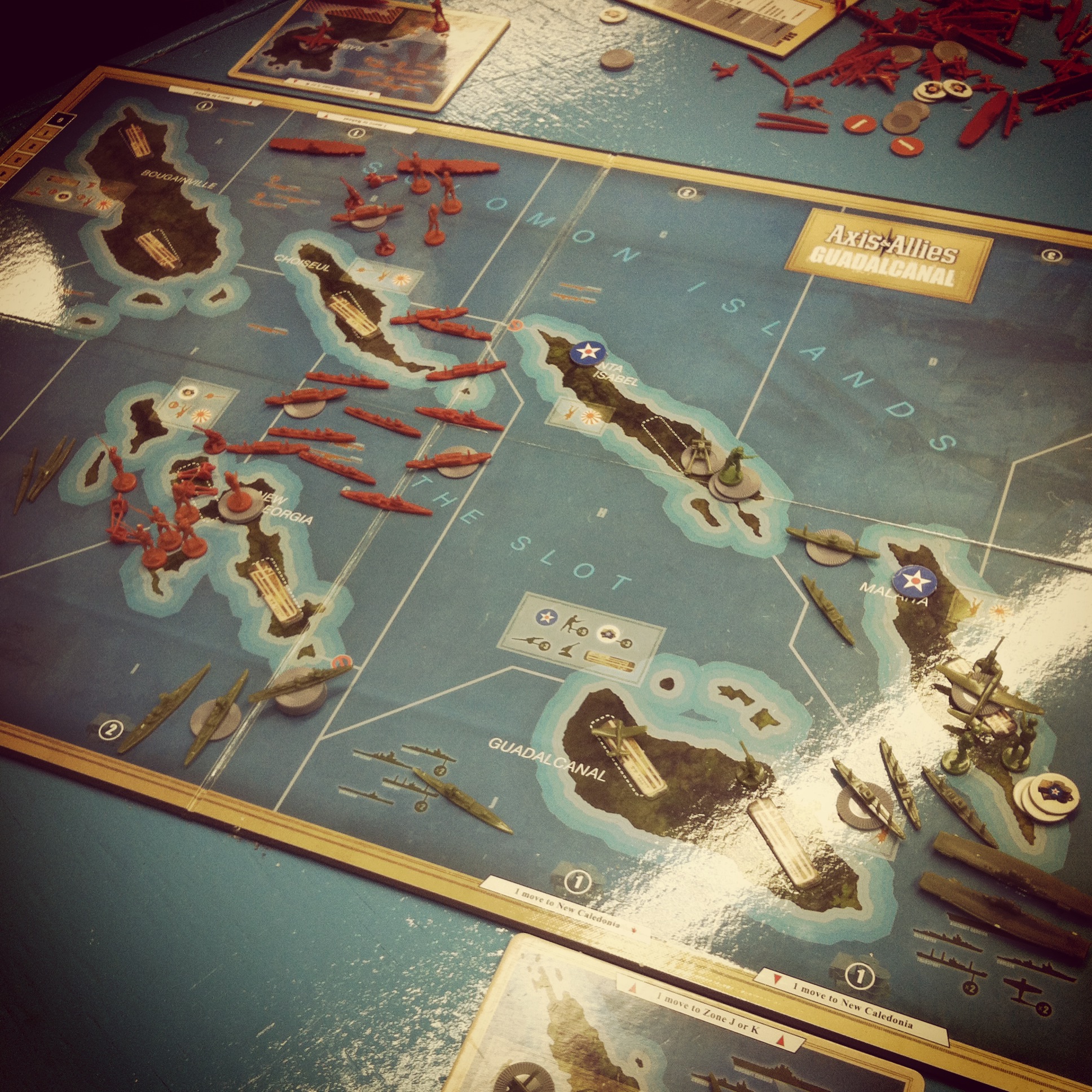
Axis & Allies: Guadalcanal at Metropolitan Wargamers

In my first play as the Americans, I quickly captured the southern half of Guadalcanal while my Japanese opponent began a big push with his navy toward The Slot. In the second turn I was able to press on to Malaita and build a second airstrip of Guadalcanal to take an early lead in victory points.

With the Japanese navy massing in the central sea zone I made a risky gamble in turn three sending in a huge air attack which destroyed a few ships and damaged a battleship but was repulsed with overwhelming deadly force. With a vastly-depleted air force, I scrambled to build myself back up as the Japanese built an airstrip on Bougainville and I made moves toward Santa Isabel. By turn four my navy headed west along the southern coast of New georgia in the hopes of catching the Japanese navy from behind. While I was able to destroy a number of Japanese submarines at the western edge of the island, my attack on Santa Isabel was halted and the Japanese took the game.

A&A: Guadalcanal moves fast for two players, playing in about 2 hours. The short nature of the game makes every move from turn one onward important with little room for error. My lesson learned in the first game was not to run too fast toward facing-off against the superior Japanese fleet early, perhaps opting instead for a greater build-up of supply to gain island footholds to launch later game attacks.

The Axis & Allies series is fantastic for out-of-the-box playability with the different game versions each offering realistically-specific game dynamics for several WWII theaters and battles. Not being a big Pacific War gamer, A&A: Guadalcanal makes for a perfect way for me to get my feet wet and expand a bit of my gaming experience to another corner of the 20th-century’s greatest conflict.