New Game Weekend: The Battle Of The Five Armies

fivearmiesbox

Like so many of my generation, J.R.R. Tolkien’s stories from the page to the screen to the game table and back again have shaped much of my life. As a fantasy-steeped child of the 1970s standing on the threshold of a lifetime of gaming and Tolkien fandom, The Hobbit (1977) and The Lord of the Rings (1978) cartoons were my first intros to the mythos of Middle-Earth. From there, I began my own journey of swords, sorcery and funny-shaped dice with Dungeons & Dragons. In my teen and college years, I plowed through Tolkien’s The Lord Of The Rings and The Hobbit books. After traveling through many pages and countless paper and pencil campaigns, Peter Jackson’s trilogy of The Fellowship of the Ring (2001), The Two Towers (2002) and The Return of the King (2003) turned another whole generation (including my own young kids) on to the story that became a worldwide phenomenon anew. Around the same time, I leaped into Game Workshop’s Lord of the Rings miniatures game and spent a fair amount of time re-fighting the battles of Middle-Earth on the tabletop in miniature. Ten more years on, Jackson returned to the prequel story of The Hobbit with An Unexpected Journey (2012), The Desolation of Smaug (2013) and The Battle of the Five Armies (2014). So, not coincidentally, gaming in the realm of hobbits, orcs, wizards and elves has also returned for a time.

hobbit5armiesposterThe Battle Of The Five Armies dominates the final movie from Peter Jackson’s Lord of The Rings and Hobbit franchises

Over four decades, I’ve come around again and again to the Battle of the Five Armies in the late-70s cartoon, my worn copy of The Hobbit, Jackson’s final blockbuster movie of last year and now with the 2014 re-issue of The Battle Of The Five Armies board game by Ares Games. The epic battle between the loose alliance of the Free Peoples of men, dwarves and elves and the evil Shadow Armies of orcs and goblins at the foot of the Lonely Mountain is a story etched into my imagination and that of many of my friends since an early age. This past week I sat down at the table with a fellow member of Metropolitan Wargamers in Brooklyn, NY for a learning game and to meet as the forces of good and evil for control of Middle-Earth.
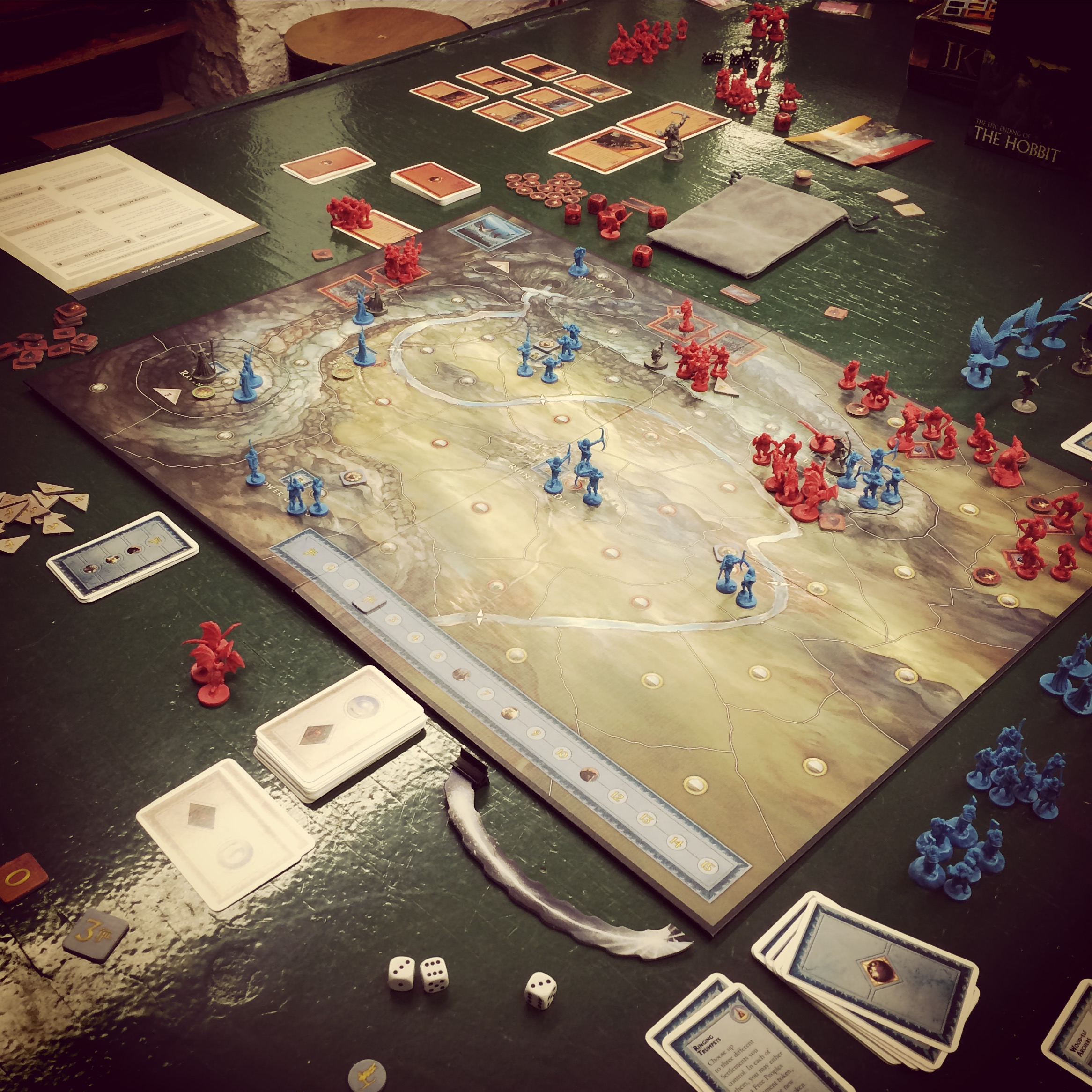
IMG_5479The Battle of the Five Armies begins

The two-player Battle Of The Five Armies retails for $89.99 USD but can be found online for about $60 USD, an incredible deal for a big box packed with fantastic components. The game contains 125 well-sculpted plastic miniatures depicting dwarves, men, elves and eagles of the Free Peoples in blue and goblins, orcs, warg riders and bats from the Shadow Armies in a ghastly red. Nine hero characters from the battle — Bard, Beorn, Bolg, Bilbo Baggins, Dain, Gandalf, the Elven King, Lord of the Eagles and Thorin — are each represented with an unique silver miniature and a character card outlining their special heroic abilities. Action and combat dice, numerous cardboard counters, dozens of Event, Fate and Story cards and a simple game board presenting the plains and mountains of the battlefield round out a greatly designed game.

The game begins on the eve of the battle with the Shadow Armies swarming in the mountains while the allied elves, men and dwarves work to create defensive position from the impending onslaught. Turns progress along a Fate track with the forces of evil racing to capture territory equaling ten points before time elapses or the Free Peoples are able to repel the Shadow Armies attack with the arrival of reinforcements or surprise allies like the Eagles from Misty Mountains or the ferocious shape-shifting man-bear Beorn.

IMG_5480The Shadow Armies and Free Peoples fight at the Eastern Spur

In each round, a single Story and Event card is drawn by each player up to a maximum hand size of six cards. The Free Peoples player then chooses to activate up to three hero characters in the round, allowing for extra recruits to appear, special magic attacks from the wizard Gandalf or a hail of arrows from the Elf King. Depending on the number of heroes activated, the Free Peoples player then also places Leadership tokens with some of their units. The Shadow Armies player then randomly selects Fate tiles to advance the Fate track, choosing as many tiles as the Free Peoples player chose to activate. Once the Fate track hits certain levels, additional heroes may appear in the game, bolstering the defenses of good. Thus, the Shadow Armies player needs to race against the Fate track to move and attack quickly and mercilessly before the Free Peoples can string together enough of a defense to win the day.

IMG_5481Gandalf releases a fireball from Ravenhill on the Shadow Armies in the distance

Dice and cards propel the action of the game. Each player throws a set of special Action dice, each depicting a specific type of activation within their turn — Character, Army, Muster, Muster/Army, Event and Will Of The West for the Free Peoples or Lidless Eye for the Shadow Armies. Beginning with the Free Peoples player, each chooses an Action die and resolves a given action. For example, an Army action allows a player to move or attack with armies or play a Character Event or Story card, and a Muster action allows recruitment or rally of armies or the play of a Muster Event or Story card. When a combat occurs, players collect their available unit cards into their hand and then roll dice based on the Combat ratings of their units. Along the way, other cards may be played to create specific events like dealing extra damage or negating leadership abilities. Terrain also plays a role in specific unit effectiveness during battle.

IMG_5485The Shadow Armies mass for a late game attack on the Free Peoples

Like many strategy games, The Battle Of The Five Armies becomes one of timing and getting the right cards, actions and forces in play. In our first learning game, the Shadow Armies quickly built up their horde and raged forward with fierce waves from the north and northeast. A heroic defense of the Eastern Spur by Lakemen fell to the orcs and their wargrider allies, and many dwarves also met their final end in a battle at Camp near the Front Gate. Gandalf held off the orcs and goblins to the west with a ranged fireball hurled from Ravenhill, saving the elven forces at the Fallen Bridge from imminent attack. As the Fate track moved in the late game to the eighth position, the Eagles were able to swoop down from their mountain aerie and attack the Shadow Armies in four areas, stalling the advance of evil. The Shadow Armies regrouped as additional recruits were placed throughout the realms defended by the Free Peoples. The Fate marker moved into the eleventh stage, releasing Beorn who sat at the southern border ready to wreak havoc on the encroaching Shadow Armies. Although many Free Peoples had fallen during the battle, the Shadow Armies weren’t close enough to strike a final fatal blow, and Middle-Earth remained free at the close of the game.

Our first game of The Battle Of The Five Armies, epic as it was, clocked in at over three hours as we got a hang of the rules. Lessons learned included the need for the Shadow Armies to always be on the attack since the arrival of more allies of the Free Peoples spells almost certain defeat for the forces of evil. Studying over the various cards and their effects, used by themselves or in combination, is also a big part of becoming an effective commander on either side of the battle.

Famously, Tolkien’s description of the Battle of the Five Armies in The Hobbit spans less than ten pages tucked in near the end of the book. For the two of us players, what we felt most from the game was how true it was to that short text and the pictures and the legends filling our imaginations over many, many years.
New Game Weekend: Acquire

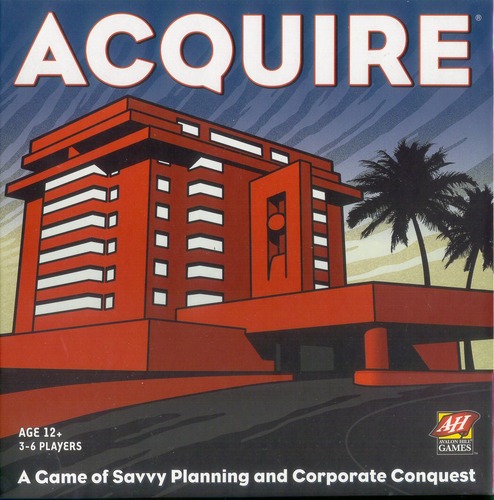
acquire box

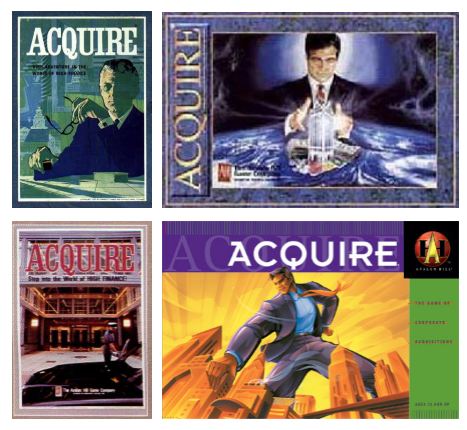
Acquire was designed by Sid Jackson and published in 1964 as part of the 3M bookshelf series. Produced from the early 1960s through mid-1970s, 3M’s games were a bit of an oddity outside their core office, medical and industrial supplies business yet they hold a solid place in the hearts and history of the gaming community. Along with classic board games like Go, Backgammon and Chess, the 3M bookshelf games also introduced the early trivia game Facts In Five, the election-themed Mr. President and economic strategy games like Acquire. In 1976, the 3M games were sold off to Avalon Hill which was subsequently purchased by Hasbro in 1998. The chain of ownership of Acquire through the years made for multiple international editions as well as a more recent period of the game being out of print until Hasbro’s Wizards of the Coast made the game available again in 2008. For a game based in the economic mechanics of buying and selling, Acquire itself has passed through several acquisitions itself over the past five decades.

AcquireBoxesTL

Various editions of Acquire from the 1960s to 1990s

I had a chance to play the modern incarnation of this venerable game on a recent weekend at Metropolitan Wargamers in Brooklyn, NY. The latest edition of Acquire consists of relatively underwhelming card stock and paper components that is short on charm but does keep the price just under $30. The game board presents a grid of building lots marked with a number and letter combination which coincide with a set of tiles with the same markings. In turn, players play tiles and may opt to construct an available corporation once two contiguous lots are available. Constructing a new corporation gets the player a free stock certificate plus the opportunity to buy up to two more shares at the starting price.

IMG_4920

My first game of Acquire in progress

On a turn where a new corporation is not being founded, a player may instead buy up to three shares total among the existing corporations. As chains of tiles are built out, the value and cost of a stock rises. Over the course of the game, existing corporations expand and larger corporations merge with smaller ones once their chains of building lots intersect. When corporations merge, players with stock may cash out, convert shares at two to one for the new coronation’s stock or hold the old stock for when (or if) the gobbled up company finds a new space to start again on the board. Once a corporation grows to a chain of eleven tiles it becomes safe from a take over, and the game ends once every company reaches at least eleven tiles in size. Stocks are cashed in and money is counted to determine the winner.

IMG_4919

Stock certificates, tile rack and reference chart from Acquire

Acquire’s staying power rests in its simplicity coupled with a lot of strategic and tactical play mirroring something like actual investing. As in the real world, timing, location and having cash on hand to strike when an opportunity presents itself are all key factors in Acquire. The game is also almost purely competitive, and the rules as written offer no opportunity for side trading or off-board deals. Placing a tile is usually a direct benefit to the player or may be a defensive move against another player’s expansion. Swooping in to buy stock to become a majority shareholder right before a merger can cut someone else out of a hefty payout. A merger or expansion of existing companies may also benefit multiple players. The ability to quickly convert cash earned into a new investment and then flipping that into more profit rules the game.

While the modern incarnation of Acquire pales next to past editions with their better components, the game itself remains strong. The buy-sell cycle of investing hasn’t changed much over the years. For a game with a fifty-year history of itself being bought and sold, little has changed with Acquire either.
New Game Weekend: King of New York

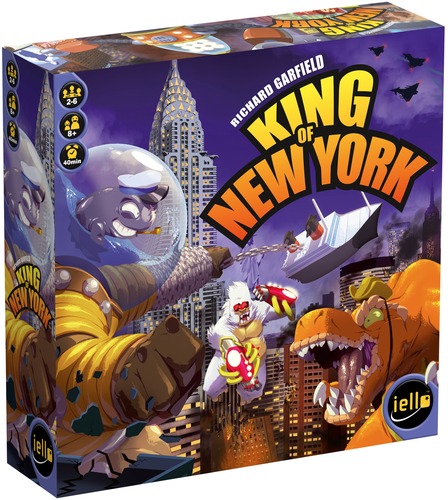
KONYbox

As the blog states, I’m a New Yorker (a Brooklynite to be exact), so playing a game based in my city of residence is always a plus. Prancing around a game board depicting the five boroughs as a towering, cartoonish monster with a nasty temper is even better. And so, King of New York hits the sweet spot for me as a gamer and occasionally cranky denizen of the city that never sleeps.

KONYmonsters

Sample monsters from King of New York

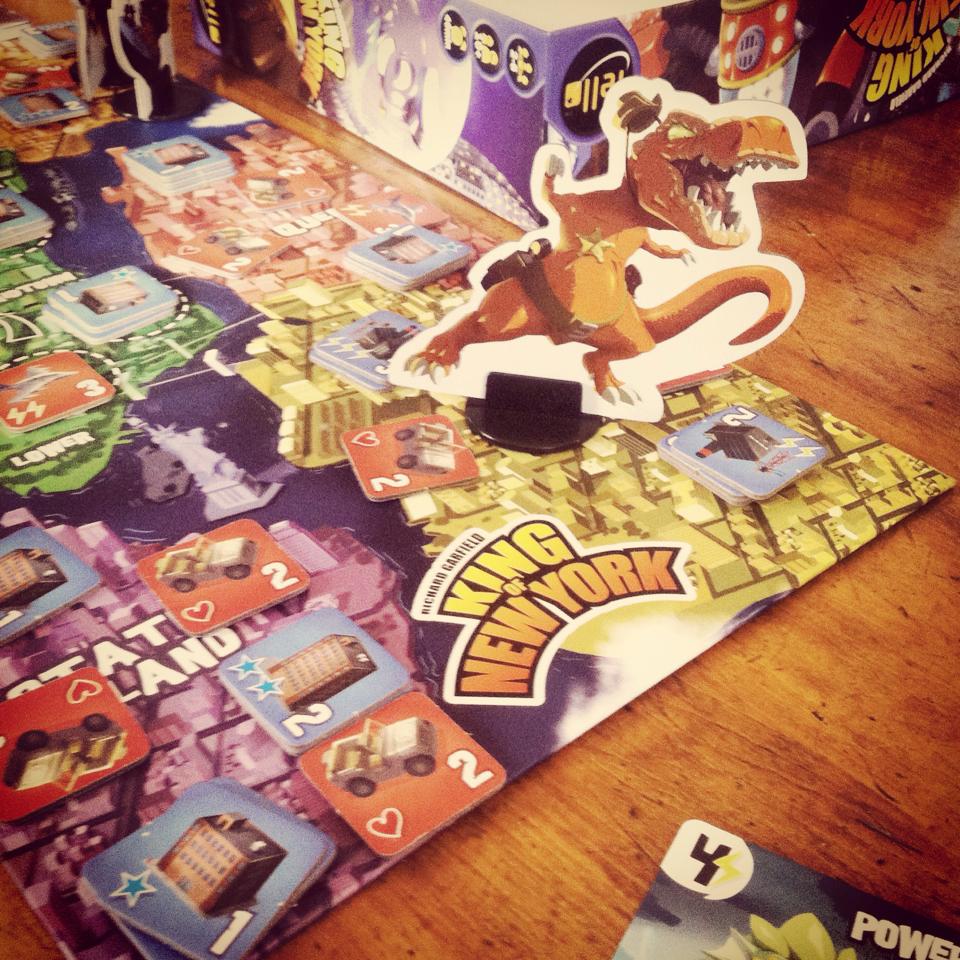
Released late in 2014 by IELLO Games, KONY is a follow-up standalone game to the popular King of Tokyo from 2011. KONY expands on KOT but it is not an expansion but a largely different game based on a similar premise and set of dice and card mechanics. Each of the 2-6 players chooses to be a gargantuan monster represented by a cardboard stand up figure and a scoring card. The monsters begin the game in one of the four outer boroughs with no more than two monsters allowed per borough. Within each borough are placed three stacks of three cardboard tiles each depicting buildings on one side and military units (jeeps, tanks and jet planes) on the reverse.

KONYcards

Sample cards from King of New York

A new set of six special dice are rolled by each player on their turn with faces for healing, attacks on other monsters, attacks on buildings, military attacks on monsters, energy cubes and victory point stars. Players roll the dice up to three times, keeping those dice they wish on each roll and re-rolling the rest. With the resulting dice, monsters resolve a number of actions. Buildings may be wrecked to earn healing points, victory points or energy cubes to purchase cards. Destroyed buildings flip over to reveal jeeps, tanks or jets which may attack other monsters in the same borough or across the board. Accumulated cubes are used to buy cards to provide permanent or one-time effects on monsters. Regular attacks take swipes at the other monsters on the board or the current “King of New York” romping northward through Manhattan. Monsters occupying Manhattan can remain on the island and earn victory points and energy cubes each turn or jump out to be replaced by an attacking monster. The first monster to earn 20 victory points wins the game to be crowned King of New York.

KONYgame

A recent game of King of New York

There’s a lot more going on in KONY than its predecessor. New dice and the building and military unit chips add options and flavor to play. Two new special cards — Super Star and Statue of Liberty — add extra mechanics to the game as cards earned through dice rolls and then swiped by other players who also roll specific results on subsequent turns. The rest of the cards can be a bit overly wordy at times yet they pump up the interest by utilizing a lot of familiar New York landmarks like Columbia University, the Unisphere in Queens, Carnegie Hall, the Holland Tunnel, the Brooklyn Bridge, the Empire State Building, Coney Island in Brooklyn and the infamous New York City Subway. Even with the new additions, KONY plays fast and fun with all ages.

If you’re a fan of King of Tokyo, giant monster films like the Godzilla series and board games set in New York City, King of New York is a towering success.

New Game Weekend: Legendary

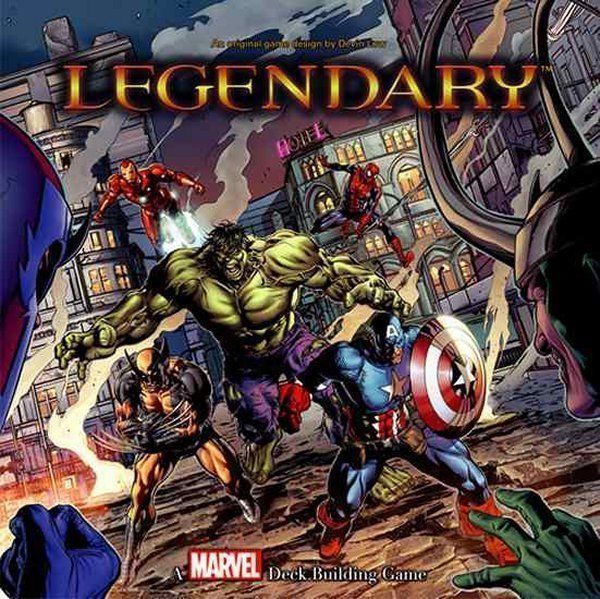
LegendaryBox

I’ve been a Marvel Comics collector and fan since the 1970s, but my gaming experience with my favorite super heroes has always been a less than satisfying experience. TSR’s Marvel Super Heroes Role-Playing Game never really played like the feel of a comic book back in the 1980s, and my brief experience with the Heroclix system in the past few years has also left me flat even with some great looking toys. And so, I was thrilled when I recently got into Legendary, a game that finally placed me directly in the midst of the wide Marvel Universe of heroes and villains.

Legendary Expansions

Fantastic Four, Paint The Town Red and Guardians of The Galaxy expansions

Released by collectibles giant Upper Deck in 2012, Legendary is a deck-building card game in which players take on the roles of super heroes doing battle with super villains in a near endless combination of scenarios and team-ups. Legendary is gloriously illustrated with all-original artwork with a hefty base game box containing heroes and foes primarily drawn from the Avengers, X-Men and Spider Man storylines. Additional expansion sets pull players into the cosmic worlds of the Fantastic Four and Guardians of the Galaxy, as well as the streets of New York populated by Daredevil, Elektra, Black Cat and Spider Woman.

Legendcards2

Sample X-Men and Spider Man cards

legendcards1

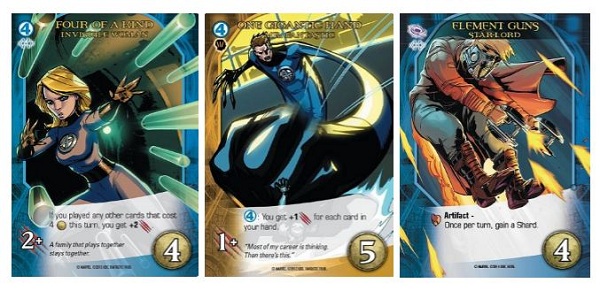
Sample Fantastic Four and Guardians of the Galaxy cards

Each hero is presented in a series of 14 cards of progressively higher value and ability. Team affiliations are depicted with small icons and values for recruiting other heroes and attacks are found at the bottom of the card. Special abilities and bonuses through interaction with other cards are listed along with colorful flavor text under the hero’s illustration. And so, each hero’s range of abilities is represented over the set of cards, allowing each character to grow in strength and use different powers or abilities throughout the game.

legendaryvillains

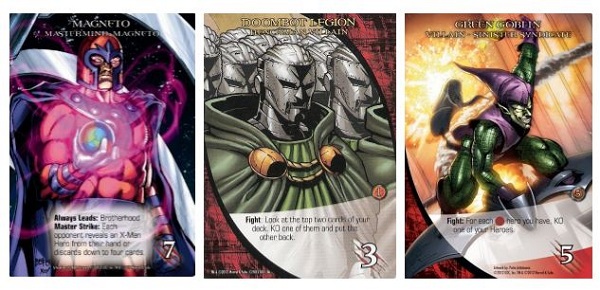
Sample Mastermind, Henchmen and Villain cards

Evil doers in Legendary are divided into three categories. Mastermind cards depict the powerful, lead villian like Doctor Doom, Magneto or Galactus within a given game and are represented with a stack of five cards. Henchmen are a group of identical cards of lower level bad guys such as Doombots and Hand Ninjas with limited abilities. Villain cards feature characters from teams of arch enemies from groups like the Sinister Six, Brotherhood of Evil Mutants, Hydra or Skrulls, each with varying abilities, effects and strength. Like the super hero cards, Villains, Masterminds

Legendaryboard

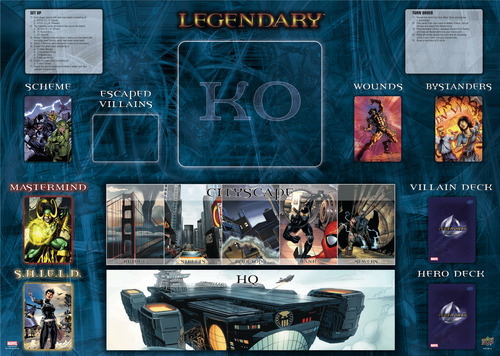
The Legendary game board

A game of Legendary is played on two levels. The players work collaboratively as a group of heroes to beat the game itself represented by the villains. If the players collectively win the game, points are tallied with each player based on the number of villains each player has defeated. The player with the most points wins. The mix of individual competition and teamwork is just one of the ways Legendary really feels like a comic book story as super heroes team up to achieve a unified goal while also performing heroic feats as individuals.

Legendary begins with the selection of a Scheme (ie scenario) which gives the conditions of victory for the heroes and villains. A Mastermind is chosen to represent the lead baddie in the game, and then Henchmen and Villain cards are selected. A Villain deck is created by shuffling in all Villains and Henchmen along with Scheme cards and Masterstrike cards which allow for attacks by the Mastermind. Depending on the number of players, a set of Hero cards are also shuffled together into a Hero deck. Choosing the mix of Heroes and Villains are sometimes dictated by the Scheme, can be done randomly or may be done by making specific selections. Part of the fun of Legendary is in the combinations of cards used to create the numerous combinations of Hero and Villain decks

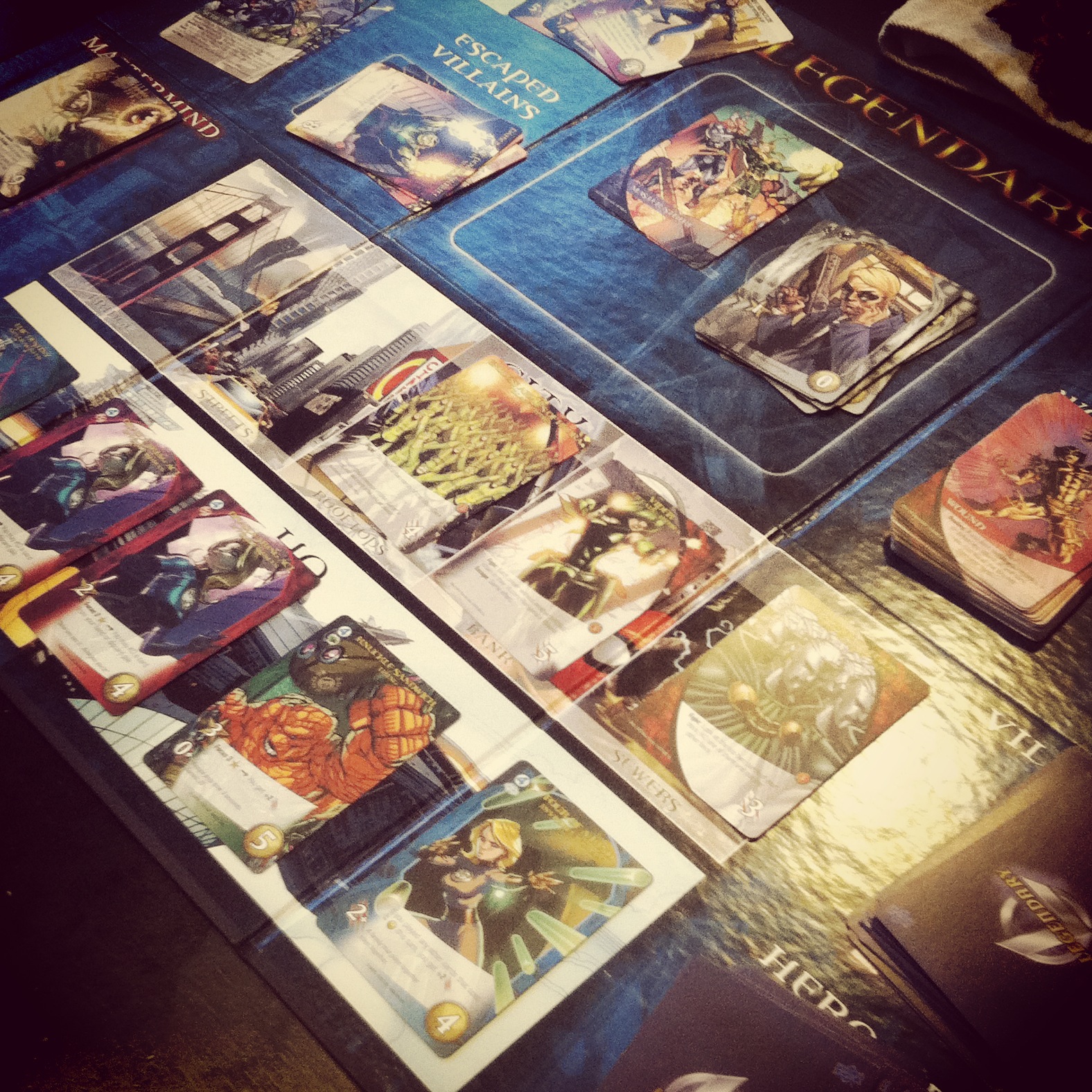
Each player is given a starter deck of identical twelve S.H.I.E.L.D. Hero cards and all other decks are placed on the Legendary game board. Six cards are drawn by each player from their shuffled starter decks. Five Hero cards are drawn from the top and laid out face up in the S.H.I.E.L.D “HQ” area and made available in turn to each player to “recruit” into their deck each turn based on recruitment points on their six cards in hand. Players may also play cards from their hand to fight Villains drawn each turn from the Villain deck and placed face up in the “City” area on the board. As each new Villain is turned up, other Villains shift down the City row and may be fought be players playing attack points on their available hand of cards. Played Hero cards also contain a variety of abilities, often used in combination with other cards to greater effect. Hero abilities can allow for extra cards to be drawn or discarded, stronger attacks, automatic defeat of Villains, extra recruitment value and numerous other special effects. Defeated Villains provide positive and negative effects on players and are then scored in a victory point pile for each player. Villains who move down the City track escape, causing negative impacts to the players. Scheme cards drawn from the Villain deck likewise cause bad things to happen. At the end of a player’s turn, a new hand is drawn back to six cards and play passes to the next player.

IMG_4855

One of my many recent games of Legendary

Legendary thus plays over a variety of turns as more Heroes are recruited into a player’s available deck, Masterminds and Villains are defeated, Bystanders are rescued and progress is made in defeating the Scheme before the bad guys win. Hero cards from the same or aligned teams combine to powerful effect, and certain Villain and Hero cards also interact in different ways. Getting the right number and combination of hero cards moving through a deck is key as the game progresses.

There are so many things I love about Legendary. Primarily, the game just “feels” like a comic book. Teams, like the Fantastic Four, X-Men or Avengers, work best together, combining skills and abilities to powerful effect against Villains. Individual Hero abilities each play with the superpowers known from the comic book canon. For example, Rogue from the X-Men is able to siphon abilities off other Heroes and Hulk rages and sometimes causes damage to Villains and Heroes alike.

Dark City

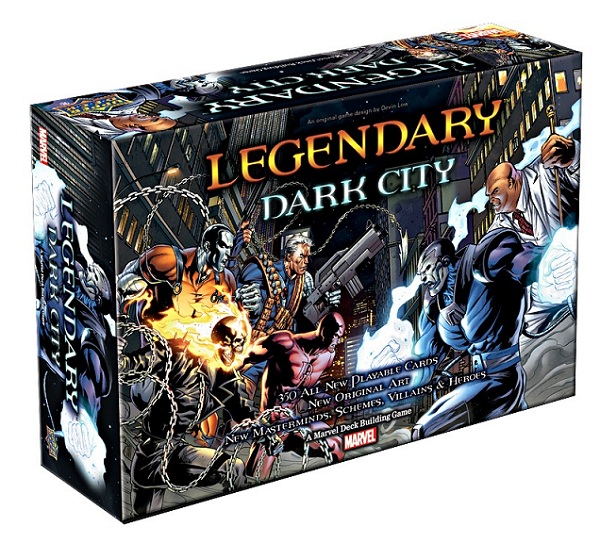
The big Dark City expansion for Legendary

I got into Legendary in a big way over the 2014 holiday season with the base game and Fantastic Four, Paint The Town Red, Guardians of The Galaxy and Dark City expansions. With hundreds of Mastermind, Villain, Henchmen, Hero and Scheme cards available, each game plays in a nearly endless variety. With the modern Marvel Universe dating back to 1961 and re-invigorated with a constant flow of hit blockbuster movies since 2000, Legendary draws richly on the complex intersecting storylines from a half century of comic book popular culture.

Legendary has started me off in 2015 with a new game favorite and one my entire family has enjoyed playing together. As a lifelong fan and gamer, Legendary has finally given me the chance to team up with my favorite heroes from the Marvel Universe.

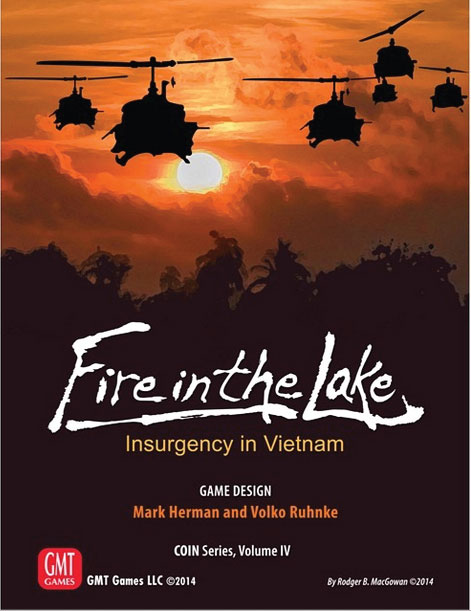
New Game Weekend: Fire In The Lake

FITLBox

I sometimes forget that I was born during the Vietnam War, one of the more complicated military conflicts in American history. In April 2015 we’ll be sitting 40 years after the fall of Saigon and the pullout of American involvement in the region’s conflict which began in the mid-1950s. To mark the occasion, the US government has quietly launched a special 50th anniversary Vietnam War Commemoration website this past year. Decades later, the complicated legacy of Vietnam continues to reverberate as even the website has proven to be controversial.

10385548_10204291766628690_7108403211786443463_n

Game set-up for the Fire In The Lake 1965-67 beginner’s scenario

Having played a few games of Cuba Libre over the past year, I’ve finally had a chance to dive into another in the COIN Series from GMT Games this fall with the Vietnam War themed Fire In The Lake. The counterinsurgency (COIN) games focusing on modern conflicts have fast become new favorites among a lot of us at Metropolitan Wargamers in Brooklyn, NY, and since the summer a core group at the club have been working through multiple games of FITL and getting a decent handle of this richly complex game.

FITLCards

Sample cards from Fire In The Lake

Like other games in the series, FITL uses a card-activation mechanic to drive the game among the competing factions of US forces and US-allied South Vietnamese ARVN counterinsurgency and the insurgent northern NVA and Viet Cong guerrillas and regulars. Cards provide turn order at the top of each with a symbol for each faction. Each player chooses to use the Event on a drawn active card, conduct an Operation and/or possibly also conduct a Special Activity related to the Operation. Operations include such things as Rally or Train (recruiting troops, irregulars and/or building bases); March, Patrol or Sweep (to move and expose and/or remove guerillas), Assault or Attack (to remove enemies); and, Terror (to effect support and opposition). Adding in Special Activities such as the VC’s Tax and Subvert, the devastating Air Strike from the US, Ambush and Infiltrate from the NVA and the ARVN’s Govern and Raid makes for a powerful set of player actions.

The card text contains effects beneficial to the US and ARVN COIN players at the top and NVA and VC events in a shaded box at the bottom. Events can produce either immediate benefit to the player using the card or a negative result to another player, so a player might choose to act on a card’s Event merely to prevent another player from using the Event. Keeping an eye on turn order and the next available card also drives decisions, as one player’s choice can limit or enable the next choice available to the following players. Every nine cards contains a random Coup card which pauses play for a round of faction-specific series of phases whereby resources are gained, troops are redeployed, pieces are reset and victory conditions are checked.
FITLmarkers

FITL Support/Opposition, Control and US, NVA, ARVN and VC Victory track markers

Each of the four groups has their own path to winning the game with victory points scored at the edges of the board on a track that also marks Resources, Aid and Patronage levels. The VC score by shifting the population of provinces toward opposition and constructing bases while the somewhat allied NVA win through gaining population control and creating bases. The ARVN player gains points through population control and earning patronage from the population of the cities and provinces. The United States wins through shifting support and building up the number of available bases and troops (reflecting a victorious withdrawal of the military from Vietnam).

IMG_4798

Another FITL game in progress this week

The combination of random turn order, Events, Operations and Special Activities creates a dizzying amount of variation to how a FITL game plays out over a few hours. With many interdependent actions and victory conditions, an unpredictable stack of Event cards and uncertainly timed Coup scoring rounds, Fire In The Lake makes returning to Vietnam again and again a most worthy choice.
FITLpic


New Game Weekend: Force On Force

Enduring FreedomFor a person who spends an outsized amount of time reading about, researching, modelling historic soldiers and playing wars of the past, I have pretty much ignored the wars of my own lifetime from the late 1960s to present. Born during the Vietnam War, I grew up in the last two decades of the Cold War. From there, the protracted engagements in Iraq and Afghanistan and the ever-shifting nation-less “War On Terror” have occupied my adult years. The United States has been at war for most of my life and all that of my two sons. For a whole host of reasons, I prefer to set my wargaming in the comfortable distance of the past.
FOFRulesForce On Force rule books from Ambush Alley Games

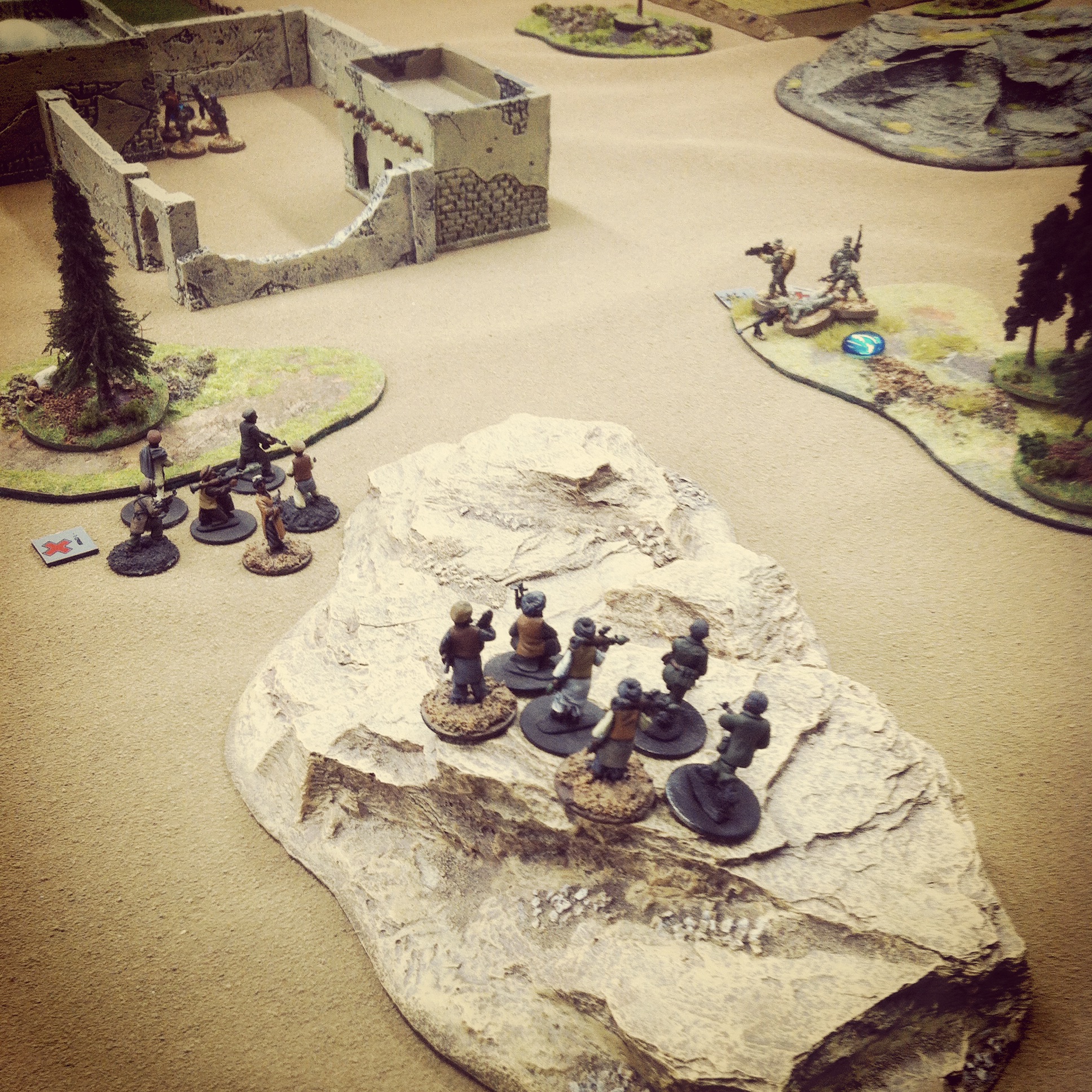
This past weekend at Metropolitan Wargamers in Brooklyn, NY, I took a rare trip to a modern tabletop battlefield with my first play through a couple of scenarios using the Force On Force rules system. Published in 2009 by Ambush Alley Games and distributed by Osprey Publishing since 2011, FOF has become the go-to rule set for miniatures gamers focused on modern conflict. The rules provide elegant gaming mechanics for asymmetric warfare between elite regular units and irregular forces. Using this, the FOF system accounts for the more advanced tactics, leadership, communications and equipment of US and NATO forces against the highly motivated yet less professional and poorly equipped irregular Taliban forces.

IMG_4793

The Afghanistan battlefield for our Force On Force scenarios

Our two scenarios presented a generic engagement between US Marines and Taliban forces in and around two typical walled compounds in rural Afghanistan in 2010. Amid the arid trees, hills and fields, the table was set with a hefty collection of 25mm Middle East structures from the Miniature Building Authority. The eight-turn scenario involved two four-man Marine squads attempting to hold a walled compound against the encroaching Taliban forces.

IMG_4792US Marines squad in Force On Force

As elite forces in FOF, the US Marines carry initiative and announce two actions  at the beginning of the turn. Actions include combinations of such things as shooting, remaining on overwatch, hiding, tactical movement of up to 6″ or rapid movement up to 12″ with a subsequent penalty for firing. The elite nature of American Marine regulars allows the unit to function without a troop quality check. Shooting for the US is achieved with D8s, one for each figure in the squad, with additional dice thrown into the mix for special or heavier weapons. For the Taliban without leaders present, movement must first be determined with a troop quality check with one D12 per each figure in the squad, and shooting is done using D6s. With their local knowledge, Taliban forces can also choose to move anywhere at any distance on the table provided they do not cross line of sight of any US forces.

IMG_4790Taliban unit in Force On Force

Thus the differing size of the dice thrown for each squad type — US regulars and Taliban irregulars — is used to determine all the variations in asymmetric troop quality. In FOF, any rolls of 4+ are considered successes, so the relatively easy D12 motivation tests for the Taliban account for their zealous dedication while their weaker D6 combat rolls mimic their relatively untrained fighters and poor weaponry with only a 50/50 chance of hitting anything. In addition, a Taliban figure firing a rocket-propelled grenade RPG gains two extra D6 but hits must be re-rolled with results of a 1 indicating a dud rocket and no effect to the target. On the other hand, US forces hit 2/3rds of the time using their D8s. Hits are applied randomly to figures in the unit, except for successful hits from US snipers which allows for a choice of targets.

IMG_4794

Second US Marines squad with sniper advances

In our game, the first US Marine squad began in a field adjacent to the objective compound with a single Taliban unit perched on an adjacent rooftop. The Marines chose to remain in cover on overwatch, allowing the Taliban a first ineffective round of fire. The Marines returned fire killing one of the Taliban fighters. Turn two saw the entry of the second US Marines team, including a sniper, while the first team scooted into the compound at a full 12″ of rapid movement through two open doors. The Taliban’s second unit, including an RPG, entered the table with a lucky roll of 6 which allowed them to deploy at the corner near the second US unit and the compound.
IMG_4795

Second US Marine squad takes heavy fire from two Taliban units

Over the next two turns, the first US team remained within the compound guarding the objective while the second US squad crept to a copse of trees just outside the compound’s walls. At the wall, the Taliban fired their RPG to open a hole in the wall to expose the US Marines inside. Another Taliban unit with two RPGs and a leader rolled another 6 to also deploy near the compound, moving close to their nearby allies to give the other unit the benefit of the leader.

Along the way, “fog of war” event cards were drawn on rolls of 1 during reactive fire. These cards add an extra element of randomness to a FOF game. The first card eliminated the Taliban’s ability to move anywhere on the table out of line of sight due to an US drone launching overhead. The second card drawn allowed the Taliban to set an improvised explosive device (IED) between the second US squad and the compound, effectively eliminating a direct path to the objective. The final card was pulled by the Americans an allowed for an “excellent position” to be created to protect the second team at the trees.

In the meantime, combined fire from the Taliban eliminated the US sniper in the trees and injured the other three members of the squad, effectively pinning them for the remainder of the game with no friendly force nearby to attempt a first aid check. With one American squad left and the Taliban poised to close in on the compound from multiple directions, the game went to the Taliban.

We switched sides for the second game with one US Marine unit immediately taking up position within the compound and the second unit moving under cover through the nearby ruins and trees. The Taliban reinforcements were not as lucky with their placement, and all entered at the far end of the table with stalled movement due to a lack of leadership. Again, a fog of war card eliminated the Taliban’s free movement on the table. A RPG shot blew up one building in the target compound, but the Marines survived and pulled back to another building. By turn six, the second US squad most moving to protect the compound and the Taliban forces, while great in number, had failed to advance far enough to prove a threat. A final fog of war card brought in a sandstorm, effectively shutting down shooting and movement for the remainder of the game. The US Marines had done their job and held the objective and the day.

One of the benefits of gaming modern war is the wealth of immediate information available in refighting actual engagements or creating other realistic scenarios. For our battle, some of the excellent coverage from National Geographic’s documentary Inside The Afghanistan War was used, and countless books, articles, photos, videos and websites provide further information and inspiration. The Force On Force rules do a masterful job at representing small engagements between regular and irregular forces, and I look forward to another series of games bringing in additional types of weapons, support and vehicles to the mix. Yes, our modern wars are still unfolding immediately in real-time, but with FOF a better appreciation of the tactics and challenges of today’s soldier is well represented for the interested wargamer.

New Game Weekend: Evolution

evolutionbox

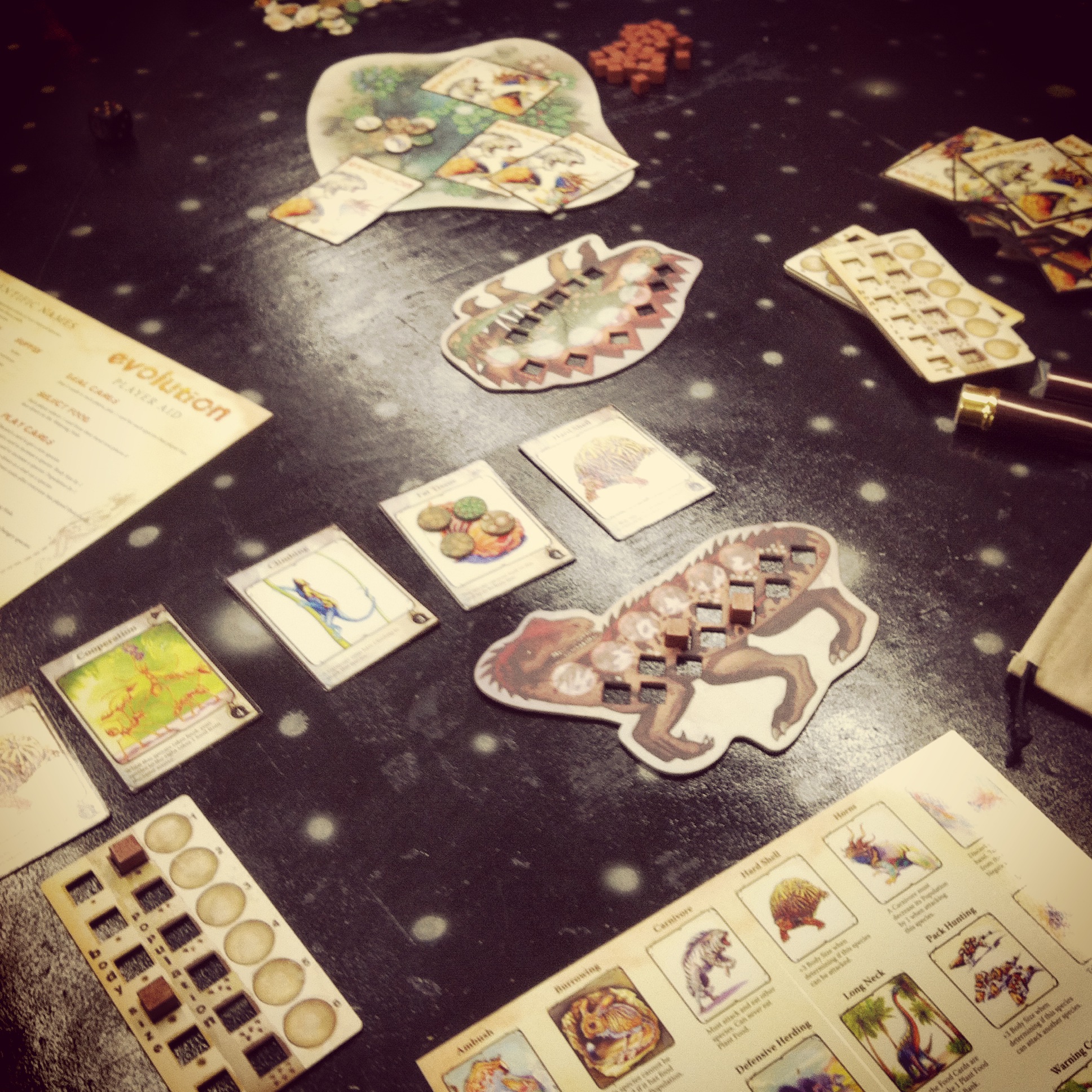
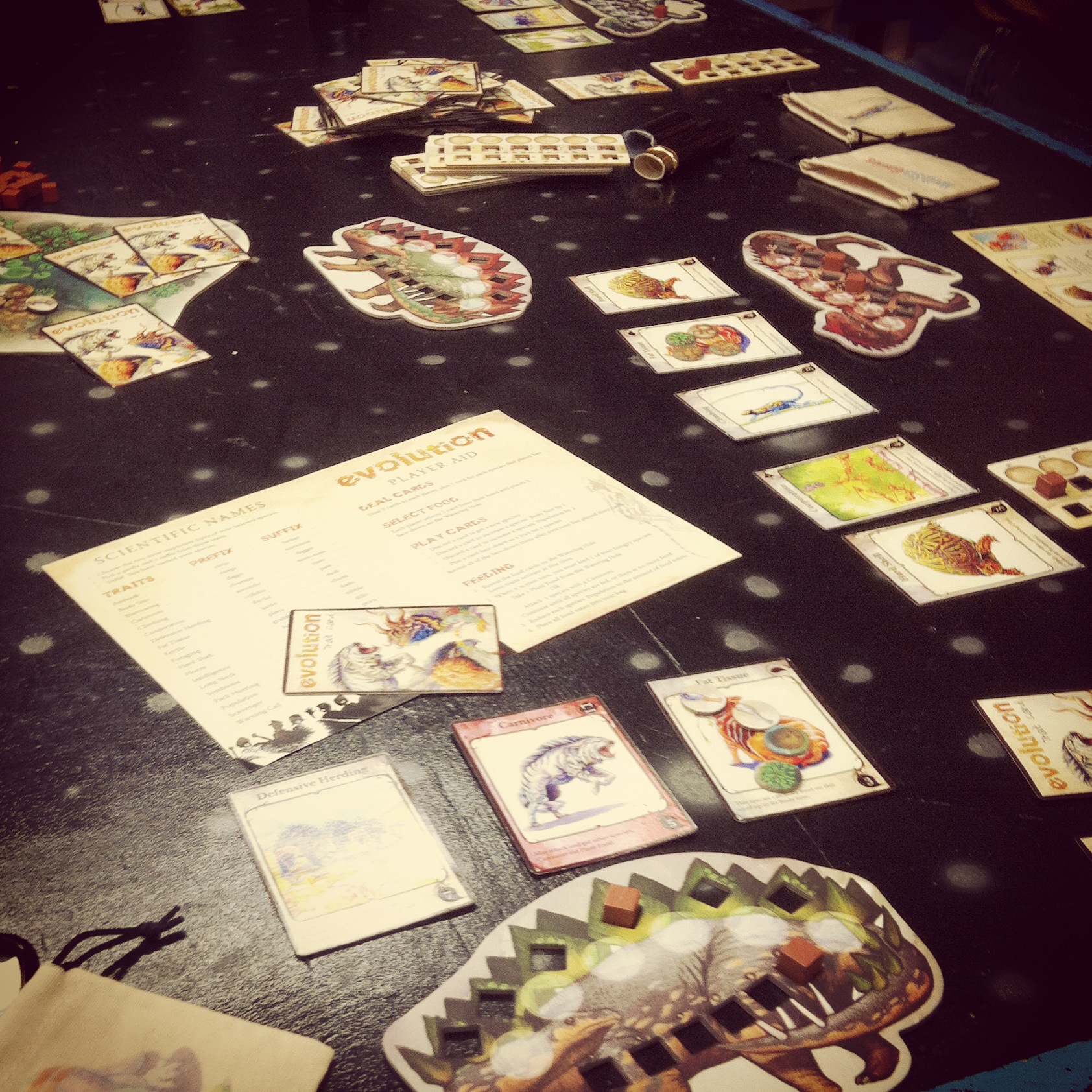
This past summer, Evolution garnered a fair amount of attention during its successful Kickstarter campaign which netted over $120,000 on a $10,000 goal. Many gamers were familiar with the game’s producer, North Star Games, and their previous casual party game favorites such as Say Anything. Evolution was a big jump into strategy game design, and the result is box a gorgeous components and a very playable game for a whole range of ages and experience. The game has been hitting the table at Metropolitan Wargamers in Brooklyn, NY over the past week or two, and this past weekend I had a chance to get in on a six person game of Evolution.

evcardsSample trait cards from Evolution

Evolution begins with each player in possession of one species and a hand of four “trait” cards. The 129 beautifully painted cards are the core mechanic of the game. A player’s turn begins by throwing a required card into the watering hole at the center of the table, contributing to a food pool with the value at the lower right corner of the card. The player then decides to play some or all their other cards in a variety of ways. Cards may be discarded to increase a species body size, grow population, spawn an additional new species or, most importantly, evolve the species by playing trait cards. This where the real action comes in.

Up to three cards may be played above a species to create evolutionary traits for that creature. Some traits provide benefits every turn with things like Long Neck allowing the species to eat first and the Fertile trait which grows species population every round. Defensive traits such as Hard Shell, Horns and Burrowing aid in providing defense against being attacked by a species with Carnivorous trait. Carnivores might add aggressive traits such as Good Eyesight, Climbing or Pack Hunting to counteract the defenses of other species.

IMG_4752Special Kickstarter first player miniature

With multiple species growing in size, population and traits, Evolution plays out as nature’s arms race for supremacy and food. After every round of playing cards, all species are fed in turn from available food in the central primordial watering hole. Each species must feed up to its population size or risk a die off of that species. Carnivores by their very nature do not feed from the pool but on other species around the table, and those species must defend using their available traits and body size. Once feeding is complete, food tokens are swept from the species cards and stored in a bag. At the end of the game, the player with the most food points, living species and trait cards played wins.

IMG_4754Player pieces and the watering hole in Evolution

The designers of Evolution claim over 4000 species can be created using differing combinations of cards, and this is where the replay value really shines. Each game plays fast, with a six player game only representing about one play through the deck of trait cards. Timing and choices are critical in the game, and a player needs to figure when is the right time to create a new species or focus on building up the population or size of existing species. Keeping an eye on what other player species are evolving toward as well as the available food supply necessarily inform strategy.

IMG_4753A player’s carnivore goes after the other species in Evolution

In my first game this past weekend, I chose to focus early in the game on scoring points by getting two species with large populations going at once. With a number of protective traits played on each of my species, I was able to hold off three other carnivore species for most of the game as they ate some of the weaker species of other players. In the end, the carnivores were effectively in a three-way stand-off with each other as the final round of food was tallied and the win went to one of them who had more than 40 points to my losing 25.

With North Star’s previous focus on word and trivia style games, Evolution is a really fantastic surprise for their entry into strategy gaming. The building, card and food resource management has a feel like so many civilization building or other Euro style games, while its relative simplicity makes the entry skill level appeal to a lot of serious and casual gamers alike. The game would be a great way to break up a school biology class or engage a dinosaur-obsessed kid in gaming. Evolution plays out with nature in all its beauty and danger, and it presents a world where only the fittest player species who can wisely manage their own growth and resources is going to survive in the end.

World War I: The Battle of Vimy Ridge 1917 with Price of Glory

VimyRidgepic

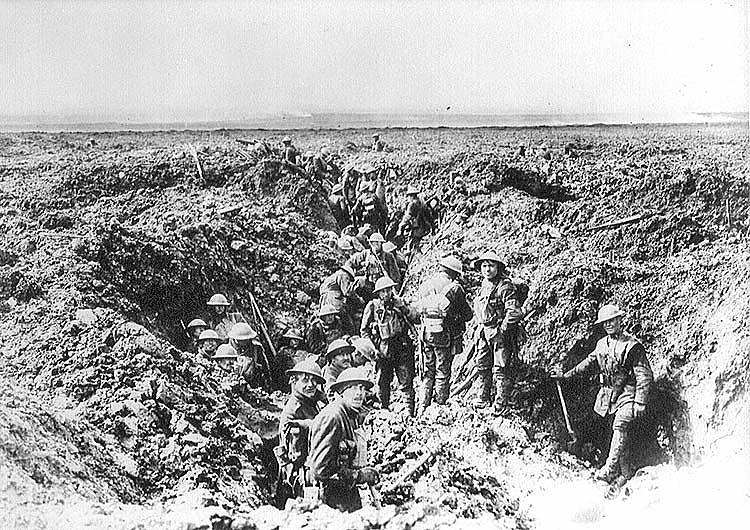
The Battle of Vimy Ridge, France over four days in early April 1917 was not just a victory for the Allies during World War I. The battle also served as a shining example of Canadian national pride as the overwhelming Canadian-led force was able to stand on its own for the first time without British leadership on the field against Germany. The decisive capture of the German lines at the ridge would hold this section of the Western Front for the Allies until the end of the war.

pogcover“Price of Glory” by Iron Ivan Games

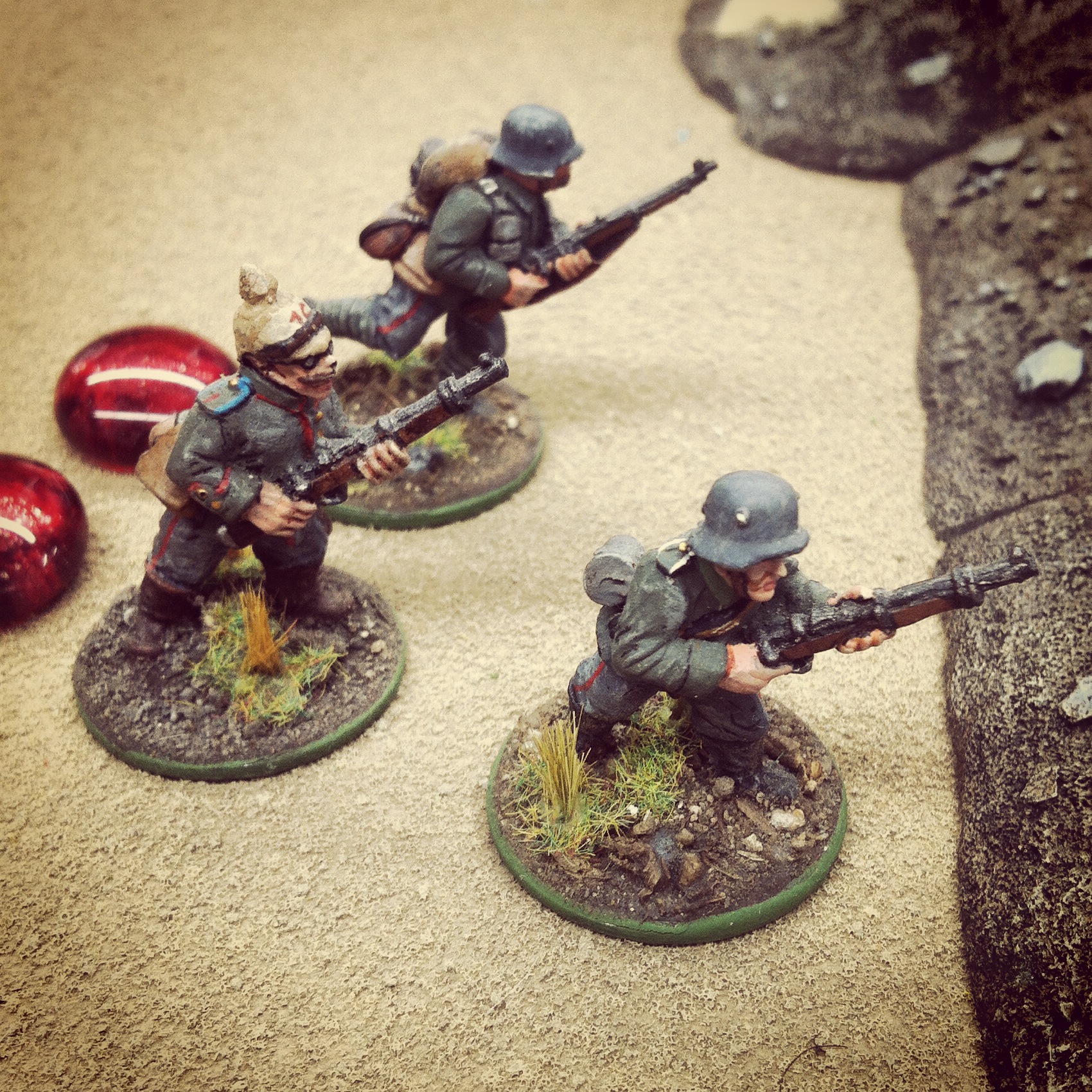
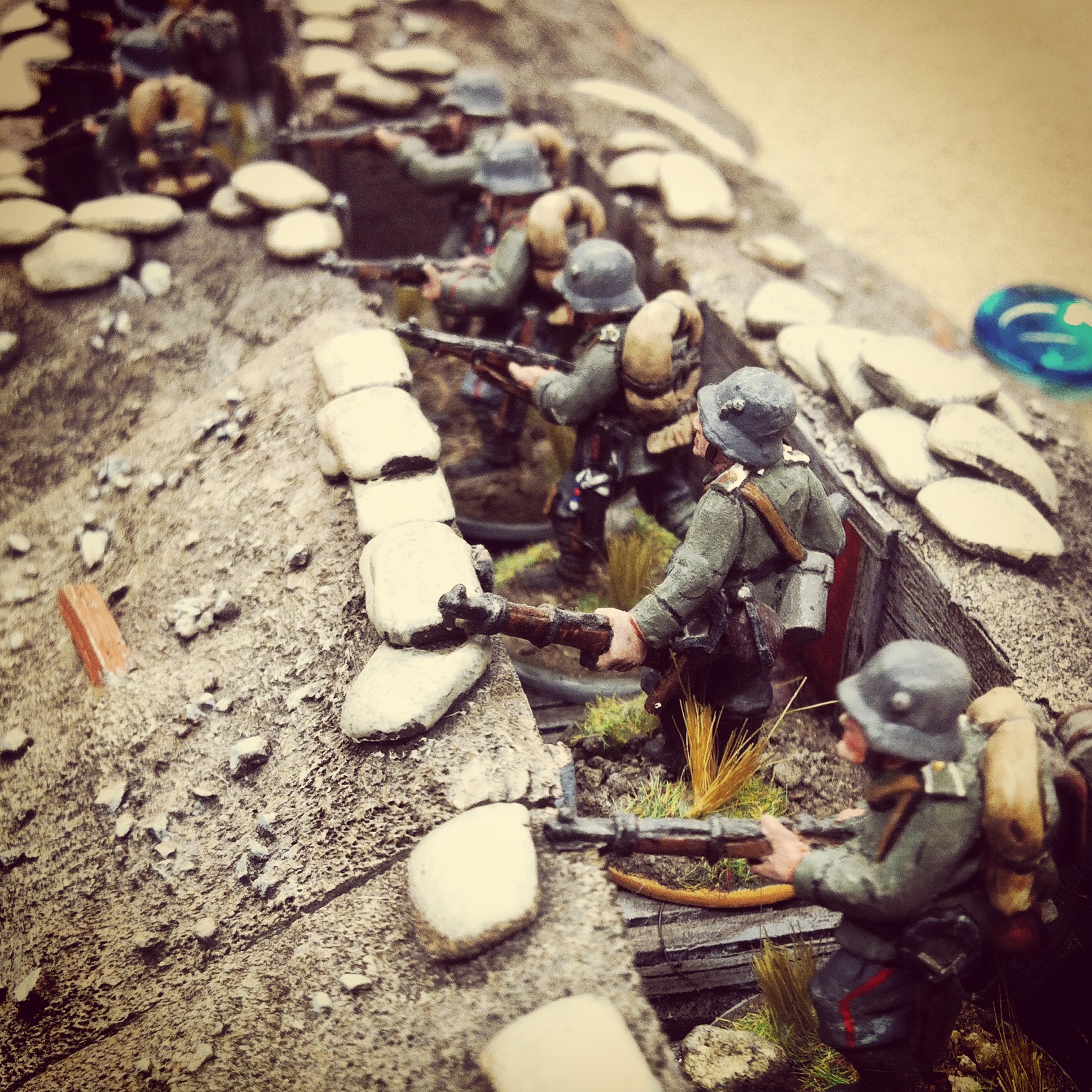
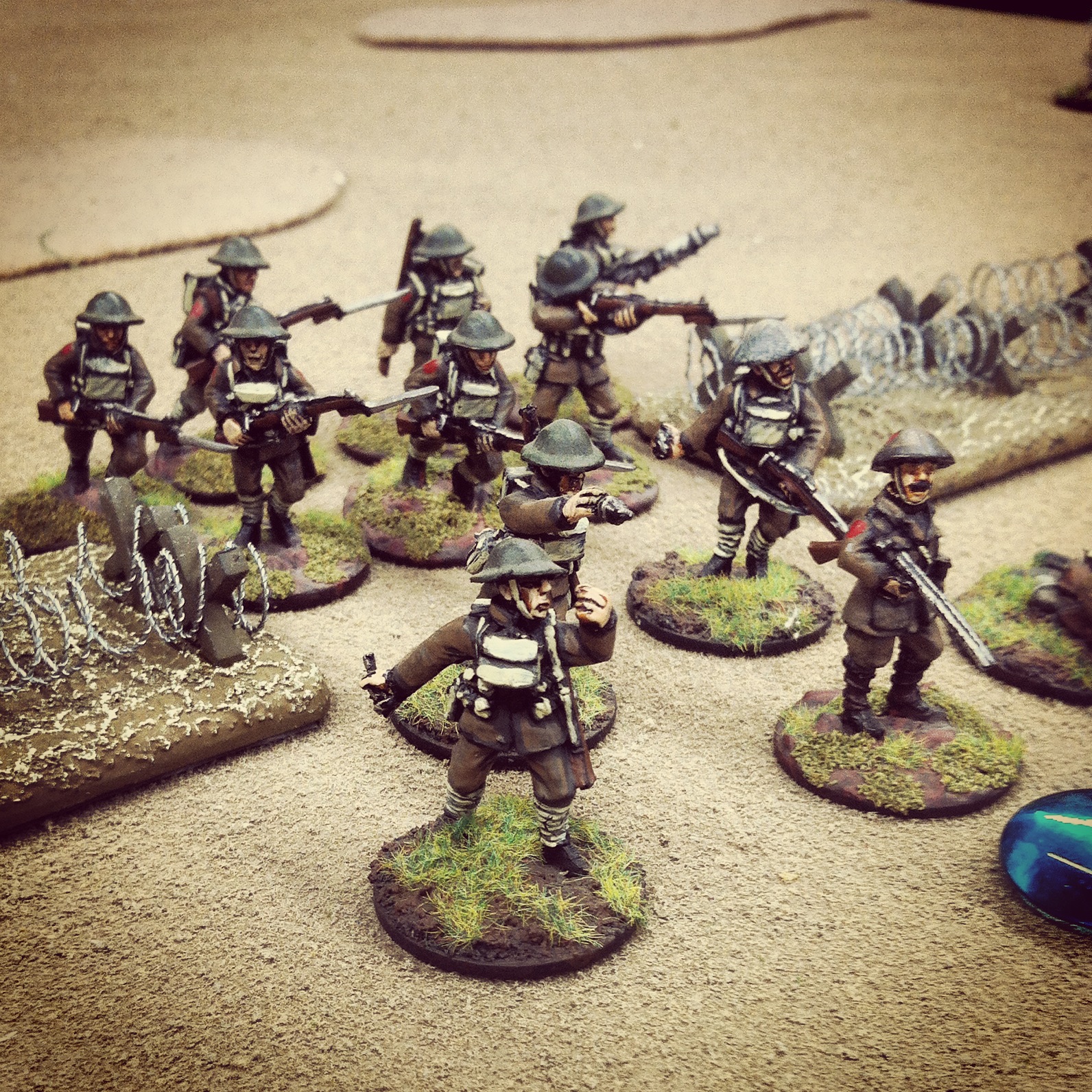
This past weekend at Metropolitan Wargamers we finally got some WWI gaming in with a quick scenario modelled on the Canadian exploits at Vimy Ridge with the Price of Glory rules from Iron Ivan Games. We unpacked over six feet of beautifully modelled trench works that had laid too long in storage and set up a gorgeous collection of 28mm WWI German and Canadian troops from Great War Miniatures. The three of us new to the rules divided the Canadians among ourselves with four rifle and machine gun squads, a grenade-armed bombing party and a Vickers machine gun to our right. Facing us across the cratered and barb-wired field was two lines of German trenches initially defended by two teams of Germans and a MG 08 on their right flank. The level of Canadian victory would be measured by the capture of the German front line, rear set of trenches or the treeline beyond in a ten-turn game.

IMG_4620

Canadian troops advance on the German lines at Vimy Ridge

The Canadians initially plotted four artillery targets along the front and rear trench lines. After the starting German deployment, we rolled off for the artillery bombardment which we had luckily ranged-in directly on the German rifles and machine gun on the front line. Unfortunately the dice were not with the Canadians, and all four artillery shots missed. From there, the Price of Glory rules progressed simple enough with a D10 roll-off for initiative which the Canadians won and began their advance. Teams alternate on each side of the table taking move, fire or melee actions with short movement of 3″ allowing for a full rate of fire, 6″ at fire at half-rate and a 9″ sprint allowing for now firing.

IMG_4621

Germans hold the front line in the trenches

As the first few turns elapsed, the Canadians at the right slowly advanced from crater to crater as they took heavy fire from the German rifles and machine gun. Defending from the trenches, the Germans were a hard target with only a “1” result counting as a hit on the fistfuls of D10s being thrown. In the rules, a team taking fire must also roll a D10 morale check or become suppressed. Morale rating is based on the command strength of the squad, with squads on both sides initially beginning with two officers each at a “7” and “8” rating. A morale check equal to or less than the command rating for the squad passes and may take an action on their turn. A squad losing their morale check must use their next activation to rally.

IMG_4622

Canadians advance through a gap in the wire

By mid-game, one Canadian squad had met their doom in the open wasteland in front of the German line and a second was torn in half as they limped to the trench line at the German left. At the center, a full Canadian squad made their way through a center gap followed by the bomb team. On the German right, the machine gun was eliminated and a final squad of fresh Canadians made way for the trenches. The Canadians continued to win initiative roll-offs which were modified at -1 on each side for lost squads or squads failing morale checks.

IMG_4623

Germans flee the front line to defend from the next line of trenches

As the remnants of one surviving squad of Germans fled the first line of defense after losing two morale checks against the encroaching Canadians, two reserve units of Germans emerged from the woods to the rear and ran to defend the secondary line of trenches. From there, the final turns of the game became a shoot-out between the two trenches with the Canadian bomb crew and a German rifle squad being nearly eliminated in the firefight. At the final turn, the Canadians had scored a minor yet costly victory by securing the first line of the German trenches for the Allies.

IMG_4625

The Canadian bombing party occupies the first line of trenches

IMG_4626

Germans hold the second line at Vimy Ridge

IMG_4624

Canadians hold the first line for victory

I hadn’t played a WWI game in a couple of years, and the figures and terrain at the club hadn’t hit the table in quite some time either. The Price of Glory rules ran fast, and we were all generally of the opinion it captured the combined fire and morale effects found during the conflict. We also agreed another larger game with a bit more complexity and perhaps some artillery, armor and cavalry would be in order. With many worldwide commemorations this year of the Great War’s 100th anniversary (including an excellent site from the Imperial War Museum), is was good to make time for our own journey back to the Western Front.

New Game Weekend: Corsairs

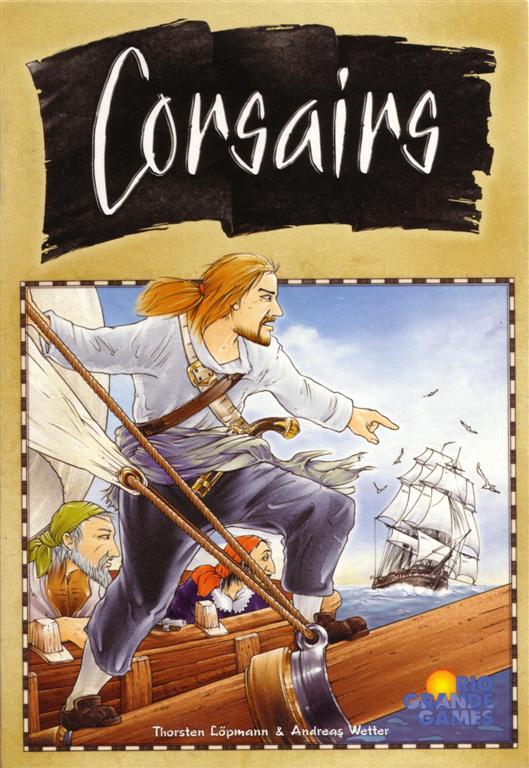
Corsairsbox

I’ve spent the last month or so reading Robert Louis Stevenson’s Treasure Island with my younger son, and it still amazes me how pirate stories continue to engage people long after the romantic swashbuckling days of yore have faded into history and myth. Just this past year, the rollicking fun NBC show Crossbones starring John Malkovich set sail in primetime. Even though the show was cancelled after a short run, it’s amazing the retelling of the exploits of the famed pirate Blackbeard found a home once again in a 21st-century crowded with zombies, superheroes and retro advertising executives behaving badly.

Corsairsships

Sample galley cards from Corsairs

The pirate theme, as I’ve noted before, also continues to have a tight grasp on gamers. This past weekend at Metropolitan Wargamers in Brooklyn, NY, I had a chance to play through the now out-of-print Corsairs produced by Rio Grande Games in 2000. Playing best with four players, Corsairs involves the simple idea of raiding and capturing ships by playing provision and pirate cards, rolling dice and double-crossing opponents. Four heavy cardboard ships (or galleys) begin on the table. Each galley card depicts the point value at the top, the die value needed to capture the ship and a mix of required provisions needed before an attempt can be made to capture the vessel.

Corsairscards

Sample provision and pirate cards from Corsairs

Players begin by being dealt a hand of six cards each. The color-coded cards depict provisions – bananas, beans, bread, meat, rum, or water – or a pirate with a face value of  2 to 4. In turn, players place a total of two cards on the available ships. Matching types and amounts of provisions are played on ships face up along with any pirate cards face-down. After two cards are played, a third is discarded before redrawing back to a six-card hand. Play passes in turn until a player has enough required provisions to attack a ship. Rolling two dice and adding available pirate bonuses, players attempt to exceed the required value to seize the ship. If successful, all players lose the provisions on that ship and the player takes the card. If unsuccessful, the player loses their provisions on the ship and play passes to the next player. A player who attacks on their turn misses their next turn when they can redraw their hand. Once the final galley card is played and seized, the game ends and the player with the most points wins.

Corsairsgame

 A game of Corsairs at Metropolitan Wargamers

As with any good pirate game, the opportunity to out-scalawag your opponents is where the real fun comes in with Corsairs. With cards played on a ship, a player may attempt a “broadside” attack once per turn by rolling two special dice with provision colors on each face. A successful result enables the player to steal the provisions for their own use or simply to prevent another player from using them first. Capturing several ships of the same colored border also allows a player to double-up on points, so stealing a ship away from another player before they snatch it also comes into play.

I managed to win my first play through Corsairs by doubling-up on two high point purple ships, snagging two other valuable galleys and then foiling some other players by stealing their provisions through broadside attacks. Corsairs moves fast like a ship on the high seas and requires no reading, making it a great game to play with kids. And what kid – young or old – doesn’t like pirates?

Collector’s Note: You made need a treasure map to find a copy of the out-of-print Corsairs, but you can fdig them up on eBay occasionally for upwards of $50-60.

New Game Weekend: Wilderness War

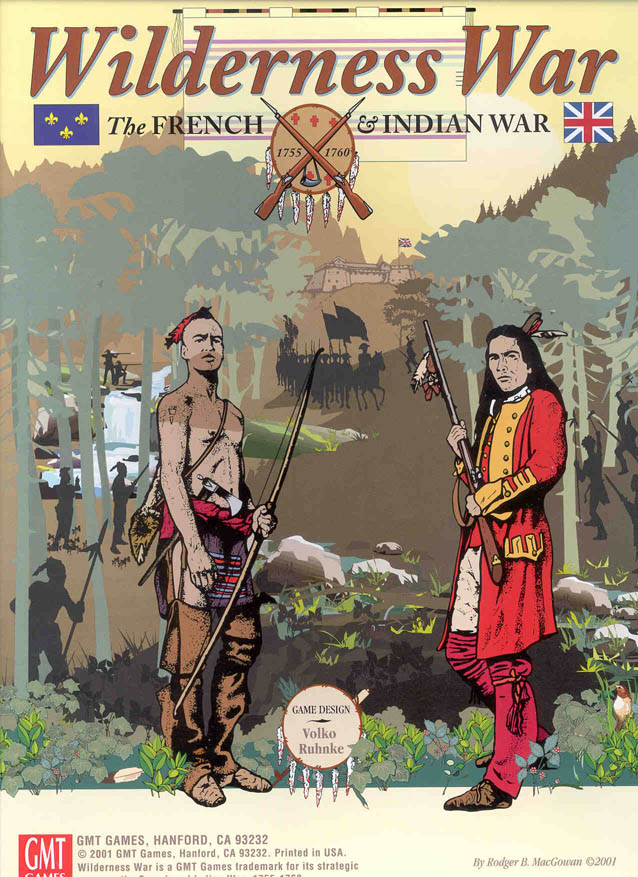
WWbox

I wound up spending a fair amount of time this past year touring sites related to the French and Indian War period while feeding my gamer’s appetite for the Seven Years War period with A Few Acres of Snow. With a little research and talking with some of the members at Metropolitan Wargamers, I decided I needed to go bigger and dive into a game focused on the French and Indian War. All trails led to GMT’s Wilderness War, and I had a chance to play my first game this past weekend.

Published in 2001, Wilderness War is a game that causes a lot of the gamers I know to glaze over with wide grins. The game is designed by Volko Ruhnke and uses a card-driven mechanic much like his COIN games series also published by GMT. I have a few games of the Runke-designed Cuba Libre and Fire In The Lake under my belt, so I knew that a French and Indian War game from him was certain to be a mix of relatively simple rules wrapped up in a rich historic board game experience.

WWboard

Wilderness War game board

The gorgeous map – hardbound in the latest edition – presents the Northeastern colonial areas of North America in the mid 18th-century. As with the war itself, the game is largely defined by geography. “Cultivated” (ie settled) areas are indicated with boxes, and “wilderness” areas and Indian settlements are printed as circles. Mountainous areas are also depicted with chains spreading through western and central Pennsylvania, the Hudson Valley region and portions of central New England. Connecting these areas are roads or trails and the more important waterways which served as the superhighways of the period. Many of the larger cultivated settlements begin with heavy fortresses protecting the space, while the game set up places a series of French and British forts and stockades throughout the map.

wwchips

Sample Wilderness War game counters

Game components consist primarily of 70 cards and 271 cardboard counters. The counters generally depict movement and combat ratings, with reduced values on the flip side once a unit takes damage in battle, during a wintering period or from an event card. Command markers also carry tactics numbers, which help during combat, and a command value. Cards allow activation of units equal to the number printed or by command rating. Special events may also be played for British (red), French (blue) or either side (red/blue), and cards with a brown-red band are events which may be played at any point during either side’s actions.

wwcards

Sample Wilderness War cards

The game plays with year-long turns each containing an early and late season, each approximating about six months of time. In each season, players begin by being dealt eight cards apiece. Later events and actions may modify a player’s hand size, but in general the French and British player then take turns playing cards to move forces, engage in battle, construct defenses or play out events as depicted on the cards. With some pre-planning, each season moves relatively swiftly toward the conclusion of a year of war. At the end of each year, victory points are tallied and units are checked to see if they suffer losses during the winter period between each yearly season of fighting.

Wilderness War comes with a playbook outlining several small to mid-sized games featuring particular periods in the war or a set-up for the entire war from 1755 to 1762. For my first game, we jumped in with both feet and started from the outset of the war  with me playing as the British and my experienced opponent using the French. The French begin the game with a small force stretched across the Lake Ontario, St. Lawrence River and western Pennsylvania regions. British forces start poised on three fronts along the Hudson River, stretching west toward the eastern tip of Lake Ontario at Oswego and just south of western Pennsylvania. The French are buoyed with their strong alliances with several Indian nations while the British hold enormous access to colonial, regular British troops and numerous commanding officers waiting to be called into service.

Using the swift wilderness movement and  raiding capabilities in the 1755 and 1756 turns, the French sent Indian forces into Pennsylvania, Virginia and New England to raid unprotected British cultivated areas. The British quickly moved to redeploy their meager regulars throughout these areas to build stockades and push back further raids. At the same time, the French massed their forces and captured Fort Oswego. By the end of the second year of play, the French were already sitting on six victory points.

With a string of stockaded defenses set up to the west by the beginning of 1757, the British began to land troops at their coastal port arrivals to offset negative British political effects which stymied the use of more Colonial regulars and militia units. British troops commenced the long march into the Pennsylvania mountains and the nearby target French fort at the Ohio Forks (today’s Pittsburgh). Back to the east, the French began using their new base at Oswego to launch a push to the southeast into the Hudson Valley and the ill-defended areas around Albany, Schenectady and the Oneida region. All the while, the French continued to recruit additional Indian forces to buffer their defenses at the Ohio Forks and continue raids toward the east. The 1757 late season ended with my leaving too many British marooned in the mountains of Pennsylvania in a clear rookie mistake which led to my mass of troops taking heavy losses in the winter season.

IMG_4433

The British stockade defenses on the western frontier lay the groundwork for a push on the French at the Ohio Forks in my first game of Wilderness War

By 1758, my British luck seemed to change a bit for the better. Drawing and playing the William Pitt event card, I was able to increase my card hand size to nine cards and gain access to more British forces. Rushing more British reinforcements west into Pennsylvania, the French fell during a siege at the fort protecting the Ohio Forks, giving the British a firm foothold on the western frontier and awarding two victory points. Additional British troops rushed up the Hudson River Valley to hold back the French push toward Albany. As the British remained engaged in fights, the French began shifting their forces along Lake Ontario and the northern frontier while also raising a large force from the Iroquois in central New York. With 1758 at an end, my British forces were safely wintering on two fronts but in a severely weakened state and still way behind on victory points.

We called the game at its midpoint, deciding to restart another time now that I had been introduced to the general game. I still hadn’t experienced some major facets of the game such as naval movement and amphibious warfare, but I had quickly come to understand some of the major drivers of how the game plays. As a beginner, here are some lessons learned from my first game of Wilderness War:

  1. Defend the frontier. Especially for the British, but for both players, keeping the frontier defended by building stockades and forts is a must. Regular troops caught in wilderness areas are easy targets for Indians and other non-regulars, so having defenses built is key to defending territory. Having a network of stockades and forts to defend from, retreat to and maintain supply line coherence is a necessity if an army is going to succeed in the wilds of North America.
  2. Don’t get caught out in the cold. Open country and mountains are a strong enemy, particularly to 18th-century European armies. Paying attention to stacking limits as each year ends is important to keeping a force at strength. When conducting operations, players need to keep in mind where their troops will all wind up as a year ends and forces settle in for the winter. Nothing is worse than spending a series of turns marching troops into position only to have a portion of them die from starvation, disease and exposure in the period following each year’s turn.
  3. Play the long game. The full game goes to eight years of warfare, so strategy needs to take a long view. The first half of the game most probably belongs to the French as they and their Indian allies sack the wide open and undefended frontier. The British simply can’t be everywhere in the early years of the war, so spending time building defenses while also waiting to get the right cards to call in reinforcements is important. Massing and moving large forces on both sides to be strong enough to siege and capture forts takes a fair amount of planning but pays off in victory points.

Wilderness War is a fantastic playable document of the French and Indian War. The shifting alliances, opportunistic events, geography of the country itself intertwine to capture the period with a realness that might be familiar to any French or British commander on the 18th-century American frontier.

ww logo