New Game Weekend: Fire In The Lake

FITLBox

I sometimes forget that I was born during the Vietnam War, one of the more complicated military conflicts in American history. In April 2015 we’ll be sitting 40 years after the fall of Saigon and the pullout of American involvement in the region’s conflict which began in the mid-1950s. To mark the occasion, the US government has quietly launched a special 50th anniversary Vietnam War Commemoration website this past year. Decades later, the complicated legacy of Vietnam continues to reverberate as even the website has proven to be controversial.

10385548_10204291766628690_7108403211786443463_n

Game set-up for the Fire In The Lake 1965-67 beginner’s scenario

Having played a few games of Cuba Libre over the past year, I’ve finally had a chance to dive into another in the COIN Series from GMT Games this fall with the Vietnam War themed Fire In The Lake. The counterinsurgency (COIN) games focusing on modern conflicts have fast become new favorites among a lot of us at Metropolitan Wargamers in Brooklyn, NY, and since the summer a core group at the club have been working through multiple games of FITL and getting a decent handle of this richly complex game.

FITLCards

Sample cards from Fire In The Lake

Like other games in the series, FITL uses a card-activation mechanic to drive the game among the competing factions of US forces and US-allied South Vietnamese ARVN counterinsurgency and the insurgent northern NVA and Viet Cong guerrillas and regulars. Cards provide turn order at the top of each with a symbol for each faction. Each player chooses to use the Event on a drawn active card, conduct an Operation and/or possibly also conduct a Special Activity related to the Operation. Operations include such things as Rally or Train (recruiting troops, irregulars and/or building bases); March, Patrol or Sweep (to move and expose and/or remove guerillas), Assault or Attack (to remove enemies); and, Terror (to effect support and opposition). Adding in Special Activities such as the VC’s Tax and Subvert, the devastating Air Strike from the US, Ambush and Infiltrate from the NVA and the ARVN’s Govern and Raid makes for a powerful set of player actions.

The card text contains effects beneficial to the US and ARVN COIN players at the top and NVA and VC events in a shaded box at the bottom. Events can produce either immediate benefit to the player using the card or a negative result to another player, so a player might choose to act on a card’s Event merely to prevent another player from using the Event. Keeping an eye on turn order and the next available card also drives decisions, as one player’s choice can limit or enable the next choice available to the following players. Every nine cards contains a random Coup card which pauses play for a round of faction-specific series of phases whereby resources are gained, troops are redeployed, pieces are reset and victory conditions are checked.
FITLmarkers

FITL Support/Opposition, Control and US, NVA, ARVN and VC Victory track markers

Each of the four groups has their own path to winning the game with victory points scored at the edges of the board on a track that also marks Resources, Aid and Patronage levels. The VC score by shifting the population of provinces toward opposition and constructing bases while the somewhat allied NVA win through gaining population control and creating bases. The ARVN player gains points through population control and earning patronage from the population of the cities and provinces. The United States wins through shifting support and building up the number of available bases and troops (reflecting a victorious withdrawal of the military from Vietnam).

IMG_4798

Another FITL game in progress this week

The combination of random turn order, Events, Operations and Special Activities creates a dizzying amount of variation to how a FITL game plays out over a few hours. With many interdependent actions and victory conditions, an unpredictable stack of Event cards and uncertainly timed Coup scoring rounds, Fire In The Lake makes returning to Vietnam again and again a most worthy choice.
FITLpic


New Game Weekend: Evolution

evolutionbox

This past summer, Evolution garnered a fair amount of attention during its successful Kickstarter campaign which netted over $120,000 on a $10,000 goal. Many gamers were familiar with the game’s producer, North Star Games, and their previous casual party game favorites such as Say Anything. Evolution was a big jump into strategy game design, and the result is box a gorgeous components and a very playable game for a whole range of ages and experience. The game has been hitting the table at Metropolitan Wargamers in Brooklyn, NY over the past week or two, and this past weekend I had a chance to get in on a six person game of Evolution.

evcardsSample trait cards from Evolution

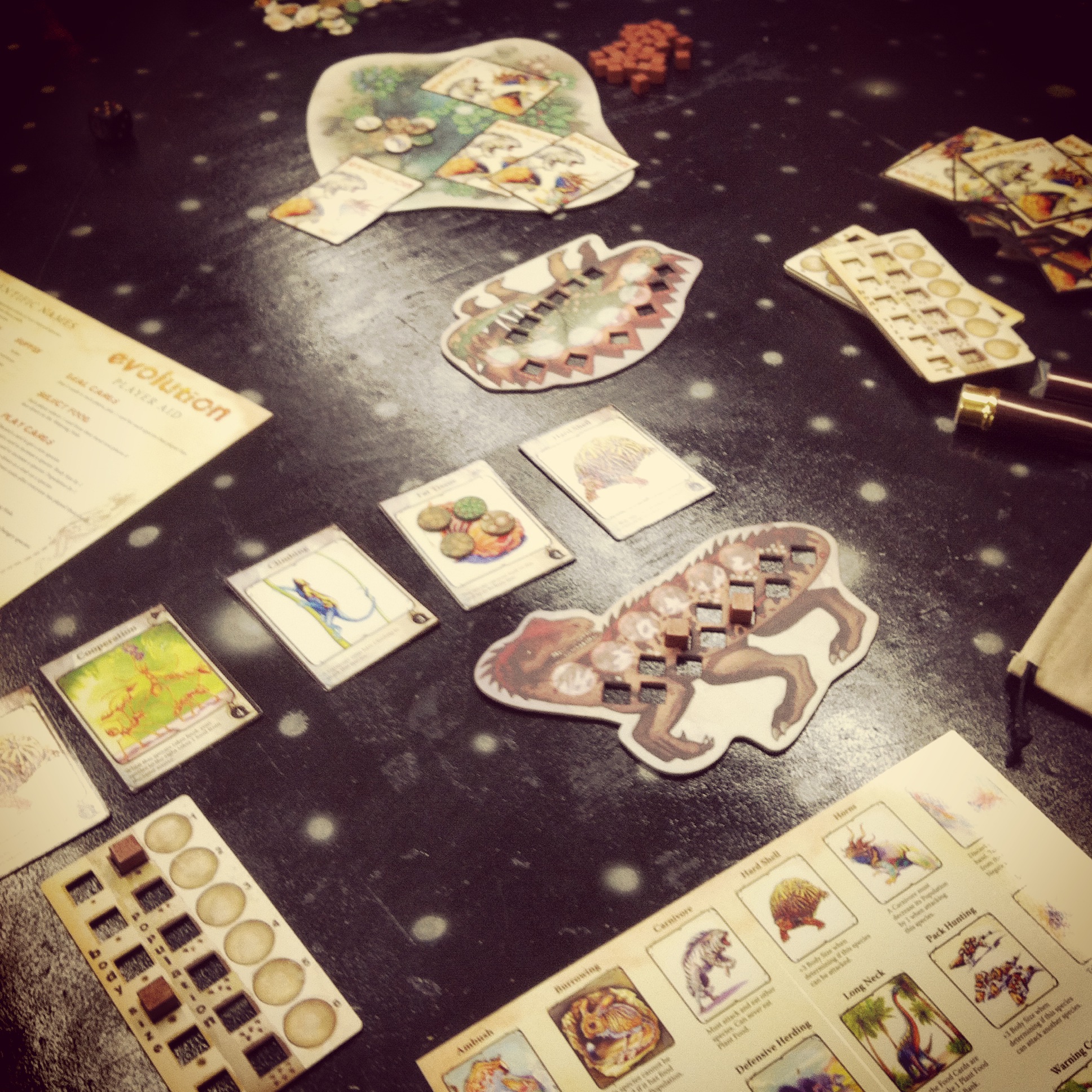
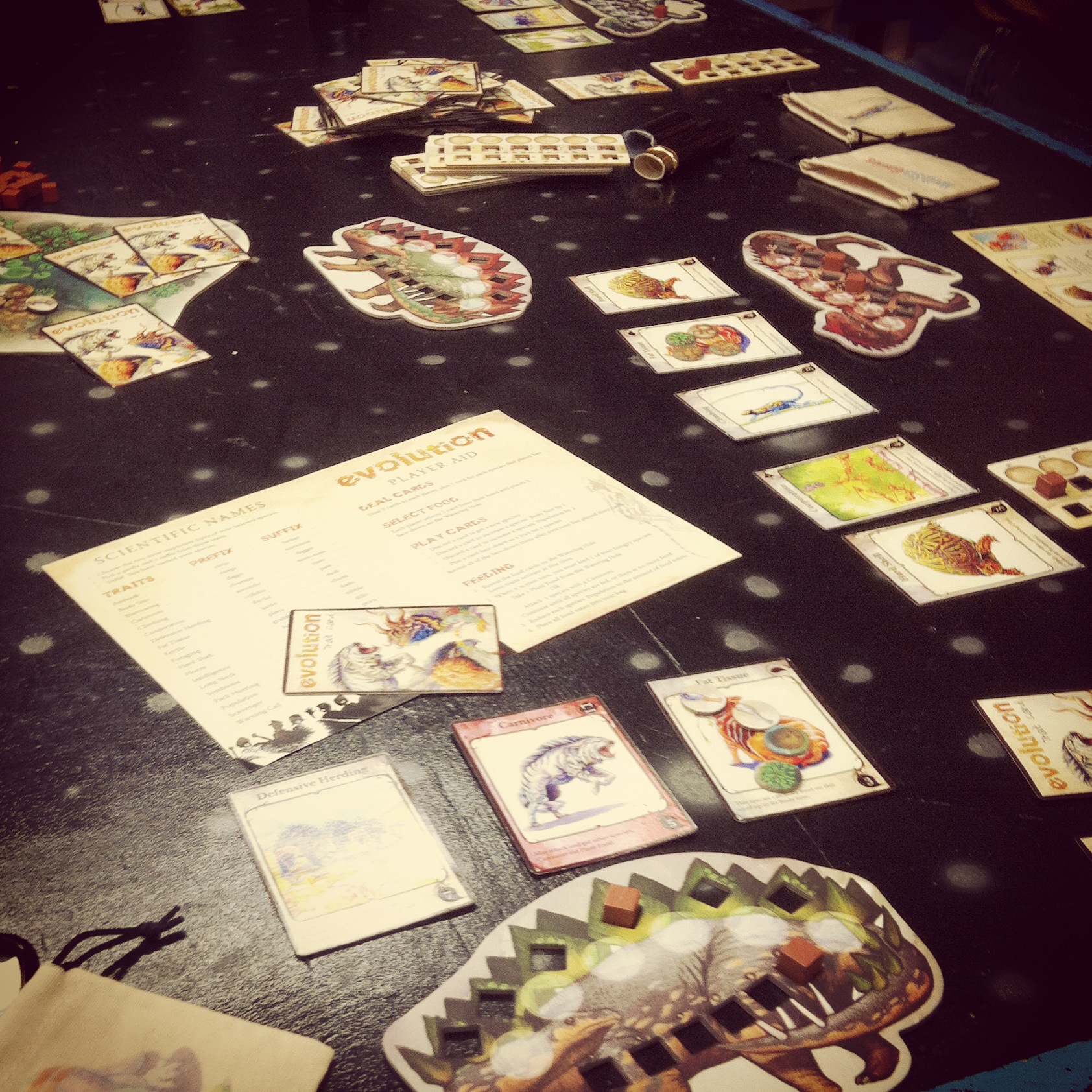
Evolution begins with each player in possession of one species and a hand of four “trait” cards. The 129 beautifully painted cards are the core mechanic of the game. A player’s turn begins by throwing a required card into the watering hole at the center of the table, contributing to a food pool with the value at the lower right corner of the card. The player then decides to play some or all their other cards in a variety of ways. Cards may be discarded to increase a species body size, grow population, spawn an additional new species or, most importantly, evolve the species by playing trait cards. This where the real action comes in.

Up to three cards may be played above a species to create evolutionary traits for that creature. Some traits provide benefits every turn with things like Long Neck allowing the species to eat first and the Fertile trait which grows species population every round. Defensive traits such as Hard Shell, Horns and Burrowing aid in providing defense against being attacked by a species with Carnivorous trait. Carnivores might add aggressive traits such as Good Eyesight, Climbing or Pack Hunting to counteract the defenses of other species.

IMG_4752Special Kickstarter first player miniature

With multiple species growing in size, population and traits, Evolution plays out as nature’s arms race for supremacy and food. After every round of playing cards, all species are fed in turn from available food in the central primordial watering hole. Each species must feed up to its population size or risk a die off of that species. Carnivores by their very nature do not feed from the pool but on other species around the table, and those species must defend using their available traits and body size. Once feeding is complete, food tokens are swept from the species cards and stored in a bag. At the end of the game, the player with the most food points, living species and trait cards played wins.

IMG_4754Player pieces and the watering hole in Evolution

The designers of Evolution claim over 4000 species can be created using differing combinations of cards, and this is where the replay value really shines. Each game plays fast, with a six player game only representing about one play through the deck of trait cards. Timing and choices are critical in the game, and a player needs to figure when is the right time to create a new species or focus on building up the population or size of existing species. Keeping an eye on what other player species are evolving toward as well as the available food supply necessarily inform strategy.

IMG_4753A player’s carnivore goes after the other species in Evolution

In my first game this past weekend, I chose to focus early in the game on scoring points by getting two species with large populations going at once. With a number of protective traits played on each of my species, I was able to hold off three other carnivore species for most of the game as they ate some of the weaker species of other players. In the end, the carnivores were effectively in a three-way stand-off with each other as the final round of food was tallied and the win went to one of them who had more than 40 points to my losing 25.

With North Star’s previous focus on word and trivia style games, Evolution is a really fantastic surprise for their entry into strategy gaming. The building, card and food resource management has a feel like so many civilization building or other Euro style games, while its relative simplicity makes the entry skill level appeal to a lot of serious and casual gamers alike. The game would be a great way to break up a school biology class or engage a dinosaur-obsessed kid in gaming. Evolution plays out with nature in all its beauty and danger, and it presents a world where only the fittest player species who can wisely manage their own growth and resources is going to survive in the end.

Toys, Trains and Games at the New York Historical Society

IMG_4659Toys and games are on my mind year-round, but the holiday season adds an extra layer of history, tradition and nostalgia to my passion for play. And so, my son and I made our way this past weekend to the New York Historical Society on Manhattan’s Upper West Side and back through more than 150 years of childhood wonder.

Holiday Express: Toys and Trains from the Jerni Collection

IMG_4660

The museum’s ground level entrance and rotunda galleries are currently occupied by the stunning Holiday Express: Toys and Trains from the Jerni Collection. The name of the collection is derived from the names of Jerry and Nina Greene, the Philadelphia area collectors who amassed more than 35,000 toys over some five decades.

The Jerni collection, considered one of if not the largest toy collections in the world, represents a comprehensive story of what is considered the high water mark in toy making from the mid-19th through 20th-centuries. With a heavy leaning toward European manufacturers like Märklin, the railroad themed items in the collection are dizzingly ornate and go beyond locomotives and carriages to encompass railroad stations, amusement rides and detailed mechanical machines and vignettes. Boats, bridges and other transportation toys are also included. Everything displays an incredible level of detail and refinement in the use of metal, wood, paper cloth and hand-painted finishes developed through advances in manufacturing processes through the late 19th-century.

IMG_4664Toy military and civilian ships from the Jerni Collection at the NYHS

IMG_4661Futuristic-looking craft hold their place next to traditional trains at the NYHS

Just a few years ago, the Jerni collection began seeking a new home. After displaying some of the collection at Sotheby’s auction house in 2010, no appropriate buyer was found to meet the estimated eight-figure value of the collection. A small portion of the collection went on display again in November 2012 at the NYHS which generated enough interest from a group of donors to underwrite the cost of acquiring the monumental collection. Two years later, the Holiday Express exhibit offers just a glimpse of what the museum now has under its roof.

IMG_4662Some of the Jerni Collection’s trains in the rotunda at the NYHS

While the current Holiday Express exhibit of some 300 objects is heavily focused on railroad-themed toys, my interest was drawn to the side displays of toy cast metal soldiers. Several periods are represented, from early American and Old West toys to a fantastic grouping of World War I era soldiers, vehicles and artillery. The preserved original paint, cloth, string and wires on these toys is some of the most impressive I’ve seen. Thin bayonets continue to protrude from the ends of tiny rifles, and an olive drab fabric cot is still doing service holding an injured soldier. The survival and ongoing preservation of these primarily metal toys in the Jerni Collection is all the more remarkable given how many vanished through the decades of play and wartime scrap drives in the mid-20th-century.

IMG_4657Toy soldiers and artillery represent multiple nationalities

IMG_4658A patriotic display of toy soldiers, medical staff and railroad transports

IMG_4663Old West metal toys from the Jerni Collection at the NYHS

The Games We Played: American Board and Table Games from the Liman Collection Gift

IMG_4665

On the museum’s lower level, is the smaller yet no less important exhibit The Games We Played: American Board and Table Games from the Liman Collection Gift. The ongoing display offers a rotating view of American made board and card games selected from the 500 item collection. Focusing on the period of 1840s to the 1920s, the games help illuminate a period where a modern and less rural middle class America was on the rise. The late 19th-century also saw great advances in color printing processes, allowing for bolder and more complex graphics. The current exhibit focuses on games with the theme of “fate,” something very much on the mind of native and newly arrived Americans at the turn of the last century. I would expect similar revelations into the shared cultural experience through gaming as the exhibit continues to evolve.

With so many stories to tell, the New York Historical Society’s current exhibit space dedicated to toys and games is certainly a crowd pleaser. My hope is that serious focus continues in future exhibits at the museum on the themes of toys, games and play. Just as technological, economic and cultural shifts drove mass change in toys and games beginning in the mid-19th-century, these same factors are driving new evolutions to the way we play today and influence who we may become as New Yorkers and Americans tomorrow.

New Game Weekend: Corsairs

Corsairsbox

I’ve spent the last month or so reading Robert Louis Stevenson’s Treasure Island with my younger son, and it still amazes me how pirate stories continue to engage people long after the romantic swashbuckling days of yore have faded into history and myth. Just this past year, the rollicking fun NBC show Crossbones starring John Malkovich set sail in primetime. Even though the show was cancelled after a short run, it’s amazing the retelling of the exploits of the famed pirate Blackbeard found a home once again in a 21st-century crowded with zombies, superheroes and retro advertising executives behaving badly.

Corsairsships

Sample galley cards from Corsairs

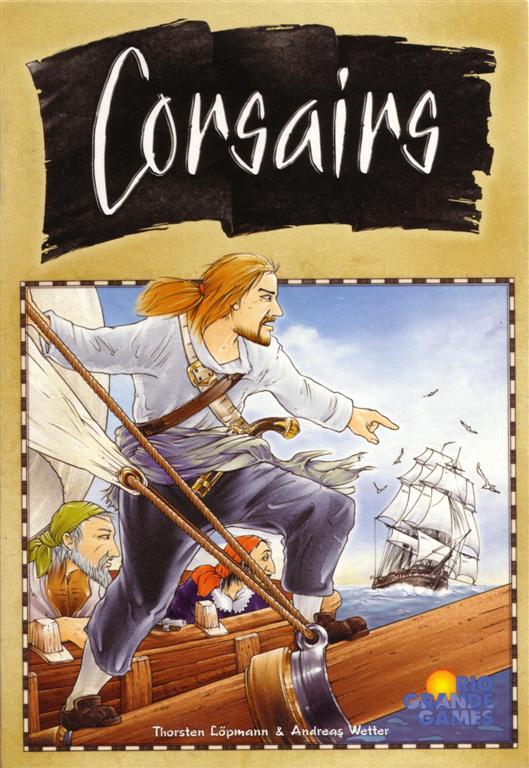
The pirate theme, as I’ve noted before, also continues to have a tight grasp on gamers. This past weekend at Metropolitan Wargamers in Brooklyn, NY, I had a chance to play through the now out-of-print Corsairs produced by Rio Grande Games in 2000. Playing best with four players, Corsairs involves the simple idea of raiding and capturing ships by playing provision and pirate cards, rolling dice and double-crossing opponents. Four heavy cardboard ships (or galleys) begin on the table. Each galley card depicts the point value at the top, the die value needed to capture the ship and a mix of required provisions needed before an attempt can be made to capture the vessel.

Corsairscards

Sample provision and pirate cards from Corsairs

Players begin by being dealt a hand of six cards each. The color-coded cards depict provisions – bananas, beans, bread, meat, rum, or water – or a pirate with a face value of  2 to 4. In turn, players place a total of two cards on the available ships. Matching types and amounts of provisions are played on ships face up along with any pirate cards face-down. After two cards are played, a third is discarded before redrawing back to a six-card hand. Play passes in turn until a player has enough required provisions to attack a ship. Rolling two dice and adding available pirate bonuses, players attempt to exceed the required value to seize the ship. If successful, all players lose the provisions on that ship and the player takes the card. If unsuccessful, the player loses their provisions on the ship and play passes to the next player. A player who attacks on their turn misses their next turn when they can redraw their hand. Once the final galley card is played and seized, the game ends and the player with the most points wins.

Corsairsgame

 A game of Corsairs at Metropolitan Wargamers

As with any good pirate game, the opportunity to out-scalawag your opponents is where the real fun comes in with Corsairs. With cards played on a ship, a player may attempt a “broadside” attack once per turn by rolling two special dice with provision colors on each face. A successful result enables the player to steal the provisions for their own use or simply to prevent another player from using them first. Capturing several ships of the same colored border also allows a player to double-up on points, so stealing a ship away from another player before they snatch it also comes into play.

I managed to win my first play through Corsairs by doubling-up on two high point purple ships, snagging two other valuable galleys and then foiling some other players by stealing their provisions through broadside attacks. Corsairs moves fast like a ship on the high seas and requires no reading, making it a great game to play with kids. And what kid – young or old – doesn’t like pirates?

Collector’s Note: You made need a treasure map to find a copy of the out-of-print Corsairs, but you can fdig them up on eBay occasionally for upwards of $50-60.

New Game Weekend: Wilderness War

WWbox

I wound up spending a fair amount of time this past year touring sites related to the French and Indian War period while feeding my gamer’s appetite for the Seven Years War period with A Few Acres of Snow. With a little research and talking with some of the members at Metropolitan Wargamers, I decided I needed to go bigger and dive into a game focused on the French and Indian War. All trails led to GMT’s Wilderness War, and I had a chance to play my first game this past weekend.

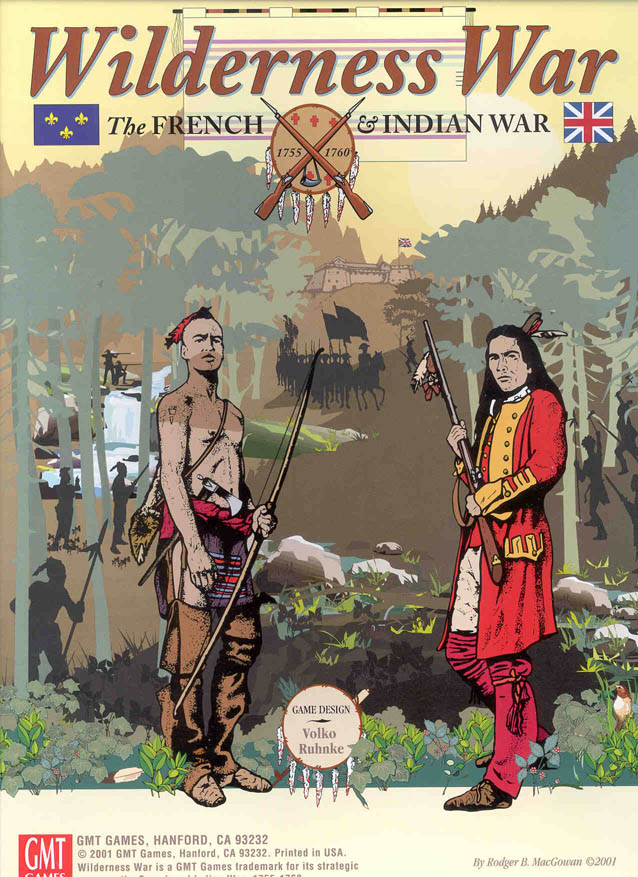
Published in 2001, Wilderness War is a game that causes a lot of the gamers I know to glaze over with wide grins. The game is designed by Volko Ruhnke and uses a card-driven mechanic much like his COIN games series also published by GMT. I have a few games of the Runke-designed Cuba Libre and Fire In The Lake under my belt, so I knew that a French and Indian War game from him was certain to be a mix of relatively simple rules wrapped up in a rich historic board game experience.

WWboard

Wilderness War game board

The gorgeous map – hardbound in the latest edition – presents the Northeastern colonial areas of North America in the mid 18th-century. As with the war itself, the game is largely defined by geography. “Cultivated” (ie settled) areas are indicated with boxes, and “wilderness” areas and Indian settlements are printed as circles. Mountainous areas are also depicted with chains spreading through western and central Pennsylvania, the Hudson Valley region and portions of central New England. Connecting these areas are roads or trails and the more important waterways which served as the superhighways of the period. Many of the larger cultivated settlements begin with heavy fortresses protecting the space, while the game set up places a series of French and British forts and stockades throughout the map.

wwchips

Sample Wilderness War game counters

Game components consist primarily of 70 cards and 271 cardboard counters. The counters generally depict movement and combat ratings, with reduced values on the flip side once a unit takes damage in battle, during a wintering period or from an event card. Command markers also carry tactics numbers, which help during combat, and a command value. Cards allow activation of units equal to the number printed or by command rating. Special events may also be played for British (red), French (blue) or either side (red/blue), and cards with a brown-red band are events which may be played at any point during either side’s actions.

wwcards

Sample Wilderness War cards

The game plays with year-long turns each containing an early and late season, each approximating about six months of time. In each season, players begin by being dealt eight cards apiece. Later events and actions may modify a player’s hand size, but in general the French and British player then take turns playing cards to move forces, engage in battle, construct defenses or play out events as depicted on the cards. With some pre-planning, each season moves relatively swiftly toward the conclusion of a year of war. At the end of each year, victory points are tallied and units are checked to see if they suffer losses during the winter period between each yearly season of fighting.

Wilderness War comes with a playbook outlining several small to mid-sized games featuring particular periods in the war or a set-up for the entire war from 1755 to 1762. For my first game, we jumped in with both feet and started from the outset of the war  with me playing as the British and my experienced opponent using the French. The French begin the game with a small force stretched across the Lake Ontario, St. Lawrence River and western Pennsylvania regions. British forces start poised on three fronts along the Hudson River, stretching west toward the eastern tip of Lake Ontario at Oswego and just south of western Pennsylvania. The French are buoyed with their strong alliances with several Indian nations while the British hold enormous access to colonial, regular British troops and numerous commanding officers waiting to be called into service.

Using the swift wilderness movement and  raiding capabilities in the 1755 and 1756 turns, the French sent Indian forces into Pennsylvania, Virginia and New England to raid unprotected British cultivated areas. The British quickly moved to redeploy their meager regulars throughout these areas to build stockades and push back further raids. At the same time, the French massed their forces and captured Fort Oswego. By the end of the second year of play, the French were already sitting on six victory points.

With a string of stockaded defenses set up to the west by the beginning of 1757, the British began to land troops at their coastal port arrivals to offset negative British political effects which stymied the use of more Colonial regulars and militia units. British troops commenced the long march into the Pennsylvania mountains and the nearby target French fort at the Ohio Forks (today’s Pittsburgh). Back to the east, the French began using their new base at Oswego to launch a push to the southeast into the Hudson Valley and the ill-defended areas around Albany, Schenectady and the Oneida region. All the while, the French continued to recruit additional Indian forces to buffer their defenses at the Ohio Forks and continue raids toward the east. The 1757 late season ended with my leaving too many British marooned in the mountains of Pennsylvania in a clear rookie mistake which led to my mass of troops taking heavy losses in the winter season.

IMG_4433

The British stockade defenses on the western frontier lay the groundwork for a push on the French at the Ohio Forks in my first game of Wilderness War

By 1758, my British luck seemed to change a bit for the better. Drawing and playing the William Pitt event card, I was able to increase my card hand size to nine cards and gain access to more British forces. Rushing more British reinforcements west into Pennsylvania, the French fell during a siege at the fort protecting the Ohio Forks, giving the British a firm foothold on the western frontier and awarding two victory points. Additional British troops rushed up the Hudson River Valley to hold back the French push toward Albany. As the British remained engaged in fights, the French began shifting their forces along Lake Ontario and the northern frontier while also raising a large force from the Iroquois in central New York. With 1758 at an end, my British forces were safely wintering on two fronts but in a severely weakened state and still way behind on victory points.

We called the game at its midpoint, deciding to restart another time now that I had been introduced to the general game. I still hadn’t experienced some major facets of the game such as naval movement and amphibious warfare, but I had quickly come to understand some of the major drivers of how the game plays. As a beginner, here are some lessons learned from my first game of Wilderness War:

  1. Defend the frontier. Especially for the British, but for both players, keeping the frontier defended by building stockades and forts is a must. Regular troops caught in wilderness areas are easy targets for Indians and other non-regulars, so having defenses built is key to defending territory. Having a network of stockades and forts to defend from, retreat to and maintain supply line coherence is a necessity if an army is going to succeed in the wilds of North America.
  2. Don’t get caught out in the cold. Open country and mountains are a strong enemy, particularly to 18th-century European armies. Paying attention to stacking limits as each year ends is important to keeping a force at strength. When conducting operations, players need to keep in mind where their troops will all wind up as a year ends and forces settle in for the winter. Nothing is worse than spending a series of turns marching troops into position only to have a portion of them die from starvation, disease and exposure in the period following each year’s turn.
  3. Play the long game. The full game goes to eight years of warfare, so strategy needs to take a long view. The first half of the game most probably belongs to the French as they and their Indian allies sack the wide open and undefended frontier. The British simply can’t be everywhere in the early years of the war, so spending time building defenses while also waiting to get the right cards to call in reinforcements is important. Massing and moving large forces on both sides to be strong enough to siege and capture forts takes a fair amount of planning but pays off in victory points.

Wilderness War is a fantastic playable document of the French and Indian War. The shifting alliances, opportunistic events, geography of the country itself intertwine to capture the period with a realness that might be familiar to any French or British commander on the 18th-century American frontier.

ww logo

A Gamer’s Guide to Manhattan’s Hobby Shops

PolksHobbiesGF

I’ve mentioned here more than once that my childhood was full of hobbies including model rocketry, model railroading, plastic kit building, Dungeons & Dragons, comic books and miniatures wargaming. Like generations before me, hobby stores and the now-vanished hobby areas of large department stores and five-and-dimes were where I felt at home from an early age.

I moved to New York City in the mid-1990s when much of Old New York started breathing its last gasps. Along with the closings of many storied NYC bars, restaurants, clubs, book stores, comic shops and movie theaters, hobby shops of all types are becoming more and more a thing of the past here in the Five Boroughs. The causes of the decline of hobby shops in the city are many, including rising rents, loss of customer interest, the growth of online hobby retail and many owners simply retiring or passing away.

PolksHobbiesLogo

The New York Times recently did a great little story on Rudy’s Hobby and Art in Astoria, Queens, and I’ve also become a semi-frequent visitor to Trainworld just a few subway stops away from my apartment in Brooklyn. These outposts in the outer boroughs hold on, but many of the classic shops in Manhattan have not. At the top of many city hobbyist memories is Polk’s Hobby Department Store which once occupied five floors at 314 5th Avenue. Like many businesses, Polk’s was a family-run affair headed up by two brothers beginning in the 1930s. The iconic store carried radio controlled boats and planes, slot cars, plastic model kits, trains and all matter hobby supplies which fueled the imaginations for generations of kids and adults. For the observant nostalgic, a quick glimpse of Polk’s survives in a scene from 1972’s The Godfather (photo at top).

Like Polk’s, most of Manhattan’s other hobby stores, like Carmen Webster’s on 45th Street and America’s Hobby Center on West 22nd Street, have likewise vanished from the city’s streets in recent years. At the same time, Brooklyn has seen a surge in gaming-specific stores and play spaces such as Kings Games, Brooklyn Game Lab, Twenty-Sided Store, The Brooklyn Strategist and Nu Brand Gaming. In Greenwich Village, The Uncommons now sits along the old “Chess Row” south of Washington Square, and a Games Workshop can be found a few blocks away well stocked with Warhammer and 40K players on any given weekend.

For the dedicated scale model hobbyist and gaming enthusiast, a few remnants of the traditional densely stocked hobby store of the past still live on in Manhattan. In almost all cases, online suppliers are a more economical option than purchasing from a local hobby or gaming brick-and-mortar store. However, it’s still hard to beat the experience of browsing a shop in person and having conversations with fellow customers and proprietors who share a passion for a hobby. I recently spent a sunny late summer day poking around in a few of my favorite NYC hobby shops that tap into that unique experience that still lives on.


Jan’s Hobby Shop

1435 Lexington Avenue

(212) 987-4765
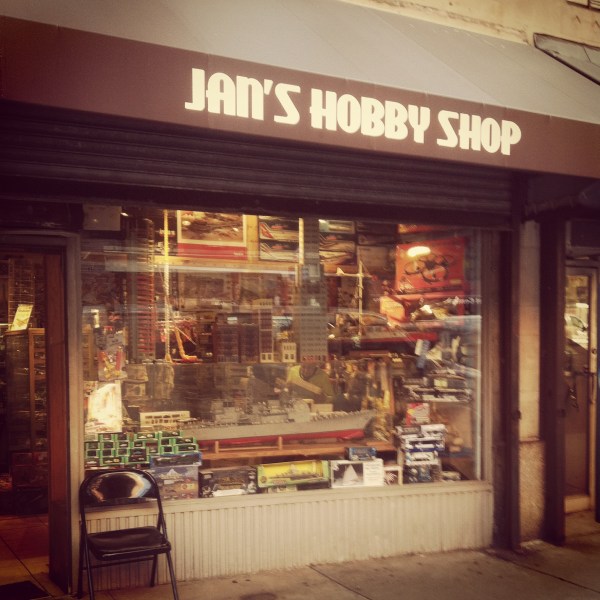
IMG_4284Way up on Lexington Avenue in the East 90s,  Jan’s Hobby Shop is just the kind of store that fired my youthful imagination. Plastic soldiers, model kits, model rockets, paints, brushes, videos, books and hobby magazines are stacked floor to ceiling in the tight space of this classic hobbyist’s paradise. Kits from hundreds of manufacturers from around the world, from the common to the obscure, cover all eras, skill levels, scales and price ranges. Ships from the Age of Sail sit across from Star Wars X-Wings, ancient siege weapons are just down the aisle from Cold War artillery and all manner of cars, tanks, ships and planes fill every bit of space between. For the more advanced scale modeller, a handy selection of balsa, plastic styrene, brass tubing and specialized glues and construction materials sit at the ready.

IMG_4286Plastic soldiers from a variety of manufacturers, eras and scales at Jan’s

IMG_4287Paints and plastic model kits line the walls at Jan’s
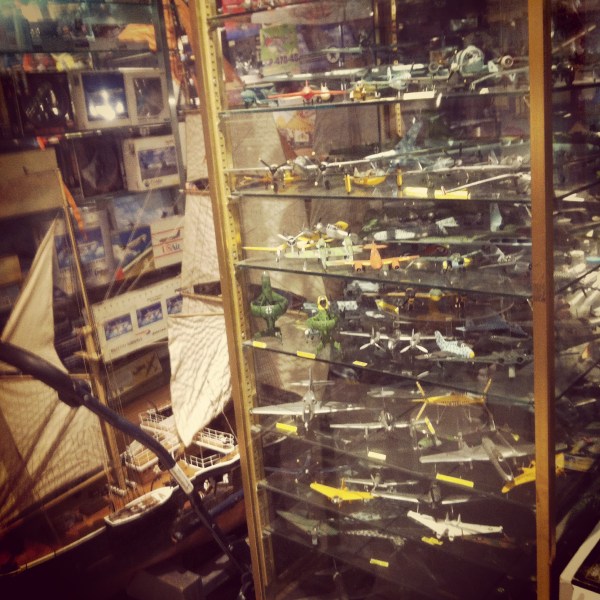
IMG_4285Fred Hutchins’s WWII era experimental aircraft models

At the heart of the store on any given morning, store manager Fred Hutchins sits behind his workbench working away on his latest project. In my short visit with Fred, I learned of his lifelong love and work in aeronautical engineering. His ongoing project, at the rate of 30-50 models per year, is to build to scale every experimental aircraft built during World War II. In the cases nearby, much of Fred’s exquisite work is on display, and if you are a polite and patient visitor, he is more than happy to engage in a brief history lesson. Conversation with Fred, modeller-to-modeller, is just the kind of experience only found in a hobby shop and makes a visit to Jan’s worth the trip.


The Red Caboose

23 West 45th Street

(212) 575-0155

www.theredcaboose.com

IMG_4282

For a hobbyist like me, basements are portals to secret worlds of play hidden away from the normal world above. That’s where you’ll find The Red Caboose, tucked at the end of an easy-to-miss entry hall and then down some narrow stairs to a subterranean hobby wonderland. Focused largely on N and HO scale model railroading, The Red Caboose is lined with glass cases of rolling stock and engines from the steam era to today. Tourists may also find their way here to buy up some authentic scale New York MTA subway cars which may be special ordered to reflect specific routes past or present.
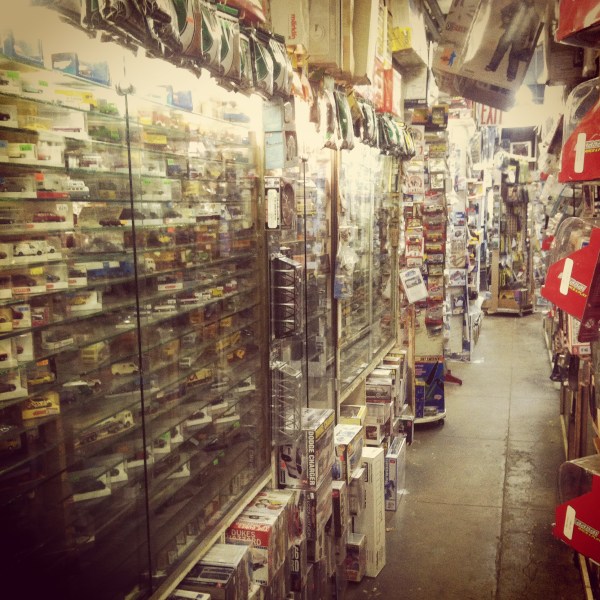
IMG_4283Cases of trains and row upon row of model kits at The Red Caboose

The Red Caboose is a place beyond trains, too.  Rows of shelves are devoted to kits for all sorts of buildings, bridges, industrial complexes and natural scenery, some of which have made their way to my wargaming tables over the years. Rotating racks of scale scratch building plastic, metal and wood parts, along with paints, brushes and other supplies provide a solid inventory for miniature modellers. A decent selection of military and civilian plastic kits and pre-built die-cast scale models can likewise by found, making a stop at The Red Caboose about much more than just trains.


The Compleat Strategist

11 East 33rd Street

(212) 685-3880

www.thecompleatstrategist.com

IMG_4280

As a budding role playing gamer in the 70s and 80s, I was fortunate to live near a college town where the local bookstore and five-and-dime each stocked a handy selection of Dungeons & Dragons books, miniatures and magazines. Tucked in the pages of later issues of those magazines, I occasionally saw ads for The Compleat Strategist with an inventory which sounded like a dream for my hungry gaming appetite. As a resident New Yorker today, a quick visit to “The Strat” over a lunch hour or on a weekend is an amazing escape for a quick purchase or just time spent browsing the latest in gaming.
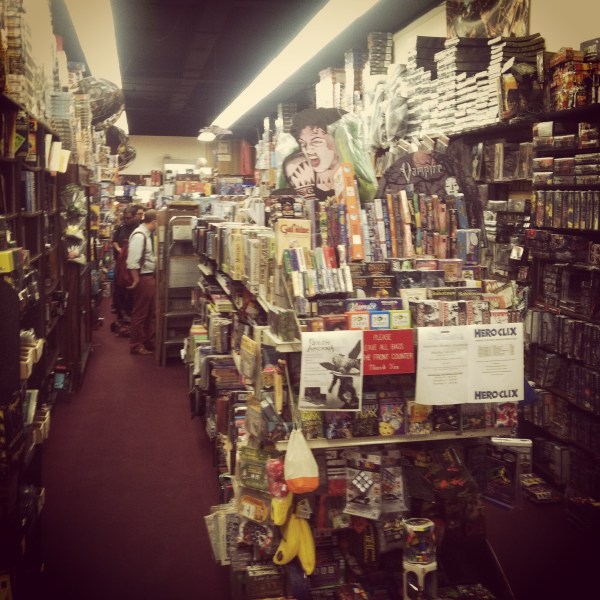
IMG_4281The Compleat Strategist is NYC’s destination for serious gamers

The store is long, narrow and deep, with shelves of games, books, miniatures and accessories piled to the ceiling. Boardgames, chess sets and puzzles occupy the rear half of the store. A massive selection of boxed historical strategy games stretch down one wall toward an inventory of paints and miniatures ranging from Games Workshop and other fantasy lines to collectible games like Heroclix. RPG books and reference materials fill out the front of the shop along with buckets of dice, stacks of collectible cards like Magic: The Gathering and two large racks of gaming periodicals. Downstairs, the Compleat Strategist also hosts mini gaming tournaments most weekends, rounding out the total experience for the city gamer looking to stay connected to a vital hobby community.


Gotham Model Trains

224 West 35th Street, 13th Floor

(212) 643-4400

www.gothammodeltrains.com

IMG_4278

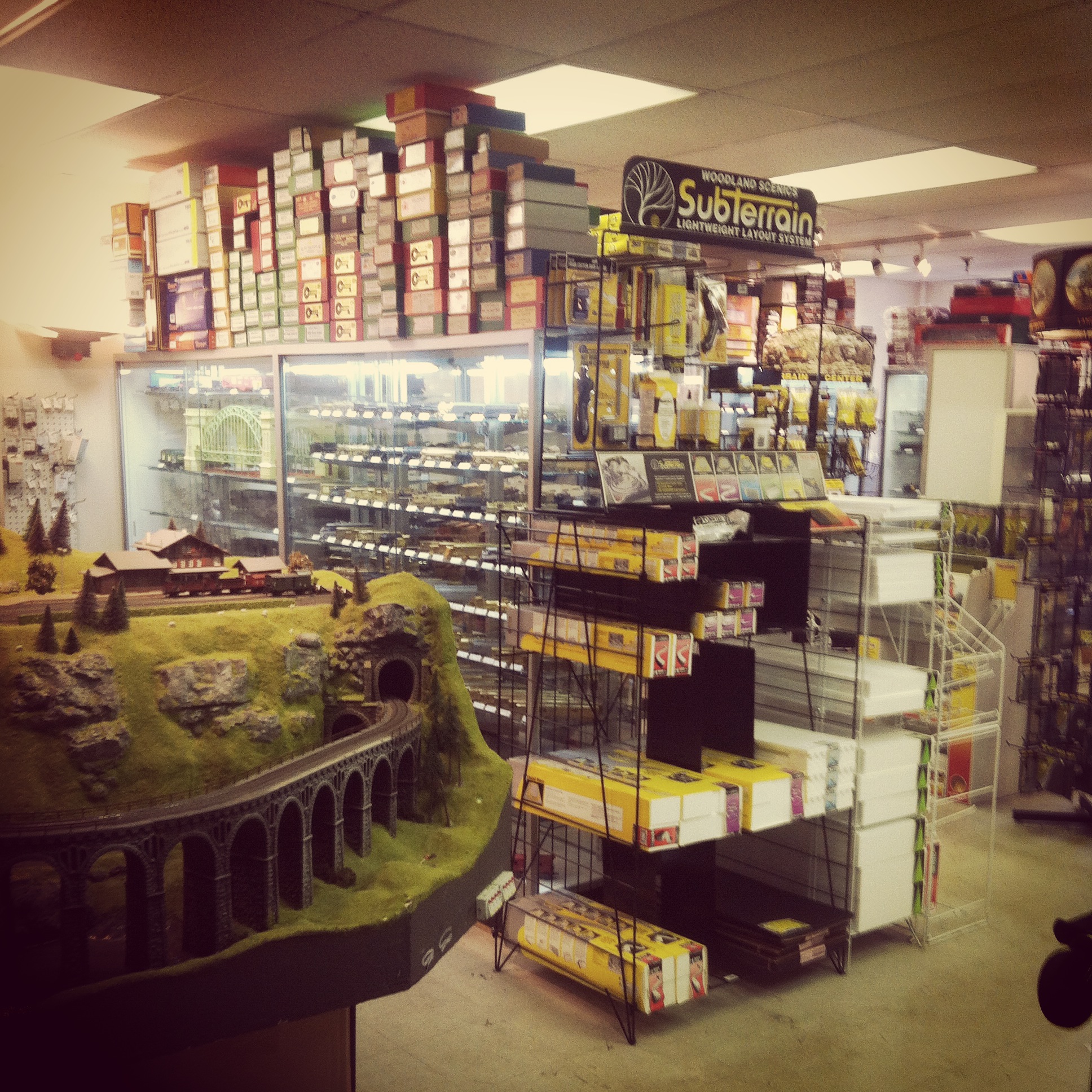
Down a generic block just north of Penn Station, the tiny and well kept Gotham Model Trains occupies a thirteenth floor space in a building housing a jumble of small businesses and professional offices. The shop is mostly about trains, and the tight inventory offers a well-edited counterpoint to the sprawling warren of shelves at The Red Caboose. I like the nice selection of Woodland Scenics ground cover, shrubbery, trees, gravel and other scratch-building materials in plastic, metal and wood on the walls and racks.
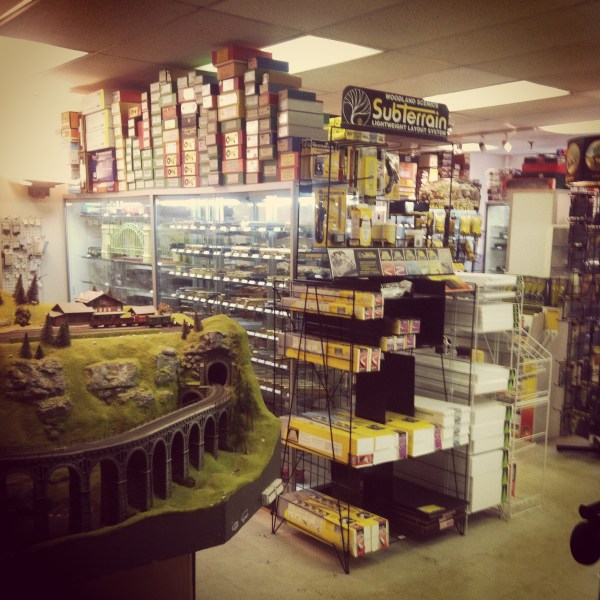
IMG_4279The well-curated inventory of Gotham Model Trains

But trains are the thing at Gotham Model Trains, and over the years this has been my local go-to for a few pieces of track needed in getting a little circular railroad running under my Christmas tree. Multiple scales, controllers, buildings, scale figures and a small selection of railfan books round out the inventory surrounding the sweet little N scale layout greeting you at the shop’s entrance. Stopping in at Gotham Model Trains, like a visit to any of Manhattan’s surviving hobby shops, you can’t help but have the irreplaceable experience of a living breathing hobby.
New Game Weekend: Arkham Horror

ahcoverbox

Released in 1987 and then vastly revised in 2005 and 2007 by Fantasy Flight Games, Arkham Horror is one of the modern classics in horror-fantasy boardgames. This past weekend, the creatures of Arkham Horror invaded our home in Brooklyn, and my sons and I have a new favorite.

Based on the writings of H.P. Lovecraft and his Cthulhu Mythos, the game casts 2-8 players in the roles of investigators in the fictional town of Arkham, Massachusetts during the interwar period of the 1920s. The New England town has been beset by the terror of strange rumblings of monsters invading the streets accompanied by weird magic, supernatural beings and strange goings-on. The mission of the investigators is to travel through portals to Other Worlds and seal them before a great Ancient One emerges in the town. Along the way, investigators accumulate clues, arcane items, spells and skills by visiting various locations in the town. If the portals are not closed in time, the horrific Ancient One rises and squares off in a final epic battle with the investigators in a last-ditch effort to save Arkham and the world as we know it.

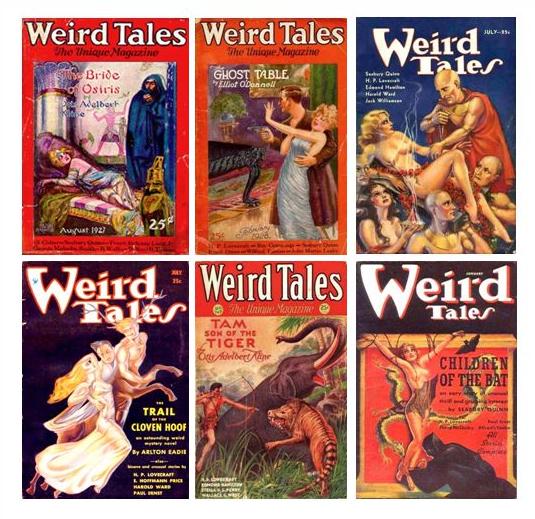
wtcoversIssues of Weird Tales magazine featuring the work of H.P. Lovecraft from 1927 to 1937

H.P. Lovecraft is a darling of gamers and science-fiction/horror fans, and his influence resonates throughout today’s pop culture of movies, comic books, fantasy literature and gaming. Throughout the 1920s and 1930s, Lovecraft published a series of short stories broadly placed in the weird fiction category combining elements of horror, science fiction, fantasy and crime genres. With its troubling themes of peril and unknown, weird fiction was perfectly suited for a broad mindset of American society just emerging from World War I, living through the Great Depression and watching the storm clouds of World War II gather on the horizon.

Weird fiction found a home with the cheap pulp-paper magazines popular in the first half of the 20th-century including dozens of titles such as Argosy Magazine, Amazing Stories, Western Story Magazine and Weird Tales. Within their wondrous and often racy covers, pulp magazines featured everything from western adventures, jungle stories, Victorian detective tales, sword and sorcery plots and science-fiction wonders. Authors such as Arthur Conan Doyle, Robert E. Howard, Edgar Rice Burroughs and Lovecraft could all be found side-by-side within these magazines. The stories from pulp magazines were of profound influence on countless later 20th-century writers and directors, perhaps most famously with Steven Spielberg and George Lucas. As kids in the 1970s and 80s, reprints of many of these pulp tales filled the heads of my circle of friends and informed our lifelong interests in all things weird and fantastic.

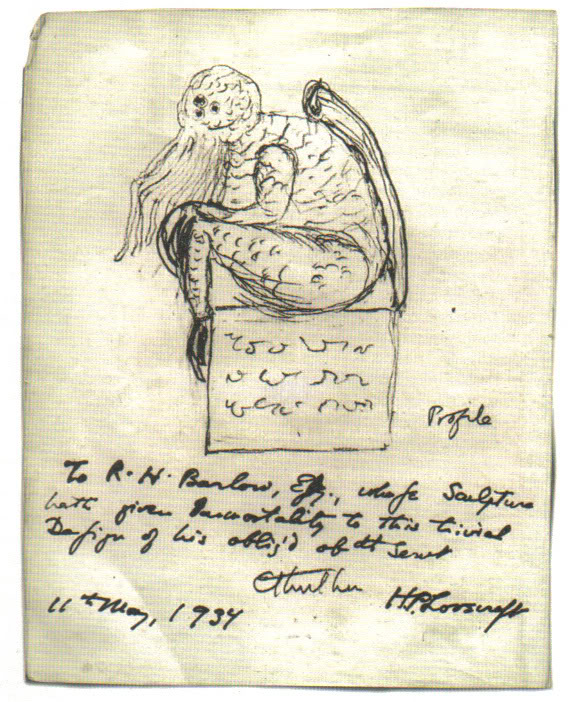
CsketchA 1934 sketch of Cthulhu by H.P. Lovecraft

One of Lovecraft’s most enduring stories, The Call of Cthulhu, was first published in Weird Tales in February 1928. The story recounts a mystery of an ancient cult of a mythic tentacled beast known as Cthulhu and the worldwide quest to uncover its origins and its new rise to plague the modern world. Through subsequent stories by Lovecraft and other writers, the world of the Cthulhu stories grew to be dizzyingly expansive in it depth of detail and plot. Today, Lovecraft’s Cthulhu universe serves as an insidery geek shorthand that stretches from stories, games, comic books and compendium reference books to clothing, statuettes, cupcakes, tattoos, jewelry and countless other collectibles.

10649826_10203907450141018_1116891535581886976_nArkham Horror from Fantasy Flight Games gets unboxed at our house

My older son recently scored a free copy of Arkham Horror after serving as a counselor in training during the summer day camp program at Brooklyn Game Lab, and we jumped into a full weekend of playing this wonderful game. People familiar with products from Fantasy Flight Games will find a box of incredibly well-designed pieces, with a richly-illustrated game board and hundreds of cards, playing pieces and reference sheets. The rules are daunting and require several plays to wrap one’s head around, but eventually Arkham Horror moves along briskly in a couple hours of gaming.

The game is basically a race against time until the Ancient One awakens to destroy the town. Much like an adventuring party in role-playing games like Dungeons & Dragons, players choose to play as one or two of sixteen roles such as a researcher, magician, gangster, nun, archaeologist or drifter. Each character begins with set standard and specialized equipment, money, spells, skills and allies laid out on a card depicting base abilities. The abilities — speed, sneak, luck, lore, will and fight — are each measured on a track that allows a player to boost or lesson their effectiveness at the beginning of each turn. Players move to various locations within Arkham where they find clues, engage in encounters or perform other actions like healing at the hospital, hiring allies at the boarding house or shopping for items at the general store or curiosity shop. Armed with items, skills and spells, characters either engage in combat with revealed monsters or attempt to slip by them. Taking damage from monsters or other encounters reduces an investigator’s Stamina (ie, health or hit points) or Sanity, driving the player closer and closer to death or madness.

At the end of each player round, a Mythos card is revealed opening a new portal to the Other Worlds, spawning new monsters and moving monsters already in the town. A character moving to a portal spends two turns journeying in one of eight Other Worlds where they may encounter more monsters or find objects. Upon emerging from the Other World, a character attempts to close or even seal the portal at the location. Each turn, the Ancient One moves on step closer to awakening. Players must either close or seal a set number of portals before the Ancient One arises for a final battle with all the players.

10639448_10203907820550278_4188666163549777050_nArkham Horror laid out for our first games this past weekend

 Like Lovecraft’s written work, there is an enormous amount of story in Arkham Horror. The game plays like a rich role-playing game with backstories on the investigator characters and detailed information on the various cards and monster pieces. Since the game is collaborative, everyone either wins or loses, making collective planning and playing to each character’s evolving set of equipment and abilities a must. For instance, certain characters may be more adept at moving quickly and acquiring valuable items while other characters may be better suited to go to battle with physical or magical beasts. In a battle with the Ancient One, the collective strengths of the entire group will combine to have any hope against defeating the creature and saving Arkham.

My sons — ages 14 and 9 — played three games of Arkham Horror with me this past weekend, and it’s a big hit at our house. We’re all fairly experienced gamers and we’ve logged many hours with some pretty heavy boardgames like Civilization, also from Fantasy Flight Games. Arkham Horror is suggested for ages 12 and up, and the flavor text on the game cards and mechanics were a bit on the challenging side for my younger son. With that said, with a little help on the heftier vocabulary words, he enjoyed the story, collecting items and using various combinations of gear, spells and skills to destroy some monsters and seal portals to the Other World. By the end of the weekend, my older son and I also started getting a handle on using characters in combination to effectively work through the rising tide of beasts and terror in the town. No matter the age, Arkham Horror is going to push any gamer’s skill and sanity to the limit.

Robin Williams (1951-2014) – Comedian, Actor, Gamer

williamstoysAmerican comedian and actor Robin Williams died yesterday from an apparent suicide after battling years of depression and addiction. While his award-winning acting, frenetic comedy performances and activism are what he will no doubt be best remembered for, to a certain set of fans like myself, his lifetime interest in gaming and toy soldiers likewise leaves a mark.

As a lonely, oddball child of wealthy parents, Williams developed an early escape valve through play with toy soldiers. In a 1993 New York Magazine profile, Williams’s mother recounted his boyhood obsession with toy soldiers:

“Robin had the entire third floor,” his mother, Laurie Williams, says. “He put his toy soldiers — he had thousands of them — in those rooms, carefully divided according to period.” Williams not only staged intricate battles between soldiers of different eras, he created dialogue for them in what was, essentially, a childhood version of his performance style.”

Not only was Williams a toy soldier fan from an early age, but gaming was a lifelong passion. He was an avowed Warhammer 40K player (apparently favoring Eldar forces), even posing for photos with staff and other players during stops at local gaming stores. He is also listed among celebrity players of Dungeons & Dragons, going so far as to participate in major gaming events up until a few years ago. His passion for gaming also extended to online and video gaming, and his daughter Zelda is rumored to have been named for the popular adventure fantasy video game series from Nintendo.

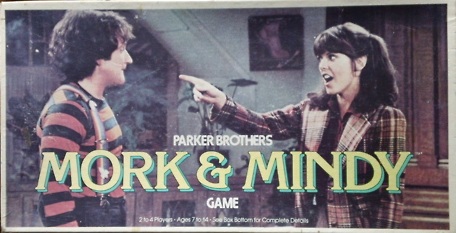
morkboardgame1979’s Mork & Mindy board game from Parker Brothers

Like a lot of kids growing up in the 1970s and 1980s, Williams’s starring role in Mork & Mindy from 1978 to 1982 was a fixture in my weekly TV viewing. Starring as Mork, a zany alien from the planet Ork, Williams’s catchphrases, mannerisms and signature look became firmly imbedded in my young mind. There was definitely Mork madness in my life and in the culture for a bit, extending to toys, games and even rainbow suspenders (yes, I had a pair).

Williams certainly went on to much bigger and often more serious professional work, but that period in my youth where I was becoming an impassioned gamer myself definitely informed some of my own willingness to stretch into characters outside the bounds of reality. Williams’s life of playing characters, switching roles and acting out wild fantasies brought so much joy to audiences around the world, but for me, I like to imagine him as that little boy crouching over his little soldiers and creating a universe that was just his for a moment.

Pinball, Pixels and Play In Rochester, New York

StrongMuseumIt’s been a couple years since I visited The Strong National Museum of Play in Rochester, NY, but I took advantage of a recent week visiting my family in Western New York to pay the place a visit. The museum was founded in the early 1980s with the massive hoard of dolls, toys, games, household items and other objects collected over the lifetime of Rochester heiress Margaret Woodbury Strong. Since then the museum has evolved and expanded to encompass the more recent history of play, as evidenced in some of the wonderful exhibits I had a chance to see this past month.

Pinball Playfields

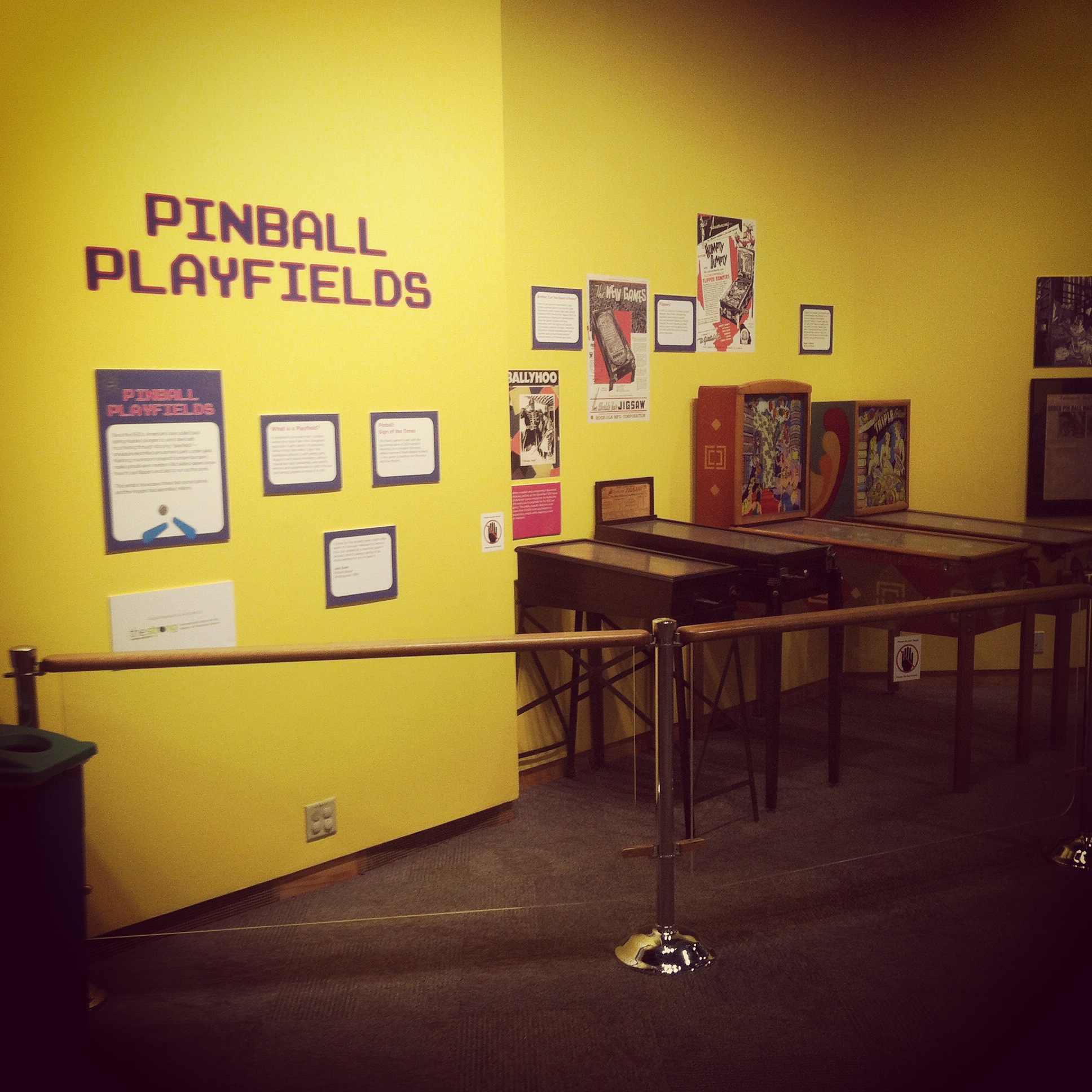
2014-07-08 11.59.24Running through September 7, 2014, Pinball Playfields offers up a tight overview of the American history of coin-operated pinball machines from their earliest appearance in the 1930s through today. A number of early games from the museum’s permanent collection kick off the small exhibit showing the first rudimentary gravity-fed games where balls plunked and clinked their way through a series of “pins” which would give the game its name.

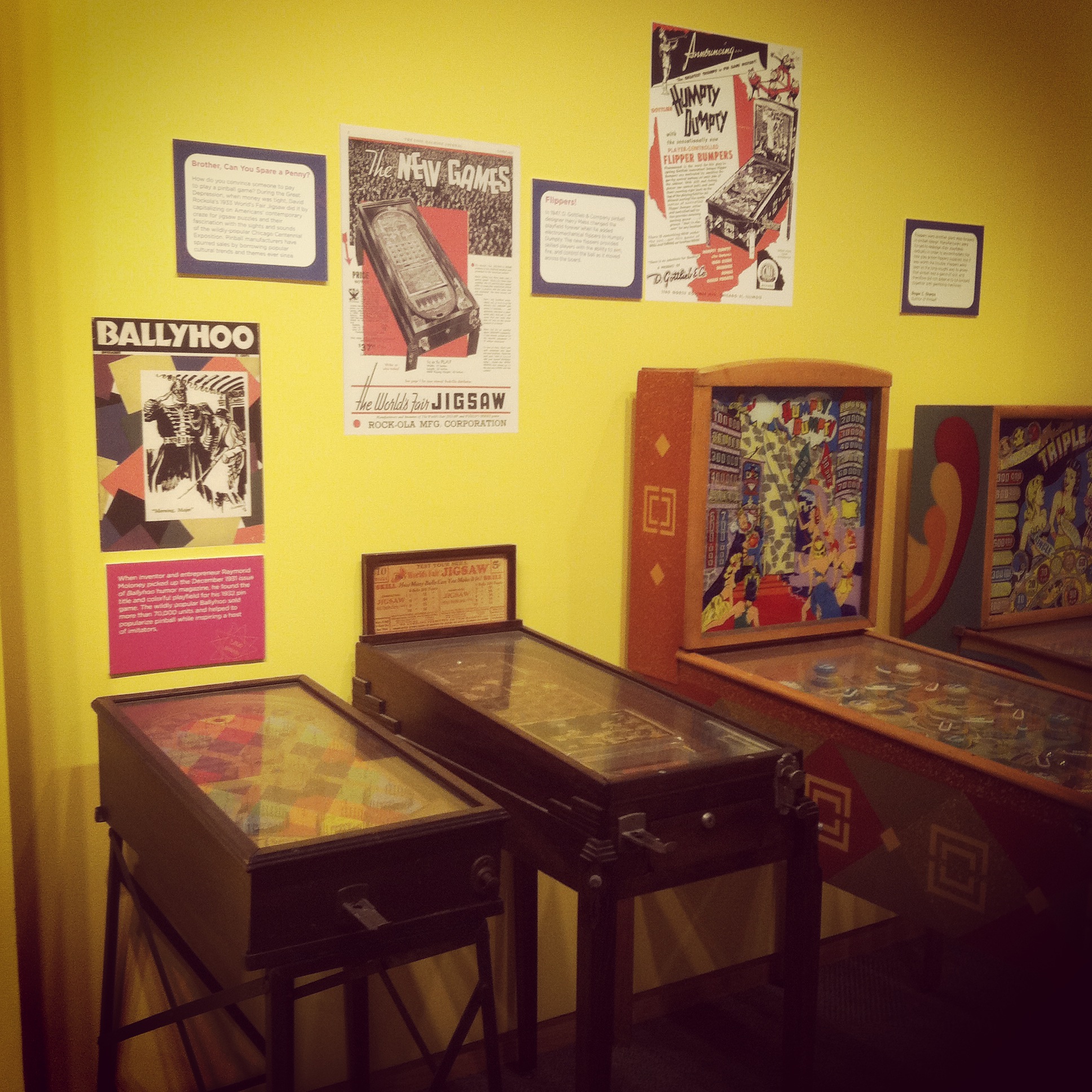
2014-07-08 12.00.10Early 1930s and 1940s pinball machines

By the 1940s, electrified games were on the rise and the introduction of flippers late in the decade added enormous playability and control for anyone willing to feed the growing craze a coin at a time. As explained on the brief wall text, it was this coin-fed frenzy that caused many cultural killjoys throughout the country to advocate for laws banning pinball as a frightening tool of gambling in the 1940s through 1970s (just this past summer, Oakland, California finally repealed an 80-year ban on pinball).

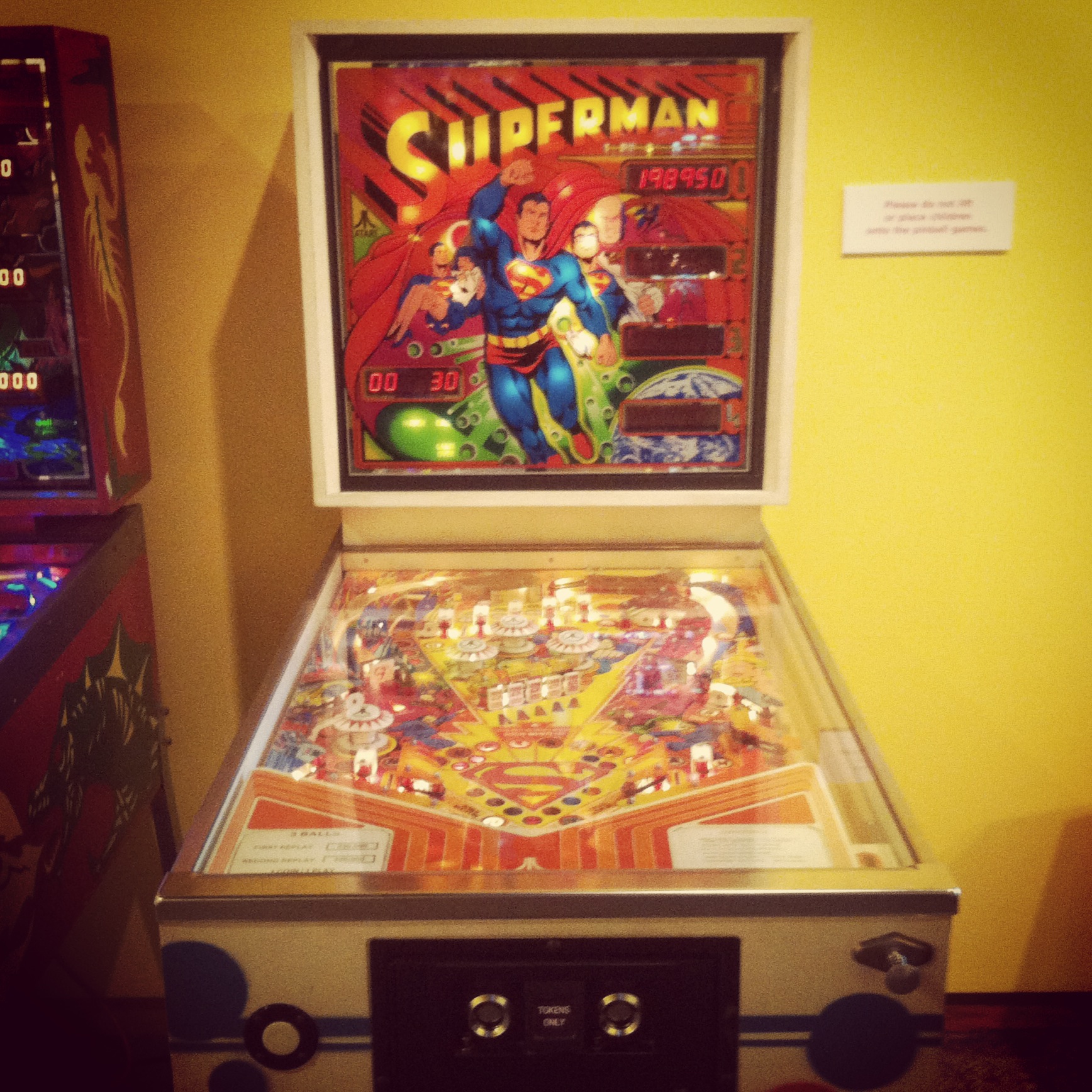
2014-07-08 12.02.40Superman pinball (1979)

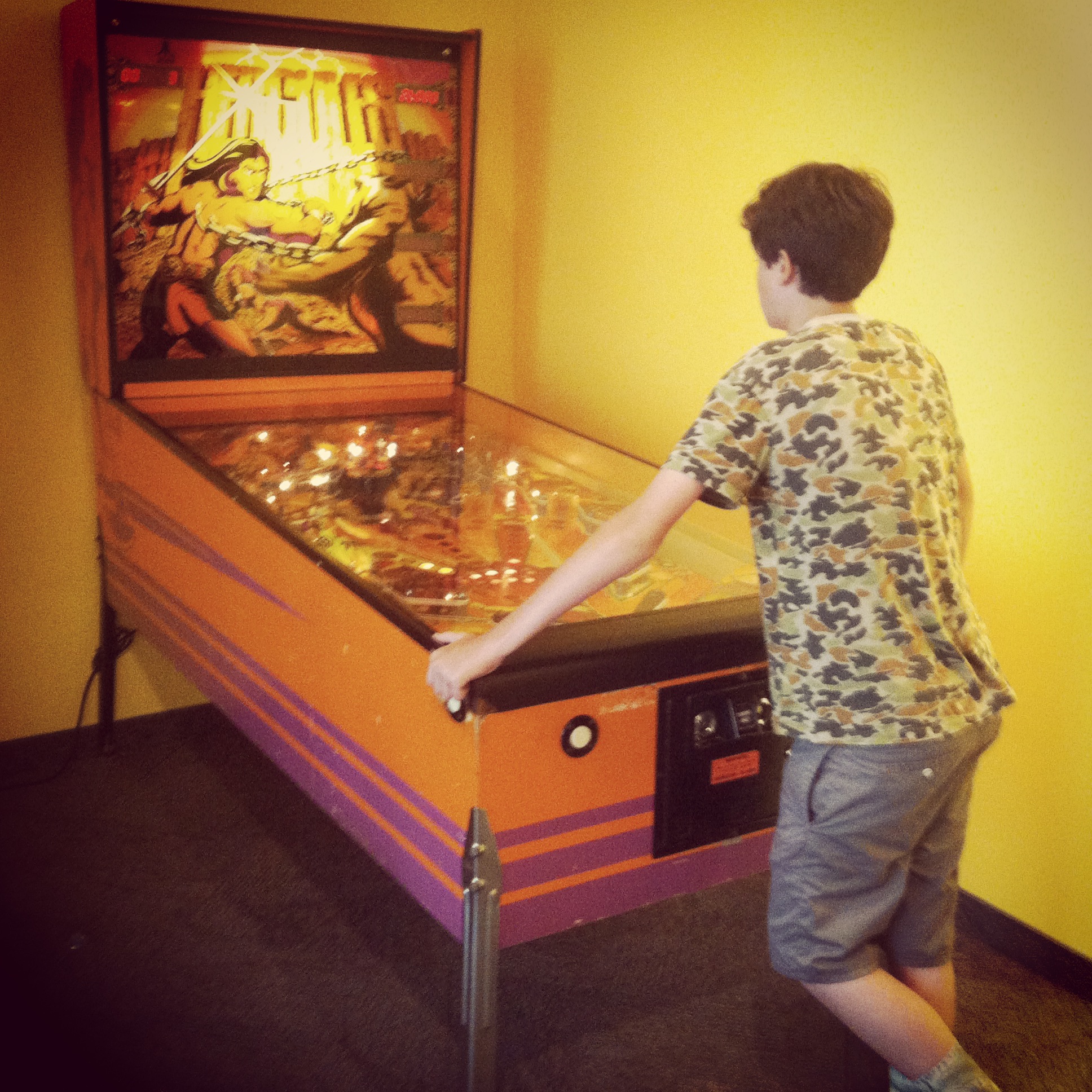
Despite its opponents, pinball fandom grew into the 1960s and 1970s, crossing over into rock music with The Who’s iconic “Pinball Wizard” from 1969’s Tommy. In my 70s childhood I can easily recall many pinball machines tucked into pizza parlor corners or inhabiting the basements of some of my lucky friends with their constant glow of light and pinging sounds. The exhibit includes a number of playable machines from the 60s and 70s, including superhero tie-ins with Superman and the Incredible Hulk which demonstrate intersecting pop culture influences on games.

2014-07-08 12.12.03Hercules (1979) — the largest pinball machine ever made

By the late 1970s video games were creeping into territory dominated by pinball machines. Gimmicky games like 1979’s enormous Hercules machine attempted to maintain the hold on fistfuls of coins which would soon be increasingly making their way to video arcades. With video games dominating coin-fed play throughout the 1980s, it was not until the 1990s and the 2000s that pinball rebounded by incorporating increasingly-complex mechanical animations, advanced LED and video screen elements into games. The more recent Wizard of Oz, Monster Bash, Star Trek and Lord of the Rings games on display — and all playable — show how the old-time pinball fun has truly been integrated with a modern thirst for visual effects overload.

Aside from the dozen or so playable machines, Pinball Playfields gives a good deal of historical information with descriptive text, early photos and advertisements, news articles and modern design schematics. All this is certainly fine stuff for the museum context, but anytime I found myself lingering a bit too long over some of the historical material I had to look around to find my wife and kids feeding another token and pulling back the plunger to start another play.

eGameRevolution

2014-07-08 13.01.51The last time I was at the Museum of Play, the museum had just launched its important International Center for the History of Electronic Games. The collection now contains tens-of-thousands of video game artifacts, making it one of the most important repositories and research resources for the dominant mode of play of the past forty years. The debut exhibit a few years back presented an overview of  video game history and dozens of playable arcade and home games from the 1960s through the present. My latest visit allowed me time to see the full permanent exhibit, eGameRevolution.

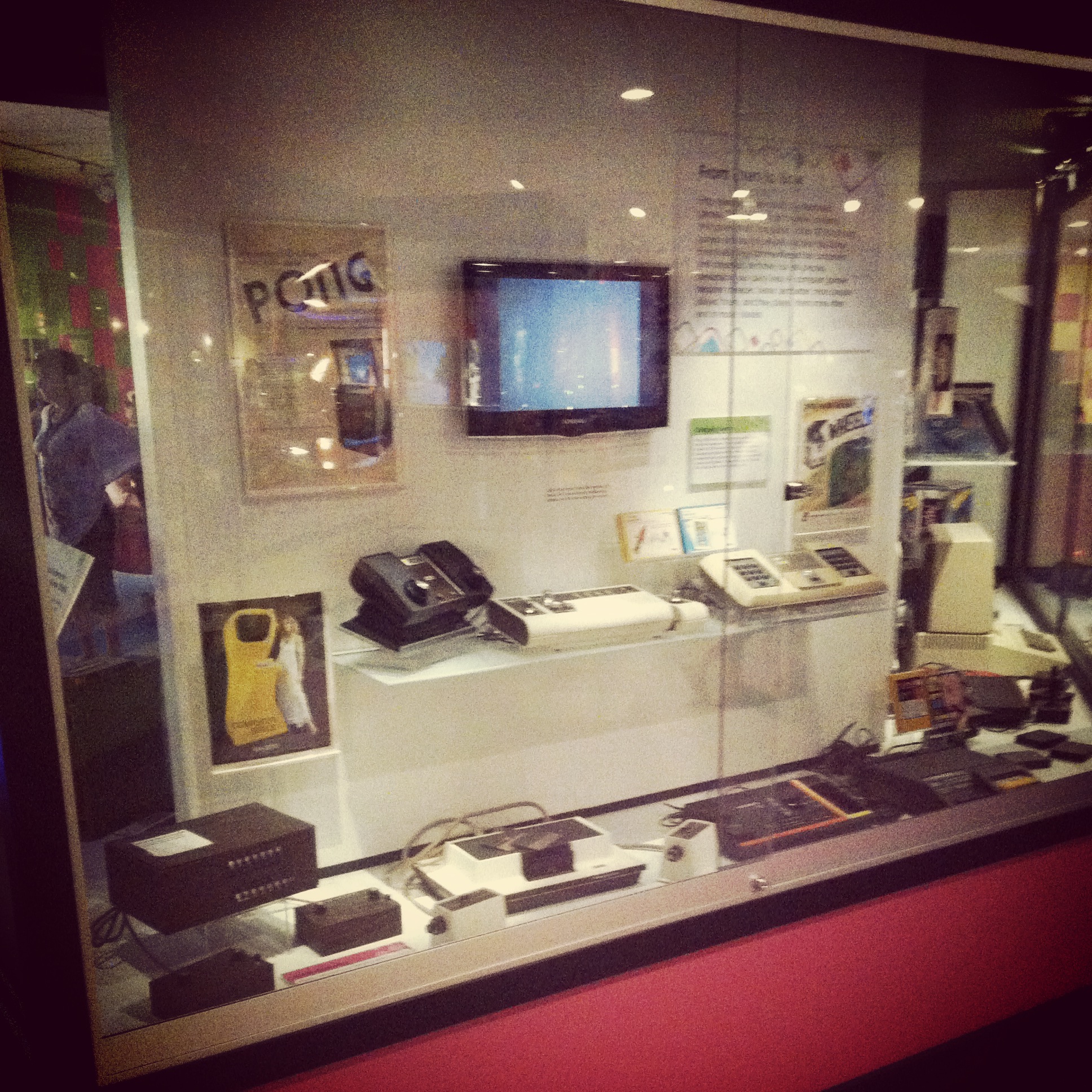
2014-07-08 13.20.36Early home video game systems from the 1960s and 1970s

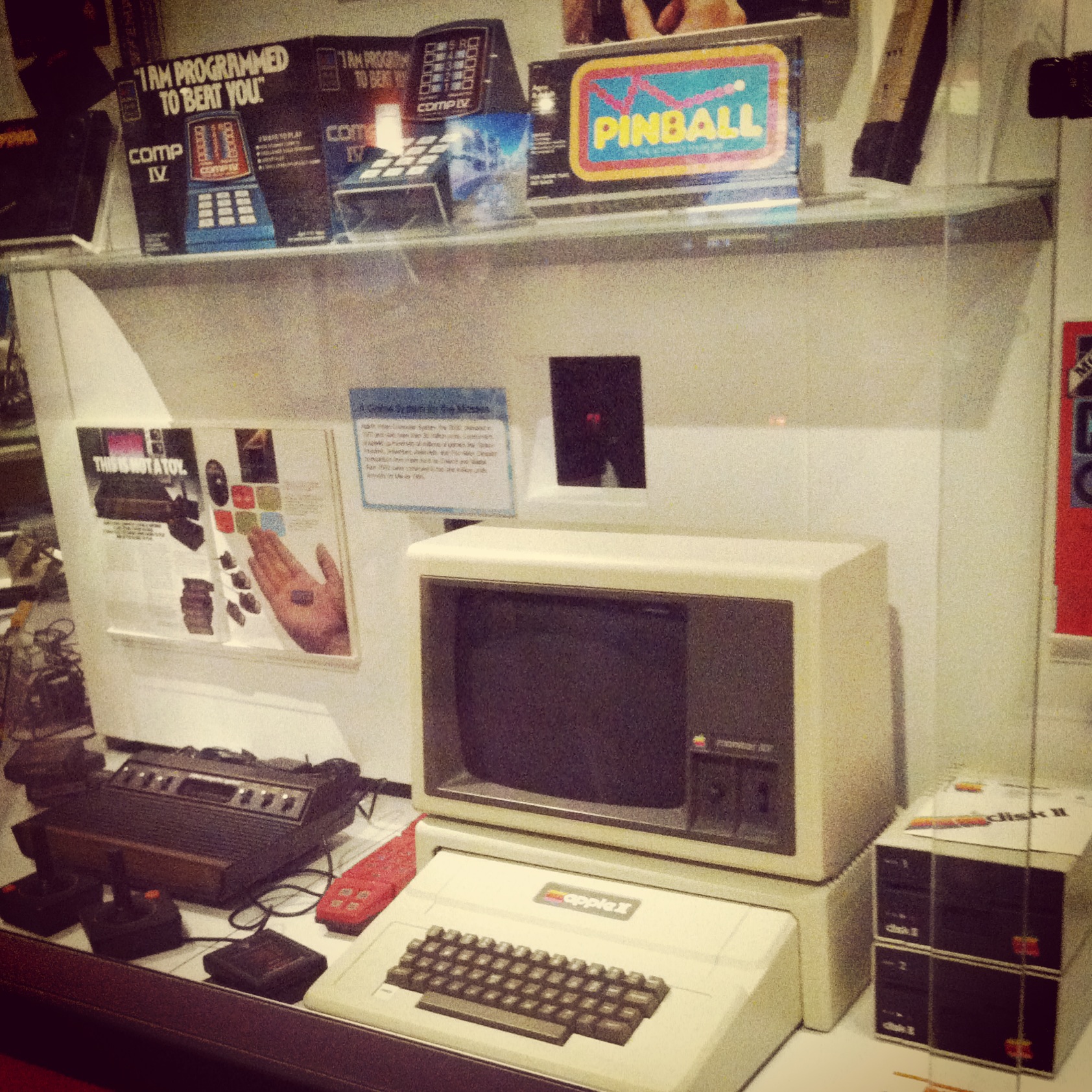
2014-07-08 13.20.26The Atari 2600 and Apple II computer — two machines that changed my world in 1977

The exhibit traces the development of the now-ubiquitous video game from its science lab beginnings of the early 60s through early console and home computer games in the 70s and 80s to the modern games which now inhabit so many living rooms worldwide. Changes in the sophisticated technology, graphics and marketing of video games are well-traced along with traditional curated displays behind glass. And, of course, there are plenty of playable games throughout the exhibit.

2014-07-08 13.22.23The video arcade in the eGameRevolution exhibit at the International Museum of Play

Pinball machines, an air hockey table, arcade cabinet classics, interactive dance and music games and a half-dozen home console games of different eras are set throughout the exhibit. A dark, low-ceilinged room reminiscent of the video arcades inhabited by many first generation video gamers like myself in the 1980s is set in the middle of the more traditional displays. At five plays for a buck, a visitor to eGameRevolution can easily lose themselves in decades of electronic gaming history.

 Game Time!

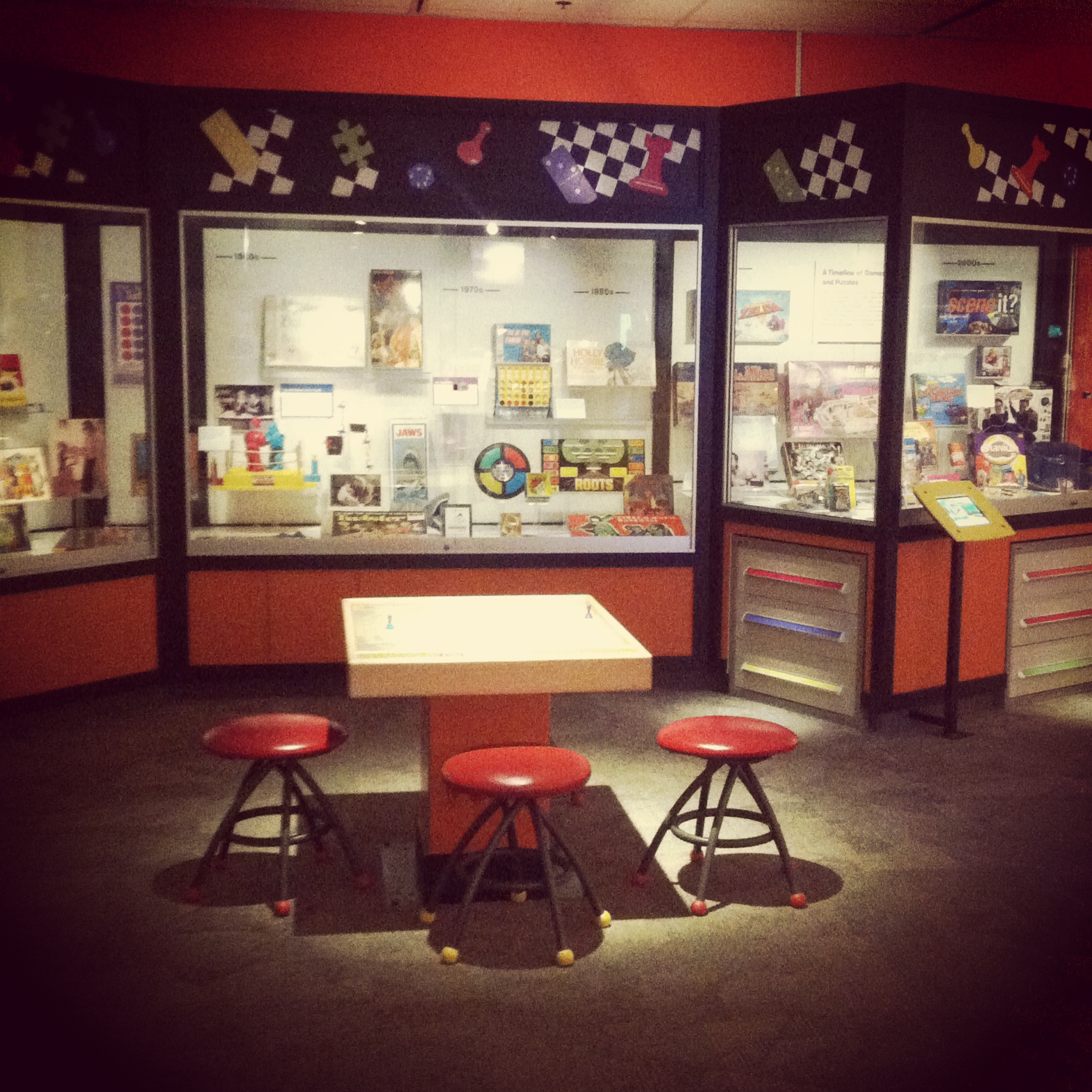
2014-07-08 13.09.07Museum goers willing to take a few steps further back in time will also find a dizzying and deep story of traditional games in the Game Time! permanent exhibit nearby. Three centuries of American board, card, puzzle and electronic games with brief, well-researched text offers a tremendous overview for those who wonder how gaming culture has evolved since the 19th-century.

2014-07-08 13.04.51An early 1970s Dungeons & Dragons set and the famed Dark Tower game from 1981

Games are arranged both in a historic timeline and also along themes such as economic games, chase games, strategy games and puzzle games. Along the way, a story unfolds where games provide a view into the American values and politics of each era, as well as the rise of the big business of games and the importance licensing particularly in the late 20th-century through the present.
2014-07-08 13.10.29War games, including classics like Risk (1959), Stratego (1961) and Battleship (1967)

2014-07-08 13.11.05Role-playing games, including 1970s and 1980s Dungeons & Dragons books

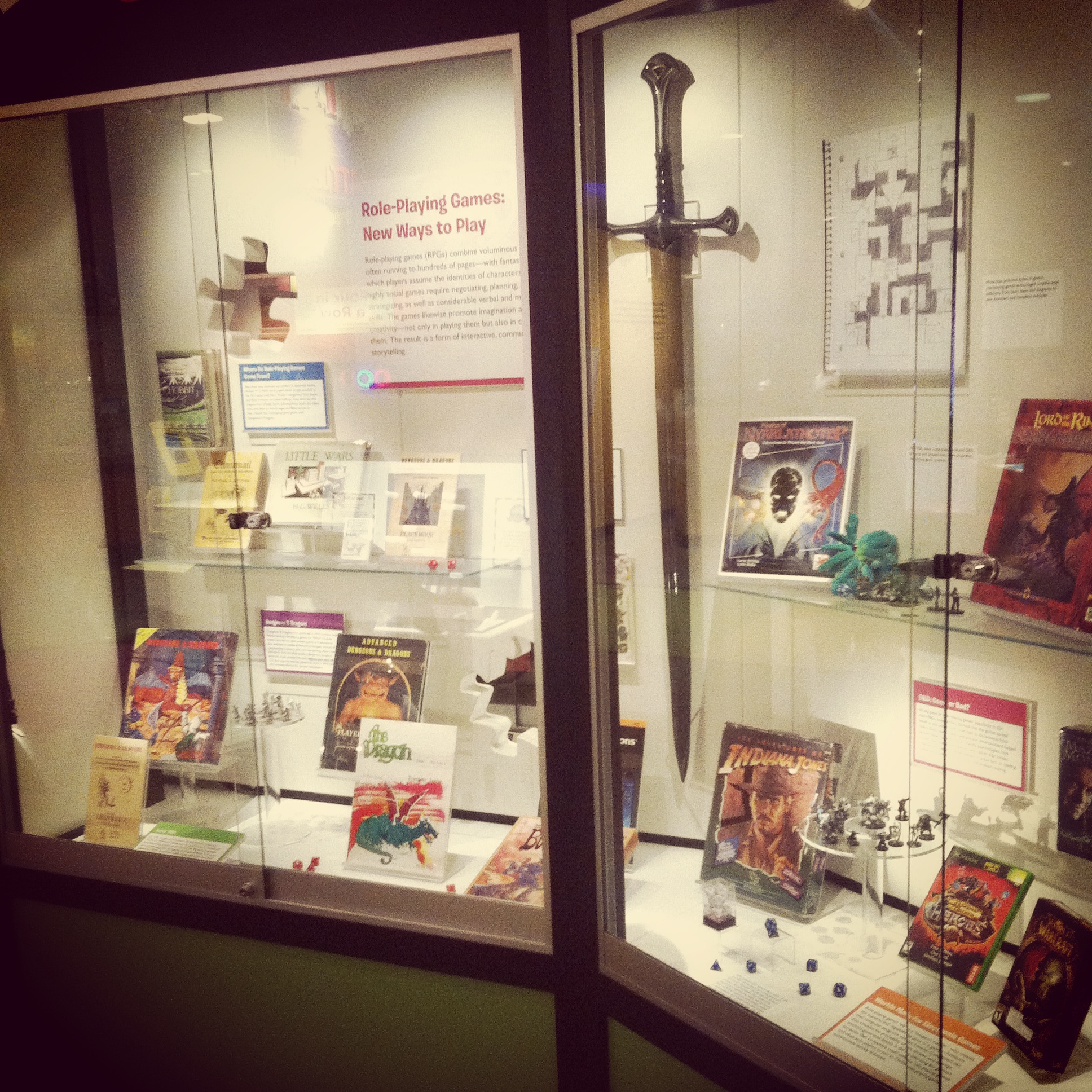
Wargames and role-playing games each receive their equal due with an early copy of Little Wars by H.G. Wells and some classic Dungeons & Dragons books from its genesis in the early 1970s. Seeing these games side-by-side with other games, like the extensive exhibit on Monopoly, is incredibly validating for someone like myself who has spent my life engaged in games which once dwelt only at the edges of our culture.

Putting all these games — from pinball and video games to board and role-playing games — which so shaped my youth and those of countless others within a broader context of American history is something one can experience in few places like you can at the Strong Museum of Play. If you can get yourself to Rochester, stealing away a few hours to play through time will be time (and maybe some game tokens) well-spent.

New Game Weekend: A Few Acres of Snow

AFewAcrescover

 “You know that these two nations are at war about a few acres of snow somewhere around Canada, and that they are spending on this beautiful war more than all Canada is worth.” — Voltaire, Candide (1758)

In the 17th and 18th centuries, the area of what would become the Northeastern United States and the neighboring Canadian Provinces of Ontario and Quebec were a battlefield for French, British and Native American control. With the two European empires locked in a protracted series of large and small wars around the globe, the American colonies were often a sideshow to the global conflict. In the colonies, King William’s War (1689–97), Queen Anne’s War (1702-13), King George’s War (1744–48) and the French and Indian War (1754–63) each played a role in shaping not only the birth of the United States of America but also the face of the entire globe for centuries to come.

Colonies

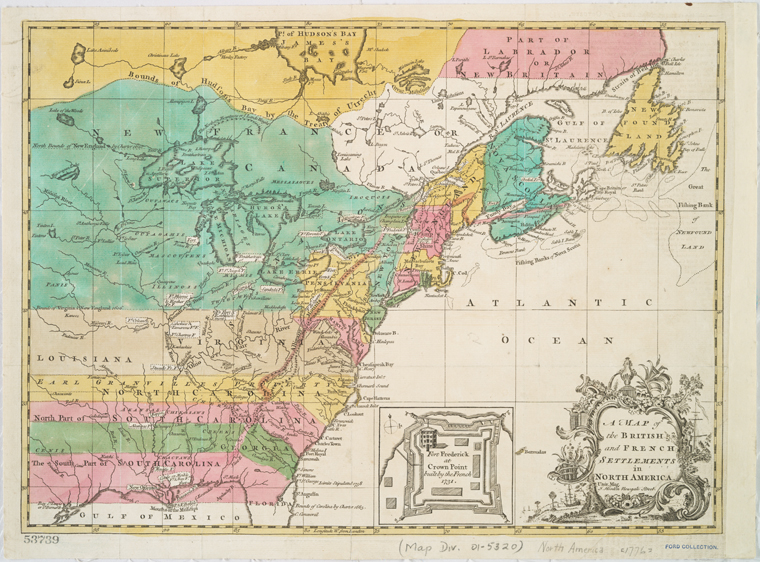
A mid-18th century map of British and French colonies in North America

(from New York Public Library Map Division)

I grew up in Western New York State, spent most of my twenties in Eastern Michigan and Western Pennsylvania, and finally settled in New York City nearly twenty years ago. In my life I’ve logged many a road trip to the landmarks of British and French military control at Fort Stanwix, Fort Ticonderoga, Fort William Henry and Fort Niagara, along with various battlefields and stops at roadside markers. In July, I’ll be swinging by Fort Necessity in Pennsylvania where a British officer named George Washington first commanded troops in an opening battle of the French and Indian War. I’ll also be swinging through Letchworth State Park which was occupied by the western edges of the Iroquois Confederacy which sided with the British during the era of European conflict. In short, I’ve spent my entire life living amid the ghosts of the contested colonial regions of the North American colonial wars.

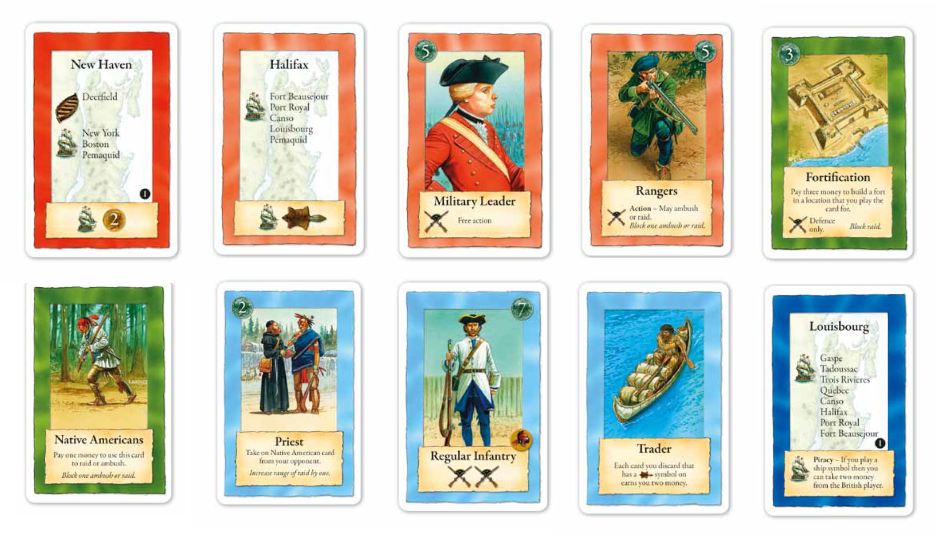
AcresCardsSample cards from A Few Acres of Snow

At the recent D-Day Plus 70 weekend at Metropolitan Wargamers in Brooklyn, NY I was fortunate to score a copy of A Few Acres of Snow in a dice-off raffle. Created by famed designer Martin Wallace and released by Treefrog Games in 2011, the game takes its name from a quote from Voltaire’s Candide commenting on the absurdity of European focus on colonial wars for territory. AFAOS takes players through the French-British colonial period in North America as each nation competed for control of the continent. Within the theme, the game is a rich mix of deck-building and area control mechanics as players seek to settle and defend key areas of the map.

snowsymbolsCard symbols from A Few Acres of Snow

(Wagon, Bateaux, Settler, Military Strength, Money, Fur, Ambush and Ship)

The two-player game begins with players choosing a side as the British or French with a set number of settled outposts in the wilderness of 17th and 18th century North America. British begin with their main settlements in New York and Boston while the French player starts with Quebec. Players begin with a draw deck from which they start with five cards. Playing cards in turns of two actions each, players perform a variety of actions including settlement, fortification, raids, sieges, trade, piracy and a number of card management options. Symbols depicted on each card allow for enormous flexibility in how each player executes their strategy of expansion. For example, a player might begin with a Location card setting off from an existing settlement. From there, a card is played with the appropriate movement symbol like a Bateaux along a river. Once at a new location, a card with a Settler might be played to create a new settlement. As a player’s holdings expand, their decks grow in size and options, leading to even more potential paths of empire growth. Once all settlement tokens are used or major settlements like Boston or Quebec are captured, the games ends and victory points are scored.

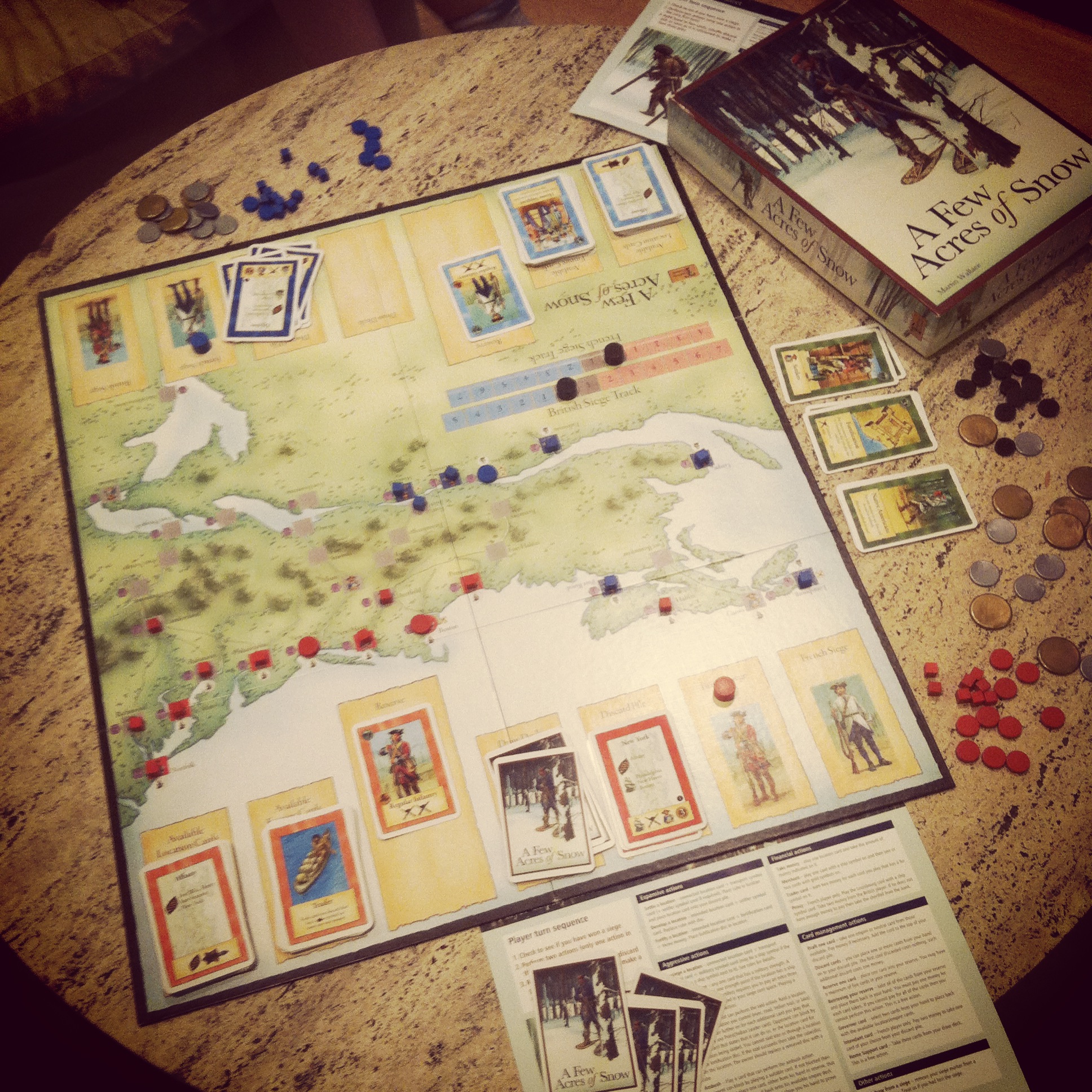
IMG_3640My first play of A Few Acres of Snow

In my first play through AFAOS, I faced off with my son playing the French and me playing as the British. The game plays in about an hour, but on our first run we went to a bit over 90 minutes as we wrapped our heads around the rules. After I quickly sailed to and settled Halifax well within the bounds of French country, several  sieges commenced. In his first siege attempt, my son was repelled by my superior military might powered by my store of money. He then took a few turns to quickly trade a lot of fur (one of the strengths of the French player) to buy additional forces for a second siege which chased my British from his territory.

IMG_3647My heavily-settled British Atlantic Coast in A Few Acres of Snow

In the meantime, I pushed inland with a string a settlements toward the Great Lakes in the hopes it would expose Quebec to a siege. However, my son quickly landed a stronghold in my coastal territory in a siege victory at Pemaquid. I retaliated with two failed attacks on Pemaquid using Native American raiding parties. Having held on, my son launched an attack on Boston and my British rule of the colonies fell.

Our first game showed us how quickly AFAOS can move once you get the mechanics. Getting the right cards in and out of your hand is key to winning the game, and the cards shift in importance as the game quickly unfolds. The balance of trade, expansion and military actions does a fantastic job in re-enacting the dynamics which played out between the British, French and shifting Native American allies over some 150 years. Even though we upset the course of history, we both walked away pretty thrilled over our new game and chatting up strategies for the next time we meet up in the woods and along the coasts of Colonial America.

afaosart