Favorite Kickstarters of the Month (August 2013)

These days it seems like a month doesn’t go by that some Kickstarter horror story makes the rounds. Projects vanish, people lose money to scams or entrepreneurs running Kickstarters go belly-up with their success. This past week, the owner of a successfully-Kickstarted game called Corporate America wrote about his experience. The piece gives a solid, balanced look at the real economics behind running a Kickstarter game campaign. It’s a good read and worth bearing in mind while taking a look through the game campaigns I’ll be watching this month.
duelA Duel Betwixt Us: This two-player card game pits two 19th-century gentleman in a game of manly combat. By using their workers, each player is able to mine for ingots used to create weaponry and armor for combat. Once ready, a player selects a duel and then brings their arms, armor and stack of dirty tricks to the fight. The very Victorian artwork reveals a hilarious game of codpieces, drunken miners, oddball weaponry and double-crossing at every turn in the quest of woman’s favor.
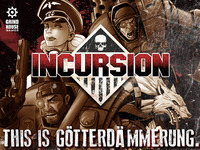
incursionIncursion: Released by Grindhouse Games in 2009, Incursion is yet another take on an alternative post-WWII world where Nazis and Allied forces persist in protracted combat as a Doomsday Device threatens world destruction for all. This sci-fi-fuelled game is full of fantastic weapons, evil scientists, daring heroes plus zombie Nazis and combat gorillas. This second edition and expansion of the game adds all sorts of plastic miniatures to the game, new missions and rules for three players.

freedomFreedom – The Underground Railroad: I grew up in Western New York, a hotbed of the Abolitionist movement and gateway to Canada for escaping slaves. Academy Games is adding the story of the Underground Railroad to their Birth of America Series of games that has already covered the American War of Independence and the War of 1812. There’s a lot of real history packed into this intense strategy game as players take on the role of allied abolitionists alluding slave trackers while escorting escaped slaves north to Canada along eight routes. Historical events and people shape the game along the way, making this game a really fascinating vehicle for retelling the story of the Underground Railroad.

TemplarTemplar – The Secret Treasures: I’m a fan of a number of the Eurogames produced by Queen Games, and Templar looks to be another fun hit. The game plays on two boards, a “harbor board” of warehouses and the other a detailed floorplan “abbey board.” Moving between the boards, players seek to find and hide treasure relics throughout the abbey by playing different character cards. Characters like the Prior, Abbot or Spy act to either aid or foil the Templar’s plans.

zerohourZero Hour – Survivor Horror Card Game: Aside from the occasional run-in with some zombies, I’m not generally a horror gamer. Zero Hour could change that. Play begins with 30 children stranded in the woods after their bus driver dies. Soon, weird things begin to happen in the woods, pushing each child closer and closer to insanity. Somehow, the children have to survive the night until the zero hour at dawn. The gothic design and theme of the entire game makes this look to be creepily attractive. A bonus part of the campaign is a tall plush Slenderman doll, certain to please the darkest child within you.
Retro Gaming The 70s & 80s: Talking Football

talkingfbbox

I was never a sporty kid, on the field or off. My playtime in the 1970s and 80s was much more apt to be spent gluing-up Airfix models, battling with Kenner Star Wars action figures or campaigning through the latest Dungeons & Dragons adventure. One of the few memories I have of a game I loved as a kid that didn’t involve dank passages, spellcraft and random encounters with wandering bugbears was Mattel’s Talking Football game.
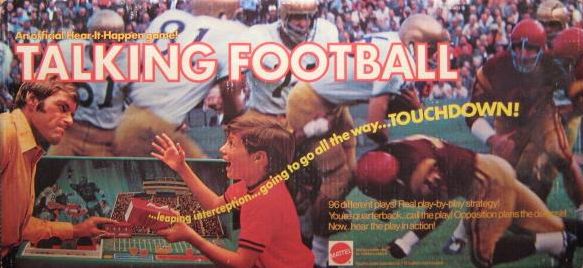
First released in 1971 and then re-reissued in 1977 as Talking ABC Monday Night Football, this semi-obscure classic was the alternative to the electric football games a lot of my friends had in the 1970s. The electric football games looked great with their customizable football player miniatures vibrating all over the little field in random directions but those never really added up to much of a game for me. Talking Football was in a league of its own.

talkingfbcontentsTalking Football had a pretty conventional football field playing board with sliding plastic clips to show yardage progress and first down markers. Other plastic components included a little scoreboard and a place to mark downs and quarters. The nifty mechanic of the game was in the tiny plastic records that made the game “talk.” Play began with the offensive player selecting from one of the ten “standard” play or three “special” play records. The chosen record was inserted into a little handheld player and then the defensive player rotated the record to a defensive play. Once plays were selected, a lever was pressed and simulated audio recordings of announcers calling the play would play in combination of the offensive and defensive selections. The result of the play would be recorded on the field and the next play would be set.

To a kid living in the pre-videogame era of the late 1970s, Talking Football was a blast and a bit of a technological wonder. Over time, players got used to the hundred or so combinations of plays and the game would repeat itself a bit at times. This became part of the strategy, as the game was basically one of picking the right play you thought would best defeat what you predicted your opponent would pick. To answer the repetitive standard set of 13 records, Mattel also offered expansion packs for the game with celebrity player voices on picture disc records, including Merlin Olsen and O.J. Simpson.

I didn’t own a copy of Talking Football, but one of my good friends did. Flash forward more than three decades, and that friend is an on-air radio personality at a rock station in Northern New York State. I don’t know if the hours we spent playing Talking Football and hearing those recorded announcers call plays had any effect on my friend’s future career choice. That said, I think of how games shaped me into the person I am today and like to think that maybe those scratchy, plastic voices still reverberate with my old friend today.

Collector’s Note: Mattel’s Talking Football can be found for sale from special sports memorabilia companies and on eBay. The standard game can run anywhere from $40-200, depending on condition. Buyers should beware that many collectors indicate the original players haven’t always aged very well due to their cheap, dated technology. The individual player records go for around $10 apiece.

Flames of War: Fielding the PSC Stuart Tank

While the durable US M4 Sherman gets most of the glory in the annals of WWII Allied tank history, the M3 Stuart also played a significant role in providing valuable infantry and reconnaissance support throughout the war. The Stuart was originally supplied to the British ahead of the US entry into the war, but American tank crews would eventually use them throughout the European, African and Pacific war theaters. Armed with .30-calibre machine guns and a 37mm main gun, the Stuart proved itself to be a finicky yet effective part of many of the war’s major actions and campaigns, including the D-Day Normandy campaign of 1944.

Most of the US armor I use in Flames of War gaming comes directly from Battlefront, the makers of the popular 15mm WWII wargame. Battlefront manufactures beautiful models but the company is often criticized for its prices. I already own a fair number of Battlefront’s M4 Sherman tank models. With so much of my armor tied up in the sameness of my Sherman platoons, I’ve long wanted to add some diversity in my force with a light tank platoon option.

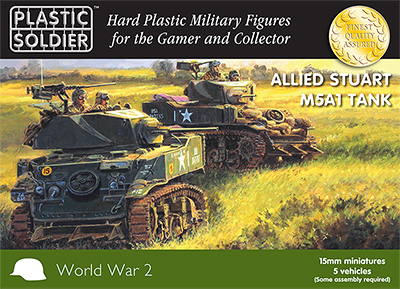
Coincidentally, the Plastic Soldier Company has recently been expanding its small but growing line of 1/72 and 15mm WWII hard plastic infantry, vehicle and armor sets. At nearly half the price of the FOW offerings, the 15mm Plastic Soldier Company boxed sets look to be a legitimate bargain alternative. As luck would have it, among their new releases from the past month was a 15mm Allied Stuart set containing five models which make up a perfect light tank platoon for my FOW force.

Despite the relative low cost, I approached my first go-around with the PSC with a critical eye. The Stuart set comes with enough parts for five tanks from the early, mid or late WWII periods. The flexibility of the modelling is fantastic, but it does result in a bunch of unusable waste parts left on the sprue. Gluing the models up for the late war was fast, with the finely-detailed casting going together smoothly. A relectuant criticism of these otherwise excellent models is the way in which the turrets fit to the hulls with tabs which were a bit tight for my liking. I wound up cutting the tabs off so the turrets move more freely, but this extra step did destroy the other strong points of the PSC models.

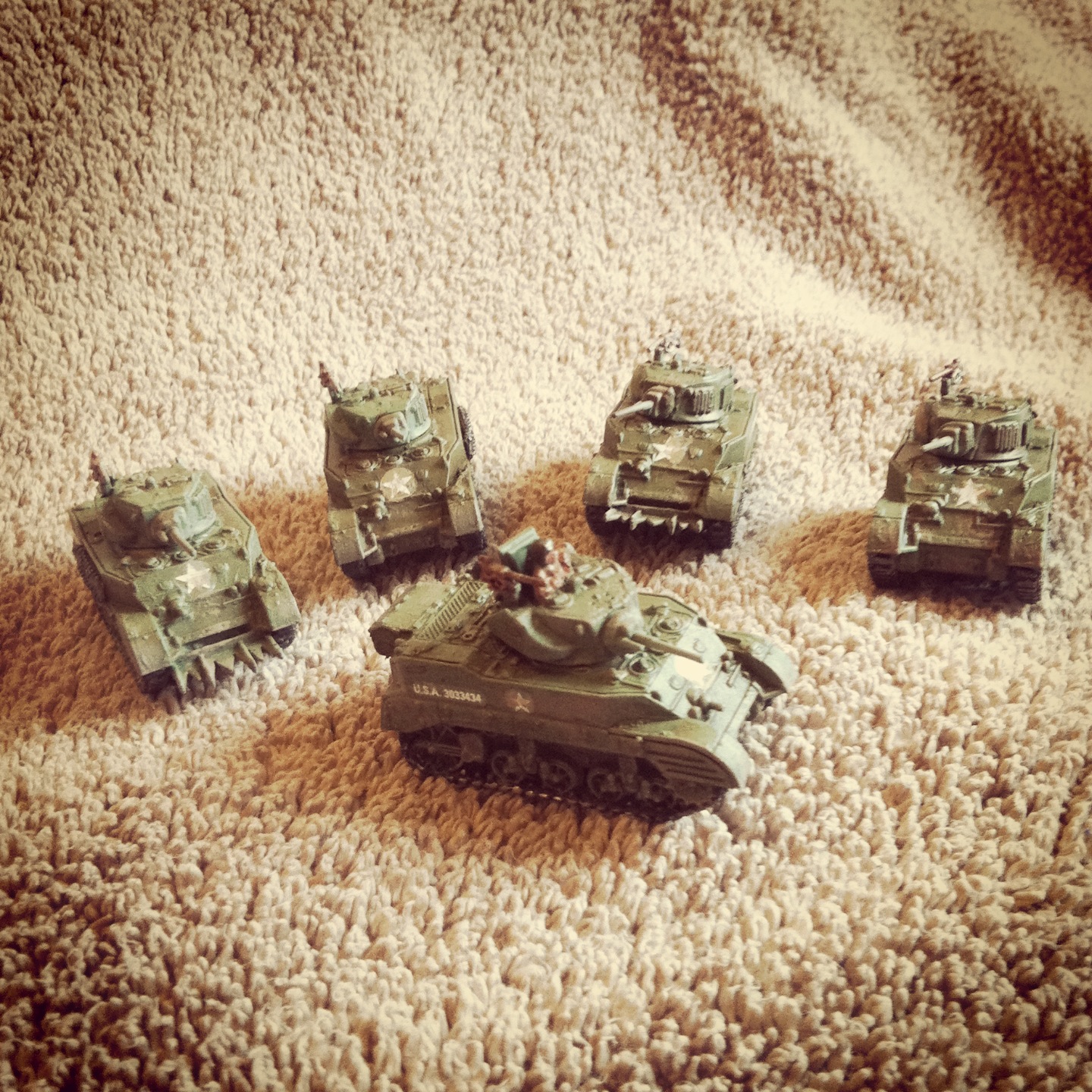
After the glue dried, the models got a coat of green armor spray followed by some black and metallic paint brushed on the treads. Tools and stowage attached to the hull were picked out in detail, and then all the tanks got a watered-down brown wash. I applied some appropriate US decals I had left over and then the tanks got some splattered mud details in a lighter mud color.

IMG_1956

The result of my Stuarts and my first experience with the Plastic Soldier Company is entirely satisfying. Not only can’t I wait to roll these fast, deadly tanks onto the table in my next game, I likewise will be anxiously awaiting what new releases the company has in store to further build-out my forces.

Retro Gaming The 70s & 80s: The DragonLords

dlbox

As a young gamer in the 70s and 80s, I had an incredibly supportive mother. Our trips shopping always allowed for stops by local bookstores, five-and-dimes and hobby shops to check out the latest Dungeons & Dragons releases, metal miniatures, fan magazines or other gaming delights to add to my growing collection. My mother was also a big yard sale and flea market fan, dragging home all sorts of used games for my brothers and I to try out. One of those early-80s yard sale finds was an unopened copy of 1978’s The DragonLords from Fantasy Games Unlimited.

Founded in 1975, FGU is still in business as a publisher of a variety of board and role-playing games. Like many game companies in the mid-70s, FGU leapt into the D&D tidal wave and released a number of fantasy-themed games. The DragonLords followed the traditional hex map and cardboard counter game model well-established by such publishers as Avalon Hill. The box contained a map, simple rule book, reference sheets and over 600 tiny cardboard playing pieces. The artwork was second-tier generic fantasy illustration, the game map was outright bland and the printing looked like it was done on a typewriter. I loved this game.

dlmap

In The DragonLords, each player took on the guise of a wizard ruling over their kingdom. Players chose to play as a Sorcerer, Conjurer, Enchanter, Necromancer or other type of specialized wizard, each with their own unique set of spells. Spells were acquired through turns “studying,” allowing for more advanced spellcraft in areas such as Siege, Hiring , Weather, Speed or Tactical. By casting their spells, wizards developed armies to fan out across the map to conquer the opposing kindgdom, hasten movement of their own horde or wreak horrible natural disasters on the enemy.

For someone well-steeped in D&D and Tolkienesque fantasy, a lot of The DragonLords felt very familiar. Tiny cardboard chips featured very basic line illustrations of elves, giants, trolls, ents, dragons and other creatures, each with values for combat and movement. The wizard spell study mechanic felt akin to the levels of advancement with magic-using characters through Experience points gained in D&D campaigns. Siege of cities and frontier keeps was a key part of the game, and building and attacking with catapults, siege towers and rams was a big component missing from a lot of smaller-scale D&D play.

What I loved about The DragonLords at the time was the mix of individual wizard character development and the grander scale of huge grotesque armies slugging it out across the mountains, swamps, forests, roads and waterways of the map. A game could be played satisfactorily in a few hours, also a nice change of pace from the long-term campaigning in D&D. The DragonLords certainly didn’t win any points for its graphics, but for straight fantasy gaming on an epic scale it definitely had its spell cast on me.

Collector’s Note: The Dragonlords is long out of print, but with a bit of online searching Iwas able to come across one bagged unpunched copy for over $100 on Amazon.com. Clearly my mother’s yardsale find was quite a deal.

Retro Gaming The 70s & 80s: Marvel Super Heroes Role-Playing Game

marvelbox

Way back in the late 1970s, well before we had summers filled with superhero movies, I was a comic book collector. Those were the days when my younger brother and I bought our weekly fix of Marvel and DC superheroes off a squeaky rotating rack in a corner store, all for under a dollar each. Eventually our collecting graduated to visiting comic book shops, flea markets, yard sales and small regional comic book conventions in Western New York. As our collection grew into thousands of books by the mid-1980s, my brother and I were receiving weekly warehouse wholesale shipments and were bidding on lots of older books through auctions by mail. Both of us sold-off the majority of our collections in the late 1980s and early 1990s before the market became glutted, eBay arrived on the scene and CCG-graded comics became the new collecting norm.

timetrapI still have a significant, albeit more scaled-down, interest in comic books to this day. Yet as I recall those peak collecting years in the early 80s, my mind eventually takes me to memories of 1984 and TSR’s release of Marvel Super Heroes: The Heroic Roleplaying Game. The game arrived during big expansion years for TSR as the popularity of their flagship Dungeons & Dragons franchise continued to grow in player fandom and pop culture infamy. Winning the Marvel license allowed TSR to launch a new game with a built-in base of players which had a lot of cross-over interest in comic books and gaming (like myself). Despite the promise of the total package of the Marvel Universe delivered in a RPG by the makers of D&D, the Marvel Super Heroes game never really delivered.

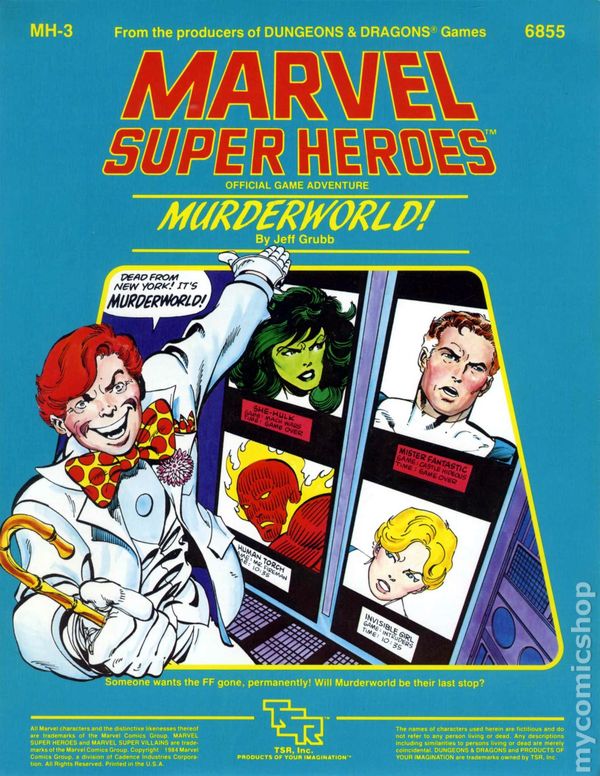
murderworldThe core box came with a quick start “Battle Book” and a more detailed “Campaign Book.” Also included was an introductory scenario, “Day of the Octopus,” plus a fold-out map, character reference cards and some rudimentary markers. TSR quickly expanded the game with a number of accessories including a couple sets of poor quality metal miniatures and quite a number of game adventures following the module model which had proven so successful with D&D. An eager collector, I snapped up a bunch of adventure books, including “Time Trap” featuring the Avengers and “Murderworld!” starring the Fantastic Four. Expansions also included a number of adventures which featured “adventure fold-up figures.” Unable to help myself, I happily bought the Hydra-themed “Pit of the Viper” edition along with a few others.

pitofviperDrawing on the stable of established Marvel characters, the game looked great. Mechanics borrowed broadly from D&D with “Attributes” establishing the primary strengths of a super hero on a scale of 1-100. “Superpowers” defined unique abilities while “Talents” were a set of skills a character could draw upon. A system of “Karma” (similar to D&D Experience) allowed for character upgrades. The problem I quickly found with the game was that you played characters within an established set of backgrounds and relationships. Spider-Man, Thor or The Human Torch carried enormous backstories, robbing players of the opportunity to create and grow a character from the ground up like in the more pure RPG realm of D&D. Eventually, I was buying the expansions simply to read the text and assemble the little cardboard figures and terrain pieces.

Despite the mediocre quality of the game overall, TSR went on the release a revised version of the game in the late 1990s. More than anything else, the second edition of the game was probably an effort to retain the license from Marvel. Even so, Marvel and TSR eventually parted ways by the early 2000s.

So much of my generation was defined by the first modern wave of toy licensing with Star Wars that I can hardly fault TSR for jumping on the brand-extending bandwagon with Marvel. It’s amazing to me the game lasted so long given my memory of its lack of interesting play. This is one game I can’t foresee ever returning to. Its true superpower lay in how deep the marketing of those characters was a part of me then and stays with me today.

Collector’s Note: Most probably owing to the low quality of the game, the original TSR  Marvel Super Heroes game starter box set and most expansions can be found on eBay for under $20 each.

Flames of War: Barkmann’s Corner Scenario

panther

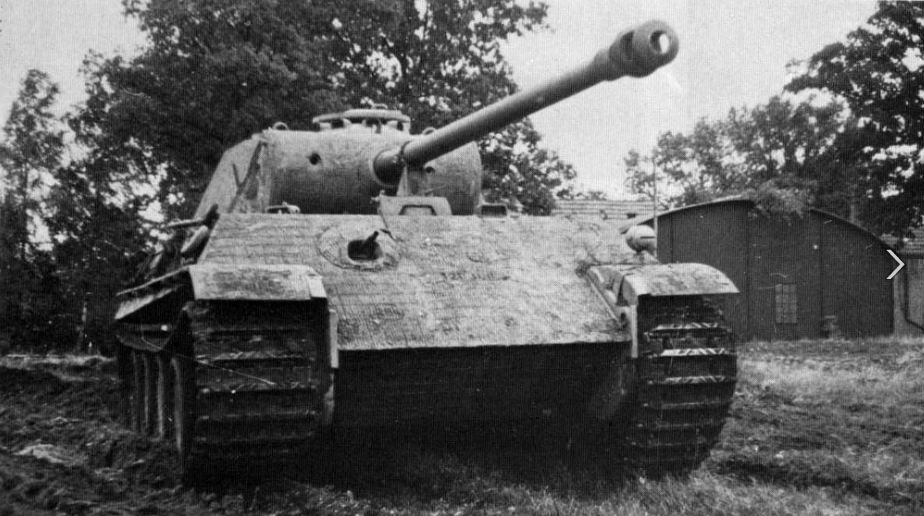
Ernst Barkmann was one of the top German tank aces to fight in World War II. Commanding a Panther tank, Barkmann served throughout the entire war on both the Eastern and Western Fronts. Not only was he deadly while at the command, but his crew became adept at making on-the-fly field repairs and getting back into action. By the time he surrendered to British forces in the spring of 1945, Barkmann had become one of the most decorated German tank commanders of the war. He was not yet 26 years of age.

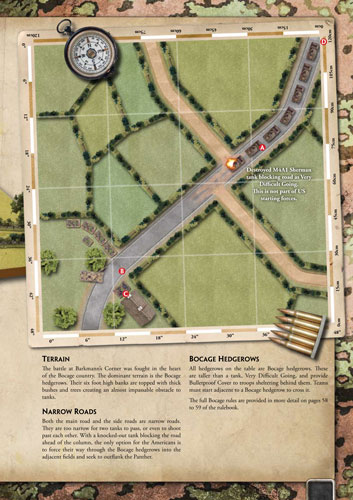
barkmannmapFlames of War offers a special Ernst Barkmann warrior set which includes Barkmann commanding his Panther plus a separate mobile repair shop. FOW also provides free scenario rules for the famed “Barkmann’s Corner” engagement from July 27, 1944. Fought in the Normandy region of France, the small battle is a classic in which Barkmann’s single tank went up against a column of over a dozen US Sherman tanks. In the end, nine Shermans and other vehicles were destroyed before Barkmann was able to slip away to safety. I’ve had the Barkmann model painted up for a few years, but I had never fielded it in a game of his most famed run-in with the Americans. With a frequent summer guest of the Metropolitan Wargamers club leaving NYC for home in Florida this coming week, the two of us got together this past weekend to have a go at the scenario.

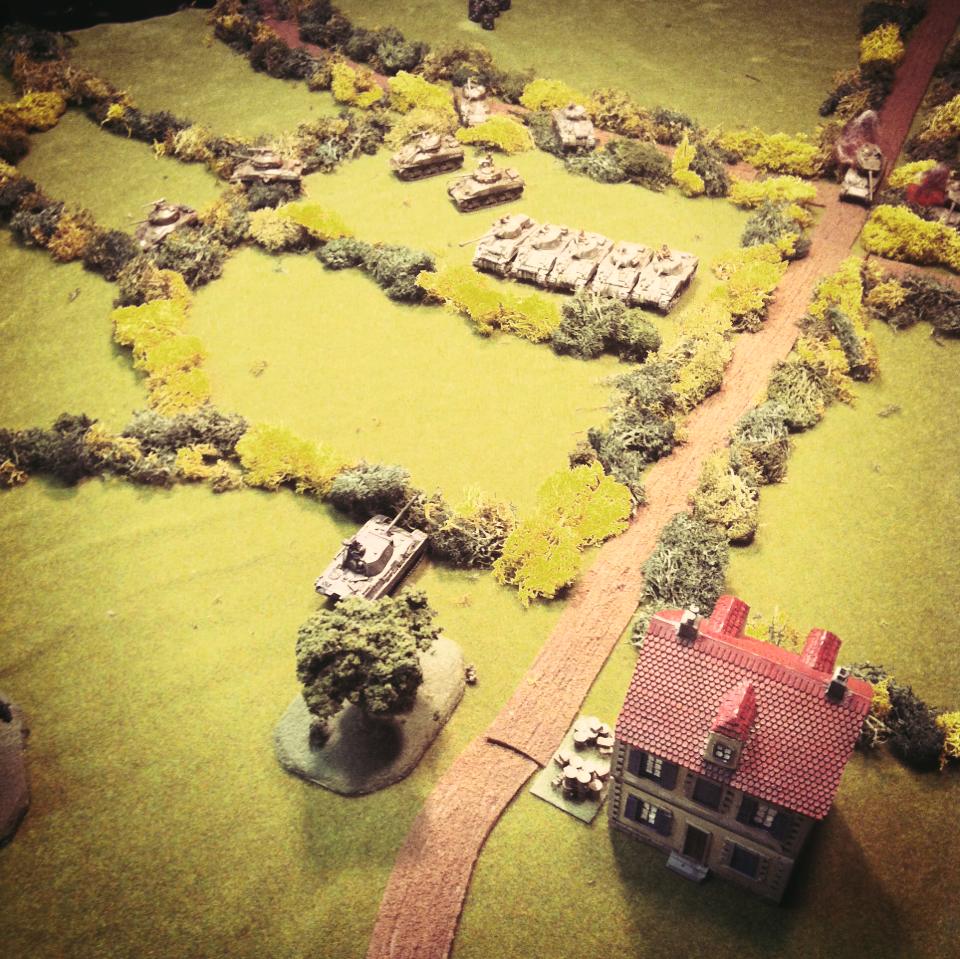
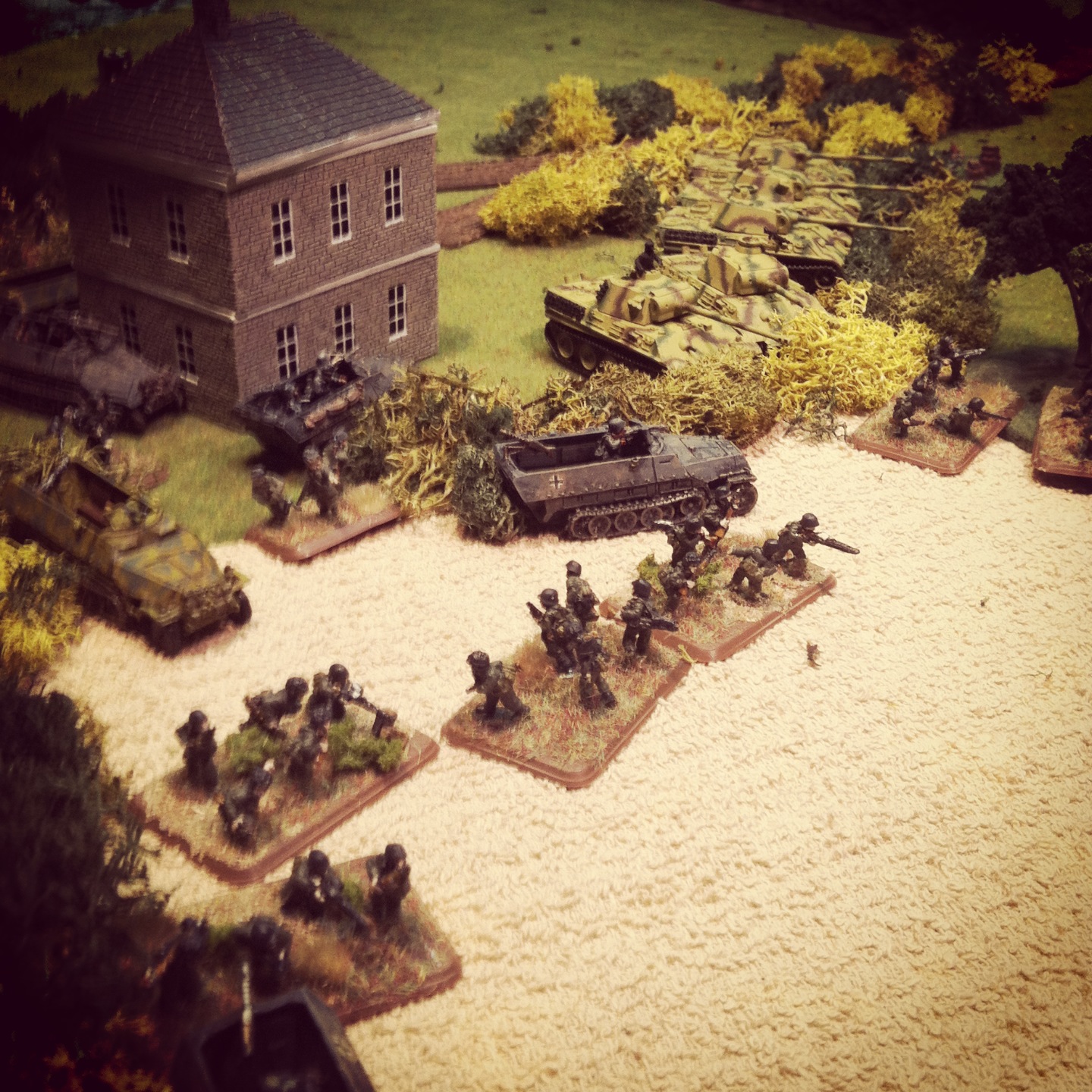
As per the rules, the small 4′ x 4′ playing area is set with fields and roads heavily crisscrossed with the high bocage hedgerows of Normandy in which I love to set my games. Barkmann’s tank and his supporting Panzergrenadier platoon begin dug into positions around a small farm at one end of the board. In the opposite corner, the US tank command group and their first platoon of M4A1s begin the game slowly rolling down the narrow road but blocked by a burning tank. The first platoon is strengthened by the presence of Staff Sgt. Lafayette Pool, another special figure offered from FOW. Historically, Pool wasn’t at this engagement but the inclusion of the hard-charging tank ace from Texas helps balance the scenario a bit. Two larger platoons of Shermans lie in the column off the board but enter on turn two and three. The Americans need to keep things moving and Barkmann’s there to stop them.

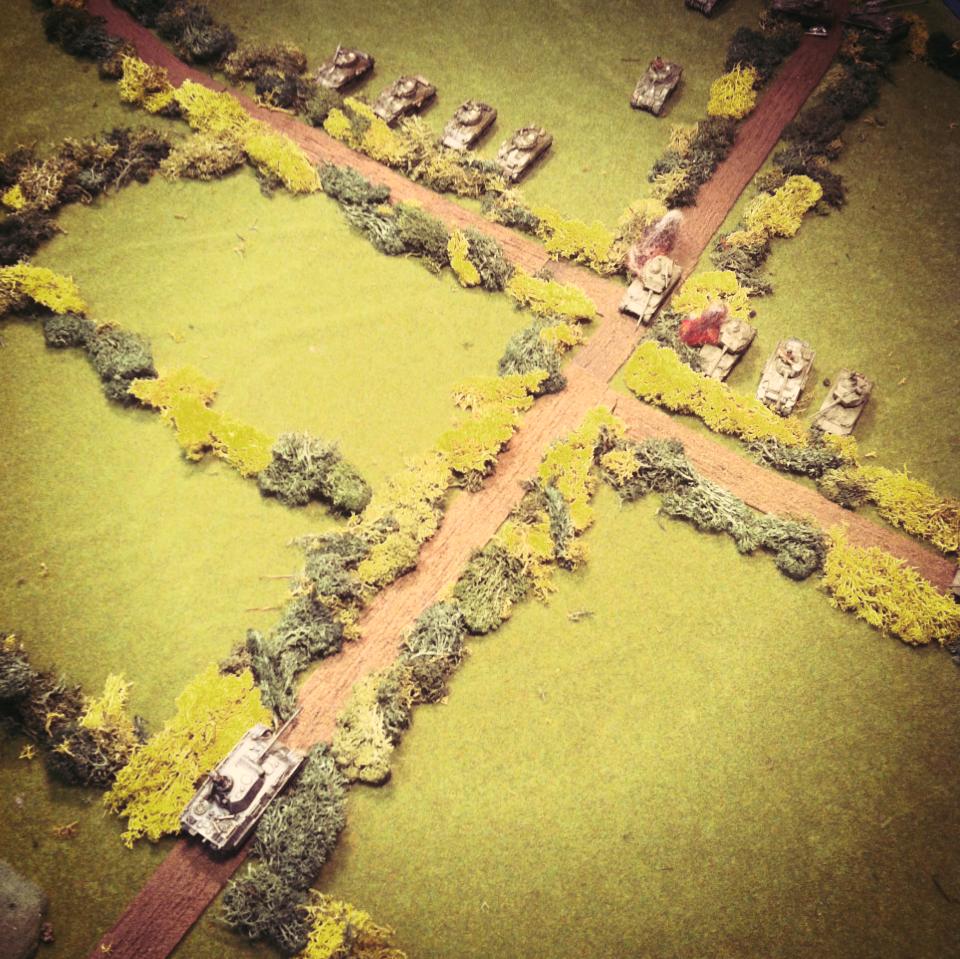
With the first turn, the US armor column begins down the road toward the farm objective in the near distance.

bark1Barkmann lies in wait behind a small copse of trees with the Panzergrenadiers gone to ground behind the bocage.

1075723_10201126852027803_1689119621_nIn the next few turns as the Americans slowly moved over the dense bocage lining the roads, the US plan became clear. The command tanks and Pool’s platoon headed toward the house and the German right flank. The remainder of the Shermans broke toward the German center and left, bogging repeatedly along the way. In the meantime, Barkmann moved to the far side of the farm house to protect his side and line up several shots on Pool’s platoon.

995453_10201126853307835_1344971388_n

3637_10201126853787847_675127225_nWith the Americans splitting in two directions and the German infantry safely in the house, Barkmann took several side shot’s at Pool’s platoon and then rode bravely to the road to begin taking shots at the approaching center Shermans. As Pool became the final survivor of his platoon, Barkmann swung his attention back to his left flank and the bulk of the closing US force which had freed itself from a series of challenging bogged turns.

992833_10201126854147856_848082758_n

538975_10201126854827873_1979156013_n

538971_10201126855507890_695500397_n

1012007_10201126856347911_1734345823_nAs the two largely-intact surviving Sherman platoons continued to attempt a flanking move on Barkmann, his Panther was forced into movement each turn to align shots and stay covered. Pool also managed to pour fire into the farmhouse with his main gun, eliminating some of the Panzergrenadiers before fleeing the table on a failed motivation test. With the twelfth and final turn, Barkmann had backed himself up to the house to protect the objective and eliminated a couple more tanks along the way. Had there been one more turn and roll of the dice, and the game would’ve gone for the Americans.

1011343_10201126857107930_1603972880_nAfter the large Total War scenarios at the club the previous weekend, it was a welcome break to play a small yet engaging battle with a limited amount of models to command. The bocage is the great equalizer in the scenario, providing alternate turns of benefit and frustration to each side as movement is stalled and lines of sight are blocked. Having read a number of historic accounts of the field-to-field fighting throughout Normandy in the spring and summer of 1944, the Barkmann’s Corner scenario went a long way in showing that choosing where you fight can be one of the most important factors in the outcome.

Related articles

New Game Weekend: Sid Meier’s Civilization: The Board Game

CivBox

Unlike myself, electronic games have been a constant presence with both my sons since they were born. Now aged 8 and 13, my boys have graduated up through a host of platforms and games with the Leapster, DS, PS2, Wii, PS3, online through sites like Steam and on the iPhone. Over the past year, their obsessive play over Minecraft has been gradually replaced with scores of hours logged with the wildy-popular Civilization V.

Developed more than 20 years ago by Sid Meier and Bruce Shelley, the Civilization franchise has evolved from a PC-only DOS game to occupy a variety of gaming platforms. The turn-based civilization-building mechanic and historical theme sets up an incredibly-engaging and educational universe for players to plan and play out a nearly-endless variety of paths in human advancement from the ancient era to the near future. The latest iteration, Civilization V, broke on the scene in 2010 with two expansions since. Worldwide, the game has sold millions of copies and has continuously won accolades from a couple generations gaming critics and devoted fans alike.

Even though my kids are devoted electronic gamers, they’ve also been raised with a healthy love for card, board and miniatures gaming. So, when my 8-year-old caught wind last week that a boardgame version of Civilization existed, I leapt at the chance to introduce the boys to the game. I’ve played a number of civilization-building games such as Clash of Cultures but hadn’t yet played Civilization.

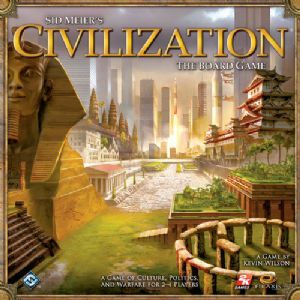
Now published by Fantasy Flight Games, Sid Meier’s Civilization: The Board Game has been around since 2002 and can be found at your local Barnes and Noble for $60 or cheaper online. Like many games of this type, the box comes stuffed with hundreds of components plus more than 300 cards. Geared for 2-4 players ages 14 and up, Civilization takes 3+ hours to play. Fortunately, my boys have been exposed to enough games, both online and on the tabletop, that they’ve been able to quickly pick up on the basic play and strategy Civilization offers.

CivContentsCivilization involves a march toward victory in one of four ways: Economic, Military, Cultural or Technological. Players begin by selecting a civilization such as the Americans, Egyptians, Romans or Russians. Each starting civilization carries its own strengths in play, making this first choice an important one in setting your strategy for the game. Based on the number of players, a map of hidden tiles is laid out and the market area is set up to the side of the board.

After set-up, the game progresses through a series of turns. In the Start Turn, a player may build a city or change their government type – an important choice which can greatly affect the path of a player’s civilization. Next, the Trade Phase allows a player to reap trade points from the areas around their cities and offer trades in resources with other players.

In the City Management Phase, the player may build units or buildings, harvest resources or focus on developing their culture. Building units – Scouts or Armies – allows the player to explore and conquer areas of the board. Constructing buildings such as Markets, Temples or Baracks allows a variety of bonuses to your civilization. At a higher price, Wonders like The Oracle, The Hanging Gardens or Angkor Wat may be built. Finally, a player may pay to build their military prowess through a progression from simple archers and pikemen to tanks and aircraft. Aside from building, a player may harvest resources such as silk, iron, incense or wheat to be later spent to activate certain technologies already researched. A player may also choose to focus on culture, with gained cultural points moving the player up the culture track while also earning special cultural event cards played to change different courses of the game’s play.

Next, in the Movement Phase a players may move their Scouts and/or Armies to explore, claim new territory or engage in combat with a barbarian village or another player. In the final Research Phase, players may spend their earned trade points to develop new technologies. The game’s “technology pyramid” is built progressively by each player as they grow from simple technologies such as Metalurgy and Horseback Riding toward higher level advancements all the way up to Flight and Nuclear Energy.

The play adavances through the above turns until a player arrives at a victory condition. Cultural victory is earned by completing progress on the culture track. A military victory is won by conquering an opponent’s capital city. Earning a technological win is done by completing the technology pyramid all the way up to Space Flight. Finally, an economic outcome is reached by collecting 15 gold coins earned through various actions your civilization makes throughout the game.

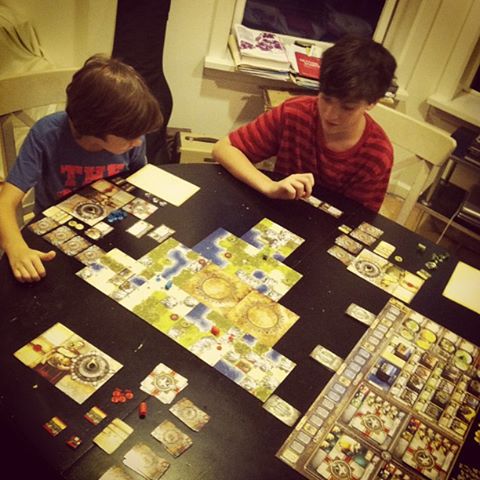
To summarize the game in a couple paragraphs is hard, as the variation of play in the game is boundless. This weekend, my younger son and I played through our first quick starter game on an eight-tile two player-map (pic below). Despite over twenty pages or rules and scores of playing pieces to manage, he picked up the game really fast. Along the way, there’s a ton of reading I’m certain is not covered in the general elementary curriculum with stops along the way to have side conversations on the meanings of words such as “despotism” and “anarchy.” At his age, my son’s memory is quite amazing and our discussions of the finer points of the rules has continued even away from the game table.

1001022_10201084784976153_1277385001_n

In our second game (pic below), three of us played on a larger map. My older son, a pretty experienced gamer at this point, blew threw a ten minute intro to the rules and played as the Prussians with an aggressively militaristic strategy I’ve grown used to over the years. Using the Egyptians, my younger son focused on culture and building construction. For my own strategy, I played as the Romans with a healthy mix of the military and cultural expansionism for which their empire was known.

1004654_10201085941885075_1372920330_n

For parents and critics of them who decry the falling attention spans of today’s kids, weekends like this past one show how with a bit of parental creativity all the stereotypes simply fall away. A game like Civilization — both online and off — offers so many opportunities to build vocabulary, learn history and develop some complex multi-layered management skills I see sorely lacking in many of the adults I encounter. Over hours of focused play, not only are my sons and I developing our civilizations but we’re also developing each other — an investment in time together well-spent.

Flames of War: Metropolitan Wargamers Summer 2013 FOW Day

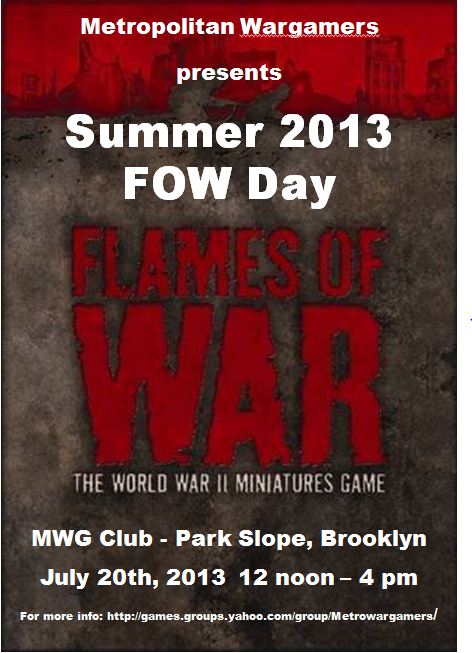
Taking advantage of a renewed interest in the popular Flames of War 15mm miniatures WWII wargame, Metropolitan Wargamers in Park Slope, Brooklyn hosted a big day of gaming this past weekend. Both experienced and new players alike came together on two of the club’s largest tables to play to big scenarios over the better part of Saturday afternoon.

Metropolitan Wargamers

MWGFOWI mention it often, but the amazing group of people who make up the Metropolitan Wargamers club bears mentioning again. The club will celebrate its 20th anniversary next year, and it’s a real gamers paradise for those of us living in New York City. Visitors and a core group of long-time members drop by the club throughout the week and engage in all manner of games, from boardgame favorites and card games to large scale historical miniatures battles and grand strategic campaigns. The club’s space occupies an entire basement-level of a typical Brooklyn rowhouse and is lined with shelves full of games and miniatures collected by members over two decades. Playing space includes a number of the club’s award-winning sand tables, regular tables and racks on which ongoing games can be stored as they are played out over the course of weeks or even months.

The club is an incredibly diverse and supportive environment for those of us who share our common passion in gaming. With 2014’s anniversary coming up, I hope to dedicate more space here in the near future with some history and perspectives from members.

Summer 2013 FOW Day

totalwarThe folks at Flames of War provide special Total War rules for gaming large-scale matches like those we played this past weekend. With a few weeks of planning, I helped round up 10 players for the day’s game. We settled on two games from the late war, one each on the Eastern and Western Front. The Western Front game featured two teams of two players each on the German and US sides with each team running 3000 points on a 4’x8′ table. On the Eastern Front, two three-player teams squared off in a tank-heavy scenario on one of the club’s famed sand tables with each team compromised of 5000 points. Each game featured endgame objectives and were slated to run to eight turns. With games these large, we were up for a very long day of action.

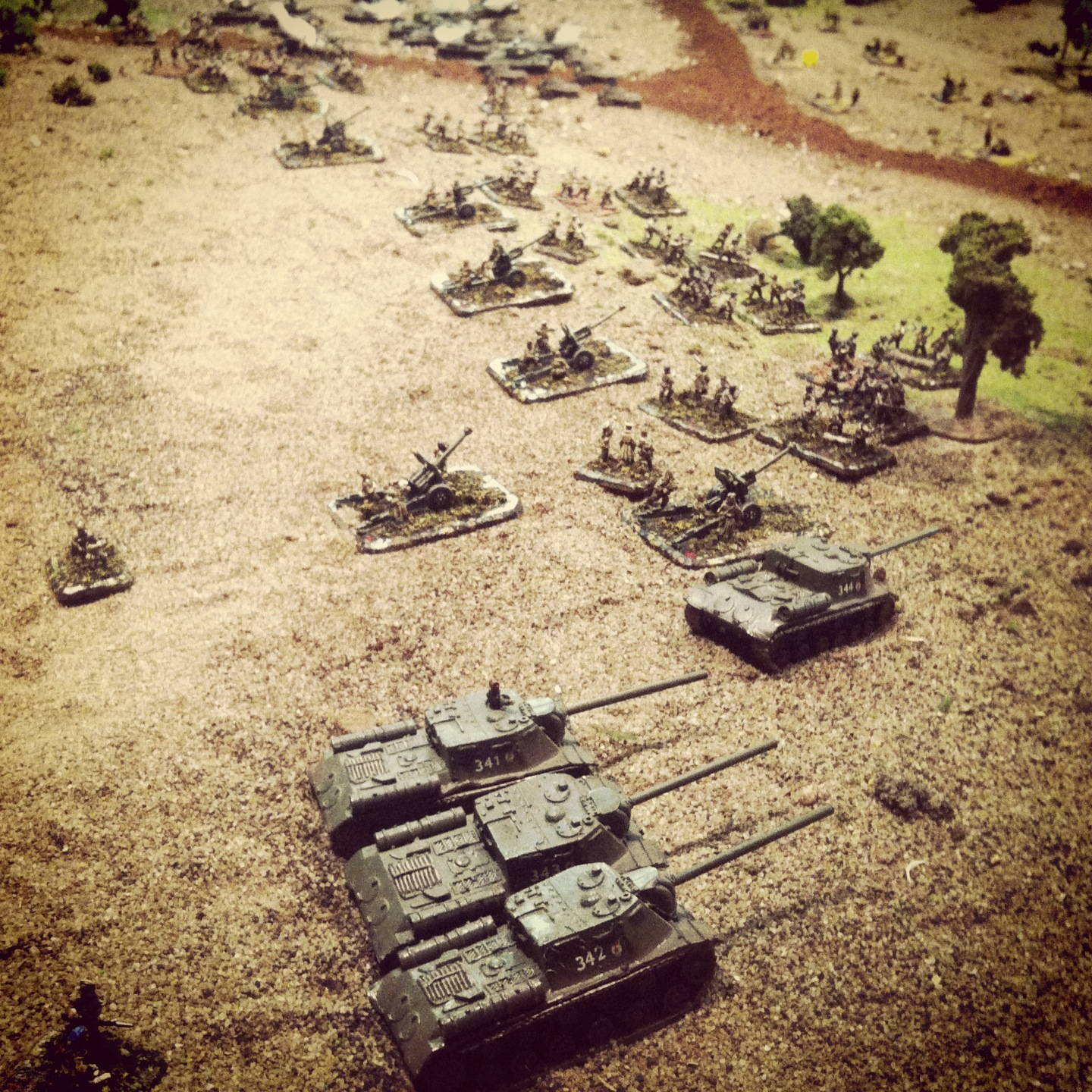
On the Eastern Front, the table was wide open with widely-sloping sculpted sand hills, small copses of trees along each long side and a Y-shaped road bisecting the table. I spent the day riveted to my own game on the Western Front table, but the German and Russian armor spent the day pounding away at each other. By mid-day, things had looked pretty good for the Germans as many destroyed Russian tanks stood smouldering midfield. All that changed in the latter half of the game as the Russians rallied to victory.

IMG_1908

IMG_1912

My game on the Western Front featured a generic French landscape cut up into winding narrow roads lined with the notoriously difficult bocage hedgerows which stymied both sides in the engagements fought in the region throughout 1944 and 1945. A church stared across the board to a stone bridge crossing a narrow stream to a small village. On the other end of the table, a small farm was set beside two wheatfields with two more rural stone houses in the near distance.

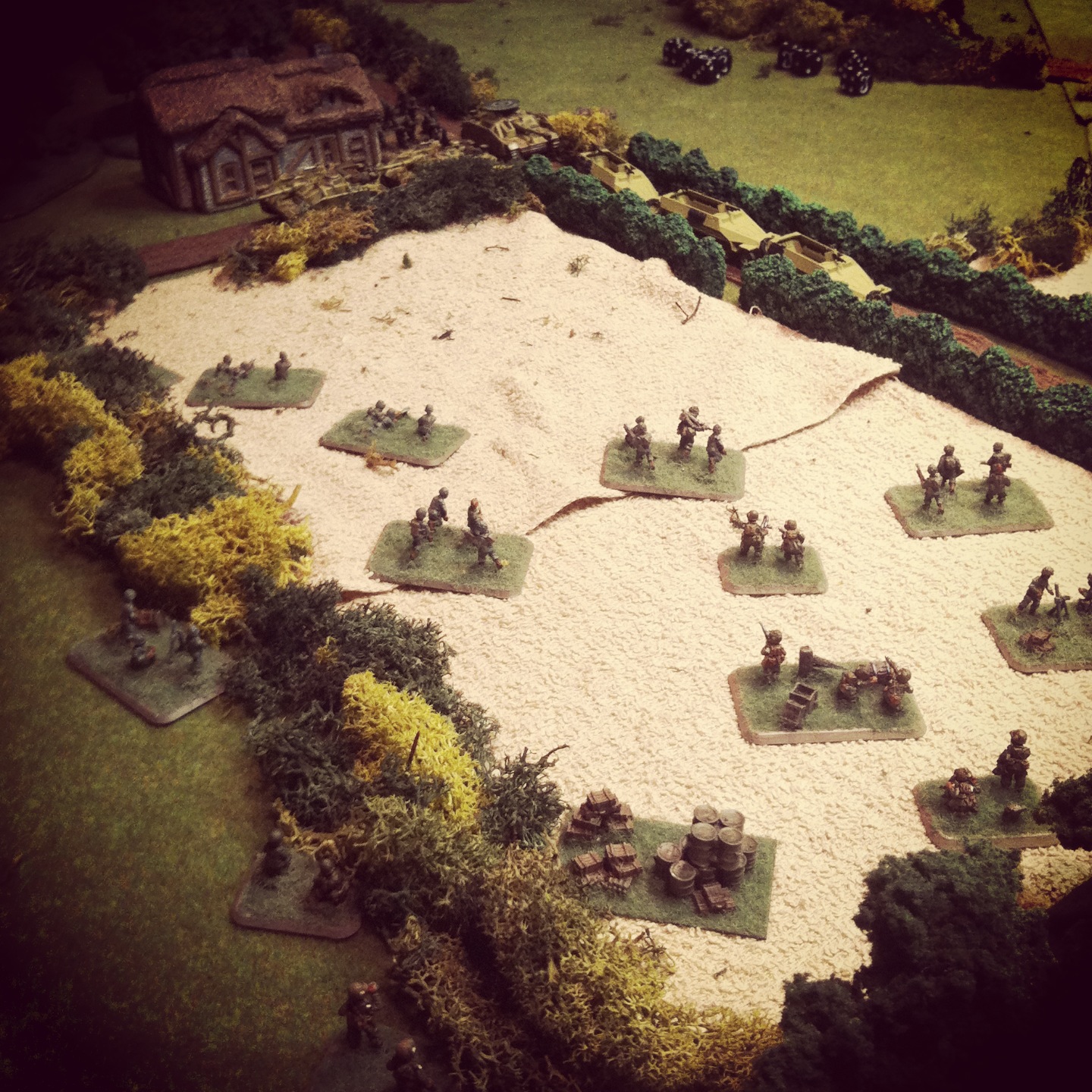
IMG_1903Our US plan was to place the majority of our armor on our right flank, supported by mobile infantry deployed in a small wood. On the left flank, the US Airborne deployed just outside the wheatfields with its small parachute battery to the rear. At the center of the board, our M7 Priests with their 105mm guns formed another battery while one lone Airborne platoon pushed to hold the buildings in the town with a vantage covering the bridge.

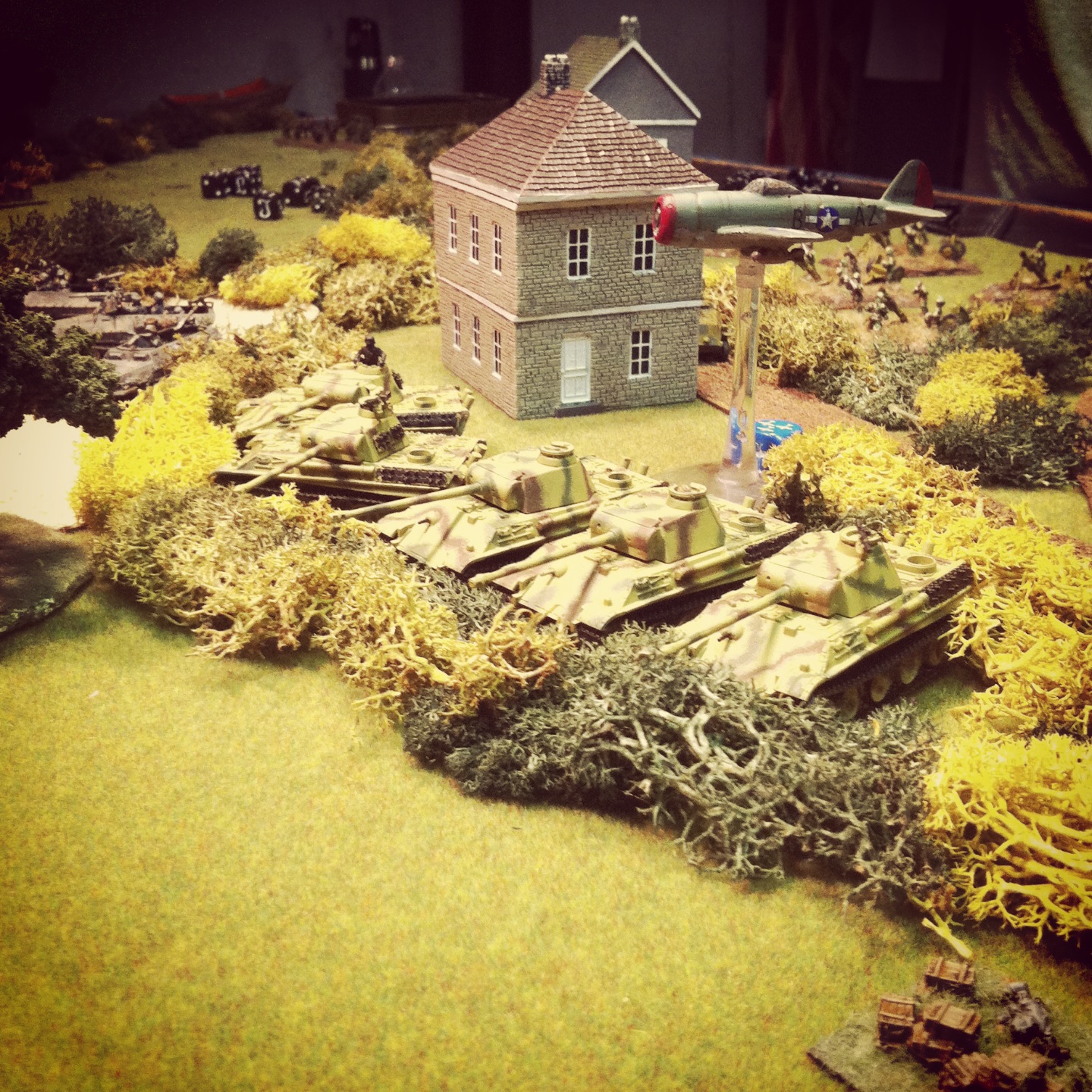
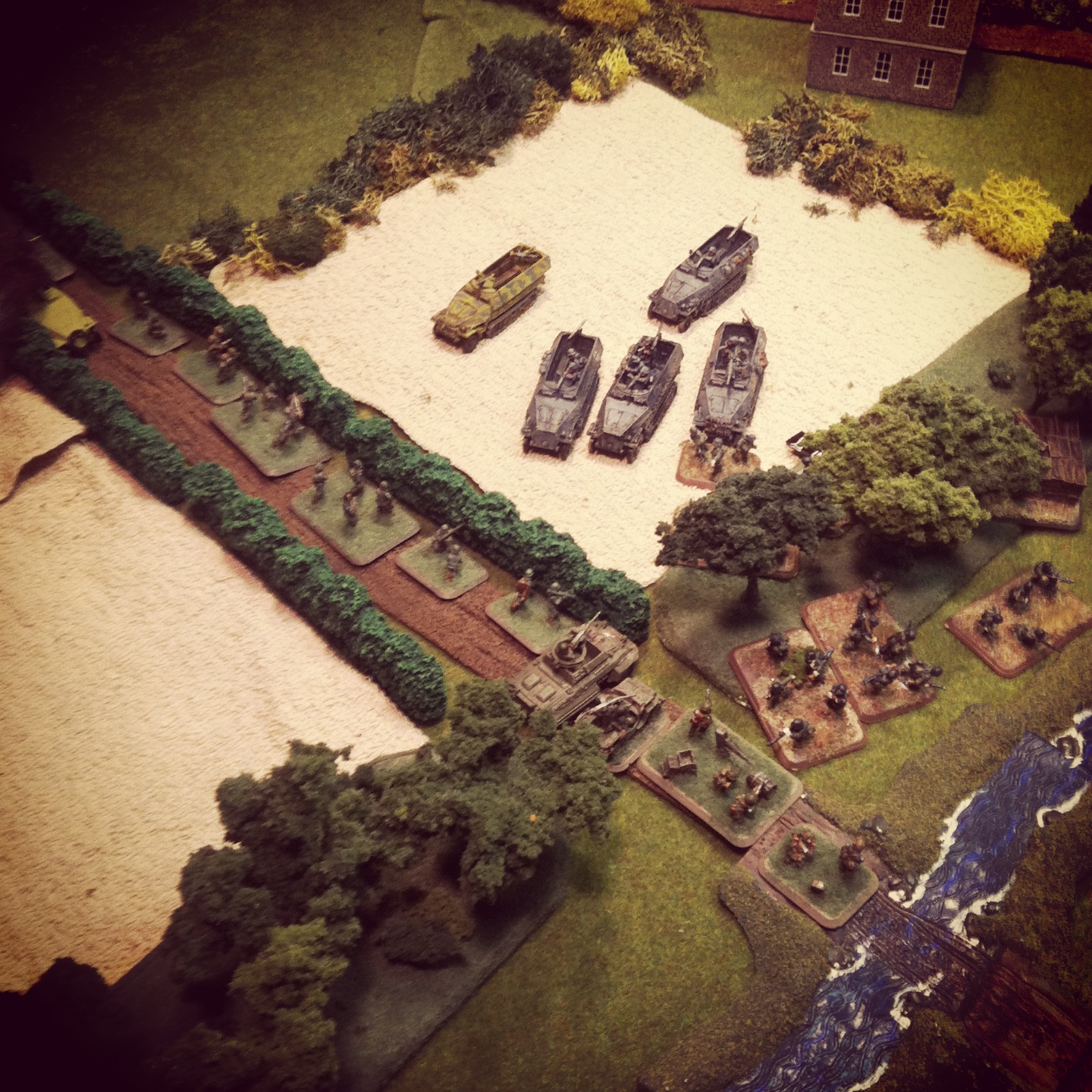
The game started poorly for the Americans as the Germans quickly pummeled the American Shermans and kept the infantry hiding in the woods. In the center, the US infantry struggled to occupy the buildings as the Germans quickly rolled five exceedingly threatening tanks behind a row of bocage overlooking two objectives. The American’s P7 Thunderbolt was likewise ineffective through the first few turns of the gaming, missing all targets except on German tank which burst into flames while bogged over a hedgerow.

IMG_1918

IMG_1906

IMG_1916

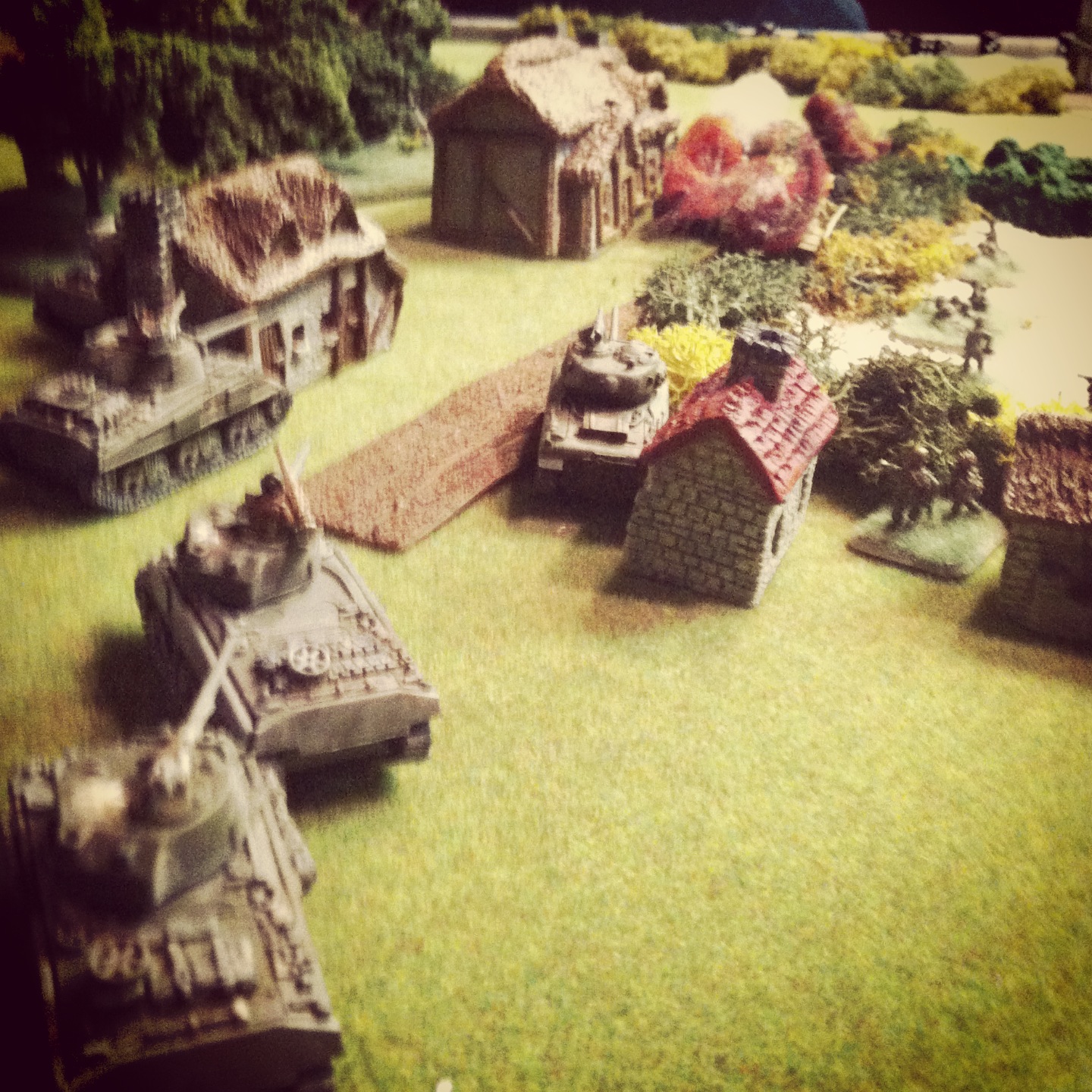
The fight on the American left went better from the start as the US Airborne filled the wheatfields and headed for the hedge and road beyond. A brief scare from a platoon of German Stugs, a row of halftracks and a platoon occupying the farmhouse  was solved with our trusty American Shermans. With a combination of artillery bombardments, heavy fire from the US tanks and some shooting from the advancing Airborne, the crossroads in front of the farm was turned into a smoking mass of destroyed German armor. Just as the German right flank stood wide open to the rolling Shermans, the command tank bogged in the woods where it and its entire platoon would remain for the rest of the game.

IMG_1914

IMG_1924By mid-game things looked good for the Germans, but the resilience of the Americans would prove to be the edge in the second half. The American armor was pretty torn up on our right flank, but the US kept making some remarkable morale rolls to stay on in the fight with the dwindling German tanks. At the center, the Priests had lost one of their guns but snuck back into cover to continue taking direct shots across the river at the remaining German armor. The US Airborne platoon occupying the town’s buildings risked a run toward the river, taking casualties along the way despite the smoke covering the German line on the far side. The fight between the wheatfields and adjoining treeline saw the Germans and Americans whittling each other down.

IMG_1926

IMG_1910

IMG_1920

IMG_1928

In the final turn, the 101st Airborne finally got in close enough for a tank assault, destroying one tank and pushing another back from an objective. It was a bloody fight, but in the end it was an American victory with four of six objectives held. On both tables, it had been a good day for the Allies.

And it was a long one, too. With a nearly eight hours of gaming and only brief breaks to grab a drink from the fridge up front or a hotdog off the grill out back, the two games had been exhausting but enjoyed by everyone – win or lose. That’s the kind of spirit we at the club experience every week, and already there’s some after-action discussion about when we’re planning our next big Flames of War day in Brooklyn.

Flames of War: Fielding the Guards Armoured Division

guardstanks

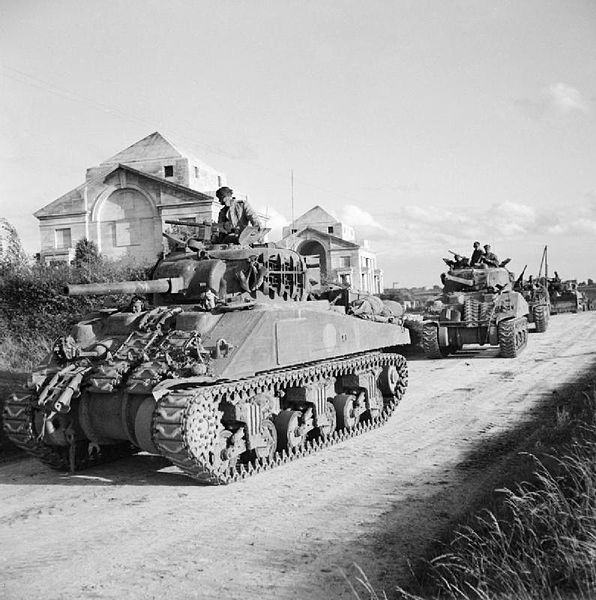
Among the multi-national Allied forces that participated in the campaign following Operation Overlord on D-Day on June 6, 1944 were the British Guards Armoured Division. Arriving a couple weeks late to the party on June 26, the Guards would roll on to participate in many of the key post-D-Day engagements including Operation Goodwood, Operation Market Garden and the Battle of the Bulge. I’ve been encountering the Guards over and over again in Rick Atkinson’s engaging The Guns At Last Light, the latest and final volume in his “Liberation Trilogy” telling of the Allied march to victory in World War II. And so, it is great timing that I’m finally getting around to adding the Guards as my first allied group supplementing my already extensive US forces in my Flames of War gaming.

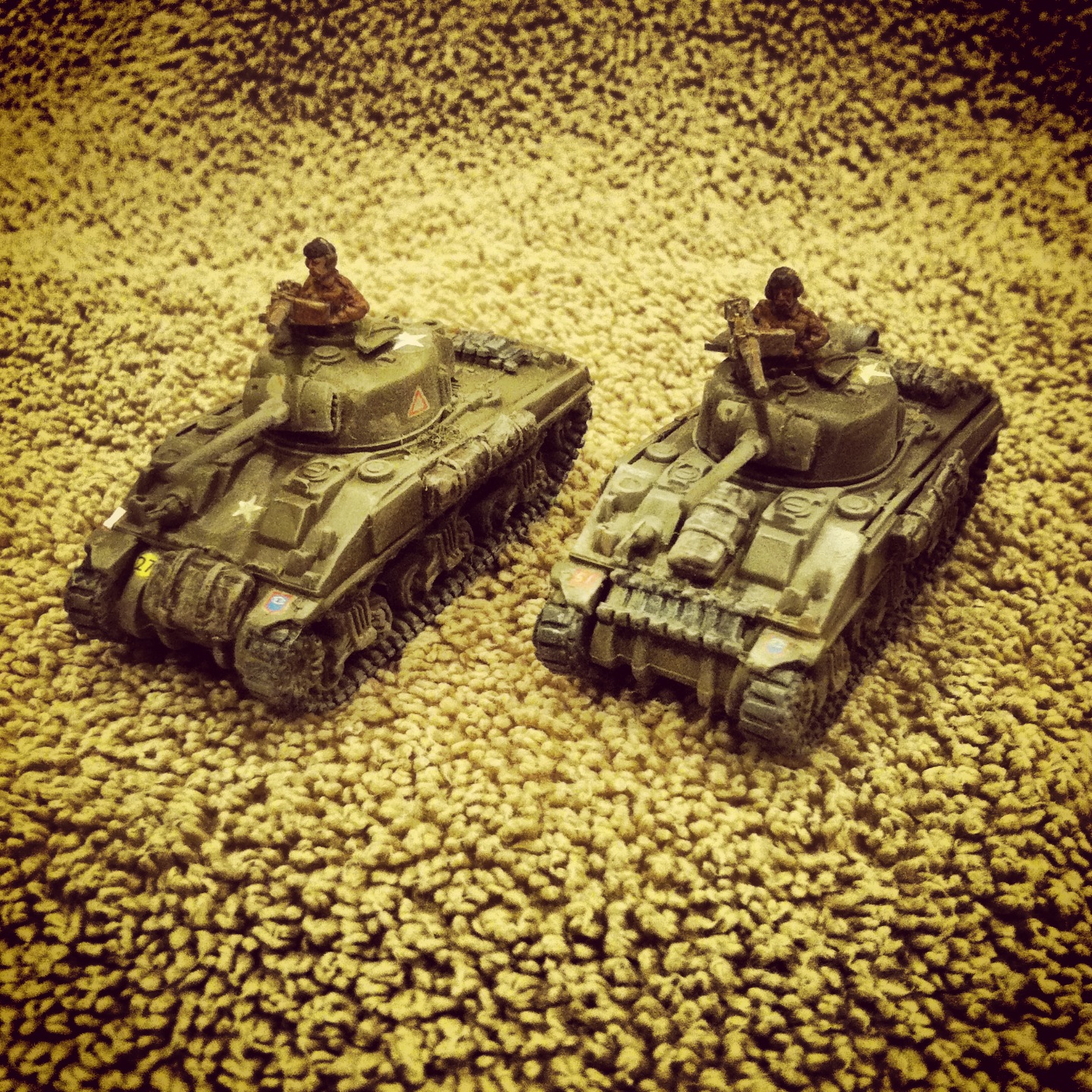
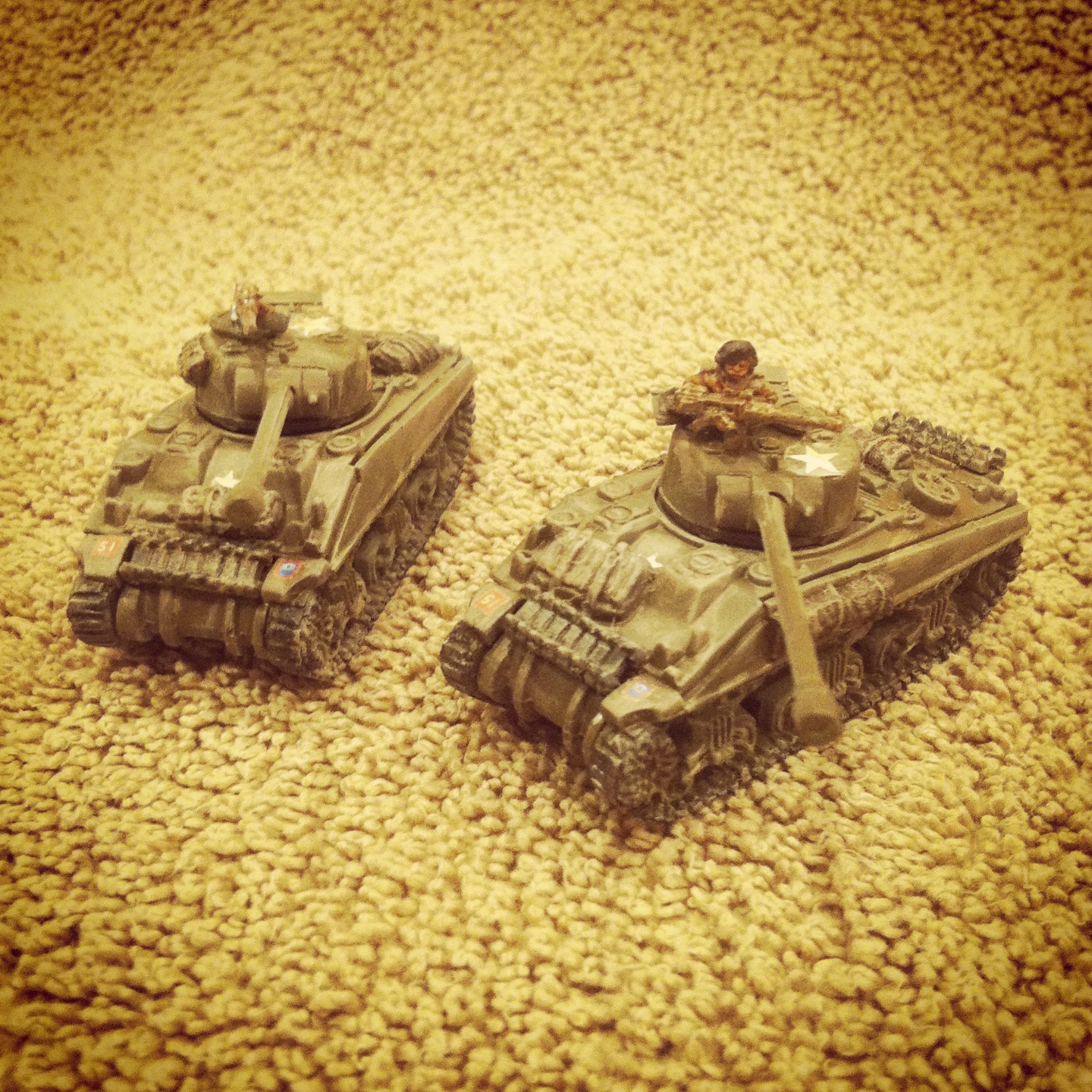
FWOFBoxI’ve been working away for half this year on finishing up the models included in the excellent Flames of War Open Fire! box set. Among all the plastic goodies included, the set offers up a nice Guards platoon to provide support to their allied US Airborne infantry. The eight models include six of the US-supplied Sherman V tanks and two of the famed Sherman Firefly tanks, retrofitted by the British with a massive 17-pound anti-tank gun.

Aside from a rather significant and well-documented issue with some parts fitting together, the models glue up pretty nicely. To the included stowage and gear included on the sprues I also added some leftover bits. A quick coat of green armor spray paint followed by black and silver lightly brushed on the treads made up the majority of the painting work. The exposed drivers received a tan uniform, black beret and radio headset picked out in detail. Crates and tool handles strapped to the hull got a quick touch of brown.

IMG_1894For decals — a big oversight in not being a part of the Open Fire! kit — I used a set from the Plastic Soldier Company and guidelines found on the Flames of War site. I found the decals from PSC to be easier to apply than those I had used from FOW in the past, but I did still use a few Allied “star” markings I had lying around from previous US tank models from FOW. With the decals dry, a bit of dried mud color and watered-down brown wash added some wear and tear around the tanks before they were hit with a matte finish.

IMG_1896

IMG_1898Now that I’ve got some Brits on the table, I’m eying some UK infantry to add some depth to my collection and flavor to my games. There’s a big full-day Flames of War gaming event coming up in just a few days at Metropolitan Wargamers, but I don’t think the Guards will be making an appearance this time around. Still, it will be good to know they’re waiting to throw in with the Yanks on another day in the near future.

Retro Gaming The 70s & 80s: Dungeon!

In 1975, just a year after the release of Dungeons & Dragons, TSR Hobbies released the boardgame Dungeon!. The game mirrored many aspects of D&D’s dungeon-crawling framework while offering a much lower point of entry for players either new to the genre or looking to just play a quick game.

dungeonadI got a copy of Dungeon! after a couple years of spending hours playing D&D and painting my first lead miniatures from the likes of Ral Partha. Dungeon! offered a traditional boardgame format and came as an occasional break from the open-ended role-playing my friends and I were used to with D&D. Ads for the game at the time (left) were also pitching the game to families and casual gamers as a point of entry and enticement to the larger world D&D offered.

Playing as an Elf, Hero, Superhero or Wizard, players moved through six progressively-difficult levels, encountered random monsters and collected treasure. Each character class carried specific strengths and powers, with more powerful characters such as the Wizard or Superhero requiring greater treasure to win the game.

Large chambers such as the Kitchen, Crypt, King’s Library or Queen’s Treasure Room were surrounded by smaller rooms, color-coded to indicate the level. In each large chamber, a stack of three randomized monster cards specific to that level were placed at the beginning at the game. In each smaller room, one monster and a treasure was placed. When a space was entered, the top card was drawn and combat between the player and the monster ensued with a simple die roll. Winning combat won the treasure while ties or losses might result in a retreat or loss of treasure.

For players familiar with D&D like myself, Dungeon! mirrored a lot of the established canon. Monsters fell along the lines of hobgoblins, werewolves, dragons, mummies and snakes. Dungeon pitfalls such as traps might be encountered. Characters like Wizards held special spell cards such as Fireball or Teleport, and found magic items included an ESP Medallion and a Magic Sword, offering certain characters bonuses to their play. Treasure ranged from meager bags of glod found in the easy levels to the covtted Huge Diamond (worth 10,000 points) hidden deep in the sixth level.

Several editions of Dungeon! followed through the years, the most recent in 2012 from Wizards of the Coast, now-owners of the D&D franchise. Longtime players have also created a rich universe of house rules, customized boards and even hand-painted figures to supplement the basics of the game. Despite its relative ease of play, Dungeon! has remained a classic bit of fun among even the most serious gamers today.