Retro Gaming The 70s & 80s: Dungeons & Dragons Computer Labryinth Game

By 1980 I was like a lot of kids with feet in two worlds of gaming — Dungeons & Dragons and electronic games. Both were well on their way to being the worldwide phenomena they would become in the next decade, and Mattel and TSR (then owner of D&D) sought to cash in on the intersecting interest of adolescents everywhere.

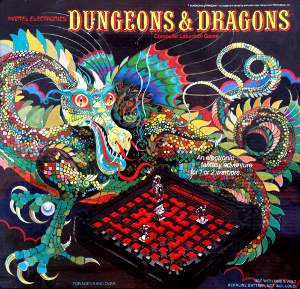
I never owned a copy of Mattel’s Dungeons & Dragons Computer Labryinth Game, but plenty of my friends did. The game looked pretty cool with its 64-square grid of spaces surround by a plastic castle-like wall. Metal figures represented a dragon, two adventurers and a treasure chest. The game could be played solo or with two players. A player moved their piece around the board, placing plastic walls when the board revealed a wall with light-up indicators. Other indicators would light up as you encountered monsters, traps or the dreaded dragon which roared as you approached. A player who avoided the dragon and navigated the revealed maze to the treasure first won the game.

A year before the D&D Computer Labryinth Game was released, Mattel was already competing in the new video game market with its Intellivision system. Those early years of the electronic game market were full of games which promised more than they delivered. Using the word “computer” in this game’s name was no doubt the work of shrewd marketing as the game itself was pretty low tech. Attaching the D&D graphics and brand to the game and even a moody TV ad didn’t do much to cover up for its shortcomings. Looking back, I recall the game even then to be unsatisfying to occasionally frustrating with its randomized LED grid and pieces which never really seemed to fit right. Retailing at around $45, the game didn’t come cheap either.

In 1984, Mattel admitted to its failed also-ran place in the video game market and pulled the plug on its Intellivision system. While it would go on to continued success with its boy-focused toy brands like Hot Wheels, Matchbox and Masters of the Universe, Mattel would never again be  significant player in electronic games. D&D, on the other hand, continues to thrive to this day. While the brand extension foray of the D&D Computer Labryinth Game never really delivered on the promises illustrated in Mattel’s box art, the game does capture a moment in time when gaming was bridging the gap from one era to the next.

Collector’s Note: Complete copies and components of the Dungeons & Dragons Computer Labryinth Game are readily avilable on eBay. Games in the original box run in the $30-50 range while the metal miniatures generally go for $5-10 each.

Favorite Tabletop Games Kickstarters of the Month (June 2013)

I’ve spent a month tracking my favorite projects and looking for new fun stuff on Kickstarter’s Tabletop Games section. Of the five projects I wrote about in May, four have been succesfully-funded to date. I wound up throwing my support behind one of these, Canterbury, and I’m still hopeful things will turn out well for 54mm plastic Civil War toy soldiers project now in its closing days. Here are the other projects I’ll be watching in June.

Princes of the Dragon Throne: This fantasy-themed board game combines deck-building, area control and resource management. Players build recruits and vie for control of the board on their quest to be crowned upon the Dragon Throne at game’s end. There’s a ton of stuff in this box with over 200 miniatures and more than 500 components overall. The levels of support for the game plus the accompanying specially-crafted meeples comes in over $100, but it’s got dragons so the game looks to be well worth it.

Euphoria: Build A Better Dystopia: This Saint Louis, Missouri-based project launched in May but wraps up this month with a very successful funding run. In this worker placement game, dice represent your workers and cards represent elite recruits. Using your workers and recruits, each player attempts to establish a new empire by managing and selling resources, collecting artifacts, building alliances, and undermining your opposition by digging tunnels and launching devious agendas. Dystopian scenarios are a big fave of mine, and the artwork captured in the design of this game is marvelous.

Amerigo: Another successfully-funded game slated to finish its run in June is Amerigo by Queen Games. Players aid famed explorer Amerigo Vespucci in his quest to discover new lands, establish settlements and collect resources in the islands of South America. The game uses a nifty tower through which players drop and draw colored cubes which determine actions available on their turns. Pledging support at different funding levels scores you a copy of Amerigo as well as one (or more) of Queens Games’s other popular historic-themed games such as Alhambra, Shogun or Lancaster, making backing this project quite a deal.

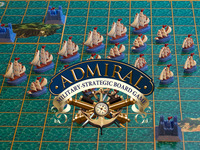
Admiral: In general, I don’t play naval games since I like the variety that a well-laid-out land terrain tabletop allows. That said, this game could get people like me interested in strategic wargaming on the high seas in the Age of Sail. The Ukrainian designers of this game have loaded the base game with 24 1:1700 scale ships that surpass their toy-like colors in their attention. Backers at higher levels get more islands, ships, seascape gameboard tiles and other game components, making supporting this project a fnatstic opportunity to set sail into a different kind of wargaming.

Giant 2 Inch Soft Foam Polyhedral Dice:  My final fave of the month is just goofy and fun. My two sons, ages 8 and 13, are familiar with real gaming dice at this point. But, if I had a small gamer-in-training in my life, these would be on my funding list. The set includes six large, squishy brightly-colored dice used in most gaming (D4, D6, D8, D10, D12 and D20) in a handy cloth storage bag. Appropriate for ages 3+, there’s a whole bunch of options for buying a la carte dice to supplement the basic set, and additional colors and number styles will be made available. What better way to introduce a kid to the wonders of gaming than throwing a few of these on the floor? Then again, they may just go nicely on my desk at work…

The War Game of Norman Bel Geddes

I somehow missed it about a year ago when The Believer ran a great piece on the wargaming obsession of famed American designer and futurist Norman Bel Geddes. While his name may not resonate outside circles of early 20th-century design enthusiasts, Geddes is responsible for much of what we commonly think of when terms like “Art Deco” and “streamlined” are used. Most of Geddes’s fame today is linked to his design of the General Motors-sponsored Futurama exhibit at the 1939 New York World’s Fair and an iconic Art Deco radio commemorated with a US postage stamp in 2011.

Much of Geddes’s work — including the Futurama’s “world of tomorrow” display — was achieved through his obsessive and highly-detailed miniatures modeling. As featured during his life in such varied publications such as The New Yorker, Atlantic Monthly, Life Magazine, Popular Science, Ladies Home Journal and Arts & Decoration, Geddes poured an enormous amount of time and thousands of dollars of time into military scale modeling. Utilizing his extensive library of military books and journals (now held in the University of Texas archives), thousands of ships were crafted from brass with exacting detail and enormous topographically-accurate sea and land playing tables were constructed by Geddes in his family’s Manhattan apartment.

Geddes moved in prominent 1920s-40s New York social, professional and intellectual circles, which led to his hosted sessions of what was simply referred to as “The War Game” to be celebrated events reported on in local papers. Movie stars, socialites, politicians, foreign dignitaries and even rumored retired military brass are said to have been frequenters of the intense gaming sessions. The weekly games ran for months on end, used a rules system Geddes designed himself and were documented in immense detail on record cards, charts and maps run on the printing press Geddes kept in the house. The archive at the University of Texas just hints at the wealth of information on how The War Game grew over the two decades of play among Geddes and his circle.

Like the games played among H.G. Wells and his friends recounted in his book Little Wars, time spent reading through the many articles now archived online of Geddes and his games reveals a vast little-known era of gentlemanly wargaming in New York City. As I look ahead to another weekend of gaming with the Metropolitan Wargamers, I can’t help but feel the rippling tradition of small and obsessive battles waged in the basements of the city to this day.

New Game Weekend: A Bridge Too Far: Operation Market Garden

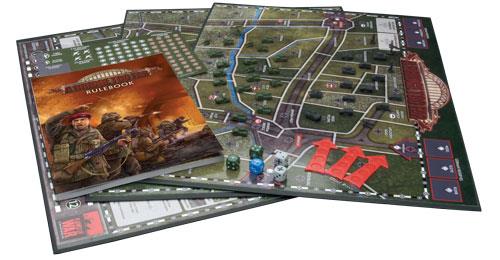
Maybe it was the dampness and spring chill, but Saturday night at Metropolitan Wargamers in Brooklyn was pretty empty with just me and one other club member around. We decided on a two-player boardgame, and being big WWII enthusiasts we picked 2010’s A Bridge Too Far: Operation Market Garden from Battlefront Miniatures.

I’ve been a long-time fan of the 1977 film A Bridge Too Far featuring a classic international cast recounting the events of Operation Market Garden and the botched Allied attempt to chase the Germans out of a number of key defenses in the Netherlands in September 1944. The film does an entertaining job of depicting the colorful real-life personalities against a backdrop of a daring daylight airborne invasion, over-confidence in the weakness of the German forces and disagreement among commanding Allied staff on the plan itself. The game offers two scenario set-ups giving the option of refighting the battle as rather historically depicted in the film or through a plan of your own devising. The game we played was the historical one, and I commanded Field Marshall Marshal Bernard Montgomery’s British and US forces.

The game involves five play turns with a random number of battles making up each turn. Initiative is rolled before each battle, and targeted objective spaces on the board are chosen to attack. Each player chooses to commit some, all or none of their forces to each battle. Different forces – tanks, guns and airborne infantry – each provide bonuses modifiers in different terrain types. Defenders of areas containing bridges get an extra bonus. Resolving combat is a simple roll of the dice with modifiers added. Defeated forces roll to be destroyed or retreat to adjoining areas, and then the next initiative is rolled for. Once a round of battles is completed, strategic moves can be made and the Allied player has the option to air-drop additional forces and supplies into designated areas of the board. The Axis player can then choose to attempt to fend off the Allied air support with their own air power. Keeping supply lines intact is key to the Allied strategy, as forces which are cut-off from their line of supply suffer a greater weakness in subsequent battles.

Typical of games by Battlefront Miniatures, makers of the popular WWII 15mm miniatures game Flames of War, this game packs some great design and ease of play into a neat box. While each battle and turn of play involves a number of steps, the game moves along quickly in about 90 minutes. The game comes with over 40 well-sculpted plastic playing pieces, but the version at the club had been modified with painted metal micro-scale armor and troops. Gamers who long-ago graduated from Risk to games like Axis & Allies will find a lot to love in the focused presentation of this game.

Even with the relative simplicity of the game, there’s a lot of strategic play potential. My first time through, my Allied strategy of pushing hard from the rear and left flanks of the board stalled rapidly as my tanks were quickly destroyed by some disastrous die throws against German anti-tank guns. My paratroppers dropped effectively into the middle of the board, yet they too became surrounded and snarled by the superior German armor defending the game’s main objectives. By four turns in, I faced certain defeat with no additional hope for much-needed tank support for my floundering airborne troops.

For a notoriously one-sided battle, I can easily see a lot of replay value in this game . I hope to give this one another shot soon, trying out some less historical and more aggressive strategies in running the Germans off the field. Having a chance to remake history is one of the joys and challenges of wargaming, and the board game A Bridge Too Far: Operation Market Garden provides a lot of opportunities to do so.

Favorite Tabletop Games Kickstarters of the Month (May 2013)

Earlier this week, I wrote about how I believe Kickstarter to be the latest incarnation of how gamers have contributed to the decades-long conversation on who truly “owns” our hobby. This had me delving deep into what’s current on Kickstarter’s Tabletop Games section.

To date, I’ve honestly only contributed to one tabletop games Kickstarter project. The modest fundraising drive for A Las Barricadas which brought in just under $10,000 for a game that has since been delayed but promises to be shipping soon. While I wait for this little game of street protest pitting Occupy Wall Street-like demonstrators against the police to arrive, I thought I’d share a few projects I’m watching this month.

Moby Dick, or the card game: Like any good English Literature major, I’m a fan of Herman Melville’s epic American tale of one man’s obsession with a whale. On the flipside, I am not generally a fan of card games. That said, this card game of the high seas boasts some truly marvelous woodcut-like artwork and what looks to be an entertaining game of the best recruited crews trying to survive in their quest to spear the Great White Whale.

All Quiet On The Martian Front: Showcasing 15mm miniatures of Martians vs. early 20th-century human armies, this game uses the H.G. Wells sci-fi classic as a jumping-off point to imagine a world of humans locked in protracted combat with alien invaders. The models look fantastic, mining the very-popular steampunk trend in gaming today. Supporters of the game (particular those pledging in the hundreds of dollars) will net a lot of cool looking stuff with its funding.

Canterbury: Nothing gets me going like a great Euro-style worker placement game, so this is particularly enticing. The game places you in the age of Saxon Kings, and your aim is to build the greatest of cities starting with only a well in the wilderness. Managing your growing population, resources, culture, military and ongoing construction of buildings, the game claims to be one of pure skill and planning with no luck factor whatsoever. This one looks like a beauty and I’ll be anxious to give it a play when it is published later this year.

 Wargaming Terrain for the American Frontier: I don’t play games in the period, but the latest from Acheson Creations presents more than a dozen wonderfully-crafted 28mm buildings from the pioneer, settler and Native American era of 18th-century colonial America. I particularly like the longhouses and wigwams, possibly inspired by the local tribal history of the Western New York and the Rochester area where the creators (and I) hail from. The blockhouse, fort wall sections, barn and cabin models also look great and could easily be used in other eras or in fantasy gaming scenarios, too.

Civil War Toy Soldiers: This final project has less to do with gaming and more to do with the special spot in my heart for the toy soldiers of my childhood, especially around the holidays. Cast in soft plastic and a large 54mm scale, this new line of Union soldiers have been launched to compliment Cunnyngham Collectibles’s existing Southern troops. The poses, liveliness and equipment details on these guys make for some really cracking personality. A few bags of these fellas on the floor or in the tall grass and I’d be transported back to when I first fell in love with little plastic men nearly 40 years ago.

Gaming Wars In The 21st Century

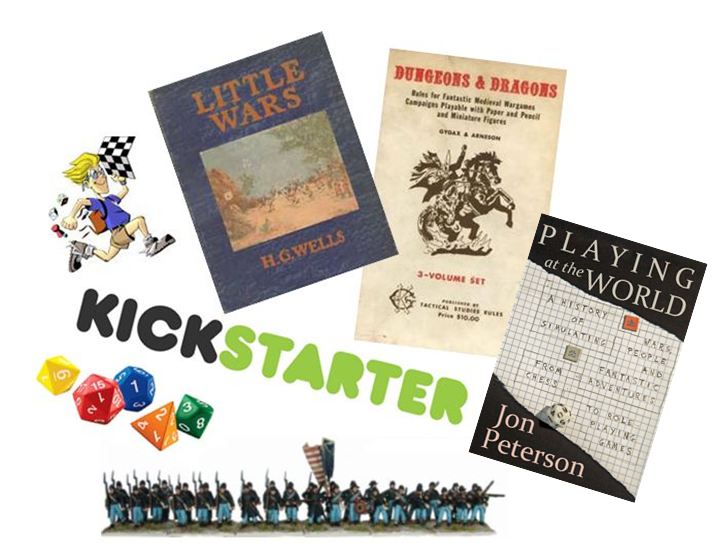
I was pleasantly surprised to open the back page of this past weekend’s New York Times Sunday Book Review section to an article on the 100th anniversary of H.G. Wells’ “Little Wars.” The book’s Edwardian-era style, classism and occasional not-so-thinly-veiled sexism is mixed with the mechanics of a gaming system which makes it a relevant read even today.  Before “Little Wars,” wargaming had largely resided in Europe’s war colleges and in the parlors of the ruling elite. Even with its English intellectual, upper-crust trappings, “Little Wars” sought to expand the popularity of wargaming. As the article points out, “Little Wars” is an important foundational document and should be required reading for those who are interested in how we’ve arrived at the business of gaming on the tabletops and screens of the world today.

“Little Wars” is widely available for free online and for e-readers today, and “ownership” of gaming is largely the subject of a post today on BoingBoing about Dungeons & Dragons retro-gamers. Whether driven by nostalgia or as a reaction to corporate ownership of a beloved game of their youth, “old school” D&D gamers stress what they believe to be a truer game style more focused on role-playing and less-so on action-driven play. To stay relevant to a new generation brought up on CGI special effects, so the argument goes, the now-owners of D&D Wizards of the Coast have increasingly made the game more combat-heavy (read: more like video games). In reaction to this, retro D&D gamers have created an increasingly-active community of story-driven gamers who look to old rules for inspiration. The ability to share thoughts, opinions and out-of-print rulesets online has only fuelled the movement.

Old school gamers are just the latest combatants  in the war over gaming. The history of wargaming rules development winds its way from military schools and H.G. Wells to postal games and strategy boardgames in the mid-20th century. Games and rules were more fluid in the 1940s-60s where there was little profit to be had in wargaming, and a big part of the gaming community was in the debates over what rules were the most realistic or playable. With a few exceptions, ownership in those days was based more on pride and ego than copyrights and profit. This timeline is well-documented in Jon Peterson’s “Playing At The World” which finally arrives at the early days of D&D.  Even before D&D made the great leap into a world-wide phenomemon there were arguments and accustaions over copyright and ownership. Peterson’s recent analysis of a transitional draft of D&D (the Dalluhn Manuscript) not only adds greater nuanace to the development of the rules themselves but I think also provides another chapter on the concepts of evolutionary, intellectual and legal ownership of games.

Much of the digital conversation today — whether about games, photos, movies or music — hinges on the topics of openness, control and copyright. Along with the free and independent gaming forums and sites, we’ve now been given a new frontier of games on Kickstarter. What used to take years (or even decades) of slow development and debate by word-of-mouth fanzines and postal newsletters, Kickstarter achieves in weeks or days. Players vote with their wallets in support of games which can now easily garner six and seven-figure funding levels, all but guaranteeing a fanbase that literally buys-in at the ground floor. Sites like BoardGameGeek can help make or break the success of a new game and then go on to serve as R&D for game expansions, rule variations and subsequent editions.

A hundred years after “Little Wars” pulled the ownership of wargaming out of the fists of Europe’s elite, we’re still warring over our games. Copyright laws, digital distribution and individual financial investment will continue to shape the next hundred years of the ownership conversation, but gaming is certain to remain a very personal investment for some time to come, too.

New Game Weekend: Fortune and Glory

By the time Raiders of the Lost Ark hit the theaters in the summer of 1981, my newly-teenaged brain was already well-steeped in the concept of high-adventure cliffhanger movies and serials. For most kids, Indiana Jones kicked-off a mini-rival in interest in the danger-thwarting, jungle-hacking, mystery-unraveling and treasure-seeking characters that populated decades of Saturday afternoons in local movie theaters for my parent’s generation and earlier. The elements of cliffhangers are so ingrained in our pop culture to this day that I challenge you to find a popular TV show, action movie, comic book or video game that doesn’t borrow some element from the genre.

One of the best things about the gaming hobby is that you can pretty much be guaranteed there’s a a game (or several) that aligns with a just about any thematic interest. So, this past weekend at Metropolitan Wargamers I had a chance to try out taking on the role of an international adventurer with 2011’s Fortune and Glory from Flying Frog Games.

The game takes place in the between-the-wars period of the 1930s where mobsters and Nazis vie for international control while your adventuring character roams the world searching for fantastic objects of great value and power. Players take on one of eight fantastically-named personalities such as Li Mie Chen, The Duke, Jake Zane, Sharon Hunter, Dr. Zhukov, Shelley Hargrove, Jacques Moreau and Cartwright (all pictured below, left to right and top to bottom). Each player character comes with their own set of special abilities and attributes such as Cunning, Lore, Combat and Agility. These attribute strengths come into play as characters roll dice to resolve their success during certain encounters within the game adventures.


The game begins by placing artifacts in random locations around the globe. Players move their characters toward these objects and upon encountering them, roll dice in a three-part attempt to resolve their quest. The thing that makes Fortune and Glory so entertaining is the random mechanic of drawing cards to create objects of the quests and the adventures themselves.

For instance, in our game (pictured at right) a quest for a magical sword unveiled an adventure that involved solving a mysterious puzzle, a high speed car chase and a final airplane chase. Failing to roll successfully against the high speed car chase challenge wound up in a “cliffhanger” on the reverse of the card which led to the car going over a cliff. All this detail is related on the well-illustrated adventure cards and left to the players to dramatically read aloud, often to great mirth around the board. Other encounters during our game included a shootout in a nightclub, a case of malria in the jungles of the Amazon and an unsuccessful encounter with a Yeti in the northern steppes of Russia. With hundreds of cards available in the game, there is endless variety to the how each adventure will play out. All this contributes significantly to the high replay value of Fortune and Glory.

Aside from all the cards, there are over 150 miniatures included for character adventurers, Nazis, mobsters, temples and a zepplin which randomly drops new Nazi henchman around the board as the game progresses. Plastic gold coins mark your progress toward gaining “fortune” and may be spent to further outfit your adventurer with guns, maps and even an airplane. In the end, collecting blue plastic “glory” coins points the way toward victory for our heroes or the villains.

We played the game collaboratively, allowing us to work together with each of our own abilities contributing toward our march toward glory and victory. A competitive set of rules options is also included which completely changes the dynamic to duelling adventurers questing toward individual glory.

Fortune and Glory carries a hefty retail price of about $100 but can be found for around $75 online. However, the investment in this big, heavy box is well worth it with the gorgeous design and endless randomness to the game providing a hugely entertaining world of cliffhanging adventure. Fortune and Glory is certain to keep you on the edge of your seat and may  even cause you to spill your popcorn if you’re not careful.

The History of Games in Western New York

I grew up in Western New York State about 40 miles South of Rochester. To my childhood self, going to Rochester was “going to the city.” Rochester was where I headed for big touring concerts, independent movies and museums. On my rare trips home these days, one of my favorites and one of the more unique museums to visit in Rochester remains the National Museum of Play.

Opened in the early 1980s, the National Museum of Play grew out of the Strong Museum and the collection of industrial heiress Margaret Woodbury Strong. The museum originally housed the enormous doll and toy collection Strong acquired over decades of worldwide travel in the first half of the 20th-century. In the past 30 years, the mission of the museum has evolved to be one of the preeminent repositories and exhibitors of toys, games, video games, dolls, action figures, children’s books and all things devoted to occupying the childhood development of children through that most basic of juvenile pursuits: play.

Among its collections, the museum has risen to prominence in the past few years with the opening of the International Center for the History of Electronic Games. The ICHEG publicly displays some 140 playable classic video arcade games and also maintains an archive of hundreds of thousands gaming systems, games, advertisements, manuals, corporate documents and other ephemera devoted to video games from their earliest development to their contemporary innovations and cultural dominance.

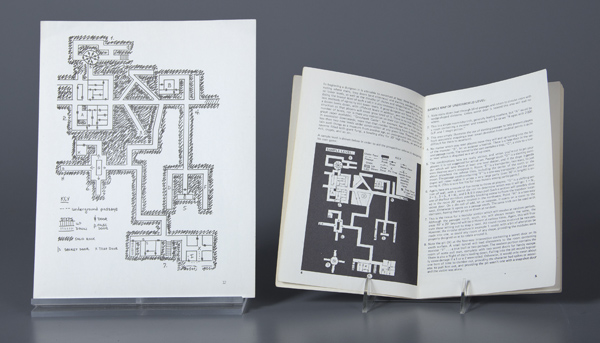
The museum made news this past week with the announcement of the temporary display of the “Dalluhn Manuscript” (photo at right) in their newest permanent exhibit called Game Time! This space will eventually devote the entire second floor of the museum to the history of American play through a series of interactive exhibits. The Dalluhn Manuscript is important as what is the earliest know draft of what would eventually become the world-changing game Dungeons & Dragons. The manuscript is on loan from Jon Peterson whose massive book “Playing At The World” took the scholarly investigation of the history of strategic gaming to new heights when it was published last year. Peterson has updated his book with a free appendix available through his blog that delves deep into the significance of the manuscript on display in Rochester. If you’ve read his book or have any desire to take a rare peek into the minutiae of how D&D came about, seeing this piece of gaming legend is a must-do over the coming months. Think of it as the Magna Carta or a first draft of the Declaration of Independence for gamers and you’ll have some idea of what a treasure these few pages are.

In general, I would urge anyone interested in games and play to visit the National Museum of Play in Rochester. It’s one of those rare museums where people of all ages will truly find something that speaks to them. If you can’t make it to Rochester, take a spin through their online archives where thousands of photos of toys, dolls and games are on view. With centuries of play behind us and unknown adventures ahead, a trip through our shared history is almost as enjoyable as a few hours of play itself.

New Game Weekend: Zombicide

My weekend of gaming started with a regular meeting of the Metropolitan Wargamers club where new members — including myself — were inducted. With a couple dozen guys in attendance, it was great to look around the room and feel the fellowship with a group with decades of gaming passion in them. I’m looking forward to years to come with these guys and the inevitable newcomers who find their way to the club.
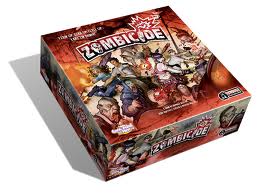
After the meeting, groups split off into a variety of board and miniatures games. I teamed up with four guys for my first playing of Zombicide. Anyone with a pulse knows zombies have been a huge trend in the culture for a few years now with the popularity of the The Walking Dead TV show and comic book series, as well as countless other books, movies and video games. Tabletop gamers haven’t been immune to the trend with a variety of popular zombie-themed miniature and boardgames rising in popularity. I’ve enjoyed playing Zombies!!! and a few of its expansions with my kids for a couple years now, and Last Night On Earth has become a mainstay for zombie gamers.

Zombicide is the latest to break into this gaming trend pitting survivors against undead hoards. The game was launched via a Kickstarter campaign just about a year ago that brought in over $750,000 from over 5,000 backers. In March of this year, the first expansion set for the game — Zombicide: Season 2 — raised an additional $2.250 million from nearly 9,000 funders. Needless to say, in a year’s time Zombicide has ridden the zombie wave to incredible heights of popularity with a rabid fan base.
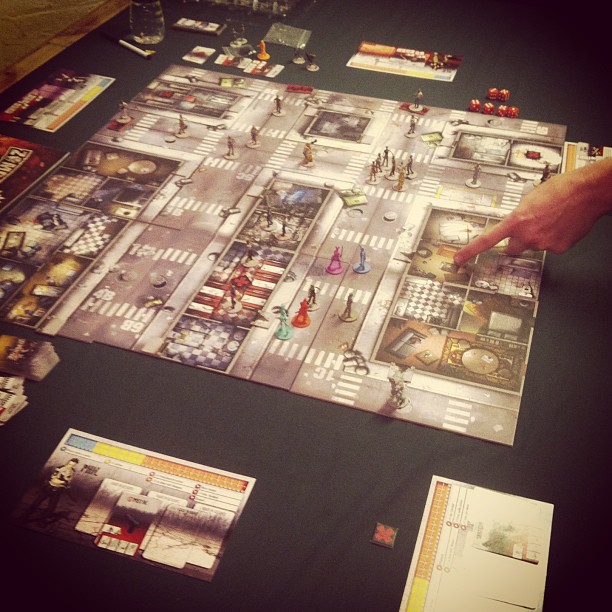
My first run through Zombicide was a tough introduction to both the goofy fun and extreme challenge of the game. Each player takes the role of survivor of the zombie apocalypse with its own card outlining their particular abilities and a personalized miniature. A streetscape of wonderfully detailed and gory cardboard tiles is laid out according to one of the ten scenarios included in the base game. To complete the set-up, areas are predefined where zombies enter the game, doors are set in buildings, objectives are placed, and, depending on the scenario, special pieces such as a police car is strewn throughout the town. Over 60 zombie miniatures in four varieties — Walkers, Runners, Fatties and the Abomination — start the game at the town’s edge, just waiting to sink their teeth into a juicy survivor.
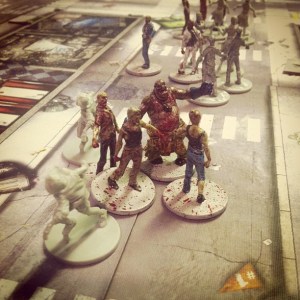
Players work collaboratively using a base three actions to move, search and/or fight zombies both on the street and in buildings. Searching allows a player to draw cards to find weapons, ammunition, gear and other special items which increase their chances of surviving the zombie onslaught to come. Since each player starts with only a frying pan as a weapon, searching for weapons is a focus from the start. Players manage what items they carry in their hands or on their person, and players may also choose to trade or simply give items to their compatriots to increase the group’s overall chances. Certain items are used in combination, adding a scavenger hunt aspect to the game. For instance, a scope added to a rifle creates a more accurate and deadly long-range weapon, and a can of gasoline combined with some empty bottles makes for a devastating molotov cocktail.

It’s when the zombies start filling the board at the end of a round of turns by the players that collected weapons and other gear become critical. Melee weapons like baseball bats, axes, machetes and chainsaws are used for close-quarters fighting with zombies while ranged weapons such as pistols, shotguns and submachine guns come into play with longer ranged combat. Certain characters or weapon types allow for weapons to be used in each hand, doubling the survivor’s visciousness when tangling with the undead. In other cases, powerful weapons like shotguns or a molotov cocktail are critical when trying to destroy more powerful zombies like Fatties or the enormous, shambling Abomination.

As the turns elapse and zombies are killed, the players advance in experience which gains them the bonus of extra abilities. The downside from this gain in experience is that zombies begin coming onto the board in greater numbers. Because of this, players need to work together to balance the team’s experience level against the amped-up presence of zombies. Zombies move en masse toward noise created by gunshots or doors being broken down, so players also have to make smart decisions as a group on when to take a chance in making noise and attracting the growing hoard of zombies. Getting attacked twice by a zombie means almost certain death for any survivor on the board.

The rules to Zombicide are pretty simple, but the game gets wild very, very fast as the streets and buildings quickly fill up with the undead. It’s one of the better collaborative boardgames I’ve played in recent memory. Players working in tandem or even sacrificing themselves for the greater good gives the game its spice and replay value. In my first game, three of the five of us were felled quickly by the zombies while the other two players managed to trick out their survivors with a plethora of weapons and fight on.

The combination of beautiful design (only improved by painting the miniatures as in the photos from today’s game above), simple rules and pretty steep odds stacked against the players has made Zombicide popular. We were kidding around during our game that if a real zombie apocalypse were to come, sticking close to our fellow members of the club might just mean the difference between life and death. After a couple hours running and slugging away at zombies in Zombicide today, that notion seemed more real than just mere joking speculation.
Downloading: The General


In our highly-digitized world of everything fandom, it’s hard to remember there was a day where a primary lifeline for fans was via the mail. While gaming enthusiasts played games by post and created their own newsletters for small cliques of fellow gamers, it was game publisher Avalon Hill that created the first widely read and regularly published magazine for the strategic wargaming hobby.

Beginning in 1964, The General served as the bi-monthly house newsletter for AH. The General provided regular space for articles on new AH products, debates on variant rules, announcements of gaming conventions and a place where gaming fans could connect with each other on a regular basis. With games like Outdoor Survival, Tactics, Gettsyburg, Blitzkrieg and Panzerblitz, AH ruled the early years of the nascent gaming hobby through their formula of bookshelf games of hexagonal maps, cardboard markers and detailed rulesets full of charts. It was not until the arrival of TSR and their culture-changing Dungeons & Dragons in the early 1970s that AH would face serious competition as gaming shifted from board games to role-playing. By the time AH was acquired by Hasbro in the late 1990s, the world of gaming had changed considerably and The General was shuttered.

In Jon Peterson’s masterful book “Playing At The World,” he tracks the development of the wargaming hobby using The General, TSR’s own Dragon magazine and dozens of smaller lesser-known newsletters as primary sources. For those of us who have wished for a deeper view into the early days of our hobby, the Internet Archive has now made PDFs of The General available. With just a few cursory early looks, having access to this archive of our own history is certain to be an incredible asset for wargamers.