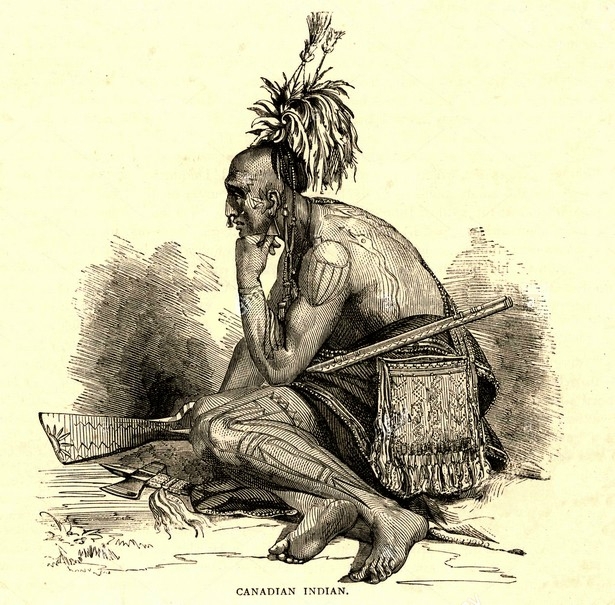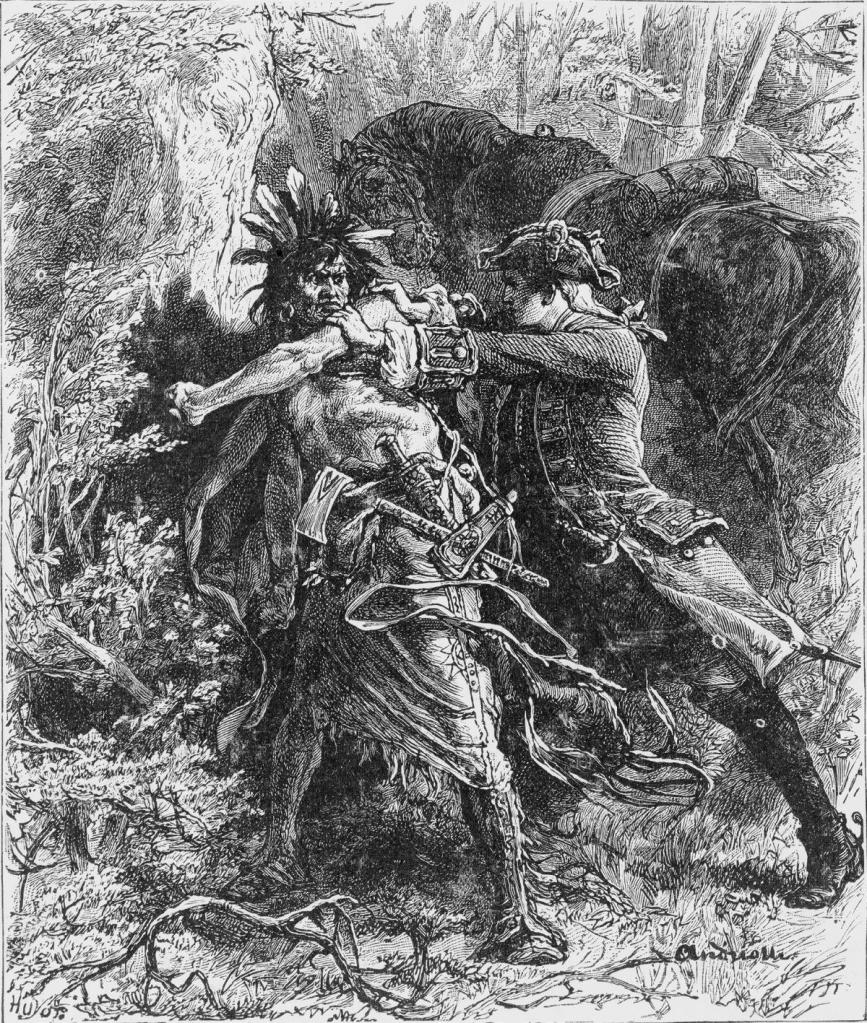
French and Indian War: French Regulars from AW Miniatures

The majority of my French figures for my French and Indian War collection tend toward irregular Canadian miltia and Compagnies Franches de la Marine troops. To supplement them, I’ve endevoured to add some models to represent more regular French troops to the mix that became a greater battlefield presence particularly as the war went on.

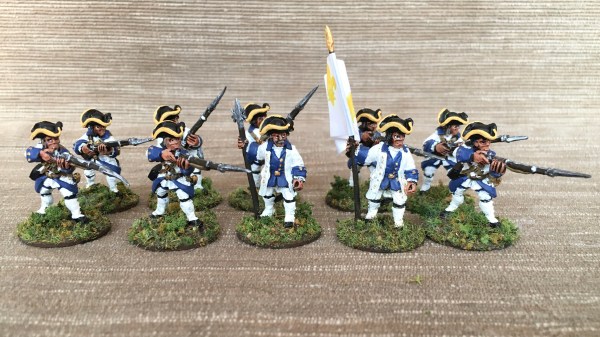
For my French regular troops, I first turned to UK-based AW Miniatures for their stout 28mm scupts which scale well with most of my other figures. To create two units, I picked up two of their eight-packs of French regular infantry (FIW30) and supplemented them with a three-pack of French regular command (FIW31) and one additional standard bearer (FIW37).

Together, this gave me two ten-figure units of French regulars. I like the mix of poses and headwear, as well as their bayonets tipping their muskets. One officer, my favorite of the bunch, sports a broad mustache with a sword at the ready and a commanding hand pointing his troops forward. For the standard bearers, I printed period French flags on paper, attached and stiffened them with white glue.

I am not generally a fan of painting white uniforms, but the blue waistcoats, lapels and cuffs, as well as the yellow-trimmed tricornes, provide a pretty stunningly graphic contrast. Once deployed, twenty of these French regulars on the table in a double-ranked firing line really present an imposing force as they must have in the many of the pivotal FIW battles in which they fought.

French and Indian War: Compagnie Franches de la Marine from Galloping Major Wargames

Fan favorite Galloping Major Wargames launched its second Kickstarter campaign in July 2017 with a line featuring Compagnies Franches de la Marine. Billed as “regular soldiers recruited in France for colonial service,” this 28mm campaign added seven new packs to their catalog, plus a single character figure which instantly became one of my favorite.

I ordered three packs of figures (FIW FCFI, FIW FCF2 and FIW FC3) featuring soldiers and command clad in “Canadian/outpost” clothes and wearing a mix of bonnets and tuques. I chose to paint them up in a variety of colors so they mix equally well with my Canadian militia units or stand alone as recruited French soldiers.

These soldiers were commonly posted at forts and fought in battles all across the French and Indian War era, so they come in pretty useful in a lot of gaming scenarios. Overall the poses are pretty basic in loading, at the ready, advancing and firing, with a little extra personality in the command figures. Other figures in the Kickstarter featured more formal short jackets and tricorne hats, and the entire range is now available for sale through the company’s website.

The gem of the entire offering is the individual Daniel Hyacinthe de Lienard de Beaujeau figure. A Canadian officer and veteran of King George’s War, Beaujeau was an inspiration to his men and often led them into battle bare-chested and dressed in Indian garb. He died in the opening minutes of the Battle of the Monongahela in July 1755 and remains a somewhat legendary character of the FIW period.

I’m always glad to add more Galloping Major figures to my collection, and the Beaujeau figure really made this campaign worth it.

French and Indian War: Civilians and Working Pioneers from Redoubt Enterprises

I’m always on the hunt for different kinds of figures, poses and little stories to tell by scouring through the offerings of as many manufacturers I can find. I’ve been adding more figures from Redoubt Enterprises to my French and Indian War collection, and I’ve found a number of their civilians to be good additions.

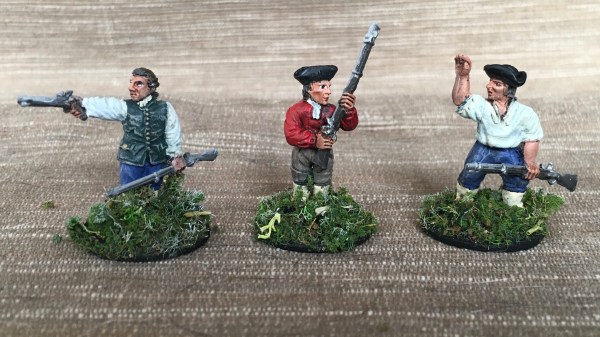
A pack of six figures of standing and firing settlers has a nice amount of diversity in poses. Two men stand at the ready, two are firing and another is waving them on in encouragement. My favorite in the set is the sculpt of the rather distinguished gentleman with a pistol extended at arm’s length to calmyly fire. I also like that half the figures are not wearing hats like the vast majority of figures found for this 18th-century colonial era.

Another kind of figure that is hard to come by is basic laborers, like those so important to the wilderness campaigns of the FIW period. Luckily, Redoubt has a very specific set of working pioneers found deep into their exetensive catalog. The package comes with two men moving fallen timber and another swinging an axe. All three wear the heavy leather aprons that worn by men doing this rough forest-clearing work.

Overseeing them and on guard are three soldiers, also included in the pack. I’ve painted them up as somewhat generic British provincials, and I usually field them with other colonial units. The six of them together on the table can find their way into a number of scenarios, especially as the lead units in the Braddock Expedition at the Battle of the Monongahela.

Combined with my wagons and other workers, these figures create opportunities to tell more of the story of the FIW. Beyond soldiers, it was the average settlers who were rallied to work or fight for both the French and British during the war. It’s great to discover more figures to act as characters in these tabletop wargaming dramas.

French and Indian War: Civilians and Settlers from Galloping Major Wargames

Gaming the scerios in the 18th-century wilderness settlement period of the French and Indian War period necessitates having some civilians models on hand. Aside from hacking an existence out of the American wilderness, settlers were often pressed into service as hastily organized militia. Incorporating this part of the era’s story into tabletop wargames makes for a lot of interest for fans of the period.

One of the most popular modern manufacturers of FIW 28mm metal miniatures is the UK-based Galloping Major Wargames. Born from the artistic skill of Lance Cawkwell, the company offers a big, ever-expanding line of figures for the period. Aside from the usual fighting units of British, French and Indian, Galloping Major carries a small selection of civilian settlers defending their homes and families, all of which I’ve snapped up.

To myself and many others, Galloping Major sculpts carry two main identifying characterics: size and personality. As 28mm models, these are defintely among some of the largest being made today. The casts are big and chunky — models hefty to hold, a joy to paint and a wonder on the table. While they may outsize some other manufacturers that veer more toward a thinner 28mm or 25mm scale, I find nothing about these models that ever makes them look too out of place with other figures once on the table.

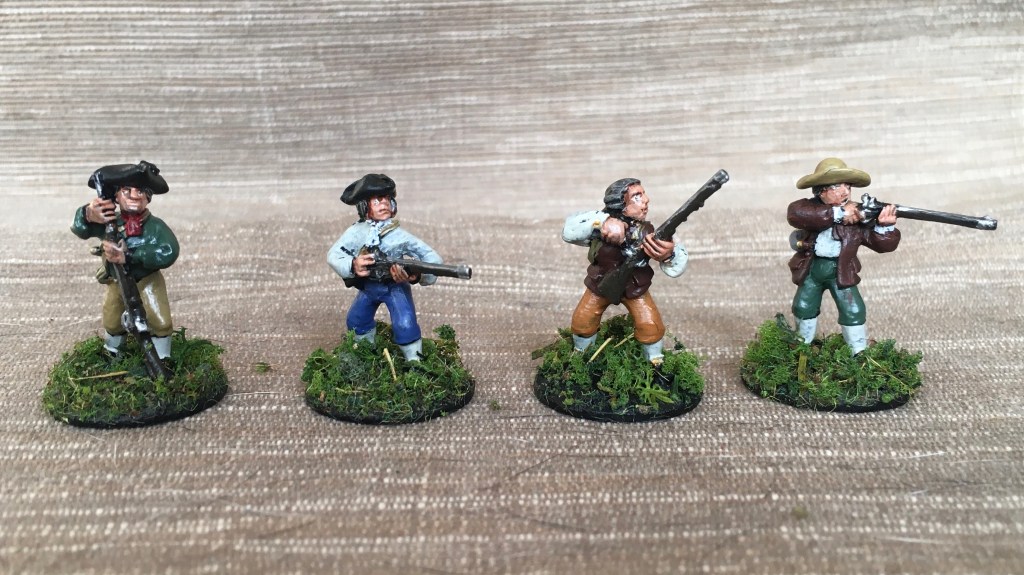
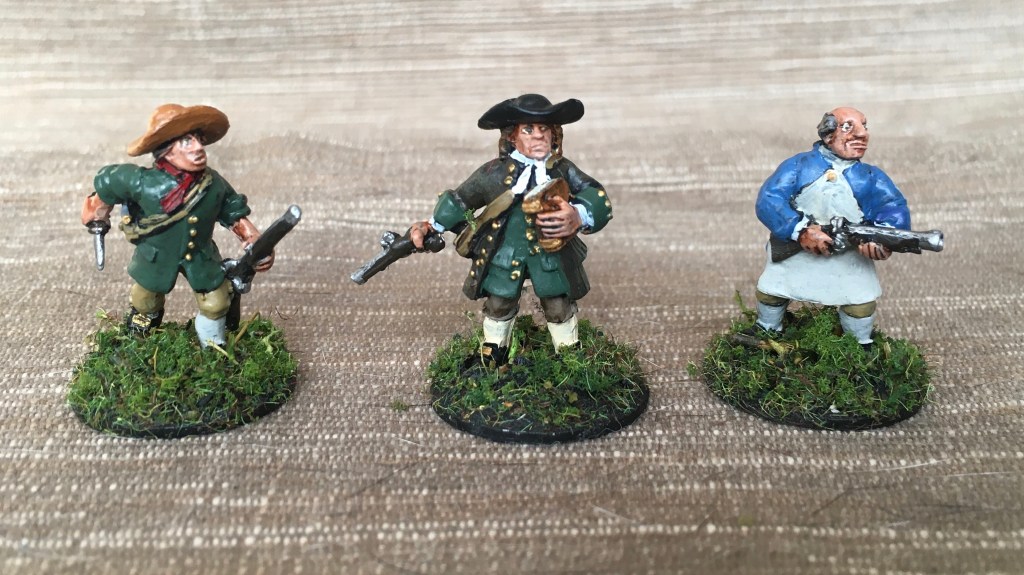
In terms of detail and character, the company’s models are among some of the best. Particularly with these civilian figures, there is a lot of indiviuality here. The Settlers Defending packs (FIW AAC 1 and FIW AAC 2) contain a total of a dozen figures armed with guns, clad in everday clothes and topped with tricorne or broad round hats.

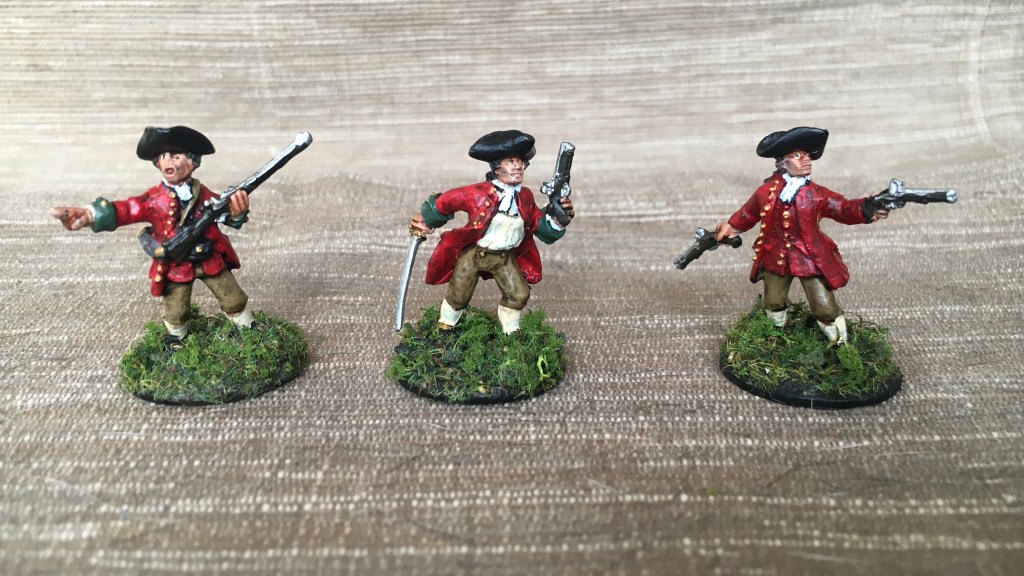
The real prize are the six figures in the Command and Characters pack (FIW AAC3) which contains an aproned baker or butcher armed with a blunderbuss, a preacher toting a bible and pistol, and, a man on the run with a knife drawn with a gun at the ready. The other three figures, perhaps local community leaders, are more formally dressed in long, lapelled coats and armed with pistols and swords. I chose to paint them up in provincial officer uniforms.

Having dozens of Galloping Major models, including all these civilian settlers, in my collection provides a variety of options and play opportunity, and I’m always looking forward to painting the next one.

French and Indian War: Woodland Indians from Sash and Saber Castings

In the summer of 2018, Sash and Saber Castings launched a Kickstarter for one of the most massively comprehensive lines of French and Indian War miniatures available. Owner and designer Chris Hughes has proven himself over the past 20 years in creating a huge catalog of metal 40mm and 28mm miniatures spanning hundreds of years of military history. His 28mm FIW launch was quickly funded by campaign backers, unlocked a number of stretch goals along the way, and shipping proceeded at a swift pace by the spring of 2019.

The miniatures in the Sash and Saber FIW collection cover British, French, Indian soldiers, warriors, mounted leaders, casualties, artillery and civilians of all types over some 100 different packs of four figures each. Less common models such as figures in winter clothes on snowshoes and some much-needed women and children help make this offering one of the most welcome and unique offerings for the period.

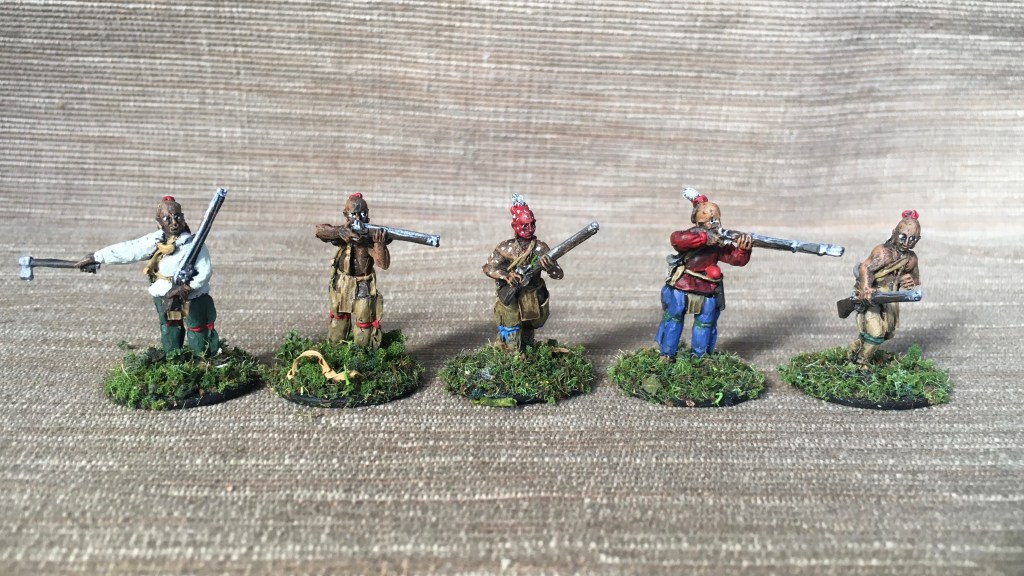
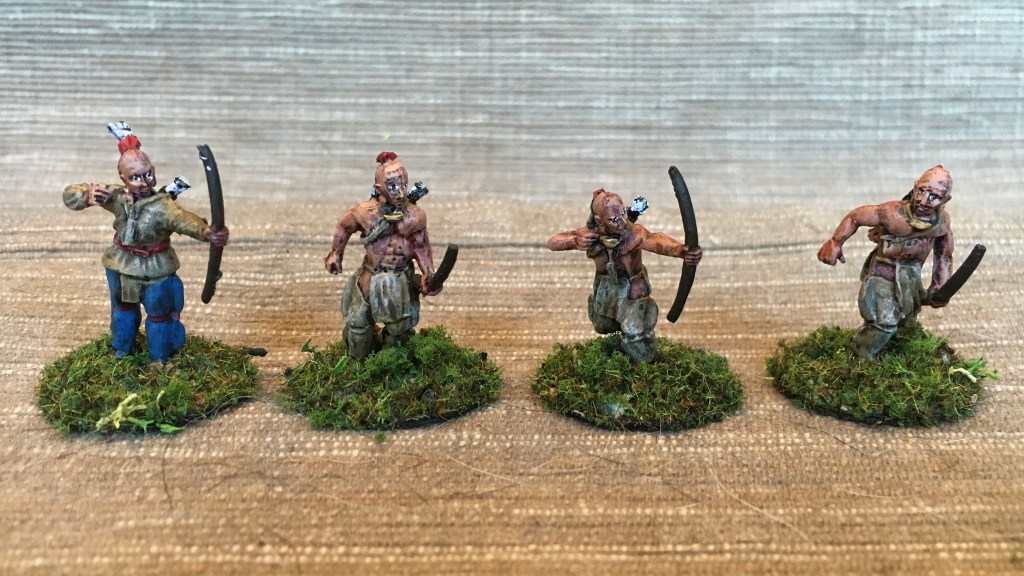
I ordered a bunch of British Provincials and several of the Indian packs, including Iroquois Firing (FW11), Iroquois Advancing (FW13), Iroquois with Clubs and Tomahawks, Iroquois with Bows (FW15) and Iroquois Leaders (FW1201). The figures carry a lot of detail in sculpts that lean a bit on a more natural scale tipping a bit toward 25mm rather than the chunkier, heroic figures found in other manufacturer lines. Many of the Iroquois come dressed in more European-influenced trade clothes while some wear more traditional bucksin leggings and loincloths, both styles reflecting the evolving culture clash of the 18th-century frontier.

The full line is now available on the company’s website, retailing for $8 a pack. With some of these models already gracing my tabletop scenarios, I’ll be certain to be slowly adding more to my collection over time.

French and Indian War: Woodland Indians from AW Miniatures

The relative newcomer AW Miniatures has been at it for about ten years, producing unique ranges of metal figures for familiar periods. This largely one-man, UK company has put out lines for the American Civil War, the Samurai period, the Seven Years War, the Zulu War and the Sudan War.

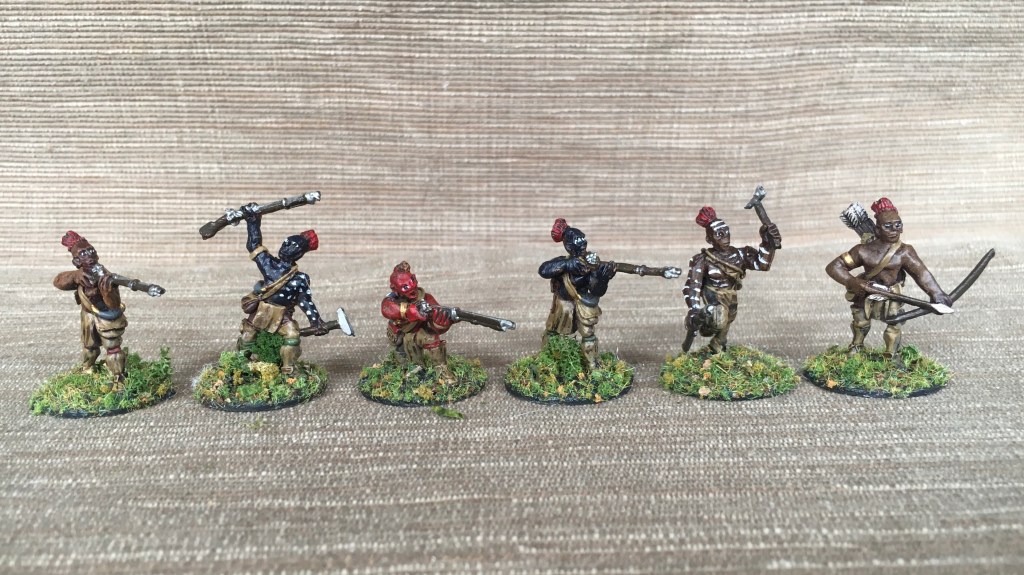
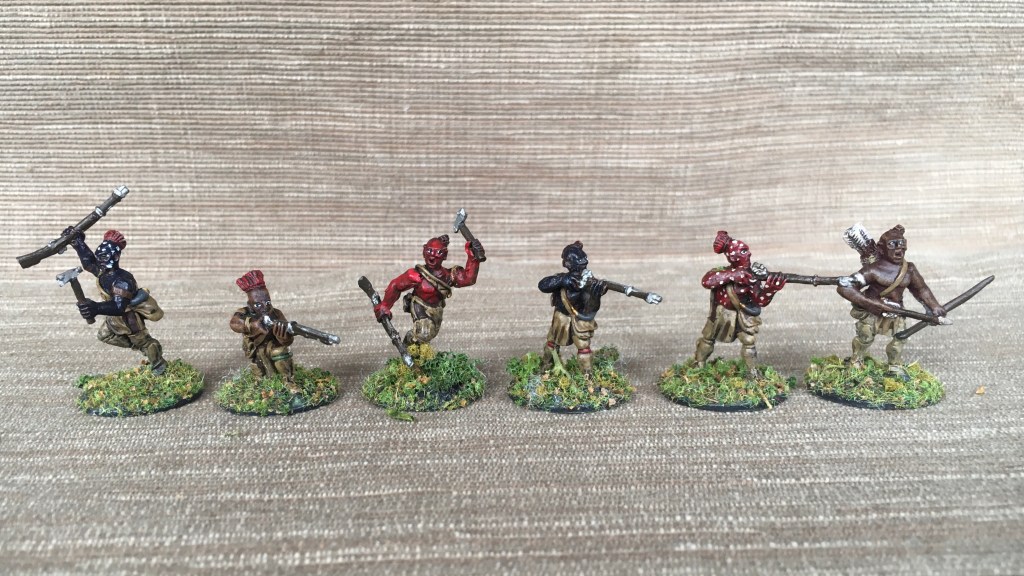
The French and Indian War line is fairly broad, and I have a number of their figures to my collection. The Indian War Party pack offers a nice mix of 20 Indians, including bowmen and figures armed with muskets and hatchets. The bowmen are a bit on the chucky side and the other figures are a bit thinner, all falling within a 25 to 28mm scale.

Many of the casts are obviously modelled off a similar base sculpt with additions and alterations to details like headwear. The figures on the run come with arms to be glued on, allowing for a bit of variety in final poses. To create some additional personality, I chose to empahisize body paint on my models which fit in nicely with my other units on the table.

French and Indian War: Woodland Indians from Redoubt Enterprises – Raiders and Sachems

The UK-based Redoubt Enterprises carries an enormous variety of metal miniatures including pirates, ancients, Renaissance, English Civil War, American Civil War, Napoleonics and several ranges of colonials figures, icluding nearly 200 separate choices of models for the French and Indian War.

Their FIW line includes vast selections of British, French and Indian models, including warriors, canoes and civillians. Sculpts from Redoubt tend toward a traditional, heroic scale that tips heavily toward 28mm with chunky casts filled with unique personality that are a joy to paint and really pop on the table.

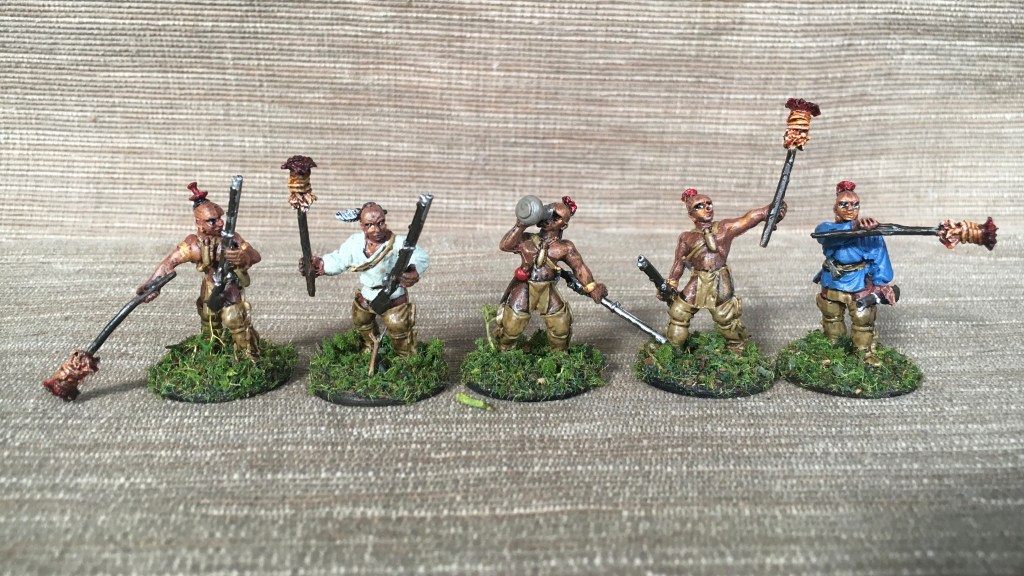
The ‘warriors with firebrands’ pack includes a raiding party, armed with blazing torches and a leader drinking from a clay vessel. The models are great for attacks on villages, farms and fortifications on the frontier. These are unique, ferocious characters modelled to bring high drama to the tabletop.

Another favorite is the ‘sachems and warchiefs’ set. These models are a mix of calm Indian leaders wrapped in a blanket with a mystical crow’s wing, holding forth a wampum belt and standing gracefully in a commanding pose. Others in the pack show more agressive leaders on the run and commanding their people in the field, looking to roll back the onslaught of European incurisions into their lands.

Both sets have brought a great deal of variety and personality to the regular warrior models from other manufacturers in my collection — moreso than just about almost any other company. For miniatures wargaming, they offer an opportunity to inject roleplay into games with the story each sculpt looks to tell — a welcome place in any gaming session with a wide range of characters to act.

Boardgames of the French and Indian War – Part II

Battle of Fort William McHenry during French and Indian War

Quite some time ago, I wrote a round-up of my favorite boardgames of the French and Indian War. Since then I’ve been focusing pretty exclusively on the FIW using 28mm miniatures and Muskets & Tomahawks. I’ve also spent a lot of time over the past year reading about the period and visiting historic sites in New York, Pennsylvania, Virginia, Maryland and West Virginia that tell the story of the FIW.

Between travel, research, painting miniatures, building scenery and running through tabletop scenarios of the period, I’ve continued to build up my collection of FIW-themed boardgames. With that, I have a second list of more of my favorites from this empire-defining conflict in North America.
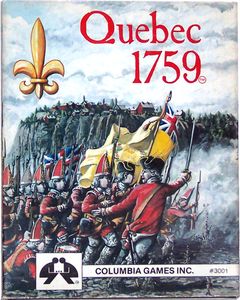
Image result for quebec 1759 game columbia

Quebec 1759 (Columbia Games)

You can’t beat Columbia Games for their quick-playing and unique block games for which they are known. I have Liberty: The American Revolution 1775-83, their American Revolution game, on my shelf, and about a year ago I finally to picked up a copy of their FIW game Quebec 1759.

Released in 1972, Quebec 1759 was one of the first block wargames produced and has remained in print for 45 years as a game perfect for entry level players as well as those experienced in the hobby. I’ve been trying to track down a first printing of the game for a while for the embossed blocks, but I couldn’t pass up a great deal on a 1980s edition with 50 stickered blocks for $20 at a convention flea market a couple years back.
IMG_1378

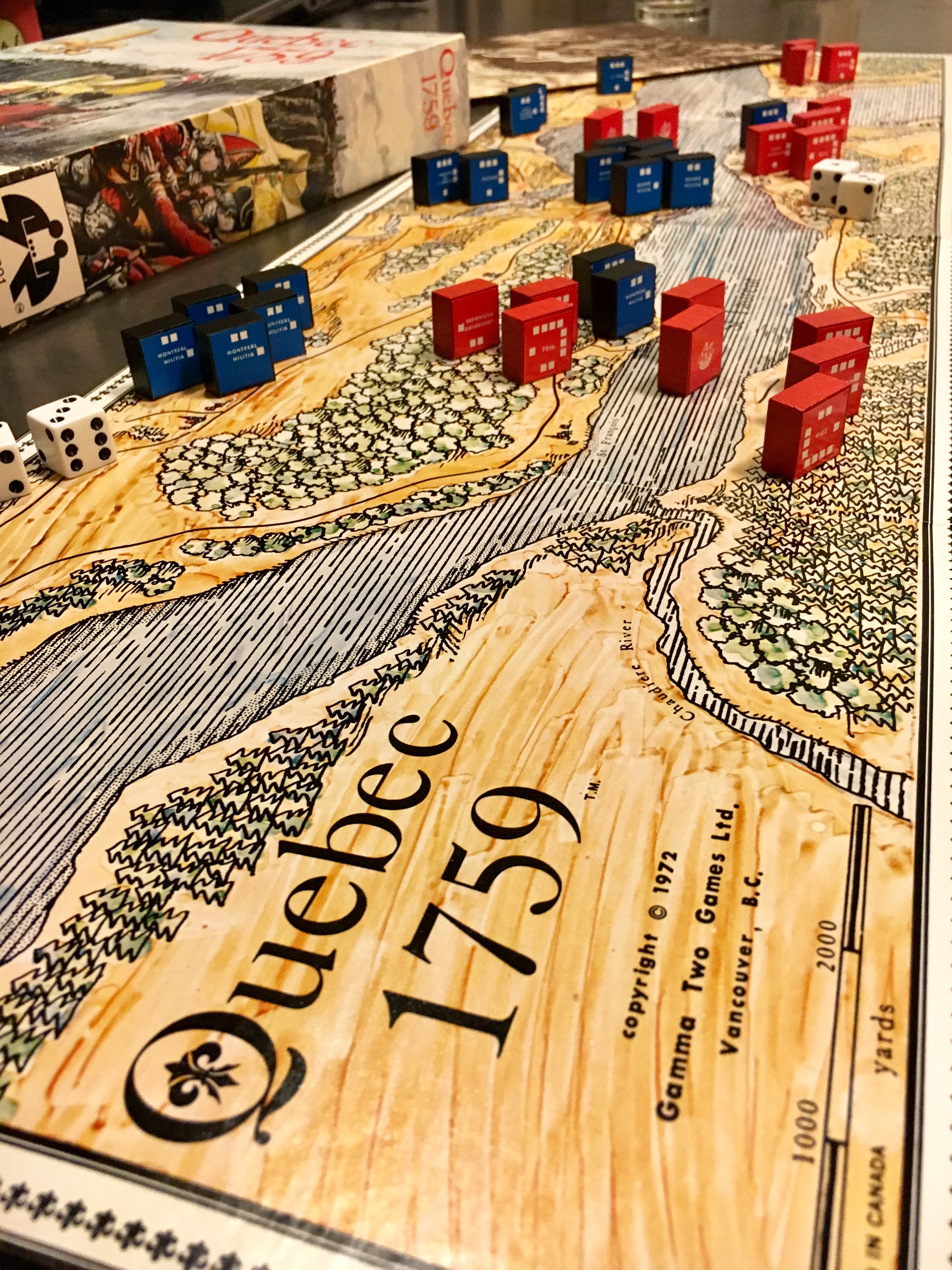
Map and wooden blocks from Quebec 1759

Playable in about an hour or so, this classic abstractly captures the meeting of the British forces led by James Wolfe and the French defenders commanded by Louis-Joseph de Montcalm in September 1759. The decisive Battle of the Plains of Abraham outside Quebec City left both men dead and was the beginning of the end of French rule in North America.

IMG_1379

Typical stickered wooden blocks from a mid-1980s edition of Quebec 1759

My near perfect copy captures the charm of the original edition with its signature wooden blocks, 10″ x 32″ elongated heavy cardboard map and a mere four pages of rules. The game is played over 16 turns with each side — British and French — plotting their moves in advance on paper and then simultaneously revealing them. There are no spaces on the map. Instead ten road-connected land zones and a bisected St. Lawrence River.

The game has remained a classic for a reason, notably its fast play that rewards numerous replays and taking turns on either side.
Related image

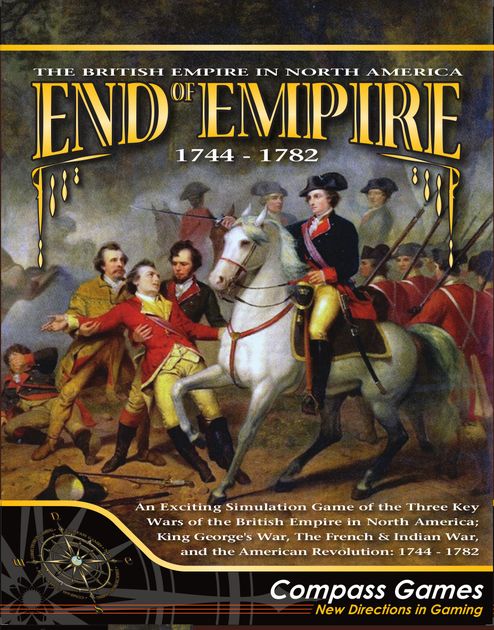
End of Empire: 1744-1782 (Compass Games)

Command was a bi-monthly magazine published between 1989 and 2001 which focused on military history, strategy and gaming. Issue 46 from December 1997 features articles on New France, the American Revolution, George Washington and his spy network, and famed traitor Benedict Arnold. The issue also contains a full hex and counter game called End of Empire which captures the grand sweep of North American history from the 1740s through early 1780s. The game was subsequently reprinted as a box game from Compass Games as End of Empire:1744-1782.

IMG_1375

My copy of Command #46 featuring End of Empire just prior to punching the counters

End of Empire covers a wide period from King George’s War, FIW and the American Revolution. Over a dozen scenarios allows play of specific conflicts or campaigns in a few hours, and a full game is playable over the whole period that will run to more than 15 hours for truly committed players. The game is regimental in scope with a huge hex map spanning the entire North American East Coast and contains hundreds of color counters representing British, French, Spanish, Indian and Colonial forces. For a real deep dive into nearly 40 years of colonial conflict, this is the game.

Wilderness Empires (Worthington Publishing)

I’m a big fan of Worthington Publishing’s games. I have three of their American Revolution games – New York 1776, Trenton 1776 and their latest, Saratoga 1777. The simple graphic maps and wooden blocks make Worthington’s games easy to grasp while also providing some great strategic play specific to the conditions of certain battles and campaigns.
IMG_1380

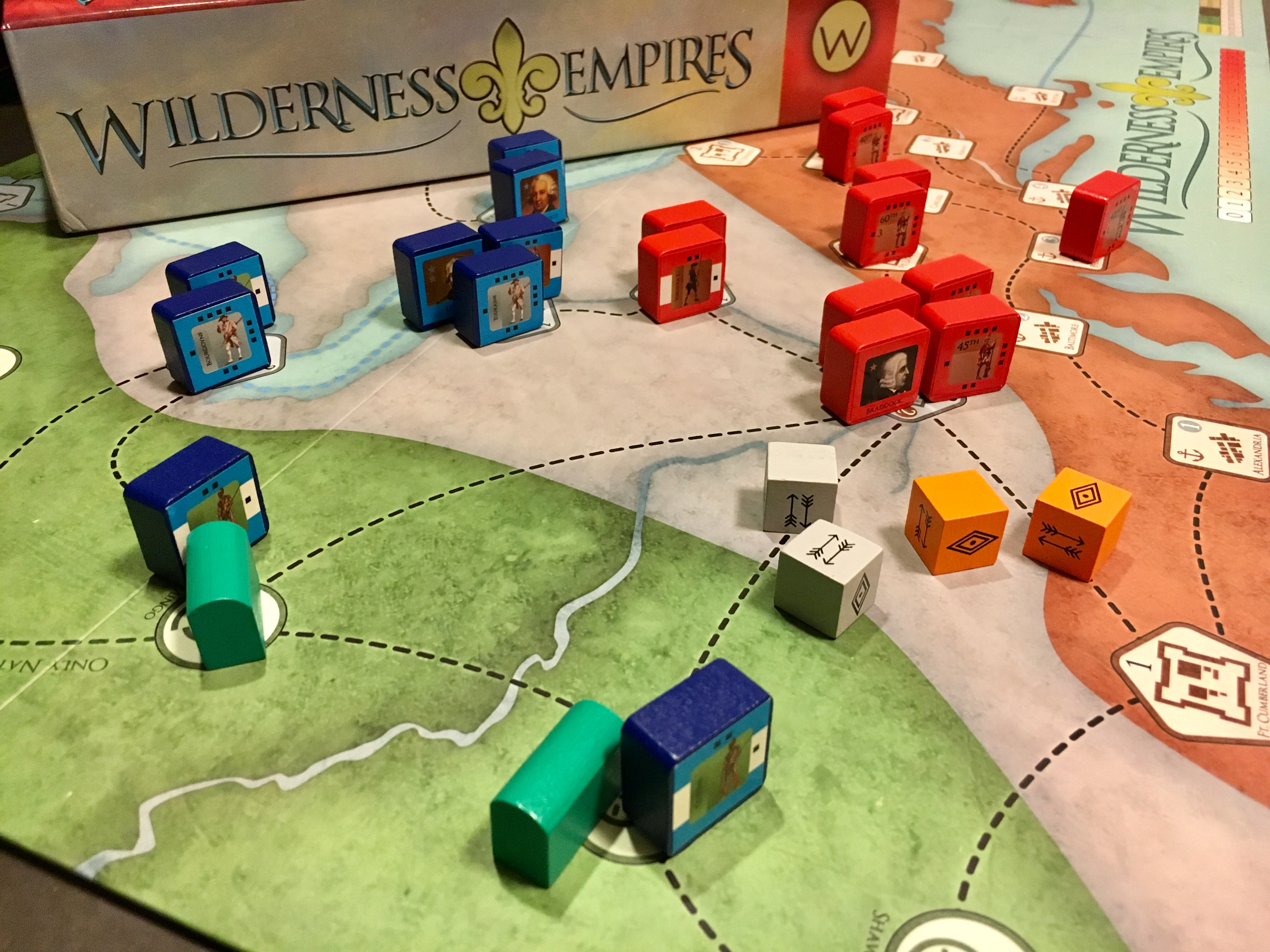
Map detail and wooden playing pieces from Wilderness Empires

With Wilderness Empires, most recently reprinted in 2016, Worthington captures the larger scope of the grand strategy of the FIW in a mix of point-to-point movement, blocks and cards. Designed by my pal Bill Molyneaux, a FIW reenactor and game designer, the game is steeped in real history while producing introductory level play of the period for 2-4 players.

IMG_1382

French (top) and British (bottom) cards from Wilderness Empire featuring original art by Don Troiani

The components are hefty 1″ wooden blocks with nicely rounded corners representing French, British and Indian forces. Indian towns, special wood dice, a large board and cards featuring beautiful original art by Don Troiani round out what’s in the box. Their artwork aside, the cards provide tactical play of reinforcements, leaders, campaign actions and specific play of historical units such as Rogers Rangers and Indian allies.

If you’re lucky, you can track down this recently out of print game in gift shops at various historical sites and forts in the northeast for a great intro to the period.
1759: The Siege of Quebec

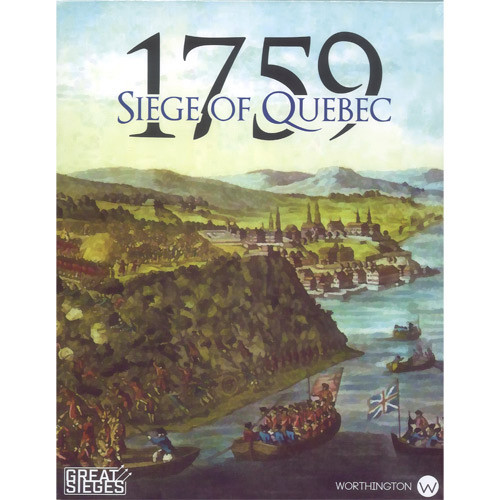
1759: Siege of Quebec (Worthington Publishing)

Worthington has also produced a new spin on the famed siege of the era with 1759: Siege of Quebec. The game presents a bit like the classic Columbia game covering the same battle but with a unique 2-in-1 package that allows for both 2-player and solo play, a rarity for games of the period.

Sample of Gameboard

The beautiful map for Worthington’s 1759: Siege of Quebec

This game is gorgeous. The area movement map is bisected with by the St. Lawrence River and has defined deployment areas for stickerless blue (French) and red (British) blocks. In the 2-player game, separate hands of Command Decision cards and Command Field Orders books allow each side to make selections on what they do each turn. Cards are revealed and resolved, with casualties and morale tracked toward victory. The solitaire game uses a separate set of cards but plays out in a similar way.

The game falls into the modern string of fast-play “lunchtime games” which typically run less than a half-hour, making 1759 a great modern spin on the often-covered battle.
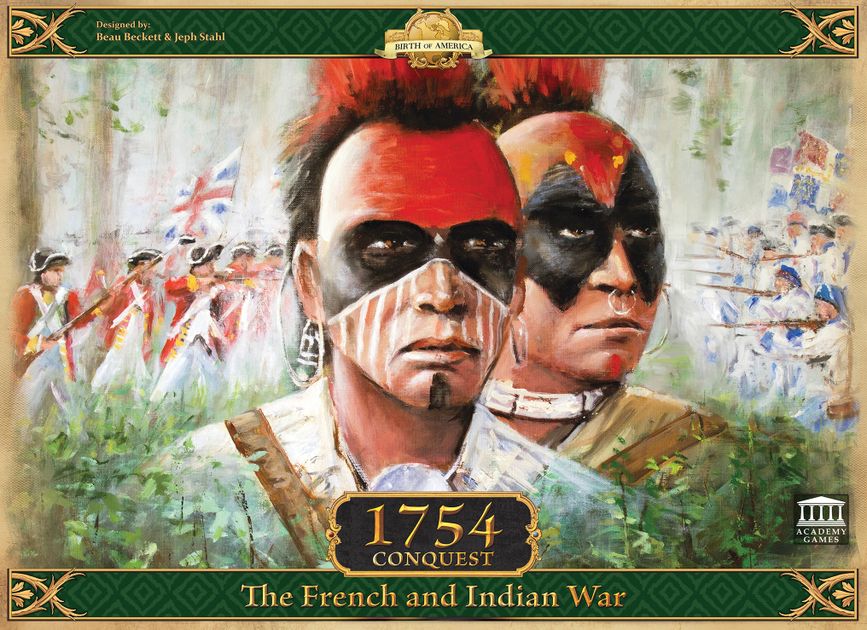
Image result for 1754 conquest academy games

1754: Conquest – The French and Indian War (Academy Games)

I’ve long been a devotee of Academy Games and their take on American history through their highly accessible and educational games. I have copies of their American Revolution game 1775: Rebellion, 1812:The Invasion of Canada and the immensely challenging Freedom: The Underground Railroad, so when I heard they were producing a FIW game, I knew I’d be getting a copy.

16681548_1298610760161843_8458888921304871472_n.jpg

Set-up of 1754: Conquest from Academy Games

The game, 1754: Conquest, follows the same basic mechanics of 1775 and 1812 and rounds out Academy’s trilogy from their “Birth of America” game series. All three games feature wonderfully colorful maps with area movement of small cubes using small hands of action cards keyed to historical events and personalities.

IMG_1377

One of my many plays through 1754: Conquest

In multiple plays of 1754, I’ve found it to be the most challenging in the series. Fortifications, muster points for militia and harbors for arriving British and French reinforcements all reflect the major points of control important to the war. As with all games in the series, this one serves as a great entry into wargaming the period while also providing a challenge to more experienced gamers.

Bayonets & Tomahawks (GMT Games)

One of my most anxiously-anticipated games is GMT’s Bayonets & Tomahawks which has been on their P500 pre-order since 2015. There’s been a steady drip of development and playtesting articles over the game’s long gestation, and in late 2019 some near-final box art was made available.

A 2018 playtest map for Bayonets & Tomahawks, slated for delivery in late 2020

As with all things that come out of GMT, the looks like its going to be a beauty with custom dice supporting a unique battle system and full-color round, square and triangular counters for different forces, fleets, forts and game conditions. The playtest map looks stunning. The game will play over shorter scenarios or the full war with raids, battles, construction, sieges and naval actions. Cards will support historical events and military actions. Having not gotten my hands on it as of yet, I can’t wait to unpack and punch this game when it becomes available, hopefully in late 2020.
French and Indian War: Woodland Indians from Galloping Major Wargames

 IMG_1602
To add yet more Indians to my French and Indian War 28mm collection, I’ve turned again to a current favorite miniatures manufacturers — Galloping Major Wargames. After a recent project using GM’s Provincials and supporting their recent French Marines Kickstarter, I filled out a direct order from the UK with a few of their Indian models which didn’t disappoint.
 GMLogo2
GM miniatures are the among the largest in my collection, cast at a 28mm heroic scale. That said, I found my first purchase of their Indians to be just a bit smaller than their other figures I own. The size of the models presents the opportunity for a lot of detail and individual personality, especially in some great facial expressions.
These Indians present a more traditional look with chests bared and dress in leather loincloths and leggings. Knives, hatchets, jewelry, powder horns and various shoulder-slung bags equip these figures nicely for any campaign. As a bonus, the six figures I ordered were supplemented with a seventh figure thrown in for free, a nice thing GM offers to larger orders. And with these Indians complete, I’m sure there will be more of those orders to Galloping Major Wargames in my future.
 IMG_1656
IMG_1655
IMG_1654
IMG_1653

French and Indian War: Woodland Indians from Knuckleduster Miniatures

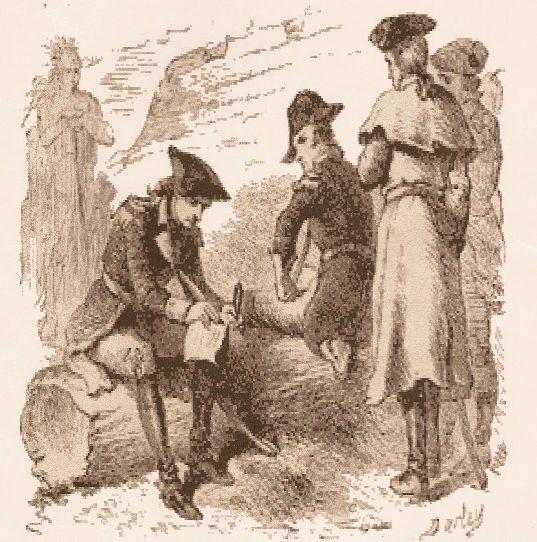
Indians-scalping-British-troops-and-women-in-the-attack-on-General-Braddocks-army-9th-July-1755-on-the-Monongahela.jpg
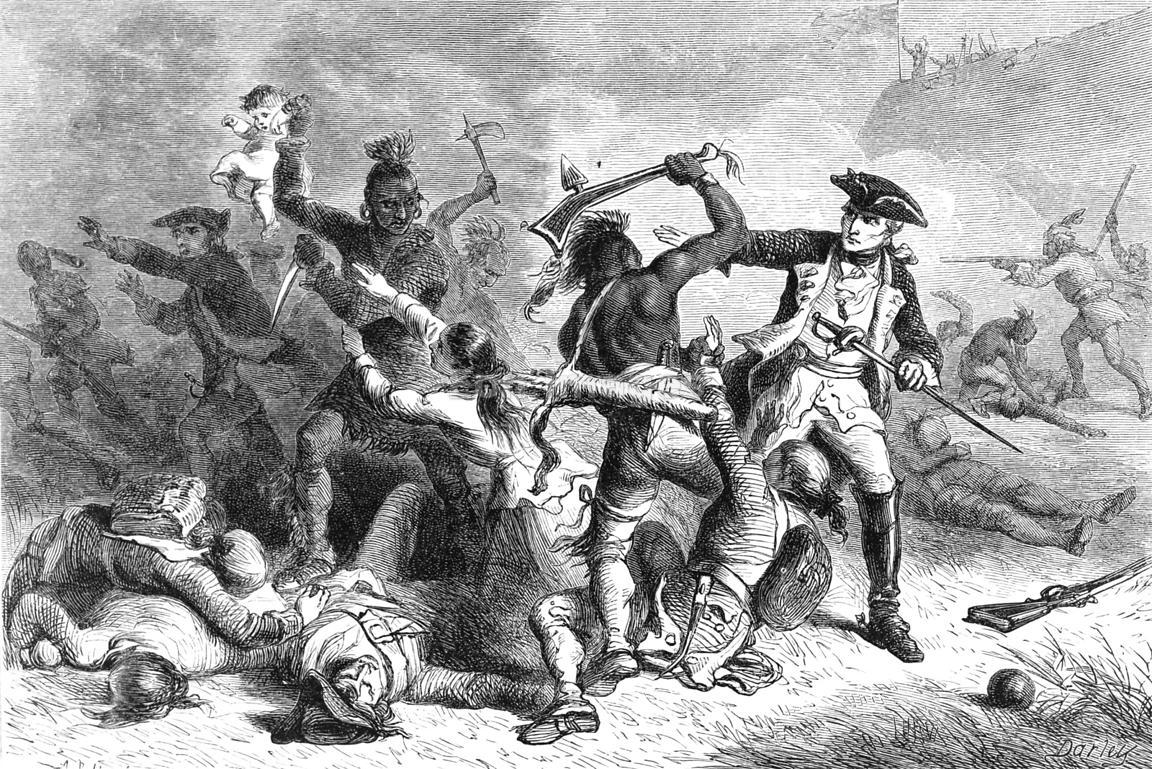
In my recent quest to add more variety to my French and Indian War Native American forces, I’ve had to look a bit beyond the usual FIW miniatures manufacturers. My core requirements in seeking new models is that they are metal, a reasonable representation of tribes present during the FIW period and that they scale well at 28mm with my other models. With this criteria in mind, I was happy to stumble across a rack of Knuckleduster Miniatures at a convention earlier this year.
 header-logo.jpg
Knuckleduster, as the name evokes, focuses largely on an expanding line of Old West themed miniatures in 25mm, 28mm and 40mm scales. Beyond this core offering, they also have a small selection of British, American and Canadian soldiers for the War of 1812. And, it’s within this era’s figures where you will find a small collection of Native Americans usable in the FIW.
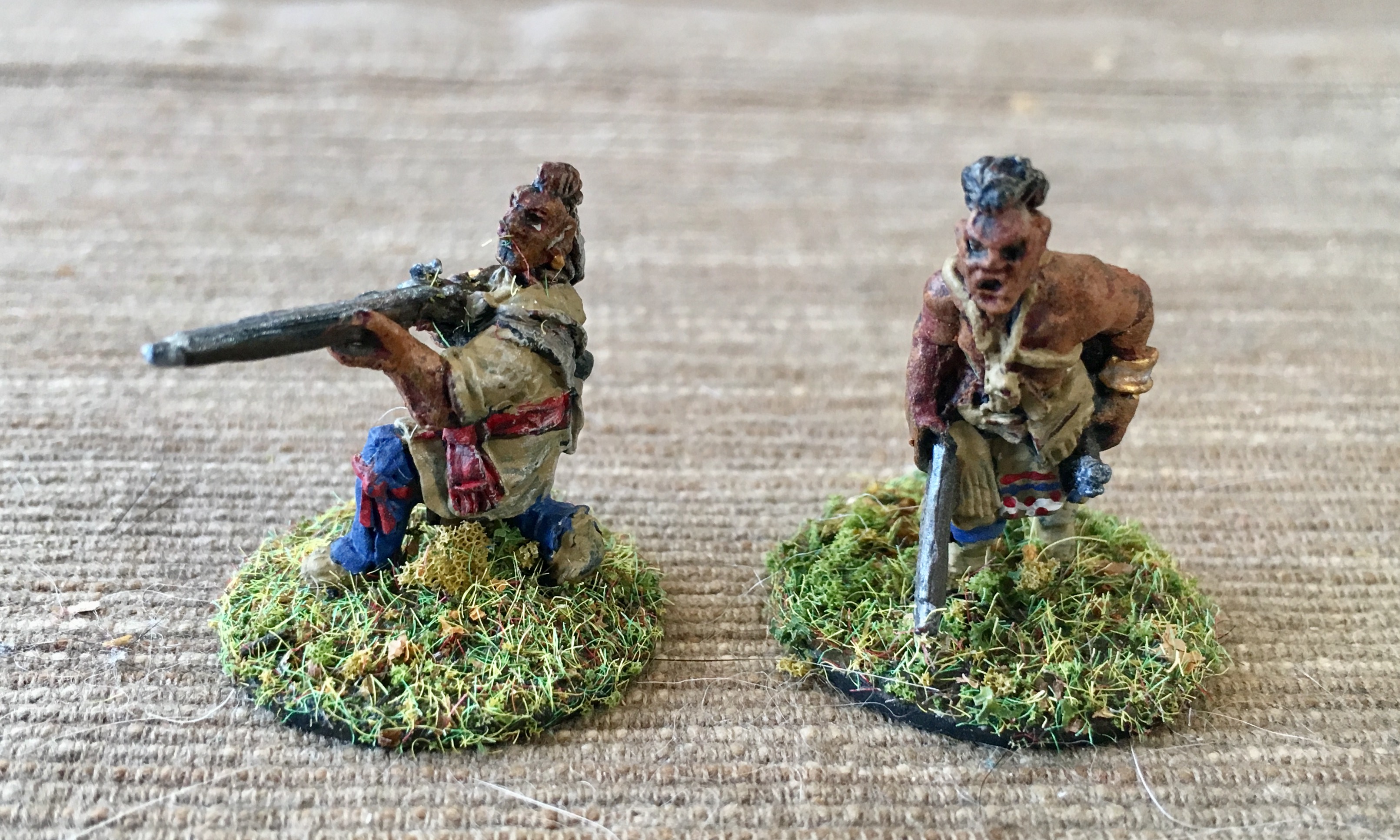
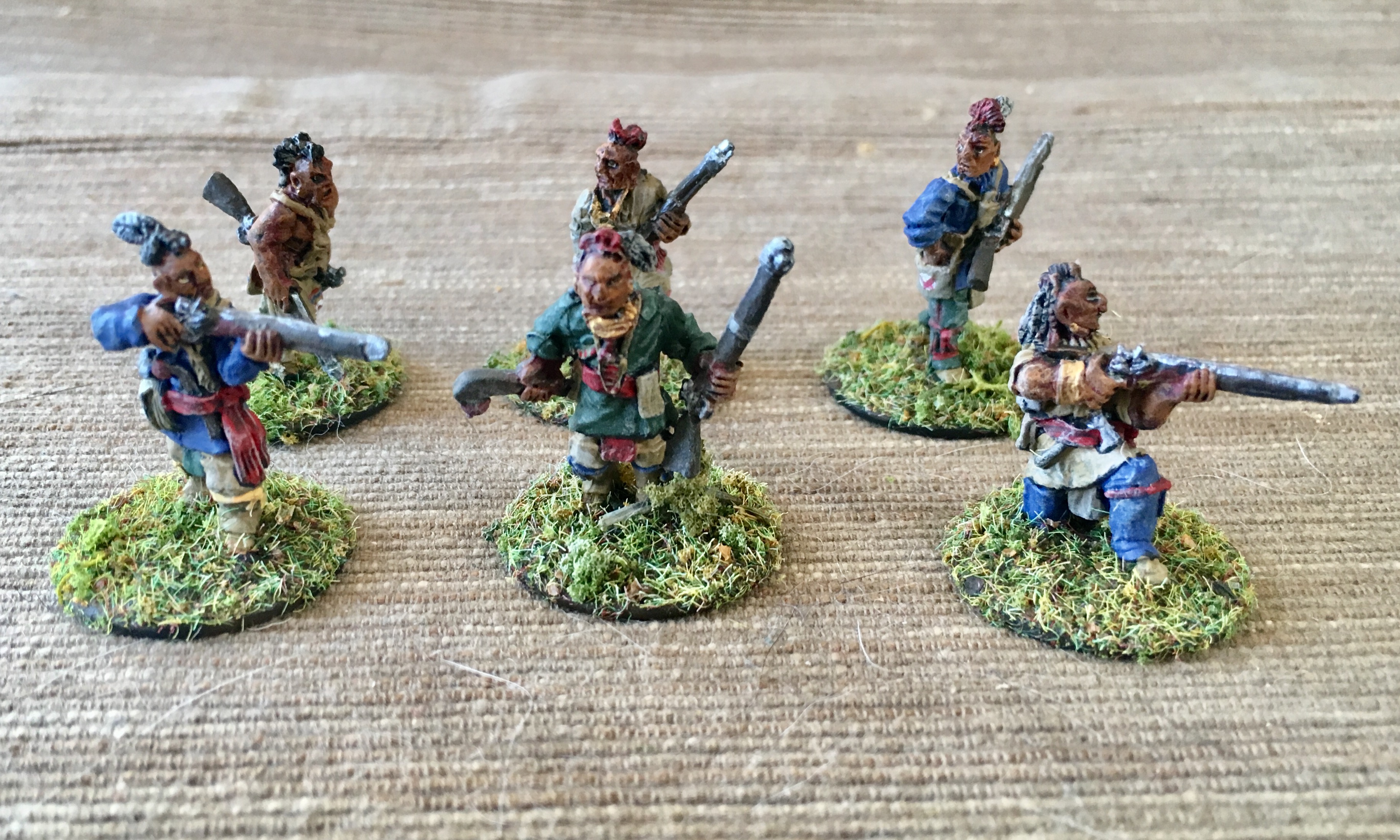
Packaged as “Grand River Nation” Indians, Knuckleduster offers two packs of six models, one in summer dress and one in winter clothing, plus a two-model leader pack. I picked up the summer dress pack for $10, a pretty good deal for a half dozen metal models cast at a true 28mm scale. These are really beefy models with lumpy facial features but with some nice detail in jewelry and clothing. Their dress generally depicts the European-influenced style from trade goods many Indians wore during the FIW era. And, it is their scale, style and variety that makes these a great hidden find for my Native force collection.
IMG_1591
IMG_1592
IMG_1593
IMG_1590