Flames of War: Fielding the FOW British Rifle Company, Machine Gun Platoon and 6-Pdr Anti-Tank Platoon

BritSoldiers

At long last, my months-long build of my British forces for Flames of War was wrapped up this week (at least for now). Starting with the Guards Armoured Division this past summer, my British collection now contains a fair amount of armor, artillery, transport and now, infantry platoons. With most of my WWII gaming focused on the late war period from D-Day onward in Western Europe, having a solid British base to supplement my Americans provides me with a lot of playability for my Allies in any number of scenarios and campaigns.
fowbritinf

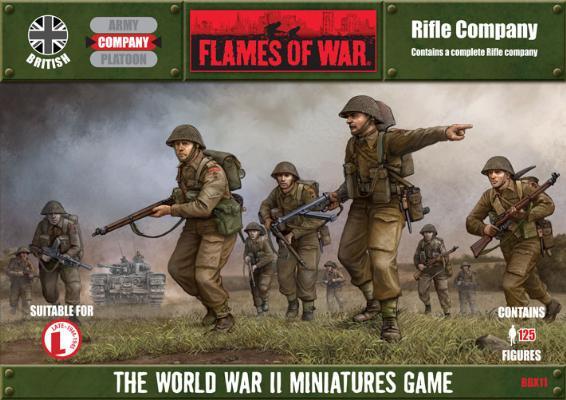
With nearly 3.8 million soldiers serving for the British army in WWII, the “PBI” (Poor Bloody Infantry”) led the war for the Allies from its earliest days right up until the bitter end in Western Europe and the Pacific. The FOW British Rifle Company box provides gamers the basic backbone for fielding a core group of British infantry. The FOW rifle company comes armed with the standard kit of WWII British infantry, including the Bren light machine gun, Sten submachine gun, 2-inch mortar and PIAT anti-tank weapon. The set also includes a few snipers and a hero figure of Stanley Hollis, whose heroic actions on D-Day earned him the only Victoria Cross awarded on that historic day.

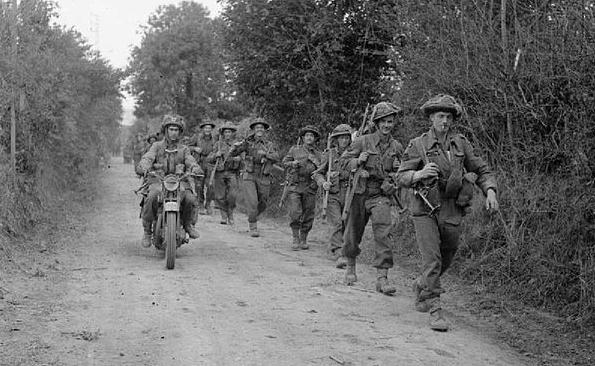
For inspiration during my hours of painting, I looked to a lot of photos of Commonwealth forces from the period and have included some below.

britinfBritish infantry with their Bren light machine gun

BritStenBritish soldiers loading Sten submachine gun magazines

Brit2inchBritish 2-inch mortar crew

BritPiatA British soldier with his PIAT

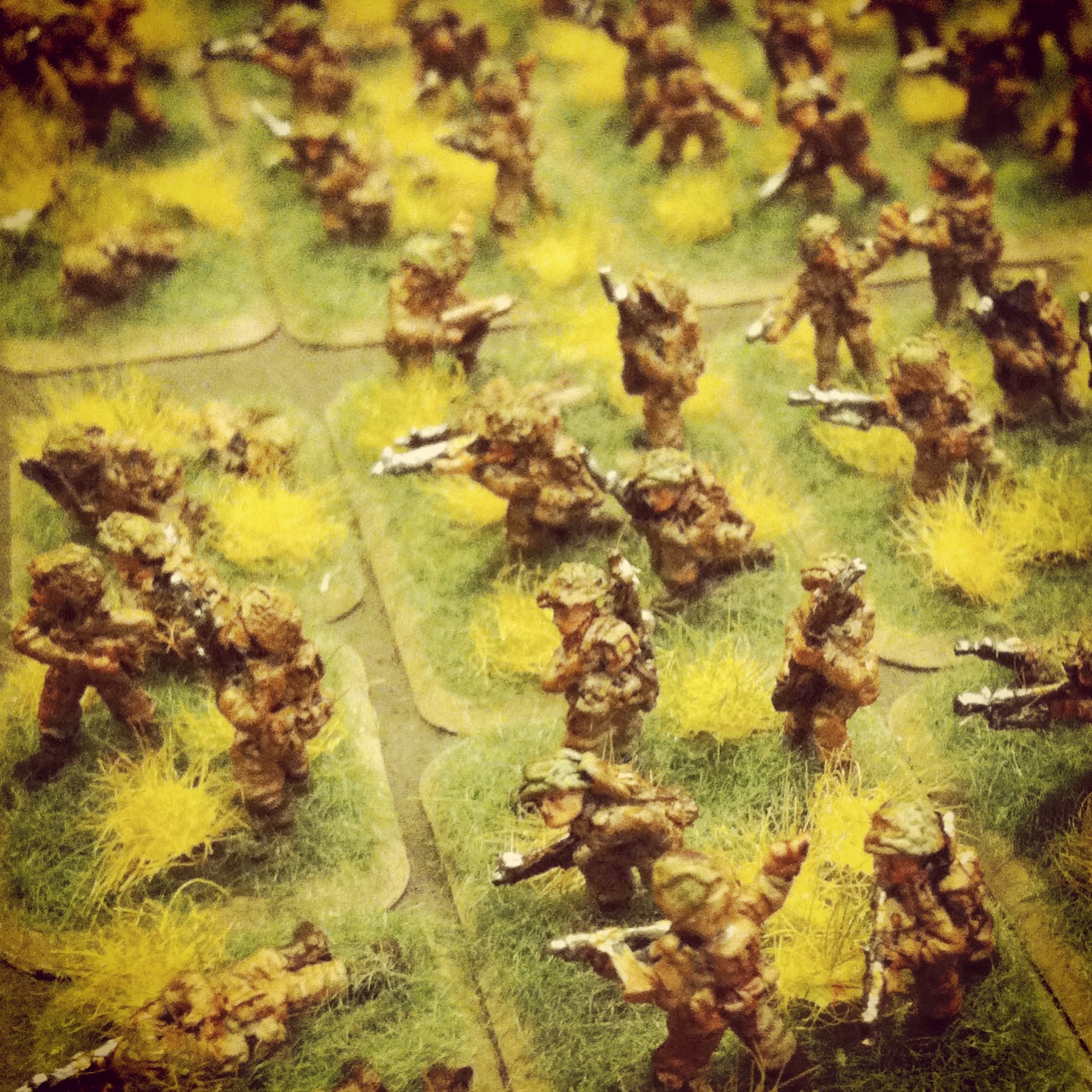
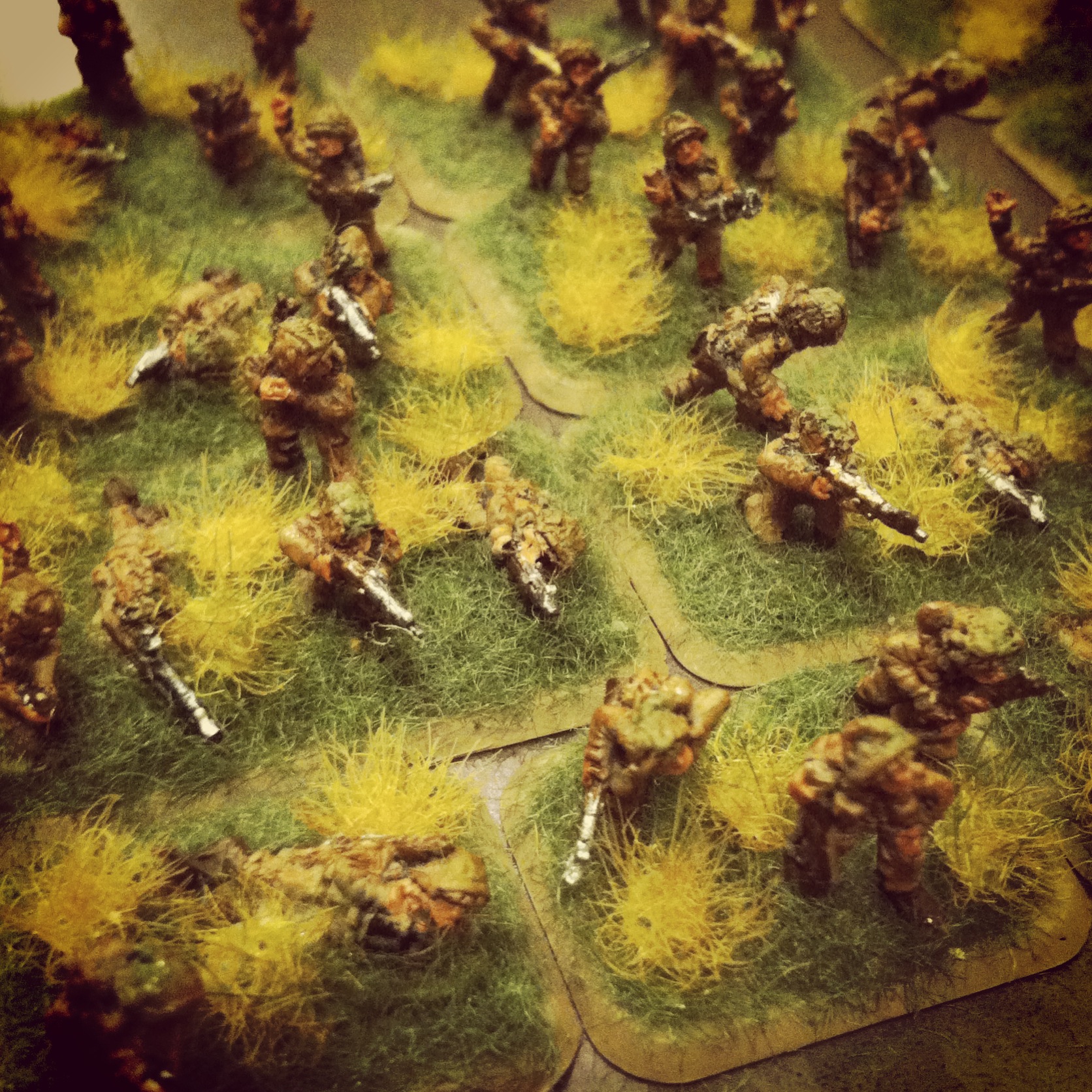
I keep my painting simple with a brownish-drab uniform, brown boots and a bit of green lightly brushed on the helmet netting. The FOW models offer a nice variety of weapons and poses, plus little details like trench shovels tucked on the backs of many of the figures. I’m usually pretty spare with my basing of basic green flock over a light brown base. That said, I’ve recently discovered easy-to-apply grass tufts from Walthers, a model railroading hobby supplier, and so I added a bunch of those to really make the bases come a bit more alive.

I’ve included a few photos below of my completed British three-platoon infantry company:

IMG_2990

IMG_2988

IMG_2991

IMG_2989

To supplement the standard infantry company and its weapons, I added in the FOW Machine Gun Platoon with the Vickers machine gun. With wide use by the British from WWI to the late 1960s, the hearty Vickers machine gun lays down a hail of fire in support of the swift advancing actions of their infantry countrymen.
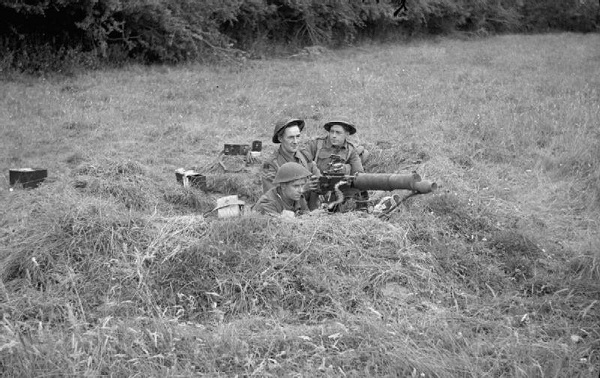
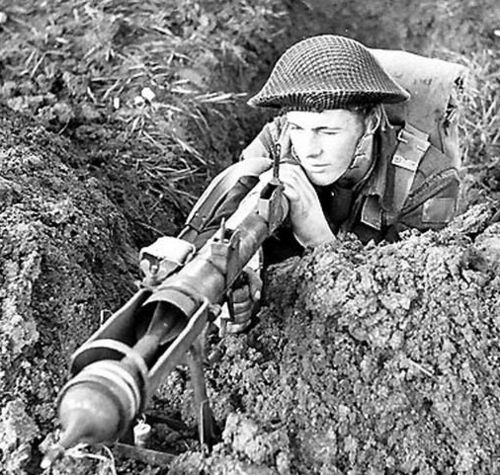
britvickersBritish infantry dug in with their Vickers machine gun

IMG_2987Completed British machine gun platoon

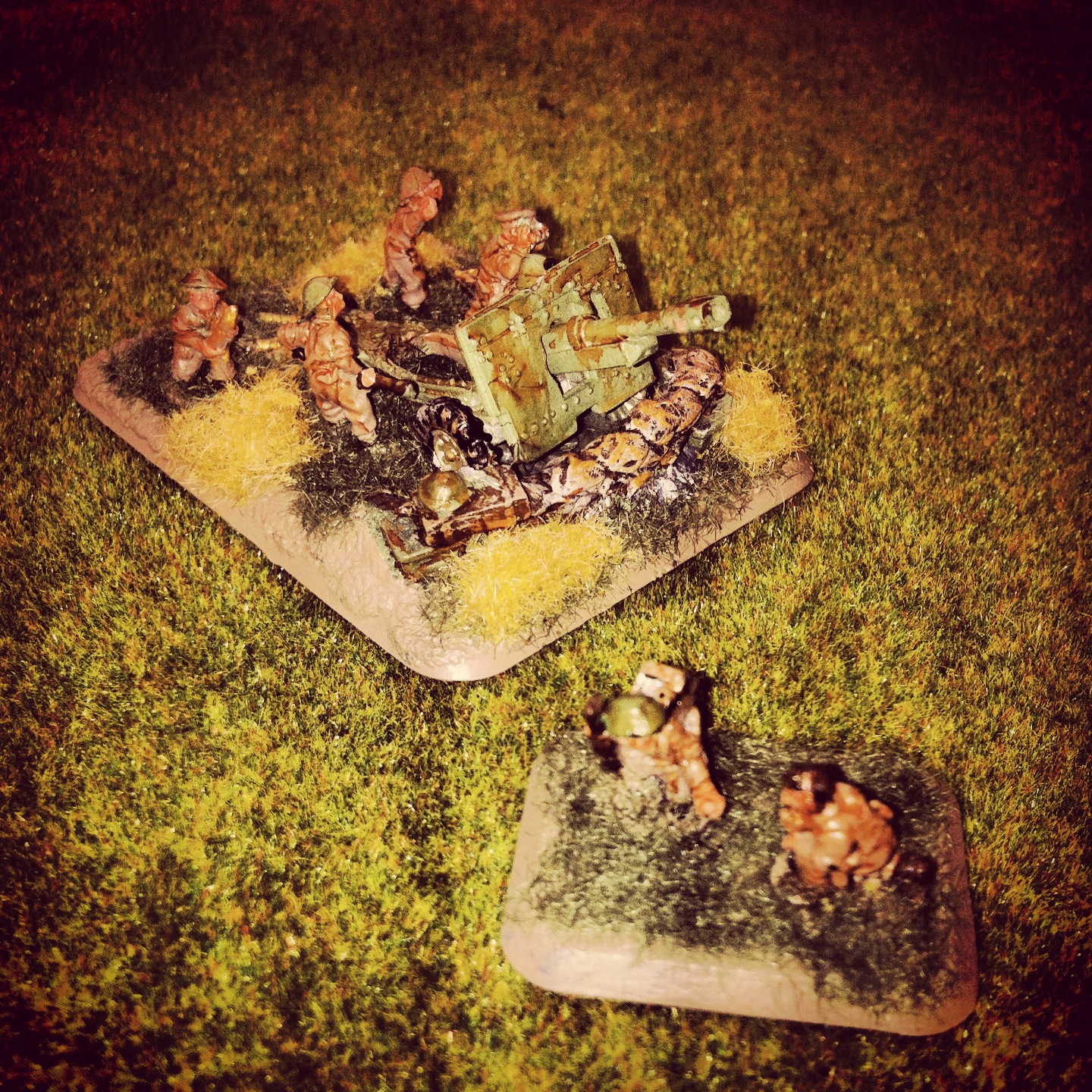
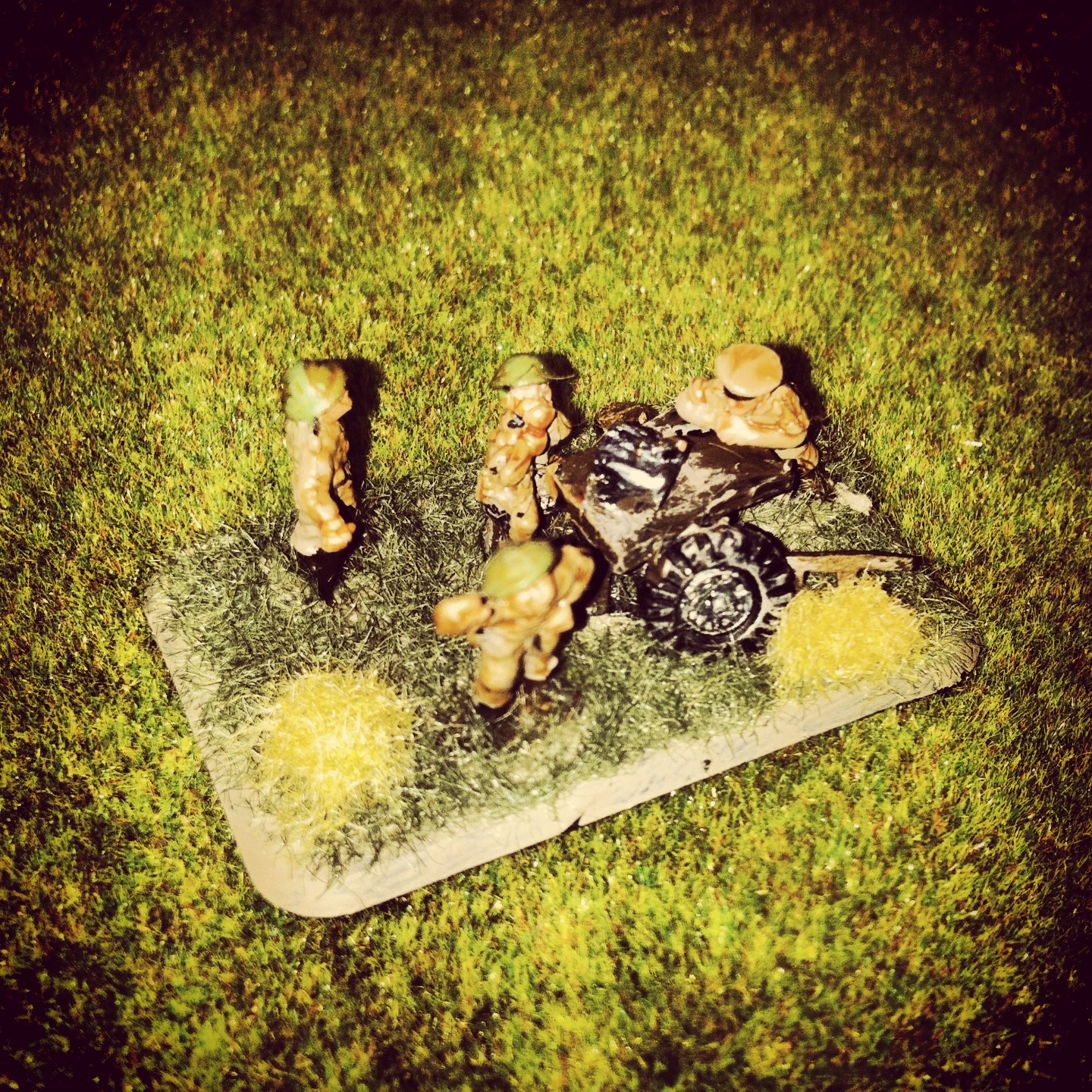
Aside from man-packed weapons, many infantry units were accompanied by heavier weapons for when faced by enemy armor. The Ordnance Quick-Firing 6-pounder or 6-pdr was the go-to British anti-tank gun throughout the battlefields of WWII. Hand-hauled short distances or commonly pulled along with the ubiquitous Universal Carrier, the 6-pdr proved most effective in stopping German tanks in the early desert war of Africa. Thicker armor on Panther and Tiger tanks eventually stymied the use of the 6-pdr in frontal face-offs with German crews, but later development of heftier armor-piercing shot by 1944 brought their effectiveness back into play in the last campaigns of the war in Normandy and beyond.

brit6pdrBritish crew with their 6-pdr anti-tank gun in Europe

Again, I needed some of these guys in the mix, so the FOW 6-pdr Platoon was another must-have in my force. I love this little set, especially the officer with his foot planted boldly on a gun’s wheel as he gestures to a distant target. Along with my existing British armor and Royal Artillery Battery, having some anti-tank guns in my force will hopefully provide enough firepower against my heavily-armored German opponents.
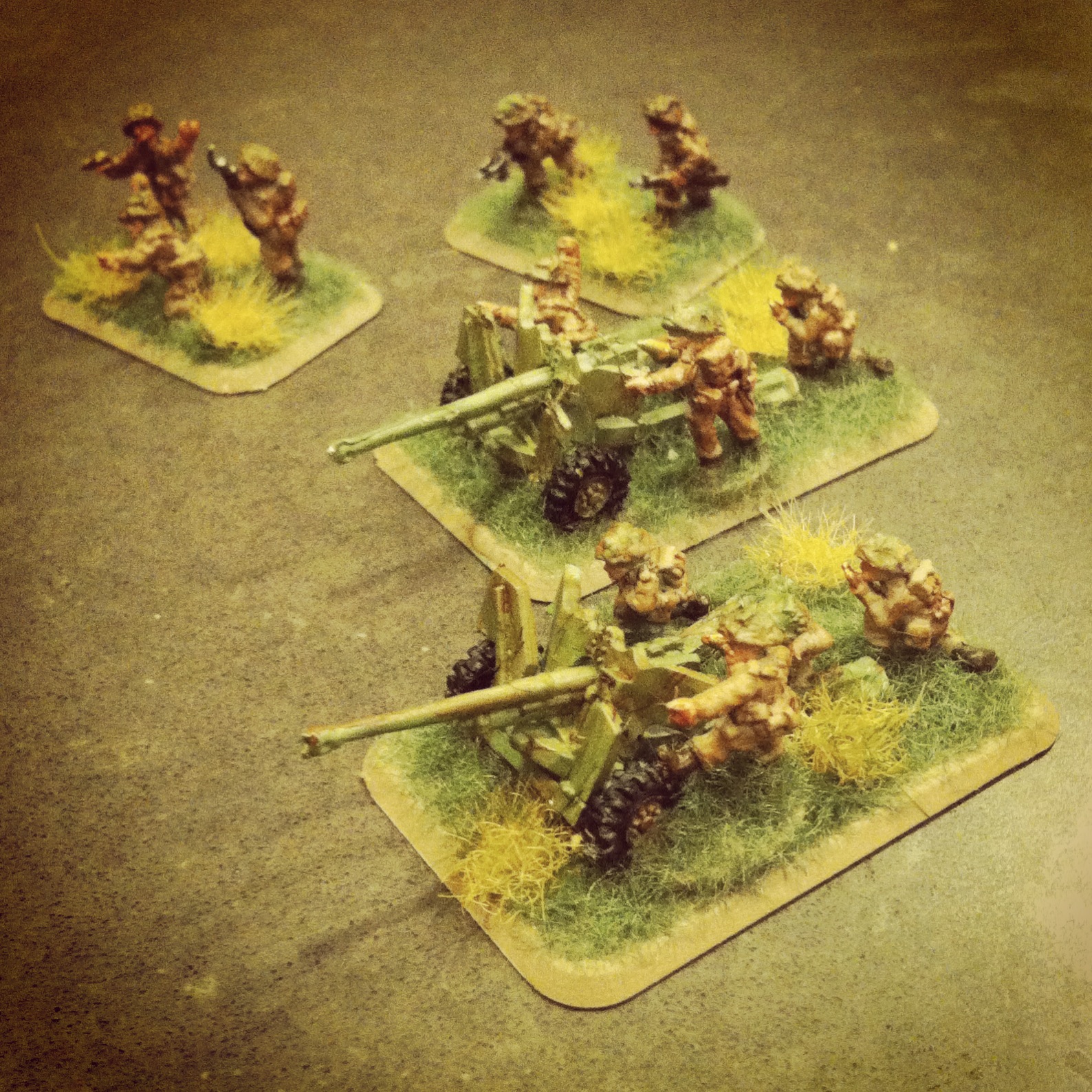
IMG_2984Completed 6-pdr anti-tank platoon

Any time I complete a big build, I’m inevitably left with the question of “what next?” First of all, most of my British will begin hitting the game table this coming weekend at Metropolitan Wargamers in Brooklyn, NY in a scenario at Aalst from September 18th, 1944 during Operation Market Garden. I’ll be posting an after-action report for the game early next week, and I’m certain I’ll have plenty more to write up on my fresh British boys in the months to come.

Flames of War: Fielding the PSC Cromwell and Firefly Tank

cromwell

I started out a month ago putting together my British 7th Armoured Divison for my Flames of War gaming with a couple platoons of FOW’s boxes. I wound up with two great looking platoons and a command section, but I really wanted two more platoons of the storied Desert Rats to beef up the company to maximum size in my post-D-Day break through scenarios.

PSCcromwell

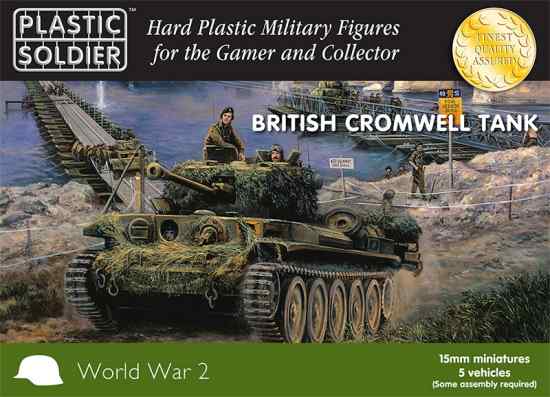
While I love the detail in the cast resin FOW models, you can’t beat the value of the kits from the Plastic Soldier Company. For about half the cost of the FOW boxes, I’m been able to double the size of my company and field a formidable wall of nimble British armor on the tabletop. Ordering directly from PSC, I was also able to add an extra Cromwell to the five included in the box plus two Firefly models for a total of two additional four-tank platoons.

IMG_2966

Two platoons of the 7th Armoured Division PSC Cromwells and Fireflies

Assembling PSC kits always reminds me of the hours I spent frustrated and thrilled gluing-up Airfix models as a kid. While FOW cast resin and metal tanks go together in a couple simple steps, there’s a particular investment in time and focus needed with boxes from PSC. The FireflyPSC molded turret  is simple to assemble, but the multi-piece tracks are a challenge even though the results with the sagging upper tread is a nice detail. The turrets on the PSC Cromwells have many pieces but fit nicely with patience, and their single-piece tracks are a breeze.

IMG_2962

Close-up of the PSC Cromwell and Firefly models

PSC tank sprues come with multiple modelling options, although there’s no stowage included in PSC offerings. To add a bit of detail, I attached some folded mesh panited as camouflage netting to rear the hulls of a few of my PSC models.

britfirefly

Members of the 7th Armoured Division with their Firefly in Normandy

Comparing the PSC and FOW models, there are some differences. PSC models tend to be thinner than the chunkier FOW kits, expecially in regards to the main gun barrels. The PSC tanks are also significantly lighter and their turrets require a bit of extra drilling to provided free movement more easily found in the magnet-mounted FOW turrets.

IMG_2963

Firefly model comparison from PSC (left) and FOW (right)

The FOW Cromwells and Fireflies both come draped in camouflage and other cast details, yet when mixed together side-by-side with the more sparely-detailed PSC kits some nice variety across the four platoons is acheived. Separate decals are also needed to complete the PSC tanks which do not include any markings options in the kits.

IMG_2965

 Four platoons and command for the 7th Armoured Division “Desert Rats” from PSC and FOW

Ultimately, the PSC and FOW models come together quite nicely with a consistent paint job and markings. If anything, the slight differences in the models will make tracking cohesive platoons on the table a bit easier when the Desert Rats roll onto the game table in the very near future.

A Trip to Brooklyn’s Trainworld

trainworldbknyI’ve written several times about my lifetime love for model trains which served as my gateway to the scale modelling hobby and eventually to miniatures wargaming. Walking into a model train convention or local hobby shop as a kid was like opening an alternate fantasy world of endless possibility. On occasional nights after dinner as a young hobbyist, my dad’s announcement that we were climbing into his truck to take a trip to Kurt’s Trains & Hobbies in nearby Caledonia, NY was like declaring we were about to take a journey to another universe.

So, after some 16 years living in Brooklyn, NY I recently made my first stop at Trainworld in the Kensington neighborhood just a few subway stops from my front door. Located in an light industrial stretch of McDonald Avenue right under the elevated F line, Trainworld is an old slice of Brooklyn brimming with charmingly coarse but knowledgeably helpful staff and one of the largest inventories anywhere of model railroading and related hobby supplies.

IMG_2906Trains running on the layout at Trainworld in the Kensington area of Brooklyn, NY

Trainworld and their Trainland location in Lynbrook, NY in nearby Nassau County lay claim as “America’s Largest Discount Mail Order Discount Train Store” powered by their extensive and well-built website. The retail location in Brooklyn features a main store space packed from floor to ceiling with N, HO, O, G and S scale model trains, track, buildings, scenery and supplies. A small phone staff manages customer service queries in a second space off the main store which also features a small train layout which loops and clatters around all day long. The enormous warehouse opens through a door just past the main retail counter space, granting any walk-in customer full access to the store’s massive inventory.

IMG_2904Scale scenery supplies at Trainworld

It’s been years since I’ve had my own model railroad layout, but having a place like Trainworld nearby is a huge resource for a wargamer and miniatures modeller like myself. On my recent visit, I was able to grab a few bags of various ground cover products from Woodland Scenics right off the racks stretched the entire length of one wall. When one specific color I needed wasn’t on display, a quick call to the warehouse brought a package to the counter in about five minutes.

IMG_2905Shelves of trees and natural modelling details at Trainworld

A little further down the aisle are several shelves of ready-made model trees of varying quality, size, coloring and price point, as well as other packaged details like rocks, gravel, crop fields and a flowering meadows. All these scenic materials are just the thing  I enjoy in making my various tabletop battlefields come alive, a topic I touched on in one of my earliest posts on this blog.

I’ve got a number of scenery projects on my list for the coming months, including a re-basing of my trees and scratch-building bocage hedgerows. Discovering a place like Trainworld just 10-minutes from my apartment is going to make these projects all the easier and provide fuel for more ideas for some time to come.

New Game Weekend: Axis & Allies: Guadalcanal

AandAguadalcanalboxThe  Battle of Guadalcanal between August 1942 and February 1943 was the first major Allied campaign set on crushing the Japanese foothold in the Pacific region. Fought in bloody air, sea and island engagements, the seven months of battle resulted in a significant shift in superiority to the Allies in the region and led to the beginnings of the downfall of the Japanese Empire in the Pacific.

Most of my wargaming happens on dry land and usually somewhere in Europe. The Pacific War in WWII always seems so separate, sprawling and overwhelming to me with its mix of different combined combats, complex supply lines and different territorial agendas. That said, dabbling in this portion of the war gives me a chance to use some very different tactics and strategies I’m not used to gaming. So, with a short couple of hours to spare recently at Metropolitan Wargamers in Brooklyn, NY, I tried my hand at some WWII Pacific action with Axis & Allies: Guadalcanal.

AandAlogo

The popular Axis & Allies boardgame series from Avalon Hill (owned by Wizards of the Coast) has been around for more than 20 years and covers many specific eras, battles and theaters of WWII. More recently, a WWI game has also been added in time for the 100th-anniversary of that conflict. The A&A games are readily available from a number of book and department stores, and they vary in complexity and time commitment. Mt first introduction to the series was with the Spring 1942 game which weaned my younger son and I off much simpler war board games like Risk forever. The great design, hundreds of sculpted plastic playing pieces, economic factors and combat mechanics make the A&A games a great way for old and new wargamers alike to engage in hours of very satisfying play.

AandAguadalcnalcontents

A&A: Guadalcanal board and game pieces (including the “battle box” at left)

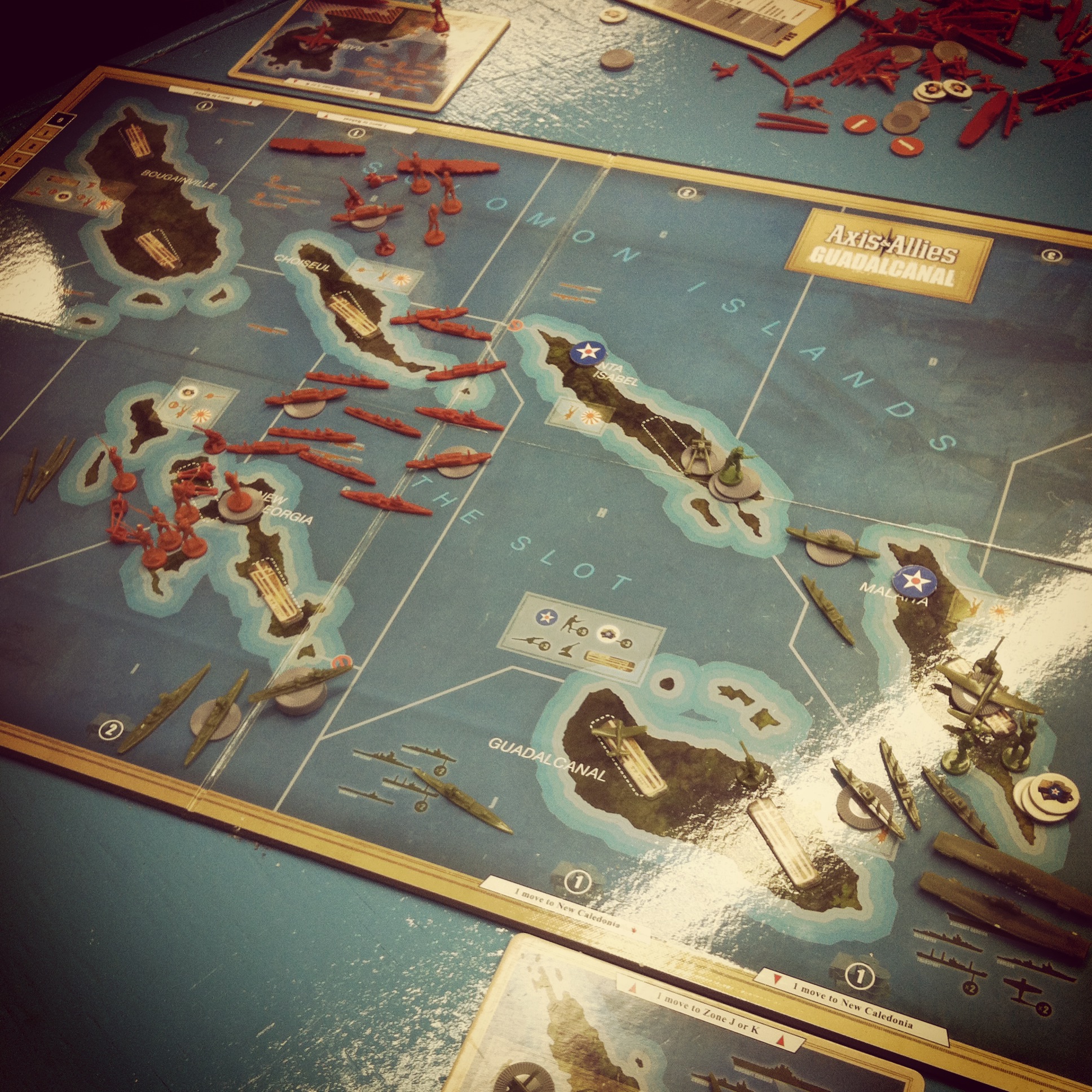
The Guadalcanal game presents a map of the South Pacific islands and sea zones contested by US and Japanese forces. Victory points are determined by building and controlling island airstrips. As in the actual campaign, quickly capturing islands and building airstrips is critical not only to endgame victory but in providing bases to supply and deploy additional forces. Aside from capturing islands, controlling the three main sea zones at the center of the board (aka “The Slot”) is key in controlling the transport of crucial supllies and reinforcements.

The combat system in the game uses a “battle box” containing a dozen dice which are shaken and reveal various randomized target effects. With land, air and sea units crowding the board, the confused mass of combined arms is neatly accounted for with a few shakes of the unique battle box.

IMG_2895

Axis & Allies: Guadalcanal at Metropolitan Wargamers

In my first play as the Americans, I quickly captured the southern half of Guadalcanal while my Japanese opponent began a big push with his navy toward The Slot. In the second turn I was able to press on to Malaita and build a second airstrip of Guadalcanal to take an early lead in victory points.

With the Japanese navy massing in the central sea zone I made a risky gamble in turn three sending in a huge air attack which destroyed a few ships and damaged a battleship but was repulsed with overwhelming deadly force. With a vastly-depleted air force, I scrambled to build myself back up as the Japanese built an airstrip on Bougainville and I made moves toward Santa Isabel. By turn four my navy headed west along the southern coast of New georgia in the hopes of catching the Japanese navy from behind. While I was able to destroy a number of Japanese submarines at the western edge of the island, my attack on Santa Isabel was halted and the Japanese took the game.
A&A: Guadalcanal moves fast for two players, playing in about 2 hours. The short nature of the game makes every move from turn one onward important with little room for error. My lesson learned in the first game was not to run too fast toward facing-off against the superior Japanese fleet early, perhaps opting instead for a greater build-up of supply to gain island footholds to launch later game attacks.

The Axis & Allies series is fantastic for out-of-the-box playability with the different game versions each offering realistically-specific game dynamics for several WWII theaters and battles. Not being a big Pacific War gamer, A&A: Guadalcanal makes for a perfect way for me to get my feet wet and expand a bit of my gaming experience to another corner of the 20th-century’s greatest conflict.

New Game Weekend: Cuba Libre

clbox

The GMT COIN series of games have fast become favorites at Metropolitan Wargamers in Brooklyn, NY. The series focuses on 20th-century insurgencies including Andean Abyss in modern Columbia, A Distant Plain in Afghanistan and the Viet Nam War-themed Fire In The Lake to be released in 2014. Future planned games will focus on conflict in Angola and Iraq. This past weekend I got a chance to play the second in the series, Cuba Libre, set in the Cuban Revolution period of 1957-1958.

The game plays up to four players, each taking on the role of either Fidel Castro’s 26th of July Movement leftists guerrillas, Cuban President Fulgencio Batista’s Government troops and police,  anti-Batista/anti-Communist student Directorio forces or the corrupt Syndicate of casino-owners led by American gangster Meyer Lansky. Using traits unique to each faction, the game plays through a fast-shifting series of diplomatic, economic and militaristic actions toward victory conditions unique to each group.

CCNapRussiansCutnerGMT’s Cuba Libre game board

Like other COIN games, Cuba Libre is compromised of a relatively simple map, abstract wooden play pieces, cardboard markers and a stack of 48 event cards. The map features the island of Cuba split into mountain, jungle and grassland areas, cities and three economic centers for the production of sugar cane, tobacco and coal. Each area carries a population point value from a high of 6 in the capital of Havana down to 1 in the smaller cities and rural areas. The factions begin with unique set-up conditions with Government troops and police primarily clustered in the cities, July 26th guerrillas in their hidden mountain camps, Directorio forces hiding in Havana and Syndicate casinos in the vacation destinations at the western end of the island.

Cities and territories are controlled when one faction’s pieces outnumber the sum of all others in the space. Each space also exists in one of five states of political stability from the pro-government Active Support to Neutral to the rebellious Active Opposition. The game’s shifting control of space and political conditions plays to specific victory conditions.

clcardsSample cards from Cuba Libre

Much of the game’s action is driven by Cuban Revolution-themed event cards which determine the turn order in each round and possible special outcomes. Each card is neatly illustrated with a period photograph, some short historic flavor text and events which may help or harm one or more factions. Players make choices in activating the event card each round or opting for a combination of Operations or Special Activities, again unique to each faction. For example, July 26th rebels can choose from Operations like March, Attack or Terror and Activities like Infiltrate or Kidnap. Government forces may play Operations like Sweep, Train or Garrison and Activities like Air Strike or Reprisal.

IMG_2863Cuba Libre at Metropolitan Wargamers

There is a ton going on in Cuba Libre, and the game’s flow can quickly turn. In my first game, the Syndicate player quickly moved toward victory conditions by building multiple casinos. My son, playing as the Government, made side deals on different turns with the Directorio and Syndicate players. My July 26th forces managed to throw much of the board into open rebellion but I could never amass enough of my guerillas where I really needed them. Cutting the game a bit short in the end, we scored it as a Government victory.

Learning how to leverage the strengths of a particular faction makes for a lot of replay value in Cuba Libre. The mix of simple components, plenty of space for strategic options and actual history baked in is what makes this and the other COIN Series games from GMT among the best being produced today.

castro¡Viva la Revolución!

New Game Weekend: Civilization & Advanced Civilization

CivAdvCivBoxesEarlier in the week I posted about the elegantly quick board game Eight-Minute Empire: Legends I first had a chance to play last weekend at Metropolitan Wargamers in Brooklyn, NY. After a brief, engaging 20 minutes with Legends, I joined four other players in another game that was also new to me and a completely different experience — Advanced Civilization.

CivMapCivilization game board with Western expansion map to the left

Civilization by UK game designer Francis Tresham was published by Avalon Hill in 1981 and introduced a number of now-standard gaming elements found in many board and video games today. Ten years later, Advanced Civilization offered some refinements, additions and simplifications to the game. Playing with 2-8 players and running to 8, 10, 12 or more rivetingly-complex hours, Civilization has become one of the signature games of the past 40 years.

CivASTAdvanced Civilization’s innovative  Archaeological Succession Table (AST)

At its core, Civilization is an area control game played in the Mediterranean region in an 8000-year period spanning the Stone Age through the Iron Age. Each player picks a civilization and places a single population marker in a territory in their color-coded beginning edge of the board. Territories each support varying numbers of population, indicated in each area. Population doubles each turn, so one marker grows to two. If the space cannot sustain more than the noted number of population markers, players must move and expand their population to new territories or “starve” population down to the maximum load for the territory. A population census grid on the Archaeology Succession Track (AST) notes population growth of each civilization and determines the order of play the following turn.

Moving six population markers to a space with a black square allows the settlement of a city, and twelve may settle a city in a blank space. Establishing cities allows the harvesting of goods the likes of Hides & Ochre, Salt & Timber or Gems & Dye. Drawn in turn order, the stacks of commodities cards also hide calamity cards which have adverse effect on a civilization through such things as Famine, Civil War, Flood or Volcano. Each round includes trading where players must keep certain untradeable calamities while trading away certain goods and other calamities in the quest to collect sets of cards which may then be turned into technologies. The technologies build upon each other through the building of a Technology Tree (“Tech Tree”) which advances with additional abilities and protections for the civilization. Simple beginning  technologies like Pottery, Mythology and Music aid early societies but lose importance over time. Philosophy, Democracy, Law, Trade Empire, Advanced Military and Golden Age technologies score the greatest points and advance a society through the  Stone, Bronze and Iron Ages to eventual victory.

IMG_2859Advanced Civilization at Metropolitan Wargamers

The AST and Tech Tree become the major machines in propelling the game forward, and evolutions of these elements have been incorporated into countless board and video games since their introduction with Civilization. These two innovations make Civilization and other subsequent games like Clash of Cultures focused more largely on elements of managing resources and cultural advancement than traditional combat-focused area control games like Risk. Resource management and building based on collection of resources shows up in so many games, prominently so in the widely-popular  Settlers of Catan. Somewhat controversially, the video and board game versions of the Sid Meir’s Civilization franchise owes a great deal both in its mechanics to the Avalon Hill game which preceded it in theme and name.

Civilization is incredibly compelling and eerily historic in how it plays and forces the hand of history. Players who begin with small civilizations are forced into territorial expansion through population growth or risk starvation of their people. Once cities thrive, feeding those cities becomes another concern and reason for more expansion. Soon, players find themselves in a loop where development begets expansion begets development. Isolated societies have to begin moving farther afield over land of through developing shipbuilding and sailing technologies. Resources become important to build technologies to further enhance and protect their civilization. By building more cities, more valuable goods are obtained and more advanced technologies may be developed. With all players expanding their societies by mid-game, civilizations eventually must compete for room in the region. War becomes somewhat inevitable, but diplomacy and mutual-beneficial trade also gain special importance as the game moves on and civilization begin to settle into specific paths to winning the game.

Of the hundreds of games I’ve played, I now understand why Civilization holds a special place in the hearts of gamers. Committing to hours upon hours of play becomes a game mechanic unto itself as players of Civilization must maintain focused attention on mentally-exhausting detail. Yes, Civilization is a game, but a marvelously intriguing one to play in the context of our own world where population, space, resources and technologies play out with increasingly dire importance as human civilization marches toward our own eventual historical endgame.

New Game Weekend: Eight-Minute Empire: Legends

emelogo

Most of the games I play can take hours to get through, leaving me satisfied but often downright exhausted by the time I’m cleaning up the pieces on the tabletop and putting them back in the box. Finding a game that is a challenge but a quick play can be a tall order. This past weekend at Metropolitan Wargamers in Brooklyn, NY, I had a chance to play through the new Eight-Minute Empire: Legends and discovered in it a gorgeous little game easily playable in about 20 minutes.

Eight-Minute Empire: Legends is yet another Kickstarter success from last year and a follow-up to the original Eight-Minute Empire which was also Kickstarted in late 2012. The original game is now out of print, but fortunately the new Legends version is playable as a standalone.

emecontents

Cards and island tiles from Eight-Minute Empire: Legends

The game plays with a classic area control mechanic on a modular set of two-sided tiles featuring islands connected by bridges and separated by sea. Players begin with a set of colored cube “armies” in a central location. Play runs a set round of turns based on the number of players (2-4) with all the action driven by 35 cards laid out six at a time near the board. Cards allow combinations of movement, placing new armies, building cities, destroying opponent’s armies or other special actions (like a “flight” ability over water spaces).

As the turns progress, cards are picked up (for free) or purchased (for 1-3 coins) depending on their position in the row. Players buy cards in turn using coins handed out at the beginning of the game. After a card is acquired , the the whole row of cards slides up and a new card is turned over. The shifting positions and costs of the cards plays heavily in the strategy as each player bides their time to snatch a card they want for the least cost possible. With each turn, the value of cards quickly rise or fall, depending on each player’s personal strategy.

IMG_2860Eight-Minute Empire: Legends hits the table at Metropolitan Wargamers

When the turns are up, players score victory points based on the control of territory spaces or dominance of an entire island. Additionally, collecting specific sets of cards score more victory points. In our game, my three opponents primarily focused on slugging it out for territory on the board while I focused on collecting cards. I managed to collect two “Mountain” cards for a couple extra victory points at the end, and I also scored points for having the most cards with blue crystals. One other player collected a bunch of “Dire” cards illustrated with menacingly evil images. After a few plays through the game, I could see how players might gain familiarity with the available cards plan their strategies with a bit more focus.

For a tiny game, it packs a punch and variety within a nifty fantasy theme. Eight-Minute Empire: Legends is a great game to have on hand — maybe tossed at the bottom of your bag — and ready to go when a swift game of conquest is just the thing to fill a  half-hour of competitive fun.

A Place To Play: Brooklyn Game Lab

bgllogo

Living and gaming in New York City is all about space. While gamers worldwide enjoy games in their basements, garages, dining rooms and even dedicated spaces, gamers living in the five boroughs wage a constant struggle for tabletop real estate. It’s in this context that Brooklyn Game Lab opens today and joins a mini-boom in storefront gaming spaces and stores that have opened over the past five years throughout New York.

Brooklyn Game Lab is the vision of Robert Hewitt, a former Silcon Valley game developer, designer, co-founder of game app company HashGo and ESL teacher in Brazil. Carrying his start-up experience and a passion for games and teaching, Bob’s mission for the Brooklyn Game Lab is to provide not only a space for play but to challenge players to think about games beyond what comes right out of the box.

Located in the heart of Brownstone Brooklyn’s Park Slope, the core of the Brooklyn Game Lab is an afterschool program focusing not just on kids playing games but evaluating games and creating homebrewed expansions. The curriculum involves player self-evaluation of gaming mechanics, strategy and tactics, as well as a reward system which will allow kids to earn merits as their gaming prowess develops. Euro, cooperative, social and conquest games like Settlers of Catan, Forbidden Island, King of Tokyo, Werewolf and Small World will serve as jumping-off points.

bglahlogo

Aside from the afterschool program, the Brooklyn Game Lab also features a number of After Hours gaming events targeting adult players. Mondays are Miniatures Night with a revolving series of fantasy and war-themed minis games the likes of Star Wars X-Wing, Space Hulk, Warhammer 40K and Flames of War for experienced players and curious newcomers alike. Wild Card Night on Tuesdays invites outside groups to host favorite go-to games for their own members and drop-ins from the general public. Thursdays are Singles Night, bringing in 20-somethings to roll dice, play cards and mingle. The old mainstay, Magic: The Gathering, occupies the Friday night slot, and weekends will provide opportunity for open gaming.

The 32-seat space will focus solely on the game curriculum and  special events for the time being, although there may be room for retail and private party rentals in the future. Things are off to a great start for Brooklyn Game Lab which is opening with a fully-booked afterschool program including my oldest son who will be a particpating Monday afternoons. Meeting with Bob for coffee last month, I was glad to connect with another passionate gamer looking to put a spin on New York’s gaming spaces. Getting kids engaged in games for life and igniting a developer mindset in them makes Brooklyn Game Lab a very welcome new space for the community.

Flames of War: Fielding the FOW Royal Artillery Battery

25pounder

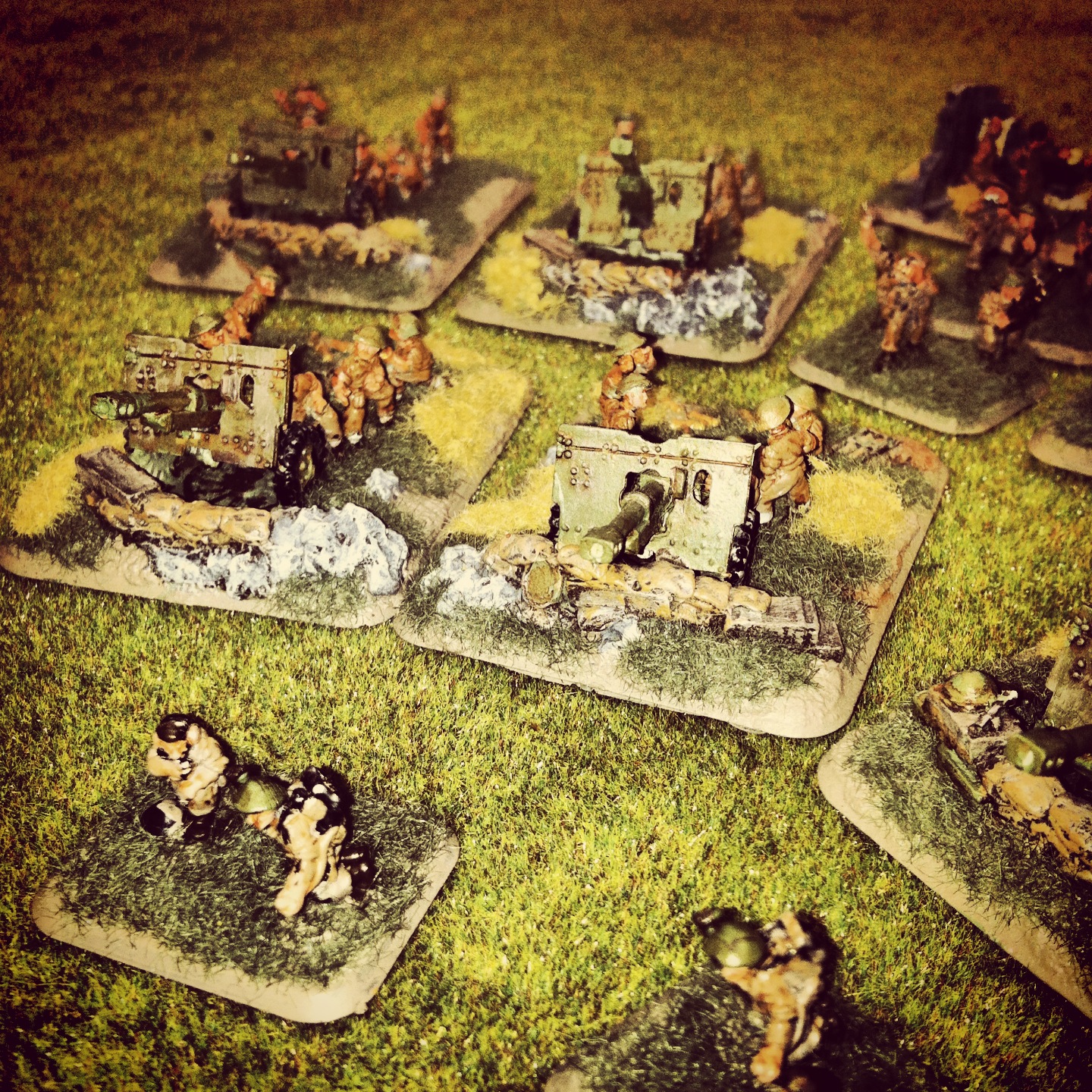
My progress on my new British forces continues with my fielding of a full  Royal Artillery Battery for Flames of War. Dating back nearly 400 years, the British Royal Artillery Regiment (or RA) has been a mainstay of support for British infantry over many continents for a couple centuries. In World War II, the massed 25-pound guns were important for their rapid fire when manned by capable British crews.

fowroyalarty

FOW provides specific rules to account for the adept British guns with the ability to field eight or twelve guns and range in on targets even under initial missed attempts with massive bombardments. In short, these guns provide incredibly deadly strength to any Late War British companies in post-D-Day scenarios the likes of Villers-Bocage or Operation Market Garden.

IMG_2840My RA Battery is made up of two FOW kits, one of which I scored for a song from a fellow club member during a summer flea market at Metropolitan Wargamers in Brooklyn, NY. After gluing everything up, the models get a basic green undercoat followed by my quick finish of drab brown for the uniforms with brown boots and off-white coverings. Figures get finished off simply with a wash to add depth, as do the guns with some rusty dirt streaks.

IMG_2836Sand bag emplacements are finished with a few layers of browns, and stonework get a some built-up coats of grey. Stands are finished with details for stacked crates and discarded brass shells on a brownish dirt basecoat followed by two different grass flockings.

IMG_2837

IMG_2838

IMG_2839

My sets came with two different command bases, the first with a nice diorama of a demolished building with a motorbike parked out back. As orders are being passed between officers, another pours tea from an aluminum kettle. The other command stand features a crowd of staff around a field table and radio operator with one dapper officer standing to the side, cane in-hand.

IMG_2835

Each four-gun battery is filled out with two other command teams and a spotter, waiting to call in the guns on the unsuspecting German forces. All together, I’m anxious to get my British RA into action with my 7th Armoured and Guards Armoured tanks in the very near future. All that’s left is some British infantry, so stay tuned for their appearance on the field in the very near future.

IMG_2834

Flames of War: Utah Beach “Uncle Red” 1944 Scenario

utah1944

When most people think of the D-Day invasion at Normandy on June 6th, 1944, the deadly images from the US landings at Omaha Beach in popular movies like The Longest Day or Saving Private Ryan generally come to mind. Utah Beach was added as an objective for US forces late in the invasion planning and occupied the far right of the Allied coastal assault. The beach was divided into three sectors (Tare Green, Uncle Red and Victor), and the landing of some 23,000 troops and armor support started the day’s invasion at 6:30am. Awaiting the invasion was the German 709th Infantry Division.

utahmap2Map of US 4th Infantry Division at Utah Beach June 6, 1944 (“Uncle Red” circled)

The US 4th Infantry Division at Utah Beach, including Gen. Theodore Roosevelt Jr. and author J.D. Salinger, came ashore with relatively few US casualties of just 400 compared to the 3000 at nearby Omaha Beach. The success of the assualt is credited largely to the effective landing of more Sherman tank support, relatively light German fortifications covering the exits from the beach and early inland actions by the 101st and 82nd Airborne Divisions earlier in the morning.

ussandtable

US 17th Airborne Division using a sand table before Operation Varsity in 1945

 Metropolitan Wargamers in Brooklyn, NY is pretty well known for the sand tables which occupy our space, and some of our founding members have won several awards for presenting sand table games at conventions over the years. Sand tables have been used by military planners since ancient times when sticks and stones were simply laid out in the sand on the ground.

modern sand table

NY Army National Guard troops train with a sand table at Fort Irwin, CA in 2011

Despite all our military technological advancements, modern war colleges and even troops deployed in the field today still use sand tables for training and planning real-world actions. Gaming on a sand table provides a great amount of flexibility and realism in shaping the contours found in real-life battlefields, adding tremendous playability to just about any scenario.

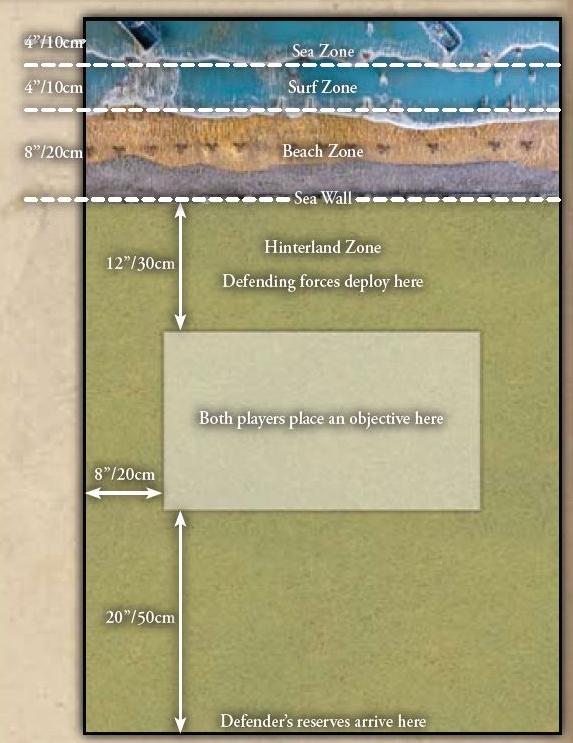
HitthebeachmapFlames of War “Hit the Beach” scenario set-up

This past weekend a few of us ran an Uncle Red beach assault scenario on one of the club’s sand tables using the Flames of War Amphibious Assault rules and ‘Hit the Beach’ scenario.The 4′ x 5′ table I set up featured a sculpted surf landing zone, sea wall and two beach exits leading to an inland area. Each player placed an objective. The German player then deployed their coastal defenses at the beach including barbed wire, two bunkers, tobruk machine gun nests and a Grenadier platoon. At the rear of the table, the Germans deployed an artillery battery and another machine gun platoon in a nearby house defending their objective. Half their 1500-point force remained off the table in reserve.

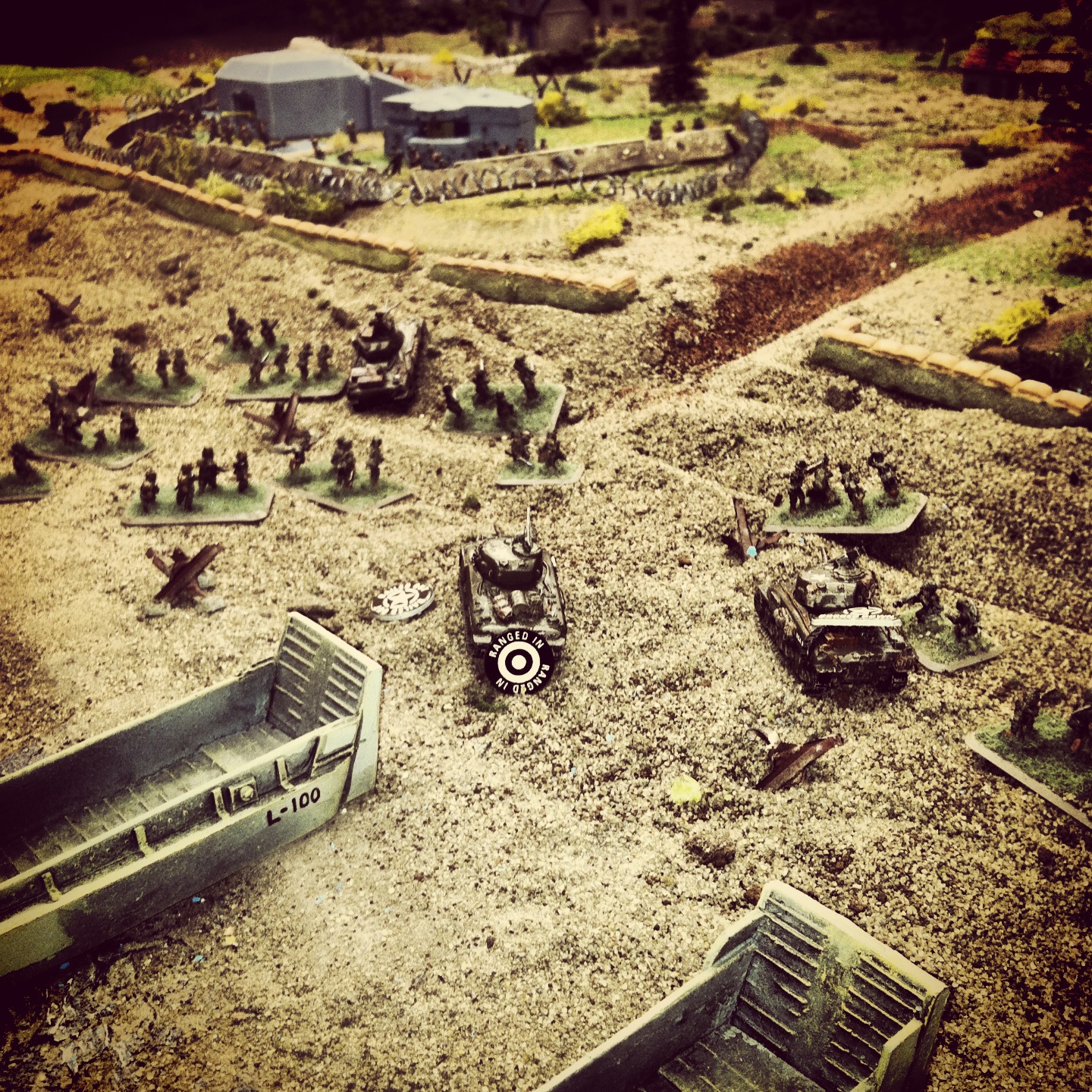
IMG_2813The US landing begins against the fortified coast and German artillery at the rear

The Americans began with a naval gun barrage pinning every German platoon but only detsroying one stand at the beach. With the first turn, two boat assualt platoons and a pioneer platoon landed at their left and center area of the beach. Choosing to shoot rather than move at the double, the first three American platoons were quickly pinned and subsequently destroyed in the first two turns of the game.

IMG_2814View from the German rear with Americans landing

Choosing to still keep their D-Day tanks off the beach, the Americans attempted another landing in turns three with only two boats able to land. Naval guns and P-47 air support attempting to hit the rear German artillery proved completly ineffective as troops at the beach continued to be pinned and detsroyed.

IMG_2816

US waves struggle to get off the beach

IMG_2819

Remanants of US platoons get over the sea wall in turn four

With still more delayed landing reinforcements and no tanks heading for the beach, two US platoons breached the sea wall in turn four. Moving at the double and under heavy machine gun fire, the short-lived progress was stalled and the platoons lay pinned with heavy casualties.

IMG_2821

Swimming Shermans finally come ashore with more infantry

Switching tactics in turn five, the Americans went for the right side of the beach. Two boat crews hit the beach moving at the double with three Shermans coming ashore in support. Two tanks immediately bogged, creating two targets stuck on the beach for the next round of incoming German artillery.

IMG_2822

Shermans pour fire into the German defenses

With turn six, one more Sherman made it to the beach while another was swamped and lay destroyed in the surf offshore. Just one more boat of infantry landed to support a pinned and heavily-damaged platoon already on the beach. Progress was made over the sea wall with US troops moving out of range of much of the German machine gunners on the far right edge of the table. Finally, the US did some damage with fire from the Shermans destroying several Grenadier units and a tobruk nest. At the bottom of the turn, the Germans brought on their first reserves with a Nebelwerfer battery at the back of the table. One Sherman was hit and destroyed by German artillery and another’s crew bailed out.

The US looked to be making a bit of progress as turn seven began with their M7 Priest arillery platoon landing with half of the platoon bogging right off the boat. The remaining three guns, along with three Shermans, took  shots at the German defenses and destroyed two more Grenadier stands. German infantry reserves began rushing on the table in front of the artillery to cover the American objective. On the beach, another monstrous German barrage left the Priests in flames and just one surviving Sherman. At turn eight, the Americans ceded the table after only one additional landing craft of troops made it to the beach to join their final Sherman.

This was our first FOW beach landing at the club, and a big learning experience for us. The US players chose to play way too conservatively from the outset with troops moving too slowly off the boat in the first two turns. Leaving the Shermans off the beach until the fifth turn was also a huge mistake, as getting them on sooner would’ve provided greater pinning support and potential for smoke cover for the boat infantry. US air support was frustrating, as often seems the case, and use of the naval guns was likewise botched. The US also suffered from poor luck with too many landing craft either not getting back off the beach to grab more reserves or failing to land existing floating reserves. In many turns, just one of three boats were able to arrive, making it impossible to hit a critical mass of troops on the beach.

Several of us at the club are planning a weekend-long D-Day series to celebrate the 70th anniversary of the Normandy campaign this June, so look for more practice scenarios and a lot more on the anniversary event in the coming months. As Gen. Roosevelt said at Utah Beach, “We’ll start the war from right here!”