Flames of War: Fielding the Guards Armoured Division

guardstanks

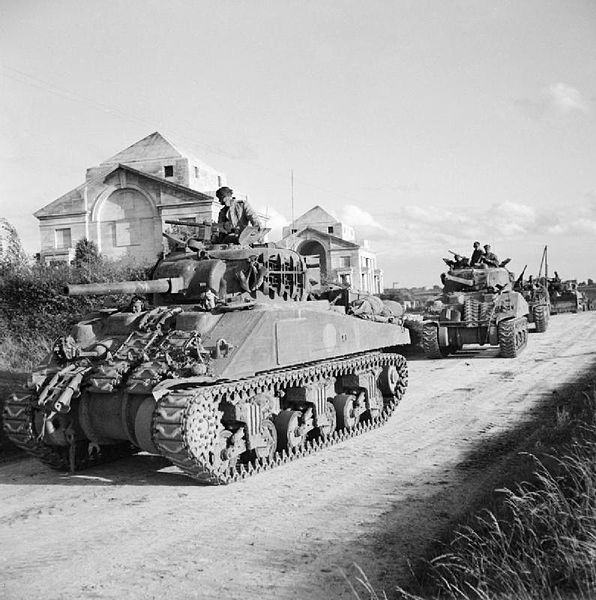
Among the multi-national Allied forces that participated in the campaign following Operation Overlord on D-Day on June 6, 1944 were the British Guards Armoured Division. Arriving a couple weeks late to the party on June 26, the Guards would roll on to participate in many of the key post-D-Day engagements including Operation Goodwood, Operation Market Garden and the Battle of the Bulge. I’ve been encountering the Guards over and over again in Rick Atkinson’s engaging The Guns At Last Light, the latest and final volume in his “Liberation Trilogy” telling of the Allied march to victory in World War II. And so, it is great timing that I’m finally getting around to adding the Guards as my first allied group supplementing my already extensive US forces in my Flames of War gaming.

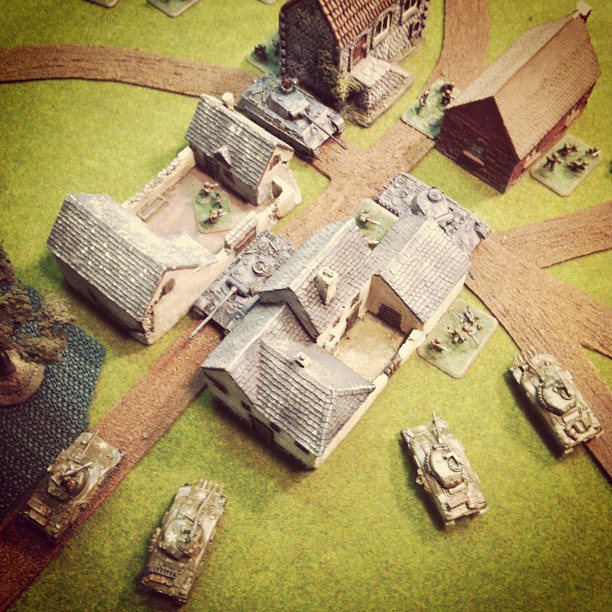
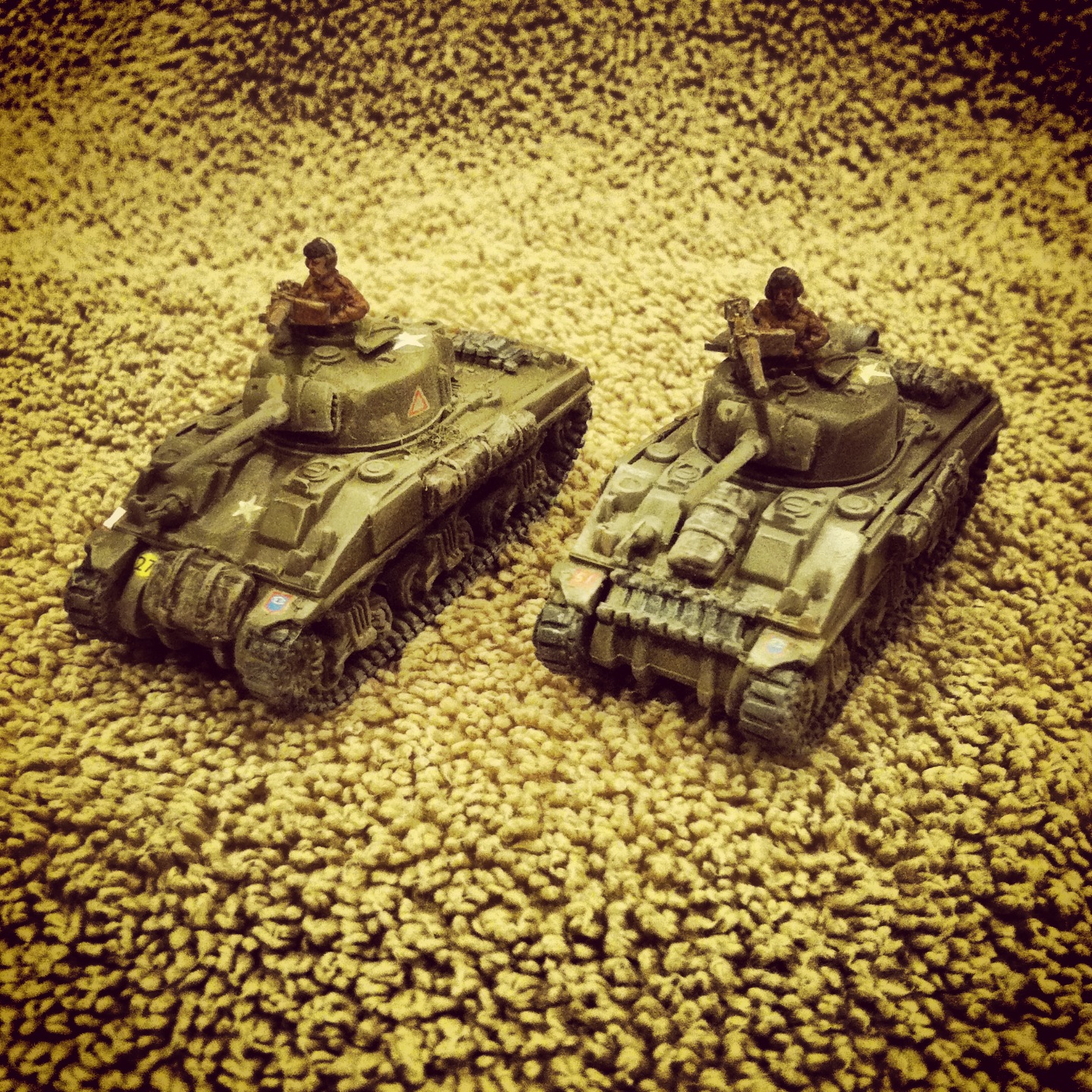
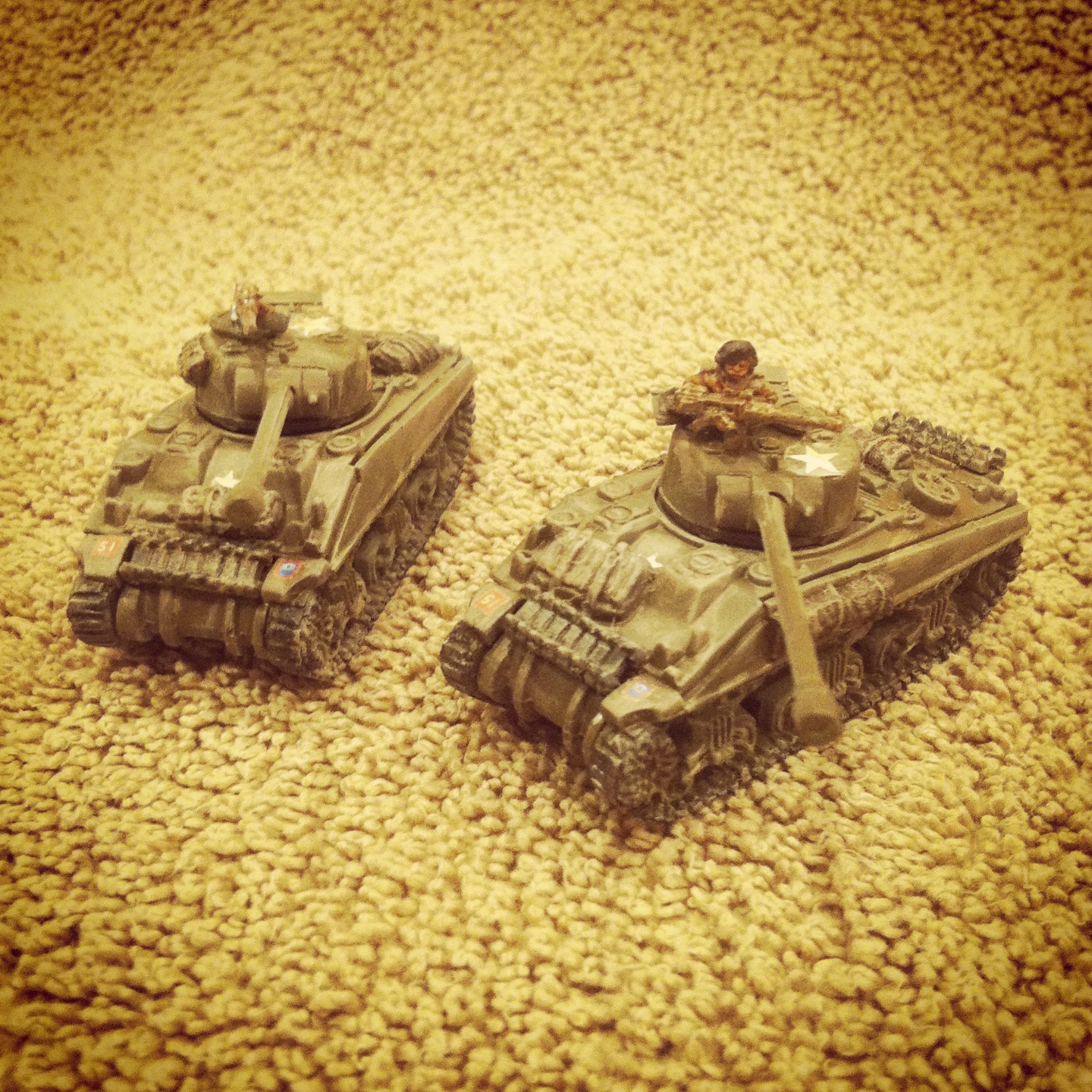
FWOFBoxI’ve been working away for half this year on finishing up the models included in the excellent Flames of War Open Fire! box set. Among all the plastic goodies included, the set offers up a nice Guards platoon to provide support to their allied US Airborne infantry. The eight models include six of the US-supplied Sherman V tanks and two of the famed Sherman Firefly tanks, retrofitted by the British with a massive 17-pound anti-tank gun.

Aside from a rather significant and well-documented issue with some parts fitting together, the models glue up pretty nicely. To the included stowage and gear included on the sprues I also added some leftover bits. A quick coat of green armor spray paint followed by black and silver lightly brushed on the treads made up the majority of the painting work. The exposed drivers received a tan uniform, black beret and radio headset picked out in detail. Crates and tool handles strapped to the hull got a quick touch of brown.

IMG_1894For decals — a big oversight in not being a part of the Open Fire! kit — I used a set from the Plastic Soldier Company and guidelines found on the Flames of War site. I found the decals from PSC to be easier to apply than those I had used from FOW in the past, but I did still use a few Allied “star” markings I had lying around from previous US tank models from FOW. With the decals dry, a bit of dried mud color and watered-down brown wash added some wear and tear around the tanks before they were hit with a matte finish.
IMG_1896

IMG_1898Now that I’ve got some Brits on the table, I’m eying some UK infantry to add some depth to my collection and flavor to my games. There’s a big full-day Flames of War gaming event coming up in just a few days at Metropolitan Wargamers, but I don’t think the Guards will be making an appearance this time around. Still, it will be good to know they’re waiting to throw in with the Yanks on another day in the near future.
Flames of War: Hunner Park 1944 Scenario

nijmeganab

In September 1944, Allied forces launched the now-infamous Operation Market Garden. Fought in the Netherlands and Germany, the ill-fated plan was an attempt to aggressively take and control various river crossings through a series of bold airborne and armored assaults along key German strongpoints.

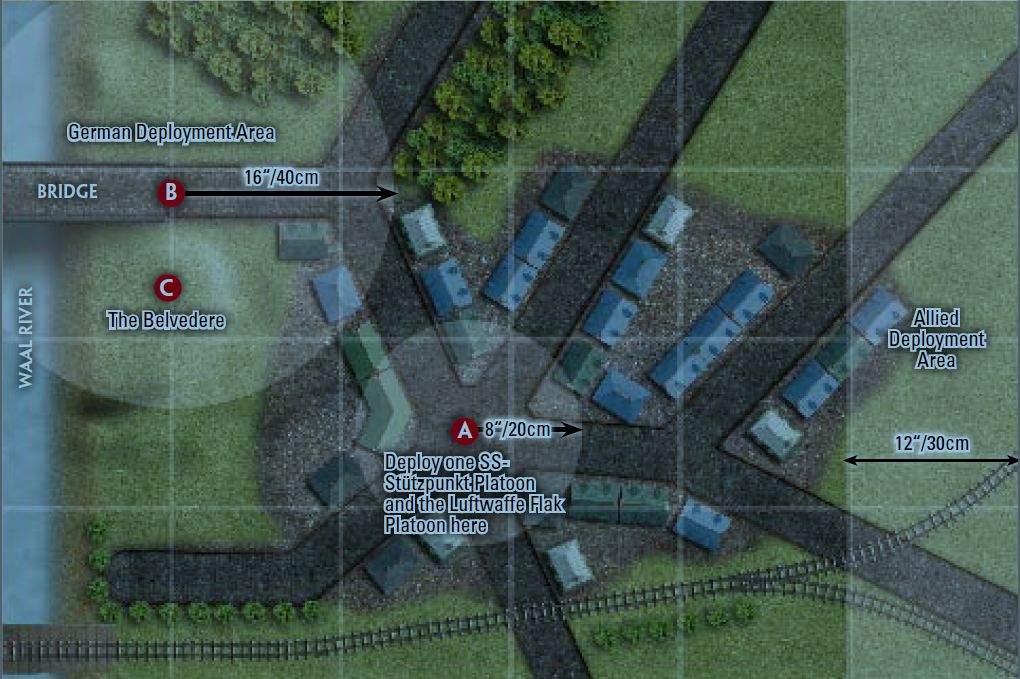
This past weekend at Metropolitan Wargamers, two of us threw together a quick Flames of War game based on the doomed Allied attempt to take the large bridge over the Waal River at Nijmegen, the oldest city in the Netherlands. Battlefront Miniatures, the makers of Flames of War, offer a PDF of the Hunner Park scenario which we used to broadly set the scene using the diagram below.

hpmap

We each fielded small, relatively balanced 1000 point forces. My US Airborne company consisted of two parachute rifle platoons, a machine gun support platoon and a US tank platoon consisting of four Shermans. The German Fallschirmjägers fielded two rifle-machine gun platoons, a heavy-machine gun support platoon and a three-tank Panzer IV platoon. The Germans deployed one rifle-machine gun platoon in the center of the town and the rest near the bridge, as per the scenario rules. My US Airborne deployed fully along the far edge.

1017331_10201039903174136_1883265778_nThe scenario’s goals call for the US Airborne to take the bridge and center of town with the Germans playing a defensive game, all within the six turn time limit. Since the Allies are at a pretty clear historical disadvantage in the scenario, I modified the game’s terrain to include some additional bocage and cover at the American end of the table to help balance the game.

My plan was to quickly run one parachute rifle platoon along the side of the table, into the woods and up the road to the bridge while the remainder of my force would slug it out against the German platoons hunkered down in the town. After one turn of movement, the second turn found the US Shermans and machine gun platoon pouring fire into the Germans occupying the town’s buildings but with no result. My other rifle platoon ran at the double to occupy the woods opposite the town while a German rifle-MG platoon and their heavy MG platoon converged to meet them.

227419_10201040232582371_1708827010_nBy the third turn, the Panzers showed up in the middle of town and quickly destroyed their first Sherman tank. In the woods, the German and US platoons began exchanging fire with the Americans finding themselves pinned after the first firefight and the Germans already taking heavy casulties. Through turns four and five, the Panzers went on to destroy two more Shermans while the American machine gun platoon and additional rifle platoon began to make headway with the German infantry hidden in the buildings. Over in the woods, the tough American Airborne managed to destroy the two German platoons and finally rolled to unpin themselves. It was a bit too little too, late. By the time of the sixth and final turn, the game was pretty well lost for the Americans as the final Sherman fled the field, a last-ditch US assault on the pinned Germans holding the  town was repulsed and the German armor rolled back to meet the Americans just emerging from the woods.

Historically, Operation Market Garden was an Allied debacle, so our game play of the scenario near the Nijmegen bridge wasn’t too far off. With just under three hours to play, the game did offer a quick, varied bit of play with plenty of opportunity for both sides to get some decent shots in. It was also a good warm-up as we prepare for a large all-day Flames of War event next Saturday at the club when I hope my US Airborne roll a bit better toward victory in Europe.

Military Terrain Making in World War II

In the opening pages of the recently-released and well-reviewed final book of his World War II “Liberation Trilogy,” The Guns At Last Light: The War In Western Europe, 1944-1945, author Rick Atkinson takes the reader swiftly to St. Paul’s School in west London on the fateful morning of May 15, 1944. In a darkened room, the secret council of the Supreme Headquarters Allied Expeditionary Force (SHAEF) were awaiting a presentation on the final plans for the impending Normandy invasion. With the 145 collected commanders and dignitaries (including Prime Minister Winston Churchill and King George IV) seated, the meeting is brought to order by Supreme Allied Commander, US General Dwight D. Eisenhower:

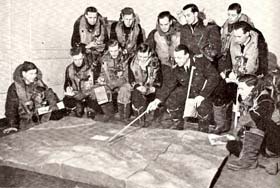
Behind him in the cockpit of the Model Room lay an immense plaster relief map of the Normandy coast where the river Seine spilled into the Atlantic. Thirty feet wide and set on a tilted platform visible from the back benches, this apparition depicted, in bright colors and on a scale of six inches to the mile, the rivers, villages, beaches, and uplands of what would become the world’s most famous battlefield. A brigadier wearing skid-proof socks and armed with a pointer stood at port arms, ready to indicate locales soon to achieve household notoriety: Cherbourg, St.-Lo, Caen, Omaha Beach.

Over the next several hundred pages, Atkinson’s book goes onto to recount the trials, travails and eventual success of Operation Overlord and the eventual Allied victory in Europe. Although I’ve read accounts of the period before, the book is incredibly gripping and moves surprisingly briskly. In reading though, my mind keeps wandering back to that brief description of that enormous model of the invasion laid out before so many great military leaders nearly 70 years ago.

No one knows for certain when terrain models were first used in warfare. One might easily envision some leader of a primitive warband arranging sticks in the dirt before his subordinates as a way of planning for an upcoming attack on a rival force. What we do know is that by a few hundred years ago models were being used frequently by commanders and in military schools throughout Europe. It was out of these same elite war colleges that modern miniature wargaming would eventually spring.
It’s from this place where my mind keeps turning back to that plaster model in 1944 London. As a wargamer, I’ve previously written here about my passion for creating a well-laid-out terrain board for my gaming. With a bit of digging around online, I managed to uncover quite a few resources outlining the this bit of military craftwork and its importance in 20th-century war planning.

Terrain Models, a joint Swiss-American scholarly site dedicated to the European history of military topographic modelling, gives a great overview of how the tradition grew through the ages. With a bit of a slant toward Swiss model-making history, the site does provide a lengthy bibliography, a rundown of model types and a number of photos (sample, right).

In a 2002 article entitled “Allied Military Model Making During World War II” from the journal of Geography and Geographic Information Science, English lecturer Alastair W. Peterson also offers a bit of historical context before detailing the specific importance of models to Allied forces in WWII. Peterson outlines the evolution of methods and materials and also presents a nice chart of common scales and military uses for each (below).

The article also presents personal accounts of the people recruited for model making during the war, and the challenges they too faced far and away from the actual fighting. A recent interview in the Cleveland Plain Dealer provides another set of remembrances from a veteran who spent the war making topographic models, including one used ahead of the Normandy invasion.

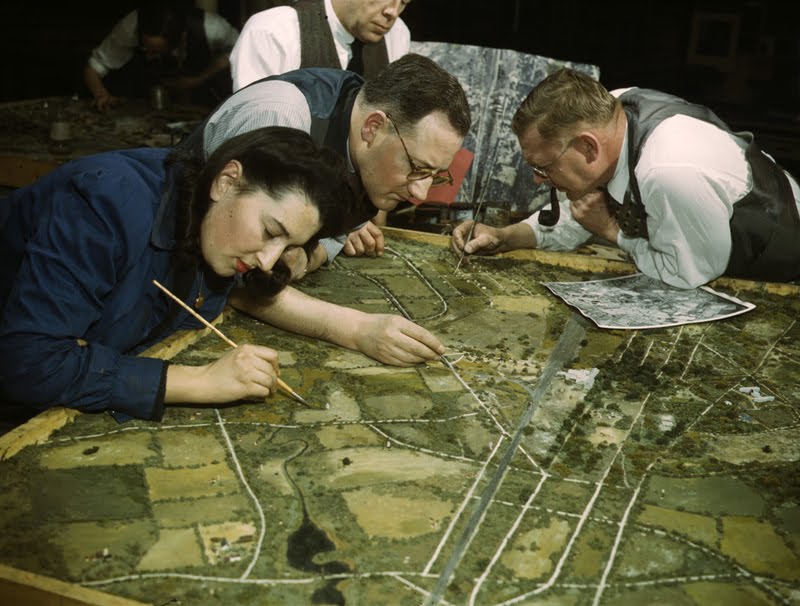
Other discoveries I made include a 1945 Universal Newsreel entitled “Secret Maps Guided US Bombers” which offers up a rare behind-the-scenes look at the construction of massive 80 foot 3D map used in planning late war air raids on Japan. And the undated color photo at left shows what purports to be a group of students learning techniques in creating a terrain map for military use during or immediately following WWII.

The articles, sites and photos I’ve uncovered give a cursory overview of military terrain making and their role in WWII. There are some lost gems I’d like to dig into more, including tracking down an actual copy of the 1956 US Army training manual Terrain Models and Relief Map Making (TM 5-249) which is referred to in a number of online bibliographies. But for now, I’ll carry all this history with me as I lay out my next wargaming battlefield in the context of all the historic importance many of the same skills and techniques have played in the wars of the past.

Flames of War: Foy 1945 Scenario

With a big full day of Flames of War gaming coming up at Metropolitan Wargamers on July 20th a few of us got together for a practice game this past weekend. There’s a renewed interest in FOW at the club as of late, and one of the great things about the group is the way experienced and new players alike come to learn together.

Wanting a manageable but interesting late war Western Europe scenario with US Airborne and German forces, we settled on the Battle of Foy from January 1945. The battle was just one small part of the brutal and much larger Battle of the Bulge campaign in the Ardennes forest region of France, Belgium and Luxembourg during the winter of ’44-’45. The engagement near Foy is featured dramatically in an episode from HBO Band of Brothers miniseries (clip here), so I was looking forward to trying my hand at commanding Easy Company from the 101st Airborne Division on the table for the day.

The FOW website offers a downloadable PDF outlining the scenario which fairly represents the German defensive position in and around Foy. No guidelines are given on the make-up of forces, but we decided on 1780 points on a side with flexibility beyond the historic record. The US Airborne begins in two divided deployment areas with I Company pinned due to indecision by its commander Lt. Norman Dike. Only by the daring sprint across open ground by Ronald Spiers sent on orders by Capt. Richard “Dick” Winters to relieve Dike of command can I Company join the assault on Foy. In the FOW scenario, the US forces have six turns to wrest control of one of two objectives from the defending Germans. The Germans must hold their ground against the bravery and skill of Easy Company.

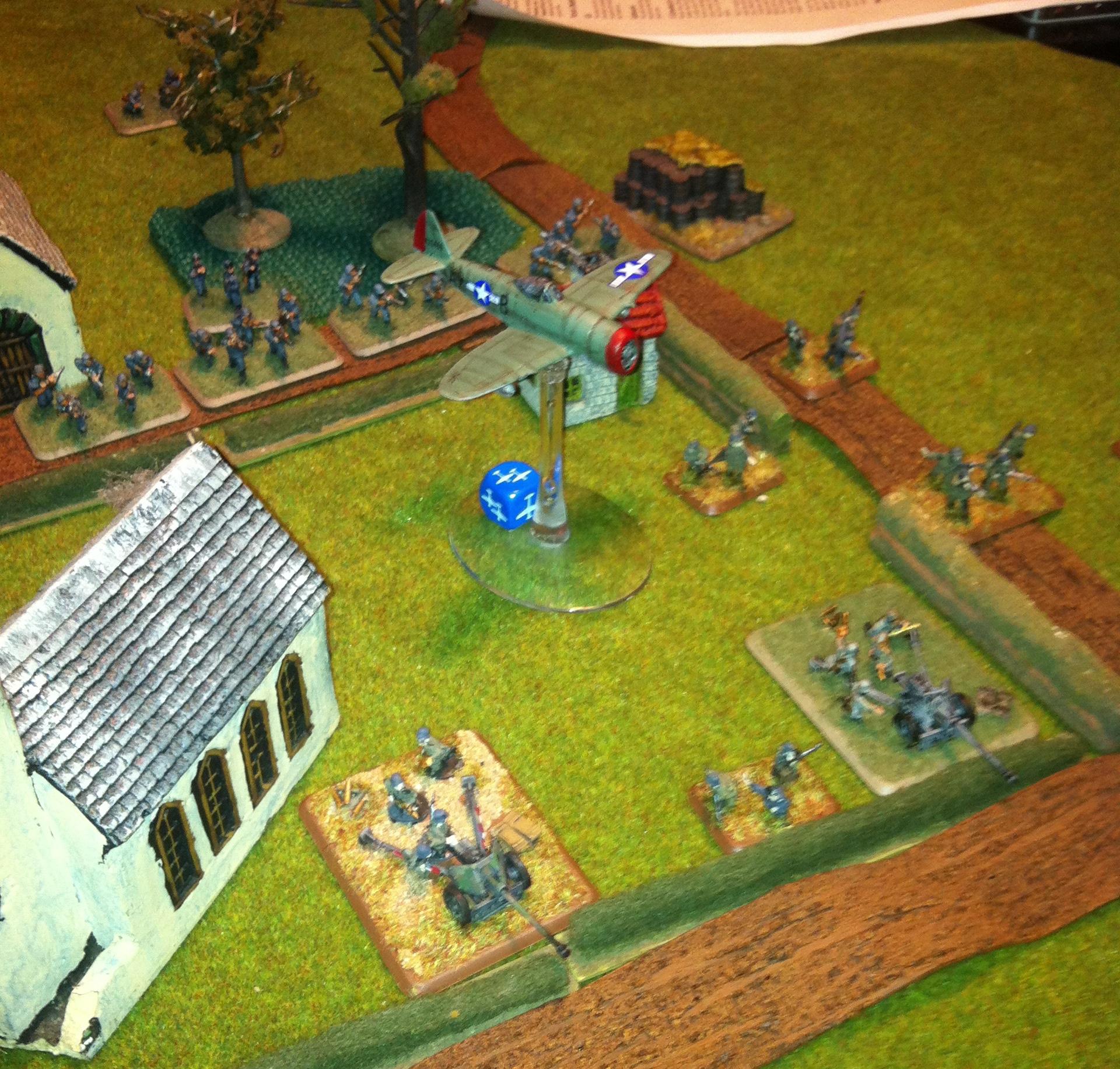
The US struck first with an airstrike from their P-47 Thunderbolt taking out two of the three German PaK 40 anti-tank guns tucked behind the churchyard walls at the center of town. After being pinned by the P-47, the anti-tank platoon wound up rolling poorly and remained pinned and ineffective for the remainder of the game.

That was pretty much the last major good story the US could tell for the rest of the game. Some house-to-house fighting took place along the German right flank with the Airborne eventually beating the Germans back from the protection of the row of houses along the road to town. The American Sherman tank platoon rolled up the center but remained stuck for the whole game attempting to machine-gun the German platoons dug in behind the churchyard walls. Four of the five tanks wound up taking fire and being destroyed where they sat.

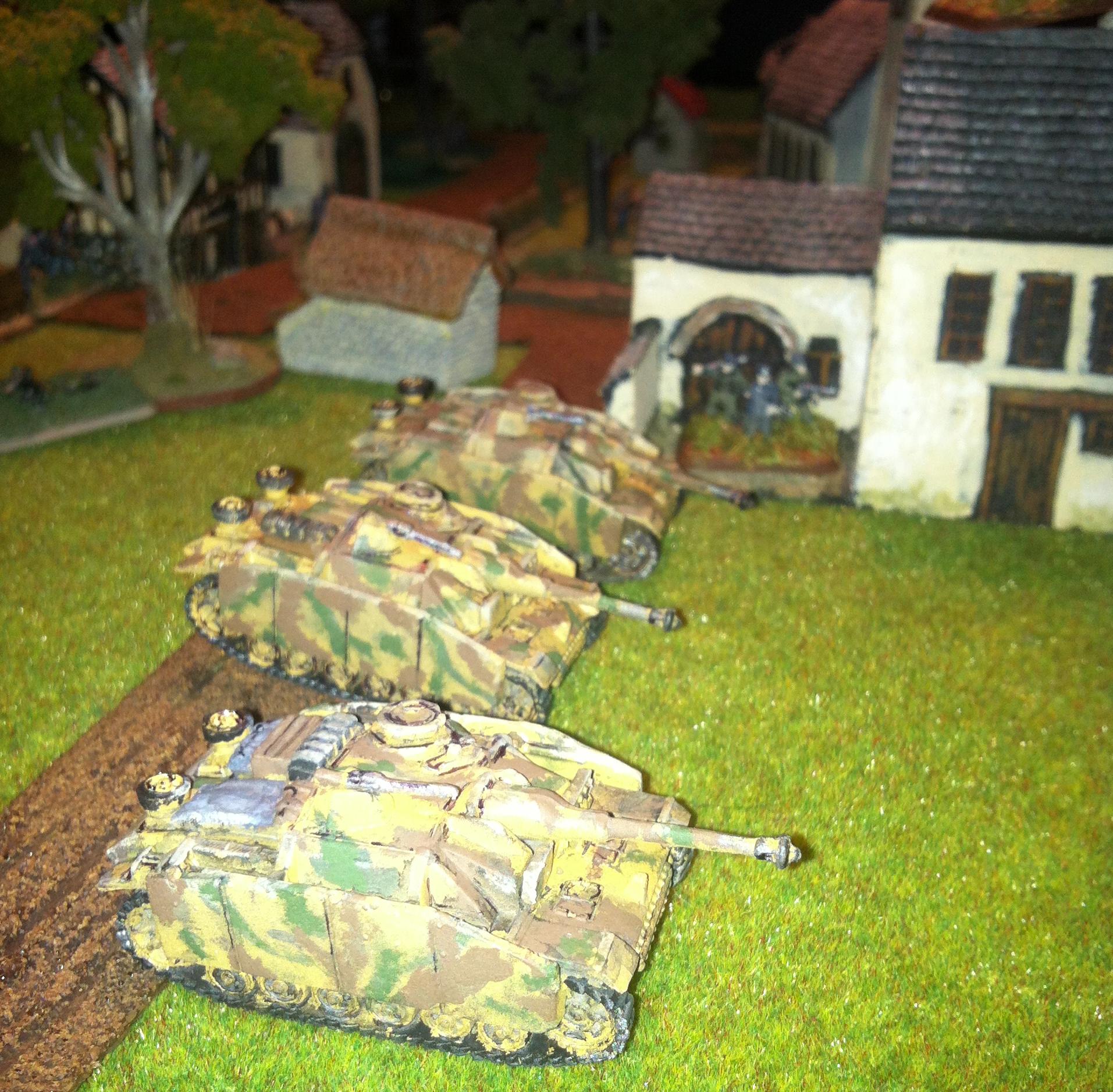
With the US infantry moving too slowly on both sides of the table, the Germans rolled their armored reserves in on turn three as their Stug platoon entered the table to hold off any US advance on the German right flank.

US volleys from the parachute artillery platoon tucked far back in the field did little more than occasionally eliminate a few German infantry and keep the units protecting the objective on the German left flank pinned.

Aside from a deadly late game P-47 strike on the German mortars which had harassed the Americans for the entire game, US air support never did much more for the rest of the game. By the sixth turn, the final German Panzer IV armor support rolled onto the table. With both flanks locked down by the Germans, a final desperate US attempt at dual assaults on the German armor platoons were ineffective. With three American platoons eliminated and most others with heavy casualties, the US ceded victory to the Germans in a revisionary result from the actual American victory in 1945.

Games like this are fun but also an opportunity to consider lessons learned. My US 101st Airborne was entirely too cautious and didn’t get into the fight fast enough, losing the opportunity to control the town’s center before the arrival of the German armor. My machine gun platoon got stuck mid-field and got chewed up bit by bit without having the opportunity to truly unleash its full effectiveness on the Germans who remained out of range and dug in for most of the game. Other infantry platoons hung back too much in the woods or buildings and never really got up in the fight.

With a much larger game coming up in a few weekends, I see that taking greater advantage of Easy Company’s aggressive, daring and deadly experience is going to be key to an Allied victory. Looking back at our re-running of the battle at Foy this past weekend, I can see I was a little too much like the wavering Lt. Dike and never let the heroics of individuals like Ronald Spiers to take over.

Flames of War: Fielding the Sd. Kfz. 7/1 Anti-Aircraft Gun

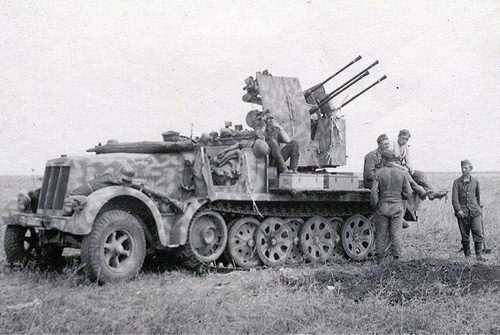
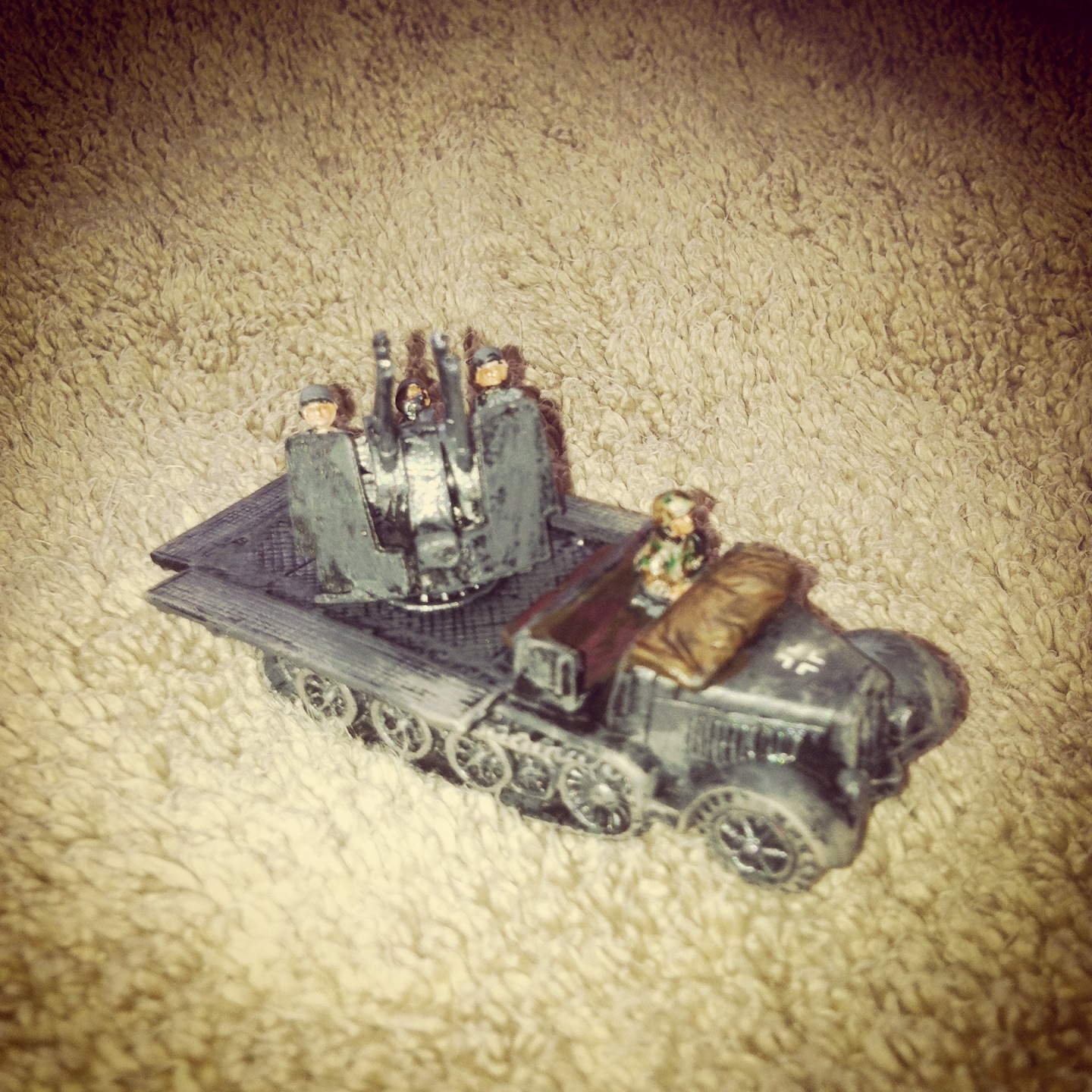
Wars are filled with big, heavy equipment, and the 8-ton German  Sd.Kfz. 7 served as the longtime workhorse throughout World War II. Short for the Sonderkraftfahrzeug (German for “special purpose vehicle”), the Sd. Kfz. 7 half-track was widely used as a transport, towing vehicle and the basis for self-propelled anti-aircraft gun crews. AA configurations of the truck featured either quad-mounted 2cm Flakvierling 38 guns on the Sd. Kfz. 7/1 and the Sd. Kfz. 7/2 with more cannon-like 3.7cm FlaK 36 guns.

For my Flames of War AA gun team, I’ve chosen to model the Sd. Kfz. 7/1 in its two variants – one with its open cab and one with an armored engine and driver’s cab. After gluing-up the metal and plastic pieces, I left the gun turrets unglued to the truck bed so the crews could rotate 360 degrees as they did in real life. As with most of my German armor, a flat black sprayed primer coat was then dry-brushed in a dark grey. Guns and details were picked out with a bit of gun metal and the bench seats were painted to resemble a reddish-brown leather. The crew and driver were finished to match my usual infantry models with flesh and equipment details finished off with a watered-down brown wash.

For now, I’ve got the open cab version finished and I’ll post again once the armored one is complete.

Having recently finished my P-47 Thunderbolt for use as air support for my Allied forces, I only thought it fair to even-out the German side with some anti-aircraft protection. As in actual combat, the FOW Sd. Kfz. 7/1 model is as equally deadly against aircraft as it is to ground forces. With a big day-long FOW day coming up on July 20th at Metropolitan Wargamers in Park Slope, Brooklyn, rushing these guys to the tabletop front to hold back the Allied invasion should be key to striking a gaming balance.

Flames of War: Fielding the P-47 Thunderbolt

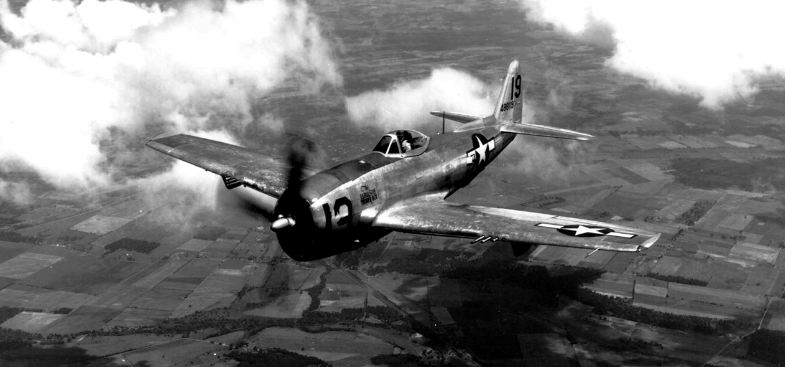
The P-47 Thunderbolt was a big, heavy, expensive and deadly plane with .50-cal machine guns and a bomb payload of 2500 pounds. Rushed into development and production near the dawn of World War II, these American planes saw their first use in Europe in 1942. By the late war period, the P-47 was being widely used in Western Europe and proved to be among the most effective fighter aircraft in both air-to-air and air-to-ground combat operations. During the Normandy landings in June 1944, the German Luftwaffe was a virtual no-show and the P-47 Thunderbolt ruled the air in support of the massive Allied invasion below.

I’ve been modelling and playing with the 15mm World War II Flames of War miniatures wargaming system for a number of years now, but until now all my gaming has been with tiny scale boots, wheels and tank tracks firmly planted on the ground. With a full afternoon of large 2500-point late war period FOW games being planned in July at Metropolitan Wargamers in Brooklyn, I decided to supplement my existing US Airborne force with some new air support with a P-47 Thunderbolt model. Armed with its wing machine guns and laden with bombs, I’m pretty excited about adding the P-47 and a whole additional dimension to a game I’ve gotten pretty familiar with over the years.

Choosing a paint scheme for the model was the first decision I needed to make in my project, and there are hundreds of historical variations to be found. While the silver fuselage seemed to be among the more commonly-modeled versions of the P-47, I opted for a simpler olive drab body. The green base coat was followed by a grey underbelly and some boldly-colorful red details at the nose and tail. The windowed canopy “glass” consisted of some flat black and white dry-brushing. Along the seams in the body of the plane I wiped fine lines of rusty metal to show wear on the plane. The decals included in the kit completed the model, albeit with a fair amount of struggle with near-miss tears.

While my first shot at modelling a plane for FOW may not be 100% historically accurate, I’m pretty satisfied with the visual impression it makes. At some point I’ll even things up with a German plane, but for now I can’t wait for my P-47 to take off in my next game.

Flames of War: Fielding Easy Company

I’m not unique in being a World War II gamer and a big fan of HBO’s Band of Brothers miniseries from 2001. I also finally got around to reading Stephen Ambrose’s same-titled book on which the series was based. Both works follow the exploits of “Easy” Company of the 506th Parachute Infantry Regiment, 101st Airborne Division from training to D-Day to the end of the war. The story is absolutely riveting and presents a dramatic account of how the collective action of individuals contributed to the Allied victory.

I’ve been working away recently at finishing my long-overdue modelling of Easy Company and a large US Airborne force. Nearly two years ago I purchased and painted up an entire company of Command Decision Paratroopers from Old Glory Miniatures, including command, machine guns, mortars, bazookas and parachute artillery support teams. This past week I’ve wrapped-up the small plastic parachute rifle company from the Flames of War Open Fire! starter box set I received this past Christmas. To this collection of troops, I’ve added the excellent Easy Company set from FOW containing a number of the real historic US servicemen portrayed in Band of Brothers.

While the casting is a bit skinnier and lacking in the detail of the official FOW miniatures, the value of the Command Decision models can’t be beaten at the low price of $15 for a hefty bag of 50 solidly serviceable figures. At under $70 online, the big Open Fire! box is a real deal for all the troops, tanks, artillery and other stuff included. The FOW Easy Company set itself runs about $12 for the few specific personality figures, and fielding these models is going to add significantly both to the look and effectiveness of my force on the tabletop battlefield.

With a good mix of FOW and Command Decision models painted-up, I turned to the “Nuts!” campaign book to put-together my order of battle for Easy Company. The book focuses on the 101st Airborne’s involvement in late 1944’s siege of Bastogne and other Battle of the Bulge engagements and then on to the German border and the eventual Allied victory in 1945.

In creating my list I wanted a highly-mobile and playable 1500 point force heavy on infantry with just a bit of tank support. In the FOW rules, the parachute rifle company is rated Fearless/Veterans, making them hard-hitting and tough to chase from the field. Their special use of Gammon bombs enhances their impact in risky infantry assaults on otherwise-intimidating German tanks. Adding the special characters from Easy Company makes for an even more resilient and daunting force, reflecting the historic bravery these men brought to the late war European campaigns.

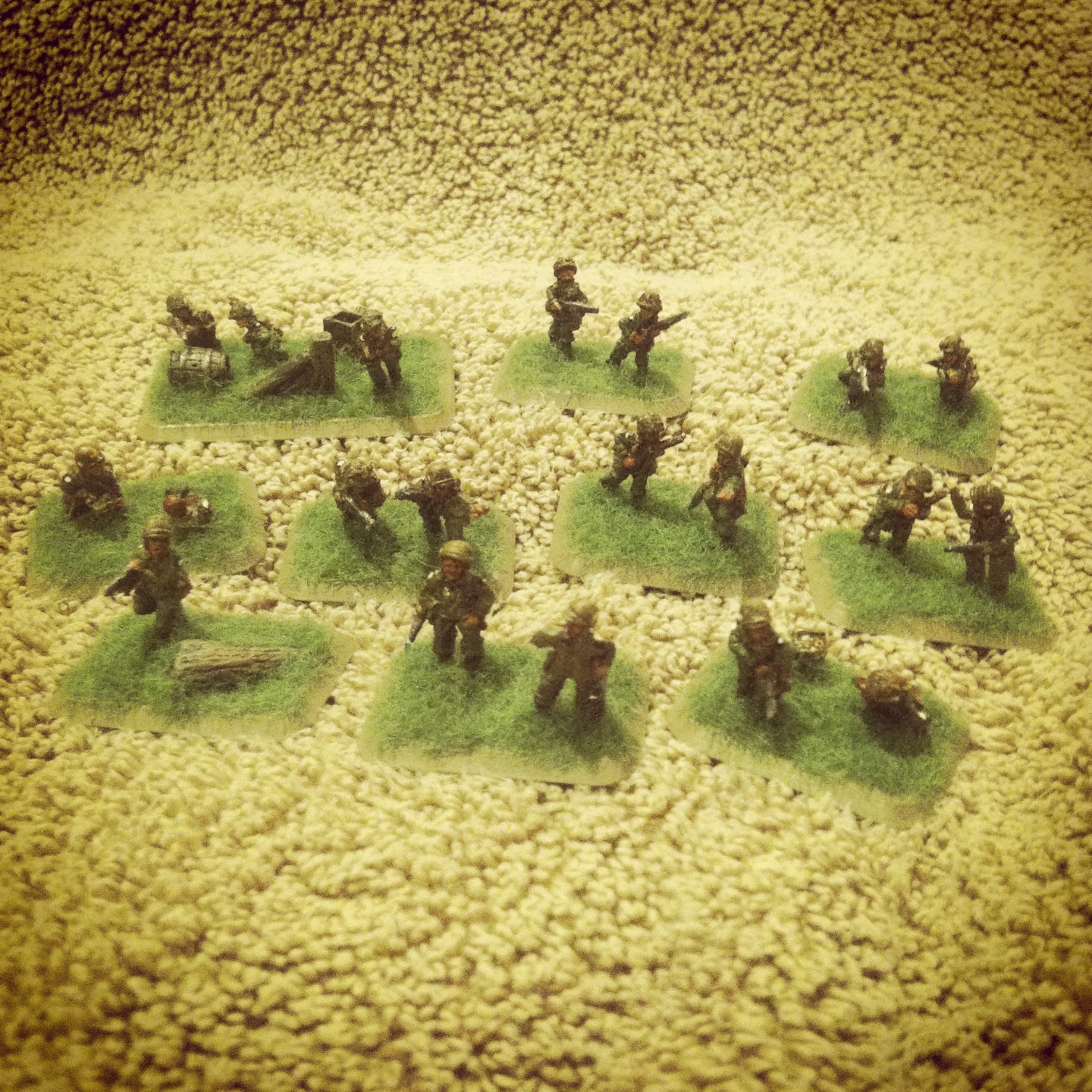
I’ve modeled my infantry pretty simply with a quick coat of flat green primer, lighter brown on backpacks and equipment bags, a contrasting watered-down brown wash and some equipment details picked-out. Finally, the shoulders get a dot of black and a dab of white to mimic the famed Airborne eagle insignia (shown at the top of the page).

The first photo below shows the specific men of East Company which come packed with a lot of individual personality. Leading the platoon is Capt. Richard Winters and Capt. Lewis Dixon (front row, center) with the Nixon model taking a swig from a bottle as he was known to do. Pvt. Eugene Roe (middle row, far left) is shown patching-up an injured comrade. Corp. Darrell “Shifty” Powers (top row, far left) is hunched aiming on a barrel and ready to take out his German target. With so many generic models in my force, these guys are all a real treat.

And below is a look at the plastic Airborne platoon included in the Open Fire! box set:

In July, I’m organizing a big FOW day at Metropolitan Wargamers with two simultaneous 2500-point games of Soviets vs. Germans and US Airborne vs. Germans. To the above list I’ll be adding some significant artillery muscle and I also hope to have a new P-47  Thunderbolt air support model ready to go. With Easy Company ready to lead on the tabletop, I can’t wait to get my new Airborne force into action.

Flames of War: Fielding the Grenadierkompanie

I got the Flames of War Open Fire! set this past Christmas and I’m finally getting around to painting-up all the stuff that comes packed in the box. At under $70 online, this big package is a real deal for new and experienced FOW gamers alike. The set includes over 100 plastic Allied and German infantry, tanks and artillery models, plus the full FOW rulebook, dice, markers and some other goodies included. A couple guys at Metropolitan Wargamers also picked up the set and are just getting into FOW. If you have any interest in gaming WWII at all, this set is the place to start.

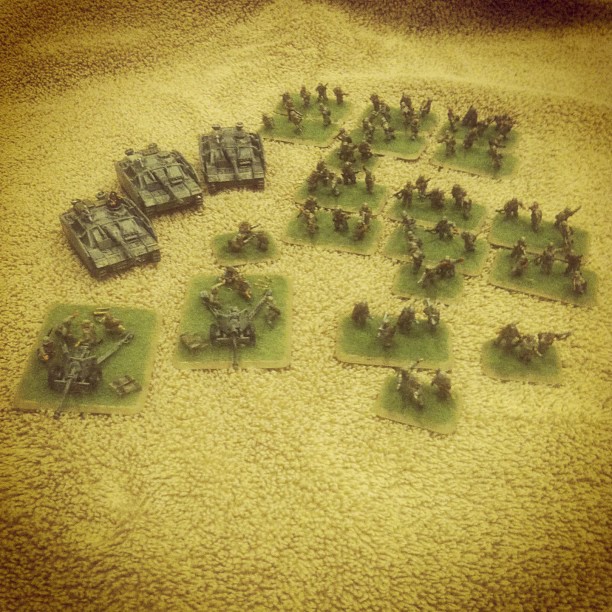
First off, I’ve finished the German Grenadierkompanie, including anti-tank 7.5cm PaK40s, a Stug G tank platoon and two platoons of infantry. These will supplement the pretty extensive Grenadier and Fallschirmjäger infantry I already have. The Stugs will also add to the large collection of Panzer IV, Jagdpanther and Konigstiger platoons I’ve already got on the shelf.

The plastic models all glue together quickly, but handling them has to be a bit delicate so as not to snap off the tips of the gun barrels. For the infantry, I spray prime everything in flat black and paint the uniforms in a mid-dark grey. All the details — guns, boots, equipment and skin — get picked-out with quick dabs of paint. Everything gets a very watered-down brown wash in the end which gives the uniforms a more accurate grey/green muted finish and also tones-down the flesh.

My camouflage painting abilities are honestly pretty atrocious, so my default is to go with a more generic grey paint scheme on my armor, artillery and vehicles. For the Stugs and PaK40s, the flat black primer was hit with a quick dry brushing of mid-dark grey.  After the dry brush coat, tank cargo and other details were then dabbed on. The platoon commander got some special attention with white detail on his cuffs and collar, plus some detail on the radio headset he’s wearing over his hat. Finally, I applied some wet-transfer decals and then dry brushed some light brown mud in the areas most likely to see some splashing on the tracks, sides and fenders.

y

With my Germans from Open Fire! complete, I’ll be posting soon with an update on the US Airborne and allied models from the set. Along with the Germans, a set of special FOW models from the famed Easy Company and a bunch of my existing models, there’ll be some major action from the Normandy campaign and beyond coming soon.

New Game Weekend: Dust Tactics

The long Memorial Day weekend was as good a time as any to roll up my sleeves for a big day of wargaming, and the Dust Tactics Regional Tournament at the Compleat Strategist in New York City on Saturday May 25th was the place to be.

I signed up my son and I for two slots in the small tournament organized by a fellow club member at Metropolitan Wargamers in Brooklyn. The two of us were newbies to Dust Tactics but I had certainly read a lot about it since its release last year by Fantasy Flight Games. Dust Tactics is an alternate reality WWII-era game where alien technology is discovered by Germany in the late 1930s and goes on to shape a world of warfare between the Axis and Allies throughout the 1940s.

As is expected with FFG releases, Dust Tactics is a gorgeous game ready to play straight out of the box for about $80 retail and cheaper online. The core set comes with a dozen infantry forces for each side plus heavily-armored walkers. The box contains two two-sided fold-out gaming mats , special dice, rules, a scenario guide, reference cards and a few rudimentary plastic terrain pieces. There’s a large variety of additional accessories, campaign expansions and army packs available in the price range of $15 to $45. All this makes Dust Tactics very collectible and flexible as a gamer’s interest expands and wallet can abide. The models are gorgeous and mostly pre-assembled at a hefty 1:48 scale with a visual appeal bridging interests from WWII into a dystopian sci-fi theme.

For the tournament, we rolled-off to choose our armies and then paired-up with other players for the first round of three games. The organizer of the tournament is way into Dust Tactics, and he hauled along his extensive collection of miniatures for players to choose from. My son chose to play as the SSU (aka Soviets) and backed his ground troops with a monstrously deadly helicopter. I chose to play as the Axis (aka Germans) with laser-armed ground troops, a huge four-legged walking gun platform and a squad of weaponized gorillas.

Dust Tactics plays pretty easily and fast. After the board is set and a scenario is chosen, players take turns performing two actions with each of their units. Combinations of move/fire, fire/move or deadly sustained fire are the most common actions. Range and strength of weaponry is clearly listed on each unit’s reference card. Special dice with hits on two sides and misses on the other four resolve combat, damage and saves from taking damage in cases where troops wear special armor.

Each game was timed at an hour with a maximum of eight turns per game. My son (above left) and I were easily beaten in the first round by more experienced players. What we both quickly learned was a lot of the game outcome could be pre-determined by the forces chosen by a player. Too much reliance on our heavy mechanized forces had also led to quick defeats for the both of us once they were destroyed in the first round.

In the second round, my son and I played off against each other with a bit more knowledge of the capabilities of the forces on the board. We each scored lucky shots early in the game, again knocking out each other’s heaviest armaments. After that, the game settled into a really enjoyable cat-and-mouse between buildings and barriers as our infantry, snipers and smaller mechanized walker units dueled it out to my eventual victory by a slim margin.

For the third and final round, the tournament organizer and house expert on Dust Tactics played against my son. Failing to focus early on destroying my son’s massive helicopter gunship drifting eight inches above the table, my son managed a solid win by picking off the tournament organizer’s ground units from the air with his multiple weapons. I got crushed in my final game as I faced-off against another Axis player who had stacked his forces with fast-moving zombie and gorilla units. These savage figures ran right over most of my ground units and even my artillery platform was eventually torn to pieces by the ape squad.

So, we didn’t do so well with our first go-around at Dust Tactics but we did have a good time. Dust Tactics is a fun little game that looks fantastic and plays pretty easy. The common criticism I’ve heard and experienced a bit today is that the game looks better than it plays. A detailed knowledge of all allied and opposing units is pretty necessary in fielding an effective force in the game. A few poor moves or die rolls can also pretty much end a game in an opening turn, making for some frustration I myself felt in my first game today.

There does seem to be a glimmer of future hope for a next stage of Dust Tactics. An announcement was made this month that Battlefront Miniatures will be taking over publishing and distribution of the game and the tabletop version, Dust Warfare. Battlefront’s past success with its Flames of War WWII gaming system had fans hotly debating the possible outcomes that may bring a bit more finesse to Dust Tactics over time. For now, the combination of some high-style miniatures with a somewhat less-than perfect set of rules still makes Dust Tactics more than worth a rainy day play.

New Game Weekend: Pacific Typhoon

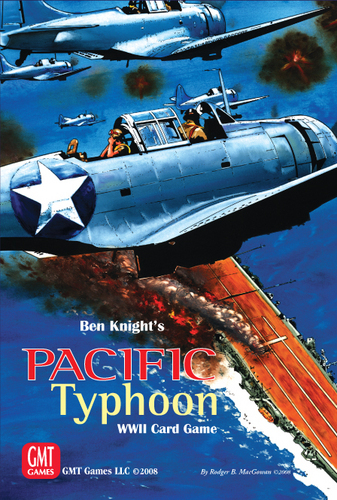
It was the second rainy weekend in a row in New York City, but a crowd of guys made it down to the Metropolitan Wargamers club in Brooklyn Sunday afternoon. With seven of us standing around the table trying to come up with a big enough game with easy rules that could be played in a couple hours, a few people tossed out the idea of 2008’s Pacific Typhoon by GMT Games.

This WWII Pacific Theater naval battle card game was originally produced as a sequel of sorts to Avalon Hill’s Atlantic Storm  game from the late 1990’s. Created for 3-7 players ages 10 and up, Pacific Typhoon is simple to grasp with a pretty straightforward trick-taking format yet enough opportunity for interaction among players to keep a group of hearty experienced gamers engaged for the afternoon.

Pacific Typhoon comes with 140 force cards and 40 battle cards plus a couple dice and a rulebook, making this a compact and entertaining game for medium to large groups. The cards themselves are simple but have nice black-and-white WWII period photos and contextual factoids which add flavor to the game. Plus, at just $20 direct from GMT Games, Pacific Typhoon carries a lot of fun at a really friendly price.

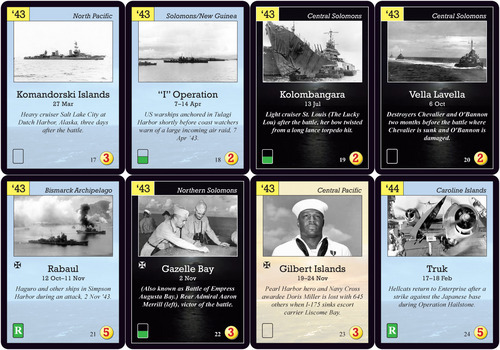
Each player begins by drawing a hand of six force cards. Cards depict historical Japanese (red, top left) and Allied (blue, middle left) naval forces plus upgrade and event cards. The starting player draws two battle cards (black-edged, bottom left) and chooses one of the two to play. Play goes around with each player choosing in turn to commit a Japanese or Allied force card to the battle. Players contribute the points on their cards to the total strength of each side in the battle, and the side with the most points wins that battle. The player with the highest point value on the winning side then divies up the points among the winning players, and the next round begins.

As described above, the play is really straightforward but there’s a lot of flexible play in each round. Battle cards take place in a specific year (’41, ’42, 43, etc.) and during day or night. The player choosing the battle also calls whether the battle is to be fought with submarines, on the surface or by air. A battle combination such as “night battle, surface, ’44” will determine which force cards the players can choose to play in the battle.

With force cards with varying levels of strength, bonuses, year, time of day and type, each battle plays out differently. Alliances among players are created and broken with each battle, with players choosing which side to support as a gamble toward contributing to whichever side will win. For example, a turn may start with Japanese cards being played to what looks like a certain victory until a group of subsequent players decide to pool their Allied cards and win in an upset. As the game progresses, winning players dole out points rewarding their allies in each round while making certain to hold enough points for themselves ahead of the whole group at the game’s end.

With alliances and double-crosses sailing back and forth over the table in each round, Pacific Typhoon is a game rife with good-natured team-play and trash-talking. Pacific Typhoon ultimately makes for a great mix of individual and collaborative play within a casual trick-taking card game good for beginners and experts alike interested in spending a couple hours re-fighting famed WWII battles of the Pacific high seas.