New Game Weekend: Pacific Typhoon

It was the second rainy weekend in a row in New York City, but a crowd of guys made it down to the Metropolitan Wargamers club in Brooklyn Sunday afternoon. With seven of us standing around the table trying to come up with a big enough game with easy rules that could be played in a couple hours, a few people tossed out the idea of 2008’s Pacific Typhoon by GMT Games.

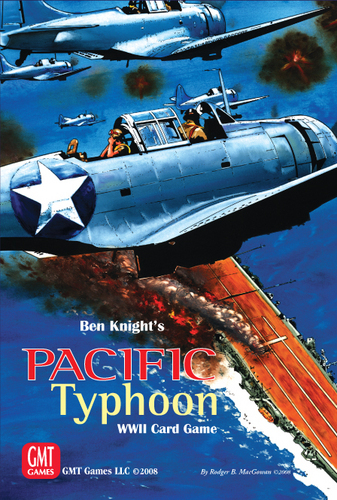
This WWII Pacific Theater naval battle card game was originally produced as a sequel of sorts to Avalon Hill’s Atlantic Storm  game from the late 1990’s. Created for 3-7 players ages 10 and up, Pacific Typhoon is simple to grasp with a pretty straightforward trick-taking format yet enough opportunity for interaction among players to keep a group of hearty experienced gamers engaged for the afternoon.

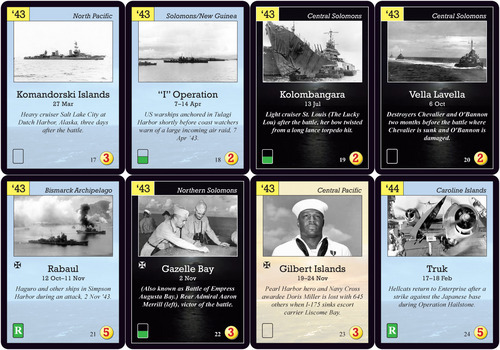
Pacific Typhoon comes with 140 force cards and 40 battle cards plus a couple dice and a rulebook, making this a compact and entertaining game for medium to large groups. The cards themselves are simple but have nice black-and-white WWII period photos and contextual factoids which add flavor to the game. Plus, at just $20 direct from GMT Games, Pacific Typhoon carries a lot of fun at a really friendly price.

Each player begins by drawing a hand of six force cards. Cards depict historical Japanese (red, top left) and Allied (blue, middle left) naval forces plus upgrade and event cards. The starting player draws two battle cards (black-edged, bottom left) and chooses one of the two to play. Play goes around with each player choosing in turn to commit a Japanese or Allied force card to the battle. Players contribute the points on their cards to the total strength of each side in the battle, and the side with the most points wins that battle. The player with the highest point value on the winning side then divies up the points among the winning players, and the next round begins.

As described above, the play is really straightforward but there’s a lot of flexible play in each round. Battle cards take place in a specific year (’41, ’42, 43, etc.) and during day or night. The player choosing the battle also calls whether the battle is to be fought with submarines, on the surface or by air. A battle combination such as “night battle, surface, ’44” will determine which force cards the players can choose to play in the battle.

With force cards with varying levels of strength, bonuses, year, time of day and type, each battle plays out differently. Alliances among players are created and broken with each battle, with players choosing which side to support as a gamble toward contributing to whichever side will win. For example, a turn may start with Japanese cards being played to what looks like a certain victory until a group of subsequent players decide to pool their Allied cards and win in an upset. As the game progresses, winning players dole out points rewarding their allies in each round while making certain to hold enough points for themselves ahead of the whole group at the game’s end.

With alliances and double-crosses sailing back and forth over the table in each round, Pacific Typhoon is a game rife with good-natured team-play and trash-talking. Pacific Typhoon ultimately makes for a great mix of individual and collaborative play within a casual trick-taking card game good for beginners and experts alike interested in spending a couple hours re-fighting famed WWII battles of the Pacific high seas.

New Game Weekend: A Bridge Too Far: Operation Market Garden

Maybe it was the dampness and spring chill, but Saturday night at Metropolitan Wargamers in Brooklyn was pretty empty with just me and one other club member around. We decided on a two-player boardgame, and being big WWII enthusiasts we picked 2010’s A Bridge Too Far: Operation Market Garden from Battlefront Miniatures.

I’ve been a long-time fan of the 1977 film A Bridge Too Far featuring a classic international cast recounting the events of Operation Market Garden and the botched Allied attempt to chase the Germans out of a number of key defenses in the Netherlands in September 1944. The film does an entertaining job of depicting the colorful real-life personalities against a backdrop of a daring daylight airborne invasion, over-confidence in the weakness of the German forces and disagreement among commanding Allied staff on the plan itself. The game offers two scenario set-ups giving the option of refighting the battle as rather historically depicted in the film or through a plan of your own devising. The game we played was the historical one, and I commanded Field Marshall Marshal Bernard Montgomery’s British and US forces.

The game involves five play turns with a random number of battles making up each turn. Initiative is rolled before each battle, and targeted objective spaces on the board are chosen to attack. Each player chooses to commit some, all or none of their forces to each battle. Different forces – tanks, guns and airborne infantry – each provide bonuses modifiers in different terrain types. Defenders of areas containing bridges get an extra bonus. Resolving combat is a simple roll of the dice with modifiers added. Defeated forces roll to be destroyed or retreat to adjoining areas, and then the next initiative is rolled for. Once a round of battles is completed, strategic moves can be made and the Allied player has the option to air-drop additional forces and supplies into designated areas of the board. The Axis player can then choose to attempt to fend off the Allied air support with their own air power. Keeping supply lines intact is key to the Allied strategy, as forces which are cut-off from their line of supply suffer a greater weakness in subsequent battles.

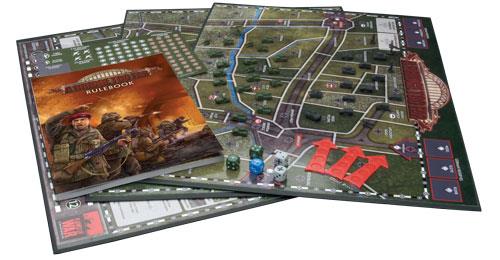
Typical of games by Battlefront Miniatures, makers of the popular WWII 15mm miniatures game Flames of War, this game packs some great design and ease of play into a neat box. While each battle and turn of play involves a number of steps, the game moves along quickly in about 90 minutes. The game comes with over 40 well-sculpted plastic playing pieces, but the version at the club had been modified with painted metal micro-scale armor and troops. Gamers who long-ago graduated from Risk to games like Axis & Allies will find a lot to love in the focused presentation of this game.

Even with the relative simplicity of the game, there’s a lot of strategic play potential. My first time through, my Allied strategy of pushing hard from the rear and left flanks of the board stalled rapidly as my tanks were quickly destroyed by some disastrous die throws against German anti-tank guns. My paratroppers dropped effectively into the middle of the board, yet they too became surrounded and snarled by the superior German armor defending the game’s main objectives. By four turns in, I faced certain defeat with no additional hope for much-needed tank support for my floundering airborne troops.

For a notoriously one-sided battle, I can easily see a lot of replay value in this game . I hope to give this one another shot soon, trying out some less historical and more aggressive strategies in running the Germans off the field. Having a chance to remake history is one of the joys and challenges of wargaming, and the board game A Bridge Too Far: Operation Market Garden provides a lot of opportunities to do so.

New Game Weekend: Fortune and Glory

By the time Raiders of the Lost Ark hit the theaters in the summer of 1981, my newly-teenaged brain was already well-steeped in the concept of high-adventure cliffhanger movies and serials. For most kids, Indiana Jones kicked-off a mini-rival in interest in the danger-thwarting, jungle-hacking, mystery-unraveling and treasure-seeking characters that populated decades of Saturday afternoons in local movie theaters for my parent’s generation and earlier. The elements of cliffhangers are so ingrained in our pop culture to this day that I challenge you to find a popular TV show, action movie, comic book or video game that doesn’t borrow some element from the genre.

One of the best things about the gaming hobby is that you can pretty much be guaranteed there’s a a game (or several) that aligns with a just about any thematic interest. So, this past weekend at Metropolitan Wargamers I had a chance to try out taking on the role of an international adventurer with 2011’s Fortune and Glory from Flying Frog Games.

The game takes place in the between-the-wars period of the 1930s where mobsters and Nazis vie for international control while your adventuring character roams the world searching for fantastic objects of great value and power. Players take on one of eight fantastically-named personalities such as Li Mie Chen, The Duke, Jake Zane, Sharon Hunter, Dr. Zhukov, Shelley Hargrove, Jacques Moreau and Cartwright (all pictured below, left to right and top to bottom). Each player character comes with their own set of special abilities and attributes such as Cunning, Lore, Combat and Agility. These attribute strengths come into play as characters roll dice to resolve their success during certain encounters within the game adventures.


The game begins by placing artifacts in random locations around the globe. Players move their characters toward these objects and upon encountering them, roll dice in a three-part attempt to resolve their quest. The thing that makes Fortune and Glory so entertaining is the random mechanic of drawing cards to create objects of the quests and the adventures themselves.

For instance, in our game (pictured at right) a quest for a magical sword unveiled an adventure that involved solving a mysterious puzzle, a high speed car chase and a final airplane chase. Failing to roll successfully against the high speed car chase challenge wound up in a “cliffhanger” on the reverse of the card which led to the car going over a cliff. All this detail is related on the well-illustrated adventure cards and left to the players to dramatically read aloud, often to great mirth around the board. Other encounters during our game included a shootout in a nightclub, a case of malria in the jungles of the Amazon and an unsuccessful encounter with a Yeti in the northern steppes of Russia. With hundreds of cards available in the game, there is endless variety to the how each adventure will play out. All this contributes significantly to the high replay value of Fortune and Glory.

Aside from all the cards, there are over 150 miniatures included for character adventurers, Nazis, mobsters, temples and a zepplin which randomly drops new Nazi henchman around the board as the game progresses. Plastic gold coins mark your progress toward gaining “fortune” and may be spent to further outfit your adventurer with guns, maps and even an airplane. In the end, collecting blue plastic “glory” coins points the way toward victory for our heroes or the villains.

We played the game collaboratively, allowing us to work together with each of our own abilities contributing toward our march toward glory and victory. A competitive set of rules options is also included which completely changes the dynamic to duelling adventurers questing toward individual glory.

Fortune and Glory carries a hefty retail price of about $100 but can be found for around $75 online. However, the investment in this big, heavy box is well worth it with the gorgeous design and endless randomness to the game providing a hugely entertaining world of cliffhanging adventure. Fortune and Glory is certain to keep you on the edge of your seat and may  even cause you to spill your popcorn if you’re not careful.

New Game Weekend: Zombicide

My weekend of gaming started with a regular meeting of the Metropolitan Wargamers club where new members — including myself — were inducted. With a couple dozen guys in attendance, it was great to look around the room and feel the fellowship with a group with decades of gaming passion in them. I’m looking forward to years to come with these guys and the inevitable newcomers who find their way to the club.

After the meeting, groups split off into a variety of board and miniatures games. I teamed up with four guys for my first playing of Zombicide. Anyone with a pulse knows zombies have been a huge trend in the culture for a few years now with the popularity of the The Walking Dead TV show and comic book series, as well as countless other books, movies and video games. Tabletop gamers haven’t been immune to the trend with a variety of popular zombie-themed miniature and boardgames rising in popularity. I’ve enjoyed playing Zombies!!! and a few of its expansions with my kids for a couple years now, and Last Night On Earth has become a mainstay for zombie gamers.

Zombicide is the latest to break into this gaming trend pitting survivors against undead hoards. The game was launched via a Kickstarter campaign just about a year ago that brought in over $750,000 from over 5,000 backers. In March of this year, the first expansion set for the game — Zombicide: Season 2 — raised an additional $2.250 million from nearly 9,000 funders. Needless to say, in a year’s time Zombicide has ridden the zombie wave to incredible heights of popularity with a rabid fan base.

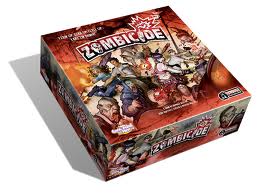
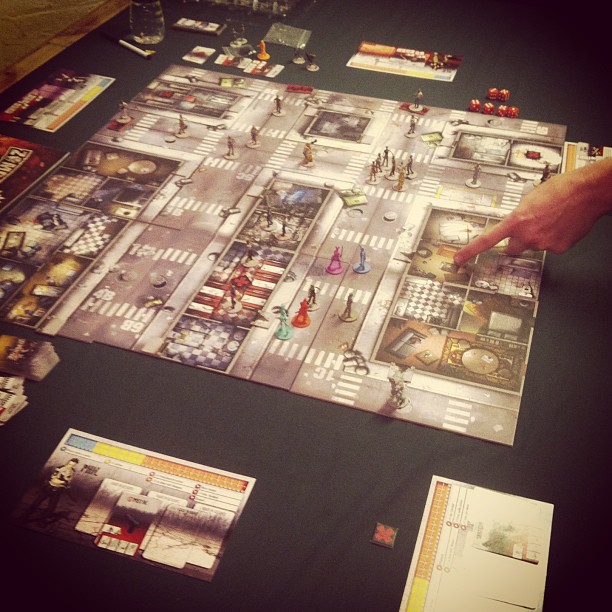
My first run through Zombicide was a tough introduction to both the goofy fun and extreme challenge of the game. Each player takes the role of survivor of the zombie apocalypse with its own card outlining their particular abilities and a personalized miniature. A streetscape of wonderfully detailed and gory cardboard tiles is laid out according to one of the ten scenarios included in the base game. To complete the set-up, areas are predefined where zombies enter the game, doors are set in buildings, objectives are placed, and, depending on the scenario, special pieces such as a police car is strewn throughout the town. Over 60 zombie miniatures in four varieties — Walkers, Runners, Fatties and the Abomination — start the game at the town’s edge, just waiting to sink their teeth into a juicy survivor.

Players work collaboratively using a base three actions to move, search and/or fight zombies both on the street and in buildings. Searching allows a player to draw cards to find weapons, ammunition, gear and other special items which increase their chances of surviving the zombie onslaught to come. Since each player starts with only a frying pan as a weapon, searching for weapons is a focus from the start. Players manage what items they carry in their hands or on their person, and players may also choose to trade or simply give items to their compatriots to increase the group’s overall chances. Certain items are used in combination, adding a scavenger hunt aspect to the game. For instance, a scope added to a rifle creates a more accurate and deadly long-range weapon, and a can of gasoline combined with some empty bottles makes for a devastating molotov cocktail.

It’s when the zombies start filling the board at the end of a round of turns by the players that collected weapons and other gear become critical. Melee weapons like baseball bats, axes, machetes and chainsaws are used for close-quarters fighting with zombies while ranged weapons such as pistols, shotguns and submachine guns come into play with longer ranged combat. Certain characters or weapon types allow for weapons to be used in each hand, doubling the survivor’s visciousness when tangling with the undead. In other cases, powerful weapons like shotguns or a molotov cocktail are critical when trying to destroy more powerful zombies like Fatties or the enormous, shambling Abomination.

As the turns elapse and zombies are killed, the players advance in experience which gains them the bonus of extra abilities. The downside from this gain in experience is that zombies begin coming onto the board in greater numbers. Because of this, players need to work together to balance the team’s experience level against the amped-up presence of zombies. Zombies move en masse toward noise created by gunshots or doors being broken down, so players also have to make smart decisions as a group on when to take a chance in making noise and attracting the growing hoard of zombies. Getting attacked twice by a zombie means almost certain death for any survivor on the board.

The rules to Zombicide are pretty simple, but the game gets wild very, very fast as the streets and buildings quickly fill up with the undead. It’s one of the better collaborative boardgames I’ve played in recent memory. Players working in tandem or even sacrificing themselves for the greater good gives the game its spice and replay value. In my first game, three of the five of us were felled quickly by the zombies while the other two players managed to trick out their survivors with a plethora of weapons and fight on.

The combination of beautiful design (only improved by painting the miniatures as in the photos from today’s game above), simple rules and pretty steep odds stacked against the players has made Zombicide popular. We were kidding around during our game that if a real zombie apocalypse were to come, sticking close to our fellow members of the club might just mean the difference between life and death. After a couple hours running and slugging away at zombies in Zombicide today, that notion seemed more real than just mere joking speculation.

New Game Weekend: Star Wars X-Wing

One of the big instant hits to come out of last year’s huge GenCon gaming convention was the new Star Wars: X-Wing Miniatures Game from Fantasy Flight Games. I finally got a chance to play it a few times in the past couple weeks with members of the Metropolitan Wargamers club in Brooklyn. Then, my brother brought me a starter set of the game over this past Easter holiday weekend. As both a lover of all things Star Wars and well-designed games, I’m hooked.

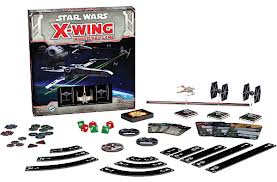
SWXW is the one of the latest fan favorites to appeal to both experienced and new gamers wanting some gaming right out of a box full of easy rules, well-designed components and beautiful pre-painted miniatures. The starter set offers two Tie Fighters and a X-Wing model, rules, movement templates and dials, cards, specialized dice and scenario markers for about $30-40. A few beginner scenarios are also included with the starter set, allowing two players a pretty solid and varied intro to the basics of the game.

In a nutshell, SWXW is a dogfight game where ships chase and fire at their opponents while maneuvering to avoid their own destruction on a typically 3′ x 3′ playing area. Play starts with each player pre-assigning movement to each of their models with a special movement dial. The dials are particular to each class of ship and allow for combinations of straight and turning moves. Since movement is planned in secret from your opponent, guessing which way the enemy will move and how you should react is key to the strategy of the game.

After ships move, firing lasers and other specialized secondary weapons occurs using special dice. Modifying “focus” or “target lock” actions increase the ability to hit enemy ships while “evade” actions increases a ship’s ability to avoid damage. Ships take damage to their hulls or shields, and destroyed ships are removed from the table. The game moves fast, and a basic game can be accomplished in well under an hour.

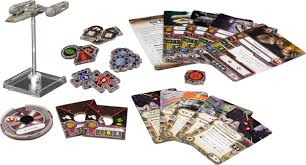
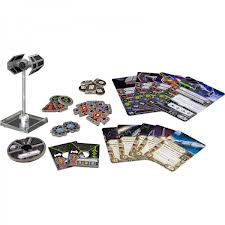
While the starter set allows for some fun intro games, players will soon want to grow their fleets and options. Like the Star Wars Universe itself, SWXW soon proves to be as expansive as players (and their bank accounts) allow. Single ship expansion sets of Tie Fighters, Tie Advanced Fighters (pictured below, right), Tie Interceptors, X-Wings, Y-Wings (pictured at right) and A-Wings retail for about $15 each (cheaper online). With these, players gain greater choice in fielding larger Rebel and Imperial fleets.

Each ship expansion comes with specific cards indicating pilots, astromech droids, secondary weapons and other special abilities which may be used in combination with that model or, in some cases, other ship types. So, an X-Wing can be fielded with Luke Skywalker, Wedge Antilles or Biggs Darklighter at the helm and R2-D2 or some other astromech droid along for the ride. You can assign Darth Vader to the controls of a Tie Advanced ship and then assign addition weapons and abilities to the ship. The latest expansion wave offers two large-sized ships — the Millenium Falcon and the Slave I — which are certain to be a huge hit with fans anxious to pit Han Solo against Boba Fett in an intergalactic duel.

Players wishing to get into SWXW will do well by themselves to get a couple of the basic sets plus some expansion ship packs. Once you’re quickly beyond the beginner stage, games are typically fielded with 100 points of ships on a side. Points are assigned according to ship class, pilot expertise and other add ons, allowing for lots of replay value and experimentation with combinations of forces. While the game is still new to me, I can see this one coming out of the box and onto the galaxy of my gaming table pretty frequently in the months ahead.

New Game Weekend: Leviathans

Saturday night at the Metropolitan Wargamers allowed me the chance to try my hand at the latest game sensation that’s making it’s way through the club’s membership. Recently produced by Catalyst Games Labs, Leviathans is quickly growing in popularity with its late 19th-century steampunk alternative reality of airship wars battled out in the skies over Europe between France and England.

Steampunk In Popular Culture

Anyone who has been aware of sci-fi and fantasy fandom over the past few years is no doubt aware of the rise of the popularity of steampunk. Broadly, steampunk is a sub-genre of science fiction involving a vision of the world from the Victorian era through the early years of the 20th-century where anochronistic modern mechanical technologies, often powered by steam, create an alternative history of science, exploration and warfare.

In popular culture, Jules Verne and H.G. Wells are usually viewed as the grandfathers of steampunk. Aside from the Victorian visions of Verne and Wells, my earliest exposure to steampunk was with reruns of the 1960s TV show Wild, Wild, West. The show followed the exploits of James West and Artemis Gordon, two US government secret agents travelling the Old West of the post-Civil War era equipped with retro high tech gadgets. The show made its way to the big screen in 1999 with a much-maligned film adaptation starring Will Smith, Kevin Klein and Kenneth Branaugh. What the movie lacked in character and story, it more than made up for in capturing the steampunk ethos of monstrously destructive weaponry wrapped up in a 19th-century Old West plot.

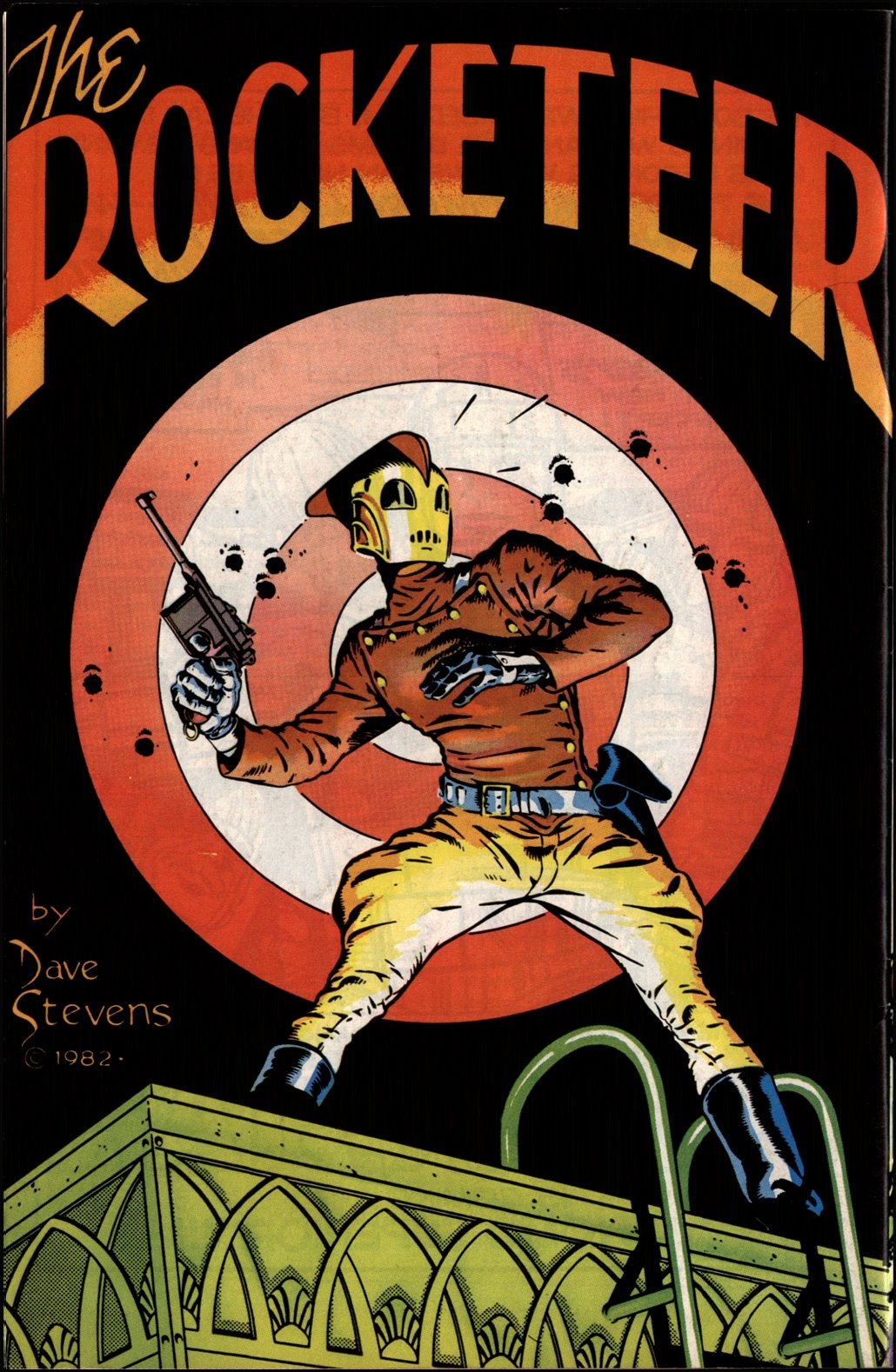
In the 1980s, underground comics writer Dave Stevens introduced the Rocketeer, a barnstorming stunt pilot and reluctant jet-packed superhero. Set in 1930s NYC and LA, the Rocketeer did battle with Nazis and crime syndicates armed with all manner of fanciful lasers, transported by airships and other might-have-been rocket technologies, and conniving with evil plots of world conquest. The comic eventually found its way to Hollywood and a beloved 1991 live-action film adaptation by Disney. Both the movie and comic capture an aesthetic of sexy and functional design bridging an Art Deco look with an alternative pre-WWII era where secret agents vie for control of fantastical emerging technologies.

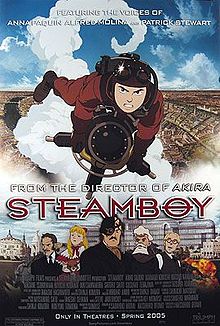
Jetpacks and high-flying airship battles also figure prominently in the 2004 Japanese anime film Steamboy. Set against the backdrop of the Crystal Palace Exhibition in London’s Hyde Park in 1851, the story follows a young inventor boy from the mills of England’s Industrial Revolution to a showdown over technology which threatens the balance of worldwide power. The classic Victorian England setting provides the stage for an ultimate steampunk-themed battle with a massive metal castle-like flying fortress, robots, jet-packed paratroopers and British soldiers fighting to preserve the fate of the British Empire and world peace ahead of the Great War in the coming decades of the early 20th-century.

The interest today goes far beyond the pages of comics and TV and movie screens,  and the examples above are just a few of my particular touchpoints in steampunk. There are steampunk cosplayers, conventions and even bars and meet-ups where like-minded fans can live out their steampunk fantasies.

Like so many fantasy interests, steampunk has also made its way to tabletop gaming in a big with a number of gaming systems over the past few years. The thematic historical “what ifs” and opportunities to let the imagination go wild with miniature modelling makes steampunk a particular draw for gamers.

Leviathans

Leviathans is the darling of the moment for steampunk-minded gamers. Produced just this year, Leviathans is a complete board and miniatures game that comes in an incredibly well-designed package containing rules, charts, game boards and detailed plastic airship models which are ready to go straight out of the box for about $100. The core set comes with massive French and British battleships along with smaller destroyers and other ships which levitate above the game board on clear plastic stands. The ships are armed with all manner of guns, turrets and torpedoes manned by crews who furiously fire away at the enemy while working to keep their airships aloft.

Each ship comes with a card detailing the armaments, engine power, stabilisers and other equipment particular to each class of ship. Players take turns manuevering their ships and bringing their weapons to bear on the enemy. Combat results are determined with multiple colored dice which factor in the strength of firing weapons, the durability of an opponent’s armor, the placement of hits and the presence of crew. As ships take fire, their effectiveness in movement, combat and the ability to make repairs is affected. Multiple hits to the same area of a ship may result in a hull breach and the ship crashing to earth in a hulk of flame and twisted steel.

The scenario I played involved my side’s two damaged French battleships attempting to flee off the far side of the board while moving at half speed and being swarmed by my opponenet’s smaller British destroyers. The quick manueverability of the British ships was initially no match for the powerful guns of my French fleet, and two UK aircraft were quickly blown from the sky. Further damage to the already slow French engines eventually made them sitting ducks in the sky, and my team’s French ceded defeat as evacuation to the far side of the table became impossible.

Popularity of Leviathans is spreading quickly with a few new French and British expansion ship fleets already available. A new German fleet is also under development, as is an online version of the game. The game is being produced under a Creative Commons license, allowing for a free distribution of rules and also encouraging fans to collaborate openly on the development of the game. With the quick rise of Leviathan’s popularity and the continued gaming interest in steampunk, I’d expect this game to rule the sky for quite some time.

New Game Weekend: Fire & Axe

After a couple weeks spent at home hunched over my workbench working away furiously at my 28MM American Civil War projects, I was finally able to get out of the house for some gaming this past Friday night. I hadn’t been to the Metropolitan Wargamers club in a few weeks, so it was good to get back this weekend. I walked in to a nearly empty club — rare on a Friday night — but in quick order a few other members showed up. I had hauled along my copy of Village to introduce to the guys, but first another member suggested we have a quick run through a different boardgame I’d heard mentioned frequently at the club before —  Fire & Axe: The Viking Saga Game.

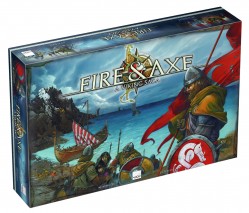
Originally published in 2004, Fire & Axe is now hard to come by and used copies can fetch over $100 at times. I’m a little surprised at the long-standing adoration this game has. Of the twenty or so games I’ve been introduced to over the past year, Fire & Axe wouldn’t be near the top of the list although it does have ease of play and short duration going for it.

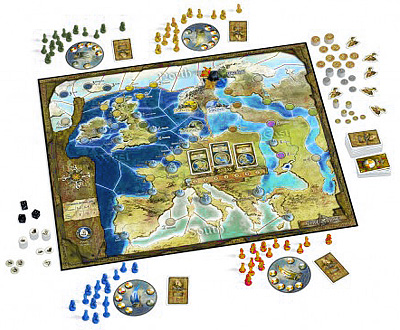
The game pits 2-4 players against one another as they sail on quests to settle, conquer or trade within various regions of European seas in the backdrop of the Viking age. The game begins with each player’s ship in the Wintering Box in the northernmost edge of the map. Once a ship is loaded and launched, players choose to depart from Norway, Denmark or Sweden. The turn begins with a player choosing to perform seven actions which may include loading goods or troops to their ship, sailing across the open seas or landing in ports to engage in trade, establish a settlement or capture a city. Special “rune cards” can also be collected and played to perform a variety of actions — from strengthening your invading forces or calling on a sea monster to destroy another player’s ship.

Gold is collected throughout the game through trade, conquest and settlement. Specific missions to trade with or take over specific ports can be collected to score additional points. The missions can also have shared success where points in conquering three port cities might be split between two players. Players who complete the most missions for each of the Viking civilizations of Norway, Sweden and Denmark stand to earn additional points at the game’s end. Additionally, missions get more valuable and reach to the farthest edges of the board as the game progresses. When all missions are completed, the game ends and points are tallied.

The game progresses quickly — four of us got through a game in about 90 minutes Friday night. The game is simple to understand after a turn or two, but it all just seemed like a race without enough variety in paths to victory. For instance, I burned up a couple turns hoping to conquer three cities, but some awful die rolls sent me back to the Wintering Box as other players swept in to claim those cities. At the end of the game, another player snatched victory from the would-be winner through one final chance move that stole a few points from the guy who had led up to that point.

I’ll give Fire & Axe another shot at some point since the guys at the club seem to have a deep love for it, but for now I think I’ll be concentrating on games beyond the Viking regions of the northern seas.

New Game Weekend: Tsuro

My Saturday evening of gaming with Metropolitan Wargamers was a busy one. First, I faced off in a 20mm World War II scenario on one of the club’s sand tables, and then I played in a three-player game of Lords of Waterdeep. It was standard fun stuff on a rainy quiet night in Brooklyn.

The surprise of the evening was when one of the guys pulled a box off the shelf and asked if I wanted to play a ten-minute game. Now, most the games I’m used to playing easily take a minimum of 60-90 minutes to play, so I was more than curious as to what this mystery game might be.

The game is Tsuro, and it’s one of those magical games that is both easy and complex all at once.

Tsuro has been around for about 10 years but the game has a feel and design making it seem a part of some ancient Far Eastern culture. It’s subtitled “the game of paths,” and that’s it in a nutshell. Each of the 2 to 8 players take turns placing square tiles on the board’s grid and moving their pieces along the linking paths. When newly-laid tiles touch other player’s pieces, those players also slide their pieces on the ever-changing linked, criss-crossing and overlapping paths. The object is to keep your piece from getting routed off the edge of the board. The last player on the board wins.

I played a couple three-player games of Tsuro in rapid succession. The turns go fast, and I can see how a game played with even more people could turn into a dizzyingly-quick game as pieces slide every which-way on the board’s paths. The game has nothing to read, nothing to count and incredibly simple rules, so I could see this as a fun game for families after dinner or with a few friends on the coffee table on a Friday night.

For another look, check out Wil Weaton’s Table Top for an episode with his friends playing Tsuro and some other quick dice games. Tsuro proves that a game doesn’t have to take all day or have a zillion pieces or complicated rules to be a blast.

New Game Weekend: Spartacus

Back in the 1970s and 80s, many popular TV shows — from Happy Days and Welcome Back Kotter to Mork and Mindy and The Six Million Dollar Man — cranked out cheap, simply-designed board games. While these games were based on shows and characters we loved, in hindsight the majority of these games were horrendous in terms of gameplay. I think there’s still a copy of the Dukes of Hazzard Game at my parents’ house, but I hesitate playing it again lest I ruin my fond childhood memories.

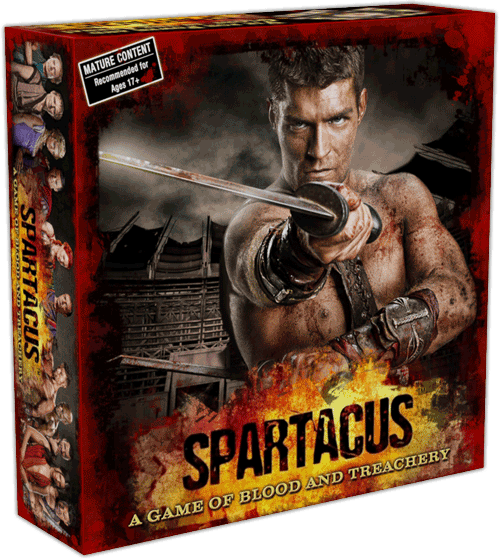
Modern shows continue to market themselves through games, although most of these come in the form of versions of Monopoly, Operation, Life, Trivial Pursuit or other established board game brands. I’ve never seen the incredibly popular Spartacus TV show on Starz, but I’ve read about the intense levels of swords-and-sandals-themed sex and violence which make the show a must-see for a certain demographic. About a week ago I had the opportunity to play the board game based on the show with three of the guys at Metropolitan Wargamers in Brooklyn, and this is definitely not a TV board game like most others.

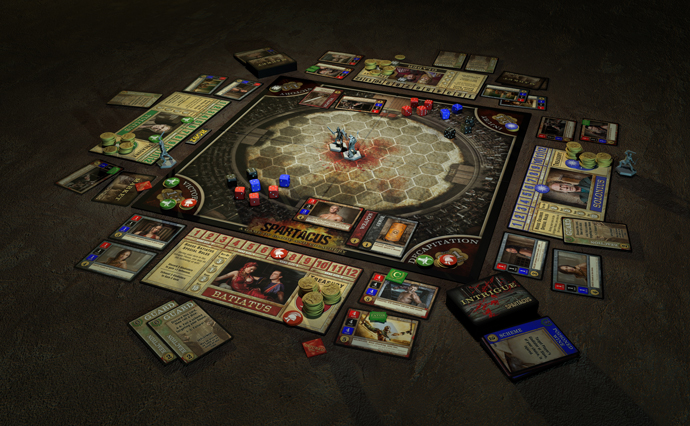
The game is played with 3-4 players with each player representing a “Dominus” or a “house” in the ancient Roman city of Capua where the show’s drama unfolds. The quest for ultimate control through growing your “influence” is the goal of the game through three basic turn phases — Intrigue, Market and Arena.

The “Intrigue” phase allows you to play schemes and reactions via cards that grant positive or negative effect combinations on you and/or other players. The “Market” phase provides a auction-like environment where the players secretly bid for slaves, gladiators, guards and equipment.  The “Arena” phase is where two players face-off in a bloody gladiator tournament where victors bring “favor” to themselves and “influence” to their Dominus.

Spartacus is definitely a game with pretty simple some straight-foward rules, but the rambunctious thrill in the game is in the free-wheeling buying, selling, bribery and double-crossing among players. Your slaves maintain your house resources and often grant additional side-bonuses like the ability to heal wounded gladiators or to earn extra gold by providing, ahem, special services. Combinations of gladiators and acquired equipment makes for stronger opponents within the arena. Guards provide protection from the havock that schemes can rain on your house. All along, players are trading and buying their way through the game. You might bribe a player to allow your gladiator access to the arena for a chance to score victory over a weaker player’s gladiator. Other times, you might share the rewards from a scheme with another player in exchange for  use of that’s player’s influence strength to your benefit.

I played the game with three other players which made for a great dynamic of shifting alliances. One player quickly acquired Spartacus and a full compliment battle equipment making him unstoppable in the arena, so the rest of us cut whatever side deals we could to block going up against him in hand-to-hand combat. While we were busy keeping Spartacus out of the arena, another player quietly bought, sold and traded his way into a series scehemes and slave acquisitions in the market which eventually shot him to the lead and winning with the most influence in the game.

Spartacus plays in a couple hours and has a great design with characters pulled directly from the TV show. Themes and play can be a bit raunchy and graphic at times, and while it’s not designed as a role-playing game, players may naturally gravitate toward taking on the snarling personalities of their Domini. Fan of the show or not, strap on your shield, grab your trident and head to the arena for some wild fun in ancient Rome.

New Game Weekend: Clash of Cultures

Once again, a few hours this weekend at the Metropolitan Wargamers brought me an introduction to yet another fantastically-addictive board game: Clash of Cultures.

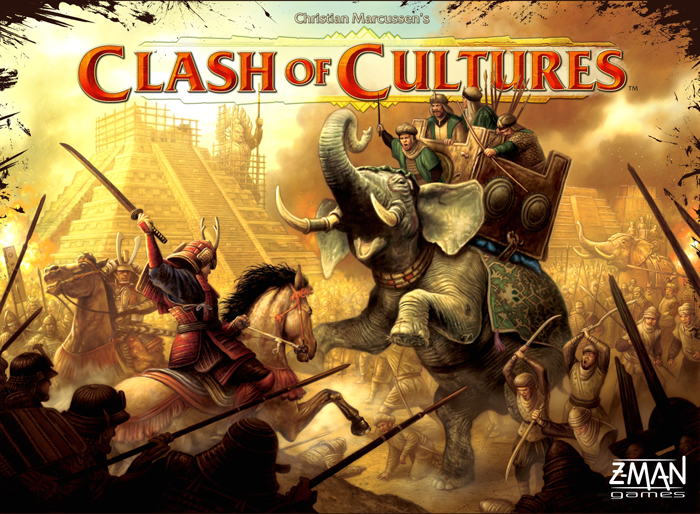
Released just last year by Z-Man Games, Clash of Cultures (aka COC) is a civilization-building endevour where each player seeks to exert their expanding cultural influence and ultimately vies for control of the imagined world of the game. If you melded Risk, Settlers of Catan and Sid Meir’s Civilization into one game and then multiplied that times ten, you’d have something like COC.

Play begins on hexagon terrain board with much of the territory hidden and open to exploration and expansion. Each player chooses three “actions” within their turn such as exploring, developing cities, reaping resources from the land, building armies or navies and expanding their culture. You can choose to increase the happiness of your cities or exploit the citizens, with each decision bringing plusses and minuses to the results. Cultural advances in areas such as Agriculture, Warfare, Spirituality, Economics and Science provide limitless variation in how each player chooses to develop their civilization. Different Government focus – Democracy, Autocracy or Theocracy – limits and expands your ability to develop the game world in different ways. “Event” cards insert random famines, bounties, natural disasters and other far-reaching events into the game, while “Wonder” cards provide players the opportunity to focus their resources on building architectural masterpieces while scoring big points. In the end, it is points earned through expansion, building and completing “Objective” cards that wins the game.

This isn’t a casual game, and a significant commitment to a play time of a minimum of an hour per player is required. My three-player game this weekend stretched to 4+ hours, and a week ago I sat in on the end of a four-player game that had run to 5-6 hours. With hundreds of plastic miniatures, cards, resource chips and cultural advances combined with quick shifts in dominance, the game moves remarkably fast but is at the same time administratively challenging.

In the game this weekend, I chose to focus on a massive defensive military build-up (those are my red soldiers filling the center of the board in the photo above).  Another player sank all his resources into building monumental wonders like the Great Pyramids and Great Gardens. The third player held half the territory while likewise building his armies and exploring coastal areas at the edge of the board. In the end, I acted too late with my superior military might and watched as several cities fell into the control of the third player who snuck through the middle in the final turns for a win.

At its heart, it’s the variety that’s making COC so wildly popular at the club in Brooklyn right now. Each game provides an opportunity to try out a different strategy and to see how each new culture clash plays out anew.