Favorite Kickstarters of the Month (August 2013)

These days it seems like a month doesn’t go by that some Kickstarter horror story makes the rounds. Projects vanish, people lose money to scams or entrepreneurs running Kickstarters go belly-up with their success. This past week, the owner of a successfully-Kickstarted game called Corporate America wrote about his experience. The piece gives a solid, balanced look at the real economics behind running a Kickstarter game campaign. It’s a good read and worth bearing in mind while taking a look through the game campaigns I’ll be watching this month.
duelA Duel Betwixt Us: This two-player card game pits two 19th-century gentleman in a game of manly combat. By using their workers, each player is able to mine for ingots used to create weaponry and armor for combat. Once ready, a player selects a duel and then brings their arms, armor and stack of dirty tricks to the fight. The very Victorian artwork reveals a hilarious game of codpieces, drunken miners, oddball weaponry and double-crossing at every turn in the quest of woman’s favor.

incursionIncursion: Released by Grindhouse Games in 2009, Incursion is yet another take on an alternative post-WWII world where Nazis and Allied forces persist in protracted combat as a Doomsday Device threatens world destruction for all. This sci-fi-fuelled game is full of fantastic weapons, evil scientists, daring heroes plus zombie Nazis and combat gorillas. This second edition and expansion of the game adds all sorts of plastic miniatures to the game, new missions and rules for three players.

freedomFreedom – The Underground Railroad: I grew up in Western New York, a hotbed of the Abolitionist movement and gateway to Canada for escaping slaves. Academy Games is adding the story of the Underground Railroad to their Birth of America Series of games that has already covered the American War of Independence and the War of 1812. There’s a lot of real history packed into this intense strategy game as players take on the role of allied abolitionists alluding slave trackers while escorting escaped slaves north to Canada along eight routes. Historical events and people shape the game along the way, making this game a really fascinating vehicle for retelling the story of the Underground Railroad.

TemplarTemplar – The Secret Treasures: I’m a fan of a number of the Eurogames produced by Queen Games, and Templar looks to be another fun hit. The game plays on two boards, a “harbor board” of warehouses and the other a detailed floorplan “abbey board.” Moving between the boards, players seek to find and hide treasure relics throughout the abbey by playing different character cards. Characters like the Prior, Abbot or Spy act to either aid or foil the Templar’s plans.

zerohourZero Hour – Survivor Horror Card Game: Aside from the occasional run-in with some zombies, I’m not generally a horror gamer. Zero Hour could change that. Play begins with 30 children stranded in the woods after their bus driver dies. Soon, weird things begin to happen in the woods, pushing each child closer and closer to insanity. Somehow, the children have to survive the night until the zero hour at dawn. The gothic design and theme of the entire game makes this look to be creepily attractive. A bonus part of the campaign is a tall plush Slenderman doll, certain to please the darkest child within you.
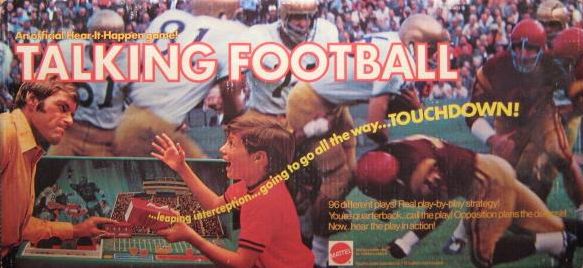
Retro Gaming The 70s & 80s: Talking Football

talkingfbbox

I was never a sporty kid, on the field or off. My playtime in the 1970s and 80s was much more apt to be spent gluing-up Airfix models, battling with Kenner Star Wars action figures or campaigning through the latest Dungeons & Dragons adventure. One of the few memories I have of a game I loved as a kid that didn’t involve dank passages, spellcraft and random encounters with wandering bugbears was Mattel’s Talking Football game.

First released in 1971 and then re-reissued in 1977 as Talking ABC Monday Night Football, this semi-obscure classic was the alternative to the electric football games a lot of my friends had in the 1970s. The electric football games looked great with their customizable football player miniatures vibrating all over the little field in random directions but those never really added up to much of a game for me. Talking Football was in a league of its own.

talkingfbcontentsTalking Football had a pretty conventional football field playing board with sliding plastic clips to show yardage progress and first down markers. Other plastic components included a little scoreboard and a place to mark downs and quarters. The nifty mechanic of the game was in the tiny plastic records that made the game “talk.” Play began with the offensive player selecting from one of the ten “standard” play or three “special” play records. The chosen record was inserted into a little handheld player and then the defensive player rotated the record to a defensive play. Once plays were selected, a lever was pressed and simulated audio recordings of announcers calling the play would play in combination of the offensive and defensive selections. The result of the play would be recorded on the field and the next play would be set.

To a kid living in the pre-videogame era of the late 1970s, Talking Football was a blast and a bit of a technological wonder. Over time, players got used to the hundred or so combinations of plays and the game would repeat itself a bit at times. This became part of the strategy, as the game was basically one of picking the right play you thought would best defeat what you predicted your opponent would pick. To answer the repetitive standard set of 13 records, Mattel also offered expansion packs for the game with celebrity player voices on picture disc records, including Merlin Olsen and O.J. Simpson.

I didn’t own a copy of Talking Football, but one of my good friends did. Flash forward more than three decades, and that friend is an on-air radio personality at a rock station in Northern New York State. I don’t know if the hours we spent playing Talking Football and hearing those recorded announcers call plays had any effect on my friend’s future career choice. That said, I think of how games shaped me into the person I am today and like to think that maybe those scratchy, plastic voices still reverberate with my old friend today.

Collector’s Note: Mattel’s Talking Football can be found for sale from special sports memorabilia companies and on eBay. The standard game can run anywhere from $40-200, depending on condition. Buyers should beware that many collectors indicate the original players haven’t always aged very well due to their cheap, dated technology. The individual player records go for around $10 apiece.

Retro Gaming The 70s & 80s: The DragonLords

dlbox

As a young gamer in the 70s and 80s, I had an incredibly supportive mother. Our trips shopping always allowed for stops by local bookstores, five-and-dimes and hobby shops to check out the latest Dungeons & Dragons releases, metal miniatures, fan magazines or other gaming delights to add to my growing collection. My mother was also a big yard sale and flea market fan, dragging home all sorts of used games for my brothers and I to try out. One of those early-80s yard sale finds was an unopened copy of 1978’s The DragonLords from Fantasy Games Unlimited.

Founded in 1975, FGU is still in business as a publisher of a variety of board and role-playing games. Like many game companies in the mid-70s, FGU leapt into the D&D tidal wave and released a number of fantasy-themed games. The DragonLords followed the traditional hex map and cardboard counter game model well-established by such publishers as Avalon Hill. The box contained a map, simple rule book, reference sheets and over 600 tiny cardboard playing pieces. The artwork was second-tier generic fantasy illustration, the game map was outright bland and the printing looked like it was done on a typewriter. I loved this game.

dlmap

In The DragonLords, each player took on the guise of a wizard ruling over their kingdom. Players chose to play as a Sorcerer, Conjurer, Enchanter, Necromancer or other type of specialized wizard, each with their own unique set of spells. Spells were acquired through turns “studying,” allowing for more advanced spellcraft in areas such as Siege, Hiring , Weather, Speed or Tactical. By casting their spells, wizards developed armies to fan out across the map to conquer the opposing kindgdom, hasten movement of their own horde or wreak horrible natural disasters on the enemy.

For someone well-steeped in D&D and Tolkienesque fantasy, a lot of The DragonLords felt very familiar. Tiny cardboard chips featured very basic line illustrations of elves, giants, trolls, ents, dragons and other creatures, each with values for combat and movement. The wizard spell study mechanic felt akin to the levels of advancement with magic-using characters through Experience points gained in D&D campaigns. Siege of cities and frontier keeps was a key part of the game, and building and attacking with catapults, siege towers and rams was a big component missing from a lot of smaller-scale D&D play.

What I loved about The DragonLords at the time was the mix of individual wizard character development and the grander scale of huge grotesque armies slugging it out across the mountains, swamps, forests, roads and waterways of the map. A game could be played satisfactorily in a few hours, also a nice change of pace from the long-term campaigning in D&D. The DragonLords certainly didn’t win any points for its graphics, but for straight fantasy gaming on an epic scale it definitely had its spell cast on me.

Collector’s Note: The Dragonlords is long out of print, but with a bit of online searching Iwas able to come across one bagged unpunched copy for over $100 on Amazon.com. Clearly my mother’s yardsale find was quite a deal.

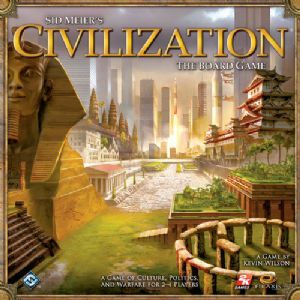
New Game Weekend: Sid Meier’s Civilization: The Board Game

CivBox

Unlike myself, electronic games have been a constant presence with both my sons since they were born. Now aged 8 and 13, my boys have graduated up through a host of platforms and games with the Leapster, DS, PS2, Wii, PS3, online through sites like Steam and on the iPhone. Over the past year, their obsessive play over Minecraft has been gradually replaced with scores of hours logged with the wildy-popular Civilization V.

Developed more than 20 years ago by Sid Meier and Bruce Shelley, the Civilization franchise has evolved from a PC-only DOS game to occupy a variety of gaming platforms. The turn-based civilization-building mechanic and historical theme sets up an incredibly-engaging and educational universe for players to plan and play out a nearly-endless variety of paths in human advancement from the ancient era to the near future. The latest iteration, Civilization V, broke on the scene in 2010 with two expansions since. Worldwide, the game has sold millions of copies and has continuously won accolades from a couple generations gaming critics and devoted fans alike.

Even though my kids are devoted electronic gamers, they’ve also been raised with a healthy love for card, board and miniatures gaming. So, when my 8-year-old caught wind last week that a boardgame version of Civilization existed, I leapt at the chance to introduce the boys to the game. I’ve played a number of civilization-building games such as Clash of Cultures but hadn’t yet played Civilization.

Now published by Fantasy Flight Games, Sid Meier’s Civilization: The Board Game has been around since 2002 and can be found at your local Barnes and Noble for $60 or cheaper online. Like many games of this type, the box comes stuffed with hundreds of components plus more than 300 cards. Geared for 2-4 players ages 14 and up, Civilization takes 3+ hours to play. Fortunately, my boys have been exposed to enough games, both online and on the tabletop, that they’ve been able to quickly pick up on the basic play and strategy Civilization offers.

CivContentsCivilization involves a march toward victory in one of four ways: Economic, Military, Cultural or Technological. Players begin by selecting a civilization such as the Americans, Egyptians, Romans or Russians. Each starting civilization carries its own strengths in play, making this first choice an important one in setting your strategy for the game. Based on the number of players, a map of hidden tiles is laid out and the market area is set up to the side of the board.

After set-up, the game progresses through a series of turns. In the Start Turn, a player may build a city or change their government type – an important choice which can greatly affect the path of a player’s civilization. Next, the Trade Phase allows a player to reap trade points from the areas around their cities and offer trades in resources with other players.

In the City Management Phase, the player may build units or buildings, harvest resources or focus on developing their culture. Building units – Scouts or Armies – allows the player to explore and conquer areas of the board. Constructing buildings such as Markets, Temples or Baracks allows a variety of bonuses to your civilization. At a higher price, Wonders like The Oracle, The Hanging Gardens or Angkor Wat may be built. Finally, a player may pay to build their military prowess through a progression from simple archers and pikemen to tanks and aircraft. Aside from building, a player may harvest resources such as silk, iron, incense or wheat to be later spent to activate certain technologies already researched. A player may also choose to focus on culture, with gained cultural points moving the player up the culture track while also earning special cultural event cards played to change different courses of the game’s play.

Next, in the Movement Phase a players may move their Scouts and/or Armies to explore, claim new territory or engage in combat with a barbarian village or another player. In the final Research Phase, players may spend their earned trade points to develop new technologies. The game’s “technology pyramid” is built progressively by each player as they grow from simple technologies such as Metalurgy and Horseback Riding toward higher level advancements all the way up to Flight and Nuclear Energy.

The play adavances through the above turns until a player arrives at a victory condition. Cultural victory is earned by completing progress on the culture track. A military victory is won by conquering an opponent’s capital city. Earning a technological win is done by completing the technology pyramid all the way up to Space Flight. Finally, an economic outcome is reached by collecting 15 gold coins earned through various actions your civilization makes throughout the game.

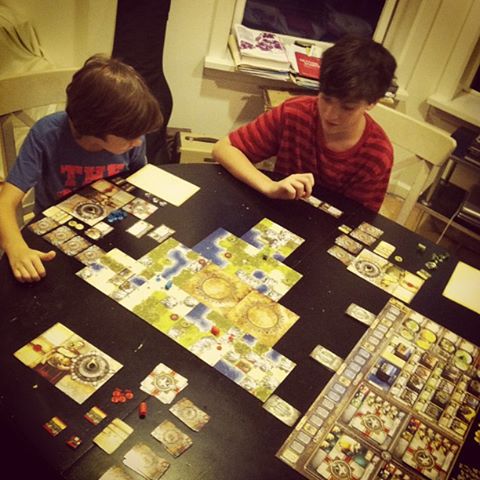
To summarize the game in a couple paragraphs is hard, as the variation of play in the game is boundless. This weekend, my younger son and I played through our first quick starter game on an eight-tile two player-map (pic below). Despite over twenty pages or rules and scores of playing pieces to manage, he picked up the game really fast. Along the way, there’s a ton of reading I’m certain is not covered in the general elementary curriculum with stops along the way to have side conversations on the meanings of words such as “despotism” and “anarchy.” At his age, my son’s memory is quite amazing and our discussions of the finer points of the rules has continued even away from the game table.

1001022_10201084784976153_1277385001_n

In our second game (pic below), three of us played on a larger map. My older son, a pretty experienced gamer at this point, blew threw a ten minute intro to the rules and played as the Prussians with an aggressively militaristic strategy I’ve grown used to over the years. Using the Egyptians, my younger son focused on culture and building construction. For my own strategy, I played as the Romans with a healthy mix of the military and cultural expansionism for which their empire was known.

1004654_10201085941885075_1372920330_n

For parents and critics of them who decry the falling attention spans of today’s kids, weekends like this past one show how with a bit of parental creativity all the stereotypes simply fall away. A game like Civilization — both online and off — offers so many opportunities to build vocabulary, learn history and develop some complex multi-layered management skills I see sorely lacking in many of the adults I encounter. Over hours of focused play, not only are my sons and I developing our civilizations but we’re also developing each other — an investment in time together well-spent.

Retro Gaming The 70s & 80s: Dungeon!

In 1975, just a year after the release of Dungeons & Dragons, TSR Hobbies released the boardgame Dungeon!. The game mirrored many aspects of D&D’s dungeon-crawling framework while offering a much lower point of entry for players either new to the genre or looking to just play a quick game.

dungeonadI got a copy of Dungeon! after a couple years of spending hours playing D&D and painting my first lead miniatures from the likes of Ral Partha. Dungeon! offered a traditional boardgame format and came as an occasional break from the open-ended role-playing my friends and I were used to with D&D. Ads for the game at the time (left) were also pitching the game to families and casual gamers as a point of entry and enticement to the larger world D&D offered.

Playing as an Elf, Hero, Superhero or Wizard, players moved through six progressively-difficult levels, encountered random monsters and collected treasure. Each character class carried specific strengths and powers, with more powerful characters such as the Wizard or Superhero requiring greater treasure to win the game.

Large chambers such as the Kitchen, Crypt, King’s Library or Queen’s Treasure Room were surrounded by smaller rooms, color-coded to indicate the level. In each large chamber, a stack of three randomized monster cards specific to that level were placed at the beginning at the game. In each smaller room, one monster and a treasure was placed. When a space was entered, the top card was drawn and combat between the player and the monster ensued with a simple die roll. Winning combat won the treasure while ties or losses might result in a retreat or loss of treasure.

For players familiar with D&D like myself, Dungeon! mirrored a lot of the established canon. Monsters fell along the lines of hobgoblins, werewolves, dragons, mummies and snakes. Dungeon pitfalls such as traps might be encountered. Characters like Wizards held special spell cards such as Fireball or Teleport, and found magic items included an ESP Medallion and a Magic Sword, offering certain characters bonuses to their play. Treasure ranged from meager bags of glod found in the easy levels to the covtted Huge Diamond (worth 10,000 points) hidden deep in the sixth level.

Several editions of Dungeon! followed through the years, the most recent in 2012 from Wizards of the Coast, now-owners of the D&D franchise. Longtime players have also created a rich universe of house rules, customized boards and even hand-painted figures to supplement the basics of the game. Despite its relative ease of play, Dungeon! has remained a classic bit of fun among even the most serious gamers today.

New Game Weekend: Innovation

Humans at one of our most basic levels are builders, and gaming offers a wide variety of opportunities to experience the push of civilization building over time. It’s no surprise then that one of the big genres a lot of board, card and even video games fall into is civilization development. The combination of historical facts and the linear nature of societal advancement through the ages lends the subject to a wide variety of games. Gamers return again and again to the chance to play out the evolution of technology, philosophy, warfare, religion, agriculture and art. Sid Meir’s Civilization, Small World, Settlers of Catan, Clash of Cultures and Tzolk’in are just a few of the games I’ve played that fall into this broad category, both historically-based or set in a fantasy realm.

This past weekend at Metropolitan Wargamers, a few of us played through Innovation, the 2010 award-winning card game from Asmadi Games. Retailing at $20, the game consists of 105 unique and text-heavy cards played against a simple set of rules but with a lot complexity in keeping track of your own civilization’s innovation track.

Like most civilization building games, Innovation proceeds along a linear timeline from the Stone Age to the Modern Era. After starting with four cards laid out in front of them, each player chooses two actions in each turn: Draw, Meld, Dogma or Achieve. Cards are drawn from chronological eras numbered 1-10 with cards depicting progressively-advanced innovations. A meld action allows a player to play a like-colored card on top of a card already laid out in front of them. Melded cards supercede the innovation on the cards previously played underneath.

The dogma action is where the meat of the game takes place. Each dogma allows a variety of single or multiple actions that can affect not just the one player but other players displaying equal or greater numbers of symbols such as crowns, factories, lightbulbs, castles, leaves, etc. Dogma actions can result in additional drawn or discarded cards, taking cards from other players or fanning the pile of cards to the right, left, up or down.  As cards are collected and scored, players can take an achieve action to score a level of era achievement for their civilization. Some dogma actions allow a combination of cards to be used to score special achievment cards such as Monument, Empire or Wonder. The first player with five achievements wins the game.

As with most civilization development games, Innovation involves a lot of balance between charting your own progress while keeping an eye on the advancement of other players. Certain dogmas are extremely valuable in moving your civilization forward, but they may also assist the other players, too. This combination of collaborative and competitive play allows Innovation to mirror the arc of human societal development as the ebb and flow of alliances and strength can shift from turn to turn.

Innovation is deceptively easy out of the box, and it’s only through a play through a game or two that the true complexity is felt. Unlike other civilization games which can often  involve managing hundreds of pieces, charts and cards, Innovation’s simple card mechanic is one of its strongest points. The devleopment of human civilization has been a complex road for sure, but with Innovation the road doesn’t get bogged down in a big box of stuff and all the strategy you need is right there in the cards.

Favorite Kickstarters of the Month (July 2013)

Kickstarter can be a weird, volatile environment. Some projects come and go with little fanfare while others soar into the stratosphere with backer support. There can be all manner of highs, lows and outright trouble for projects on their journey from idea to funding to delivery. That said, four of the projects I wrote about in June wound up successfully funded in the past month. The fifth, the seafaring game Admiral, was funded but the project was then suspended inexplicably with a day to go. No doubt there’s a story there, but for now, here are the projects I’ll be watching as we hit the first hot month of the summer in July.

Cthulhu Wars: Drawing on the Cthulhu Mythos of H.P. Lovecraft, this game is the big story in games on Kickstarter right now. With dozens of gorgeously grotesque miniatures and many planned expansions, this strategy board game turns the tables and allows the players to play as Lovecraft’s beastly horde seeking to control the surface of a ruined Earth. Many of the pledgers have bought in at the higher funding levels of $200-500+, no doubt attracted by not only the theme but the tons of extra maps, gaming pieces and figures rewards. The project is trending toward nearly $1 million in funding in its closing days, and the more than 3300 backers are delivering a built-in fan base of this classic horror genre already popular with gamers.

Seas of Iron: I’m not a big naval gaming fan, but I really like the looks of this very modest battleship wargame from Battle Bunker Games. The battleships are comprised of two-sided cards defining the sections of each ship where you deploy your crew and fire volleys at your opponent. When a section is destroyed, cards are flipped over to show that part of your ship aflame. The Kickstarter exclusives include the famed Yamato and Bismarck warships. Just $20 allows for a backer to get a full version of the game which allows enough flexibility for 1-on-1 or small fleet play with combined sets.

Devil Dogs and Dragons: I’ve invested in more than a few of the Anglo-Zulu War 28mm miniatures from Empress Miniatures. They make quality, spirited and detailed miniatures, so its great to see them expanding their Modern Combat line. There’s a lot of interest in gaming modern warfare right now, and the 28mm scale seems to be a clear favorite with small squad-level engagements in the dusty and hot embattled corners of the world. These 28mm figures fill out modern US Marine Corps and Chinese People’s Liberation Army options for deployment in the Asia-Pacific desert and jungle regions. With a bit more imagination, these guys will even find a home in various zombie, alien invasion or post-apocalyptic scenarios.

Fife & Drum American Revolution Range: Just in time for the 4th of July weekend, Fife & Drum Miniatures is also expanding their established line of miniatures. Sculpted in a large 30mm or 1/56 scale, these majestic figures offer incredible detail for the Colonial Period ranging from the Seven Years War to the American War of Independence. The Kickstarter campaign will help fund the company’s expansion into new British cavalry, Hessian, Highlander and French infantry offerings. At the $50 level, backers receive a special three-figure “Spirit of ’76” vignette, making this project perfect for any patriot and fan of the AWI period.

Gettysburg: The Tide Turns: Finally, and in keeping with the theme of American military history, I’m throwing in one video game offering to round out the list. The Battle of Gettysburg is celebrating its 150th anniversary this month, and so this timely iOS game for the iPad and iPhone looks to be a deal at just $10 to back the project. Developed by Shenandoah Studio, the makers of the previously Kickstarted Battle of the Bulge iOS game, this simulation looks to be a very promising 21st-century tribute to the strategy, tactics and heroics found on the famed Pennsylvania battlefield 150 years ago.

Gaming With the Stars

Aside from my love for games, comic books, movies and associated hallmarks of geekdom, I’m a longtime fan of AMC’s Mad Men which wraps up its sixth season this coming Sunday. One of the much-maligned characters on the show is the media buyer and TV man Harry Crane played by Rich Sommer.

What the average fan of the show probably doesn’t know is that Sommer is one of the increasingly-prominent stars of the small and big screen who has a deep passion for gaming. Although currently on hiatus, Sommers until recently posted frequently about his gaming exploits on his blog Rich Likes Games, and he has appeared on a number of webisodes of gaming sites like Wil Wheaton’s Tabletop. Wheaton’s show will soon be premiering new episodes featuring a new crowd of writers, comedians, actors and other creative friends with the common love of rolling dice, playing cards and out-strategizing their opponents across the table.

The ability for gaming to bring together diverse groups of people, the famous and not-so-famous alike, is one of the wonderful things about the hobby. There’s an oft-told tale of Vin Diesel introducing Judi Dench to Dungeons & Dragons on the set of The Chronicles of Riddick, leading to Dench dungeon-mastering subsequent games for her grandchildren. There are all sorts of stories out there and extensive lists of celebrities who place themselves among the worldwide population of gamers. Among them are Stephen Colbert, Matt Damon, Ben Affleck, Mike Meyers, Robin Williams, John Favreau and Joss Whedon. Go back further and there are stories of the likes of Charlie Chaplin, Douglas Fairbanks Sr., King Vidor, Cole Porter, Harold Ross and Amelia Earhart partaking in gaming.

What I’ve found in my own experience is that gamers come from all walks of life but share a commonality in creativity, reason, knowledge, problem-solving, logic and alternating collaborative and competitive natures. These are obvious traits to be found in people who occupy prominent positions in the culture but also in the regular folks I game with on a regular basis. I find this every week at Metropolitan Wargamers club in Brooklyn where different combinations of ages, background and experience come together to play.

I recall being at a gaming convention a few years back watching a young guy with a mohawk, lipstick, piercings and dressed in head-to-toe black speaking passionately with a retired buttoned-down US Army veteran about some tactical minutae of a WWII engagement. Thinking back to that scene, it serves as my Diesel-Dench moment where those of us who share nothing and everything randomly encounter each other in our worlds of gaming.

New Game Weekend: King of Chicago & RoboRally

Friday night at Metropolitan Wargamers in Park Slope, Brooklyn had a decent crowd of six of us collected in the back with a few other people up front continuing play of a multi-week and fairly dense American Civil War battle. Coming to agreement on an ad hoc game together for a half-dozen guys is a challenge on its own, but we managed to settle on two games which are standbys at the club but pretty new to me.

King of Chicago

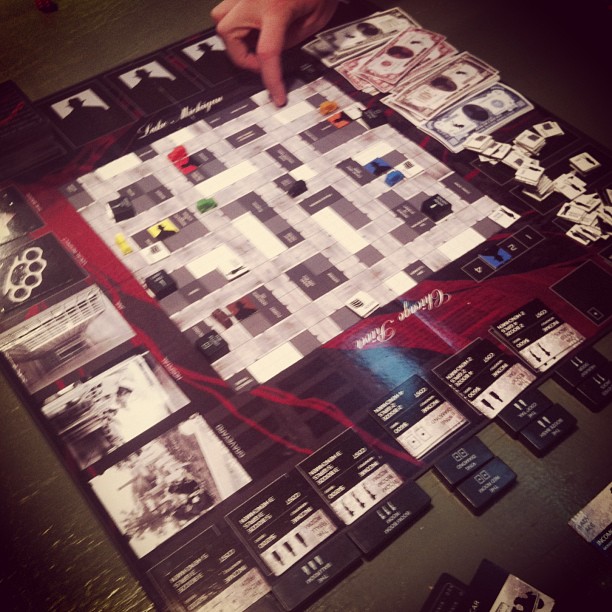
Produced in Denmark in 2005, King of Chicago takes place in the Prohibition-era Windy City where each player takes on the guise of gangster looking to rule the streets by creating and breaking alliances, building their empire and whacking the competition along the way.

The game begins with each player owning a gangster, a car, $1000 and a few resources. Resources in the game are booze, henchman and girls, and additional resources are picked up in various landmarks spread throughout the city. Combinations of booze, henchmen and girls in your gang allows you to build bars, casinos and brothels which create income at the completion of four turns in each round of play. At the end of a round, players collect income, new gangsters are put into play and resources get set on the board. Bidding takes place for gangsters to add to your mob, gaining you bonuses of speed, income, protection and lethalness. Players also bid to bribe the cops, controlling them through the next round of play.

The game offers a lot of strategic play in how a player chooses to build their empire and also in managing relationships with the other mob bosses on the board. Drive-by shootings, shutting down competing businesses and sending the other guys to the hospital or the morgue makes for a lot of opportunity for deals to be struck and double-crosses to take place. Certain cards cause “events” like police raids to be played and others send players on “jobs” which net substantial sums of income. The player who quickly amasses ten points from money, businesses and influence wins the game.

The game looks great with simple components and a wonderful collection of historic photos from the Chicago gangland days depicted on the cards. The many paths players can choose to build their mob empire adds significant replay value to the game.

King of Chicago was released with a limited print run and can be hard to come by in the United States. However, for lovers of gangster movies and the period when the underworld ruled Chicago, chasing down a copy is well worth the effort.

RoboRally

After a couple hours on the mean streets of Chicago, we had a seventh player show up. Our second game of the evening took us in a different direction with the hilariously chaotic RoboRally. The game was originally published by Wizards of the Coast way back in 1994 but was created a decade earlier by Richard Garfield who would go on to design the insanely-popular Magic: The Gathering card game.

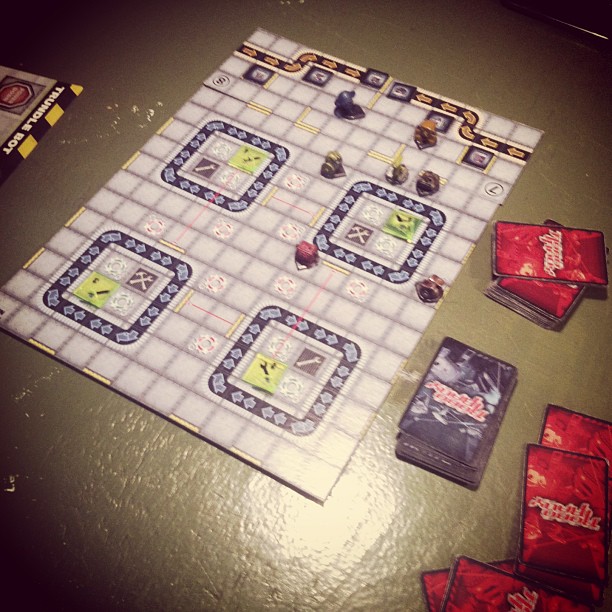
The game takes place on a factory floor with each player’s tiny robot attempting to navigate through a set number of flagged gates. This seemingly-simple mission is hampered by moving conveyor belts, rotating gears, solid walls and laser arrays spread throughout the factory. Robots controlled by other players also wreak havoc on your path by bumping into and zapping your robot with their lasers.

At the beginning of each round, players draw up to nine cards each with directional actions such as left and right rotations, u-turns and movement backward and forward. Players secretly place their cards face down in front of them defining their robots’s moves for the round. In turn, players reveal each card and move their robots in order of card value and according to the movements selected. The fun and craziness comes in when well-thought plans quickly go awry as robots beginning bumping into each other and throwing each other off course. Just when you think you have a direct route neatly plotted out to a flagged gate space, some other robot (or two or three) ram straight into you, sending you wheeling off in some other direction.

Lasers cause damage to your robot, reducing your movement choices in a round and only made better by spending a turn shut down repairing. Occupying repair spaces can also provide fixes for damage, and even special robot upgrade cards. The truly unlucky robots will find themselves bumped off the board, returning to their last starting point at the beginning of the next round.

The more players who play only contributes to greater chaos on the board. Our late night seven-player game stretched to nearly two hours of mechanized madness until one player managed to get through a few gates and away from the crowd. My sad little robot, on the other hand, wound up spending the game unluckily bumping into his mechanized comrades and finished the game exactly where it started.

RoboRally has won multiple awards, and its many versions and expansions have ensured its continued love among gamers for nearly two decades. After the cold-bloooded and calculating play in King of Chicago, it was great to end the night on a much more lighter but no less challenging game like Robo Rally.

Retro Gaming The 70s & 80s: TSR Minigames


Alternatively known as “microgames,” “pocket games” or “minigames,” a number of companies created a fad in games in small packages in the late 1970s through early 1980s. These compact games came in a variety of historic, sci-fi and fantasy themes. Rulebooks, maps, cardboard chips and dice were usually packaged in hardshell cases or even simple zip-lock plastic bags. A very few of these games, like the post-apocalyptic Road Warrior-esque Car Wars from Steve Jackson Games, would see a long life fueled by supplements and expansions. More commonly, these minigames were stand-alones of vastly varying quality which faded into obscurity in a few short years.

TSR, the makers of Dungeons & Dragons, entered the minigame market late with a total of eight games released in the first couple years of the 1980s. This was a big growth period for TSR as they continued to diversify beyond their core D&D products into other boardgames, role-playing games, toys, computer and video games, and even an animated TV show. Already investing a ton of our time and money in TSR products, my brother and I snapped four of their minigames:

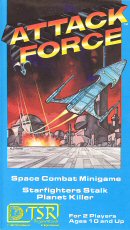
  • Attack Force was a simple Star Wars rip-off with one player’s force of small star fighters attempting to find the weakness in the other player’s monstrous space station to destroy it. As a fan of Luke’s attack on the Deathstar, I gave TSR a pass on the lack of originality for the chance to do some space battling myself.
  • They’ve Invaded Pleasantville was also a two-player game, this time set in a rural village where the townspeople try to fend off alien invaders infiltrating the local populace. Each player used identical chips representing such local folk like the minister, sheriff, plumber, checkout girl and others. The trick of the game was the alien invader bluffing their way toward taking over the bodies of the locals while the town player sought to uncover who was really an alien.
  • Revolt on Antares was a much better sci-fi-themed game and offered play for 2 to 4 players. The game presented a Risk-like map of a fictional world where six ruling “houses” with names like Andros, Dougal and Serpentine fought to rule the planet through three different scenarios. Each house had its own personality and strengths, adding a lot of variety and replay value. The ability to recruit new troops, move across varied terrain and use seven special alien weapons or devices made this little gem seem a lot more like a real wargame.
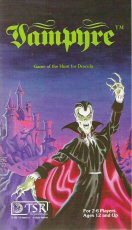
  • Vampyre was two games in one set in the realm of Bram Stoker’s “Dracula.” The first campaign-map-style game took 2 to 6 players in the roles of Stoker’s hero characters questing to find and destroy the coffin safe-havens of Count Dracula hidden throughout Transylvania. Turning the map over, a detailed floorplan of Castle Dracula allowed another game to be played as the characters sought to track down the Count himself and destroy him.

As a kid, I loved these games as a break from the longer hours spent bent over the table with my D&D campaigns. Each minigame offered its own varied mechanic, but rules were simple and limited to just a few pages for each game. The booklets, game maps and cardboard playing chips contained some wonderfully intricate small-scale artwork, much of it by popular fantasy artists of the day. While I don’t recall the exact cost of each game, I remember them being under $10 apiece and quite a deal for the hours of play we wrung out of each.

These four TSR games still sit in a closet packed full of my childhood puzzles and boardgames in the house where I grew up. At the time, there was an outsized amount of fun in each little mingame package. Today, there’s still a lot of memory in each, too.

Collector’s Note: Many of the TSR minigames can be found frequently on eBay selling in the $10-30 range. Steve Jackson Games makes much of their Car Wars and other microgames back catalog available for digital purchase online.