New Game Weekend: Innovation

Humans at one of our most basic levels are builders, and gaming offers a wide variety of opportunities to experience the push of civilization building over time. It’s no surprise then that one of the big genres a lot of board, card and even video games fall into is civilization development. The combination of historical facts and the linear nature of societal advancement through the ages lends the subject to a wide variety of games. Gamers return again and again to the chance to play out the evolution of technology, philosophy, warfare, religion, agriculture and art. Sid Meir’s Civilization, Small World, Settlers of Catan, Clash of Cultures and Tzolk’in are just a few of the games I’ve played that fall into this broad category, both historically-based or set in a fantasy realm.

This past weekend at Metropolitan Wargamers, a few of us played through Innovation, the 2010 award-winning card game from Asmadi Games. Retailing at $20, the game consists of 105 unique and text-heavy cards played against a simple set of rules but with a lot complexity in keeping track of your own civilization’s innovation track.

Like most civilization building games, Innovation proceeds along a linear timeline from the Stone Age to the Modern Era. After starting with four cards laid out in front of them, each player chooses two actions in each turn: Draw, Meld, Dogma or Achieve. Cards are drawn from chronological eras numbered 1-10 with cards depicting progressively-advanced innovations. A meld action allows a player to play a like-colored card on top of a card already laid out in front of them. Melded cards supercede the innovation on the cards previously played underneath.

The dogma action is where the meat of the game takes place. Each dogma allows a variety of single or multiple actions that can affect not just the one player but other players displaying equal or greater numbers of symbols such as crowns, factories, lightbulbs, castles, leaves, etc. Dogma actions can result in additional drawn or discarded cards, taking cards from other players or fanning the pile of cards to the right, left, up or down.  As cards are collected and scored, players can take an achieve action to score a level of era achievement for their civilization. Some dogma actions allow a combination of cards to be used to score special achievment cards such as Monument, Empire or Wonder. The first player with five achievements wins the game.

As with most civilization development games, Innovation involves a lot of balance between charting your own progress while keeping an eye on the advancement of other players. Certain dogmas are extremely valuable in moving your civilization forward, but they may also assist the other players, too. This combination of collaborative and competitive play allows Innovation to mirror the arc of human societal development as the ebb and flow of alliances and strength can shift from turn to turn.

Innovation is deceptively easy out of the box, and it’s only through a play through a game or two that the true complexity is felt. Unlike other civilization games which can often  involve managing hundreds of pieces, charts and cards, Innovation’s simple card mechanic is one of its strongest points. The devleopment of human civilization has been a complex road for sure, but with Innovation the road doesn’t get bogged down in a big box of stuff and all the strategy you need is right there in the cards.

New Game Weekend: King of Chicago & RoboRally

Friday night at Metropolitan Wargamers in Park Slope, Brooklyn had a decent crowd of six of us collected in the back with a few other people up front continuing play of a multi-week and fairly dense American Civil War battle. Coming to agreement on an ad hoc game together for a half-dozen guys is a challenge on its own, but we managed to settle on two games which are standbys at the club but pretty new to me.

King of Chicago

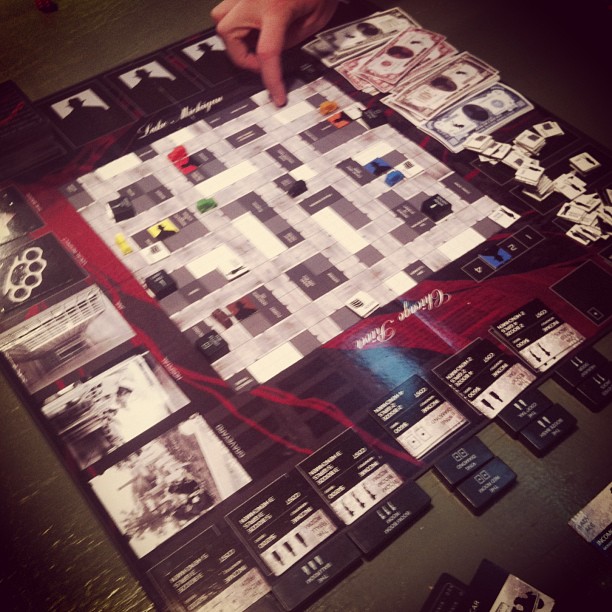
Produced in Denmark in 2005, King of Chicago takes place in the Prohibition-era Windy City where each player takes on the guise of gangster looking to rule the streets by creating and breaking alliances, building their empire and whacking the competition along the way.

The game begins with each player owning a gangster, a car, $1000 and a few resources. Resources in the game are booze, henchman and girls, and additional resources are picked up in various landmarks spread throughout the city. Combinations of booze, henchmen and girls in your gang allows you to build bars, casinos and brothels which create income at the completion of four turns in each round of play. At the end of a round, players collect income, new gangsters are put into play and resources get set on the board. Bidding takes place for gangsters to add to your mob, gaining you bonuses of speed, income, protection and lethalness. Players also bid to bribe the cops, controlling them through the next round of play.

The game offers a lot of strategic play in how a player chooses to build their empire and also in managing relationships with the other mob bosses on the board. Drive-by shootings, shutting down competing businesses and sending the other guys to the hospital or the morgue makes for a lot of opportunity for deals to be struck and double-crosses to take place. Certain cards cause “events” like police raids to be played and others send players on “jobs” which net substantial sums of income. The player who quickly amasses ten points from money, businesses and influence wins the game.

The game looks great with simple components and a wonderful collection of historic photos from the Chicago gangland days depicted on the cards. The many paths players can choose to build their mob empire adds significant replay value to the game.

King of Chicago was released with a limited print run and can be hard to come by in the United States. However, for lovers of gangster movies and the period when the underworld ruled Chicago, chasing down a copy is well worth the effort.

RoboRally

After a couple hours on the mean streets of Chicago, we had a seventh player show up. Our second game of the evening took us in a different direction with the hilariously chaotic RoboRally. The game was originally published by Wizards of the Coast way back in 1994 but was created a decade earlier by Richard Garfield who would go on to design the insanely-popular Magic: The Gathering card game.

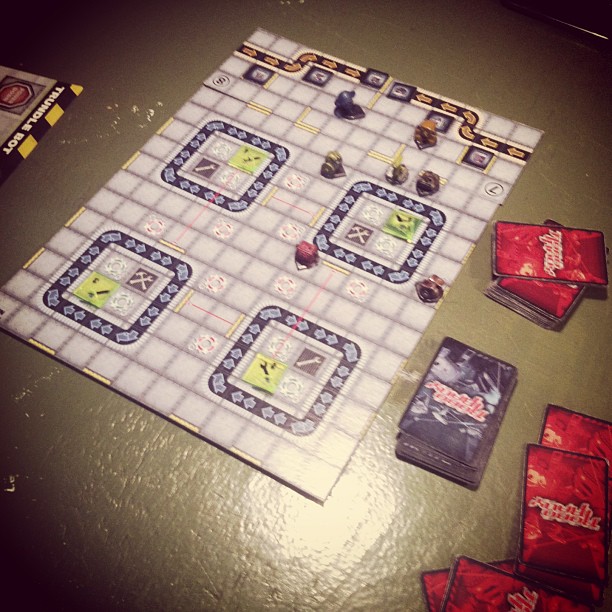
The game takes place on a factory floor with each player’s tiny robot attempting to navigate through a set number of flagged gates. This seemingly-simple mission is hampered by moving conveyor belts, rotating gears, solid walls and laser arrays spread throughout the factory. Robots controlled by other players also wreak havoc on your path by bumping into and zapping your robot with their lasers.

At the beginning of each round, players draw up to nine cards each with directional actions such as left and right rotations, u-turns and movement backward and forward. Players secretly place their cards face down in front of them defining their robots’s moves for the round. In turn, players reveal each card and move their robots in order of card value and according to the movements selected. The fun and craziness comes in when well-thought plans quickly go awry as robots beginning bumping into each other and throwing each other off course. Just when you think you have a direct route neatly plotted out to a flagged gate space, some other robot (or two or three) ram straight into you, sending you wheeling off in some other direction.

Lasers cause damage to your robot, reducing your movement choices in a round and only made better by spending a turn shut down repairing. Occupying repair spaces can also provide fixes for damage, and even special robot upgrade cards. The truly unlucky robots will find themselves bumped off the board, returning to their last starting point at the beginning of the next round.

The more players who play only contributes to greater chaos on the board. Our late night seven-player game stretched to nearly two hours of mechanized madness until one player managed to get through a few gates and away from the crowd. My sad little robot, on the other hand, wound up spending the game unluckily bumping into his mechanized comrades and finished the game exactly where it started.

RoboRally has won multiple awards, and its many versions and expansions have ensured its continued love among gamers for nearly two decades. After the cold-bloooded and calculating play in King of Chicago, it was great to end the night on a much more lighter but no less challenging game like Robo Rally.

New Game Weekend: Love Letter

Heading into a weekend visit to Metropolitan Wargamers, I often don’t know what kind of game I’m going to be jumping into. It could be a re-fighting of a World War II D-Day scenario with hundreds of finely-painted miniatures. It might be a gory zombie apocalypse boardgame. Maybe it’s a sci-fi deck-building card game. Or, it could be an abstract Euro-style game where great world civilizations are built over the course of a couple hours of play.

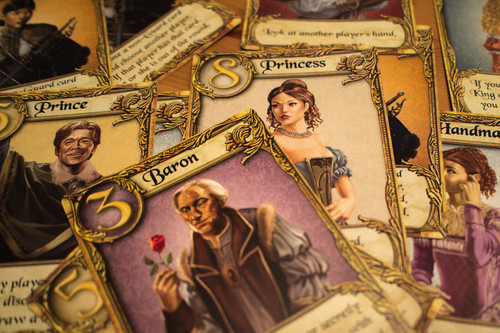
This past Saturday night it was Love Letter. Released in 2012 in Japan and quickly moving into multiple international versions, Love Letter is a seemingly unlikely game for a group of hardcore gamers crowded around a basement table. The game is comprised of just 16 playing cards, 4 reference cards and 13 tiny red square cubes — “tokens of affection.” Everything comes in a crimson crushed velvet drawstring bag with “Love Letter” embroidered in flowery yellow script. The simplicity of the game’s packaging, design and minimal components hides a pretty compelling strategy card game which even the most battle-hardened gamers will find engaging in just under a half-hour’s play.

In Love Letter, player’s vie for the affection of Princess Annette of the imaginary kingdom of Tempest. Players are dealt cards with values of 1 to 9, each depicting a courtly character with a specific ability. In turn, each player then draws and plays one card. Guards (value 1) allow you to guess a card in another player’s hand. The Baron (value 3) has two players compare hands with the lowest hand eliminated from the round. The Prince (value 5) forces a player to discard their hand and draw a new card. The remaining six cards reveal different types of actions, and some cards are plentiful while others are unique. After a round of play, the last player holding a card or the player with highest-valued card wins a cube and a new round is dealt. The first player to score four cubes — “tokens of affection” — over a number of rounds of play wins the hand of Princess Annette.

The trick of the game is to attempt to follow which cards are in the hands of other players and still in the draw pile. Love Letter is thus a game of memorization, strategy and deceit. The most powerful cards, while best at the end of a round may make a player a target early in the round. Playing cards may reveal information to you, but also allow your opponents to possibly infer who is holding what cards. Players may gang up on a leading player to force them from a round, leading to shifting alliances from hand to hand.

Despite its courtly conceit, Love Letter can turn into a bit of a raucous and cut-throat game, as ours did among four of us Saturday night. The game would be perfect to keep tucked in the bottom of your bag to pull out among a group of friends at a bar or around the table during dessert. Given that entire ancient battles have been fought and historic treaties struck over the union of two fated lovers, Love Letter provides a quick and challenging chance to play out the ultimate game of royal affection taken to extremes.

New Game Weekend: Dust Tactics

The long Memorial Day weekend was as good a time as any to roll up my sleeves for a big day of wargaming, and the Dust Tactics Regional Tournament at the Compleat Strategist in New York City on Saturday May 25th was the place to be.

I signed up my son and I for two slots in the small tournament organized by a fellow club member at Metropolitan Wargamers in Brooklyn. The two of us were newbies to Dust Tactics but I had certainly read a lot about it since its release last year by Fantasy Flight Games. Dust Tactics is an alternate reality WWII-era game where alien technology is discovered by Germany in the late 1930s and goes on to shape a world of warfare between the Axis and Allies throughout the 1940s.

As is expected with FFG releases, Dust Tactics is a gorgeous game ready to play straight out of the box for about $80 retail and cheaper online. The core set comes with a dozen infantry forces for each side plus heavily-armored walkers. The box contains two two-sided fold-out gaming mats , special dice, rules, a scenario guide, reference cards and a few rudimentary plastic terrain pieces. There’s a large variety of additional accessories, campaign expansions and army packs available in the price range of $15 to $45. All this makes Dust Tactics very collectible and flexible as a gamer’s interest expands and wallet can abide. The models are gorgeous and mostly pre-assembled at a hefty 1:48 scale with a visual appeal bridging interests from WWII into a dystopian sci-fi theme.

For the tournament, we rolled-off to choose our armies and then paired-up with other players for the first round of three games. The organizer of the tournament is way into Dust Tactics, and he hauled along his extensive collection of miniatures for players to choose from. My son chose to play as the SSU (aka Soviets) and backed his ground troops with a monstrously deadly helicopter. I chose to play as the Axis (aka Germans) with laser-armed ground troops, a huge four-legged walking gun platform and a squad of weaponized gorillas.

Dust Tactics plays pretty easily and fast. After the board is set and a scenario is chosen, players take turns performing two actions with each of their units. Combinations of move/fire, fire/move or deadly sustained fire are the most common actions. Range and strength of weaponry is clearly listed on each unit’s reference card. Special dice with hits on two sides and misses on the other four resolve combat, damage and saves from taking damage in cases where troops wear special armor.

Each game was timed at an hour with a maximum of eight turns per game. My son (above left) and I were easily beaten in the first round by more experienced players. What we both quickly learned was a lot of the game outcome could be pre-determined by the forces chosen by a player. Too much reliance on our heavy mechanized forces had also led to quick defeats for the both of us once they were destroyed in the first round.

In the second round, my son and I played off against each other with a bit more knowledge of the capabilities of the forces on the board. We each scored lucky shots early in the game, again knocking out each other’s heaviest armaments. After that, the game settled into a really enjoyable cat-and-mouse between buildings and barriers as our infantry, snipers and smaller mechanized walker units dueled it out to my eventual victory by a slim margin.

For the third and final round, the tournament organizer and house expert on Dust Tactics played against my son. Failing to focus early on destroying my son’s massive helicopter gunship drifting eight inches above the table, my son managed a solid win by picking off the tournament organizer’s ground units from the air with his multiple weapons. I got crushed in my final game as I faced-off against another Axis player who had stacked his forces with fast-moving zombie and gorilla units. These savage figures ran right over most of my ground units and even my artillery platform was eventually torn to pieces by the ape squad.

So, we didn’t do so well with our first go-around at Dust Tactics but we did have a good time. Dust Tactics is a fun little game that looks fantastic and plays pretty easy. The common criticism I’ve heard and experienced a bit today is that the game looks better than it plays. A detailed knowledge of all allied and opposing units is pretty necessary in fielding an effective force in the game. A few poor moves or die rolls can also pretty much end a game in an opening turn, making for some frustration I myself felt in my first game today.

There does seem to be a glimmer of future hope for a next stage of Dust Tactics. An announcement was made this month that Battlefront Miniatures will be taking over publishing and distribution of the game and the tabletop version, Dust Warfare. Battlefront’s past success with its Flames of War WWII gaming system had fans hotly debating the possible outcomes that may bring a bit more finesse to Dust Tactics over time. For now, the combination of some high-style miniatures with a somewhat less-than perfect set of rules still makes Dust Tactics more than worth a rainy day play.

New Game Weekend: Pacific Typhoon

It was the second rainy weekend in a row in New York City, but a crowd of guys made it down to the Metropolitan Wargamers club in Brooklyn Sunday afternoon. With seven of us standing around the table trying to come up with a big enough game with easy rules that could be played in a couple hours, a few people tossed out the idea of 2008’s Pacific Typhoon by GMT Games.

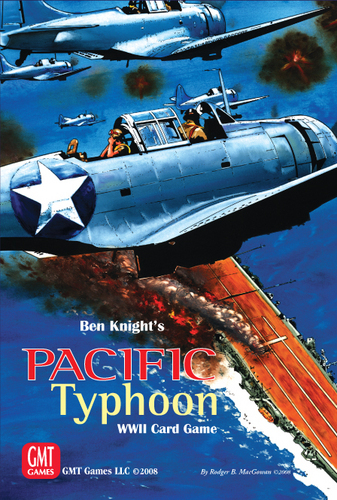
This WWII Pacific Theater naval battle card game was originally produced as a sequel of sorts to Avalon Hill’s Atlantic Storm  game from the late 1990’s. Created for 3-7 players ages 10 and up, Pacific Typhoon is simple to grasp with a pretty straightforward trick-taking format yet enough opportunity for interaction among players to keep a group of hearty experienced gamers engaged for the afternoon.

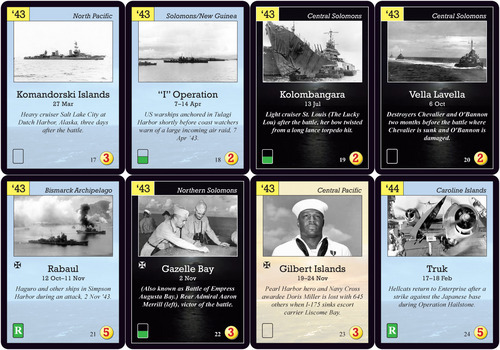
Pacific Typhoon comes with 140 force cards and 40 battle cards plus a couple dice and a rulebook, making this a compact and entertaining game for medium to large groups. The cards themselves are simple but have nice black-and-white WWII period photos and contextual factoids which add flavor to the game. Plus, at just $20 direct from GMT Games, Pacific Typhoon carries a lot of fun at a really friendly price.

Each player begins by drawing a hand of six force cards. Cards depict historical Japanese (red, top left) and Allied (blue, middle left) naval forces plus upgrade and event cards. The starting player draws two battle cards (black-edged, bottom left) and chooses one of the two to play. Play goes around with each player choosing in turn to commit a Japanese or Allied force card to the battle. Players contribute the points on their cards to the total strength of each side in the battle, and the side with the most points wins that battle. The player with the highest point value on the winning side then divies up the points among the winning players, and the next round begins.
As described above, the play is really straightforward but there’s a lot of flexible play in each round. Battle cards take place in a specific year (’41, ’42, 43, etc.) and during day or night. The player choosing the battle also calls whether the battle is to be fought with submarines, on the surface or by air. A battle combination such as “night battle, surface, ’44” will determine which force cards the players can choose to play in the battle.

With force cards with varying levels of strength, bonuses, year, time of day and type, each battle plays out differently. Alliances among players are created and broken with each battle, with players choosing which side to support as a gamble toward contributing to whichever side will win. For example, a turn may start with Japanese cards being played to what looks like a certain victory until a group of subsequent players decide to pool their Allied cards and win in an upset. As the game progresses, winning players dole out points rewarding their allies in each round while making certain to hold enough points for themselves ahead of the whole group at the game’s end.

With alliances and double-crosses sailing back and forth over the table in each round, Pacific Typhoon is a game rife with good-natured team-play and trash-talking. Pacific Typhoon ultimately makes for a great mix of individual and collaborative play within a casual trick-taking card game good for beginners and experts alike interested in spending a couple hours re-fighting famed WWII battles of the Pacific high seas.

New Game Weekend: A Bridge Too Far: Operation Market Garden

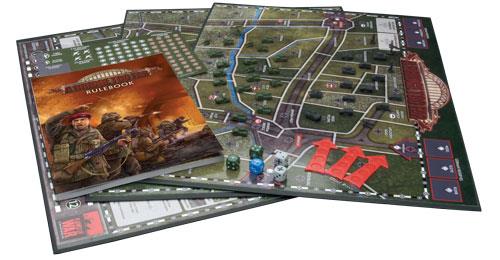
Maybe it was the dampness and spring chill, but Saturday night at Metropolitan Wargamers in Brooklyn was pretty empty with just me and one other club member around. We decided on a two-player boardgame, and being big WWII enthusiasts we picked 2010’s A Bridge Too Far: Operation Market Garden from Battlefront Miniatures.

I’ve been a long-time fan of the 1977 film A Bridge Too Far featuring a classic international cast recounting the events of Operation Market Garden and the botched Allied attempt to chase the Germans out of a number of key defenses in the Netherlands in September 1944. The film does an entertaining job of depicting the colorful real-life personalities against a backdrop of a daring daylight airborne invasion, over-confidence in the weakness of the German forces and disagreement among commanding Allied staff on the plan itself. The game offers two scenario set-ups giving the option of refighting the battle as rather historically depicted in the film or through a plan of your own devising. The game we played was the historical one, and I commanded Field Marshall Marshal Bernard Montgomery’s British and US forces.

The game involves five play turns with a random number of battles making up each turn. Initiative is rolled before each battle, and targeted objective spaces on the board are chosen to attack. Each player chooses to commit some, all or none of their forces to each battle. Different forces – tanks, guns and airborne infantry – each provide bonuses modifiers in different terrain types. Defenders of areas containing bridges get an extra bonus. Resolving combat is a simple roll of the dice with modifiers added. Defeated forces roll to be destroyed or retreat to adjoining areas, and then the next initiative is rolled for. Once a round of battles is completed, strategic moves can be made and the Allied player has the option to air-drop additional forces and supplies into designated areas of the board. The Axis player can then choose to attempt to fend off the Allied air support with their own air power. Keeping supply lines intact is key to the Allied strategy, as forces which are cut-off from their line of supply suffer a greater weakness in subsequent battles.

Typical of games by Battlefront Miniatures, makers of the popular WWII 15mm miniatures game Flames of War, this game packs some great design and ease of play into a neat box. While each battle and turn of play involves a number of steps, the game moves along quickly in about 90 minutes. The game comes with over 40 well-sculpted plastic playing pieces, but the version at the club had been modified with painted metal micro-scale armor and troops. Gamers who long-ago graduated from Risk to games like Axis & Allies will find a lot to love in the focused presentation of this game.

Even with the relative simplicity of the game, there’s a lot of strategic play potential. My first time through, my Allied strategy of pushing hard from the rear and left flanks of the board stalled rapidly as my tanks were quickly destroyed by some disastrous die throws against German anti-tank guns. My paratroppers dropped effectively into the middle of the board, yet they too became surrounded and snarled by the superior German armor defending the game’s main objectives. By four turns in, I faced certain defeat with no additional hope for much-needed tank support for my floundering airborne troops.

For a notoriously one-sided battle, I can easily see a lot of replay value in this game . I hope to give this one another shot soon, trying out some less historical and more aggressive strategies in running the Germans off the field. Having a chance to remake history is one of the joys and challenges of wargaming, and the board game A Bridge Too Far: Operation Market Garden provides a lot of opportunities to do so.

New Game Weekend: Fortune and Glory

By the time Raiders of the Lost Ark hit the theaters in the summer of 1981, my newly-teenaged brain was already well-steeped in the concept of high-adventure cliffhanger movies and serials. For most kids, Indiana Jones kicked-off a mini-rival in interest in the danger-thwarting, jungle-hacking, mystery-unraveling and treasure-seeking characters that populated decades of Saturday afternoons in local movie theaters for my parent’s generation and earlier. The elements of cliffhangers are so ingrained in our pop culture to this day that I challenge you to find a popular TV show, action movie, comic book or video game that doesn’t borrow some element from the genre.

One of the best things about the gaming hobby is that you can pretty much be guaranteed there’s a a game (or several) that aligns with a just about any thematic interest. So, this past weekend at Metropolitan Wargamers I had a chance to try out taking on the role of an international adventurer with 2011’s Fortune and Glory from Flying Frog Games.

The game takes place in the between-the-wars period of the 1930s where mobsters and Nazis vie for international control while your adventuring character roams the world searching for fantastic objects of great value and power. Players take on one of eight fantastically-named personalities such as Li Mie Chen, The Duke, Jake Zane, Sharon Hunter, Dr. Zhukov, Shelley Hargrove, Jacques Moreau and Cartwright (all pictured below, left to right and top to bottom). Each player character comes with their own set of special abilities and attributes such as Cunning, Lore, Combat and Agility. These attribute strengths come into play as characters roll dice to resolve their success during certain encounters within the game adventures.


The game begins by placing artifacts in random locations around the globe. Players move their characters toward these objects and upon encountering them, roll dice in a three-part attempt to resolve their quest. The thing that makes Fortune and Glory so entertaining is the random mechanic of drawing cards to create objects of the quests and the adventures themselves.

For instance, in our game (pictured at right) a quest for a magical sword unveiled an adventure that involved solving a mysterious puzzle, a high speed car chase and a final airplane chase. Failing to roll successfully against the high speed car chase challenge wound up in a “cliffhanger” on the reverse of the card which led to the car going over a cliff. All this detail is related on the well-illustrated adventure cards and left to the players to dramatically read aloud, often to great mirth around the board. Other encounters during our game included a shootout in a nightclub, a case of malria in the jungles of the Amazon and an unsuccessful encounter with a Yeti in the northern steppes of Russia. With hundreds of cards available in the game, there is endless variety to the how each adventure will play out. All this contributes significantly to the high replay value of Fortune and Glory.

Aside from all the cards, there are over 150 miniatures included for character adventurers, Nazis, mobsters, temples and a zepplin which randomly drops new Nazi henchman around the board as the game progresses. Plastic gold coins mark your progress toward gaining “fortune” and may be spent to further outfit your adventurer with guns, maps and even an airplane. In the end, collecting blue plastic “glory” coins points the way toward victory for our heroes or the villains.

We played the game collaboratively, allowing us to work together with each of our own abilities contributing toward our march toward glory and victory. A competitive set of rules options is also included which completely changes the dynamic to duelling adventurers questing toward individual glory.

Fortune and Glory carries a hefty retail price of about $100 but can be found for around $75 online. However, the investment in this big, heavy box is well worth it with the gorgeous design and endless randomness to the game providing a hugely entertaining world of cliffhanging adventure. Fortune and Glory is certain to keep you on the edge of your seat and may  even cause you to spill your popcorn if you’re not careful.

New Game Weekend: Zombicide

My weekend of gaming started with a regular meeting of the Metropolitan Wargamers club where new members — including myself — were inducted. With a couple dozen guys in attendance, it was great to look around the room and feel the fellowship with a group with decades of gaming passion in them. I’m looking forward to years to come with these guys and the inevitable newcomers who find their way to the club.

After the meeting, groups split off into a variety of board and miniatures games. I teamed up with four guys for my first playing of Zombicide. Anyone with a pulse knows zombies have been a huge trend in the culture for a few years now with the popularity of the The Walking Dead TV show and comic book series, as well as countless other books, movies and video games. Tabletop gamers haven’t been immune to the trend with a variety of popular zombie-themed miniature and boardgames rising in popularity. I’ve enjoyed playing Zombies!!! and a few of its expansions with my kids for a couple years now, and Last Night On Earth has become a mainstay for zombie gamers.

Zombicide is the latest to break into this gaming trend pitting survivors against undead hoards. The game was launched via a Kickstarter campaign just about a year ago that brought in over $750,000 from over 5,000 backers. In March of this year, the first expansion set for the game — Zombicide: Season 2 — raised an additional $2.250 million from nearly 9,000 funders. Needless to say, in a year’s time Zombicide has ridden the zombie wave to incredible heights of popularity with a rabid fan base.
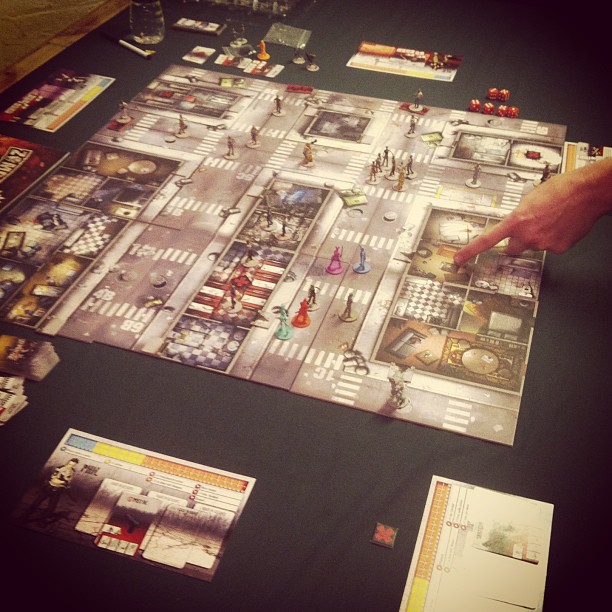
My first run through Zombicide was a tough introduction to both the goofy fun and extreme challenge of the game. Each player takes the role of survivor of the zombie apocalypse with its own card outlining their particular abilities and a personalized miniature. A streetscape of wonderfully detailed and gory cardboard tiles is laid out according to one of the ten scenarios included in the base game. To complete the set-up, areas are predefined where zombies enter the game, doors are set in buildings, objectives are placed, and, depending on the scenario, special pieces such as a police car is strewn throughout the town. Over 60 zombie miniatures in four varieties — Walkers, Runners, Fatties and the Abomination — start the game at the town’s edge, just waiting to sink their teeth into a juicy survivor.

Players work collaboratively using a base three actions to move, search and/or fight zombies both on the street and in buildings. Searching allows a player to draw cards to find weapons, ammunition, gear and other special items which increase their chances of surviving the zombie onslaught to come. Since each player starts with only a frying pan as a weapon, searching for weapons is a focus from the start. Players manage what items they carry in their hands or on their person, and players may also choose to trade or simply give items to their compatriots to increase the group’s overall chances. Certain items are used in combination, adding a scavenger hunt aspect to the game. For instance, a scope added to a rifle creates a more accurate and deadly long-range weapon, and a can of gasoline combined with some empty bottles makes for a devastating molotov cocktail.

It’s when the zombies start filling the board at the end of a round of turns by the players that collected weapons and other gear become critical. Melee weapons like baseball bats, axes, machetes and chainsaws are used for close-quarters fighting with zombies while ranged weapons such as pistols, shotguns and submachine guns come into play with longer ranged combat. Certain characters or weapon types allow for weapons to be used in each hand, doubling the survivor’s visciousness when tangling with the undead. In other cases, powerful weapons like shotguns or a molotov cocktail are critical when trying to destroy more powerful zombies like Fatties or the enormous, shambling Abomination.

As the turns elapse and zombies are killed, the players advance in experience which gains them the bonus of extra abilities. The downside from this gain in experience is that zombies begin coming onto the board in greater numbers. Because of this, players need to work together to balance the team’s experience level against the amped-up presence of zombies. Zombies move en masse toward noise created by gunshots or doors being broken down, so players also have to make smart decisions as a group on when to take a chance in making noise and attracting the growing hoard of zombies. Getting attacked twice by a zombie means almost certain death for any survivor on the board.

The rules to Zombicide are pretty simple, but the game gets wild very, very fast as the streets and buildings quickly fill up with the undead. It’s one of the better collaborative boardgames I’ve played in recent memory. Players working in tandem or even sacrificing themselves for the greater good gives the game its spice and replay value. In my first game, three of the five of us were felled quickly by the zombies while the other two players managed to trick out their survivors with a plethora of weapons and fight on.

The combination of beautiful design (only improved by painting the miniatures as in the photos from today’s game above), simple rules and pretty steep odds stacked against the players has made Zombicide popular. We were kidding around during our game that if a real zombie apocalypse were to come, sticking close to our fellow members of the club might just mean the difference between life and death. After a couple hours running and slugging away at zombies in Zombicide today, that notion seemed more real than just mere joking speculation.

New Game Weekend: Star Wars X-Wing

One of the big instant hits to come out of last year’s huge GenCon gaming convention was the new Star Wars: X-Wing Miniatures Game from Fantasy Flight Games. I finally got a chance to play it a few times in the past couple weeks with members of the Metropolitan Wargamers club in Brooklyn. Then, my brother brought me a starter set of the game over this past Easter holiday weekend. As both a lover of all things Star Wars and well-designed games, I’m hooked.

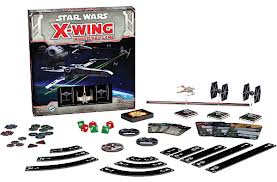
SWXW is the one of the latest fan favorites to appeal to both experienced and new gamers wanting some gaming right out of a box full of easy rules, well-designed components and beautiful pre-painted miniatures. The starter set offers two Tie Fighters and a X-Wing model, rules, movement templates and dials, cards, specialized dice and scenario markers for about $30-40. A few beginner scenarios are also included with the starter set, allowing two players a pretty solid and varied intro to the basics of the game.

In a nutshell, SWXW is a dogfight game where ships chase and fire at their opponents while maneuvering to avoid their own destruction on a typically 3′ x 3′ playing area. Play starts with each player pre-assigning movement to each of their models with a special movement dial. The dials are particular to each class of ship and allow for combinations of straight and turning moves. Since movement is planned in secret from your opponent, guessing which way the enemy will move and how you should react is key to the strategy of the game.

After ships move, firing lasers and other specialized secondary weapons occurs using special dice. Modifying “focus” or “target lock” actions increase the ability to hit enemy ships while “evade” actions increases a ship’s ability to avoid damage. Ships take damage to their hulls or shields, and destroyed ships are removed from the table. The game moves fast, and a basic game can be accomplished in well under an hour.

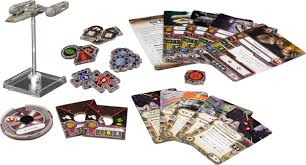
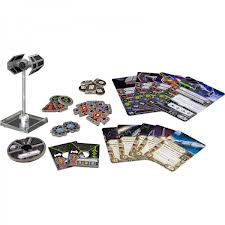
While the starter set allows for some fun intro games, players will soon want to grow their fleets and options. Like the Star Wars Universe itself, SWXW soon proves to be as expansive as players (and their bank accounts) allow. Single ship expansion sets of Tie Fighters, Tie Advanced Fighters (pictured below, right), Tie Interceptors, X-Wings, Y-Wings (pictured at right) and A-Wings retail for about $15 each (cheaper online). With these, players gain greater choice in fielding larger Rebel and Imperial fleets.

Each ship expansion comes with specific cards indicating pilots, astromech droids, secondary weapons and other special abilities which may be used in combination with that model or, in some cases, other ship types. So, an X-Wing can be fielded with Luke Skywalker, Wedge Antilles or Biggs Darklighter at the helm and R2-D2 or some other astromech droid along for the ride. You can assign Darth Vader to the controls of a Tie Advanced ship and then assign addition weapons and abilities to the ship. The latest expansion wave offers two large-sized ships — the Millenium Falcon and the Slave I — which are certain to be a huge hit with fans anxious to pit Han Solo against Boba Fett in an intergalactic duel.

Players wishing to get into SWXW will do well by themselves to get a couple of the basic sets plus some expansion ship packs. Once you’re quickly beyond the beginner stage, games are typically fielded with 100 points of ships on a side. Points are assigned according to ship class, pilot expertise and other add ons, allowing for lots of replay value and experimentation with combinations of forces. While the game is still new to me, I can see this one coming out of the box and onto the galaxy of my gaming table pretty frequently in the months ahead.

New Game Weekend: Leviathans

Saturday night at the Metropolitan Wargamers allowed me the chance to try my hand at the latest game sensation that’s making it’s way through the club’s membership. Recently produced by Catalyst Games Labs, Leviathans is quickly growing in popularity with its late 19th-century steampunk alternative reality of airship wars battled out in the skies over Europe between France and England.

Steampunk In Popular Culture

Anyone who has been aware of sci-fi and fantasy fandom over the past few years is no doubt aware of the rise of the popularity of steampunk. Broadly, steampunk is a sub-genre of science fiction involving a vision of the world from the Victorian era through the early years of the 20th-century where anochronistic modern mechanical technologies, often powered by steam, create an alternative history of science, exploration and warfare.

In popular culture, Jules Verne and H.G. Wells are usually viewed as the grandfathers of steampunk. Aside from the Victorian visions of Verne and Wells, my earliest exposure to steampunk was with reruns of the 1960s TV show Wild, Wild, West. The show followed the exploits of James West and Artemis Gordon, two US government secret agents travelling the Old West of the post-Civil War era equipped with retro high tech gadgets. The show made its way to the big screen in 1999 with a much-maligned film adaptation starring Will Smith, Kevin Klein and Kenneth Branaugh. What the movie lacked in character and story, it more than made up for in capturing the steampunk ethos of monstrously destructive weaponry wrapped up in a 19th-century Old West plot.

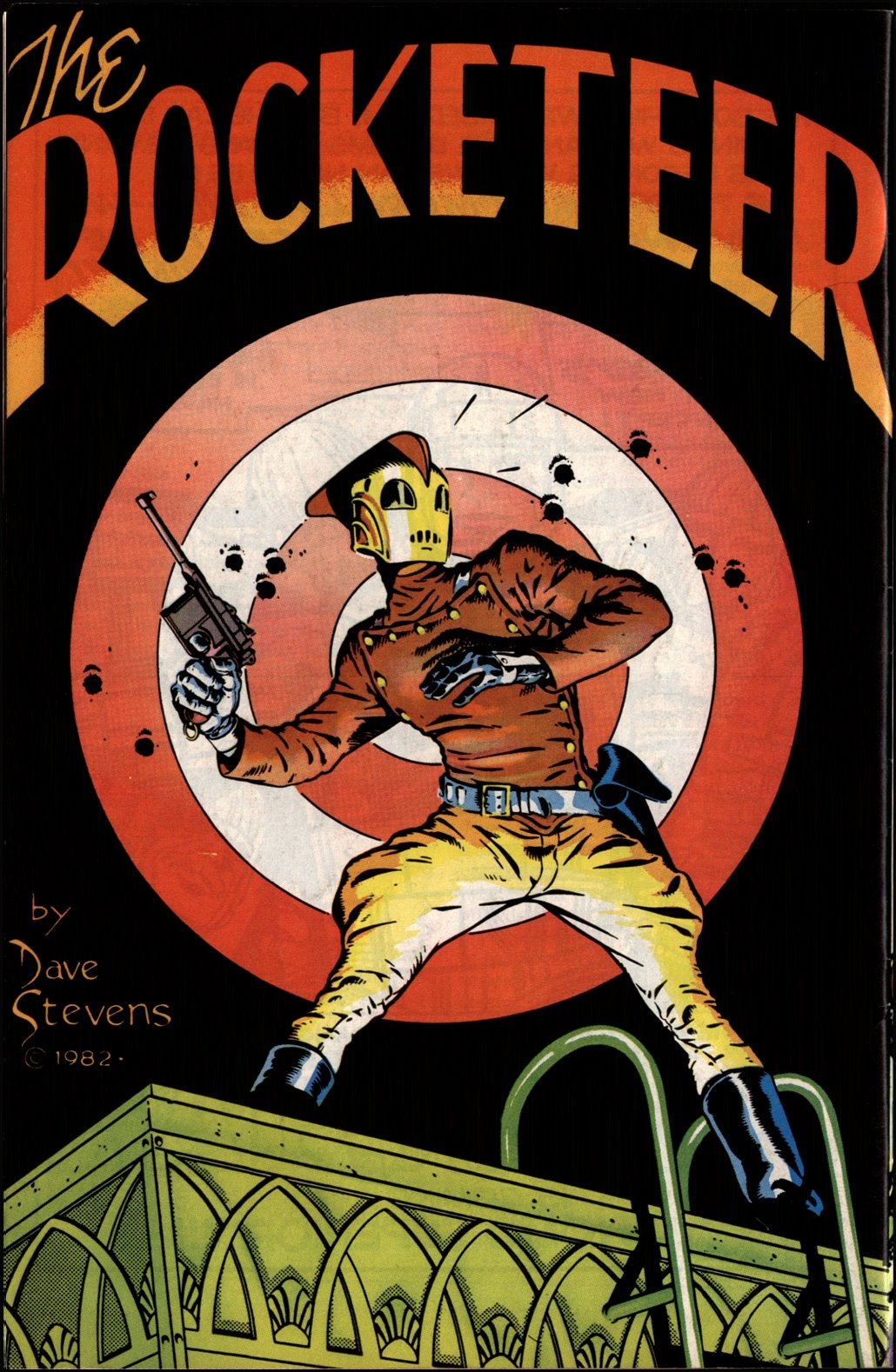
In the 1980s, underground comics writer Dave Stevens introduced the Rocketeer, a barnstorming stunt pilot and reluctant jet-packed superhero. Set in 1930s NYC and LA, the Rocketeer did battle with Nazis and crime syndicates armed with all manner of fanciful lasers, transported by airships and other might-have-been rocket technologies, and conniving with evil plots of world conquest. The comic eventually found its way to Hollywood and a beloved 1991 live-action film adaptation by Disney. Both the movie and comic capture an aesthetic of sexy and functional design bridging an Art Deco look with an alternative pre-WWII era where secret agents vie for control of fantastical emerging technologies.

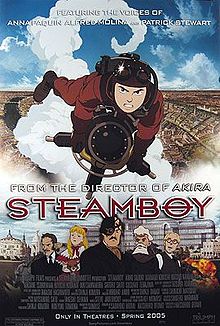
Jetpacks and high-flying airship battles also figure prominently in the 2004 Japanese anime film Steamboy. Set against the backdrop of the Crystal Palace Exhibition in London’s Hyde Park in 1851, the story follows a young inventor boy from the mills of England’s Industrial Revolution to a showdown over technology which threatens the balance of worldwide power. The classic Victorian England setting provides the stage for an ultimate steampunk-themed battle with a massive metal castle-like flying fortress, robots, jet-packed paratroopers and British soldiers fighting to preserve the fate of the British Empire and world peace ahead of the Great War in the coming decades of the early 20th-century.

The interest today goes far beyond the pages of comics and TV and movie screens,  and the examples above are just a few of my particular touchpoints in steampunk. There are steampunk cosplayers, conventions and even bars and meet-ups where like-minded fans can live out their steampunk fantasies.

Like so many fantasy interests, steampunk has also made its way to tabletop gaming in a big with a number of gaming systems over the past few years. The thematic historical “what ifs” and opportunities to let the imagination go wild with miniature modelling makes steampunk a particular draw for gamers.

Leviathans

Leviathans is the darling of the moment for steampunk-minded gamers. Produced just this year, Leviathans is a complete board and miniatures game that comes in an incredibly well-designed package containing rules, charts, game boards and detailed plastic airship models which are ready to go straight out of the box for about $100. The core set comes with massive French and British battleships along with smaller destroyers and other ships which levitate above the game board on clear plastic stands. The ships are armed with all manner of guns, turrets and torpedoes manned by crews who furiously fire away at the enemy while working to keep their airships aloft.

Each ship comes with a card detailing the armaments, engine power, stabilisers and other equipment particular to each class of ship. Players take turns manuevering their ships and bringing their weapons to bear on the enemy. Combat results are determined with multiple colored dice which factor in the strength of firing weapons, the durability of an opponent’s armor, the placement of hits and the presence of crew. As ships take fire, their effectiveness in movement, combat and the ability to make repairs is affected. Multiple hits to the same area of a ship may result in a hull breach and the ship crashing to earth in a hulk of flame and twisted steel.

The scenario I played involved my side’s two damaged French battleships attempting to flee off the far side of the board while moving at half speed and being swarmed by my opponenet’s smaller British destroyers. The quick manueverability of the British ships was initially no match for the powerful guns of my French fleet, and two UK aircraft were quickly blown from the sky. Further damage to the already slow French engines eventually made them sitting ducks in the sky, and my team’s French ceded defeat as evacuation to the far side of the table became impossible.

Popularity of Leviathans is spreading quickly with a few new French and British expansion ship fleets already available. A new German fleet is also under development, as is an online version of the game. The game is being produced under a Creative Commons license, allowing for a free distribution of rules and also encouraging fans to collaborate openly on the development of the game. With the quick rise of Leviathan’s popularity and the continued gaming interest in steampunk, I’d expect this game to rule the sky for quite some time.