New Game Weekend: Shoot N’ Skedaddle

sns

One of my favorite parts of attending gaming conventions is playing scales, periods and scenarios I usually don’t game. Getting the chance to play in scenarios run by the authors of rules is also a big bonus opportunity to experience a game “straight from the horse’s mouth,” so to speak. This past weekend at Fall In! I had one of those rare sessions that hit all these marks, playing in an Old West 28mm skirmish game of Shoot N’ Skedaddle by Oscar Turner.

Since I was a kid, I’ve been a big fan of Westerns. Starting with re-runs of the old Lone Ranger TV show and radio serials, I graduated up through American Western classics like Red River and The Searchers to the Italian “Spaghetti Westerns” of Sergio Leone and Clint Eastwood. Over the years I’ve remained dedicated to the now-declining genre, and I’m an enormous fan of Eastwood’s later Unforgiven and Quentin Tarantino‘s Django Unchained

unforgiven

1992’s Academy Award-winning Unforgiven, produced, directed by and starring Clint Eastwood

Like a lot of American boys, my  interest in Western TV, radio and movies spilled over into my play time. I spent a lot of time gunfighting on my bedroom floor in the 1970s with Gabriel Lone Ranger dolls  and the earlier Marx Johnny West toys. I also had plenty of cheap dimestore plastic cowboys and indians, plus a pretty substantial collection of the cowboys and indians from Britains Deetail and a pile of Western-themed Playmobil toys.

gabriellr

1970s ad for Gabriel’s Lone Ranger toys

Despite all my interest in Westerns, gaming the genre never became my thing. TSR’s Boot Hill, released in 1975 just as Dungeons & Dragons was taking off, has been a popular RPG option for years. There are a number miniatures ruelsets for the Wild West, and 1992’s Desperado by Monday Knight Productions seems to be the standard I’ve seen played at conventions. So, with nearly zero experience with shoot-outs on the streets of dusty tabletop frontier towns, I was really impressed with my three hours playing through my first game of Shoot N’ Skedaddle this past weekend.

snsgameset

The Shoot N’ Skedadle cards, dice and equipment needed to play

 With a visually stellar town laid out with incredible laser-cut and plastic scenery, Oscar’s scenario presented a simple scenario of outlaws on the lam with lawmen in hot pursuit. In Shoot N’ Skedaddle, play begins with character cards dealt to players playing on either the Outlaw Gang or Lawmen Posse side. Main characters such as “Judge,”Doc” and “Bandit” team-up with neutral characters like “Thug,” “Cowboy,” “Townsperson” and “Thug.” Characters then draw primary and secondary weapons (if any) which can include anything from a deringer, knife or carbine to a gattling gun, buffalo gun or dynamite. There are 40 character and 72 weapons cards, making for tremedously fun variations in the player Gangs and Posses in Shoot N’ Skedaddle.

IMG_2418

The town set-up for Shoot N’ Skedaddle at Fall In!

After initial deployment according to the scenario, regular playing cards are drawn to randomly activate characters in turn. I really loved this thematically-appropriate mechanic, tying the iconic Old West card game into the play. On a turn, a player can perform a combination of movements and action. Special event cards are also randonly drawn for each side, allowing the resurrection of dead characters, the arrest of an outlaw or an extra character activation. With this simple framework, characters can perform a seemingly endless variety of feats including running, hiding, shooting, grabbing a mule by the reins, jumping between rooftops, crashing through windows, kicking in doors or starting a fist fight. Player imagination bordering on role-playing is really the only boundary to the game.

IMG_2419

Lawmen with guns blazin’ in Shoot N’ Skedaddle at Fall In!

To resolve actions, an incredibly elegant dice mechanic is used. Characters each come with key attributes — Strength, Agility, Scrap, Marksmanship and Guts — with each of these weighted with a D6, D8, D12 or D20. Success when using a particular attribute is resolved by rolling a 5 or better, no matter what the action and no matter what the die. For example, a poor shot would roll a D6 when firing their pistol while a more skilled character might roll a D12. In either case, the player would need to roll a 5 or better to succeed. Wounds, hiding in cover or other game conditions modify the dice downward, so that same crack shot with the D12 Marksmanship would roll a D8 when shooting at someone hiding behind a barrel.

IMG_2420

A local woman acting just a little suspicious in Shoot N’ Skedaddle at Fall In!

Shoot and Skedaddle’s wonderful card and dice structure puts the focus back on the fun on the table like any really great game should. Oscar offers his game as a free PDF ruleset or in a printed set of cards for $25 ($30 with a box). Check out his website at http://shootnskedaddle.blogspot.com/ for downloads, ordering info, development news and more pics and information. The basic rules contain scenarios and a campaign option for longer-term  storylines to be played. I can’t say I’m going to run out and invest in a dozen Western buildings and paint up a bunch of cowboys and local citizens, but if you’re a fan of Old West gaming, I highly recommend checking out Shoot N’ Skedaddle. It’s a bullseye.
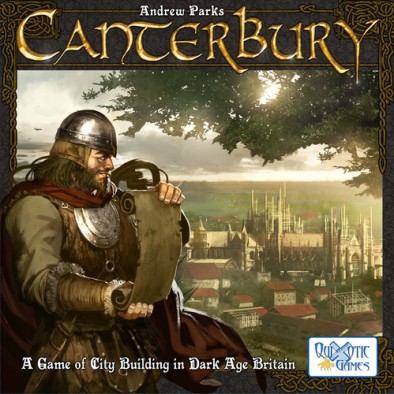
New Game Weekend: Canterbury

CanterburyBox

This past week I arrived home from work one evening to find a package in the mail containing the first game I’ve received from backing a Kickstarter campaign. Canterbury from Quixotic Games was successfully funded at just over $58,000, a relatively small game when compared to recent runaway Kickstarter hits like Zombicide: Season 2 at $2.2 million, All Quite On The Martian Front with just over $300,000 in funding and the current it-game Mars Attacks which looks to be cruising to a finish over a half-million dollars.

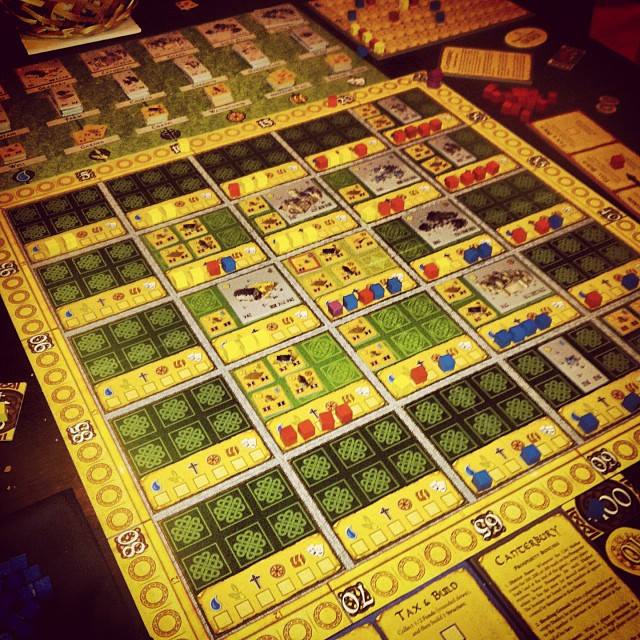
As promised in the steady stream of updates from the game makers, Canterbury is an exceedingly well-manufactured board game with tons of sturdy cardboard playing pieces and typical colorful wooden markers. The game presents a board containing 25 districts, each with six building lots. Each lot contains spaces to indicate water, food, religion, defense, commerce, and culture services which are provided as players build out the board.

canterburydist

Beginning with a simple well providing water to the central district, players take turns performing one of three actions. A full build action allows 1-2 buildings to be constructed, depending on size and moneies available. Levying taxes gains a full monetrary collection based on the current economic strength of the entire kingdom, and a player using a levy play must perform on full build of 1-2 structures on their following turn. A third option allows a player to collect half the avilable taxes and build a single structure.

Building and placing structures provide services to the board. A small, single-lot building gives that distruct the available service while a medium-sized two-lot building provides the service to that district plus the districts surrounding at right angles. The five largest structures are built at a high cost, cover four building lots and provide their service to the local district plus any five other districts on the board. Planning comes into play as buildings may only be built when previous services are available in a district. For example, religious structures may only be placed when the prerequisite water and food services are already present in the district. Previously-constructed buildings may be demolished to upgrade existing services or expand on already-provided services.

There are lots of points to keep track of in Canterbury, adding up to many strategies toward winning at the game’s end. Erecting a structure gains points for the player as well as the kingdom, and players receive bonus points when breaking ground and building in empty districts. Once the kingdom passes the 100-point mark, players score “district favor” points based on the prominence of providing services to each district. Providing services also moves each player up an additional scoring track with those points scored at the end of the game. Points are again counted at the 200-point mark. Once the kingdom’s wealth takes three laps around the edge of the board to 300 points, the game ends with a final tally of points.

CanterburyGame

The game is a bit lighter and faster than other civilization-building games I’ve played like Settlers of Catan, Civilization, Clash of Cultures and Village. That said, even with the brisk pace of the game, there’s a lot of strategy to be had. Players must always balance their own plays for points with the riches and services they are providing the kingdom (and other players) as a whole. Racing to provide services, build structures and gain an early lead on district favor points looked to be the key path to victory in the first game I played with my sons. Collecting and spending money at a balanced rate was also important since sitting on a pile of coins at the end of the game doesn’t provide much in the way of points.

Like any civilization-building game, Canterbury strikes a great balance of real-world competitive and collaborative construction play. My older son thought injecting the game with random events like floods or droughts might spice up the straightforward play a bit, but overall the three of us really liked the quick, well-structured play and progressive organization on the board. As a Kickstarter supporter, I’m really pleased with the results of Canterbury and I’m glad to have been there to see the kingdom’s development from that lone well in the wilderness.

New Game Weekend: Africana

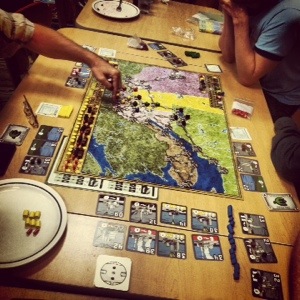
westsideFor the second time this year I found myself in Los Angeles for work this past week, and once again I also wound up linking up with the West Side Gamers. The meeting of the group I attended at an IHOP just south of Culver City was the organization’s 510th consecutive club get-together. The group meets weekly in local restaurants, camping out over several tables and booths chocked full of dozens of games toted along by attendees. A weekly theme game is featured, but players split into groups to play whatever people are up for from about 6pm until well past midnight.

This past week’s featured game was Power Grid played on the recently-released Quebec map, although more than a dozen different board and card games were played throughout the evening. More than a couple dozen players spent the evening munching on diner food and hunched over tables of games.

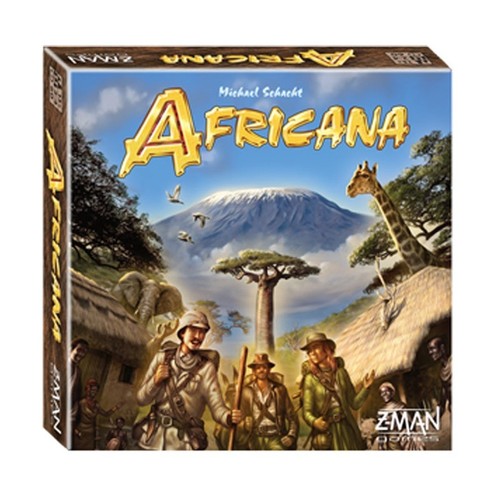
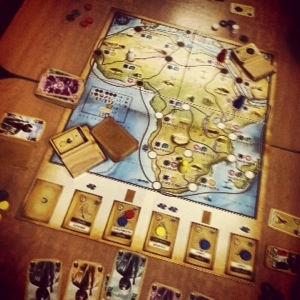
20131010-233030.jpgOf the many games being played that evening, I  had the opportunity to play a game new to me, 2012’s Africana from Z-Man Games. Playable by up to four participants, Africana uses a few familiar card-driven mechanics within the context of the travel and exploration of the African continent. The game board features a map of Africa divided in two by the equator and laced with routes between cities. Each player’s expedition uses color-coded movement cards to trek between locations. A series of five adventure cards at the bottom of the board allows a player to pick a starting point for a research expedition to another location. Setting off on an adventure gains either a movement card or silver coins used to buy from the two adventure books.

africanaEach turn, players may either draw movement cards, move their explorer aroundthe board or purchase up to three pages from the wooden book racks. Purchasing pages from the adventure books north and south of the equator provides another quest opportunity to gather artifacts or hire additional workers to help move your expedition along the board. Collecting combinations of artifacts and completing adventure routes gain more coins and score victory points at the game’s end. While having multiple workers in your hand can help move you quickly around the board, holding too many at the game’s end deducts points from your total. As the game progresses, adventures become more valuable and players may be working on several adventures at once. Once all the adventures are drawn from the deck, the game ends and the player with the most victory points wins.

20131010-232920.jpgThe travel mechanics of Africana don’t allow for a lot of opportunity to really block other players on the board, although completing adventures ahead of the competition or acquiring valued artifacts from the books does allow for some strategic play. Moving your pawn to key port cities such as Cape Town allow for quick moves around the continent while moving inland is a bit more circuitous, so choosing adventures wisely is also key. The player who won our game focused on high-value adventures late in the game while my second place finish was scored mainly through the collection of artifacts. Even in this relatively light travel game, akin to something like Ticket To Ride, I could see the possibility of trying varying strategies.

Deep down I dislike just about everything about traveling for work — cabs, hotels, airports, living out of a suitcase — but heading to Los Angeles and a chance to meet-up with the folks at West Side Gamers makes the trips to the West Coast a bit more worth the journey.

Gaming The High Seas

bbpicFor as long as there have been people putting boats to sea, there have probably been pirates close behind. Even though the classic high period of piracy perhaps only spanned a few decades in the 1600 through 1700s, pirates have loomed large in popular culture from Robert Louis Stevenson’s Treasure Island all the way through to the Johnny Depp-fuelled blockbuster Pirates of the Caribbean film franchise. Piracy will also be the theme of the latest release in the Assassin’s Creed video game  series next month, and the game is already being lauded as a potential game of the year for its historical high seas combat.

Naturally, pirates find their way to gaming tables. I like checking in on the UK-based blog Shed Wars for a fellow gamer’s incredibly elaborate pirate miniatures gaming. While I’m rather certain pirate miniatures gaming is never going to be my thing, I have played my share of pirate games over the past thirty years.

broadsidesIn the early 1980s, Milton Bradley launched their Gamemaster Series. While Axis and Allies would be the one game to catch on, the series also included other historically-themed wargames packed full of some nifty design, tons of plastic miniatures and varying levels of gameplay. The two player Broadsides & Boarding Parties featured a card-based maneuvering “broadsides” combat phase of the game which then led to a close-quarters “boarding parties” series of turns. During hand-to-hand attacks, each player moved their pirate, canon and captain figures among the two large ship models in an attempt to capture the opposing captain. Like many of the games in the series, Broadsides & Boarding Parties was a great looking game, but the play was a bit simplistic and it wound up collecting dust on my game shelf.

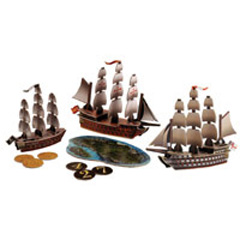
pirateconstJust over 20 years later, WizKids introduced the Pirates of the Spanish Main constructable miniatures game. This still-popular game consists of collectible packs of ships in plastic credit card-sized punch-out packs. Each pack contains a whole game with a couple ships, rules, islands and playing tokens. The system went through a number of expansions with additional ships from varying eras and nations along with special island island fortesses and even sea monsters. Along with the movie series, a Pirates of the Caribbean series was also released with the ships, characters and story pulled right from the films. The ships looked fantastic although proved to be a bit brittle during gameplay which involved trade, combat and double-crossing across an open tabletop board. Although the game was officially shuttered in 2008, a huge secondary market continues for unopened packs of game cards.

lootWhen my two sons were younger, we played the heck out of the 1992 card game Loot. This surprisingly engaging and award-winning kid’s game by Gamewright allows for play as a merchant or pirate. Pirate cards come in four colored “suits” with a captain card for each suit. Each pirate card carries an attack value denoted by a number of skull symbols. Pirates compete to attack merchant ships carrying different gold values, and an Admiral card shows up to protect merchant ship. Each player manages their hand through a series of draws, plays and discards as gold is collected and attacks by other pirates are thwarted. While the original Loot features cartoonish graphics, an updated more historically-themed version was introduced in 2010 under the name Korsar. Whichever version you get your hands on, Loot is a pretty simple but engaging card game for crews of all ages.

This past weekend at Metropolitan Wargamers in Brookln, NY, I had the chance to get my sea legs with two more pirate games: Cartagena and Merchants & Marauders.

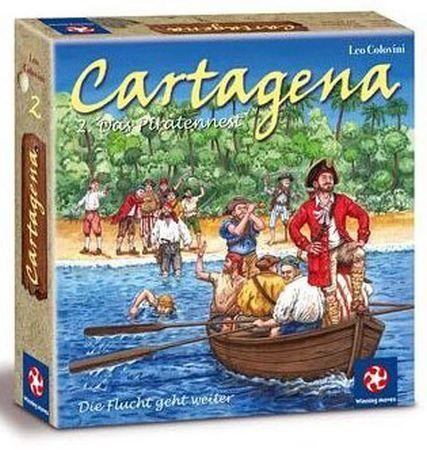
cartagenaCartagena is a quick game recreating the late-17th-century pirate jailbreak in Cartagena, Colombia. This wordless, diceless, easy-to-play game sets each player with five pirates making their way along a dock game board toward an awaiting getaway boat.

cartagenagame

Each player begins with six cards featuring hats, bottles, swords, keys, pistols and Jolly Roger flags. Playing a card allows a player to move one of their pirates along the board to the next empty space featuring that symbol. Players may double and triple-up placement on a space, and additional cards may be drawn from a face-up row of cards by moving backwards along the dock. Moving back to a space with one other purate gains a player one card, while moving back to a space with two pirates gets a maximum two-card draw. Players move forward and backward, acquiring cards and playing them as they progress toward the boat. Strategy comes in planning out your card moves with available spaces on the board, blocking other pirates and stealing in-demand cards from the draw row. The simplicity of Cartagena makes this a great choice for little pirates in your life while it also holds interest for some aggressive adult play like my first game this past weekend with some club members.

MMbox

Merchants & Marauders from ZMan Games is a beefier boardgame akin to the Viking exploration and conquest game Fire & Axe. Set among the islands and seazones of the Caribbean, the game allows players to play as merchant traders or dastardly pirate captains set on acquring gold, completing missions, following rumors and scoring points toward victory.

MMgame

Players begin with their ships at a home port island with each port offering varying bonuses to different types of players. In each turn, players may take three actions of movement, scouting or  port activities. While in port, captains may trade or sell goods, repair damaged vessels, acquire special crew and outfit or upgrade their ships with additional weapons and equipment. Each port shows goods that are in demand like tobacco, rum or spices, and trading in-demand goods scores extra victory points and special Glory cards that can add to a players effectiveness in particular situations. Pirates acquire goods agressively at sea but risk becoming wanted by the various nations looking to go to war with seafaring criminals.

There’s a lot of flexibility in the heading to victory a captain charts. Players may focus on trading or seizing goods, completing missions to other ports and attempting to chase down legendary rumors amid the islands. Attacking other ships can gain goods and gold but players run the risk of damaged or sunken ships that can set them back a few turns. Event cards at the top of each round inject additional elements to the game with storms and other sea-bound pitfalls reducing speed or even wrecking ships. Games of Merchants & Marauders typically run a couple of hours, and players must balance their own captain’s focus with what are other players are doing.

Like the legends of piracy, there’s a lot of variety to be found in pirate gaming. Aside from the games I’ve played and the many miniatures systems available, their are dozens of other pirate-themed games to suit an level of interest. The storied history and mythology of pirates yields a bounty of treasure for any gamer looking to raise a crew under the Jolly Roger and set out in quest of adventure, booty and intrigue on the Seven Seas.

Collector’s Note: Broadsides & Boarding Parties is available on eBay and elsewhere starting at around $50, Pirates of the Spanish Main is set to re-launch soon, but older expansion packs are likewise available via eBay in the $5-10 range and even cases of some card sets are available. Scalawags and bucaneers will find plenty of fellow pirate card, boargame and miniature action at most major gaming conventions. Arrrrrgh!

New Game Weekend: Power Grid

PGcontents

This year I’ve been fortunate to have both the time and a revolving line-up of patient opponents at Metropolitan Wargamers to introduce me to nearly 30 new games. Lots of times I’ll hear the name of a game or references to its mechanics tossed around by other members, and I’ll just file that name away in the back of my head for a future gaming option. One of the games I’ve heard come up again and again is Power Grid, and this past weekend I finally got my first shot at playing it.

What a fantastic game.

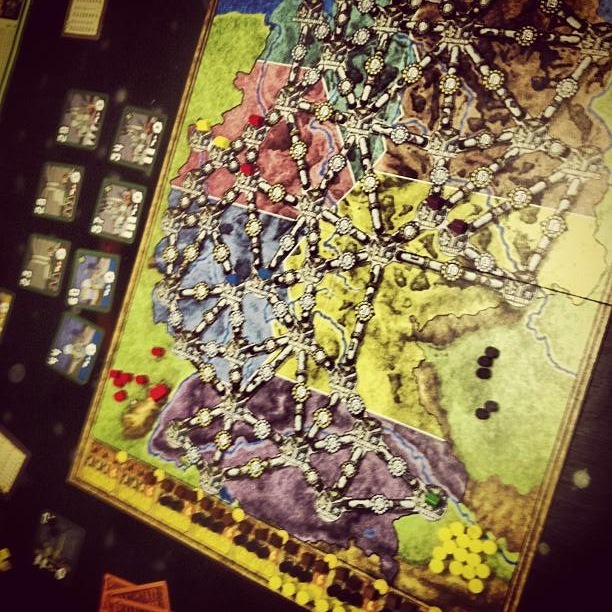
Power Grid is a game of building power plants along a grid among interconnected cities and managing the resources to power the system. Originally published in Germany over 10 years ago, Power Grid began as a crayon and paper game. The version available since 2004 from Rio Grande Games is a more typical Eurogame with a two-sided playing board (Germany and US maps on either side), cards and scores of wooden playing pieces.

The game play unfolds over a series of turn phases. First, player order is determined by the player with the most cities built. Player order is very important in the second phase when power plants are auctioned among players. Some primitive coal, wood or trash-burning plants may come cheap but power few cities or require lots of resources to fire them. Other plants, like solar fields and wind farms, come at a higher initial cost but require no resources to fuel them since the wind and sun come for free. At the far edge are high-tech nuclear plants which can power many cities but require the rare and costly uranium fuel.

And so that leads to the third phase of buying resources. In turn order, players buy coal, wood, trash and uranium which fluctuate in a market of varying demand and pricing throughout the game. Each player’s plant holds double the resources it requires, so a coal-fired plant that requires two coal to run it can hold four coal resources. In terms of strategy, players buy resources for use in their own plants, but they may also choose to stockpile resources and rob other players of the ability to buy resources for their plants.

In the fourth phase, players build cities and their grid. Building cities begins at a $10 value but rises to $15 and then $25 as the game progresses and the grid becomes more crowded with development. Connections between cities also costs money, so creating a close network of cities along a compact grid can make things cheaper for you and more expensive for your opponent as the game goes on. To wrap a turn, players fire up their grid, burn resources and collect income based on how many cities they are able to supply with power.

PGgame

Power grid is a fantastic game of economics, resource management and area control, hitting all the marks of a classic Eurogame. A mix of strategies of building and resource management makes for a realistic yet streamlined game requiring just some basic rules, no reading during the game and simple components. The

Numerous expansion sets are available for Power Grid, including additional power plant cards and additional two-sided regional maps from around the world such as France/Italy, Central Europe, Russia/Japan and China/Korea. A rabid international online fanbase has also created custom homebrewed maps of just about any country or region on the planet.

With the topic of energy and natural resource consumption on the front page of just about any paper in the world on any given day, it’s easy to see why Power Grid resonates so widely. The game also plays without any reading required (other than a basic understanding of one of the translated rulesets), adding to its international appeal. Not only is the game a huge draw for hardcore gamers, I could also see it as a very instructive tool in teaching any group of engaged kids on the challenges of managing ever-increasing power demands.

New Game Weekend: Bioshock Infinite: The Siege of Columbia

bsboxAfter a week away on vacation I returned to Brooklyn and the Metropolitan Wargamers club in Park Slope this past weekend. The club was packed on the Labor Day weekend with lots of different games hitting the tables. I paired-off with one of my fellow members to try out his new copy of Bioshock Infinite: The Siege of Columbia.

Based on the latest game in the long-running Bioshock video game franchise, this 2013 boardgame is at its root an area control game. Players choose to play as one of the two factions – the Vox Populi led by Daisy Fitzroy and the Founders led by Zachary H. Comstock. The game plays in a one-on-one two-player game or in a four-player team version of the game.

Play begins with each faction placing their starting miniatures and Turret and Home Base building markers. Each turn begins with the draw of a victory point mission card followed by a World Event Card which kicks off a secret vote with each player committing influence points from their hand of five Action cards. Winning or defeating the vote varies in importance, as the neutral Booker and Elizabeth characters advance to different spaces on the board and other game-changing events are put into play.

bscontents

The winner of the vote also receives the first turn marker which is key to controlling the flow of the game. Starting with the first player, units are purchased or Action cards are upgraded with Silver Eagle coins. Action card upgrades give you greater influence in votes, stronger combat values or more purchasing power in subsequent turns. The player then moves up to four units to adjacent squares or takes a chnace gliding to neighboring territories across the Skyline. Most units move one space but the Founders’ Songbird and Voz Populi’s Airship models each move up to two spaces. Skyline moves are achieved through rolls of special dice sliding you to the next node or risking a fall into thin air with each roll.

Combat occurs next. Common, Special and Leader units each carry a different die value, with different colored dice being rolled to resolve combat situations. Loss of a combat results in a figure being removed. Playing Action cards and upgrades add to combat effectiveness as do the special Turret markers. Conquering unoccupied spaces earns additional Silver Eagle coins, and controlling all spaces in a territory earns victory points. Destroyed units are removed from play or returned to Home Base safe havens. A mix of controlling territories and completing missions of combined actions wins victory points, and the first player to ten victory points wins the game.

There’s a lot going on in this game, and well-played plans and strategies are forced to change as world events switch from turn to turn. In my first game, I found controlling the first player spot was key. However, controlling the first player role means spending lots of cards which can come back to haunt you in a heavy combat challenge later in a turn. As the game advances, the heroine Elizabeth moves along a timeline track which also alters how the game plays out. Her protector Booker is also a big spoiler in swaying votes and possibly attacking each faction at different points in the game. Unlike most area control games where occupying and defending a won territory is often enough to ensure victory, the Skyline allows an opposing player to drop right into or behind your defenses and attack.

For a bit more of an intro to the game’s actual gameplay, check out the video below from the alwyas-entertaining Watch It Played video series.

If you aren’t up on your Bioshock Infinite video game lore, I could see some initial challenges in wrapping your head around the interplay of the characters, factions and events in the boardgame. I’ve spent quite a few hours watching my son work his way through the spectacular action and storyline in the video game, making my understanding of the boardgame’s narrative a bit richer from the get-go. Whether you’re a fan of the video game already or just interested in a really rich and challenging area control board game experience, you should hop the next airship back in time for the floating nation of Columbia.

New Game Weekend: Letters From Whitechapel

ripperbox

This fall will be the 125th anniversary of one of the most famed unsolved crime cases in history and a story that continues to fascinate to this day. The Jack the Ripper case, also known as the Whitechapel Murders for the section of London where the killings occured in 1888, involved the gruesome homicides of (at least) five prostitutes by a still-unknown perpetrator. Much like today’s high-profile crimes, the case held Victorian London in a state of rapturous horror as an anxious police force, press and citizenry obsessed over the murders and hunt for the suspect. Graphic crime-scene photos, mysteriously cryptic letters and speculation on potential suspects – from butchers to surgeons to members of the British royal family – combine to make to make the lore of “Ripperology” a thing of modern legend.

Jack The Ripper in Pop Culture

From a pretty early age, I had a macabre interest in Jack The Ripper. Aside from the countless true-crime books on the case, Jack The Ripper has made it to the big and small screen dozens of times over the years. I love the moody 1928 silent picture Pandora’s Box starring Louise Brooks as a wayward innocent who falls into a life of prostitution before becoming a victim of Jack. The 1979 movie Time After Time adds a sci-fi spin on the case with Malcolm McDowell as H.G. Wells chasing Jack The Ripper through time to modern day San Francisco. My favorite by far has to be the 1988 Golden Globe-winning TV miniseries Jack The Ripper with Michael Caine chewing the scenery as the real-life Scotland Yard chief investigator of the Whitechapel Murders Inspector Frederick Aberline. Made on the centennial of the case, the series focused on the theorized link of the murders to the British royal family and re-introduced the case to a new generation of Ripper-obsessives like myself.

Pandora’s Box

Time After Time

Jack The Ripper

fromhellcoverOf all the movies and books I’ve encountered about Jack the Ripper nothing can hold an oil lamp to Alan Moore and Eddie Campbell‘s 1999 graphic novel masterpiece, From Hell. Orginally released in a 10-issue serial and now available as a bound edition, From Hell is one of the most dizzyingly complex stories I’ve ever read. This is also Moore at his most obsessive with nearly 600 pages of slowly-building detail ultimately pointing to a grand and ancient conspiracy. The muddy black-and-white ink drawings of Campbell perfectly capture the grime of the streets of 19th-century London and the unhinged mind of a serial killer. The depth of research and detail in the characters and places surrounding the case really can’t be described, and it’s this complexity in the book that has driven me back to re-read it a number of times over the years. Johnny Depp starred in a 2011 film adaptaion of the story, but honestly I’ve never been able to bring myself to watch it given how much I love Moore and Campbell’s original series. A new book, The From Hell Companion, goes behind the scenes to the story and visual development of the book, and I’m certain I’ll be picking up a copy very soon.

Letters From Whitechapel

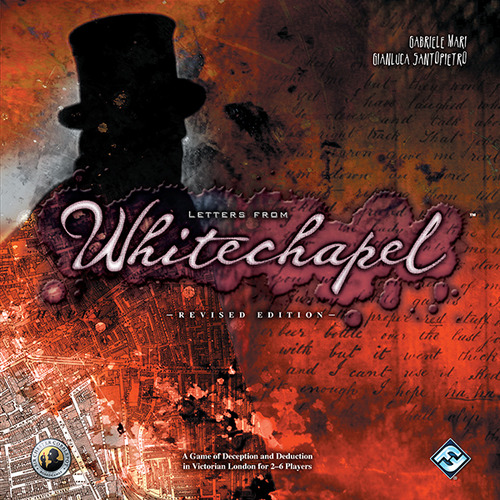
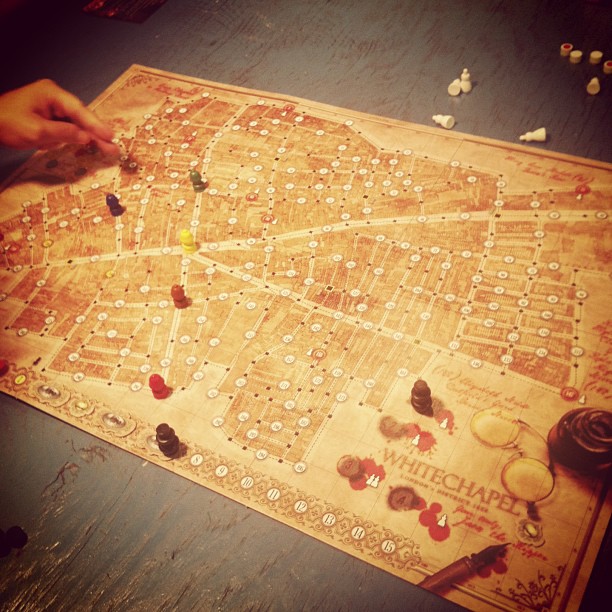
With a long-time interest with Jack The Ripper, I was thrilled to get a chance to play Fantasy Flight Game’s Letters From Whitechapel recently at Metropolitan Wargamers. The game presents a historically-accurate map of Whitechapel with its intricate cobblestoned streets and alleys on which a group of police officers attempt to track down and apprehend Jack The Ripper before his murderous spree comes to a bloody end.

rippercontents

In the game, one player is elected to play as Jack while the other players take on the roles of patrolling London policemen. Behind a special screen, Jack denotes his hidden home base on a special sheet before placing tokens on the board at the location of possible victims. The police players then secretly place the starting locations of their patrolling officers. Then, all starting places for the police and prostitutes are revealed and markers are placed on the board. Going first, Jack then decides whether to kill his first victim or delay for time. Once the victim is murdered, a red token is placed to denote the scene of the crime and the police pawns are moved up to two black squares at a time.

1157510_10201267172015715_1763666450_n

Jack the Ripper then moves each turn in secret between numbered spaces, marking the locations on his sheet away from view from the police players. A carriage token allows Jack to move two spaces and slip by police potentially blocking his path. An alley token lets jack slip through a dark back passage within any given city block. After each move by Jack, the police move and choose to investigate nearby areas or speculate on and adjacent location of Jack and make an arrest. If a player investigates a space where Jack has been, a clue is revealed and marked on the board. Turns alternate with Jack moving and the officers attempting to string together his movements through discovering more clues. Jack attempts to get back to his secret hideout before being found out by the inspectors within the set time of the round. If Jack is successful, the next round begins with a reset of the board and a new potential victim being placed.

Letters from Whitechapel is basically a cat-and-mouse game with the police players attempting to decode Jack’s possible routes of movement in order to close in and capture him. In my first game, it took us two rounds to track down a very elusive Jack who ran devious circuitous routes back toward his hideout. After the first round, we felt fairly confident we had narrowed his home base to one of three areas of the board, and we finally caught him in the second round by focusing on those areas. The game involves a lot of discussion among the police players with various theories of Jack’s whereabouts bandied across the table throughout the game.

For gamers with more than a little Jack The Ripper interest coupled with a desire to play out a game of hidden movement of the opponent, Letters From White Chapel is incredibly satisfying. With 125 years of the unsolved Whitechapel Murders behind us and probably many more to come, having a go at bringing Jack The Ripper to justice makes for an intriguing couple hours of play.

New Game Weekend: King Of Tokyo & Chinatown

A fun, quick boardgame is a good thing any time, and this past weekend at Metropolitan Wargamers in Brooklyn I tried my hand at a couple which were new to me. In King of Tokyo and Chinatown, players get to run through some very quick gaming (less than hour each) under very different mechanics and themes.

King Of Tokyo

KOTcontents

Whether you’re a fan of old Godzilla movies, remember playing with Shogun Warriors toys in the 1970s or caught this summer’s Pacific Rim, 2011’s King of Tokyo may be just the thing for you. Battling as giant monsters like Gigazaur, Cyber Bunny, Alienoid, Meka Dragon or Pandakai, players duke it out through a cartoonishly-funny game to become the ultimate King of Tokyo.

KOTgame

Each turn, a player rolls six special dice with values of 1 through 3 or a symbol indicating an Attack, Heal or Energy result. Numbers score victory points, Attacks take swipes at other monsters, Heals allow you to regain health points or evolve your monster, and Energy results allow for the collection of green cubes to spend on special ability cards. With three Heart results, not only does your monster heal but it also allows you to pull an Evolve card which gives you monster specific upgrades. Players choose to re-roll some or all of their dice three times each turn before finishing up and passing the dice.

Through the “king of the hill” action of the game, monsters jump in and out of Tokyo to heal and avoid being attacked by the other menacing players. Once you’re strong enough, you can choose to charge your monster back into Tokyo. The special ability and evolution cards give you added strengths to affect your and your opponents’ monsters. The expansions for the game add additional cards and room for 5-7 players so two monsters can occupy Tokyo and nearby Tokyo Bay simultaneously. The artwork of the cards and combinations of monster evolutions and special cards makes for a lot of variety and fun as the monsters pound away at each other until 20 victory points are achieved or all other monsters are destroyed.

Chinatown

CTbox

There’s no battling monsters or references to Roman Polanski’s classic 1974 modern noir movie Chinatown in the boardgame Chinatown, but a different kind of intrigue abounds on these streets. Released in 1999 by Z-Man Games, Chinatown is a club favorite at this point for its pure economic strategy play. In the game, a map shows a series a of city blocks with numbered lots all set within the street grid of Chinatown. In six turns (or years), each player first draws and selects random building lots and businesses. Businesses include such common Chinatown landmarks like dim sum restaurants, pet stores, antique shops, florists, jewelers, laundries and factories. Players need to build businesses on their lots to earn rent. For example, a tea house requires three contiguous lots to complete while a restaurant requires six. The bigger the business, the more rent collected at the end of each turn. Partially-completed businesses can score modestly (maybe $10,000 per turn) but a sprawling big business can earn big money each round ($100,000 or more). Strategy might focus on completing multiple small businesses, one or two larger ones or a mixture of businesses of all sizes. The player with the most money at the end of the game wins.

CTgame

Unlike a more typical economic game like Monopoly, Chinatown is very fluid and involves little in the way of traditional game mechanics. There is no set play within a turn, no dice and a minimal amount of chance in the game. Players can buy or trade combinations of lots, businesses and money through an open negotiation process which only ends when there’s an agreement for no more that round. You might offer a business another player needs in exchange for a building lot you need on one of your blocks. During the draw phase, not only are you thinking of the lots you need to build your businesses but those which may prove valuable to your opponents. Balancing what you earn in a trade and what another player may gain in the exchange makes for both a competitive and collaborative game, much like the environemnt you would fine in any dense Chinatown.

Whether you’re up for some giant monsters slugging it out in Tokyo or some urban development on the crowded streets of Chinatown, both King of Tokyo and Chinatown make for very different but very entertaining games. At just around $40 each, these games are a sure thing for any group of new or experienced gamers looking for some quick yet engaging play.

New Game Weekend: Escape…From The Temple Curse

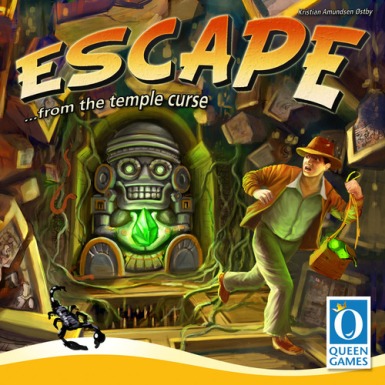
escape As I’ve previosuly written, I grew up on Indiana Jones and the cliffhanger world adventurer genre in re-runs of old movie serials. Games like Fortune and Glory are loads of fun in taking on the guise of a rustic hero globetrotting to exotic locales in search of treasure and reknown while dodging enemies looking for to dastardly foil your mission. A few weeks ago at Metropolitan Wargamers I had a chance to run through a few games of another adventurer game, Escape…From The Temple Curse from Germany’s Queen Games. Released in 2012 after a successful Kickstarter campaign, Escape is a fast-paced game in which you and your fellow player-adventurers race through a temple collecting treasures and escaping before the temple collapses.

escapecontentsEscape begins with each player placing their adventurer on the starting temple tile. Simultaneously, players begin furiously rolling five dice apiece. Rolling a green adventurer allows a move while a blue key or red torch reveals a new room, opens a treasure or allows for a gem to be picked up. A black mask “curses” a die which is set aside and cannot be used in a subsequent roll. Once a gold mask is rolled, up to two cursed black mask dice can be put back into play. Players may share dice results if they occupy the same chamber, adding a collaborative element to the game. Quick-paced decisions need to be made constantly as players need to stay close enough together to help each other but also spread out to cover enough ground to gather gems to unlock the exit to the temple.

Unlike most games I play over many hours, Escape plays out in no more than 10 minutes of real time. The game uses an actual recorded soundtrack which builds in intensity over the course of the game until a warning sounds and the temple crashes to ruins. Not only does the soundtrack serve as a game timer, but it also adds a real cinematic aspect to the game. It’s as if you’re playing through an old Saturday matinee movie serial.

Playing the game is crazy, even more so as the number of players increases. From the moment the soundtrack begins, people are rolling dice, shouting to each other, mapping new routes, running into roadblocks, collecting gemstones, falling victim to a curse or finding a treasure. Two expansions make offer additional temple tiles as well as curse and treasure markers. Curses might make a player lose a die if it rolls off  the table or force them to not speak. Treasures do such things as reveal magic doors between chambers or transport you magically to another part of the temple.

The game plays so fast that any decent gaming session allows for multiple games to be played with increasing difficulty by adding in more of the expansion elements. In the few games I played with the maximum of five players at Metropolitan Wargamers, we successfully escaped the temple at around the 8-to-9-minute mark each time. Although our bunch at the club was compromised of experienced gamers in our 20s-40s, Escape is simple enough in its rules that families would find the game to be a kick. Regardless of the make up of the players, Escape…From The Temple Curse is loads of fun for anyone looking to live out their cinematic adventure fantasies in a manic and fun-filled tabletop game.

New Game Weekend: Sid Meier’s Civilization: The Board Game

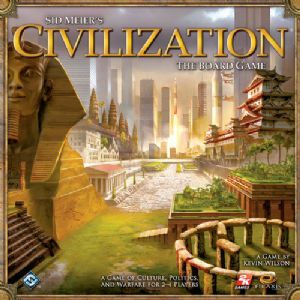
CivBox

Unlike myself, electronic games have been a constant presence with both my sons since they were born. Now aged 8 and 13, my boys have graduated up through a host of platforms and games with the Leapster, DS, PS2, Wii, PS3, online through sites like Steam and on the iPhone. Over the past year, their obsessive play over Minecraft has been gradually replaced with scores of hours logged with the wildy-popular Civilization V.

Developed more than 20 years ago by Sid Meier and Bruce Shelley, the Civilization franchise has evolved from a PC-only DOS game to occupy a variety of gaming platforms. The turn-based civilization-building mechanic and historical theme sets up an incredibly-engaging and educational universe for players to plan and play out a nearly-endless variety of paths in human advancement from the ancient era to the near future. The latest iteration, Civilization V, broke on the scene in 2010 with two expansions since. Worldwide, the game has sold millions of copies and has continuously won accolades from a couple generations gaming critics and devoted fans alike.

Even though my kids are devoted electronic gamers, they’ve also been raised with a healthy love for card, board and miniatures gaming. So, when my 8-year-old caught wind last week that a boardgame version of Civilization existed, I leapt at the chance to introduce the boys to the game. I’ve played a number of civilization-building games such as Clash of Cultures but hadn’t yet played Civilization.

Now published by Fantasy Flight Games, Sid Meier’s Civilization: The Board Game has been around since 2002 and can be found at your local Barnes and Noble for $60 or cheaper online. Like many games of this type, the box comes stuffed with hundreds of components plus more than 300 cards. Geared for 2-4 players ages 14 and up, Civilization takes 3+ hours to play. Fortunately, my boys have been exposed to enough games, both online and on the tabletop, that they’ve been able to quickly pick up on the basic play and strategy Civilization offers.

CivContentsCivilization involves a march toward victory in one of four ways: Economic, Military, Cultural or Technological. Players begin by selecting a civilization such as the Americans, Egyptians, Romans or Russians. Each starting civilization carries its own strengths in play, making this first choice an important one in setting your strategy for the game. Based on the number of players, a map of hidden tiles is laid out and the market area is set up to the side of the board.

After set-up, the game progresses through a series of turns. In the Start Turn, a player may build a city or change their government type – an important choice which can greatly affect the path of a player’s civilization. Next, the Trade Phase allows a player to reap trade points from the areas around their cities and offer trades in resources with other players.

In the City Management Phase, the player may build units or buildings, harvest resources or focus on developing their culture. Building units – Scouts or Armies – allows the player to explore and conquer areas of the board. Constructing buildings such as Markets, Temples or Baracks allows a variety of bonuses to your civilization. At a higher price, Wonders like The Oracle, The Hanging Gardens or Angkor Wat may be built. Finally, a player may pay to build their military prowess through a progression from simple archers and pikemen to tanks and aircraft. Aside from building, a player may harvest resources such as silk, iron, incense or wheat to be later spent to activate certain technologies already researched. A player may also choose to focus on culture, with gained cultural points moving the player up the culture track while also earning special cultural event cards played to change different courses of the game’s play.

Next, in the Movement Phase a players may move their Scouts and/or Armies to explore, claim new territory or engage in combat with a barbarian village or another player. In the final Research Phase, players may spend their earned trade points to develop new technologies. The game’s “technology pyramid” is built progressively by each player as they grow from simple technologies such as Metalurgy and Horseback Riding toward higher level advancements all the way up to Flight and Nuclear Energy.

The play adavances through the above turns until a player arrives at a victory condition. Cultural victory is earned by completing progress on the culture track. A military victory is won by conquering an opponent’s capital city. Earning a technological win is done by completing the technology pyramid all the way up to Space Flight. Finally, an economic outcome is reached by collecting 15 gold coins earned through various actions your civilization makes throughout the game.

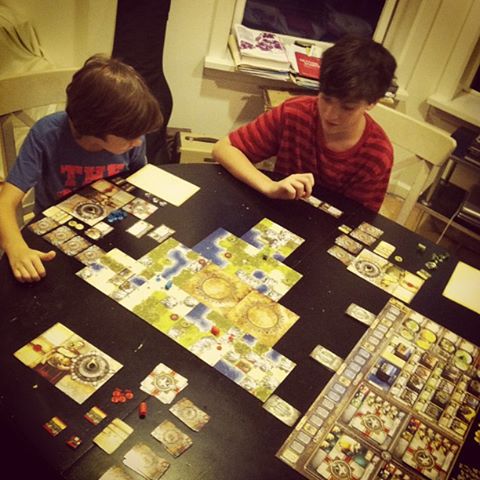
To summarize the game in a couple paragraphs is hard, as the variation of play in the game is boundless. This weekend, my younger son and I played through our first quick starter game on an eight-tile two player-map (pic below). Despite over twenty pages or rules and scores of playing pieces to manage, he picked up the game really fast. Along the way, there’s a ton of reading I’m certain is not covered in the general elementary curriculum with stops along the way to have side conversations on the meanings of words such as “despotism” and “anarchy.” At his age, my son’s memory is quite amazing and our discussions of the finer points of the rules has continued even away from the game table.

1001022_10201084784976153_1277385001_n

In our second game (pic below), three of us played on a larger map. My older son, a pretty experienced gamer at this point, blew threw a ten minute intro to the rules and played as the Prussians with an aggressively militaristic strategy I’ve grown used to over the years. Using the Egyptians, my younger son focused on culture and building construction. For my own strategy, I played as the Romans with a healthy mix of the military and cultural expansionism for which their empire was known.

1004654_10201085941885075_1372920330_n

For parents and critics of them who decry the falling attention spans of today’s kids, weekends like this past one show how with a bit of parental creativity all the stereotypes simply fall away. A game like Civilization — both online and off — offers so many opportunities to build vocabulary, learn history and develop some complex multi-layered management skills I see sorely lacking in many of the adults I encounter. Over hours of focused play, not only are my sons and I developing our civilizations but we’re also developing each other — an investment in time together well-spent.