Getting Ready For HMGS Fall In! 2015

WaterlooRobinsonPainting

FALL IN!™ 2015 (Nov. 6 – 8)

Convention Theme: “Campaign of the 100 Days”

Lancaster Host Resort & Conference Center

Lancaster, PA

Less than two months from now, a number of us from Metropolitan Wargamers in Brooklyn, NY will be attending this year’s HMGS Fall In! convention the weekend of November 6-8, 2015 in Lancaster, PA. I, some fellow club members and my brother have a variety of games from different periods we’re presenting in several scales, and the events will be geared toward a variety of levels of gamer experience from beginner to veteran.

Here’s a rundown of our scheduled games so far which you can find along with hundreds of other games listed online in the convention’s event list.

Friday, November 6th Events

F: 351 Rivoli – 1797 – 1:00-6:00 PM

Period: Napoleonic, Scale: 10mm, Rules: TBD

Re-fight the Battle of Rivoli that crushed the first coalition and set Napoleon on a trajectory toward consulate and empire. Will 23,000 French repeat their historical victory over Alvinczi’s 28,000 Austrians? Or will Napoleon’s rise end in the fields of Piedmont? A follow-up to the truly spectacular award-winning Battle of Marengo on a custom-built terrain board from previous HMGS conventions which you can view here.

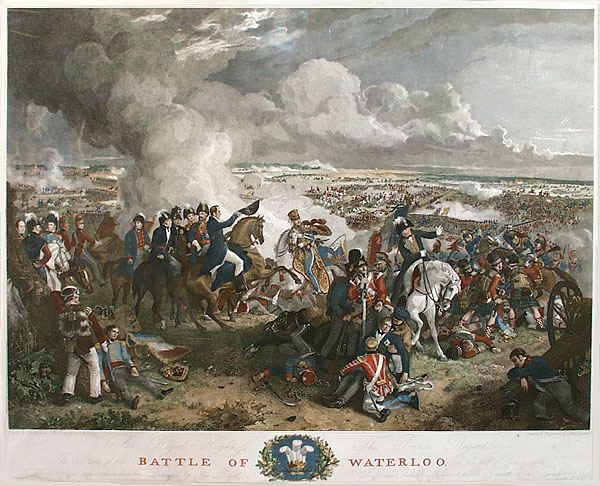
F: 257 Battle Of Waterloo 200th Anniversary – 3:00-8:00 PM

Period: Napoleonic, Scale: 15mm, Rules: Home Rules

Play one of the greatest battles in history on the 200th anniversary — Waterloo. Napoleon’s French attack the Anglo-Dutch army led by the Duke of Wellington. Time tested home rules perfect for anyone new to Napoleonics or for experienced players. Fast play for convention yet with all the detail and pageantry of the era. This game is being run by my brother who presents games of the Napoleonic Wars in 6mm, 15mm and 28mm with gorgeous hand-crafted tables and his beautifully painted figures, so this one will also be a treat.

F: 374 Barkmann’s Corner – July 17, 1944 – 4:00-6:00 PM

Period: World War II, Scale: 15mm, Rules: Flames Of War

It’s the summer of 1944. Famed German tank ace Ernst Barkmann is rolling through Normandy commanding his Panther and looking to halt the Allied advance. Amid the bocage of the French countryside, a US armored column encounters Barkmann in a showdown at a crossroads which will become legend. A great learning game for people new to FOW (including kids with adults). I’ve run this short scenario before (report and pics here) and it’s a blast to play if you like pushing tanks around the table.

F: 377 A Peaceful Exchange Of Prisoners…Hopefully. Wheeling, VA, 1777 – 6:00-10:00 PM

Period: American War for Independence, Scale: 25mm, Rules: Muskets And Tomahawks

A British/Indian delegation during the American War of Independence has arrived in wheeling to discuss a prisoner exchange. Both commanders hope the exchange goes off everything might go off without a hitch, and everyone might go home happy. But this is a wargaming convention, so don’t count on it. Winning will require negotiation, flexibility, deceit, and the element of surprise. Each player has his her own victory conditions. A club member who is a college instructor with expertise on American Colonial warfare is running this game, so it’s sure to be laced with colorful historic narrative.

 Friday (night pick-up game): Churchill’s Nightmare – 8:00-11:PM

Period: World War II, Scale: 1:200, Rules: Naval Home Rules

Can the British home fleet stop the German breakthrough into the Atlantic?

Saturday, November 7th Events

S: 376 St. Oedenrode – September 17-24, 1944 – 2:00-6:00 PM

Period: World War II, Scale: 15mm, Rules: Flames Of War

It’s the autumn of 1944. As part of Operation Market Garden, the US 502nd Parachute Infantry regiment has parachuted into Holland and seized an important bridge on the Dommel river at St. Oedenrode. Rushing to counter attack are German Fallschrimjager regiments supported by artillery and armor. Can the allies hold the bridge until reserves arrive or will the axis rush to retake the objective? A great learning game for people new to FOW (including kids with adults). This is another scenario I’ve run several times before (report and pics here), and I’m also working on some new models to bring along in time for the convention.

Saturday (night pick-up game): Engagement in the Mediterranean – 8:00-11:PM

Period: World War II, Scale: 1:200, Rules: Naval Home Rules

Can the British Mediterranean fleet stop the Italian fleet?

Come to Fall In! and meet the Members of Metropolitan Wargamers

We’ll also be planning to run other games including two games based on the 1980s movie classics Mad Max and Red Dawn. You will be able to spot the members of Metropolitan Wargamers wearing our new club shirts celebrating over three decades of gaming in New York City. We’re certain to have a some other surprises at the convention, so sign up for Fall In! and we’ll see you in Lancaster in November.

New Game Weekend: The Battle Of Bushy Run

BushyRunMap

The end of the French and Indian War in 1763 was less than satisfactory for many of the participants, especially the Native American tribes which had been entwined in decades of alliances with British and French forces. After losing their attachment to their longtime French allies in the Great Lakes Region, many Indian tribes were angered by the post-war British policies which aggressive opened white settlement to the Ohio Territory (present day Western Pennsylvania and Ohio), Illinois Country (portions of present day Illinois, Indiana and Michigan) and wider Great Lakes Region (including present day Western New York). British promises to continue the flow of gifts to the tribes in the region were also cut back, further angering the Native peoples who had become dependent on European trade goods over the years.

Feeling duped by British colonial rule, a confederation of more than a dozen tribes rose up in a unified force led by Ottawa leader Pontiac (among other tribal leaders in the region). In the spring of 1763, groups of white settlers and multiple British forts and in the disputed territories were attacked. After the destruction of several smaller forts and an unsuccessful siege at Fort Detroit, another at Fort Pitt also occurred. With a British relief column en route from the east, many of the Indians at Fort Pitt broke off to the meet the British. What resulted was the Battle of Bushy Run on August 5-6, 1763.

IMG_6397MMP’s Special Ops Issue #5 from September 2014

Multi-Man Publishing is best known for it’s 20th-century wargames (including the classic Advanced Squad Leader), but the September 2014 issue of their Special Ops magazine contains a nifty little game for the Battle of Bushy Run. Packed into just four pages of rules, 88 cardboard counters and two beautiful maps, MMP’s presentation of the two-day battle in the thick woods of Western Pennsylvania is an incredibly satisfying game.

IMG_6392Indian and British force counters for MMP’s Battle of Bushy Run

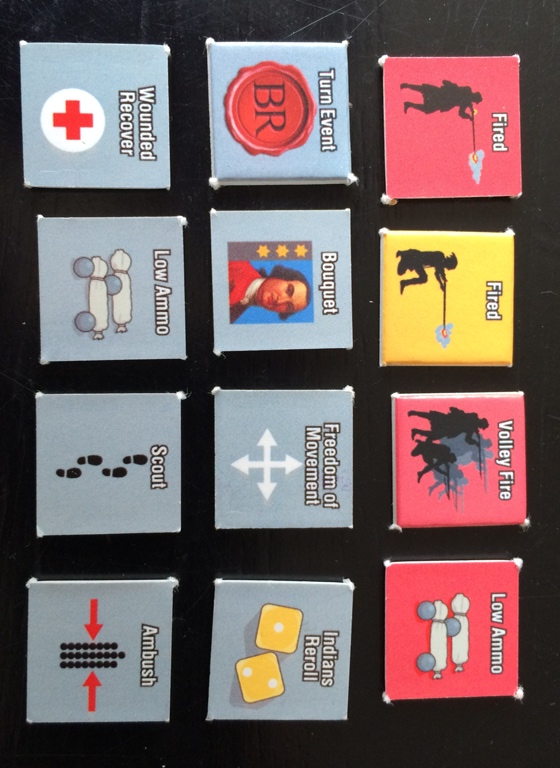
IMG_6395Fire and random turn event markers for MMP’s Battle of Bushy Run

I had a chance to punch and play a new copy of the game this past weekend at Metropolitan Wargamers in Brooklyn, NY. Giving the game it’s first spin with me was a fellow club member who is an instructor at a local college and an expert in 18th-century North American colonial warfare. The playing counters have tidy artwork and are divided into force chips and a variety of other game markers. The British force markers depict the various historic units at the battle with values for strength and movement and step losses. A supply wagon piece provides the path of victory for the British looking to move it off the board and onward to relieve Fort Pitt. Special British scout markers also play as a way to counteract the nature of how the Indian force markers work in the game.

IMG_6386Indian hidden movement map

The Indian force markers display the various tribes present at Bushy Run, and each have an identical strength and movement value. Each also has just one step loss, but the way they work in the game does not reward the Indian player for simply standing to fight against the British. Along with the larger game map where the British column begins fully deployed, the Indians deploy on a smaller hidden map. Throughout the game, the Indian player may move their units from one map to the other as they attack, hide or come back concealed. Additionally, some Indian pieces are dummy markers which can add an additional layer of confusion for the British player struggling to see where their enemy are. These simple markers and the double maps helps to create a fantastic simulation of the challenge of the regular British troops in fighting Indians fading in and out of the woods with harassing attacks. Since movement is by the area, each with it’s own defensive equal for both sides, choosing where and when to fight is important for the British and Indians alike.

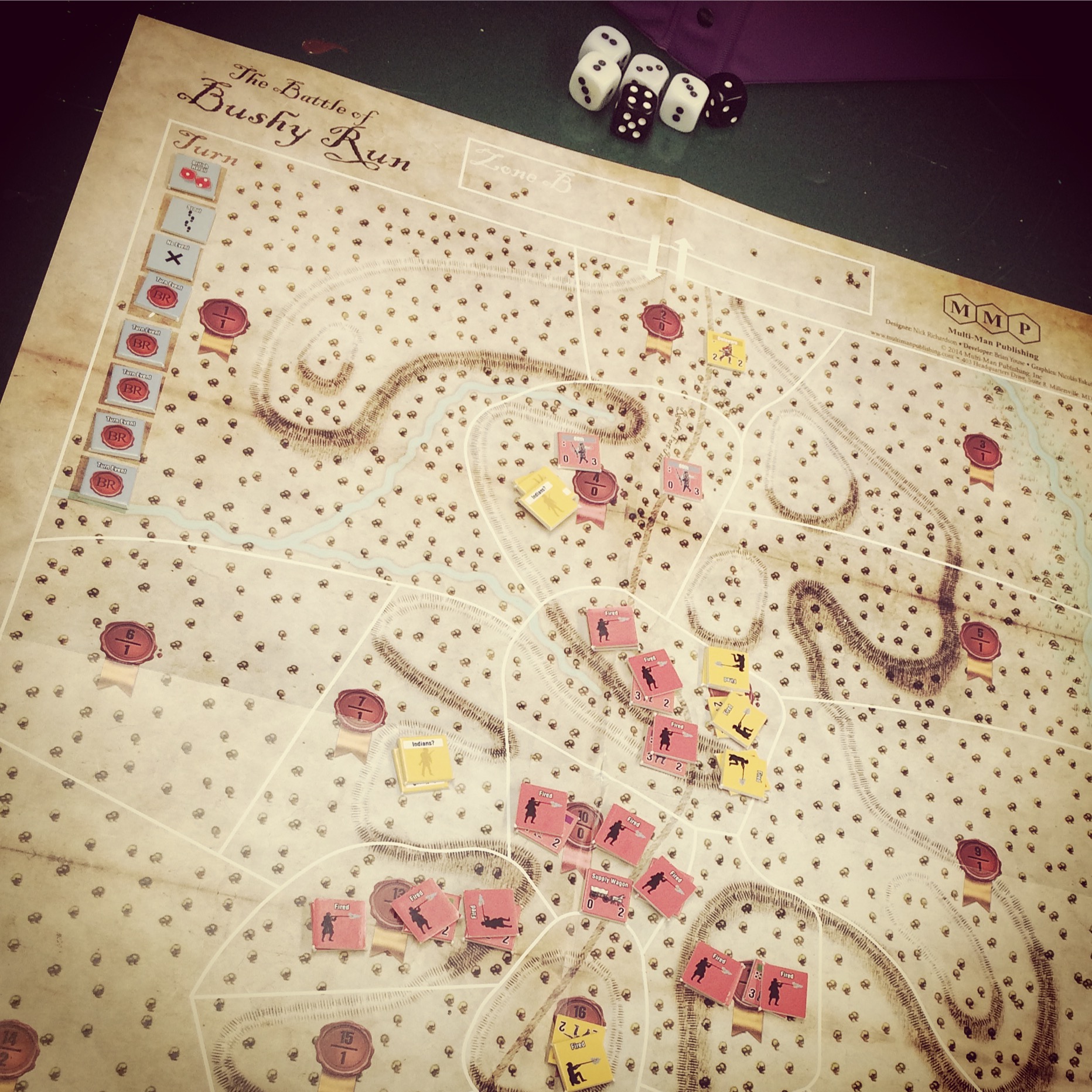
IMG_6389MMP’s The Battle of Bushy Run in progress

Further adding to the unpredictability of the frontier fight is a series of random turn events which can potentially benefit each side in a turn. With the British objective of getting their wagon off the board, the European force must balance choices on when to move, when to engage the surrounding Indian forces and when to stand still to take a round of volley fire. The Indians must capture the wagon using a force which lacks the military superiority of the British, but make up for it in their ability to appear, disappear, move and reappear throughout the battle. Indian casualties can mount quickly under British fire, and the Redcoats can also win by eliminating 14 Indian units.

Our first game resulted in a narrow victory for the British, just wheeling their wagon off the board as the final mass of surviving Indians closed in on all sides. We found the British scouts to be pretty ineffective, but they didn’t hinder the game either. My Indian casualties were high, owing to my more aggressive early game engagement with the British as I worked out how effective the concealed and hidden movement could be. The British also learned some lessons by probably sitting still a turn or two too long, standing and awaiting to fire on the encroaching Indians rather than hustling their column forward from the get-go. For a tiny game depicting a small battle in a largely forgotten period of conflict in Colonial American history, MMP’s The Battle of Bushy Run is a tactical and historical thrill.

A Milestone at Brooklyn Wargaming

100KviewsThis week, this site rolled past 100,000 views and 56,000 visitors since its launch in July 2013. While Brooklyn Wargaming is by no means one of the more popular gaming sites out there, I am constantly pleased I garner so many visitors every day around the world coming to check out what’s new with me and my hobby.

Over the past few years, I written over 200 posts, played over 100 games, paid visits to numerous historic sites and museums, modeled a lot of terrain and painted a ton of miniatures. My blog has served as not only a diary of my gaming passion, but also as a way to share my love for this stuff with people who have visited my site from almost every country on the planet.

Here are some lessons learned and observations about blogging about gaming over the past two years:

Be Early

One of my earliest successes was from a post I wrote about the passing of famed wargamer and author Donald Featherstone in the autumn of 2013. Just as the story was breaking on the morning of September 4, 2013 in Europe, I noticed there wasn’t a lot of coverage in the United States as of yet. I work for a company that works partially in breaking news, so I know the value of being first to a story. By the end of the day, my traffic had spiked to nearly 200 visitors, by far the best day for my site which had just launched a couple months before.

Be Timely

As a historical wargamer, posts which tie in with anniversaries of particular battles and campaigns are great generators of traffic. My best examples are the two articles I wrote about modelling the Guards Armoured Division during Market Garden. Many months after originally posting them, the Flames of War website made the two posts featured articles in their weekly site update celebrating the anniversary of Market Garden. Traffic flooded in and each have seen about 3000 reads over their lifetime.

Be Unique

Now and then I write about my early years of gaming with my Retro Gaming the 70s & 80s series. In these posts, I look back at games from my childhood and teen years when I was just becoming passion about the hobby. Often times, these posts are love letters to obscure games which appeal to only certain people. While many of these articles get just a few views from my nostalgic visitors, I’ve been surprised that my piece on Crossbows and Catapults has become a popular post day in and day out since it was published in July 2014.

The Crossbows and Catapults article lingered in obscurity for a few months, but several months later the traffic started picking up. Since then, this piece has been getting about five reads a day. I find this to be an interesting stat given the game is not especially well-remembered nor is it played much today. What I think makes the post strong is that it is one of the few comprehensive articles about the game you can find online. The article contains a detailed history of the game and its subsequent editions plus lots of photos and scans of the original rules included in the game. Other sites have linked to the article over time, directing traffic to my site daily with people with fond memories for this game. Unwittingly, my written childhood memories have now become a go-to article online for Crossbows and Catapults.

Be Instructive

As a hobbyist, some of my favorite articles online fall into the ‘how-to’ category. It shouldn’t be surprising then that my posts which outline detailed descriptions, step-by-step guides and lots of illustrative photos are among my most popular. Over time, I’ve added more in-process descriptions and pictures of my painting and modelling projects, garnering traffic day in and day out. Whether it’s modelling 15mm Western European terrain, micro armor projects or my recent build of Pegasus Bridge in 15mm, these ‘how-to’ posts are visited multiple times day after day. The great thing about a solid, detailed instructional post is they have long ‘evergreen’ lives as both new and old hobbyists alike seek reference posts as they work their own projects.

Be Connected

People don’t find stuff online on their own, so connecting my blog to like-minded folks is an important way to get others to read my posts. Posting modelling projects and after action reports links to The Miniatures Page is the number one generator of outside traffic for my site. After that, connecting posts to various groups, museum, historic site and manufacturer pages on Facebook is the second best way to find readers. Facebook also gives the most ego-boosting immediate feedback as the likes, shares and comments flow with almost every post. Posting my articles directly to forums on manufacturer websites, like Flames of War and GHQ, also drive pretty significant views from people invested in a particular niche of the hobby. As a member and president of Metropolitan Wargamers in Brooklyn, NY, my posts also flow directly to the club’s homepage for current and prospective members to check out. I also use my Twitter account and have dabbled in Reddit, although each of these only see a trickle of visitors to the site. It’s a bit of work, but I definitely need to push my social media connectivity to keep my traffic boosted.

Getting to the next 100,000 visits…

So, with this first milestone at Brooklyn Wargaming, I’m asking myself where I go next. I’m certainly going to be continuing to post projects on a regular basis, and I’d like to break into miniatures of more eras beyond my core interest in World War II. I’m going to keep bringing reviews and plays through new board games to the site as I’m introduced to them. I’d also like to get into more feature articles, and I’ve got a few ideas churning away in the back of my head.

As a kid originally from a tiny rural Western New York town who’s been pushing little miniatures around tables and rolling dice for over thirty years, I’m grateful to my tens-of-thousands of readers who have come to my site over the past two years. Keep checking out the site, and, if you’re ever in Brooklyn, let’s play a game.

Boardgames of the American Revolution, Part I

DOI

Last month, Quartz published a crowd-sourced online survey of how the rest of the world learns about the American Revolution in school. For most outside the US, the war is variably seen as a sideshow to other 18th-century European conflicts, an extension of the Enlightenment or ignored altogether. Children in the United States itself often leave school and march into adult citizenship with only the broadest mythic stories and American patriotic heroes of the war under their belts.

My interest in the American War of Independence has fluctuated over time since growing up as a kid amid the United States Bicentennial fervor of the mid-1970s. Having been in Brooklyn for almost two decades now, I’ve developed a growing interest in the war as I live and commute daily through the ground fought over during the Battle of Brooklyn and Battle of New York in 1776. Over the past year or two I’ve also been working through a minor obsession with boardgames of the American War of Independence. I’ve played many and collected a few ranging from classics of the early 1970s to modern games varied in scope and mechanics.

Presented here is by no means a complete list of games themed on America’s defining early conflict, but an overview of the ones I’ve played or chosen to add to my inventory of wargames. Style, scope and time commitments vary with these games, offering interested gamers – both new and experienced – an opportunity to play and learn about the American Revolution anew with each tabletop session.

AMRevSPI

The American Revolution 1775-1783 (SPI)

Simulation Publications Inc (SPI) rolled out The American Revolution 1775-1783 in 1972 a few years ahead of the Bicentennial celebration, and launched some revolutionary new aspects to wargaming along with it. Breaking from the tradition of a hex-based wargame map of the time, SPI’s game is laid out in a graphic abstract series of areas and regions with their own victory point values. Rules for the game are slim, and reference charts for turn sequence, movement, winter attrition, combat and reinforcements by turn season and year are all printed right on the map. The overall design, from the slick Helvetica font on the plain white box edition to the map itself has a great retro feel that sets it apart from other games of the early 70s. I’ve played In short, the game feels very ‘modern’ despite being more than forty years old.

AmRevSPIgameSPI’s The American Revolution 1775-1783

Cardboard chits with simple iconic graphics display force strength for the two main sides of the war, and movement is standardized in terrain marked simply as either as wilderness or open. Colonial forces move more effectively in wilderness areas than the British, making it easier for them to evade confrontation with the superior English troops. Staying away from the British until enough Colonial forces can be raised is key to any success for the Revolution.

The arrival of additional British troops into ports is scheduled specifically according to the year and season of the game outlined at the edge of the board, and Colonial forces are raised and deployed through a random die roll levy. The mechanics whereby Colonial Militia and Tory forces deploy I find to be pretty accurately reflective of the regional politics of the era. Tories appear only once when British Regulars enter a region, and Colonial Militia take up arms against the British when they first enter a region they do not control and each time the British lose control. French forces arrive after a ‘major success’ (five or more losses by the British) in combat by the Colonials. All these well-thought deployment mechanisms stand out as big historical differentiators for me with this game.

Combat is resolved through a die roll check on a simple table in a corner of the board which can result in very bloody losses to both sides as they meet in battle. First losses in battle always go to Tories of Militia forces which historically often left battlefields when the going got tough. Sieges are pretty simple with forces defending in forts getting triple their combat strength and attackers outside the fort doubling their value when counter-attacked by the fortified foes. Victory for the British comes by controlling a value of 51 victory points on the board, and the Colonials can win with three ‘major success’ battles. In all its abstract area movement and control, SPI’s game offers a slick game that captures just enough of the nuanced history of the period to more than satisfy.

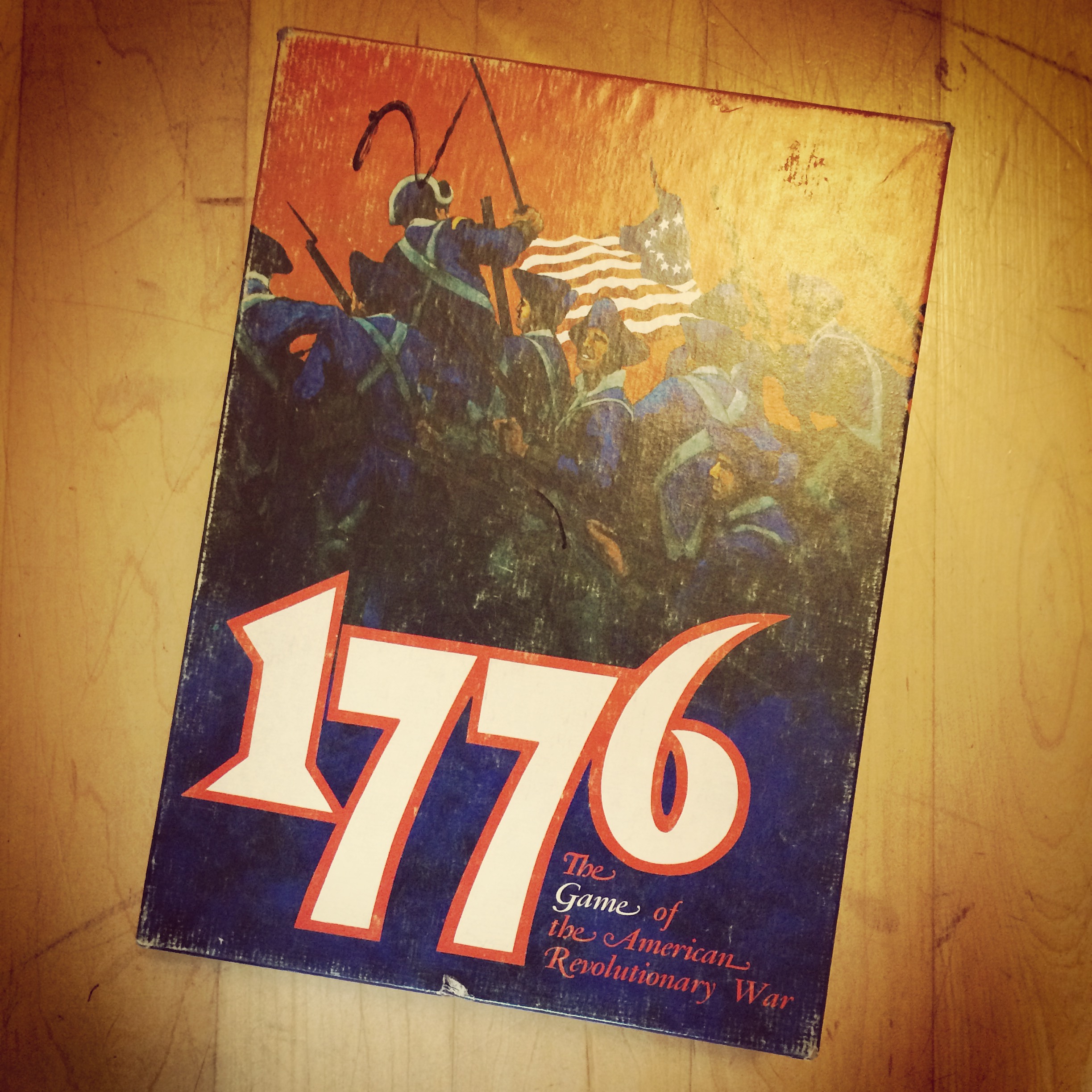
 IMG_6366

1776 (Avalon Hill)

The other big game to come out before the Bicentennial was Avalon Hill’s 1776 from 1974. With rules running almost three times as long as those in SPI’s game, 1776 is often viewed as the more detailed play experience of the two. Some 400 counters represent infantry, artillery and dragoons for the Continental Army, British Regulars, Colonial and Tory Militia, French Regulars, Indians, and British and French naval units. The large mounted hex maps are filled with detailed terrain with each feature effecting movement and combat in different ways. Other tables for combat and turn sequence are contained on a series of additional reference charts, and tactical cards and scenario sheets round out the components in the hefty box.
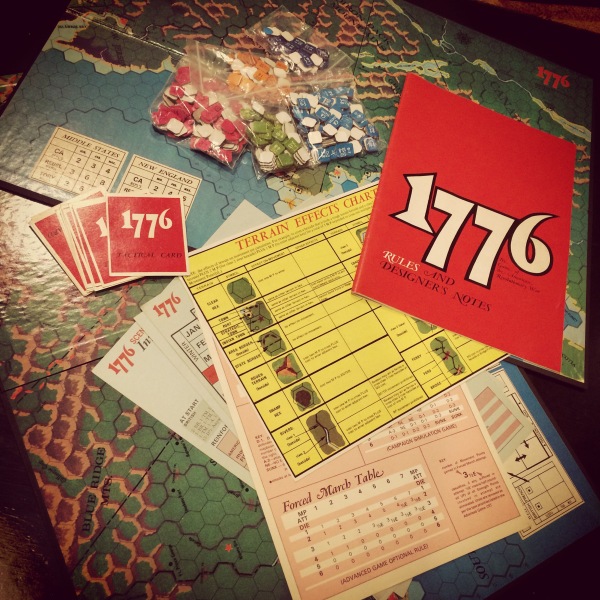
IMG_6370Avalon Hill’s 1776

I’ve only recently picked up a copy of 1776 and I’m not certain when I’m going to be able to find an opponent to give this one a proper play. A read through the lengthy rules outline the game from a quick beginner’s experience to specific historic scenarios within the war to a full campaign mode covering the entire war. Advanced rules go deep in simulating the role of supply, forts, entrenchments, naval movement and combat, river movement by bateaux, wintering effects, French entrance to the war and the arrival of additional troops throughout the chosen game. Combat is achieved by a ratio of force size and a die roll modified by factors of supply, defense from forts and trenches and presence of artillery. Control of specific locations within a region is the key factor to the game, creating an interestingly complex dynamic for the raising additional forces as well as a path of victory. Aside from the game itself, the splendid designer notes offer a great general meditation on the trade-offs inherent to historic war simulation balanced with playability. For the gamer really wanting to roll their sleeves up with the intricacies of the American Revolution, 1776 is probably the game.
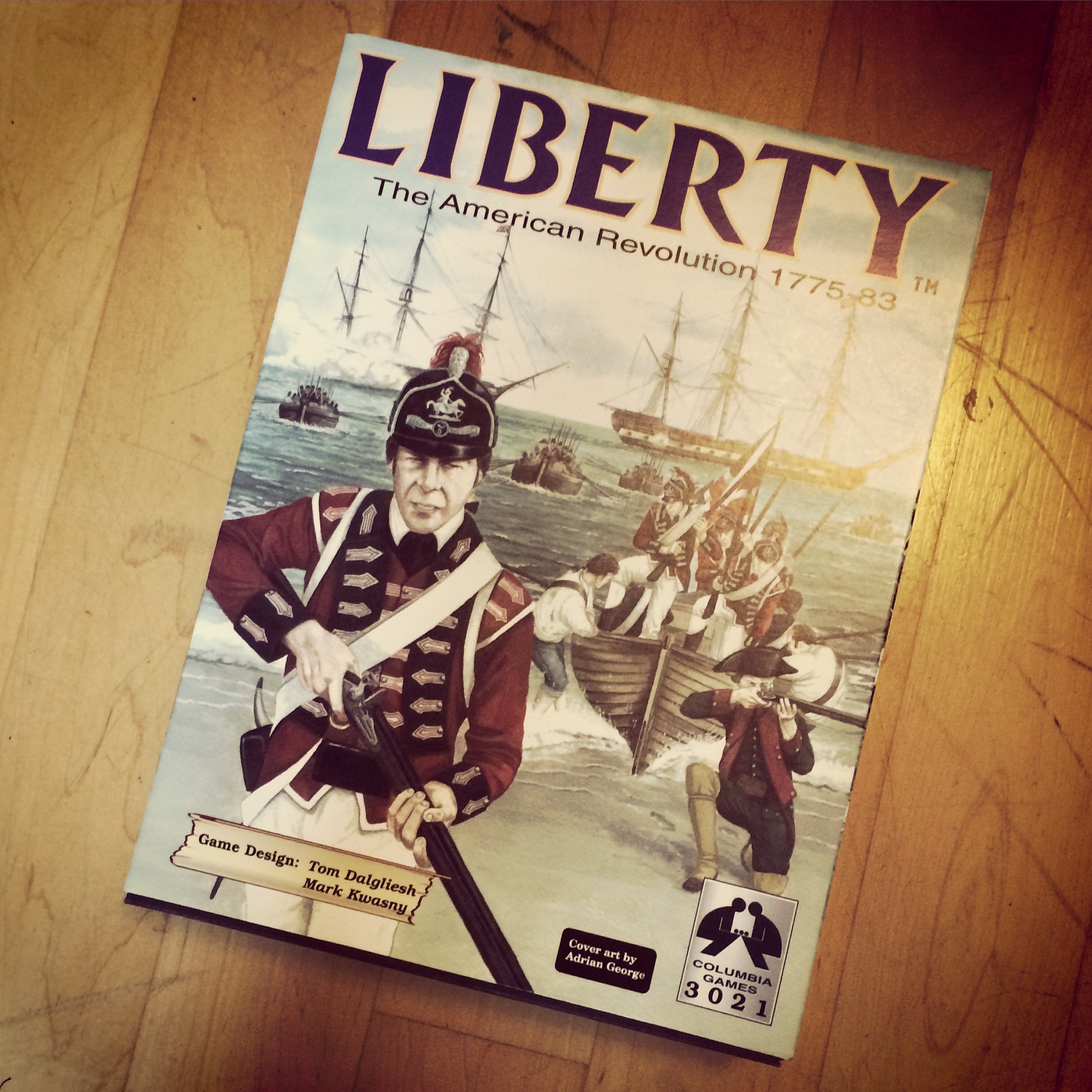
IMG_6365

Liberty: The American Revolution 1775-83 (Columbia Games)

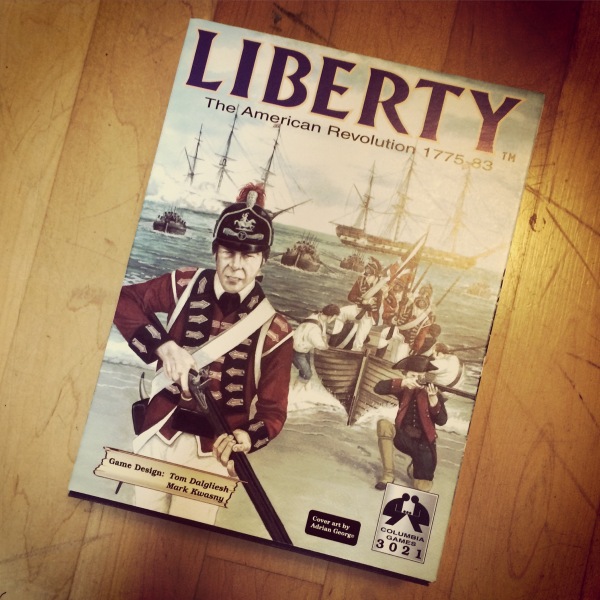
Liberty: The American Revolution 1775-1783, published by Columbia Games in 2003, bridges the gap from traditional wargames to the present with relatively swift play, wooden blocks to represent British, Colonial, French and Native American forces, and simple cards driving force activation and supply during each game turn. The long game map consists of large hexes with forest, swamp and river terrain features which affect movement as well as geographic supply towns and key victory point locations. British and French West Indies ports allow for additional options in naval movement and combat. The game strikes a balance between simple rules and rich re-playability, and my time with the game has seen victories for either side depending on the session.

IMG_6372

Liberty: The American Revolution 1775-83 by Columbia Games

In each year of the game, a hand of five dealt cards activate forces and re-supply existing forces which have taken step losses in previous turns. Actions may either move forces already on the map or bring new units onto the board by selecting from a random pool of blocks. A limited number of Native American blocks are allied with the British player only, and French forces may arrive randomly after the first turn beginning in 1776. Colonial forces arrive in controlled supply areas, British and French forces arrive by sea to available ports and Tory Militia rise from British-controlled supply areas. When opposing forces move into contact, combat is resolved by simple die rolls depending on the quality and strength of the blocks available. Blocks are reduced in strength and then eliminated as ‘prisoners’ which may be exchanged at the end of the turn and returned to each player’s pool of available forces. At the end of combat, forces may have the option to withdraw or stay in the fight. Weather plays a random role in the game, potentially limiting combat during a turn year, and troops may be also eliminated in a wintering phase at the end of turn. Victory is tallied at the end of each hand of cards and year with the British winning with 30 supply points and the Colonials by driving the British to under 12 supply points.
1775box

1775: Rebellion (Academy Games)

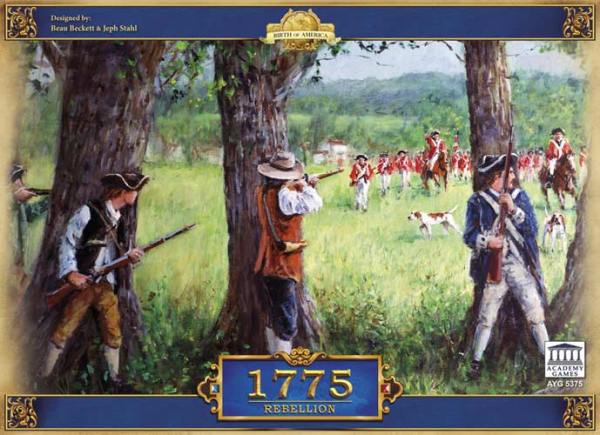
I’ve written previously in detail about 2013’s 1775: Rebellion from the Birth of America series from Academy Games, one of my favorite quick-playing boardgames of the American Revolution. The game plays different from most in the period with two to four players able to command the American Continental Army, Patriot Militia, British Army and Loyalist forces in a game driven by card activation and randomized turn order.
IMG_2757

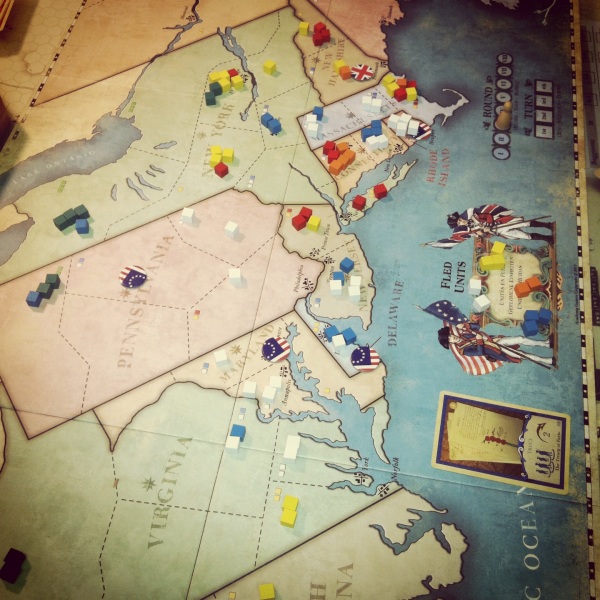
1775: Rebellion from Academy Games

The four main forces plus French, Hessian and Native American allies are all represented by simple colored cubes moving and warring over a gorgeous game board representing the the colonies, territories and Canadian provinces of the northeastern American continent of the late 18th-century. Cards drive the action with movement, period-specific events and personalities, and special color-coded dice resolve combat as forces are either destroyed or flee to return in later turns. Areas flip to British or American control as combat is resolved. When two special Treaty of Paris cards are played, the game ends with victory rewarded to the player holding the most control of the board. If I’m going to play the American Revolution with a relatively inexperienced player or non-gamer, this is my go-to game for the period.

Worthington1776KS

New York 1776 and Trenton 1776 (Worthington Publishing)

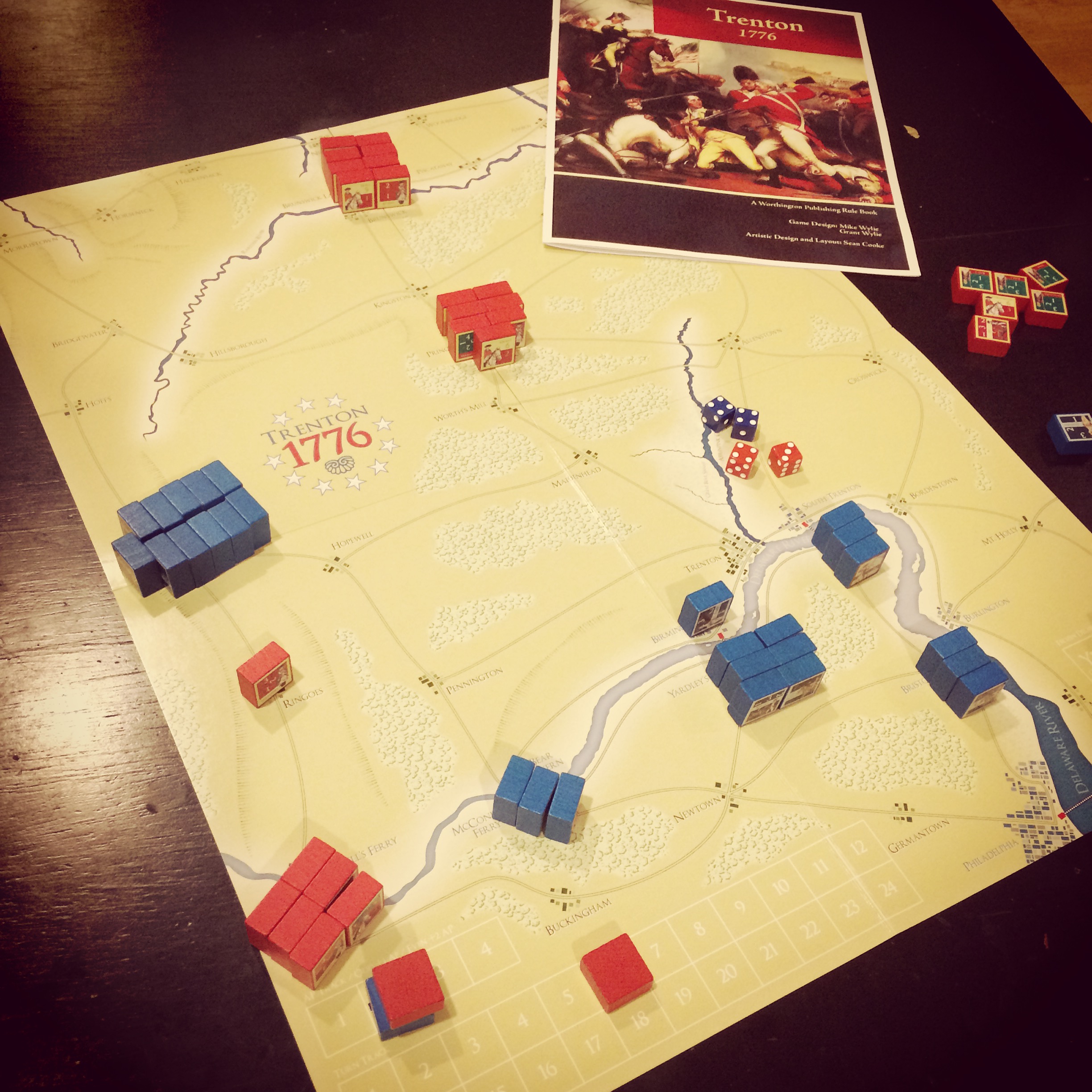
In 2014, Worthington Publishing launched their ambitious Campaigns of the American Revolution series with New York 1776 followed by Trenton 1776 in 2015. These strategic block games, funded through popular Kickstarter campaigns I backed, take players through specific stages of the war beginning with the action on Long Island and in and around New York City in the summer and fall of 1776 and continuing the conflict into New Jersey in the winter of 1776 and 1777.

While the games do not directly connect to each other in a grand campaign, each two-hour game is well-scaled to the strategy inherent to each series of battles in the early years of the war. Randomized turn order, variable numbers of turn actions and the block components provide a fog of war mechanic to the game as forces move by themselves or as groups under the command of the many leaders present on each side. Movement is broadly point-to-point on game boards simply illustrated with towns, ports, forts or other key geographic points of control. Combat goes off as forces meet on the map with infantry, artillery, leaders and fortified positions playing into results that can include withdrawals, retreats, fleeing Militia and follow up attacks. Command plays several roles in these games, including being able to move groups of forces and other scenario-specific special rules in battle, deployment and victory conditions.

NY1776gameplayWorthington Publishing’s New York 1776

New York 1776 presents the largest meeting of troops during the American Revolution with the professional British army and navy, along with their hired Hessian allies, looking to halt the uprising of the new American Colonial army and Militia in the early months of the war. Controlling the waterways and supply routes around New York with the British navy plays a big part in the British player’s path to either capturing Washington or controlling New York by game’s end. For the Colonial player, the game is largely one of avoiding the mass of better rated British troops, preventing their control of New York or reducing the superior British army by 20 points.

IMG_6368Worthington Publishing’s Trenton 1776

In Trenton 1776, the action moves to smaller scale engagements in New Jersey as the British looked to smash the Colonial army and Militia retreating from their defeat in New York. With Washington in command, he risks bold counterattacks to push the British back out of southern New Jersey or simply moving to safety south of the Delaware. Howe’s pursuing British army must mass its forces against the rebel army at key towns and river crossings and hopefully push to seize Philadelphia as the icy winter settles in. With similar rules but at a smaller scale than New York 1776, multiple plays of Trenton 1776 can really show players how cautious or aggressive decisions can make or break a campaign.

GMTLibertyDeath

Liberty Or Death: The American Insurrection (GMT Games)

I’m really looking forward to the release of Liberty Or Death: The American Resurrection, due out late this year. The sixth game in the counterinsurgency (COIN) series from GMT Games, I’ve had this one on pre-order based on my love for the other COIN games. Playing from solo to four players, Liberty Or Death will present the war as one of insurgent and counterinsurgency forces of American Colonials, British, French and Native Americans warring for control of the North American continent. As in the other COIN games, shifting alliances, varied turn order, separate victory conditions, irregular forces and historically-themed event cards will each play into a game which will greatly expand beyond the typical presentation of the war as one between just two opposing nations. Early reports from game tests and some sneak looks at artwork make this my personally most anticipated game of the year, and I’ll surely be back with a full report in the coming months.

So where to start with the American Revolution?

The 1970s era SPI and Avalon Hill games will appeal the most to experienced strategy players looking to really dig into hours of the broad complexity of some or all the war within a very traditional wargame. On the flipside, the Worthington Publishing games provide short but replayable intros to gaming the period for younger players or those just getting into block games. The Columbia Games take on the war splits the difference by offering up relatively simple mechanics of a card-activated block game representing the entire war over a couple hours of play. The Academy Games game expands play to four players and allied forces in an abstracted area control strategy game that likewise covers the entire war in mix of card and dice action. The forthcoming game from GMT Games will reinvent the conflict anew within the context of four separate interests vying for victory.

Players wishing to play through advanced strategic simulation of 18th-century warfare will be rewarded by time invested in the Avalon Hill and SPI games. The Columbia Games and Worthington Publishing games will also provide a satisfying  combat simulation albeit at a much simplified level. To experience more abstracted combat as well as the interplay of politics, alliances and events within the period of the war, the Academy Games and GMT Games games provide both relatively fast play as well as more of a learning experience about broader aspects of the American Revolution.

Each game above paints the American Revolution large or small, and together they are a fine reflection of the evolving mechanics of wargaming over the past forty years. There are numerous additional games of the American Revolution, some focusing on specific regional campaigns and many others presenting the full war. Games still on my shortlist to try include 2010’s Washington’s War from GMT Games and its 1994 predecessor We The People by Avalon Hill which helped launch the modern trend in card-driven wargaming.

There’s a point of entry for gamers of every type to get in on the War of Independence and relive what Thomas Paine famously called, “the times that try men’s souls.”
Mad Max In Miniature

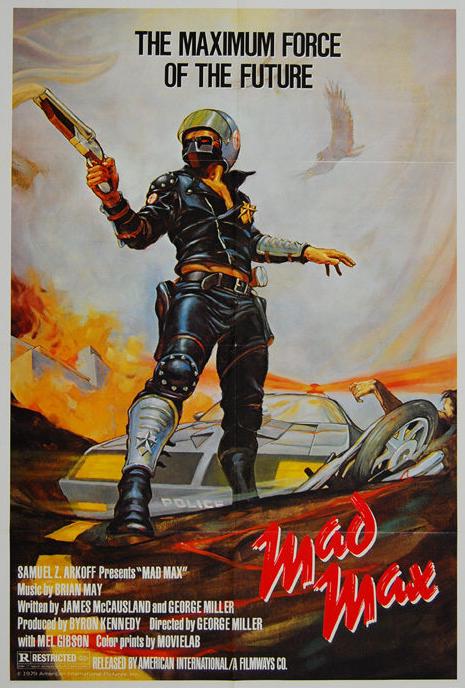
MadMaxOriginal Just as my early-1980s adolescent brain was feasting on a steady diet of Dungeons & Dragons, comic books and all things Star Wars, Mad Max raced out of the Australian wastelands and into my world. I caught The Road Warrior at a local theater, only to realize there was an earlier film which I tracked down on video cassette. In the years to come, the Mad Max movies and their sequels tucked in nicely with my other adventure film mythologies. The Conan movies held the sword-and-sandals spot, Star Wars filled the sci-fi niche and Indiana Jones was the retro heroic adventure serial.

It was the the Mad Max films which brought the genres together in a barbaric, sci-fi tale led by a charismatic hero who always seemed to be losing right up until the final moments of the film when you realized he’d just won. The Mad Max movies also held a certain raw immediacy to me, especially in the final dangerous decade of the Cold War where a Road Warrior-esque post-apocalyptic future seemed like a possibility. Thirty years after the third film, Mad Max Beyond Thunderdome, I (thankfully) am not surviving in a souped up car on a murderous desert highway, but I did get another new Mad Max film that thrilled my inner teenager while satisfying my now more adult brain with story and message.

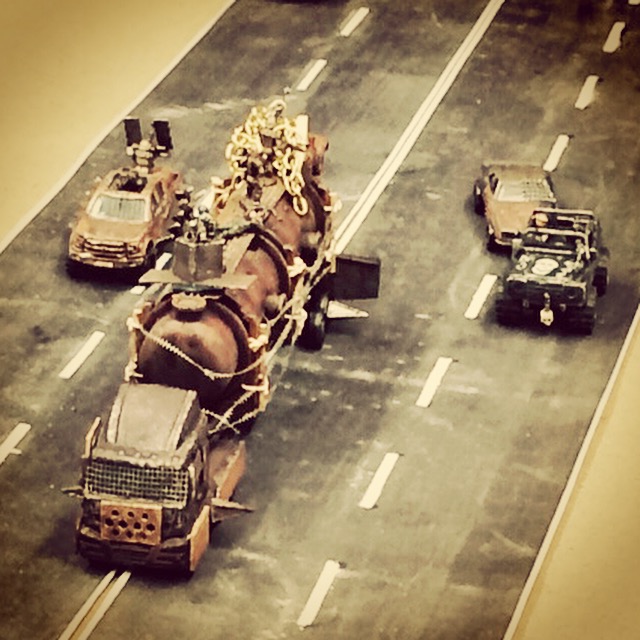
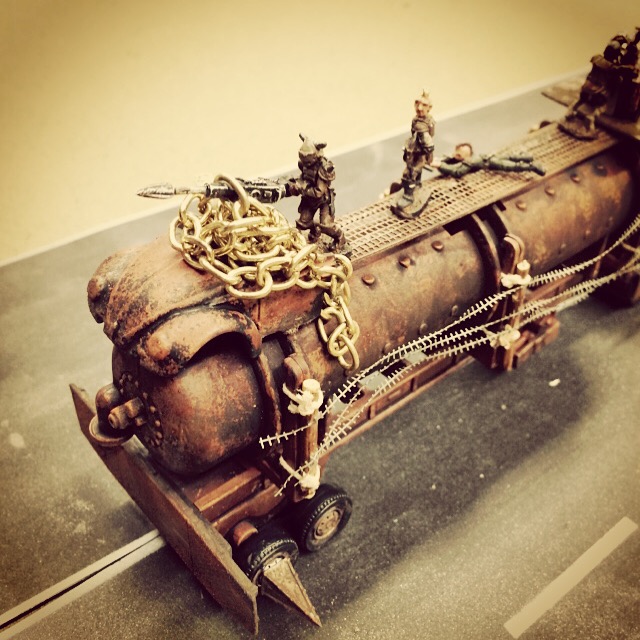
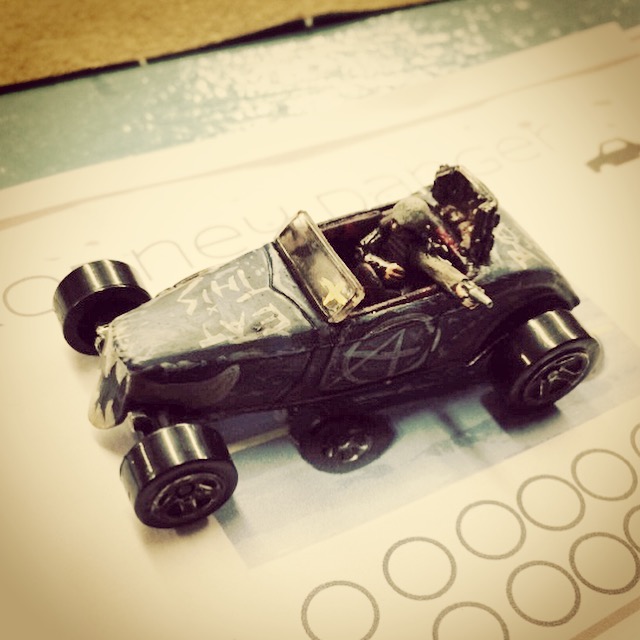
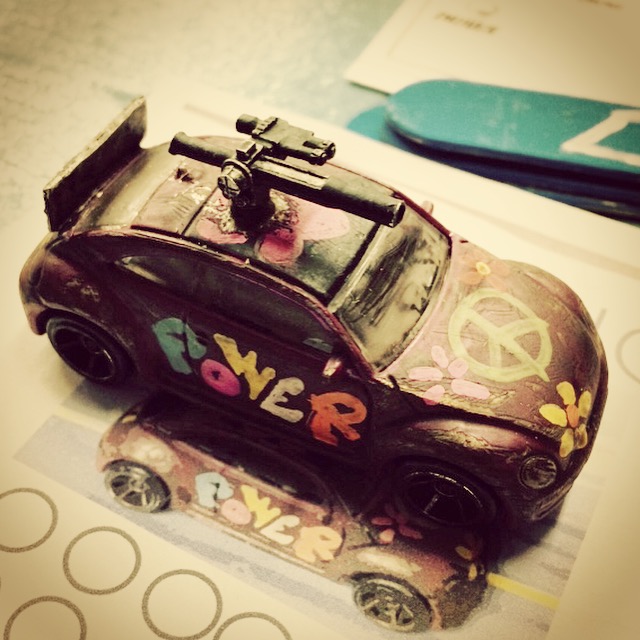
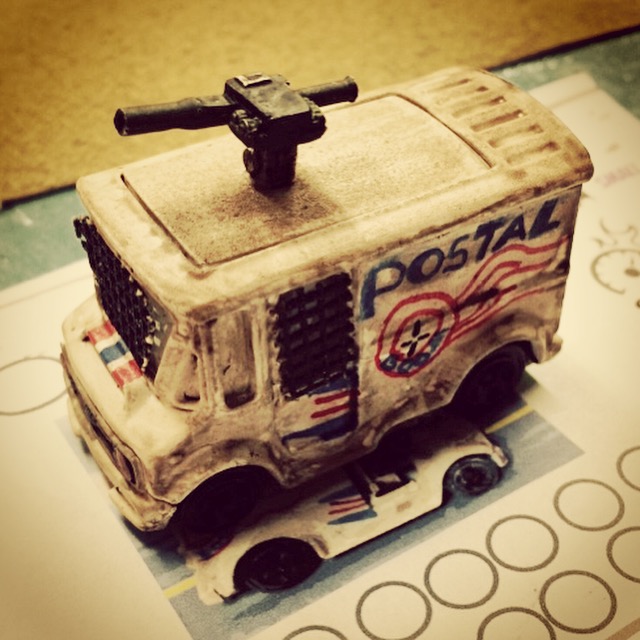
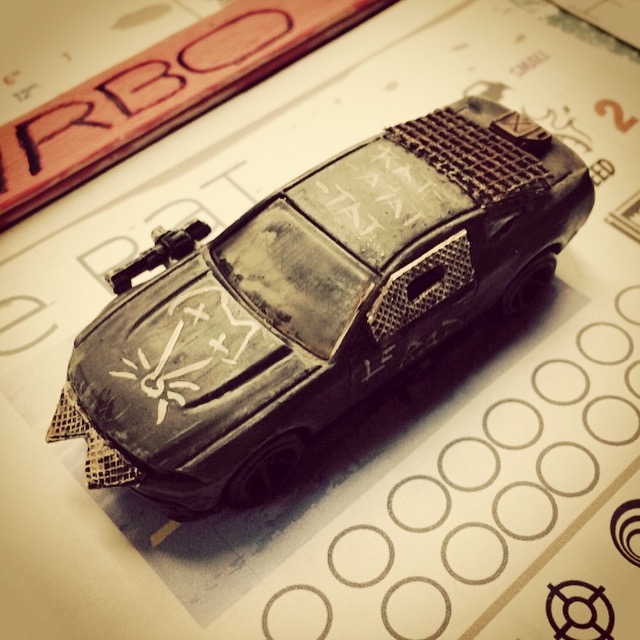
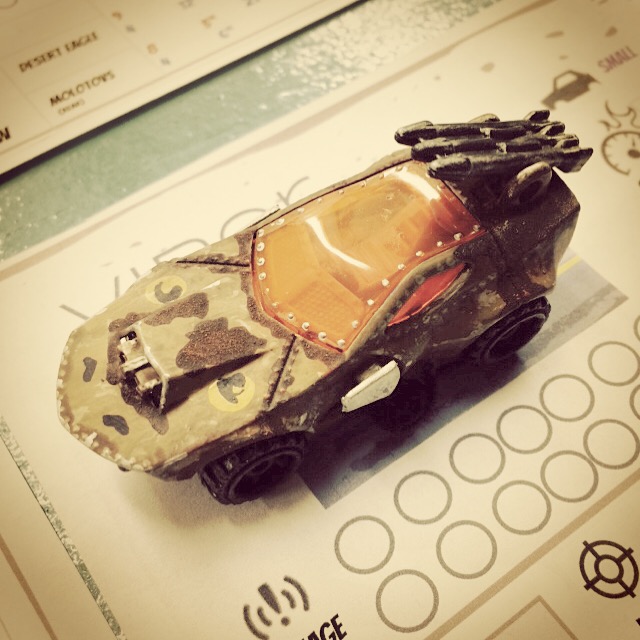
I’m also thankful for being a part of Metropolitan Wargamers which is filled with passionate, creative gamers who put together stunning games like the Road Warrior miniatures event this past weekend at the club. IMG_6151 The game was based largely on a modified set of rules available at the Third Point of Singularity website which have been popular during late night games at some conventions the past year or so. The basics of the rules were maintained with simple sticks for movement, and combat and damage results resolved with D20s and D6s cross-referencing tables. The tabletop itself  used an extra large canvas desert mat, rocky outcroppings and some custom blacktop roads made from roofing material. Dust, smoke and fire markers all come in handy as the carnage builds rapidly. The pics below give a pretty good feel for what the game looks like as the cars race and battle across the table. IMG_6156 IMG_6150 IMG_6162 IMG_6160 IMG_6161 The really wonderful aspect of the game is the cars, made for the most part from Hot Wheels and Matchbox toy vehicles. Cars are tricked-out using bits left over from other military models plus a lot of special 20mm parts and figures made specifically by Stan Johnson Miniatures for post-apocalyptic gamers. Each of the unique cars gets its own stats card and name, as shown in some of the examples below. IMG_6159 IMG_6153 IMG_6152 IMG_6154 IMG_6155 IMG_6158 IMG_6157 With a couple dozen cars, trucks and vans, bunches of good guys and bad guys, and a raucously absurd game, there’s going to be a lot of Mad Max-style roadside carnage in the weeks to come in Brooklyn.

Gaming In The Shelfie Era

Pianosettlers

Photography has been a personal and professional interest of mine for more than twenty years. One particular area of photography that has long fascinated me is frontier photography of the United States. I was turned on to the period in the 1973 classic Wisconsin Death Trip by Michael Lesy which frames a late 19th-century town’s life in photos ranging from the deeply personal to the macabre. Given the complexity and expense of early photography, I’ve always thought of the personal, logistical and financial choices made in people capturing images in the late 19th through early 20th century.

Photographs of American frontier people and their possessions have always held a big pull for me. In the photo at top (from the Nebraska State Historical Society’s Prairie Settlement collection) a family has chosen to hire a photographer to document them on the new frontier. Aside from the family in the foreground, the photo is filled with possessions. What the family owns occupies more than three-quarters of the photo — land, cattle, horses, mules, hogs, wagons and a prominently placed piano right in the middle of the family. So large are the family’s holdings the photographer has needed to climb to the top of a hill or perch on a ladder to take it all in with a shot taken from a godlike point of view from above. The photo conveys much including survival and success not only with the portrait of the family itself but in the wider portrait defining the family by what they own.

SodHouse

A picture of another Nebraskan family from the same period (above) puts what is among their most valuable possessions — a team of horses — on an equal plain with the family. One of the family’s cattle stands above them all on the sod house’s roof, a quirky accident placing the ownership of livestock not only on equal par but above the family in terms of importance. A table decorated with a blanket has also been hauled out of the home and set with food, and it appears some celebration is being documented. The family’s possessions — the house, the animals and the land — dominate the photo. As with other frontier photos of the period, the celebration of success is what’s captured in the photo. It provides a document that says, “Here we are. Here’s our stuff. We’ve made it.”
PhotoBooksPhoto books of people and their possessions by Peter Menzel and Gabriele Galimberti

People, and seemingly Americans in particular, have a long tradition of defining themselves by what they own. From the 19th-century frontier until relatively recently, photos of what we own have largely been for the benefit of ourselves and perhaps the closest of family and friends. In the era of mass self-documentation of even the most mundane activities, meals, possessions and “selfies” distributed through Facebook, Twitter, Tumblr, Instagram, Reddit and other social media platforms, what people own is now widely available for all to visually consume. Some sites critical of the trend, such as Rich Kids of Instagram, point out the more absurd edges of what we’ve all come to accept as just another part of our digital day-to-day. Photojournalists have taken a more documentary approach in such series as Material World: A Global Family Portrait, Toy Stories: Photos of Children From Around the World and Their Favorite Things and Personified: A Photo Series on People and Possessions. It’s clear for many of us, we are what we own.

Last year I became highly aware of the trend among my own gaming subculture. Many of the online groups I had joined to share historic knowledge, miniature modelling techniques, learn about game industry news or discuss rules were quickly filling up with a photos of people’s stuff. As a subset of the “selfie,” the “shelfie” is popular among gamers as a way of showing just how committed they are to the hobby the the sheer size of their collections. Some of the photographed collections border on historical archives of out-of-print games collected over decades in the hobby. More often than not though, many of the photos appear to be presented with a flair of a “top this” subtext or alternately a “this is all I have” apology to the virtual crowd. Things amped up during the past winter holiday season with a torrent of online photographs posted to gaming sites I frequent depicting a virtual arms race of heaps of games received as gifts or bought for themselves.

BNRedDotThe Barnes & Noble “red dot” clearance sale is wildly popular with gamers

This spring the US-based bookseller Barnes & Noble is running what I quickly came to learn was an annual 50%-off game clearance sale, and there was enormous online gamer excitement and chatter in the weeks leading up to the event. Gamers plotted elaborate routes to multiple locations, connected with employees for inside connections, shared inventory reconnaissance (or lack thereof) and even concocted complex plans of buying from one store and returning at another store for a higher value of store credit (an idea not supported by many online). Others, living far away from a B&N store, lamented jealously they were being left out of the sales rush. As the sale period progressed, complaints also arose in a mix of comments on poor local selections or having to settle on buying something the person didn’t really want. Buying something — anything — was critical to many, lest a gamer somewhere feel left out during the sale. In the weeks following, photos of “the haul” have appeared in social media displaying stacks of games purchased (often in multiple copies for gifts or re-sale). Again, photos and shopping stories were met with comments ranging from congratulatory to jealousy to the feelings that this was simply another example of how life isn’t fair.

The emotions wrapped around photographic documentation of the acquisition of games are not limited to the holidays or special sales by corporate retailers. People who post pictures and tales of finding bargain second-hand games in local thrift stores are likewise met with digital slaps on the back or lamentations that some people’s thrift stores are unjustly better than others. Reviews of gaming conventions are increasingly dedicated to celebration or criticism of purchasing opportunities, and in the past year I’ve seen an increasing number of photos showing not only the fabulous games played at a convention but also of all the stuff a person managed to buy while there.

IMG_3025My own “shelfie” taken in mid-2014

I’m a lifelong collector of many things, including comics, books, model trains, music, toys and, yes, games. My comic book collection paid for a lot of my college education. My parents are collectors, too. So was my grandmother. I have great memories and stories about an insane find at a flea market, working for years to track down a long-sought item or hours of relaxed browsing through dust boxes at a yard sale. It’s in my blood — I love collecting.

Gamers I’ve known for decades are also more often than not cut from similar collector cloth. There’s always something new to buy – a board game expansion, a new army to paint, a campaign module, a new edition of rules or the latest hot release. The hobby naturally attracts collectors. I know people with more games than they will ever play or even open for that matter. I also know people who are no less passionate as gamers with small collections of games.

Within the endless stream of online photographs and stories of consumer victory and defeat in the gamer community, there’s a lot of personal information that rises to the surface from comments. Couples have babies or get divorced. Jobs are lost and others find new careers with richer paychecks. People relocate for a variety of reasons, sometimes willingly and sometimes not. Some owe taxes or are buried in household bills while others spend their hefty refunds or max out credit cards. Narratives vary, priorities shift, lives are lived and another game is purchased.

Like most games, life has a time limit. We do what we can to play the game right and by the rules, celebrating our victories along the way (sometimes with a bit too much passion) and hopefully learning from our mistakes. Like those families struggling to show in photographs how they had made a life on the 19th-century American frontier, we all want to show we’re not only surviving but thriving. The photos of shelves and hauls gamers share (again, sometimes with a bit too much passion) may possibly just be the way we’re all trying desperately to communicate, “Here I am. Here’s my stuff. I made it.”

The Ratzer Maps At The Brooklyn Historical Society

IMG_5425

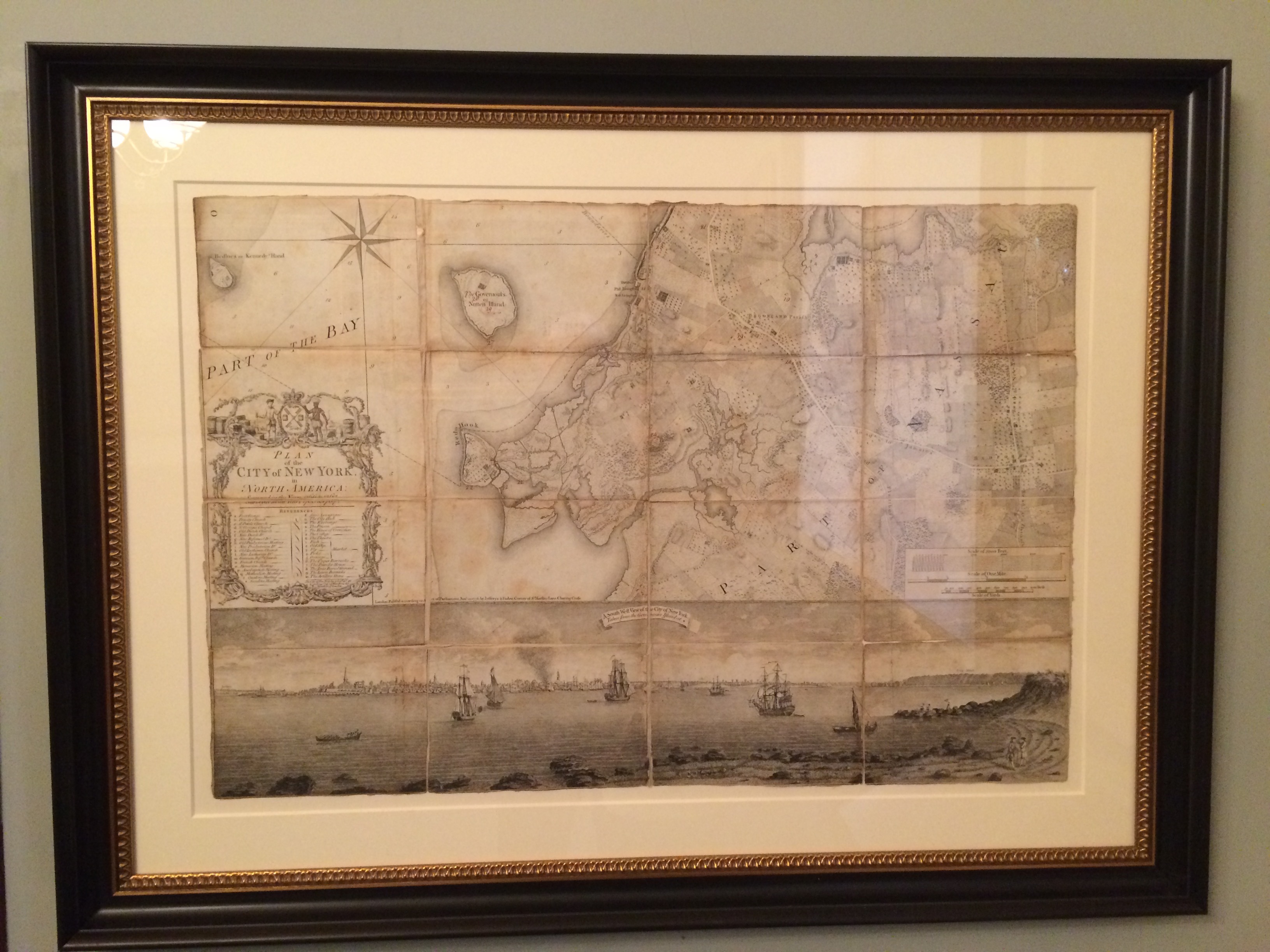
Now in its final weeks at the Brooklyn Historical Society, the tiny second floor exhibition Unlocking Two Revolutionary War Maps: The Ratzer Maps at BHS showcases two incredibly important maps of the American War of Independence and the 1776 Battle of Long Island in particular. Alternately known as the Battle of New York and the now-popular Battle of Brooklyn, the Battle of Long Island was the first of the new nation after announcing its independence on July 4, 1776 and the largest of the entire war. For anyone with an interest in the American Revolution or 18th-century New York history, these maps unlock a close-up view of the ground fought over between the British Empire and the upstart Colonials nearly 240 years ago.

IMG_5426The “Percy Map” used during the Battle of Brooklyn in 1776 (left) and the restored 1770 “Ratzer Map” (right) at the Brooklyn Historical Society

Drawn by British cartographer Bernard Ratzer in 1766-1767, the Ratzer Map is one of the seminal documents of early New York. The BHS copy of the full 1770 edition of the Ratzer Map is only one of four in known existence and showcases an early snapshot of Manhattan and nearby Brooklyn in their early days where farms and rural roads still dominated the landscape. The smaller map on display, showing only the lower portion of the Ratzer Map, was carried by British General Hugh Percy during the Battle of Long Island in August 1776. The Percy Map is now co-owned by the BHS and nearby Green-Wood Cemetery, the high ground for much of the battle, and was first put on public view in the summer on 2014 at the cemetery. The current exhibit of these maps at the BHS after a restoration of the full Ratzer map in 2011 is a wonder of 18th-century map making and 21st-century preservation.

schecterbfnyBarnet Schecter’s classic “The Battle For New York” from 2002

The exhibit features text from BHS President Deborah Schwartz and historian Barnet Schecter whose compellingly-detailed The Battle For New York: The City At the Heart Of The American Revolution has become the standard narrative of the battle. Additionally, the BHS has produced a free educational resource entitled Exploring Pre-Revolutionary New York: The Ratzer Map which digs into much of the historical detail found in the map including panoramic views of the shoreline and major landmarks of the era.

History can feel so large and abstract, buried in long ago events which are difficult to square with the present day. The Ratzer Maps at the BHS bring history remarkably into the present and allow a modern viewer to trace pivotal events along lines carefully set down on paper and battlefields more than two centuries ago.

Touching History at the Military History Society of Rochester

mhsrlogo

I have logged many, many hours over the years visiting battlefields, historical homes, living heritage sites, reenactments, roadside markers and all sorts of art, history and military museums. Near the top of these experiences was a full day I spent at the Imperial War Museum a few years back while working in London for over a month. With over two million visitors a year and some 11 millions artifacts, the IWM is hard to beat for immersing yourself in the history of warfare.

This past week I had a very different, yet truly remarkable experience in my first visit to the Military History Society of Rochester. Located up a flight of stairs in a warehouse inhabited by various artist galleries and studios, the MHSR occupies roughly 2000 square feet of space packed with all manner of historical artifacts focused on telling the story of the US military through the local lens of Rochester, NY.

IMG_4891

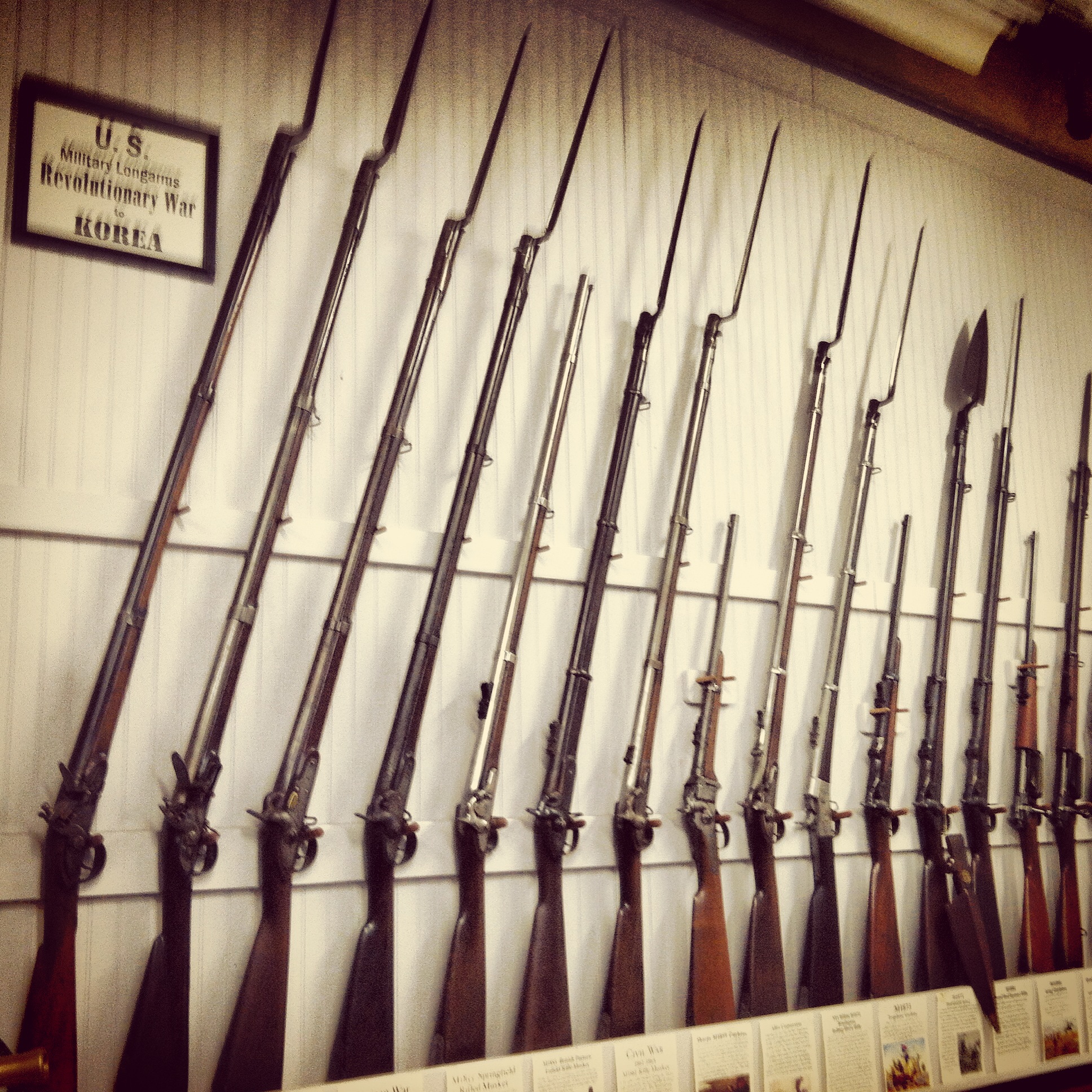
A timeline of US long arms from the American War of Independence through the Korean War at the MHSR

Founded several years ago by Chuck Baylis as the American Civil War Artillery Association, the group’s mission has since grown beyond his original collection of Civil War artifacts to encompass American wars from the Revolution to the present. The first room still focuses on the Civil War including detailed displays on artillery, uniforms and the 140th New York Volunteer Regiment formed in Rochester in 1862. A timeline of American long arms from the American War of Independence through the Korean War covers an entire wall.

IMG_4890

A timeline of military uniforms from the American War of Independence through the present at the MHSR

In the rear space of the museum, the focus swings to 20th-century with displays on World War I, World War II, the Korean War, Vietnam and present day wars. Uniforms, guns, swords, equipment hang from the walls, rest on shelves and lay slung over mannequins. Scale model airplanes hang from the ceiling, model vehicles rest on the floors and cases and a D-Day diorama sits nearby. Throughout the museum are some 2000 books as well as countless other letters, maps, photos, schematics, deck plans, prints, posters and other ephemera for perusal or research.

IMG_4887

 A US .50 caliber machine gun at the MHSR

Baylis has been joined by a number of passionate volunteers who can be found at the museum during its operating hours on Thursdays, Fridays and some Saturdays. Civil War reenactor, historian and wargamer Mike Vasile (co-author of the excellent Arena Games: Gladiatorial Combat rules) is responsible for many of the scale dioramas throughout the museum. Scale ship modeller Timothy Igoe of Historia Militaris Shipways has contributed several naval models to the collection and is currently undertaking a build of the USS Rochester (CA-2) for the museum. Retired Social Studies teacher Orton Begner rounds out the group with a deep knowledge of every object on hand.

IMG_4889

A US M1919 Browning machine gun at the MHSR

The one-to-one interaction with the MHSR’s members and the collection is what sets the museum apart from any other I’ve every visited. Everything has been well labeled, organized and put on display but hardly anything in the museum sits behind glass. Care to hold the various types of artillery rounds used in the Civil War? Want to feel the heft of a WWII era Thompson submachine gun or M-1 rifle? Would you like to take a look inside a pack carried by an American GI on D-Day? Want to lie down with a German MG-42? Ever wanted to hold a Japanese officer’s sword or 1913 “Patton Saber”? Just about everything in the museum, with the proper care, respect and assistance from one of the staff, can be touched, offering an incredibly rare opportunity to physically connect with past.

IMG_4888

 A German MG-42 and StG 44 at the MHSR

The mission to bring history alive beyond the walls of the museum also occurs with the exhibits members of the group bring to school groups and veteran events in the Rochester area. With its focus on celebrating the men and women of Western New York’s service in every branch of the military past and present, the museum is serving a unique and human mission of connecting today’s generations to a long tradition military service.

IMG_4892

My son gets some hands-on time with a Thompson submachine gun at the MHSR

In all my years of interest in history and military heritage, I have yet to find a museum as alive as the experience found at the Military History Society of Rochester. As a wargamer, the opportunity to see and handle so many objects up close is unparalleled. My time spent at the museum on my first visit was brief, but meeting the guys and seeing the collection at the museum will definitely bring me back my next time in Rochester.

Interview with Chuck Baylis of the MHSR

The Military History Society of Rochester is located in the Anderson Arts Building at 250 North Goodman Street on the second floor. Admission is free.

Toys, Trains and Games at the New York Historical Society

IMG_4659Toys and games are on my mind year-round, but the holiday season adds an extra layer of history, tradition and nostalgia to my passion for play. And so, my son and I made our way this past weekend to the New York Historical Society on Manhattan’s Upper West Side and back through more than 150 years of childhood wonder.

Holiday Express: Toys and Trains from the Jerni Collection

IMG_4660

The museum’s ground level entrance and rotunda galleries are currently occupied by the stunning Holiday Express: Toys and Trains from the Jerni Collection. The name of the collection is derived from the names of Jerry and Nina Greene, the Philadelphia area collectors who amassed more than 35,000 toys over some five decades.

The Jerni collection, considered one of if not the largest toy collections in the world, represents a comprehensive story of what is considered the high water mark in toy making from the mid-19th through 20th-centuries. With a heavy leaning toward European manufacturers like Märklin, the railroad themed items in the collection are dizzingly ornate and go beyond locomotives and carriages to encompass railroad stations, amusement rides and detailed mechanical machines and vignettes. Boats, bridges and other transportation toys are also included. Everything displays an incredible level of detail and refinement in the use of metal, wood, paper cloth and hand-painted finishes developed through advances in manufacturing processes through the late 19th-century.

IMG_4664Toy military and civilian ships from the Jerni Collection at the NYHS

IMG_4661Futuristic-looking craft hold their place next to traditional trains at the NYHS

Just a few years ago, the Jerni collection began seeking a new home. After displaying some of the collection at Sotheby’s auction house in 2010, no appropriate buyer was found to meet the estimated eight-figure value of the collection. A small portion of the collection went on display again in November 2012 at the NYHS which generated enough interest from a group of donors to underwrite the cost of acquiring the monumental collection. Two years later, the Holiday Express exhibit offers just a glimpse of what the museum now has under its roof.

IMG_4662Some of the Jerni Collection’s trains in the rotunda at the NYHS

While the current Holiday Express exhibit of some 300 objects is heavily focused on railroad-themed toys, my interest was drawn to the side displays of toy cast metal soldiers. Several periods are represented, from early American and Old West toys to a fantastic grouping of World War I era soldiers, vehicles and artillery. The preserved original paint, cloth, string and wires on these toys is some of the most impressive I’ve seen. Thin bayonets continue to protrude from the ends of tiny rifles, and an olive drab fabric cot is still doing service holding an injured soldier. The survival and ongoing preservation of these primarily metal toys in the Jerni Collection is all the more remarkable given how many vanished through the decades of play and wartime scrap drives in the mid-20th-century.

IMG_4657Toy soldiers and artillery represent multiple nationalities

IMG_4658A patriotic display of toy soldiers, medical staff and railroad transports

IMG_4663Old West metal toys from the Jerni Collection at the NYHS

The Games We Played: American Board and Table Games from the Liman Collection Gift

IMG_4665

On the museum’s lower level, is the smaller yet no less important exhibit The Games We Played: American Board and Table Games from the Liman Collection Gift. The ongoing display offers a rotating view of American made board and card games selected from the 500 item collection. Focusing on the period of 1840s to the 1920s, the games help illuminate a period where a modern and less rural middle class America was on the rise. The late 19th-century also saw great advances in color printing processes, allowing for bolder and more complex graphics. The current exhibit focuses on games with the theme of “fate,” something very much on the mind of native and newly arrived Americans at the turn of the last century. I would expect similar revelations into the shared cultural experience through gaming as the exhibit continues to evolve.

With so many stories to tell, the New York Historical Society’s current exhibit space dedicated to toys and games is certainly a crowd pleaser. My hope is that serious focus continues in future exhibits at the museum on the themes of toys, games and play. Just as technological, economic and cultural shifts drove mass change in toys and games beginning in the mid-19th-century, these same factors are driving new evolutions to the way we play today and influence who we may become as New Yorkers and Americans tomorrow.

Bringing Modelling Into Focus

IMG_4465

As a wargamer and scale miniatures modeller working my way through the latter half of my 40s, eyesight has become more of an issue for me. It’s a reality of just getting older (I like to think, more experienced) as I’ve aged through about 30 years in the hobby.

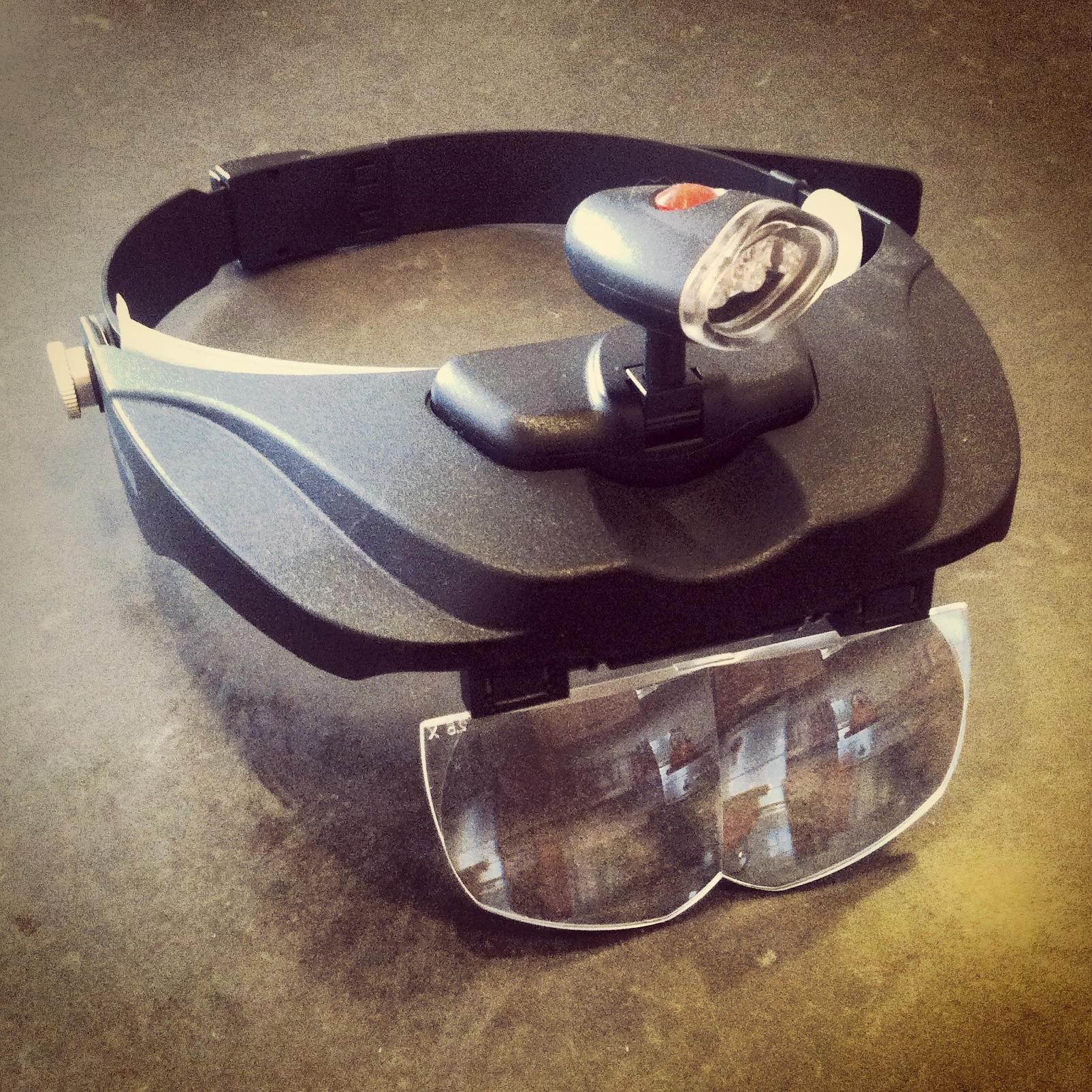
Recently, I picked up the magnifying visor from Sharper Image and it’s become a welcome addition to my modelling tool kit. Retailing for about $60 (and less expensive with an additional 10% off for new customers), the visor brings a number of great features which separates it from other magnifiers I’ve seen. The adjustable visor comes with four lenses at  1.5x, 2x, 2.5x and 3x strengths stored in a separate small plastic case. Each lens snaps into the visor and flips up and down easily with a flick of the wrist while painting. Most visors or magnifying eyeglasses used by hobbyists come with just one fixed lens strength, so being able to adjust the level of magnification depending on the project adds a lot of use to the Sharper Image’s visor.

Living in an a Brooklyn apartment, I do most of my modelling projects in natural light at the dining table flanked by a tall set of large windows. For a lot of other hobbyists relegated to painting in basements or small, darker rooms, lighting is often supplemented with workbench lights or a separate camping-style headlamp. For hobbyists like me without a permanent workspace, tabletop lights just aren’t practical and adding a headlamp is just one more thing to store. With these factors in mind, the added feature of a powerful LED light on the Sharper Image visor is also a welcome addition. The light adjusts easily to angles which can direct a beam of cool, white light directly to the area needed. Again, this kind of thing just isn’t found on lesser magnifiers.

I got the Sharper Image visor just as I started going to a smaller scale with 6mm World War II microscale models from GHQ. Whether painting or applying decals, the visor makes details pop on these tiniest of models. At this scale, I found the 2.5x lens to be the best option. The smallest bits of equipment and other features on models practically jump out at me when wearing the visor, and I feel I could practically apply paint with a house painting brush if I had to. I’ve got some other 15mm projects coming up in the coming months, and I’ll be using the visor at that scale for the first time, too.

Regardless of the scale and veteran status in the miniatures hobby, the outlay for the magnifying visor from Sharper Image is a solid investment. As I soon head into another decade in the hobby, I’m grateful to have this new tool to keep my future projects in focus.