Flames of War: Metropolitan Wargamers Summer 2013 FOW Day

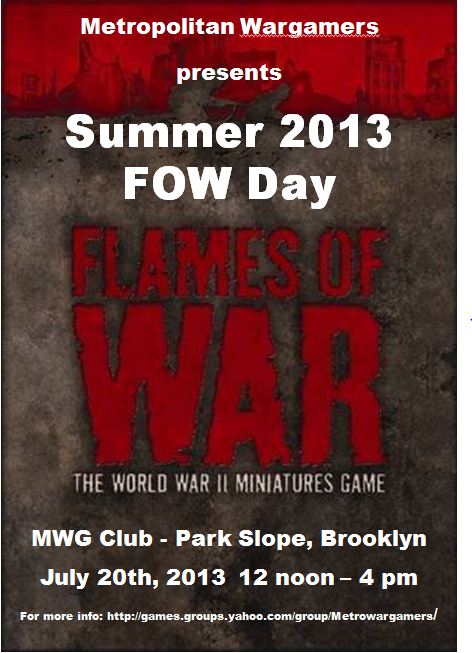
Taking advantage of a renewed interest in the popular Flames of War 15mm miniatures WWII wargame, Metropolitan Wargamers in Park Slope, Brooklyn hosted a big day of gaming this past weekend. Both experienced and new players alike came together on two of the club’s largest tables to play to big scenarios over the better part of Saturday afternoon.

Metropolitan Wargamers
MWGFOWI mention it often, but the amazing group of people who make up the Metropolitan Wargamers club bears mentioning again. The club will celebrate its 20th anniversary next year, and it’s a real gamers paradise for those of us living in New York City. Visitors and a core group of long-time members drop by the club throughout the week and engage in all manner of games, from boardgame favorites and card games to large scale historical miniatures battles and grand strategic campaigns. The club’s space occupies an entire basement-level of a typical Brooklyn rowhouse and is lined with shelves full of games and miniatures collected by members over two decades. Playing space includes a number of the club’s award-winning sand tables, regular tables and racks on which ongoing games can be stored as they are played out over the course of weeks or even months.

The club is an incredibly diverse and supportive environment for those of us who share our common passion in gaming. With 2014’s anniversary coming up, I hope to dedicate more space here in the near future with some history and perspectives from members.

Summer 2013 FOW Day

totalwarThe folks at Flames of War provide special Total War rules for gaming large-scale matches like those we played this past weekend. With a few weeks of planning, I helped round up 10 players for the day’s game. We settled on two games from the late war, one each on the Eastern and Western Front. The Western Front game featured two teams of two players each on the German and US sides with each team running 3000 points on a 4’x8′ table. On the Eastern Front, two three-player teams squared off in a tank-heavy scenario on one of the club’s famed sand tables with each team compromised of 5000 points. Each game featured endgame objectives and were slated to run to eight turns. With games these large, we were up for a very long day of action.

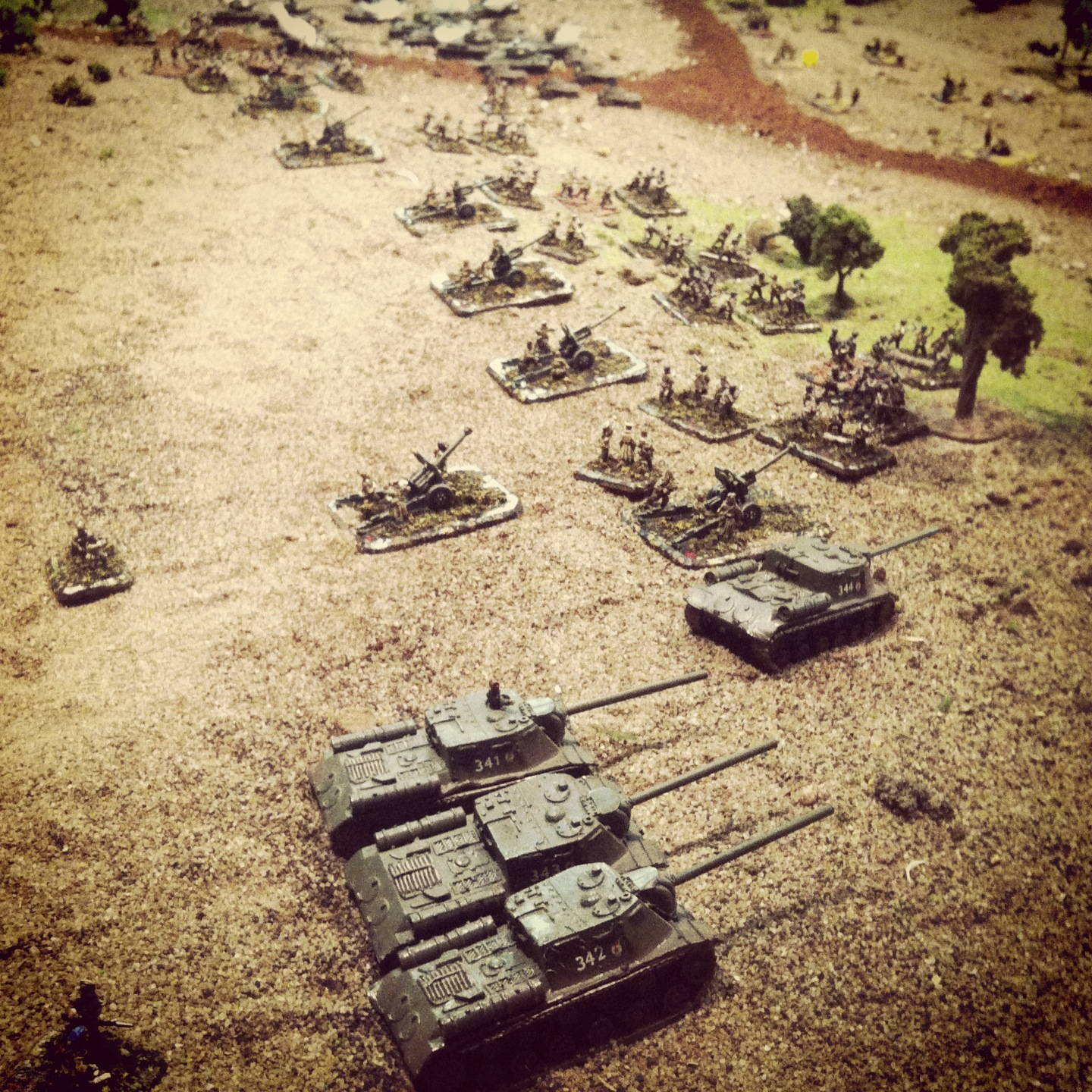
On the Eastern Front, the table was wide open with widely-sloping sculpted sand hills, small copses of trees along each long side and a Y-shaped road bisecting the table. I spent the day riveted to my own game on the Western Front table, but the German and Russian armor spent the day pounding away at each other. By mid-day, things had looked pretty good for the Germans as many destroyed Russian tanks stood smouldering midfield. All that changed in the latter half of the game as the Russians rallied to victory.

IMG_1908

IMG_1912

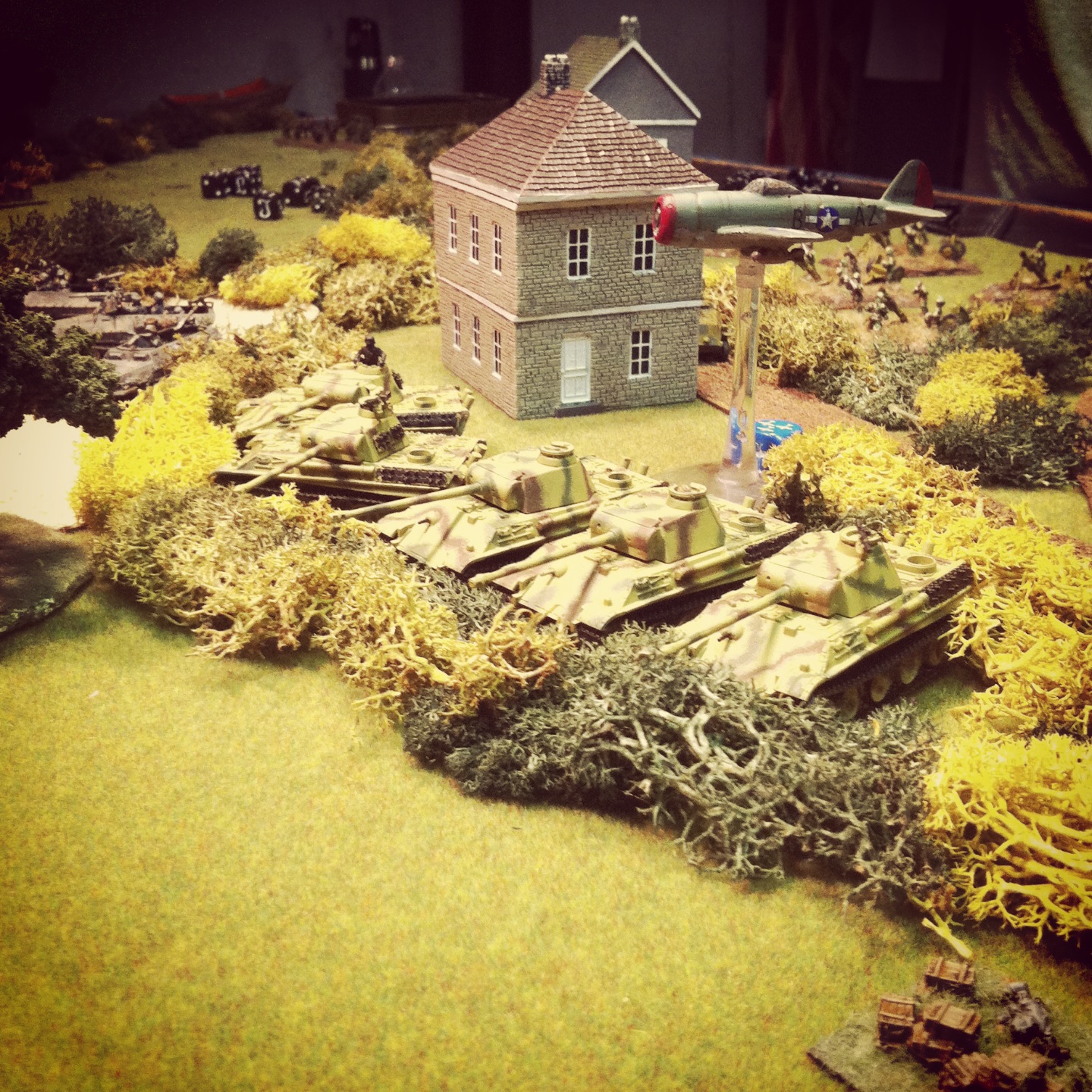
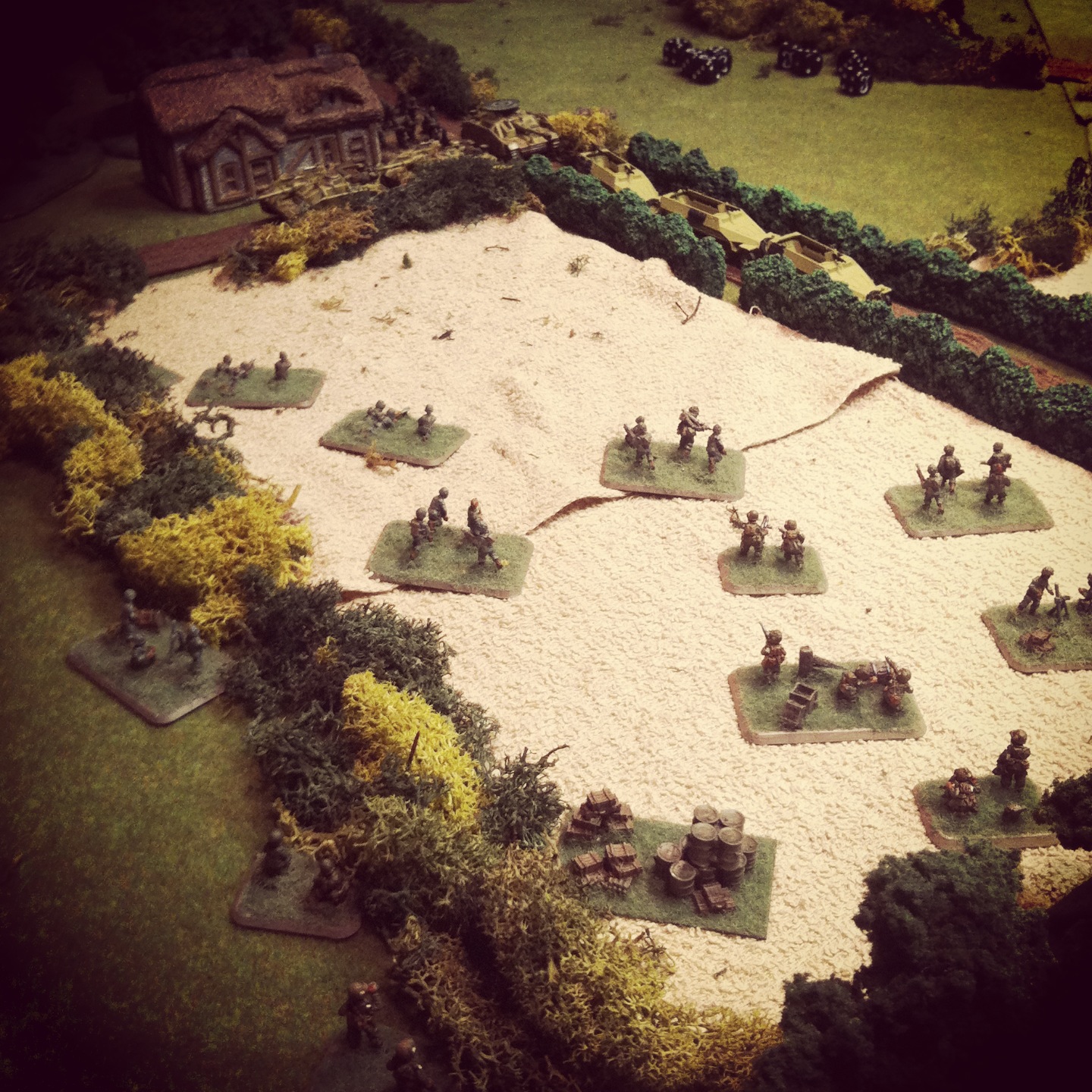
My game on the Western Front featured a generic French landscape cut up into winding narrow roads lined with the notoriously difficult bocage hedgerows which stymied both sides in the engagements fought in the region throughout 1944 and 1945. A church stared across the board to a stone bridge crossing a narrow stream to a small village. On the other end of the table, a small farm was set beside two wheatfields with two more rural stone houses in the near distance.

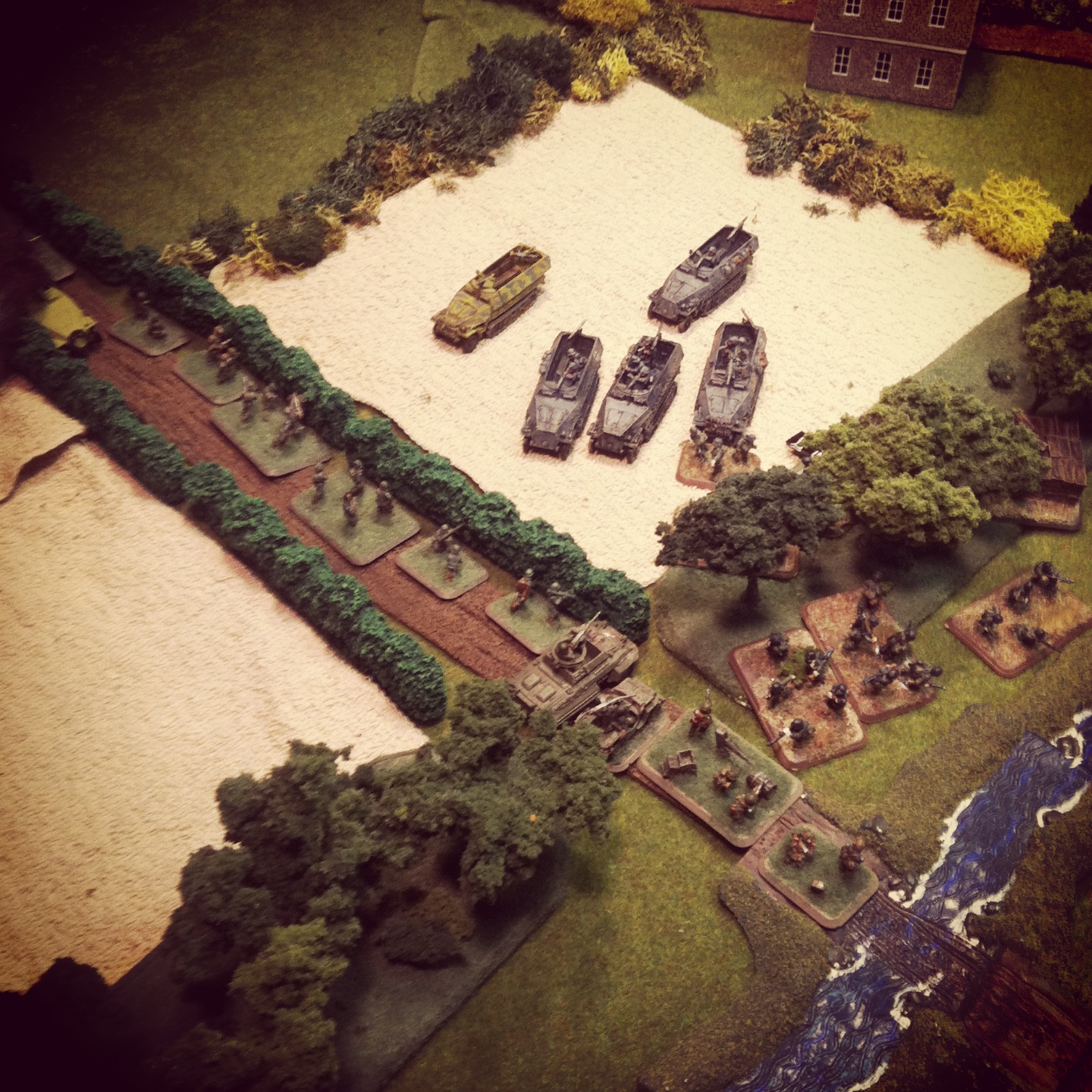
IMG_1903Our US plan was to place the majority of our armor on our right flank, supported by mobile infantry deployed in a small wood. On the left flank, the US Airborne deployed just outside the wheatfields with its small parachute battery to the rear. At the center of the board, our M7 Priests with their 105mm guns formed another battery while one lone Airborne platoon pushed to hold the buildings in the town with a vantage covering the bridge.

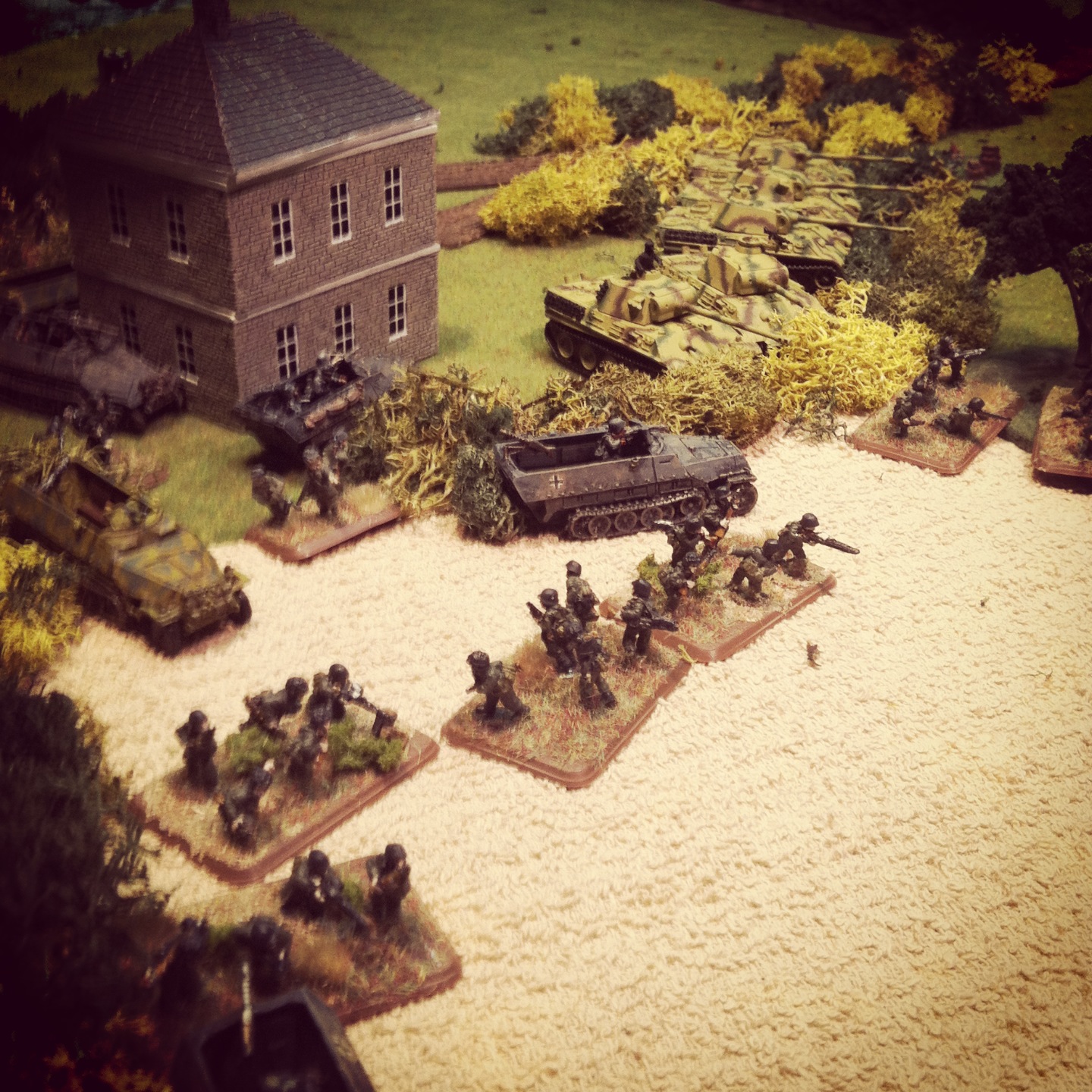
The game started poorly for the Americans as the Germans quickly pummeled the American Shermans and kept the infantry hiding in the woods. In the center, the US infantry struggled to occupy the buildings as the Germans quickly rolled five exceedingly threatening tanks behind a row of bocage overlooking two objectives. The American’s P7 Thunderbolt was likewise ineffective through the first few turns of the gaming, missing all targets except on German tank which burst into flames while bogged over a hedgerow.

IMG_1918

IMG_1906

IMG_1916

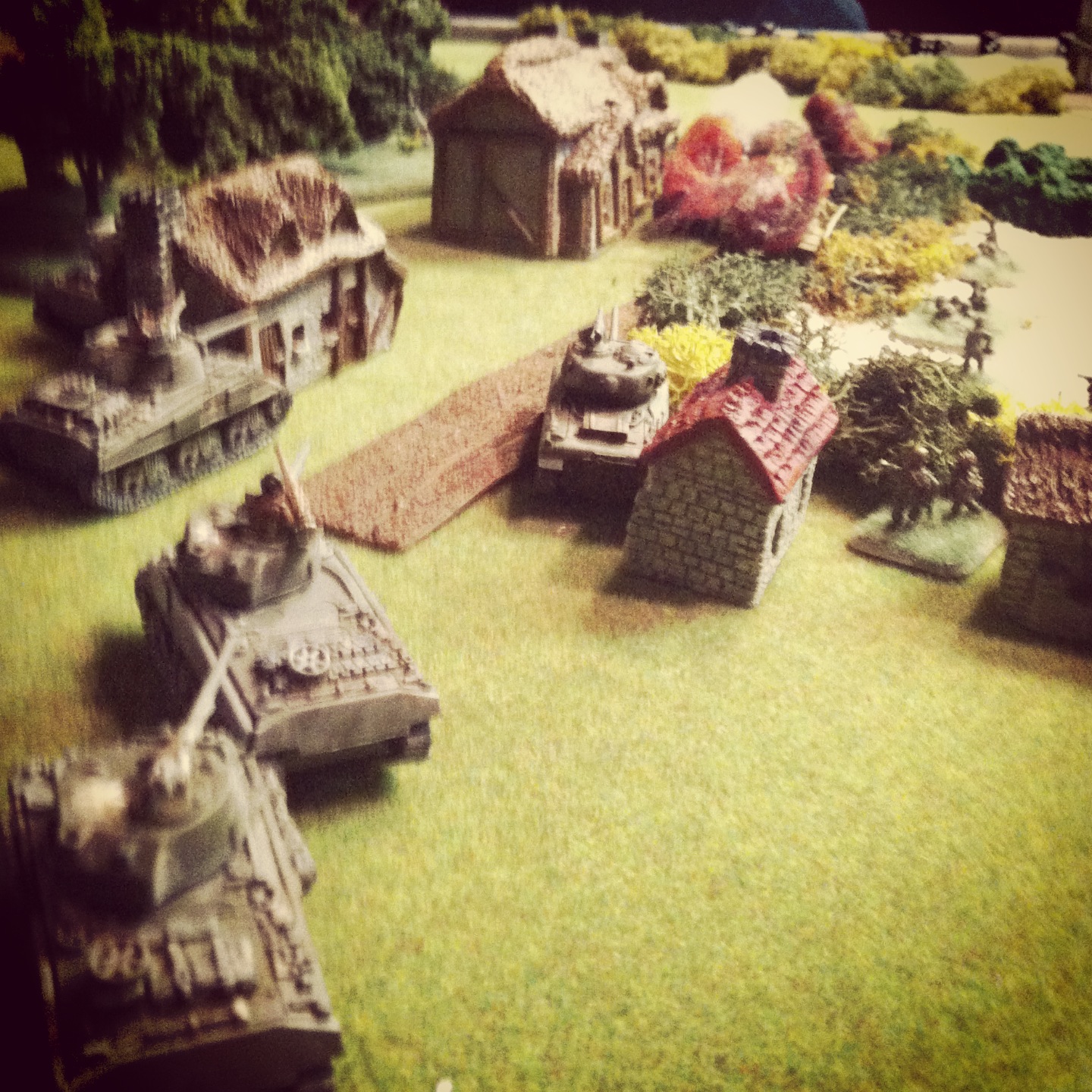
The fight on the American left went better from the start as the US Airborne filled the wheatfields and headed for the hedge and road beyond. A brief scare from a platoon of German Stugs, a row of halftracks and a platoon occupying the farmhouse  was solved with our trusty American Shermans. With a combination of artillery bombardments, heavy fire from the US tanks and some shooting from the advancing Airborne, the crossroads in front of the farm was turned into a smoking mass of destroyed German armor. Just as the German right flank stood wide open to the rolling Shermans, the command tank bogged in the woods where it and its entire platoon would remain for the rest of the game.
IMG_1914

IMG_1924By mid-game things looked good for the Germans, but the resilience of the Americans would prove to be the edge in the second half. The American armor was pretty torn up on our right flank, but the US kept making some remarkable morale rolls to stay on in the fight with the dwindling German tanks. At the center, the Priests had lost one of their guns but snuck back into cover to continue taking direct shots across the river at the remaining German armor. The US Airborne platoon occupying the town’s buildings risked a run toward the river, taking casualties along the way despite the smoke covering the German line on the far side. The fight between the wheatfields and adjoining treeline saw the Germans and Americans whittling each other down.

IMG_1926

IMG_1910

IMG_1920

IMG_1928

In the final turn, the 101st Airborne finally got in close enough for a tank assault, destroying one tank and pushing another back from an objective. It was a bloody fight, but in the end it was an American victory with four of six objectives held. On both tables, it had been a good day for the Allies.

And it was a long one, too. With a nearly eight hours of gaming and only brief breaks to grab a drink from the fridge up front or a hotdog off the grill out back, the two games had been exhausting but enjoyed by everyone – win or lose. That’s the kind of spirit we at the club experience every week, and already there’s some after-action discussion about when we’re planning our next big Flames of War day in Brooklyn.

Military Terrain Making in World War II

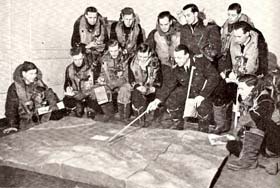
In the opening pages of the recently-released and well-reviewed final book of his World War II “Liberation Trilogy,” The Guns At Last Light: The War In Western Europe, 1944-1945, author Rick Atkinson takes the reader swiftly to St. Paul’s School in west London on the fateful morning of May 15, 1944. In a darkened room, the secret council of the Supreme Headquarters Allied Expeditionary Force (SHAEF) were awaiting a presentation on the final plans for the impending Normandy invasion. With the 145 collected commanders and dignitaries (including Prime Minister Winston Churchill and King George IV) seated, the meeting is brought to order by Supreme Allied Commander, US General Dwight D. Eisenhower:

Behind him in the cockpit of the Model Room lay an immense plaster relief map of the Normandy coast where the river Seine spilled into the Atlantic. Thirty feet wide and set on a tilted platform visible from the back benches, this apparition depicted, in bright colors and on a scale of six inches to the mile, the rivers, villages, beaches, and uplands of what would become the world’s most famous battlefield. A brigadier wearing skid-proof socks and armed with a pointer stood at port arms, ready to indicate locales soon to achieve household notoriety: Cherbourg, St.-Lo, Caen, Omaha Beach.

Over the next several hundred pages, Atkinson’s book goes onto to recount the trials, travails and eventual success of Operation Overlord and the eventual Allied victory in Europe. Although I’ve read accounts of the period before, the book is incredibly gripping and moves surprisingly briskly. In reading though, my mind keeps wandering back to that brief description of that enormous model of the invasion laid out before so many great military leaders nearly 70 years ago.

No one knows for certain when terrain models were first used in warfare. One might easily envision some leader of a primitive warband arranging sticks in the dirt before his subordinates as a way of planning for an upcoming attack on a rival force. What we do know is that by a few hundred years ago models were being used frequently by commanders and in military schools throughout Europe. It was out of these same elite war colleges that modern miniature wargaming would eventually spring.

It’s from this place where my mind keeps turning back to that plaster model in 1944 London. As a wargamer, I’ve previously written here about my passion for creating a well-laid-out terrain board for my gaming. With a bit of digging around online, I managed to uncover quite a few resources outlining the this bit of military craftwork and its importance in 20th-century war planning.

Terrain Models, a joint Swiss-American scholarly site dedicated to the European history of military topographic modelling, gives a great overview of how the tradition grew through the ages. With a bit of a slant toward Swiss model-making history, the site does provide a lengthy bibliography, a rundown of model types and a number of photos (sample, right).

In a 2002 article entitled “Allied Military Model Making During World War II” from the journal of Geography and Geographic Information Science, English lecturer Alastair W. Peterson also offers a bit of historical context before detailing the specific importance of models to Allied forces in WWII. Peterson outlines the evolution of methods and materials and also presents a nice chart of common scales and military uses for each (below).

The article also presents personal accounts of the people recruited for model making during the war, and the challenges they too faced far and away from the actual fighting. A recent interview in the Cleveland Plain Dealer provides another set of remembrances from a veteran who spent the war making topographic models, including one used ahead of the Normandy invasion.

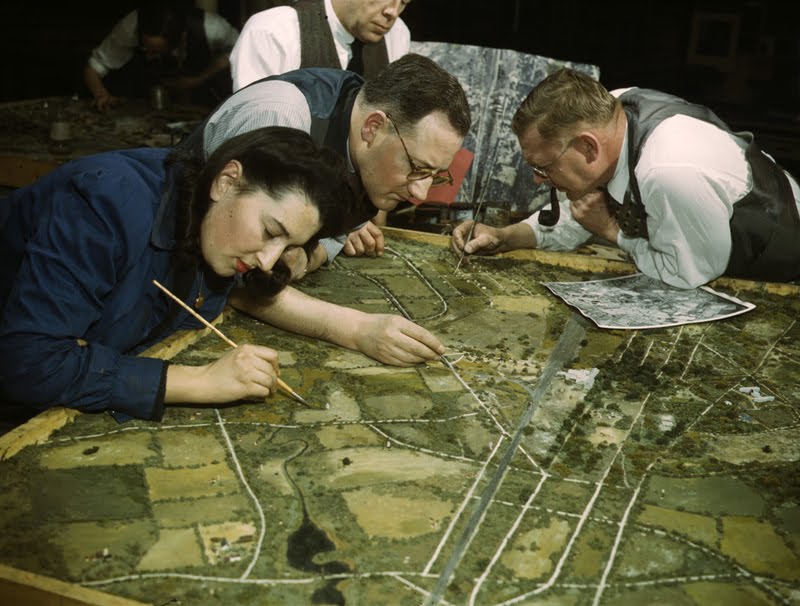
Other discoveries I made include a 1945 Universal Newsreel entitled “Secret Maps Guided US Bombers” which offers up a rare behind-the-scenes look at the construction of massive 80 foot 3D map used in planning late war air raids on Japan. And the undated color photo at left shows what purports to be a group of students learning techniques in creating a terrain map for military use during or immediately following WWII.

The articles, sites and photos I’ve uncovered give a cursory overview of military terrain making and their role in WWII. There are some lost gems I’d like to dig into more, including tracking down an actual copy of the 1956 US Army training manual Terrain Models and Relief Map Making (TM 5-249) which is referred to in a number of online bibliographies. But for now, I’ll carry all this history with me as I lay out my next wargaming battlefield in the context of all the historic importance many of the same skills and techniques have played in the wars of the past.

The War Game of Norman Bel Geddes

I somehow missed it about a year ago when The Believer ran a great piece on the wargaming obsession of famed American designer and futurist Norman Bel Geddes. While his name may not resonate outside circles of early 20th-century design enthusiasts, Geddes is responsible for much of what we commonly think of when terms like “Art Deco” and “streamlined” are used. Most of Geddes’s fame today is linked to his design of the General Motors-sponsored Futurama exhibit at the 1939 New York World’s Fair and an iconic Art Deco radio commemorated with a US postage stamp in 2011.

Much of Geddes’s work — including the Futurama’s “world of tomorrow” display — was achieved through his obsessive and highly-detailed miniatures modeling. As featured during his life in such varied publications such as The New Yorker, Atlantic Monthly, Life Magazine, Popular Science, Ladies Home Journal and Arts & Decoration, Geddes poured an enormous amount of time and thousands of dollars of time into military scale modeling. Utilizing his extensive library of military books and journals (now held in the University of Texas archives), thousands of ships were crafted from brass with exacting detail and enormous topographically-accurate sea and land playing tables were constructed by Geddes in his family’s Manhattan apartment.

Geddes moved in prominent 1920s-40s New York social, professional and intellectual circles, which led to his hosted sessions of what was simply referred to as “The War Game” to be celebrated events reported on in local papers. Movie stars, socialites, politicians, foreign dignitaries and even rumored retired military brass are said to have been frequenters of the intense gaming sessions. The weekly games ran for months on end, used a rules system Geddes designed himself and were documented in immense detail on record cards, charts and maps run on the printing press Geddes kept in the house. The archive at the University of Texas just hints at the wealth of information on how The War Game grew over the two decades of play among Geddes and his circle.

Like the games played among H.G. Wells and his friends recounted in his book Little Wars, time spent reading through the many articles now archived online of Geddes and his games reveals a vast little-known era of gentlemanly wargaming in New York City. As I look ahead to another weekend of gaming with the Metropolitan Wargamers, I can’t help but feel the rippling tradition of small and obsessive battles waged in the basements of the city to this day.

Favorite Tabletop Games Kickstarters of the Month (May 2013)

Earlier this week, I wrote about how I believe Kickstarter to be the latest incarnation of how gamers have contributed to the decades-long conversation on who truly “owns” our hobby. This had me delving deep into what’s current on Kickstarter’s Tabletop Games section.

To date, I’ve honestly only contributed to one tabletop games Kickstarter project. The modest fundraising drive for A Las Barricadas which brought in just under $10,000 for a game that has since been delayed but promises to be shipping soon. While I wait for this little game of street protest pitting Occupy Wall Street-like demonstrators against the police to arrive, I thought I’d share a few projects I’m watching this month.

Moby Dick, or the card game: Like any good English Literature major, I’m a fan of Herman Melville’s epic American tale of one man’s obsession with a whale. On the flipside, I am not generally a fan of card games. That said, this card game of the high seas boasts some truly marvelous woodcut-like artwork and what looks to be an entertaining game of the best recruited crews trying to survive in their quest to spear the Great White Whale.

All Quiet On The Martian Front: Showcasing 15mm miniatures of Martians vs. early 20th-century human armies, this game uses the H.G. Wells sci-fi classic as a jumping-off point to imagine a world of humans locked in protracted combat with alien invaders. The models look fantastic, mining the very-popular steampunk trend in gaming today. Supporters of the game (particular those pledging in the hundreds of dollars) will net a lot of cool looking stuff with its funding.

Canterbury: Nothing gets me going like a great Euro-style worker placement game, so this is particularly enticing. The game places you in the age of Saxon Kings, and your aim is to build the greatest of cities starting with only a well in the wilderness. Managing your growing population, resources, culture, military and ongoing construction of buildings, the game claims to be one of pure skill and planning with no luck factor whatsoever. This one looks like a beauty and I’ll be anxious to give it a play when it is published later this year.

 Wargaming Terrain for the American Frontier: I don’t play games in the period, but the latest from Acheson Creations presents more than a dozen wonderfully-crafted 28mm buildings from the pioneer, settler and Native American era of 18th-century colonial America. I particularly like the longhouses and wigwams, possibly inspired by the local tribal history of the Western New York and the Rochester area where the creators (and I) hail from. The blockhouse, fort wall sections, barn and cabin models also look great and could easily be used in other eras or in fantasy gaming scenarios, too.

Civil War Toy Soldiers: This final project has less to do with gaming and more to do with the special spot in my heart for the toy soldiers of my childhood, especially around the holidays. Cast in soft plastic and a large 54mm scale, this new line of Union soldiers have been launched to compliment Cunnyngham Collectibles’s existing Southern troops. The poses, liveliness and equipment details on these guys make for some really cracking personality. A few bags of these fellas on the floor or in the tall grass and I’d be transported back to when I first fell in love with little plastic men nearly 40 years ago.

American Civil War: 28mm American Farmhouse

My workbench focus over the past couple of weeks has been almost exclusively on my 28mm American Civil War project which I hope to have wrapped-up and ready to present in a large scale battle this spring. As posted previously, I love setting out a realistic wargaming table full of structures and terrain. Luckily, Perry Miniatures – the maker of my favored 28mm American Civil War soldiers – also produces a couple 1/56th scale plastic kits of terrain suitable to the period.

The Perry Miniatures farmhouse is loosely modelled on General Meade’s Union headquarters from the Battle of Gettsyburg, pictured at right in a photo from the aftermath of the battle and as it looks today. I’ve seen the house in person a couple of times, and I’ve also seen similar buildings in Western New York, Ohio, Michigan and Virginia. The Perry Miniatures model is typical of the small wood-framed clapboard rural farmhouses found in the North, South and into the Great Lakes region from the late 18th through 19th-centuries.

The pieces of the farmhouse kit come in two easily-assembled sprues along with an extra sprue of three types of fencing. The fencing is disappointing and unfortunately doesn’t really offer much to work with in terms of building out a farm scene. Some extra sets of plastic fencing from Renedra are probably needed to really complete the set. However, the box does contain a chair and a couple barrels to add some nice detail to the model’s front porch.

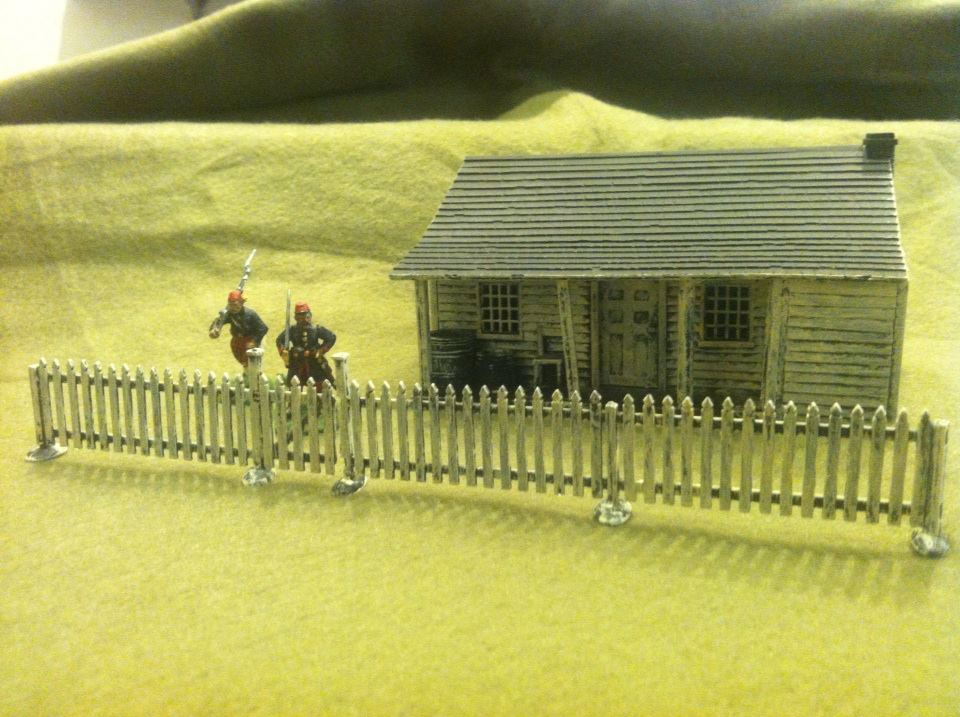
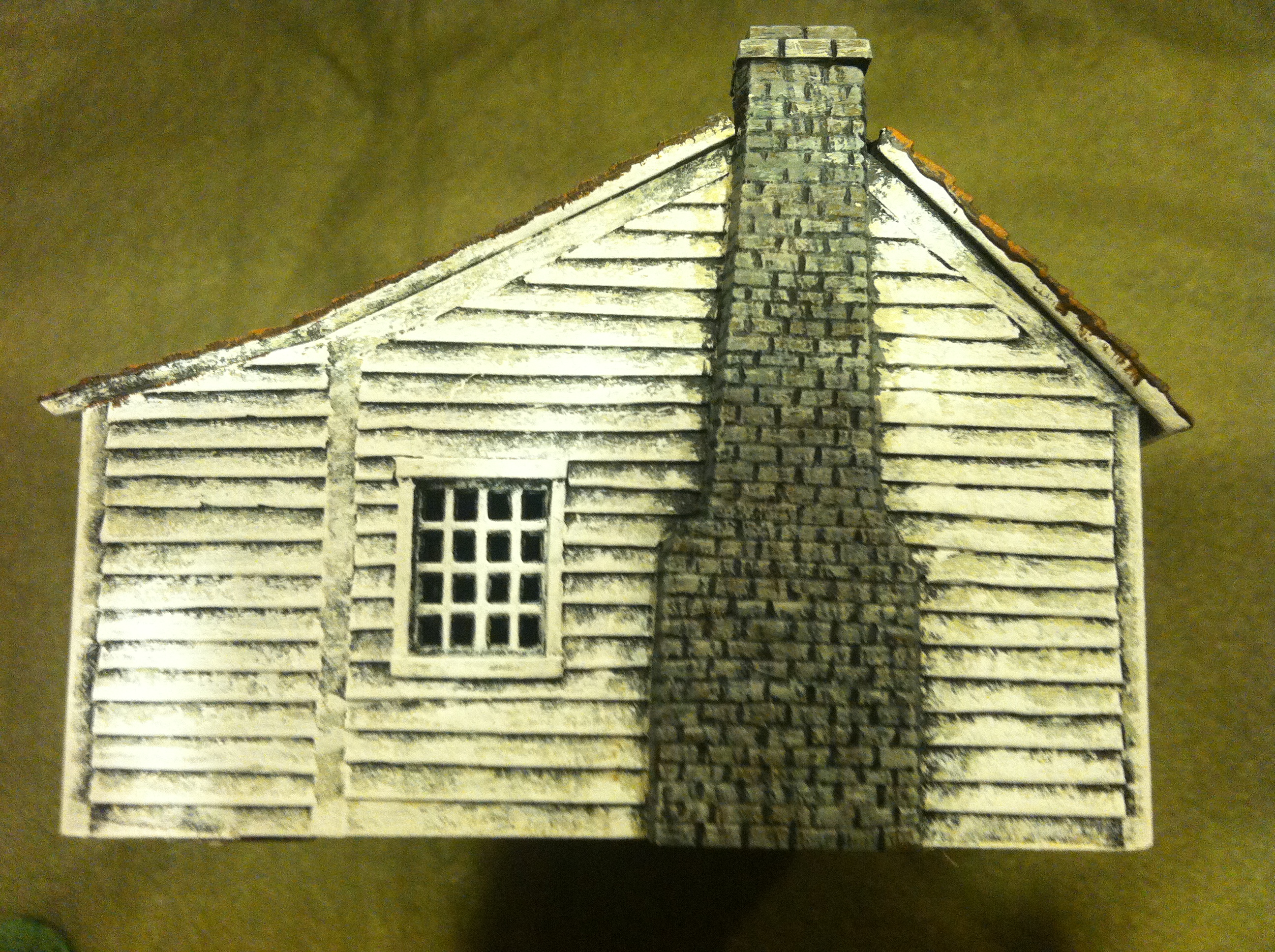
I glued up the kit and sprayed it with a flat black undercoat. My plan was to give the farmhouse a weather-beaten finish looking like it had years of peeling paint. I started by dry-brushing the model with a large flat brush with a yellowish off-white paint, making sure to leave a fair amount of the black in the gaps and areas between the clapboards (photo at top left).

Next, I dry-brushed the house again with a bright white paint, giving the clapboards additional depth as if the most recent layer of paint had deteriorated over time. For the roof shingles, I built-up dry-brushed paint in dark brown, light brown and then a bit of dark green mixed with a brown wash. I began the chimney with a dark gray paint and then finished it with dry-brushed lighter gray and dabs of brown and off-white paint to represent variations in the stonework (photo at middle left).

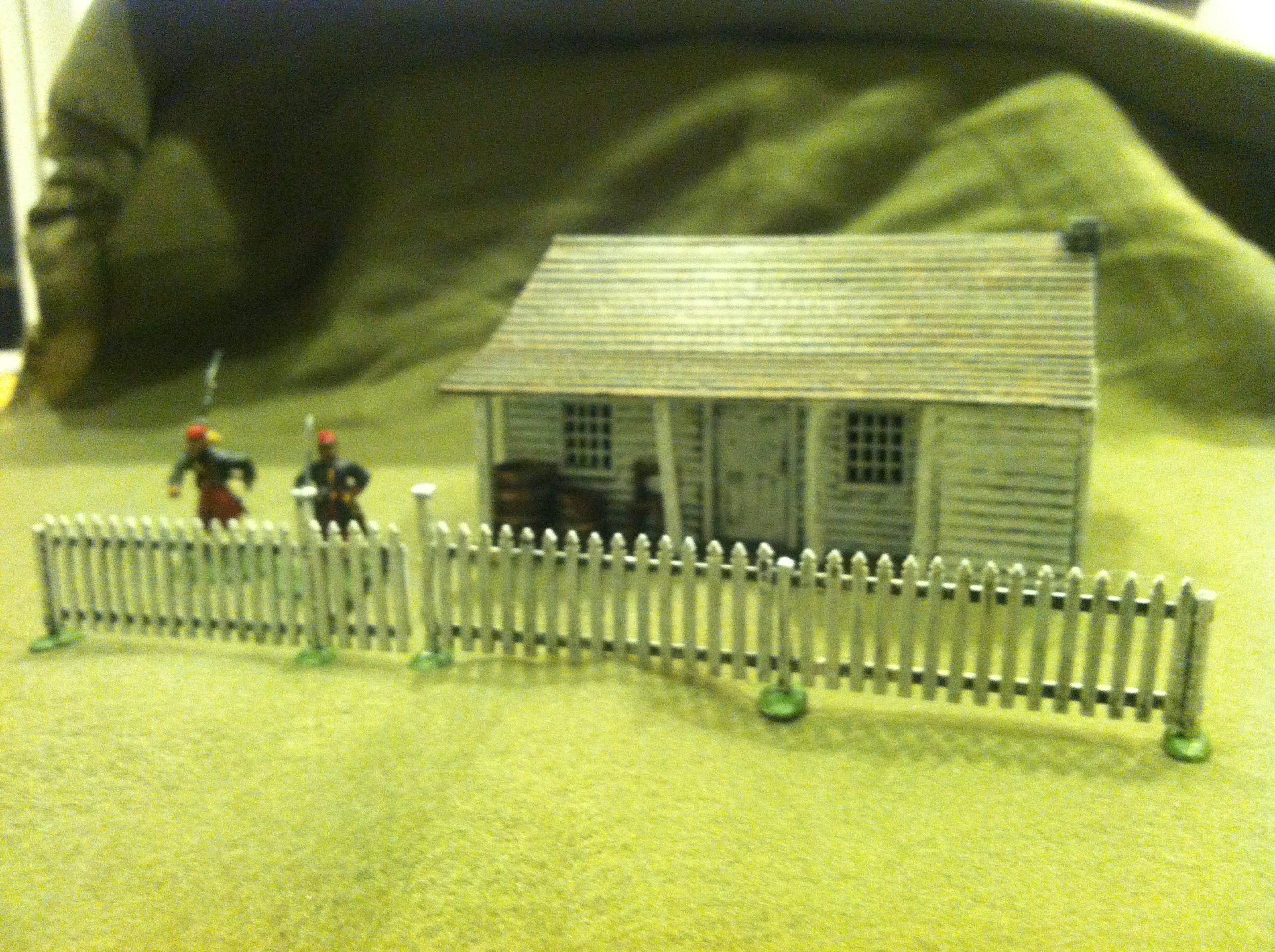
For details, I dabbed the barrels, chair and porch planking with dark brown and completed them with some lighter brown dry-brushing and some aging metal for the barrel hoops. The door knobs at the front and rear each got a dab of brass paint (photo at bottom left), and I gave the picket fence another coat of the bright white like the house clapboards.

The final results are below and ready for the battlefield this coming spring.

American Civil War: 28mm Cannonball Markers

Aside from actual gaming, one of the more enjoyable aspects of wargaming for me is scale modelling. Scale modelling is basically looking at the real world and figuring out how to represent it realistically on the tabletop. I’m constantly picking up little pieces of wood, paper, metal, fabric and string and figuring out what those materials might be used for down in a miniature scale.

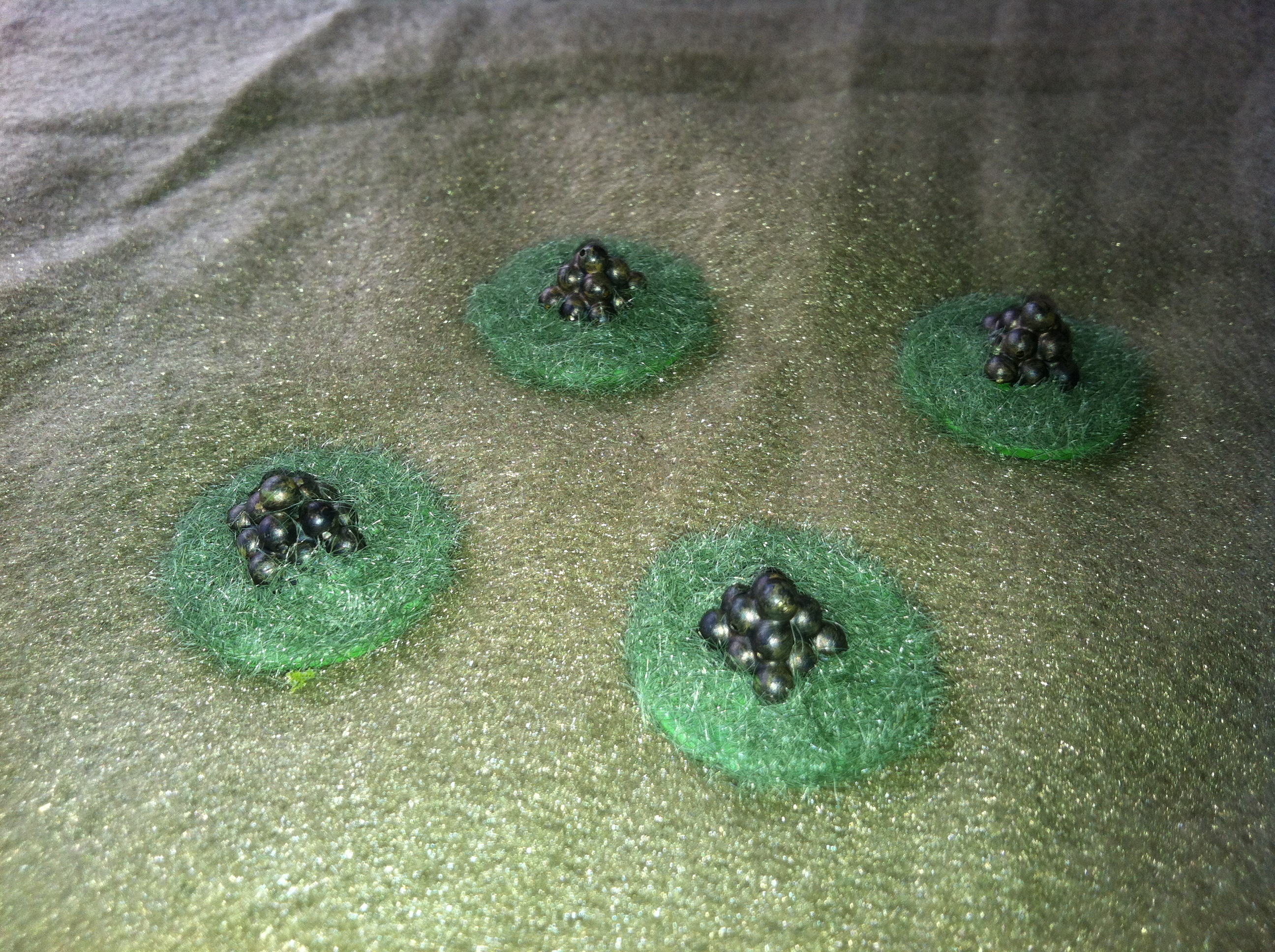
My most recent project is building some cannonball markers for my 28mm scale American Civil War gaming. These markers will be used to indicate when my field guns are loaded and ready to fire. In reality, most American Civil War field batteries probably didn’t have time to neatly stack piles of cannonballs as gun teams fired furiously at enemy lines. That said, anyone who has visited a historic battlefield site will most probably be familiar with the look of cannonball piles often found sitting neatly nearby an antique artillery piece.

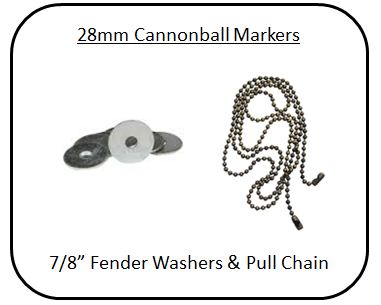
Many companies offer pre-made cannonball markers cast in plastic or metal, however, I thought scratch-building some markers of my own would offer a nice break from my usual painting of soldiers in blue and gray. For bases, I used the same 7/8″ fender washers I use for basing all my 28mm miniatures. The cannonballs were made from a length of metal pull chain found in the electric aisle of any hardware store. Many modellers use small gauge shot to model cannonballs, but I found the connected balls/links of the chain makes assembly quicker without the mess of chasing little balls around the workbench.

To begin, I cut and glued a small thin piece of cardboard over the center hole of each washer. I then cut three three-link sections, two two-link sections and a single ball from the chain. Starting at the bottom layer, I used a dab of superglue to affix the three three-link sections on the base. When dry, I glued the two two-link sections on top of the base layer and then fixed a single ball on the top of the pile. The result was a neat pile of 14 balls stacked into a symetric pyramid.

Once each based pile was dry, I spray-coated the markers with flat black paint. To give the cannonballs some shading and depth, I lightly dry-brushed some rusty metal and brown paint over the balls, allowing some of the black to remain between. The base was then painted green and flocked with some static grass affixed with PVA glue. A protective dull clear spray coat finished them off.

Sitting alongside my Union gunners running a field piece into position as their General shouts orders, these new markers make for a nice piece of detail on the battlefield.

Setting The Scene

One of the aspects of wargaming I love most is setting up the tabletop battlefield. I first got into scenery building with a large basement HO scale model railroad as a kid in the 1970s and 80s. Through a mix of sculpting hills and roads, modelling trees and creating realistic tableaus of buildings, I spent hours bringing to life a miniature world.

Setting up a tabletop battlefield serves two purposes. Firstly, playability is affected in terms of terrain contours, defensive cover and lines of sight. Secondly, a well-laid and realistic tabletop brings an aesthetic appeal and excitement only to be found in miniature wargaming. While throwing down a big piece of green fabric and some simple trees or lichen shrubbery and maybe some rocks for outcroppings can provide a bare minimum play area, adding a few pieces of additional model detail really makes a game come to life.

Check out some of my WWII and American Civil War set-ups in the Gaming & Painting section above, and have a quick read on some easy resources below to get your own tabletop ready for battle.

Battlefield Basics

For my groundcover, I use a $10 green fleece throw I picked up in a discount store. I like that I can fold it or open it up to create different sized gaming spaces. You can also use felt or any other cloth easily picked up at a local fabric store. For roads, I use a rubber textured road system I bought at a gaming convention. On the cheap, you can cut felt or other material into strips to create roads of varying lengths and widths. Streams and rivers can also be cut from blue felt. For basic shrubs, a bag or two of lichen from a hobby shop in varying shades of greens and browns provides flexibility in creating hedgerows and other bunches of ground cover. Spreading some gravel or larger stones around the battlefield can also provide some texture and look to the table.

Trees

While a lot of gamers prefer making trees from scratch using twigs and lichen, I like tree systems like those offered by Woodland Scenics. Whether you choose to build your own or buy pre-made trees, you can easily find what you need via websites or stores that cater to model railroading hobbyists. Keep scale in mind that shorter HO-scale trees suffice for 15mm scenarios and taller O-scale trees will stand in nicely for forests and treelines in 28mm games.

 Buildings

There are tons of options for wargaming buildings. Many experienced gamers make their buildings from scratch using foamcore, balsa wood and other kit-building materials found at any decent hobby shop. Another cheap option is downloadable paper cut-out buildings, many examples of which can be found online for free or in easy and immediate pay/download format.

A number of companies specialize in model buildings in lots of scales, eras and geographic locations. Some relatively inexpensive buildings come cast in solid resin and unpainted, while others come completely assembled and detailed with removable floors and roofs. More recently, laser-cut wood buildings are becoming a popular option.

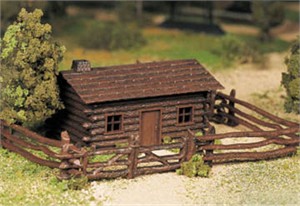
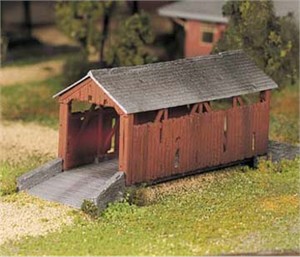
I like using plastic kits from model railroad suppliers, particularly O-scale buildings when I’m gaming the American Civil War in 28mm. These kits are pretty inexpensive ($10-30), easy to find online or in stores, simple to glue together and lightweight. The often simple detailing is easily enhanced with some simple painting and weathering removing the plastic gloss. Companies such as Bachmann (log cabin and covered bridge pictured), Atlas and Lionel all make model railroad buildings which can easily stand on an 18th or 19th-century American battlefield. I love my big Lionel K-Line O-scale American church I picked up for $9 on sale, and it always takes center stage in my American Civil War set-ups.

Boxed Terrain Systems

While pricey, several companies offer full lines of pre-packaged terrain systems made specifically for gaming. Flames of War offers a big line of 15mm WWII terrain through their Battlefield In A Box sets with roads, rivers, buildings and battlefield accessories to fit different regions of the war. Games Workshop also offers a number of products specific to their games from Citadel but much of it could be used for other gaming in Medieval and fantasy gaming environments in 28mm. For gamers with particularly deep pockets, Games Worshop all carries highly-detailed modular gaming boards for nearly $300 each.

Painting and Playing

Wargaming broadly falls into three categories — paper-and-pencil games, board games and miniatures gaming. Dungeons & Dragons is the classic pencil-and-paper game, with games played out largely through verbal role-playing with a lot of note-taking and mapping on paper. Board games are great to pull off a shelf, set up and play, often in one sitting.

Miniatures wargaming is my favorite. The hobby combines two entirely different aspects – painting and playing. Firstly, miniatures wargaming involves obtaining often hundreds of plastic or metal figures in various sizes from just a few millimeters to nearly two inches tall. A fair amount of research usually goes into creating forces of the proper size and and make up. Then there’s a lot of gluing to get poses and equipment together in realistic and historically-accurate configurations. Lastly, a miniatures modeller is faced with hours and hours of painting with tiny brushes, dabbing paint on uniforms, weapons, gear and exposed faces and hands. Even within the same historical era, say WWII or the American Civil War, there are nearly-limitless variations in how miniatures can be painted. Beyond the figures themselves, setting up a wargame usually involves creating terrain including buildings, trees, rivers, roads and hills.

Only after you’ve logged many hours painting up your armies and laying out your terrain can the miniatures wargamer get on to the second half of the hobby — actually playing. Again, miniatures wargaming has a tremendous variety of rulesets available depending on the era, scale and size of a game desired. Some games might involve skirmish-level battles with just a couple dozens figures on a side and other games can be of a grand tactical scale with hundreds (or thousands) of troops filling the field. Rulesets can run from just a few pages to dozens of books, and some gamers choose to write their own “home-brewed” rules. Some companies such as Flames of War or Games Workshop manufacture self-contained systems of miniatures and rules, even offering some starter sets of figures, rules, paints and dice all in one box for new players.

For a glimpse at the intersection of painting and playing wargames, check out the newly-updated pages on my Gaming and Painting page. Whether it’s World War II, the American Civil War or the Anglo-Zulu War, each era and scale brings different variety to what I love about the hobby.