Flames of War: Fielding the P-47 Thunderbolt

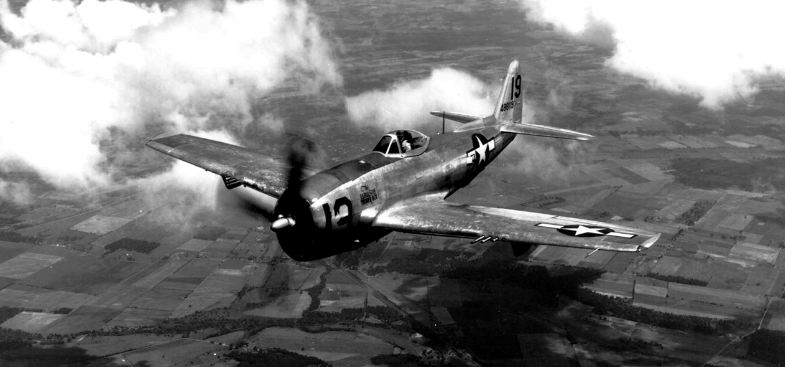
The P-47 Thunderbolt was a big, heavy, expensive and deadly plane with .50-cal machine guns and a bomb payload of 2500 pounds. Rushed into development and production near the dawn of World War II, these American planes saw their first use in Europe in 1942. By the late war period, the P-47 was being widely used in Western Europe and proved to be among the most effective fighter aircraft in both air-to-air and air-to-ground combat operations. During the Normandy landings in June 1944, the German Luftwaffe was a virtual no-show and the P-47 Thunderbolt ruled the air in support of the massive Allied invasion below.

I’ve been modelling and playing with the 15mm World War II Flames of War miniatures wargaming system for a number of years now, but until now all my gaming has been with tiny scale boots, wheels and tank tracks firmly planted on the ground. With a full afternoon of large 2500-point late war period FOW games being planned in July at Metropolitan Wargamers in Brooklyn, I decided to supplement my existing US Airborne force with some new air support with a P-47 Thunderbolt model. Armed with its wing machine guns and laden with bombs, I’m pretty excited about adding the P-47 and a whole additional dimension to a game I’ve gotten pretty familiar with over the years.

Choosing a paint scheme for the model was the first decision I needed to make in my project, and there are hundreds of historical variations to be found. While the silver fuselage seemed to be among the more commonly-modeled versions of the P-47, I opted for a simpler olive drab body. The green base coat was followed by a grey underbelly and some boldly-colorful red details at the nose and tail. The windowed canopy “glass” consisted of some flat black and white dry-brushing. Along the seams in the body of the plane I wiped fine lines of rusty metal to show wear on the plane. The decals included in the kit completed the model, albeit with a fair amount of struggle with near-miss tears.

While my first shot at modelling a plane for FOW may not be 100% historically accurate, I’m pretty satisfied with the visual impression it makes. At some point I’ll even things up with a German plane, but for now I can’t wait for my P-47 to take off in my next game.

Flames of War: Fielding Easy Company

I’m not unique in being a World War II gamer and a big fan of HBO’s Band of Brothers miniseries from 2001. I also finally got around to reading Stephen Ambrose’s same-titled book on which the series was based. Both works follow the exploits of “Easy” Company of the 506th Parachute Infantry Regiment, 101st Airborne Division from training to D-Day to the end of the war. The story is absolutely riveting and presents a dramatic account of how the collective action of individuals contributed to the Allied victory.

I’ve been working away recently at finishing my long-overdue modelling of Easy Company and a large US Airborne force. Nearly two years ago I purchased and painted up an entire company of Command Decision Paratroopers from Old Glory Miniatures, including command, machine guns, mortars, bazookas and parachute artillery support teams. This past week I’ve wrapped-up the small plastic parachute rifle company from the Flames of War Open Fire! starter box set I received this past Christmas. To this collection of troops, I’ve added the excellent Easy Company set from FOW containing a number of the real historic US servicemen portrayed in Band of Brothers.

While the casting is a bit skinnier and lacking in the detail of the official FOW miniatures, the value of the Command Decision models can’t be beaten at the low price of $15 for a hefty bag of 50 solidly serviceable figures. At under $70 online, the big Open Fire! box is a real deal for all the troops, tanks, artillery and other stuff included. The FOW Easy Company set itself runs about $12 for the few specific personality figures, and fielding these models is going to add significantly both to the look and effectiveness of my force on the tabletop battlefield.

With a good mix of FOW and Command Decision models painted-up, I turned to the “Nuts!” campaign book to put-together my order of battle for Easy Company. The book focuses on the 101st Airborne’s involvement in late 1944’s siege of Bastogne and other Battle of the Bulge engagements and then on to the German border and the eventual Allied victory in 1945.

In creating my list I wanted a highly-mobile and playable 1500 point force heavy on infantry with just a bit of tank support. In the FOW rules, the parachute rifle company is rated Fearless/Veterans, making them hard-hitting and tough to chase from the field. Their special use of Gammon bombs enhances their impact in risky infantry assaults on otherwise-intimidating German tanks. Adding the special characters from Easy Company makes for an even more resilient and daunting force, reflecting the historic bravery these men brought to the late war European campaigns.

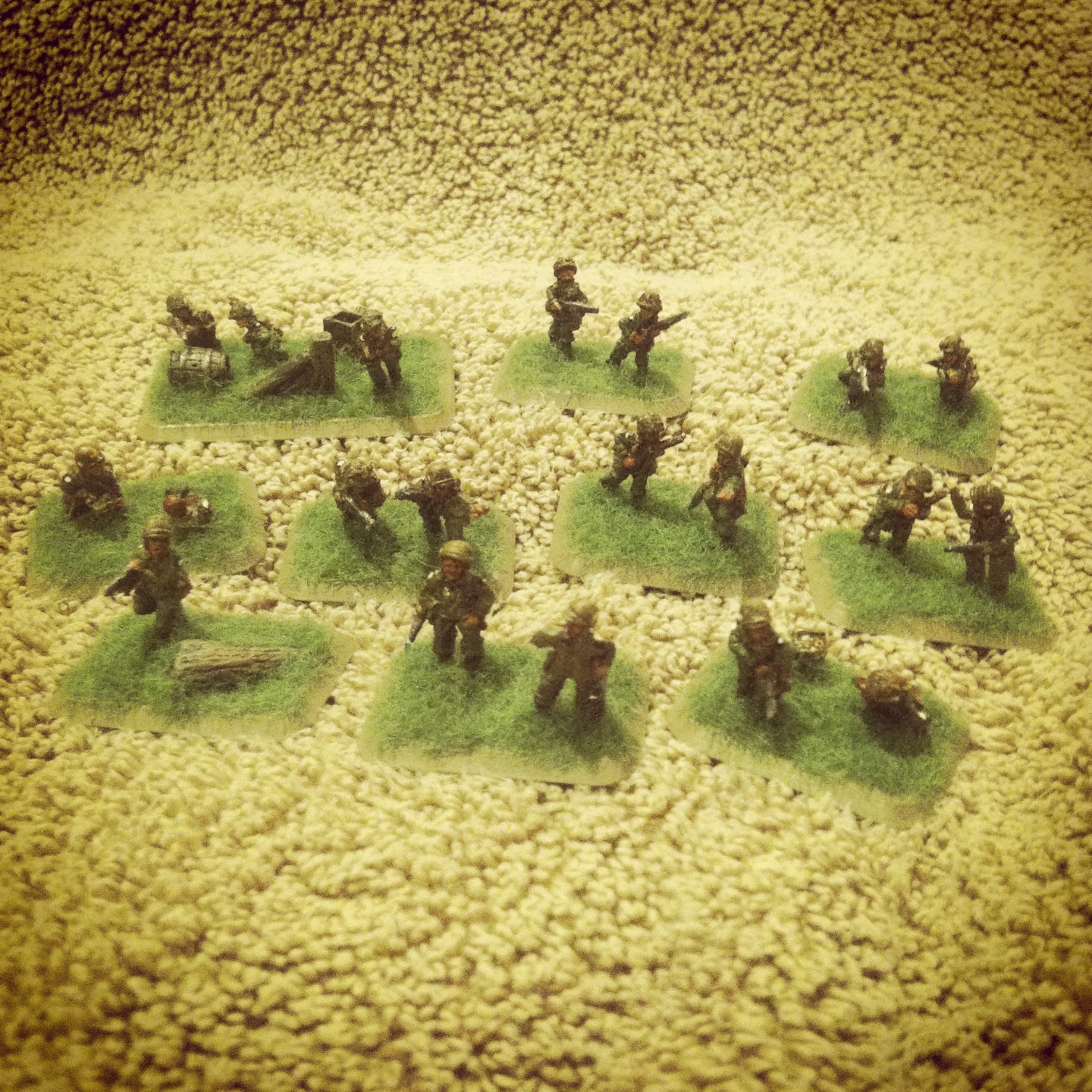
I’ve modeled my infantry pretty simply with a quick coat of flat green primer, lighter brown on backpacks and equipment bags, a contrasting watered-down brown wash and some equipment details picked-out. Finally, the shoulders get a dot of black and a dab of white to mimic the famed Airborne eagle insignia (shown at the top of the page).

The first photo below shows the specific men of East Company which come packed with a lot of individual personality. Leading the platoon is Capt. Richard Winters and Capt. Lewis Dixon (front row, center) with the Nixon model taking a swig from a bottle as he was known to do. Pvt. Eugene Roe (middle row, far left) is shown patching-up an injured comrade. Corp. Darrell “Shifty” Powers (top row, far left) is hunched aiming on a barrel and ready to take out his German target. With so many generic models in my force, these guys are all a real treat.

And below is a look at the plastic Airborne platoon included in the Open Fire! box set:

In July, I’m organizing a big FOW day at Metropolitan Wargamers with two simultaneous 2500-point games of Soviets vs. Germans and US Airborne vs. Germans. To the above list I’ll be adding some significant artillery muscle and I also hope to have a new P-47  Thunderbolt air support model ready to go. With Easy Company ready to lead on the tabletop, I can’t wait to get my new Airborne force into action.

Flames of War: Fielding the Grenadierkompanie

I got the Flames of War Open Fire! set this past Christmas and I’m finally getting around to painting-up all the stuff that comes packed in the box. At under $70 online, this big package is a real deal for new and experienced FOW gamers alike. The set includes over 100 plastic Allied and German infantry, tanks and artillery models, plus the full FOW rulebook, dice, markers and some other goodies included. A couple guys at Metropolitan Wargamers also picked up the set and are just getting into FOW. If you have any interest in gaming WWII at all, this set is the place to start.

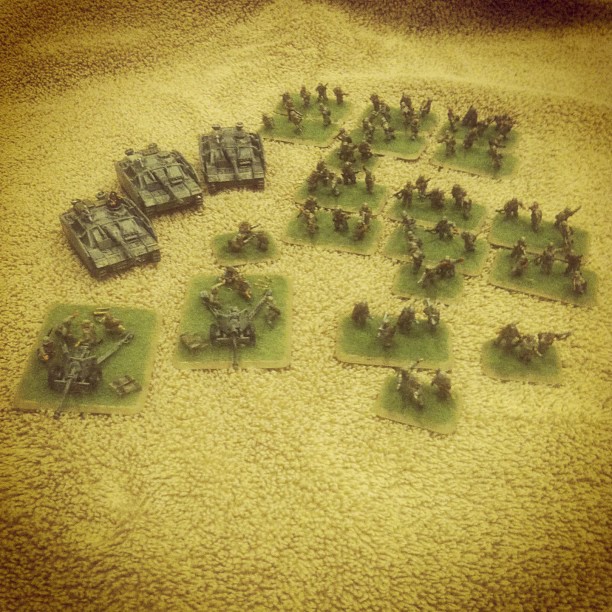
First off, I’ve finished the German Grenadierkompanie, including anti-tank 7.5cm PaK40s, a Stug G tank platoon and two platoons of infantry. These will supplement the pretty extensive Grenadier and Fallschirmjäger infantry I already have. The Stugs will also add to the large collection of Panzer IV, Jagdpanther and Konigstiger platoons I’ve already got on the shelf.

The plastic models all glue together quickly, but handling them has to be a bit delicate so as not to snap off the tips of the gun barrels. For the infantry, I spray prime everything in flat black and paint the uniforms in a mid-dark grey. All the details — guns, boots, equipment and skin — get picked-out with quick dabs of paint. Everything gets a very watered-down brown wash in the end which gives the uniforms a more accurate grey/green muted finish and also tones-down the flesh.

My camouflage painting abilities are honestly pretty atrocious, so my default is to go with a more generic grey paint scheme on my armor, artillery and vehicles. For the Stugs and PaK40s, the flat black primer was hit with a quick dry brushing of mid-dark grey.  After the dry brush coat, tank cargo and other details were then dabbed on. The platoon commander got some special attention with white detail on his cuffs and collar, plus some detail on the radio headset he’s wearing over his hat. Finally, I applied some wet-transfer decals and then dry brushed some light brown mud in the areas most likely to see some splashing on the tracks, sides and fenders.

y

With my Germans from Open Fire! complete, I’ll be posting soon with an update on the US Airborne and allied models from the set. Along with the Germans, a set of special FOW models from the famed Easy Company and a bunch of my existing models, there’ll be some major action from the Normandy campaign and beyond coming soon.

Retro Gaming The 70s & 80s: Dungeon Dwellers


I was already a fairly experienced D&D gamer by the time I encountered the Heritage Dungeon Dwellers series of miniatures and game sets in the early 1980s. Aside from playing creative games and campaigns dripping with swords, sorcery and all things creepy and crawly in the underworld of our imaginations, my brother and I were quickly filling up our free time with miniature painting. If it was tiny, cast in lead and even mildly gruesome, chances were it was on our radar.

We were already pretty familiar with Ral Partha’s growing line of D&D lead miniatures picked up at our local five-and-dime, bookstore and hobby shops in Rochester, NY when we encountered Dungeon Dwellers. At the time, we had no idea Heritage was producing boxed sets and blister packs of figures similar to Ral Partha. What we did know was that holding these two green Dungeon Dwellers boxed sets in our hands was clearly something different.

Unlike the sets of miniatures from Ral Partha and other suppliers of the time, Heritage Dungeon Dwellers offered two all-in-one model and gaming sets. Each box contained a number of monster and adventurer figures, paints and a simplified self-contained game with rules and a map. This off-the-shelf game was an easy and rare counterpoint to the expansive D&D universe of the era. Each set — “Caverns of Doom” and “Crypt of the Sorcerer” — read like a D&D module with a defined scenario in which to play. The models were animated, unique and somewhat more appealing than some of the widely-available Ral Partha lines. I particularly recall the multi-piece winged dragon from “Caverns of Doom” and the fire-casting wizard from “Crypt of the Sorcerer” as being favorites.

Despite the limited replay value on the surface, these two sets got a lot of outsized-use when I was a kid. Thinking back, they combined the best aspects of board, miniatures and role-playing games, plus they allowed us to cut our chops on our painting skills. Serious gamers of the time probably dismissed these sets as pandering to the growing fantasy gaming fad of the day, but for a growing gamer in the early 1980s, Heritage Dungeon Dwellers really made an impression.

Collector’s Note: The Dungeon Dwellers boxed sets are exceedingly hard to come by, but miniatures sets and individual figures are readily available on eBay for just a few dollars for an individual figure up to well over $100 for sets.

American Civil War: Perry Miniatures ACW in 28mm

About a year ago I got back into gaming the American Civil War.

My first miniatures wargaming experience back in the 1980s was with 15mm ACW played with the Fire & Fury rules. I wound up stepping away from gaming for the 1990s, but with the celebration of the 150th anniversary of Civil War and some ACW gaming with the Brother Against Brother rules at a convention I decided last year that now was the time to get back to the ACW.

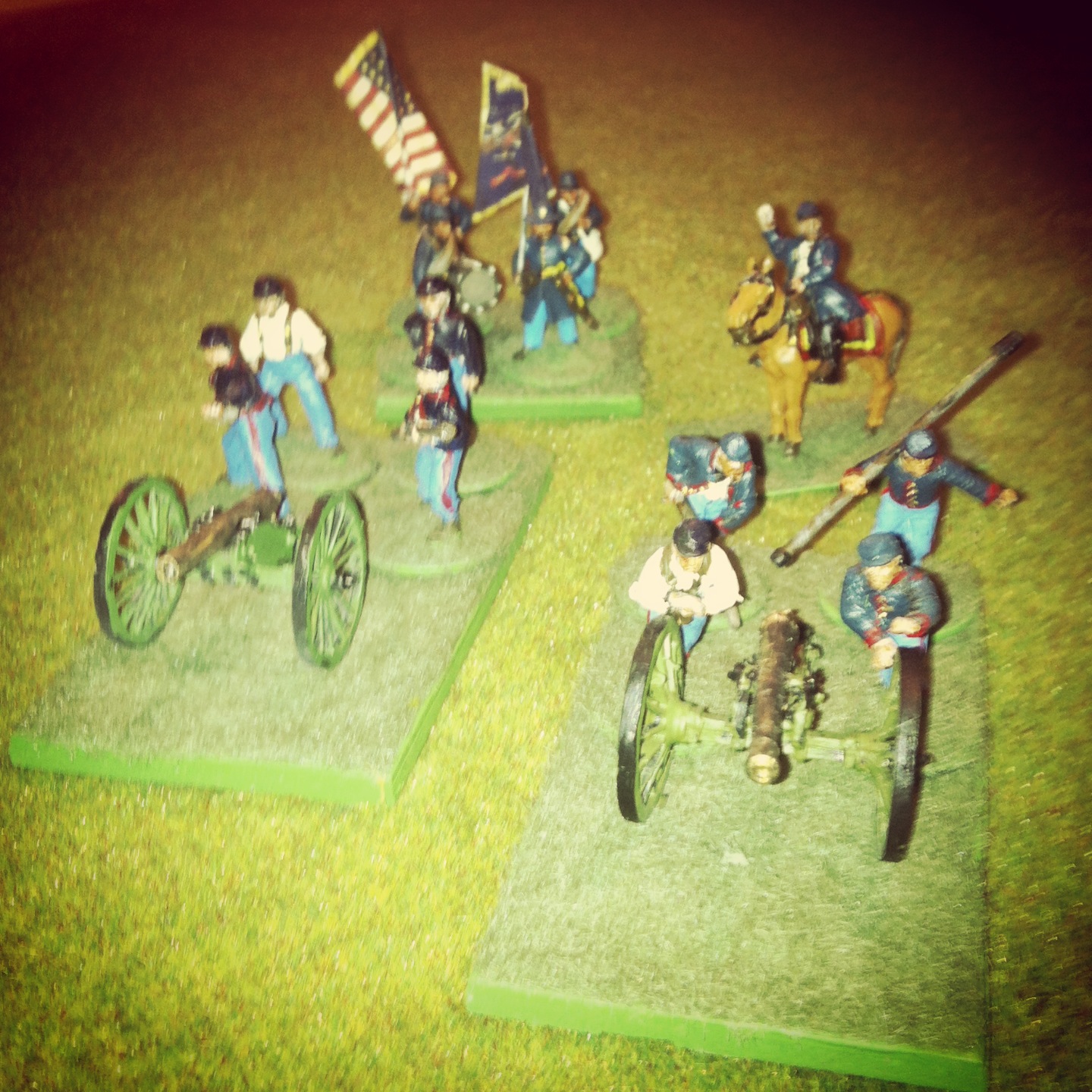
Having spent a couple years playing WWII in 15mm, I very much ready to try another era but I also chose to go bigger with another scale at 28mm. Fortunately, Perry Miniatures offer a line of well-sculpted and very reasonably-priced plastic and metal line of ACW figures which I’ve used exclusively to this point.

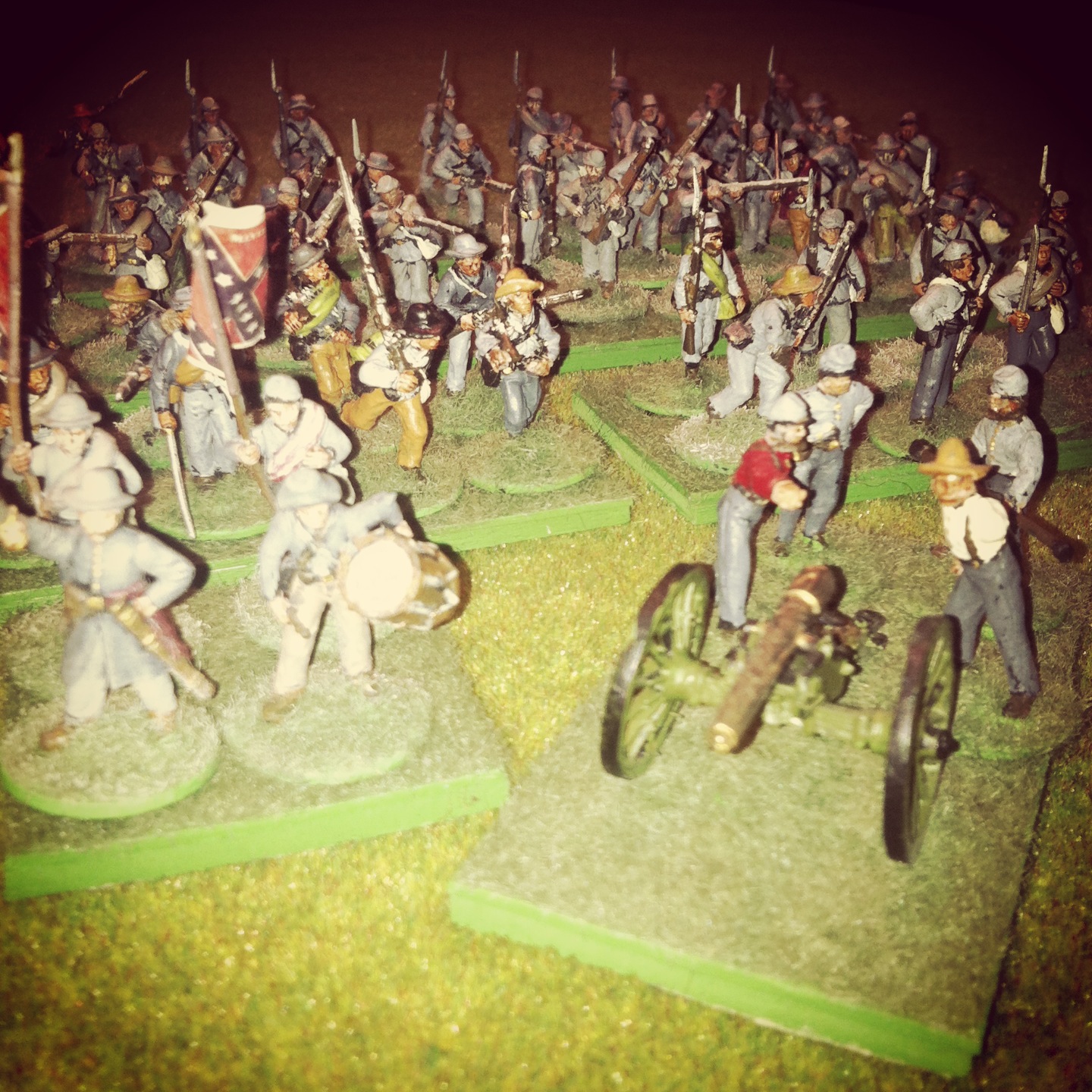
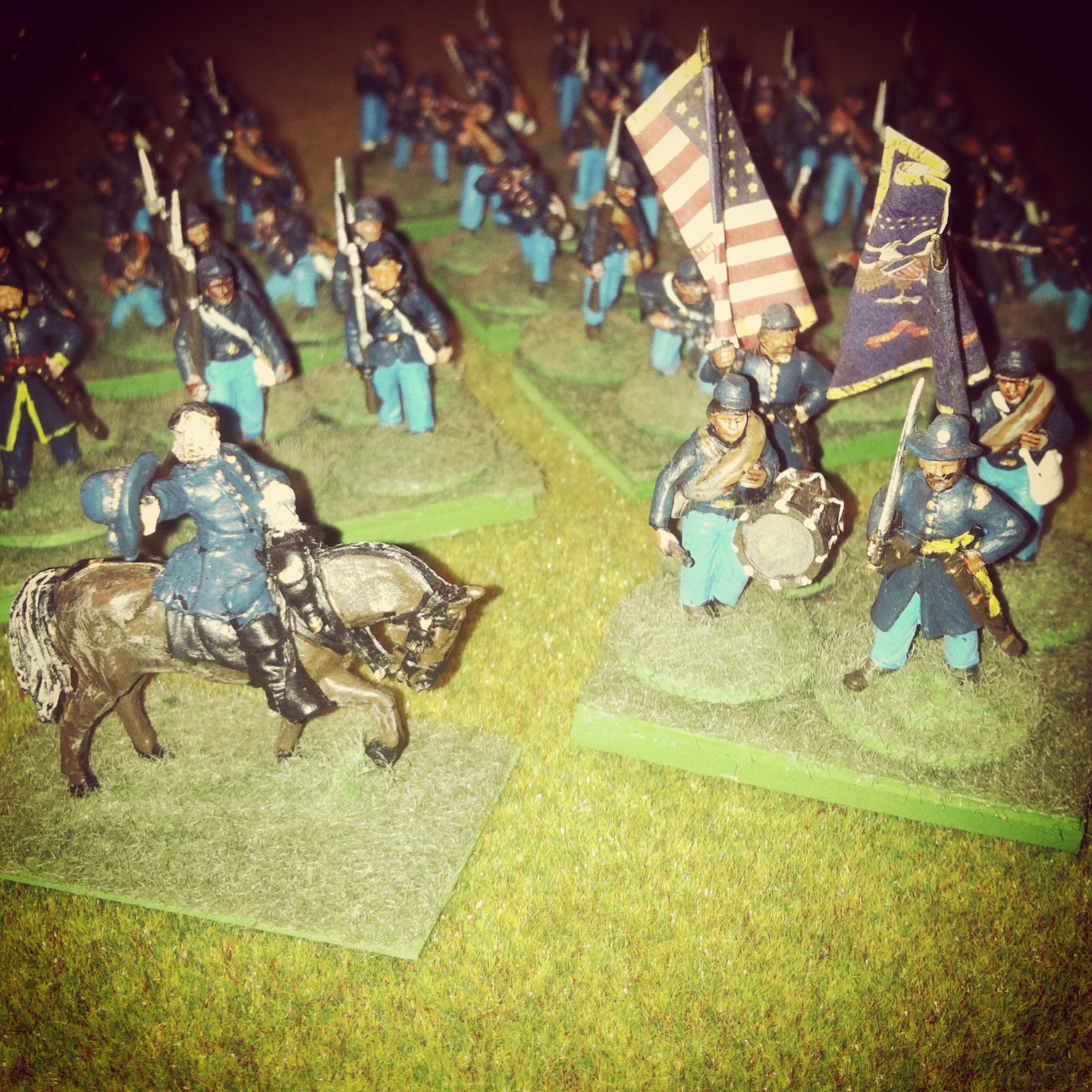
Without going into the details of assembly (relatively easy) and painting technique (also quite easy), I’ve got about 125 figures painted up now on each side. I’ve also completed some mounted and infantry command, artillery batteries and casualty figures. All figures are based on metal washers, and I also made some movement stands for each unit with magnetic sheets adhered to balsa bases.

First, some of the boys from the South…


And, some of the boys from up North…


Now that I’ve got a decent set of figures with which to play, I’m looking forward to setting up a real nice game with the Metropolitan Wargamers in Brooklyn this summer. Just in time for some key ACW anniversaries, I’m really happy to see my Blue and Grey hit the tabletop again.

The War Game of Norman Bel Geddes

I somehow missed it about a year ago when The Believer ran a great piece on the wargaming obsession of famed American designer and futurist Norman Bel Geddes. While his name may not resonate outside circles of early 20th-century design enthusiasts, Geddes is responsible for much of what we commonly think of when terms like “Art Deco” and “streamlined” are used. Most of Geddes’s fame today is linked to his design of the General Motors-sponsored Futurama exhibit at the 1939 New York World’s Fair and an iconic Art Deco radio commemorated with a US postage stamp in 2011.

Much of Geddes’s work — including the Futurama’s “world of tomorrow” display — was achieved through his obsessive and highly-detailed miniatures modeling. As featured during his life in such varied publications such as The New Yorker, Atlantic Monthly, Life Magazine, Popular Science, Ladies Home Journal and Arts & Decoration, Geddes poured an enormous amount of time and thousands of dollars of time into military scale modeling. Utilizing his extensive library of military books and journals (now held in the University of Texas archives), thousands of ships were crafted from brass with exacting detail and enormous topographically-accurate sea and land playing tables were constructed by Geddes in his family’s Manhattan apartment.

Geddes moved in prominent 1920s-40s New York social, professional and intellectual circles, which led to his hosted sessions of what was simply referred to as “The War Game” to be celebrated events reported on in local papers. Movie stars, socialites, politicians, foreign dignitaries and even rumored retired military brass are said to have been frequenters of the intense gaming sessions. The weekly games ran for months on end, used a rules system Geddes designed himself and were documented in immense detail on record cards, charts and maps run on the printing press Geddes kept in the house. The archive at the University of Texas just hints at the wealth of information on how The War Game grew over the two decades of play among Geddes and his circle.

Like the games played among H.G. Wells and his friends recounted in his book Little Wars, time spent reading through the many articles now archived online of Geddes and his games reveals a vast little-known era of gentlemanly wargaming in New York City. As I look ahead to another weekend of gaming with the Metropolitan Wargamers, I can’t help but feel the rippling tradition of small and obsessive battles waged in the basements of the city to this day.

Favorite Tabletop Games Kickstarters of the Month (May 2013)

Earlier this week, I wrote about how I believe Kickstarter to be the latest incarnation of how gamers have contributed to the decades-long conversation on who truly “owns” our hobby. This had me delving deep into what’s current on Kickstarter’s Tabletop Games section.

To date, I’ve honestly only contributed to one tabletop games Kickstarter project. The modest fundraising drive for A Las Barricadas which brought in just under $10,000 for a game that has since been delayed but promises to be shipping soon. While I wait for this little game of street protest pitting Occupy Wall Street-like demonstrators against the police to arrive, I thought I’d share a few projects I’m watching this month.

Moby Dick, or the card game: Like any good English Literature major, I’m a fan of Herman Melville’s epic American tale of one man’s obsession with a whale. On the flipside, I am not generally a fan of card games. That said, this card game of the high seas boasts some truly marvelous woodcut-like artwork and what looks to be an entertaining game of the best recruited crews trying to survive in their quest to spear the Great White Whale.

All Quiet On The Martian Front: Showcasing 15mm miniatures of Martians vs. early 20th-century human armies, this game uses the H.G. Wells sci-fi classic as a jumping-off point to imagine a world of humans locked in protracted combat with alien invaders. The models look fantastic, mining the very-popular steampunk trend in gaming today. Supporters of the game (particular those pledging in the hundreds of dollars) will net a lot of cool looking stuff with its funding.

Canterbury: Nothing gets me going like a great Euro-style worker placement game, so this is particularly enticing. The game places you in the age of Saxon Kings, and your aim is to build the greatest of cities starting with only a well in the wilderness. Managing your growing population, resources, culture, military and ongoing construction of buildings, the game claims to be one of pure skill and planning with no luck factor whatsoever. This one looks like a beauty and I’ll be anxious to give it a play when it is published later this year.

 Wargaming Terrain for the American Frontier: I don’t play games in the period, but the latest from Acheson Creations presents more than a dozen wonderfully-crafted 28mm buildings from the pioneer, settler and Native American era of 18th-century colonial America. I particularly like the longhouses and wigwams, possibly inspired by the local tribal history of the Western New York and the Rochester area where the creators (and I) hail from. The blockhouse, fort wall sections, barn and cabin models also look great and could easily be used in other eras or in fantasy gaming scenarios, too.

Civil War Toy Soldiers: This final project has less to do with gaming and more to do with the special spot in my heart for the toy soldiers of my childhood, especially around the holidays. Cast in soft plastic and a large 54mm scale, this new line of Union soldiers have been launched to compliment Cunnyngham Collectibles’s existing Southern troops. The poses, liveliness and equipment details on these guys make for some really cracking personality. A few bags of these fellas on the floor or in the tall grass and I’d be transported back to when I first fell in love with little plastic men nearly 40 years ago.

Zulu War: British 24th of Foot Regiment in 28mm

One of the big goals I set for myself this year was to have at my Anglo-Zulu War era project in 28mm. Most of my gaming interest has a US tie-in — American Civil War and WWII — but I am just fascinated by the dynamics of the in late 19th-century British campaigns of invasion fought in Sub-Saharan Africa . Now, after a few months of on-again-off-again toil, my British forces are looking pretty sharp and battle-ready.

I first picked up a couple boxes of plastic Anglo-Zulu War era British from Wargames Factory at a convention flea market for just $8 each (quite a deal from the $20 retail price). At 25 figures per box, these run under a buck per soldier at full cost. The sprues come with head and arm options for firing, loading, advancing and at-the-ready pose variations. The casting is a bit chunky, all figures are standing fully upright and no command figures are available, so there are some trade-offs for the relative value of these figures. Wargames Factory’s Anglo-Zulu War line is also very limited in that they only offer this one box of British and another of Zulus. Still, they’re a great bang-for-your-buck option, especially for an era that requires fielding a lot of soldiers on the table.

For variety and comparison’s sake I next bought a box of British infantry from Empress Miniatures and Warlord Games. Their expanding “Anglo-Zulu War 1879” line offers a nice mix of plastic and metal British, Zulu and allied forces along with terrain, artillery, cavalry and other nice models. Their British infantry box runs about $32 for 24 figures making their cost-per-figure a bit pricier than the offering from Wargames Factory at over a dollar each. However, their figure sculpting is a fair amount finer and the pose options allow for more variety. The boxed set also includes crouching figures, making double-ranked firing lines a possibility. Along with twenty plastic infantry armed with rifles, the box comes with four metal command stands which fill a basic need for most Anglo-Zulu War gaming. I’ve rounded-out my force with an additional 16 metal figures in various crouching poses and four more metal officers from Empress Miniatures in poses that vary from those in the box set. The metal figures run more than $2 each, but by spreading them among the less expensive plastics I’ve achieved what I think is a nice variety.

In sum, my first round of modelling the 24th of Foot will net me 76 infantry stands commanded by 8 officers. This will give me a nice Company-sized British force broken out into two Platoons of two Squads each of 20 figures (including command).

Here’s a couple work-in-progress photos:


My challenge now is to tackle my Zulus which are typically fielded in a ratio of (at least) 3:1 to British figures in many gaming systems. I have a few Zulus already painted shown along with some of my new British below, but it looks like I’ve got many hours of painting still to go in the coming months.

American Civil War: ACW Artillery in 28mm

I spent this past Sunday at the Metropolitan Museum of Art in New York City and caught the absolutely spectacular “Photography and the American Civil War” exhibit which runs through September 2, 2013. The hundreds of photos cover a bit of the same ground as past exhibits, documentaries and books, but there’s a lot I had never seen before, too. What spoke to me most were the dozens of simple individual soldier photos. The contrast between the dressed-up idealistic pre-war studio portraits and the devastatingly gruesome prisoner of war and hospital images is wrenching.

Aside from the portraits occupying the bulk of the show, one of my favorite photos from the show was the one shown below by Timothy O’Sullivan from 1864.

Titled “Pennsylvania Light Artillery, Battery B, Petersburg, Virginia,” O’Sullivan’s small photo (maybe 3″ x 9″) purports to give a rare glimpse of a full artillery battery either drilling or possibly in actual combat. The mass of guns, crew and equipment shows the full size and complexity an artillery section brought to the fields of the American Civil War 150 years ago.

My go-to favorite miniatures company for my American Civil War 28mm gaming is Perry Brothers for both their sculpting and reasonable cost in both their plastic and metal ranges. I have three artillery teams painted up  from their metals line, but more guns would always be better. However, each gun team currently runs me about $12. At this price, modelling realistic large-scale batteries like those in the O’Sullivan photo from the Met has seemed pretty cost-prohibitive.

Well, over at the Perry Brothers Plastics Workbench section of their site, they’ve just recently teased a few plastic sprues of artillery which will include carriages, limbers, multiple barrels and crew. The flexibility of the soon-to-come set will allow for modelling of different crews — North and South — as well as rifled and smoothbore gun types.


There’s no release date for this set as of yet, but in the meantime there are some nice work-in progress shots I’ve shared here. With a few of these assembled and painted up on each side of my tabletop battlefield, my games will get an added boost of realism captured timelessly in the hundreds of photos currently on view here in New York.

American Civil War: Duryee’s Zouaves in 28mm

Any American school kid with a passing knowledge of the American Civil War will be able to immediately recognize the classic blue uniform of Northern forces and the less regular gray and earth-toned make-up of Southern troops. What’s lesser-known is the fanciful variety that was found in uniforms of some units during the war.

Immediately preceding the American Civil War, Europe’s Crimean War of the 1850s saw the Russian Empire facing off against an alliance of the French, British and Ottomans. The French Zoauve uniform of the Crimean War went on to inspire military uniforms in the United States, and one of the more notable Zouave regiments of the Civil War period was the 5th New York Volunteers or Duryee’s Zouaves.

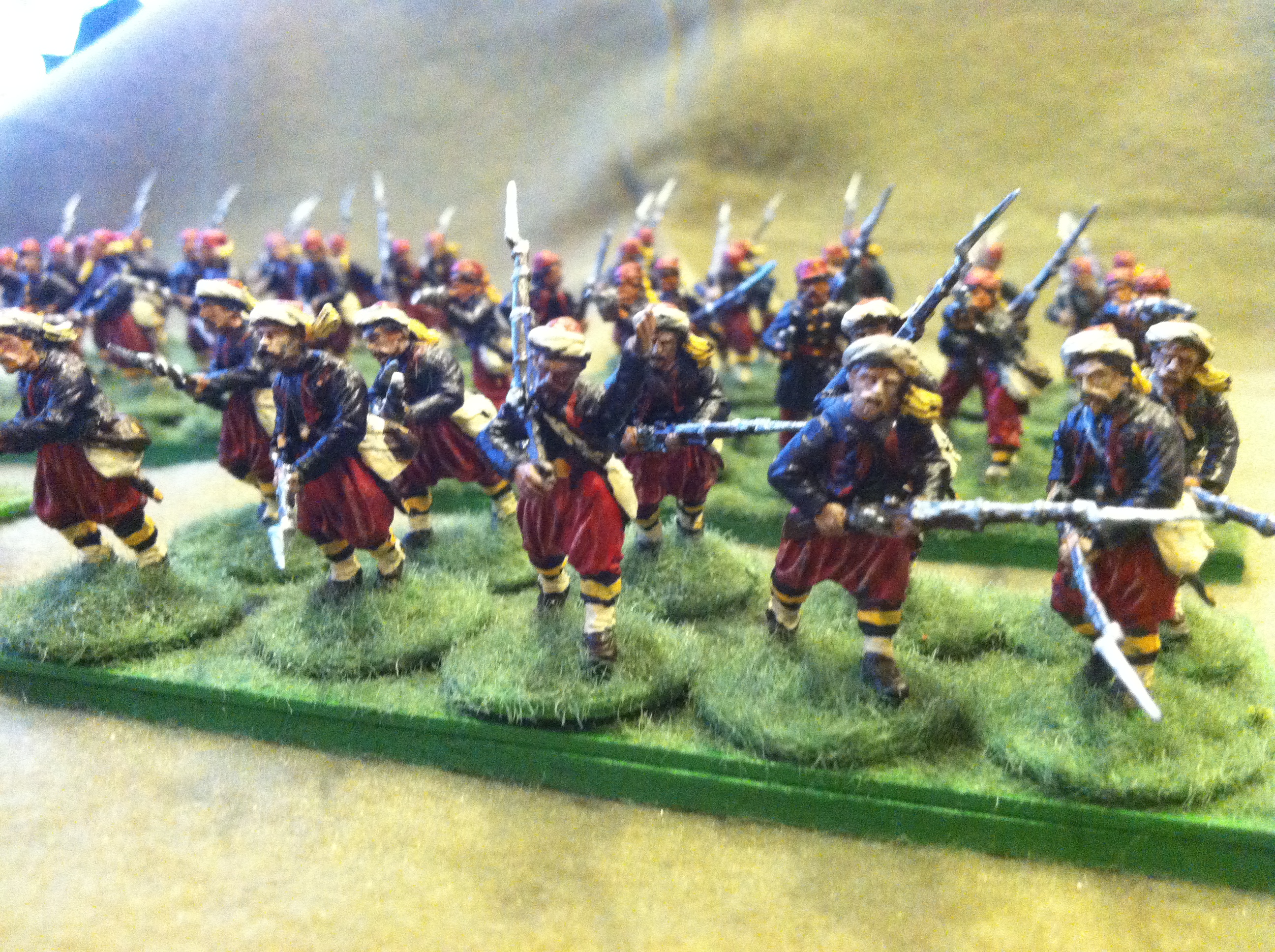
Formed in New York City in 1861 by Colonel Abram Duryée, the 5th NY Volunteers would find action throughout the war at Second Bull Run, Antietam, Chancellorsville and Fredericksburg. But it’s the uniforms that make the 5th NY a memorable unit for me. Dressed in baggy red chasseur trousers, dark blue jackets with red braiding and topped in fezzes with yellow tassels, Duryee’s Zouaves offer up one of the more colorful units to deploy on a Civil War gaming table. While some period drawings and photos exist in black and white, the true whimsy of these uniforms can really only be found in the work of modern artists like Don Troiani  (see above) or with active 5th NY Volunteer re-enactor groups.

For miniatures, I love the affordable and well-sculpted variety to be found in the line of 28mm American Civil War models from Perry Brothers. My 5th NY Volunteers are a mix of a Perry Brothers plastic Zouave box set and two sets of their metal Zouave firing/skirmishing line. Perry Brothers offer a nice variety in optional poses and heads in their plastics, and the metal figures offer just a bit more crisp detail. I chose to model most of my Zouaves in their fezzes, as this is how they usually appeared in battle. For variety’s sake, I modeled one unit with turbans which were more common in ceremonial and parade settings. The box set also offers arm options to represent units advancing at “right shoulder shift” and “at the charge” with bayonets leveled at the enemy lines.

Below is an overview of my completed five squads from the 5th NY Volunteers along with their company command stand.

And here’s a close-up of the company command below.

I painted most of the company in their more common battlefield fez headgear, shown below in detail. These figures are the metal Perry Miniatures firing line, while the rest of the company are plastics.

And finally, here’s the one squad in their turbans.

Painting Duryée’s Zoauves was a great break from my usual painting, and now I’m already thinking of some other specific units from the Civil War to mix up the walls of blue and gray lining my tabletop battlefield.