Retro Gaming The 70s & 80s: TSR Minigames


Alternatively known as “microgames,” “pocket games” or “minigames,” a number of companies created a fad in games in small packages in the late 1970s through early 1980s. These compact games came in a variety of historic, sci-fi and fantasy themes. Rulebooks, maps, cardboard chips and dice were usually packaged in hardshell cases or even simple zip-lock plastic bags. A very few of these games, like the post-apocalyptic Road Warrior-esque Car Wars from Steve Jackson Games, would see a long life fueled by supplements and expansions. More commonly, these minigames were stand-alones of vastly varying quality which faded into obscurity in a few short years.

TSR, the makers of Dungeons & Dragons, entered the minigame market late with a total of eight games released in the first couple years of the 1980s. This was a big growth period for TSR as they continued to diversify beyond their core D&D products into other boardgames, role-playing games, toys, computer and video games, and even an animated TV show. Already investing a ton of our time and money in TSR products, my brother and I snapped four of their minigames:

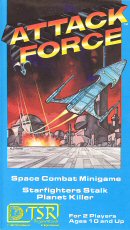
  • Attack Force was a simple Star Wars rip-off with one player’s force of small star fighters attempting to find the weakness in the other player’s monstrous space station to destroy it. As a fan of Luke’s attack on the Deathstar, I gave TSR a pass on the lack of originality for the chance to do some space battling myself.
  • They’ve Invaded Pleasantville was also a two-player game, this time set in a rural village where the townspeople try to fend off alien invaders infiltrating the local populace. Each player used identical chips representing such local folk like the minister, sheriff, plumber, checkout girl and others. The trick of the game was the alien invader bluffing their way toward taking over the bodies of the locals while the town player sought to uncover who was really an alien.
  • Revolt on Antares was a much better sci-fi-themed game and offered play for 2 to 4 players. The game presented a Risk-like map of a fictional world where six ruling “houses” with names like Andros, Dougal and Serpentine fought to rule the planet through three different scenarios. Each house had its own personality and strengths, adding a lot of variety and replay value. The ability to recruit new troops, move across varied terrain and use seven special alien weapons or devices made this little gem seem a lot more like a real wargame.
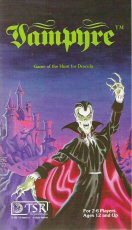
  • Vampyre was two games in one set in the realm of Bram Stoker’s “Dracula.” The first campaign-map-style game took 2 to 6 players in the roles of Stoker’s hero characters questing to find and destroy the coffin safe-havens of Count Dracula hidden throughout Transylvania. Turning the map over, a detailed floorplan of Castle Dracula allowed another game to be played as the characters sought to track down the Count himself and destroy him.

As a kid, I loved these games as a break from the longer hours spent bent over the table with my D&D campaigns. Each minigame offered its own varied mechanic, but rules were simple and limited to just a few pages for each game. The booklets, game maps and cardboard playing chips contained some wonderfully intricate small-scale artwork, much of it by popular fantasy artists of the day. While I don’t recall the exact cost of each game, I remember them being under $10 apiece and quite a deal for the hours of play we wrung out of each.

These four TSR games still sit in a closet packed full of my childhood puzzles and boardgames in the house where I grew up. At the time, there was an outsized amount of fun in each little mingame package. Today, there’s still a lot of memory in each, too.

Collector’s Note: Many of the TSR minigames can be found frequently on eBay selling in the $10-30 range. Steve Jackson Games makes much of their Car Wars and other microgames back catalog available for digital purchase online.
Retro Gaming The 70s & 80s: Dungeons & Dragons Computer Labryinth Game

By 1980 I was like a lot of kids with feet in two worlds of gaming — Dungeons & Dragons and electronic games. Both were well on their way to being the worldwide phenomena they would become in the next decade, and Mattel and TSR (then owner of D&D) sought to cash in on the intersecting interest of adolescents everywhere.

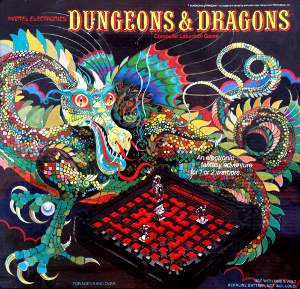
I never owned a copy of Mattel’s Dungeons & Dragons Computer Labryinth Game, but plenty of my friends did. The game looked pretty cool with its 64-square grid of spaces surround by a plastic castle-like wall. Metal figures represented a dragon, two adventurers and a treasure chest. The game could be played solo or with two players. A player moved their piece around the board, placing plastic walls when the board revealed a wall with light-up indicators. Other indicators would light up as you encountered monsters, traps or the dreaded dragon which roared as you approached. A player who avoided the dragon and navigated the revealed maze to the treasure first won the game.

A year before the D&D Computer Labryinth Game was released, Mattel was already competing in the new video game market with its Intellivision system. Those early years of the electronic game market were full of games which promised more than they delivered. Using the word “computer” in this game’s name was no doubt the work of shrewd marketing as the game itself was pretty low tech. Attaching the D&D graphics and brand to the game and even a moody TV ad didn’t do much to cover up for its shortcomings. Looking back, I recall the game even then to be unsatisfying to occasionally frustrating with its randomized LED grid and pieces which never really seemed to fit right. Retailing at around $45, the game didn’t come cheap either.

In 1984, Mattel admitted to its failed also-ran place in the video game market and pulled the plug on its Intellivision system. While it would go on to continued success with its boy-focused toy brands like Hot Wheels, Matchbox and Masters of the Universe, Mattel would never again be  significant player in electronic games. D&D, on the other hand, continues to thrive to this day. While the brand extension foray of the D&D Computer Labryinth Game never really delivered on the promises illustrated in Mattel’s box art, the game does capture a moment in time when gaming was bridging the gap from one era to the next.

Collector’s Note: Complete copies and components of the Dungeons & Dragons Computer Labryinth Game are readily avilable on eBay. Games in the original box run in the $30-50 range while the metal miniatures generally go for $5-10 each.

Favorite Tabletop Games Kickstarters of the Month (June 2013)

I’ve spent a month tracking my favorite projects and looking for new fun stuff on Kickstarter’s Tabletop Games section. Of the five projects I wrote about in May, four have been succesfully-funded to date. I wound up throwing my support behind one of these, Canterbury, and I’m still hopeful things will turn out well for 54mm plastic Civil War toy soldiers project now in its closing days. Here are the other projects I’ll be watching in June.

Princes of the Dragon Throne: This fantasy-themed board game combines deck-building, area control and resource management. Players build recruits and vie for control of the board on their quest to be crowned upon the Dragon Throne at game’s end. There’s a ton of stuff in this box with over 200 miniatures and more than 500 components overall. The levels of support for the game plus the accompanying specially-crafted meeples comes in over $100, but it’s got dragons so the game looks to be well worth it.

Euphoria: Build A Better Dystopia: This Saint Louis, Missouri-based project launched in May but wraps up this month with a very successful funding run. In this worker placement game, dice represent your workers and cards represent elite recruits. Using your workers and recruits, each player attempts to establish a new empire by managing and selling resources, collecting artifacts, building alliances, and undermining your opposition by digging tunnels and launching devious agendas. Dystopian scenarios are a big fave of mine, and the artwork captured in the design of this game is marvelous.

Amerigo: Another successfully-funded game slated to finish its run in June is Amerigo by Queen Games. Players aid famed explorer Amerigo Vespucci in his quest to discover new lands, establish settlements and collect resources in the islands of South America. The game uses a nifty tower through which players drop and draw colored cubes which determine actions available on their turns. Pledging support at different funding levels scores you a copy of Amerigo as well as one (or more) of Queens Games’s other popular historic-themed games such as Alhambra, Shogun or Lancaster, making backing this project quite a deal.

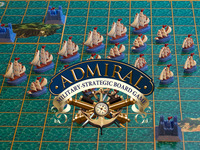
Admiral: In general, I don’t play naval games since I like the variety that a well-laid-out land terrain tabletop allows. That said, this game could get people like me interested in strategic wargaming on the high seas in the Age of Sail. The Ukrainian designers of this game have loaded the base game with 24 1:1700 scale ships that surpass their toy-like colors in their attention. Backers at higher levels get more islands, ships, seascape gameboard tiles and other game components, making supporting this project a fnatstic opportunity to set sail into a different kind of wargaming.

Giant 2 Inch Soft Foam Polyhedral Dice:  My final fave of the month is just goofy and fun. My two sons, ages 8 and 13, are familiar with real gaming dice at this point. But, if I had a small gamer-in-training in my life, these would be on my funding list. The set includes six large, squishy brightly-colored dice used in most gaming (D4, D6, D8, D10, D12 and D20) in a handy cloth storage bag. Appropriate for ages 3+, there’s a whole bunch of options for buying a la carte dice to supplement the basic set, and additional colors and number styles will be made available. What better way to introduce a kid to the wonders of gaming than throwing a few of these on the floor? Then again, they may just go nicely on my desk at work…

Memorial Day 2013 in Brooklyn

Memorial Day in Brooklyn saw a crowd of the guys gaming and grilling at Metropolitan Wargamers, but I chose to spend the sunny day with my youngest son retracing the historic military past in my own backyard.

I live about a 15-minute walk from Green-Wood Cemetery, a National Historic Landmark celebrating its 175th anniversary this year. The cemetery occupies a 478 acre hilly, picturesque landscape traced with winding roads and paths. It is a who’s who of New York City and American history, and the design of its entry gates, grave markers and mausoleums provides a visual history of how Americans have celebrated themselves in the afterlife across three centuries.

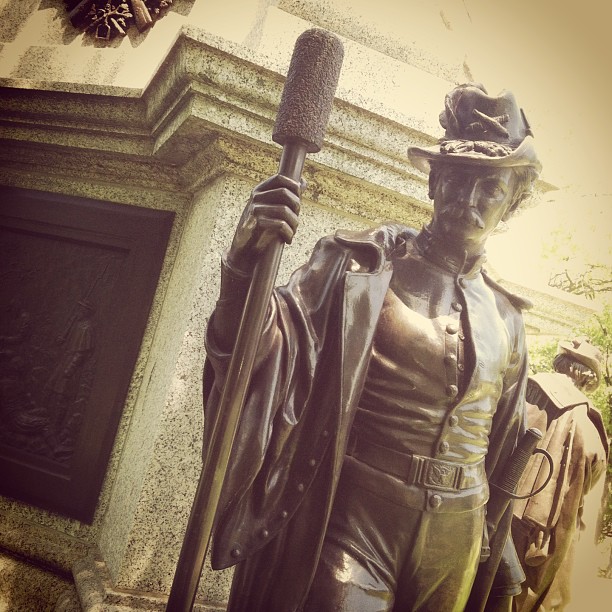
What we celebrate today as Memorial Day began as Decoration Day when freed slaves decorated the graves of Union dead following the American Civil War. Green-Wood’s marking of the war is found with 1869’s Civil War Soldiers’ Monument (photos below). The pillared monument ringed with four bronze statues was restored and re-dedicated in 2002. The re-dedication kicked off interest in documenting and marking the Civil War dead interred at Green-Wood, and to-date the Civil War Project has identified some 3,300 residing for eternity in the cemetery.


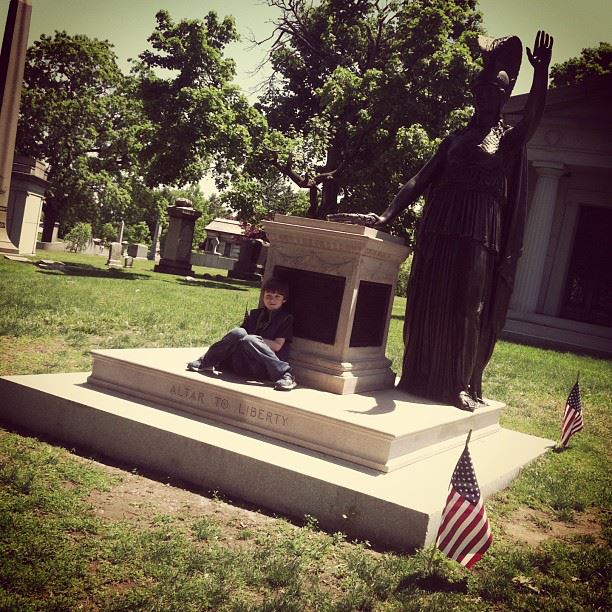
The Civil War Soldiers’ Monument sits along Battle Avenue and atop Battle Hill, the highest point in Brooklyn. The hill won its name for its important strategic role in 1776’s Battle of Long Island as Colonial forces held off multiple attacks on the far left of the invading British line. Standing on the hill today, you can clearly see the military importance of the hill with its broad views of the sloping land down to New York Harbor to the west and the island of Manhattan to the north. The battle is marked with the Altar of Liberty (photo at right), a 1920 monument installed as part of the plot of Brooklyn India ink magnate Charles Higgins. The bronze statue of Minerva raises her arm to the Statue of Liberty standing in the distant harbor, making the view from Battle Hill on a clear, sunny day one of the most breathtaking vistas in the city.

Next, we wound our way toward the center of the cemetery and to the family plot of Abram Duryée (photos of Duryee and his monument below). I’m a fan of Duryee and his command of the 5th NY Volunteer Infantry during the Civil War. Known as “Duryee’s Zouaves,” these Manhattan men saw action throughout the war at such battles as Second Bull Run, Antietam, Chancellorsville and Fredericksburg. I’ve made the 5th NY with their baggy red chasseur trousers, dark blue jackets with red braiding and fezzes with yellow tassels a big part of my 28mm American Civil War painting project this past year, so it was great to stop and pay tribute to him at his final resting place.


Our final destination of the afternoon was to the grave of General Henry Wager Halleck, a relative of mine (photos of Halleck and his monument below). Halleck served as General-In-Chief of Union forces for about two years of the Civil War before being replaced by the much more famous General Ulysses S. Grant. Known more for his intellect than his military exploits, Halleck was nicknamed “Old Brains” during the war and spent his years after the war as a lawyer and author. While by no means a household name, I was glad to have the opportunity to visit his grave again after many years.


As a wargamer, my hobby wouldn’t exist without wars and the men and women who fight and die in them to this day. On this Memorial Day, it was a good change of pace to put down my dice, step away from the tabletop and venture out for a few hours visiting the monuments to those who have paid the ultimate price throughout American history.

New Game Weekend: Dust Tactics

The long Memorial Day weekend was as good a time as any to roll up my sleeves for a big day of wargaming, and the Dust Tactics Regional Tournament at the Compleat Strategist in New York City on Saturday May 25th was the place to be.

I signed up my son and I for two slots in the small tournament organized by a fellow club member at Metropolitan Wargamers in Brooklyn. The two of us were newbies to Dust Tactics but I had certainly read a lot about it since its release last year by Fantasy Flight Games. Dust Tactics is an alternate reality WWII-era game where alien technology is discovered by Germany in the late 1930s and goes on to shape a world of warfare between the Axis and Allies throughout the 1940s.

As is expected with FFG releases, Dust Tactics is a gorgeous game ready to play straight out of the box for about $80 retail and cheaper online. The core set comes with a dozen infantry forces for each side plus heavily-armored walkers. The box contains two two-sided fold-out gaming mats , special dice, rules, a scenario guide, reference cards and a few rudimentary plastic terrain pieces. There’s a large variety of additional accessories, campaign expansions and army packs available in the price range of $15 to $45. All this makes Dust Tactics very collectible and flexible as a gamer’s interest expands and wallet can abide. The models are gorgeous and mostly pre-assembled at a hefty 1:48 scale with a visual appeal bridging interests from WWII into a dystopian sci-fi theme.
For the tournament, we rolled-off to choose our armies and then paired-up with other players for the first round of three games. The organizer of the tournament is way into Dust Tactics, and he hauled along his extensive collection of miniatures for players to choose from. My son chose to play as the SSU (aka Soviets) and backed his ground troops with a monstrously deadly helicopter. I chose to play as the Axis (aka Germans) with laser-armed ground troops, a huge four-legged walking gun platform and a squad of weaponized gorillas.

Dust Tactics plays pretty easily and fast. After the board is set and a scenario is chosen, players take turns performing two actions with each of their units. Combinations of move/fire, fire/move or deadly sustained fire are the most common actions. Range and strength of weaponry is clearly listed on each unit’s reference card. Special dice with hits on two sides and misses on the other four resolve combat, damage and saves from taking damage in cases where troops wear special armor.

Each game was timed at an hour with a maximum of eight turns per game. My son (above left) and I were easily beaten in the first round by more experienced players. What we both quickly learned was a lot of the game outcome could be pre-determined by the forces chosen by a player. Too much reliance on our heavy mechanized forces had also led to quick defeats for the both of us once they were destroyed in the first round.

In the second round, my son and I played off against each other with a bit more knowledge of the capabilities of the forces on the board. We each scored lucky shots early in the game, again knocking out each other’s heaviest armaments. After that, the game settled into a really enjoyable cat-and-mouse between buildings and barriers as our infantry, snipers and smaller mechanized walker units dueled it out to my eventual victory by a slim margin.

For the third and final round, the tournament organizer and house expert on Dust Tactics played against my son. Failing to focus early on destroying my son’s massive helicopter gunship drifting eight inches above the table, my son managed a solid win by picking off the tournament organizer’s ground units from the air with his multiple weapons. I got crushed in my final game as I faced-off against another Axis player who had stacked his forces with fast-moving zombie and gorilla units. These savage figures ran right over most of my ground units and even my artillery platform was eventually torn to pieces by the ape squad.

So, we didn’t do so well with our first go-around at Dust Tactics but we did have a good time. Dust Tactics is a fun little game that looks fantastic and plays pretty easy. The common criticism I’ve heard and experienced a bit today is that the game looks better than it plays. A detailed knowledge of all allied and opposing units is pretty necessary in fielding an effective force in the game. A few poor moves or die rolls can also pretty much end a game in an opening turn, making for some frustration I myself felt in my first game today.

There does seem to be a glimmer of future hope for a next stage of Dust Tactics. An announcement was made this month that Battlefront Miniatures will be taking over publishing and distribution of the game and the tabletop version, Dust Warfare. Battlefront’s past success with its Flames of War WWII gaming system had fans hotly debating the possible outcomes that may bring a bit more finesse to Dust Tactics over time. For now, the combination of some high-style miniatures with a somewhat less-than perfect set of rules still makes Dust Tactics more than worth a rainy day play.

The War Game of Norman Bel Geddes

I somehow missed it about a year ago when The Believer ran a great piece on the wargaming obsession of famed American designer and futurist Norman Bel Geddes. While his name may not resonate outside circles of early 20th-century design enthusiasts, Geddes is responsible for much of what we commonly think of when terms like “Art Deco” and “streamlined” are used. Most of Geddes’s fame today is linked to his design of the General Motors-sponsored Futurama exhibit at the 1939 New York World’s Fair and an iconic Art Deco radio commemorated with a US postage stamp in 2011.

Much of Geddes’s work — including the Futurama’s “world of tomorrow” display — was achieved through his obsessive and highly-detailed miniatures modeling. As featured during his life in such varied publications such as The New Yorker, Atlantic Monthly, Life Magazine, Popular Science, Ladies Home Journal and Arts & Decoration, Geddes poured an enormous amount of time and thousands of dollars of time into military scale modeling. Utilizing his extensive library of military books and journals (now held in the University of Texas archives), thousands of ships were crafted from brass with exacting detail and enormous topographically-accurate sea and land playing tables were constructed by Geddes in his family’s Manhattan apartment.

Geddes moved in prominent 1920s-40s New York social, professional and intellectual circles, which led to his hosted sessions of what was simply referred to as “The War Game” to be celebrated events reported on in local papers. Movie stars, socialites, politicians, foreign dignitaries and even rumored retired military brass are said to have been frequenters of the intense gaming sessions. The weekly games ran for months on end, used a rules system Geddes designed himself and were documented in immense detail on record cards, charts and maps run on the printing press Geddes kept in the house. The archive at the University of Texas just hints at the wealth of information on how The War Game grew over the two decades of play among Geddes and his circle.

Like the games played among H.G. Wells and his friends recounted in his book Little Wars, time spent reading through the many articles now archived online of Geddes and his games reveals a vast little-known era of gentlemanly wargaming in New York City. As I look ahead to another weekend of gaming with the Metropolitan Wargamers, I can’t help but feel the rippling tradition of small and obsessive battles waged in the basements of the city to this day.

New Game Weekend: Pacific Typhoon

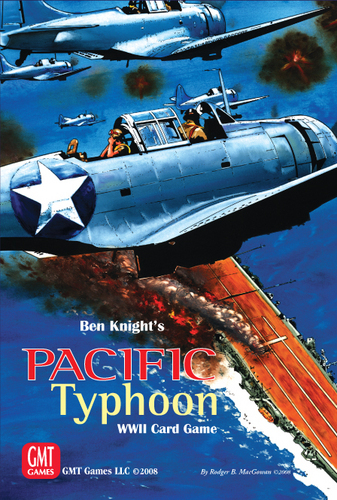
It was the second rainy weekend in a row in New York City, but a crowd of guys made it down to the Metropolitan Wargamers club in Brooklyn Sunday afternoon. With seven of us standing around the table trying to come up with a big enough game with easy rules that could be played in a couple hours, a few people tossed out the idea of 2008’s Pacific Typhoon by GMT Games.

This WWII Pacific Theater naval battle card game was originally produced as a sequel of sorts to Avalon Hill’s Atlantic Storm  game from the late 1990’s. Created for 3-7 players ages 10 and up, Pacific Typhoon is simple to grasp with a pretty straightforward trick-taking format yet enough opportunity for interaction among players to keep a group of hearty experienced gamers engaged for the afternoon.

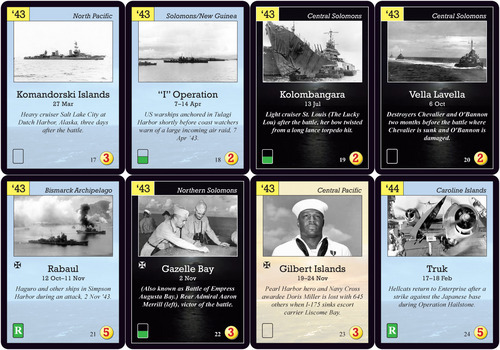
Pacific Typhoon comes with 140 force cards and 40 battle cards plus a couple dice and a rulebook, making this a compact and entertaining game for medium to large groups. The cards themselves are simple but have nice black-and-white WWII period photos and contextual factoids which add flavor to the game. Plus, at just $20 direct from GMT Games, Pacific Typhoon carries a lot of fun at a really friendly price.

Each player begins by drawing a hand of six force cards. Cards depict historical Japanese (red, top left) and Allied (blue, middle left) naval forces plus upgrade and event cards. The starting player draws two battle cards (black-edged, bottom left) and chooses one of the two to play. Play goes around with each player choosing in turn to commit a Japanese or Allied force card to the battle. Players contribute the points on their cards to the total strength of each side in the battle, and the side with the most points wins that battle. The player with the highest point value on the winning side then divies up the points among the winning players, and the next round begins.

As described above, the play is really straightforward but there’s a lot of flexible play in each round. Battle cards take place in a specific year (’41, ’42, 43, etc.) and during day or night. The player choosing the battle also calls whether the battle is to be fought with submarines, on the surface or by air. A battle combination such as “night battle, surface, ’44” will determine which force cards the players can choose to play in the battle.

With force cards with varying levels of strength, bonuses, year, time of day and type, each battle plays out differently. Alliances among players are created and broken with each battle, with players choosing which side to support as a gamble toward contributing to whichever side will win. For example, a turn may start with Japanese cards being played to what looks like a certain victory until a group of subsequent players decide to pool their Allied cards and win in an upset. As the game progresses, winning players dole out points rewarding their allies in each round while making certain to hold enough points for themselves ahead of the whole group at the game’s end.

With alliances and double-crosses sailing back and forth over the table in each round, Pacific Typhoon is a game rife with good-natured team-play and trash-talking. Pacific Typhoon ultimately makes for a great mix of individual and collaborative play within a casual trick-taking card game good for beginners and experts alike interested in spending a couple hours re-fighting famed WWII battles of the Pacific high seas.

New Game Weekend: A Bridge Too Far: Operation Market Garden

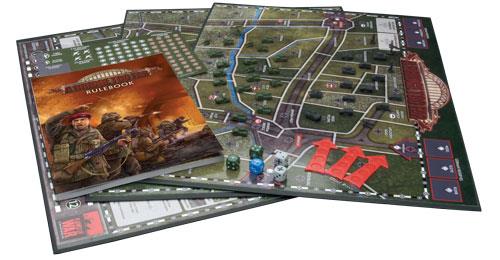
Maybe it was the dampness and spring chill, but Saturday night at Metropolitan Wargamers in Brooklyn was pretty empty with just me and one other club member around. We decided on a two-player boardgame, and being big WWII enthusiasts we picked 2010’s A Bridge Too Far: Operation Market Garden from Battlefront Miniatures.

I’ve been a long-time fan of the 1977 film A Bridge Too Far featuring a classic international cast recounting the events of Operation Market Garden and the botched Allied attempt to chase the Germans out of a number of key defenses in the Netherlands in September 1944. The film does an entertaining job of depicting the colorful real-life personalities against a backdrop of a daring daylight airborne invasion, over-confidence in the weakness of the German forces and disagreement among commanding Allied staff on the plan itself. The game offers two scenario set-ups giving the option of refighting the battle as rather historically depicted in the film or through a plan of your own devising. The game we played was the historical one, and I commanded Field Marshall Marshal Bernard Montgomery’s British and US forces.

The game involves five play turns with a random number of battles making up each turn. Initiative is rolled before each battle, and targeted objective spaces on the board are chosen to attack. Each player chooses to commit some, all or none of their forces to each battle. Different forces – tanks, guns and airborne infantry – each provide bonuses modifiers in different terrain types. Defenders of areas containing bridges get an extra bonus. Resolving combat is a simple roll of the dice with modifiers added. Defeated forces roll to be destroyed or retreat to adjoining areas, and then the next initiative is rolled for. Once a round of battles is completed, strategic moves can be made and the Allied player has the option to air-drop additional forces and supplies into designated areas of the board. The Axis player can then choose to attempt to fend off the Allied air support with their own air power. Keeping supply lines intact is key to the Allied strategy, as forces which are cut-off from their line of supply suffer a greater weakness in subsequent battles.

Typical of games by Battlefront Miniatures, makers of the popular WWII 15mm miniatures game Flames of War, this game packs some great design and ease of play into a neat box. While each battle and turn of play involves a number of steps, the game moves along quickly in about 90 minutes. The game comes with over 40 well-sculpted plastic playing pieces, but the version at the club had been modified with painted metal micro-scale armor and troops. Gamers who long-ago graduated from Risk to games like Axis & Allies will find a lot to love in the focused presentation of this game.

Even with the relative simplicity of the game, there’s a lot of strategic play potential. My first time through, my Allied strategy of pushing hard from the rear and left flanks of the board stalled rapidly as my tanks were quickly destroyed by some disastrous die throws against German anti-tank guns. My paratroppers dropped effectively into the middle of the board, yet they too became surrounded and snarled by the superior German armor defending the game’s main objectives. By four turns in, I faced certain defeat with no additional hope for much-needed tank support for my floundering airborne troops.

For a notoriously one-sided battle, I can easily see a lot of replay value in this game . I hope to give this one another shot soon, trying out some less historical and more aggressive strategies in running the Germans off the field. Having a chance to remake history is one of the joys and challenges of wargaming, and the board game A Bridge Too Far: Operation Market Garden provides a lot of opportunities to do so.

Favorite Tabletop Games Kickstarters of the Month (May 2013)

Earlier this week, I wrote about how I believe Kickstarter to be the latest incarnation of how gamers have contributed to the decades-long conversation on who truly “owns” our hobby. This had me delving deep into what’s current on Kickstarter’s Tabletop Games section.

To date, I’ve honestly only contributed to one tabletop games Kickstarter project. The modest fundraising drive for A Las Barricadas which brought in just under $10,000 for a game that has since been delayed but promises to be shipping soon. While I wait for this little game of street protest pitting Occupy Wall Street-like demonstrators against the police to arrive, I thought I’d share a few projects I’m watching this month.

Moby Dick, or the card game: Like any good English Literature major, I’m a fan of Herman Melville’s epic American tale of one man’s obsession with a whale. On the flipside, I am not generally a fan of card games. That said, this card game of the high seas boasts some truly marvelous woodcut-like artwork and what looks to be an entertaining game of the best recruited crews trying to survive in their quest to spear the Great White Whale.

All Quiet On The Martian Front: Showcasing 15mm miniatures of Martians vs. early 20th-century human armies, this game uses the H.G. Wells sci-fi classic as a jumping-off point to imagine a world of humans locked in protracted combat with alien invaders. The models look fantastic, mining the very-popular steampunk trend in gaming today. Supporters of the game (particular those pledging in the hundreds of dollars) will net a lot of cool looking stuff with its funding.

Canterbury: Nothing gets me going like a great Euro-style worker placement game, so this is particularly enticing. The game places you in the age of Saxon Kings, and your aim is to build the greatest of cities starting with only a well in the wilderness. Managing your growing population, resources, culture, military and ongoing construction of buildings, the game claims to be one of pure skill and planning with no luck factor whatsoever. This one looks like a beauty and I’ll be anxious to give it a play when it is published later this year.

 Wargaming Terrain for the American Frontier: I don’t play games in the period, but the latest from Acheson Creations presents more than a dozen wonderfully-crafted 28mm buildings from the pioneer, settler and Native American era of 18th-century colonial America. I particularly like the longhouses and wigwams, possibly inspired by the local tribal history of the Western New York and the Rochester area where the creators (and I) hail from. The blockhouse, fort wall sections, barn and cabin models also look great and could easily be used in other eras or in fantasy gaming scenarios, too.

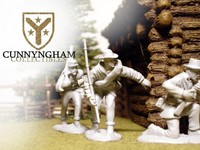
Civil War Toy Soldiers: This final project has less to do with gaming and more to do with the special spot in my heart for the toy soldiers of my childhood, especially around the holidays. Cast in soft plastic and a large 54mm scale, this new line of Union soldiers have been launched to compliment Cunnyngham Collectibles’s existing Southern troops. The poses, liveliness and equipment details on these guys make for some really cracking personality. A few bags of these fellas on the floor or in the tall grass and I’d be transported back to when I first fell in love with little plastic men nearly 40 years ago.

Zulu War: British 24th of Foot Regiment in 28mm

One of the big goals I set for myself this year was to have at my Anglo-Zulu War era project in 28mm. Most of my gaming interest has a US tie-in — American Civil War and WWII — but I am just fascinated by the dynamics of the in late 19th-century British campaigns of invasion fought in Sub-Saharan Africa . Now, after a few months of on-again-off-again toil, my British forces are looking pretty sharp and battle-ready.

I first picked up a couple boxes of plastic Anglo-Zulu War era British from Wargames Factory at a convention flea market for just $8 each (quite a deal from the $20 retail price). At 25 figures per box, these run under a buck per soldier at full cost. The sprues come with head and arm options for firing, loading, advancing and at-the-ready pose variations. The casting is a bit chunky, all figures are standing fully upright and no command figures are available, so there are some trade-offs for the relative value of these figures. Wargames Factory’s Anglo-Zulu War line is also very limited in that they only offer this one box of British and another of Zulus. Still, they’re a great bang-for-your-buck option, especially for an era that requires fielding a lot of soldiers on the table.

For variety and comparison’s sake I next bought a box of British infantry from Empress Miniatures and Warlord Games. Their expanding “Anglo-Zulu War 1879” line offers a nice mix of plastic and metal British, Zulu and allied forces along with terrain, artillery, cavalry and other nice models. Their British infantry box runs about $32 for 24 figures making their cost-per-figure a bit pricier than the offering from Wargames Factory at over a dollar each. However, their figure sculpting is a fair amount finer and the pose options allow for more variety. The boxed set also includes crouching figures, making double-ranked firing lines a possibility. Along with twenty plastic infantry armed with rifles, the box comes with four metal command stands which fill a basic need for most Anglo-Zulu War gaming. I’ve rounded-out my force with an additional 16 metal figures in various crouching poses and four more metal officers from Empress Miniatures in poses that vary from those in the box set. The metal figures run more than $2 each, but by spreading them among the less expensive plastics I’ve achieved what I think is a nice variety.

In sum, my first round of modelling the 24th of Foot will net me 76 infantry stands commanded by 8 officers. This will give me a nice Company-sized British force broken out into two Platoons of two Squads each of 20 figures (including command).

Here’s a couple work-in-progress photos:


My challenge now is to tackle my Zulus which are typically fielded in a ratio of (at least) 3:1 to British figures in many gaming systems. I have a few Zulus already painted shown along with some of my new British below, but it looks like I’ve got many hours of painting still to go in the coming months.