New Game Weekend: A Bridge Too Far: Operation Market Garden

Maybe it was the dampness and spring chill, but Saturday night at Metropolitan Wargamers in Brooklyn was pretty empty with just me and one other club member around. We decided on a two-player boardgame, and being big WWII enthusiasts we picked 2010’s A Bridge Too Far: Operation Market Garden from Battlefront Miniatures.

I’ve been a long-time fan of the 1977 film A Bridge Too Far featuring a classic international cast recounting the events of Operation Market Garden and the botched Allied attempt to chase the Germans out of a number of key defenses in the Netherlands in September 1944. The film does an entertaining job of depicting the colorful real-life personalities against a backdrop of a daring daylight airborne invasion, over-confidence in the weakness of the German forces and disagreement among commanding Allied staff on the plan itself. The game offers two scenario set-ups giving the option of refighting the battle as rather historically depicted in the film or through a plan of your own devising. The game we played was the historical one, and I commanded Field Marshall Marshal Bernard Montgomery’s British and US forces.

The game involves five play turns with a random number of battles making up each turn. Initiative is rolled before each battle, and targeted objective spaces on the board are chosen to attack. Each player chooses to commit some, all or none of their forces to each battle. Different forces – tanks, guns and airborne infantry – each provide bonuses modifiers in different terrain types. Defenders of areas containing bridges get an extra bonus. Resolving combat is a simple roll of the dice with modifiers added. Defeated forces roll to be destroyed or retreat to adjoining areas, and then the next initiative is rolled for. Once a round of battles is completed, strategic moves can be made and the Allied player has the option to air-drop additional forces and supplies into designated areas of the board. The Axis player can then choose to attempt to fend off the Allied air support with their own air power. Keeping supply lines intact is key to the Allied strategy, as forces which are cut-off from their line of supply suffer a greater weakness in subsequent battles.
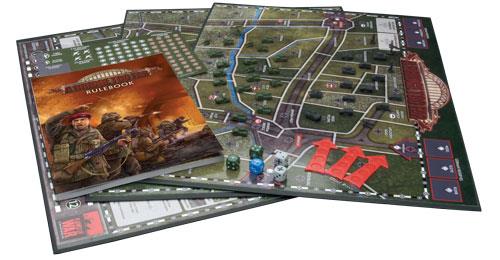
Typical of games by Battlefront Miniatures, makers of the popular WWII 15mm miniatures game Flames of War, this game packs some great design and ease of play into a neat box. While each battle and turn of play involves a number of steps, the game moves along quickly in about 90 minutes. The game comes with over 40 well-sculpted plastic playing pieces, but the version at the club had been modified with painted metal micro-scale armor and troops. Gamers who long-ago graduated from Risk to games like Axis & Allies will find a lot to love in the focused presentation of this game.

Even with the relative simplicity of the game, there’s a lot of strategic play potential. My first time through, my Allied strategy of pushing hard from the rear and left flanks of the board stalled rapidly as my tanks were quickly destroyed by some disastrous die throws against German anti-tank guns. My paratroppers dropped effectively into the middle of the board, yet they too became surrounded and snarled by the superior German armor defending the game’s main objectives. By four turns in, I faced certain defeat with no additional hope for much-needed tank support for my floundering airborne troops.

For a notoriously one-sided battle, I can easily see a lot of replay value in this game . I hope to give this one another shot soon, trying out some less historical and more aggressive strategies in running the Germans off the field. Having a chance to remake history is one of the joys and challenges of wargaming, and the board game A Bridge Too Far: Operation Market Garden provides a lot of opportunities to do so.

New Game Weekend: Tsuro

My Saturday evening of gaming with Metropolitan Wargamers was a busy one. First, I faced off in a 20mm World War II scenario on one of the club’s sand tables, and then I played in a three-player game of Lords of Waterdeep. It was standard fun stuff on a rainy quiet night in Brooklyn.

The surprise of the evening was when one of the guys pulled a box off the shelf and asked if I wanted to play a ten-minute game. Now, most the games I’m used to playing easily take a minimum of 60-90 minutes to play, so I was more than curious as to what this mystery game might be.

The game is Tsuro, and it’s one of those magical games that is both easy and complex all at once.

Tsuro has been around for about 10 years but the game has a feel and design making it seem a part of some ancient Far Eastern culture. It’s subtitled “the game of paths,” and that’s it in a nutshell. Each of the 2 to 8 players take turns placing square tiles on the board’s grid and moving their pieces along the linking paths. When newly-laid tiles touch other player’s pieces, those players also slide their pieces on the ever-changing linked, criss-crossing and overlapping paths. The object is to keep your piece from getting routed off the edge of the board. The last player on the board wins.

I played a couple three-player games of Tsuro in rapid succession. The turns go fast, and I can see how a game played with even more people could turn into a dizzyingly-quick game as pieces slide every which-way on the board’s paths. The game has nothing to read, nothing to count and incredibly simple rules, so I could see this as a fun game for families after dinner or with a few friends on the coffee table on a Friday night.

For another look, check out Wil Weaton’s Table Top for an episode with his friends playing Tsuro and some other quick dice games. Tsuro proves that a game doesn’t have to take all day or have a zillion pieces or complicated rules to be a blast.

“Where Do I Start?” Some Thoughts On Starter Sets

One of the more daunting things for people just getting into tabletop wargaming is where to start. There are countless systems to choose from, many scales, different levels of complexity and hundreds of thousands of products to choose from. Shopping online or walking into a local hobby store, the newcomer can easily be overwhelmed by the sheer quantity of “stuff” that’s out there in the hobby.

Here’s a few pointers on how to get yourself (or your kids) started.

1.) Try a game first. If you have an opportunity to try a game before buying, that’s the best (and cheapest) first step. Spending a few hours with a local gaming club, visiting a gaming convention or playing at a nearby hobby shop will give you a broad overview of how complex and fun a game can be. It’s also good to speak with other players so they can relate their personal experience in what they do (or don’t) about particular games, and what kind of a time and money commitment you may be making by undertaking a new game.

2.) Pick a theme. There is a tremendous variety in the playable world of gaming. If your kids like comic book superheroes or sci-fi space battles, there are games for those. If you like reading about history and are interested in playing a particular historic era, chances are there’s a game for it. If you have tendencies toward swords, sorcery and fantasy monsters, there are plenty of options. And, for those of you into horror and zombies, there are definitely games to suit your taste for the macabre.

3.) Visit a local store. It’s great to support local businesses, and getting to know the folks at your local hobby store, comic book shop or specialized wargaming outlet is key to your intro and growth with a game. People at these stores are usually gamers themselves, and they know and love this stuff. Be honest with them when just starting out. Explain your level of previous experience, interests, budget and the amount of free time available to play games. If you are looking to play a World War II game for a couple hours a week and have a budget of $50, they’ll probably steer toward the great board or card games available. If you have hours of free time and are willing to invest hundreds (or thousands) of dollars in a World War II game over the long term, a good store employee will point you in a different direction.

4.) Get a starter set. One of the great things about wargaming is the wide array of products the industry churns out. Settling on just one gaming system can present a new player with thousands of options. Experienced gamers usually go the a la carte route, picking and choosing the specific miniatures, models and rulesets they want. As a new gamer, however, what you usually need to get started is some miniatures and rules.

Thankfully, many popular wargaming systems offer packaged starter sets. These usually contain a set of rules, dice, maps and enough miniatures to wage a small game right out of the box. The other bonus with starer sets is the costs savings, as many companies package there starter sets with contents that might be double the cost if bought separately.

Here’s a couple of my favorite starter sets, covering a couple different scales and eras. If you’re looking a for a great wargaming gift this holiday season, start here.

Flames of War: Open Fire!

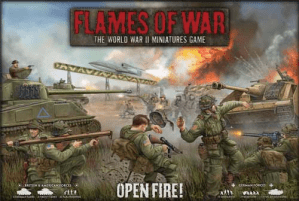
If you’re interested in World War II, start here. For about $70, this incredible set gives a player a 50-page quick-start guide, a full 300-page rulebook, dice, nearly 120 soldiers, eleven tanks and lots of other goodies. The set encourages you to glue up the miniatures and models and start right in playing. Once you’ve got a game or two under your belt, you can get started painting and then head back to the shop to start building out your forces for even bigger games.

The Hobbit: Escape from Goblin Town

Millions of people are going to be marching into movie theaters this month to see The Hobbit: An Unexpected Journey. If your interest in things Tolkienesque goes beyond the Hobbit and Lord of the Rings books and movies, then Games Workshop’s line of games should be your next stop. To coincide with the new movie, a whole new line of miniatures, rules and this incredible limited starter set has been introduced. The set costs $125, but with that you get all the hero characters (Bilbo Baggins, Gandalf the Wizard and Thorin Oakenshield and his band of dwarves) and dozens of goblins. The set includes a 50-page rule book plus some terrain models, dice and a ruler. Everything is plastic and modelled with incredible detail and personality. When painted, the models really come to life on the table. There’s also a full line of Hobbit-themed (and previously-produced Lord of The Rings) miniatures and rules ready to be added to your future games.

Warhammer and Warhammer 40K

Games Workshop also offers two long-standing favorites in the miniatures gaming world: Warhammer and Warhammer 40,000 (or, 40K to fans). Each gaming system offers a starter set for $99 that comes packed with incredibly detailed miniatures, rule books, starter guides, dice and other gaming accessories.

Warhammer is set in a fantasy world of magic and monsters, The Island of Blood starter sets allows you to field an army of High Elves against the Skaven, a race of giant rats. The 74 models exclusive to this box include Elves on horseback, an Elven prince riding a giant griffon, Skaven ogres and a whimsical cannon strapped to the back of a giant rat.

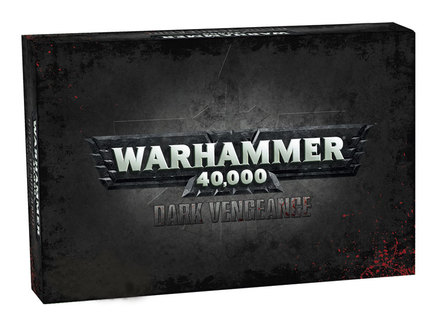
Warhammer 40K inhabits a universe in a far off future plagued by armies in endless intergalactic planetary war. The dark vengence starter set gives you 48 plastic miniatures depicting the Dark Angels against the Chaos Space Marines. Theses figures come armed to the teeth with gruesome hi-tech weapons and clad in enormous suits of armor. A squad of bikers and a walking death machine armed with laser cannons and giant claws round out the armed forces.