Flames of War: Foy 1945 Scenario

With a big full day of Flames of War gaming coming up at Metropolitan Wargamers on July 20th a few of us got together for a practice game this past weekend. There’s a renewed interest in FOW at the club as of late, and one of the great things about the group is the way experienced and new players alike come to learn together.

Wanting a manageable but interesting late war Western Europe scenario with US Airborne and German forces, we settled on the Battle of Foy from January 1945. The battle was just one small part of the brutal and much larger Battle of the Bulge campaign in the Ardennes forest region of France, Belgium and Luxembourg during the winter of ’44-’45. The engagement near Foy is featured dramatically in an episode from HBO Band of Brothers miniseries (clip here), so I was looking forward to trying my hand at commanding Easy Company from the 101st Airborne Division on the table for the day.

The FOW website offers a downloadable PDF outlining the scenario which fairly represents the German defensive position in and around Foy. No guidelines are given on the make-up of forces, but we decided on 1780 points on a side with flexibility beyond the historic record. The US Airborne begins in two divided deployment areas with I Company pinned due to indecision by its commander Lt. Norman Dike. Only by the daring sprint across open ground by Ronald Spiers sent on orders by Capt. Richard “Dick” Winters to relieve Dike of command can I Company join the assault on Foy. In the FOW scenario, the US forces have six turns to wrest control of one of two objectives from the defending Germans. The Germans must hold their ground against the bravery and skill of Easy Company.

The US struck first with an airstrike from their P-47 Thunderbolt taking out two of the three German PaK 40 anti-tank guns tucked behind the churchyard walls at the center of town. After being pinned by the P-47, the anti-tank platoon wound up rolling poorly and remained pinned and ineffective for the remainder of the game.
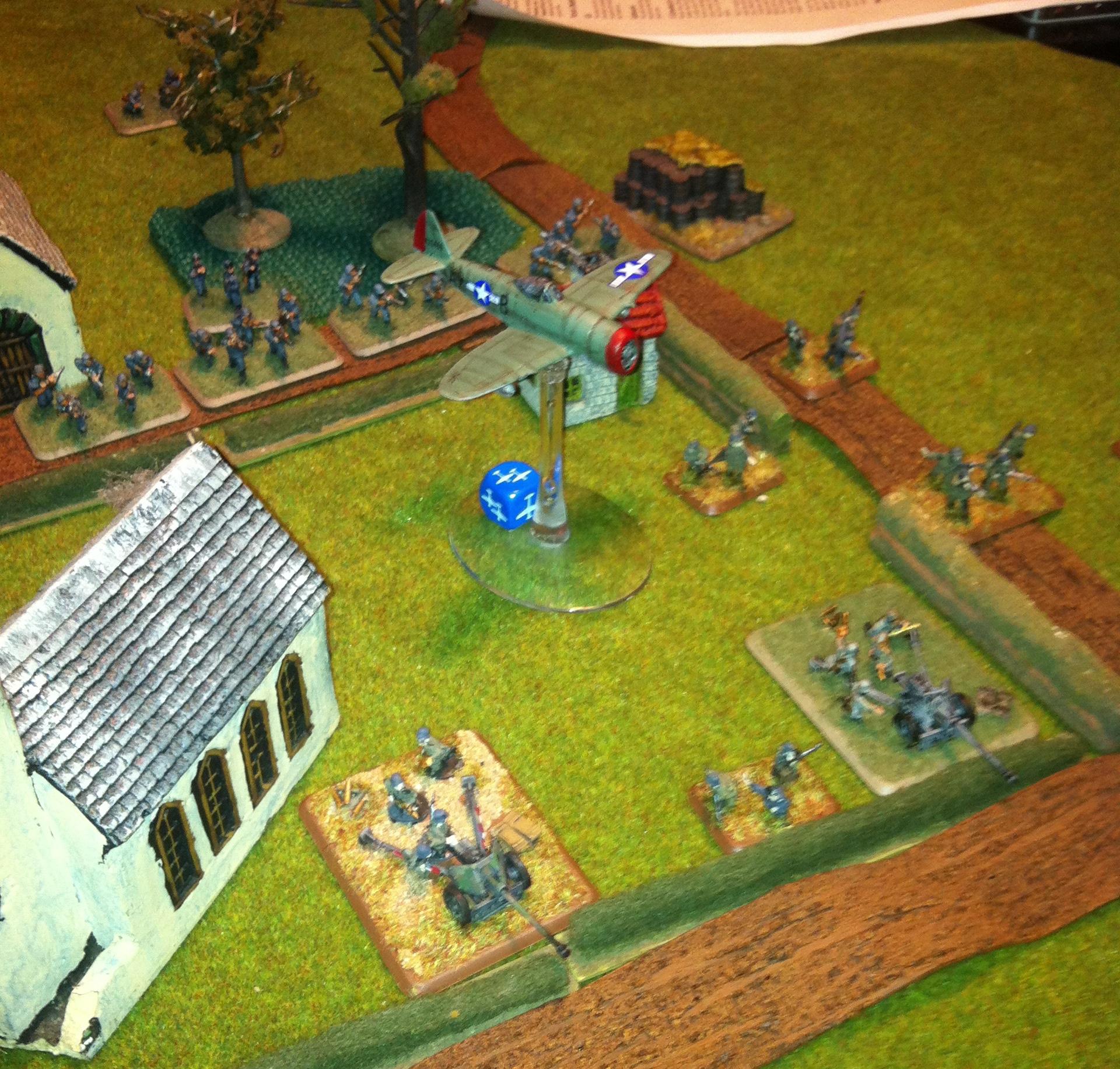
That was pretty much the last major good story the US could tell for the rest of the game. Some house-to-house fighting took place along the German right flank with the Airborne eventually beating the Germans back from the protection of the row of houses along the road to town. The American Sherman tank platoon rolled up the center but remained stuck for the whole game attempting to machine-gun the German platoons dug in behind the churchyard walls. Four of the five tanks wound up taking fire and being destroyed where they sat.

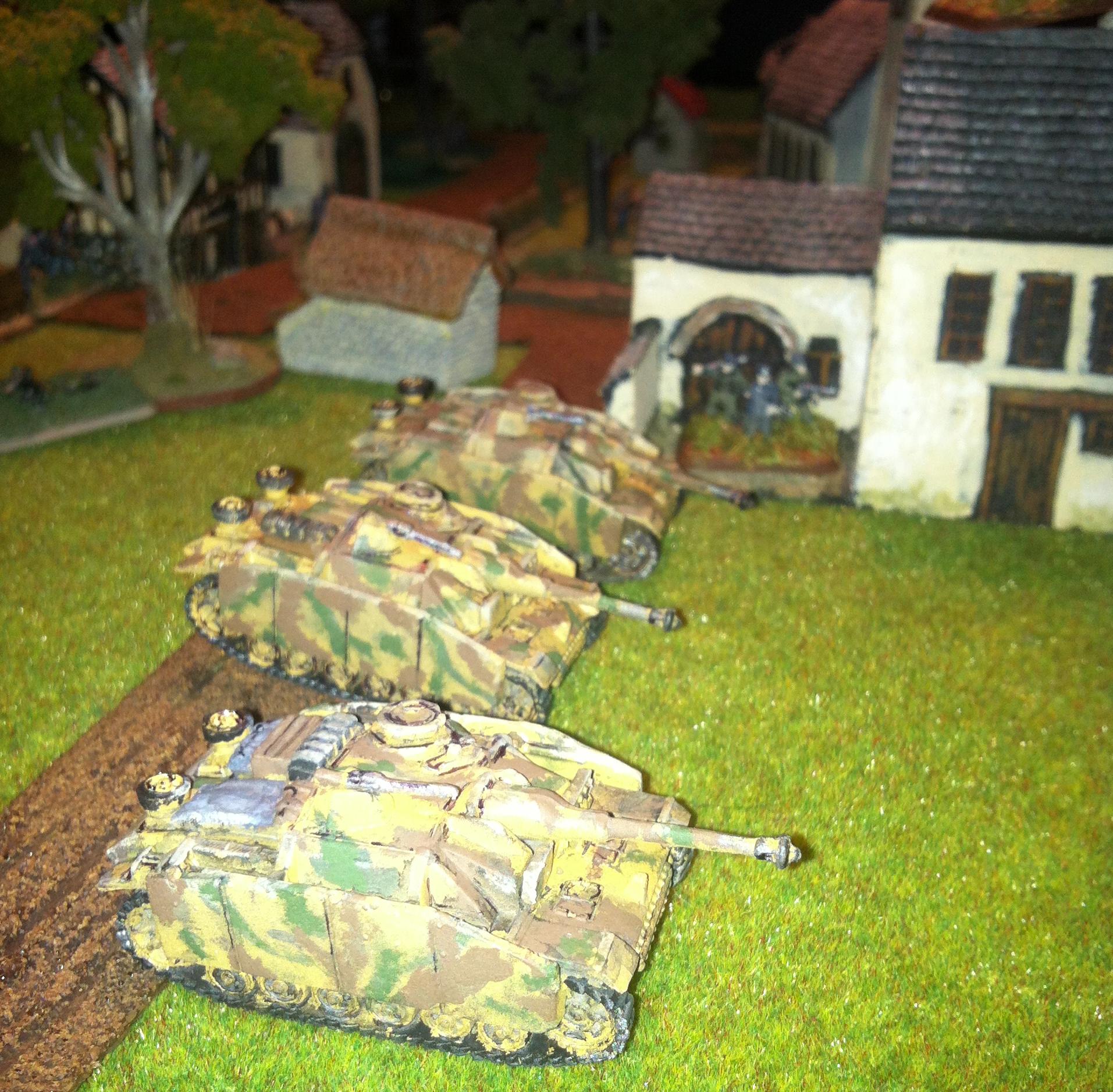
With the US infantry moving too slowly on both sides of the table, the Germans rolled their armored reserves in on turn three as their Stug platoon entered the table to hold off any US advance on the German right flank.
US volleys from the parachute artillery platoon tucked far back in the field did little more than occasionally eliminate a few German infantry and keep the units protecting the objective on the German left flank pinned.

Aside from a deadly late game P-47 strike on the German mortars which had harassed the Americans for the entire game, US air support never did much more for the rest of the game. By the sixth turn, the final German Panzer IV armor support rolled onto the table. With both flanks locked down by the Germans, a final desperate US attempt at dual assaults on the German armor platoons were ineffective. With three American platoons eliminated and most others with heavy casualties, the US ceded victory to the Germans in a revisionary result from the actual American victory in 1945.

Games like this are fun but also an opportunity to consider lessons learned. My US 101st Airborne was entirely too cautious and didn’t get into the fight fast enough, losing the opportunity to control the town’s center before the arrival of the German armor. My machine gun platoon got stuck mid-field and got chewed up bit by bit without having the opportunity to truly unleash its full effectiveness on the Germans who remained out of range and dug in for most of the game. Other infantry platoons hung back too much in the woods or buildings and never really got up in the fight.

With a much larger game coming up in a few weekends, I see that taking greater advantage of Easy Company’s aggressive, daring and deadly experience is going to be key to an Allied victory. Looking back at our re-running of the battle at Foy this past weekend, I can see I was a little too much like the wavering Lt. Dike and never let the heroics of individuals like Ronald Spiers to take over.
Flames of War: Fielding the Sd. Kfz. 7/1 Anti-Aircraft Gun

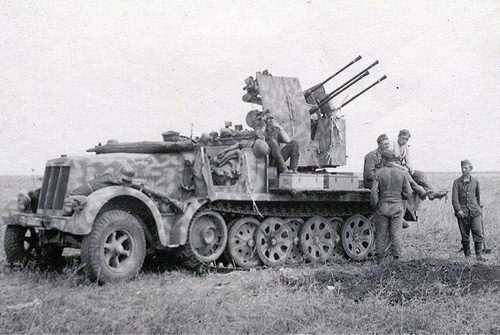
Wars are filled with big, heavy equipment, and the 8-ton German  Sd.Kfz. 7 served as the longtime workhorse throughout World War II. Short for the Sonderkraftfahrzeug (German for “special purpose vehicle”), the Sd. Kfz. 7 half-track was widely used as a transport, towing vehicle and the basis for self-propelled anti-aircraft gun crews. AA configurations of the truck featured either quad-mounted 2cm Flakvierling 38 guns on the Sd. Kfz. 7/1 and the Sd. Kfz. 7/2 with more cannon-like 3.7cm FlaK 36 guns.

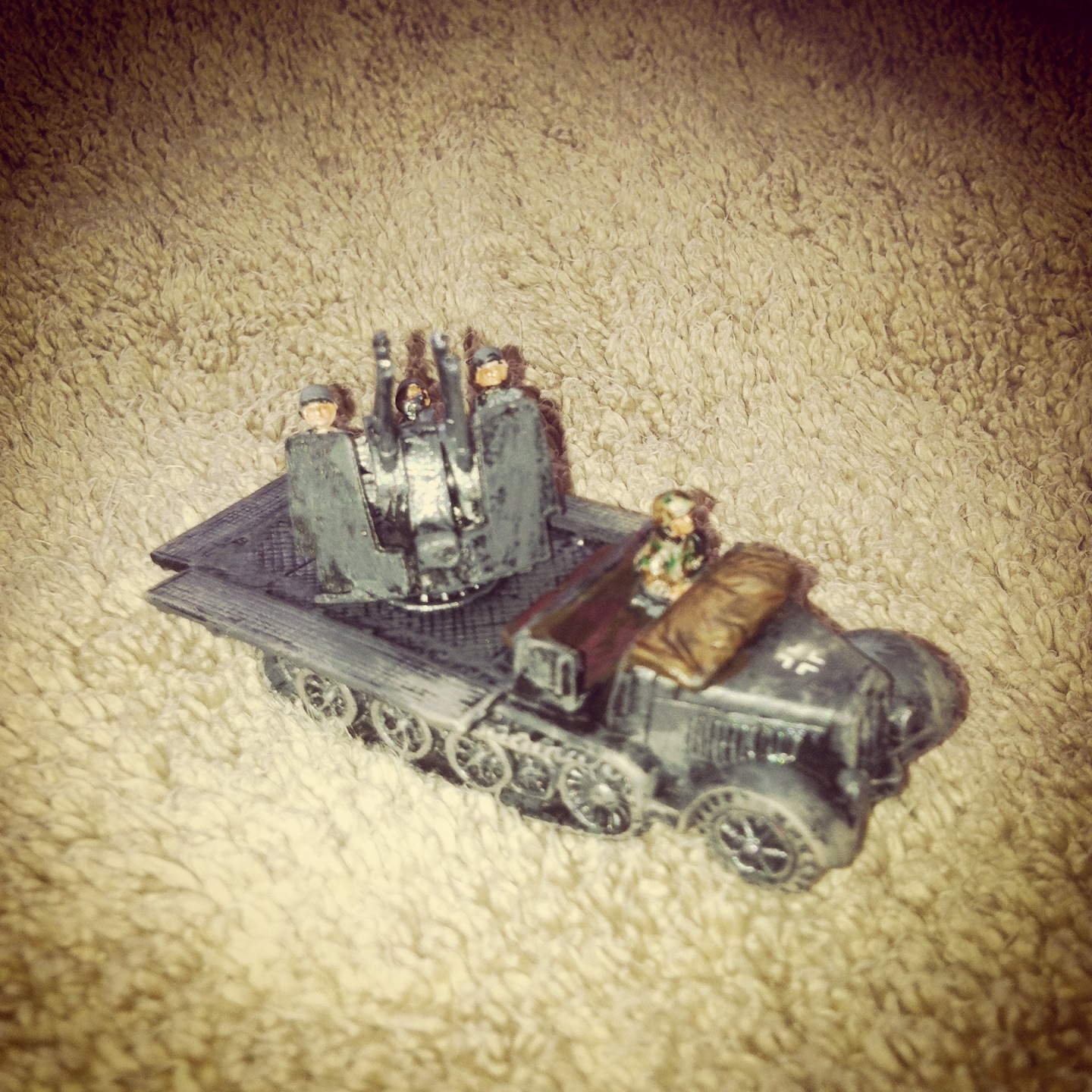
For my Flames of War AA gun team, I’ve chosen to model the Sd. Kfz. 7/1 in its two variants – one with its open cab and one with an armored engine and driver’s cab. After gluing-up the metal and plastic pieces, I left the gun turrets unglued to the truck bed so the crews could rotate 360 degrees as they did in real life. As with most of my German armor, a flat black sprayed primer coat was then dry-brushed in a dark grey. Guns and details were picked out with a bit of gun metal and the bench seats were painted to resemble a reddish-brown leather. The crew and driver were finished to match my usual infantry models with flesh and equipment details finished off with a watered-down brown wash.

For now, I’ve got the open cab version finished and I’ll post again once the armored one is complete.

Having recently finished my P-47 Thunderbolt for use as air support for my Allied forces, I only thought it fair to even-out the German side with some anti-aircraft protection. As in actual combat, the FOW Sd. Kfz. 7/1 model is as equally deadly against aircraft as it is to ground forces. With a big day-long FOW day coming up on July 20th at Metropolitan Wargamers in Park Slope, Brooklyn, rushing these guys to the tabletop front to hold back the Allied invasion should be key to striking a gaming balance.

Flames of War: Fielding the P-47 Thunderbolt

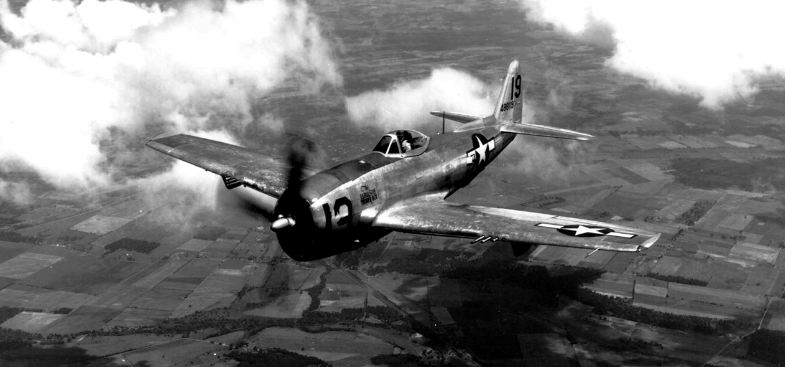
The P-47 Thunderbolt was a big, heavy, expensive and deadly plane with .50-cal machine guns and a bomb payload of 2500 pounds. Rushed into development and production near the dawn of World War II, these American planes saw their first use in Europe in 1942. By the late war period, the P-47 was being widely used in Western Europe and proved to be among the most effective fighter aircraft in both air-to-air and air-to-ground combat operations. During the Normandy landings in June 1944, the German Luftwaffe was a virtual no-show and the P-47 Thunderbolt ruled the air in support of the massive Allied invasion below.

I’ve been modelling and playing with the 15mm World War II Flames of War miniatures wargaming system for a number of years now, but until now all my gaming has been with tiny scale boots, wheels and tank tracks firmly planted on the ground. With a full afternoon of large 2500-point late war period FOW games being planned in July at Metropolitan Wargamers in Brooklyn, I decided to supplement my existing US Airborne force with some new air support with a P-47 Thunderbolt model. Armed with its wing machine guns and laden with bombs, I’m pretty excited about adding the P-47 and a whole additional dimension to a game I’ve gotten pretty familiar with over the years.

Choosing a paint scheme for the model was the first decision I needed to make in my project, and there are hundreds of historical variations to be found. While the silver fuselage seemed to be among the more commonly-modeled versions of the P-47, I opted for a simpler olive drab body. The green base coat was followed by a grey underbelly and some boldly-colorful red details at the nose and tail. The windowed canopy “glass” consisted of some flat black and white dry-brushing. Along the seams in the body of the plane I wiped fine lines of rusty metal to show wear on the plane. The decals included in the kit completed the model, albeit with a fair amount of struggle with near-miss tears.

While my first shot at modelling a plane for FOW may not be 100% historically accurate, I’m pretty satisfied with the visual impression it makes. At some point I’ll even things up with a German plane, but for now I can’t wait for my P-47 to take off in my next game.

Gaming With the Stars

Aside from my love for games, comic books, movies and associated hallmarks of geekdom, I’m a longtime fan of AMC’s Mad Men which wraps up its sixth season this coming Sunday. One of the much-maligned characters on the show is the media buyer and TV man Harry Crane played by Rich Sommer.

What the average fan of the show probably doesn’t know is that Sommer is one of the increasingly-prominent stars of the small and big screen who has a deep passion for gaming. Although currently on hiatus, Sommers until recently posted frequently about his gaming exploits on his blog Rich Likes Games, and he has appeared on a number of webisodes of gaming sites like Wil Wheaton’s Tabletop. Wheaton’s show will soon be premiering new episodes featuring a new crowd of writers, comedians, actors and other creative friends with the common love of rolling dice, playing cards and out-strategizing their opponents across the table.

The ability for gaming to bring together diverse groups of people, the famous and not-so-famous alike, is one of the wonderful things about the hobby. There’s an oft-told tale of Vin Diesel introducing Judi Dench to Dungeons & Dragons on the set of The Chronicles of Riddick, leading to Dench dungeon-mastering subsequent games for her grandchildren. There are all sorts of stories out there and extensive lists of celebrities who place themselves among the worldwide population of gamers. Among them are Stephen Colbert, Matt Damon, Ben Affleck, Mike Meyers, Robin Williams, John Favreau and Joss Whedon. Go back further and there are stories of the likes of Charlie Chaplin, Douglas Fairbanks Sr., King Vidor, Cole Porter, Harold Ross and Amelia Earhart partaking in gaming.

What I’ve found in my own experience is that gamers come from all walks of life but share a commonality in creativity, reason, knowledge, problem-solving, logic and alternating collaborative and competitive natures. These are obvious traits to be found in people who occupy prominent positions in the culture but also in the regular folks I game with on a regular basis. I find this every week at Metropolitan Wargamers club in Brooklyn where different combinations of ages, background and experience come together to play.

I recall being at a gaming convention a few years back watching a young guy with a mohawk, lipstick, piercings and dressed in head-to-toe black speaking passionately with a retired buttoned-down US Army veteran about some tactical minutae of a WWII engagement. Thinking back to that scene, it serves as my Diesel-Dench moment where those of us who share nothing and everything randomly encounter each other in our worlds of gaming.

Flames of War: Fielding Easy Company

I’m not unique in being a World War II gamer and a big fan of HBO’s Band of Brothers miniseries from 2001. I also finally got around to reading Stephen Ambrose’s same-titled book on which the series was based. Both works follow the exploits of “Easy” Company of the 506th Parachute Infantry Regiment, 101st Airborne Division from training to D-Day to the end of the war. The story is absolutely riveting and presents a dramatic account of how the collective action of individuals contributed to the Allied victory.

I’ve been working away recently at finishing my long-overdue modelling of Easy Company and a large US Airborne force. Nearly two years ago I purchased and painted up an entire company of Command Decision Paratroopers from Old Glory Miniatures, including command, machine guns, mortars, bazookas and parachute artillery support teams. This past week I’ve wrapped-up the small plastic parachute rifle company from the Flames of War Open Fire! starter box set I received this past Christmas. To this collection of troops, I’ve added the excellent Easy Company set from FOW containing a number of the real historic US servicemen portrayed in Band of Brothers.

While the casting is a bit skinnier and lacking in the detail of the official FOW miniatures, the value of the Command Decision models can’t be beaten at the low price of $15 for a hefty bag of 50 solidly serviceable figures. At under $70 online, the big Open Fire! box is a real deal for all the troops, tanks, artillery and other stuff included. The FOW Easy Company set itself runs about $12 for the few specific personality figures, and fielding these models is going to add significantly both to the look and effectiveness of my force on the tabletop battlefield.

With a good mix of FOW and Command Decision models painted-up, I turned to the “Nuts!” campaign book to put-together my order of battle for Easy Company. The book focuses on the 101st Airborne’s involvement in late 1944’s siege of Bastogne and other Battle of the Bulge engagements and then on to the German border and the eventual Allied victory in 1945.

In creating my list I wanted a highly-mobile and playable 1500 point force heavy on infantry with just a bit of tank support. In the FOW rules, the parachute rifle company is rated Fearless/Veterans, making them hard-hitting and tough to chase from the field. Their special use of Gammon bombs enhances their impact in risky infantry assaults on otherwise-intimidating German tanks. Adding the special characters from Easy Company makes for an even more resilient and daunting force, reflecting the historic bravery these men brought to the late war European campaigns.

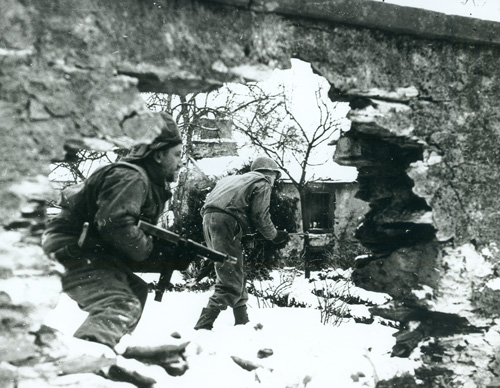
I’ve modeled my infantry pretty simply with a quick coat of flat green primer, lighter brown on backpacks and equipment bags, a contrasting watered-down brown wash and some equipment details picked-out. Finally, the shoulders get a dot of black and a dab of white to mimic the famed Airborne eagle insignia (shown at the top of the page).

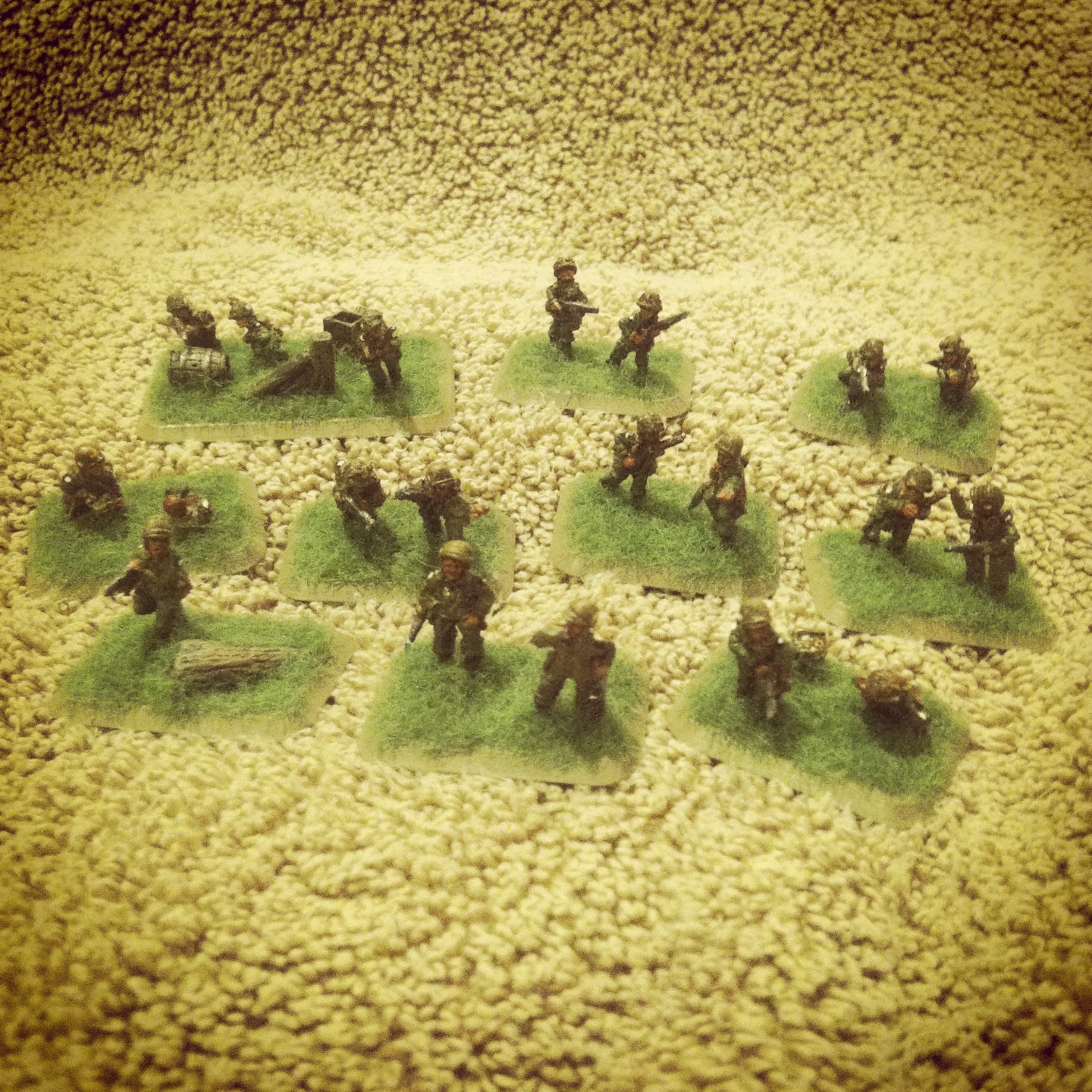
The first photo below shows the specific men of East Company which come packed with a lot of individual personality. Leading the platoon is Capt. Richard Winters and Capt. Lewis Dixon (front row, center) with the Nixon model taking a swig from a bottle as he was known to do. Pvt. Eugene Roe (middle row, far left) is shown patching-up an injured comrade. Corp. Darrell “Shifty” Powers (top row, far left) is hunched aiming on a barrel and ready to take out his German target. With so many generic models in my force, these guys are all a real treat.

And below is a look at the plastic Airborne platoon included in the Open Fire! box set:

In July, I’m organizing a big FOW day at Metropolitan Wargamers with two simultaneous 2500-point games of Soviets vs. Germans and US Airborne vs. Germans. To the above list I’ll be adding some significant artillery muscle and I also hope to have a new P-47  Thunderbolt air support model ready to go. With Easy Company ready to lead on the tabletop, I can’t wait to get my new Airborne force into action.

Retro Gaming The 70s & 80s: Dark Tower

Dark Tower from Milton Bradley is probably my favorite game of all time.

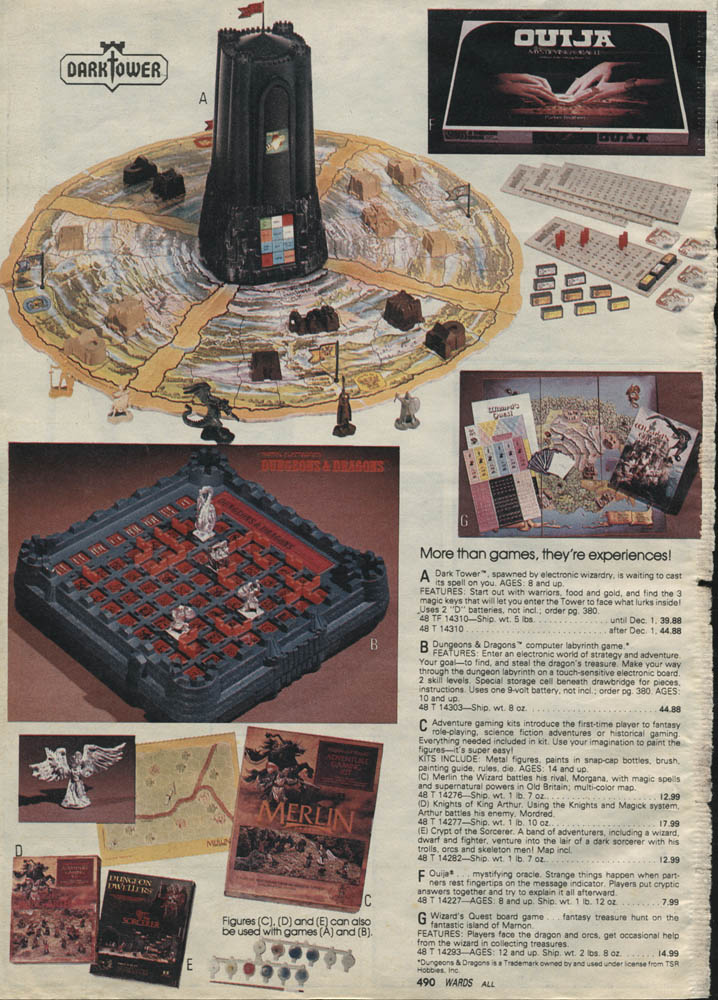
Aside from what I had seen in a few comic book print ads and the weird Orson Welles TV ad, I didn’t really know much about Dark Tower. When it arrived under the Christmas tree in 1981, the game hit right in the middle of the period of my life where I was already deep into D&D and all things fantasy. Looking back at holiday department store catalogs from that season, there was a lot for a young geek to wish for. A page from the Montgomery Ward holiday catalog from that year (below) not only shows Dark Tower, but also the D&D Computer Labryinth Game from Mattel and the  Heritage Dungeon Dwellers sets about which I’ve previously written about in my retro posts on this blog.

Out of the box, this game became a family favorite with even my father, uncle and various other adult friends of the family crowding around the kitchen table for many an evening game with us kids. I can’t recall my dad ever playing another boardgame other than chess or maybe Monopoly with me as a kid, so there was obviously something very enticing indeed about this mystical game.

Dark Tower consisted of a plastic battery-operated black tower set in the middle of a circular game board divided into four kingdoms. Each player journeyed around the board fighting monsters, gathering treasure and searching for three keys before arriving back to their home kingdom and attempting to breach the doors of the Dark Tower.


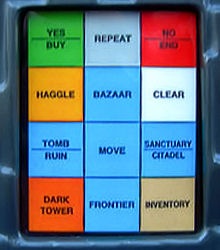
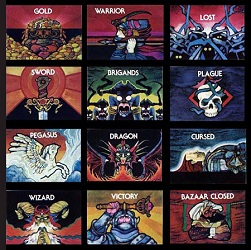
With each move the player pushed a button on the tower’s keypad (above, left) and a series of rotating cylinders within the tower would rotate and light up with results (above, right). Collecting treasure, taking damage and adding to your adventurer’s force was tracked on thick cardboard cards with red plastic pegs. Low-tech digital sound effects also accompanied each move, encounter or effect, and to this day I find myself accossionally whistling the little tunes Dark Tower played.

I’m certain the tiny bundle of electronics buried in the tower is simple by today’s standards, but at the time we were in awe of how it tracked each player’s progress throughout the game. Entering a Bazaar space, the market would open and a player would have the option to bid and buy resources depending on the inventory and the amount of gold you had on hand. A player could haggle on price, but at times the merchant would just decide to cut you off and your turn would end abruptly. In other cases, a player would encounter marauding brigands and a battle would break out with victory determined by the size of your army and any special items you had on hand. All of this was tracked on your little card but the Dark Tower also kept tabs on all the goings on in the game. The Dark Tower was like a Dungeon Master powered by a couple batteries and it was truly amazing.

Despite its popularity, Dark Tower was a very short-lived game. A lawsuit over the design of the game led to some messy legal dealings between Milton Bradley and two game designers, and the game was finally yanked from distribution by 1985. To my mind and that of many other gamers, the quick death of Dark Tower is one of the great tragedies of modern toy manufacture. The game has managed to live on prominently in our hearts and minds, and across the country there are still old copies tucked into closets among much lesser games. There’s a copy on a high shelf at my parents’ house, and although I haven’t pulled it down to see if it still works after these many years, I feel better knowing that my copy of Dark Tower is still there.

Collector’s Note: Because its short period of commercial availablity, subsequent intellectual lawsuit and somewhat delicate electronics, copies of Dark Tower are highly sought after. On eBay, parts can go for $5-100 and complete working games in original condition can command over $1000. But it’s all worth it.

New Game Weekend: King of Chicago & RoboRally

Friday night at Metropolitan Wargamers in Park Slope, Brooklyn had a decent crowd of six of us collected in the back with a few other people up front continuing play of a multi-week and fairly dense American Civil War battle. Coming to agreement on an ad hoc game together for a half-dozen guys is a challenge on its own, but we managed to settle on two games which are standbys at the club but pretty new to me.

King of Chicago

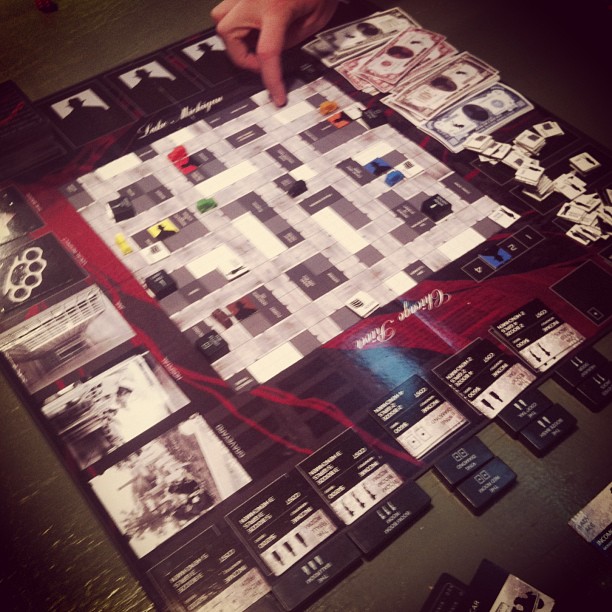
Produced in Denmark in 2005, King of Chicago takes place in the Prohibition-era Windy City where each player takes on the guise of gangster looking to rule the streets by creating and breaking alliances, building their empire and whacking the competition along the way.

The game begins with each player owning a gangster, a car, $1000 and a few resources. Resources in the game are booze, henchman and girls, and additional resources are picked up in various landmarks spread throughout the city. Combinations of booze, henchmen and girls in your gang allows you to build bars, casinos and brothels which create income at the completion of four turns in each round of play. At the end of a round, players collect income, new gangsters are put into play and resources get set on the board. Bidding takes place for gangsters to add to your mob, gaining you bonuses of speed, income, protection and lethalness. Players also bid to bribe the cops, controlling them through the next round of play.

The game offers a lot of strategic play in how a player chooses to build their empire and also in managing relationships with the other mob bosses on the board. Drive-by shootings, shutting down competing businesses and sending the other guys to the hospital or the morgue makes for a lot of opportunity for deals to be struck and double-crosses to take place. Certain cards cause “events” like police raids to be played and others send players on “jobs” which net substantial sums of income. The player who quickly amasses ten points from money, businesses and influence wins the game.

The game looks great with simple components and a wonderful collection of historic photos from the Chicago gangland days depicted on the cards. The many paths players can choose to build their mob empire adds significant replay value to the game.

King of Chicago was released with a limited print run and can be hard to come by in the United States. However, for lovers of gangster movies and the period when the underworld ruled Chicago, chasing down a copy is well worth the effort.

RoboRally

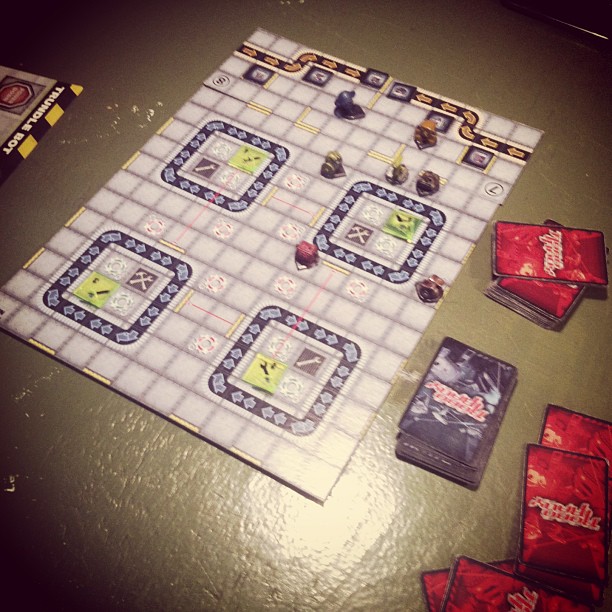
After a couple hours on the mean streets of Chicago, we had a seventh player show up. Our second game of the evening took us in a different direction with the hilariously chaotic RoboRally. The game was originally published by Wizards of the Coast way back in 1994 but was created a decade earlier by Richard Garfield who would go on to design the insanely-popular Magic: The Gathering card game.

The game takes place on a factory floor with each player’s tiny robot attempting to navigate through a set number of flagged gates. This seemingly-simple mission is hampered by moving conveyor belts, rotating gears, solid walls and laser arrays spread throughout the factory. Robots controlled by other players also wreak havoc on your path by bumping into and zapping your robot with their lasers.

At the beginning of each round, players draw up to nine cards each with directional actions such as left and right rotations, u-turns and movement backward and forward. Players secretly place their cards face down in front of them defining their robots’s moves for the round. In turn, players reveal each card and move their robots in order of card value and according to the movements selected. The fun and craziness comes in when well-thought plans quickly go awry as robots beginning bumping into each other and throwing each other off course. Just when you think you have a direct route neatly plotted out to a flagged gate space, some other robot (or two or three) ram straight into you, sending you wheeling off in some other direction.

Lasers cause damage to your robot, reducing your movement choices in a round and only made better by spending a turn shut down repairing. Occupying repair spaces can also provide fixes for damage, and even special robot upgrade cards. The truly unlucky robots will find themselves bumped off the board, returning to their last starting point at the beginning of the next round.

The more players who play only contributes to greater chaos on the board. Our late night seven-player game stretched to nearly two hours of mechanized madness until one player managed to get through a few gates and away from the crowd. My sad little robot, on the other hand, wound up spending the game unluckily bumping into his mechanized comrades and finished the game exactly where it started.

RoboRally has won multiple awards, and its many versions and expansions have ensured its continued love among gamers for nearly two decades. After the cold-bloooded and calculating play in King of Chicago, it was great to end the night on a much more lighter but no less challenging game like Robo Rally.

Flames of War: Fielding the Grenadierkompanie

I got the Flames of War Open Fire! set this past Christmas and I’m finally getting around to painting-up all the stuff that comes packed in the box. At under $70 online, this big package is a real deal for new and experienced FOW gamers alike. The set includes over 100 plastic Allied and German infantry, tanks and artillery models, plus the full FOW rulebook, dice, markers and some other goodies included. A couple guys at Metropolitan Wargamers also picked up the set and are just getting into FOW. If you have any interest in gaming WWII at all, this set is the place to start.

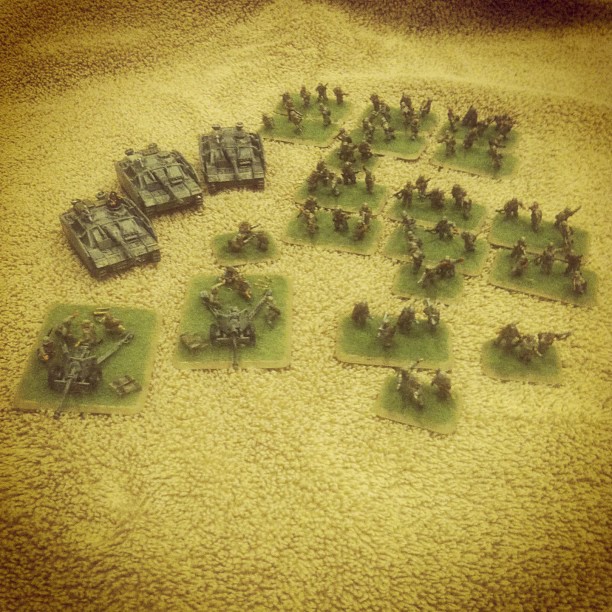
First off, I’ve finished the German Grenadierkompanie, including anti-tank 7.5cm PaK40s, a Stug G tank platoon and two platoons of infantry. These will supplement the pretty extensive Grenadier and Fallschirmjäger infantry I already have. The Stugs will also add to the large collection of Panzer IV, Jagdpanther and Konigstiger platoons I’ve already got on the shelf.

The plastic models all glue together quickly, but handling them has to be a bit delicate so as not to snap off the tips of the gun barrels. For the infantry, I spray prime everything in flat black and paint the uniforms in a mid-dark grey. All the details — guns, boots, equipment and skin — get picked-out with quick dabs of paint. Everything gets a very watered-down brown wash in the end which gives the uniforms a more accurate grey/green muted finish and also tones-down the flesh.

My camouflage painting abilities are honestly pretty atrocious, so my default is to go with a more generic grey paint scheme on my armor, artillery and vehicles. For the Stugs and PaK40s, the flat black primer was hit with a quick dry brushing of mid-dark grey.  After the dry brush coat, tank cargo and other details were then dabbed on. The platoon commander got some special attention with white detail on his cuffs and collar, plus some detail on the radio headset he’s wearing over his hat. Finally, I applied some wet-transfer decals and then dry brushed some light brown mud in the areas most likely to see some splashing on the tracks, sides and fenders.

y

With my Germans from Open Fire! complete, I’ll be posting soon with an update on the US Airborne and allied models from the set. Along with the Germans, a set of special FOW models from the famed Easy Company and a bunch of my existing models, there’ll be some major action from the Normandy campaign and beyond coming soon.

Retro Gaming The 70s & 80s: Choose Your Own Adventure Books


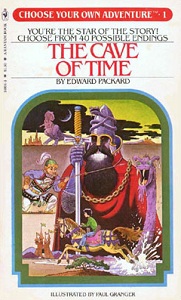
This week there was news the Choose Your Own Adventure (CYOA) book series is to be developed into a film series by 20th Century Fox. Launched in 1979, the series was enormously popular throughout the 80s and 90s, sold over 250 million copies and is still published today. The movie announcement got me thinking about how these books played yet another part in my personal growth as a gamer.

The CYOA series follows the form of a gamebook which allows a reader to participate in how a story unfolds through a a variety of choices made along the way. To a young kid, the CYOA books shared a lot in common with my role playing game interests. Each book presented a fantastically-themed self-contained adventure, International travel, outerspace journeys, crime investigations and sword and sorcery tales filled the pages of each paperback, and collecting them was part of the fun. Choices made while reading each story could take you to more than 20, 30 or 40 different endings to the book, making for a lot of re-reading value in seeing how things might turn out differently each time.

The CYOA mechanic provided the feel of a solo game for when no one else was around with which to play something a bit more complex like D&D. Looking back from today, the structure of jumping back and forth through the narrative is akin to the experience of clicking through hyperlinks online. Even videogames today like 2012’s award-winning The Walking Dead series from Telltale Games share in the basic chapter and choices format people of my generation grew up on.

There’s no telling what shape the proposed Choose Your Own Adventure movies series will take, and it may prove to be yet another Hollywood move to attempt to cash-in on a known property. That said, it’s interesting to see just one more way these books continue to ripple through the culture over 30 years later.

Collector’s Note: The Choose Your Own Adventure series is still published today and can also be picked up fairly easily used starting at about $3-5 each on eBay. For true collectors, first editions from books early in the series can go from hundreds or even over a thosand dollars from rare book dealers like AbeBooks.

Retro Gaming The 70s & 80s: Dungeon Dwellers


I was already a fairly experienced D&D gamer by the time I encountered the Heritage Dungeon Dwellers series of miniatures and game sets in the early 1980s. Aside from playing creative games and campaigns dripping with swords, sorcery and all things creepy and crawly in the underworld of our imaginations, my brother and I were quickly filling up our free time with miniature painting. If it was tiny, cast in lead and even mildly gruesome, chances were it was on our radar.

We were already pretty familiar with Ral Partha’s growing line of D&D lead miniatures picked up at our local five-and-dime, bookstore and hobby shops in Rochester, NY when we encountered Dungeon Dwellers. At the time, we had no idea Heritage was producing boxed sets and blister packs of figures similar to Ral Partha. What we did know was that holding these two green Dungeon Dwellers boxed sets in our hands was clearly something different.

Unlike the sets of miniatures from Ral Partha and other suppliers of the time, Heritage Dungeon Dwellers offered two all-in-one model and gaming sets. Each box contained a number of monster and adventurer figures, paints and a simplified self-contained game with rules and a map. This off-the-shelf game was an easy and rare counterpoint to the expansive D&D universe of the era. Each set — “Caverns of Doom” and “Crypt of the Sorcerer” — read like a D&D module with a defined scenario in which to play. The models were animated, unique and somewhat more appealing than some of the widely-available Ral Partha lines. I particularly recall the multi-piece winged dragon from “Caverns of Doom” and the fire-casting wizard from “Crypt of the Sorcerer” as being favorites.

Despite the limited replay value on the surface, these two sets got a lot of outsized-use when I was a kid. Thinking back, they combined the best aspects of board, miniatures and role-playing games, plus they allowed us to cut our chops on our painting skills. Serious gamers of the time probably dismissed these sets as pandering to the growing fantasy gaming fad of the day, but for a growing gamer in the early 1980s, Heritage Dungeon Dwellers really made an impression.

Collector’s Note: The Dungeon Dwellers boxed sets are exceedingly hard to come by, but miniatures sets and individual figures are readily available on eBay for just a few dollars for an individual figure up to well over $100 for sets.