New Game Weekend: Love Letter

Heading into a weekend visit to Metropolitan Wargamers, I often don’t know what kind of game I’m going to be jumping into. It could be a re-fighting of a World War II D-Day scenario with hundreds of finely-painted miniatures. It might be a gory zombie apocalypse boardgame. Maybe it’s a sci-fi deck-building card game. Or, it could be an abstract Euro-style game where great world civilizations are built over the course of a couple hours of play.

This past Saturday night it was Love Letter. Released in 2012 in Japan and quickly moving into multiple international versions, Love Letter is a seemingly unlikely game for a group of hardcore gamers crowded around a basement table. The game is comprised of just 16 playing cards, 4 reference cards and 13 tiny red square cubes — “tokens of affection.” Everything comes in a crimson crushed velvet drawstring bag with “Love Letter” embroidered in flowery yellow script. The simplicity of the game’s packaging, design and minimal components hides a pretty compelling strategy card game which even the most battle-hardened gamers will find engaging in just under a half-hour’s play.
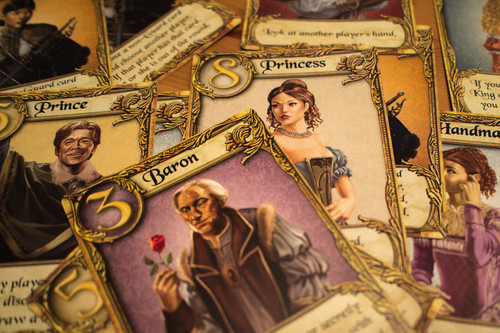
In Love Letter, player’s vie for the affection of Princess Annette of the imaginary kingdom of Tempest. Players are dealt cards with values of 1 to 9, each depicting a courtly character with a specific ability. In turn, each player then draws and plays one card. Guards (value 1) allow you to guess a card in another player’s hand. The Baron (value 3) has two players compare hands with the lowest hand eliminated from the round. The Prince (value 5) forces a player to discard their hand and draw a new card. The remaining six cards reveal different types of actions, and some cards are plentiful while others are unique. After a round of play, the last player holding a card or the player with highest-valued card wins a cube and a new round is dealt. The first player to score four cubes — “tokens of affection” — over a number of rounds of play wins the hand of Princess Annette.

The trick of the game is to attempt to follow which cards are in the hands of other players and still in the draw pile. Love Letter is thus a game of memorization, strategy and deceit. The most powerful cards, while best at the end of a round may make a player a target early in the round. Playing cards may reveal information to you, but also allow your opponents to possibly infer who is holding what cards. Players may gang up on a leading player to force them from a round, leading to shifting alliances from hand to hand.

Despite its courtly conceit, Love Letter can turn into a bit of a raucous and cut-throat game, as ours did among four of us Saturday night. The game would be perfect to keep tucked in the bottom of your bag to pull out among a group of friends at a bar or around the table during dessert. Given that entire ancient battles have been fought and historic treaties struck over the union of two fated lovers, Love Letter provides a quick and challenging chance to play out the ultimate game of royal affection taken to extremes.

Retro Gaming The 70s & 80s: Gamma World

Post-apocalyptic and dystopian futures in pop culture were big fascinations of mine as a kid. Planet of the Apes premiered the year I was born, and the movie sequels, live-action TV show, Saturday morning cartoon and toys were a big part of my imagination through the first half of the 1970s. As I grew into a budding sci-fi fan, movies like The Omega Man, Invasion of the Body Snatchers and Logan’s Run, as well as television re-runs of The Twilight Zone further filled my brain with visions of future what-ifs and the destruction of the human race.

In 1981, two things happened. Ronald Reagan became President and would go on to occupy the White House for all my teenage years. During this formative period of my life, my waking mind and night time dreams were filled with the ever-looming threat of nuclear war flowing from Reagan’s amped-up rhetoric toward what was then still the Soviet Union. Suddenly, the fictionalized visions of the end of civilization seemed very, very real.

That same year, I saw Mad Max 2, (aka The Road Warrior). Although shot in Australia with an Aussie-accented Mel Gibson in the lead, the movie resonated as very American to me. With it’s high-desert setting, gunfights, chase scenes and a hero with a hidden past, the film struck me very much like Westerns (particularly those of Clint Eastwood) I already loved. Wrapping the Western genre up in a post-apocalyptic story hit all the right notes in my 13-year-old imagination.

Along the way in the late 70s through early 80s, I was spending a lot of time gaming with Dungeons & Dragons. In 1983, I ran across the second edition of Gamma World in the local bookstore where I bought most of my D&D gaming stuff. Originally introduced in 1978 by TSR, the makers of D&D, Gamma World was a role-playing game set in a post-nuclear war 25th-century Earth populated  by mutants, cyborgs and remnants of the human race. While D&D drew its influence from various fantasy sword-and-sorcery antecedents, Gamma World’s dystopian setting was rooted in the sci-fi themes of stories and movies I loved. From a game mechanics standpoint, Gamma World had a familiar feel to D&D with character attributes, fantastical equipment and a chart and dice-driven combat and encounters system. The similiarities with D&D made it easy to slide into the entirely different storylines Gamma World offered.

I never took to Gamma World with the same depth of interest as D&D, but playing it was pretty fantastic. The world of the game was occupied by giant rabbits, humanoid lizard people, deadly plantlife, robotic killing machines and all other manner of deadly foes and allies. Weaponry ranged from spears and traffic sign shields to laser rifles and nuclear devices. Maps represented entire crumbling city street grids or hidden underground survivalist bunkers. An adventure could involve a quest for an “ancient” 20th-century manuscript holding the key to human salvation or an infiltration mission to destroy a cyborg factory. To my friends and me, Gamma World allowed us to write the scripts and play through the dozens of unmade post-apocalyptic movies living in our heads and influenced by the films already ingested into our psyches.

Gamma World is still published by Wizards of the Coast today, but the popular trend in zombie-themed games occupies most of today’s gaming interest in post-apocalyptic scenarios. That said, for a purely futuristic, dystopian, sky’s-the-limit role-playing game, fast-wording a few centuries to Gamma World can’t be beaten.

Collector’s Note: Original TSR-published Gamma World boxed sets and expansion modules can be found on eBay. Modules and indivdual rule books can run in the range of $15-75 while original complete boxed sets of early editions can run into the hundreds of dollars.

Retro Gaming The 70s & 80s: The Official Advanced Dungeons & Dragons Coloring Album


As a kid in the 1970s, I had heaps of activity books of all sorts — brain teasers, mazes, puzzles, coloring, paper doll and cut-out model books. As a new Dungeons & Dragons gamer, I loved 1979’s “The Official Advanced Dungeons & Dragons Coloring Album” which captured two of my childhood passions within 30 or so pages of absolute wonder.

This was no ordinary coloring book on any level. Even as a kid, I was always impressed by its long and prideful title. This was a “coloring album” instead of just another “coloring book.” The drawings were by Greg Irons who famously worked on posters for Bill Graham’s legendary Fillmore Auditorium rock concerts and the 1968 Beatles animated film Yellow Submarine. To my young eye, Irons’s art in the coloring album looked liked the work of a Medieval woodcutter or like uncolored stained glass windows. Lines were dark and heavy, but the drawings wildly animated each page in a progressive story of adventurers and monsters familiar to D&D gamers.

The other aspect that made this publication unlike any normal coloring book was the text by Gary Gygax, the co-creator of D&D. Knit within the story-like captions accompanying the illustrations by Irons, Gygax delivered an actual game you could play. While vastly simplified, Gygax borrowed heavily from some of the basic D&D terminology and concepts with which I was quite familiar by then. And there, at the center of the book, was a two-page dungeon map on which the short adventure could be played. Despite the game having little replay value, I remember playing it repeatedly just because I loved this book so much.

Out of all the stacks of throw-away activity books I had as a kid, “The Official Advanced D&D Coloring Album” is one of the few standouts in my memory. Like the game that inspired it, the book presented and inspired so much fantastic creativity in a way I had never seen before and have seldom seen since.

Collector’s Note: “The Official Advanced D&D Coloring Album” is out of print but scans are available online for free download here and here. Copies of the original unused book can also be found on eBay for an astonishing $75 and up, and partially-colored copies start in the $15 range from online rare book dealers like AbeBooksYou can also check out some of the Fillmore-era posters from Greg Irons at Wolfgang’s Vault, although buying one will run you into the thousands of dollars.

American Civil War: Perry Miniatures ACW in 28mm

About a year ago I got back into gaming the American Civil War.

My first miniatures wargaming experience back in the 1980s was with 15mm ACW played with the Fire & Fury rules. I wound up stepping away from gaming for the 1990s, but with the celebration of the 150th anniversary of Civil War and some ACW gaming with the Brother Against Brother rules at a convention I decided last year that now was the time to get back to the ACW.

Having spent a couple years playing WWII in 15mm, I very much ready to try another era but I also chose to go bigger with another scale at 28mm. Fortunately, Perry Miniatures offer a line of well-sculpted and very reasonably-priced plastic and metal line of ACW figures which I’ve used exclusively to this point.

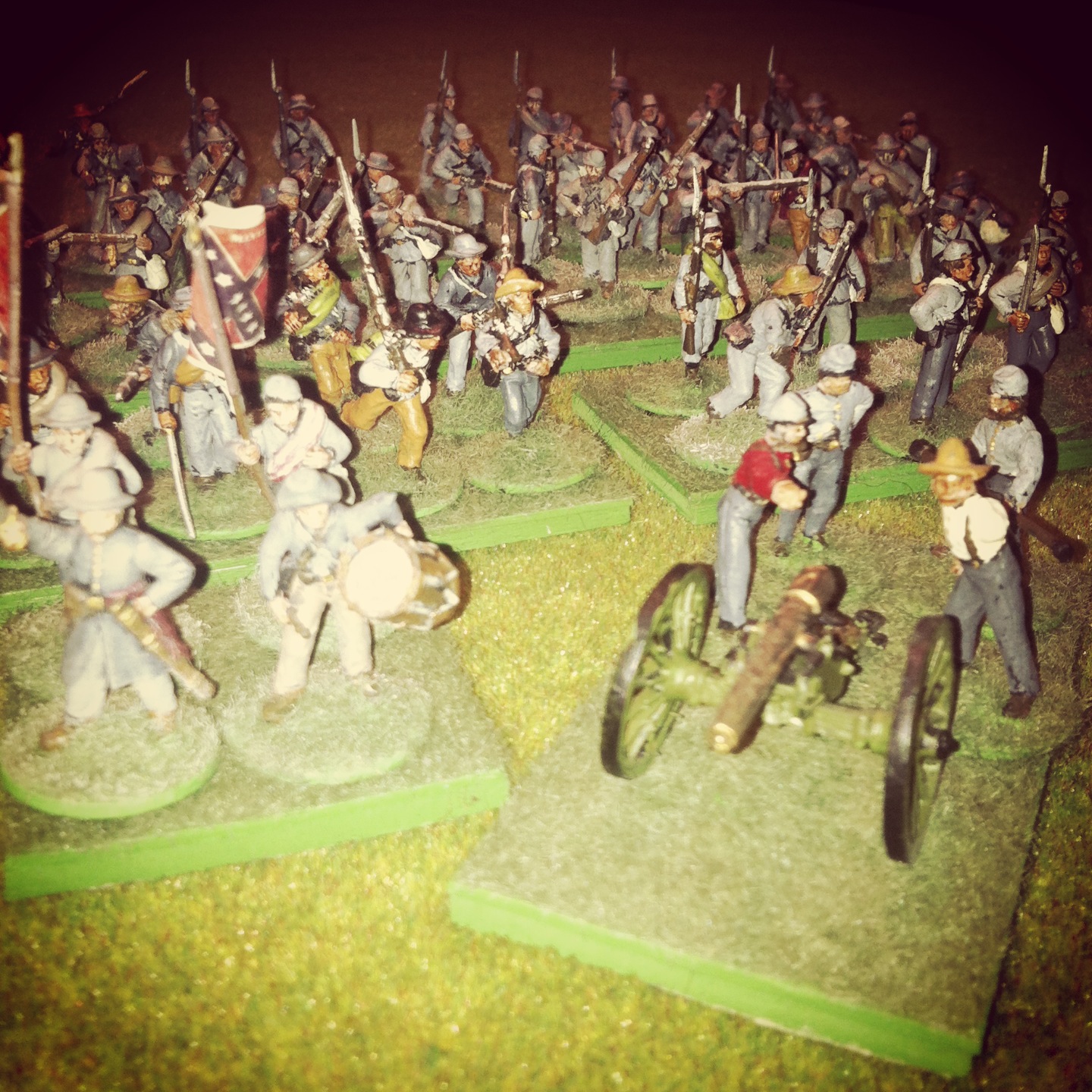
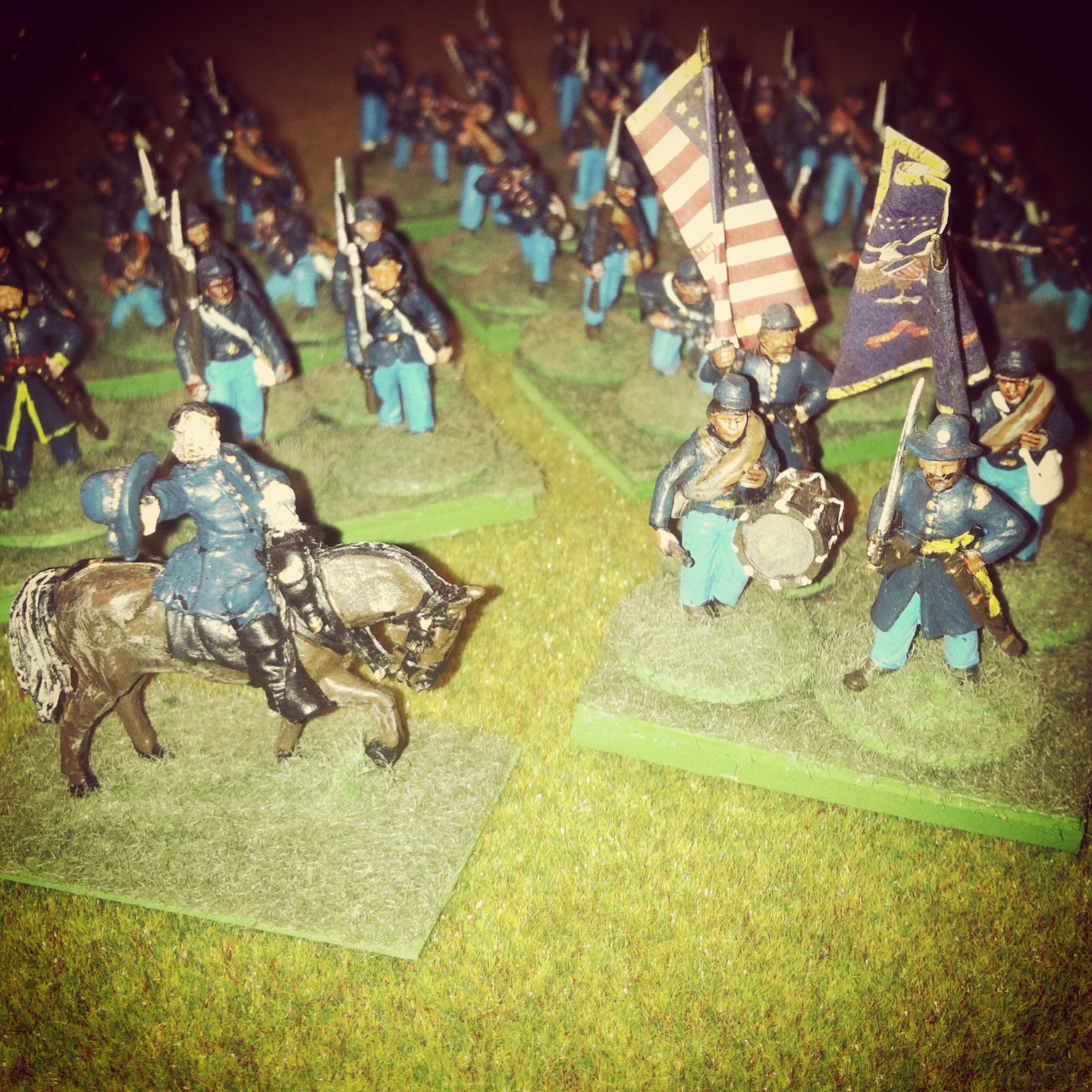
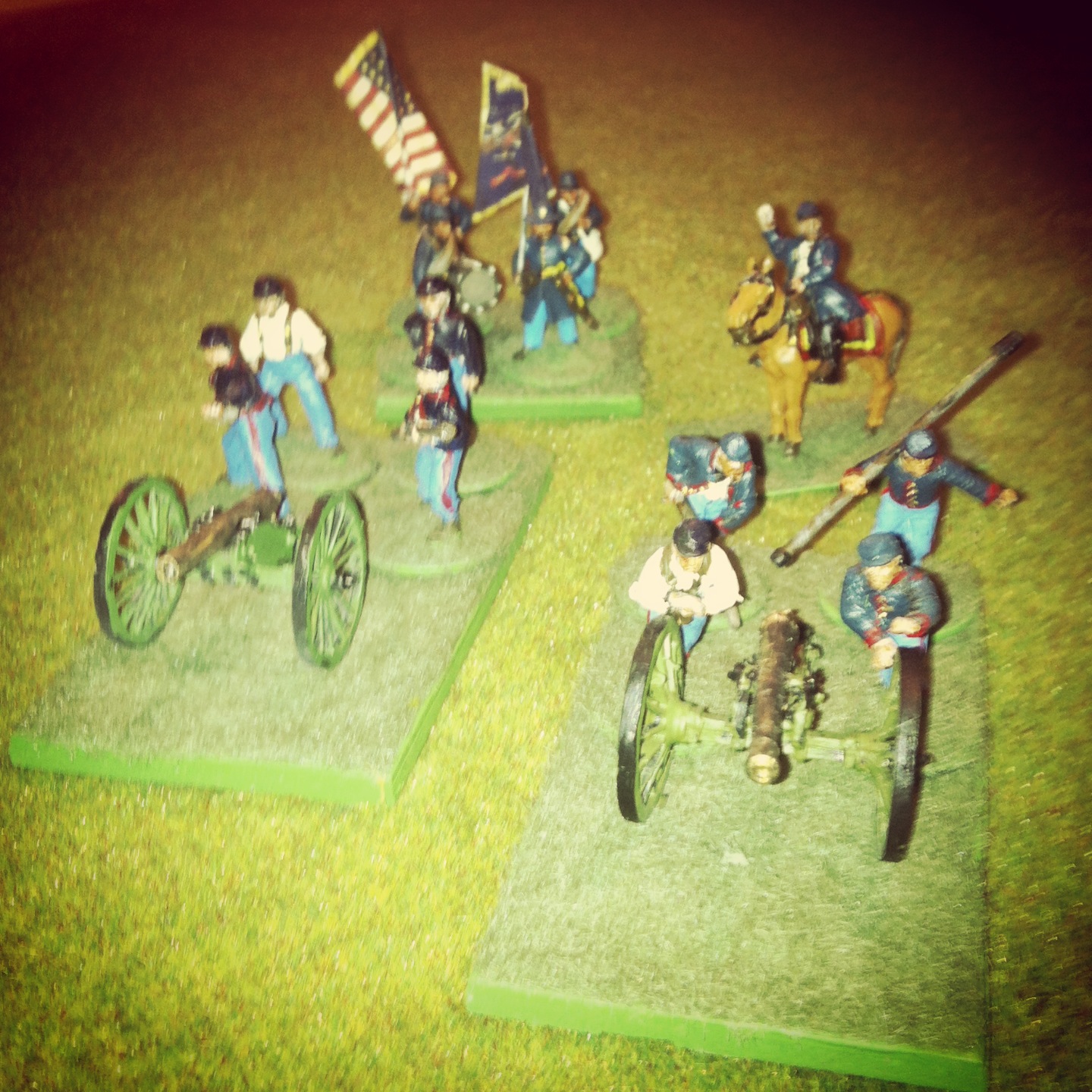
Without going into the details of assembly (relatively easy) and painting technique (also quite easy), I’ve got about 125 figures painted up now on each side. I’ve also completed some mounted and infantry command, artillery batteries and casualty figures. All figures are based on metal washers, and I also made some movement stands for each unit with magnetic sheets adhered to balsa bases.

First, some of the boys from the South…


And, some of the boys from up North…


Now that I’ve got a decent set of figures with which to play, I’m looking forward to setting up a real nice game with the Metropolitan Wargamers in Brooklyn this summer. Just in time for some key ACW anniversaries, I’m really happy to see my Blue and Grey hit the tabletop again.