Favorite Tabletop Games Kickstarters of the Month (May 2013)

Earlier this week, I wrote about how I believe Kickstarter to be the latest incarnation of how gamers have contributed to the decades-long conversation on who truly “owns” our hobby. This had me delving deep into what’s current on Kickstarter’s Tabletop Games section.

To date, I’ve honestly only contributed to one tabletop games Kickstarter project. The modest fundraising drive for A Las Barricadas which brought in just under $10,000 for a game that has since been delayed but promises to be shipping soon. While I wait for this little game of street protest pitting Occupy Wall Street-like demonstrators against the police to arrive, I thought I’d share a few projects I’m watching this month.

Moby Dick, or the card game: Like any good English Literature major, I’m a fan of Herman Melville’s epic American tale of one man’s obsession with a whale. On the flipside, I am not generally a fan of card games. That said, this card game of the high seas boasts some truly marvelous woodcut-like artwork and what looks to be an entertaining game of the best recruited crews trying to survive in their quest to spear the Great White Whale.
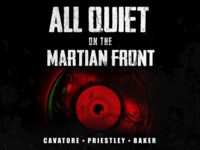
All Quiet On The Martian Front: Showcasing 15mm miniatures of Martians vs. early 20th-century human armies, this game uses the H.G. Wells sci-fi classic as a jumping-off point to imagine a world of humans locked in protracted combat with alien invaders. The models look fantastic, mining the very-popular steampunk trend in gaming today. Supporters of the game (particular those pledging in the hundreds of dollars) will net a lot of cool looking stuff with its funding.

Canterbury: Nothing gets me going like a great Euro-style worker placement game, so this is particularly enticing. The game places you in the age of Saxon Kings, and your aim is to build the greatest of cities starting with only a well in the wilderness. Managing your growing population, resources, culture, military and ongoing construction of buildings, the game claims to be one of pure skill and planning with no luck factor whatsoever. This one looks like a beauty and I’ll be anxious to give it a play when it is published later this year.

 Wargaming Terrain for the American Frontier: I don’t play games in the period, but the latest from Acheson Creations presents more than a dozen wonderfully-crafted 28mm buildings from the pioneer, settler and Native American era of 18th-century colonial America. I particularly like the longhouses and wigwams, possibly inspired by the local tribal history of the Western New York and the Rochester area where the creators (and I) hail from. The blockhouse, fort wall sections, barn and cabin models also look great and could easily be used in other eras or in fantasy gaming scenarios, too.
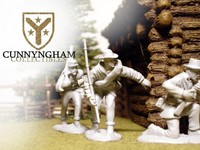
Civil War Toy Soldiers: This final project has less to do with gaming and more to do with the special spot in my heart for the toy soldiers of my childhood, especially around the holidays. Cast in soft plastic and a large 54mm scale, this new line of Union soldiers have been launched to compliment Cunnyngham Collectibles’s existing Southern troops. The poses, liveliness and equipment details on these guys make for some really cracking personality. A few bags of these fellas on the floor or in the tall grass and I’d be transported back to when I first fell in love with little plastic men nearly 40 years ago.

Zulu War: British 24th of Foot Regiment in 28mm

One of the big goals I set for myself this year was to have at my Anglo-Zulu War era project in 28mm. Most of my gaming interest has a US tie-in — American Civil War and WWII — but I am just fascinated by the dynamics of the in late 19th-century British campaigns of invasion fought in Sub-Saharan Africa . Now, after a few months of on-again-off-again toil, my British forces are looking pretty sharp and battle-ready.

I first picked up a couple boxes of plastic Anglo-Zulu War era British from Wargames Factory at a convention flea market for just $8 each (quite a deal from the $20 retail price). At 25 figures per box, these run under a buck per soldier at full cost. The sprues come with head and arm options for firing, loading, advancing and at-the-ready pose variations. The casting is a bit chunky, all figures are standing fully upright and no command figures are available, so there are some trade-offs for the relative value of these figures. Wargames Factory’s Anglo-Zulu War line is also very limited in that they only offer this one box of British and another of Zulus. Still, they’re a great bang-for-your-buck option, especially for an era that requires fielding a lot of soldiers on the table.

For variety and comparison’s sake I next bought a box of British infantry from Empress Miniatures and Warlord Games. Their expanding “Anglo-Zulu War 1879” line offers a nice mix of plastic and metal British, Zulu and allied forces along with terrain, artillery, cavalry and other nice models. Their British infantry box runs about $32 for 24 figures making their cost-per-figure a bit pricier than the offering from Wargames Factory at over a dollar each. However, their figure sculpting is a fair amount finer and the pose options allow for more variety. The boxed set also includes crouching figures, making double-ranked firing lines a possibility. Along with twenty plastic infantry armed with rifles, the box comes with four metal command stands which fill a basic need for most Anglo-Zulu War gaming. I’ve rounded-out my force with an additional 16 metal figures in various crouching poses and four more metal officers from Empress Miniatures in poses that vary from those in the box set. The metal figures run more than $2 each, but by spreading them among the less expensive plastics I’ve achieved what I think is a nice variety.

In sum, my first round of modelling the 24th of Foot will net me 76 infantry stands commanded by 8 officers. This will give me a nice Company-sized British force broken out into two Platoons of two Squads each of 20 figures (including command).

Here’s a couple work-in-progress photos:


My challenge now is to tackle my Zulus which are typically fielded in a ratio of (at least) 3:1 to British figures in many gaming systems. I have a few Zulus already painted shown along with some of my new British below, but it looks like I’ve got many hours of painting still to go in the coming months.

Gaming Wars In The 21st Century

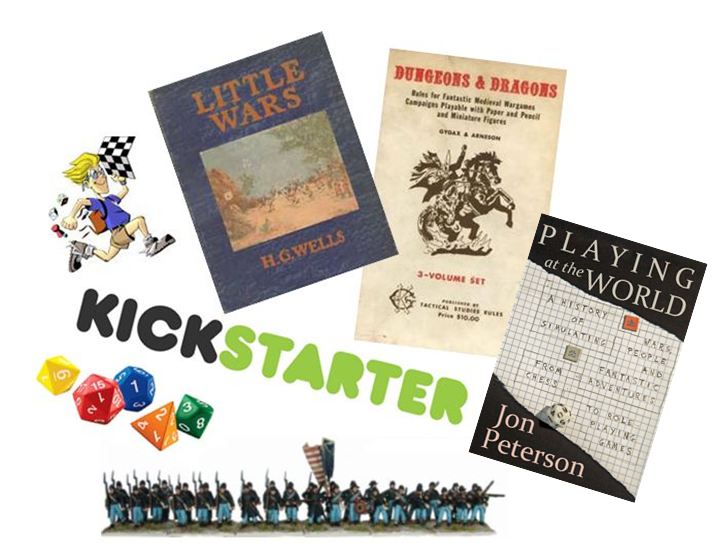
I was pleasantly surprised to open the back page of this past weekend’s New York Times Sunday Book Review section to an article on the 100th anniversary of H.G. Wells’ “Little Wars.” The book’s Edwardian-era style, classism and occasional not-so-thinly-veiled sexism is mixed with the mechanics of a gaming system which makes it a relevant read even today.  Before “Little Wars,” wargaming had largely resided in Europe’s war colleges and in the parlors of the ruling elite. Even with its English intellectual, upper-crust trappings, “Little Wars” sought to expand the popularity of wargaming. As the article points out, “Little Wars” is an important foundational document and should be required reading for those who are interested in how we’ve arrived at the business of gaming on the tabletops and screens of the world today.

“Little Wars” is widely available for free online and for e-readers today, and “ownership” of gaming is largely the subject of a post today on BoingBoing about Dungeons & Dragons retro-gamers. Whether driven by nostalgia or as a reaction to corporate ownership of a beloved game of their youth, “old school” D&D gamers stress what they believe to be a truer game style more focused on role-playing and less-so on action-driven play. To stay relevant to a new generation brought up on CGI special effects, so the argument goes, the now-owners of D&D Wizards of the Coast have increasingly made the game more combat-heavy (read: more like video games). In reaction to this, retro D&D gamers have created an increasingly-active community of story-driven gamers who look to old rules for inspiration. The ability to share thoughts, opinions and out-of-print rulesets online has only fuelled the movement.

Old school gamers are just the latest combatants  in the war over gaming. The history of wargaming rules development winds its way from military schools and H.G. Wells to postal games and strategy boardgames in the mid-20th century. Games and rules were more fluid in the 1940s-60s where there was little profit to be had in wargaming, and a big part of the gaming community was in the debates over what rules were the most realistic or playable. With a few exceptions, ownership in those days was based more on pride and ego than copyrights and profit. This timeline is well-documented in Jon Peterson’s “Playing At The World” which finally arrives at the early days of D&D.  Even before D&D made the great leap into a world-wide phenomemon there were arguments and accustaions over copyright and ownership. Peterson’s recent analysis of a transitional draft of D&D (the Dalluhn Manuscript) not only adds greater nuanace to the development of the rules themselves but I think also provides another chapter on the concepts of evolutionary, intellectual and legal ownership of games.

Much of the digital conversation today — whether about games, photos, movies or music — hinges on the topics of openness, control and copyright. Along with the free and independent gaming forums and sites, we’ve now been given a new frontier of games on Kickstarter. What used to take years (or even decades) of slow development and debate by word-of-mouth fanzines and postal newsletters, Kickstarter achieves in weeks or days. Players vote with their wallets in support of games which can now easily garner six and seven-figure funding levels, all but guaranteeing a fanbase that literally buys-in at the ground floor. Sites like BoardGameGeek can help make or break the success of a new game and then go on to serve as R&D for game expansions, rule variations and subsequent editions.

A hundred years after “Little Wars” pulled the ownership of wargaming out of the fists of Europe’s elite, we’re still warring over our games. Copyright laws, digital distribution and individual financial investment will continue to shape the next hundred years of the ownership conversation, but gaming is certain to remain a very personal investment for some time to come, too.

Downloading: Zulus On The Ramparts

Living in Brooklyn and commuting back and forth to Manhattan on the subway for work each day, I wind up with a fair amount of time on my hands. I read a lot and the New York Times crossword puzzle is a daily necessity, but sometimes I like to just unwind with a game on my iPhone. I’m not a big electronic player in general, so I was glad to happen across Zulus On The Ramparts! by Victory Point games in the iTunes Store.

Over the past six years or so, Victory Point Games has cranked out dozens of board and card games covering all kinds of scenarios, eras and genres. More recently, they’ve begun releasing a few apps, and Zulus On The Ramparts! just debuted a couple months ago. The game is based on their popular boardgame of the same name from their historical “States of Siege” solitaire games line, and it is available now for iPhone, iPad and Android devices.

As with the boardgame, the app inserts the player into the Battle of Rorke’s Drift. In the January of 1879 battle, a small group of maybe 150 British soldiers from the 24th Regiment of Foot successfully defended a small outpost against a massive army of thousands of Zulus. The battle was popularly dramatized in the 1964 movie “Zulu,” and I was first introduced to it in John Keegan’s “A History of Warfare.” My interest in the battle and the Anglo-Zulu War period has only grown over time, and I’m currently working toward getting a large 28mm scale wargame up and running.

The game progresses through a series of turn phases. First, a random action is chosen for a Zulu impi to move, attack, retreat, stand their ground or perform some other specific action. Each Zulu force appears on the field and then moves over the course of the game through a series of predefined oval spaces which progressively close in on the walls and barricades of the British hospital outpost. Some Zulu actions may cause extra moves or the entire Zulu force to move en masse. Since close range combat is key to a Zulu victory, the first portion of the game is spent quickly organizing and supplying the British before the inevitable attack.

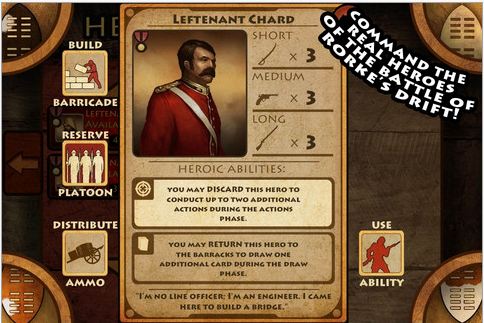
A lot of information is crammed into the game map screen. The position of the Zulus is shown at their various ranges from the fortifications. At the top, the game phase is indicated. On the left side of the screen, various historic officers or more generic soldier characters stand at the ready to use their various bonuses in combat and other special actions. On the right side a running status of supplies such as water and ammo, along with other factors which will effect the outcome. The bottom of the screen displays a clock as the turns click by toward darkness as well as a link that takes you to the “barracks” screen.

On the barracks screen you manage your officers and troops, viewing their heroic abilities on virtual “cards.” Abilities range from calling up reserves, ordering the construction of barricades or distributing supplies to the troops. The barracks also contain combat actions allowing you to fire volleys from your Martini-Henry rifles with various effectiveness of range

Once actions are selected, combat is resolved through a nifty slot machine-like spinning wheel. Depending on range, the type of weapons being fired and any modifiers from heroic actions on activated officer and troop “cards,” combat outcomes are determined. After combat, new cards are randomly placed in your barracks and the next round begins with additional Zulu actions.

Like the historic battle at Rorke’s Drift, time is of the essence in Zulus At The Ramparts! and hours run by quickly on the game clock as the Zulus swarm in on the British and supplies run low. This is a really tough game in a small digital package with lots of variables to manage from turn to turn. Playing on the tiny iPhone screen makes things even harder, and there is probably significant playability to be gained in playing the game on an iPad or Android tablet.

With a few games (and losses) behind me, the game can seem frustrating at times. With that said, the difficulty of Zulus At The Ramparts! does a pretty decent job in simulating the bloody tough spot the British found themselves in on the plains of Africa on that famous 1879 day where retreat simply wasn’t an option.

American Civil War: ACW Artillery in 28mm

I spent this past Sunday at the Metropolitan Museum of Art in New York City and caught the absolutely spectacular “Photography and the American Civil War” exhibit which runs through September 2, 2013. The hundreds of photos cover a bit of the same ground as past exhibits, documentaries and books, but there’s a lot I had never seen before, too. What spoke to me most were the dozens of simple individual soldier photos. The contrast between the dressed-up idealistic pre-war studio portraits and the devastatingly gruesome prisoner of war and hospital images is wrenching.

Aside from the portraits occupying the bulk of the show, one of my favorite photos from the show was the one shown below by Timothy O’Sullivan from 1864.

Titled “Pennsylvania Light Artillery, Battery B, Petersburg, Virginia,” O’Sullivan’s small photo (maybe 3″ x 9″) purports to give a rare glimpse of a full artillery battery either drilling or possibly in actual combat. The mass of guns, crew and equipment shows the full size and complexity an artillery section brought to the fields of the American Civil War 150 years ago.

My go-to favorite miniatures company for my American Civil War 28mm gaming is Perry Brothers for both their sculpting and reasonable cost in both their plastic and metal ranges. I have three artillery teams painted up  from their metals line, but more guns would always be better. However, each gun team currently runs me about $12. At this price, modelling realistic large-scale batteries like those in the O’Sullivan photo from the Met has seemed pretty cost-prohibitive.

Well, over at the Perry Brothers Plastics Workbench section of their site, they’ve just recently teased a few plastic sprues of artillery which will include carriages, limbers, multiple barrels and crew. The flexibility of the soon-to-come set will allow for modelling of different crews — North and South — as well as rifled and smoothbore gun types.


There’s no release date for this set as of yet, but in the meantime there are some nice work-in progress shots I’ve shared here. With a few of these assembled and painted up on each side of my tabletop battlefield, my games will get an added boost of realism captured timelessly in the hundreds of photos currently on view here in New York.

Downloading: The General


In our highly-digitized world of everything fandom, it’s hard to remember there was a day where a primary lifeline for fans was via the mail. While gaming enthusiasts played games by post and created their own newsletters for small cliques of fellow gamers, it was game publisher Avalon Hill that created the first widely read and regularly published magazine for the strategic wargaming hobby.

Beginning in 1964, The General served as the bi-monthly house newsletter for AH. The General provided regular space for articles on new AH products, debates on variant rules, announcements of gaming conventions and a place where gaming fans could connect with each other on a regular basis. With games like Outdoor Survival, Tactics, Gettsyburg, Blitzkrieg and Panzerblitz, AH ruled the early years of the nascent gaming hobby through their formula of bookshelf games of hexagonal maps, cardboard markers and detailed rulesets full of charts. It was not until the arrival of TSR and their culture-changing Dungeons & Dragons in the early 1970s that AH would face serious competition as gaming shifted from board games to role-playing. By the time AH was acquired by Hasbro in the late 1990s, the world of gaming had changed considerably and The General was shuttered.

In Jon Peterson’s masterful book “Playing At The World,” he tracks the development of the wargaming hobby using The General, TSR’s own Dragon magazine and dozens of smaller lesser-known newsletters as primary sources. For those of us who have wished for a deeper view into the early days of our hobby, the Internet Archive has now made PDFs of The General available. With just a few cursory early looks, having access to this archive of our own history is certain to be an incredible asset for wargamers.

New Game Weekend: Fire & Axe

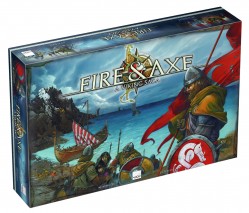
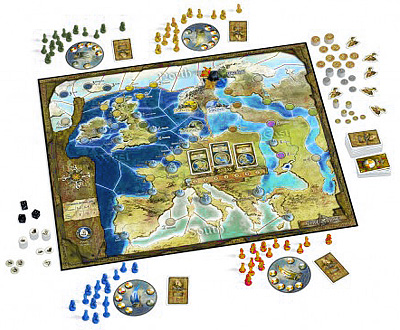
After a couple weeks spent at home hunched over my workbench working away furiously at my 28MM American Civil War projects, I was finally able to get out of the house for some gaming this past Friday night. I hadn’t been to the Metropolitan Wargamers club in a few weeks, so it was good to get back this weekend. I walked in to a nearly empty club — rare on a Friday night — but in quick order a few other members showed up. I had hauled along my copy of Village to introduce to the guys, but first another member suggested we have a quick run through a different boardgame I’d heard mentioned frequently at the club before —  Fire & Axe: The Viking Saga Game.

Originally published in 2004, Fire & Axe is now hard to come by and used copies can fetch over $100 at times. I’m a little surprised at the long-standing adoration this game has. Of the twenty or so games I’ve been introduced to over the past year, Fire & Axe wouldn’t be near the top of the list although it does have ease of play and short duration going for it.

The game pits 2-4 players against one another as they sail on quests to settle, conquer or trade within various regions of European seas in the backdrop of the Viking age. The game begins with each player’s ship in the Wintering Box in the northernmost edge of the map. Once a ship is loaded and launched, players choose to depart from Norway, Denmark or Sweden. The turn begins with a player choosing to perform seven actions which may include loading goods or troops to their ship, sailing across the open seas or landing in ports to engage in trade, establish a settlement or capture a city. Special “rune cards” can also be collected and played to perform a variety of actions — from strengthening your invading forces or calling on a sea monster to destroy another player’s ship.

Gold is collected throughout the game through trade, conquest and settlement. Specific missions to trade with or take over specific ports can be collected to score additional points. The missions can also have shared success where points in conquering three port cities might be split between two players. Players who complete the most missions for each of the Viking civilizations of Norway, Sweden and Denmark stand to earn additional points at the game’s end. Additionally, missions get more valuable and reach to the farthest edges of the board as the game progresses. When all missions are completed, the game ends and points are tallied.

The game progresses quickly — four of us got through a game in about 90 minutes Friday night. The game is simple to understand after a turn or two, but it all just seemed like a race without enough variety in paths to victory. For instance, I burned up a couple turns hoping to conquer three cities, but some awful die rolls sent me back to the Wintering Box as other players swept in to claim those cities. At the end of the game, another player snatched victory from the would-be winner through one final chance move that stole a few points from the guy who had led up to that point.

I’ll give Fire & Axe another shot at some point since the guys at the club seem to have a deep love for it, but for now I think I’ll be concentrating on games beyond the Viking regions of the northern seas.

American Civil War: 28mm Cannonball Markers

Aside from actual gaming, one of the more enjoyable aspects of wargaming for me is scale modelling. Scale modelling is basically looking at the real world and figuring out how to represent it realistically on the tabletop. I’m constantly picking up little pieces of wood, paper, metal, fabric and string and figuring out what those materials might be used for down in a miniature scale.

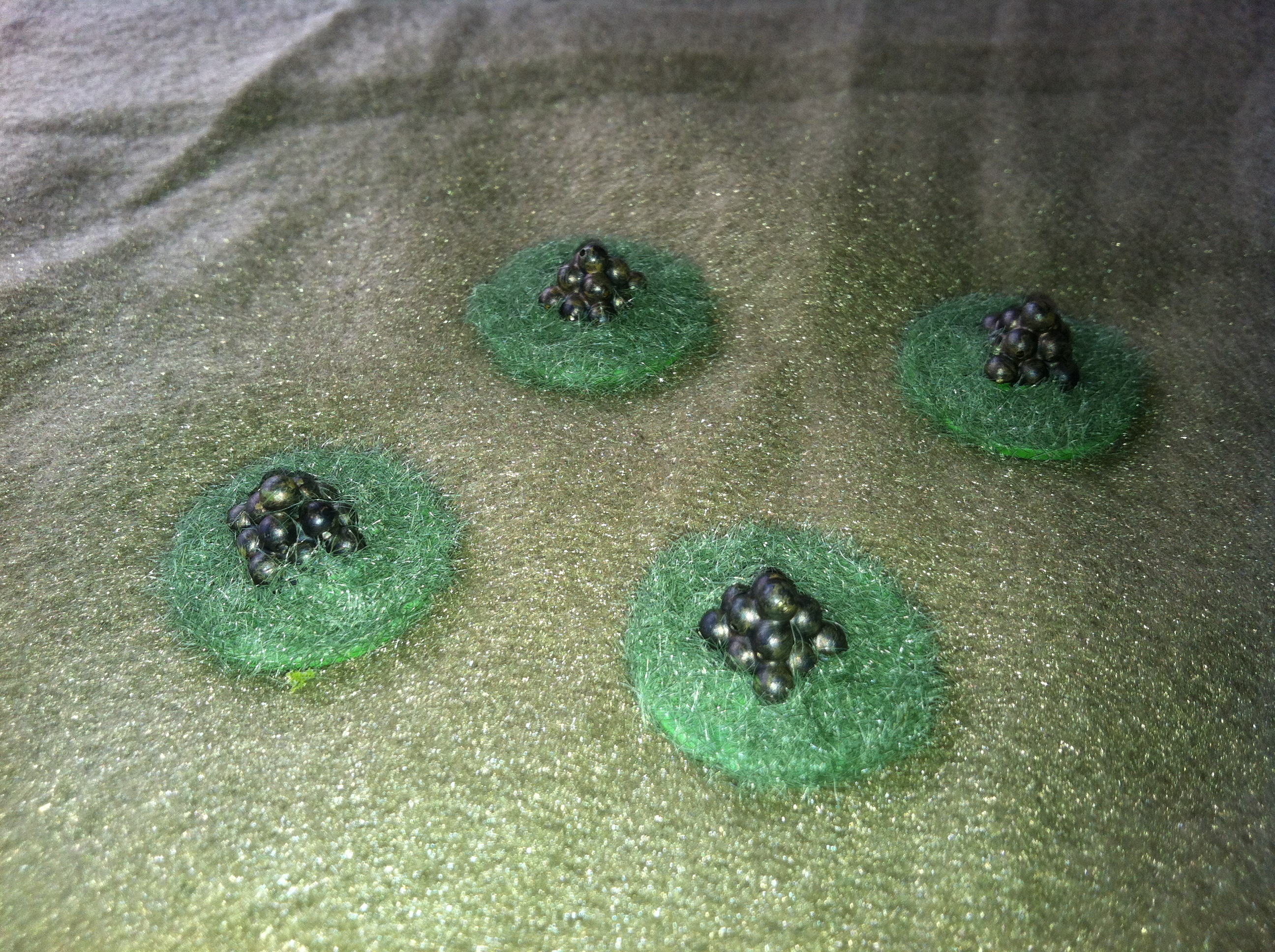
My most recent project is building some cannonball markers for my 28mm scale American Civil War gaming. These markers will be used to indicate when my field guns are loaded and ready to fire. In reality, most American Civil War field batteries probably didn’t have time to neatly stack piles of cannonballs as gun teams fired furiously at enemy lines. That said, anyone who has visited a historic battlefield site will most probably be familiar with the look of cannonball piles often found sitting neatly nearby an antique artillery piece.

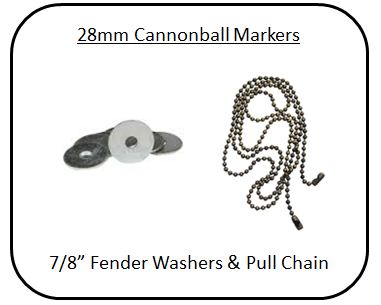
Many companies offer pre-made cannonball markers cast in plastic or metal, however, I thought scratch-building some markers of my own would offer a nice break from my usual painting of soldiers in blue and gray. For bases, I used the same 7/8″ fender washers I use for basing all my 28mm miniatures. The cannonballs were made from a length of metal pull chain found in the electric aisle of any hardware store. Many modellers use small gauge shot to model cannonballs, but I found the connected balls/links of the chain makes assembly quicker without the mess of chasing little balls around the workbench.

To begin, I cut and glued a small thin piece of cardboard over the center hole of each washer. I then cut three three-link sections, two two-link sections and a single ball from the chain. Starting at the bottom layer, I used a dab of superglue to affix the three three-link sections on the base. When dry, I glued the two two-link sections on top of the base layer and then fixed a single ball on the top of the pile. The result was a neat pile of 14 balls stacked into a symetric pyramid.

Once each based pile was dry, I spray-coated the markers with flat black paint. To give the cannonballs some shading and depth, I lightly dry-brushed some rusty metal and brown paint over the balls, allowing some of the black to remain between. The base was then painted green and flocked with some static grass affixed with PVA glue. A protective dull clear spray coat finished them off.

Sitting alongside my Union gunners running a field piece into position as their General shouts orders, these new markers make for a nice piece of detail on the battlefield.

2013 Goal Setting

We’re just over a week into 2013 but with more than 50 weeks still ahead, I think I have time to squeeze in some ideas on gaming goals I’m setting myself for 2013. Here’s five goals I’m setting for the year (including one I’ve already checked off the list):

1. Join a club

I have been dropping in on the Metropolitan Wargamers in Brooklyn for probably 4-5 years, and this year I’ve already finally got around to becoming a full member. The club occupies the basement garden level of a townhouse on a side street in historic Park Slope Brooklyn, just two stops from me on the subway. In a city where space for storage and gaming is at a premium, the club is a wonderland of gaming tables, boardgames and miniatures. While a lot of guys arrange to play a particular game ahead of time, there’s a big opportunity on the weekends to simply stop in at the club and grab a few guys up for playing whatever sounds good. The members of the club are incredibly supportive and passionate about gaming, and the diverse ages and backgrounds always makes for an interesting and entertaining mix over the course of a few hours.

If you’re in the NYC-area and you’re interested in what’s going on at the club, I’d suggest introducing yourself via their Yahoo! Group and then come in for a game at some point. You can also check them out via Facebook or follow them on Twitter.

2. Get back into World War II

A few years ago I got heavily into WWII gaming in 15mm with Flames of War. In pretty short order I painted up large German and American infantry armies, and then threw in a US paratrooper force for good measure. I signed up and played in a full-day tournament at a convention, and then I ran a game at another convention. Along with my infantry, I’ve also got dozens and dozens of tanks, jeeps, trucks and artillery pieces that have largely sat fallow for over a year as my interests (and schedule) have drifted elsewhere. In the interim, a new revised set of rules were released and a whole host of additional rulebooks focusing on the post-D-Day actions have also hit the market.

So, I’m jump-starting my interest in the era again in 2013. A big new starter boxed set containing the new rules and a bunch of new plastic figures and tanks wound up under the Christmas tree. I also scored the new Easy Company set of character figures who bring with them a whole set of special rules as you recreate the famed command exploits of the 101st Airborne Division. I spent part of my time off from work at the end of the year gluing up and priming my new forces and re-familiarizing myself with the rules. I’ve been talking up World War II with some guys at the club, my son seems interested in playing again and now I’ve just got to commit to returning to the tabletop battlefields of 1940s Europe.

3. Tackle my Anglo-Zulu War project

At a convention a few years ago I signed up blindly for a recreation of the Battle of Rourke’s Drift, one of the most significant engagements of the late-19th-century Anglo-Zulu War and a favorite of mine in the history of warfare. I tucked the game in the back of my head for a couple years, and then I happened upon some really inexpensive boxes of plastic British troops from the era at another convention last year. Well, once I had some Brits on the workbench I certainly needed some Zulus (and more Brits).

Months on, this project has stalled. I have hundreds of figures glued-up in various states of painting and a couple additional boxes of Zulus still waiting to be unwrapped. There’s a sameness to the British and Zulus which I haven’t quite cracked as of yet. I obviously need a system and a process to tackle all these guys in the coming year so I can finally get them up and running on the table. Long-term (really, really long-term), I fantasize about playing the battle of Rourke’s Drift in a true 1:1 scale of approximately 4,000 Zulu miniatures facing off against a contingent of 140 or so British troops. That said, getting this whole Anglo-Zulu project back on track this year is a promise I’m making to myself.

 4. Wrap up my American Civil War forces

If 2012 had a focus for me, it was the American Civil War in 28mm. With the 150th anniversary of the war in the news and Stephen Spielberg’s “Lincoln” in theaters, America’s greatest conflict was in the air. I worked along throughout the year painting away at the wonderful plastic and metal range of ACW miniatures offered by Perry Brothers Miniatures, and my sons and I played increasingly larger skirmish battles on the coffee and dining room tables.

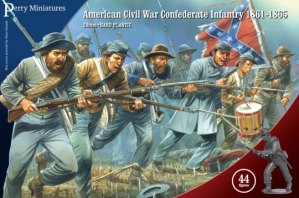
At this point I think I’m maxing out with a couple hundred troops in both Blue and Gray. I have a few more models of artillery which are about 80% complete, some fez-hatted 5th New York Volunteer “Duryee’s Zouaves” to wrap up and one box of the new Confederate infantry to start. I’ve been really happy with results this year, and I’m looking forward to hauling the whole contingent out of my apartment by the spring to share my work with the guys at the club.

5. More boardgames (and maybe some card games)

I largely ignored all manner of gaming throughout the 90s, and, with that, I largely missed the boat on the rise of Euro games. Over the past year-and-half, I’ve re-invigorated my interest in boardgames. Settlers of Catan and Ticket To Ride have become mainstays in my home for “family game nights.” I’ve already added Small World to the mix this year, and a friend of ours introduced us to Bohnanza – a competitive bean-planting and harvesting card game – over the holidays. I’ve got a list of others I want to try this year, and there’s probably countless more I don’t even know about yet.

Playing games with friends, family and members of the local club is such a fantastic way to disconnect from the realities of the world and re-connect with people in a way we seldom do in the normal course of life. Here’s to 2013 and a year of play.

Setting The Scene

One of the aspects of wargaming I love most is setting up the tabletop battlefield. I first got into scenery building with a large basement HO scale model railroad as a kid in the 1970s and 80s. Through a mix of sculpting hills and roads, modelling trees and creating realistic tableaus of buildings, I spent hours bringing to life a miniature world.

Setting up a tabletop battlefield serves two purposes. Firstly, playability is affected in terms of terrain contours, defensive cover and lines of sight. Secondly, a well-laid and realistic tabletop brings an aesthetic appeal and excitement only to be found in miniature wargaming. While throwing down a big piece of green fabric and some simple trees or lichen shrubbery and maybe some rocks for outcroppings can provide a bare minimum play area, adding a few pieces of additional model detail really makes a game come to life.

Check out some of my WWII and American Civil War set-ups in the Gaming & Painting section above, and have a quick read on some easy resources below to get your own tabletop ready for battle.

Battlefield Basics

For my groundcover, I use a $10 green fleece throw I picked up in a discount store. I like that I can fold it or open it up to create different sized gaming spaces. You can also use felt or any other cloth easily picked up at a local fabric store. For roads, I use a rubber textured road system I bought at a gaming convention. On the cheap, you can cut felt or other material into strips to create roads of varying lengths and widths. Streams and rivers can also be cut from blue felt. For basic shrubs, a bag or two of lichen from a hobby shop in varying shades of greens and browns provides flexibility in creating hedgerows and other bunches of ground cover. Spreading some gravel or larger stones around the battlefield can also provide some texture and look to the table.

Trees

While a lot of gamers prefer making trees from scratch using twigs and lichen, I like tree systems like those offered by Woodland Scenics. Whether you choose to build your own or buy pre-made trees, you can easily find what you need via websites or stores that cater to model railroading hobbyists. Keep scale in mind that shorter HO-scale trees suffice for 15mm scenarios and taller O-scale trees will stand in nicely for forests and treelines in 28mm games.

 Buildings

There are tons of options for wargaming buildings. Many experienced gamers make their buildings from scratch using foamcore, balsa wood and other kit-building materials found at any decent hobby shop. Another cheap option is downloadable paper cut-out buildings, many examples of which can be found online for free or in easy and immediate pay/download format.

A number of companies specialize in model buildings in lots of scales, eras and geographic locations. Some relatively inexpensive buildings come cast in solid resin and unpainted, while others come completely assembled and detailed with removable floors and roofs. More recently, laser-cut wood buildings are becoming a popular option.

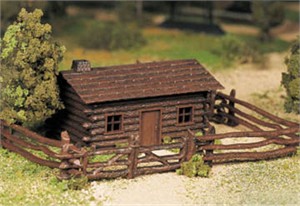
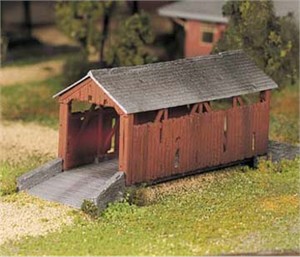
I like using plastic kits from model railroad suppliers, particularly O-scale buildings when I’m gaming the American Civil War in 28mm. These kits are pretty inexpensive ($10-30), easy to find online or in stores, simple to glue together and lightweight. The often simple detailing is easily enhanced with some simple painting and weathering removing the plastic gloss. Companies such as Bachmann (log cabin and covered bridge pictured), Atlas and Lionel all make model railroad buildings which can easily stand on an 18th or 19th-century American battlefield. I love my big Lionel K-Line O-scale American church I picked up for $9 on sale, and it always takes center stage in my American Civil War set-ups.

Boxed Terrain Systems

While pricey, several companies offer full lines of pre-packaged terrain systems made specifically for gaming. Flames of War offers a big line of 15mm WWII terrain through their Battlefield In A Box sets with roads, rivers, buildings and battlefield accessories to fit different regions of the war. Games Workshop also offers a number of products specific to their games from Citadel but much of it could be used for other gaming in Medieval and fantasy gaming environments in 28mm. For gamers with particularly deep pockets, Games Worshop all carries highly-detailed modular gaming boards for nearly $300 each.