The Four-Decade History and Future of NYC’s Trailblazing Metropolitan Wargamers

Editorial note: I wrote this article in May of 2024 on the occasion of the 40th anniversary of Metropolitan Wargamers. The article was originally published by SDHist here.

Background

Metropolitan Wargamers (MWG) was founded in 1984. The club is New York City’s premier and longest-operating gaming organization in the five boroughs with its own dedicated private gaming spaces.

MWG grew out of of the New York Wargamers Association (NYWA), founded in the early 1970s as an affiliation of local Napoleonic miniatures players. By the early 80s, some members of the group split off to form what would become MWG. The club’s first permanent yet short-lived home was on Steinway Street in Queens in a cramped second-story apartment with a couple of small tables and a leaky hole in the roof.

After losing this space, the club moved to its largest space at 20 Broadway in Williamsburg, Brooklyn. In the early 90s, the club was regularly listed in the “Opponents Wanted” section of Avalon Hill’s The General magazine. It touted “its own 2,000 square foot loft for boardgames and miniatures” and “facilities and members to play any game, anytime.”

Occupying the entire second floor of a warehouse, the Broadway space held six tables (plus a poker table) and lines of shelves along the walls holding miniatures, games and an enormous collection of military and history books and magazines. With a dingy couch, a threadbare area rug, peeling linoleum floors, overhead fluorescent lighting, a closet with a cold-water sink and toilet, and an industrial heater mounted to the corner of the ceiling, the Metropolitan Wargamers in Williamsburg reflected the grit of a Brooklyn since largely faded into memory.

For years, a small, dedicated group of about a dozen members struggled to scrape together money to cover rent and keep the club operating. The Broadway building was sold (and subsequently demolished) during the Brooklyn real estate development boom of the early 2000s.,After that, the club moved to its current location in the basement of a four-story, eight-unit 1920 apartment building at 522 Fifth Street in the heart of Park Slope, Brooklyn. (Entrance door pictured above.)

Set-Up

When the club arrived at its new Park Slope home, it was a raw, unused space. About $300 was initially invested in building new tables and shelves. It is still very much a semi-raw basement with a painted concrete floor and brick and stone foundation walls.

We have a front room with three 4’ x 5’ tables, each with multiple racks underneath to hold games in progress, plus a small 4’ x 4’ kitchen style table we salvaged off the street.

The front room at Metropolitan Wargamers.

Moving down a narrow hall, we have our “monster game” table measuring 8’ x 8’ which plays host to large footprint multi-month games such as World In Flames or Pacific War. The three tables at the rear of the club (two at 5’ x 8’ and one at 5’ x 10’) all have removable tops, handy for hosting months-long games like Empires In Arms or a big RPG dungeon crawl miniatures campaign.

The back room at Metropolitan Wargamers, featuring sand tables and walls of lined with miniatures and games.

Most uniquely, lifting the covers off two of the tables reveals sand tables for miniatures gaming. World War II miniatures games such as Battleground, Flames of War, O Group and Bolt Action have often been played on these sand tables.

A recent game of O Group in 15mm, with members and visiting guest from Detroit, on one of the club’s sand tables.

Shelves line the walls of the club, and first-time visitors usually gaze in awe at their contents of hundreds of games and thousands of miniatures. Shelves in the rear hold club-owned terrain – trees, buildings, gaming mats, rivers, roads, hills, and buildings ranging from historical periods to sci-fi and fantasy in multiple scales. A tall rack holds a dozen 4’ x 4’ sheets of plywood where more in-progress games can be stowed. Most of the shelves are rented by members to store personal collections of games and miniatures.

A 20mm Battleground game on one of the club’s sand tables.

Creature comforts at the club are few. There’s a refrigerator, microwave and coffee maker at the front, a tiny bathroom at the rear, and stairs up and out the back to a small private yard. The yard is used to spray-paint miniatures, and is where we’ll throw food on the grill during warm months.

The Battle of the Monongahela in 28mm using Muskets & Tomahawks rules at the club (figures and scenario by the author).

We finally installed free Wi-Fi within the past two years. Other than that, not a lot has changed since we made the move twenty years ago, and the club remains a bare-bones space solely focused on gaming.

Rules

So how do we manage this gamer’s paradise nestled on a side street in one of the more expensive neighborhoods in Brooklyn? We are fortunate to have a very good relationship with our landlord, who rents us the space for what is far below what he charges for one of his $3200 per month two-bedroom apartments upstairs.

Visitors attend for free as guests their first time at the club, and then pay a weekly fee of $15 whenever they stop by to play again. There’s an option for regular guest players to pay $40 per month for as much gaming as they want, provided they are there with one of our members.

Members and guest playing Root at the club.

The real magic comes in being voted in as a member of MWG after a 3-month probationary period of paying a monthly fee. With membership comes a set of keys to the club, granting 24/7 access to the space. That said, some visitors pay at the weekly rate for years without becoming members. For gamers largely living in small NYC apartments, the monthly fee of $40 for membership and $20 for a private shelf is a real deal.

Over the past ten years, membership has held steady at around 35 in number, give or take. We each pay our nominal fees, which pays for rent, utilities, cleaning supplies (one member pays no fees and handles all our cleaning and maintenance work) and whatever else comes up like building new shelves or replacing major things like the sink. Because our costs are relatively fixed, we’ve been able to maintain our very reasonable fee structure for years.
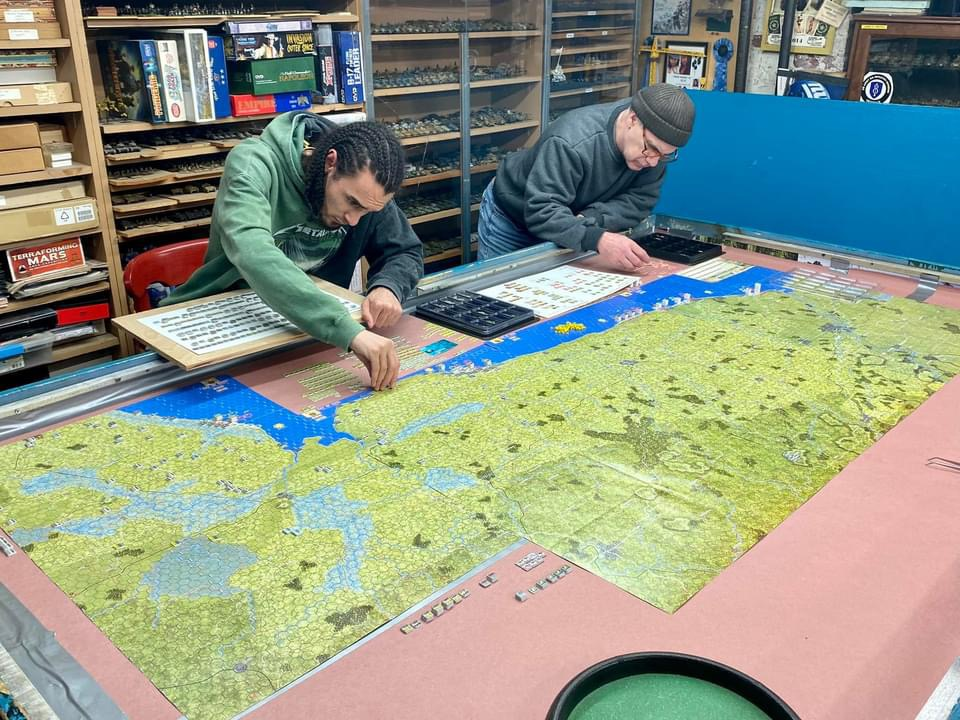
Father and son team James Jr. and James Sr. are often found playing big WWII hex and counter games, like Day of Days, over weeks on the club’s tables. James Jr. is just one of the people who have grown up in the club.

Modern gaming cafes in the city typically charge $15 for three to four hours of play, so the club is a bargain for serious gamers looking to clock many hours or even entire days of gaming. Unlike these café spaces, however, we are not open to walk-in traffic.And we don’t keep regular hours, so arrangements to visit are coordinated through an online club message board and via our social media channels on Facebook and Instagram.

Leviathans on the table surrounded by brick arches in the front room of the club. Second from left is Frank, our venerable eldest member and honorary Master of Arms.

Minors aren’t allowed without parents, but we’ve seen a few kids grow up within the club and come back to visit and play. We also don’t rent our space out, although we’ve been asked many times over the years.

Historical Notes

Membership has evolved greatly over the decades at MWG. Our founding members were largely working class first- and second-generation Italian, Irish and Greek New Yorkers who came of age in the 60s, 70s and 80s when New York City was a very different place. Stories abound with some members carrying knives and guns coming to and from the club in Williamsburg.
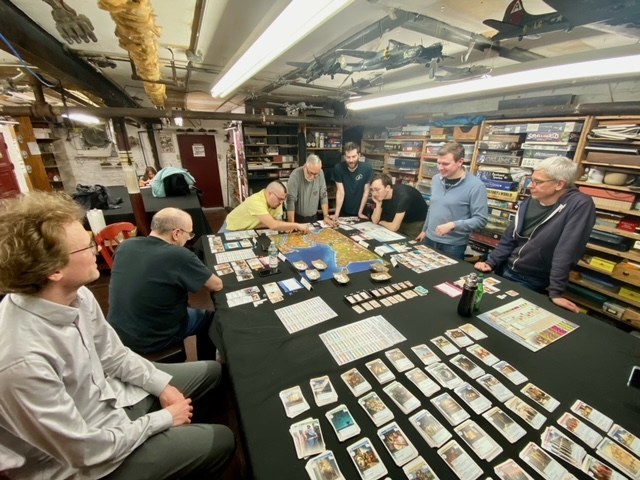
A day-long, 10-player game of MegaCiv at the club. Club founder Tony is second from left.

Today, about half our current membership reflects the modern influx of GenXers and Millennials who flocked to the city since the mid-90s. Our membership ranges in age from mid-20s to mid-80s. We’ve only ever had a few women as members at any given time. We’re fortunate to have many of the old guard around to share our history and that of the hobby with newer arrivals.

The games we play at MWG have also changed significantly. In its first decade, the club was almost exclusively home to historical miniatures gaming including Ancients, Hundred Years War, Napoleonic, American Civil War and World War II, all at multiple scales. Some board gaming from classic publishers like Avalon Hill and SPI also made regular appearances. Through the 1990s and into the 2000s, Warhammer Fantasy, Ancients and 40K rose to prominence, as did a greater interest in emerging Eurogames.
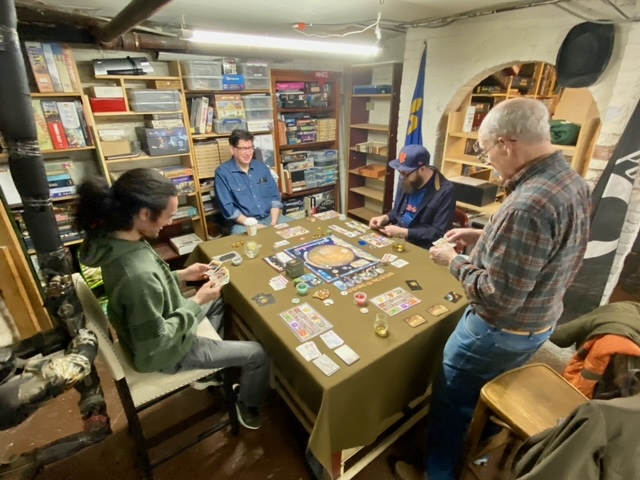
Club favorite Terraforming Mars shows up on the tables about once a week. Club founder Joe is at right.

While miniatures, including WWII, ACW, French & Indian War, Robotech, Epic 40K, Star Wars: Legion and Marvel: Crisis Protocol, have been played recently, most of the club’s gaming interests have moved toward a focus on modern board games and wargames in the past 10 years. RPGs have also continued to have a small but consistent presence at the club throughout its history.

Over its history, MWG has also been an incubator for game design and playtesting. A number of our earliest members spent time at the offices of SPI here in NYC in the 70s and 80s playtesting now-classic games. The club has included prominent designers in its membership, including Adam Starkweather (IGS, MMP) and Carl Fung (SCS and BCS, MMP), newer designers like Mike Willner (Prelude to Revolution, Compass Games) and Mike Lorino (Seminal Catastrophe, Vuca Simulations), and GMT Games Art Director Justin Martinez.

Members have won multiple awards at regional Historical Miniatures Gaming Society (HMGS) conventions. And the club continues to host visitors from across the country and around the world. That has included gamers from Spain, the UK and Australia.

Running an organization like ours has not been without its challenges. We’ve had more than a couple floods, weathered some internal controversies, and survived an extended shutdown during the COVID-19 pandemic (during which time most members continued paying dues and we received a grant from HMGS to offset a financial shortfall). Most recently there has been some conversation about changing our name to Metropolitan Tabletop Gamers to potentially broaden our appeal, but we continue to see new people show up almost every week just as we are.
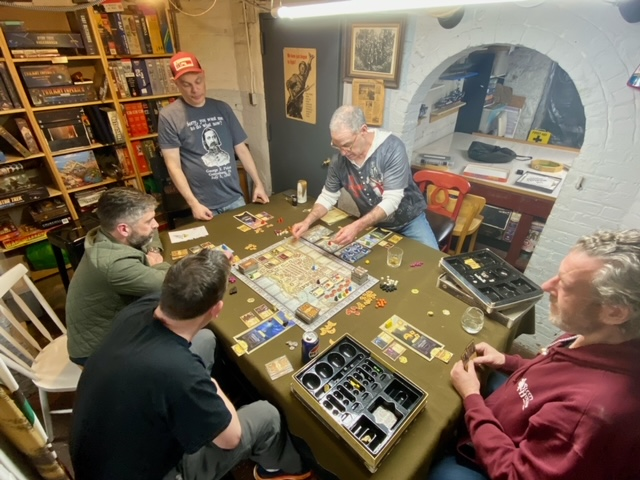
Another club favorite, Lords of Waterdeep, often serves as the opening or closing game of a day.

In 2024, Metropolitan Wargamers is celebrating its 40th anniversary. I’ve been fortunate to serve as President of MWG for the past ten years, and it remains one of the more unique communities of which I’ve been a part. The hobby, the city, the club, and its members have all changed over the years, but our core personality has remained intact as a community of dedicated gamers.
Boardgames of the French and Indian War – Part II

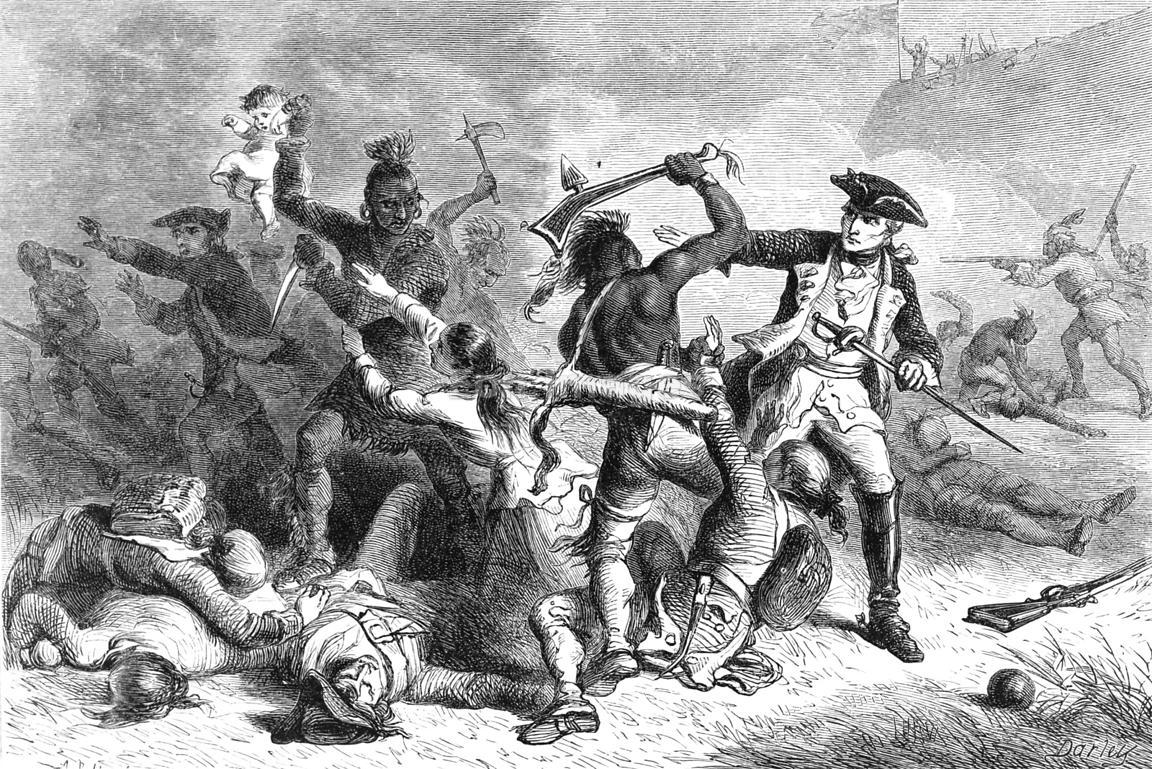
Battle of Fort William McHenry during French and Indian War

Quite some time ago, I wrote a round-up of my favorite boardgames of the French and Indian War. Since then I’ve been focusing pretty exclusively on the FIW using 28mm miniatures and Muskets & Tomahawks. I’ve also spent a lot of time over the past year reading about the period and visiting historic sites in New York, Pennsylvania, Virginia, Maryland and West Virginia that tell the story of the FIW.

Between travel, research, painting miniatures, building scenery and running through tabletop scenarios of the period, I’ve continued to build up my collection of FIW-themed boardgames. With that, I have a second list of more of my favorites from this empire-defining conflict in North America.

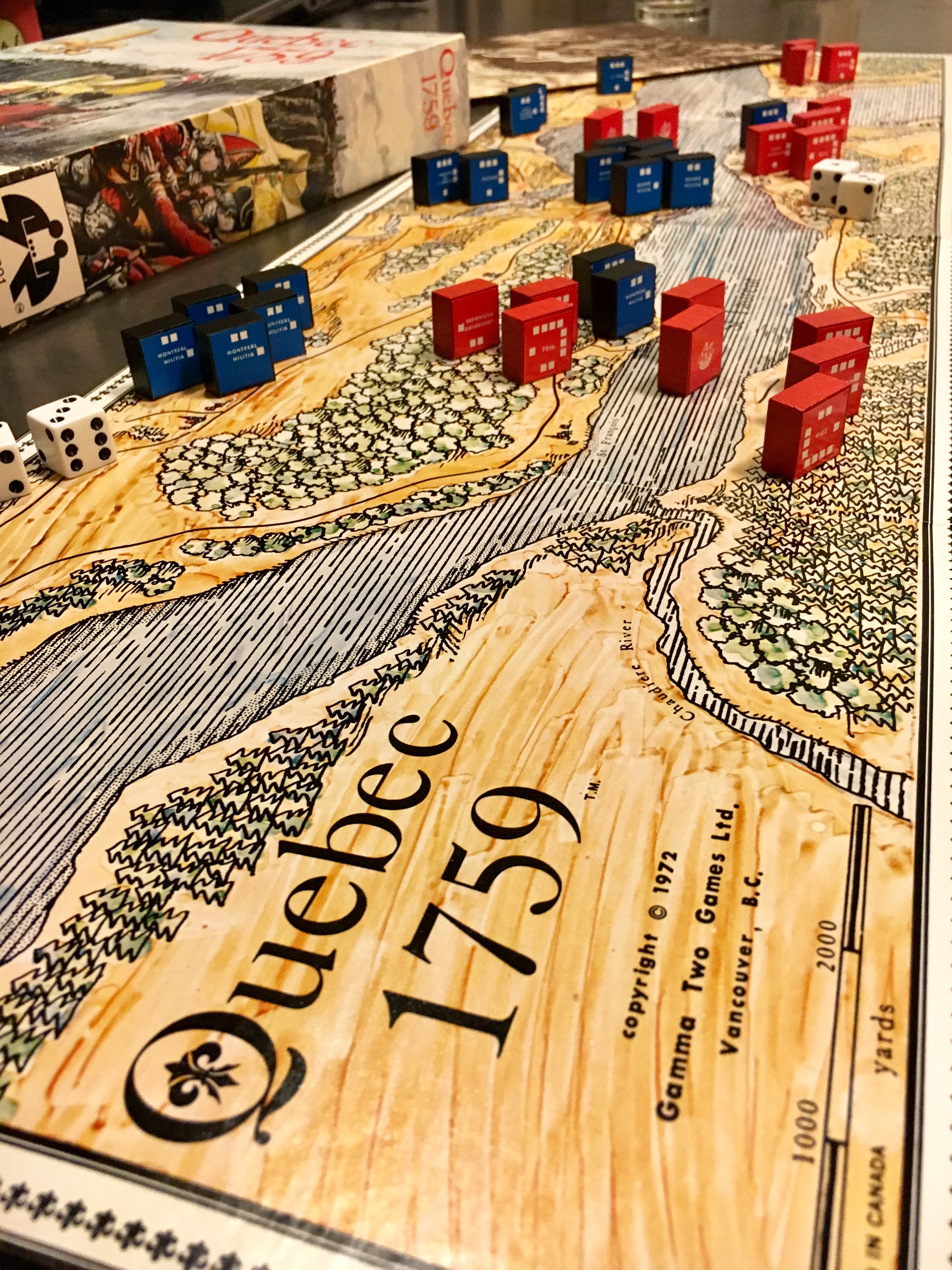
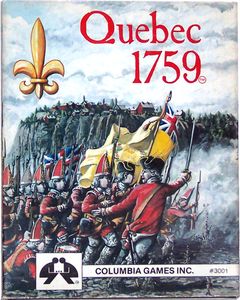
Image result for quebec 1759 game columbia

Quebec 1759 (Columbia Games)

You can’t beat Columbia Games for their quick-playing and unique block games for which they are known. I have Liberty: The American Revolution 1775-83, their American Revolution game, on my shelf, and about a year ago I finally to picked up a copy of their FIW game Quebec 1759.

Released in 1972, Quebec 1759 was one of the first block wargames produced and has remained in print for 45 years as a game perfect for entry level players as well as those experienced in the hobby. I’ve been trying to track down a first printing of the game for a while for the embossed blocks, but I couldn’t pass up a great deal on a 1980s edition with 50 stickered blocks for $20 at a convention flea market a couple years back.

IMG_1378

Map and wooden blocks from Quebec 1759

Playable in about an hour or so, this classic abstractly captures the meeting of the British forces led by James Wolfe and the French defenders commanded by Louis-Joseph de Montcalm in September 1759. The decisive Battle of the Plains of Abraham outside Quebec City left both men dead and was the beginning of the end of French rule in North America.

IMG_1379

Typical stickered wooden blocks from a mid-1980s edition of Quebec 1759

My near perfect copy captures the charm of the original edition with its signature wooden blocks, 10″ x 32″ elongated heavy cardboard map and a mere four pages of rules. The game is played over 16 turns with each side — British and French — plotting their moves in advance on paper and then simultaneously revealing them. There are no spaces on the map. Instead ten road-connected land zones and a bisected St. Lawrence River.

The game has remained a classic for a reason, notably its fast play that rewards numerous replays and taking turns on either side.

Related image

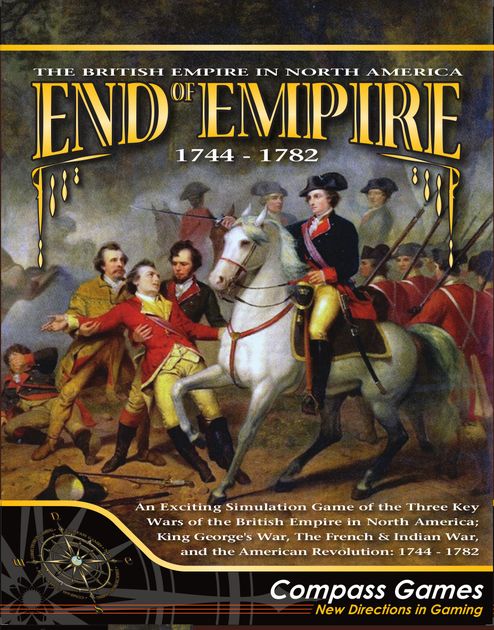
End of Empire: 1744-1782 (Compass Games)

Command was a bi-monthly magazine published between 1989 and 2001 which focused on military history, strategy and gaming. Issue 46 from December 1997 features articles on New France, the American Revolution, George Washington and his spy network, and famed traitor Benedict Arnold. The issue also contains a full hex and counter game called End of Empire which captures the grand sweep of North American history from the 1740s through early 1780s. The game was subsequently reprinted as a box game from Compass Games as End of Empire:1744-1782.

IMG_1375

My copy of Command #46 featuring End of Empire just prior to punching the counters

End of Empire covers a wide period from King George’s War, FIW and the American Revolution. Over a dozen scenarios allows play of specific conflicts or campaigns in a few hours, and a full game is playable over the whole period that will run to more than 15 hours for truly committed players. The game is regimental in scope with a huge hex map spanning the entire North American East Coast and contains hundreds of color counters representing British, French, Spanish, Indian and Colonial forces. For a real deep dive into nearly 40 years of colonial conflict, this is the game.

Wilderness Empires (Worthington Publishing)

I’m a big fan of Worthington Publishing’s games. I have three of their American Revolution games – New York 1776, Trenton 1776 and their latest, Saratoga 1777. The simple graphic maps and wooden blocks make Worthington’s games easy to grasp while also providing some great strategic play specific to the conditions of certain battles and campaigns.

IMG_1380

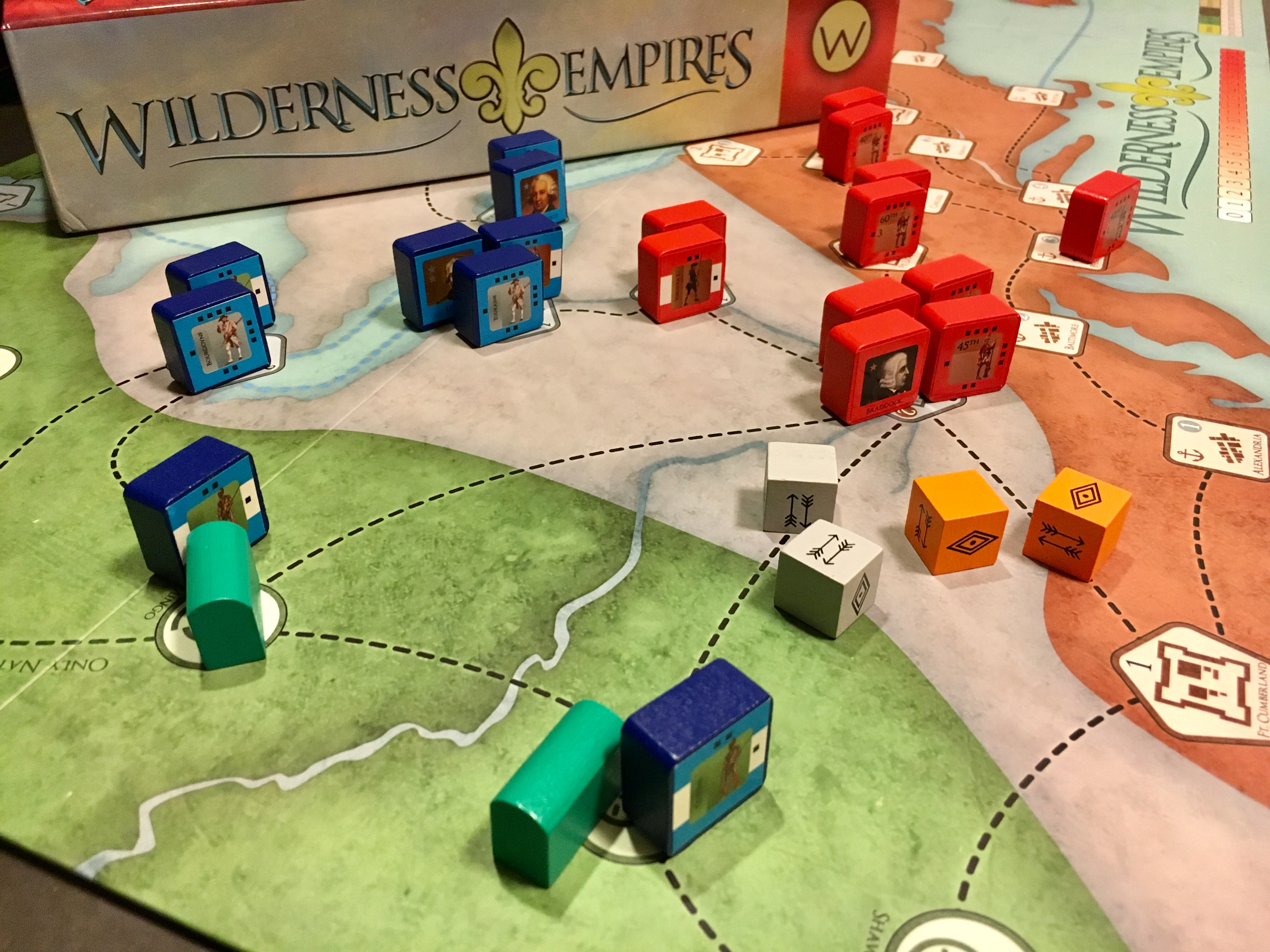
Map detail and wooden playing pieces from Wilderness Empires

With Wilderness Empires, most recently reprinted in 2016, Worthington captures the larger scope of the grand strategy of the FIW in a mix of point-to-point movement, blocks and cards. Designed by my pal Bill Molyneaux, a FIW reenactor and game designer, the game is steeped in real history while producing introductory level play of the period for 2-4 players.

IMG_1382

French (top) and British (bottom) cards from Wilderness Empire featuring original art by Don Troiani

The components are hefty 1″ wooden blocks with nicely rounded corners representing French, British and Indian forces. Indian towns, special wood dice, a large board and cards featuring beautiful original art by Don Troiani round out what’s in the box. Their artwork aside, the cards provide tactical play of reinforcements, leaders, campaign actions and specific play of historical units such as Rogers Rangers and Indian allies.

If you’re lucky, you can track down this recently out of print game in gift shops at various historical sites and forts in the northeast for a great intro to the period.

1759: The Siege of Quebec

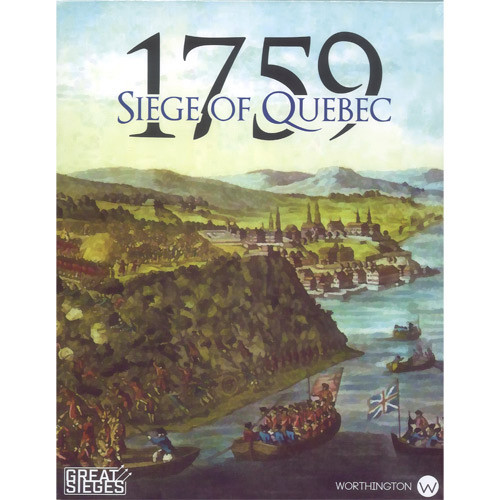
1759: Siege of Quebec (Worthington Publishing)

Worthington has also produced a new spin on the famed siege of the era with 1759: Siege of Quebec. The game presents a bit like the classic Columbia game covering the same battle but with a unique 2-in-1 package that allows for both 2-player and solo play, a rarity for games of the period.

Sample of Gameboard

The beautiful map for Worthington’s 1759: Siege of Quebec

This game is gorgeous. The area movement map is bisected with by the St. Lawrence River and has defined deployment areas for stickerless blue (French) and red (British) blocks. In the 2-player game, separate hands of Command Decision cards and Command Field Orders books allow each side to make selections on what they do each turn. Cards are revealed and resolved, with casualties and morale tracked toward victory. The solitaire game uses a separate set of cards but plays out in a similar way.

The game falls into the modern string of fast-play “lunchtime games” which typically run less than a half-hour, making 1759 a great modern spin on the often-covered battle.

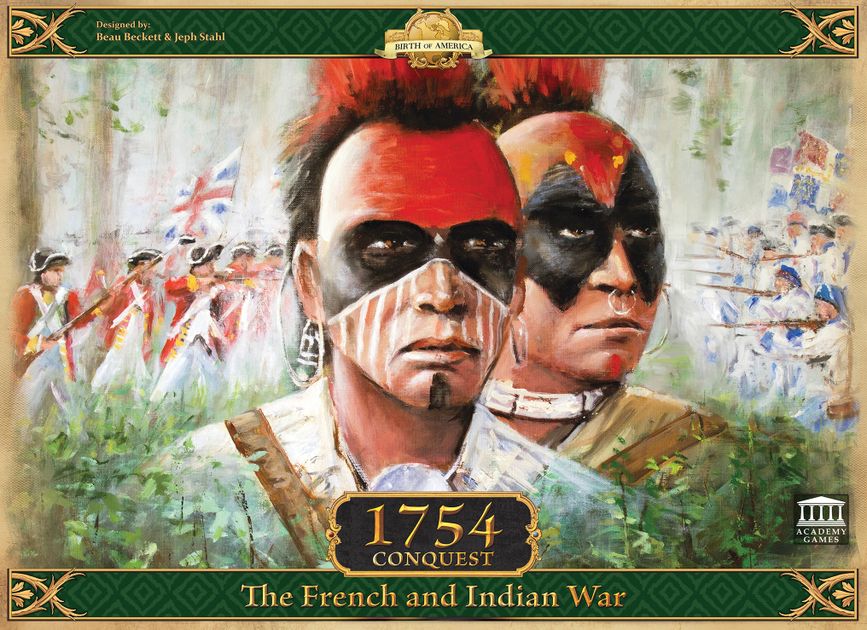
Image result for 1754 conquest academy games

1754: Conquest – The French and Indian War (Academy Games)

I’ve long been a devotee of Academy Games and their take on American history through their highly accessible and educational games. I have copies of their American Revolution game 1775: Rebellion, 1812:The Invasion of Canada and the immensely challenging Freedom: The Underground Railroad, so when I heard they were producing a FIW game, I knew I’d be getting a copy.

16681548_1298610760161843_8458888921304871472_n.jpg

Set-up of 1754: Conquest from Academy Games

The game, 1754: Conquest, follows the same basic mechanics of 1775 and 1812 and rounds out Academy’s trilogy from their “Birth of America” game series. All three games feature wonderfully colorful maps with area movement of small cubes using small hands of action cards keyed to historical events and personalities.

IMG_1377

One of my many plays through 1754: Conquest

In multiple plays of 1754, I’ve found it to be the most challenging in the series. Fortifications, muster points for militia and harbors for arriving British and French reinforcements all reflect the major points of control important to the war. As with all games in the series, this one serves as a great entry into wargaming the period while also providing a challenge to more experienced gamers.

Bayonets & Tomahawks (GMT Games)

One of my most anxiously-anticipated games is GMT’s Bayonets & Tomahawks which has been on their P500 pre-order since 2015. There’s been a steady drip of development and playtesting articles over the game’s long gestation, and in late 2019 some near-final box art was made available.

A 2018 playtest map for Bayonets & Tomahawks, slated for delivery in late 2020

As with all things that come out of GMT, the looks like its going to be a beauty with custom dice supporting a unique battle system and full-color round, square and triangular counters for different forces, fleets, forts and game conditions. The playtest map looks stunning. The game will play over shorter scenarios or the full war with raids, battles, construction, sieges and naval actions. Cards will support historical events and military actions. Having not gotten my hands on it as of yet, I can’t wait to unpack and punch this game when it becomes available, hopefully in late 2020.

Rebuilding a 28mm Wilderness Fortification

IMG_1403

The construction of 17th and 18th-century European fortifications were revolutionized by the writing of Sébastien Le Prestre de Vauban, the French military engineer and author of A Manual of Siegecraft and Fortification. His formal star-shaped forts of the era defined military and city defensive architecture throughout Europe and in overseas colonies.

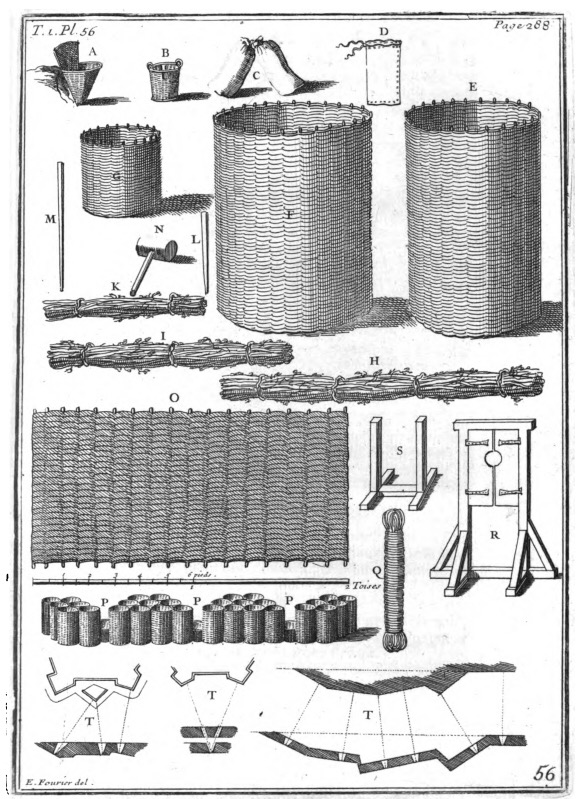
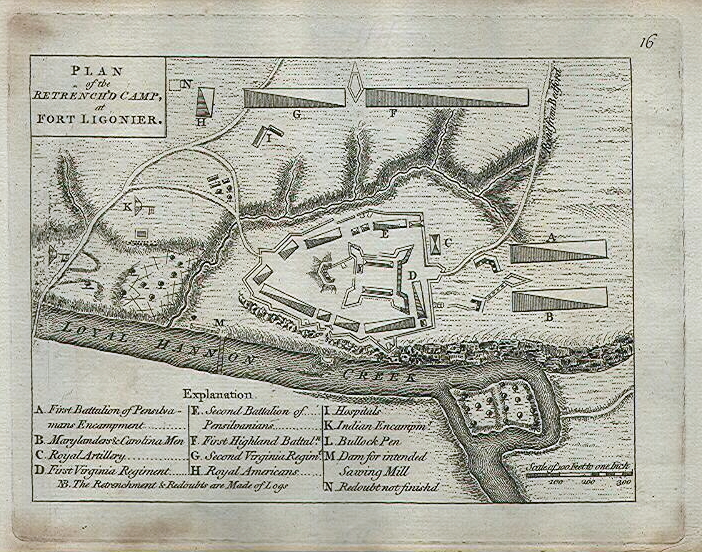
North American wilderness warfare of the French and Indian War often called for more hastily-built backcountry defenses. A paper by Military Architecture of the American Frontier, made available online by the National Park Service, provides an overview of how Vauban’s and other writings of the period influenced fort building in a very different environment. Blockhouses and stockades were common, and some reconstructed examples like Fort Necessity and Fort Ligonier can be visited today. Given even less time and planning, dirt, plentiful trees, and woven gabions filled with rocks could be used to create a somewhat formidable defensive position by throwing the strong backs of soldiers and hired civilians into the effort. While some Vauban-style grand forts of the period like Fort Niagara and Fort Ticonderoga still stand centuries later in the United States, countless small, temporary fortifications have been long lost to time.

FortLigonier.jpg

A plan of Fort Ligonier, Pennsylvania from “A Set of Plans and Forts in America. Reduced from Actual Surveys” by John Rocque (c. 1750)

My local club Metropolitan Wargamers in Brooklyn, NY has hundreds of pieces of terrain in multiple scales spanning many historical eras. Some of these pieces are decades old, once belonging to members who have long since moved on. They reflect different wargaming modeling techniques of the past and some bear the markings of manufacturers long gone.

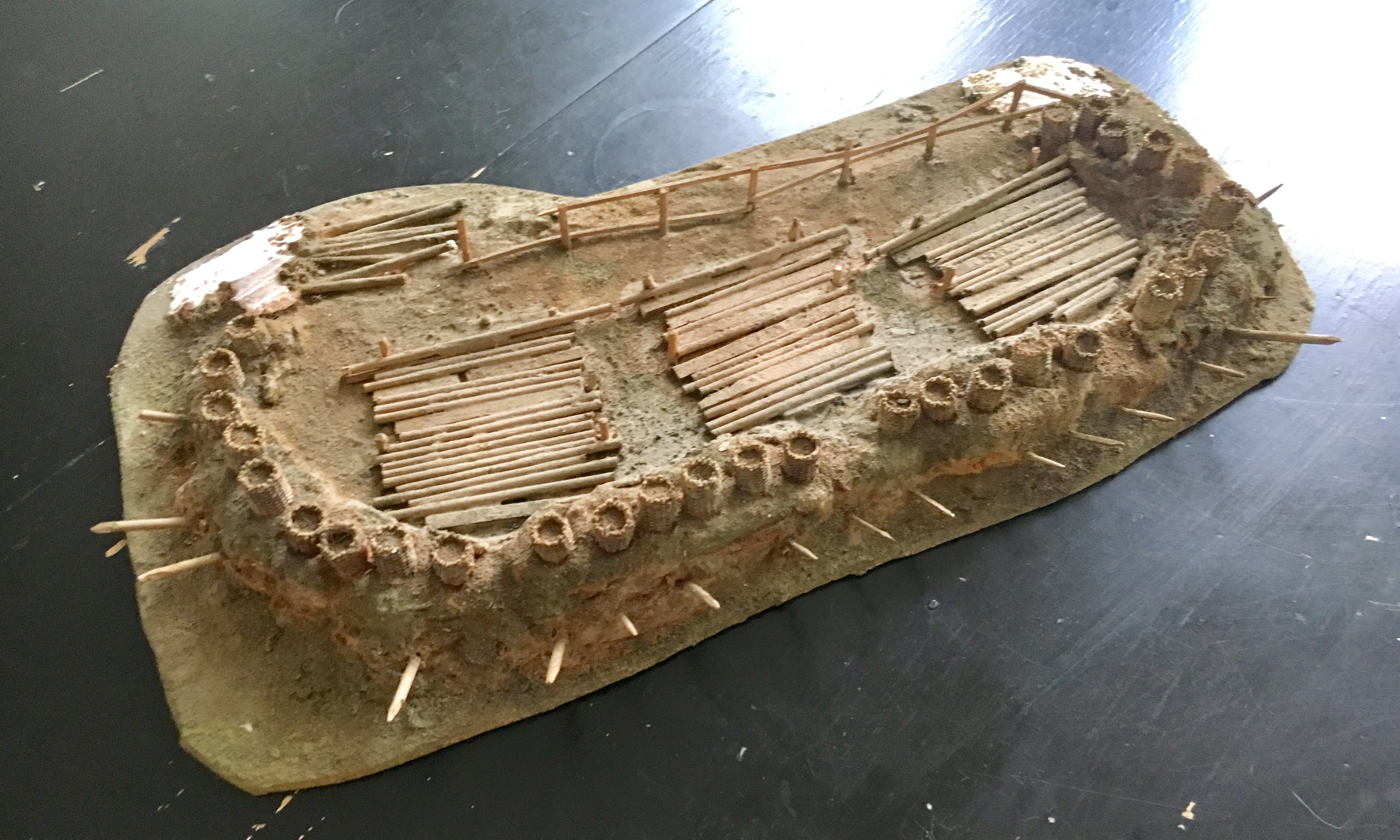
I’ve taken it upon myself recently to rebuild and refresh some of these pieces, particularly a number of 28mm buildings and scratch built terrain models appropriate to 18th-century scenarios of the French and Indian War era. With this in mind, a large, banged-up and dusty wilderness fortress piece recently caught my eye on the club’s shelf and I set to work making it usable again.

IMG_1401

A decades-old scratchbuilt piece of terrain in need of repair

Mounted on a piece of quarter-inch plywood measuring about 8″ x 18″, this hefty model features three canon positions on a plaster raised earth mound surrounded by resin-cast wicker gabions and sharpened wooden stakes. The years had not been kind to the model. Original trees had snapped off long ago, several breaks in the plaster were evident, grass had worn off, fences were broken and overall, the whole model had taken on a drab appearance.

IMG_1406

Some initial repairs and a fresh coat of paint

The first step was to clean the model of the layers of dust accumulated over the years, remove remnants of broken trees and trim off flaking and broken bits of plaster. Next, I filled cracks and missing areas of plaster with lightweight wood filler. All the earthen areas then received a fresh coat of dark brown paint over which I dry brushed varying layers of browns and gray paints.

With the base repainted, I made small glued repairs to broken fencing. I also added a few spare sticks and a barrel to bring some detail to the model as if repairs were an ongoing part of the fortification’s use. From there, the logs, fence, sharpened stakes and gabions were repainted and weathered using more dry brushed coats of browns and grays.

IMG_1407

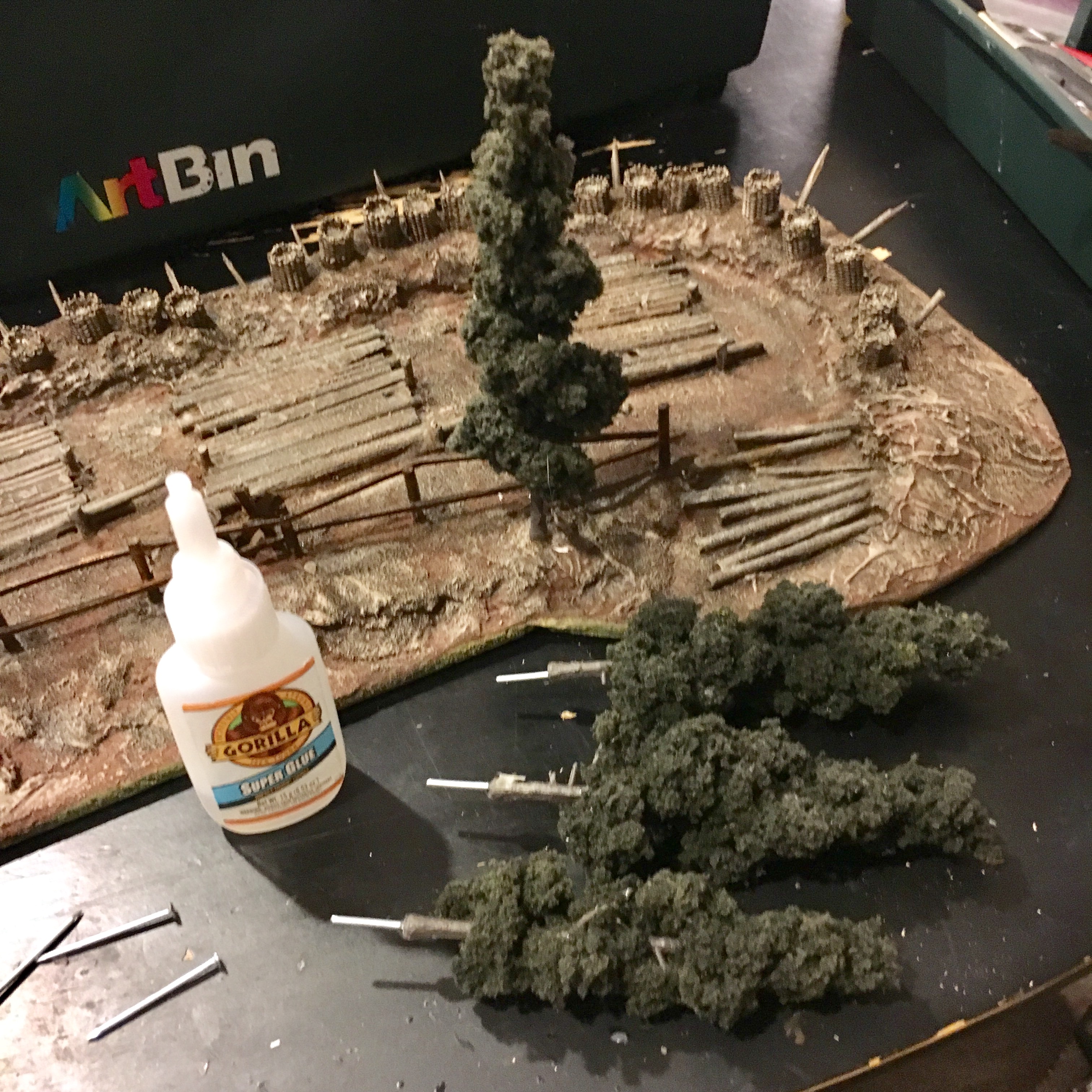
New trees are glued to the model

With most of the new painting done, I turned to adding new trees. I drilled and glued nails into the trunks of pre-made trees from Woodland Scenics which were then glued into holes in the base at the rear along the fence. The trees added textural and vertical interest to an otherwise flat model and also provided some additional color to the overall earthiness of the terrain.

IMG_1408

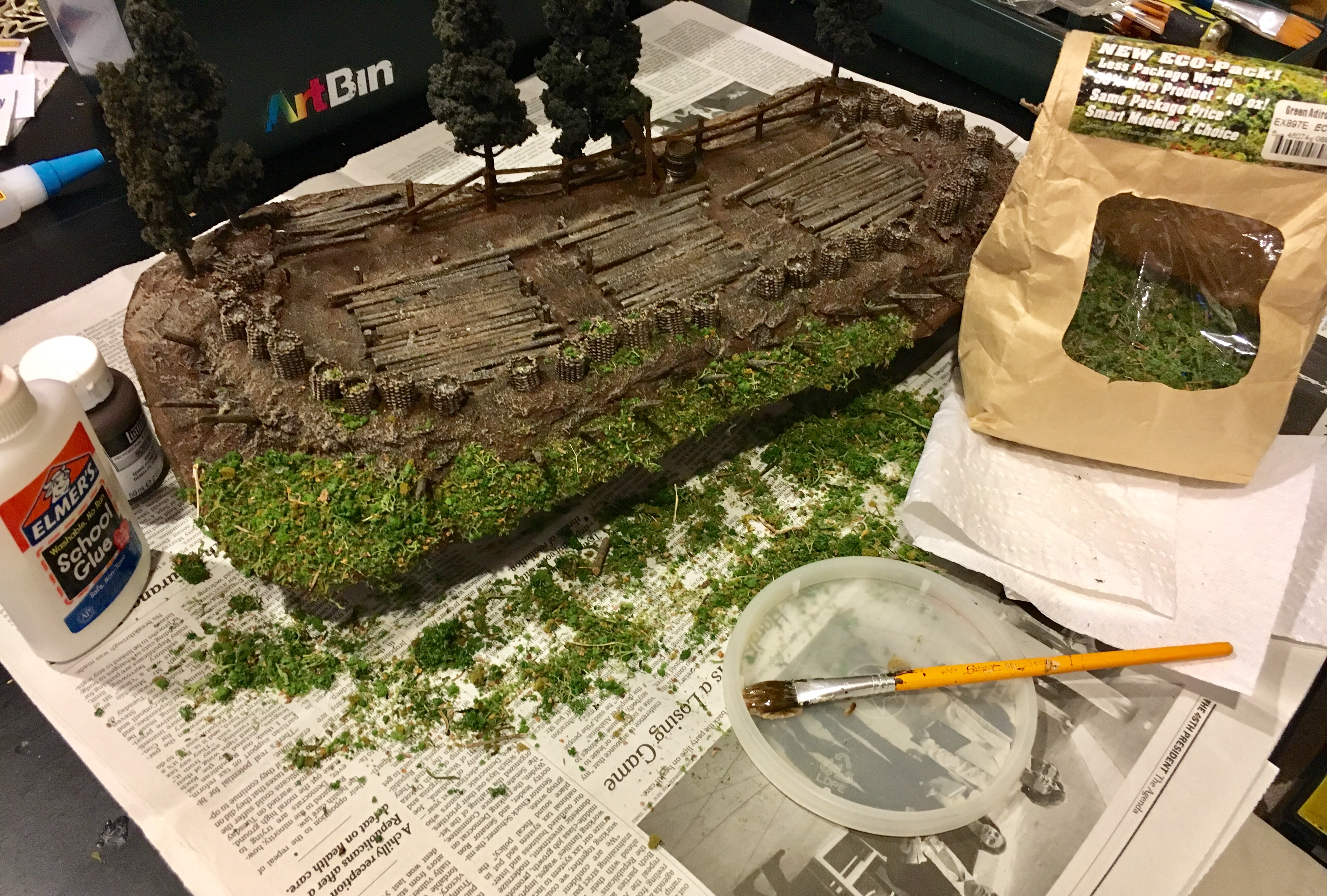
A layer of new groundcover is applied over the model

Further texture and color was added with my favorite Adirondack Blend from Scenic Express. This material contains grass of varying color and texture along with other larger bits of scattered twigs and wood chips which give a highly detailed look that reflects the ground of the North American wilderness. To attach, I heavily brushed white glue on a section at a time all around the base of the fortification and then shook a thick layer of the grass over the glue. Some areas around the logs also received a bit of grass to break up the sameness of the main battery area. Once dry, I lightly tapped the excess grass off the model, carefully scooping up the extra for use again. Finally, a couple small bits of clump foliage were glued around the trees and in random areas along the model’s base. With everything dry, the model got a matte spray coat to hold on the grass and seal the new paint.

In less than a couple hours work, the whole model popped back to life after sitting unused for years. The fortress also has a look more consistent with some of my other terrain pieces, allowing for a more unified look on the table. The project has inspired me to have a look at rebuilding other long-ignored pieces of terrain at the club, bringing them into a new century of miniature wargaming for hopefully years to come.

IMG_1498

IMG_1499

Retro Gaming The 70s & 80s: The DragonLords

dlbox

As a young gamer in the 70s and 80s, I had an incredibly supportive mother. Our trips shopping always allowed for stops by local bookstores, five-and-dimes and hobby shops to check out the latest Dungeons & Dragons releases, metal miniatures, fan magazines or other gaming delights to add to my growing collection. My mother was also a big yard sale and flea market fan, dragging home all sorts of used games for my brothers and I to try out. One of those early-80s yard sale finds was an unopened copy of 1978’s The DragonLords from Fantasy Games Unlimited.

Founded in 1975, FGU is still in business as a publisher of a variety of board and role-playing games. Like many game companies in the mid-70s, FGU leapt into the D&D tidal wave and released a number of fantasy-themed games. The DragonLords followed the traditional hex map and cardboard counter game model well-established by such publishers as Avalon Hill. The box contained a map, simple rule book, reference sheets and over 600 tiny cardboard playing pieces. The artwork was second-tier generic fantasy illustration, the game map was outright bland and the printing looked like it was done on a typewriter. I loved this game.

dlmap

In The DragonLords, each player took on the guise of a wizard ruling over their kingdom. Players chose to play as a Sorcerer, Conjurer, Enchanter, Necromancer or other type of specialized wizard, each with their own unique set of spells. Spells were acquired through turns “studying,” allowing for more advanced spellcraft in areas such as Siege, Hiring , Weather, Speed or Tactical. By casting their spells, wizards developed armies to fan out across the map to conquer the opposing kindgdom, hasten movement of their own horde or wreak horrible natural disasters on the enemy.

For someone well-steeped in D&D and Tolkienesque fantasy, a lot of The DragonLords felt very familiar. Tiny cardboard chips featured very basic line illustrations of elves, giants, trolls, ents, dragons and other creatures, each with values for combat and movement. The wizard spell study mechanic felt akin to the levels of advancement with magic-using characters through Experience points gained in D&D campaigns. Siege of cities and frontier keeps was a key part of the game, and building and attacking with catapults, siege towers and rams was a big component missing from a lot of smaller-scale D&D play.

What I loved about The DragonLords at the time was the mix of individual wizard character development and the grander scale of huge grotesque armies slugging it out across the mountains, swamps, forests, roads and waterways of the map. A game could be played satisfactorily in a few hours, also a nice change of pace from the long-term campaigning in D&D. The DragonLords certainly didn’t win any points for its graphics, but for straight fantasy gaming on an epic scale it definitely had its spell cast on me.

Collector’s Note: The Dragonlords is long out of print, but with a bit of online searching Iwas able to come across one bagged unpunched copy for over $100 on Amazon.com. Clearly my mother’s yardsale find was quite a deal.