Retro Gaming The 70s & 80s: The Official Advanced Dungeons & Dragons Coloring Album


As a kid in the 1970s, I had heaps of activity books of all sorts — brain teasers, mazes, puzzles, coloring, paper doll and cut-out model books. As a new Dungeons & Dragons gamer, I loved 1979’s “The Official Advanced Dungeons & Dragons Coloring Album” which captured two of my childhood passions within 30 or so pages of absolute wonder.

This was no ordinary coloring book on any level. Even as a kid, I was always impressed by its long and prideful title. This was a “coloring album” instead of just another “coloring book.” The drawings were by Greg Irons who famously worked on posters for Bill Graham’s legendary Fillmore Auditorium rock concerts and the 1968 Beatles animated film Yellow Submarine. To my young eye, Irons’s art in the coloring album looked liked the work of a Medieval woodcutter or like uncolored stained glass windows. Lines were dark and heavy, but the drawings wildly animated each page in a progressive story of adventurers and monsters familiar to D&D gamers.

The other aspect that made this publication unlike any normal coloring book was the text by Gary Gygax, the co-creator of D&D. Knit within the story-like captions accompanying the illustrations by Irons, Gygax delivered an actual game you could play. While vastly simplified, Gygax borrowed heavily from some of the basic D&D terminology and concepts with which I was quite familiar by then. And there, at the center of the book, was a two-page dungeon map on which the short adventure could be played. Despite the game having little replay value, I remember playing it repeatedly just because I loved this book so much.

Out of all the stacks of throw-away activity books I had as a kid, “The Official Advanced D&D Coloring Album” is one of the few standouts in my memory. Like the game that inspired it, the book presented and inspired so much fantastic creativity in a way I had never seen before and have seldom seen since.

Collector’s Note: “The Official Advanced D&D Coloring Album” is out of print but scans are available online for free download here and here. Copies of the original unused book can also be found on eBay for an astonishing $75 and up, and partially-colored copies start in the $15 range from online rare book dealers like AbeBooksYou can also check out some of the Fillmore-era posters from Greg Irons at Wolfgang’s Vault, although buying one will run you into the thousands of dollars.
Retro Gaming The 70s & 80s: TSR Minigames


Alternatively known as “microgames,” “pocket games” or “minigames,” a number of companies created a fad in games in small packages in the late 1970s through early 1980s. These compact games came in a variety of historic, sci-fi and fantasy themes. Rulebooks, maps, cardboard chips and dice were usually packaged in hardshell cases or even simple zip-lock plastic bags. A very few of these games, like the post-apocalyptic Road Warrior-esque Car Wars from Steve Jackson Games, would see a long life fueled by supplements and expansions. More commonly, these minigames were stand-alones of vastly varying quality which faded into obscurity in a few short years.

TSR, the makers of Dungeons & Dragons, entered the minigame market late with a total of eight games released in the first couple years of the 1980s. This was a big growth period for TSR as they continued to diversify beyond their core D&D products into other boardgames, role-playing games, toys, computer and video games, and even an animated TV show. Already investing a ton of our time and money in TSR products, my brother and I snapped four of their minigames:

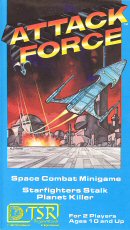
  • Attack Force was a simple Star Wars rip-off with one player’s force of small star fighters attempting to find the weakness in the other player’s monstrous space station to destroy it. As a fan of Luke’s attack on the Deathstar, I gave TSR a pass on the lack of originality for the chance to do some space battling myself.
  • They’ve Invaded Pleasantville was also a two-player game, this time set in a rural village where the townspeople try to fend off alien invaders infiltrating the local populace. Each player used identical chips representing such local folk like the minister, sheriff, plumber, checkout girl and others. The trick of the game was the alien invader bluffing their way toward taking over the bodies of the locals while the town player sought to uncover who was really an alien.
  • Revolt on Antares was a much better sci-fi-themed game and offered play for 2 to 4 players. The game presented a Risk-like map of a fictional world where six ruling “houses” with names like Andros, Dougal and Serpentine fought to rule the planet through three different scenarios. Each house had its own personality and strengths, adding a lot of variety and replay value. The ability to recruit new troops, move across varied terrain and use seven special alien weapons or devices made this little gem seem a lot more like a real wargame.
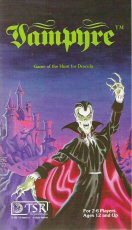
  • Vampyre was two games in one set in the realm of Bram Stoker’s “Dracula.” The first campaign-map-style game took 2 to 6 players in the roles of Stoker’s hero characters questing to find and destroy the coffin safe-havens of Count Dracula hidden throughout Transylvania. Turning the map over, a detailed floorplan of Castle Dracula allowed another game to be played as the characters sought to track down the Count himself and destroy him.

As a kid, I loved these games as a break from the longer hours spent bent over the table with my D&D campaigns. Each minigame offered its own varied mechanic, but rules were simple and limited to just a few pages for each game. The booklets, game maps and cardboard playing chips contained some wonderfully intricate small-scale artwork, much of it by popular fantasy artists of the day. While I don’t recall the exact cost of each game, I remember them being under $10 apiece and quite a deal for the hours of play we wrung out of each.

These four TSR games still sit in a closet packed full of my childhood puzzles and boardgames in the house where I grew up. At the time, there was an outsized amount of fun in each little mingame package. Today, there’s still a lot of memory in each, too.

Collector’s Note: Many of the TSR minigames can be found frequently on eBay selling in the $10-30 range. Steve Jackson Games makes much of their Car Wars and other microgames back catalog available for digital purchase online.

Retro Gaming The 70s & 80s: Dungeons & Dragons Computer Labryinth Game

By 1980 I was like a lot of kids with feet in two worlds of gaming — Dungeons & Dragons and electronic games. Both were well on their way to being the worldwide phenomena they would become in the next decade, and Mattel and TSR (then owner of D&D) sought to cash in on the intersecting interest of adolescents everywhere.

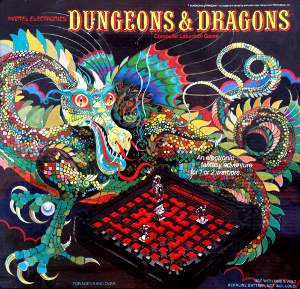
I never owned a copy of Mattel’s Dungeons & Dragons Computer Labryinth Game, but plenty of my friends did. The game looked pretty cool with its 64-square grid of spaces surround by a plastic castle-like wall. Metal figures represented a dragon, two adventurers and a treasure chest. The game could be played solo or with two players. A player moved their piece around the board, placing plastic walls when the board revealed a wall with light-up indicators. Other indicators would light up as you encountered monsters, traps or the dreaded dragon which roared as you approached. A player who avoided the dragon and navigated the revealed maze to the treasure first won the game.

A year before the D&D Computer Labryinth Game was released, Mattel was already competing in the new video game market with its Intellivision system. Those early years of the electronic game market were full of games which promised more than they delivered. Using the word “computer” in this game’s name was no doubt the work of shrewd marketing as the game itself was pretty low tech. Attaching the D&D graphics and brand to the game and even a moody TV ad didn’t do much to cover up for its shortcomings. Looking back, I recall the game even then to be unsatisfying to occasionally frustrating with its randomized LED grid and pieces which never really seemed to fit right. Retailing at around $45, the game didn’t come cheap either.

In 1984, Mattel admitted to its failed also-ran place in the video game market and pulled the plug on its Intellivision system. While it would go on to continued success with its boy-focused toy brands like Hot Wheels, Matchbox and Masters of the Universe, Mattel would never again be  significant player in electronic games. D&D, on the other hand, continues to thrive to this day. While the brand extension foray of the D&D Computer Labryinth Game never really delivered on the promises illustrated in Mattel’s box art, the game does capture a moment in time when gaming was bridging the gap from one era to the next.

Collector’s Note: Complete copies and components of the Dungeons & Dragons Computer Labryinth Game are readily avilable on eBay. Games in the original box run in the $30-50 range while the metal miniatures generally go for $5-10 each.

Downloading: The General


In our highly-digitized world of everything fandom, it’s hard to remember there was a day where a primary lifeline for fans was via the mail. While gaming enthusiasts played games by post and created their own newsletters for small cliques of fellow gamers, it was game publisher Avalon Hill that created the first widely read and regularly published magazine for the strategic wargaming hobby.

Beginning in 1964, The General served as the bi-monthly house newsletter for AH. The General provided regular space for articles on new AH products, debates on variant rules, announcements of gaming conventions and a place where gaming fans could connect with each other on a regular basis. With games like Outdoor Survival, Tactics, Gettsyburg, Blitzkrieg and Panzerblitz, AH ruled the early years of the nascent gaming hobby through their formula of bookshelf games of hexagonal maps, cardboard markers and detailed rulesets full of charts. It was not until the arrival of TSR and their culture-changing Dungeons & Dragons in the early 1970s that AH would face serious competition as gaming shifted from board games to role-playing. By the time AH was acquired by Hasbro in the late 1990s, the world of gaming had changed considerably and The General was shuttered.

In Jon Peterson’s masterful book “Playing At The World,” he tracks the development of the wargaming hobby using The General, TSR’s own Dragon magazine and dozens of smaller lesser-known newsletters as primary sources. For those of us who have wished for a deeper view into the early days of our hobby, the Internet Archive has now made PDFs of The General available. With just a few cursory early looks, having access to this archive of our own history is certain to be an incredible asset for wargamers.

Downloading: Dungeons & Dragons Classics

I just finished reading Jon Peterson’s epic history of wargaming, “Playing At The World,” this past week. Reading through several hundred pages of gaming lore centered around the development of Dungeons & Dragons by TSR, I’ve had a yen to track down some of my old D&D rule books from those glory days of my early adolescent years in the late 1970s and early 80s. Well, as if the gaming gods themselves were reading my thoughts, the now-owners of the D&D franchise, Wizards of the Coast, launched a partnership just this week with DriveThruRPG to begin offering every piece of classic D&D as digital downloads.

The new web store, www.danddclassics.com, launched with more than 80 classic bits of D&D, from whole rule sets to module campaign adventures to detailed expansions. With a few downloads initially available for free and dozens more in the $5 to just under $20 range, the site promises to eventually release more material long-since out our print from the 1970s-90s. The site struggled under the massive weight of countless rabid fans and crashed over and over again on its first day, clearly demonstrating the pent-up demand for long-lost D&D material only to be found at the bottom of abandoned teenage closets and on eBay at inflated prices.

After multiple site time-outs and crashes, I managed to download a free file today: 1979’s B1 module “In Search of the Unknown.” For new players like me just getting into D&D as 1980 and my teen years neared, “In Search of the Unknown” and B2 “The Keep on the Borderlands” (available online now for $5) were our first forays into the professionally-developed D&D modules that showed us the way toward creating our own adventures. These self-contained adventures allowed players like my friends and me to jump right into a few hours of gaming with story background, maps, treasure and monsters neatly set forward in about 20 pages. These books also served as teaching tools as we learned to craft our own elaborate adventures in our childhood bedrooms, basements and classrooms after school.

With the release of 1979’s “blue book” Basic Rules (shown at right), TSR presented a serious clean-up and consolidation of the D&D rules which had been slowly released in multiple pamphlets throughout the early to mid 1970s. Though D&D had already established itself as the king of the role-playing game world, it was the release of the Basic Rules that roped-in hundreds of thousands of new players like myself. From these rules onward, a constant flow of modules, new iterations of the rules and expansion books became one of the most exciting aspects to me about D&D while also being much criticized by many for TSR’s strategy of extracting every last dime out of its faithful fans.

And so, here we are again some 30+ years later with D&D waging melee combat on our wallets with the spectre of a full-compliment of its back catalog coming soon. Already I see many module favorites of mine available like G1-3 “Against the Giants” and Q1 “Queen of the Demonweb Pits.” Hardcover classics such as the ancient religions and mythologies compilation of  “Deities and Demigods” and the odder European-themed monster compilation “Fiend Folio” are also currently available. I credit “Deities and Demigods” in particular for providing me a sort of independent study comparative religions primer at the age of 13. A few years later, this interest would lead me to Joseph Campbell’s “The Power of Myth” as well as his earlier writings. Three decades on, my life-long interest in the intersection of the stories of faith in the world’s societies — what I commonly refer to as the “holy mish-mash” — continues to shape my outlook on life. D&D is just chocked full of these kind of rippling memories for me.

The re-release of this material seems obvious for a whole host of reasons as I and my fellow first-generation D&D players are entering mid-life with our own children and a load of nostalgia for a pre-video game world in tow. Then again, as I scrolled through all the D&D titles again this week, I was reminded of the precedent D&D set in so many ways for today’s electronic gamers. Of course the basics of hit points, armor class, found items, completed missions and skill advancement laid out in D&D provided the foundation for today’s popular video gaming universe. But with each of these additional D&D modules and rules expansions, TSR also provided an early blueprint for the constant version updates and downloadable content of maps, missions, skins and characters that any inhabitant of the world of the Xbox and Playstation finds every day.

As always, what is old is new again, and I’m slowly getting to a place where I want to unplug my kids for a few hours some afternoon, help them roll-up a couple characters and blow the digital dust off these D&D treasures now just a click away.

Not Buying Monopoly

Hasbro’s Monopoly managed to insert itself into several news cycles over a week ago with an announcement that one of the classic player tokens would be retired and updated with a new token. The classic game, originally owned by Parker Brothers, holds a storied place in American culture and you would be hard-pressed not to find a dusty copy in nearly every household in the country. Despite it’s popularity, I am one of those growing number of gamers who maligns this game for its poor gameplay and overall lack of satisfaction in investing a couple hours slogging through taking laps around the board and pummelling opponents into bankruptcy.

Everyone knows Monopoly. Since its early development at the turn of the 20th-century and then its acquisition by Parker Brothers in the 1930s, a mythology developed around Monopoly as a game which grew out of the Great Depression and flourished in the post-war boom years of the 1950s and 60s. Monopoly has hundreds of boardgame variants (I have a Brooklyn-themed set at my house),  video games, state lottery games and an annual McDonald’s sweepstakes, all of which have extended the game’s tentacle-like brand across the country’s culture.

My family spent hundreds of hours in my youth playing Monopoly. Family friends often came over for rounds of play propped up by pizza, soda for the kids and beer for the adults. We played Monopoly so much that we wore out a couple sets, and when I visit my parents I can still find a set on the shelf in a crowded closet of games and puzzles. The game does have appeal in its relatively easy rules of acquiring property, collecting rent, building real estate empires and out-earning your opponents. Kids enjoy the game early on as they learn to count, add and subtract, and I think adults enjoy it since you can be pretty much be assured anyone knows how to play. The game has expanded into a worldwide presence, but it’s usually viewed as a very American game where simple winner-takes-all economics wins.

The problem with Monopoly for gamers like myself is that it is no fun and requires little to no skill or input by the players. Moving your top hat, battleship, race car, dog or other game piece around the board, a player’s fate is left almost entirely to the roll of the dice. A simple strategy (if you can call it that) of agressively buying any and all properties you land on (except the Ultilities, who buys those?) usually wins the game. Random dice rolls, an ever-shifting variance of popular “house rules” and economically destroying opponents makes the game incredibly frustrating. I have rarely played a game where tempers haven’t flared and people haven’t walked away mad at each other.

So, when Hasbro announced plans to retire one of its Monopoly game pieces recently, I was and wasn’t surprised at how much press there was. Newspapers, magazines, TV and cable news, blogs, talk radio and even usually-serious outlets like NPR lept on the story. What the whole thing was to me was a cycnical modern marketing ploy, a manufactured media event cooked-up by corporate boardroom marketers to place a decades-old brand back in the public consciousness and boost investor shareholder value.

As I often write here, there are so many great games to play with your kids, in your college dorm or with a group of friends on your dining room table. Unfortunately, most of the best games today (like Settlers of Catan, which I talk about a lot here) simply don’t have the marketing behind them to insert them into the public’s mind.

Monopoly is very American. It’s the fast food of gaming – cheap, quick, easy, tasteless and ultimately unsatisfying. Do yourselves a favor and find something more nutritious for your gaming.