Playing War

179892_1760799734172_551897_n

Like so many kids, I grew up playing an abstract outdoor game called War. Spend any amount of time with a group of young boys and play aggression often naturally emerges, lines are drawn and any object within arm’s reach becomes a surrogate weapon. War takes this to the next level. Through the application of ever-shifting rules , a broad framework is created within which you split into teams and then spend hours hunting down your friends. Sometimes finding a secret base in a capture-the-flag scenario is the objective. In larger group games, a tag-like game of collecting kills can determine who wins.

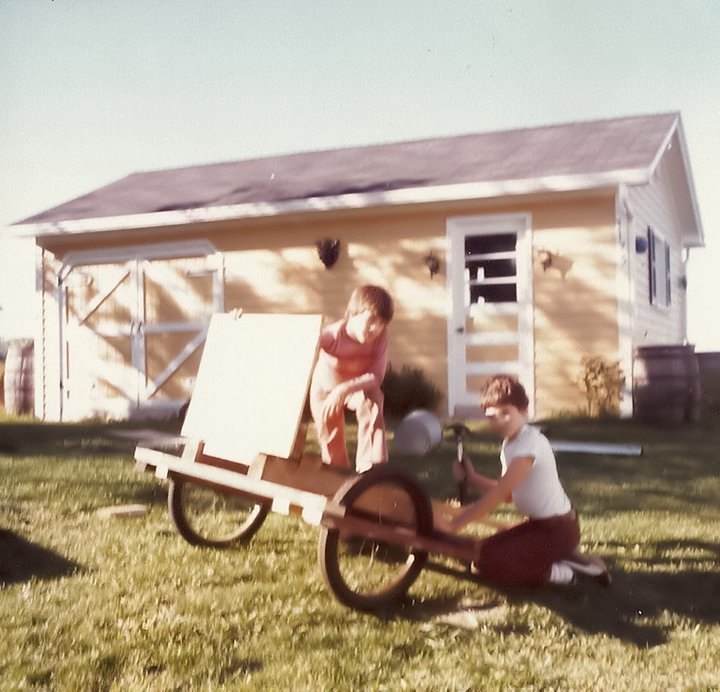
For my childhood friends and me, anything from sticks to hand-made weapon replicas to store-bought plastic toy arms made up the main equipment for the game, and our imaginations filled in the rest. One summer in the late 1970s, my brother and I (that’s me in the blurry snapshot above on the right) built an estimation of a howitzer from some scrap wood, bicycle tires and the side exhaust pipe from a sports car. A friend of mine had a fort built in the woods adjacent to his house, complete with a lockable below-ground prison and a series of three-foot-deep foxholes dug at the defense perimeter. Other pals checked books out of the library to study old photographs of guns they would carve out of left-over 2′ x 4’s.

I logged many hours playing War among the fields, woods and buildings in and around my rural hometown in Western New York. One weekend I spent the majority of a Saturday hunting down one of my friends on a nearby SUNY campus in a one-on-one scenario where the first one to spot the other won the war. I found a set of shrubs to hide in where I sat for an hour until I saw my friend creeping through an open plaza. On another day, I was captured and locked in my other friend’s dungeon with another comrade. While more than ten other guys ran around shouting in the nearby fields, we two prisoners spent more than two hours digging a tight hole under the plywood wall to escape. Other times there were weekend sleepovers and night games chasing each other through the woods and over creeks in the darkness lit by flashlights.
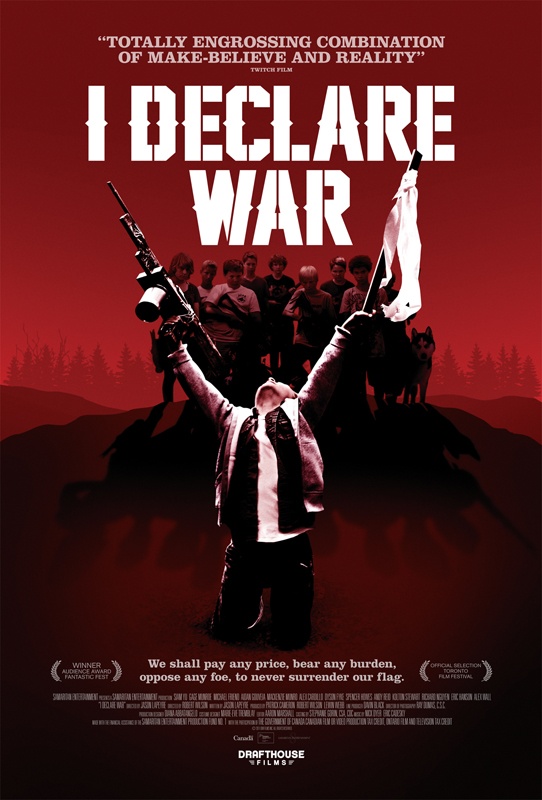
idw-poster-final-web__large

The new movie “I Declare War” from Drafthouse Films should resonate like a carpet bombing for anyone like me who can look back wistfully to hot summer days of trying to kill their best friends in a game of War. This isn’t a great piece of filmmaking, but its the sort of thing that’s sure to light up parental discussions and also conjure youthful memories of when play involved something without digital graphics.

Now in limited release and available through some streaming services, “I Declare War” focuses on a day-long game of War between two groups of adolescent boys (plus one girl). The serious intensity of the day’s game depicted in the movie captures the complexity of the time in life of being a care-free kid teetering on the edge of the ages to come.

Most of the kids in the film approach the game with the expected intensity of children whose imaginations are running full-on, transforming sticks and plastic guns into actual weapons. One boy adds a sci-fi flair with imagined lightning bolts streaming explosive death rays from his eyes. There’s also a clumsy protracted love interest that evolves with the young girl’s arrival in the game, but she too winds up being a skilled player in the game. And finally, there’s one truly sadistic kid who treats the game a bit too seriously, bordering on psychological and physical harm to a few unfortunate victims.

There’s a lot in this movie, and the game of War presents as merely a mechanic for the kids to work out their emerging pre-adult personalities. Within the group there are plotters, double-crossers, bullies, romantics, innocents and leaders. The kids yell, cry, laugh, fantasize, threaten and swear like kids do — a hot stew of thoughts and emotions most mainstream movies (and many parents) would rather avoid.

A couple of the guys I played War with in the 70s and early 80s wound up serving in the real-life military but the majority of us went off to college or started regular jobs after school. For the most part, I’d say we all grew up to be relatively decent human beings. On the balance playing War didn’t warp any of us in a negative way and it quite possibly taught us some early lessons in teamwork, negotiation, problem-solving and communication. For me, it mostly built something along the lines of friendship or strangely, compassion.

“I Declare War” captures the spirit of the kind of play which mostly exists now in an abstract virtual world for my own kids and their peers. Did my friends and I rack-up more life lessons playing War in the woods than my sons do playing war on screens with people who they’ll never meet? That question is going to be answered in a generation or so, but “I Declare War” is worth considering in how playing War shaped us a generation ago.

Retro Gaming The 70s & 80s: Survive!

surviveboxBy the early 1980s, I had a shelf full of games from Parker Brothers. Like millions of other kids, I was brought up on Parker Brothers classics like Monopoly, Clue, Risk and Sorry! Most of these games were already a couple generations old by the time I first played them, and, despite their updates, they were showing their age a bit. But then in 1982 Parker Brothers introduced Survive! which has gone on to be a new modern classic for gamers of all ages.

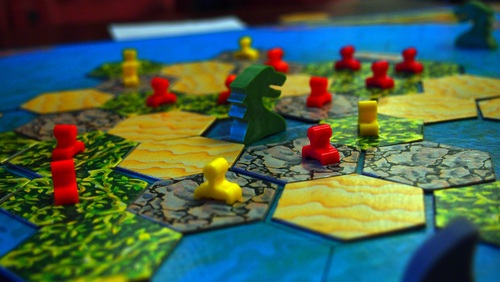
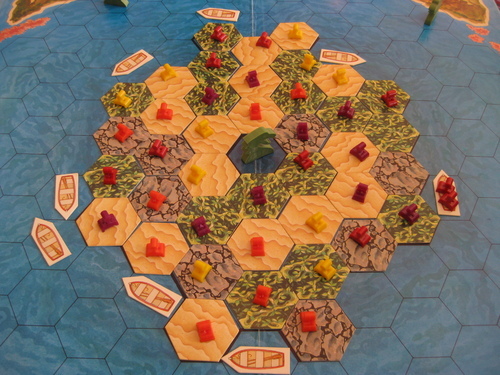
The story of the game involved each player trying to get their tribespeople off an island which is quickly sinking into the sea. At the beginning of the game, the hex land tiles – beach, forest and mountains – were shuffled and then placed randomly on the board to create the island. Then, in turn, each player placed their ten tribespeople tokens with up to three per hex except for beach spaces which held only one. Each player piece had a number value etched into the bottom, and saving the higher-valued tribespeople was key to scoring and winning the game. Cardboard lifeboats were then placed floating at the edges of the island and a sea monster figure went in the lagoon at the center of the island.

surviveboard2

Each turn, players moved their tribespeople and then removed a tile, beginning with beach hexes and then forests and mountains. Player’s pieces which fell into the water drowned, but you could also move your a piece to a water space as a swimming would-be survivor. Boats carried up to three survivors at once and could carry tokens from multiple tribes at once. Removed tiles had special events on the back and might indicate the appearance of a whale, dolphin or shark in that hex. Finally, a die was rolled to move a sea creature dipicted on the special die.

surviveboard1

Strategy for the game involved getting as many of your tribespeople to the coral islands at the corners of the board before a mountain hex piece was turned over to reveal a volcanic eruption killing all survivors not safely away. Moving a whale to a space with a boat capsized the boat, tossing any passengers into the water. A dophin could carry one tribesperson swiftly through the water. Sharks ate swimming survivors and the sea monster destroyed a boat and all its passengers. Other tiles revelaed different special actions, including whirlpools which destroyed anything in that and immediately adjoining spaces. The combination of all the possible outcomes and actions of the other players made for a mix of competitive and collaborative play, always balancing what was best for your tribespeople against what the other player’s actions were.

At the time, there were a number of things that set Survive! apart from most other conventional board games. The board featured hex-shaped spaces like many of the fantasy and RPG games I was playing then. The board was also different each time you played, adding a randomness factor not found in most board games featuring a traditional static set up every time you played. The game components were a bit less abstract and more like the “meeples” now a common part of just about any Eurogame.

A European version of the game appeared a few years after the original with a few variations. In 2010, Survive: Escape from Atlantis! was released by Stronghold Games with an updated game using elements of both versions in one. Since then, Strongehold Games has also released a number of expansions including a 5-6 player variant and others containing extra sea creatures. The game remains widely available, and the 30th anniversary base game released in 2012 can now be picked up for $40 with expansions running for $10 (all cheaper online).

More than three decades on, Survive: Escape From Atlantis! has entered the modern canon of board games. Whether your tribe includes kids or a group of friends looking to pick-up a quick new game, heading back to the island of Survive! is well worth the ride.

Collector’s Note: While Survive: Escape From Atlantis is now widely available, original copies of the 1982 first edition of Survive! can be found on eBay for $25-50. Individual game components are also available for a few bucks apiece, just in case any of yours were swallowed-up by a sea monster over the years.

Retro Gaming The 70s & 80s: Talking Football

talkingfbbox

I was never a sporty kid, on the field or off. My playtime in the 1970s and 80s was much more apt to be spent gluing-up Airfix models, battling with Kenner Star Wars action figures or campaigning through the latest Dungeons & Dragons adventure. One of the few memories I have of a game I loved as a kid that didn’t involve dank passages, spellcraft and random encounters with wandering bugbears was Mattel’s Talking Football game.

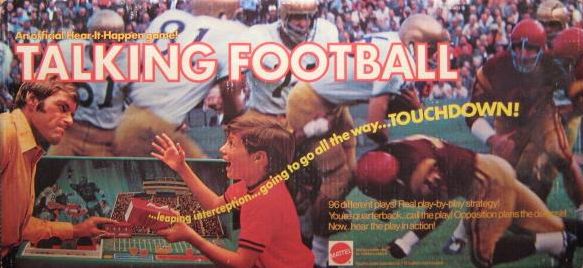
First released in 1971 and then re-reissued in 1977 as Talking ABC Monday Night Football, this semi-obscure classic was the alternative to the electric football games a lot of my friends had in the 1970s. The electric football games looked great with their customizable football player miniatures vibrating all over the little field in random directions but those never really added up to much of a game for me. Talking Football was in a league of its own.

talkingfbcontentsTalking Football had a pretty conventional football field playing board with sliding plastic clips to show yardage progress and first down markers. Other plastic components included a little scoreboard and a place to mark downs and quarters. The nifty mechanic of the game was in the tiny plastic records that made the game “talk.” Play began with the offensive player selecting from one of the ten “standard” play or three “special” play records. The chosen record was inserted into a little handheld player and then the defensive player rotated the record to a defensive play. Once plays were selected, a lever was pressed and simulated audio recordings of announcers calling the play would play in combination of the offensive and defensive selections. The result of the play would be recorded on the field and the next play would be set.

To a kid living in the pre-videogame era of the late 1970s, Talking Football was a blast and a bit of a technological wonder. Over time, players got used to the hundred or so combinations of plays and the game would repeat itself a bit at times. This became part of the strategy, as the game was basically one of picking the right play you thought would best defeat what you predicted your opponent would pick. To answer the repetitive standard set of 13 records, Mattel also offered expansion packs for the game with celebrity player voices on picture disc records, including Merlin Olsen and O.J. Simpson.

I didn’t own a copy of Talking Football, but one of my good friends did. Flash forward more than three decades, and that friend is an on-air radio personality at a rock station in Northern New York State. I don’t know if the hours we spent playing Talking Football and hearing those recorded announcers call plays had any effect on my friend’s future career choice. That said, I think of how games shaped me into the person I am today and like to think that maybe those scratchy, plastic voices still reverberate with my old friend today.

Collector’s Note: Mattel’s Talking Football can be found for sale from special sports memorabilia companies and on eBay. The standard game can run anywhere from $40-200, depending on condition. Buyers should beware that many collectors indicate the original players haven’t always aged very well due to their cheap, dated technology. The individual player records go for around $10 apiece.

Retro Gaming The 70s & 80s: The DragonLords

dlbox

As a young gamer in the 70s and 80s, I had an incredibly supportive mother. Our trips shopping always allowed for stops by local bookstores, five-and-dimes and hobby shops to check out the latest Dungeons & Dragons releases, metal miniatures, fan magazines or other gaming delights to add to my growing collection. My mother was also a big yard sale and flea market fan, dragging home all sorts of used games for my brothers and I to try out. One of those early-80s yard sale finds was an unopened copy of 1978’s The DragonLords from Fantasy Games Unlimited.

Founded in 1975, FGU is still in business as a publisher of a variety of board and role-playing games. Like many game companies in the mid-70s, FGU leapt into the D&D tidal wave and released a number of fantasy-themed games. The DragonLords followed the traditional hex map and cardboard counter game model well-established by such publishers as Avalon Hill. The box contained a map, simple rule book, reference sheets and over 600 tiny cardboard playing pieces. The artwork was second-tier generic fantasy illustration, the game map was outright bland and the printing looked like it was done on a typewriter. I loved this game.

dlmap

In The DragonLords, each player took on the guise of a wizard ruling over their kingdom. Players chose to play as a Sorcerer, Conjurer, Enchanter, Necromancer or other type of specialized wizard, each with their own unique set of spells. Spells were acquired through turns “studying,” allowing for more advanced spellcraft in areas such as Siege, Hiring , Weather, Speed or Tactical. By casting their spells, wizards developed armies to fan out across the map to conquer the opposing kindgdom, hasten movement of their own horde or wreak horrible natural disasters on the enemy.

For someone well-steeped in D&D and Tolkienesque fantasy, a lot of The DragonLords felt very familiar. Tiny cardboard chips featured very basic line illustrations of elves, giants, trolls, ents, dragons and other creatures, each with values for combat and movement. The wizard spell study mechanic felt akin to the levels of advancement with magic-using characters through Experience points gained in D&D campaigns. Siege of cities and frontier keeps was a key part of the game, and building and attacking with catapults, siege towers and rams was a big component missing from a lot of smaller-scale D&D play.

What I loved about The DragonLords at the time was the mix of individual wizard character development and the grander scale of huge grotesque armies slugging it out across the mountains, swamps, forests, roads and waterways of the map. A game could be played satisfactorily in a few hours, also a nice change of pace from the long-term campaigning in D&D. The DragonLords certainly didn’t win any points for its graphics, but for straight fantasy gaming on an epic scale it definitely had its spell cast on me.

Collector’s Note: The Dragonlords is long out of print, but with a bit of online searching Iwas able to come across one bagged unpunched copy for over $100 on Amazon.com. Clearly my mother’s yardsale find was quite a deal.

Retro Gaming The 70s & 80s: Marvel Super Heroes Role-Playing Game

marvelbox

Way back in the late 1970s, well before we had summers filled with superhero movies, I was a comic book collector. Those were the days when my younger brother and I bought our weekly fix of Marvel and DC superheroes off a squeaky rotating rack in a corner store, all for under a dollar each. Eventually our collecting graduated to visiting comic book shops, flea markets, yard sales and small regional comic book conventions in Western New York. As our collection grew into thousands of books by the mid-1980s, my brother and I were receiving weekly warehouse wholesale shipments and were bidding on lots of older books through auctions by mail. Both of us sold-off the majority of our collections in the late 1980s and early 1990s before the market became glutted, eBay arrived on the scene and CCG-graded comics became the new collecting norm.

timetrapI still have a significant, albeit more scaled-down, interest in comic books to this day. Yet as I recall those peak collecting years in the early 80s, my mind eventually takes me to memories of 1984 and TSR’s release of Marvel Super Heroes: The Heroic Roleplaying Game. The game arrived during big expansion years for TSR as the popularity of their flagship Dungeons & Dragons franchise continued to grow in player fandom and pop culture infamy. Winning the Marvel license allowed TSR to launch a new game with a built-in base of players which had a lot of cross-over interest in comic books and gaming (like myself). Despite the promise of the total package of the Marvel Universe delivered in a RPG by the makers of D&D, the Marvel Super Heroes game never really delivered.

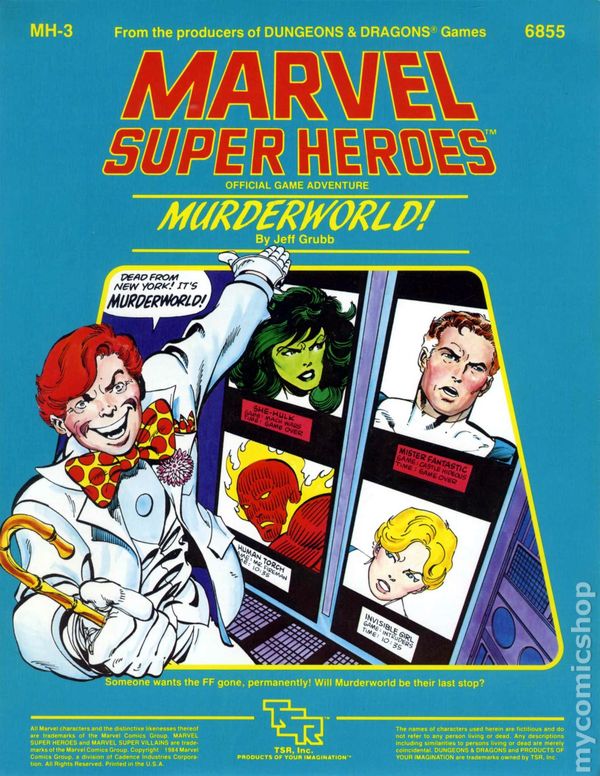
murderworldThe core box came with a quick start “Battle Book” and a more detailed “Campaign Book.” Also included was an introductory scenario, “Day of the Octopus,” plus a fold-out map, character reference cards and some rudimentary markers. TSR quickly expanded the game with a number of accessories including a couple sets of poor quality metal miniatures and quite a number of game adventures following the module model which had proven so successful with D&D. An eager collector, I snapped up a bunch of adventure books, including “Time Trap” featuring the Avengers and “Murderworld!” starring the Fantastic Four. Expansions also included a number of adventures which featured “adventure fold-up figures.” Unable to help myself, I happily bought the Hydra-themed “Pit of the Viper” edition along with a few others.

pitofviperDrawing on the stable of established Marvel characters, the game looked great. Mechanics borrowed broadly from D&D with “Attributes” establishing the primary strengths of a super hero on a scale of 1-100. “Superpowers” defined unique abilities while “Talents” were a set of skills a character could draw upon. A system of “Karma” (similar to D&D Experience) allowed for character upgrades. The problem I quickly found with the game was that you played characters within an established set of backgrounds and relationships. Spider-Man, Thor or The Human Torch carried enormous backstories, robbing players of the opportunity to create and grow a character from the ground up like in the more pure RPG realm of D&D. Eventually, I was buying the expansions simply to read the text and assemble the little cardboard figures and terrain pieces.

Despite the mediocre quality of the game overall, TSR went on the release a revised version of the game in the late 1990s. More than anything else, the second edition of the game was probably an effort to retain the license from Marvel. Even so, Marvel and TSR eventually parted ways by the early 2000s.

So much of my generation was defined by the first modern wave of toy licensing with Star Wars that I can hardly fault TSR for jumping on the brand-extending bandwagon with Marvel. It’s amazing to me the game lasted so long given my memory of its lack of interesting play. This is one game I can’t foresee ever returning to. Its true superpower lay in how deep the marketing of those characters was a part of me then and stays with me today.

Collector’s Note: Most probably owing to the low quality of the game, the original TSR  Marvel Super Heroes game starter box set and most expansions can be found on eBay for under $20 each.

Retro Gaming The 70s & 80s: Dungeon!

In 1975, just a year after the release of Dungeons & Dragons, TSR Hobbies released the boardgame Dungeon!. The game mirrored many aspects of D&D’s dungeon-crawling framework while offering a much lower point of entry for players either new to the genre or looking to just play a quick game.

dungeonadI got a copy of Dungeon! after a couple years of spending hours playing D&D and painting my first lead miniatures from the likes of Ral Partha. Dungeon! offered a traditional boardgame format and came as an occasional break from the open-ended role-playing my friends and I were used to with D&D. Ads for the game at the time (left) were also pitching the game to families and casual gamers as a point of entry and enticement to the larger world D&D offered.

Playing as an Elf, Hero, Superhero or Wizard, players moved through six progressively-difficult levels, encountered random monsters and collected treasure. Each character class carried specific strengths and powers, with more powerful characters such as the Wizard or Superhero requiring greater treasure to win the game.

Large chambers such as the Kitchen, Crypt, King’s Library or Queen’s Treasure Room were surrounded by smaller rooms, color-coded to indicate the level. In each large chamber, a stack of three randomized monster cards specific to that level were placed at the beginning at the game. In each smaller room, one monster and a treasure was placed. When a space was entered, the top card was drawn and combat between the player and the monster ensued with a simple die roll. Winning combat won the treasure while ties or losses might result in a retreat or loss of treasure.

For players familiar with D&D like myself, Dungeon! mirrored a lot of the established canon. Monsters fell along the lines of hobgoblins, werewolves, dragons, mummies and snakes. Dungeon pitfalls such as traps might be encountered. Characters like Wizards held special spell cards such as Fireball or Teleport, and found magic items included an ESP Medallion and a Magic Sword, offering certain characters bonuses to their play. Treasure ranged from meager bags of glod found in the easy levels to the covtted Huge Diamond (worth 10,000 points) hidden deep in the sixth level.

Several editions of Dungeon! followed through the years, the most recent in 2012 from Wizards of the Coast, now-owners of the D&D franchise. Longtime players have also created a rich universe of house rules, customized boards and even hand-painted figures to supplement the basics of the game. Despite its relative ease of play, Dungeon! has remained a classic bit of fun among even the most serious gamers today.

Retro Gaming The 70s & 80s: Dark Tower

Dark Tower from Milton Bradley is probably my favorite game of all time.

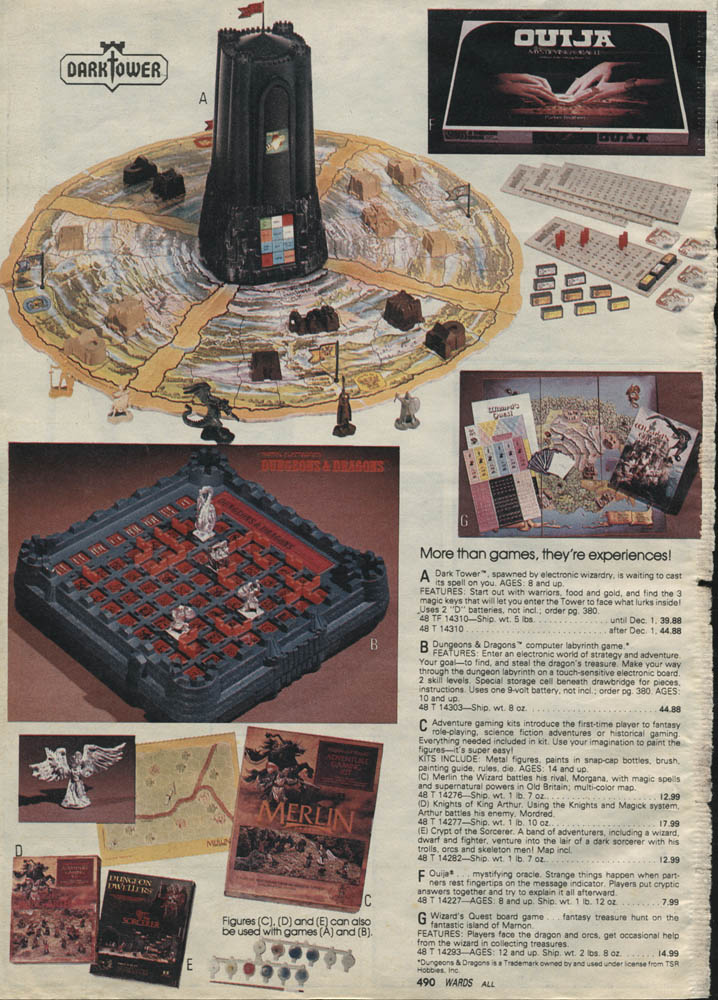
Aside from what I had seen in a few comic book print ads and the weird Orson Welles TV ad, I didn’t really know much about Dark Tower. When it arrived under the Christmas tree in 1981, the game hit right in the middle of the period of my life where I was already deep into D&D and all things fantasy. Looking back at holiday department store catalogs from that season, there was a lot for a young geek to wish for. A page from the Montgomery Ward holiday catalog from that year (below) not only shows Dark Tower, but also the D&D Computer Labryinth Game from Mattel and the  Heritage Dungeon Dwellers sets about which I’ve previously written about in my retro posts on this blog.

Out of the box, this game became a family favorite with even my father, uncle and various other adult friends of the family crowding around the kitchen table for many an evening game with us kids. I can’t recall my dad ever playing another boardgame other than chess or maybe Monopoly with me as a kid, so there was obviously something very enticing indeed about this mystical game.

Dark Tower consisted of a plastic battery-operated black tower set in the middle of a circular game board divided into four kingdoms. Each player journeyed around the board fighting monsters, gathering treasure and searching for three keys before arriving back to their home kingdom and attempting to breach the doors of the Dark Tower.


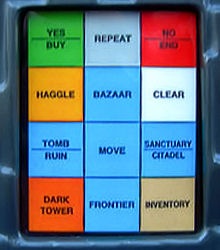
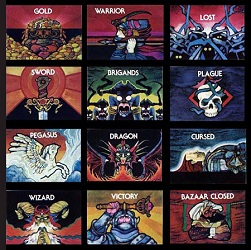
With each move the player pushed a button on the tower’s keypad (above, left) and a series of rotating cylinders within the tower would rotate and light up with results (above, right). Collecting treasure, taking damage and adding to your adventurer’s force was tracked on thick cardboard cards with red plastic pegs. Low-tech digital sound effects also accompanied each move, encounter or effect, and to this day I find myself accossionally whistling the little tunes Dark Tower played.

I’m certain the tiny bundle of electronics buried in the tower is simple by today’s standards, but at the time we were in awe of how it tracked each player’s progress throughout the game. Entering a Bazaar space, the market would open and a player would have the option to bid and buy resources depending on the inventory and the amount of gold you had on hand. A player could haggle on price, but at times the merchant would just decide to cut you off and your turn would end abruptly. In other cases, a player would encounter marauding brigands and a battle would break out with victory determined by the size of your army and any special items you had on hand. All of this was tracked on your little card but the Dark Tower also kept tabs on all the goings on in the game. The Dark Tower was like a Dungeon Master powered by a couple batteries and it was truly amazing.

Despite its popularity, Dark Tower was a very short-lived game. A lawsuit over the design of the game led to some messy legal dealings between Milton Bradley and two game designers, and the game was finally yanked from distribution by 1985. To my mind and that of many other gamers, the quick death of Dark Tower is one of the great tragedies of modern toy manufacture. The game has managed to live on prominently in our hearts and minds, and across the country there are still old copies tucked into closets among much lesser games. There’s a copy on a high shelf at my parents’ house, and although I haven’t pulled it down to see if it still works after these many years, I feel better knowing that my copy of Dark Tower is still there.

Collector’s Note: Because its short period of commercial availablity, subsequent intellectual lawsuit and somewhat delicate electronics, copies of Dark Tower are highly sought after. On eBay, parts can go for $5-100 and complete working games in original condition can command over $1000. But it’s all worth it.

Retro Gaming The 70s & 80s: Choose Your Own Adventure Books


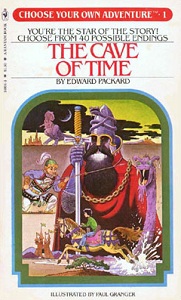
This week there was news the Choose Your Own Adventure (CYOA) book series is to be developed into a film series by 20th Century Fox. Launched in 1979, the series was enormously popular throughout the 80s and 90s, sold over 250 million copies and is still published today. The movie announcement got me thinking about how these books played yet another part in my personal growth as a gamer.

The CYOA series follows the form of a gamebook which allows a reader to participate in how a story unfolds through a a variety of choices made along the way. To a young kid, the CYOA books shared a lot in common with my role playing game interests. Each book presented a fantastically-themed self-contained adventure, International travel, outerspace journeys, crime investigations and sword and sorcery tales filled the pages of each paperback, and collecting them was part of the fun. Choices made while reading each story could take you to more than 20, 30 or 40 different endings to the book, making for a lot of re-reading value in seeing how things might turn out differently each time.

The CYOA mechanic provided the feel of a solo game for when no one else was around with which to play something a bit more complex like D&D. Looking back from today, the structure of jumping back and forth through the narrative is akin to the experience of clicking through hyperlinks online. Even videogames today like 2012’s award-winning The Walking Dead series from Telltale Games share in the basic chapter and choices format people of my generation grew up on.

There’s no telling what shape the proposed Choose Your Own Adventure movies series will take, and it may prove to be yet another Hollywood move to attempt to cash-in on a known property. That said, it’s interesting to see just one more way these books continue to ripple through the culture over 30 years later.

Collector’s Note: The Choose Your Own Adventure series is still published today and can also be picked up fairly easily used starting at about $3-5 each on eBay. For true collectors, first editions from books early in the series can go from hundreds or even over a thosand dollars from rare book dealers like AbeBooks.

Retro Gaming The 70s & 80s: Dungeon Dwellers


I was already a fairly experienced D&D gamer by the time I encountered the Heritage Dungeon Dwellers series of miniatures and game sets in the early 1980s. Aside from playing creative games and campaigns dripping with swords, sorcery and all things creepy and crawly in the underworld of our imaginations, my brother and I were quickly filling up our free time with miniature painting. If it was tiny, cast in lead and even mildly gruesome, chances were it was on our radar.

We were already pretty familiar with Ral Partha’s growing line of D&D lead miniatures picked up at our local five-and-dime, bookstore and hobby shops in Rochester, NY when we encountered Dungeon Dwellers. At the time, we had no idea Heritage was producing boxed sets and blister packs of figures similar to Ral Partha. What we did know was that holding these two green Dungeon Dwellers boxed sets in our hands was clearly something different.

Unlike the sets of miniatures from Ral Partha and other suppliers of the time, Heritage Dungeon Dwellers offered two all-in-one model and gaming sets. Each box contained a number of monster and adventurer figures, paints and a simplified self-contained game with rules and a map. This off-the-shelf game was an easy and rare counterpoint to the expansive D&D universe of the era. Each set — “Caverns of Doom” and “Crypt of the Sorcerer” — read like a D&D module with a defined scenario in which to play. The models were animated, unique and somewhat more appealing than some of the widely-available Ral Partha lines. I particularly recall the multi-piece winged dragon from “Caverns of Doom” and the fire-casting wizard from “Crypt of the Sorcerer” as being favorites.

Despite the limited replay value on the surface, these two sets got a lot of outsized-use when I was a kid. Thinking back, they combined the best aspects of board, miniatures and role-playing games, plus they allowed us to cut our chops on our painting skills. Serious gamers of the time probably dismissed these sets as pandering to the growing fantasy gaming fad of the day, but for a growing gamer in the early 1980s, Heritage Dungeon Dwellers really made an impression.

Collector’s Note: The Dungeon Dwellers boxed sets are exceedingly hard to come by, but miniatures sets and individual figures are readily available on eBay for just a few dollars for an individual figure up to well over $100 for sets.

Retro Gaming The 70s & 80s: Gamma World

Post-apocalyptic and dystopian futures in pop culture were big fascinations of mine as a kid. Planet of the Apes premiered the year I was born, and the movie sequels, live-action TV show, Saturday morning cartoon and toys were a big part of my imagination through the first half of the 1970s. As I grew into a budding sci-fi fan, movies like The Omega Man, Invasion of the Body Snatchers and Logan’s Run, as well as television re-runs of The Twilight Zone further filled my brain with visions of future what-ifs and the destruction of the human race.

In 1981, two things happened. Ronald Reagan became President and would go on to occupy the White House for all my teenage years. During this formative period of my life, my waking mind and night time dreams were filled with the ever-looming threat of nuclear war flowing from Reagan’s amped-up rhetoric toward what was then still the Soviet Union. Suddenly, the fictionalized visions of the end of civilization seemed very, very real.

That same year, I saw Mad Max 2, (aka The Road Warrior). Although shot in Australia with an Aussie-accented Mel Gibson in the lead, the movie resonated as very American to me. With it’s high-desert setting, gunfights, chase scenes and a hero with a hidden past, the film struck me very much like Westerns (particularly those of Clint Eastwood) I already loved. Wrapping the Western genre up in a post-apocalyptic story hit all the right notes in my 13-year-old imagination.

Along the way in the late 70s through early 80s, I was spending a lot of time gaming with Dungeons & Dragons. In 1983, I ran across the second edition of Gamma World in the local bookstore where I bought most of my D&D gaming stuff. Originally introduced in 1978 by TSR, the makers of D&D, Gamma World was a role-playing game set in a post-nuclear war 25th-century Earth populated  by mutants, cyborgs and remnants of the human race. While D&D drew its influence from various fantasy sword-and-sorcery antecedents, Gamma World’s dystopian setting was rooted in the sci-fi themes of stories and movies I loved. From a game mechanics standpoint, Gamma World had a familiar feel to D&D with character attributes, fantastical equipment and a chart and dice-driven combat and encounters system. The similiarities with D&D made it easy to slide into the entirely different storylines Gamma World offered.

I never took to Gamma World with the same depth of interest as D&D, but playing it was pretty fantastic. The world of the game was occupied by giant rabbits, humanoid lizard people, deadly plantlife, robotic killing machines and all other manner of deadly foes and allies. Weaponry ranged from spears and traffic sign shields to laser rifles and nuclear devices. Maps represented entire crumbling city street grids or hidden underground survivalist bunkers. An adventure could involve a quest for an “ancient” 20th-century manuscript holding the key to human salvation or an infiltration mission to destroy a cyborg factory. To my friends and me, Gamma World allowed us to write the scripts and play through the dozens of unmade post-apocalyptic movies living in our heads and influenced by the films already ingested into our psyches.

Gamma World is still published by Wizards of the Coast today, but the popular trend in zombie-themed games occupies most of today’s gaming interest in post-apocalyptic scenarios. That said, for a purely futuristic, dystopian, sky’s-the-limit role-playing game, fast-wording a few centuries to Gamma World can’t be beaten.

Collector’s Note: Original TSR-published Gamma World boxed sets and expansion modules can be found on eBay. Modules and indivdual rule books can run in the range of $15-75 while original complete boxed sets of early editions can run into the hundreds of dollars.