New Game Weekend: King of Chicago & RoboRally

Friday night at Metropolitan Wargamers in Park Slope, Brooklyn had a decent crowd of six of us collected in the back with a few other people up front continuing play of a multi-week and fairly dense American Civil War battle. Coming to agreement on an ad hoc game together for a half-dozen guys is a challenge on its own, but we managed to settle on two games which are standbys at the club but pretty new to me.

King of Chicago

Produced in Denmark in 2005, King of Chicago takes place in the Prohibition-era Windy City where each player takes on the guise of gangster looking to rule the streets by creating and breaking alliances, building their empire and whacking the competition along the way.

The game begins with each player owning a gangster, a car, $1000 and a few resources. Resources in the game are booze, henchman and girls, and additional resources are picked up in various landmarks spread throughout the city. Combinations of booze, henchmen and girls in your gang allows you to build bars, casinos and brothels which create income at the completion of four turns in each round of play. At the end of a round, players collect income, new gangsters are put into play and resources get set on the board. Bidding takes place for gangsters to add to your mob, gaining you bonuses of speed, income, protection and lethalness. Players also bid to bribe the cops, controlling them through the next round of play.

The game offers a lot of strategic play in how a player chooses to build their empire and also in managing relationships with the other mob bosses on the board. Drive-by shootings, shutting down competing businesses and sending the other guys to the hospital or the morgue makes for a lot of opportunity for deals to be struck and double-crosses to take place. Certain cards cause “events” like police raids to be played and others send players on “jobs” which net substantial sums of income. The player who quickly amasses ten points from money, businesses and influence wins the game.
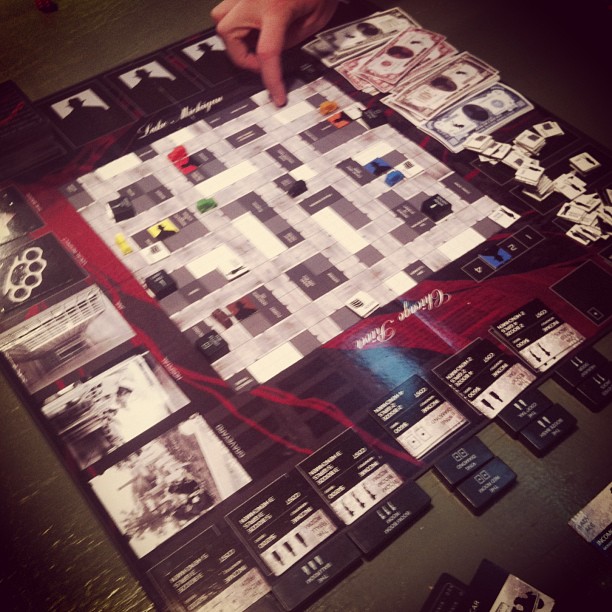
The game looks great with simple components and a wonderful collection of historic photos from the Chicago gangland days depicted on the cards. The many paths players can choose to build their mob empire adds significant replay value to the game.

King of Chicago was released with a limited print run and can be hard to come by in the United States. However, for lovers of gangster movies and the period when the underworld ruled Chicago, chasing down a copy is well worth the effort.

RoboRally

After a couple hours on the mean streets of Chicago, we had a seventh player show up. Our second game of the evening took us in a different direction with the hilariously chaotic RoboRally. The game was originally published by Wizards of the Coast way back in 1994 but was created a decade earlier by Richard Garfield who would go on to design the insanely-popular Magic: The Gathering card game.

The game takes place on a factory floor with each player’s tiny robot attempting to navigate through a set number of flagged gates. This seemingly-simple mission is hampered by moving conveyor belts, rotating gears, solid walls and laser arrays spread throughout the factory. Robots controlled by other players also wreak havoc on your path by bumping into and zapping your robot with their lasers.

At the beginning of each round, players draw up to nine cards each with directional actions such as left and right rotations, u-turns and movement backward and forward. Players secretly place their cards face down in front of them defining their robots’s moves for the round. In turn, players reveal each card and move their robots in order of card value and according to the movements selected. The fun and craziness comes in when well-thought plans quickly go awry as robots beginning bumping into each other and throwing each other off course. Just when you think you have a direct route neatly plotted out to a flagged gate space, some other robot (or two or three) ram straight into you, sending you wheeling off in some other direction.

Lasers cause damage to your robot, reducing your movement choices in a round and only made better by spending a turn shut down repairing. Occupying repair spaces can also provide fixes for damage, and even special robot upgrade cards. The truly unlucky robots will find themselves bumped off the board, returning to their last starting point at the beginning of the next round.
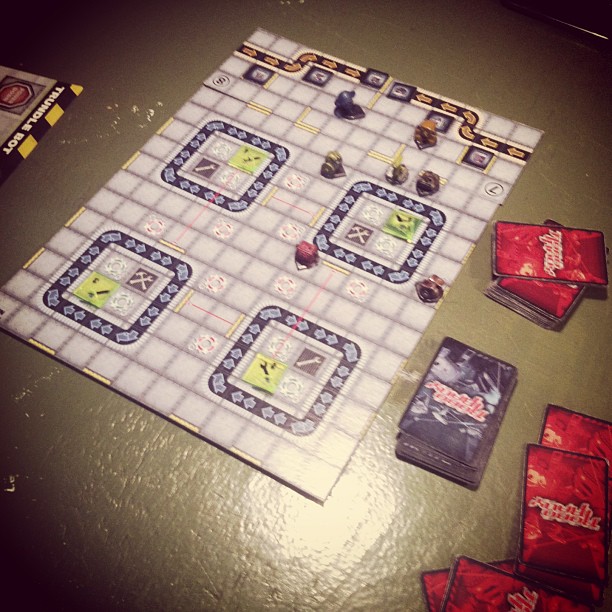
The more players who play only contributes to greater chaos on the board. Our late night seven-player game stretched to nearly two hours of mechanized madness until one player managed to get through a few gates and away from the crowd. My sad little robot, on the other hand, wound up spending the game unluckily bumping into his mechanized comrades and finished the game exactly where it started.

RoboRally has won multiple awards, and its many versions and expansions have ensured its continued love among gamers for nearly two decades. After the cold-bloooded and calculating play in King of Chicago, it was great to end the night on a much more lighter but no less challenging game like Robo Rally.

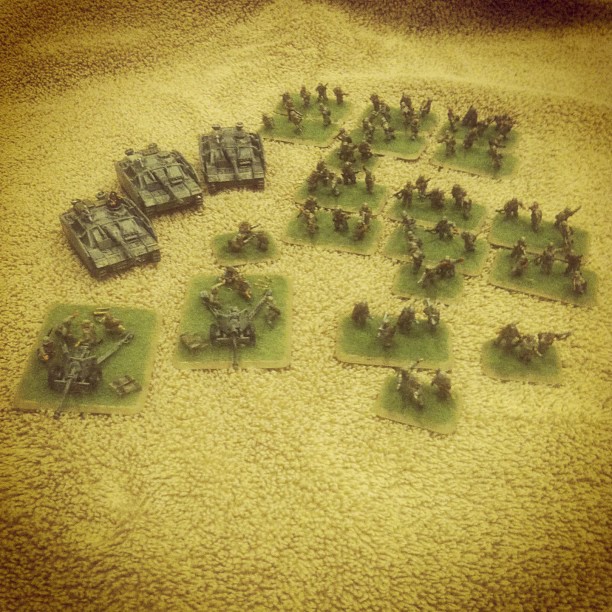
Flames of War: Fielding the Grenadierkompanie

I got the Flames of War Open Fire! set this past Christmas and I’m finally getting around to painting-up all the stuff that comes packed in the box. At under $70 online, this big package is a real deal for new and experienced FOW gamers alike. The set includes over 100 plastic Allied and German infantry, tanks and artillery models, plus the full FOW rulebook, dice, markers and some other goodies included. A couple guys at Metropolitan Wargamers also picked up the set and are just getting into FOW. If you have any interest in gaming WWII at all, this set is the place to start.

First off, I’ve finished the German Grenadierkompanie, including anti-tank 7.5cm PaK40s, a Stug G tank platoon and two platoons of infantry. These will supplement the pretty extensive Grenadier and Fallschirmjäger infantry I already have. The Stugs will also add to the large collection of Panzer IV, Jagdpanther and Konigstiger platoons I’ve already got on the shelf.

The plastic models all glue together quickly, but handling them has to be a bit delicate so as not to snap off the tips of the gun barrels. For the infantry, I spray prime everything in flat black and paint the uniforms in a mid-dark grey. All the details — guns, boots, equipment and skin — get picked-out with quick dabs of paint. Everything gets a very watered-down brown wash in the end which gives the uniforms a more accurate grey/green muted finish and also tones-down the flesh.

My camouflage painting abilities are honestly pretty atrocious, so my default is to go with a more generic grey paint scheme on my armor, artillery and vehicles. For the Stugs and PaK40s, the flat black primer was hit with a quick dry brushing of mid-dark grey.  After the dry brush coat, tank cargo and other details were then dabbed on. The platoon commander got some special attention with white detail on his cuffs and collar, plus some detail on the radio headset he’s wearing over his hat. Finally, I applied some wet-transfer decals and then dry brushed some light brown mud in the areas most likely to see some splashing on the tracks, sides and fenders.

y

With my Germans from Open Fire! complete, I’ll be posting soon with an update on the US Airborne and allied models from the set. Along with the Germans, a set of special FOW models from the famed Easy Company and a bunch of my existing models, there’ll be some major action from the Normandy campaign and beyond coming soon.

Retro Gaming The 70s & 80s: Choose Your Own Adventure Books


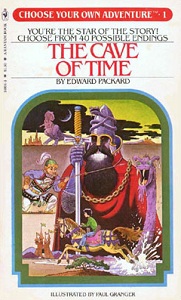
This week there was news the Choose Your Own Adventure (CYOA) book series is to be developed into a film series by 20th Century Fox. Launched in 1979, the series was enormously popular throughout the 80s and 90s, sold over 250 million copies and is still published today. The movie announcement got me thinking about how these books played yet another part in my personal growth as a gamer.

The CYOA series follows the form of a gamebook which allows a reader to participate in how a story unfolds through a a variety of choices made along the way. To a young kid, the CYOA books shared a lot in common with my role playing game interests. Each book presented a fantastically-themed self-contained adventure, International travel, outerspace journeys, crime investigations and sword and sorcery tales filled the pages of each paperback, and collecting them was part of the fun. Choices made while reading each story could take you to more than 20, 30 or 40 different endings to the book, making for a lot of re-reading value in seeing how things might turn out differently each time.

The CYOA mechanic provided the feel of a solo game for when no one else was around with which to play something a bit more complex like D&D. Looking back from today, the structure of jumping back and forth through the narrative is akin to the experience of clicking through hyperlinks online. Even videogames today like 2012’s award-winning The Walking Dead series from Telltale Games share in the basic chapter and choices format people of my generation grew up on.

There’s no telling what shape the proposed Choose Your Own Adventure movies series will take, and it may prove to be yet another Hollywood move to attempt to cash-in on a known property. That said, it’s interesting to see just one more way these books continue to ripple through the culture over 30 years later.

Collector’s Note: The Choose Your Own Adventure series is still published today and can also be picked up fairly easily used starting at about $3-5 each on eBay. For true collectors, first editions from books early in the series can go from hundreds or even over a thosand dollars from rare book dealers like AbeBooks.

Retro Gaming The 70s & 80s: Dungeon Dwellers


I was already a fairly experienced D&D gamer by the time I encountered the Heritage Dungeon Dwellers series of miniatures and game sets in the early 1980s. Aside from playing creative games and campaigns dripping with swords, sorcery and all things creepy and crawly in the underworld of our imaginations, my brother and I were quickly filling up our free time with miniature painting. If it was tiny, cast in lead and even mildly gruesome, chances were it was on our radar.

We were already pretty familiar with Ral Partha’s growing line of D&D lead miniatures picked up at our local five-and-dime, bookstore and hobby shops in Rochester, NY when we encountered Dungeon Dwellers. At the time, we had no idea Heritage was producing boxed sets and blister packs of figures similar to Ral Partha. What we did know was that holding these two green Dungeon Dwellers boxed sets in our hands was clearly something different.

Unlike the sets of miniatures from Ral Partha and other suppliers of the time, Heritage Dungeon Dwellers offered two all-in-one model and gaming sets. Each box contained a number of monster and adventurer figures, paints and a simplified self-contained game with rules and a map. This off-the-shelf game was an easy and rare counterpoint to the expansive D&D universe of the era. Each set — “Caverns of Doom” and “Crypt of the Sorcerer” — read like a D&D module with a defined scenario in which to play. The models were animated, unique and somewhat more appealing than some of the widely-available Ral Partha lines. I particularly recall the multi-piece winged dragon from “Caverns of Doom” and the fire-casting wizard from “Crypt of the Sorcerer” as being favorites.

Despite the limited replay value on the surface, these two sets got a lot of outsized-use when I was a kid. Thinking back, they combined the best aspects of board, miniatures and role-playing games, plus they allowed us to cut our chops on our painting skills. Serious gamers of the time probably dismissed these sets as pandering to the growing fantasy gaming fad of the day, but for a growing gamer in the early 1980s, Heritage Dungeon Dwellers really made an impression.

Collector’s Note: The Dungeon Dwellers boxed sets are exceedingly hard to come by, but miniatures sets and individual figures are readily available on eBay for just a few dollars for an individual figure up to well over $100 for sets.

New Game Weekend: Love Letter

Heading into a weekend visit to Metropolitan Wargamers, I often don’t know what kind of game I’m going to be jumping into. It could be a re-fighting of a World War II D-Day scenario with hundreds of finely-painted miniatures. It might be a gory zombie apocalypse boardgame. Maybe it’s a sci-fi deck-building card game. Or, it could be an abstract Euro-style game where great world civilizations are built over the course of a couple hours of play.

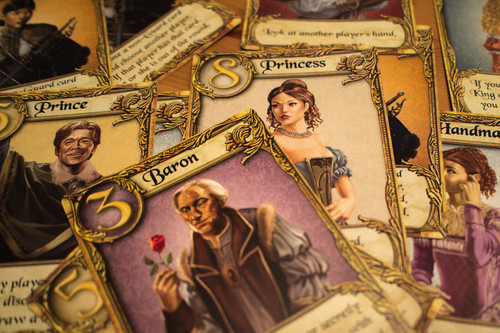
This past Saturday night it was Love Letter. Released in 2012 in Japan and quickly moving into multiple international versions, Love Letter is a seemingly unlikely game for a group of hardcore gamers crowded around a basement table. The game is comprised of just 16 playing cards, 4 reference cards and 13 tiny red square cubes — “tokens of affection.” Everything comes in a crimson crushed velvet drawstring bag with “Love Letter” embroidered in flowery yellow script. The simplicity of the game’s packaging, design and minimal components hides a pretty compelling strategy card game which even the most battle-hardened gamers will find engaging in just under a half-hour’s play.

In Love Letter, player’s vie for the affection of Princess Annette of the imaginary kingdom of Tempest. Players are dealt cards with values of 1 to 9, each depicting a courtly character with a specific ability. In turn, each player then draws and plays one card. Guards (value 1) allow you to guess a card in another player’s hand. The Baron (value 3) has two players compare hands with the lowest hand eliminated from the round. The Prince (value 5) forces a player to discard their hand and draw a new card. The remaining six cards reveal different types of actions, and some cards are plentiful while others are unique. After a round of play, the last player holding a card or the player with highest-valued card wins a cube and a new round is dealt. The first player to score four cubes — “tokens of affection” — over a number of rounds of play wins the hand of Princess Annette.

The trick of the game is to attempt to follow which cards are in the hands of other players and still in the draw pile. Love Letter is thus a game of memorization, strategy and deceit. The most powerful cards, while best at the end of a round may make a player a target early in the round. Playing cards may reveal information to you, but also allow your opponents to possibly infer who is holding what cards. Players may gang up on a leading player to force them from a round, leading to shifting alliances from hand to hand.

Despite its courtly conceit, Love Letter can turn into a bit of a raucous and cut-throat game, as ours did among four of us Saturday night. The game would be perfect to keep tucked in the bottom of your bag to pull out among a group of friends at a bar or around the table during dessert. Given that entire ancient battles have been fought and historic treaties struck over the union of two fated lovers, Love Letter provides a quick and challenging chance to play out the ultimate game of royal affection taken to extremes.

Retro Gaming The 70s & 80s: Gamma World

Post-apocalyptic and dystopian futures in pop culture were big fascinations of mine as a kid. Planet of the Apes premiered the year I was born, and the movie sequels, live-action TV show, Saturday morning cartoon and toys were a big part of my imagination through the first half of the 1970s. As I grew into a budding sci-fi fan, movies like The Omega Man, Invasion of the Body Snatchers and Logan’s Run, as well as television re-runs of The Twilight Zone further filled my brain with visions of future what-ifs and the destruction of the human race.

In 1981, two things happened. Ronald Reagan became President and would go on to occupy the White House for all my teenage years. During this formative period of my life, my waking mind and night time dreams were filled with the ever-looming threat of nuclear war flowing from Reagan’s amped-up rhetoric toward what was then still the Soviet Union. Suddenly, the fictionalized visions of the end of civilization seemed very, very real.

That same year, I saw Mad Max 2, (aka The Road Warrior). Although shot in Australia with an Aussie-accented Mel Gibson in the lead, the movie resonated as very American to me. With it’s high-desert setting, gunfights, chase scenes and a hero with a hidden past, the film struck me very much like Westerns (particularly those of Clint Eastwood) I already loved. Wrapping the Western genre up in a post-apocalyptic story hit all the right notes in my 13-year-old imagination.

Along the way in the late 70s through early 80s, I was spending a lot of time gaming with Dungeons & Dragons. In 1983, I ran across the second edition of Gamma World in the local bookstore where I bought most of my D&D gaming stuff. Originally introduced in 1978 by TSR, the makers of D&D, Gamma World was a role-playing game set in a post-nuclear war 25th-century Earth populated  by mutants, cyborgs and remnants of the human race. While D&D drew its influence from various fantasy sword-and-sorcery antecedents, Gamma World’s dystopian setting was rooted in the sci-fi themes of stories and movies I loved. From a game mechanics standpoint, Gamma World had a familiar feel to D&D with character attributes, fantastical equipment and a chart and dice-driven combat and encounters system. The similiarities with D&D made it easy to slide into the entirely different storylines Gamma World offered.

I never took to Gamma World with the same depth of interest as D&D, but playing it was pretty fantastic. The world of the game was occupied by giant rabbits, humanoid lizard people, deadly plantlife, robotic killing machines and all other manner of deadly foes and allies. Weaponry ranged from spears and traffic sign shields to laser rifles and nuclear devices. Maps represented entire crumbling city street grids or hidden underground survivalist bunkers. An adventure could involve a quest for an “ancient” 20th-century manuscript holding the key to human salvation or an infiltration mission to destroy a cyborg factory. To my friends and me, Gamma World allowed us to write the scripts and play through the dozens of unmade post-apocalyptic movies living in our heads and influenced by the films already ingested into our psyches.

Gamma World is still published by Wizards of the Coast today, but the popular trend in zombie-themed games occupies most of today’s gaming interest in post-apocalyptic scenarios. That said, for a purely futuristic, dystopian, sky’s-the-limit role-playing game, fast-wording a few centuries to Gamma World can’t be beaten.

Collector’s Note: Original TSR-published Gamma World boxed sets and expansion modules can be found on eBay. Modules and indivdual rule books can run in the range of $15-75 while original complete boxed sets of early editions can run into the hundreds of dollars.

Retro Gaming The 70s & 80s: The Official Advanced Dungeons & Dragons Coloring Album


As a kid in the 1970s, I had heaps of activity books of all sorts — brain teasers, mazes, puzzles, coloring, paper doll and cut-out model books. As a new Dungeons & Dragons gamer, I loved 1979’s “The Official Advanced Dungeons & Dragons Coloring Album” which captured two of my childhood passions within 30 or so pages of absolute wonder.

This was no ordinary coloring book on any level. Even as a kid, I was always impressed by its long and prideful title. This was a “coloring album” instead of just another “coloring book.” The drawings were by Greg Irons who famously worked on posters for Bill Graham’s legendary Fillmore Auditorium rock concerts and the 1968 Beatles animated film Yellow Submarine. To my young eye, Irons’s art in the coloring album looked liked the work of a Medieval woodcutter or like uncolored stained glass windows. Lines were dark and heavy, but the drawings wildly animated each page in a progressive story of adventurers and monsters familiar to D&D gamers.

The other aspect that made this publication unlike any normal coloring book was the text by Gary Gygax, the co-creator of D&D. Knit within the story-like captions accompanying the illustrations by Irons, Gygax delivered an actual game you could play. While vastly simplified, Gygax borrowed heavily from some of the basic D&D terminology and concepts with which I was quite familiar by then. And there, at the center of the book, was a two-page dungeon map on which the short adventure could be played. Despite the game having little replay value, I remember playing it repeatedly just because I loved this book so much.

Out of all the stacks of throw-away activity books I had as a kid, “The Official Advanced D&D Coloring Album” is one of the few standouts in my memory. Like the game that inspired it, the book presented and inspired so much fantastic creativity in a way I had never seen before and have seldom seen since.

Collector’s Note: “The Official Advanced D&D Coloring Album” is out of print but scans are available online for free download here and here. Copies of the original unused book can also be found on eBay for an astonishing $75 and up, and partially-colored copies start in the $15 range from online rare book dealers like AbeBooksYou can also check out some of the Fillmore-era posters from Greg Irons at Wolfgang’s Vault, although buying one will run you into the thousands of dollars.

American Civil War: Perry Miniatures ACW in 28mm

About a year ago I got back into gaming the American Civil War.

My first miniatures wargaming experience back in the 1980s was with 15mm ACW played with the Fire & Fury rules. I wound up stepping away from gaming for the 1990s, but with the celebration of the 150th anniversary of Civil War and some ACW gaming with the Brother Against Brother rules at a convention I decided last year that now was the time to get back to the ACW.

Having spent a couple years playing WWII in 15mm, I very much ready to try another era but I also chose to go bigger with another scale at 28mm. Fortunately, Perry Miniatures offer a line of well-sculpted and very reasonably-priced plastic and metal line of ACW figures which I’ve used exclusively to this point.

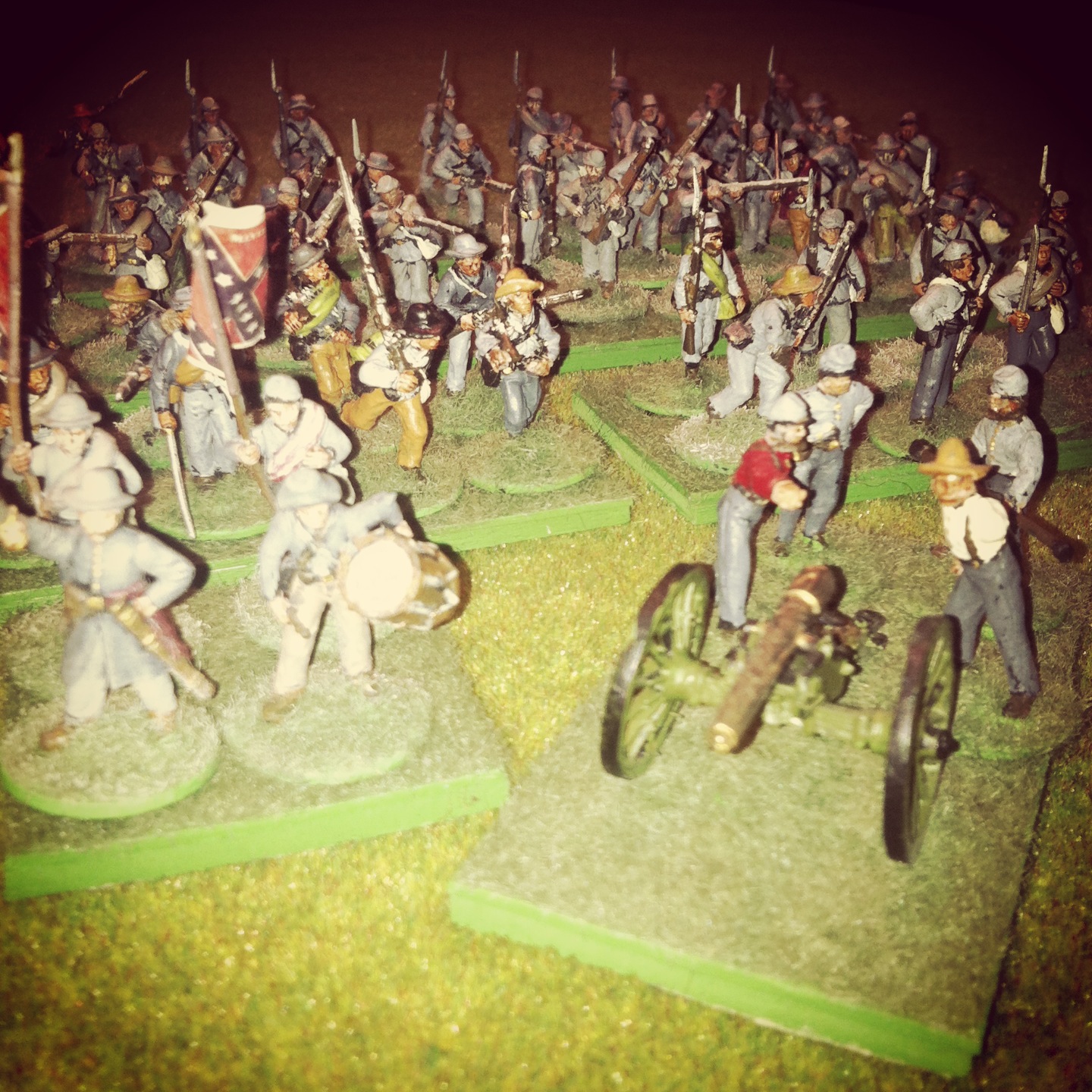
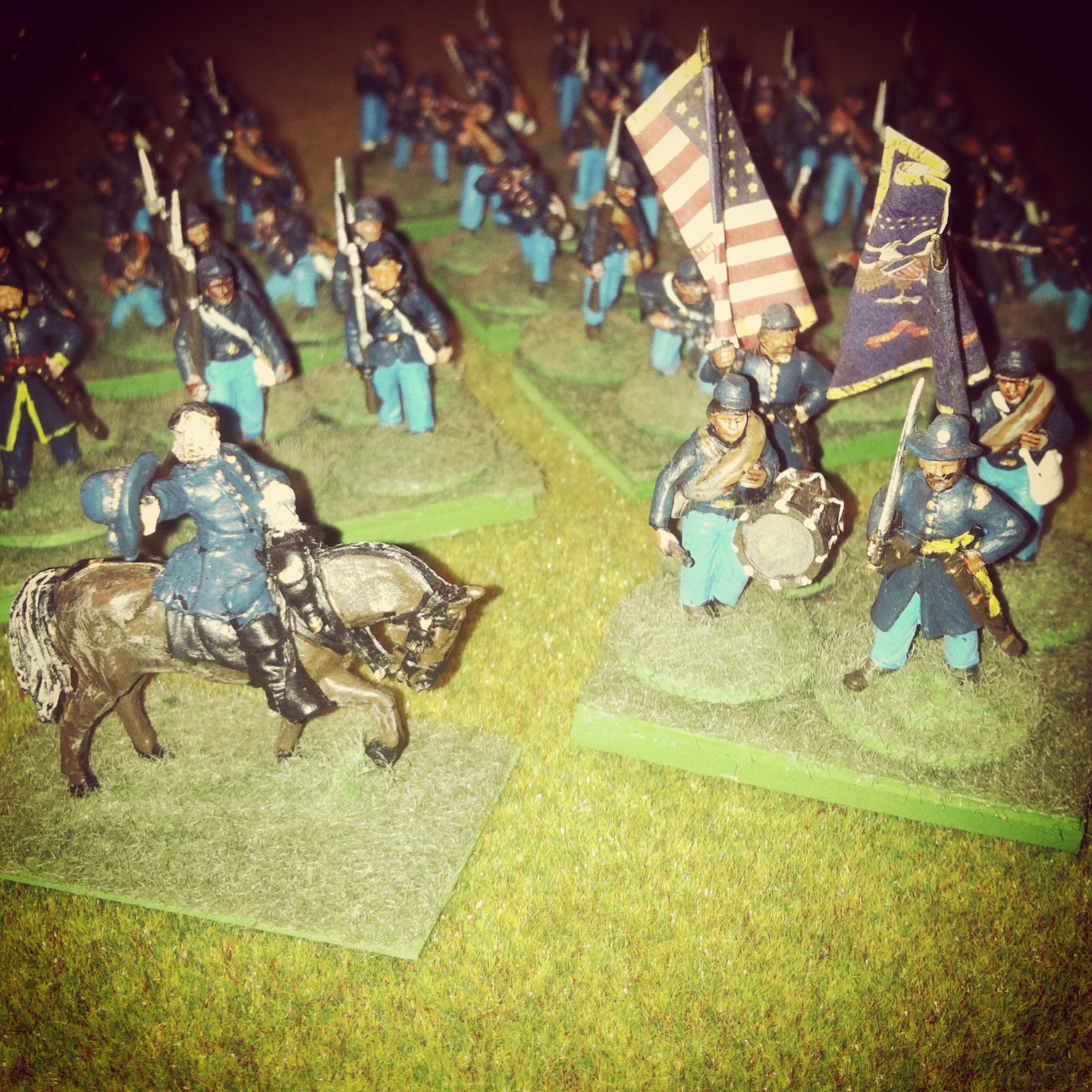
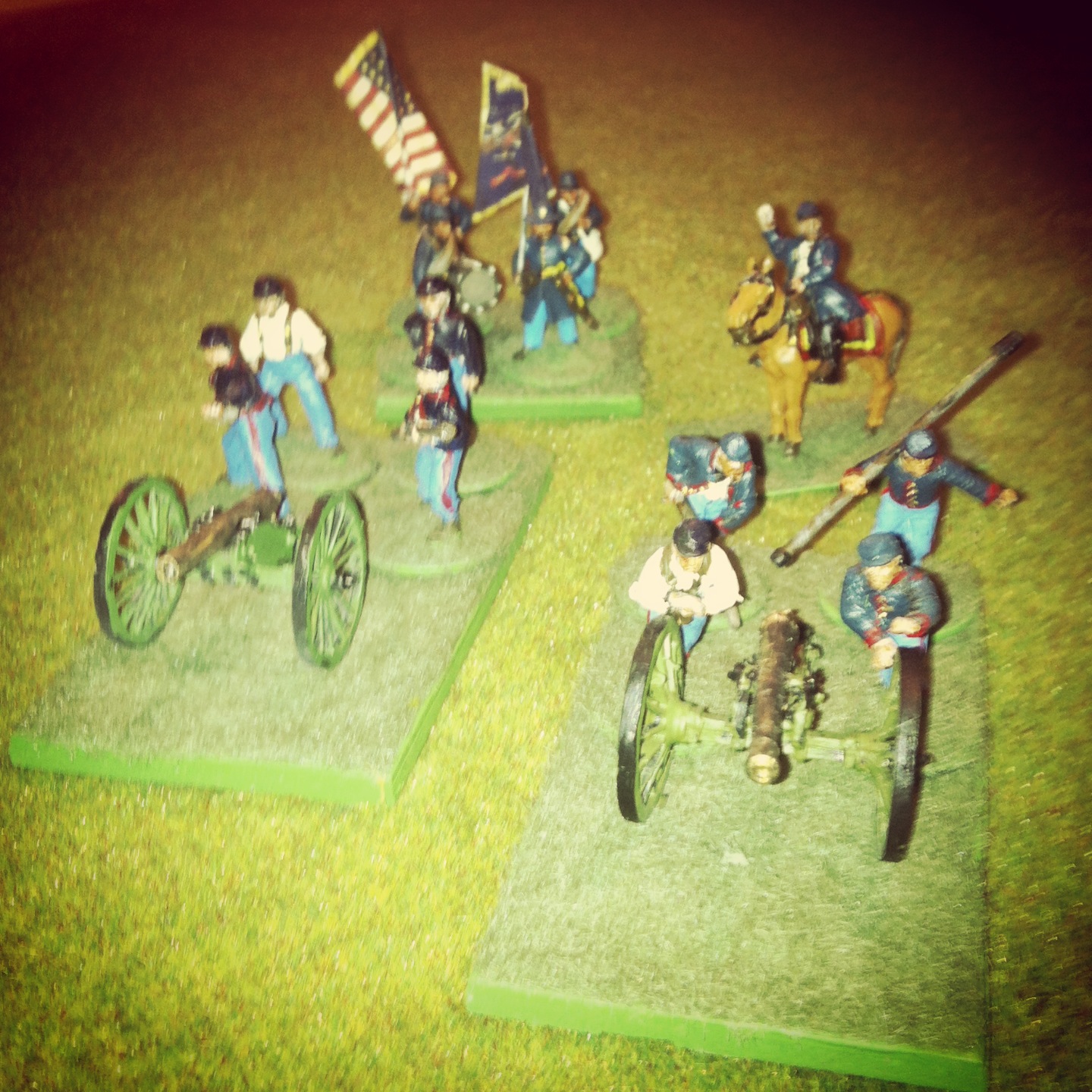
Without going into the details of assembly (relatively easy) and painting technique (also quite easy), I’ve got about 125 figures painted up now on each side. I’ve also completed some mounted and infantry command, artillery batteries and casualty figures. All figures are based on metal washers, and I also made some movement stands for each unit with magnetic sheets adhered to balsa bases.

First, some of the boys from the South…


And, some of the boys from up North…


Now that I’ve got a decent set of figures with which to play, I’m looking forward to setting up a real nice game with the Metropolitan Wargamers in Brooklyn this summer. Just in time for some key ACW anniversaries, I’m really happy to see my Blue and Grey hit the tabletop again.

Retro Gaming The 70s & 80s: TSR Minigames


Alternatively known as “microgames,” “pocket games” or “minigames,” a number of companies created a fad in games in small packages in the late 1970s through early 1980s. These compact games came in a variety of historic, sci-fi and fantasy themes. Rulebooks, maps, cardboard chips and dice were usually packaged in hardshell cases or even simple zip-lock plastic bags. A very few of these games, like the post-apocalyptic Road Warrior-esque Car Wars from Steve Jackson Games, would see a long life fueled by supplements and expansions. More commonly, these minigames were stand-alones of vastly varying quality which faded into obscurity in a few short years.

TSR, the makers of Dungeons & Dragons, entered the minigame market late with a total of eight games released in the first couple years of the 1980s. This was a big growth period for TSR as they continued to diversify beyond their core D&D products into other boardgames, role-playing games, toys, computer and video games, and even an animated TV show. Already investing a ton of our time and money in TSR products, my brother and I snapped four of their minigames:

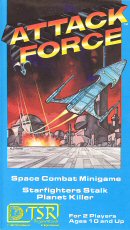
  • Attack Force was a simple Star Wars rip-off with one player’s force of small star fighters attempting to find the weakness in the other player’s monstrous space station to destroy it. As a fan of Luke’s attack on the Deathstar, I gave TSR a pass on the lack of originality for the chance to do some space battling myself.
  • They’ve Invaded Pleasantville was also a two-player game, this time set in a rural village where the townspeople try to fend off alien invaders infiltrating the local populace. Each player used identical chips representing such local folk like the minister, sheriff, plumber, checkout girl and others. The trick of the game was the alien invader bluffing their way toward taking over the bodies of the locals while the town player sought to uncover who was really an alien.
  • Revolt on Antares was a much better sci-fi-themed game and offered play for 2 to 4 players. The game presented a Risk-like map of a fictional world where six ruling “houses” with names like Andros, Dougal and Serpentine fought to rule the planet through three different scenarios. Each house had its own personality and strengths, adding a lot of variety and replay value. The ability to recruit new troops, move across varied terrain and use seven special alien weapons or devices made this little gem seem a lot more like a real wargame.
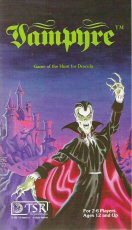
  • Vampyre was two games in one set in the realm of Bram Stoker’s “Dracula.” The first campaign-map-style game took 2 to 6 players in the roles of Stoker’s hero characters questing to find and destroy the coffin safe-havens of Count Dracula hidden throughout Transylvania. Turning the map over, a detailed floorplan of Castle Dracula allowed another game to be played as the characters sought to track down the Count himself and destroy him.

As a kid, I loved these games as a break from the longer hours spent bent over the table with my D&D campaigns. Each minigame offered its own varied mechanic, but rules were simple and limited to just a few pages for each game. The booklets, game maps and cardboard playing chips contained some wonderfully intricate small-scale artwork, much of it by popular fantasy artists of the day. While I don’t recall the exact cost of each game, I remember them being under $10 apiece and quite a deal for the hours of play we wrung out of each.

These four TSR games still sit in a closet packed full of my childhood puzzles and boardgames in the house where I grew up. At the time, there was an outsized amount of fun in each little mingame package. Today, there’s still a lot of memory in each, too.

Collector’s Note: Many of the TSR minigames can be found frequently on eBay selling in the $10-30 range. Steve Jackson Games makes much of their Car Wars and other microgames back catalog available for digital purchase online.

Retro Gaming The 70s & 80s: Dungeons & Dragons Computer Labryinth Game

By 1980 I was like a lot of kids with feet in two worlds of gaming — Dungeons & Dragons and electronic games. Both were well on their way to being the worldwide phenomena they would become in the next decade, and Mattel and TSR (then owner of D&D) sought to cash in on the intersecting interest of adolescents everywhere.

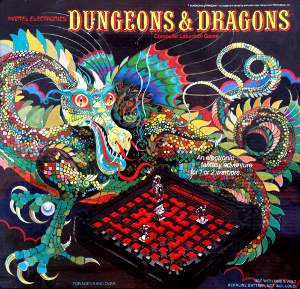
I never owned a copy of Mattel’s Dungeons & Dragons Computer Labryinth Game, but plenty of my friends did. The game looked pretty cool with its 64-square grid of spaces surround by a plastic castle-like wall. Metal figures represented a dragon, two adventurers and a treasure chest. The game could be played solo or with two players. A player moved their piece around the board, placing plastic walls when the board revealed a wall with light-up indicators. Other indicators would light up as you encountered monsters, traps or the dreaded dragon which roared as you approached. A player who avoided the dragon and navigated the revealed maze to the treasure first won the game.

A year before the D&D Computer Labryinth Game was released, Mattel was already competing in the new video game market with its Intellivision system. Those early years of the electronic game market were full of games which promised more than they delivered. Using the word “computer” in this game’s name was no doubt the work of shrewd marketing as the game itself was pretty low tech. Attaching the D&D graphics and brand to the game and even a moody TV ad didn’t do much to cover up for its shortcomings. Looking back, I recall the game even then to be unsatisfying to occasionally frustrating with its randomized LED grid and pieces which never really seemed to fit right. Retailing at around $45, the game didn’t come cheap either.

In 1984, Mattel admitted to its failed also-ran place in the video game market and pulled the plug on its Intellivision system. While it would go on to continued success with its boy-focused toy brands like Hot Wheels, Matchbox and Masters of the Universe, Mattel would never again be  significant player in electronic games. D&D, on the other hand, continues to thrive to this day. While the brand extension foray of the D&D Computer Labryinth Game never really delivered on the promises illustrated in Mattel’s box art, the game does capture a moment in time when gaming was bridging the gap from one era to the next.

Collector’s Note: Complete copies and components of the Dungeons & Dragons Computer Labryinth Game are readily avilable on eBay. Games in the original box run in the $30-50 range while the metal miniatures generally go for $5-10 each.