Flames of War: Fielding Easy Company

I’m not unique in being a World War II gamer and a big fan of HBO’s Band of Brothers miniseries from 2001. I also finally got around to reading Stephen Ambrose’s same-titled book on which the series was based. Both works follow the exploits of “Easy” Company of the 506th Parachute Infantry Regiment, 101st Airborne Division from training to D-Day to the end of the war. The story is absolutely riveting and presents a dramatic account of how the collective action of individuals contributed to the Allied victory.

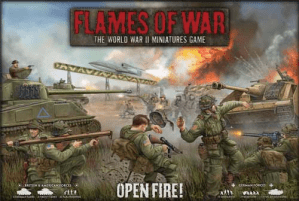
I’ve been working away recently at finishing my long-overdue modelling of Easy Company and a large US Airborne force. Nearly two years ago I purchased and painted up an entire company of Command Decision Paratroopers from Old Glory Miniatures, including command, machine guns, mortars, bazookas and parachute artillery support teams. This past week I’ve wrapped-up the small plastic parachute rifle company from the Flames of War Open Fire! starter box set I received this past Christmas. To this collection of troops, I’ve added the excellent Easy Company set from FOW containing a number of the real historic US servicemen portrayed in Band of Brothers.

While the casting is a bit skinnier and lacking in the detail of the official FOW miniatures, the value of the Command Decision models can’t be beaten at the low price of $15 for a hefty bag of 50 solidly serviceable figures. At under $70 online, the big Open Fire! box is a real deal for all the troops, tanks, artillery and other stuff included. The FOW Easy Company set itself runs about $12 for the few specific personality figures, and fielding these models is going to add significantly both to the look and effectiveness of my force on the tabletop battlefield.

With a good mix of FOW and Command Decision models painted-up, I turned to the “Nuts!” campaign book to put-together my order of battle for Easy Company. The book focuses on the 101st Airborne’s involvement in late 1944’s siege of Bastogne and other Battle of the Bulge engagements and then on to the German border and the eventual Allied victory in 1945.

In creating my list I wanted a highly-mobile and playable 1500 point force heavy on infantry with just a bit of tank support. In the FOW rules, the parachute rifle company is rated Fearless/Veterans, making them hard-hitting and tough to chase from the field. Their special use of Gammon bombs enhances their impact in risky infantry assaults on otherwise-intimidating German tanks. Adding the special characters from Easy Company makes for an even more resilient and daunting force, reflecting the historic bravery these men brought to the late war European campaigns.

I’ve modeled my infantry pretty simply with a quick coat of flat green primer, lighter brown on backpacks and equipment bags, a contrasting watered-down brown wash and some equipment details picked-out. Finally, the shoulders get a dot of black and a dab of white to mimic the famed Airborne eagle insignia (shown at the top of the page).

The first photo below shows the specific men of East Company which come packed with a lot of individual personality. Leading the platoon is Capt. Richard Winters and Capt. Lewis Dixon (front row, center) with the Nixon model taking a swig from a bottle as he was known to do. Pvt. Eugene Roe (middle row, far left) is shown patching-up an injured comrade. Corp. Darrell “Shifty” Powers (top row, far left) is hunched aiming on a barrel and ready to take out his German target. With so many generic models in my force, these guys are all a real treat.
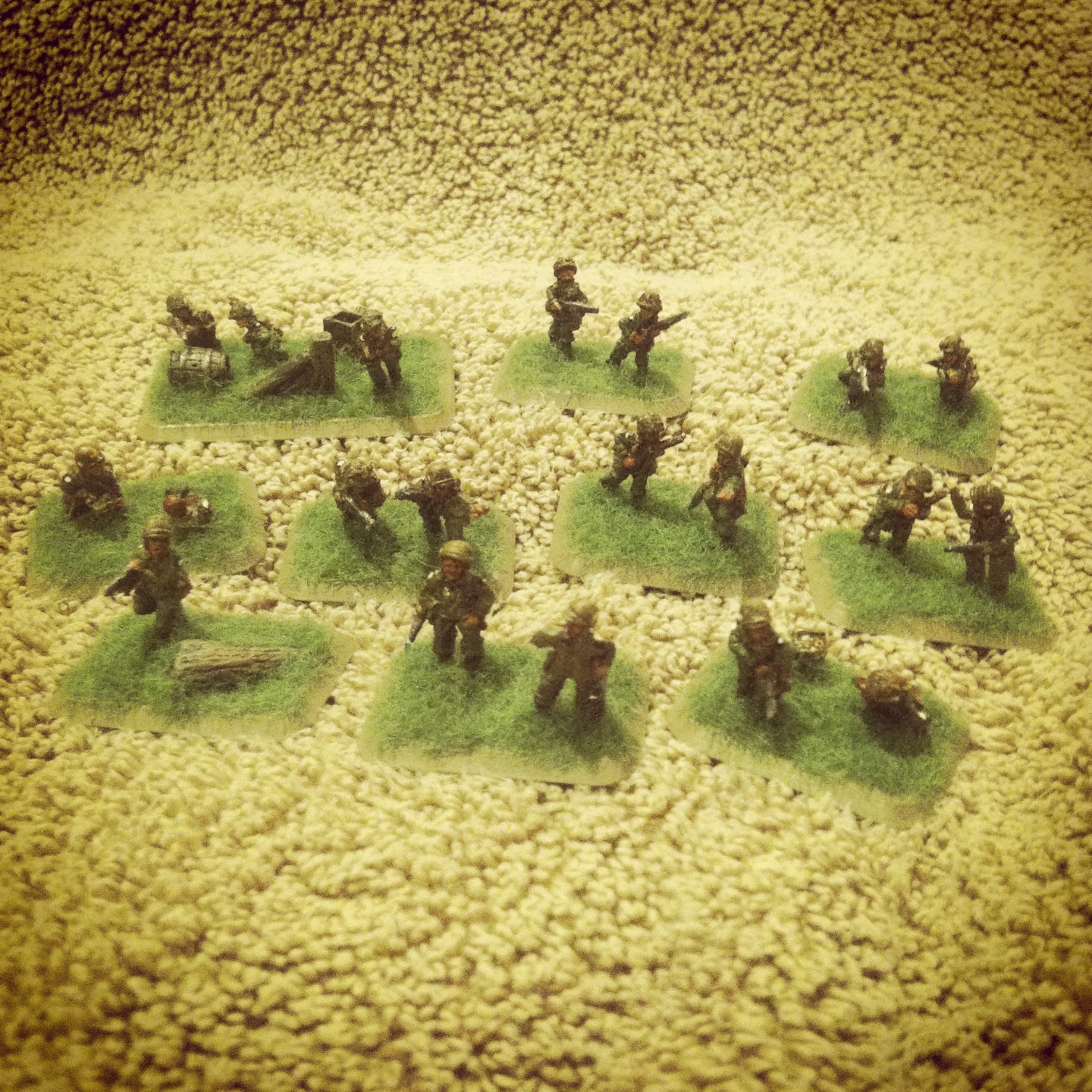
And below is a look at the plastic Airborne platoon included in the Open Fire! box set:

In July, I’m organizing a big FOW day at Metropolitan Wargamers with two simultaneous 2500-point games of Soviets vs. Germans and US Airborne vs. Germans. To the above list I’ll be adding some significant artillery muscle and I also hope to have a new P-47  Thunderbolt air support model ready to go. With Easy Company ready to lead on the tabletop, I can’t wait to get my new Airborne force into action.

Flames of War: Fielding the Grenadierkompanie

I got the Flames of War Open Fire! set this past Christmas and I’m finally getting around to painting-up all the stuff that comes packed in the box. At under $70 online, this big package is a real deal for new and experienced FOW gamers alike. The set includes over 100 plastic Allied and German infantry, tanks and artillery models, plus the full FOW rulebook, dice, markers and some other goodies included. A couple guys at Metropolitan Wargamers also picked up the set and are just getting into FOW. If you have any interest in gaming WWII at all, this set is the place to start.

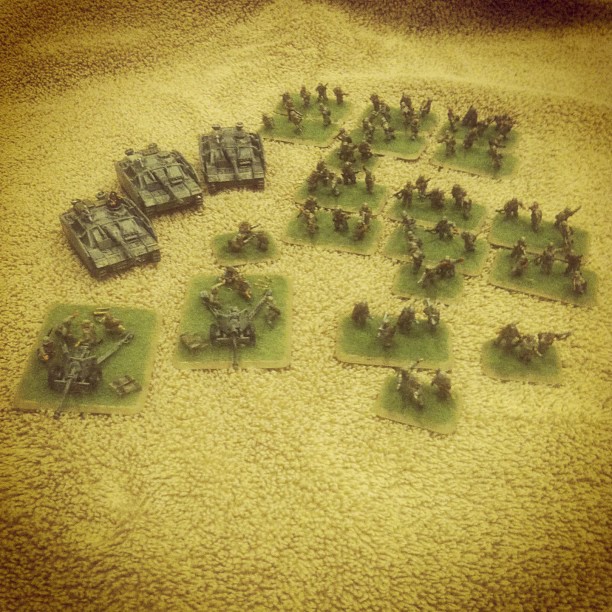
First off, I’ve finished the German Grenadierkompanie, including anti-tank 7.5cm PaK40s, a Stug G tank platoon and two platoons of infantry. These will supplement the pretty extensive Grenadier and Fallschirmjäger infantry I already have. The Stugs will also add to the large collection of Panzer IV, Jagdpanther and Konigstiger platoons I’ve already got on the shelf.

The plastic models all glue together quickly, but handling them has to be a bit delicate so as not to snap off the tips of the gun barrels. For the infantry, I spray prime everything in flat black and paint the uniforms in a mid-dark grey. All the details — guns, boots, equipment and skin — get picked-out with quick dabs of paint. Everything gets a very watered-down brown wash in the end which gives the uniforms a more accurate grey/green muted finish and also tones-down the flesh.

My camouflage painting abilities are honestly pretty atrocious, so my default is to go with a more generic grey paint scheme on my armor, artillery and vehicles. For the Stugs and PaK40s, the flat black primer was hit with a quick dry brushing of mid-dark grey.  After the dry brush coat, tank cargo and other details were then dabbed on. The platoon commander got some special attention with white detail on his cuffs and collar, plus some detail on the radio headset he’s wearing over his hat. Finally, I applied some wet-transfer decals and then dry brushed some light brown mud in the areas most likely to see some splashing on the tracks, sides and fenders.

y

With my Germans from Open Fire! complete, I’ll be posting soon with an update on the US Airborne and allied models from the set. Along with the Germans, a set of special FOW models from the famed Easy Company and a bunch of my existing models, there’ll be some major action from the Normandy campaign and beyond coming soon.

Favorite Tabletop Games Kickstarters of the Month (May 2013)

Earlier this week, I wrote about how I believe Kickstarter to be the latest incarnation of how gamers have contributed to the decades-long conversation on who truly “owns” our hobby. This had me delving deep into what’s current on Kickstarter’s Tabletop Games section.

To date, I’ve honestly only contributed to one tabletop games Kickstarter project. The modest fundraising drive for A Las Barricadas which brought in just under $10,000 for a game that has since been delayed but promises to be shipping soon. While I wait for this little game of street protest pitting Occupy Wall Street-like demonstrators against the police to arrive, I thought I’d share a few projects I’m watching this month.

Moby Dick, or the card game: Like any good English Literature major, I’m a fan of Herman Melville’s epic American tale of one man’s obsession with a whale. On the flipside, I am not generally a fan of card games. That said, this card game of the high seas boasts some truly marvelous woodcut-like artwork and what looks to be an entertaining game of the best recruited crews trying to survive in their quest to spear the Great White Whale.

All Quiet On The Martian Front: Showcasing 15mm miniatures of Martians vs. early 20th-century human armies, this game uses the H.G. Wells sci-fi classic as a jumping-off point to imagine a world of humans locked in protracted combat with alien invaders. The models look fantastic, mining the very-popular steampunk trend in gaming today. Supporters of the game (particular those pledging in the hundreds of dollars) will net a lot of cool looking stuff with its funding.

Canterbury: Nothing gets me going like a great Euro-style worker placement game, so this is particularly enticing. The game places you in the age of Saxon Kings, and your aim is to build the greatest of cities starting with only a well in the wilderness. Managing your growing population, resources, culture, military and ongoing construction of buildings, the game claims to be one of pure skill and planning with no luck factor whatsoever. This one looks like a beauty and I’ll be anxious to give it a play when it is published later this year.

 Wargaming Terrain for the American Frontier: I don’t play games in the period, but the latest from Acheson Creations presents more than a dozen wonderfully-crafted 28mm buildings from the pioneer, settler and Native American era of 18th-century colonial America. I particularly like the longhouses and wigwams, possibly inspired by the local tribal history of the Western New York and the Rochester area where the creators (and I) hail from. The blockhouse, fort wall sections, barn and cabin models also look great and could easily be used in other eras or in fantasy gaming scenarios, too.

Civil War Toy Soldiers: This final project has less to do with gaming and more to do with the special spot in my heart for the toy soldiers of my childhood, especially around the holidays. Cast in soft plastic and a large 54mm scale, this new line of Union soldiers have been launched to compliment Cunnyngham Collectibles’s existing Southern troops. The poses, liveliness and equipment details on these guys make for some really cracking personality. A few bags of these fellas on the floor or in the tall grass and I’d be transported back to when I first fell in love with little plastic men nearly 40 years ago.

Setting The Scene

One of the aspects of wargaming I love most is setting up the tabletop battlefield. I first got into scenery building with a large basement HO scale model railroad as a kid in the 1970s and 80s. Through a mix of sculpting hills and roads, modelling trees and creating realistic tableaus of buildings, I spent hours bringing to life a miniature world.

Setting up a tabletop battlefield serves two purposes. Firstly, playability is affected in terms of terrain contours, defensive cover and lines of sight. Secondly, a well-laid and realistic tabletop brings an aesthetic appeal and excitement only to be found in miniature wargaming. While throwing down a big piece of green fabric and some simple trees or lichen shrubbery and maybe some rocks for outcroppings can provide a bare minimum play area, adding a few pieces of additional model detail really makes a game come to life.

Check out some of my WWII and American Civil War set-ups in the Gaming & Painting section above, and have a quick read on some easy resources below to get your own tabletop ready for battle.

Battlefield Basics

For my groundcover, I use a $10 green fleece throw I picked up in a discount store. I like that I can fold it or open it up to create different sized gaming spaces. You can also use felt or any other cloth easily picked up at a local fabric store. For roads, I use a rubber textured road system I bought at a gaming convention. On the cheap, you can cut felt or other material into strips to create roads of varying lengths and widths. Streams and rivers can also be cut from blue felt. For basic shrubs, a bag or two of lichen from a hobby shop in varying shades of greens and browns provides flexibility in creating hedgerows and other bunches of ground cover. Spreading some gravel or larger stones around the battlefield can also provide some texture and look to the table.

Trees

While a lot of gamers prefer making trees from scratch using twigs and lichen, I like tree systems like those offered by Woodland Scenics. Whether you choose to build your own or buy pre-made trees, you can easily find what you need via websites or stores that cater to model railroading hobbyists. Keep scale in mind that shorter HO-scale trees suffice for 15mm scenarios and taller O-scale trees will stand in nicely for forests and treelines in 28mm games.

 Buildings

There are tons of options for wargaming buildings. Many experienced gamers make their buildings from scratch using foamcore, balsa wood and other kit-building materials found at any decent hobby shop. Another cheap option is downloadable paper cut-out buildings, many examples of which can be found online for free or in easy and immediate pay/download format.

A number of companies specialize in model buildings in lots of scales, eras and geographic locations. Some relatively inexpensive buildings come cast in solid resin and unpainted, while others come completely assembled and detailed with removable floors and roofs. More recently, laser-cut wood buildings are becoming a popular option.

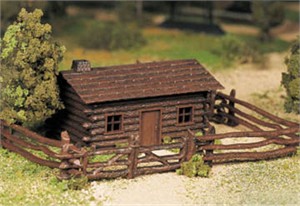
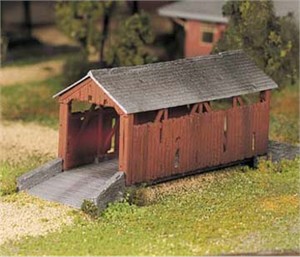
I like using plastic kits from model railroad suppliers, particularly O-scale buildings when I’m gaming the American Civil War in 28mm. These kits are pretty inexpensive ($10-30), easy to find online or in stores, simple to glue together and lightweight. The often simple detailing is easily enhanced with some simple painting and weathering removing the plastic gloss. Companies such as Bachmann (log cabin and covered bridge pictured), Atlas and Lionel all make model railroad buildings which can easily stand on an 18th or 19th-century American battlefield. I love my big Lionel K-Line O-scale American church I picked up for $9 on sale, and it always takes center stage in my American Civil War set-ups.

Boxed Terrain Systems

While pricey, several companies offer full lines of pre-packaged terrain systems made specifically for gaming. Flames of War offers a big line of 15mm WWII terrain through their Battlefield In A Box sets with roads, rivers, buildings and battlefield accessories to fit different regions of the war. Games Workshop also offers a number of products specific to their games from Citadel but much of it could be used for other gaming in Medieval and fantasy gaming environments in 28mm. For gamers with particularly deep pockets, Games Worshop all carries highly-detailed modular gaming boards for nearly $300 each.

“Where Do I Start?” Some Thoughts On Starter Sets

One of the more daunting things for people just getting into tabletop wargaming is where to start. There are countless systems to choose from, many scales, different levels of complexity and hundreds of thousands of products to choose from. Shopping online or walking into a local hobby store, the newcomer can easily be overwhelmed by the sheer quantity of “stuff” that’s out there in the hobby.

Here’s a few pointers on how to get yourself (or your kids) started.

1.) Try a game first. If you have an opportunity to try a game before buying, that’s the best (and cheapest) first step. Spending a few hours with a local gaming club, visiting a gaming convention or playing at a nearby hobby shop will give you a broad overview of how complex and fun a game can be. It’s also good to speak with other players so they can relate their personal experience in what they do (or don’t) about particular games, and what kind of a time and money commitment you may be making by undertaking a new game.

2.) Pick a theme. There is a tremendous variety in the playable world of gaming. If your kids like comic book superheroes or sci-fi space battles, there are games for those. If you like reading about history and are interested in playing a particular historic era, chances are there’s a game for it. If you have tendencies toward swords, sorcery and fantasy monsters, there are plenty of options. And, for those of you into horror and zombies, there are definitely games to suit your taste for the macabre.

3.) Visit a local store. It’s great to support local businesses, and getting to know the folks at your local hobby store, comic book shop or specialized wargaming outlet is key to your intro and growth with a game. People at these stores are usually gamers themselves, and they know and love this stuff. Be honest with them when just starting out. Explain your level of previous experience, interests, budget and the amount of free time available to play games. If you are looking to play a World War II game for a couple hours a week and have a budget of $50, they’ll probably steer toward the great board or card games available. If you have hours of free time and are willing to invest hundreds (or thousands) of dollars in a World War II game over the long term, a good store employee will point you in a different direction.

4.) Get a starter set. One of the great things about wargaming is the wide array of products the industry churns out. Settling on just one gaming system can present a new player with thousands of options. Experienced gamers usually go the a la carte route, picking and choosing the specific miniatures, models and rulesets they want. As a new gamer, however, what you usually need to get started is some miniatures and rules.

Thankfully, many popular wargaming systems offer packaged starter sets. These usually contain a set of rules, dice, maps and enough miniatures to wage a small game right out of the box. The other bonus with starer sets is the costs savings, as many companies package there starter sets with contents that might be double the cost if bought separately.

Here’s a couple of my favorite starter sets, covering a couple different scales and eras. If you’re looking a for a great wargaming gift this holiday season, start here.

Flames of War: Open Fire!

If you’re interested in World War II, start here. For about $70, this incredible set gives a player a 50-page quick-start guide, a full 300-page rulebook, dice, nearly 120 soldiers, eleven tanks and lots of other goodies. The set encourages you to glue up the miniatures and models and start right in playing. Once you’ve got a game or two under your belt, you can get started painting and then head back to the shop to start building out your forces for even bigger games.

The Hobbit: Escape from Goblin Town

Millions of people are going to be marching into movie theaters this month to see The Hobbit: An Unexpected Journey. If your interest in things Tolkienesque goes beyond the Hobbit and Lord of the Rings books and movies, then Games Workshop’s line of games should be your next stop. To coincide with the new movie, a whole new line of miniatures, rules and this incredible limited starter set has been introduced. The set costs $125, but with that you get all the hero characters (Bilbo Baggins, Gandalf the Wizard and Thorin Oakenshield and his band of dwarves) and dozens of goblins. The set includes a 50-page rule book plus some terrain models, dice and a ruler. Everything is plastic and modelled with incredible detail and personality. When painted, the models really come to life on the table. There’s also a full line of Hobbit-themed (and previously-produced Lord of The Rings) miniatures and rules ready to be added to your future games.

Warhammer and Warhammer 40K

Games Workshop also offers two long-standing favorites in the miniatures gaming world: Warhammer and Warhammer 40,000 (or, 40K to fans). Each gaming system offers a starter set for $99 that comes packed with incredibly detailed miniatures, rule books, starter guides, dice and other gaming accessories.

Warhammer is set in a fantasy world of magic and monsters, The Island of Blood starter sets allows you to field an army of High Elves against the Skaven, a race of giant rats. The 74 models exclusive to this box include Elves on horseback, an Elven prince riding a giant griffon, Skaven ogres and a whimsical cannon strapped to the back of a giant rat.

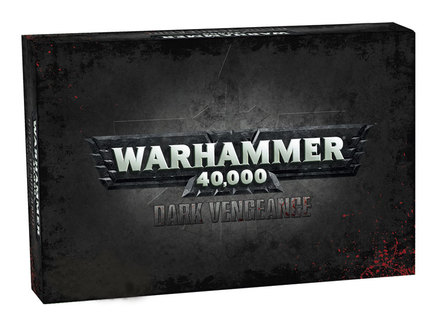
Warhammer 40K inhabits a universe in a far off future plagued by armies in endless intergalactic planetary war. The dark vengence starter set gives you 48 plastic miniatures depicting the Dark Angels against the Chaos Space Marines. Theses figures come armed to the teeth with gruesome hi-tech weapons and clad in enormous suits of armor. A squad of bikers and a walking death machine armed with laser cannons and giant claws round out the armed forces.