American Civil War: ACW Artillery in 28mm

I spent this past Sunday at the Metropolitan Museum of Art in New York City and caught the absolutely spectacular “Photography and the American Civil War” exhibit which runs through September 2, 2013. The hundreds of photos cover a bit of the same ground as past exhibits, documentaries and books, but there’s a lot I had never seen before, too. What spoke to me most were the dozens of simple individual soldier photos. The contrast between the dressed-up idealistic pre-war studio portraits and the devastatingly gruesome prisoner of war and hospital images is wrenching.

Aside from the portraits occupying the bulk of the show, one of my favorite photos from the show was the one shown below by Timothy O’Sullivan from 1864.

Titled “Pennsylvania Light Artillery, Battery B, Petersburg, Virginia,” O’Sullivan’s small photo (maybe 3″ x 9″) purports to give a rare glimpse of a full artillery battery either drilling or possibly in actual combat. The mass of guns, crew and equipment shows the full size and complexity an artillery section brought to the fields of the American Civil War 150 years ago.

My go-to favorite miniatures company for my American Civil War 28mm gaming is Perry Brothers for both their sculpting and reasonable cost in both their plastic and metal ranges. I have three artillery teams painted up  from their metals line, but more guns would always be better. However, each gun team currently runs me about $12. At this price, modelling realistic large-scale batteries like those in the O’Sullivan photo from the Met has seemed pretty cost-prohibitive.

Well, over at the Perry Brothers Plastics Workbench section of their site, they’ve just recently teased a few plastic sprues of artillery which will include carriages, limbers, multiple barrels and crew. The flexibility of the soon-to-come set will allow for modelling of different crews — North and South — as well as rifled and smoothbore gun types.


There’s no release date for this set as of yet, but in the meantime there are some nice work-in progress shots I’ve shared here. With a few of these assembled and painted up on each side of my tabletop battlefield, my games will get an added boost of realism captured timelessly in the hundreds of photos currently on view here in New York.

New Game Weekend: Fortune and Glory

By the time Raiders of the Lost Ark hit the theaters in the summer of 1981, my newly-teenaged brain was already well-steeped in the concept of high-adventure cliffhanger movies and serials. For most kids, Indiana Jones kicked-off a mini-rival in interest in the danger-thwarting, jungle-hacking, mystery-unraveling and treasure-seeking characters that populated decades of Saturday afternoons in local movie theaters for my parent’s generation and earlier. The elements of cliffhangers are so ingrained in our pop culture to this day that I challenge you to find a popular TV show, action movie, comic book or video game that doesn’t borrow some element from the genre.

One of the best things about the gaming hobby is that you can pretty much be guaranteed there’s a a game (or several) that aligns with a just about any thematic interest. So, this past weekend at Metropolitan Wargamers I had a chance to try out taking on the role of an international adventurer with 2011’s Fortune and Glory from Flying Frog Games.

The game takes place in the between-the-wars period of the 1930s where mobsters and Nazis vie for international control while your adventuring character roams the world searching for fantastic objects of great value and power. Players take on one of eight fantastically-named personalities such as Li Mie Chen, The Duke, Jake Zane, Sharon Hunter, Dr. Zhukov, Shelley Hargrove, Jacques Moreau and Cartwright (all pictured below, left to right and top to bottom). Each player character comes with their own set of special abilities and attributes such as Cunning, Lore, Combat and Agility. These attribute strengths come into play as characters roll dice to resolve their success during certain encounters within the game adventures.


The game begins by placing artifacts in random locations around the globe. Players move their characters toward these objects and upon encountering them, roll dice in a three-part attempt to resolve their quest. The thing that makes Fortune and Glory so entertaining is the random mechanic of drawing cards to create objects of the quests and the adventures themselves.

For instance, in our game (pictured at right) a quest for a magical sword unveiled an adventure that involved solving a mysterious puzzle, a high speed car chase and a final airplane chase. Failing to roll successfully against the high speed car chase challenge wound up in a “cliffhanger” on the reverse of the card which led to the car going over a cliff. All this detail is related on the well-illustrated adventure cards and left to the players to dramatically read aloud, often to great mirth around the board. Other encounters during our game included a shootout in a nightclub, a case of malria in the jungles of the Amazon and an unsuccessful encounter with a Yeti in the northern steppes of Russia. With hundreds of cards available in the game, there is endless variety to the how each adventure will play out. All this contributes significantly to the high replay value of Fortune and Glory.

Aside from all the cards, there are over 150 miniatures included for character adventurers, Nazis, mobsters, temples and a zepplin which randomly drops new Nazi henchman around the board as the game progresses. Plastic gold coins mark your progress toward gaining “fortune” and may be spent to further outfit your adventurer with guns, maps and even an airplane. In the end, collecting blue plastic “glory” coins points the way toward victory for our heroes or the villains.

We played the game collaboratively, allowing us to work together with each of our own abilities contributing toward our march toward glory and victory. A competitive set of rules options is also included which completely changes the dynamic to duelling adventurers questing toward individual glory.

Fortune and Glory carries a hefty retail price of about $100 but can be found for around $75 online. However, the investment in this big, heavy box is well worth it with the gorgeous design and endless randomness to the game providing a hugely entertaining world of cliffhanging adventure. Fortune and Glory is certain to keep you on the edge of your seat and may  even cause you to spill your popcorn if you’re not careful.

The History of Games in Western New York

I grew up in Western New York State about 40 miles South of Rochester. To my childhood self, going to Rochester was “going to the city.” Rochester was where I headed for big touring concerts, independent movies and museums. On my rare trips home these days, one of my favorites and one of the more unique museums to visit in Rochester remains the National Museum of Play.

Opened in the early 1980s, the National Museum of Play grew out of the Strong Museum and the collection of industrial heiress Margaret Woodbury Strong. The museum originally housed the enormous doll and toy collection Strong acquired over decades of worldwide travel in the first half of the 20th-century. In the past 30 years, the mission of the museum has evolved to be one of the preeminent repositories and exhibitors of toys, games, video games, dolls, action figures, children’s books and all things devoted to occupying the childhood development of children through that most basic of juvenile pursuits: play.

Among its collections, the museum has risen to prominence in the past few years with the opening of the International Center for the History of Electronic Games. The ICHEG publicly displays some 140 playable classic video arcade games and also maintains an archive of hundreds of thousands gaming systems, games, advertisements, manuals, corporate documents and other ephemera devoted to video games from their earliest development to their contemporary innovations and cultural dominance.

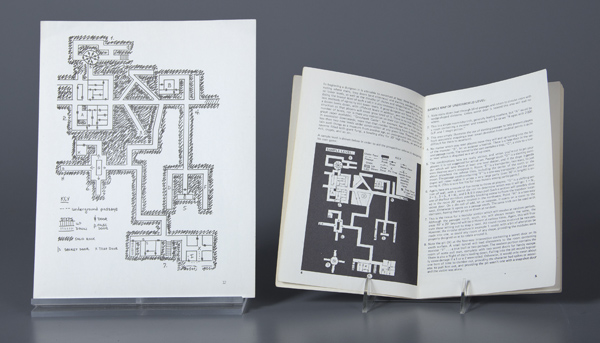
The museum made news this past week with the announcement of the temporary display of the “Dalluhn Manuscript” (photo at right) in their newest permanent exhibit called Game Time! This space will eventually devote the entire second floor of the museum to the history of American play through a series of interactive exhibits. The Dalluhn Manuscript is important as what is the earliest know draft of what would eventually become the world-changing game Dungeons & Dragons. The manuscript is on loan from Jon Peterson whose massive book “Playing At The World” took the scholarly investigation of the history of strategic gaming to new heights when it was published last year. Peterson has updated his book with a free appendix available through his blog that delves deep into the significance of the manuscript on display in Rochester. If you’ve read his book or have any desire to take a rare peek into the minutiae of how D&D came about, seeing this piece of gaming legend is a must-do over the coming months. Think of it as the Magna Carta or a first draft of the Declaration of Independence for gamers and you’ll have some idea of what a treasure these few pages are.

In general, I would urge anyone interested in games and play to visit the National Museum of Play in Rochester. It’s one of those rare museums where people of all ages will truly find something that speaks to them. If you can’t make it to Rochester, take a spin through their online archives where thousands of photos of toys, dolls and games are on view. With centuries of play behind us and unknown adventures ahead, a trip through our shared history is almost as enjoyable as a few hours of play itself.

New Game Weekend: Zombicide

My weekend of gaming started with a regular meeting of the Metropolitan Wargamers club where new members — including myself — were inducted. With a couple dozen guys in attendance, it was great to look around the room and feel the fellowship with a group with decades of gaming passion in them. I’m looking forward to years to come with these guys and the inevitable newcomers who find their way to the club.

After the meeting, groups split off into a variety of board and miniatures games. I teamed up with four guys for my first playing of Zombicide. Anyone with a pulse knows zombies have been a huge trend in the culture for a few years now with the popularity of the The Walking Dead TV show and comic book series, as well as countless other books, movies and video games. Tabletop gamers haven’t been immune to the trend with a variety of popular zombie-themed miniature and boardgames rising in popularity. I’ve enjoyed playing Zombies!!! and a few of its expansions with my kids for a couple years now, and Last Night On Earth has become a mainstay for zombie gamers.

Zombicide is the latest to break into this gaming trend pitting survivors against undead hoards. The game was launched via a Kickstarter campaign just about a year ago that brought in over $750,000 from over 5,000 backers. In March of this year, the first expansion set for the game — Zombicide: Season 2 — raised an additional $2.250 million from nearly 9,000 funders. Needless to say, in a year’s time Zombicide has ridden the zombie wave to incredible heights of popularity with a rabid fan base.

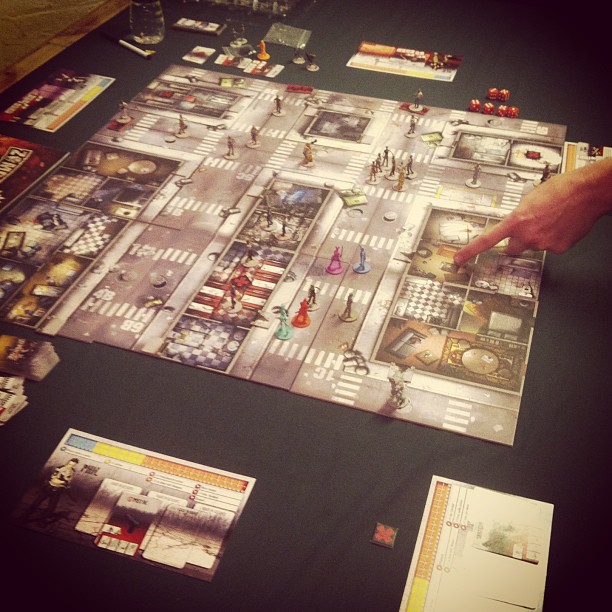
My first run through Zombicide was a tough introduction to both the goofy fun and extreme challenge of the game. Each player takes the role of survivor of the zombie apocalypse with its own card outlining their particular abilities and a personalized miniature. A streetscape of wonderfully detailed and gory cardboard tiles is laid out according to one of the ten scenarios included in the base game. To complete the set-up, areas are predefined where zombies enter the game, doors are set in buildings, objectives are placed, and, depending on the scenario, special pieces such as a police car is strewn throughout the town. Over 60 zombie miniatures in four varieties — Walkers, Runners, Fatties and the Abomination — start the game at the town’s edge, just waiting to sink their teeth into a juicy survivor.

Players work collaboratively using a base three actions to move, search and/or fight zombies both on the street and in buildings. Searching allows a player to draw cards to find weapons, ammunition, gear and other special items which increase their chances of surviving the zombie onslaught to come. Since each player starts with only a frying pan as a weapon, searching for weapons is a focus from the start. Players manage what items they carry in their hands or on their person, and players may also choose to trade or simply give items to their compatriots to increase the group’s overall chances. Certain items are used in combination, adding a scavenger hunt aspect to the game. For instance, a scope added to a rifle creates a more accurate and deadly long-range weapon, and a can of gasoline combined with some empty bottles makes for a devastating molotov cocktail.

It’s when the zombies start filling the board at the end of a round of turns by the players that collected weapons and other gear become critical. Melee weapons like baseball bats, axes, machetes and chainsaws are used for close-quarters fighting with zombies while ranged weapons such as pistols, shotguns and submachine guns come into play with longer ranged combat. Certain characters or weapon types allow for weapons to be used in each hand, doubling the survivor’s visciousness when tangling with the undead. In other cases, powerful weapons like shotguns or a molotov cocktail are critical when trying to destroy more powerful zombies like Fatties or the enormous, shambling Abomination.

As the turns elapse and zombies are killed, the players advance in experience which gains them the bonus of extra abilities. The downside from this gain in experience is that zombies begin coming onto the board in greater numbers. Because of this, players need to work together to balance the team’s experience level against the amped-up presence of zombies. Zombies move en masse toward noise created by gunshots or doors being broken down, so players also have to make smart decisions as a group on when to take a chance in making noise and attracting the growing hoard of zombies. Getting attacked twice by a zombie means almost certain death for any survivor on the board.

The rules to Zombicide are pretty simple, but the game gets wild very, very fast as the streets and buildings quickly fill up with the undead. It’s one of the better collaborative boardgames I’ve played in recent memory. Players working in tandem or even sacrificing themselves for the greater good gives the game its spice and replay value. In my first game, three of the five of us were felled quickly by the zombies while the other two players managed to trick out their survivors with a plethora of weapons and fight on.

The combination of beautiful design (only improved by painting the miniatures as in the photos from today’s game above), simple rules and pretty steep odds stacked against the players has made Zombicide popular. We were kidding around during our game that if a real zombie apocalypse were to come, sticking close to our fellow members of the club might just mean the difference between life and death. After a couple hours running and slugging away at zombies in Zombicide today, that notion seemed more real than just mere joking speculation.

New Game Weekend: Star Wars X-Wing

One of the big instant hits to come out of last year’s huge GenCon gaming convention was the new Star Wars: X-Wing Miniatures Game from Fantasy Flight Games. I finally got a chance to play it a few times in the past couple weeks with members of the Metropolitan Wargamers club in Brooklyn. Then, my brother brought me a starter set of the game over this past Easter holiday weekend. As both a lover of all things Star Wars and well-designed games, I’m hooked.

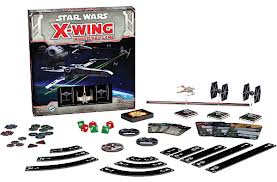
SWXW is the one of the latest fan favorites to appeal to both experienced and new gamers wanting some gaming right out of a box full of easy rules, well-designed components and beautiful pre-painted miniatures. The starter set offers two Tie Fighters and a X-Wing model, rules, movement templates and dials, cards, specialized dice and scenario markers for about $30-40. A few beginner scenarios are also included with the starter set, allowing two players a pretty solid and varied intro to the basics of the game.

In a nutshell, SWXW is a dogfight game where ships chase and fire at their opponents while maneuvering to avoid their own destruction on a typically 3′ x 3′ playing area. Play starts with each player pre-assigning movement to each of their models with a special movement dial. The dials are particular to each class of ship and allow for combinations of straight and turning moves. Since movement is planned in secret from your opponent, guessing which way the enemy will move and how you should react is key to the strategy of the game.

After ships move, firing lasers and other specialized secondary weapons occurs using special dice. Modifying “focus” or “target lock” actions increase the ability to hit enemy ships while “evade” actions increases a ship’s ability to avoid damage. Ships take damage to their hulls or shields, and destroyed ships are removed from the table. The game moves fast, and a basic game can be accomplished in well under an hour.

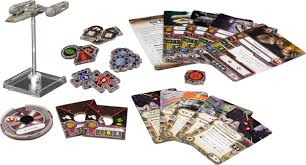
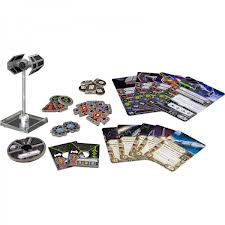
While the starter set allows for some fun intro games, players will soon want to grow their fleets and options. Like the Star Wars Universe itself, SWXW soon proves to be as expansive as players (and their bank accounts) allow. Single ship expansion sets of Tie Fighters, Tie Advanced Fighters (pictured below, right), Tie Interceptors, X-Wings, Y-Wings (pictured at right) and A-Wings retail for about $15 each (cheaper online). With these, players gain greater choice in fielding larger Rebel and Imperial fleets.

Each ship expansion comes with specific cards indicating pilots, astromech droids, secondary weapons and other special abilities which may be used in combination with that model or, in some cases, other ship types. So, an X-Wing can be fielded with Luke Skywalker, Wedge Antilles or Biggs Darklighter at the helm and R2-D2 or some other astromech droid along for the ride. You can assign Darth Vader to the controls of a Tie Advanced ship and then assign addition weapons and abilities to the ship. The latest expansion wave offers two large-sized ships — the Millenium Falcon and the Slave I — which are certain to be a huge hit with fans anxious to pit Han Solo against Boba Fett in an intergalactic duel.

Players wishing to get into SWXW will do well by themselves to get a couple of the basic sets plus some expansion ship packs. Once you’re quickly beyond the beginner stage, games are typically fielded with 100 points of ships on a side. Points are assigned according to ship class, pilot expertise and other add ons, allowing for lots of replay value and experimentation with combinations of forces. While the game is still new to me, I can see this one coming out of the box and onto the galaxy of my gaming table pretty frequently in the months ahead.

Downloading: The General


In our highly-digitized world of everything fandom, it’s hard to remember there was a day where a primary lifeline for fans was via the mail. While gaming enthusiasts played games by post and created their own newsletters for small cliques of fellow gamers, it was game publisher Avalon Hill that created the first widely read and regularly published magazine for the strategic wargaming hobby.

Beginning in 1964, The General served as the bi-monthly house newsletter for AH. The General provided regular space for articles on new AH products, debates on variant rules, announcements of gaming conventions and a place where gaming fans could connect with each other on a regular basis. With games like Outdoor Survival, Tactics, Gettsyburg, Blitzkrieg and Panzerblitz, AH ruled the early years of the nascent gaming hobby through their formula of bookshelf games of hexagonal maps, cardboard markers and detailed rulesets full of charts. It was not until the arrival of TSR and their culture-changing Dungeons & Dragons in the early 1970s that AH would face serious competition as gaming shifted from board games to role-playing. By the time AH was acquired by Hasbro in the late 1990s, the world of gaming had changed considerably and The General was shuttered.

In Jon Peterson’s masterful book “Playing At The World,” he tracks the development of the wargaming hobby using The General, TSR’s own Dragon magazine and dozens of smaller lesser-known newsletters as primary sources. For those of us who have wished for a deeper view into the early days of our hobby, the Internet Archive has now made PDFs of The General available. With just a few cursory early looks, having access to this archive of our own history is certain to be an incredible asset for wargamers.

New Game Weekend: Leviathans

Saturday night at the Metropolitan Wargamers allowed me the chance to try my hand at the latest game sensation that’s making it’s way through the club’s membership. Recently produced by Catalyst Games Labs, Leviathans is quickly growing in popularity with its late 19th-century steampunk alternative reality of airship wars battled out in the skies over Europe between France and England.

Steampunk In Popular Culture

Anyone who has been aware of sci-fi and fantasy fandom over the past few years is no doubt aware of the rise of the popularity of steampunk. Broadly, steampunk is a sub-genre of science fiction involving a vision of the world from the Victorian era through the early years of the 20th-century where anochronistic modern mechanical technologies, often powered by steam, create an alternative history of science, exploration and warfare.

In popular culture, Jules Verne and H.G. Wells are usually viewed as the grandfathers of steampunk. Aside from the Victorian visions of Verne and Wells, my earliest exposure to steampunk was with reruns of the 1960s TV show Wild, Wild, West. The show followed the exploits of James West and Artemis Gordon, two US government secret agents travelling the Old West of the post-Civil War era equipped with retro high tech gadgets. The show made its way to the big screen in 1999 with a much-maligned film adaptation starring Will Smith, Kevin Klein and Kenneth Branaugh. What the movie lacked in character and story, it more than made up for in capturing the steampunk ethos of monstrously destructive weaponry wrapped up in a 19th-century Old West plot.
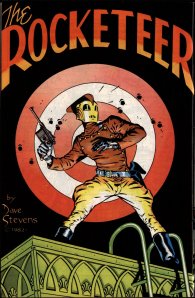
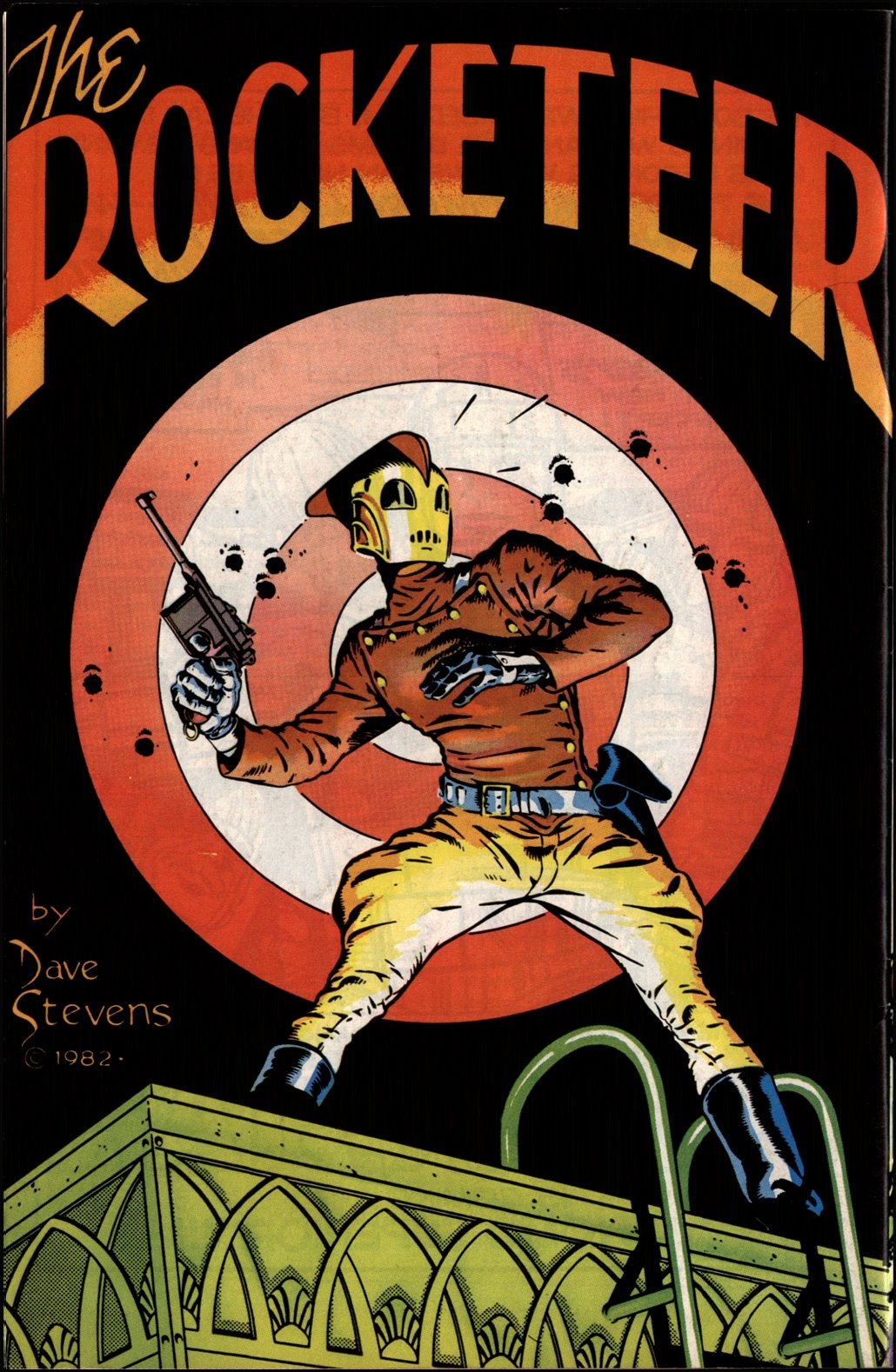
In the 1980s, underground comics writer Dave Stevens introduced the Rocketeer, a barnstorming stunt pilot and reluctant jet-packed superhero. Set in 1930s NYC and LA, the Rocketeer did battle with Nazis and crime syndicates armed with all manner of fanciful lasers, transported by airships and other might-have-been rocket technologies, and conniving with evil plots of world conquest. The comic eventually found its way to Hollywood and a beloved 1991 live-action film adaptation by Disney. Both the movie and comic capture an aesthetic of sexy and functional design bridging an Art Deco look with an alternative pre-WWII era where secret agents vie for control of fantastical emerging technologies.

Jetpacks and high-flying airship battles also figure prominently in the 2004 Japanese anime film Steamboy. Set against the backdrop of the Crystal Palace Exhibition in London’s Hyde Park in 1851, the story follows a young inventor boy from the mills of England’s Industrial Revolution to a showdown over technology which threatens the balance of worldwide power. The classic Victorian England setting provides the stage for an ultimate steampunk-themed battle with a massive metal castle-like flying fortress, robots, jet-packed paratroopers and British soldiers fighting to preserve the fate of the British Empire and world peace ahead of the Great War in the coming decades of the early 20th-century.

The interest today goes far beyond the pages of comics and TV and movie screens,  and the examples above are just a few of my particular touchpoints in steampunk. There are steampunk cosplayers, conventions and even bars and meet-ups where like-minded fans can live out their steampunk fantasies.

Like so many fantasy interests, steampunk has also made its way to tabletop gaming in a big with a number of gaming systems over the past few years. The thematic historical “what ifs” and opportunities to let the imagination go wild with miniature modelling makes steampunk a particular draw for gamers.

Leviathans
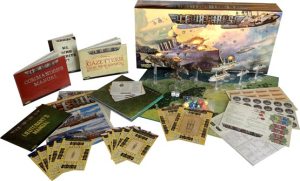
Leviathans is the darling of the moment for steampunk-minded gamers. Produced just this year, Leviathans is a complete board and miniatures game that comes in an incredibly well-designed package containing rules, charts, game boards and detailed plastic airship models which are ready to go straight out of the box for about $100. The core set comes with massive French and British battleships along with smaller destroyers and other ships which levitate above the game board on clear plastic stands. The ships are armed with all manner of guns, turrets and torpedoes manned by crews who furiously fire away at the enemy while working to keep their airships aloft.

Each ship comes with a card detailing the armaments, engine power, stabilisers and other equipment particular to each class of ship. Players take turns manuevering their ships and bringing their weapons to bear on the enemy. Combat results are determined with multiple colored dice which factor in the strength of firing weapons, the durability of an opponent’s armor, the placement of hits and the presence of crew. As ships take fire, their effectiveness in movement, combat and the ability to make repairs is affected. Multiple hits to the same area of a ship may result in a hull breach and the ship crashing to earth in a hulk of flame and twisted steel.

The scenario I played involved my side’s two damaged French battleships attempting to flee off the far side of the board while moving at half speed and being swarmed by my opponenet’s smaller British destroyers. The quick manueverability of the British ships was initially no match for the powerful guns of my French fleet, and two UK aircraft were quickly blown from the sky. Further damage to the already slow French engines eventually made them sitting ducks in the sky, and my team’s French ceded defeat as evacuation to the far side of the table became impossible.

Popularity of Leviathans is spreading quickly with a few new French and British expansion ship fleets already available. A new German fleet is also under development, as is an online version of the game. The game is being produced under a Creative Commons license, allowing for a free distribution of rules and also encouraging fans to collaborate openly on the development of the game. With the quick rise of Leviathan’s popularity and the continued gaming interest in steampunk, I’d expect this game to rule the sky for quite some time.

New Game Weekend: Fire & Axe

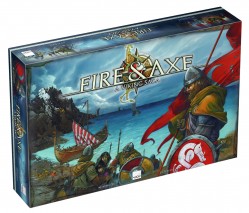
After a couple weeks spent at home hunched over my workbench working away furiously at my 28MM American Civil War projects, I was finally able to get out of the house for some gaming this past Friday night. I hadn’t been to the Metropolitan Wargamers club in a few weeks, so it was good to get back this weekend. I walked in to a nearly empty club — rare on a Friday night — but in quick order a few other members showed up. I had hauled along my copy of Village to introduce to the guys, but first another member suggested we have a quick run through a different boardgame I’d heard mentioned frequently at the club before —  Fire & Axe: The Viking Saga Game.

Originally published in 2004, Fire & Axe is now hard to come by and used copies can fetch over $100 at times. I’m a little surprised at the long-standing adoration this game has. Of the twenty or so games I’ve been introduced to over the past year, Fire & Axe wouldn’t be near the top of the list although it does have ease of play and short duration going for it.
The game pits 2-4 players against one another as they sail on quests to settle, conquer or trade within various regions of European seas in the backdrop of the Viking age. The game begins with each player’s ship in the Wintering Box in the northernmost edge of the map. Once a ship is loaded and launched, players choose to depart from Norway, Denmark or Sweden. The turn begins with a player choosing to perform seven actions which may include loading goods or troops to their ship, sailing across the open seas or landing in ports to engage in trade, establish a settlement or capture a city. Special “rune cards” can also be collected and played to perform a variety of actions — from strengthening your invading forces or calling on a sea monster to destroy another player’s ship.

Gold is collected throughout the game through trade, conquest and settlement. Specific missions to trade with or take over specific ports can be collected to score additional points. The missions can also have shared success where points in conquering three port cities might be split between two players. Players who complete the most missions for each of the Viking civilizations of Norway, Sweden and Denmark stand to earn additional points at the game’s end. Additionally, missions get more valuable and reach to the farthest edges of the board as the game progresses. When all missions are completed, the game ends and points are tallied.

The game progresses quickly — four of us got through a game in about 90 minutes Friday night. The game is simple to understand after a turn or two, but it all just seemed like a race without enough variety in paths to victory. For instance, I burned up a couple turns hoping to conquer three cities, but some awful die rolls sent me back to the Wintering Box as other players swept in to claim those cities. At the end of the game, another player snatched victory from the would-be winner through one final chance move that stole a few points from the guy who had led up to that point.

I’ll give Fire & Axe another shot at some point since the guys at the club seem to have a deep love for it, but for now I think I’ll be concentrating on games beyond the Viking regions of the northern seas.

American Civil War: Duryee’s Zouaves in 28mm

Any American school kid with a passing knowledge of the American Civil War will be able to immediately recognize the classic blue uniform of Northern forces and the less regular gray and earth-toned make-up of Southern troops. What’s lesser-known is the fanciful variety that was found in uniforms of some units during the war.

Immediately preceding the American Civil War, Europe’s Crimean War of the 1850s saw the Russian Empire facing off against an alliance of the French, British and Ottomans. The French Zoauve uniform of the Crimean War went on to inspire military uniforms in the United States, and one of the more notable Zouave regiments of the Civil War period was the 5th New York Volunteers or Duryee’s Zouaves.

Formed in New York City in 1861 by Colonel Abram Duryée, the 5th NY Volunteers would find action throughout the war at Second Bull Run, Antietam, Chancellorsville and Fredericksburg. But it’s the uniforms that make the 5th NY a memorable unit for me. Dressed in baggy red chasseur trousers, dark blue jackets with red braiding and topped in fezzes with yellow tassels, Duryee’s Zouaves offer up one of the more colorful units to deploy on a Civil War gaming table. While some period drawings and photos exist in black and white, the true whimsy of these uniforms can really only be found in the work of modern artists like Don Troiani  (see above) or with active 5th NY Volunteer re-enactor groups.

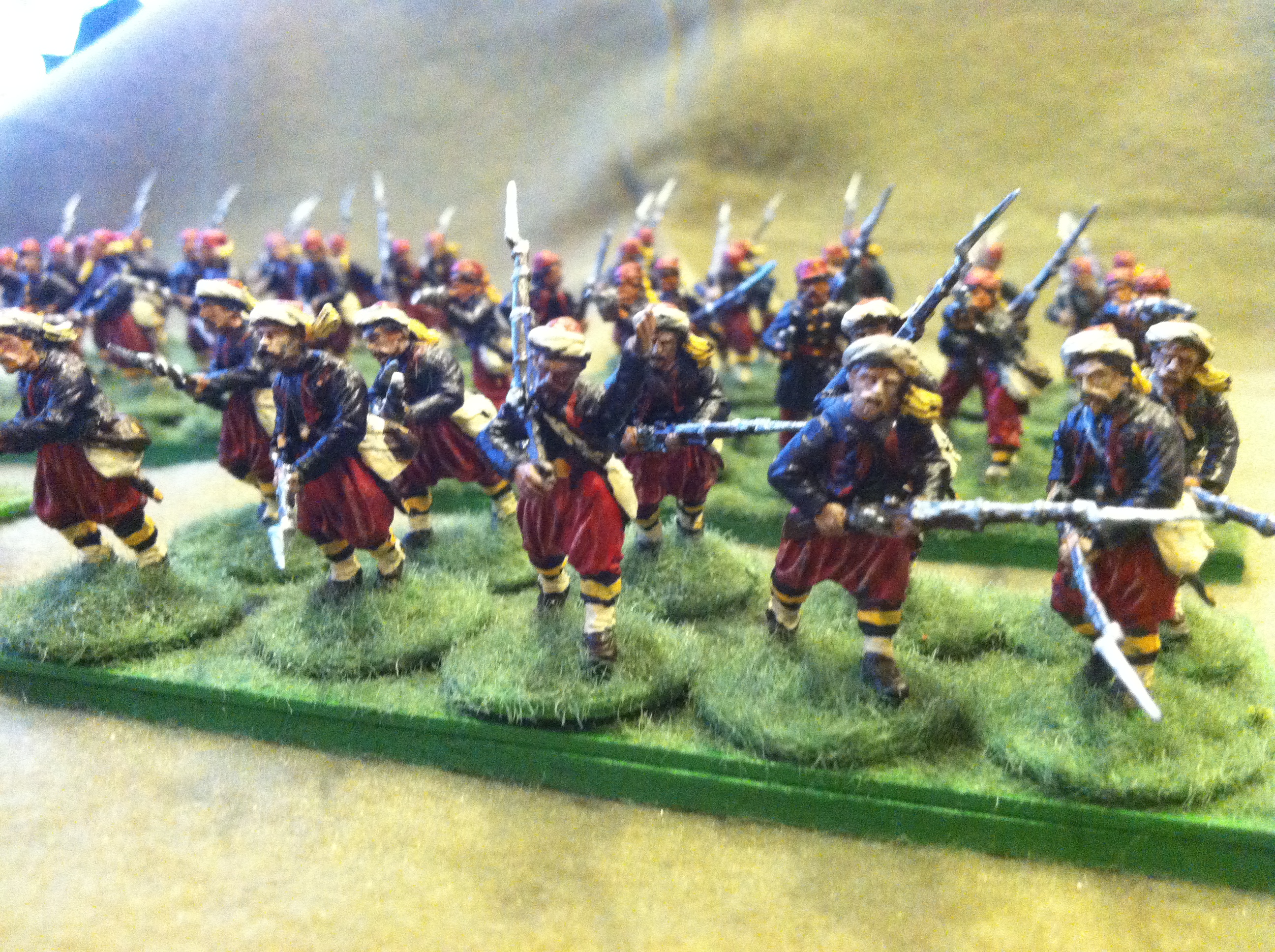
For miniatures, I love the affordable and well-sculpted variety to be found in the line of 28mm American Civil War models from Perry Brothers. My 5th NY Volunteers are a mix of a Perry Brothers plastic Zouave box set and two sets of their metal Zouave firing/skirmishing line. Perry Brothers offer a nice variety in optional poses and heads in their plastics, and the metal figures offer just a bit more crisp detail. I chose to model most of my Zouaves in their fezzes, as this is how they usually appeared in battle. For variety’s sake, I modeled one unit with turbans which were more common in ceremonial and parade settings. The box set also offers arm options to represent units advancing at “right shoulder shift” and “at the charge” with bayonets leveled at the enemy lines.

Below is an overview of my completed five squads from the 5th NY Volunteers along with their company command stand.

And here’s a close-up of the company command below.

I painted most of the company in their more common battlefield fez headgear, shown below in detail. These figures are the metal Perry Miniatures firing line, while the rest of the company are plastics.

And finally, here’s the one squad in their turbans.

Painting Duryée’s Zoauves was a great break from my usual painting, and now I’m already thinking of some other specific units from the Civil War to mix up the walls of blue and gray lining my tabletop battlefield.

American Civil War: 28mm American Farmhouse

My workbench focus over the past couple of weeks has been almost exclusively on my 28mm American Civil War project which I hope to have wrapped-up and ready to present in a large scale battle this spring. As posted previously, I love setting out a realistic wargaming table full of structures and terrain. Luckily, Perry Miniatures – the maker of my favored 28mm American Civil War soldiers – also produces a couple 1/56th scale plastic kits of terrain suitable to the period.

The Perry Miniatures farmhouse is loosely modelled on General Meade’s Union headquarters from the Battle of Gettsyburg, pictured at right in a photo from the aftermath of the battle and as it looks today. I’ve seen the house in person a couple of times, and I’ve also seen similar buildings in Western New York, Ohio, Michigan and Virginia. The Perry Miniatures model is typical of the small wood-framed clapboard rural farmhouses found in the North, South and into the Great Lakes region from the late 18th through 19th-centuries.

The pieces of the farmhouse kit come in two easily-assembled sprues along with an extra sprue of three types of fencing. The fencing is disappointing and unfortunately doesn’t really offer much to work with in terms of building out a farm scene. Some extra sets of plastic fencing from Renedra are probably needed to really complete the set. However, the box does contain a chair and a couple barrels to add some nice detail to the model’s front porch.

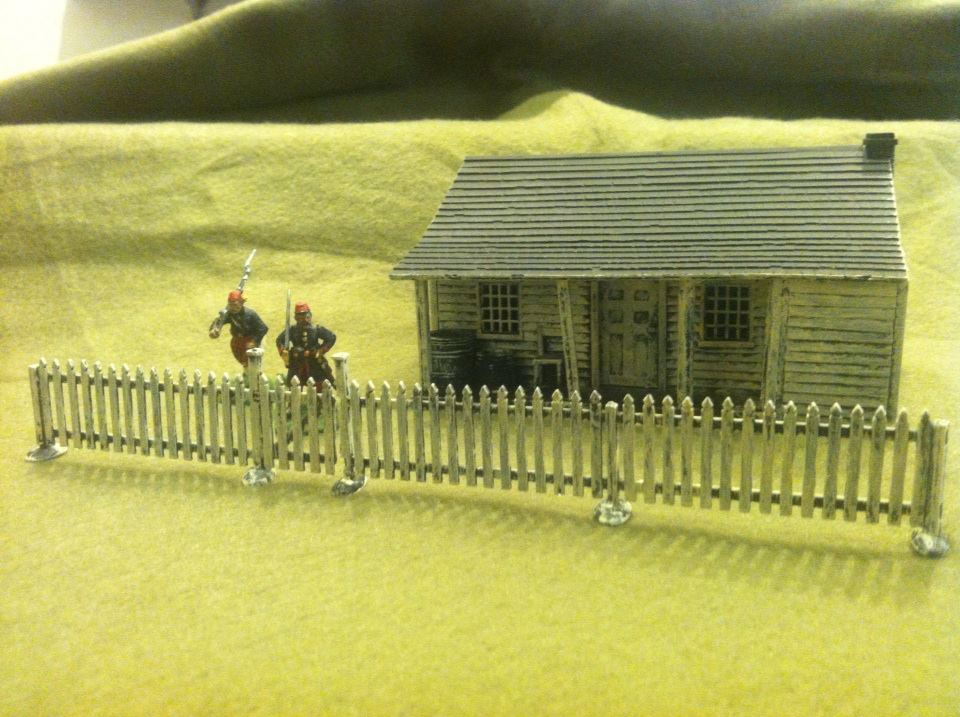
I glued up the kit and sprayed it with a flat black undercoat. My plan was to give the farmhouse a weather-beaten finish looking like it had years of peeling paint. I started by dry-brushing the model with a large flat brush with a yellowish off-white paint, making sure to leave a fair amount of the black in the gaps and areas between the clapboards (photo at top left).

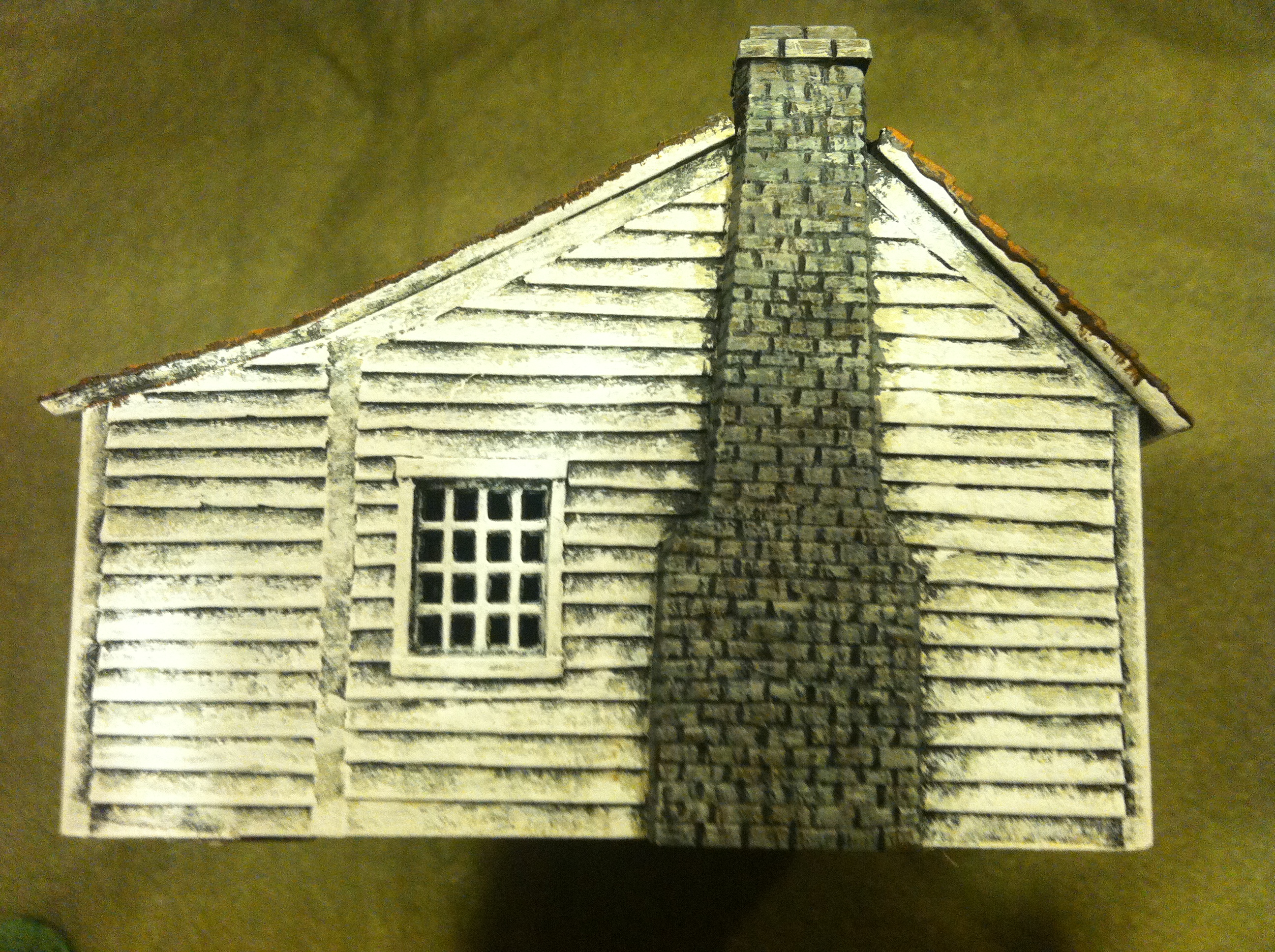
Next, I dry-brushed the house again with a bright white paint, giving the clapboards additional depth as if the most recent layer of paint had deteriorated over time. For the roof shingles, I built-up dry-brushed paint in dark brown, light brown and then a bit of dark green mixed with a brown wash. I began the chimney with a dark gray paint and then finished it with dry-brushed lighter gray and dabs of brown and off-white paint to represent variations in the stonework (photo at middle left).

For details, I dabbed the barrels, chair and porch planking with dark brown and completed them with some lighter brown dry-brushing and some aging metal for the barrel hoops. The door knobs at the front and rear each got a dab of brass paint (photo at bottom left), and I gave the picket fence another coat of the bright white like the house clapboards.

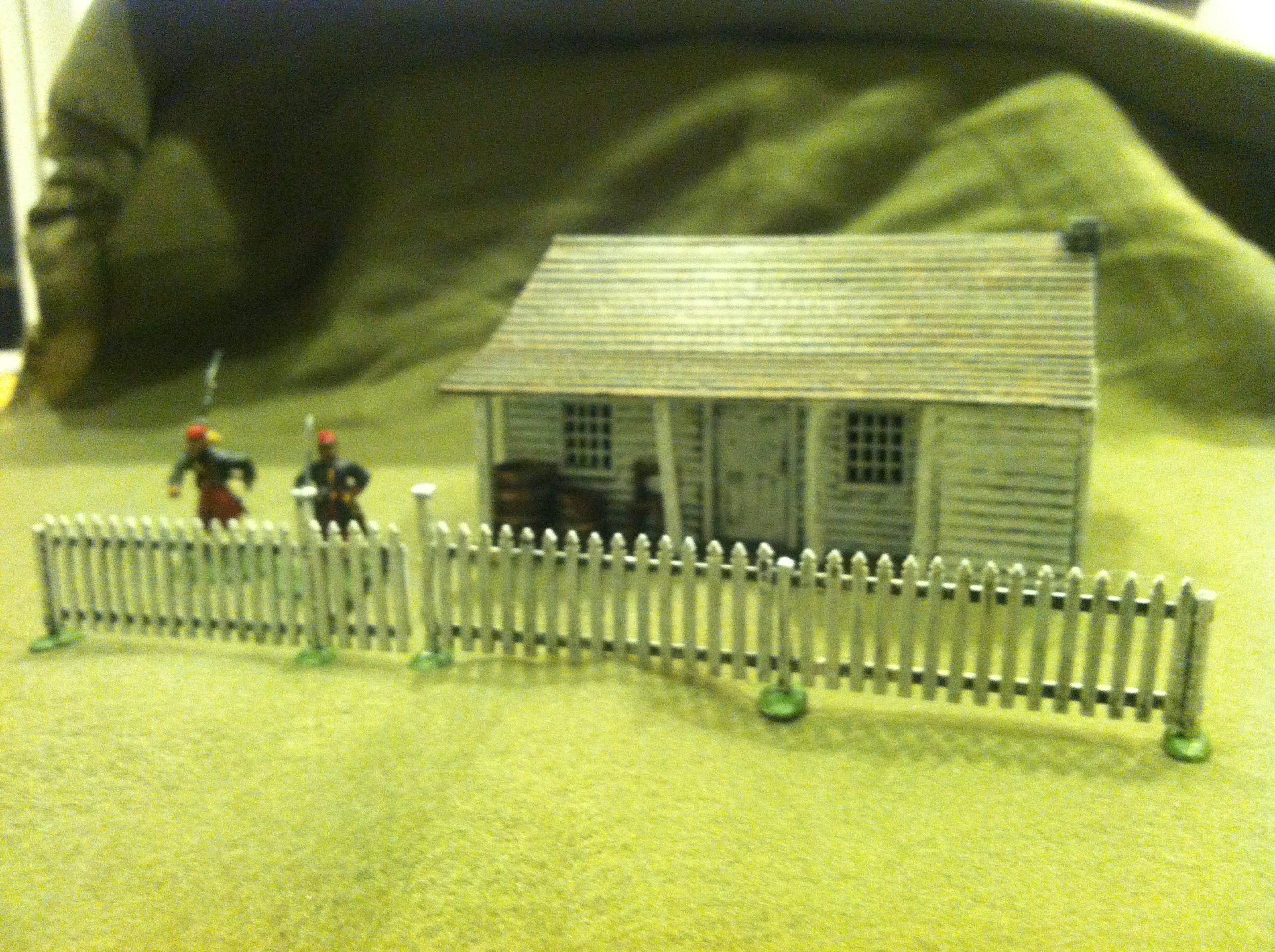
The final results are below and ready for the battlefield this coming spring.