Gaming Wars In The 21st Century

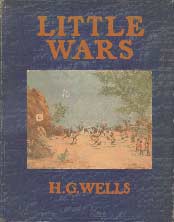
I was pleasantly surprised to open the back page of this past weekend’s New York Times Sunday Book Review section to an article on the 100th anniversary of H.G. Wells’ “Little Wars.” The book’s Edwardian-era style, classism and occasional not-so-thinly-veiled sexism is mixed with the mechanics of a gaming system which makes it a relevant read even today.  Before “Little Wars,” wargaming had largely resided in Europe’s war colleges and in the parlors of the ruling elite. Even with its English intellectual, upper-crust trappings, “Little Wars” sought to expand the popularity of wargaming. As the article points out, “Little Wars” is an important foundational document and should be required reading for those who are interested in how we’ve arrived at the business of gaming on the tabletops and screens of the world today.

“Little Wars” is widely available for free online and for e-readers today, and “ownership” of gaming is largely the subject of a post today on BoingBoing about Dungeons & Dragons retro-gamers. Whether driven by nostalgia or as a reaction to corporate ownership of a beloved game of their youth, “old school” D&D gamers stress what they believe to be a truer game style more focused on role-playing and less-so on action-driven play. To stay relevant to a new generation brought up on CGI special effects, so the argument goes, the now-owners of D&D Wizards of the Coast have increasingly made the game more combat-heavy (read: more like video games). In reaction to this, retro D&D gamers have created an increasingly-active community of story-driven gamers who look to old rules for inspiration. The ability to share thoughts, opinions and out-of-print rulesets online has only fuelled the movement.

Old school gamers are just the latest combatants  in the war over gaming. The history of wargaming rules development winds its way from military schools and H.G. Wells to postal games and strategy boardgames in the mid-20th century. Games and rules were more fluid in the 1940s-60s where there was little profit to be had in wargaming, and a big part of the gaming community was in the debates over what rules were the most realistic or playable. With a few exceptions, ownership in those days was based more on pride and ego than copyrights and profit. This timeline is well-documented in Jon Peterson’s “Playing At The World” which finally arrives at the early days of D&D.  Even before D&D made the great leap into a world-wide phenomemon there were arguments and accustaions over copyright and ownership. Peterson’s recent analysis of a transitional draft of D&D (the Dalluhn Manuscript) not only adds greater nuanace to the development of the rules themselves but I think also provides another chapter on the concepts of evolutionary, intellectual and legal ownership of games.

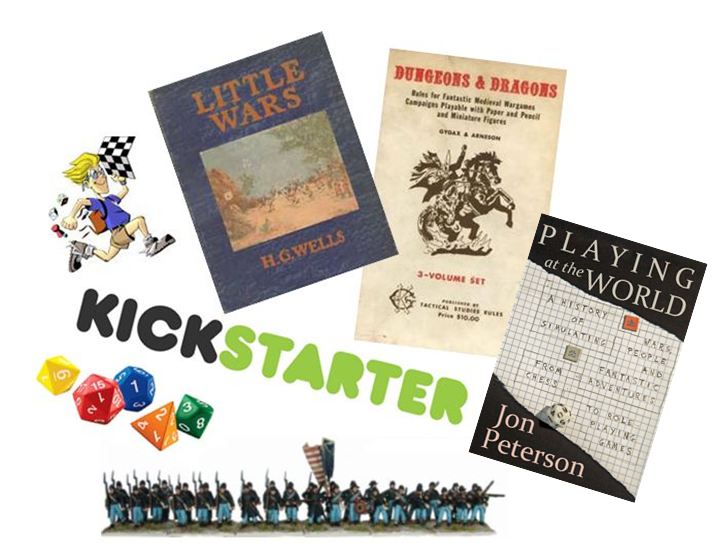
Much of the digital conversation today — whether about games, photos, movies or music — hinges on the topics of openness, control and copyright. Along with the free and independent gaming forums and sites, we’ve now been given a new frontier of games on Kickstarter. What used to take years (or even decades) of slow development and debate by word-of-mouth fanzines and postal newsletters, Kickstarter achieves in weeks or days. Players vote with their wallets in support of games which can now easily garner six and seven-figure funding levels, all but guaranteeing a fanbase that literally buys-in at the ground floor. Sites like BoardGameGeek can help make or break the success of a new game and then go on to serve as R&D for game expansions, rule variations and subsequent editions.

A hundred years after “Little Wars” pulled the ownership of wargaming out of the fists of Europe’s elite, we’re still warring over our games. Copyright laws, digital distribution and individual financial investment will continue to shape the next hundred years of the ownership conversation, but gaming is certain to remain a very personal investment for some time to come, too.

The History of Games in Western New York

I grew up in Western New York State about 40 miles South of Rochester. To my childhood self, going to Rochester was “going to the city.” Rochester was where I headed for big touring concerts, independent movies and museums. On my rare trips home these days, one of my favorites and one of the more unique museums to visit in Rochester remains the National Museum of Play.

Opened in the early 1980s, the National Museum of Play grew out of the Strong Museum and the collection of industrial heiress Margaret Woodbury Strong. The museum originally housed the enormous doll and toy collection Strong acquired over decades of worldwide travel in the first half of the 20th-century. In the past 30 years, the mission of the museum has evolved to be one of the preeminent repositories and exhibitors of toys, games, video games, dolls, action figures, children’s books and all things devoted to occupying the childhood development of children through that most basic of juvenile pursuits: play.

Among its collections, the museum has risen to prominence in the past few years with the opening of the International Center for the History of Electronic Games. The ICHEG publicly displays some 140 playable classic video arcade games and also maintains an archive of hundreds of thousands gaming systems, games, advertisements, manuals, corporate documents and other ephemera devoted to video games from their earliest development to their contemporary innovations and cultural dominance.

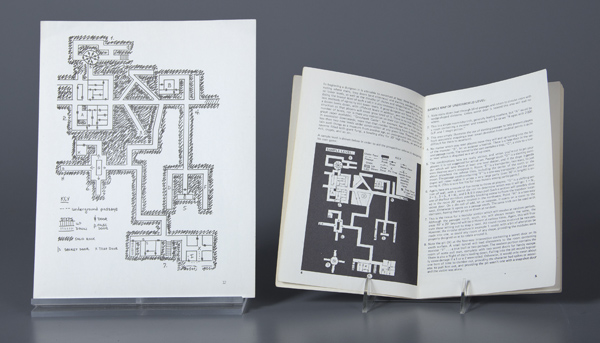
The museum made news this past week with the announcement of the temporary display of the “Dalluhn Manuscript” (photo at right) in their newest permanent exhibit called Game Time! This space will eventually devote the entire second floor of the museum to the history of American play through a series of interactive exhibits. The Dalluhn Manuscript is important as what is the earliest know draft of what would eventually become the world-changing game Dungeons & Dragons. The manuscript is on loan from Jon Peterson whose massive book “Playing At The World” took the scholarly investigation of the history of strategic gaming to new heights when it was published last year. Peterson has updated his book with a free appendix available through his blog that delves deep into the significance of the manuscript on display in Rochester. If you’ve read his book or have any desire to take a rare peek into the minutiae of how D&D came about, seeing this piece of gaming legend is a must-do over the coming months. Think of it as the Magna Carta or a first draft of the Declaration of Independence for gamers and you’ll have some idea of what a treasure these few pages are.

In general, I would urge anyone interested in games and play to visit the National Museum of Play in Rochester. It’s one of those rare museums where people of all ages will truly find something that speaks to them. If you can’t make it to Rochester, take a spin through their online archives where thousands of photos of toys, dolls and games are on view. With centuries of play behind us and unknown adventures ahead, a trip through our shared history is almost as enjoyable as a few hours of play itself.

Downloading: The General


In our highly-digitized world of everything fandom, it’s hard to remember there was a day where a primary lifeline for fans was via the mail. While gaming enthusiasts played games by post and created their own newsletters for small cliques of fellow gamers, it was game publisher Avalon Hill that created the first widely read and regularly published magazine for the strategic wargaming hobby.

Beginning in 1964, The General served as the bi-monthly house newsletter for AH. The General provided regular space for articles on new AH products, debates on variant rules, announcements of gaming conventions and a place where gaming fans could connect with each other on a regular basis. With games like Outdoor Survival, Tactics, Gettsyburg, Blitzkrieg and Panzerblitz, AH ruled the early years of the nascent gaming hobby through their formula of bookshelf games of hexagonal maps, cardboard markers and detailed rulesets full of charts. It was not until the arrival of TSR and their culture-changing Dungeons & Dragons in the early 1970s that AH would face serious competition as gaming shifted from board games to role-playing. By the time AH was acquired by Hasbro in the late 1990s, the world of gaming had changed considerably and The General was shuttered.

In Jon Peterson’s masterful book “Playing At The World,” he tracks the development of the wargaming hobby using The General, TSR’s own Dragon magazine and dozens of smaller lesser-known newsletters as primary sources. For those of us who have wished for a deeper view into the early days of our hobby, the Internet Archive has now made PDFs of The General available. With just a few cursory early looks, having access to this archive of our own history is certain to be an incredible asset for wargamers.

Downloading: Dungeons & Dragons Classics

I just finished reading Jon Peterson’s epic history of wargaming, “Playing At The World,” this past week. Reading through several hundred pages of gaming lore centered around the development of Dungeons & Dragons by TSR, I’ve had a yen to track down some of my old D&D rule books from those glory days of my early adolescent years in the late 1970s and early 80s. Well, as if the gaming gods themselves were reading my thoughts, the now-owners of the D&D franchise, Wizards of the Coast, launched a partnership just this week with DriveThruRPG to begin offering every piece of classic D&D as digital downloads.

The new web store, www.danddclassics.com, launched with more than 80 classic bits of D&D, from whole rule sets to module campaign adventures to detailed expansions. With a few downloads initially available for free and dozens more in the $5 to just under $20 range, the site promises to eventually release more material long-since out our print from the 1970s-90s. The site struggled under the massive weight of countless rabid fans and crashed over and over again on its first day, clearly demonstrating the pent-up demand for long-lost D&D material only to be found at the bottom of abandoned teenage closets and on eBay at inflated prices.

After multiple site time-outs and crashes, I managed to download a free file today: 1979’s B1 module “In Search of the Unknown.” For new players like me just getting into D&D as 1980 and my teen years neared, “In Search of the Unknown” and B2 “The Keep on the Borderlands” (available online now for $5) were our first forays into the professionally-developed D&D modules that showed us the way toward creating our own adventures. These self-contained adventures allowed players like my friends and me to jump right into a few hours of gaming with story background, maps, treasure and monsters neatly set forward in about 20 pages. These books also served as teaching tools as we learned to craft our own elaborate adventures in our childhood bedrooms, basements and classrooms after school.

With the release of 1979’s “blue book” Basic Rules (shown at right), TSR presented a serious clean-up and consolidation of the D&D rules which had been slowly released in multiple pamphlets throughout the early to mid 1970s. Though D&D had already established itself as the king of the role-playing game world, it was the release of the Basic Rules that roped-in hundreds of thousands of new players like myself. From these rules onward, a constant flow of modules, new iterations of the rules and expansion books became one of the most exciting aspects to me about D&D while also being much criticized by many for TSR’s strategy of extracting every last dime out of its faithful fans.

And so, here we are again some 30+ years later with D&D waging melee combat on our wallets with the spectre of a full-compliment of its back catalog coming soon. Already I see many module favorites of mine available like G1-3 “Against the Giants” and Q1 “Queen of the Demonweb Pits.” Hardcover classics such as the ancient religions and mythologies compilation of  “Deities and Demigods” and the odder European-themed monster compilation “Fiend Folio” are also currently available. I credit “Deities and Demigods” in particular for providing me a sort of independent study comparative religions primer at the age of 13. A few years later, this interest would lead me to Joseph Campbell’s “The Power of Myth” as well as his earlier writings. Three decades on, my life-long interest in the intersection of the stories of faith in the world’s societies — what I commonly refer to as the “holy mish-mash” — continues to shape my outlook on life. D&D is just chocked full of these kind of rippling memories for me.

The re-release of this material seems obvious for a whole host of reasons as I and my fellow first-generation D&D players are entering mid-life with our own children and a load of nostalgia for a pre-video game world in tow. Then again, as I scrolled through all the D&D titles again this week, I was reminded of the precedent D&D set in so many ways for today’s electronic gamers. Of course the basics of hit points, armor class, found items, completed missions and skill advancement laid out in D&D provided the foundation for today’s popular video gaming universe. But with each of these additional D&D modules and rules expansions, TSR also provided an early blueprint for the constant version updates and downloadable content of maps, missions, skins and characters that any inhabitant of the world of the Xbox and Playstation finds every day.

As always, what is old is new again, and I’m slowly getting to a place where I want to unplug my kids for a few hours some afternoon, help them roll-up a couple characters and blow the digital dust off these D&D treasures now just a click away.

New Games Weekend: Small World & Lords of Waterdeep

The first weekend of the New Year brought me an intro to two new games – Small World and Lords of Waterdeep. Both games are based in a fantasy realm with the mechanics of a Euro boardgame, and each offer a different take on some fast-paced group play of control and development of an imaginery world.

Small World

You can pick up a copy of Small World at specialty game shops and in book stores like Barnes & Noble. The game has been around for about three years, but my brother just tipped me off to it being a great game to play with a mix of kids and adults in about an hour-and-half’s time.

Small World comes with four maps on two game boards comprised of different regions of hills, fields, forests, mountains and water areas. Players take on the role of some 14 races including Elves, Humans, Giants, Dwarves, Amazons, Sorcerers and Ghouls. Each race comes combined with one of twenty random special powers such as Commando, Diplomat, Alchemist or Flying. Using a combined special power and race, each player spreads out across the board occupying regions, fighting other races and scoring coins toward victory. Once a race becomes over-extended, a player marks that race in “decline” and selects a new race.

The nearly endless permutations of races and special powers creates immense replay value in the game. One turn, you may have Diplomat Dwarves battling Flying Ratmen. A few turns later, Hill Giants and Mounted Haflings may be vying for control of the board. The art and combinations of races and special powers make Small World funny, fierce and a great entree for players new to strategy boardgames.

Lords of Waterdeep

I spent Saturday afternoon at the Metropolitan Wargamers club in Brooklyn, and the guys turned me on to my first game of Lords of Waterdeep. Longtime D&D players know Waterdeep to be one of the main cities within the storied Forgotten Realms campaign. The Lords of Waterdeep, released just last year, takes the history of Waterdeep as a jumping-off point for a strategy boardgame that can be played by 2-5 players in about 1 1/2 to 2 hours.

You begin the game as a Lord with two agents in your employ. Using these agents, you recruit parties of thieves, warriors, priests and wizards to complete Quests selected from a pile a cards. Along the way you also gain and play Intrigue cards which can be used to block or reward other players as loyalties shift. As you complete quests, construct buildings and reap gold, the play quickly switches-up throughout the game as your opportunity to change the turn order and grow your pool of agents and influence.

My first go-around with the game was with a group of experienced players, yet I quickly picked up on the raucous tone of the game as competition grew more heated yet good-natured. Five players seemed a bit cumbersome, and the other guys said a 3-4 person game is ideal. I’d recommend Lords of Waterdeep for veteran strategy gamers looking to bang out a quick, fun game or for a group of players who are looking to graduate from a game like Small World.

Gaming In Challenging Times

Most people know H.G. Wells as one of the modern inventors of science fiction literature with such masterpieces as “The War Of The Worlds,” “The Time Machine” and “The Invisible Man.” Wells is less well-known as one of the first popular writers on the subject of miniature wargaming. Published just before Great Britain entered World War I, Wells’ “Little Wars” outlined one of the first widely-available English sets of rules for miniatures wargaming. Using cast metal toy soldiers and artillery, Wells and his Edwardian friends created elaborate wargames on their parlor floors and English gardens. Using wooden projectiles fired from small model canons, these proper English gentlemen waged war on opposing sides of tiny infantry and cavalry armies. Many of the concepts of movement, effects of model terrain and chance still present in 21st-century wargaming were set down in print by Wells.

Wells was also a socialist, pacifist and supporter of the concept of a world-governing body to preserve peace and avoid increasingly large-scale warfare that would eventually come to haunt much of the 20th-century. In “Little Wars,” Wells lays out the idealistic aspiration that men, young and old, would someday permanently remove themselves from the real killing fields of modern war and instead settle great international conflicts through wargaming and boardroom diplomacy. “The tin soldier leaves behind no tin widow, and no tin orphan,” said Wells.

I’ve spent well over half my life gaming, with countless hours spent locked in play violence. I’ve also made the study of history and warfare one of my educational and personal pursuits. I’m fascinated by why people make war on each other, and I wonder at what makes one human decide to do violence against another. With this, I too hate war and violence, questioning even when attempts are made to choose what fights are historically just.

The modern pervasiveness of video games, movies and news media makes violence real and immediate in ways Wells and his contemporaries could have never imagined a century ago. Even as a kid just 30 years ago, I couldn’t imagine for myself a culture so covered in virtual blood, real or fictitious.

I have two sons now, and like most parents, I wish to share and pass on some of my interests to them. For some parents, it’s baseball. For others, it may be a love of camping or cooking or knitting. Me, I want my kids to play wargames. I want them to do this because it is an incredibly rewarding hobby, combining artistry, historical research, complex decision-making, math, teamwork and management skills. I also want them to take up my interest in wargames because I think, when done right, wargaming can
still teach why war and violence is a horrible, horrible thing to be avoided at all costs.

“Doing it right” is the rub. Like so many worthwhile things, wargaming takes time. Lots of it. You need to have a real interest and a real commitment in not only yourself but in your fellow players in order to play wargames. Wargames are for people who care.

And here, I will expand beyond miniature wargames to include video games in the discussion. Just as Dungeons & Dragons was accused of being the realm of loner weirdo teenage Satanists with a penchant for violence and anti-social behavior in the 1970s and 80s, video games are the target now. Yes, the video gamer community and industry is far, far larger than the D&D community ever was. Yes, video games depict violence in a far more realistic way than tabletop wargaming can. But the problem is not inherent in the games. The problem is a lack parental involvement with their children’s gaming pursuits.

A parent who is fairly tuned-into their kids’ playtime is a participant and a partner. I’ve spent hours watching my kids play video games, playing video games with them, reading about video games with them and discussing video games with them. I am willing to bet most parents’ level of involvement with their children’s gaming begins with buying their kid a game they know nothing about and ends with the kid vanishing into their bedroom to start logging dozens of hours in a game. The same parent who will re-arrange their schedule and devote hours to their son’s baseball practices and games will probably not make a similar investment in the same son’s hours devoted to racking up kills on Call of Duty or levels of progression in Skyrim.

Play – parentally-invested play – is an indispensable part of childhood that can provide a lifetime of healthy and creative thinking. Maybe he is outdated, but I’ll stick with Wells and his utopian hope that games can and do provide the path to a better world.

Painting and Playing

Wargaming broadly falls into three categories — paper-and-pencil games, board games and miniatures gaming. Dungeons & Dragons is the classic pencil-and-paper game, with games played out largely through verbal role-playing with a lot of note-taking and mapping on paper. Board games are great to pull off a shelf, set up and play, often in one sitting.

Miniatures wargaming is my favorite. The hobby combines two entirely different aspects – painting and playing. Firstly, miniatures wargaming involves obtaining often hundreds of plastic or metal figures in various sizes from just a few millimeters to nearly two inches tall. A fair amount of research usually goes into creating forces of the proper size and and make up. Then there’s a lot of gluing to get poses and equipment together in realistic and historically-accurate configurations. Lastly, a miniatures modeller is faced with hours and hours of painting with tiny brushes, dabbing paint on uniforms, weapons, gear and exposed faces and hands. Even within the same historical era, say WWII or the American Civil War, there are nearly-limitless variations in how miniatures can be painted. Beyond the figures themselves, setting up a wargame usually involves creating terrain including buildings, trees, rivers, roads and hills.

Only after you’ve logged many hours painting up your armies and laying out your terrain can the miniatures wargamer get on to the second half of the hobby — actually playing. Again, miniatures wargaming has a tremendous variety of rulesets available depending on the era, scale and size of a game desired. Some games might involve skirmish-level battles with just a couple dozens figures on a side and other games can be of a grand tactical scale with hundreds (or thousands) of troops filling the field. Rulesets can run from just a few pages to dozens of books, and some gamers choose to write their own “home-brewed” rules. Some companies such as Flames of War or Games Workshop manufacture self-contained systems of miniatures and rules, even offering some starter sets of figures, rules, paints and dice all in one box for new players.

For a glimpse at the intersection of painting and playing wargames, check out the newly-updated pages on my Gaming and Painting page. Whether it’s World War II, the American Civil War or the Anglo-Zulu War, each era and scale brings different variety to what I love about the hobby.

“Playing At The World” by Jon Peterson

Since its release in the middle of the year, I’ve been nibbling away at Jon Peterson’s monstrous 720-page history of wargaming, “Playing At The World.” Peterson’s book takes the broadest swipe I’ve yet seen at tackling the true history of games. His opus work covers ancient games in Egypt to the early development of chess, 18th and 19th century Eastern European wargaming, the rise of simulations in the colleges and think tanks of Cold War America and into the birth of Dungeons & Dragons and eventually video games in the latter part of the 20th-century.

The book is daunting, and only for the true scholars of gaming. Whole chapters are devoted to concepts of randomizing results in gameplay, the rise of miniatures wargaming with toy soldiers (with early support by the likes of H.G. Wells and his book “Little Wars”), basic concepts of fantasy character development and the minutiae of gaming mechanics. The latter half of the book focuses on how a small group of gamers in Wisconsin, led by the now-famous Gary Gygax and David Arneson, created the worldwide sensation that became D&D in the late 60s and early 70s.

As both a gamer and historian, my love for this book flows from its slow-building narrative that firmly places the importance of games in worldwide culture. With immense detail, Peterson clearly shows games not to be the often-maligned pastime of nerds and misfits but an important device through which we’ve developed our modern worldwide approaches to military policy, economics, international diplomacy and social interaction.

The book is certainly enough on its own, but Peterson also runs a blog which adds insight into his ongoing research. “Playing At The World” is such an achievement of singular vision, and I highly recommend it for anyone who is interested in how we play beyond the four corners of our gaming tables.