
This past Saturday was International Tabletop Day, a day where tens-of-thousands of people around the world crowd around tables in dining rooms, basements, clubs and hobby shops to do what many of us do year-round — play games. My youngest son and I spent the afternoon at Brooklyn Game Lab, a recent entry into the growing list of New York City venues dedicated to unplugging and playing tabletop games with friends and strangers alike. The scene in Brooklyn was like that played-out worldwide with a packed house of experienced gamers and newcomers joining together, rolling dice, racking up points, playing cards, placing tokens and role-playing through a massive variety of games. At Brooklyn Game Lab, players faced off with a variety of games like Betrayal at House on the Hill, Love Letter, The Resistance: Avalon, Tokaido and even a few games of Chess. My son and I had a go at two games which were new to us — Revolution! and Carcassonne.
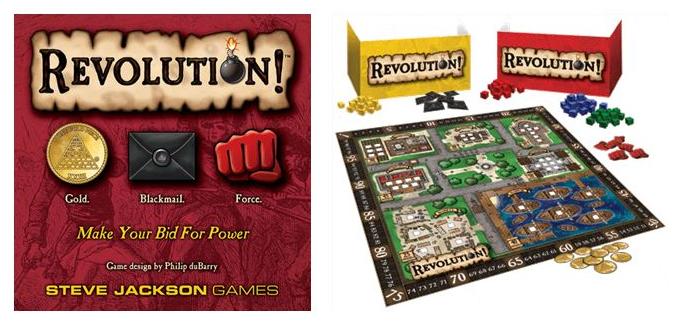 In Revolution! from the decades-old Steve Jackson Games players vie for power in a town through a secretive combination of blackmail, strong-armed force and out-and-out bribery. With four new players at the table, Revolution! was a quick learn and exciting fast play in just under an hour’s time.
 A player’s secret bidding card in Revolution with Gold, Blackmail and Force tokens
Revolution! has an interesting secret bidding mechanic where players simultaneously bid their Force, Blackmail and Gold tokens on a dozen citizens of the board’s town such as the General, Priest, Printer, Mercenary or Spy. Once bids are placed, players remove their screens to reveal their bids. Bids to influence the same character are resolved through a simple Force beats Blackmail, Blackmail beat Gold and ties result in no effect for the round. Once a player wins influence over a character, the effects dealt out through additional earned Force, Blackmail and Gold tokens, Support points or placement of Influence markers in one of the town’s areas such as the Tavern, Town Hall, Market or Harbor.
 Our game of Revolution! from Steve Jackson Games at Brooklyn Game Lab
The game continues with subsequent rounds of bidding which progress into evolving strategies and agendas as the town’s areas fill up with player Influence. As the board is filled, players in Revolution! shift in their need for Force, Blackmail and Gold tokens, seeking to not only control the board but shift and undermine their opponent’s already-placed pieces. Controlling an area of the town brings additional Support points when the game ends, and the player with the most points on the outer scoring track wins.
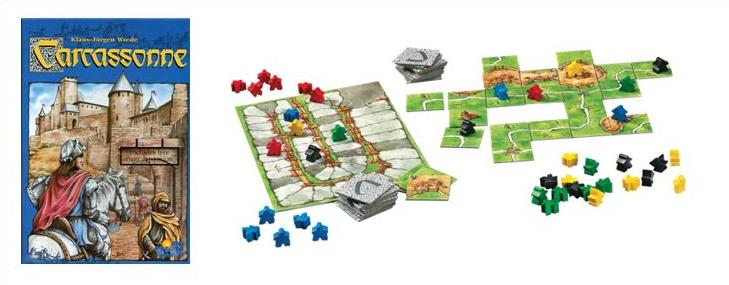 For our second game of the day, we got into the now-classic Carcassonne from 2000. Distributed by Z-Man Games in the United States, Carcassonne is a tile-placement game where players build-out and a kingdom dotted with cities, roads and monasteries. Carcassonne is a quick learn, and the random tile choice at the beginning of each player’s turn creates choices in matching the tile to the multiple potential fits on the table.
In placing a tile, a player also makes a choice in placing a meeple on the board and in doing so, placing a bet on potential points. In placing the first tile of a city, a player may place one of their colored meeple pieces with the hope of closing off the city with additional tile plays which score points on the number of subsequently connected city pieces at a two points apiece. A monastery scores nine points when the eight surrounding tiles are placed, and roads are scored at a tile each once a route is closed between two endpoints. Victory points are tracked on a scorecard next to the growing kingdom of Carcassonne, and each tile played reduces the chances from the finite number of potential tiles in the draw pile. Playing against three experienced players in my first game, I was able to score highest on some chancy bets and lucky tile draws.
International Tabletop Day is 24 hours of celebration of games, chanced strategies played out and opportunities to try something new. At the Brooklyn Game Lab this past weekend I found myself in my element surrounded by passionate gamers questing for victory and fun and more than a few hours of play. Games focus on this one day per year, but for a lot of my fellow gamers, they play out week after week until next turn rolls around on the calendar.


 Brooklyn Wargaming